Resettling in the Rubble

Review:   By the Water

By Perry Tannenbaum

IMG_3340

Compared with Cape Hatteras, Wilmington, or Charleston here in the Carolinas, the borough of Staten Island up in New York City hasn’t historically been known as a punching bag for hurricanes. Until late 2012, when Hurricane Sandy battered three NYC boroughs, Staten Island was hardly in the conversation when compared even with nearby Long Island. Zeroing in on the impact of Sandy on a Staten Island family and community, Sharyn Rothstein’s By the Water not only changes the conversation, it also fiddles with history.

Taking in Ryan Maloney’s storm-ravaged set design at Duke Power Theater, with its waist-high waterline, you would likely expect Rothstein’s drama to be about the folly of resettling near a hurricane-prone shore. Or we might assume we’ll encounter the innocent victims of unscrupulous real estate developers, or come face-to-face with the new New York calculus of climate change. None of the working-class folk in this Three Bone Theatre production, smartly directed by Ron Law, seems capable – or sufficiently woke – to address any of these subjects.IMG_3234
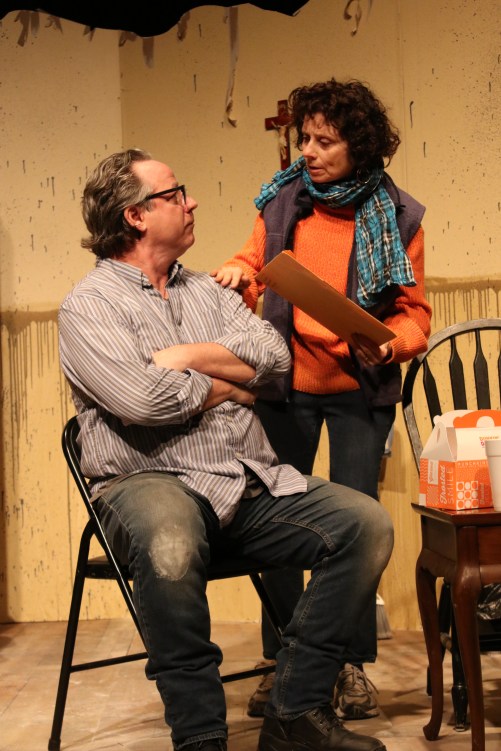
As a result, the topicality of By the Water becomes rather shrouded in a mist of Murphy family grudges and disputes, further distanced from pressing issues that might concern us by the neighboring Carter family’s involvement. The Murphys seem as broken, fallible, and struggling as the Lomans were in Death of a Salesman, and the heads of this devastated household, Marty and Mary, have a fairly similar relationship.

For Marty, it’s axiomatic that he should rebuild and restart. To his eldest son, Sal, it’s obvious that his dad should move to higher, safer ground – and way past time that his mom stop blindly supporting whatever Dad says, especially after all his past misjudgments and misdeeds. Philip and Andrea Carter, the Murphys’ longtime friends and neighbors, have decided that they wish to accept a government buyout and move to Montclair, New Jersey.

But this isn’t a laissez-faire situation, where the Murphys and the Carters are free to do whatever they wish, no harm done. The government’s offer to the Carters and other survivors in the neighborhood will be withdrawn unless 80% of the community decides to sign on. Marty is fervid enough about his cause to go out picketing against the buyout.

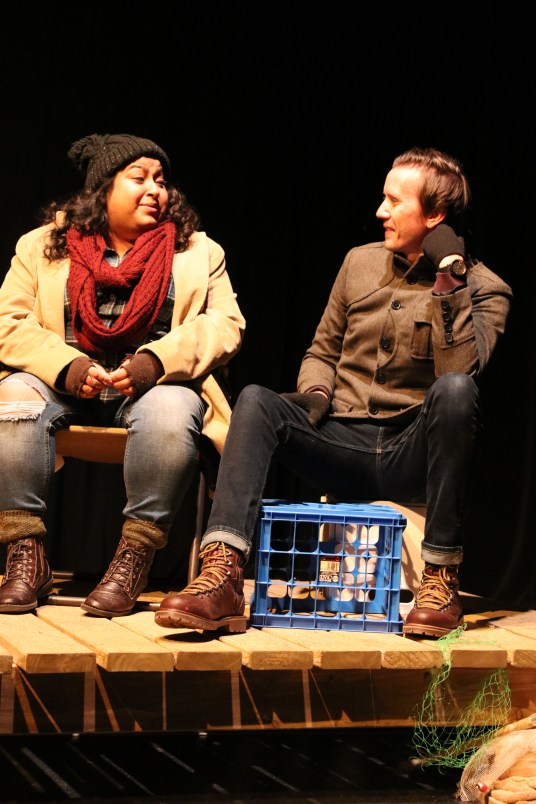
A stretch at a hotel and returning to a home that boasts a few sticks of furniture, a hardy fridge, and the better part of one wall is starting to fray Mary’s unquestioning loyalty to her husband. The younger son, Brian, is returning home after a stretch of own – in prison as a result of his past drug addiction. He sides with his dad, seemingly to keep his favor, but his endorsement is tainted by his rap sheet, and he’s actually more intent on regaining the affections of the Carters’ daughter, Emily. Her parents, of course, know all about him, so they don’t approve.

Could work in Brian’s favor, right? He and Emily are both City kids. Minds of their own.
IMG_3248

A corner of the stage is set aside for the wee wharf where Brian and Emily rendezvous, providing a respite from the family quarreling and the neighborhood politics, which grew a little repetitious during the 91-minute performance on opening night. More substance in the debate would have dispelled the tedium. It might have been worth pondering what government should and shouldn’t subsidize on these fragile wetlands. And a more eloquent Marty might voice the notion that, given the historical infrequency of tropical storms and hurricanes hitting Staten Island, it’s not such a stupid plan to live out the 20-30 remaining years of your life in the house your father built rather than transplanting to Montclair.

While Rothstein does disappoint me on topicality, and in giving us any sense that she’s intensively researched the Tri-State housing market or Marty’s prospects for homeowner’s insurance, there are times when she brings us vividly into the moment. Despite skirting the basic survivalist questions of home life without a roof, the playwright etches her characters with finely judged individuality and gives us a nuanced feel for the Murphys’ family dynamics.

Law and his cast are definitely on Rothstein’s wavelength, and the only major mistake they make is in overestimating the Duke’s acoustics. As the inimitable Tania Kelly demonstrated last year in Three Bone’s Every Brilliant Thing, it’s easy to convince yourself that you’re being heard up in the balcony when people are actually having problems in the second row.

While you might not catch the ends of all of Marty’s sentences, Thom Tonetti delivers all of the outsized personality and bossiness that fosters Mary’s adoration and submission. We are definitely dealing with a force that can sway community sentiment when we encounter Tonetti, and we are not surprised to learn that Marty is capable of taking audacious and catastrophic risks. Physically, Susan Stein projects the frailty that perfectly fits Mary but with a salty New York accent that constantly reminds us of the street savvy and toughness that lurk within. There’s a tenseness and pallor to Stein as well, hinting that Mary has reached the end of her tether.IMG_3301

Law would have been safer casting an older actor to get the right look for Sal, the elder son, but there’s no doubt that Tommy Prudenti captures his straight-arrow essence in his Charlotte debut. Sal is a living white-collar rebuke of his father’s values, yet at key moments, Prudenti convinces us that he still craves Dad’s love. Tim Hager’s portrait of Brian adds another black sheep to his gallery, and if you saw his Franz in Three Bone’s Appropriate last summer, you won’t be surprised that he’s as lovable a reprobate up in the New York City wetlands as he was down on the bayou.

The accent is different, but this bad boy remains a magnet for one unattached lady who may be ready to rekindle an old pre-prison flame. I think you’ll like the sassy flavor that Sonia J. Rosales brings to Emily in her Charlotte debut. She’s certainly more liberated than the two moms we see here.

It’s slightly surprising to see Law pairing Lillie Oden with Joe Copley as the Carters, but they work beautifully together. Opposed to the Murphys’ plans, there’s a clear gender difference in how their oppositions play out. Like Mary, Oden as Andrea is more apt to be conciliatory, and like Marty, Copley as Philip inevitably becomes enraged and bellicose. You get the idea that Rothstein believes that the world would be so much more peaceful and sensible if women were in charge. But where would her drama be without all her guys?

 

Messing Up Asia, American Style

Review: Miss Saigon

By Perry Tannenbaum

06.MISS_SAIGON_TOUR_9_21_18_5953 r photo by Matthew Murphy“Un bel di,” Cio-Cio-San famously warbled at the 1904 premiere of Giacomo Puccini’s Madama Butterfly, yearning for the return of American Lieutenant Pinkerton from across the Pacific to honor their marriage vows and his responsibilities toward their son. Four score and seven years later, the scene shifted from Japan to Vietnam for Claude-Michel Schönberg and Alain Boublil’s Miss Saigon, where Kim sang, “I Still Believe,” yearning for the return of American Staff Sgt. Chris – for exactly the same reasons.

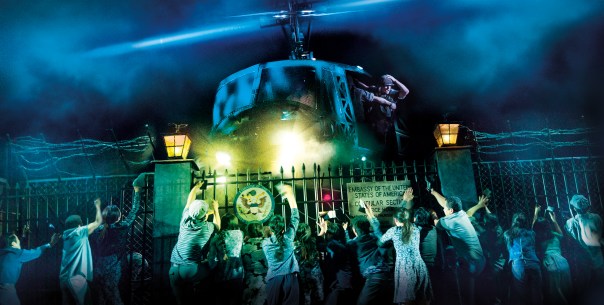
We haven’t seen a touring production of Miss Saigon at Belk Theater in over 15 years. In the meantime, a new production directed by Laurence Connor came to Broadway in the spring of 2017 and folded in less than 10 months. The two key players in the recent remount both had Charlotte connections. Eva Noblezada, who snagged a Tony Award nomination as Kim, won the 2013 Blumey Award at Belk Theater as the best actress in a high school musical. And playing The Engineer, the most electrifying of Boublil’s new characterizations, Jon Jon Briones reprised the role he had played in the low-budget, copter-less production that landed at the Belk in November 2003.

I had to wonder whether the Broadway revival of Miss Saigon had been so short-lived because of the changes Connor had made to the 1991 original or because of changes the show still needed.

08.MISS_SAIGON_TOUR_Thuy's death crop

In the heat of the Vietnam War and the fall of Saigon, both Kim and Chris had noticeably evolved compared with their operatic ancestors. Chris tried to take Kim with him as the Vietcong overran the capital. He sought to locate Kim after he returned safely to Atlanta, and he seemed honestly conflicted between his true love and his wife, Ellen. Kim had also evolved, no longer the shy, passive, pitiful flower Puccini immortalized. There was steel and ferocity in her: she’d murder the Commie who threatened the life of her son.

Yet in some ways, the 1991 Broadway musical was more primitive and insensitive than the 1904 opera.

Schönberg and Boublil were less respectful toward the culture of the Vietnamese than Puccini was toward the culture of Japan in Butterfly or China in Turandot. Except for the costumes and a brief wedding ceremony, there was hardly any indigenous culture in Saigon – and not a whiff of Asian music. Even the piety that Puccini dramatized in his Asian operas has vanished. Bar Girls that we notice in Saigon are scantily clad whores, usually spreading their legs when they aren’t face to face with a GI’s crotch.02.MISS_SAIGON_TOUR_2549


Love as a romantic concept is strictly confined to Kim, and the two Asian men who want her don’t seem to be familiar with the word. Thuy, who returns to Ho Chi Minh City as a conqueror after defecting to the Vietcong, views Kim as his rightful possession – and her son as a repugnant atrocity. Her protector is The Engineer, a slimy pimp who initially installs Kim in his sex stable as a virgin delicacy and subsequently views her and Tam, Chris’s American citizen son, as his passport to the USA.

The most nuanced aspect of Boublil’s book was the opposition he set up between Thuy and The Engineer. Clad in his military uniform, Commissar Thuy was the embodiment of the Communism we were battling to keep at bay. Devoid of warmth, tenderness and humanity, he was a totalitarian gargoyle. The Engineer, on the other hand, was pure venal enterprise, emblematic of the insidious corruption that American capitalism always leaves in its wake.

It was horrifying – and strangely exhilarating – to see how totally The Engineer had absorbed our perverted values in his climactic showstopper, “The American Dream.” Part of the reason that Americans came home feeling that the Vietnamese hadn’t been worth fighting and dying for, after all, stemmed from the unsavory effects of our being there and spreading our influence.

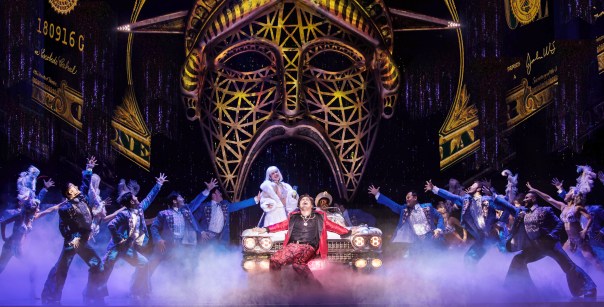
Well, the new Miss Saigon didn’t show me any more empathy toward the Vietnamese than before, nor any more of their indigenous culture. If anything, The Engineer and his Bar Girls seemed raunchier, more mercenary, and more degraded than I had remembered. Downsized to more realistic proportions, Red Concepción’s portrayal of The Engineer is more quietly servile and less flamboyant than Joseph Anthony Foronda’s was in 1997, the first time a prop copter landed at the Belk. So when Concepción suddenly breaks into his “American Dream,” the fantasy isn’t just what The Engineer’s life will be on richer USA soil, it’s also a fantasy about who he will become.

05.MISS SAIGON. Company. Photo Matthew Murphy and Johan Persson (2)

Yes, the copter is back on the Belk stage during the fall of Saigon for the first time in over 21 years, and so is the shiny Cadillac where The Engineer, humping the hood, has an orgasm during his fantasy. The years haven’t been as kind to Kim. We expect more of our female heroes nowadays, so killing a Commie no longer earns Kim an exclamation mark.

Working within the traditional Cio-Cio-San constraints, Emily Bautista is more assertive and less decorous as Kim, getting two duets with the “other woman,” outshining Stacie Bono as Ellen on both occasions. A generic belter, Bono makes Bautista look better than Andreane Neofitou’s bland costumes do. Sprucing up his script, Boublil has added a Trump slogan to The Engineer’s spiel and a Mormon to the rascal’s clientele. Maybe the latter is the inspiration for Adrian Vaux’s design concept, which brings a Third World squalor to Saigon and to Bangkok that reminds me of the Africa where the missionaries of The Book of Mormon were deployed.

Bautista brings the most beauty to Kim when she sings her lovely “The Last Night of the World” duet with Anthony Festa as Chris. Festa gives Chris more texture than I would have thought possible, making me wish that Boublil hadn’t taken Pinkerton’s rehab quite so far. Kim begins as a $50 gift from his best bud John, Chris’s PTSD is all about Kim rather than battle fatigue or horrific warfare. The bravest action Festa gets to perform is filling Ellen in on all he has hidden from her about that last night before he climbed onto the US Marines helicopter – and all the news he has just learned about his son.

Getting the word from J. Daughtry as John certainly doesn’t boost the drama. Another generic belter, Daughtry sings his “Bui-Doi” (“dust of life”) appeal for the stigmatized mixed-race children of Saigon’s streets as if he were a competitor on The Voice rather than a contrite vet in a poignant Broadway show. True, Daughtry came to life nicely later in Act 2, showing what he was capable of dramatically when John, Chris, and Ellen tracked down Kim and The Engineer, now refugees in Bangkok. Before receding into the ensemble (perhaps not as inconspicuously as he should), Jinwoo Jung was a malign force to be reckoned with as Commissar Thuy, especially when Chris wasn’t around in Saigon to protect Kim.

In fairness to the cast, conditions at the Performing Arts Center weren’t ideal for performing – or reviewing – a big-budget Broadway musical. Because of travel and load-in delays, the curtain time was rescheduled from 7:30 pm to 8:00. But the first notes of the overture weren’t played until 8:37, long after we had finally been seated. Intermission lasted over 32 minutes, so when Act 2 started, it was nearly 10:25, past the time when the show would normally end . Maybe that’s why the production fell short of my hopes when the curtain fell an hour later.

Or maybe, just maybe, the clock has struck midnight on a sob story that first opened on Broadway in 1900 as a one-act play by David Belasco. Instead of Belasco, or Puccini’s librettists, or Boublil looking into the heart of a Japanese geisha or a Vietnamese bar girl, maybe it’s time that this story was retold from an Asian viewpoint by an Asian writer.

Charlotte Symphony Concertmaster Spearheads a Devastating “Scheherazade”

Review:  Scheherazade

By Perry Tannenbaum

Among over 100 versions of Rimsky-Korsakov’s Scheherazade that you can find on Spotify, the name of the violinist who plays the title role, in rare instances, will appear on the album cover. Given the enduring popularity of this Arabian Nights suite and the challenges it presents for our narrator, you can probably assume that the part of Scheherazade would be a prime arrow for an aspiring concertmaster to have in his or her quiver. Charlotte Symphony’s ace violinist, Calin Ovidiu Lupanu, proved once again that he had it. Unlike his previous triumph at Belk Theater as the spellbinding Arabian in 2009, Lupanu didn’t upstage conductor Christopher Warren-Green, who was then auditioning for the music directorship he now holds. No, this triumph could be credited to the entire orchestra, a redemption that was lifted even higher with a sense of renewal as Symphony’s new principal clarinetist Taylor Marino and their new principal bassoonist Olivia Oh made auspicious Belk Theater debuts. The program was also more propitiously supplemented, with the prelude to Englebert Humperdinck’s Hansel and Gretel launching the evening and Richard Strauss’s youthful Don Juan bringing us to intermission.

If you were expecting that lineup to be altogether spirited, lyrical, and upbeat, Humperdinck’s “Prelude” would have been a surprise. After Warren-Green dedicated the evening to the late Wolfgang Roth, Symphony’s former principal second violin, the soft and soothing choir of French horns set an appropriate tone and the sheen of the violins added soulfulness to the dedication. In the uptempo section that followed, Warren-Green banished all Wagnerian influences, so the piece became summery and bucolic. When the music crested and became rather grand for a children’s fairytale, the mood we arrived at was jubilation rather than conquest.

Maybe the Warren-Green dedication, assuring us that Herr Roth was listening, was the reason that everybody in the orchestra brought their A-game. Not only did Symphony eclipse their previous Scheherazade of 2009, they bettered their Don Juan performance of 2005 under the able baton Christof Perick. Lupanu gave us foretastes of things to come, sparkling in his early exchange with the glockenspiel and getting in on more of the storytelling late in Strauss’s tone poem with principal harpist Andrea Mumm Trammell, another harbinger of sweets to come. But it was the horn section and principal Frank Portone who atoned most mightily for the blemishes of yesteryear, announcing the Don’s heroic theme and keying a thrilling climax before the timpani and brass piled on. Warren-Green not only measured up to Perick’s Strauss expertise, he provided a useful explication, in his introductory remarks, of the full stop at the climax of the piece and drew our attention to the beautiful love song that principal oboist Hollis Ulaky would play. She did not disappoint.

All across Scheherazade, Lupanu and Trammell renewed their gorgeous partnership, stitching the narrative together, but it was Lupanu who reveled in the most virtuosic opportunities. In the opening “Sea and Sinbad” movement, Lupanu played so softly that Trammell’s harp actually sounded louder at times. He was commanding in one of the passages I most look forward to, the speed-up that cues the full orchestra’s build to the full epic, oceanic majesty of Rimsky’s symphony. Oh emerged impressively at the forefront for the bassoon’s graceful statement of the “Kalendar Prince” theme, and Marino was scintillating in the lyrical “Young Prince and the Young Prince” movement, first in the magical run after the gorgeous theme and later in the accelerated waltz section, dancing with the two flutes. Yet Lupanu reasserted his dominion with a narration that included some ricochet bowing before the orchestral repeat of the waltz and a delicate fadeout.

Lupanu’s double-bowed intro to the eventful finale – “Carnival,” “Sea,” shipwreck, “Bronze Warrior” – moodily contrasted with the busy tumult to come, beautifully dispelled by flutists Amy Orsinger Whitehead and principal Victor Wang as we arrived at the boisterousness of Baghdad. It had seemed that Warren-Green and Symphony couldn’t surpass the power and majesty of the opening movement, but they had not peaked too soon. There was a phantasmagorical speed and madness to the festival that broke dramatically into the “Sea” section with muscular brass and towering grandeur. Not an easy episode to follow, but Lupanu saved his most devastating eloquence for his final cadenza, sustaining a cluster of long high harmonics over the harp.

Bound and Gagged in a Georgia Cabin

Review: Exit, Pursued by a Bear

By Perry Tannenbaum

IMG_9649

It’s been 28 years since I saw a murderous woman binding a man to a chair onstage, and I haven’t forgotten the spectacle of that near rape-victim turning the tables – and a spool of duct tape – on her would-be rapist. Maybe there were other instances after that stunning UNC Charlotte production of Extremities in 1991, one of the top five dramas I critiqued that year. If so, those action she-roes haven’t seared themselves in my memory the way that William Mastrosimone’s did.

A trail of empty honey bottles greeted us outside the Warehouse Performing Arts Center storefront in Cornelius as we entered upon a similar scene in Exit, Pursued by a Bear, the new Charlotte’s Off-Broadway production directed by Anne Lambert. Once again, three people are deliberating what to do with the captive – Kyle Carter, who has abused his wife Nan for the umpteenth time. Lauren Gunderson’s 2012 play, subtitled “A Southern-Fried Revenge Comedy,” isn’t quite as intent on ratcheting up the tension.

Like Gunderson’s title, derived from Shakespeare, it’s complicated. Often cited as the Bard’s most outré – or hilarious – or expensive – stage direction, “Exit, pursued by a bear” occurs in Act 3, Scene 3, of The Winter’s Tale. The fleeing nobleman is the otherwise forgettable Antigonus, whose mauling is vividly reported a moment later by the curiously named Clown, a shepherd’s son, while the bear is still devouring its kill offstage.

IMG_9912

Nan isn’t intending to give her husband even that sporting chance at survival. She plans to abandon her secluded cabin in the Georgia woods and leave the doors open for any bear in the vicinity to enter. To hurry the process, Nan and her friends Simon and Sweetheart are adding inducements to make Kyle more aromatic and inviting. Some honey, of course, but here’s some luck: Kyle just killed a deer, so they can cut up some fresh meat and strew that around, too. Cool condiments!

Since Conrad Harvey as Kyle is already bound and gagged as we walk by with our tickets and drinks – hey, go ahead and take selfies with Conrad if you like – Gunderson is taking on two conflicting objectives when the lights come up. She’s painstakingly justifying what Nan is doing to her husband, and she’s striving to preserve the murderous unraveling of the Carters’ marriage in a comedy mold. Nan’s accomplices come in handy for both of these objectives.

Sweetheart is a stripper at a local bar who aspires to be an actress – or at least a movie star – and Kyle is Nan’s lifelong best friend. Since he is a bit of a queen in his Georgia Bulldogs cheerleading outfit, the stripper-transvestite combo is inherently comical as soon as it forms, if you’re not going to be offended by stereotyped affronts to political correctness and feminism. Part of the action, you must remember, is Nan overcoming her submissiveness and moving towards feminism. It’s a liberating leap.

IMG_9965

With Kyle as her literally captive audience, Nan will express the anger, frustration, and humiliation she has kept bottled up inside by playing out the key scenes that have pushed her to this drastic homicidal response. Since Kyle is indisposed – and hasn’t learned his lines – Julia Benfield as Sweetheart will step into the role of Nan’s husband in these flashbacks. Lambert has made a cagey casting choice here. Benfield is not only dwarfed by Harvey, you’ll see that Julie Janorschke Gawle towers over her as well. More built-in comedy.

Benfield is trashy in her cinched flannel shirt impersonating Kyle, and a fair amount of that trashiness appears to come naturally, but the more we get to know her, the more clearly we see that she isn’t a slut or a bimbo. With all the two-handed scenes in the flashbacks, you might worry that Simon is simply superfluous. But he’s more than a cheerleader. When Nan wavers, Simon is there to help shore up her resolve.

Not always the subtlest of performers, Ryan Stamey calibrates and balances his bloodthirsty zeal, his genuine affection for Nan, and his flaming outrageousness in such a precise way that he emerges as genuinely human rather than as a cartoon provocateur. With this kind of quirky support, Gawle can explore the serious depths that Gunderson explores in the Carters’ abusive marriage. Nan’s waverings are based in a pathological dependency that develops between an abused spouse and her abuser, ground into the rubble of crushed self-esteem.

IMG_9812

Gunderson also wants us to be ambivalent about the payback Nan is meting out, no matter how many Hollywood revenge flicks we’ve seen. As if he were on trial rather than passively listening to his sentence, Kyle gets his chances to speak and defend himself. More than that, he gets Nan to allow him a temporary reprieve from his bondage, so that he can re-enact the good times they had together before things went sour.

Harvey doesn’t mitigate the fact that Kyle is a boorish hayseed, but he also doesn’t hold back on the sincerity of “getting it” and his intent to be a better man. We’re apt to be a little torn, as Nan is, on the option of giving Kyle a second chance. Gawle is visibly affected by Harvey’s pleas, his evocations of past Kyles, and perhaps his newfound respect for the doormat who has risen up against him. So with the prospect of Kyle suddenly reverting to violence, there’s not only dramatic tension in the air but also multiple layers of give-and-take between Nan and Kyle, Nan and Simon, between the men and inside Nan’s heart.

Feminists will appreciate how this deadlock is broken.

IMG_0106

Gawle does everything right interacting with the other performers. She even gives herself moments when she ponders the enormity of what she’s planning – and to question whether she’s sufficiently calm to proceed after the suddenness and the adrenaline rush of what she has done and how it has changed her. One thing you might question is whether Gawle is as Southern or as trashy as Gunderson imagined her. Hang in there until Nan’s final scene, and you’ll likely see the rationale for the choice Gawle and Lambert have made in crafting her character.

Along with the cast’s work onstage, costume design by Ramsey Lyric, lighting by Sean Kimbro, and Jarvis Garvin’s fight choreography are all indicative of Charlotte Broadway’s professionalism. The only dodgy aspect of this production are the projections flashed on the upstage wall delivering stage directions when we reach Gunderson’s play-within-a-play segments. The lettering doesn’t exactly pop, and efforts to read them can draw attention away from the action. Maybe freezing the action might help solve the problem. Worth a try.

Otherwise, Exit, Pursued by a Bear is all-pro all the way. Consider yourself lucky if you can pursue and snag a ticket.

Two Iconic Singer-Songwriters Collide

Reviews: Nina Simone: Four Women and Ain’t Misbehavin’

By Perry Tannenbaum

With three new theater productions opening last week from Actor’s Theatre, Brand New Sheriff, and Theatre Charlotte – all sporting all-black casts – we have entered a Black History Month in Charlotte that is more about black history than ever before. Some of the African Americans who might be expected to show up for those auditions will be shining in the spotlight somewhere else this weekend as Children’s Theatre of Charlotte opens Bob Marley’s Three Little Birds at ImaginOn.

Unless you count university productions, we haven’t had more than one truly black theater production here in Charlotte during any Black History Month in the past 10 years.

So our Black History Month upgrade – and the stunning amount of local black talent necessary to make it happen – was definitely on my mind as I took in all of these shows. But a couple of times, in Actor’s Theatre’s tribute to Nina Simone and Theatre Charlotte’s Fat Waller revue, I found myself flashing back to January 2003.

That’s when a bi-racial Charlotte Rep production of Let Me Sing featured two black Broadway veterans, Gretha Boston and André de Shields, who boasted five Tony Award nominations and two wins between them.

Nina Simone: Four Women from Actor’s Theatre threw a new perspective on what are usually regarded as Rep’s declining years. The title role, calling for a passionate Black Power advocate and a charismatic singer-songwriter, would obviously benefit from the Broadway star power that Michael Bush, with his Manhattan Theatre Club connections, was able to lure down to our Booth Playhouse during Rep’s latter days.

De Shields was actually one of the original stars of Ain’t Misbehavin’ when it opened at Manhattan Theatre Club and took the Tony for Best Musical in 1978. So my thoughts naturally returned to De Shields, Rep, and Let Me Sing when Theatre Charlotte opened the Fats Waller musical revue two days after Actor’s opened their Simone musical. On this night at least, I had the satisfaction of recalling the Broadway star and feeling that our fair Queen City was getting along just fine without him.

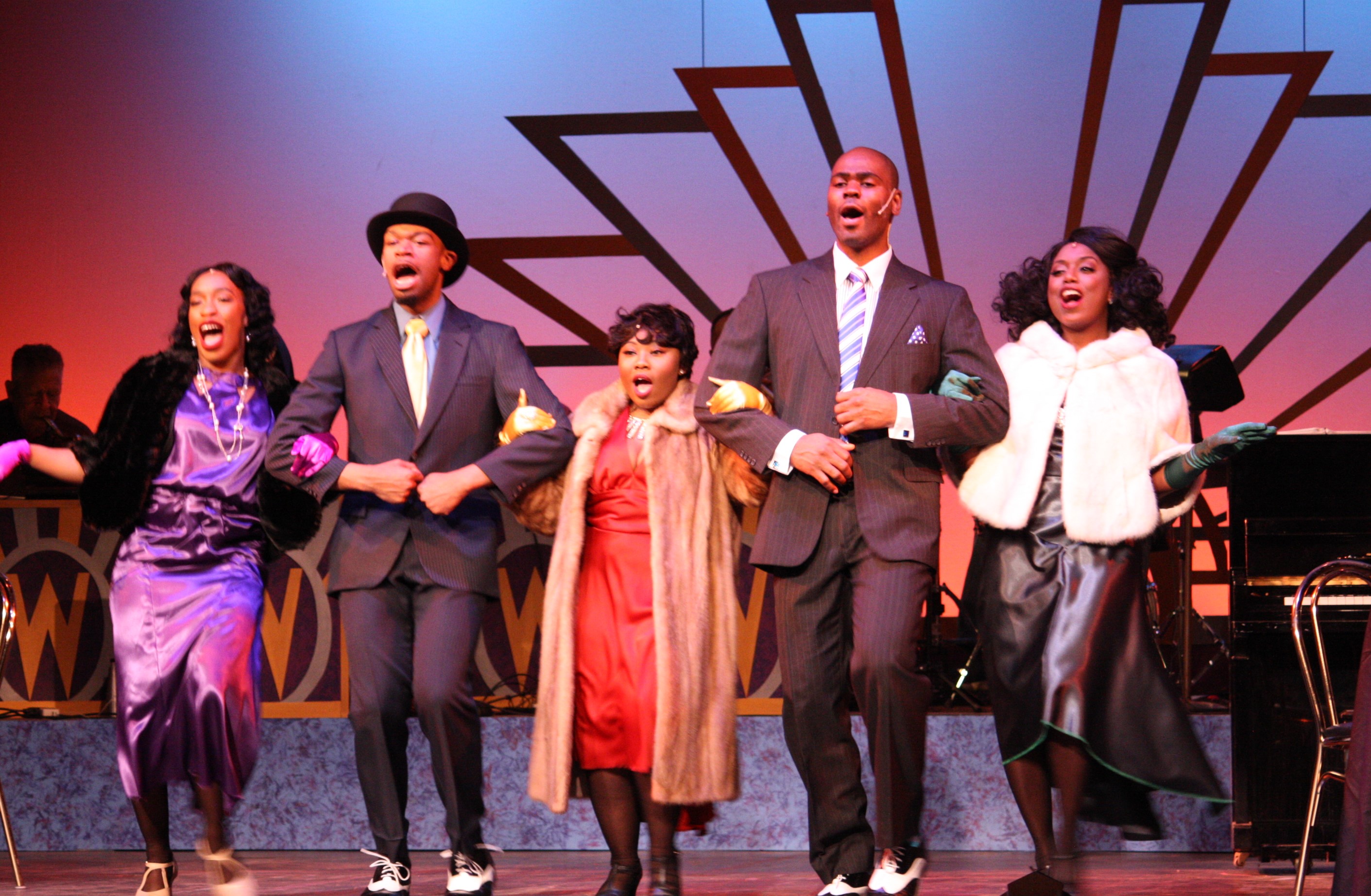
A lot of the credit goes to Charlotte’s own Tony winner, educator extraordinaire Corey Mitchell, who directs this sassy 94-minute show at the Queens Road barn. The cast he culled from auditions is consistently spectacular, whether they’re singing or dancing, but we also need to slice off some accolades to the seven-piece jazz band led by trombonist Tyrone Jefferson, featuring Neal Davenport at the piano. Kudos to choreographer Ashlyn Sumner: with some formidable talents to work with, she has stretched them.

Conceived by Murray Horwitz and Richard Maltby, Jr., Misbehavin’ goes about capturing Waller’s essence by culling the gems from his imposing oeuvre and preserving the pianist’s penchant for interpolating sly comments and wisecracks between his lyrics. Comical gems like “The Viper’s Drag,” “Find Out What They Like (and How They Like It),” and “Your Feet’s Too Big,” all score big. Adapting and orchestrating, Luther Handerson and Jeffrey Gutcheon usually go with the grain of Waller’s merry, mischievous recordings, but occasionally they go against it, slowing down “Honeysuckle Rose” and “Mean to Me” so they sound brand new.

Yet Waller also composed one solemn anthem that belongs in the same elite pantheon as Simone’s “Four Women” and Billie Holiday’s “Strange Fruit.” The introductory chords from the piano were all I needed to tell me that “Black and Blue” was on its way with lyricist Andy Razaf’s indelible refrain: What did I do to be so black and blue?

After delivering more than an hour of pure ebullient joy, it was a powerful question to ask. Lighting designer Chris Timmons dimmed his gels over Tim Parati’s funky nightclub set, Jefferson hushed the band, and Mitchell huddled his entire cast downstage where all five could look us coldly in the eye.

Never afflicted with obliquity. Waller and Razaf answered their own question: My only sin is in my skin.

Keston Steele has the most amazing voice in this cast, and it’s not just her range and volume. Steele may look small, but as “I’ve Got a Feeling I’m Falling” proves, this lady can g-g-growl! Best dancer is more of a toss-up. Look no further than Nonye Obichere kicking “How Ya Baby” if you’re looking for somebody startling and athletic. Tyler Smith is your man if your quest is for someone smooth and sensual.

Smith was the comedy showstopper – and the chief reason why De Shields can stay right where he is – delighting us with his stealth and style in “The Viper’s Drag,” but Marvin King was just as hilarious in the outright insulting “Your Feet’s Too Big.” Danielle Burke’s breakout moments were her mellow “Squeeze Me” solo and her bawdy “Find Out What They Like” duet with Steele.

The songlist is loaded with Fats faves that will get your toes tapping, including “Handful of Keys,” “The Joint Is Jumpin’,” “Fat and Greasy,” and “Keepin’ Out of Mischief Now.” Or you might get into the sway of “Jitterbug Waltz” and “Lounging at the Waldorf.” All in all, another insane overachievement for Charlotte’s community theater. Pass the reefer and the champagne!

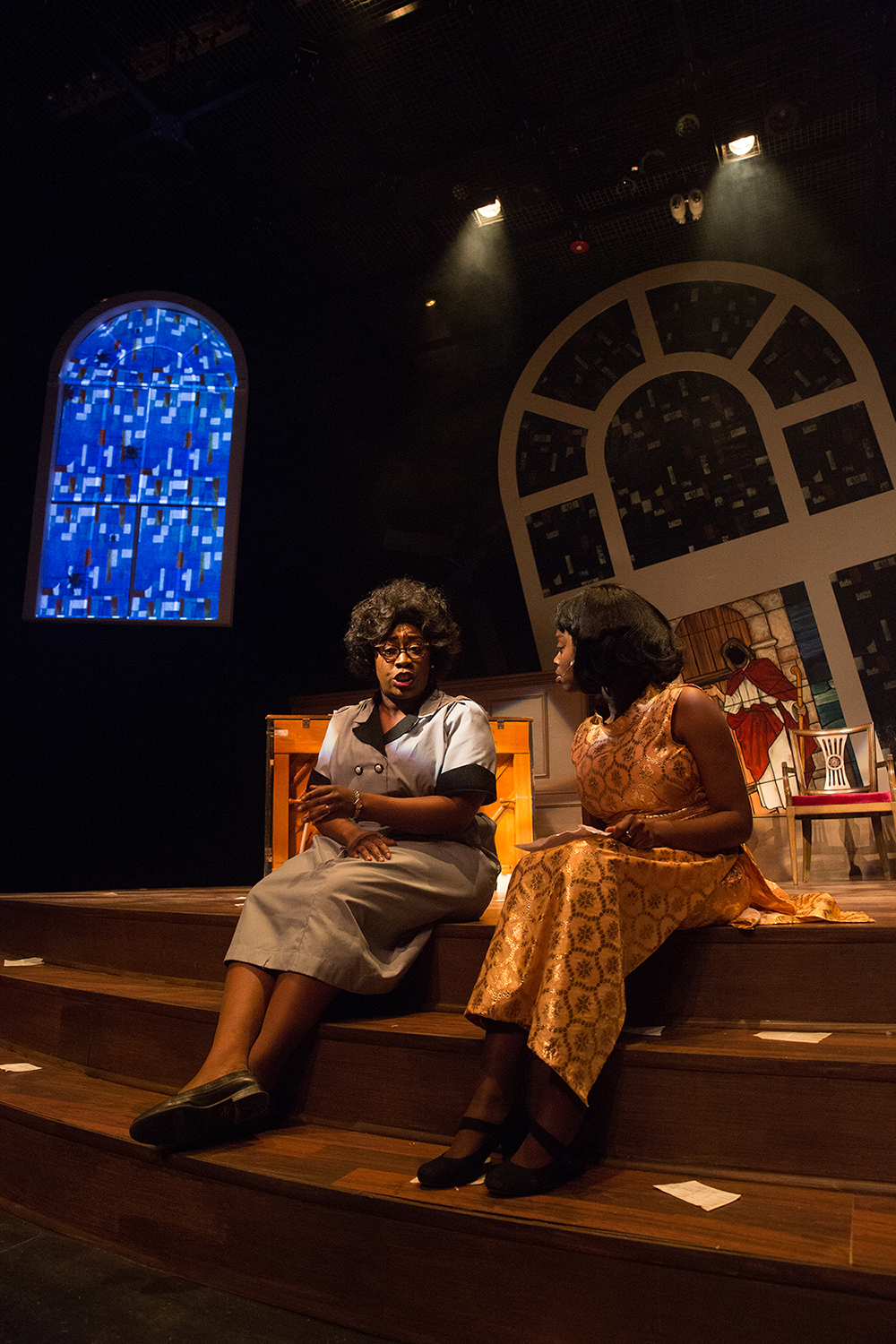
Production values at Hadley Theater looked like they would be up to the usual high Actor’s Theatre of Charlotte standard when we took our seats on opening night of Nina Simone: Four Women. Chip Decker’s set design for the 16th Street Baptist Church in Birmingham, Alabama, is colorful and impressive. And shifty: when Decker detonates his sound design, simulating the bomb blast that killed four black girls on September 15, 1963, the walls twist acutely to register the racist atrocity.

But after Lizzie and American Idiot, two arrestingly loud shows at ATC’s new Queens University home, this Christina Ham drama was often too soft-spoken to be clearly heard – even though I spotted the actors wearing head mics late in the 86-minute performance. That was a major element that can improve as the run continues.

Shortcomings in Ham’s script and Chanel Blanchett’s stage direction are not so easily remedied. I’m sure the playwright didn’t intend to be insulting, but her scenario basically tells us that Simone went down to the 16th Street church, stationed herself defiantly behind the sanctuary keyboard with the intention of completing her livid protest song, “Mississippi Goddam.” While completing her response to the murder of Medgar Evers three months earlier in Mississippi, three of the women who would be immortalized in “Four Women” walked in off the street to take refuge from the violence still raging out on the streets of Birmingham.

Fate basically hands the songwriter one of her most revered compositions, if you take Ham literally.

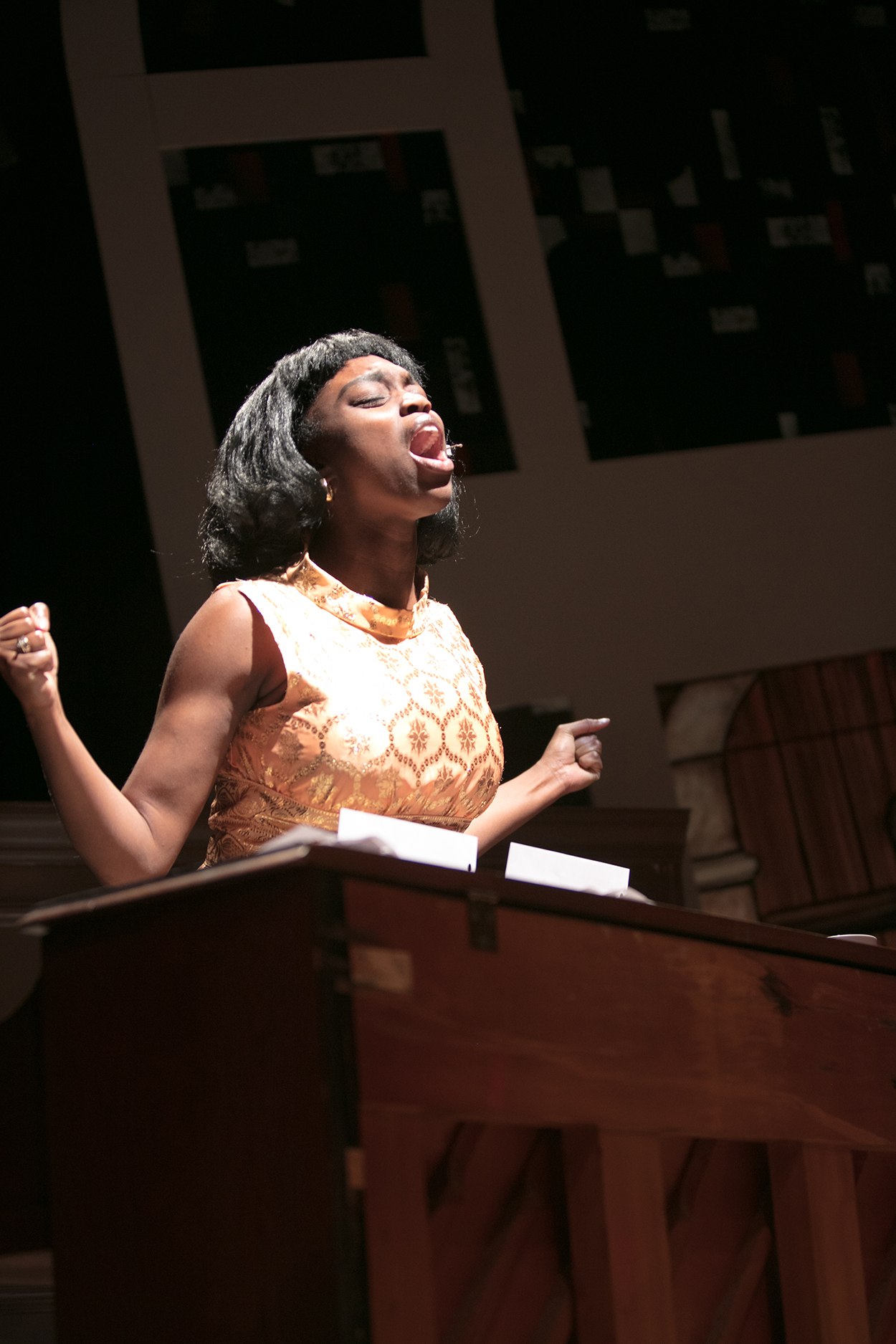
I’m not sure that Blanchett wants us to take the story that way. Played with stormy intensity by Destiny Stone, Simone is already hostile and militant when she arrives in Birmingham. Nina’s urgent need to get her song finished only begins to catalog the reasons why she antagonizes each of the three women who walk in on her. Sarah is a humdrum housemaid who would rather pursue MLK non-violence than take Malcolm X action. Sephronia is a yellow-skinned socialite who doesn’t struggle at all financially like Sarah, drawing class hatred from the housekeeper for her money and scorn from Simone for her political aloofness.

Further stirring the pot is Sweet Thing, seething because she can’t have Sephronia’s fiancé though she can have his baby. This liquor-swigging streetwalker draws hatred and scorn from all quarters, for how she lives and for entering a holy place. Beware, though, she’s brandishing a knife.

Although the arguments are passionate, Blanchett blunts their sharpness, preferring to space her players rather than getting them in each other’s faces – until Arlethia Friday arrives as Sweet Thing. Stone, Erica Ja-Ki Truesdale as Sarah and Krystal Gardner as Sephronia often face us instead of the person they’re arguing with. Maybe Blanchett doesn’t really believe that Simone and the “intruders” are really there at the Baptist Church. Having these actors appear like they’re reliving the first play they ever performed in grade-school doesn’t solve the problem.

After all the verbal and physical combat, the title song breaks out. It’s surreal: all three women miraculously know their lyric and their order in the song. I’m guessing this dramatic flouting of logic will help distract us from the fundamental flip she burdens Stone with in portraying Simone. For 80 minutes, she has heaped hatred, anger, and scorn upon these women who are interfering with her creative process. Now she’s deeply empathetic toward them all, turning them into emblems of scarred, heroic black womanhood.

With 11 other songs along the way, there are sudden lurches as we move forward, cutting abruptly from argument to song. Stone’s singing, with pianist Judith Porter leading a driving quartet, is the show’s most human element as she channels Simone’s fire into “Sinnerman,” “Mississippi Goddam,” and the last of the “Four Women.” Stripped of the backup singers that sugarcoat Simone’s recordings of “Young, Gifted, and Black,” I liked the crispness of Stone’s even better.

Intensity was never Stone’s problem. What I was looking for was more arrogant self-assurance lifting her rage to a higher plane – a serene majesty that earns you the title of High Priestess of Soul. A few more leading roles, not to mention turning 30, will likely do the trick someday. Probably because she comes in toting a flask and a knife, getting the liberty to stagger around the stage rather than finding a mark and facing front, Friday’s Sweet Thing is the best acting we see. She isn’t Simone’s Sweet Thing until she sings her, but she’s closer to what Nina had in mind than Ham’s housemaid. Darting between the worlds of rock, jazz, blues, folk, and soul, Simone has eluded many who would find excitement and enjoyment in her music. Ham’s writing marshals key facts in this North Carolina native’s life into the dialogue but never really captures her soul. The songs in Four Women and Stone’s singing could be a gateway to that treasure trove.

BNS Productions’ “Two Trains Running” Runs at Full Steam With a Deep Cast

Review: Two Trains Running

By Perry Tannenbaum

DSC05592

Like all of the other plays I’ve seen in August Wilson’s epic Pittsburgh Cycle ­ and I’ve now seen nine of the 10 – Two Trains Running is about community struggle and personal redemption. Each of the dramas digs into one of decades of the 20th century, and after Brand New Sheriff began its Wilson explorations with Jitney and the 1950s, their sophomore effort at Spirit Square takes us into the turbulent 1960s.

With so much memorable social and civil rights upheaval in that decade, not to mention the horrifying Birmingham church bombing and the assassinations of Medgar Evers and MLK, it’s no surprise that community struggles are more at the forefront of this Wilson work than the others. As it was in the ‘50s, when we looked on the city through Jitney, Pittsburgh is continuing its predatory campaign to demolish the predominantly black Hill District in the name of urban renewal. After Becker’s gypsy cab depot in Jitney, the city is moving in on Memphis Lee’s Restaurant.

DSC05659

Another young man is returning from incarceration and trying start a new life – but not quietly this time. Sterling is handing out leaflets for an upcoming Black Power rally and befriending Hambone, a mentally handicapped person who was cheated years ago by the white grocer across the street. At the same time, Sterling is seeking out a job or at least a lead from everyone else he speaks to at the restaurant. Standing up for other black people cheated by a white system – and for himself – Sterling is clearly a powder keg that will soon go off.

Memphis estimates that he’ll be back in prison in three weeks. As the days pass and he sees more of Sterling, who grabs whatever he can, Memphis will revise that estimate downwards.

DSC05797

Sterling teaches Hambone a Black Power slogan, but Memphis isn’t so easily swayed. It’s the central issue for black people of that time, especially here in 1969 after the MLK murder. Do they wait patiently and peacefully for what is rightfully theirs, marching and petitioning to make their wishes known – or do they resort to the same kind of violence that kept their people down? Memphis insists on doing things the right way, holding out for a fair price from the city for his property, firing the craven lawyer who advises him to cave.

Looking at Memphis’s regular customers, you’ll find additional evidence that MLK’s ideas didn’t die with him. Nobody intends to join the rally. A more popular road to self-fulfillment is winning the daily numbers game at odds of 600-1, and it’s Wolf who haunts the place, taking all bets, often through unauthorized use of the restaurant’s phone. The sagely and cynical Holloway will play a number as readily as Memphis or Sterling, but to change your life, Holloway recommends a visit to Aunt Ester, the 322-year-old soothsayer who lurks behind a faithfully guarded red door in an alley down the block.

Risa, the troubled waitress who has scarred herself, disparages the men who throw their money away on the numbers. To her mind, they’d get a better return from their quarters if they just dropped them in the jukebox. Until recently, she’s been a follower of the Prophet Samuel, but currently her rock and redeemer is lying in state across the street at West’s Funeral Home. She has no desire to see the man in a casket, but Sterling goes through the long lines waiting to see the Prophet and snatches flowers from the site and presents them to Risa, whose head he’s trying to turn.

DSC05549

It’s another illustrative instance of Sterling flouting decorum and convention. Why should her qualms get in the way of enjoying a few beautiful flowers that would die and be trashed in the next couple of days if she weren’t caring for them? West certainly doesn’t notice or mind, Sterling maintains. It’s true. When West comes by every day, he’s looking for Risa to serve him another cup of coffee and Memphis to accept his latest lowball offer for the restaurant.

The parallel rituals are significant, two of the sparkplugs that keep Wilson’s drama humming. The grocer fends off Hambone’s daily demand for the ham that was promised to him, and Memphis refuses to allow West to steal his property away for a bargain price.

BNS and director Corlis Hayes, in their second Wilson outing at Duke Energy Theater, are getting really good at this. Although smaller than the design the playwright describes, James Duke’s set captures the spirit of the time beautifully, perfectly calibrating the restaurant’s waning appeal so that we see it as a warm, welcoming place. Or at least we can imagine it that way, for Tim Bradley as Memphis is not at all the deferential restauranteur, arguing with customers, barking at Wolf for running numbers on his phone, bragging about duping West, bossing Risa unnecessarily, and expressing general disdain for his lazy people.

That’s all very much on the page, so Bradley finds ways to keep us empathizing with Memphis. Hayes and LeShea Stukes have far more latitude with Risa as we watch the waitress going about her job and reacting to various advances. Stukes plays her as sullen and cynical, allowing Risa’s resentment of her boss’s scolding tone to occasionally surface. Seeing her smile late in Act 2 is like seeing the sun come out after fives days of stormy weather. By the time that happens, we may suspect that the jukebox being out of order is troubling Risa as much as Prophet Samuel’s death and her boss’s bossiness.

DSC05563

Devin Clark struts around as Wolf like an arrogant sleazeball, but there are more depths, contours, and vulnerabilities to him than the iconic Sportin’ Life as he talks about himself and strikes out with Risa. Ramsey Lyric’s costume designs certainly help Clark strut his stuff, but they also help us to chart Jonavan Adams’s progress in his portrayal of Sterling, fresh out of prison. Hayes and Adams have worked together before on Wilson’s plays, so they both know the strength, the brashness, and the seething frustrations of these strapping young men. Trust me, Adams’ work as Sterling is even more powerful and nuanced than his 2017 outing as Levee in Ma Rainey’s Black Bottom.

BNS continues to have admirable depth in their Wilson lineups. You can understand why Jermaine A. Gamble would gravitate to a role as salty as Holloway, whose sharp observations are mixed with a strong belief in the supernatural, expressed in an unwavering advocacy of Aunt Ester’s powers. Gamble makes Holloway a reasonable man, good reason for having this kind of restaurant around. He’s the neighborhood. But the disruptive Hambone, restricted to little more than one repeated line, wouldn’t jump out at you as a plum role to audition for. Dominic Weaver makes it one in a performance of astonishing intensity and authenticity.

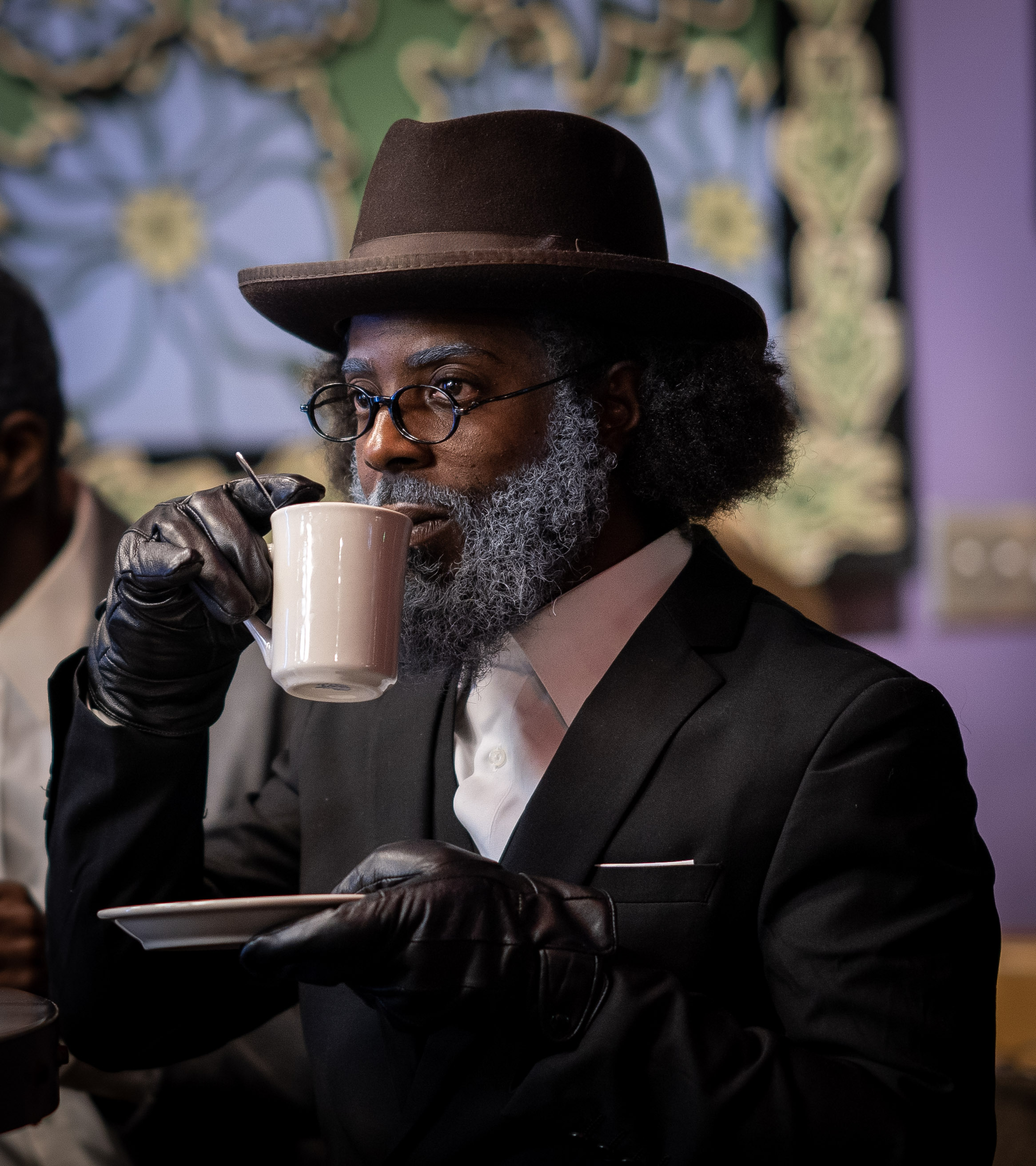
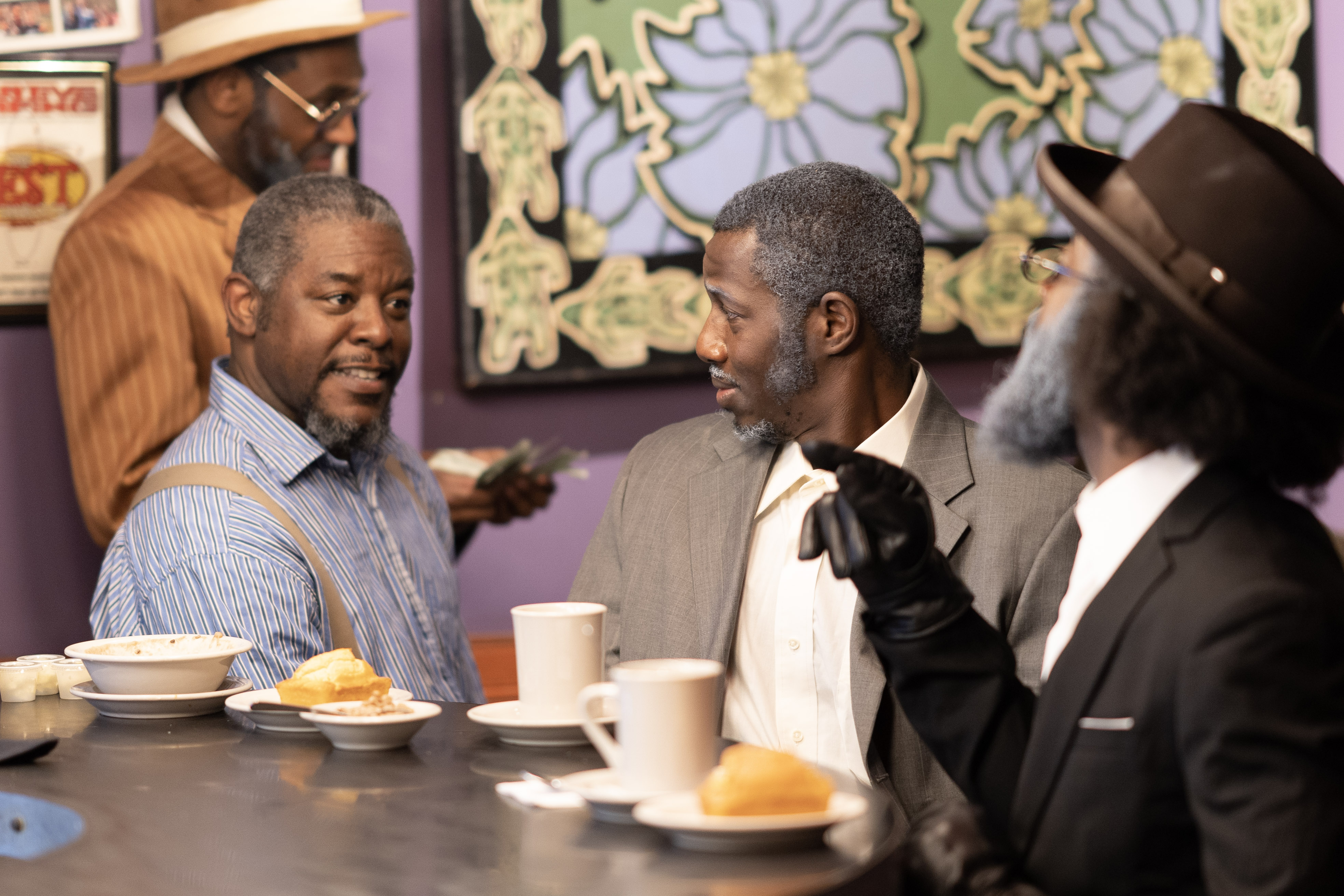
It was probably a group effort to make Weaver look so frightfully grubby as Hambone, but Lyric and Hayes draw my kudos for the sensation West makes each time he enters. Wilson prescribes that the undertaker is always dressed in an all-black outfit, including black gloves that he wears indoors, but designers only add a black hat in about half the productions I’ve tracked on YouTube – and none of them are as imposing as the formal chapeau Lyric chooses for Sultan Omar El-Amin. Hayes layers onto this formality, decreeing that El-Amin must meticulously spread a napkin across his lap at each sitting.

With such outré ammo, El-Amin steals each of his scenes without raising his voice to a level that might lead you to seriously suspect that he doubts his own power. By the manner he holds his cup and saucer, you’d think he was at high tea! From a man who has specialized in portrayals of angry, resentful, and mixed-up young men, El-Amin’s confidently restrained performance as an established 60-year-old widower is a stunner.

Two Trains Running at Spirit Square is a good place to climb aboard the complete Pittsburgh Cycle that BNS is planning to present in coming seasons. You won’t miss a thing because BNS is planning to reprise its previous production of Jitney in May. Then they plan to present Radio Golf, the final drama in the Cycle – and Wilson’s last completed play – next season. Two Trains is not the last stop, but you’ll need to catch it this week before it closes.


Bach Akademie Charlotte’s Epiphany Concert Includes Schütz and Amon Appetizers in a Cantata Feast

Review: Bach Akademie Charlotte’s Epiphany Concert

By Perry Tannenbaum

2019~Epiphany Cantatas_0014

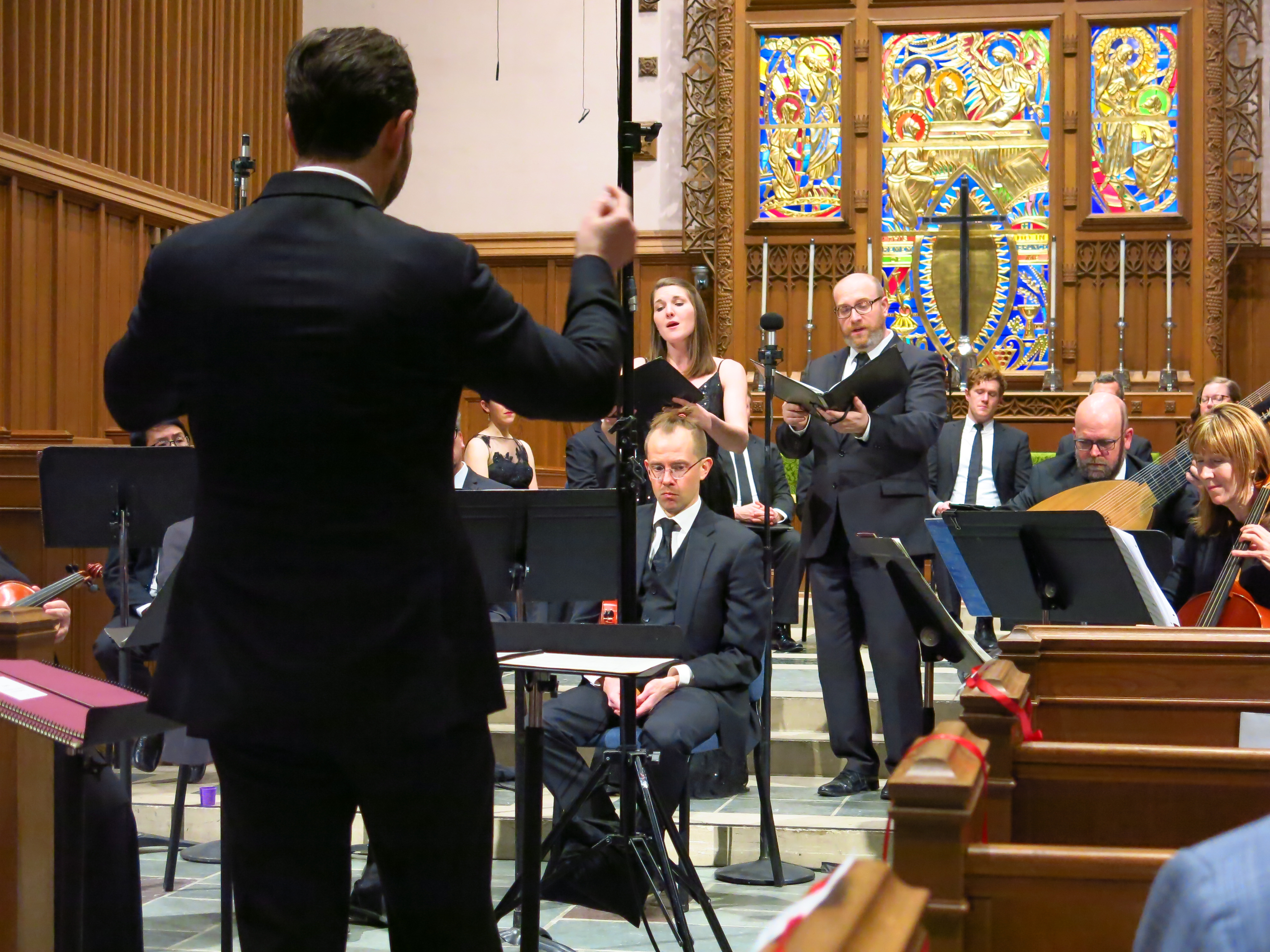
Word has spread quickly about Bach Akademie Charlotte, their professional choir, and their polyphonic excellence. After their biggest splash last spring, the first annual Charlotte Bach Festival with its Oregon Bach aspirations, Akademie reconnected with their audience in the fall with “Priceless Treasure: Bach and the Motet Tradition” at Christ Church Charlotte. They rekindled the flame in a midwinter program, “Epiphany Cantatas,” last Saturday night at Myers Park Presbyterian Church in front of a robust turnout. It wasn’t all Bach or all cantatas, with motets by Heinrich Schütz (1585-1672) and Blasius Amon (ca. 1560-1590) sprinkled in between, and while it’s always so apt to hear Bach’s sacred cantatas in a church, these were sung and played nearly four Sundays after this year’s Feast of Epiphany.

Programmed and conducted by artistic director Scott Allen Jarrett, rest assured that the concert was aptly themed on the Epiphany celebration. While the BA Cantata Choir was reduced in size to 12, about half the maximum number that performed the B Minor Mass last June, there was nothing off-season about its membership, including choristers and soloists who flew in from as far north as New York and as far west as California. The 18-member North Carolina Baroque Orchestra also sported ace guests who had traveled from afar.

2019~Epiphany Cantatas_0002

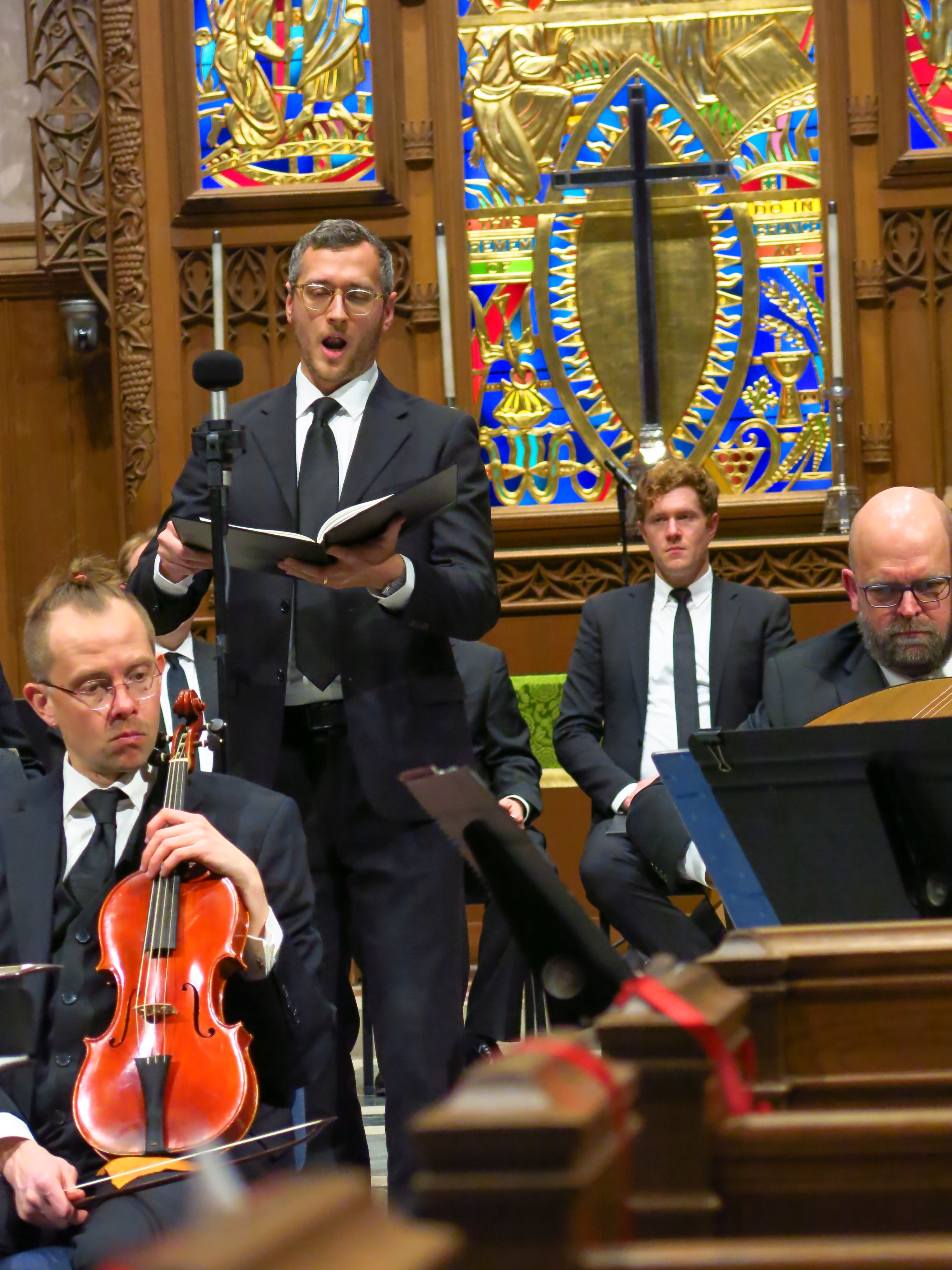
The opening piece of the evening, “Fallt mit Danken, Fallt mit Leben” (“prostrate yourselves with thanks and praise”), was easily the most extended work of the evening – but not exactly a cantata. Actually, it was the fourth part of Bach’s Christmas Oratorio and, celebrating the circumcision of Jesus, performed on New Year’s Day. Do the math, recall the Jewish custom, and you’ll know why. There’s a pretty little orchestral prelude before the chorus enters that gave hornists Chris Caudill and Rachel Niketopoulus a chance to shine, and once the Cantata Choir broke in, there were appealing spaces provided for oboists Geoffrey Burgess and Sung Lee. Burgess surpassed himself later on with his charming obbligato in the “Flösst, mein Feiland, Flösst dein Namen” (“does your name, my savior, instill”) aria where Molly Quinn floated her echoes, soprano to soprano, from upstage to Arwen Myers’s lead vocal up front.

As the Evangelist, tenor Bryon Grohman underscored the deeper significance of the circumcision, reminding us in “Und da Acht Tage” recitative that Jesus was given his name during that eighth-day ritual. Most impressive of the solo vocalists, starting with the length of his contribution, was bass baritone Jason Steigerwalt, who drew two recitatives during this piece. The first of these, “Immanuel, o Süsses Wort!” (“Emmanuel, oh sweet word!”), not only showed off Steigerwelt’s gorgeous lower range to better advantage, it pleasantly surprised us when three sopranos stood up to accompany him midway through.

2019~Epiphany Cantatas_0011

Instrumentally, some of the accompaniment for the soloists was spare, and while organist Nick Haigh played ably, a sweeter more robust instrument would have especially elevated the thinner recitatives. The Choir bolstered Steigerwalt’s second recitative, “Wohlan, dein Name Soll Allein” (“well then, your name alone”), effectively following the echo aria. Two violinists, Martha Perry and Janelle Davis, joined tenor Gene Stenger in his genial “Ich will nur dir zu Ehren leben” (“I will live only to honor you”) aria, with additional backup from Haigh, Simon Martyn-Ellis’s theorbo, and Susan Yelanjian’s violone. The two horns returned with the orchestra and Choir for the closing Chorale, raising the devotional level to exuberance and joy while repeatedly reminding us – with six mentions of the name Jesus – of the meaning of the day.

Schutz’s Das ist je gewisslich wahr, based on the testimonial recorded in the opening chapter of 1 Timothy, immediately impressed with the awesome layered entrance of the Choir in verse 15 (New RSV): “The saying is sure and worthy of full acceptance, that Christ Jesus came into the world to save sinners – of whom I am the foremost.” Radically contrasting the slow opening bars of this motet with the speed-up that followed, Jarrett and his Cantata Choir dramatized the swiftness of Christ’s coming more emphatically than I’ve heard on any recording, with a light sense of liberation emanating from the women’s voices.

2019~Epiphany Cantatas_0006

Briefly showcased as the Evangelist in BWV 248.IV, Grohman made more indelible impressions in the tenor recitative and aria of Bach’s BWV 124 Cantata for January 7, Meinem Jesum, lass ich nicht (“I will not let go of my Jesus”). With Burgess excelling again in a lovely obbligato, Grohman was especially smooth in the aria, “Und wenn der herte Todesschlag” (“and when the cruel stroke of death”), notwithstanding its wide intervals. Burgess also sweetened the opening chorus, but they were all soon to be upstaged by the soprano-alto duet sung by Margaret Carpenter Haigh and countertenor Jay Carter, “Entziehe dich eilends, mein Herze, die Welt” (“withdraw swiftly, my heart, from the world”).

Jarrett boldly speculated that Amon’s three-minute motet, “Magi videntes stellam” (“the Magi, seeing the star”), was likely the composer’s Charlotte debut. Finding that the piece represents one-third of Amon’s output available on Spotify, I won’t dispute that assertion. “Rorat Coeli de super,” mixing solo and choral vocals, would be my choice as the best of the three Amon titles I’ve heard, but the Cantata Choir advocated beautifully for this moment of biblical revelation, and it was certainly a fitting bridge to Bach’s Epiphany Cantata, BWV 65, with its mentions of gold, frankincense, and myrrh.

2019~Epiphany Cantatas_0008

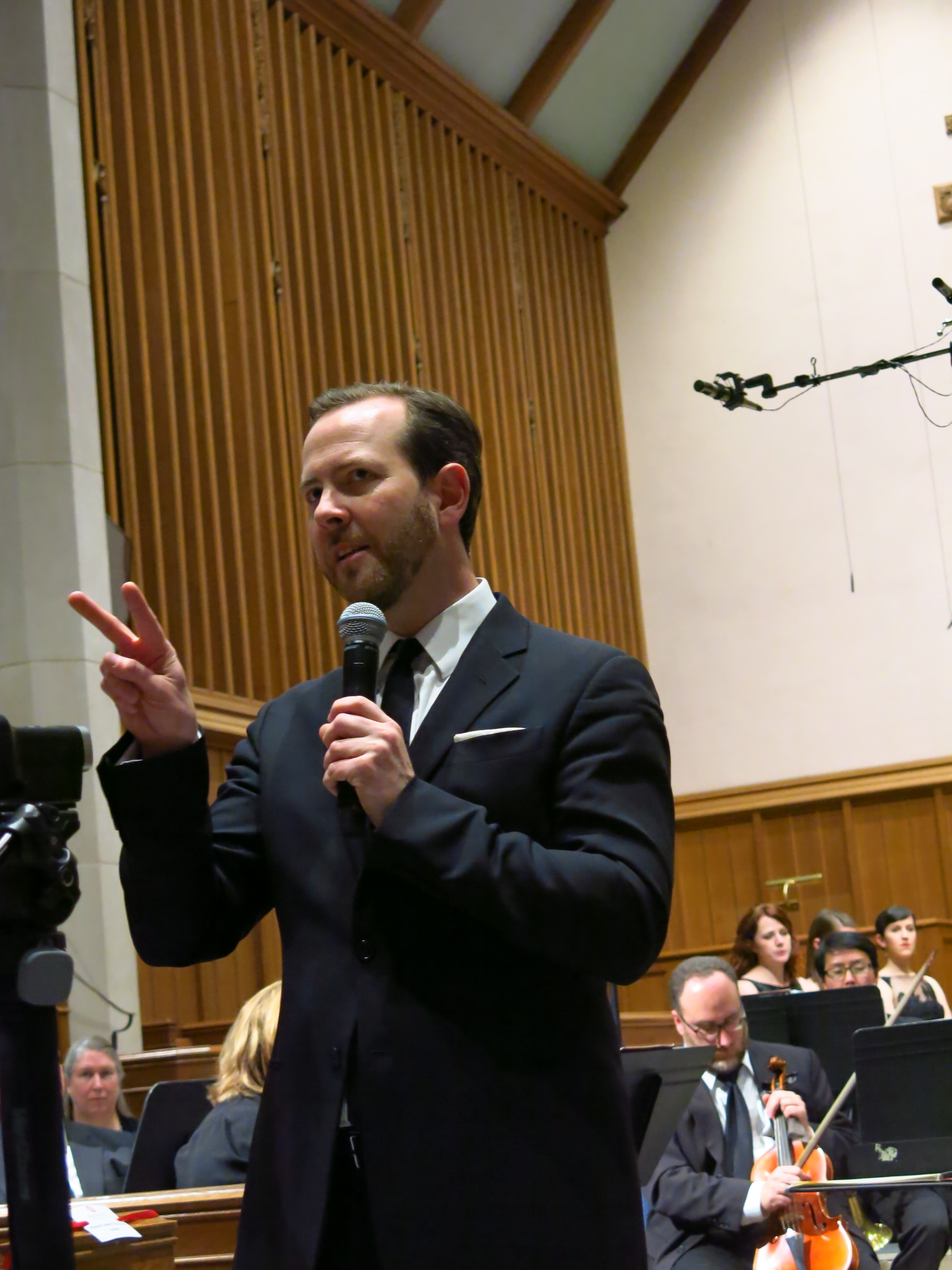
No surprise, then, that Jarrett drew our attention to the gloss on the iconic gifts that Stenger would sing in his tenor recitative, equating gold with faith, frankincense with prayer, and myrrh with patience. Jarrett also welcomed back the horn players in his introductory remarks, pointing out the extra tubing that Caudill and Niketopoulus would be adding to their valveless instruments, allowing them to play lower than before. Burgess and Lee were also asked to stand and display their curved oboes da caccia, the third different kind of oboe they would play during the evening, having slipped a pair of oboe d’amores past us earlier.

First performed on Epiphany Sunday in 1724 and one of Bach’s earliest Leipzig compositions, Sie warden aus Saba alle kommen is framed by the chorus as the fulfillment of Isiah’s prophecy in 60:6, “all those from Sheba shall come. They shall bring gold and frankincense and shall proclaim the praise of the Lord.” Steigerwelt returned to give the baritone’s recitative explicating the fulfillment of the prophecy. Then he sang a very lovely aria, “Gold aus Ophir ist zu schlecht” (“gold from Ophir is too base”), exhorting Christians to offer their hearts instead of mere gold as their gifts to the newborn. With its own orchestral intro, the climactic tenor aria, “Nimm mich dir zu eigen hin” (‘take me to you as your own”), offered Stenger the chance to match Steigerwalt’s exploits, and he responded with his heartiest, most heartfelt singing of the evening.

The orchestral postlude to Stenger’s aria, peppered with pulsing horns and exchanges between a pair of recorders, was actually livelier than the closing chorale, which brought the concert to a calm, anthemic close. Altogether, this Epiphany concert was a memorable enough feast to leave us looking forward to the 2019 Charlotte Bach Festival, already scheduled for June 7-16, culminating with performances of the St. Matthew Passion on the final two nights.

New Sheriff Greenlights a Complete Cycle

Preview: Two Trains Running

By Perry Tannenbaum

DSC05583

Rory Sheriff, the founder and producer at Brand New Sheriff Productions – and the author of two works staged at Spirit Square, Be a Lion and Boys to Baghdad – has a special affinity with the work of August Wilson. After presenting Wilson’s Jitney at Duke Energy Theater in 2017, BNS is back this Thursday with Two Trains Running, another drama from Wilson’s acclaimed 10-play Pittsburgh Cycle.

The special appeal of America’s pre-eminent black playwright for Sheriff is twofold – as a writer and as a Pennsylvanian.

“As a playwright myself,” Sheriff explains, “I am fascinated with August Wilson’s style of writing, more so the characters he writes about. Growing up in Reading PA, I can relate to every last character, situation and location he speaks about in Two Trains Running. The beautiful thing is I can now see and understand these people from an adult point of view. They are my dad, his friends, my uncles, my neighbors. I guess what I’m trying to say is I’m reliving my childhood through the works of Mr. Wilson.”

Each of the plays in Wilson’s Cycle is set in a different decade of the 20th century, and all of them are set Pittsburgh’s Hill District, except for one Chicago excursion representing the 1920s, Ma Rainey’s Black Bottom. The only play that predates Ma Rainey was the one Sheriff first plunged into, Jitney, which premiered in 1982 and represents the 1940s. By the time Two Trains, representing the 1960s, premiered in 1990, Wilson had already finished six of the plays in his Cycle.

So Sheriff has honed in on decades that his dad and uncles would recognize, but as he takes us back to the days of Malcolm X and the rise of the Black Panthers, Sheriff is promising that Two Trains won’t be his last stop.

“Yes,” he proclaims, “BNS Productions is committed to producing all ten of Mr. Wilson’s works. We will produce at least one of his works every season. Here’s an exclusive: We will be ending this season with Jitney, and next season we will be doing Radio Golf.”

This extraordinary announcement comes during an extraordinary launch of Black History Month, with three theatrical productions featuring black performers opening in the same week – making some unprecedented Charlotte history. While Theatre Charlotte is waiting until the first of the month on Friday to open Ain’t Misbehavin’, Actor’s Theatre is jumping the gun, officially opening Nina Simone: Four Women on Wednesday.

None of these productions is miniscule, testifying to the depth of black acting and musical talent across the Queen City. So the time is ripe for Brand New Sheriff to be making bolder, more confident and ambitious plans.

Sheriff is definitely packing some high-powered ammunition onstage for Two Trains.

DSC05863

“All of the actors in Two Trains Running have been in at least one Wilson play,” says Corlis Hayes, who will direct. Hayes is no slouch herself. Combined with the four she has directed at CPCC, where she teaches in the drama program, Hayes has now directed six of the 10 Pittsburgh plays, including the two Pulitzer Prize winners, Fences and The Piano Lesson.

Like Jitney, the action in Two Trains Running takes place in a building slated for acquisition and demolition by City of Pittsburgh. The wrongheaded concept of urban renewal evidently had a cancerous grip on black community life for a long time. Here it’s a restaurant rather than a gypsy cab company facing its doom, and the restaurant owner, Memphis, is our protagonist. He’s holding out for a fair price on his property – against the lowball bids of both the city and the ghoulish, rapacious West, who owns West’s Funeral Parlor across the street.

DSC05592

Memphis also has some unfinished business back in his hometown of Jackson, Mississippi, where he was driven off his land many years earlier and not paid a dime. He’s typical of the black men in Wilson’s plays, struggling against a system that white society has rigged against them. Echoing that reality – or responding to it – men in both Jitney and Two Trains Running play the numbers, hoping that luck will supply the boost that honest work doesn’t.

Recently discharged from prison, another recurring Wilson motif, Sterling is trying to interest Memphis and his male customers in attending an upcoming Black Power rally. Jonovan Adams, who has performed in all the Wilson plays that Hayes staged at CP, will portray the restless, volatile Sterling. Activism isn’t his only pursuit: he asks everybody he speaks with for a job or at least a lead, and he’s persistently trying to make headway with Risa, Memphis’s troubled waitress.

DSC05659

Estranged from his wife, Memphis seems to have a blind spot when it comes to women. Debating with Holloway, one of his older customers, about why Risa has mutilated herself, Memphis labels her dangerous while Holloway sees her as searching for someone who will love her true inner self.

“I feel both of these men hit on some truths about Risa,” says actress LeShea Nicole, whose previous venture into Wilson’s world was as Vera in the On Q Performing Arts production of Seven Guitars in 2015.

“Dangerous is definitely not a word I would use to describe Risa, because she never resorts to violence or threats, but I believe she feels ruined from some form or forms of abuse that she encountered in her past that has caused her to shut down socially/emotionally and even distort her appearance. Risa may feel ruined, but not beyond repair. She seeks guidance and solace from Prophet Samuel, which, in my eyes, equals hope.”

Working on her second Wilson drama, Nicole is switching companies and directors. The legendary Lou Bellamy, founder of Penumbra Theatre Company in St. Paul, Minnesota, worked directly with Wilson on multiple occasions. Bellamy not only directed Nicole for On Q, he also directed her as an understudy for the Blumenthal Performing Arts production of The Mountaintop that played at Booth Playhouse in 2014.
In their first-ever collaboration, Nicole says that Hayes measures up.

DSC05797


“I am extremely pleased and energized with her process of directing,” Nicole says. “She’s well versed and makes it her mission to stay true to Wilson’s vision. Dr. Hayes allows actors to explore, find depth in our characters and tap into our creative freedom without jeopardizing the integrity of the production. It is a tricky balancing act that she masters effortlessly. Hayes’ extensive acting career truly makes her an ‘actor’s director’ which is wonderful.”
Whether it’s Prophet Samuel, who lies in state at West’s funeral parlor, or it’s hitting the numbers; whether it’s promoting a Black Power rally or gleaning wisdom from the mysterious Aunt Ester, a 322-year-old soothsayer; the people of Two Trains Running are seekers. The emphasis on ritual especially sets this play apart from other plays in the Pittsburgh Cycle, according to Hayes, but there’s still a common thread.

“Always with Wilson,” Hayes observes, “reunion and reconciliation with the past heals the wounds of the present, bridges gaps between loved ones, and clears the path for a promising future.”

UNC Doctors Do No Harm in Charlotte Ballet’s “Shakespeare Reinvented”

Review:  Innovative Works

By Perry Tannenbaum

Charlotte Ballet's Innovative Works 2019

When Shakespeare wrote his plays four centuries ago, he knew the word “ballet” – but not as we do. Back then, he used the word interchangeably with “ballad.” So yes, the man of so many words knew about dance, spoke about it over a hundred times in his works, but he was far more preoccupied with music and song. Collaborating with a couple of theatre heavyweights from UNC Charlotte, distinguished Shakespeare professor Andrew Hartley and department chair Lynne Conner, Charlotte Ballet is bridging the gap in their latest Innovative Works program at the Patricia McBride & Jean-Pierre Bonnefoux Center for Dance.

With Unsex Me Here, choreographed by Stephanie Martinez, and Let Be by Peter Chu, Shakespeare Reinvented seeks to wed ballet with the Bard. It’s not an unheard-of idea, but it is an unusual one.

Truly reinventing Shakespeare sets the bar higher than merely blending, of course, and it’s Martinez and Connor who take on that challenge most aggressively. Their core idea is that Shakespeare’s universe is male-dominated, as evidenced in such titles as Romeo and Juliet, Troilus and Cressida, or Antony and Cleopatra. What would it be like to see that script flipped?

Martinez and Connor select four Shakespearean couples and give it a go. Some of the segments pair the couples as you would expect, Juliet with Romeo, Titania with Bottom, Lady Macbeth with Macbeth, and Kate with Petruchio. But each of the women, starting with a devastating Alessandra Ball James as Lady M in a devilish jumpsuit designed by Aimee J. Coleman, gets a solo spot – and so do the demoted heroes. At regular intervals, the men dance as a group, yet it seemed that more time was devoted to the women and their sorority.

Coleman’s costumes, along with a few props, served to differentiate between the characters. Twin panels with studio mirrors were the only scenery on the bare Center for Dance stage, most effective when the guys rolled them apart and, aided by JP Woodey’s lighting, the ladies made a dramatic upstage entrance.

Projected on the flipside of the mirrors – or prerecorded and delivered through the loudspeakers – text from the plays helped to orient us, and the soundtrack composed and constructed by Johnny Nevin and Peter de Klerk was heavily freighted with music by Bach, Handel, and Vivaldi to complete our time travels.

With so much sound and design necessary to orient us in the worlds of four Shakespearean couples, you may be dubious about how much a choreographer and her dancers can do to reinvent them. Other quibbles arise when men and women gather – presumably from different eras and countries – with no observable upshot or takeaway. Are we really contemplating gender when we watch a fairy queen cavorting with a donkey, or are we simply revisiting A Midsummer Night’s Dream and having some fun?

Martinez and Coleman definitely set the women free from their traditional moorings, particularly James as Lady M and Amelia Sturt-Dilley as Kate. If you’ve seen or studied Macbeth, you’re likely aware that the “unsex me here” quote comes from a Lady M soliloquy where she is steeling herself to commit regicide with her husband and seize the throne of Scotland. Perhaps less familiar is the quote gleaned from The Taming of the Shrew, “If I be waspish, best beware my sting.” It comes from early in the first dialogue that Katherine has with Petruchio, shortly after he has obtained her father’s consent to take her hand in marriage – with a sizable dowry to go along with the prize.

Belying her customary wildness – downright frowziness in some productions I’ve seen – Sturt-Dilly is rather dazzlingly dressed, intimidating in a whole new way. Nothing comical or witty remains here to remind us of the male-female sparring that often enlivens Shakespeare’s comedies. Instead, Martinez channels all of the comedy into the Titania-Bottom encounter, as Sarah Lapointe vamps Peter Mazuroski to the tunes of a medley sung by Judy Garland from her iconic Judy at Carnegie Hall album. We can assume that we’re not seriously contemplating gender when Garland is crooning “For Me and My Gal.”

Clad in a simple summer dress, I mistook Sarah Hayes Harkins for Kate at first, but the rose she carries, referencing Juliet’s signature “that which we call a rose would smell as sweet,” should be a giveaway. Harkins gets to do some rather audacious stuff that we would not expect of a demure young teen, most notably when she brushes the flower across Ball’s hand and produces the large bloody spot that Lady M obsesses over so famously.

Charlotte Ballet's Innovative Works 2019

Clocking in at an expansive 44+ minutes, Unsex Me Here was richly enjoyable and never struck me as an academic or PC rehab of these familiar men and women. Yes, it’s true that the guys – even Bottom – were deemphasized, but there was no detectable condemnation or belittlement. Aside from Mazurowki, who got to wear the donkey ears, the most characterful men were Ben Ingel as a soulful Romeo and Drew Grant as a somewhat malevolent Macbeth. No longer tasked to tame Kate and not visibly intimidated by her, it was hard to discern what was driving James Kopecky in his portrayal of Petruchio.

The Chu approach in Let Be, following the development of Hamlet’s character rather than his story, promised to be intriguing when I read the program notes. As the piece unfolded, I found it hard to connect anything I saw from Juwan Alston as the royal Dane with any developmental scheme whatsoever. Costume designs by Chu were a dreary gray and Woodey’s lighting wasn’t intended to dispel the gloom. Nor was the New Age musical score typified by Ólafur Arnalds’ “Nyepi.” Amorphous pods or globs were scattered across the stage when the lights came up, coalescing into a monkish Oriental style when dancers bloomed from them.

Instead of Ophelia, Horatio, the usurping King Claudius, or even Hamlet’s spectral father, these were the shades that surrounded our troubled prince. When the ensemble sprouted pomegranate-colored fans, they snapped them open and shut in unison. Only by reciting lines from the most recognizable soliloquies could we know that Alston was Hamlet. Pitted against performances of these greatest hits that you may have seen onstage or on film by great Shakespearean immortals – or your 11th grade English teacher – Alston fares as you might expect. Wisely, nobody is asking him to ascend into those heavenly spheres of eloquence, so there’s a vulnerable student simplicity to his speeches.

If no amazing synthesis or revelation emerges in Shakespeare Reinvented, there are no pretentious or stupid faux pas either, probably because these two talented choreographers didn’t allow their academic partners to get inside their heads – or their art. The dancers embrace the project with an enthusiasm that matches their talents, so the result constantly bristles with excitement and electricity.

Greek Gods Rock a Comeback

Review: The Lightning Thief: The Percy Jackson Musical

By Perry Tannenbaum


Photo: Jeremy Daniel

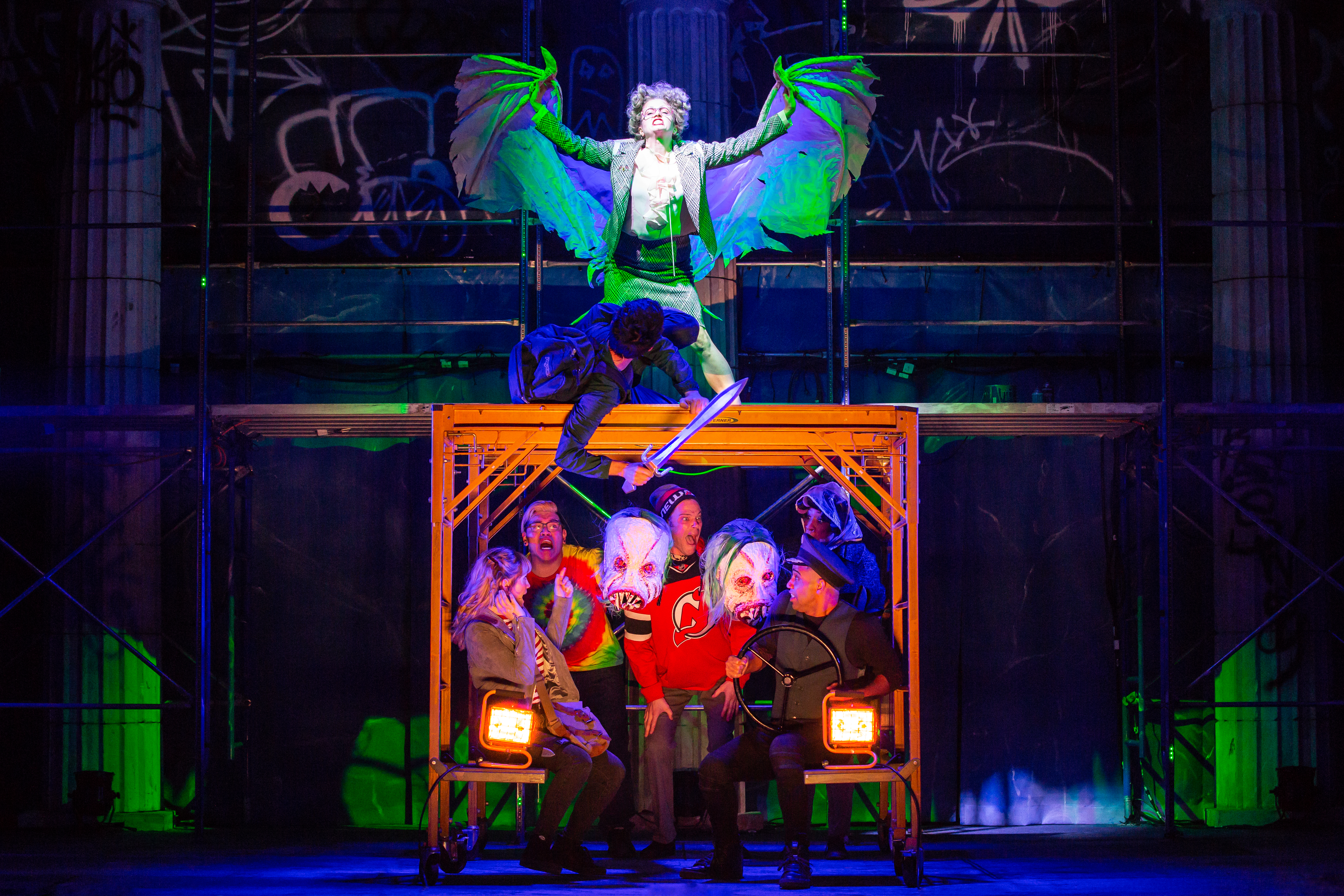
Take it from a very hairy satyr – or a prancing centaur: “The gods are real!” That’s the emphatic message Rick Riordan delivered to Percy Jackson, the hero of his young adult novel, The Lightning Thief, in 2005. Five years later, the best-selling saga became a blockbuster movie, and now – after a modest off-Broadway run in 2017 – Riordan’s demigod is on tour in The Lightning Thief: The Percy Jackson Musical, and Knight Theater is one of his first stops.

Joe Tracz’ adaptation of Riordan’s story leans more towards the book than the movie, and Rob Rokicki’s songs add a rocking dimension to Lightning, pushing Percy’s youthful voltage decisively into defiant adolescence – and away from the 12-year-olds who were the original protagonists. But that boost doesn’t compare with the jumpstart this new musical delivers for the Greek gods.

Photo: Jeremy Daniel

You need to remember that these mighty Olympians were already fairly passé in the days of the Roman Empire when Zeus’s name was changed to Jove and Odysseus became Ulysses. Revivals of the Greek gods by 20th century novelists and poets were about the potency of myth rather than the truth of religion – and Homer’s heroes were more likely to be the focus than the immortals on Olympus.

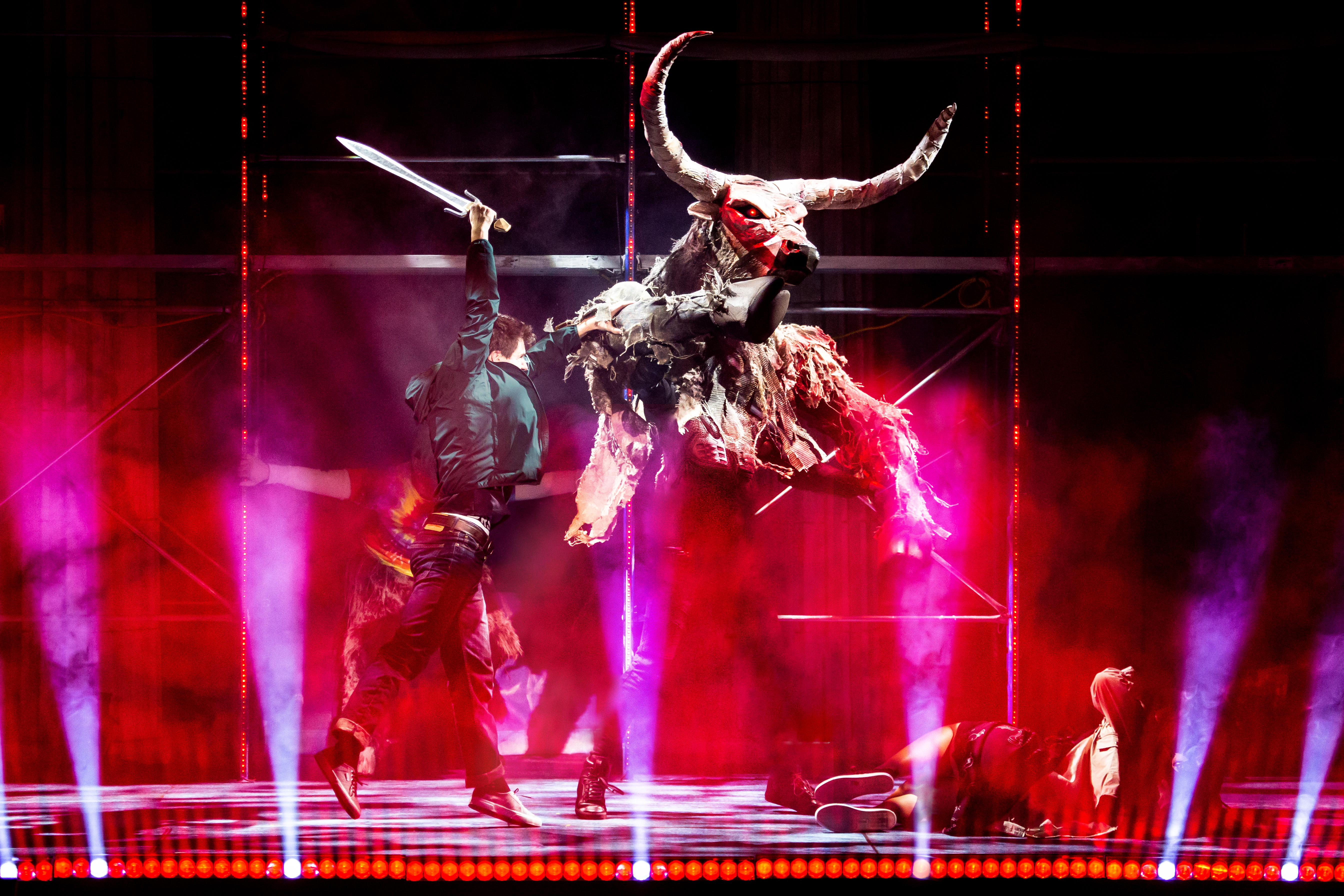
We hear some definite rumblings from Olympus before the action begins at Knight Theater. Before we learn that Zeus’s lightning has been stolen and that Percy is a prime suspect, the lad’s field trip to the Metropolitan Museum – yes, in New York – is punctuated by attacks from a harpy and a minotaur.

Yeah, a very mighty somebody is angry with Percy, and the kid really has a lot to learn. After he gets expelled from school, the long-overdue lessons begin. Mom breaks the news that Dad, if not a great parent, was and is unquestionably great. But before Sally can specify Percy’s divine lineage, his implacable pursuers strike again. Now in hindsight, I could second-guess Zeus and politely assert that it would have been more sensible for him to send a more articulate messenger than a minotaur to ask Percy where he’d hidden the damn lightning.

Photo: Jeremy Daniel

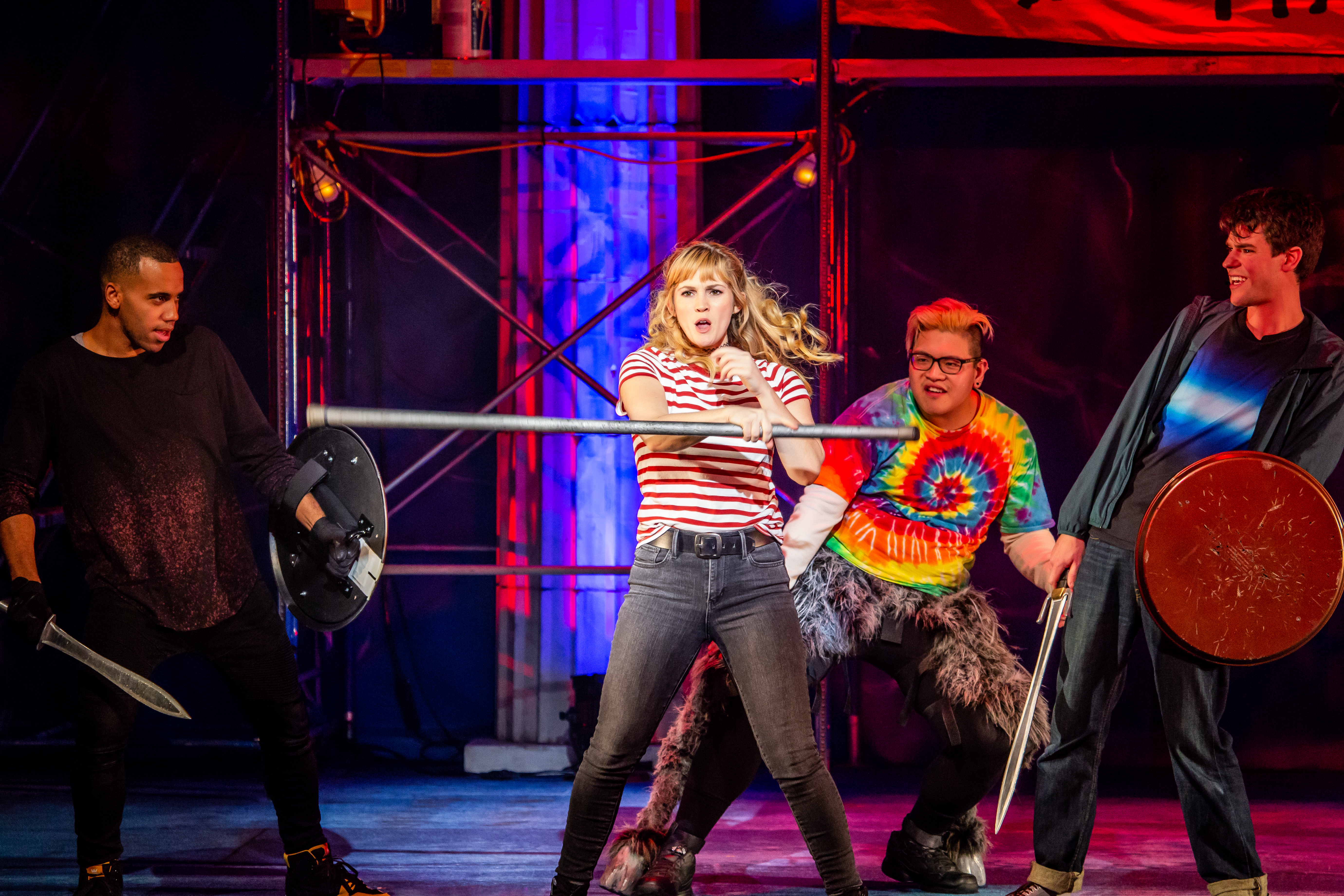
So be advised, action comic book logic often prevails here – which is not very much out of step with the illogic of Greek mythology. When Percy awakens from a coma three days later, he finds himself motherless and enrolled at Camp Half-Blood up in Long Island, together with other kids whose divine parents are equally neglectful. Needless to say, the animus bred among these teenage demigods by their absentee parents chimes well with the Rokicki rock score.

Percy is doubly different from the rest. Until deep into Act 1, he doesn’t know whose son he is. On a dark night, the revelation from Dad will be truly spectacular as Percy and his fellow campers look up in the sky and – amid the obligatory earthshaking tremors – see the god’s signature trident blazoned among the stars. Heavenly signs are the stuff you hear heroes speak about in plays by Aeschylus, Sophocles, and Euripides, a dramatic effect that Shakespeare shrewdly revived.

Photo: Jeremy Daniel

The other distinction that separates Percy is his getting selected to go on the quest to somehow retrieve the stolen lightning and prevent all-out warfare from breaking out among the gods. It’s here that Riordan takes us all the way back to the heroes of Homer’s epics. Just as there was tension and moodiness on the fields of Troy where Achilles, Ajax, Agamemnon, Hector, and Paris trod, there are rivalries and animosities among the half-blood campers. Annabeth, neglected by Mama Athena, wants to join Percy and prove herself. Others channel their jealousy, resentment, and antagonism into undermining him.

Up above, the unseen gods are supporting their neglected children, using them as instruments against one another, very much like Homer described them behind the scenes of the Trojan War. Mars and Mercury, the gods with Roman names, are sponsoring kids at camp who are going to make it tough on the offspring of Zeus and Poseidon. Singing rock songs with amped-up intensity and sincerity amid flashing lights and minimal scenery, these relentlessly energetic teens do occasionally seem like avatars in a video game.

I guess that’s because so much of the energy is channeled into the music.

Kristen Stokes as Annabeth sported the best vocal chops among our protagonists, but the role of Athena’s daughter isn’t nearly as meaty as the lead. Chris McCarrell is your fairly generic rock ‘n’ roll lead, not quite as iconoclastic as the Footloose outsider at his core, but he’s marvelously awed and illuminated by his magic sword and his mission. Somehow his determined edge never grows stale.

Photo: Jeremy Daniel


But as often happens with pure heroes and superheroes, Percy and Annabeth are often upstaged by the more outré characters they pal around with or confront. Three of the five supporting players have multiple roles to feast on, and I still find myself torn about which scene stealer I liked most. Perhaps because he rocked the most costumes, I’m giving the nod to Ryan Knowles as Chiron, Hades, and Poseidon. Knowles starts out as Percy’s teacher and principal before he reveals himself as a centaur – not an unreasonable stretch, since the original Chiron tutored such adventurers as Achilles and Jason.

Likewise, Percy’s classmate Grover reveals himself as a satyr when our hero comes out of his coma, the pagan equivalent of a guardian angel. Yet somehow, he moonlights as Mr. D, the godly camp director who presides over admissions in a manner that suggests a Hawaiian bartender. Jalynn Steele spends the largest chunk of her stage time as Percy’s mom, warmly nurturing and humdrum, but she gets the most startling cameo as Mrs. Dodd, the substitute teacher who turns into a very shrill harpy. Given a couple of chances to sing, Steele proves to have ample reserves of voltage and sizzle.

Okay, so maybe the gods aren’t real. At Knight Theater, in The Lightning Thief, they’re still a lot of fun.