Category Archives: Theatre

Down at Spoleto USA, the Vibe Is Shifting

Review: Spoleto Festival USA in Charleston

By Perry Tannenbaum

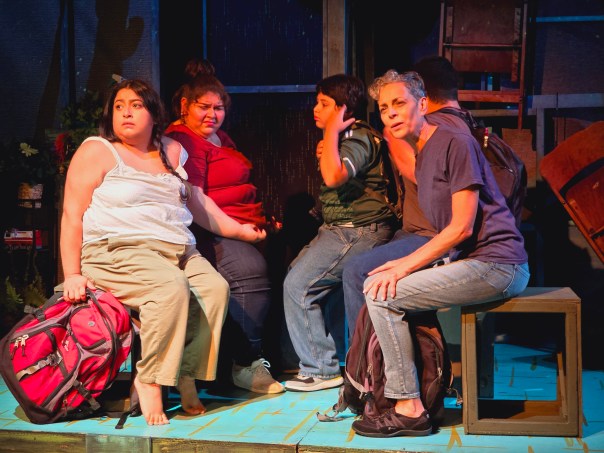
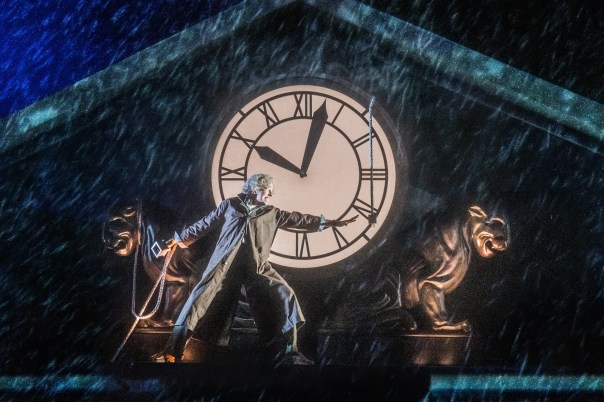
‘Song of Rome’ at Spoleto Festival USA in Charleston. (Photo by William Struhs)

Looking down benignly at his Dock Street Theater audience, the newly anointed host of Spoleto Festival USA’s chamber music series, Paul Wiancko, gave us a slight ceremonial nod. “You have chosen wisely,” he said sagely.

But he wasn’t exactly speaking to me, since this was already the fifth program in the noonday series – the backbone of Spoleto – that I was attending this year. Nor was he speaking to the “eleven-ers” in the audience who were signed up for the complete set of programs down in Charleston through June 9.

He was speaking directly to those in the audience who would only attend one of the concerts. Today. And he would go on to ask us all to participate in making the experience special and unforgettable.

It would be very special – beginning with a Beethoven piano trio that showcased Amy Wang at the keyboard, Benjamin Beilman on violin, and Raman Ramakrishnan on cello. How’s that for diversity? My love affair with Wang’s artistry and demeanor had begun just two hours earlier when she played the Schumann Violin Sonata, teamed up with the Slavically expressive Alexi Kenney.

Enough to mightily crown most concerts, the Beethoven was merely a satisfying appetizer. For Wiancko had cooked up a powerful combo, calling upon two living composers that I was barely familiar with, Jonathan Dove (b. 1959) and Valentin Silvestrov (b. 1937).

Our contribution to the magic would be to withhold our applause between the two pieces. It was easy enough to maintain stunned silence after In Damascus, Dove’s heartfelt setting of Syrian poet Ali Safar’s grieving – and aggrieved – reaction to a senseless car-bombing in his nation’s war-torn capital.

The prose poems were achingly and angrily sung by tenor Karim Sulayman, perhaps most indelibly after an extended instrumental interlude, turbulently delivered by a string quartet that included Kenney, Beilman, Wiancko (on cello), and violist Masumi Per Rostad.

“We will be free,” Sulayman sang in Anne-Marie McManus’s ardent translation, “of our faces and our souls – or our faces and our souls will be free of us. And the happy world won’t have to listen to our clamor anymore, we who have ruined the peace of this little patch of Earth and angered a sea of joy.”

Sulayman was visibly in tears as the lights went down on In Damascus and pianist Pedja Mužijević entered with his iPad and sat down at the Steinway. In the dimness, Mužijević played Silvestrov’s Lullaby, an appropriate coda to a song sequence that began with the children of the Zuhur neighborhood in Damascus who would never wake from their sleep – or survive a bogus “holiday truce” – and ended with the evocation of mothers and loved ones who would always await their return.

Amazingly enough, this isn’t the only instance where Sulayman is singing about children caught in the web of brutal war and barbaric terror, for his wondrous voice also figures at Spoleto in the world premiere of Ruinous Gods, a new opera with exotic music by Layale Chaker and libretto by Lisa Schlesinger.

Co-commissioned by Spoleto, Nederlandse Reisopera, and Opera Wuppertal, Ruinous Gods is a fantastical deep dive into the mindworld of Uppgivenhetssyndrome, a rare traumatic response to living in the limbo of displacement. It was first observed in children detained in Sweden, but the syndrome has now been observed in refugee camps around the world. Hopeless children simply go to sleep in reaction to their endlessly unresolved status. Some die, others lapse into coma – sustained only by a feeding tube.

Encased in a surreal bubble over a grassy bed from scenic designer Joelle Aoun, that is how we find our sleeping-beauty protagonist, Teryn Kuzma as H’ala, when the opera begins. Mezzo-soprano Taylor-Alexis DuPont as her mom, Hannah, is stressing and blaming herself while two doctors, Overcast and Undertow, hover over their patient, unsympathetic researchers hoping to analyze and classify the disease.

Meanwhile, Sulayman is decked out in a feathery all-black outfit as Crow, the mentor who, like Dante’s Virgil, guides all these comatose children from around the globe into a common underworld dreamscape where all are free. Is that a spaghetti rainbow dropping down across the Sottile Theatre stage from the fly loft as the imprisoning globule lifts off H’ala, or is there an unfathomably large jellyfish floating above?

Sinuous, jazzy, and sensuously obsessive, Chaker’s music resurfaced in the jazz sector of Spoleto 2024 – at Charleston Music Hall, a venue never used by the festival before. Bigger than Spoleto’s customary hall for chamber jazz (and eccentric modern music), the Emmett Robinson at the College of Charleston, the Music Hall was an acoustic revelation and a welcome escape from the Robinson’s clean-room sterility. Bonus points for the stars that lit up on the black backdrop.

Attendance was astonishing, more than could ever be seated at the Robinson, as Chaker, leading her Sarafand quintet on violin – with an occasional vocal – delved into her two most recent albums, Radio Afloat (2024) and Inner Rhyme (2019). Having worked with Daniel Barenboim and his West-Eastern Divan Orchestra, Chaker has created a jazz equivalent in Sarafand with Phillip Golub on keyboards, Jake Charkey on cello, John Hadfield on drums, and Sam Minaie behind the bass.

Compared to her opera, Chaker’s jazz and her Sarafand personnel made subtler political points. But this wasn’t the only jazz gig that came loaded with extra cargo. Terri Lyne Carrington returned to Cistern Yard for a pointedly themed concert under the moon and the live oaks – with political firebrand diva (and NEA Jazz Master) Dianne Reeves as her special guest.

Carrington’s cargo was collected into her Grammy-winning album of 2022, New Standards, Vol. 1, the first studio sprouting of her pathfinding songbook collection, New Standards: 101 Lead Sheets by Women Composers. So without much preaching, her set was a celebration of Geri Allen, Gretchen Parlato, Eliane Elias, and – at a high summit where Reeves duetted for the first time with Christie Dashiell – the great Abbey Lincoln and her mesmerizing “Throw It Away.”

All these greats joined together again on Allen’s “Unconditional Love,” with Kris Davis on piano, Matthew Stevens on guitar, and trumpeter Etienne Charles all getting in their licks, plus spoken and dance stints from Christiana Hunte. Wow.

Theatre at Spoleto this season is densely messaged. Or not. The Song of Rome was deeply immersed in issues of immigration and sexism, with an overarching interest in the fate of republics, in ancient day Rome and 21st century USA. Cassette Roulette, on the other hand, was pure frivolity, barely deeper than its title and whole lot bawdier.

After starring in An Iliad last season, Denis O’Hare could be logically expected to follow up that one-man conquest with An Odyssey. Well, he has, sort of. O’Hare co-wrote A Song of Rome with Lisa Peterson, his Iliad writing partner, but this time he doesn’t appear onstage, handing over the acting chores to Rachel Christopher and Hadi Tabbal.

Christopher is Sheree in modern times, a grad student striving to learn Latin, and Octavia, Emperor Augustus’s sister at the dawn of the Roman Empire. Tabbal is Azem in present day, Sheree’s immigrant Latin tutor – and our overall storyteller – and the poet Virgil during the reign of Augustus.

So O’Hare is skipping over the rest of Homer to engage with Rome’s great epic, The Aeneid, knowing full well that Virgil based the first six books of his masterwork on The Odyssey and the last six on The Iliad. As a thematic bonus, O’Hare and Peterson discovered during their research for this world premiere that Virgil himself was a refugee, forced out of his ancestral home in Northern Italy by Roman avengers of Julius Caesar who got Dad’s estate for their prize.

Although Virgil’s epic was likely commissioned by Emperor Augustus, aka Octavian, doubt remains whether The Aeneid is a work of propaganda justifying the Roman Empire as divinely ordained – tracing Octavian’s ancestry back to Aeneas and Venus as meticulously as the New Testament traces Jesus back to King David, son of Jesse – or a subversive work by an immigrant genius settling a score. While getting handsomely paid to do it.

Octavia and Virgil go back and forth on this point because the Emperor’s sister is both an admirer and a keen reader, but both are critical of Octavian, who is hell-bent on buttressing the legitimacy of Rome while closing off its path back to a glorious Republic.

“The Republic is over,” they agree. And how about ours?

While Sheree is learning about the Roman issue that comes up as Virgil delivers more and more manuscript pages to Octavia over the years, Sheree must face the issue in American terms when Azem receives a deportation notice. Does she instantly jump to his defense and rescue, or does she immediately suspect him of criminal activity?

Meanwhile, Sheree is reading The Aeneid differently from Azem and Octavia. Why is Octavia left out of literary history if she played such a key role? Why are Virgil’s women, particularly Dido and Lavinia, so passive and pathetic while the strong woman, Camilla, is a she-devil?

Finding this insidious neglect and defamation rampant in literary history and beyond, Sheree comes up with a radical, shocking solution that she announces on her podcast. She will pour fuel over every single book piled on the Dock Street stage and burn them all.

When will all this vicious animosity end? Citing the end of Virgil’s epic, where Aeneas, the immigrant from far-off Troy, killed the vanquished Turnus instead of offering peace, conciliation, and mercy, Sheree answers us curtly lighting the flame: it won’t. Opting for chaos, she almost says it aloud – to hell with the immigrants. (Or give it to the immigrants, if you’ve heard of the Goths.)

Moments like that land hard at Spoleto. Deep in Trump Country, at the Sunday matinee of Ruinous Gods, there was a loud boo among all the lusty cheering as the singers took their bows. Good. The nurturing point of the opera, gushing with empathy toward immigrants worldwide, had hit home, no matter how you feel about it.

Depending on whether you were attuned to John Cameron Mitchell’s Hedwig and the Angry Inch cache, or whether you resonated with Amber Martin’s worship of Reba McIntyre, Bette Midler, and Stevie Nicks, Cassette Roulette was hit-and-miss, redeemed or further cheapened by Martin’s bawdiness. Nicks’ “Rhiannon” was the crowd fave and mine on the night I attended, getting a far more epic performance that you’ll hear on AM radio or an elevator. But neither David Bowie nor Midler got much of a rise. The diet of ‘70s and ‘80s hits didn’t draw much of a youth crowd to Festival Hall, which was made over to a quasi-cabaret setup.

Trombone Shorty slayed far more decisively at TD Arena, where his outdoor revels with Orleans Avenue were abruptly moved when rain threatened. At the height of the indoor bacchanale, Shorty paraded through the audience at the home of College of Charleston basketball with key members of the band (none of whom were named in Spoleto’s fabled program book). They slashed up the rear aisle of the stadium, swung around to the side of the gym and came down along the side.

Snaking through the stadium, Shorty & Orleans reigned over the reigning pandemonium. The prohibition against photography was washed out to sea in a riptide of glowing cellphones.

Shoot, the band was taking selfies! And through it all, the sound remained perfect, Shorty and his brass perfectly aligned with the rhythm section on the TD stage, absolutely distortion-free. Sure, a few dissenters and defectors also trickled through the aisles, accompanied by true believers seeking and returning with beverage.

The most pathetic sufferer sat right across the aisle from my wife Sue and me, hunched over, elbows on kness, with his hands tightly cupped over his ears. Probably needed a ride to escape. Maybe he would have fared better in the open air, where at least some of the sound could have escaped skyward through the live oaks of Cistern Yard.

Final week highlights: Bank on it, the Bank of America Chamber Music series has four more different programs to offer – and a dozen performances – before Spoleto wraps up on Sunday. The Wells Fargo Jazz lineup continues strong, with an all-star Latin twist. Puerto Rican saxophonist Miguel Zenón and Venezuelan pianist Luis Perdomo bring their Grammy-nominated El Arte Del Bolero albums to life at the Dock Street Theatre in a three-day, five-performance engagement (June 6-8) while Cuban percussionist extraordinaire Pedrito Martinez lights up Cistern Yard with an Afro-Cuban stewpot of infectious rhythm, Echoes of Africa (June 7).

After distinguishing themselves in Mahler’s Fifth, the Spoleto Festival USA Orchestra returns to Gaillard Center with Beethoven’s Third (June 5), plus a Rachmaninoff concerto for piano + trumpet and composer-in-residence Reena Esmail’s “Testament” for tabla and orchestra. Upstaged by a visitation from the Charles Lloyd Sky Quartet this past weekend, the Spoleto Festival USA Chorus rebounds with a two-performance run of The Heart Starts Singing (June 6-7), sporting another Esmail piece that will feature Wiancko’s cello – and an eclectic mix of works by Tomás Luis de Victoria, Rachmaninoff, Irving Berlin, and more.

The Festival Finale of yore is gone this year, but there’s more folk, funk, Americana, and alt-country in this year’s Spoleto lineup. Still to come are Andrew Marlin and Emily Frantz’s latest partnering, Watchhouse (June 5), with their own band-backed experiments in folk-rock playing at Cistern Yard; Grammy Award winner Aiofe O’Donovan (June 7) returns with the SFUSA Orchestra to Sottile Theatre; and Jason Isbell (June 8-9) headlines the final weekend with a two-night stint at the Cistern.

Theatre continued during Spoleto’s second weekend with sharply contrasting shows, the wholesome Ugly Duckling from Lightwire Theater and the savagely satirical send-up of the American West, Dark Noon, from the Danish fit + foxy company in its US Premiere. A similar dichotomy prevails this week as Australian company Casus Creations takes over Festival Hall with Apricity (June 6-9), a family-friendly mix of aerial and acrobatic astonishment, with sprinklings of comic shtick and moody music.

On the edgy side, RuPaul’s Drag Race fans can rejoice greatly as Season 9 champion Sasha Velour deigns to bring her presence to Gaillard Center with The Big Reveal Live Show! (June 6). Is Charleston’s big house big enough for drag’s Queen of Queens? The Holy City and Spoleto haven’t been so sensationally desecrated since Taylor Mac ruled the festival.

“Thoughts of a Colored Man” Lauds Three Strong Women

Review: Thoughts of a Colored Man at the Arts Factory

By Perry Tannenbaum

So Lust and Passion walk into a bar… You can imagine how fervently I’ve longed to lead off a review with a line like that for close to 40 years. Well, now that Keenan Scott II’s Thoughts of a Colored Man has almost provided that opportunity, you can see that I’ve pulled the trigger. Jumped the gun. For in multiple scenes of Scott’s 2021 script, we can find Love, Lust, Depression, Passion, and Happiness all congregated in a Brooklyn barbershop run by Wisdom and Anger.

Scott gives us more than a hint that Colored Man was written as a companion piece of Ntozake Shange’s for colored girls who have considered suicide / when the rainbow is enuf. That 1976 “choreopoem” had seven women with similarly abstract names, corresponding with the colors of the rainbow, and it is similarly studded with monologues and poetry. Scott’s newer piece at the Arts Factory, flawlessly cast by director Sidney Horton for Three Bone Theatre and imbued with just the right sizzle and raw edge, comes at us evolved into SLAM poetry rants rather than incantatory spells.

Less obviously, Scott’s form is modeled on “Four Women,” one of Nina Simone’s signature songs. Simone gives us the names of her women after she has told their stories, but we’re usually not in suspense for appreciably more than a minute as the complete sequence clocks in at under five. Unless you’ve paid close attention to your playbill before the lights dim, this playwright will make you wait nearly the full intermission-less 90 minutes until, one by one, we get the group reveal.

Thankfully, plenty of names pop up in various scenes. At the barbershop, Kobe, LeBron, and MJ are upheld as the GOAT by bickering customers and kibitzers, moving right along to a similarly lightweight comparison of rap giants past and present. Equally memorable, and no less intense, there’s a lengthy dispute about the best basketball sneakers of all time as the group stands in line for a latenight release of the newest Jordans carrying the legendary Jumpman logo.

Wisdom welcomes us to Joe’s Barbershop, but it becomes clearer as the meandering chatter proceeds that old Joe has retired or passed away, leaving him in charge. Nor does anybody identify Depression as he’s bagging groceries, retrieving carts, or stocking shelves at Whole Foods, though he relays boss’s orders to an offstage Timmy. So as Scott veers and swerves on his path of SLAM poetry and raw prose, with some rhythmic prose bridging the gap, he is also at play with raw specifics and unspoken generalities.

The opening question that Depression poses, “Who is the Colored Man? Is he a king… or is he a slave?” invites that kind of approach. Or evasion. Ironically, only Depression will introduce himself well before the evening is over – at a little past 7:30 PM. One of the ways Scott has of stringing out his opposing tracks is by offering signposts in his stage directions that tell us what time of day it is, steadily moving us forward. Horton has these projected on the upstage wall perfectly on cue.

And whether you’re Love or Lust, Depression or Happiness, you have a personal story. Depression, for example, fumbled an opportunity to break away from Brooklyn and attend MIT on a full scholarship. Giving that up by taking care of his mom – without a moment’s hesitation – he settled for the ongoing indignity of Whole Foods.

On the other hand, Happiness is a stranger in town, living with his fiancé. He grew up in the South, his parents were the first in his family to earn six figures, and that’s why he was shunned by the relatives back home. Up in Brooklyn, he feels no less alienated, because he is prosperous and because he is gay.

Scott is pulling hard here against answering his own opening question. The reason that such fascinating hostility flares up between Depression and Happiness in an aisle at Whole Foods is that neither one can answer “Who is the Colored Man?” when they meet one. Both pointedly tell each other “you don’t know me” – which is what any of Scott’s characters could have shouted at us at the beginning if the playwright were less designing and discreet. Or if he hadn’t been aware that Colored Men themselves cannot answer any better than by telling us, one by one, who they are.

It’s hard for me to resist applying the same observation more widely to the whole Black theatre scene in Charlotte these days. Having sampled Penumbra in Minneapolis presenting August Wilson, Black Ensemble in Chicago celebrating Marvin Gaye, and a multitude of companies from across the US bringing their best to the National Black Theatre Festival in Winston-Salem in even numbered years – ahem, the International Black Theatre Festival for 2024 (July 29-August 3) – I’m always telling people that the Black performers, directors, and theatercraftsmen that we have in the QC are second to none.

Catch is: not only doesn’t the Charlotte theatergoing public seem to realize the bounty in our midst. The artists themselves seem to be sleeping on it. To a greater degree now than ever before, when we were merely equals.

Lesser performers and directors might struggle with the challenge of portraying Anger, Passion, or Wisdom and real people at the same time. Horton and his able cast wisely let it slide. When he’s not shaving, shearing, and trimming at Joe’s, Devin Clark as Anger trains and does drills with highly-ranked basketball players who aspire to the big-name colleges, the NBA draft, and huge commercial endorsements. Now they’re possible in college! Or he drifts into nostalgic recollections of his peak playing days when he was “nice.” He earned his scholarship back in the day, so he’s worried about how today’s NIL generation will maintain their dedication – and their grades, if b-ball doesn’t pan out.

Jonovan Adams, another mainstay on the local scene, also assumes a mentor’s role as Passion, a seasoned teacher of 26 students – plus cameo roles as social worker, psychiatrist, and surrogate parent, depending on the kid and his or her homelife. Neither Passion nor Anger is likely to strike you as particularly tough: more likely, Clark and Adams will come across as personable and authentic as ever.

It is well that Passion invokes the OGs of yesteryear who helped him growing up, hanging around the hood and doling out free advice. He wants to be one of those old heads now, a street scholar. That’s what cool, easygoing-yet-stern Graham Williams personifies at his shop as Wisdom, conscientiously doling out sharp cuts and implacably demanding a buck for the swear jar each time a customer – or Anger – curses or breaches decorum.

Dionte Darko as Lust is the most-often-fined in the group, a youngblood with repeat offenses in swearing, misogyny, and homophobia in and out of the barbershop. With his undimmed geniality, Darko is so useful to have around. Aside from needing to apologize to Wisdom for his multiple trespasses, he also riles up the romantic Daylon Jones as Love, so vulnerably poetic in his amatory feelings that he has not yet dared to approach his beloved – while Lust will instantly harass any skirt that walks by, previously known or not.

With similar boorishness, Lust also runs afoul of Nehemiah Lawson as Happiness. Renowned as the Minstrel of Something Rotten and Leading Player of Pippin at Theatre Charlotte, lead Drifter in Beautiful at Matthews Playhouse, and _thesingingdentist on Instagram, Lawson has more than sufficient urbanity and polish for portraying a relatively mundane financial director, so it’s interesting to see him in a performance that discards stage magic in favor of wariness, loneliness, and a touch of anxiety.

Maybe Scott would have preferred someone older than Lawson in Happiness’s encounters with Lust and Depression, but in the Whole Foods scene especially, Horton’s calculus paid off for me though it changed the chemistry. If there was any bullying flavor intended in the hostility between Lust and Happiness, that is gone.

Marvin King bookends the show as Depression and, with a long white tunic that echoes the twin white fires of his flowing beard, sanctifies it with a mystic, ceremonial aura that the more worldly SLAM poetry and prose never dispels. King’s mighty presence certainly endures when he descends to the degradation of a Whole Foods grocery drudge, and the reason why he discloses his name before anyone else will become clear enough if we’ve watched closely. In this cityscape of living, breathing, struggling abstractions, Depression is probably the one who best encompasses them all. By that time, Scott has fastened upon a fresh muse, supplanting Shange’s Colored Girls and Simone’s “Four Women.” This third inspiration is Lorraine Hansberry’s Raisin, handed down from Langston Hughes, and the effects of the sun are still the same as they were at the height of the Harlem Renaissance

“Next to Normal” Is Alive at the Barn!

Review: Next to Normal at Theatre Charlotte

By Perry Tannenbaum

July 4, December 7, September 11, and October 7 are all dates we remember for their historic meaning to the nation and the world. A similar earthshaking significance can descend on a single day in the life of a relationship, a marriage, or a family that can reverberate for generations – whether you were at the event or even alive at the time.

That’s essentially what we’re watching in Brian Yorkey’s Next to Normal with music by Tom Kitt, winner of the Pulitzer Prize for Drama in 2010 after winning Tony Awards for Best Musical, Best Book, and Best Orchestrations the previous year. Instead of doing things the traditional way, setting up the location and the situation in a big opening number that stages or recaps the prime catastrophe, Yorkey fast-forwards us more than 17 years, when the original hurt in the Goodman family has marinated and metastasized – a fissionable maelstrom that will soon explode.

With a fresh set of seismic events.

Diana is at the vortex of the mushrooming crises, so it’s both interesting and wickedly deceptive that Yorkey brings us into her drugged and delusional mind for much of the opening action. We still see the basic outlines of the family turmoil clearly enough. Her husband, Dan, keeps trying to go with the flow of Diana’s bi-polar mood swings. She navigates a series of therapists, looking for either a therapeutic epiphany or the perfectly calibrated cocktail of meds.

Meanwhile, Diana’s teen daughter Natalie feels neglected and unappreciated, living in the shadow of Mom’s obsessive devotion to her older brother Gabe. Warily, Natalie navigates her self-worth issues as schoolmate Henry tries to get closer and establish a relationship. When Natalie overcomes her shame and allows Henry, after much hesitation, to meet her family, we seem to have arrived at a breakthrough.

It’s a brave move and all goes swimmingly at the Goodman dinner table between Natalie and Henry until Diana walks in with a birthday cake, all smiles, candles lit. Yorkey’s sleight-of-hand has worked so beautifully that we wonder which of the two teens is the target of the birthday surprise. Suddenly things are going downhill – off a high cliff.

Like we’ve been overdosing on the meds so far.

Yorkey is very good at these slow build-ups where we see budding new hopes dashed by a sudden disappointment and fresh Diana relapses. After portraying Dan, the long-suffering husband in Queen City Theatre Company’s fine production in 2013, Billy Ensley takes the reins at Theatre Charlotte’s slightly slicker version. His suffering, grimly stoical, was very different from Johnny Hohenstein’s unfiltered and uncontrolled anguish. It’s easier to breathe at the old Queens Road barn when emotions get a space to release.

On the other hand, the Broadway edition starring Alice Ripley in 2009 (which toured here with Ripley in 2011) took a dimmer, more skeptical view of psychiatry and pharmacology, giving those productions directed by Michael Greif a darker, satirical, mad scientist edge. Around the corner from a cluster of medical centers and hospitals, Josh Webb’s set design on Queens Road is easily the brightest and most antiseptic I’ve seen. The usual two-story scaffolding that adorns rock operas is outfitted with colorful fluorescent lighting, though some flickering occasionally marred the serene pastels (intentionally?) inside the translucent fixtures.

So in transit to Charlotte, the emphasis continues to shift more emphatically away from the quackery to the suffering. Hohenstein’s broadened performance now rivals Melissa Cook’s bipolarity as Diana, for he’s still a domesticated dad to Natalie and a cheerful host to Henry between bouts of stressing and losing it in private and with his wife. In its fits and starts, Hohenstein helps us to balance the toll mental illness takes on its victims and on their loved ones. Easily the best of Hohenstein that I’ve seen and the most intensely consistent performance of the night.

Cook’s performance as Diana is as genuine and riveting as any I’ve seen in Charlotte or on Broadway – except when it isn’t. Whether you call it resistance or retreat, there are whole songs where she is suddenly no longer a cri-de-coeur rock singer and becomes a more traditional Broadway belter: sweeter voice with noticeably less emotion and intelligibility. Suddenly, it isn’t about how sensationally Cook is acting but about the singing, likely more in her comfort zone.

I can’t say for certain that the duality was there from the start, but there should be no turning back after the big birthday reveal.

And the words here are important – I could almost hear Ensley stressing this at rehearsals – for we get the best sound in a musical production, local or touring company, since MJ stormed the Belk last September at the beginning of the season. Kudos to Ensley for his pertinacity and, if there was any acoustic work or equipment upgrades in the mojo, glory to the staffers involved in the push, beginning with artistic director Chris Timmons and managing director Scot P J MacDonald. The old barn is sounding better than ever.

It needed to. In contrast with Spirit Square’s more intimate Duke Energy Theatre, where Glenn Griffin directed Normal, a musical on Queens Road requires ample decibels to reach the back of the house. Keeping with Theatre Charlotte wisdom, music director Ellen Robison trims her rock band to six musicians while placing them behind the singers.

Instinctively, Ensley finds a perfect pathway for his cast to turn up the volume. As if inspired by grand opera, he dials up the melodrama past suburban proportions so that most of the characters are wearing their hearts on their sleeves. Craig Allen as Drs. Madden and Fine, allows himself to be callous and ghoulish for the blink of an eye when the script absolutely demands it. Otherwise, he is the throbbing soul of earnest concern – moonlighting as a rock star in Diana’s delusions.

As Natalie, the only lonely daughter, I found Cornelia Barnwell to be more shut-down and compulsive than Abby Corrigan was on her express route to stardom in 2013. Barnwell’s voice is purest rock, piercing as a poignard with no blade. She seems to be the studious type in her scenes at school or alone with Henry. But she can flip and go rogue as soon as she sings. Very appropriate for Natalie, so anti-meds at the beginning because she has seen the wreck of her mom – before following in her footsteps. At the same upstairs medicine cabinet.

If a stoner-slacker can be seen as an oasis of calm, then that’s how Zach Linick will appear as Henry, faithfully devoted, non-judgmental, discreetly giving Natalie her space. There aren’t too many laugh-out-loud moments on this bumpy road to tentative stability, but when Natalie, resistant at first to Henry’s weed, leapfrogs him into wanton pill popping, Linick’s reaction bears watching.

Melodramatic or not, Ensley’s read on Next to Normal is more in tune with our chaotic times than the 2013 original, when Yorkey likely turned to the mad laboratory aspects of pharmacology and electroshock therapy to provide a counterweight to the suffering and gloom. Everybody is wronged here as if the world were all MAGA malcontents, but the uplift and electricity of Kitt’s score have always been there to supply lightning, spirit, and zest. Ensley relies on Robison’s band to deliver and their chemistry with all the suffering Goodmans is fire.

It’s especially white-hot in the stunning performance of Joey Rising as the disembodied Gabe. What a wonderful nuisance he is, impervious to all who ignore him! Over and over, he quashes the best hopes of his mom and dad, and he’s hardly less devastating to our own. If you find it hard to imagine a mad-scientist horror movie strain in this musical, the chill of hearing Rising’s defiant, jubilant “I’m Alive” will convince you that Yorkey believes devoutly in melodrama after all.

We in audience become like the frenzied villagers in Frankenstein, collectively yearning for Gabe’s destruction while wondering at Rising’s fire. But after he beats a full retreat, he returns, fierier than before. And then he multiplies!

“Hadestown” Makes a Merry, Satiric Tragedy

Review: Hadestown at Belk Theater

By Perry Tannenbaum

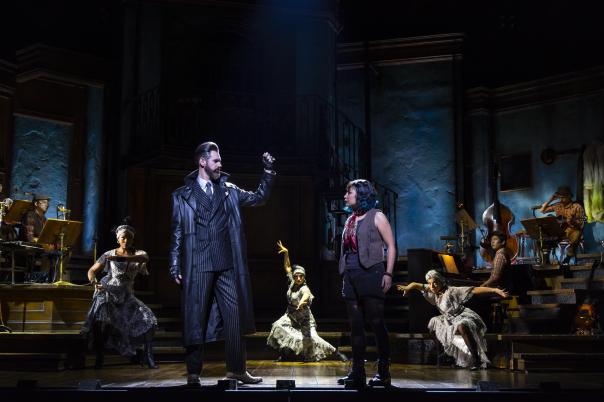
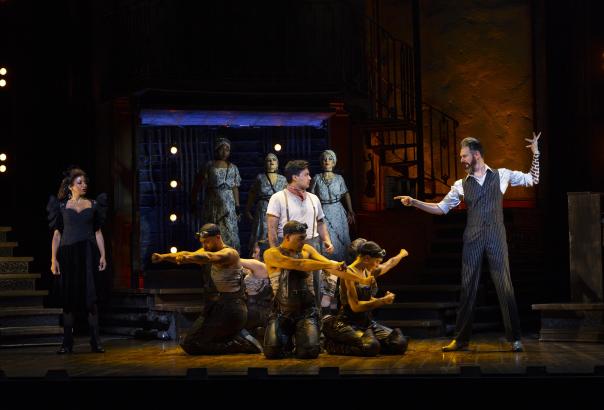
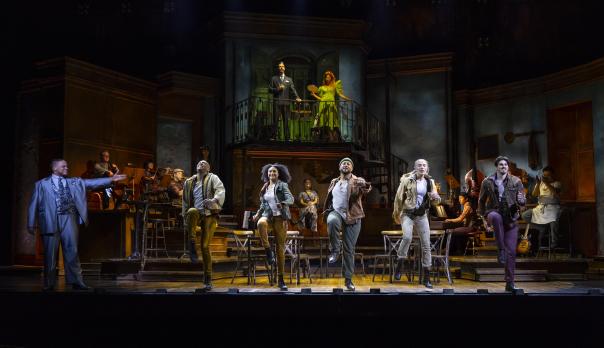
The last time HADESTOWN sauntered into town with its jazzy swagger was almost exactly 18 months ago, Election Day 2022. Perfect timing. When Matthew Patrick Quinn as King Hades brought down the Act 1 curtain with “Why We Build the Wall,” the thrust was so hideously Donald-like that two MAGA maniacs sitting in front of us, clearly offended, huffed out of Belk Theater and didn’t return after intermission.

Well, Quinn and his tectonic shelf-shaking bass baritone voice are back in the title role – the chief reason why my wife Sue would return to see Hadestown a third time if he and the Anaïs Mitchell musical should come back yet again. Yeah, he is that good. And even though The Wall is a bit in the rearview mirror as a national topic of conversation, the satanic aura of Hades still adheres to the corrupt kingpin of the GOP.

Maybe in a different way this time. More than Hades’ striking xenophobia, a strange attitude for a king of Hell, my lingering distaste was for the god’s rabble-rousing dictatorial strut. #MeToo was probably past its fullest bloom in 2022, though it still weighed on the elections, but in 2024, I couldn’t help paying closer attention to Hades’ “Hey, Little Songbird” propositioning of Eurydice.

When she eventually followed the slick monarch to the Netherworld and climbed the stairs to his boudoir, where she would sign away her soul behind closed doors… Yeah, Eurydice’s slow assenting ascent turned my thoughts northward to Stormy Daniels testifying in a Manhattan courtroom earlier that day in the hush money trial. Another little songbird.

To dwell on how deeply Hadestown resonates with the American political scene is to ignore that it first workshopped in New York before the master of Trump Tower declared his candidacy. It also disrespects how well Mitchell retold the story before it developed its adhesive powers. We see Quinn as Hades soon enough, but he doesn’t assert himself until he becomes impatient for Persephone’s annual return to the underworld after she has brought on spring and summer here above.

Until then, Lana Gordon as Persephone and Will Mann as our host/narrator Hermes are the prime charismatics. Next to their flamboyance, Orpheus and Eurydice are rather tame, despite J. Antonio Rodriguez’s pure high tenor and Amaya Braganza’s street-urchin perkiness. Musically, Mitchell lavishes her best invention on Hades and Orpheus, which makes sense since Orpheus has always represented the power of music while Hades, alias Pluto, has always stood for mindless greed.

Gordon and Mann are expected to light up the stage with their outsized personalities, their pizzaz, and eye-popping color – costume designer Michael Krass’s best – chief reasons why Hadestown rolls along so grandly, backed up less brashly by Braganza’s kooky charm and Rodriguez’s botanical magic.

But Mitchell’s book is also provocative, darkly portraying the world above as stricken by an apocalyptic nuclear winter or irreversible climate change, needing Orpheus’s musical magic to set things right and Eurydice to supply him with inspiration and encouragement to finish his cosmic song. The core of this world-changing song, appropriately enough, is wordless. Mitchell gives us a nice touch of the universal here.

Mitchell herself was the original Eurydice when her show first surfaced in New England in 2007. For me, that explains the most annoying, least enduring traits of Hadestown: its devout unpretentiousness and its dogged determination never to proceed too far without undercutting itself and reminding us that this is merely theatre. We’re having a party, y’all! Have a drink!

All the musicians are perennially onstage with the actors, particularly the ponytailed Emily Frederickson, who occasionally sashays among the cast with her trombone when called upon for her tastiest licks. For backup vocals, three more angels are engaged as the Fates – Marla Loussaint, Lizzie Markson, and Hannah Schreer – all of whom pick up various instruments during the evening. Could we have Orpheus trudging out of Hades, a fearful but trusting Eurydice behind him, without being tracked by a backup group?

Mitchell and director/developer Rachel Chavkin apparently didn’t think so. Maybe they’ve never experienced Christof Glück’s Orfeo ed Euridice at the Met’s Lincoln Center production, where the legendary newlyweds walk up a long, steep, irregular staircase splayed against the upstage wall, carrying torches to light up the tunnel.

Or perhaps they had seen that opera and realized that youngsters in the audience, not knowing how Vergil and Ovid told the tale, would be bummed by the tragedy if Glück hadn’t appended a happy ending. The whole evening seems cushioned by Chavkin and Mitchell’s worry that they might lose a key demographic along the way if the seriousness of the tragedy remained undiluted by mirth, merriment, and David Neuman’s most festive choreography.

Not to worry, when the Fates take their toll, the hearty, genial, and avuncular Hermes will be there to console Orpheus and all his bummed fans. Along with a big brassy jazz band. Raise another glass!

Shakespeare, Airplanes, and Jazz in CP’s “Twelfth Night”

Review: Twelfth Night at the Parr Center

By Perry Tannenbaum

Shakespeare’s best comedies are bursting with multiple plots, and two of the most perfect – A Midsummer Night’s Dream and Twelfth Night – are the most dizzying and delightful. It is quite likely that the latter, later work was first performed on Twelfth Night of 1601 to celebrate the newborn century on January 5 (with a singing clown suggestively named Feste). Yet time, scholarship, and heavy-handed dramaturgy have tended to darken many modern-day productions.

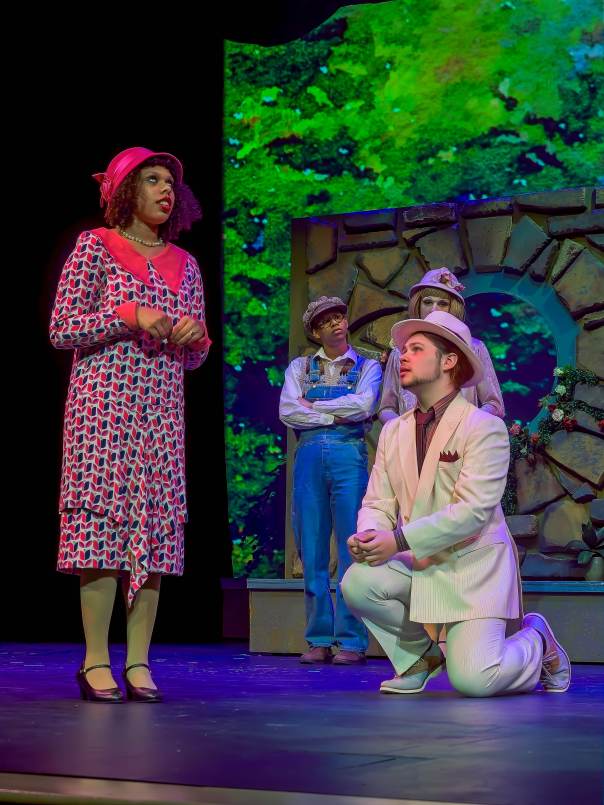
That’s why the current Central Piedmont Theatre version at the Parr Center, adapted and directed by Elizabeth Sickerman, is so refreshing. Twelfth Night has at least four main plots: Viola’s separation and reunion with her twin brother Sebastian, Duke Orsino’s unrequited love for the widowed Countess Olivia (seconded by Sir Andrew Aguecheek), Viola’s crush on Orsino while disguised as his manservant, and the wicked prank concocted by Aguecheek, Sir Toby Belch, Feste, and Maria to send Olivia’s ambitious and party-pooping steward, Malvolio, to the madhouse.

Of these, the most dominant plot should be the Viola-Orsino mess, for it sprouts so many delicious complications. Acting as Caesario, Orsino’s servant, Viola is dispatched to to Countess Olivia’s manor to plead on behalf of the Duke – only to have the Countess fall in love with her. Olivia’s inclinations toward Viola/Caesario not only enflame Orsino’s jealousy, they also lead to an absurd duel with fellow coward Sir Andrew. Meanwhile, she encounters Sebastian’s close friend, Antonio, who puts all his money in Viola’s care, mistaking her for her twin. You can easily imagine what happens when Sir Andrew makes the same mistake.

Ultimately, the mistaken identities reach the giddy point where Olivia cannot recognize her own husband just hours after their marriage. Ah, a honeymoon to remember.

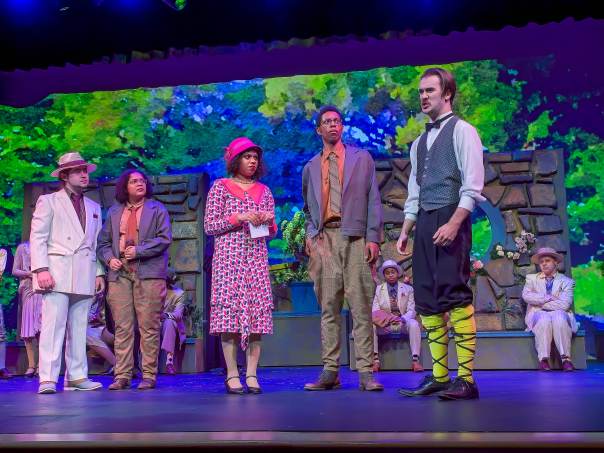
So to tip the balance toward empathizing with Malvolio, simply because he is incidentally berated as “a kind of puritan,” is rather perverse. Elsewhere, I’ve seen the steward outfitted with a Puritan’s hat. Far more stupidly, I’ve heard a theatre sage say Malvolio was modeled on Lord Protector Oliver Cromwell, born in 1599. Thomas Cromwell, Earl of Essex (1485-1540), instrumental in the English Reformation, is a more feasible candidate. Sickerman not only discards such nonsense, she transports the action from ancient Illyria, at the heel of Italy’s boot, to a coastal town immersed in the Jazz Age.

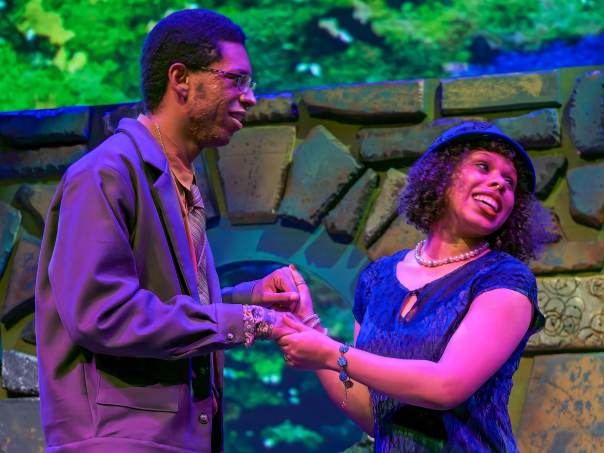
Costume designer Emily McCurdy certainly goes with the Roaring 20’s flow. Orsino and Olivia could easily pass for the recently reprised Gatsby and Daisy Buchanan on Broadway, surrounded by flappers and jazzy gallants galore. The moving pieces and projections of Jennifer O’Kelly’s scenery, more evocative of summer than winter, have enough classic detailing for Viola to sit at the foot of an Ionian pillar when describing herself sitting like “Patience on a monument.”

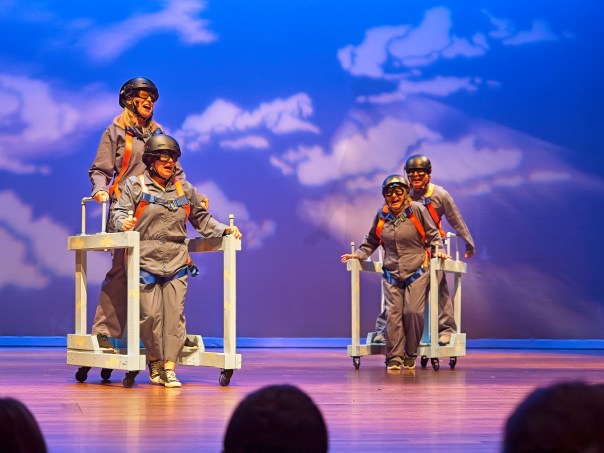
Nor does the music veer from the vintage of Prohibition days. Montavious Blocker has choice cuts of Duke Ellington and Sidney Bechet in his soundtrack, and just a few bars of music arranger Matt Postle’s chart for “Come Away, Death,” transformed from a lover’s lament into a jivey jump tune, are enough to conclusively vanquish melancholy, injecting Feste’s song for the lovesick Orsino with catchy mischief. The debris downstage suggests an Amelia Earhart plane crash rather than Shakespeare’s original shipwreck, and Charles Lindbergh could have inspired Sebastian and Viola’s matching outfits. Except for the tacky slacks.

If you’ve seen Twelfth Night before, Sickerman cordially adds to the Bard’s dizzying layers of identity, cutting some expositional text and casting females in key roles. Not one of them is a Chickspeare alum. Saskia Lewis as Feste, Rhianon Chandler as Antonio, and Kameal Brown as the recklessly unknighted Dame Toby Belch are all QC newcomers to me. If only Aryana Mitchell, portraying Viola, had an identical twin sister to take on Sebastian!

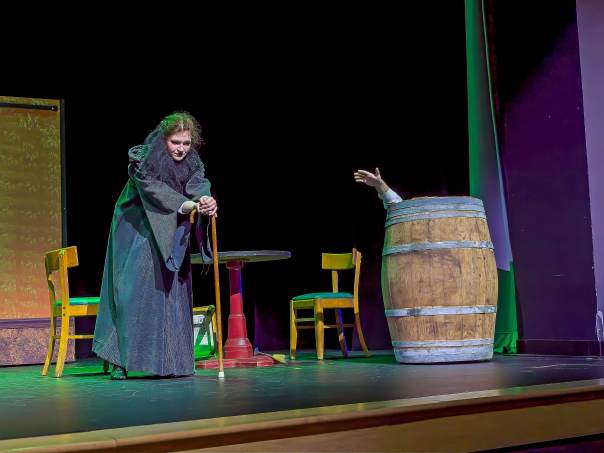
We are centuries away from the Protestant Reformation or the English Restoration, although Sickerman seems to beach the sibs closer to the Pilgrims’ beloved Plymouth Rock than to the Adriatic coast. Such oceanic distancing frees Malvolio from a dungeon of scorn when Central Piedmont’s plotters and nobles plunk their preening steward into a humble barrel to punish his prudery.

He isn’t the clown among the comical group, but Sickerman allows Truman Grant as Malvolio to loosen up, so that his usual rigidity is now almost elegance, mockable now as uppity pretense. Another sign of Sickerman’s lighthearted touch: her pick for the incredulous Sebastian is Timothy Snyder, who is at least a foot taller than his “twin.”

The disparity was so great, that I didn’t catch on at first. Brown’s outfit as Dame Toby, more like Miss Marple than a Falstaffian drunkard, compounded my early confusion, making me feel like newbie to the comedy while I got oriented. Struggling to remember a single instance when the euthanized CPCC Summer Theatre ever presented such a challenging comedy, I stumbled upon another reason why this excellent production was so refreshing.

All the cast was youthful, like the summer college grads who swarmed to Charlotte during CP summers to launch their pro careers. Not one old-timer in the bunch!

As a result of coping with all the period, costume, and gender changes, my disorientation was dispelled at the same time that I was learning to trust the youngbloods performing at CP’s New Theater, which has thankfully replaced panoramic Pease Auditorium but lamentably failed to showcase nearly as much CP talent. The mental training wheels that I had doled out to all these student efforts quickly flew away.

But along with a lightened, more secular and decadent Malvolio, there was newfound pleasure in the other creatures onstage who no longer needed to orbit around the self-absorbed steward. The Malvolio miasma that I’d felt since my first encounter with Twelfth Night in a college Shakespeare seminar, taught by a professor victimized by the prevailing obsession with the “puritan,” finally evaporated.

Twelfth Night, or What You Will has always been an awesome comedy for me. Now it was fun. I’d barely appreciated the bounty of fascinating character sketches that the Bard serves up here.

Now Viola is the patient, softspoken eye of the storm, and Mitchell is keenly sensitive, alternately anguished and bemused by all the passion and folly that surround her. Mitchell’s discreet takes, shared with us, make her a sort of co-emcee with Feste, though Sickerman asks too many eyerolls from her. Fitz Fitzpatrick is only slightly over-the-top with the lovesick gushings of Orsino, chiming well with a lounging Duke or a mob boss. Yes, that sleek robe has a Godfather aura before we see Fitz in the Gatsby threads.

As Olivia, Arianna Zappley does not yield at all to Fitzpatrick in regal dopiness. The two are as perfect a matching pair as the twins, made for each other, yet both are insanely lucky to land one of the sibs. Rounding out the symmetry of the two couples as Sebastian is the disproportioned Snyder, who does manage to nearly equal the calm of his diminutive twin – even though the Illyrians mistake him for her over and over. Playing Sebastian’s closest friend, the wrongly arrested Antonio, Chandler helps the prisoner to emerge as a neat counterweight to Malvolio, who is rightfully chastised for his presumption, though the penalty is too harsh.

There’s a little more slapstick flavor to the motley crew who bedevil Malvolio – and a bit more spice. Evelyn Ovall as Olivia’s waiting-gentlewoman Marie, who forges her mistress’s handwriting in the billet-doux that entraps the detested steward, is destined to marry Brown as Dame Toby. I’d like to think Ellington and his orchestra would have consented to play at the wedding reception, but I’m not sure.

Dopiest of the conspirators and clearly the least self-aware is Salim Muhammad as Sir Andrew, usually exiting with an absurdly military goosestep. In his challenge to Caesario/Viola, Muhammad now dons boxing gloves instead grabbing a sword, magnifying his ineffectuality with his effeminate pawing as he briefly combats the well-matched Mitchell.

Lewis effortlessly steals nearly every scene she appears in as Feste, convincing me along the way that this clown was intended to upstage all others. Not only does Feste sing lyrically and wittily – compared to the other lovers who barely stammer their effusions – she proves to be a better actress than the leading lady, Viola. Visiting Malvolio at the mouth of a barrel he believes is dark hell, Feste gives bravura performances as Sir Topas, a parson supposedly sent to determine how mad this lunatic is, interspersed with imitations of a sincere jester. Lewis cackles and coos this cruel vaudeville as bewitchingly as she swings death, ranging further than anyone else.

Photos by Perry Tannenbaum

“Mrs. Doubtfire” Flips Wacko to Wisdom Overnight

Review: Mrs. Doubtfire at Blumenthal Performing Arts

By: Perry Tannenbaum

Pardon me a second, but I seem to be noticing stretch marks on my suspension of disbelief. Three nights before the curtain rose on the touring version of Mrs. Doubtfire that rolled into Belk Theater, I saw a rather fine production of Twelfth Night across town at Central Piedmont College. Since both of the brief runs include at least one matinee between now and Sunday, my experience of seeing two wives who fail to identify their true husbands can be intensified, compressed into the space eight hours, if you wish, after my relatively relaxed 75-hour exercise.

In Shakespeare’s 1601 comedy, Olivia marries Sebastian – much to his delighted befuddlement – the twin brother of the disguised Viola, the woman who has actually smitten her. Later, on the same day of her wedding to Sebastian, whom she believes is Caesario (!), Olivia encounters Viola still in her disguise, who has the gall to deny they are married!

In the 1993 film starring Robin Williams and in the Broadway musical adaptation of 2021, the mix-up occurs earlier in the action – but after a lengthy Daniel-and-Miranda marriage that has produced three darling Hilliard children from its intimacies and one bitter divorce from its hostilities. The set-up for Daniel’s makeover zoomed by so quickly on opening night that, aside from throwing his son a super birthday party despite Mom’s insistence that he was grounded for his poor school grades, I really didn’t grasp how he had gotten Miranda so pissed.

Not that I blamed her. Rob McClure as Daniel was so hyper, manic, and over-the-top in his early scenes, like a cut-rate Robin Williams in his early nanu-nanu years, that it was easier to wonder why Miranda had married him than why she would file papers. This is one grating, irritating, self-absorbed dude who is spoiling his kids, always “on” in his daddy role, like a badly misfiring Williams improv shtick on latenight TV. Until suddenly, like in an epiphany, he hears the family court judge’s decree and finds himself poignantly pleading for a greater share of his children’s lives.

his is only the beginning of Daniel’s lightning-quick transformation, for it isn’t going to be merely skin- or mask-deep. In Mrs. Doubtfire, to be fair, Daniel is really trying so hard to deceive Miranda – and regain his precious access to his kids, who clearly matter more to him than their mom. So he commandeers all the advanced mumbo jumbo of modern makeup science via his gay brother Frank and his partner Andre. A true artist, he proceeds to artificially boost his bustle and decks himself out as a ragout of Miss Marple, Margaret Thatcher, and Julia Child. With a Scottish accent.

Meanwhile, our playful Daniel sabotages his ex’s email search for a nanny (a bit nasty, really) and moves himself to the head of the line of nanny telephone applicants, impersonating all the losers before shining as Mrs. Doubtfire, a name he improvises on the spot. Cunning and very much in character, except that he’s suddenly catering to his ex-wife instead of blithely ignoring her.

The nanny who appears at the Hilliards’ threshold for “her” in-person interview not only fools Miranda, he also fools his three kids. Well he might. This nanny is not at all Daniel anymore. The voice, the tempo, the personality, and the parenting approach are all radically different. Instead of his previous happy-go-lucky, laissez-faire practices, he now leapfrogs Miranda and becomes sterner, stubborner, and more demanding than she ever was.

Conceived as a stopgap avenue to his children while he regains Miranda’s trust, Mrs. Doubtfire succeeds beyond Daniel’s dreams. She’s a godsend, not only as a caretaker, but as a friend, confidante, and a chef! Miranda cannot remember when she was so happy and wouldn’t ever dismiss Mrs. D in favor of Daniel, no matter how thoroughly or sincerely he has reformed by the time the judge reconsiders custody.

This irony brings no consolation to the kids. As long as the Mrs. Doubtfire ruse continues to deceive them, they are missing their dad. The son, Christopher, has lifted his grades under the new nanny’s guidance, but he still blames himself for the divorce.

So it’s a mercy that Chris and his older sister Lydia accidentally figure it out after a few weeks. A louder tinkle in the toilet on opening night would have made it clearer how this happens.

Otherwise, the show ran better than I expected, rewarding my suspended disbelief with some zany antics and absurd predicaments. Thanks to a humorless family court social worker and an equally stolid TV showrunner, who merely doesn’t display her amusement, Daniel is forced to portray himself and Mrs. Doubtfire simultaneously on two occasions.

These crises force Daniel to enlist emergency assistance. When Romelda Teron Benjamin pops up as the frightfully upright Wanda, the social worker, for a home visit at Daniel’s shabby new apartment, Frank and Andre also show up fortuitously when Wanda wishes to interview both Daniel and Doubtfire. Aaron Kaburik as the brother is the more frantic of Daniel’s speed dressers, unable to tell a lie without raising his voice to fortissimo. Nik Alexander as Andre is the calmer and cleverer of the two, with a soupçon of flare, saving the day by secretly whipping out his cellphone.

Daniel’s second crisis builds slowly to a wonderful catastrophe as Stuart, the hunky new boyfriend, invites Mrs. Doubtfire to join him and the family to celebrate Miranda’s birthday – at the same restaurant where Daniel must meet with Ms. Lundy, the TV producer, to discuss a new series built upon his improvised personae. Once again, Frank and Andre are recruited for the quick changes – maybe in the ladies’ room. Fearing what Mom will or won’t see when she goes to see what has become of Doubtfire, Giselle Gutierrez and Sam Bird (alternating with Axle Rimmele) as the elder sibs must spring frantically to the rescue, reassuring a dubious Miranda that all is well.

McClure does his best work during this hectic denouement, and against all odds, we don’t absolutely despise Maggie Lakis as Miranda, though we’re rooting against her all evening. She and Benjamin eventually melt appealingly. Aided by Daniel’s conspicuous indifference toward his ex, despite Doubtfire’s meddlesome jealousy, Leo Roberts gradually gains our favor as Stuart, even if he is pumped-up and comparatively normal.

Music and lyrics by Wayne and Karey Kirkpatrick do little to elevate or damage the script adaptation by John O’Farrell and Karey K, which not only gives Andre a cell but equips the Hilliard home with wi-fi and spoils the kids with various screens, apps, and video games. No melody stuck with me, but I liked the energy of “Make Me a Woman” for Daniel, Frank, Andre, and ensemble. “I’m Rockin’ Now,” with Mrs. Doubtfire fronting the ensemble, brings us handsomely to intermission.

Two other comic gems can be commended, Jodi Kimura’s stone-faced turn as producer Janet Lundy and David Hibbard’s lachrymose portrayal of Mr. Jolly, the kiddie TV host that Daniel is destined to replace. Hibbard is like a Captain Kangaroo who long ago lost his hops, hopelessly lapsed into senility. It was generous of the writers to keep Jolly employed on the new show.

Private Anguish and Global Triumph Keynote “Everybody’s Got a Story”

Review: Everybody’s Got a Story at VAPA

By Perry Tannenbaum

If you like taking things apart and seeing how they work, there’s an interesting tension at the heart of Everybody’s Got a Story to Tell,the new Charlotte’s Off Broadway production at the VAPA Center. COB producer Anne Lambert describes it more accurately in her subtitle, “The One-Person Play Project.” Then if you apply a QR code reader to your program leaflet, you’ll find that Lambert pulls against the marquee title when she observes that, for some, performing onstage for an audience is a dreaded terror while for others it’s an addictive drug.

Onstage – or on The Moth Radio Hour – baring yourself to the world can be an exhilarating high, especially when you’re showered with laughter and applause. But it turns out that, although we’re certainly watching folk in the addict category, they’re not always telling us their own story. Or blurting it out to us compulsively as might be implied by Everybody’s Got a Story to Tell.

No, when you scan the three titles of the playbill, you’ll hit a roadblock to that confessional concept at the bottom of the page where you discover Eartha Kitt: Cotton to Caviar, written and performed by Toi Reynolds-Johnson. Before that title explodes any notion of a purely soul-baring evening of personal trials, the first play of the evening, Reflection: The Musical might detain you momentarily. Many, many confessions have been crafted into song. But not spontaneously. We know better.

Enriching this impure brew of personal effusions, the names that precede the titles splashed in yellow mustard typeface come into play: director Rob Coppel behind the scenes and PJ Barnes, very much up front as our host. Before we watch Reynolds-Johnson, Spencer Hawkins, and Tyler Wills perform the works they’ve written, Coppel and Barnes conspire to glue the disparate pieces together into a cohesive whole and conjure up the illusion of a natural flow.

Barnes as our emcee actually precedes us into COB’s VAPA nook, welcoming us as we enter and encouraging us to make ourselves at home. So briefly, we are part of the show for those who are already seated. The transition between greeter and emcee is as smooth as possible as the lights dim and Barnes starts strutting the stage in his more prestigious persona, weaving our everybody’s-got-a-story theme. How much of this BS is freshly improvised is hard to discern from whatever Coppel and the writer/performers have fed him in scripted form or as a sort of “head arrangement” as jazz musicians would call it. Whatever, Barnes is one slick and nicely turned-out dude.

The polished impression that Barnes makes contrasts nicely with the vulnerability Wills projects in Reflection, a glittery gay man who is freshly suffering the gut punch of a breakup and feeling the sting of a rejection that will linger for more than a month. After an opening communion in front of a vanity mirror, it’s very apparent that self-loathing is also prominent among Wills’ ills, for he resolutely removes his cruising gear – rhinestone high-heels, high-cut denim shorts with glitter belt, and matching pullover – in favor of workout wear that might be adopted during the isolation of a pandemic.

Double underlining Wills’ self-flagellation, he covers both his vanity mirror and a full-length mirror in shrouds. The powder room is transformed into a house of mourning, and reflection is now done by journaling. In a series of songs and vignettes, Wills is reliving his story rather than telling it. Dramatic intensity is paradoxically increased by Wills’ refusal to break the fourth wall and speak to us, but the intimacy of our encounter with the playwright/lyricist suffers as our peeping is prolonged.

Nor do the pre-recorded melodies, composed by pianist David Roach, dispel the oppressiveness of the 40-day vigil as Wills continues to pour out his anguish and bewail his betrayal. Three nights before Passover, the 40-day, 12-step slog toward self-acceptance and reaffirmation began to feel to me like the Israelites’ 40-year exodus in the Sinai Desert. I gradually despaired that the next song would sound much different from the one I was hearing.

Wills and Roach need to tighten up their collaboration. Or else they need to liven it up with a greater variety of mood and tempos. We’re convinced that Wills has a fine voice and vocal range while we’re frustrated at not seeing more emotional range. Another way to let more light into Reflection before the inevitable uncovering of the mirrors would be by letting us in, occasionally poking some holes in that fourth wall, breaking up the tedium of self-involvement. Just allow the piece to breathe in the here-and-now with occasional retrospective commentary.

Or maybe Wills and Roach overestimated the amount of suspense they were creating. More, please.

Notwithstanding Wills’ final affirmations, I welcomed back Barnes and his stylish patter with more enthusiasm than I’d anticipated. Hawkins and his You’re Accepted offered even more refreshing contrast, though it was also fueled by a breakup. Instead of grieving and self-quarantining, Hawkins deflected, launching into a series of spurious podcasts behind his laptop as if broadcasting his vocational and romantic woes to the wide world live from Davidson. After the parched drought of Reflections, we experienced a dizzying blizzard of sudden twists and turns, inexplicable leaps, mood swings, and casual reveals.

The more Hawkins revealed, the less authentic and autobiographical this confessional, by a Davidson College admissions officer, seemed to me. Cynical, cruelly dismissive, and burnt-out toward the pile of college admission essays on his desk, Hawkins was rather wickedly at-odds with the confessional mode of writing he was practicing himself.

Hopscotching as it does, Hawkins’ script defies a linear summary, likely because it has less to do with the troubles a college administrator has with women and his job, more to do with that cloistered academic’s difficulties in understanding and managing himself and what he’s doing. The quick pacing nicely supports our narrator’s caprices and indecision. What we wind up with is an artful and funny portrait of a peppy but unreliable narrator who lets down his guard often enough to clearly see both his charms and his flaws.

Of the two complete plays, Hawkins’ non-musical was better, but although Reynolds-Johnson’s Eartha was only presented in vignettes after intermission, it easily laid equal claim to the distinction of best on the bill. And where you had to wonder how autobiographical or authentic You’re Accepted and its admissions essays were, you could instantly perceive Reynolds-Johnson’s inspiration. Just look at her eyes! If she didn’t have the idea to portray Kitt on her own, somebody else surely suggested it. Likely on numerous occasions.

We can perversely suggest that R-J looks more like Eartha Kitt than Eartha herself, for when we see her as a child, born on a South Carolina plantation and rejected by both her parents in the opening Cotton scenes, she already looks like the woman she would become at the Caviar conclusion. And the powerhouse superstar who would one day bewitch Orson Welles, make Lady Bird Johnson weep at the White House with her Vietnam War comments, conquer Europe, and play Catwoman on the hit Batman TV series was never more than 62 inches tall.

R-J, likely no taller than her subject, revels in every phase of the Eartha bio. Even the digital playbill doesn’t say, but she’s probably as responsible for the spot-on costumes and props as she is for the writing – though Eartha wrote three autobiographies, plenty to glean from. Nor is R-J at all uncomfortable in sprinkling her various scenes and costume changes with frank narrative, engaging directly with her audience at times. Allowing the diva even more stature in her Caviar phase, Coppel brings Barnes back for one last hilarious shtick as the cabaret queen’s worshipful lackey. Although Adrienne Williams takes on her most prominent role here at the keyboard, we barely get a taste of the Evil One’s full repertoire in snippets of “C’est Si Bon” and “Santa Baby.” Just a cursory look and listen to the top stuff a Google search led me to was more than enough to convince me that there’s plenty of juicy episodes, from her tête-à-têtes with Welles to her verbatim White House harangue, remaining to be unveiled in the complete Eartha.As they stand, the vignettes at VAPA are very tasty and satisfying, but the complete Cotton to Caviar will be richer and spicier.

Photos by Perry Tannenbaum

Vampires and Trumpers

Reviews: Vampire Lesbians of Sodom and Thanksgiving: 2016

By Perry Tannenbaum

For devout upstanding citizens who had decided way back in the hippie ‘60s that Greenwich Village was an abominable den of sin, Charles Busch’s Vampire Lesbians of Sodom was a flaming and perverse poke in the eye. Or an argument clincher when it landed on Macdougal Street in 1985. The New York Times raved, the extravagant little trio of sketches became a cult obsession, and Vampire Lesbians had a five-year run.

Busch slipped away from his castmates when the review came out in the early morning after the Provincetown Playhouse premiere and had a good cry. Why did this diva desecrate his mascara? His career in theatre was now assured. He would write more outrageous comedies and send-ups that he, as the prima donna, could cross-dress and slay in, most famously Psycho Beach Party.

Vampire Lesbians made it to Charlotte at the Pterodactyl Club in 1991, after the slightly wholesomer Psycho Beach had paved the way during the previous year. George Brown directed this orgy of sacrilege with fiendish glee, while Innovative Theatre co-founder Alan Poindexter starred with Keith Bulla as the titular vamps.

With the Rev. Joe Chambers carrying the torch for fundamentalism in the wake of Jim Bakker’s disgrace, Banktown was still a very Christian place. It was my sacred duty to bring my daughter, not yet bat mitzvahed, to see Poindexter in all his counter-culture glory. After beholding the kinky wonders of Psycho Beach, my Ilana would have kissed Alan’s feet.

Flash forward to 2023. Poindexter is gone and the Pterodactyl Club, the one-time cultural capital of Freedom Drive, is goner. But thanks to Nicia Carla and her PaperHouse Theatre, Hollywood antagonists La Condesa and Madeleiné Astarté (a Succubus and a Virgin Sacrifice back in their Sodom days) are undead again!

Taking on Busch’s mantle, Carla directs and stars in this stunning revival at VisArt Video, tucked into the nether region of a strip mall on Eastway Drive – I’m trying to make this little suburban dive sound as risqué as the Pterodactyl! Walls are black as you walk inside, and hostesses in Goth attire and makeup are there to greet you. Whatever Google Maps has told you (it misled both me and my wife Sue on separate occasions), you can now be sure you’re in the right place.

Small as it is, the inner sanctum of VisArt is perfectly sized for Busch’s secret forbidden rites. The seats are soft enough to keep butt burnout at bay for 90 minutes, even if you don’t stretch for intermission and fall prey to the treats in the lobby. Yet sightlines are not ideal according to Sue’s scouting report.

The PaperHouse cast multitasks even more than Busch’s original ensemble, just six players covering the 14 roles instead of seven. All six are battle-tested in madcap comedy, so this outrage is hardly outside their comfort zones. Nicia probably hasn’t had this much fun onstage since Poindexter directed her as The Witch in Hansel & Gretel. She minces and manipulates here as the Virgin Sacrifice, growing regal and stentorian as theatrical megastar Astarté as she assaults the Left Coast. Opposite her, Ashby Blakely is a steely, sneering diva bridging four millennia as The Succubus, aging gracefully into La Condesa and crossdressing in costume designer Beth Levine Chaitman’s most outré couture.

That isn’t to say that Josh Looney and Charlie Carla are anything less than visions of decadence as Sodomite musclemen Ali and Hujar in complementary S&M outfits and Wagnerian wigs. Nicia is already fairly slutty in the opening sketch despite her somewhat revealing white dress, willing to break her hymen with Ali or cut a deal with the cave monster Succubus. Subsequent scenes in Hollywood and Sin City climax in a couple of startling onstage costume changes, most improbably by Tanya McClellan who snoops into La Condesa’s boudoir as gossip columnist Oatsie Carewe.

Gosh, it’s good to see McClellan back onstage in manic comedy mode. Squinting her snoopiness, she sniffs out the ungodly acts performed by Nicia as Astarté on La Condessa’s protégée, luminous Sarah Molloy as flapper Renee Vain, and her meddlesome boy toy, Looney as matinee idol King Carlyle.

Hard times for a vampire? You’ll need to come back after intermission for Blakely’s final transformations. Andrea King’s choreography, on loan from Jane Fonda, elegantly shows off McClellan’s dancing prowess.

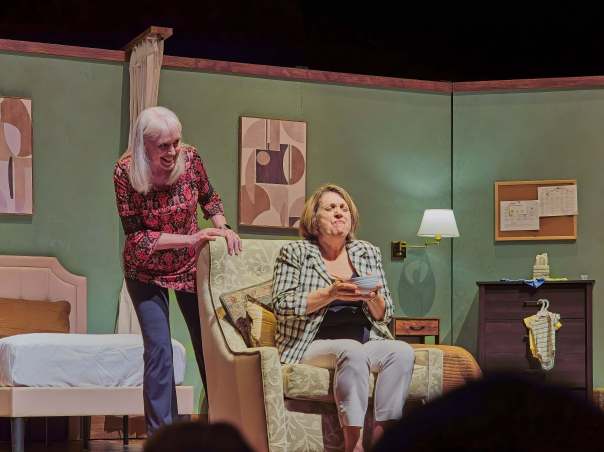
Anyone who reads advice columns or cruises social media at this time of year will have an accurate inkling of what Thanksgiving: 2016 might be about. Millions of Turkey Day hosts are wondering how they will keep opposing family factions from shouting their lungs out or coming to blows while the sharp cutlery is still on the table. Playwright Elaine Alexander smartly calculates that the situation is prime fuel for a dining room comedy – or tragedy – but the world premiere of Charlotte’s Off-Broadway production now at VAPA also reveals that the NC native had a tough time deciding which way to go.

Ground Zero for the annual onset of hosting panic was clearly in November 2016 when Hillary Rodham Clinton resoundingly won the popular vote for the US presidency while Donald Jefferson Trump won the Electoral College – and the White House – just as resoundingly. Liberals, Democrats, and rational folk are still in shock. Yet as Alexander deftly reminds us along the way, they are all blissfully unaware of the betrayals of good sense, rationality, rule of law, and democracy to come.

As the West family up in the liberal Northeast prepares to host young Eric’s girlfriend, riding up the highway from Alabama, the aroma of crisis already fills the suburban kitchen. Papa Harry, after diligently knocking on hundreds of doors crusading for Clinton, was hospitalized – either for a nervous breakdown or a heart attack – immediately after watching CNN declare Florida for Trump. The chief Turkey Day watchword from Harry’s physician is for wife and son to prevent the shell-shocked Hillary soldier from indulging his CNN addiction.

Taking to drink in the wake of her husband’s collapse, either out of worry or guilt, Renee has pretty much abandoned any serious intent to impress Brittany, the Southern belle she’ll be meeting for the first time. So it has fallen to young Eric to try to cook a luscious feast for his beloved, even though Mom hasn’t properly shopped for the occasion. Some improvising and substitution will need to be done. Worse, frozen will occasionally need to stand in for fresh.

Worst of all, Brittany voted for Trump, so Eric desperately hopes to keep talk of politics – the subject Dad is obsessed with and still agonizing over – away from the holiday dinner table. Harry has enough difficulty digesting that his son would date a girl from Alabama. Nor does Dad have enough self-awareness to realize that, in a reflexive action stemming from his years in community theatre, he mocks every Southern drawl he comes in contact with.

Finding out she’s a Trump voter could send him over the edge. Getting Dad to refrain from talking politics promises to be even tougher than steering him away from CNN. Finessing how to keep Brittany off the touchy subject is a bridge Eric hasn’t crossed yet.

As a director, Alexander casts father and son perfectly. Matthew Howie is a master of timorous anxiety as Eric. He can craft crescendos of panic and befuddlement while doing a hilariously awful job of warding off disaster with a shit-eating smile. Nor could we improve much on Tom Ollis as Harry. Since his 1997 debut at Theatre Charlotte in Arsenic and Old Lace, Ollis has grown into the most visible volcano on the Metrolina theatre landscape. Whether as Mr. Blonde in Reservoir Dogs, Sweeney Todd, or Titus Andronicus, Ollis is peerless at seething, suspecting, and erupting into towering, raving rages.

Since Harry is also a trial lawyer recently dismissed from his law firm because of his excessive zeal, Ollis can feast on numerous opportunities to cross-examine everyone in sight, bullying and browbeating every witness. Alexander’s women don’t get nearly as much scenery to chew, but her casting choices are nearly as impeccable.

Donna Norcross seemed to be battling opening night jitters early in Act 1 as Renee, but as Mom yielded to a multitude of wine refills, Norcross also relaxed, becoming quite powerful in the Act 2 denouement. Quite ripe for stereotyping, Michelle Strom as Renee entered the West home like a sudden ray of sunshine, without the preamble of a knock or a doorbell chime, her drawl as wide as the Mississippi. No, Dad could not restrain himself, nor could I blame him.

As you can imagine, the setup of Thanksgiving: 2016 is almost pure comedy – until the Trumper truth finally comes out, as an announcement rather than a shy confession, with the proud flourish of a cheerleader’s somersault. Looking from Strom to Ollis as we reach intermission, we can only wonder whether Dad will clutch his head or his heart.

But what can come afterward from our host, our hostess, and from poor Eric? Admirably enough, Alexander lets her characters carry her along across Act 2. But her impulse to bludgeon Harry with more secrets and uncomfortable turns this comedy upside-down. We transition, not very gradually, from a Neil Simon comedy of futile secret -eeping to an impactful series of revelations that conjures up Sophocles’ Oedipus, Strindberg’s The Father, or Albee’s Virginia Woolf. Those revelations are topped off by a  couple of increasingly jaw-dropping ideological rebukes to Harry’s smug liberalism that might shake you up a bit.

We seem to fall over a cliff here, with too little before intermission to prepare us for the high drama afterward. By the time the cast is taking their bows, Renee has radically transformed from a borderline bimbo into a pieta resembling Steinbeck’s Rose of Sharon on the final pages of The Grapes of Wrath. Instead of dumping us off a high cliff, I’d advise Alexander to lay down more track that would guide us around the mountain: a sudden dramatic swerve – not too sudden – would be more satisfying than this swan dive.

A visit to VAPA for Thanksgiving: 2016 is still worth it, delivering hearty laughs and a gasp or two. By all means, dig in!

Moulin Rouge! Welcome to the Megamix of Pops and Plots

Review: Moulin Rouge! The Musical! at Belk Theater

By Perry Tannenbaum

Even before the first downbeat, the musk of forbidden fruit fills the air at Belk Theater each night as Moulin Rouge! The Musical! readies to detonate. Against a scarlet backdrop and under a proscenium studded with vanity bulbs and panning red spotlights, scantily-clad chorines slink onstage, showing limbs and cleavages like ladies in Amsterdam’s red-light district slyly advertising their merch. Elegant tuxedoed gentlemen puffing on cigarettes enter at the opposite end, consumed by each other nearly as much as by the ladies’ legs.

The ban on taking photographs, policed by Belk’s ushers wielding official signage, is already in force as soon as the first glove and high-heeled shoe come into view.

Like our more raucous welcomes to Cabaret and La Cage aux Folles, what follows in leering silence is sexy and showbizzy,. The aroma of illicitness only increases when the music kicks in – unmistakably purloined from the Top 40 pops charts as soon as we hear “Voulez-vous couchez avec moi, ce soir?” for the first time. Why trouble to compose fresh tunes, like John Kander or Jerry Herman, when you can steal or lease pure gold from a multitude of hitmakers and hire a team of co-orchestrators led by arranger Justin Levine to stitch them together?

That’s what book writer John Logan has done in adapting and updating Baz Luhrmann’s gaudy 2001 film, with costume designer Catherine Zuber and choreographer Sonya Tayeh adding their sinful embroidery and panache. All of this talented team knows that mercenary greed is as much at the heart of Moulin Rouge as glitter and concupiscence. Labelle’s “Lady Marmalade” will soon be followed – inevitably – by Barrett Strong’s “Money (That’s What I Want).”

Our beautiful and consumptive heroine, Satine, wants to sell herself to the lecherous Duke of Monroth, but only because she mistakes the handsome young Christian, a budding songwriting genius from Ohio, for her buyer. Christian is no less smitten by Satine, but his prime motive for invading her boudoir, after witnessing her killer cabaret act, is to sell her on a musical show he has written with Henri de Toulouse-Lautrec and Santiago, a dashing Argentinian dude.

The nightclub glitz is interrupted by a detour to Bohemia, where we catch up on the Christian’s backstory with Toulouse-Lautrec, and preceded by the commerce behind-the-scenes between the two charismatics in the story – the predatory Duke and club owner Harold Zidler, our wicked emcee. Zidler, portrayed with garrulous savoir-faire by Robert Petkoff, hypes and sells his jewel’s charms, wheedling and boasting as he pimps. Since the financial fate of Moulin Rouge now depends on Satine’s success as a temptress, Zidler’s domineering mode is reserved for her.

Petkoff is marvelously matched with Andrew Brewer as the Duke. With a sinister sneer, Brewer aristocratically assesses and stalks his prey, hardly troubling himself to move around or give up his proprietary lounging position. Until he strikes like a snake when he takes his turn backstage in milady’s boudoir. In the wake of Satine’s onstage glitter – including “Diamonds Are Forever” morphing into “Diamonds Are a Girl’s Best Friend” before swerving into “Material Girl” – the Duke answers brutally with a Rolling Stones medley. Brewer pounces on “Sympathy for the Devil” and builds from there with “You Can’t Always Get What You Want” and a climactic “Gimme Shelter,” maybe the most savage and primal track in the history of rock.

If that weren’t enough contrast to dramatize the Duke’s first big splash, consider the sweetness of Christian Douglas as Christian, serenading Satine with Bizet, Offenbach, and “La Vie en Rose” during his pitch. That’s the business end of his visit after springing a new song on Satine that he has written just for her, Elton John’s “Your Song.” Christian is also a crack lyricist. Back in Montmartre, he’s doctoring a Toulouse throwaway into promising shape as “The Sound of Music.”

Lowered from the flyloft on a decorous trapeze after her extended build-up, Gabrielle McClinton gets every lift she could possibly need from director Alex Timbers’ staging to bedazzle the Duke, Christian, and her breathlessly salivating audience. To me, she’s a letdown in more ways than one. Given a megamix that evokes Marilyn Monroe, Madonna, and Beyoncé in a matter of minutes, Satine should be a goddess who commands the leading men’s adoration. But instead of mesmerizing, McClinton is… meh.

It would be hugely consoling to be able to report that McClinton’s tearjerking efforts as the dying Satine are any more riveting than her diva moments. But there’s a bit of a plot megamix going alongside the pop megamix, so McClinton’s opportunities to rouse our empathy don’t quite keep pace with Mimi’s in La Bohème or Violetta’s in La Traviata. Christian has framed what we’re watching as his story and Zidler wants everyone to care that the fate of the Moulin Rouge hangs by a thread.

Our wicked emcee is augmented by the lowlife charms of Nick Rashad Burroughs as Toulouse, Danny Burgos as Santiago, and Sarah Bowden as Nini, Satine’s sexy sidekick: reminding us that love and art desperately for sale. So there would be barely enough room for Satine to be both Mimi and Sally Bowles – or Violetta and Gypsy Rose Lee – even if there weren’t more than 70 songs on the playlist to navigate.

But there are more than 70 songs swirling at us, some on replays. Paradoxically that’s what saves this Moulin Rouge superstorm from itself despite the vacuum at its vortex. The fun is not only in the pacing, the spectacle, and the jets of confetti that that tops off Zidler and Luhrmann’s circus style of cabaret. It’s in our efforts as well, episode after twisted episode, to keep up with the anachronistic onslaught of melodies and lyrics that pelt us throughout the evening. By hearkening back to 19th century hits at one end of the spectrum and contemporary sounds at the other end, this epic playlist is cunningly engineered to confound.

Whether you are old or young, devoted to pop hits or the classics, whether or not you remember when rock was young or even have a clue what Tin Pan Alley was, you will face moments at Belk Theater when you’re asking yourself: have I ever heard this song before? and what the hell are they playing now? Because its score thrusts you far outside of how you normally absorb a musical, casting you out into the realm of memories, half memories, and speculation, Moulin Rouge succeeds at sucking you in. There’s no songlist in the playbill to cling to as you swim this ocean.

Even if you’re fully versed in Luhrmann’s film, you will likely be cast adrift or taken by surprise, for Logan and Levine haven’t stood pat. Not only Beyoncé, but also Pink, Sia, Lorde, Katy Perry, Britney Spears, Rihanna, Adele and others are mixed into the fresh brew. And Lady Gaga!?!

If you’re a Broadway or jukebox musical maven, there’s another sort of question you’ll be asking yourself. How did Elton John’s “Your Song” get in here when Sir E never had the chutzpah to put one of his megahits in any of his own musicals? Good grief, they actually got the rights to perform part of a Beatles song?

Teasing you out of thought on your drive home, you will likely continue pondering what you heard or may have missed inside the lacy valentine world of Moulin Rouge. Yes, Elvis and the Everly Brothers were covered, but what about Gershwin and Cole Porter, Charlie Chaplain and Fats Domino? Likely you’ll shuttle back to remembering that Nat King Cole and Whitney Houston were enfolded in this musical’s fond embrace. There were whiffs of Marilyn Monroe and Madonna.

That’s when you realize that Satine and the Moulin Rouge nightclub – the red windmill, if you need a translation – swept you away after all.

Normality Attacks a Serial Killer in Catch the Butcher

Review: Catch the Butcher with Post Mortem Players @ CATCh

By Perry Tannenbaum

Serial killers, wherever they prey on young defenseless women and girls, are universally detested, even by fellow criminals. Yet these monsters, vying with vampires in wickedness and cunning, surely have a captive audience that greatly outnumbers their victims. Identify one and he’s frontpage news, sure to draw breathless airtime on local and national TV. Invent one who is truly special and you may spawn a bestseller and even an Oscar winner.

Yes, the guilty pleasures of sopping up the gory conquests of killers at-large and thrilling in the hunt to stop and avenge their rampages are perverse addictions shared by millions. Our susceptibility to the lurid scent of butchery was more than enough license for playwright Adam Seidel to bring us Nancy, his sacrificial lamb in the grimly satirical Catch the Butcher.

Nancy doubles down on the audience’s unspoken perversion: she wants to be abducted by “the butcher of Harbor Park.” Night after night, she sits alone on a park bench deep in the darkness of that dreaded landmark, fearing that she will be stalked and longing for it. As directed by Heather Wilson-Bowlby in the current Post Mortem Players production at CATCh, the company’s first sally into the QC, Nancy is almost advertising her yearning.

She’s reading The Stranger Beside Me, Ann Rule’s account of her friendship with serial killer Ted Bundy, a classic in the true crime genre. Heather-Bowlby’s mischievous touch, we will learn, is especially apt because the Harbor Park butcher dabbles a little in literature, dedicating a poem to each of his victims. Nancy’s fandom runs deep, admiring the fiend’s verse and feeling an unspoken kinship.

Parallel to this literary thread, the action of the early scenes is dark, silent, and animal until the Butcher pulls off his abduction. The silence of this lamb, as her killer circles ever more closely around her, is not merely evocative of a silent movie creepshow, begging for organ music in the background. We come to realize that it was also like a National Geographic documentary depicting a mating ritual in the wild.

Throughout Nancy’s bizarre captivity, Seidel has his fun juxtaposing the sophisticated with the primal and the drudgery of domesticity with our natural savagery – to shocking or comical effect. Numerous twists are in store as this butcher-victim pas-de-deux develops, including at least one complete flip-flop. And why not, seeing that Nancy and the butcher of Harbor Park were actually stalking each other?

If you don’t scan the QR code on Post Mortem’s flyer before the lights go down, gaining access to the full digital “Slaybill,” you won’t have any idea of where the silent opening scenes are happening, who we’re watching, or when the action takes place. That heightens our suspense and delays the onset of humor we’d expect at CATCh (Comedy Arts Theater of Charlotte). You’ll know most of the details if you’ve read the script beforehand, but Wilson-Bowlby flouts the playwright’s insistence that we’re in the present day, giving her star headphones instead of earbuds and a boombox instead of an iPhone.

We’re no further back than 1980, when The Stranger Beside Me was first published, but the copy that Jackie Obando Carter is clutching shows considerable wear and age. Costume designs by Carter were no more decisive to my eyes in designating the decade. More impressive were the design and execution of special effects that Carter and Hilary Powell collaborated on: one stabbing was particularly impressive since, at CATCh, my wife Sue and I were seated as close to the action as we would be watching a card trick.

Carter’s chemistry with her abductor, Chuck Riordan as the Butcher, is deliciously volatile. The vibe is more spiced with sensuality on Carter’s end as Nancy tries to divert and charm Bill – revealing his name bares the first chink in the Butcher’s armor – as her survival instincts kick in. While Nancy is dazed and disoriented when she first awakens in the Butcher’s soundproofed dungeon, this is what she quested for during her previous vigils in the dark.

She is not like us. She needs prodding to scream her loudest and confirm Bill’s soundproofing. A knife at her throat as she sits helplessly handcuffed to a chair? Carter must calibrate the mortal terror that Nancy is experiencing with her fantasy fulfillment and delight. The more we realize how diligently Nancy has worked to be here, the more we appreciate the complexity of Carter’s performance.

Since she candidly lets out that the Butcher and his technique aren’t what she expected, Bill is also a bit disoriented as he realizes what he has stepped into. Being measured against the glamor and terror of Nancy’s dream serial killer begins to tilt his attitude toward defensiveness and appreciation. While maintaining his dominator role, he finds he must prove himself as a ruthless butcher and sustain the admiration his victim has professed toward his poetry.

Riordan, like Carter, is making his QC debut in a role that requires deft and sudden navigation. But he has significantly more leeway in how he portrays this monster as his vulnerabilities are exposed. He doesn’t get to be quite so sure of himself as the adventurous nothing-to-lose Nancy – deviations from glamor, savoir faire, and fearsome menace all redound in his favor as we see more beneath his façade. He’s an anti-villain, in a sense.

Riordon can thus roll with the moment and seem authentic so long as he doesn’t fumble his lines or visibly stumble in his actions. Especially in Bill’s domesticated scenes, Riordon can mute his paranoia and be altogether humdrum. There are key moments when Riordon is suddenly called upon to show a killer’s steel or a lover’s grace. He masters these with aplomb, and he’s strong on Bill’s telling trait: he wants to make his mark with his murders and his poetry, desperate for both notoriety and acclaim.

It would be heartless to give an even sketchy summary of how the story unfolds with Seidel’s unfailing logic. So let’s concentrate on a sequence that was pivotal for me.

To gain precious time, Nancy has convinced Bill that she wishes to hear the poem that was written about her. Bill not only picks up on the ploy, he notices that, compared with previous victims, Nancy isn’t as terrified when a knife is at her throat. She is not what he expected. He must consider the possibility that Nancy is a cop or an FBI agent, particularly after she escapes her handcuffs to use the toilet.

Fast forward a bit past some juicy action, one of them with French toast, and Bill has finished his new poem. We haven’t sampled the Butcher’s literary craft before, so we presumably know less about what we can expect than Nancy. “A Single Rose,” as Bill titles it, is recognizably dreadful – so dreadful that I initially suspected that the serial killer was laying a fiendish trap for our lady in distress, testing whether her esteem was worth having.

Asked for her reaction, Nancy comes back with an utterly hilarious, magnificently audacious response: “It’s not your best work.”

At this point, we had reached a realm of dark humor that was unfamiliar to me. In perfect style. From here, Seidel could take us wherever he wished – even upstairs, out of the Butcher’s dungeon, to a new household.

In the aftermath, we get to know the couple’s next-door neighbor, Joanne – a bubbling busybody portrayed by Jennifer Briere, yet another talented Post Mortem newcomer. She enters through the front door with a bundt cake, then a vase filled with freshly cut roses, seemingly well-acquainted with the welcoming-new-neighbors drill. Briere is especially precious when Joanne learns how Milwaukee, wherever that is, differs from Texas. You will see that all the audacity Nancy has shown us before is eclipsed the moment she dares to open the front door for Joanne, defying Bill’s stern commandment.

Reviews of Catching the Butcher sometimes cite Silence of the Lambs as an inspiration and inevitably Dexter, because the original Nancy in the 2015 Off-Broadway production, Lauren Luna Vélez, was a fixture in that series. If you’ll permit a more classical viewpoint, Seidel’s macabre comedy reminded me more of John Fowles’ The Collector, may favorite horror novel alongside Dracula. Bill is more of a scientist than Hannibal, less of a gourmand.

The household idyll we see blossoming after intermission, with its undercurrent of doom, took me back to prelapsarian Adam and Eve, with snoopy vivacious Joanne subtly installed as our Serpent. Wilson-Bowlby may have been feeling similar vibes as she staged the ending, giving it more of a wedding or honeymoon tang than Seidel could have imagined. Quite wonderful.