Category Archives: Dance

Two Pieces by Sasha Janes Highlight Charlotte Ballet’s Innovative Works

Review Dance: Charlotte Ballet’s Innovative Works and Its Tribute to Jean-Pierre Bonnefoux
By Perry Tannenbaum


Twenty years is a long time in the history of a dance troupe – four or more generations for Charlotte Ballet if you calculate how long the typical dancer remains before moving along or retiring. Charlotte Ballet’s artistic director, Jean-Pierre Bonnefoux, is taking the latter route after 20 seasons at the helm, an era during which excellence was admirably sustained while the organization grew in strength, most notably in its facilities and educational programming. So it was appropriate to dedicate the latest iteration of Innovative Works as a special tribute to Bonnefoux, not only because this annual showcase of new, exciting, and intimate works was his brainchild but because its current home has been the Patricia McBride and Jean-Pierre Bonnefoux Center for Dance since 2011. There’s no better place for Charlotte Ballet to celebrate.

When Bonnefoux first divulged his imminent fadeout to emeritus status a couple of years ago, he told me that he wouldn’t be choreographing any new pieces, although some new wrinkles were evident in the million-dollar makeover of his Nutcracker last fall. There were no surprises in the 2017 crop of Innovative pieces. The in-house feel of the programming still remains intact, all of the choreographers hailing from within the Charlotte Ballet orbit without any unexpected debuts.

The program began and ended with pieces by associate artistic director (and resident choreographer) Sasha Janes, whose pieces continue to grow more intriguing every year. In between, there were works by Mark Diamond, director of Charlotte Ballet II, Sarah Hayes Harkins, a longtime principal in the company, and David Ingram, a fondly-remembered alum. Continuing the tradition of recent years, each of these choreographers cut an intro that was projected on the side walls of the McBride-Bonnefoux studio before each dance began. Since Janes’ “Hallejujah” was a reprise from last year, Bonnefoux took the opportunity of subbing for Janes, reflecting back on his Innovative series while introducing a piece that was well worth its revival.

170126-peterzay48-web

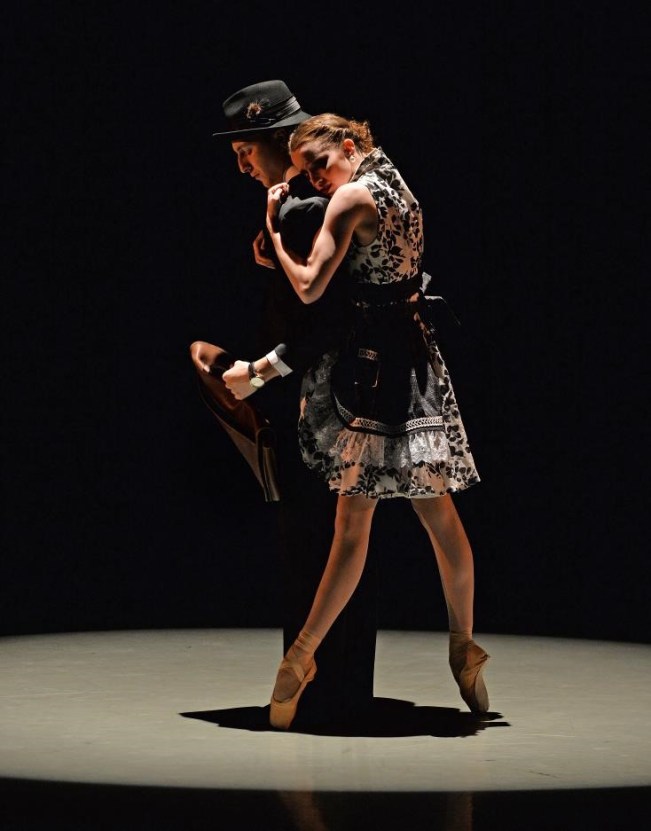
Opening the program, Janes’ “Utopia” was a startling piece to come from a man who spent his formative years in Australia, born more than a decade after the songs on his playlist – by The Platters, Link Wray, Patience & Prudence, and The Teddy Bears – found their way to jukeboxes on 45 rpm discs. The Aussie’s erudition with The Platters is particularly impressive in his sardonic look at 1950’s American domesticity, where everything wasn’t the Father Knows Best bliss that Eisenhower voters would have us recall. “No Matter What You Are,” the song that bookends Janes’ piece, isn’t at all among The Platters’ greatest hits. For over a half century, it has been hidden in plain view on the flipside of “Smoke Gets in Your Eyes” – a clever hint that we’re watching the flipside of the Ike Era. With Elizabeth Truell as the Wife and Josh Hall as the Husband, we watch the typical morning scene of seeing the family breadwinner off to work. Only there was some visible desperation from Truell as she clung to her husband, handing him his hat and briefcase, the devoted housewife gone slightly berserk. Hall was visibly impatient and eager to go, irritated with all the affectionate blandishments, but as we adjourned to his office with “The Great Pretender” (The Platters’ breakthrough hit), we could see that the Husband was suffering from frustrations – and neuroses – of his own.

170126-peterzay150-web-1024x774

Enter Jamie Dee Clifton as the Secretary, to the beat – and power chords – of Wray’s “Rumble.” Her attempts at seduction got a far more welcome reception from the Husband, though there were definitely some signs of distress as he absorbed the vamping. Yet with Patience and Prudence’s “Tonight You Belong to Me,” there could be no doubting Secretary’s conquest, though the necking session was interrupted by a phone call from the patiently waiting Wife back home. Truell’s ensuing solo, begun on the couch of her Psychiatrist (Michael Menghini) was the most sensational segment of the suite for me, savagely contrasted with the cuddlesome harmonies of The Teddy Bears’ “To Know Him Is to Love Him.” The frenetic energies that preceded this therapy session came to full boil, overflowing into a primal scream that Truell delivered into the unresponsive shrink’s face (before he presented his bill). As Janes predicted in his intro, the repetition of “No Matter What You Are” and the bizarre morning send-off took on an added level of irony as we saw so much more clearly how the lyrics applied to the married couple’s daily ritual.

fix_1008-5717-web-1024x683

The other works that preceded intermission weren’t as daring, ambitious, or satisfying. Set to a Chopin favorite, Harkins’ “Gemini” never convinced me that we were seeing two aspects of the same individual, and the promised improvisation element eluded me altogether though the performances by Drew Grant and Ben Ingel were certainly intriguing. Part of the problem was the damage that the McBride-Bonnefoux acoustics did to Ingel’s monologue when he ventured into the audience. Not sitting in the center sections, I hardly understood a word. Nor could I tell what it was that Grant replied from the stage or determine whether it echoed what his partner had just spoken. In this one respect, Booth Playhouse, where Innovative was staged 1998-2009, was a better venue, though it was no better for pre-recorded music and less hospitable for lobby receptions. “Ever After” by Diamond was a better showcase for Harkins’ talents as she partnered with Hall in an abstract piece about the transition to afterlife, set to music by J.S. Bach, Ivan Spassov, and Karl Jenkins. Destined to partner in the program finale later in the evening, the Harkins-Hall duo stole most of what was left, in the wake of Rose Nuchims’ lighting design, of the focus that could have gone to the three other couples onstage. Another barrier to full appreciation was the language barrier, Bach’s German and Jenkins’ Latin.

fix_1008-4071-jeff-cravotta-web-1024x682

Following the hypnotic ecstasy of Diamond’s piece, Ingram’s new “Flamouriá” after the break was rousing and refreshing, set to the music of Luigi Boccherini, which deserves to be heard more often. The modern visuals – huge balloons suspended over the action, projections on the rear wall – clashed provocatively with the 18th century score, and a certain amount of sloppiness was built in to the concept. Movement by four couples, led by Alessandra Ball James and James Kopecky, was by the dancers, “curated” by Ingram. This sparked numerous questions as I watched. Like the other works on the program, “Flamouriá” will be danced by multiple sets of dancers as Innovative continues it run through February 18. So, will the movement change to accord with the other set of dancers – and did Ingram allow his performers any latitude, or multiple choices, in their movements? Unfortunately, some of the sloppiness I witnessed was layered on by the new projection technology that was lavished on the piece. Most of the video was blurry and, at times, edges of the projections cut randomly and inelegantly on the rear screen, stealing focus from the dancers. I’d also thought that those massive white balloons might double as projection surfaces – a potential that went unfulfilled. There were some special moments when Nuchims’ lighting was uncluttered by the new gadgetry, most notably when the dancers became silhouettes against the ginormous backlighting of the rear screen.

1454643066_crop

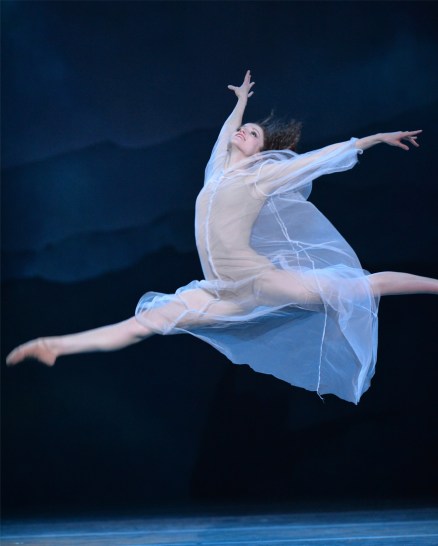
Little needs to be added to the raves I posted at my own website a year ago when Janes’ “Hallelujah” was first unveiled as the penultimate segment of his “Sketches from Grace,” especially since Harkins and Hall danced it last January as well. Okay, maybe not as well as they did this year after living another year with the piece and their dance partnership. The “Sketches,” originally intended by Janes as a tribute to Leonard Cohen, was deflected from its original purpose when the choreographer heard Jeff Buckley’s cover of “Hallelujah” and turned the suite into a Buckley-based sequence. But if Janes had introduced this year’s reprise instead of Bonnefoux, I suspect that he would have mentioned the Canadian troubadour’s death (on the eve of our momentous Election Day). Pared down to the originating essence of  became a fitting tribute to Cohen, with Harkins and Hall sensuously evoking the darkness of his vision through their memorial flame.

Moscow Ballet’s “Nutcracker” Brims With Tradition, Grace, and Delight

Review : Great Russian Nutcracker

14-moscow-ballets-sergey-chumakov-and-elena-petrichenko-1

By Perry Tannenbaum

Now in its 24th annual North American tour with traditional Russian favorites, the Moscow Ballet is a massive enterprise to contemplate. Three separate tours are currently crisscrossing the US and Western Canada with their Great Russian Nutcracker. So on December 11, for example, when the Central tour came to Ovens Auditorium in Charlotte, the Eastern tour was in Syracuse, NY, and the Western tour was in Albuquerque, NM. And what about back home? We can’t imagine that the cupboard is bare back in the Motherland, where the puissant Putin rules.

So after seeing the new $1 million Charlotte Ballet remount of Tchaikovsky’s holiday favorite, I was curious to see how the Great Russian would compare – with Moscow’s resources and talent spread so far and wide. The negatives manifested themselves pretty quickly. You can’t replace the curtains with proscenium-spanning art at over 100 theaters when you’re only performing there just once, with few exceptions, and you can’t tour with three symphony orchestras playing the beloved score live.

Nor can you take over 200 schoolchildren on tours that last over a month – 54 days, in the case of the mammoth Western tour. This is where the Great Russian also becomes the friendly Nutcracker, for the Moscow Ballet teamed with Gay Porter’s Charlotte School of Ballet to fill over 70 roles: Party Children, Mice, Snowflakes, Snow Maidens, Snow Sprites, and backup dancers for the Act 2 divertissements by Moscow’s Spanish, Chinese, Russian, and French soloists.

So on any given night, over 200 costumes may be worn by aspiring dancers who hail from the towns where Moscow Ballet performs. Talk about outreach. Over 5,000 young dancers are getting to rehearse, perform, and wear those wondrous costumes in through Moscow’s Dance With Me program. Better than Halloween, as the Donald would say, believe me.

2-moscow-ballet-great-russian-nutcracker-set-designed-by-carl-sprague

The negatives I’ve spoken of soon recede. I didn’t have to send up a flare to alert the people in the soundbooth that the music was turned up too loud, but I did wish it were potted down sooner. When the curtains parted at Ovens, Moscow’s newly revamped scenery, with new designs by Carl Sprague, was definitely in the same class as Charlotte Ballet’s, with a faux proscenium as ornate as the real one I’d seen the previous weekend.

There weren’t as many scene changes as Charlotte Ballet lavishes on their production. The sleigh that carries Masha – better known to us as Clara – to the Land of Peace and Harmony remains earthbound instead of flying, and did the parade of playful 10-foot-high puppets ballyhooed in the program synopsis really escape my notice? Don’t think so. Most of these beasts were depicted on the imposing backdrop in a style vaguely reminiscent of Henri Rousseau.

Other details that distinguished this Nutcracker from those I’m accustomed to did not escape detection. Though there wasn’t liftoff for the sleigh, it was conveyed to Peace and Harmony by “Ded Moroz,” Russia’s Father Christmas, and Snow Maiden “Snegurochka,” both resplendently attired in Carolina – um, cerulean – blue costumes newly designed by Arthur Oliver. Uncle Drosselmeyer was a jovial gift-giving enchanter, still sporting a cape but more like a ringmaster or a game show host. And imagine, the Sugar Plum Fairy and her Cavalier never appear! Instead, it’s Masha and the Nutcracker Prince who dance the grand pas de deux.

21-moscow-ballets-ekaterina-bortiakova-and-akzhol-mussakhanov

After receiving so many gifts, Masha and her Prince present their dance to – the flowers that just waltzed for them? The synopsis is mum on that point, but Ekaterina Bortiakova is pure delight as our heroine, most adorable when does her simple tippy-toe shtick in the “Dance of Sugar Plum Fairy,” as light as the celesta cuing each step. She’s graceful, demure, vivacious, and youthful enough for us to imagine Nutcracker as a coming-of-age story. Andrey Batalov brings star quality of his own to the role of the Prince, definitely a cavalier partner when he sheds his Nutcracker headgear and brocaded waistcoat, most memorable when he whirls around the stage in his uptempo solo.

Choreography by balletmaster Stanislov Vlasov adheres to the manner of Tchaikovsky’s original collaborators, Lev Ivanov and Marius Petipa, most challenging when we arrive at the Act 2 showcases. Casting in these key spots is predictable, since only one pair of partners is listed for each of the divertissements, but most of the major roles we see in Act 1 are double-cast, including Masha and the Nutcracker Prince. Chiefly worthy of mention here were Sergey Dotsenko, a dashing Uncle Drosselmeyer in his florid purple cape, and Meievsky Vsevelod as the furtive and menacing Rat King.

Four of the six couples who partnered in Act 2 etched themselves vividly in my memory. In the snowy transition between the Stahlbaums’ Christmas soiree and Masha’s final destination, Anna Radik and an unmasked Dotsenko were the most sculpturesque of the couples as the Dove of Peace, each one of the silvery dancers bearing one of the bird’s luxuriant 10-foot-wide white wings, another new Oliver design. Perpetually leaning left with index fingers pointing upwards, Kseniia Stukalenko and Vladyslav Stepanov were the most charming and amusing pair as the Chinese Variation.

11-moscow-ballet-chinese-variation-set-design-valentin-federov

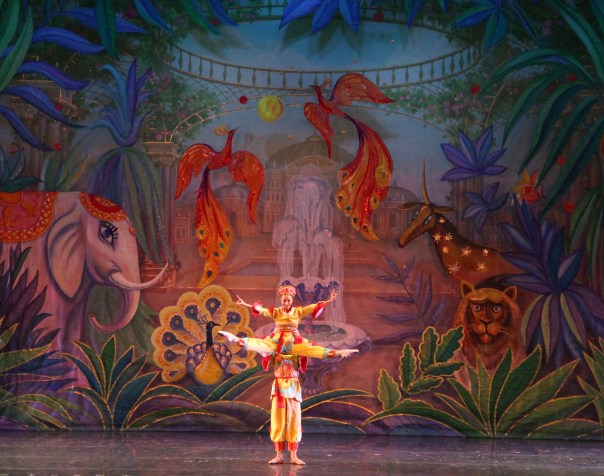
Contrasting marvelously – again – with the perky Chinese, Radik and Dotsenko returned as the smoldering Arabian Variation, with Radik executing snaky contortions that were unrivaled by anything else we saw. Clearly this was the most sensuous couple of the afternoon, but Veronika Melnyk and Michail Botoc as the Russian Variation took us to another dimension – sheer athleticism. Botoc, in particular, astonished with a series of leg-split jumps, a string of somersaults that spanned half the stage, and various gymnastic moves, effectively stealing the latter moments of the show. He even persisted during the curtain calls, unfurling the famed Cossack Kazatsky squat dance, more than sufficient reason why Putin wishes to recover the Ukraine.

The couple sitting next to my wife and me have a daughter who will be dancing with this tour when it arrives in Detroit. They came to Charlotte because one of their kin was a Charlotte School of Ballet student in a similar role at this performance. I could see that they had no regrets at all about making the trip to see a Mouse. Very likely, they and their daughter view the Great Russian Nutcracker as the experience of a lifetime. From the ovation and the swells of applause that spontaneously broke out all over Ovens during curtain calls, it was obvious that hundreds of non-relatives felt the same

Charlotte Ballet’s New $1 Million Nut Is Everything It Was Cracked Up to Be

Dance Review :  Nutcracker

By Perry Tannenbaum

Many of the people who jammed into Belk Theater on Saturday afternoon, nearly filling the top balcony to the rafters, were wondering the same thing as I was. Just how much can $1 million do to improve Charlotte Ballet’s already stellar production of Tchaikovsky’s Nutcracker? There weren’t any gaping holes that needed to be filled in when it came to the live music. Charlotte Symphony has played the ballet score beautifully ever since Salvatore Aiello transplanted the dance troupe, originally known as North Carolina Dance Theatre, from Winston-Salem in 1990.

Many of the musicians – and many of the orchestra’s principals – who accompanied Aiello’s setting for Nutcracker in the early years have played on through the many iterations of Jean-Pierre Boonefoux’s choreography, which premiered in 2006. Every one of the players works up the same zest for the music as the year before. Nor can money buy a much finer array of dancers to fill the stage with agility and grace. Calling the dancers in Charlotte Ballet and Charlotte Ballet II – not to mention the various levels of apprentices, trainees, and students from the company’s Academy – the best in North Carolina may actually be an understatement.

Of course, the unprecedented gift had garnered plenty of positive publicity for the donors, the McColl family of Bank of America fame, and the worthy recipients. Unless you had completely ignored the Charlotte Observer for the past three months, you already knew that the McColl makeover would bring new Nutcracker costumes and new scenery to the Belk stage – and to lavishly renovated Gaillard Center in Charleston, where the Christmas classic will sojourn on December 10 and 11 before returning to Charlotte on December 13-23 for an additional 13 performances. I probably wasn’t alone in bringing a show-me attitude to the unusual matinee premiere, for the costumes, the scenery, and the spectacle of Bonnefoux’s Nutcracker, incrementally upgraded in its early years, had already proven to be quite formidable in their elegance and wit.

6_charlotte-ballet_jean-pierre-bonnefouxs-nutcracker_-rosie-morrison-as-clara-and-mark-diamond-as-herr-drosselmeyer-_photo-by-peter-zay_web-1024x682

Holly Hynes’s new set of costume designs gobbled up most of the prepublicity. Taking her inspiration from the Belle Epoque (1871-1914), Hynes and a team of 300 dressmakers in 15 states created 208 new costumes, each one costing as much as $6000. As she confessed in one of the two infomercials I’ve seen, Hynes often had to rely on a bunch of polyester to offset the extravagance of the dancers’ silks. The new scenery by Alain Vaës obviously took its inspiration from Bonnefoux’s traditional Nutcracker scenario and Steven Rubin’s set designs, seeming to depart more radically from Rubin’s concepts as the story moved from the Stahlbaums’ Christmas party to Clara’s dreamy fantasies, developing a whole new motif of whimsy – lifesize cutouts! – along the way.

Vaës wasn’t working with a paltry budget, either. A whole new trim, teeming with red, covered the entire arc of the proscenium. The backlit scrim of the Staulbaums’ town, more brightly lit by the lamplight gleaming through the windows of the homes than by the moonlight, greeted us like the frontispiece of a storybook.

In its nocturnal grayness, the first exterior view of the Staulbaum home was very similar to Rubin’s, but we were looking from a greater distance, seeing all that can be seen instead of merely the front façade. There was a little more humor in the gradual reveal of the magnificent interior, for the first of the new cutouts, a housemaid, was wheeled out to centerstage to greet the guests. Onto its outstretched arms, the parade of guests flung coats, stoles, and scarves until this cunning portable closet was rolled away.

7_charlotte-ballet_jean-pierre-bonnefouxs-nutcracker_-george-bokaris-nutcracker-michael-menghini-mouse-king_photo-by-peter-zay_web-1024x682

Imagery in the new Vaës scenic designs is bolder, more calculated to appear colossal, and the designer’s drawings evoked for me two of the great masterworks of the Belle Epoque, War and Peace and Alice in Wonderland. Probably by sheer accident, the bold muscularity and the florid curves in some of the scenery reminded me of Fritz Eichenberg’s memorable illustrations for the Heritage edition of Tolstoy’s epic. But the evocation of Alice was quite intentional. After the party, when Clara nodded off, the Mouse King entered the scene on a broken teacup for his royal battle with the Nutcracker. Once Clara assisted her champion in his victory, the set changed briefly to a surreal and magical toyland, where the head of Clara’s doll was as large as the castle. Very Alice.

The new scenery also brings fresh emphasis to numerous arrivals. Drosselmeyer’s amazing gifts, Clara’s Toy Doll and her brother Fritz’s Toy Soldier, arrive on carts where each of them is flanked by two lifesize cutouts of the same toy. Instead of lifting her massive skirts to reveal her periwigged Marzipan brood, Mother Ginger arrived on the second floor of her own gingerbread house, opening the front doors to let them out. But aside from the Mouse King’s teacup and the flying balloon-boat that carries Clara off to the Land of Sweets – a galleon now large enough to transport two honeymooning couples – the most significant entrance was created for Herr Drosselmeyer. He arrived at the Stahlbaum soirée in his own clock tower!

Mark Diamond may hold onto his annual stint as Drosselmeyer even after he’s forced to arrive clutching a walker, for he still revels in reminding us with his comical antics that he himself is program director of Charlotte Ballet II and, more importantly, one of the company’s potent line of resident choreographers. The Drosselmeyer shtick always looks like Diamond is doing his own thing, altering the routine every year – maybe every performance.

3_charlotte-ballet_jean-pierre-bonnefouxs-nutcracker_-juwan-alston_toy-soldier_photo-by-jeff-cravotta_web-1024x683

The new clock draws the spotlight in Mary Louise Geiger’s new lighting design when Tchaikovsky’s score tolls the midnight hour chez Stahlbaum. Using his new cutouts, Bonnefoux completely alters this segment in his choreography. In past years, spotlights flashed on a different costumed kid each time the bell tolled, unpredictably scanning the full width of the stage. Now there was simply a single-file parade of various cutouts, their manipulators hidden behind them. As we approached the final chiming, we had our first glimpse of the lifesize girl doll that would enlarge to supernatural Alice-size in the yet-unseen scenery.

Geiger also teamed up with Hynes on some of the new magic. Like the opening cityscape, Vaës’s new Land of Sweets builds on Rubin’s previous concept of candy canes and gumdrops by putting us at a greater distance and increasing its scale. We could now see a huge skylight window in the rooftop dome opening up on a starry evening sky. At floor level below, the view also opens up to the outdoors, directing our gaze toward the horizon. Initially, there was a marked difference between the two views: it was still twilight on the horizon while it was already evening above.

9_charlotte-ballet_jean-pierre-bonnefouxs-nutcracker_elizabeth-truell-juwan-alston-as-chocolate_photo-by-peter-zay_web-1024x716

In this unflattering light, we had our first glimpse of the newly minted backup dancers for the Coffee segment. Their bright red skirts, contrasting sharply with their dark blouses, seemed garish under the bright light between the little Marzipan and Candy Cane groups. But Geiger would dramatically lower the lights for Raven Barkley and Ben Ingel, so it was now (briefly) nighttime both on the horizon and above when they performed their sinuous Coffee pas de deux – and the perfection of the six backup dancers’ glowing red skirts in this dimmed light redeemed them from the first impressions they had made. Their pink capes also made a difference.

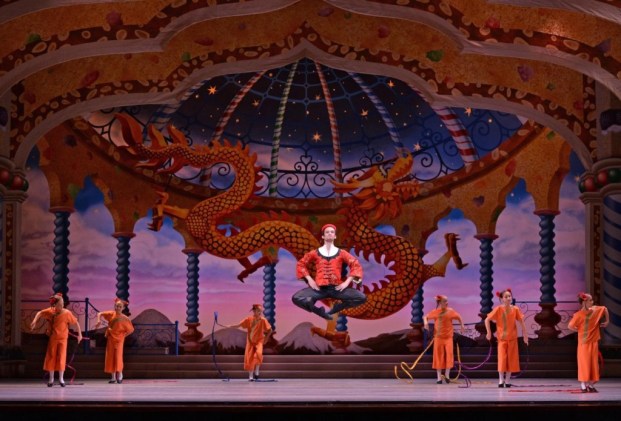
In little ways and in big ways, Bonnefoux and his design team have heightened the wow factor in staging their spectacle. Just for the Tea segment in Act 2, a Chinese dragon drops down from the flyloft for a visit, and the Stahlbaums’ Christmas tree no longer stops it miraculous growth when its piney peak hits the ceiling. Now when Drosselmeyer cast his spell, that growth continued on the upstage backdrop until the entire upstage wall was filled with what we imagined was a wee portion of the fabulously gigantic tree. You need not worry that such awesome stagecraft at all diminishes the exploits of the dancers. Aided by their revamped costumes, Charlotte Ballet still measured up to the superabundance surrounding them.

10_charlotte-ballet_jean-pierre-bonnefouxs-nutcracker_alessandra-ball-james-as-sugar-plum-fairy-james-kopecky-as-cavalier_photo-by-peter-zay-_web

Rosie Morrison as Clara and Clay Houston as Fritz may be the most personable Stahlbaum kids I’ve seen. The precision and perfection of Sarah Hayes Harkins as the Sugar Plum Fairy will surely inspire little ballerinas who see Nutcracker for the first time. Harkins hits every beat with her elegant movements exactly on the nose, and her new partner, Drew Grant, is the picture of chivalry as her Cavalier, though the rookie needs to loosen up a bit. Chelsea Dumas and Ben Ingel were a similarly ideal couple at the premiere as the Snow Queen and King, and Alessandra Ball James was luminous in her musicality as Rose in the “Waltz of the Flowers.” Below tea green tops, Rose’s dozen dancing flowers sported frilly three-tiered skirts, each tier a different tint of pink or fuchsia. Even a child could recognize the stems and petals of the flowers for what they were.

Except for Fritz, who is merely doublecast, there’s a dizzying rotation of four dancers for each of the major roles I just named. It would take an astronomer to predict when, where, and if this exact alignment will occur again, so let me merely add the names of the other dancers who will figure in the dizzying mix: Jamie Dee Clifton, Elizabeth Truell, and Sarah Lapointe among the ladies, James Kopecky and Juwan Alston among the gentlemen.

8_charlotte-ballet_jean-pierre-bonnefouxs-nutcracker_humberto-ramazzina-as-tea_photo-by-peter-zay_web-1024x695

The athleticism of the Charlotte Ballet men did shine through during the Act 2 procession of divertissements, counterbalancing the dominance of the ballerinas. Newcomer Peter Mazurowski sparkled in the Gopak section and, under that dragon, Humberto Ramazzina from the II troupe served charmingly – and deferentially – in Tea. Both of these men are in a rotation of three men who will dance their roles. So will Ryo Suzuki, whom I wasn’t seeing for the first time as Candy Cane. I don’t think I’ve seen Ryo’s match in performing Candy’s joyously asymmetrical leaps, but I’m sure parents and children of all ages will be satisfied when Suzuki rotates to Tea and Gopak.

Roguish “Rouge” Keeps Its Freshness

Dance Review: CC&Co.’s Rouge

379075_10150607398863084_1504680463_n

By Perry Tannenbaum

Now in its fourth year, Rouge began as a slightly naughty variety show featuring Caroline Calouche & Co.‘s signature aerial choreography, with a naughty cabaret twist that meshed well with its October timeslot – and a late 9:30 pm performance that was a novelty for dance in Charlotte. Compared to the Nutcracker Rouge that I sampled last winter in an off-Broadway production, the first two CC&Co. editions of Rouge barely grazed the possibilities of risqué dance. Absent from the spectacles at Booth Playhouse were the profusion of pasties, satyrs, fauns, and cross-dressing men that I witnessed in Greenwich Village, all ganging up on an innocent virgin and serving as her initiation into the rites of eroticism. So if the Charlotte troupe had no intention of following a similar trail, it was prudent for the company to retreat from October, when steamier saturnalia might be expected, to a sunnier timeslot in August. Here the modest moves toward cabaret decadence and S&M stylings actually seemed more daring.

Yet the move to a balmier season didn’t absolve Calouche & Co. of the obligation to embrace cabaret naughtiness with gusto. If the opening tableau with three couples intertwining downstage and four females behind them straddling chairs was any indication of how the company would attack the can-can, then I could be grateful that I was spared from seeing a kickline that would have proven they can’t-can’t. Couples went through the motions of sensuous contact without either the heat or the enjoyment that would bring the choreography vividly to life, and the women on those chairs did little more than occupy them. A “Take It Easy” duet with Javier Gonzalez and Sarah Ritchy, some segments aerial and others on the floor, generated a little heat, but the closest we came to flame was Calouche’s “It Takes Two” aerial coupling with Anthony Oliva, introduced by hostess/songstress Rachael Houdek as the evening’s BDSM segment and boasting black costumes to match.

Set to some orgiastic guitar blues, something in this aerial choreography was definitely simmering.

10424463_1495611417317853_930816821_a

Hosting for the fourth time, Houdek seems to get what CC&Co. is about much better than she did in her first two years, and her singing has improved as much as her poise, most noticeably on “Creep,” the penultimate number on the Rouge 2016 program. Keeping the show fresh were five other guest performers, including the Von Howard Project from New York. Dancing the choreography of Christian von Howard, this trio of dancers – Breeanah Breeden, Jake Deibert, and Tracy Dunbar – were the gray antithesis of an orgiastic rouge spirit as they performed “Seeker”: eerily fluid, urban, dystopic, and occasionally extraterrestrial. Notwithstanding their discordant vibe, I wished Von Howard Project had offered us second and third helpings.

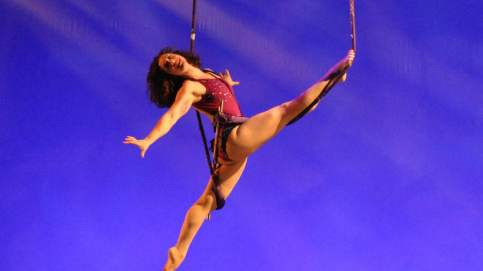
I can warily say the same about Atlanta-based Nicole Mermans, who delighted me midway during the second half of the evening with her “Tousled” on an aerial sling. Aerial pieces rarely strive for comedy, but this one had slapstick elements, set to a klezmer score. Hopefully, other pieces Mermans has devised would be equally unique, perhaps on an assortment of apparatuses. After watching aerial acts for a number of years, I’ve concluded that the number of moves available on each apparatus – particularly the aerial silks – is probably more limited than the number afforded by such gymnastic apparatuses as the rings, the pommel horse, or the balance beam. So are the risks after the performer has mastered each skill.

536539565_1280x720

So I was pleased that Rouge presented the wide variety of equipment that CC&Co. has accustomed its audience to, including Gwynne Flanagan from DC on trapeze and Molly Graves from Vermont on aerial rope. The only guest soloist who disappointed was Jen MacQueen from Atlanta, who only showed me moves on the cyr wheel that already I’d seen many, many times since the days that Cirque du Soleil first began touring. To her credit, Calouche has fortified her troupe to such an extent that the aforementioned members of the troupe – Gonzalez, Ritchy, and Oliva – aren’t alone in being able to perform to the level of the guest artists. Sarah Small performed a gorgeous aerial solo silhouetted behind a translucent disc, choreographed to an instrumental adaptation of Dvořák’s “Moon Song,” and though he wasn’t airborne at all, Jake StainbackSarah Small’s talents as an ecdysiast were singular nevertheless.

After the busy opening and the Von Howard Project spot, there were other segments featuring three or more performers, including a bouncy bungee trio (with some unseen complicity up in the fly loft) and an aerial finale on a massive twin-cube apparatus that could accommodate four performers simultaneously. My favorite was the semi-spontaneous segment that brought us to intermission, which began with Houdek picking out a conspicuously gifted member of the audience to bust out a few of his startling dance moves. Then members of the company invaded the audience, pulling some choice prospects onstage – well, they discreetly avoided old codgers like me, anyway. All of these recruits began to show their stuff to some very festive music. I not only noticed a non-musical actor among the recruits but also a few moves from the others that were raunchier than any of the rehearsed choreography. Rouge may not be particularly wicked, risqué, or even particularly French, but it remains an impressive show – and it attracts an impressive crowd.

Charlotte Symphony Spotlights the Balcony in “Romeo and Juliet” Tribute

et-romeo-juliet-maria-kochetkova-joan-boada-end_1000

By Perry Tannenbaum

May 20, 2016, Charlotte, NC – A distinguished scholar who taught my undergrad Shakespeare course once told us that a precious folio edition of the Bard’s plays was on display at one of England’s most prestigious libraries, available to all to peruse, and that the most well-worn page in the whole book – by far – was the balcony scene from Romeo and Juliet. “Rightly so,” she added after a brief pause, defusing my presumption that she was about to sneer at popular taste. Charlotte Symphony Orchestra musical director Christopher Warren-Green might very well agree with my professor’s sentiments, for at the latest KnightSounds concert, he programmed that scene twice in succession, underscoring the fact that we still haven’t tired of that balcony 400 years after Shakespeare’s death.

Helping the demonstration at Knight Theater were emissaries from UNC Charlotte’s Theatre Department and Charlotte Ballet. Charlotte-based soprano Melinda Whittington helped to similarly double-underline the appeal of two other prime Juliet moments. So in the space of a mere 70 minutes, 50 less than the “two hours’ traffic of our stage” promised in the tragedy’s prologue, we not only had orchestral and operatic works inspired by Shakespeare’s first great tragedy, we had the lovers themselves speaking the lines of their most memorable scenes.

Tchaikovsky, Gounod, Prokofiev, and Nino Rota all took their cues from the blank verse and rhymed couplets in different ways. Of course, Tchaikovsky’s famed Fantasy-Overture wasn’t written for any specific production of Romeo and Juliet. With three fully developed themes for Friar Lawrence, the Montague-Capulet strife, and the R&J romance, the flavor of the piece is more like a Liszt tone poem than a true overture. About half the size of a Tchaikovsky symphony, the KnightSounds performance quickly offered us opportunities to savor the work of the clarinets, the double basses, the violins, the French horns, the cellos, the flutes, and harpist Andrea Mumm.

At the same time, the performance was streamed outdoors to the plaza at the nearby plaza on the Levine Avenue of Arts, and the screen hovering above the Knight Theater stage gave us the pleasure of seeing what the outdoor audience saw with the added thrill of the live sound. There were more than enough cameras deftly at work to prove that this video production had been nearly as meticulously rehearsed as the music. We didn’t cut to the French horns or the cellos in the early going, and the cameras later settled on the second violins too late and missed English hornist Terry Maskin entirely. Yet overall, direction was quite polished.

Romeo & Juliet 'Plazacast' Closes KnightSounds Sitting toward the front of the orchestra, I found that the cameras consistently revealed who was playing upstage when the musicians in front of them blocked my sightline. My fears of being overwhelmed by the sheer loudness of the orchestra were also allayed: the acoustic shell that graces the Knight stage gathers in the orchestral sound while still allowing it to breathe. This was different from the old school presentation that the CSO brought us of the Fantasy-Overture at Belk Theater in 2011, and while there was little to prefer musically at either performance, I have to say that the camera work lifted the current experience above the one I praised five years ago, enriching what I saw and heard then with occasional close-ups of Warren-Green’s expressions.

I had little hopes for the UNC Charlotte segments of the evening, with Jennifer Huddleston appearing as Juliet and Sammy Hajmahmoud as Romeo. When their stage director, Professor Andrew Hartley, appeared onstage to recite Shakespeare’s prologue, he didn’t exactly fire up my hopes. Nor was I initially impressed with Hajmahmoud when he initially came onstage to launch the party scene where the masked Romeo first meets Juliet. But Huddleston was pure luminosity as Juliet, instantly proving the advantage of casting the role as youthfully as possible. The glow of her performance magically turned Hajmahmoud’s halting awkwardnesses into virtues and he gradually relaxed into Romeo, further igniting their chemistry. Together they grew irresistibly charming, somewhat upstaging their elders when they followed.

13263907_1718667768397005_7712306438347482717_nAfter Huddleston, Whittington seemed woefully mature as Juliette singing the bubbly “Je veux vivre” from Gounod’s opera. The costume she wore was comparatively formal and neither the suppleness of her coloratura nor the lightness of her tone matched what we hear from elite sopranos in this showpiece. But she returned later in the concert and absolutely scorched Juliette’s “Potion Aria,” demonstrating the power that opera can add to turbulent moments of indecision. Huddleston and Hajmahmoud do all the potions and suicides as well, but their most glorious moments – and Hartley’s as well – come when they do the balcony scene.

Romeo initiates the scene onstage, but a spotlight cues us to the likelihood that Juliet will appear in the box seat section of the Knight’s balcony. It’s absolutely sublime when she does. Part of the magic is sculptural, after all, for the moonlit Juliet is not only more divine at a height, Romeo is more ardent and worshipful below her with his upward gaze. Hartley played around with the usual blocking and Romeo’s climbing up and down, but somehow he contrived to have Juliet down at the orchestra level and onstage for the latter half of the scene and its exquisite farewells.

The “Balcony Scene Pas de Deux” from Prokofiev’s ballet score had to follow this sublimity, and the presence of two eminent Charlotte Ballet principals, Josh Hall and Alexandra Ball, helped to ease the descent. Hall and Ball were so impressive, in fact, that I fairly well ignored Prokofiev’s music and the excellence of the orchestra. But as majestic as the lifts were – Ball’s hands as she rises have a musicality that most ballerinas can only envy – the sculptural advantages of the theatrical staging we had just seen were surrendered, along with Hajmahmoud’s touching awkwardness and Huddleston’s youth. An impossibly acrobatic final kiss partially compensated for those missing elements

After the stunning sequence of balcony scenes and potion scenes, the concert grew more somber with Rota’s “Romeo and Juliet: A Renaissance Timepiece” and Hartley’s pronouncement of the tragedy’s concluding lines. Until I heard CSO’s performance, I’d assumed that the Rota melody most familiar to me was his “Theme from The Godfather.” As often as I’ve heard that tune over the years, I wouldn’t be surprised if I’d heard Rota’s Romeo and Juliet melody even more often. The familiar melody nestles nicely in a composition that has more to offer, with some gorgeous work from Mumm, oboist Hollis Ulaky, and flutists Amy Orsinger Whitehead and Erica Cice.

An evening that I expected to be pleasantly light and superficial turned out to be rich and deeply satisfying. Programs were in the funky style that usually characterizes the KnightSounds series, but they are augmented by the Charlotte Symphony app that can be downloaded to your smartphone. You can get bios of the featured professionals from this app as you ease into your seat – it’s general admission, so early arrival can be recommended. While I couldn’t confirm my suspicion that Charlotte Ballet artistic director Jean-Pierre Bonnefoux was the choreographer, the app did supply translations of the Gounod arias.

Ballet’s Last Dance Ranges from Grief to Orgy

Dance Review: Charlotte Ballet’s Spring Works

By Perry Tannenbaum

Finishing Jean-Pierre Bonnefoux’s penultimate year as artistic director, Charlotte Ballet served up an evening of Spring Works that carved a graceful arc from sorrow to celebration. Musically, the program could be described as all-American, though sticklers would consider that a stretch. Resident choreographer Sasha Janes’s We Danced Through Life, premiered at Chautauqua last summer, is set to Dvorak’s Symphony No. 9, “From the New World,” written in 1893 while the Czech composer was living in America.

No ambiguity about music that followed. George Balanchine’s Who Cares? was set to a sheaf of Gershwin tunes when it premiered in 1970, pared down to eight selections by associate artistic director Patricia McBride, who introduced three of the original 17 pieces back in the days when she was a star of the New York City Ballet. Capping the evening was the world premiere of Dwight Rhoden’s Bop Doo Wah, danced to eight jazz standards by the likes of Duke Ellington, Billy Strayhorn, Louis Prima, Irving Berlin, and George Benson.

Although Janes scrapped the opening movement of “New World” in condensing it to 20 minutes, he retained a fast-slow-fast (or dense-light-dense) structure by tucking the lovely Largo second movement – and its memorable “Goin’ Home” tune – in between the third movement Molto vivace and the concluding Allegro. That showcased the fearless elegance of Sarah Hayes Harkins in an achingly tender pas de deux with David Morse, along with a move I’d never seen before.

Charlotte Ballet_Sasha Janes_We Danced Through Life_Sarah Hayes Harkins_...[2]

Starting from upstage right and running diagonally toward downstage center, Harkins took one of those leaps that flings a ballerina’s arms and legs out parallel to the floor an instant before a sure-handed guy catches her in midair. But there was no guy standing there to catch Harkins in Janes’s choreography. Instead, two guys somehow overtook her and caught her two arms at the same moment, one under each arm.

Clearly, Harkins and Morse were the tragic couple Janes had in mind as his most pointed evocation of Terrie Valle Hauck, who commissioned the dance at Chautauqua for her late husband Jimmy – particularly at that instant when Morse wasn’t there to catch his partner. But another couple shone in the outer movements, Alessandra Ball James and Josh Hall, amid busier action with four other couples. At the end of one set of lifts, the men didn’t put their partners down on the ground. Instead they maintained their lifts and trotted upstage, placing each woman on her own pedestal.

Well done, Jimmy!

Aside from McBride, James and her pink flapper dress was the living link between this presentation of Who Cares? and the company’s previous revival in 2008. She’s still musical and precise in “The Man I Love,” her duet with Hall, and she’s still youthfully jazzy in “Fascinatin’ Rhythm,” the other piece that McBride originated. There was a tinge of poetry in the title tune, Jamie Dee Clifton’s duet with Hall, and a touch of Fred-and-Ginger sophistication in “Embraceable You,” the Hall-Harkins pairing.

I just felt that this Balanchine was unnecessarily musty compared to the newer pieces bookending it. Couldn’t we get a recording of Hershey Kay’s orchestrations that sounded like they were recorded in stereo, let alone digitally? And the costumes, recreated by Aimee J. Coleman, could stand a refresh. Clifton’s looked like it should have been discarded five washings ago, and Harkins’ – when cutie pie Anna Gerberich danced “My One and Only” eight years ago, it was teal, but now it seemed faded to turquoise.

Yep, it’s challenging to nitpick a Charlotte Ballet program. Everyone is so damn good, but in Rhoden’s Bop Doo Wah, we could lament seeing Addul Manzano, David Morse and Gregory Taylor for the last time. While I wasn’t particularly impressed with his singer, Gloria Reuben (more different in her interpretations than delightful), guitarist Marty Ashby’s jazz band could definitely swing and bop. But come on, man: “Teenie’s Blues,” ostensibly written by trombonist Jay Ashby, had more of Dizzy Gillespie’s “Oop Bop Sh’Bam” than anything else.

Charlotte Ballet_Dwight Rhoden_Bop Doo Wah_Sarah Hayes Harkins_Josh Hall_photo by Jeff Cravotta[10]

That’s why the tune stood up to those that surrounded it, Ellington’s “It Don’t Mean a Thing (If It Ain’t Got That Swing)” and Berlin’s “Steppin’ Out With My Baby.” The piece intensified with Strayhorn’s “Blood Count” as James partnered with Morse and Harkins reconnected with Hall, and “How High the Moon,” one of five pieces set by Rhoden for the full cast of 16, fired up with an alto sax solo that I considered the best of the whole suite.

With James partnering Morse one last time, the full cast turned it up another notch as the women let their hair down for Benson’s “My Latin Brother.” But Rhoden knows the value of turning up the intensity to its fullest when his dancers ought to be nearing exhaustion. That’s what a dance orgy is, and Louis Prima’s classic “Sing, Sing, Sing” was the perfect vehicle to take us there, arranged to evoke the Benny Goodman band’s landmark 1939 invasion of Carnegie Hall – and the legendary set of LPs that emerged from it.

Instrumental solo followed instrumental solo in this epic performance, with the guys, previously clad in punkish black costumes by Christine Darch, adding on matching androgynous skirts as they intensified the furious celebration. Not the way Manzano envisioned ending his career, I’m sure – his was the only farewell performance signaling retirement – but he looked as hot as ever in his valedictory appearance. Darch’s costumes for the women were equally sensuous, but due to the shifting hues of Michael Korsch’s lighting design, I never could determine exactly what three or four deep colors the ladies wore.

New Costumes and Scenery Heighten the Wonder of Charlotte Ballet’s “Little Mermaid”

By Perry Tannenbaum

March 11, 2016, Charlotte, NC – Everything seems to be going so well at Charlotte Ballet as Jean-Pierre Bonnefoux stands on the verge of his final year as artistic director. During his tenure, Bonnefoux has seen his dance troupe establish residence in the trendiest theater in town on South Tryon Street while the company strengthened its educational program at its new administrative HQ on North Tryon Street. Two days before opening night of a nine-performance run of The Little Mermaid, choreographed by Mark Diamond, news broke that the McColl family – the BofA billionaires – had given the company $1 million to revamp Bonnefoux’s version of The Nutcracker, leaving little doubt about what the company’s most spectacular production will be for years to come. That announcement may have upstaged the new sets and costumes adorning the Diamond remount in the eyes of newspaper readers, but for the horde of little girls who helped fill Knight Theater to near capacity on opening night, the light in their eyes came from the new undersea wonders lavished upon The Little Mermaid.

There was definitely a fresh dazzle in the new costumes by Aimee J. Coleman, and their iridescence wasn’t confined to the rig Alessandra Ball James wore as the Mermaid before shedding her tailfins for legs. Three Little Mermaid Friends and a matching pair of Seahorses also gleamed, and there was a Day-Glo phosphorescence to the costumes of the Eels, the Undertow group, and the Fish. This new Little Mermaid signals that the extensive use of youthful dancers at Charlotte Ballet will no longer be confined to the annual Nutcracker extravaganza. No less than 20 kids are listed as Fish in the program, and they actually began the show with an extensive dance of their own, fluttering in formation and seemingly gliding across the stage in a manner that simulated black-light puppetry. Diamond had them admirably schooled to resemble a school of fish at multiple points in their dance.

Costumes that aren’t aglow are frequently marvels. Parents will no doubt need to dip into their program booklets to inform their princesses that Ryo Suzuki is an Anemone, but there’s no mistaking Raven Barkley for anything but a Sea Turtle. The sheer plenitude of sea creatures that have nothing to do with the story is a constant delight, not in the least Rylie Beck, making her way up the orchestra aisle at a snail’s pace and lurking onstage as the Hermit Crab – though she could easily be mistaken for a Mary Poppins’ old rucksack. As enchanting as all these costumes were, the new wow factor came from Michael Baumgarten’s lighting projections, functional when the Mermaid’s destined Prince gets thrown overboard during a storm but truly spectacular as we glide through undersea corals and canyons.

The low tech, held over from previous Mermaid productions of 2008 and 2011, mixes charmingly with the high tech as we watch the scene where the Prince is tossed by the tempest and the Mermaid rescues him. Three linen ribbons that stretched across the stage were the sea, and I’m sure that the sailboat James Kopecky fell out of wasn’t even half-built. Throughout the opening act, while the Mermaid remains a finned sea creature, Diamond solves the Mermaid’s mobility problem by having her transported in the sort of sledge the crippled Porgy might use, drawn by the same invisible hands that ripple the linen ocean from the wings. When Ball James rises from floor level, she remains horizontal thanks to the ministrations of her Friends and the rolling Undertow crew.

Although Addul Manzano makes a dashing appearance as the Sea King, Diamond hasn’t integrated him into the drama. Aside from the Mermaid, who occasionally appears on the verge of being heaved onto a dinner platter, it’s Jamie Dee Clifton who makes the biggest splash as the Sea Witch. Beyond pointing upwards, the Mermaid doesn’t articulate what she’s yearning for in the climactic encounter with the Witch, but the real exposition gap that Diamond leaves parents to fill in for their kids is the particulars of the bargain that the Mermaid agrees to when the Witch grants her the ability to walk on land. Clifton’s movements – and her saturnine costume – make it clear enough that goodwill and charity aren’t motivating the Witch as she grants the Mermaid’s wishes, and there’s a wondrous fairytale foreboding when Clifton hands Ball James the magic potion that effects her metamorphosis.

Thanks to the last of Baumgarten’s projections, the Mermaid awakens on a beauteous seashore with her newfound legs. Diamond doesn’t skip over the most absurd aspect of the Mermaid’s transformation, so we get an endearing, comical incongruity that no parent will be able to explain. After the Mermaid marvels at her feet and toes, she stands up tentatively on her legs like a newborn foal – and within seconds is dancing like the Princess Grace Fellowship winner that Ball James truly is. Even without the same undersea magic afterwards, Diamond constructs a second act that intertwines the Mermaid/Prince romance with a couple of strands of comedy and a couple of explosions of pure dance.

Along with two Charlotte Ballet II troupe members, namely Suzanna Duba and the hunched-over Ben Youngstone, Beck sheds her shell to become one of three Gossips. Singly, they snoop and scurry about in various corners and alleys of the set as the Mermaid glows, blushes, and plain shows off in response to all the attentions that the Prince lavishes upon her. Collectively, they engage in effusive sessions of head-bobbing, mouth-flapping gossip. But it’s a military trio, no more pertinent to the action than the Turtle before them, who provide the greatest comic delight. David Morse is pomposity itself as the General, head tilted back and sporting an imposing belly bulge. Yet he begins bickering lustily as soon as Josh Hall appears as the Admiral, topped with the appropriate seafaring hat. It becomes so heated – and of course, silly – that Amand Pulaj as the Secretary General is hard-pressed to keep them for pawing each other to death.

When he isn’t bickering, the General reviews a small brigade of Officers whose uniforms are colorfully unalike. But in her costumes for Suzuki, Juwan Alston, Iago Bresciani, Ben Ingel, Thel Moore, and Gregory Taylor; Coleman makes sure that each of the designs registers as unmistakably Russian, matching the spirited music by Glière that they dance to. Nearly all these soldier dances are solos where each of the men vies with the others in acrobatic éclat. But the Russian flavor only crystallizes what has gone before. There is some Debussy wedged into the score Diamond has chosen, but with the generous selections from Borodin’s chamber and orchestral works, the overall musical texture is decidedly Russian. When we adjourn from the Prince’s garden to the ballroom in his palace (the most impressive of Howard Jones’s new set designs), we could be at any Russian ballet, for Diamond’s dance stylings are as retro as the music.

During this formal cotillion, Sarah Hayes Harkins comes into full flower as the Prince’s Fiancée, a vision of cold elegant perfection as she dances with Kopecky, hardly deigning to notice her rival skulking in the corner in her damp rags. The tension between the supple, skittish, and vulnerable Ball James and the serene and imperious Harkins seems so ideal that I wondered how they could be switching roles for four of the nine performances. But they are merely the tip of a general shuffle of principals including Kopecky, Manzano, Hall, Morse, Clifton, and Chelsea Dumas. Diamond could easily shuffle a few more members from the main troupe and the satellite Ballet II dancers without marring the overall effect. The company that Bonnefoux has built is that strong.

© 2016 CVNC

Production Values Continue to Evolve at Charlotte Ballet’s Innovative Works

Innovative Works_Yamato_Dancer Ryo Suzuki

By Perry Tannenbaum

January 29, 2016, Charlotte, NC – Ever since the event was created in 2003, when Charlotte Ballet was known as North Carolina Dance Theatre, Innovative Works has been a special event in the company’s season, performed at a special venue that further set it apart. The size of these venues, the length of the pieces on the program, and the number of dancers in each work were all smaller than the big ensemble pieces staged at Belk Theater and, more recently, at Knight Theater. Charlotte Ballet artistic director Jean-Pierre Bonnefoux was not only providing a platform for edgier, lapidary pieces, he was also establishing an incubator for new choreographers, usually dancers or former dancers in the company, to expand their creativity and pave a pathway to their afterlives when they were no longer onstage.

Works first seen at Innovative have not only enriched the repertoire of Charlotte’s pre-eminent performing arts group, they have served as springboards for further choreographic creations and for the formation of new companies outside Charlotte established by the former fledglings. This year’s collection of miniatures, running at the Patricia McBride and Jean-Pierre Bonnefoux Center for Dance through February 20, presents the brainchildren of current and former troupe members wedged among works by the company’s resident choreographers. Included on the bill are pieces by Dwight Rhoden, Mark Diamond, Sasha Janes, David Ingram, Sarah Hayes Harkins, David Morse, Gregory Taylor, and Josh Hall.

That’s a bunch, to be sure, but three of the works choreographed by current dancers – the “Dancer Spotlight” – are presented in rolling rep, so each evening consists of six pieces. The first two, Rhoden’s “Ballad Unto” and Ingram’s “Omologia,” are staples in every performance of the run. Taken together, they exemplify how Innovative has evolved. Intimacy and chamber size are no longer requisites of new choreography unveiled at the McBride. Both of these pieces were long enough to present on the Knight Theater mainstage, and by the time they were done, we had seen 18 dancers perform, including three up-and-comers from the satellite Charlotte Ballet II company.

Although scenery is still outlawed in this studio setting, lighting has become very sophisticated. In fact, the hard-edge lighting designs by Jennifer Propst are very much at the forefront of both experiences. Further blurring the difference between Knight and McBride presentations, the previously filmed “Behind the Dance” segments, where the choreographers talk about either their aesthetic or the genesis of the piece we’re about to see, are now as much a part of Innovative as they were last October in Fall Works at the Knight.

Innovative Works_Dwight Rhoden_Ballad Unto

Photos by Peter Zay

Rhoden’s “Ballad Unto” sets Bach’s famed Chaconne, prerecorded on violin, upon five couples, yet this destination is preceded by a setting to assorted sounds, textures, and rhythms that seemed equally long and substantial. Jamie Dee Clifton and Josh Hall were the couple that grabbed my attention most dynamically, but Ben Ingel and Raven Barkley were also charismatic standouts. All ten of the performers delighted in both the high-speed handwork and the footwork that Rhoden challenged them with, consistently accenting the beat with precision. Rhoden himself had fresher, livelier ideas than you might expect from him this deep into his career responding to Bach. Propst had a fairly a fairly stunning reaction to the choreography, setting five squares on the floor in an M formation for the five couples, occasionally replacing them with – or superimposing them on – an inverted V.

Interaction between the dancers and Propst’s lighting design was even more salient in Ingram’s “Omologia.” As the eight dancers advanced toward us at the outset of the piece, set to Corelli’s “La Follia,” a bright illuminated line across the stage seemed to daunt their progress. Once the dancers took possession of the stage, we discovered that there would be two more lines of lights connected to the first – and that each of the three lines was actually comprised of three adjacent squares. So while the dancers danced in close sync with the music, the nine pre-programmed squares, blinking on and off, were similarly wed to the movements and the shifting tableaus of the dancers. Numerous permutations of the nine squares flashed before us, including U shapes formed by seven of the squares that opened out at various moments to all four points on the compass.

From these lengthy baroque abstractions, we suddenly transitioned to a very real subject with Harkins’ “#Hatehurts,” the sort of high-concept piece that has typified Innovative in the past. Diagonally across the stage from each other when the lights came up, Sarah Lapointe in the foreground and Ingel upstage sat in front of laptop computers, reacting to online bullying and its fatal consequences. Of the six dances, this was the only one that didn’t come to us paired with a filmed introduction. Sure, it was the piece that least required explanation, but it was also so short that a prelude may only have drawn further attention to the piece’s brevity. Perhaps if the seated opening tableau didn’t seem to be such a substantial portion of the piece, the effect would have been more powerful, for the dance seemed to end as it was just getting started once the couple converged at the middle of the stage. The ratio between the prerecorded bullying and suffering we heard about and the anguish we saw live from the dancers ultimately struck me as too message-rich, an effective presentation for middle schoolers, perhaps, but artistically too thin for me.

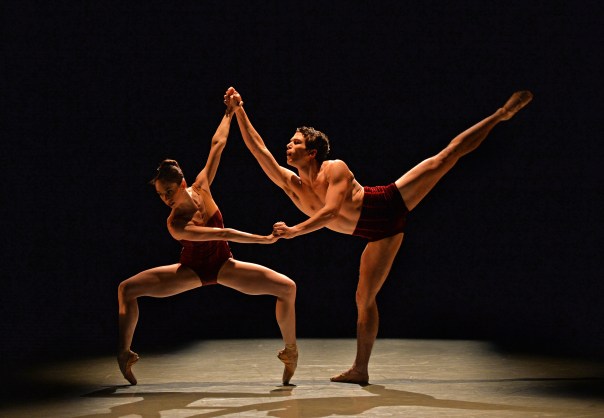
John Adams’ “Short Ride in a Fast Machine” served as both title and soundtrack for David Morse’s piece, brilliantly danced by Harkins and Hall. In costuming, lighting, and choreography, Morse divides his work in two. The dancers come on in dim light, Hall in a waistcoat and Harkins in a long flowing blouse. Turning up their intensity, the dancers shed these upper garments as the lights come up fully. This moment of liberation is amplified by the ensuing choreography, which utilizes the entire stage. Morse’s piece returns to the rotation during the evenings of the final weekend of the run, February 18-20. Next weekend, Morse’s spot is taken by Gregory Taylor’s “Requiem of a Meaning,” and Hall shows off his “Social Butterfly” on the third weekend.

Hall will be borrowing rookie dancer Ryo Suzuki for his solo piece. Meanwhile, he is featured in “Yamato, earth/nature/drum,” a three-part celebration of Japan by Diamond, demonstrating that he’s no less eager to pursue new directions than Rhoden. The 12 people in this piece form a spherical mass as Propst’s shimmering lighting comes up, with Suzuki slapped across it horizontally. Then the ball explodes in big-bang fashion to an original score arranged by Rocky Iwashima, heavy with taiko pounding. Ultimately, the group regathers downstage in a tableau that is analogous to the spherical beginning but with Suzuki in an uplifted, triumphal posture. Inside of this effective framing, Suzuki and Addul Manzano are the dominant presences, although Barkley is hard to ignore whenever she’s involved.

Charlotte Ballet Innovative Works by Christopher Record

Photo by Christopher Record

For his new work, “Sketches from Grace,” Janes veered from his intent to create settings for works by Leonard Cohen, opting instead for a four-piece suite of settings to cuts by Jeff Buckley – including his cover of Cohen’s “Hallelujah,” which became a posthumous #1 hit for Buckley in 2008. The work showcases a punkish set of costumes by Katherine Zywczyk with faint, silvery highlights, beginning with Buckley’s most distinctive original, “You and I,” a brooding, floating, dreamy song that would seem to defy choreography. Yet Chelsea Dumas and James Kopecky fully conveyed the smoldering energy lurking in the lyric. Once covered by Nina Simone, “Lilac Wine” took the tempo up to a bluesy dirge, given an aching elegance by Ingel partnering with Alessandra Ball James. Bringing the tempo further up to a lethargic shuffle, “Hallelujah” was undoubtedly the climax of the suite, danced with such heartbreaking perfection by Hayes and Hall that the audience applauded as if it were the finale, although Janes’s video intro had promised us that all three couples had a concluding segment together. That closing ensemble was a more driven Buckley original, “Lover You Should Have Come Over,” very appropriate for the hubbub of three couples strutting their stuff simultaneously. Those last pushes in tempo, spectacle, and animation gave the audience one more reason to cheer.

Drosselmeyer Takes It to the Hood, Yo

By Perry Tannenbaum

On a nighttime set projected onto the back wall of Booth Playhouse that evokes the setting for Lin-Manuel Miranda’s In the Heights, Mike Fitelson has made over a Christmas classic produced by the New Jersey Performing Arts Center. Aside from Drosselmeyer’s Toy Shop and the tumescent fir tree that sprouts up deep in Act 1 on an empty moonlit playground, The Hip Hop Nutcracker makes few references to Christmas or the E.T.A. Hoffman story that inspired Tchaikovsky’s wondrous ballet.

But a lithe and versatile 11-member dance troupe certainly reminds us of the Russian composer’s music, dancing to a conventional pre-recorded performance of the score with live lagniappe provided by violinist Mathew Silvera and DJ Boo. Here in Washington Heights, with the mighty GW Bridge looming behind the tenements, Maria-Clara is our protagonist. The teenager’s quarreling parents and an assortment of neighborhood characters, some of them gang members, precede her onstage.

Surrounded by such seedy strife, Maria-Clara could use a Prince Charming coming to her rescue. Enter The Nutcracker in the appropriate artist-formerly-known-as-Prince costume, wheeling a pushcart that bears his nutty name. He’s promptly thrashed by the gang when he tries to come to the aid of our damsel in distress. So perhaps it’s more accurate to say that Drosselmeyer is her prince – except, in this instance, it’s Frau Drosselmeyer, since the impish Miki Michelle dances the role.

As in the traditional Nutcracker, Drosselmeyer flamboyantly doles out gifts, and once again, it’s ambiguous whether Frau Drosselmeyer sends Maria-Clara off on a magical journey or lulls her into a fabulous dream with a hypnotic watch chain. In either case, no Flying by Foy is necessary to convey Maria-Clara to this magical realm – as it is when Charlotte Ballet sets up its traditional Nutcracker downstairs at Belk Theater. No, the gateway to this journey is a graffiti-strewn storefront façade that lifts like the garage door of a loading dock (such protection is required by Upper West Side shopkeepers), revealing a deeper more amazing vista than you would ever have suspected inside a neighborhood Candyland store.

There are more blandishments to the new scenario that you’ll enjoy, most notably the pair of red sneakers slung over the lamppost where we first see the violinist play, and Fitelson does attack the problem that besets most traditional Nutcracker productions – the fact that nothing really happens in Act 2 besides a pleasant parade of luscious melodies and dances.

What chiefly pleased me was choreography of Jennifer Weber, a marvelous fusion of hip-hop and traditional ballet. Perhaps because Weber, who also stage directed, allows for so much of the dancers’ freestyling to be incorporated into the dance, the lead characters positively gush with charisma. Leading the ensembles, Ann Sylvia Clark gives Maria-Clara a definite Janet Jackson wickedness and flair, yet in the pas de deux, there’s an innocence and grace that recalls Mia Cunningham’s sweetheart exuberance during the many years that she was NC Dance Theatre’s Clara. In the title role, Gabriel Alvarez is as proper and deferential as his starchy military costume would imply, but he can also bust some prodigious moves.

In the holiday spirit, the strife between Mom and Dad is more comical than mean, with Myriam Gadri and Alain “Hurrikane” Lauture establishing a winsome contrast. Gadri is long, leggy, and wanton, a Mom who wants to dance; while Lauture is crotchety, jealous, and hypochondriacal. Another side to the old folks emerges in Act 2 when we behold the couple back in 1984, before Marie-Claire was a gleam in Dad’s eye, so these are two juicy roles. Among the minor players, I’d call attention to Brandon Rosario, as the gang leader and the Mouse King, and Sophia Lavonne as Drosselmeyer’s toy marionette, perhaps the most classical episode of the entire evening.

My only disappointment was in the music coming languidly out of the Booth’s sound system. I wish they had done more with it. Duke Ellington was able to record a whole CD of jazzy Nutcracker hits, making them over into his inimitable big band idiom. I think a funkified Tchaikovsky would be more to the point here, at least interspersed with the orchestral score. Except for one charming moment when his soundboard ministrations mimic a blizzard wind, DJ Boo devolves into virtual insignificance after his overloud preshow and break, and the lonesome forlorn Silvera merely plays the tunes as written.

A fiddler under a pair of sneakers. Sounds crazy, no?” Okay, that was a bad joke, but I couldn’t resist throwing it out there.

Jamie Laval Injects Wassail, Bagpipes, Poetry, and Highland Dancing into His Scottish Christmas

Jamie-&-Dancers-Christmas-5-Low-res

By Perry Tannenbaum

Unconvinced that Charlotte was a hotbed for competitive fiddling enthusiasts, I was a little doubtful that a U.S. National Scottish Fiddle Champion would attract a substantial crowd to a “Christmas in Scotland” concert on a Monday night three days after the holiday. But as we drew up to the Great Aunt Stella Center on a sloppy evening, we noticed that the outdoor parking lot was full. So was the lower level of the nearby parking deck, and there was a bit of a crowd in the lobby, where we picked up our tickets. Jamie Laval last appeared in the Metrolina area back in October at Belmont Abbey College, more than two years after participating in a Classical Idol fundraiser on behalf of the Charlotte Symphony – perhaps on the strength of the Asheville-based violinist’s previous Metrolina foray at Davidson College in 2011. This Christmas gift from the mountains had no precedent, but there is no doubt that the Great Aunt Stella Center has established an enviable folk music cachet in Charlotte due to the series of free concerts that Charlotte Folk Society stages there monthly.

Ensuring that the event would be nothing if not colorful, Laval brought plenty of artillery to the occasion, including four instrumentalists, a budding young vocalist, and four dancers, who changed costumes at least four times during the concert. Further diversifying the musical palette, most of the musicians played multiple instruments. Both McLeod brothers, David and Michael, played bagpipes and the less punishing smallpipes, with Michael adding a drum and a pennywhistle along the way. For the most part, Rosalind Buda supplied a fluid obbligato and continuo on bassoon, but she also wended her way through a couple of bombards, a recorder, and an odd percussion instrument that could have begun life as a black canteen. Above all else, Buda read all the poetry selections beautifully, adorning them with a warm expressiveness and just a faint touch of dramatic flair. When he wasn’t flashing his championship fiddling bravura, Laval switched less impressively to strumming a guitar. But Laval was also a relaxed and personable host – his intros, anecdotes, and stories flowing so effortlessly that I sometimes lost track of when he crossed over from one type of spiel into another.

Yet there was nothing offhand about this concert. Laval’s craftsmanship was immediately apparent in the arrangement of the opening medley. Kelly Brzozowski began it with a lovely solo on the Celtic harp, introducing the “Wexford Carol,” and reminding me what a marvelous acoustic the Great Aunt Stella offers – something I’d quite forgotten since I last heard music there in 2001. We savored the sweet-sounding Ana Carolina Scott soon enough as she sang the ensuing “Angelus ad Virginem,” where we also heard our first sampling of the smallpipes. By the time we galloped into the fifth and final tune in this medley, “The Flagon,” we had seen most of the musical arsenal. With three wind instruments blowing simultaneously, the dynamic difference from the opening quiescence was startling.

The variety, contrasts, and unpredictability of the opening medley were mirrored by the entire program, which eventually covered more than 30 songs. Scott returned for three more vocals before intermission, beginning with a quiet rendition of a pre-Christian version of “The Holly and the Ivy,” accompaniment by harp and guitar with a couple of bassoon fills between stanzas. Assembling his program, Laval took a special interest in Celtic materials, melodies and lyrics that were eventually commandeered by Christianity – altering traditions rather than superseding them. That didn’t prevent Laval from utilizing a trio of young women from Atlanta’s Glencoe School of Highland Dance in further exploring Scottish folkways or from sneaking into North American tradition for a taste of Cape Breton step dancing with Amy Mooney.

After Buda and the McLeod brothers demonstrated how loud and make-it-stop irritating just three smallpipes could be on “Ding Dong Merrily on High,” things quieted down for the no-less-lively “Cape Breton Step Dance” featuring Laval’s infectious fiddling and Mooney’s percussive stepping. Mooney’s dancing was actually so percussive that she and Laval would trade two-bar solos with each other as Brzozowski accompanied on harp (with a few foot stomps of her own). All three Glencoe dancers then appeared in bright plaid skirts for their “Highland Dance Set,” accompanied by Luval’s fiddle and the McLeods’ smallpipes.

Return visits by the quaint trio didn’t wear out their welcome. The Glencoes next appeared in black outfits that were bedecked with colorful strips of fabric. Shaking bell sticks in both hands as they danced, they simulated a pair of wassail ceremonies designed to waken the apple orchards in the dead of winter and ensure the hard cider for the coming year. The next costume change was even more surprising as the Glencoe gals shuffled back onto the stage after intermission in sailor suits, doing mock battle with one another as the two bagpipers played the “Sailor’s Hornpipe” behind them.

While the smallpipes’ wind is supplied entirely by a small bellows pumped under the armpit, the bagpipes are fueled by both breath and bellows. Two of them, as was proven by the ensemble’s “Bessie Brown” just before intermission, can be even more make-it-stop loud than three smallpipes – with a rougher, more irritating sound at full blast. A rock concert sensibility would have been helpful, but I found that I’d acclimated well enough by the time we reached the evening’s final medley, finishing with the “Break Your Bass Drone” and “Flett from Flocca.” Meanwhile, Laval pursued his musical travelogue even more extensively than the ladies’ dance rounds, taking us to Orkney, Brittany, Coventry, Sussex, and Gloucester before we were done.

Most engaging of all was Laval’s extended excursion to Iceland, from where he brought us some diverting Yuletide legends and anecdotes along with three very entertaining songs. Withholding them until the end of the evening, Laval obviously knew the value of what he had. But he also edited prudently, beginning the “Icelandic Yule Lada,” the local equivalent of “The Twelve Days of Christmas,” on Day 8. There are actually 13 days in the Icelandic tradition, and how that evolved was another narrative. Laval hadn’t sung audibly during the evening, and when he duetted with Scott in “The Wren in the Furze,” we could hear why, for his vocals were chiefly effective in contrasting with the beauty of Scott’s. The backstory of this song, traditionally sung on St. Stephen’s Day after Christmas, meandered into Icelandic history and how the wren became an icon for military betrayal before taking on a radically different meaning for the holidays. Basically, “The Wren” was the weirdest begging song I’ve ever heard.

The final medley began with the “Boar’s Head Carol” and ended with the entire audience clapping rhythmically as the musicians and dancers took their bows, both bagpipes blaring once again. Even that wasn’t a sufficiently emphatic return to Scotland, but Laval wasn’t guilty of an oversight. For an encore, the pipers and the harpist accompanied Scott as she sang “Auld Lang Syne.” I didn’t recognize Scottish laureate Robert Burns’ words – or his brogue – in the stanzas Scott sang, but when the ensemble answered with the refrain, all hearts were in the Highlands.