All posts by perryt77

King of Pop Invades Popo in “Leonce and Lena”

Review: US premiere of Leonce and Lena

By Perry Tannenbaum

DSC_0010[4]

As the action in the US premiere of Christian Spuck’s Leonce and Lena reached its climax, King Peter of Popo stepped forward on the Knight Theater stage to make an important announcement – to the audience, presumably, for the rest of the Charlotte Ballet cast stood respectfully and expectantly behind him. King Peter struggled mightily to express himself, never quite succeeding in uttering a syllable, though I’m sure I heard a consonant.

Summoning up more power and determination, the doddering King of Popo snapped his fingers. Behold, the house lights came on. But still, when he faced us squarely, no words came out. Well-heeled ballet mavens would have scanned their programs by now and read the synopsis, knowing before Peter’s abortive attempts at speech that he was probably announcing the upcoming wedding of his son, Prince Leonce, to Princess Lena of Pipi.

Or, since Leonce and Lena had fled their respective kingdoms back in Act 1, perhaps Peter was announcing a kingdom-wide search for the absent bride and groom-to-be. A reward for whoever found and returned them? That would certainly be in keeping with fairytale decorum.

That the ineffectual king snapped his fingers and brought the house lights back down was no longer a big surprise. But Spuck had plenty more shtick in reserve for James Kopecky, the dancer in Peter’s royal regalia who had pitifully shrunk away from us in defeat. Shedding his doddering persona, Peter busted a whole bevy of pop dance moves, including a stylish anthology of moves associated with the concerts and videos of Michael Jackson.

“You are the king!” I was tempted to shout.

There probably were shouts amid the hubbub of laughter and surprise that greeted this dramatic break from Peter’s previous character. You couldn’t doubt that Spuck’s intentions were largely comical, but if you found an edge of satire lurking beneath the laughs, you might also find it challenging to decide who or what the targets could be.

A powdered periwig that detonates in the opening scene reliably tells us that ceremonial pretensions were definitely in Spuck’s crosshairs. The fawning and fussing of Peter’s underlings are also mercilessly exposed in the costume designs of Emma Ryott and Spuck’s choreography. Repeatedly in Popo, the presumed grandeur of fairytale kingdoms – or European kingdoms so obscure they might as well be fairytales – is repeatedly punctured. Peter’s first wedding announcement is scrawled on a humble blackboard, with interlocking rings hastily drawn with chalk, while Leonce listens to his music on his friend Valerio’s wee boombox instead of adjourning to an dignified spinet.

What Charlotte Ballet subscribers are most likely to overlook, until Kopecky’s King of Pop antics conk them over the head with it, is that Spuck’s prime satirical target is ballet itself. Robotic choreography, such as we see in Leonce and Lena among Peter’s sycophants and later among the Italian townspeople, has been part of the balletic arsenal since the days of Copéllia and Nutcracker in the 19th century. That isn’t where I was finding Spuck’s fresh assault on ballet conventions. No, it’s the royal lovebirds who are most hilariously antithetical to ballet.

Instead of the customary piety, elegance, or bookishness that might mark Leonce and Lena as kindred spirits, Spuck points up their pure boredom. Nor is this mere low-key eyeroll boredom. This is enervated, prone, cradling-your-chin-in-the-palm-of-your-hand boredom. While Leonce is moping on the floor, he does something even more unbefitting the heir to the Popo throne: he propels himself along the ground like an inchworm. Backwards.

The alienation that Lena and Leonce feel toward their parents is demonstrated, in a charmingly antiquated way, by the music they listen to. At court, we’re likely to hear the waltzes of Johan Strauss Jr., including the majestic Emperor Waltz. Lena and her loyal Governess prefer to unwind with a coy version of Cole Porter’s sexually suggestive “Let’s Do It,” while the less fiercely rebellious Leonce and Valerio crank up Burl Ives’ greatest hit, “A Little Bitty Tear” on the boombox.

DSC_0230[11]

Less downcast than their besties, Peter Mazurowski as Valerio and Alessandra Ball James as the Governess get to sparkle more at their respective castles before the young royals hit the road – and wear the less humdrum costumes. They also spark more readily with each other when the quartet meets up in Italy. Love at first sight between Leonce and Lena is more of a slow burn and more passionate, allowing Colby Foss as the Prince and Sarah Hayes Harkins to fire up a singularly quirky pas de deux that will linger in your memory. Notice that Stuck sticks them side-by-side in this whirlwind courtship, not forgetting how he established their characters.

Meanwhile, Mazurowski and James’ settle into a comedy groove that has belonged to second-banana couples on stage and on screen since before the days of Guys and Dolls. Then the zany Finale, when they return to Popo to crash the wedding – and stop the show almost as hysterically as Kopecky.

Plotwise, where ballet and its mute characters always have difficulties in storytelling, Spuck gets a little haphazard when Leonce and Lena part from each other in Italy. There’s a bit of Cinderella-at-midnight confusion to how Lena abruptly leaves Leonce. So it’s quite possible on your way home, after the full happily-ever-after tale has been told, that you’ll be asking yourself: when love first exploded between them, did Leonce and Lena even tell each other who they were?

During the final scene; filled with masquers, eccentrics, a wedding bower, and the king’s antics; you’ll likely be too entertained to worry about tying up such stray details. You might, on the other hand, miss Chelsea Dumas’ pouting as Rosetta and her unsuccessful flirtations. Pursuing Leonce in the opening act, Dumas neatly livened the action and underscored the Prince’s ennui. Maybe Spuck could bring Rosetta back to ply her charms on queenless King Peter! Such monkeyshines would be quite apropos in Popo.

CSO Takes Flight With Stravinsky “Firebird”

Review: Stravinsky’s Firebird Suite

By Perry Tannenbaum

2019~Symphony Firebird-11

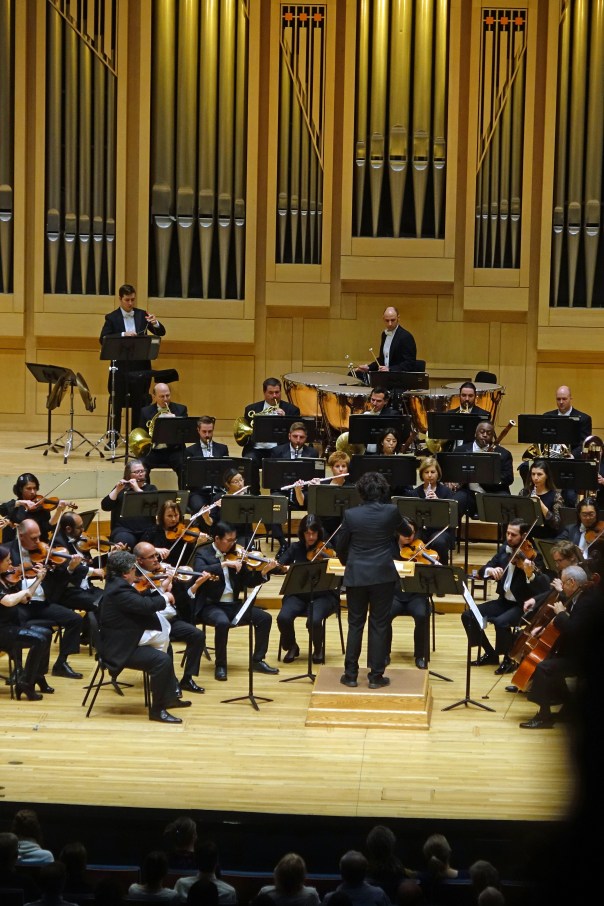
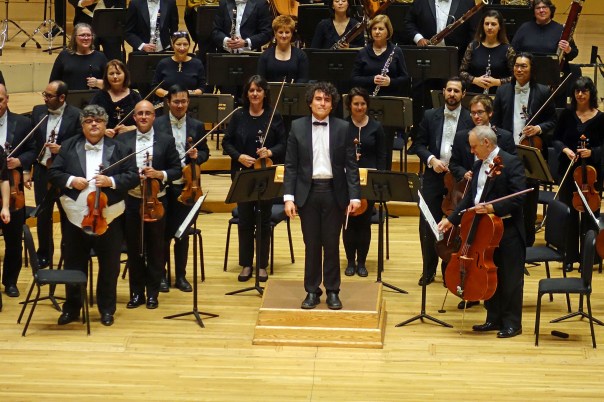
If you think The Donald is in cahoots with the Russians, take a look at the Charlotte Symphony. They began their 2019-20 Classics season with an all-Tchaikovsky program late last month and continued with another all-Russian bill last weekend featuring music by Modest Mussorgsky, Alexander Glazunov, and Anatoly Liadov before climaxing with the Igor Stravinsky Firebird. Are the musicians of Charlotte Symphony and their conductors, first music director Christopher Warren-Green and now resident conductor Christopher James Lees, leading us into the arms of Vladimir Putin?

Or just maybe… they’re following their audience’s inclinations in melting into the bosom of Mother Russia!

Principal flutist Victor Wang started off the evening with his introductory remarks, citing a previous experience with Lees, when he led Symphony in the pivotal “Infernal Dance” from The Firebird, as emblematic of the special enthusiasm that he brings to the podium. But Lees would first need to conquer Mussorgsky’s Night on Bald Mountain in the fearsome arrangement by Nikolai Rimsky-Korsakov. Under Warren-Green’s baton, CSO had failed in its two previous assaults on the Mountain – in 2009, when the British conductor was auditioning for his Charlotte post, and in 2016.

Strangely, it’s the most familiar part of the tone poem – the macabre, witches’ sabbath part – that eluded Warren-Green on both occasions. All the chaotic, nocturnal terror of the piece was drained from the 2009 performance, though the tolling of the bells and the onset of morning at the end of the piece were gorgeous. The more recent performance three years ago attempted to restore the original snap and crackle of the piece, pushing the tempo from the violins, turning up the volume from the brass, and unleashing more sforzando crispness from the percussion. A bit over-the-top, I thought, and not convincing – until the bells sounded, more glorious than ever because of the heightened contrast.

The 2019 version glowed even more fabulously with the dawn as Wang, principal clarinetist Taylor Marino, and principal harpist Andrea Mumm worked their magic. The calm resolution was nearly as impressive as the diablerie that preceded it – so overall, I was still disappointed with our nighttime sojourn. Lees certainly brought all the percussive razor sharpness you could want on the Bald Mountain, and the brass were excellent, with full-bodied trombones rocking the house. Violins were note-perfect quailing before the onset of the brass and astringent in reacting.

2019~Symphony Firebird-06

Trouble was, Lees eased off the pedal in pushing tempo. Nothing about the witches’ sabbath was ever maniacal or threatening to lurch out of control, and the interplay between the violins and the brass, particularly when the strings were asked to suddenly pounce, was lacking in visceral excitement. Listen to how electric it can be on the Naxos recording by Theodor Kuchar and the Ukraine National Symphony.

While you’re there, you can also listen to Mussorgsky’s original orchestration. You’ll likely reach the same conclusion I have: it was Rimsky-Korsakov who was being “modest” if he termed the work we know today an orchestration or even an arrangement. Only six of the familiar notes from the fearsome brass theme were written by Mussorgsky. The next nine add-ons were Rimsky’s invention – and all of the concluding dawn episode was his as well. Joint attribution is very much warranted for Bald Mountain, and Ken Meltzer needs to go back to the drawing board with his program notes.

Once Lees and the CSO had exorcised the Halloween – or St. John’s Night – demons haunting them on Bald Mountain with Rimsky-Korsakov’s original music, they continued to warrant Wang’s praise. Glazunov’s Stenka Razin was delightfully contoured, though the Cossack rebel’s bellicose episodes could have been more turbulent and his dalliance with a Persian princess would have benefited from another splash of Rimsky, namely Scheherezade. The recurring theme, an old Russian folksong known as the “Song of the Volga Boatmen” on recordings by Glenn Miller and Paul Robeson, was handsomely passed back and forth from the brass to the French horns, and Mumm and Marino were again a beguiling combo on harp and clarinet.

Lees continued to be at a loss about creating maximum drama in Liadov’s The Enchanted Lake (listen to Vassily Sinaisky’s account on Chandos with the Slovak Phil to hear what I mean). But there was no lack of atmosphere here as tremolos from the strings vividly simulated Liadov’s lake. Nor was there a dearth of enchantment as the woodwinds made telling contributions and Mumm again excelled, even on the smallest strings of her harp.

2019~Symphony Firebird-02

With the 1919 Suite from The Firebird, the most-frequently heard of the three suites that Stravinsky distilled from his 1910 ballet score, Symphony achieved lift-off, playing with their most admirably controlled fury. Lees not only captured the bacchanalian abandon of the “Infernal Dance of King Kastchei” as Wang had predicted, he and the orchestra brought orgiastic celebration to the Finale, where Prince Igor weds his chosen Princess after freeing her from Kastchei’s captivity, using the Firebird’s magical feather.

Amid the collective sparkle and might of The Firebird, there were individual exploits to magnify the triumph. Principal oboist Hollis Ulaky had lovely spots in the opening “Introduction and Dance of the Firebird” and later in the tender “Berceuse,” where principal bassoonist Olivia Oh spread additional nocturnal wonder. Principal cellist Alan Black and concertmaster Calin Ovidiu Lupanu were both eloquent in the “Dance of the Princesses,” but none of the principals made a more memorable impression than Byron Johns, launching the Finale with his beautiful work on the French horn. The forlorn splendor of it gave the fireworks that followed added impact and an onrush of drama.

Inside a She-Wolfpack

Review: The Wolves by Actor’s Theatre of Charlotte

By Perry Tannenbaum

WOLVES-10-web

A couple of new productions drew my attention over the weekend, both sporting a cast of at least eight players. Yet at the two dramas, the new Countess Dracula from The Actor’s Gym and the local premiere of The Wolves by Actor’s Theatre of Charlotte, there wasn’t a single male performer among the 18 that I saw. Even more surprising, it was the older, more established company that was fielding more new faces.

There aren’t any particularly sharp canine teeth on display in The Wolves, for the title pack is a women’s soccer team, but director Sarah Provencal and her design team are making a point of fielding this high-school-aged club. ATC has turned Hadley Theater on the Queens University campus into a soccer practice field, a somewhat jarring experience after you park your car, since there’s a real practice field adjacent to the lot and the school building that houses the Hadley.

In Evan Kinsley’s set design, the field and a scoreboard bisect the theater, and ticketholders can choose to sit on either side for a nicely simulated grandstand – and soccer mom – experience. The playing space was so large that ATC executive director barely made himself heard in his inimitable pre-show welcome, feeding my concern that the newcomers we were about to see would fare even worse.

Sarah DeLappe’s script and Provencal’s direction weren’t designed to allay such fears. Other than winning their next games and making it to the national tournament, the nine Wolves aren’t consumed by a single storyline as they gather for practices, and there can be multiple conversations vying for our attention at the same time, all equally tangential. Reminding me a bit of Annie Baker’s The Flick in its verité style, DeLappe develops her characters casually and obliquely as her teens’ conversations leap unexpectedly from immigration policy to Harry Potter to soccer strategy to coach’s hangover to the Khmer Rouge – and of course, juicy gossip about absent teammates.

WOLVES-6-web

Compounding our difficulties – and her actors’ – Provencal conspires with soccer trainer Kirsten Allen to keep the Wolves engaged in an ongoing cavalcade of stretching exercises and soccer drills while all these scattershot conversations are popping at us from all points of the field. There’s plenty for us to see as we sift through the trivialities for telling info, and there’s plenty for the never-further-identified #25, #13, #46, #2, #7, #14, #8, and #00 (the goalie) to do, prompted by #11, the movement captain.

Along the way, we learn that we are somewhere in Middle America, that the mysterious newcomer lives in a yurt, and that another’s dad works with immigrants. There are little markers that attach to most of the others: #00 darts off the field repeatedly to vomit, the slender #2 may be anorexic, #14 is Armenian, and the movement captain, while aching to attract the notice of a college scout, takes on the responsibility of making her teammates winners. She’ll take the silliest of them aside, #8, and chastise her for making hurtful remarks to another player.

As with The Flick, another darling of Pulitzer Prize committees in recent years, you’re likely to conclude that, behind the outward aimlessness of The Wolves, an inner aimlessness lurks as well. At times, I felt like The Wolves might be a first draft of a script that could become a TV pilot for a series that HBO or Lifetime would reject as too nebulous or punchless. There are definitely players here who pique our curiosity and promise to reward deeper exploration.

WOLVES 5

This ATC production reaches that limbo level because Provencal’s cast is so credible – both in inhabiting their roles and their soccer uniforms. I was most impressed by El Osborn as #7, the iconoclastic striker who is unexpectedly replaced by the socially awkward newcomer, Maevis Pair as an equally impressive #46. Osborn does a fine job with the glints of vulnerability that creep into #7’s haughty front after #46’s exploits on the pitch, revealing her longing for belonging when her stardom is broken. Pair evolves from her initial trepidations – counseling would likely be helpful for #46 – but she remains respectful toward #7 and a long distance from arrogance.

Maybe the fullest character on the team is Harley Winzenreid as #11, whose world is totally upended when she is no longer the hot college prospect but still the team leader. To be sure, DeLappe and Provencal provide Winzenreid with means to register the shifting landscape she copes with – and the cataclysms that befall the whole team collectively – but she’s interesting to watch as she effortlessly maintains leadership. Aside from the always disgruntled #7, who’s there to challenge her?

Not the two neurotic pups, Annarah Shephard as the nervous goalie, nor Hannah Kevitt as the inward and secretive #2, possibly anorexic. Entertaining as she may be as the ignorant and insensitive #8, Ahzjai Culbreth is well aware that she isn’t leader-of-the-pack material. What all of the teammates achieve, even as they expend so much athletic energy going through their pre-game paces, is a naturalness that I didn’t adequately appreciate until it was paused.

WOLVES 1

That’s when the one adult in the cast, Jennifer Poarch as Soccer Mom, makes a dramatic entrance and delivers a fairly lengthy monologue. Compared to haphazardness that precedes her, Soccer Mom seems stagey, and I found myself accusing Poarch of acting. What comes across, aside from a distinct impression that Soccer Mom isn’t sure why she’s there, is that she exits without deepening her connection with her daughter or the other Wolves. After spending 90 minutes with them, I found that I had only barely begun.

Prague Is the Coolest Place for the Classics in September

Reviews: The Classics in the Czech Republic’s Capital City

By Perry Tannenbaum

Letn° DG dern 073

The Czech national river, Vltava, flows through the Republic’s capital city of Prague, crossed by no fewer than 18 city bridges and most famously memorialized in Bedřich Smetana’s Ma Vlast (My Country) – where the river usually goes under its German name, “The Moldau.” A rich vein of classical music also flows through Prague, as you might expect in the heart of Bohemia. The gorgeous city not only nurtured Smetana and Antonín Dvořák, it was a friendly haven for Mozart, who premiered Don Giovanni and La Clemenza di Tito at the Estates Theatre.

Classics still pulse through the city. Daily. At the Church of Nicholas in the Old Town, posters proclaim two concerts every day. The Czech Philharmonic, the Prague Symphony, and the National Theatre Opera all have their own venues, and they don’t seem to fret over performing on the same nights as the others. In mid-September, when we visited, the Prague scene was conspicuously intense, diverting us from Vienna and Budapest, where the new seasons had not quite begun.

The National was offering the last performance in its 2019 run of Don Giovanni – at the Estates Theatre! – and Prague Symphony was opening its season with guest shots by Pinchas Zukerman and Amanda Forsyth. Two festivals were in full swing when we arrived, the Young Prague International and the star-studded Dvořák Prague International. By star-studded, we’re talking Gil Shaham, Nicola Benedetti, Ivo Pogorelich, Gautier and Renaud Capuçon, and Boris Giltburg among this year’s virtuosi; Zubin Mehta, Neeme Järvi, Christoph Eschenbach, Semyon Bychkov, and Emmanuel Villaume among the conductors; and the Israel Phil, the Estonian National, the Prague Radio Symphony, the Essen Phil and the Italian National Radio and TV Symphony among the orchestras.

Letn° DG dern 024

We could have concentrated on the Dvořák Prague Festival, which offered five concerts during our five-night stay, but we opted for a broader survey of the local companies and venues. The National’s Don Giovanni was obviously a more Prague-infused choice than its La Traviata, so we pounced on that opportunity. Nor were we passing up the Zukerman opener, offered on the same evening as the Verdi. Our dance card was rounded out by the all-Tchaikovsky concert featuring Gautier Capuçon, my one chance to sample the Czech Phil in action.

To our surprise, National Opera was nearly as excited about our coverage of their Don Giovanni as we were about seeing it in the same hall where Mozart conducted it for the first time on October 29, 1787 – and where Czech director Miloš Forman insisted on filming his Oscar-winning Amadeus. National’s stock of production photos evidently didn’t replicate the cast that we would see on September 15, so they committed to providing us with photos from that performance!

The offer certainly didn’t stem from a desperate need for audience or publicity. Notwithstanding the fact that the Dvořák Festival was offering two concerts that evening – one featuring Shaham and the other showcasing Mehta’s Israelis performing Mahler’s Third – the Estates with its five tiers of boxes and balconies was packed to capacity. We were given aisle seats, to be sure, but it was necessary for management to bring in chairs to make that happen.

Letn° DG dern 318

Musicians of the State Opera Orchestra, under the baton of Richard Hein, likely numbered less than 30, even with a fortepiano and a mandolinist on hand, a prudent size for Mozart’s music. The Ouvertura probably would have sounded firmer and more sinewy from one of those mid-level boxes, if my experience at the similarly cylindrical La Scala can serve as a guide. But the hall seemed to warmly embrace operatic voices whether you were seated at ground level or up in the rafters.

A statue of the Commendatore lurks outside of the Estates, indicative of the dark hues often attributed to Giovanni and reinforced by Amadeus. But if you delight in seeing a brighter balance of comedy and drama in Lorenzo Da Ponte’s libretto, this cast directed by Jiří Nekvasil (reviving the 1969 production conceived by Václav Kašlík) was ready to deliver heartily. As the Don, baritone Martin Bárta was more than sufficiently virile and predatory, but there was a smoothness in his serenading that underscored his legendary charm. Bass-baritone František Zahradníček maintained a pragmatic ambivalence toward his master as Leporello, and his quick tongue on his most familiar arias proved that he was Rossini-ready.

Letn° DG dern 140

Giovanni’s lady conquests were wonderfully differentiated by the sopranos who sang them and in the sumptuous costume designs by Theodor Pištěk, who took home an Oscar for his work on Amadeus. Veronika Hajnová was elegant, wanton, and insatiable as the love-blinded Donna Elvira, and Petra Alvarez Šimková was so starchy and pure as the grieving Donna Anna that she actually drew laughs when she put off Don Ottavio yet again after Giovanni had gotten his comeuppance. Upstaging both of these nobles was Lenka Pavlovič as Zerlina, deliciously vamping her Masetto in two of her arias.

Utilizing the side aisles and a couple of the audience’s side exits, Nekvasil heightened the comical flow of the action and the sense that Giovanni was constantly pursued by Donna Anna and Donna Elvira. From our ground-level vantage point, it seemed doubtful that folks seated in some of those side boxes and balconies could see all of the offstage action at the sides of the hall, but they were better situated for the Czech and English supertitles, which were projected high above the stage near the proscenium.

DSC_4796

There were no such tradeoffs between ground level and the balconies at the Smetana Hall in the Municipal House, where Zukerman and Forsyth teamed up on the Brahms Double Concerto for Violin and Cello. To see them or hear them, ground level was best. Elsewhere in the art nouveau Smetana, you will feel a little exiled from conductor Pietari Inkinen and his Prague Symphony, though the hall’s design spares ticketholders below from any overhangs.

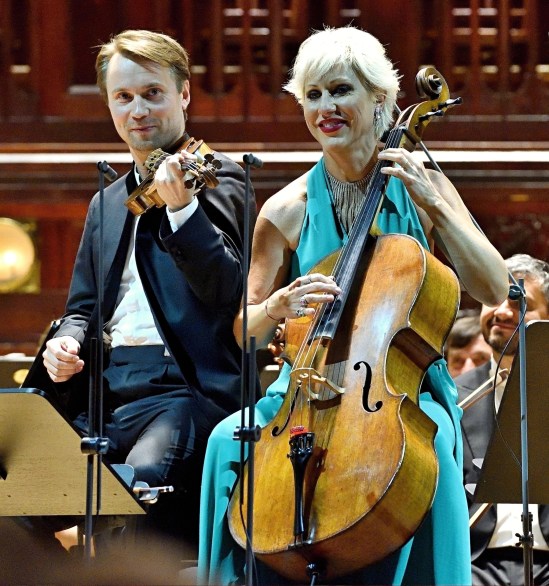
The opening night program was deftly crafted so Zukerman fans wouldn’t feel cheated by his sharing the spotlight in the Brahms. Both Zukerman and his wife of 15 years had individual turns in the spotlight at the start of the evening when they presented two Dvořák gems, the Romance for Violin and Orchestra followed by a showcase for Forsyth, Silent Woods. When we reached the Brahms, it was Forsyth’s cello that was most favored by the hall’s acoustics in the dreamy Andante middle movement, but the couple’s musical chemistry crested in the closing Vivace non troppo.

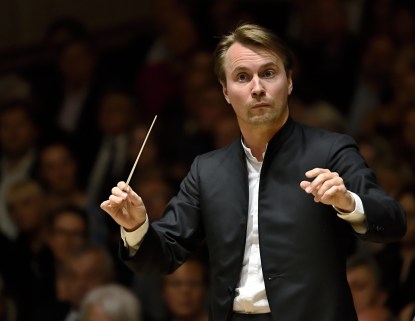
Slated to conduct a new Wagner Ring next summer at Bayreuth, Inkinen also holds chief conductorships at the Japan Philharmonic and Deutsche Radio Philharmonie. In a cute encore after the Brahms, he picked up his violin and traded pizzicatos with Forsyth, radiating genuine charm. Then after intermission, the 39-year-old Finn displayed his affinity with Jean Sibelius in a majestic rendition of the Symphony No. 5. By evening’s end, the Smetana’s quirky acoustics were no longer a worry.web_DP19_1709_ČF_Bychkov_Capucon_photo_Martin_Divisek_15

No acoustic blemishes marred the all-Tchaikovsky concert at the Rudolfinum’s glorious Dvořák Hall, where we heard a transcendent account of the Variations on a Rococo Theme from Capuçon. The gorgeous, impactful Symphony No. 5 from Bychkov and the Czech Phil was not at all anticlimactic, with splendid playing from the principal French horn, bravura from the timpanist, and tack-sharp section work from the brass. But the shape, control, and opulence that the orchestra brought to the Serenade for Strings in C to start the evening – plus the Viennese lilt to the Valse movement – demonstrated that the Czechs’ excellence encompasses sensitivity and finesse as well as brilliance and power.

Capuçon was amazing, the enduring pinnacle of the evening. I’ve heard Alban Gerhardt, Lynn Harrell, Mischa Maisky, Daniel Müller-Schott, Pieter Wispelwey, Alisa Weilerstein, Zuill Bailey, Joshua Roman, and Steven Isserlis in live performance. None of them surpassed the exquisite pianissimos, the gleaming harmonics, or the stunning virtuosity I heard from Capuçon as he possessed the Rococo Theme and each of its eight variations.

Ah, but I’ve never heard any of those other cellists at the beautiful Neo-Renaissance Rudolfinum! Capuçon himself seemed inspired by the sounds that reverberated back to him from the Dvořák Hall. It wasn’t surprising at all that so many orchestras from near and far were converging on the Dvořák Prague International: the sonics at the Rudolfinum have that kind of ravishing, Siren appeal.web_DP19_1709_ČF_Bychkov_Capucon_photo_Martin_Divisek_23So does the September weather in Prague. High temperatures ranged between 58° and 75°F during our five-day stay, ideal for strolling through this walkable and photogenic city, and nighttime lows dipped down to 48°F, justifying my choice of a long-sleeve dress shirt under my blazer for our after-concert walks back to our hotel – along the rim of the Vltava when we attended the Festival.

Preceded on the Prague cultural calendar by the now-defunct Prague Autumn International Music Festival, the Dvořák Prague Festival website yields no hints of kinship to – or rebranding of – the event it replaced. Yet it remains locally and internationally in the shadow of the older and broader Prague Spring International Music Festival, which begins annually on May 12, the anniversary of Smetana’s death.

The Dvořák event has plenty in its favor. Prague’s weather isn’t quite as unique in May, which is why classical music is especially cool here in September.


New “Dracula” Sports Female Feline Fangs

Review: Countess Dracula

By:  Perry Tannenbaum

Countess Draucla The Actor's Gym

Yes, playwright Tony Wright has flipped his villain’s gender for his new Halloween confection, Countess Dracula, but the ripest of the fiend’s victims – Mina and Lucy – remain substantially as they were when Bram Stoker published his original novel in 1897. In fact, all of Wright’s players are now women, including the vampire queen’s most implacable enemies, Jane (neé John) Harker and the occultist Professor Van Helsing.

While a mutual attraction that dare not speak its name seems to be simmering between Mina and Jane, no such restraints apply to the Countess, exclusively ravenous for female flesh and blood. Even her obedient slave, Renfield, is a woman – a madwoman with more powers than my credulity could take as this Actor’s Gym melodrama unfolded at Spirit Square.

CD-1 Photo by David Hensley

For some occult reason, perhaps a reluctance to hire a set designer, Wright confines all of his early action to a dance studio, where Mina and Jane are ballet students taught by a newly-minted Carlotta. (Lucy is already undead, gnawing on innocent children out and around London – and out of our sight – when the sun goes down.) It’s rather elegant, then, to see a Dracula knockoff begin with three ballerinas decorously choreographed by Melissa McDaniel dancing to music played on a phonograph, even if Wright’s budget doesn’t allow for an Edison replica that Carlotta could crank up.

This studio set-up works well enough for Dracula’s customary parlor visits and even excuses Mina’s lack of furniture. But we’re deprived of the Countess’s nocturnal invasions of Mina’s bedroom, where she overcomes such puny obstacles as garlic, wolfbane, and perhaps a locked window appreciably above ground. Forced to become a boarder offstage, Mina is a bit tainted by the thrift of the playwright’s concept.

CD-3 Photo by David Hensley

Beyond that, Wright is further strained to engineer Renfield’s scenes at the same studio. Conceived by Stoker as Lucy’s suitor as well as a mental health specialist, Dr. Seward now operates the asylum that adjoins the ballet school – a business model that Seward herself recognizes is absurd. To take her share of the action at the studio, Renfield must repeatedly escape from her nearby cell, employing transformative and wall-clinging powers on loan from her mistress. Despite all the fuming and fretting of her keeper, Wilma, Renfield is always back in lockup before her next appearance.

You would think that Renfield might take advantage of her escapes to lose herself in a nearby meadow or wood, where she could hunt down all the flies and spiders she so desperately craves. What keeps her around, besides Dracula’s awesome power, is sheer contrivance.

Why Wright hamstrings himself with this fixed-set concept is beyond me, especially since the playwright-director is also a very capable lighting designer who could easily transport us to Renfield’s cell and Mina’s bedroom with additional lighting placements and cues. Deep into Act 2, when Dracula’s coffins come into play – the vampire’s homes away from his true Transylvania home – Wright will be forced to change scenes. He should surrender sooner.

Taking on these challenges instead of circumventing them would probably make COUNTESS DRACULA more fun to watch. With Harker and Van Helsing mostly in men’s clothing – and the Countess enrolling for ballet lessons! – fun and frivolity are definitely on our dance card. Tarantella, Smee!

Costume designer Davita Galloway has a merry old time dressing up Corliss Hayes as Van Helsing and Katy Schultz as Harker in dinner party attire – contrasting sharply with the drab togs she devises for Teresa Abernethy as Renfield. The inmate’s insane wildness gets accentuated by impossibly long sleeves designed to convert her top to a straightjacket. Flapping away like a cheap balloon-person outside a carwash, Abernethy pretty much steals the show every time she makes one of her weird, wild-eyed entrances, either from stage right or out of the orchestra.

CD-2 Photo by David Hensley

Only Elisha Bryant as the Countess truly compares with Abernethy’s dominance. She has the lean, slightly skeletal look that the best male Draculas have plus wild red Joker hair almost as flaming as Abernethy’s. She doesn’t stint on the Eastern European accent and, underscoring her catlike menace, we get to see Bryant in a body suit when she prowls her ballet lesson. Hayes at her best matches Bryant’s power and command as Van Helsing, but much of the time last Saturday night, she was reminding herself why she has so ably confined her stage appearances to eccentric cameos over the past decade, stumbling over many of her lines. We can only hope for more consistent performances this week.

Exiled to a dance studio as Dr. Seward, Lillie Oden staunchly sustains the illusion she belongs there all evening long, boiling over spontaneously each time Renfield makes one of her predictable escapes. Of the three ballerinas, only Candice Houser as Carlotta seems to have been chosen primarily for her dancing skills. Olivia DeAmicis as Mina and Katy Schultz as Harker make a wonderful couple, though you might be taken by surprise when you see how Wright treats them.

Schultz is notably starchy, self-effacing, and deferential as Jane, though she wears the pants and gently pushes for a more intimate relationship. As Mina, DeAmicis is as pure, chaste and unattainable as you would expect a storybook ballerina to be. Yet when she falls under Dracula’s spell, Mina emerges from her bedroom with an aggressiveness that clearly shocks Harker. It’s DeAmicis who now exudes catlike grace and menace in predatory pursuit of her would-be lover, and we’re not speaking of a kittycat, either. There are rough edges to Wright’s new Countess Dracula, but on occasion, his creation sprouts some deliciously sharp fangs.

Children’s Theatre Puts a Cherry on Top of a Joyous “Peter Pan”

Review: Peter Pan

By Perry Tannenbaum

DSC01463_sized

It has been well over 100 years since Captain Hook first asked James M. Barrie’s signature protagonist, “Who and what art thou?” Hook has certainly evolved since then, shedding his antiquated diction, but so has “The Boy Who Wouldn’t Grow Up,” as the current Children’s Theatre of Charlotte production of Peter Pan jubilantly reminds us. Peter no longer answers as Barrie prescribed, “I’m youth, I’m joy! I’m a little bird that has broken out of the egg!” Ever since Jerome Robbins, Betty Comden, Adolf Green, and Jule Styne got hold of him for their musical adaptation, Peter says, “I am youth. I am joy. I am freedom!” Without any official conquest or treaty, Neverland became an American territory.

Yet it must be said that, directing the show at McColl Theatre in the ImaginOn complex, Jenny Male has turned back the clock in a couple of key respects. Like the Darling family of Londoners – Wendy, John, Michael, and their parents – Renee Welsh-Noel as Peter spoke with an unmistakable British accent. Better yet, she radiated more pure bird-broken-out-of-the-egg joy than anyone I’ve seen since Mary Martin introduced this musical ages ago. The voice is also very fine, with richer low notes than I’ve heard before from a lady Peter and only a negligible loss of power at the top. Welsh-Noel also boasts more youthful energy than Cathy Rigby, the last marquee name to tour Charlotte in the title role, with a dancer’s athleticism rather than a gymnast’s.

DSC01768_sized

Fresh new joy also radiates from Caleb Ryan Sigmon, who sashays across Neverland and his pirate ship in a silken, spangled, flaming-red greatcoat designed by Ryan Moller that skirts the borders of effeminacy without quite crossing over. Male and choreographer Mavis Scully supply Sigmon with abundant shtick to feast on, and his antics kept the kiddies in a hysterical uproar of laughter. I’m not sure I’ve ever heard more excited glee during an intermission, as if parents had discovered buried treasure in the comedy, the music, and the flying action. Sigmon excelled most notably in “Hook’s Waltz,” slightly eclipsing the éclat he and his crew had created in his previous “Tango” and “Tarantella.” After he concluded the “Waltz” once, I hoped Sigmon would get a second ending to croon. Hamming up “Mrs. Hook’s little baby boy,” he did.

Political correctness, however, has taken away Tiger Lily’s former Native American zest, short-changing Desirae Powell’s chances to shine. “Indians!” and “The Pow-Wow Polka” have gone the way of the passenger pigeon, along with the “Ugg-a-Wugg” title and much of the Styne melody from what is now “True Brothers to the End.” A percussion orgy, maybe African- or Caribbean-inspired, and a splash of Scully choreography replaced the tom-tom tattoo. Hard to say what the main sore point was here, referring to Native Americans or the treaties we made with them. Either way, despite Moller’s evocative costuming, it was difficult for Powell to sustain any traction in her severely pruned role. I’m not sure it was even kosher for her to acknowledge that she was leading a tribe. Gender may also be off limits in our hypersensitive new world: Hook’s “Mysterious Lady” has disappeared, and the first greeting from Wendy to Peter is no longer “Boy.”

The Darling children, products of the Children’s Theatre of Charlotte School of Theatre Training, were absolutely wonderful, perfect examples Male’s meticulous directing. Mary Kathryn Brown artlessly delivered the full range of Wendy – eldest sib, adventurous girl, fantasy mother and wife – with all the joy and frustration of dealing with Peter. Wearing the traditional top hat, Eli Fischer was suitably priggish as John, and Andrew Ahdieh dispatched some endearing business with a teddy bear as Michael. Of course, the boys wanted to go to Neverland – Wendy hardly needed to invite them – but of course they soon got homesick after a few adventures and asked to schlep back across the galaxy. Alison Snow-Rhinehardt presided over the sleepy opening action with a sweet Julie Andrews accent as Mrs. Darling, starting off the canonic “Tender Shepherd” lullaby with a warmth that justified her children’s affections. Snow-Rhinehardt shed her formal during her brood’s absence, transforming into one of the pirate crew, but Jeremy Shane Kinser as Mr. Darling moonlights more prominently, becoming Starkey, one of Hook’s chief henchmen.

Male’s inventive overlays are certainly open to question. She frames the action with a little girl, Wendy’s future daughter, off to the side of the stage, reading the story and ultimately stepping into it for the final scene. In the meanwhile, lights come up on her occasionally as she gets swept up in the action – it seems that she’s supplanting the role of an interpreter for the hearing impaired. And if you think the woman listed in the cast as Tinker Bell is a celesta virtuoso, guess again. After twinkling on walls, furniture, and foliage all through the story, she suddenly flies into Peter’s hideout in the corporeal form of Haley Vogel, drinking Hook’s poison to save dear Peter and dying a fairy’s death. The tableau, Tink cradled in Peter’s arms before we’re entreated to resurrect her with our clapping, is like a Pietà. Kids at the Saturday matinee were as amazed as I was – and responsive. And how about Lisa Schacher as Smee? She was so lovably servile towards Hook that I didn’t begrudge her tagging along behind the Lost Boys at the end.

DSC02046_sized

Sets by Robin Best weren’t the most eye-popping that I’ve seen at the McColl, a little humdrum in the framing London scenes but bursting with life in Neverland with a preternaturally large dragonfly painted onto the skein along with clusters of grapes larger than Hook himself. The deck of Hook’s ship was, in the same vein, a monstrously enlarged replica of the boat we first saw on John’s bed, made from a folded-up newspaper. Dreamy and odd. The idea of making Nanna, the Darlings’ dog, into a big floppy puppet was brilliant, but I’m sorry to report that Male and her design team bungled the Croc rather badly, giving us only a tail dangling over the side of that newspaper boat as the action crested. Evidently, nobody at ImaginOn has checked out the wondrous Charlotte Ballet production of Peter Pan and discovered just how hilarious a costumed Croc can be.

But it would be foolish to assert that Children’s Theatre didn’t know what they were doing in this spectacular season opener. Clocking in at 140 minutes, Peter Pan surely ranks among the longest shows ever staged at the McColl Theatre, its opening act longer than most of the shows the company produces. Maybe the cagiest – and subtly effective – thing Male does is in the careful placement of her intermission. Flouting the norm, she doesn’t bring down the curtain on a rousing climax. Instead, we adjourn at the moment when Peter and Tiger Lily shake hands after saving each other from the pirates. When the lights came up, everybody in the audience – children of all ages – knew that there was more to come and that it would be good. The flying by Peter, Wendy, her sibs, and the surprising Tink is delightful throughout, but the curtain call sends Peter out over the audience, an artful cherry on top.

Flouting History and Scholarship, “Shakespeare in Love” Reveals How the Bard Became the Bard

Review: Central Piedmont Theater’s Shakespeare in Love

By Perry Tannenbaum

THEA2019-DLV-0926-0018

For centuries, theatergoers and scholars have mulled over the question of how William Shakespeare became the magisterial genius he was, how as a poet and playwright he came to know so much, write with such a honeyed tongue, and move so many so deeply. In 1998, screenwriters Marc Norman and Tom Stoppard tackled that question with Shakespeare in Love, taking a new approach and attitude. Discarding the usual methods of textual study and meticulous historical investigation, Norman and Stoppard wove a new fabric, some of it out of whole cloth and some of it stitched together from familiar scraps of information and familiar quotes.

THEA2019-DLV-0926-0027.jpg

Two operative principles preside over their work, normalizing Shakespeare as a writer. You will certainly come away from playwright Lee Hall’s stage adaptation of Shakespeare in Love, currently at Halton Theater in a handsome Central Piedmont Theatre production, with the notion that the Bard of Avon wrote about what he personally experienced and that he was a magnificent and insatiable sponge, absorbing everything that was said to him and sublimating it into magnificent verse and poetry. In the words of Henry James, repeatedly intoned in graduate level writing programs across America, Shakespeare was “one upon whom nothing is lost.”

You can also choose to be outraged by the shambles Norman and Stoppard make of actual history, beginning with the notion that the story of Romeo and Juliet is a Shakespeare original. Even undergrad lit majors know better. But you’ll likely be won over by the fun-filled attitude of Norman and Stoppard as they put together a story with sufficient romance, theatre and court intrigue, comedy, and tragedy to inspire not only Romeo and Juliet but also armloads of Shakespearean treasure afterwards. With Stoppard on the team, a genuine theatre insider, there’s a theatre-making perspective that adds to the excitement of the multiple plots that keep us scrambling to follow the action. Under the direction of Tom Hollis, the energy and enthusiasm of this teeming yarn were quite contagious for its Saturday evening audience.

THEA2019-DLV-0926-0128.jpg

Before Will meets Viola De Lesseps, who will inspire the playwright to change his frivolous “Romeo and Ethel” comedy into the tragedy we all know – and serve as model for the heroine of Twelfth Night – a hectic stew of rivalry, antagonism, and desperation is boiling around him. Assailed by writer’s block, Will is already past the time when he promised to finish new scripts for Philip Henslowe’s Rose Theatre and Richard Burbage’s Curtain Theatre. Henslowe’s need is particularly acute because he owes money to Fennyman, a shark who employs henchmen and torture to ratchet up his coercion. Christopher “Kit” Marlowe, Shakespeare’s greatest contemporary, is a friend here, helping Will toward shaping the plot of Romeo and feeding him lines for his most famous sonnet.

All of this desperation and streetfighting are a perfect backdrop for the luminescence of Viola. A beautiful noblewoman smitten by the theatre and Shakespeare’s verse, she disguises herself as Thomas Kent in order to audition for the role of Romeo, performing a speech from the Bard’s first hit, Two Gentlemen of Verona, as a sampling. (Audience members who don’t know that women were forbidden to act onstage during the Elizabethan Era will be deftly brought up to speed.) Until Viola shows up, Will hasn’t seen much to encourage him that he’ll be able to cast “Romeo and Ethel” if he ever finishes writing it. When Kent flees the audition after flubbing some kissing business, Will pursues, only to come face-to-face with Viola. So now it’s Will’s turn to be flustered.

THEA2019-DLV-0926-0295.jpg

Once Viola is on the scene, romance enters to dispel Will’s writer’s block and the world of Shakespeare in Love widens to include nobility, government, and royalty. Lord Essex, aspiring to Viola’s hand and fortune, is Will’s chief romantic obstacle, having obtained daddy’s permission – and Queen Elizabeth herself will also need to approve. If Viola does achieve her ambition and appear publicly onstage, the Master of the Revels, Edmund Tilney, stands in the wings, empowered to instantly stop the performance and shut down the theatre.

Jennifer O’Kelly’s set design, with its Globe Theater arches and balcony, emphatically reinforces the notion that the action we’re watching in Will’s life is the stuff of Shakespearean drama. Pre-recorded music composed by Paddy Cunneen, infused with the sounds of flutes and lutes, helps in the transitions from theaters and taverns to noble and palatial surroundings. With plenty of input from companies and theatre departments as far away as Greensboro, costume designer Emily McCurdy splendidly outfits a cast of 23 playing 60 different roles – though it might be pointed out that the Queen of England should have more than one dress. Choreography by Clay Daniels, when we reach the iconic Romeo ballroom scenes in real life and in rehearsal, meshes with the music simply and authentically.

Best of all, the key roles were aptly cast. Morgan Wakefield had an abundance of breathless energy and theatre enthusiasm that never seemed nerdy and – since she was the inspiration for Juliet as well as Viola – a total lack of vanity staining her beauty. While Wakefield’s energy largely fueled the pulsing effervescence of this performance, Jack Stanford was no less on point as Shakespeare. He walked a similar tightrope between pragmatic calculation and youthful impulse that Wakefield trod, never becoming too cerebral. As lines from Shakespeare’s future works showered him from all directions throughout the evening, I always sensed from Stanford that Will was absorbing rather than stealing them.

THEA2019-DLV-0926-0366.jpg

The nobles all sounded very polished, beginning with Jonathan Stephens as the pushy, valorous and conceited Essex and Pat Heiss as the sternly regal Queen Elizabeth – with a broad vein of worldliness. Jim Greenwood as Tilney was exactly the kind of prig you would want to cram into a trapdoor, costumed puritanically to make it obvious that he inspired Malvolio in Twelfth Night; and Anne Lambert bustled about officiously enough as Viola’s Nurse to make it obvious that Juliet should have one, too.

Out in the London jungle where the Rose Theatre struggled for survival, inexperience only occasionally peeped out among the players. Jeff Powell infused Fennyman with menace, convincingly shifting his attitude once the moneylender became stagestruck, and while Larry Wu could be downright bizarre as the tortured Henslowe, his intensity was endearing. A little more confidence and individuality would help Blake Williams in his portrayal of Kit Marlowe, but there was abundant stage presence from Bryce Mac as Ned Allyn, the star actor who took on the role of Mercutio, and from Brian Holloway as the predatory, opportunistic Burbage.

Chemistry between Stanford and Wakefield in the Will/Viola romance will sufficiently captivate groundlings new to the world of Shakespeare. But the more you’ve experienced of the Bard, the more you will be delighted by the quotes from Twelfth Night, Macbeth, and Lear that also creep in. Where the intended allusions and echoes ended and where unintended parallels began was sometimes hard to discern. When Elizabeth told Viola that even she could not dissolve an ordained marriage, was this a foreshadowing of what Theseus had to tell Hermia in A Midsummer Night’s Dream? While Romeo and Juliet was virtually writing itself before my eyes, it was reassuring to recall that genuine monarchs can understand the limits of their power.


Dangerous and Delicious London – With a Twist

Review: Oliver! at Theatre Charlotte

By Perry Tannenbaum

IMG_1349

Ron Law will be retiring when his 15th season as executive director at Theatre Charlotte comes to an end next spring, but he sure isn’t retiring – or even receding into the background – right now. The spotlight will shine brightest on Law in December when he stars for the first time ever as Ebenezer Scrooge in the annual revival of A Christmas Carol at the Queens Road barn. Meanwhile he’s had other things besides bookkeeping on his mind for the past month or so, since the 92nd season at Theatre Charlotte is kicking off with a different Dickens, Lionel Bart’s Oliver! and Law is the stage director.

Thanks to some impressively weathered scenic design by Josh Webb and a juicy mix of dignified and low-life costumes by Melody Branch, the current production looks vibrant and fetching before we even reach the title song, though purists will recoil at the sound of the prerecorded orchestra. Your first favorable impressions will be sustained by the fine set of adult principals that Law has gleaned from the rich Queen City talent trove that showed up for auditions. Yet the mean rigidity of Mr. Bumble, the terror of Bill Sikes, the acquisitive cunning of Fagin, and the conflicted kindness of Nancy would be largely wasted if they were directed at an Oliver who didn’t win us over.

IMG_1318

Atticus Ware passes his first key test as Oliver Twist simply by standing up after dinner has been served at the workhouse and having the cheek to say, “More, please!” We’ve actually seen an Oliver at Children’s Theatre long ago who looked the very antithesis of orphaned malnourishment, and it was hard to suppress a laugh. Easily two years younger than any Oliver to appear in a local production – except for Andrew Kenny in 2001 – Ware also passes muster when Bumble reassures the Sowerberrys, morticians he has sold Oliver to, that the lad will surely grow bigger.

There are prudential reasons past directors haven’t opted for an Oliver as young and small – and maybe considered cutting Bumble’s room-to-grow remark. Without a body mic, it’s hard for a middle-schooler to sing Oliver’s angelic “Where Is Love?” or his wonderstruck “Who Will Buy?” and make himself heard across an orchestra and an audience. Nicely miked-up, Ware holds up as beautifully as Andrew Griner did in Theatre Charlotte’s last Oliver! in 2007, and he adds palpable charm when he takes his turns in “I’ll Do Anything.”

Of course, the main reason why Oliver! is being offered in the metro Charlotte area for the sixth time this century is Bart’s amazing score. No fewer than a dozen of the songs have engraved themselves in my mind so that I can agreeably recall their main hooks without assistance. Familiarity can tempt directors and actors to deviate from established Oliver Twist expectations – or, in the practice of casting girls at the workhouse and in Fagin’s band of thieving urchins, widening our expectations.

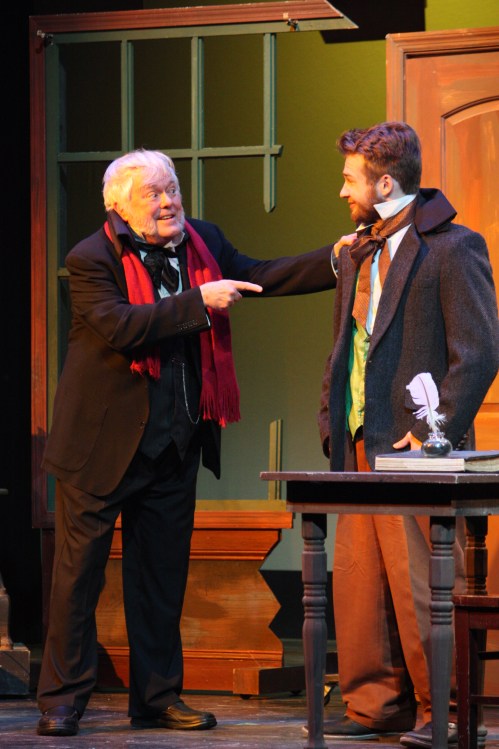
Law has presented enough iterations of Christmas Carol to value and preserve the Dickensian spirit of Oliver while loosening casting requirements where the envelope has already been pushed. Johnny Hohenstein immediately stands out as a fierce and booming Mr. Bumble, while Geof Knight as Fagin and William Kirkwood as Sikes are among the best we’ve seen. Together they form an adult triumvirate who remind us that greed and corruption aren’t simply confined to the underworld.

Hohenstein is as titanic as a beleaguered husband as he is when he’s a tyrannical beadle, a definite asset. I find ample menace and intimidation in Sikes when Kirkwood delivers his growling “My Name,” and I like the sliminess that Knight brings to “You Got to Pick a Pocket or Two” – and the grim calculation of his “Reviewing the Situation.” You couldn’t get me to dispute that any of these three gave the best auditions for their respective roles.

It’s just that I want to see a craven factor, a fear of Sikes’ violent volatility that would give an extra dimension to Fagin’s craftiness. From there, the chemistry between the two rogues can be further textured by their one-time mentor-apprentice relationship. Knight just doesn’t have the appearance of a cerebral weasel, which would make these layers relatively easy and self-evident. Here it needs work.

When it comes to Sikes’ abusive relationship with Nancy, Bart gives Kristin Graf Sakamoto all that she needs to get to its heart. Even if Nancy isn’t liberated, she’s spirited, best seen in Sakamoto’s interactions with the youngsters and in her lusty, boozy rendition of her “Oom-Pah-Pah” polka. Nancy faces some grim choices with Oliver, yet Sakamoto makes it clear that fidelity to Sikes is infused with fear – propped up by fear, you could say – when she repeats her signature “As Long as He Needs Me.”

So the Sikes-Nancy-Oliver drama and suspense develops beautifully from the first moments that we see Sakamoto. There’s already a glint of welcoming light when the Artful Dodger accosts Oliver after he has escaped Bumble and the Sowerberry mortuary. Bailey Wray ignites a “Consider Yourself” welcome as Dodger, assisted by Lisa Blanton’s choreography, that seems to engulf the whole city of London. Wray himself radiates a city-sized energy all by himself. Dodger’s precocious top hat is a couple of sizes too large, a plausible wardrobe choice, but I suspect that Law has elected to keep it that way in order to keep Wray’s hyperactive hands partially occupied.

Later there’s lively bustle in Fagin’s lair when the master puts his kids through their pickpocketing drill, and a new flowering of Blanton choreography when Oliver awakens at the home of his benefactor, Mr. Brownlow. the greatness of Britain beams at us like a sunshiney day, for Ware isn’t the only vocalist in “Who Will Buy” as it swirls with increasing anthemic force. Consonant with this cornucopia of wholesomeness, Rick Taylor is upright and trusting, a quiet affirmation that goodness and kindheartedness can rise above the miasma that swallows up Bill and Nancy.

Aside from the cloudy Sikes-Fagin chemistry, Law only loses focus at the end when Fagin and Dodger make their final exits – seemingly without any emphasis or attitude. Maybe bringing them downstage would help, but it’s a moment that deserves more fiddling with and agonizing over. Last impressions are as important as our first.

IMG_1338

It’s still quite sensible to hurry over to Queens Road, where the corruption and goodness of humanity are as exquisitely balanced as night and day. At its core, Oliver’s journey is a progression from secluded, deprived oppression to the centers of opportunity and civilization. Performances are almost universally fresh and decisive among over 40 onstage participants, and it’s hard to overpraise the work of musical director Ryan Deal in keeping his singers fresh and precise through a long rehearsal process.

Of course, the excitement of opening night added a jolt of energy to the performance, especially for the 13 actors – plus a dog – who were making their Theatre Charlotte debuts. If you’ve never experienced Oliver! before, you will likely feel a similar jolt of discovery.


“Amos McGee” Takes Us Into Uncharted Pre-K Territory

Review: A Sick Day for Amos McGee at Children’s Theatre of Charlotte

By Perry Tannenbaum

DSC06703

When you watch the new Children’s Theatre of Charlotte production of A Sick Day for Amos McGee, you and your child might not realize that Amos is employed as a zookeeper. You won’t see Amos swabbing down or feeding the animals that he visits – an elephant, a tortoise, a penguin, a rhino, and an owl – nor will you see him sweeping any cages or disposing of any droppings.

The time Amos spends with the zoo animals, to be honest, never looks like work. Thanks to the text by Philip C. Stead, adapted for the stage by Nicole B. Adkins, what Amos does looks exactly like friendship. He sits down to a game of chess with the elephant, races – and discreetly loses to – the tortoise, sits quietly and patiently with the shy penguin, and wipes the allergy-prone rhino’s nose. Time has truly flown by when dusk comes and Amos reads the owl a bedtime story.

DSC06694

What struck me more forcefully than Amos’s vocation in Scottie Rowell’s puppet design, excellently derived from Erin Stead’s illustration, was his age. He’s elderly. You don’t need much youthfulness or foot speed to play chess, lose a race to a tortoise, extract a hankie from your pocket, or read a book.

So if you come to Wells Fargo Playhouse, you’ll find that Children’s Theatre is carving out a new niche with this leisurely-paced production sensitively directed by Melissa Ohlman-Roberge. It’s theatre for pre-K, and kids that I saw at the opening performance last Thursday seemed to find the pacing perfect. Oldsters and anklebiters are a natural combo, like peanut butter and jelly.

I did begin to wonder whether all the unhurried quality time Amos was spending with his zoo friends was the “sick day” of the title, for it takes up a larger proportion of our time at the theater than it does in the book. And I also began to suspect that Amos McGee wasn’t as fit for Children’s Theatre’s vaunted Kindness Project as it might be for a Friendship Initiative.

All that was neatly sorted out after Amos returned home and his new day began the next morning – a sick day when he just didn’t want to get out of bed. Consternation breaks out at the zoo. Elephant is missing his chess rival, tortoise is raring to race, and rhino is a mess. More than ever, we see that the animals don’t regard Amos as a zookeeper. When he doesn’t appear on schedule, we see that they regard him as a friend and as an integral part of their day. Their healthy day.

DSC09364

When it becomes obvious to Amos’s friends that something is wrong, the kindness breaks out. Apparently, the animals recognize the city bus that Amos arrives on each day, so they resolve to take it to his house and pay him a visit. I’m assuming that animals who play chess and understand stories can devise ways to take leave of the zoo, pay their bus fares, and squeeze through the entrance to their friend’s apartment. But how do they find Amos’s place? If I figure anything out, I’ll let you know.

What matters, of course, is that Amos is modeling behavior that the animals appreciate, count on, and reciprocate. As the tortoise plays hide-and-seek with Amos, penguin sits quietly with his friend, and owl initiates story time, we’re likely to realize something that probably should have hit us when Amos was well: he gets as much from his friends as he gives.

The three actors who serve as our puppeteers and take turns narrating gravitate toward a middle ground between ninja invisibility and emcee assertiveness, earnestly directing their attention – and ours – toward the puppets most of the time and calmly genial, never loud, in addressing us. Kids are likely to have a lively debate over which of Rowell’s puppet stars we should like best, elephant and tortoise perhaps leading the pack, but a call to express a preference among the puppeteers – Ron Lee McGill, Kevin Sarlo, or Lydia Williamson – will likely be met with blank stares.

All three puppeteers efface themselves sufficiently to allow Amos and the animals to be the stars. They’re like good parents for kids in this pre-K age group, encouraging their children to discover and play without going too far in voicing their views or imposing their structure. Yes, this is fertile new ground for theatre, worthy of further exploration.


Ample Eloquence Thrusts Home Against Faulty Amplification

Review: Shakespeare Carolina’s Cyrano

2019~Cyrano-36

By Perry Tannenbaum

Not surprisingly, Edmond Rostand was a theatrical reactionary. His most famous drama, Cyrano de Bergerac, was the last play written in verse or poetry that is still widely revived. The verse plays of William Butler Yeats, Maxwell Anderson and Archibald MacLeish have long since fallen by the wayside, but Rostand’s throwback along with his more whimsical Les Romanesques, transmuted into the evergreen musical, The Fantasticks, still endure.

But lately, Rostand’s original French text has been buffeted by film and stage adaptations that take us far from the playwright’s classic Alexandrine couplets – and the Brian Hooker verse translation that Jose Ferrer immortalized playing the title role. My last brush with a traditional Cyrano was in 1997 in an Off-Broadway production, when Frank Langella heroically took the title role in an abridged rendering of the Hooker translation.

The Anthony Burgess version, performed in SouthEnd by Epic Arts Repertory Theatre in 2004, took some liberties with parts that the translator didn’t fancy – and Laura Depta took on the title role, liberating it from traditional menfolk. So it’s been awhile since Charlotte has seen a traditional Cyrano, though the opera composed by David DiChiera, presented here by Opera Carolina late in 2017, reminded us of the huge scale and tapestry that Rostand imagined.

2019~Cyrano-39

You won’t find comparable operatic grandeur in the SlimFast Cyrano adapted by Jason O’Connell and

Brenda Withers, presented outdoors at the Winthrop Amphitheater by Shakespeare Carolina. Among the 44 “persons” catalogued in the original cast list are groups of cadets, poets, pastrycooks, pages, and musicians. After all these, Rostand calls for citizens, musketeers, thieves, children, Spanish soldiers, intellectuals, academicians, nuns, etc. O’Connell and Withers distill these multitudes into a script that ShakesCar presents with a cast of five – fewer people than you’ll see onstage in any precious little revival of The Fantasticks.

Naturally, O’Connell and Withers keep those five actors very busy in multiple roles. Even James Cartee, who will settle into the role of Cyrano, appears in a curiously updated prologue, falling off a ladder and setting off an ambulance-vs.-Uber debate on how to get him to a hospital. Stefani Cronley, off my radar since her debut in Fahrenheit 451 two years ago, must moonlight as a cadet when she isn’t Roxane, the beautiful lady of surprising depth and courage who absorbs Cyrano’s undeclared love and Christian’s inarticulate rapture.

Christian is fairly stunning himself, which may explain why Daniel Brown reappears as Sister Marthe when he has finished wooing Roxane. S. Wilson Lee also has an interesting array of roles; including Montfleury, a bogus poet whom Cyrano mocks; DeGuiche, a powerful noble who stalks Roxane; and Ragueneau, a friendly baker. The scenes we remember best from traditional productions, the moonlit scene in Roxane’s courtyard and the finale 15 years later at the Ladies of the Cross Convent, don’t really suffer dramatically from the O’Connell-Withers compression.

On the other hand, the remaining scenes were conceived on a grand scale. Cyrano heckles and denounces Montfleury at a theatrical presentation, he has an ill-fated triste with Roxane and meets Christian for the first time amid a hubbub of impoverished poets at Ragueneau’s bakery. And the unique love triangle climaxes at a besieged castle defended by Cyrano, Christian, and the cadets of Gascoyne. These are the scenes where Rostand’s multitudes are normally deployed.

2019~Cyrano-08

This Cyrano also applies the shears to our hero’s swordsmanship and literary prowess, so Monsieur De Bergerac doesn’t sensationally compose a ballade at Winthrop while outfencing and casually slaying a hapless enemy – and Cyrano’s gazette gets short shrift in the final scene. There is simply less reason here to admire and fear this dashing cavalier.

But the new script occasionally rhymes, and Cartee gives Cyrano ample eloquence. He wears a mask of his own design to underscore his ugliness, and his pacing is perfection when he verbally demolishes the simpleton who has the nerve to declare that Cyrano’s nose is outsized – with 20 or more elegant and witty self-deprecating descriptions he improvises on the spot. Confronting Roxane, he is timidity and deference, abashed by his own repulsiveness, yet with a touch of élan. He grows noticeably bolder under the cover of darkness when he woos his beloved on Christian’s behalf.

2019~Cyrano-43

Chris O’Neill’s costume and scenic design prove adequate for the more intimate scenes, largely because of the strength of his stage direction and Danny Wilt’s deft lighting. Until the end, when I felt that Cronley was a bit monochromatic in her weepiness, I was nicely swept into Roxane’s impetuous vigor. Dealing with Cyrano and Christian, Cronley’s eager energy dispelled any suspicion that Roxane was stupid, and the scenes with Christian were always pitch-perfect.

Of course, it’s Christian who readily strikes us as more dimwitted than Roxane at first, but Brown convincingly rides the tide of enlightenment that happens to this young buck as he becomes better and better acquainted with both Cyrano and Roxane. Montfleury and DeGuiche are akin in their foppishness and prissiness with Lee in both roles, which turns out to be quite fine, since De Guiche’s predatory lechery and his worldly power adequately supply sharp distinctions. Lee’s gentle geniality as Ragueneau also helps keeps things afloat and affecting at the end.

What may sink ShakesCar’s production for those less familiar with Rostand is the quirky performance of the sound system. Nearly all of the time, I could hear the players whether or not their microphones were working at that moment. But the in-and-out of the amplification, often in the space of a single line, gets to be annoying and distracting – a possible obstacle to understanding if this is your first encounter with this classic. I could only marvel how the entire cast soldiered through this adversity unfazed.

Hopefully, electronic glitches won’t mar the remainder of the run, for this compressed Cyrano certainly has plenty of panache.