Tag Archives: Rixey Terry

CP’s “Joseph” Connects With Talent and Style, Frustrates With Ongoing Audio Woes

Review:  Joseph and the Amazing Technicolor Dreamcoat at Halton Theater

By Perry Tannenbaum

THEA2021-DLV-0708-2138

Before this weekend, Halton Theater hadn’t opened its doors to a theatre crowd since February 2020, and Central Piedmont Community College Summer Theatre had been dark since July 2019, when they closed their five-show season with A Gentleman’s Guide to Love and Murder. Returning to the Halton stage as guest director of Andrew Lloyd Webber’s Joseph and the Amazing Technicolor Dreamcoat, Tom Hollis posed a poignant question during his introductory remarks. Does it really count as a season when a company offers its audience just one production? Even the most loyal Central Piedmont supporter can’t buy a 2021 season ticket, that’s for sure. And until Central Piedmont Community College completes its recovery from a debilitating ransomware attack this past winter, they won’t be able to accept credit card payments at their Overcash ticket windows. Cash or checks for walk-ups, plastic for online sales only.

Opening night at Halton was a cautious first step back toward pre-pandemic norms – with a Delta-be-damned giddiness to it as COVID protocols were loosened at last. For most of the crowd mingling in the Halton lobby before and after the show, this was probably the first public event they had risked in at least 16 months, a milestone moment. For the theatre folk scattered among us, it was an emotional reunion – an affirmation.

Last season was originally envisioned as Hollis’s grand valedictory after nearly four decades at Central Piedmont, his latter years as theatre department chair. An encore reset of the lost 2020 season was rumored for a while as Central Piedmont scrambled with their winter programming, so Joseph is a double surprise – not among the shows announced for the lost 47th Central Piedmont Summer Theatre season and the only show replacing them. Previously mounted in Summer 1993 and revived in Summer 2001 at the now-demolished Pease Auditorium (the CPCC Theatre production of 2008 at the Halton was a wintertime affair) – with rousing success on all occasions – Joseph is likely more bankable than Footloose, lighter on the budget than The Music Man, and far better-known and cheaper to produce than Something Rotten! Additionally, there is likely a finely calculated ecology in a true Central Piedmont Summer season that allows the college the biggest bang for their bucks when auditioning and casting their overall troupe of performers and designers. These discarded musicals, plus Peter Pan Jr. and a Ken Ludwig comedy, might conceivably be in cold storage, slated for resurrection in 2022.THEA2021-DLV-0708-1267
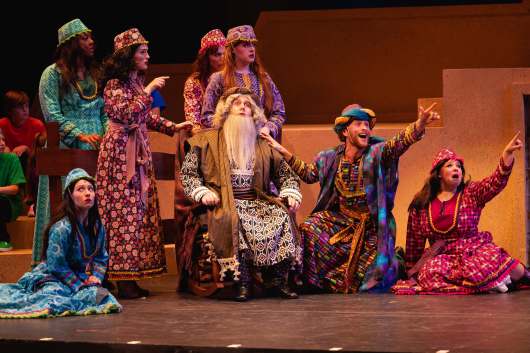
Sitting in Row K, I only noticed one gentleman taking a restroom break during this intermission-free presentation, and I was somewhat surprised that the cast began taking their bows a mere 71 minutes after the show commenced. Another eight minutes came packaged in a “Megamix” reprise of Webber’s most bodacious songs – or parodies, since the composer delights in shuttling among an unlikely array of genres in retelling the most epic tale from the Book of Genesis, aided by Tim Rice’s lyrics. The news of Joseph’s demise is delivered to his doting father, Jacob, in the form of a sobbing lone-prairie cowboy song. Pharaoh is transformed into a pre-historic Elvis as he rocks his account of his prophetic dreams. The poverty of Joseph’s 11 brothers during the years of famine takes on the nostalgic air of a sad French café, complete with Apache dancer, and Naphtali’s pleas for the innocence of little brother Benjamin come in the form of a Caribbean calypso.THEA2021-DLV-0708-1815

Curiously, the irreverence and multitudinous anachronisms of this Webber-Rice concoction, not to mention the narrative alterations of Holy Writ, have never seemed to spark any massive public outcry from Judeo-Christian clergy. Maybe the outright anachronisms, beginning with the Technicolor in the title, insulate all the irreverence and textual tinkering from being taken seriously. James Duke’s scenic design and Bob Croghan’s costume design underscore the assurance that we are not in the immediate vicinity of ancient Egypt or Canaan, fortified by the equally anachronistic projection designs by Infante Media. No, this is more like a Disney or a Las Vegas style of Egypt, with Duke taking full advantage of the lordly height of the Halton stage compared with Pease’s pancake panorama. Our Elvis is also a Vegas version, clearly the sequined, jumpsuited, decadent superstar of his latter days. The Duke-Infante collaboration is so glittery and colorful that it is only slightly upstaged by Croghan’s creations for Pharaoh and Joseph.THEA2021-DLV-0708-1357

You don’t often get the chance to design a costume that is hyped in the title of a show, and Croghan, on the Charlotte scene even longer than I, doesn’t disappoint. The impact of this mid-pandemic return to live theatre caught me off-guard several times. Each time a major character made his or her first entrance – Lindsey Schroeder as our Narrator, Rixey Terry as Joseph, and J. Michael Beech as Pharaoh – I had that tingling sensation of recognizing something basic and exciting that had been missing in my life for over a year.

My biggest surprise, a frisson of renewal, came from the audience when they reacted to the most iconic moment in Joseph, when the brothers picked up the skirts of Croghan’s knockout dreamcoat so that it formed a pinwheel around Rixey, spinning around as he, Schroeder, and the ensemble sang “Joseph’s Coat.” Anybody even glancingly familiar with musical theatre anticipates this moment before it happens, or at least recalls it fondly from a previous encounter. But part of the audience at Halton erupted in delighted and surprised laughter, recalling what the first London and Broadway and high school audiences must have experienced when Joseph was new and reminding me of my own delight back in 1993.THEA2021-DLV-0708-1130

Rixey walked a treacherous tightrope, blending innocence with vanity as beautifully and energetically as any Joseph I’ve ever seen, lacking the cloying wholesomeness that only true Donny Osmond fans will miss. Maybe a plunge or two into that saccharine syrup might make Rixey more memorable in “Any Dream Will Do,” but I would prefer that he add a sprinkling of excess to those melodramatic moments when he is unjustly imprisoned, crying out his “Close Every Door.” Lighting designer Jeff Childs does come to the prisoner’s rescue, adding some spiritual gravitas.

Schroeder was brimful of brilliance as the Narrator, infusing enough energy into her string of recitative that it never devolved into tedious singsong, though she was often unintelligible. Beech’s misfortunes with his microphone were even more egregious as Pharaoh, including intermittent sonic dropouts, but his audio setup was likely jostled over the course of the evening, since he donned different costumes and headgear for his other roles – Jacob, Potiphar, and the doomed Baker.

Admittedly, it’s churlish of me to keep harping on Central Piedmont’s defective sound equipment and the cavalcade of professional-grade technicians who have failed to tame it. North of $115 million are being spent on replacing Pease, originally a lecture hall, with a genuine theatre facility, while Central Piedmont’s audio woes have gone unaddressed since 2005, when the Halton was new. But new generations come to the Halton every year, and new summer visitors from afar get their first taste of Charlotte theatre there – and they still need to be cautioned. By the time the “Megamix” came around on opening night, Beech’s “Song of the King” was only fitfully audible and Schroeder’s mic was intermittently dropping out.

THEA2021-DLV-0708-1993

More power, then, to the performers onstage who merrily soldiered through. Even the charade of the brothers’ mournful moments was untarnished. All of the cameo solos hit their marks. Matthew Howie was hilariously rusticated as Reuben delivering the bad news to Jacob with “One More Angel,” and Neifert Enrique as Simeon – aided by his brothers and Emma Metzger’s scene-stealing table dance – brought a boulevardier’s wistful regret to “Those Canaan Days,” with more than a soupçon of self-mockery in his lamentations.

Even more THEA2021-DLV-0708-2049irrepressible and irresistible was the calypso lightness and joy that Griffin Digsby brought to the “Benjamin Calypso” as Naphtali. Around the third or fourth time Digsby reached the “Oh no! Not he!” refrain, I had to stop myself, for I had started to sing along. Just another adjustment I’ll need to make after 16 months of consuming theatre in front of my computer monitor and TV set. It was hard to be displeased by anything that accompanied this welcome change.

Jewish Playwriting Contest Dramatically Involves Charlotte Audience in Selecting a New Play for a New York Production

Review: The Jewish Plays Project

By:  Perry Tannenbaum

The Jewish Plays Project, currently in its ninth season, seeks to recognize and develop new plays that freshly address contemporary Jewish life. In their annual Jewish Playwriting Contest, plays that peddle stock Jewish humor or deal directly with the Shoah are graciously discouraged. Like other playwriting contests, it solicits scripts that haven’t received professional productions and welcomes playwrights of all ethnicities. Of course, an expert panel is part of the selection process, but unlike the Pulitzers, the Tonys, or the Steinberg Awards, the JPP panel only screens the hundreds of entries and winnows them down to a group of finalists.

Cunningly, JPP invites theatre communities around the country to engage with the scripts, winnow them down to a Top 3, perform the Top 3 publicly in abbreviated staged readings, and have the live audience vote for their winner. In the 2019 cycle, Charlotte is the first of seven cities to complete its participation in the process, so the ultimate winner won’t be announced until after the Palo Alto readings on May 1 – moving on to a full production in New York this September.

The seven finalist scripts were emailed to us back in November, and I can proudly say that our reading panel in Charlotte had the most listed members, edging out Houston and New York, sharing the honor for the most populous panel with Chicago. Our panelists met at the Levine Jewish Center for a dinner powwow during the last week in January. After spirited discussions of each script, we wound up choosing In Every Generation by Ali Viterbi, The Shabbos Goy by Cary Gitter, and Dox Modern Middle by Megan Pope for the public event at Gorelick Hall, the J’s theater facility.

Last year’s national winner, Summer Night with Unicorn by David Rush, had been produced by the Levine Cultural Arts department’s JStage at the Gorelick in November, so there were people in the audience – and onstage – who had experienced last year’s playoffs and/or seen its fruit. This was the third year that Charlotte had participated in the annual contest, my second year of participating on the community panel, and my first time at the competitive readings. I was a bit taken aback by the robust turnout. Word has gotten around.

Unlike the staged reading festivals presented in the past by Actor’s Theatre of Charlotte and the defunct Charlotte Rep, the Levine’s Jewish Playwriting Contest maintained its professionalism without stuffiness or excessive formality. If you were an actor, you weren’t warned against the impropriety of wearing a color or dressing for your part, but you did lay your script on a lectern as you performed. If you bought a ticket, you could grab a free nosh at the back of the hall and schmooze with your fellow cognoscenti before David Winitsky, the founder and director of JPP, moved up front to issue welcomes and thanks. Then he explained the JPP and the Contest before testing the technology that would be used for the individual playwright intros and the voting. Directing all three entries, he also read the stage directions during the readings.

Old schoolers could vote on paper ballots as God intended, or if you had a smart phone, you could text your vote to a prescribed number. My first two test votes, before and after the first play reading, were for macaroons and Bernie (who lost to Midge). While writing this review, I texted “LEAVE” to the number we had been given and received an answer, my first real assurance that my votes had counted. So the technology worked, the format for the evening had been exhilarating, and theoretically, my vote may have been decisive. Yet I did not drive home feeling that the format had been completely fair.

Gitter’s The Shabbos Goy led off the readings, probably the easiest of the three to summarize. Seth, a divorced Orthodox Jew, has a crisis of faith because he has fallen in love with Angie, an Italian-American art gallery curator who recently moved into an apartment down the hall. Not knowing she had moved in, Seth had knocked on her door, thinking he would call on his Shabbos goy to do something for him that Orthodox Jews are forbidden to do on the Sabbath – like turning on a lamp or an oven. Angie readily agrees to help this nerdy knish maker. He’s such an unlikely candidate for her affections that, when he asks her out, she doesn’t immediately grasp what he’s doing, by which time he’s apologizing.

Seth’s sister Rachel, his partner in the Lower East Side knish store, is more devoutly opposed to her brother’s wishes – she’s not Jewish! – but Sophia, Angie’s folksy grandmother, has an open mind. In the scenes excerpted for the reading, Seth (Jordan Ellis) told Angie (Karina Caporino) about his spiritual crisis. His confession went better than Fitzwilliam Darcy’s, acting as an aphrodisiac. Afterwards, Angie had a couple of heart-to-hearts with Sophia (Jackie Fishman) and Rachel (Susan Cherin Gundersheim).


If the allusion strikes home, you’ll already know that Viterbi’s In Every Generation has something to do with Passover. Not only is the Passover seder the instrument of fulfilling the biblical commandment of telling your children about the exodus from slavery in Egypt, it is the gateway for fulfilling man’s obligation “to see himself as if he personally went out of Egypt.” Viterbi divides her play into four parts, a very apt number for Passover, and links three generations of a family across three seders, beginning with 2018 in LA, then flashing back 65 years to 1953, and then zipping forward to 2048. After three seders with this family, Viterbi thinks we’re ready to visualize her family in 1416 BCE after leaving Egypt, celebrating Passover and yearning for the Promised Land.

In the first excerpted scene, we saw all three generations gathered at the 2018 seder. Drawing most of our attention were two squabbling siblings, Yael Katz (Caporino) and her adopted Chinese older sister, Devorah (Vivian Howell Tong), who is studying to be a rabbi. It is she, therefore, who expounded on the number four in the Passover Haggadah. Their mom, Valeria (Stephanie DiPaolo), tried to keep order, but her difficulties were compounded by her octogenarian parents, Davide Levi (David Catenazzo), who coukd no longer speak due to ALS, and Paola (Fishman), who kept lapsing into Italian. Our second excerpt took us to 1953, shortly after Davide and Paola had immigrated to America. Davide could talk at that seder – smoothly enough to convince Paola that Passover might be a great time to start their squabbling unborn family.

Reduced to a bare-bones 20-minute sampling, In Every Generation had to shed its last two parts – and the English subtitles that are supposed to help us understand Paola’s Italian when she arrived in LA back in 1953. Shabbos Goy suffered to a lesser extent from Winitsky’s radical abridgement, losing one of its characters, a dashing young artist whose work Angie would love to display at her gallery. Young and sexy Blake, Angie’s arrogant quarry, expected to combine business with pleasure. Pope’s Dox Modern Middle was perhaps the most disadvantaged by Winitsky’s excerpting. It would have been helpful, for starters, if the playwright, the director, or the reading had explained what the title meant.

Amid some healing chanting and a spectral appearance of Fathermother, representing her parents and her Orthodox Jewish heritage, the excerpt began with 17-year-old Raphaela (Arella Flur) arriving in Israel. She was greeted by her Aunt Caroline (DiPaolo), a longtime Israeli who knew more about Raphaela than the girl thought. Caroline already knew, for instance, that her upfront 16-year-old neighbor Gil (Rixey Terry) would be the perfect companion to show Raphaela around – because he is gay, she is lesbian, and that’s why she was sent away from Brooklyn by her “Dox” parents. In later excerpts, we learned that there’s an LGBTQ nightclub in Jerusalem that will welcome both Gil and Raphaela, with queerness to burn. A quartet of glittery queens emerged from the audience, voguing and preening. More seriously, the club’s bartender, Pop Tart Girl, took an interest in Raphi, evoking memories of Ani (Caporino in both roles), her previous paramour back in Brooklyn.

When the votes were tallied, Winitsky announced that The Shabbos Goy had been our audience favorite. Audience members who have become attached to Seth and Angie, rooting for their romance, can go to JewishPlaysProject.org and see how Gitter’s romantic comedy is doing in the standings. With the two points that Shabbos Goy earned at the Charlotte playoffs, it is now tied with In Every Generation for first place. Next in the standings, trailing the leaders by two points, is Dox Modern Middle. As exciting as the contest was, I’d be more comfortable if the readings were extended to 40-45 minutes each. Lacking that, audiences should get a full summary of each contestant. That’s what I’m voting for.

Hey, Hey, We’re the Herdmans!

Theater Review: The Best Christmas Pageant Ever: The Musical

By Perry Tannenbaum

primary-pageant-1

So the holidays are here, and we know the live entertainment drill: inevitable revivals of A Christmas Carol, Nutcracker, and The Best Christmas Pageant Ever plus a few fresh novelties to liven the mix. This year, one of the novelties is also one of the inevitables. For while it’s possible to see the customary stage adaptation of Barbara Robinson’s Yuletide favorite at Matthews Playhouse starting on Thursday, Children’s Theatre of Charlotte unveiled the world premiere of The Best Christmas Pageant Ever: The Musical on Black Friday.

Robinson adapted her 1971 novel for the Seattle Children’s Theatre in 1982, and the proliferation of productions across America has arguably made the playscript more beloved than the book. So the team of Johanna Beecham and Malcolm Hilgartner, adding their lyrics and musical score, did the prudent thing in adapting Robinson’s stage version.

Nearly 34 years to the day since the story succeeded in Seattle, a whole generation of parents who saw Best Christmas Pageant onstage as children are bringing their offspring to ImaginOn to see The Musical. Our Children’s Theatre, which has grown to national renown during those intervening years, had to add five performances to the run before opening night – a tribute to their prestige as well as the bankable title.

Turns out that the Robinsons, the playwright (who died in 2013) and her daughters, were pretty prudent themselves in choosing Beecham and Hiltgartner. They seem to know what can be enlarged to musical proportions and how to get the job done. I’d also say that Best Christmas Pageant is easier to swallow than A Christmas Carol was when it morphed into Scrooge.

Big crowd scenes can be magnified most easily from stage to musical dimensions, but A Christmas Carol doesn’t really abound with them. Scrooge’s workplace and Cratchit’s home aren’t bustling places, and London is a cold, lonely, and forbidding city until Ebenezer’s reformation. So a couple of parties and a funeral were supersized, effervesced, and choreographed for Scrooge. We’re also more familiar with the older, more entrenched Dickens tale, so tampering is riskier, more jarring.


Recognizing that they’re primarily dealing with schoolkids, normal ones in fear of the notorious Herdmans, they make sure to create their biggest scenes when kids congregate, at church for Sunday school, at school during lunchtime, and at their rehearsal hall near the fateful church kitchen. The catastrophic rehearsal scene, causing Rev. Hopkins to cancel the pageant after the Herdman herd has stampeded it, is rockin’ pandemonium.

Beecham and Hiltgartner are more artful even before that in their depiction of the adult antagonists. What I labeled as the four Old Biddies, when Jill Bloede directed the play for Children’s Theatre in 1995, are now three parents of Beth and Charlie Bradley’s classmates. Luanne, Connie, and Betty start us off singing “Perfect Little Town,” as beautifully harmonized and sugary as the overdubbing Connie Francis cooing “My Happiness.” They are natural allies of the dictatorial Helen Armstrong, the rigid director who is usually in charge of the unchanging Christmas pageant year after year.

ladies

But Armstrong is hospitalized this year, so the vocal trio mobilizes with Helen to convince Grace Bradley, Beth and Charlie’s mom, to take over just before auditions. In the play version, all four women wielded old-fashioned phones in cajoling Grace. A musical allows for more fanciful, comical liberties. By the end of another pop rocker, “Counting on You,” the ladies have circled to the opposite side of McColl Family Theatre from Helen’s bedside to resume their vocal trio assault on Grace at the Bradley home, with the siblings and their father joining in on the hubbub.

If the ladies can be more ridiculous now – a big if, since Bloede had Alan Poindexter and Sidney Horton crossdressing as two of the hags in ’95 – then the Herdmans can be more fearsome and ferocious to counterbalance them. Augmenting their chaotic energy is the fiendish work of choreographer Ron Chisholm, who keeps the six Herdmans and their terrified victims spread across the stage in frenetic action. Even Rev. Hopkins must be convinced of their true menace.

ctc-bcpetm-4

We are far closer here to believing Beth’s famed opening pronouncement: “The Herdmans were the worst kids in the whole history of the world.” Where Bloede capitalized a bit on the fact that rather entertaining performances could come from kids who might be visibly reluctant to immerse themselves in the full barbarity of a Herdman, current Children’s Theatre artistic director Adam Burke will have no such laxity.

As Imogene, the Herdman who takes the role of Virgin Mary by the throat, Carlyn Head is an absolute she-wolf in her howling vocals, and there is only the slightest glint of cuteness in Charli Head as Gladys, the little sister who pounces on the role of Herald Angel. With all of this vocal artillery hurled at her from young and old, Ashley Goodson can be sweet and caring as Grace, but when those moments arrive for reasserting control and conviction, she also unveils a voice of steel.

So when the Herdmans come around to the spirit of the Nativity, Grace is a little more amazing than she was in the play version, but I’m more thankful for the fulminating comic relief from Allison Snow Rhinehart, thwarted each time she issues a demand or insists that the Herdmans must be thrown out of the pageant. As phlegmatic as Rhinehart is, Tiffany Bear as Connie, Olivia Edge as Luanne, and Tracie Frank as Luanne are purest plastic, aging Supremes wannabes.

Arella Flur is more than satisfying as Beth, but she’s usually upstaged by Bennett Harris as the bullied younger brother or Ryann Losee, the tattletale Alice who lets Imogene snatch the role of Mary from her without a struggle. Bobby Tyson’s comic timing is so sharp in the minor role of Mr. Bradley that it’s reassuring to see him get a duet with wife Grace late in the show, and Dan Brusnson is the kindliest, most Christian Rev. Hopkins that I can recall. Among the male Herdmans, Colin Samole as Ralph and Rixey Terry as Leroy impressed me the most, but I don’t think either is written fully enough.

At least not yet. Estimates of the running time that I’ve seen in the Children’s Theatre press releases and in their program booklet have ranged from 60 minutes, approximately the length of their 1995 production, to 80 minutes in the current playbill. My clocking of the Sunday matinee at under 67 minutes suggests that the piece I saw underwent feverish modifications in its final weeks of rehearsal.

I point that out for a couple of reasons. It illustrates that Burke and Children’s Theatre, who commissioned this world premiere, have taken significant ownership in intensively shaping the product. It also suggests to me that the process isn’t finished, that the 80-minute target that seems more sensible to me might be what we see the next time The Best Christmas Pageant Ever: The Musical opens at ImaginOn. Or even by the time it closes on December 23.

Maybe then I’ll be able to say that this is the best Best Christmas Pageant Ever ever. It’s pretty damn close right now – and a very gratifying achievement at Charlotte’s fantasy palace.

The Bee Gees Lose Their Falsettos

Theater Reviews: Saturday Night Fever and 5 Lesbians Eating a Quiche

By Perry Tannenbaum


img_4913

(Photo by Chris Timmons)

John Travolta at his peak: has there ever been anyone like him? The ruggedness, the grace, the strut, the conceit, and the boyish charisma — all of these studmuffin assets uniquely tinged with a robust Brooklynese vulgarity that took America by storm from the moment Welcome Back, Kotter hit the airwaves in 1975. But the full bloom of Travolta-mania didn’t happen until 1977, when Saturday Night Fever hit the big screen.

Surely the music of the Bee Gees was a prime component in the mystique of that breakthrough film. Yet the Bee Gees’ film score underpinning Travolta’s disco exploits was exquisitely subordinated to the heart of Tony Manero’s halting, confusing, and sometimes comical progress toward manhood in Norman Wexler’s screenplay. Bring the song hits more to the fore, as the Broadway musical version of 1999 attempted to do, and the narrow emotional range of disco is cruelly exposed.

“More Than a Woman” is unquestionably less than a woman to me, “Tragedy” is barely morose, and the answer to “How Deep Is Your Love?” is not very deep at all. I’d say that the Gibbs Brothers chose wisely in never attempting to write music for the Broadway stage.

We can only guess why director Ron Law, kicking off Theatre Charlotte’s 89th season, passed on the original Broadway adaptation by Nan Knighton in favor of a newer 2015 adaptation by Sean Cercone and David Abbinanti that has never been on Broadway — or even a national tour. Either way, Law faced an uphill battle with his core of teenage performers.

After playing the somewhat delicate boy protagonist in Caroline, or Change earlier this year in the Theatre Charlotte lobby, Rixey Terry attempts a huge leap forward from that concert production in tackling the iconic Travolta role of Tony. While the welter of tunes launched at us — the worst are those newly penned by Abbinanti — dilute the impact of the drama, they don’t obscure the complexity of Tony’s character or his double lives.

By day, Tony works a dead-end job at a Brooklyn paint store, coming home to parents who adulate his older brother Frank, a priest, while belittling his talents. A huge chunk of Tony’s paint store paycheck — and some elaborate rehearsals and primping rituals — go into Saturday nights, when he reigns as king of the dance floor at the 2001 Odyssey club. Local girls long to be his partner, thrilling to the privilege of even mopping his brow after a dance.

So at work and at home, Tony is meek, querulous, and downtrodden, but out on the street or at the club among his friends and admirers, he’s self-absorbed, arrogant, and cruel. He ignores and snaps at his good friend Bobby, who leans on him for advice, and he forcefully rejects all advances from Annette, the best dancing partner in the neighborhood.

From the moment he first sees Stephanie Mangano at the club, Tony’s world turns upside-down. Classically trained, Stephanie’s moves are easily a match for Tony’s — and her savoir-faire is miles ahead. She has a job in Manhattan! Suddenly, Tony is the supplicant and the pursuer, hoping Stephanie will be his partner for an upcoming prize competition. Yeah, the story has been slightly altered.

Terry wraps his arms around the meek, downtrodden, and needy aspects of Tony a lot more readily than his imperial arrogance. Terry’s ordinariness carries over to Tony’s first few turns on the dance floor, where he just doesn’t look masterful. So the true turning point on opening night last week came when we reached Terry’s solo on “You Should Be Dancing” at the end of Act 1. Adding acrobatic break dancing moves never seen in the iconic film, choreographer Lisa Blanton unleashed the beast in Terry.

In less than a minute, Rixey proved that, even among triple-threats, he possesses unique gifts.

img_4851

Whether or not Stephanie is intended to have more confidence and dancing polish than Tony, Susannah Upchurch definitely brings it. The way things are between Tony and his groupies doesn’t always come off precisely as they should, but when Upchurch is around, Tony’s shortcomings and vulnerabilities snap sharply into focus. Her Stephanie is almost unattainable, not quite.

Meanwhile Ava Smith is acting up a frenetic whirlwind as Annette, almost convincing us that Tony is the dreamboat we never quite see. Vic Sayegh and Mara Rosenberg make Tony’s parents a rather squalid couple, contributing mightily to the Brooklyn ambiance, and Jay Masanotti brings out all of the older brother’s cryptic contradictions.

The fabled three-piece suit from the film isn’t quite equaled by costume designer Jamey Varnadore, whose budget was likely too strict for all the clotheshorses and wannabes he’s called upon to outfit. Zachary Tarlton leads a tight five-piece band, but the real heat is mostly generated by Blanton’s choreography — and Dani Burke’s solos as Candy, the 2001 chanteuse. Burke’s “Dance Inferno,” not a Bee Gees song, is the chief showstopper among the vocals. With so many three-part harmonies discarded, it’s hard to pick a lowlight among the songs that the Gibbs Brothers made famous. Not one falsetto all evening long!

I’ll go with “Stayin’ Alive” as the nadir. For decades, I’ve despaired of explaining how tone-deaf most renditions of “If I Were a Rich Man” sound to Yiddish-speaking Jews when Christian singers navigate the vocalise, non-verbal sections of the lyrics. Now I can finally point to an equivalent.


4cab0c_8e61596cf00f4ad2a25425910884a614mv2

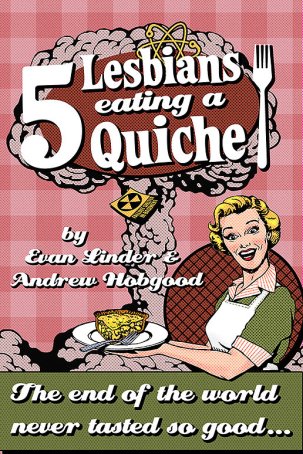
At first, I could hardly believe how over-the-top director Sarah Provencal was wanting her cast to act in 5 Lesbians Eating a Quiche, currently at the Warehouse Performing Arts Center in Cornelius. This was the customarily sophisticated Lane Morris as Wren, one of our five quiche bake-off hostesses? The effusive audience interaction, from the time we enter the Westmoreland Road storefront, makes Pump Boys and Dinettes seem funereal by comparison.

But after a while we realize just how strange this script by Evan Linder and Andrew Hobgood truly is. For this egg-worshipping black comedy takes us back to a 1950s dystopia in an alternate universe. Only the desperation of our hostesses’ plight can prod them into coming proudly out of the closet, a delicious juxtaposition with their ’50s primness.

Actually, Morris with her “victory curls” looks more like a throwback to the ’40s and the Andrews Sisters (yes, these Daughters of Susan B. Anthony and Gertrude Stein have a club song). It’s Joanna Gerdy as Vern who’s the outright lesbian of this quiche quintet from the start, flinging away her customary sophistication even further from the norm in a comedy performance to relish.

Ginny, played by Stephanie DiPaolo, is a diffident Brit who almost seems catatonic at times. Vying with her for the distinction of being the most repressed in the house is Nikki Stepanek as Dale, who hasn’t spoken to a man since the age of three. She’s definitely the youngest, which is why she becomes the chosen vessel — for a while, anyway — to save mankind.

Every one of us in the audience must come out and admit that, yes, we are also lesbians, a quite unique moment in the annals of theatre. The only remaining holdout is Pam Coble Coffman as club president Lulie, a veritable Betty Crocker of propriety and discipline. Lulie hits us with the startling revelation that sends this 73-minute production into its unnecessary break. My wife Sue balked at this intermission, but the folks taking hits from the boxes of wine on the buffet seemed to be okay with it.

So real men and real women don’t eat quiche? Please forget I said that.


Jews, Blacks, and JFK Converge at Concertized Kushner

Theatre Review: Caroline, or Change

2016~Caroline or Change_0028-1_edited-3
L-R: Brittany Currie, Tracie Frank, and Veda Covington

By Perry Tannenbaum

The relationship between African Americans and Jews has been a fascinating convergence of parallel histories and unavoidable class conflict. We’ve had a couple of dramas here before that dramatized the relationship, beginning with Alfred Uhry’s famed Driving Miss Daisy, which reached the Charlotte stage in 1991, just two years after the Oscar-winning movie. The 1988 Pulitzer Prize winner took us back to Atlanta after World War 2, when the curmudgeonly Daisy was in denial about her physical deterioration, her racist attitudes, and the prevalence of anti-Semitism in her city.

Just over three years ago, Actor’s Theatre of Charlotte brought us Matthew Lopez’s The Whipping Boy, transporting us to the first days of Reconstruction after the Civil War, when two emancipated slaves returned to their former owner’s home for Passover. Between Uhry’s drama and Lopez’s auspicious 2011 debut, Tony Kushner collaborated with composer Jeanine Tesori on a musical – a chamber opera, really – that looks at yet another Jewish household where an African American was employed.

Until last February 26, when Theatre Charlotte brought Caroline, or Change to its lobby for one night only, the widely-hailed 2003 piece had never been performed in the Queen City. It’s unquestionably the most ambitious Grand Night for Singing event held at the 501 Queens Road barn. The format has been in a cabaret spirit, songs selected from a rarely performed musical taking up half of the program, more rarities by the same composers after intermission. With Caroline, music director Zachary Tarlton staged a concert-style production of the full show – and so many people bought tickets that Theatre Charlotte executive director Ron Law nearly had to move the performance out of the lobby and into the auditorium.

Caroline Thibodeaux works in the bowels of a home owned by Stuart Gellman and his second wife, Rose, but the core of Kushner’s story – an autobiographical one according to the playwright’s intro to the printed edition – is the relationship between Caroline and Noah, Stuart’s 8-year-old son from a previous marriage. Although Caroline takes place in 1963, closer in time to Daisy than Whipping Boy, its resemblances to Lopez’s script are strong enough that it could have served as the younger playwright’s model. During the Passover holiday celebrated by Caleb DeLeon in Whipping Boy, President Abraham Lincoln is assassinated. In the November-December timeline of Caroline, John F. Kennedy is assassinated before the Gellmans’ Chanukah celebration.

If Kushner had a model, the likeliest candidate would be another autobiographical play, Athol Fugard’s Master Harold, in which the title character also behaves unforgivably toward a black person working for his dad. In her dignity, in the way Caroline absorbs Noah’s abuse in apartheid Lake Charles, Louisiana, she very much resembles Sam’s forbearance toward Hally in apartheid Port Elizabeth, South Africa, in 1950. The big difference is that Kushner looks at Caroline as critically as he looked at Noah.

She’s a divorced, conspicuously joyless mother of three, staunchly resistant to change. The entire cast was outstanding, but we were especially fortunate to have Tracie Frank in the title role. We had a brief sampling of Frank’s gospel fire last spring in Theatre Charlotte’s production of Jesus Christ Superstar, but even her Whitney Houston bravura singing “I Don’t Know How to Love Him” hardly cushioned the surprise of this sustained excellence, her silent reactions nearly as taut as her vocals.

Stuart and Rose realize they’re not paying Caroline enough to comfortably take care of her three children, but they do what they can. In order to teach her stepson a lesson – and to slip the Thibodeauxs some extra cash – Rose decrees that Caroline can have whatever loose change Noah carelessly leaves in his pockets when she puts his clothes in the washing machine. Noah is more softhearted than Rose, so he starts leaving loose change in his pockets on purpose – until Chanukah rolls around.

Grandpa Stocknick, Rose’s dad, gives Noah a $20 bill in Chanukah gelt. Some days later, Noah is back in school and realizes that he has left the 20 in a pair of pants earmarked for the laundry. His piddling charity is in serious jeopardy of becoming lavish generosity, and he rushes home to retrieve his gift. Too late. It’s nearly Christmas, her three kids expect something under the tree, so do you think Caroline is going to put that $20 bill back in the bleach cup for Noah?

Noah is even less likable than Caroline in the fight that ensues, so it’s to Rixey Terry’s credit that he made the transition from adulating schoolboy to beneficent master to sore and abrasive loser so convincingly over the course of the night – and no fewer than 15 songs. Terry didn’t try to emulate an eight-year-old, so he didn’t sound at all like Harrison Chad on the cast album, a prudent choice for this reading-stage style presentation, adroitly stage directed by Corey Mitchell. He and the other younger members – the three Thibodeaux siblings and The Radio – had their music down pat, thanks to some good hard work and, I suspect, that cast album.

2016~Caroline or Change_0017-1_edited-1

Yes, the dramatis personae included some inanimate objects that brought Caroline’s basement domain quirkily to life, often with a gospel flavor. Dani Burke was Caroline’s Washing Machine while Maya Sistruck, Dominique Atwater, and Kayla Ferguson were The Radio, even more amazing when they harmonized than when they soloed. Among these kitchen accouterments, Tyler Smith was the king of appliances as The Dryer in an electrifying performance, Tesori’s score starting him off with a mix of street shout, yelped with Porgy and Bess gusto, and R&B that he crushed into the depths of his velvety bass baritone – with The Radio providing backup.

More of Kushner’s fanciful universe turned up outside of Caroline’s basement. Much to our delight, Smith returned to the row of lecterns at centerstage as The Bus taking Caroline and her friend Dotty home from work, but Brittany Currie often lurked on the side as The Moon, emblematic of change. The change that Noah leaves in his pants isn’t the only change Caroline struggles with. Although $30 a week isn’t enough to get by, it’s Dotty who is resolved to do something about it, going to night school in an effort to better herself.

So it’s both Dotty’s energy and initiative at the end of a long workday that irritates Caroline. Watching Veda Covington as Dotty, bragging that her daytime employer is actually proud of what she’s doing, I found myself a little irritated with both women, Dotty for needling her friend and Caroline for her unremitting sullenness. Currie as The Moon was a somewhat soothing presence crooning about change, but there was also a wisp of sultry sensuality in her vocals, very effective in this cabaret setting.

2016~Caroline or Change_0030-1_edited-1
L-R: Yabi Gedewan, Ibrahim Web, and TyNia Brandon as Caroline’s children

Mitchell had the races sitting at opposite sides of the stage when they weren’t at the lecterns, accentuating how little they actually interact during this musical. It’s mostly Noah and stepmama Rose who show an active interest in Caroline. Although she badly flubbed the Yiddish word for navel, Allison Snow Rhinehardt was an otherwise credible balaboosteh: a little unsure of her footing with both the new stepson and the help, somewhat sensitive to their feelings, yet definitely reveling in her mission to run the household and to command.

Upstairs-downstairs decorum was broken momentarily at the Chanukah party in one of Kushner’s most insightful scenes. Asked to help with the extra party housework, Caroline’s eldest daughter Emmie gets into an argument with Rose’s father about the efficacy of Dr. King’s non-violent civil rights movement. Caroline is outraged by her daughter’s presumption, Emmie is angered by her mother’s inbred meekness, and Mr. Stopnick thinks this is the first real conversation he has had since coming South to visit his daughter. Excellent work here from Frank, TyNia Brandon, and Vito Abate.

I would have been quite content just to witness some local theatre company putting Caroline on its feet after all these years. The fortunate few who attended the February 26 performance saw something far finer. With a minimum of rehearsal, the 17 singers and Tarlton performed nearly flawlessly, all the more astonishing when you consider that the musical director was never in the line of sight of any of the performers even once as they performed this challenging two-hour Tesori score.

Here’s hoping that we don’t have to wait another 13 years before Caroline, or Change is produced here again – and that, when Kushner’s lone musical returns, it will be fully staged in a larger hall for a larger audience in a longer run. As it deserves.

Photos by Perry Tannenbaum