Review: Frankenstein at Theatre Charlotte
By Perry Tannenbaum
Charlotte, NC – Thirteen Halloweens have gone by since the ghost of Boris Karloff last haunted Theatre Charlotte’s Queens Road barn. Back in 2013, a wicked comedy marked the nocturnal festival: Joseph Kesselring’s Arsenic and Old Lace. Karloff was originally featured as hero Mortimer Brewster’s homicidal brother, Jonathan, a role that was customized for the Hollywood horror icon.
The joke was that Jonathan, trying to thwart wanted posters showing his face everywhere, sought plastic surgery from the cut-rate Dr. Einstein, who badly botched the job. Presumably, he now looked like the Monster made famous by Karloff in the celebrated Frankenstein movie. That’s likely the creature most people will be expecting to see when they come to see Nick Dear’s stage adaptation of Mary Shelley’s classic novel.
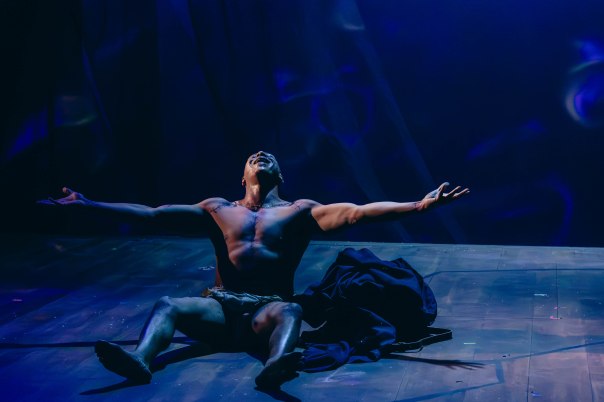
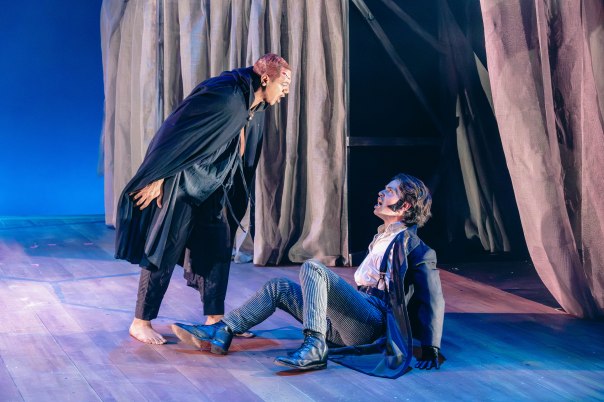
Come to Queens Road with those expectations, and you will likely emerge a bit puzzled two hours later, maybe a bit disappointed. With his sloppy sutures, sickly skin, and ample musculature, Jonavan Adams visually incarnates Karloff – or at least evokes him – but the mind and, arguably, the soul are those that Mrs. Shelley set down in writing. This Creature learns how to read, walk without a galumphing limp, and make a cavalier bow. At the peak of Adams’ astonishing metamorphosis, the Creature becomes educated enough to quote John Milton’s Paradise Lost, possessing sufficient intellect and education to persuade his maker, Victor Frankenstein, to make a mate for him.
Perhaps most human of all, he learns how to lie.

Brilliantly cast and directed by Dee Abdullah, this Frankenstein impresses as soon as we see how well Chris Timmons’ scenic and lighting design mesh with Grover Smith’s moody, gloomy, and abstract music. The set is inchoate enough to serve as the secluded place where The Creature is born and later as the Arctic wastes where Victor pursues his creation.
Abdullah not only delegates Mary Carter to help coach the Brit dialects, but she also conspires with movement coach Latanya Johnson in Adams’ stunning birth scene, an epic soliloquy of grunts, ungainly movement, and discovery – by a fully adult male we can view with a mixture of revulsion and empathy. They are free to largely reimagine Dear’s opening scene because it is so totally inarticulate. Helping us to see Adams’ mesmerizing movements, Timmons noticeably rakes his set, tilting The Creature toward us as he writhes on the floor.
As the story develops, Kyle Lilly’s Charlotte debut as Victor is hardly less impressive than Adams’ exploits.
Although makeup designer Aneeshah Taylor has sketched a masterwork on Adams’ visage, she (or someone else?) hasn’t done Lilly any favors with the roofing tiles cut and pasted onto his face as sideburns. Yet Lilly quickly vanquishes these distractions with a charismatic debut that ranks with those of Alan Poindexter, Scott Helm, Robert Simmons, Josh Gaffga, Mark Scarboro, Jeremy DeCarlos, Brett Gentile, Berry Newkirk, Tyler Smith, and Christopher Donoghue over the past four decades.
When I glimpse such talents for the first time, I find myself envisioning the actor onstage in even plumier roles. Resonating with this 19th century outing, Lilly struck me as especially suited for Fitzwilliam Darcy or Sherlock Holmes. You might find yourself nearly as enchanted by his reactions as you will be when he speaks. In Dear’s hands, the role here is quite varied and textured: Victor ranges from a disgraceful, unfeeling coward to a gallant action hero.
There’s a huge gulf between Lilly and the cinematic “It’s alive! It’s alive” madman we all mock so justly.
You’ll also find that Dear has crafted a pleasing range of supporting roles. Tim Huffman as Ewan and Darnell Ducre-Harden as Rab give a lusty crassness and vulgarity to Victor’s graverobbing hirelings. They make an earthy counterbalance to the elegance of Graham Williams as Victor’s father and Rowan Lees as Victor’s younger brother.
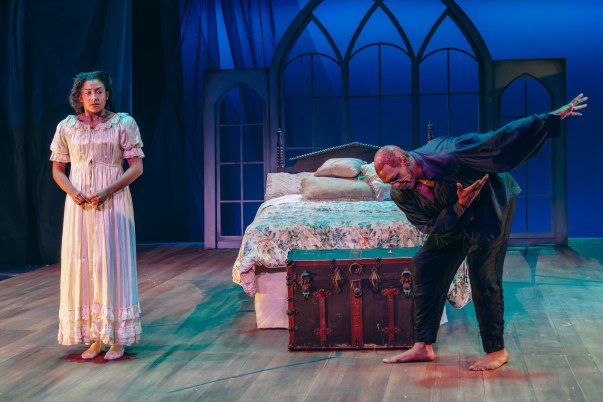
Most elegant of all is Chloe Shade as Victor’s fiancée, Elizabeth Lavenza, who must morph from fright and revulsion to deepest empathy – and back again – within the space of her one dialogue with The Creature. If memory serves, Dear has written her from a more feminist perspective than Shelley herself, for she not only chides Victor’s over his wedding delays, she also gets to plead passionately for the opportunity to join her fiancé on his travels and to assist him in his work.
Dear’s mini-society is completed during The Creature’s development phase. He makes a brief foray into a city, where he is fearfully shunned by nearly everyone – even a harlot, after he rescues her from a belligerent john. Two beggars who ought to empathize with his hunger beat him up after he’s drawn to their campfire and their rabbit dinner.
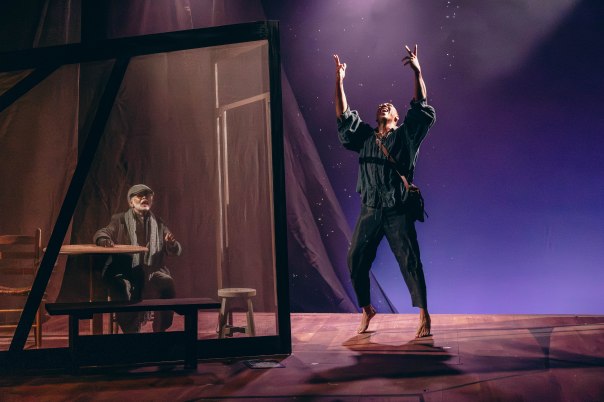
Deeper nourishment was to be found in the countryside. The Creature could hide in plain view in the cottage of a blind old man, De Lacey, learning to speak, read, and hunt while secretly and benevolently providing food for the household. Prudently, as he’s reading his Milton and leafing through Frankenstein’s private journal, he remains hidden from De Lacey’s son, Felix, and his daughter-in-law, Agatha.
Joseph Kbuor as Felix and Ava Fish as Agatha make a wonderfully blissful couple, genuinely appreciative of The Creature’s mighty services, for he clears their rocky field to make it farm-worthy and chops firewood so they can tend to their agriculture. Their bliss and their appreciation, however, don’t prevent them from recoiling in terror at their first sight of The Creature, months after he has settled in De Lacey’s home.
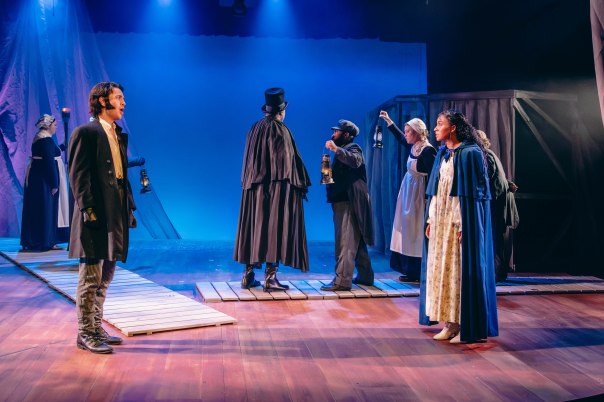
By this time, we experience this instinctive repulsion as tragic, having watched The Creature’s tribulations as he matures. Not for long. At this moment, we can see that the ethereal Corlis Hayes as De Lacey has landed what may be the most pivotal role in Dear’s drama. He, as much as Victor has created The Creature in its final perfected form. At first, we feel like blessing the old man’s kindness before understanding how Shelley may have viewed his blindness.
Mary and her famed husband Percy Bysshe Shelley both studied Aeschylus’s Prometheus Bound together. Both proceeded to publish classic takeaways, Percy’s drama Prometheus Bound and Mary’s Frankenstein; or, The Modern Prometheus. While the drama affirms and glorifies the human spirit, Mary’s novel is deeply cautionary.
Dear not only follows Shelley’s lead in the parallel that The Creature draws from Milton, identifying with Satan rather than Adam in Paradise Lost, he also seems to recognize that, with Frankenstein in 1818 (and The Last Man in 1826), Mrs. Shelley invented the modern dystopian novel.
Instead of defending The Creature, we see Hayes losing her sagely cool as De Lacey exclaims, “What have I done? Dear God, what have I done?” Underlining that horror of innocently abetting evil, Victor echoes that same sentiment – and in a brilliant touch, so will Monsieur Frankenstein, Victor’s dad.
This is one cunning and profound retelling of a classic, right at home with today’s dystopian AI headlines.


