Tag Archives: Esther Jeehae Ahn

Charlotte Bach Festival Hits High Notes with Echoes of Bach and Handel’s Theodora

Review: Theodora at Sandra Levine Theatre

By Perry Tannenbaum
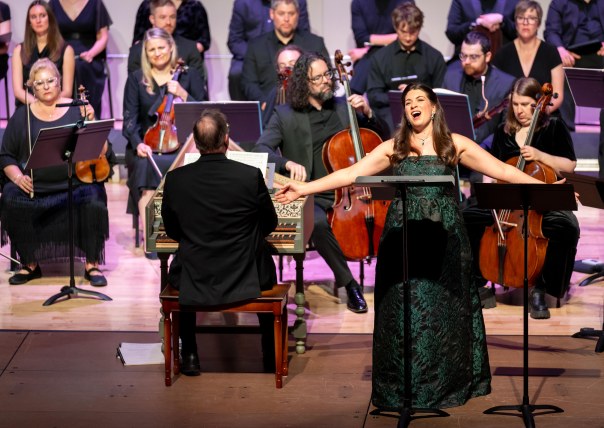
June 6, 2026, Charlotte, NC – After witnessing a mighty Mahler “Titan” Symphony and a world premiere Violin Concerto, “Agrifolia,” by Paul Wiancko at Spoleto Festival USA in Charleston, we passed up Emmylou Harris, Sullivan Fortner, and Ayodele Casel to hurry home and catch a couple of nights at the seventh Charlotte Bach Festival. With an Echoes of Bach program of solo instrumental and chamber music followed by an evening with George Frideric Handel’s Theodora, my wife Sue and I did not at all feel let down.

We already knew the mettle of violinist Aisslinn Nosky and cellist Guy Fishman, co-artistic leaders at Bach Charlotte and festival mainstays since its inaugural year in 2018. Nor did we lack confidence in the singers and instrumentalists recruited to the festival, no less consistent in their excellence. We also knew from last year’s experience, the first time that the North and South Carolina festivals overlapped, that maintaining our loyalty to Spoleto for my 33rd consecutive festival now came at a cost. Last year’s greatest regrets, before catching the Mozart Requiem finale, were missing Bach’s complete Brandenburg Concertos on opening night and Pius Cheung’s rendition of Johann Sebastian’s Goldberg Variations on marimba.

This year’s biggest regrets included missing excerpts from Handel’s Messiah, played on authentic instruments, at the opening weekend Gloria! concert, which also spotlighted works by Bach and Vivaldi, and the opportunity to hear a full Arwen Myers concert two nights later, accompanied by Nosky and theorbo ace John Lenti. Fortunately, Dido and Aeneas did not make my list. We had seen a very fine – if idiosyncratic – production at Spoleto, staged and designed by Yaron Lifschitz in collaboration with Circa, his contemporary Australian circus company. Bolstered with interstitial music curated by Lifschitz and conductor Benjamin Bayl, this US Premiere from Opera Queensland was not as absurd as you might assume. Think Cirque du Soleil without the gibberish.

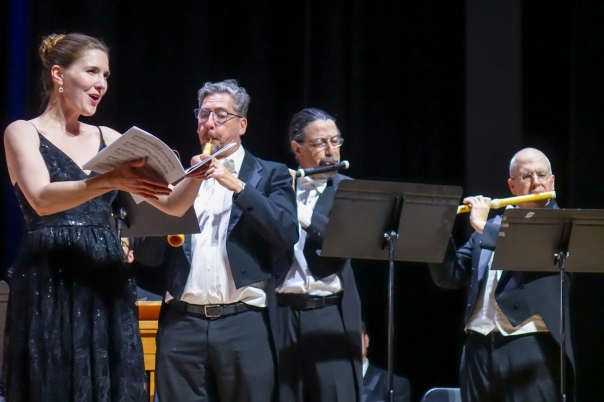
Somehow, the piano did not look out of place as we settled into a nearby pew at St. Mark’s Lutheran Church, though this was the first keyboard we had seen at the festival that wasn’t an organ or a harpsichord. Joining Fishman for the opening pieces, however, were two musicians we had never seen before, pianist Esther Jeehae Ahn and Emi Ferguson – carrying a modern metal flute with her, unprecedented at Charlotte Bach. As it turned out, the ladies would be the stars of this program with Fishman confining himself to continuo through the first half of the concert before ceding the stage.

Ahn had made her Charlotte Bach debut last year while we were away in the Holy City for Spoleto, so it was fitting that she should dazzle us first, which she did on César Franck’s Prélude, Choral et Fugue, a piece for keyboard as expressive and epic as anything Chopin ever gave us. The performance echoed Bach more in its title than in its considerable tumult and turbulence, taking me by surprise. On the other hand, Francis Poulenc’s Sonata for Flute and Piano is likely the composer’s most familiar work, a favorite among flutists, and found on at least three CDs in my collection – plus the obligatory Jean-Pierre Rampal on vinyl.

Regardless of how well Bach was echoed, you could hardly ask for a lovelier, sprightlier ending for a concert. We can only envy those hearing this Poulenc gem for the first time. Ferguson’s lovely tone, evident earlier in the evening in less challenging fare, remained firm and supple throughout her Poulenc romp, equaling the mastery we’ve heard from Tara Helen O’Connor during her many performances at Spoleto USA. Ahn also took advantage of her chances to shine.

In contrast with Messiah, we can all sense that an opportunity to see Handel’s Theodora performed live is a chance of a lifetime. So the robust turnout at the Sandra Levine Theatre at Queens University’s Gambrell Center was not a surprise, though the absence of the two trumpets listed in the program book was a disappointment. The story of this lesser St. Theodora is not nearly as well-known as that of the two Empress Theodoras who were similarly canonized.

Her story seems to hover between history and fairy tale, with details and names – aside from those of the saints, Theodora and Didymus – varying among tellers. Compared with others, Handel and librettist Thomas Morell not only cleansed Theodora’s backstory of prostitution, but also punished the steadfast Christian less salaciously for defying the Roman governor Valens’ edict to worship Venus and Flora on Emperor Diocletian’s birthday. Here, the local Antioch despot dispatches her to prison rather than a brothel.

Secretly a fellow convert to Christianity, Didymus first pleads with Valens to allow all citizens to follow their own beliefs if they cannot worship Venus in good faith. After Valens rejects his petition, the most famous plot twist in Theodora is triggered when the lady is imprisoned. Didymus contrives to visit Theodora in prison and exchange clothing with her after he arrives, allowing her to escape in his soldier’s uniform. The tang of discovering Didymus’s ruse would have been so much tastier and comical in a brothel, but Morell – true to his name! – was a clergyman and wouldn’t have it.
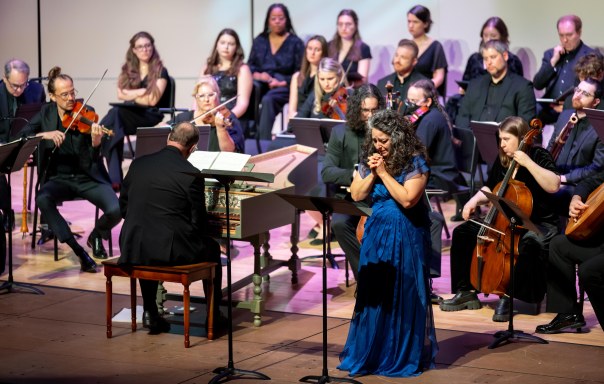
Morell and Handel manage to lift the lechery to a higher plane with Septimus, Valens’ henchman, charged with spreading the word of the cruel edict. He wishes to persuade Theodora to yield to the edict and to him. More righteous pleadings on Theodora’s behalf come from her bestie, Irene, whose motivations are purer, allowing Theodora to engage in more practical disputation.

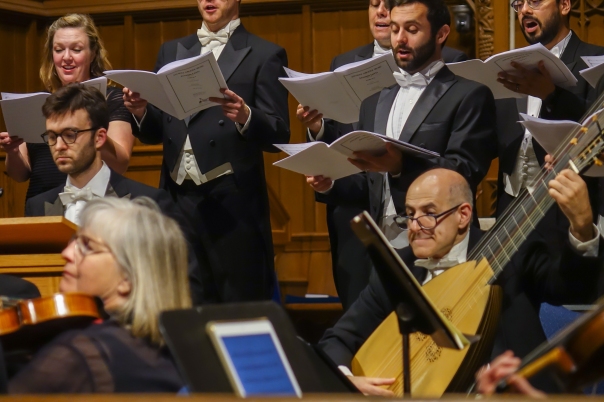
Against Theodora’s ardent trio of well-wishers, the mighty bass baritone Ryne Cherry, as Valens, stood alone. After witnessing his power in issuing Valens’ edict in the opening scene, my greatest worry was that he might never return! No doubt about it, Cherry can rage fiercely, counterbalancing the high voices and varied sincerities of his castmates with his massive presence and demonic energy. As new to me as Cherry, tenor Eric Carey as Septimus was also a force to be reckoned with, capable of projecting a poisonous and devious malignity of his own.
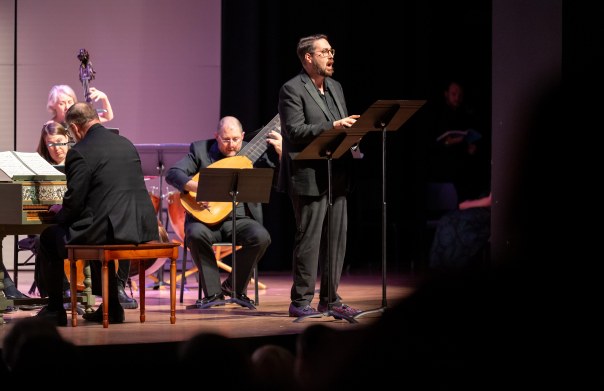
What’s left of the potential for comedy was surrendered by the concert staging at Levine Theatre, preventing countertenor Nicholas Garza, as Didymus, from donning Theodora’s ladies’ wear. While there was an undeniable plaintive tone to his singing, Garza was able to couple his earnest supplications with an earnest religious zeal. Garza’s power not only lifted his Didymus far over the threshold of masculinity, but it also helped to fill in the void left by Theodora’s total lack of will to survive.
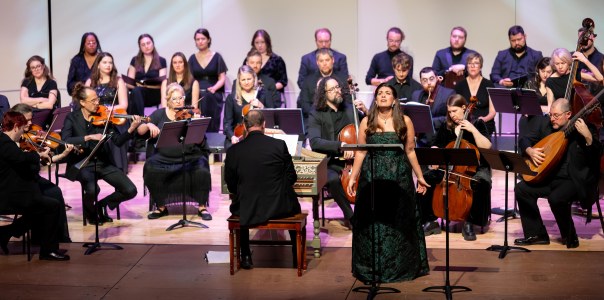
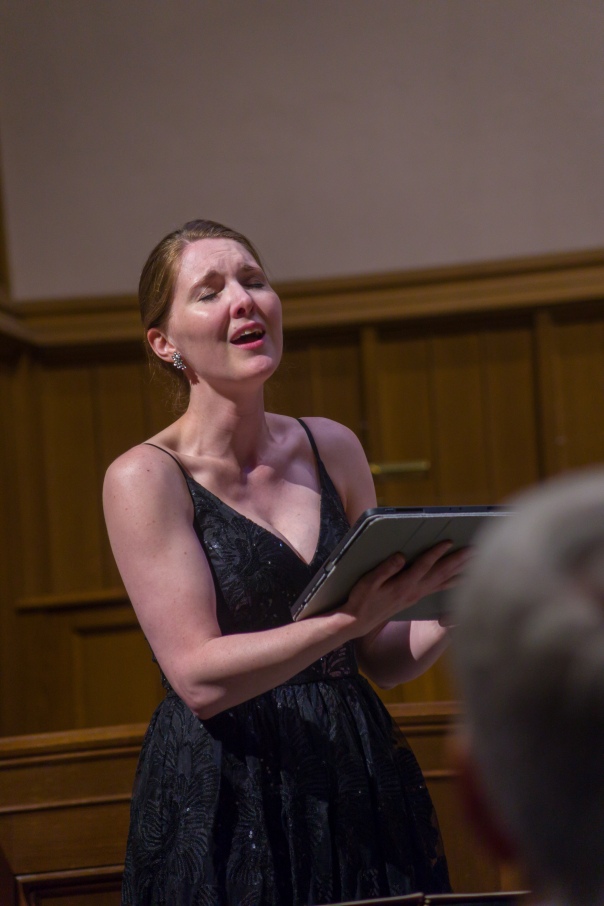
Sweet as can be, soprano Carley DeFranco as Theodora despairs for her life as soon as she hears the government’s edict. But she does not despair for her soul! Theodora’s inner strength remained mostly eclipsed when besieged by Septimus’s ardor and her bestie Irene’s pragmatism, and when Didymus showed up later to liberate her from prison, DeFranco seemed malleable enough to comply with his scheme. What finally fires Theodora up is learning that her liberator has been sentenced to death. Not only does she rush to offer her life for his, real bravery, we also get to see Valens again, brutally rejecting her noble pleas and decreeing that she must suffer the same fate. The diabolical cackle that Cherry piled on top was sheer delight.

At this point, it really was special to see the rapture and joy projected by DeFranco and Garza as they contemplated their souls’ heavenward ascent and everlasting bliss. While it may have remained ambiguous whether Garza as Didymus needed to be won over to Theodora’s point of view, mezzo soprano Carrie Cheron as a very caring Irene seemed to need convincing – a key recognition from Morell and Handel that their audience also needed to be swayed. Actually, DeFranco and Garza’s ultimate duet could be viewed as persuasion enough, but it was nice having Cheron there for insurance.

Charlotte Bach Is Breaking Out All Over

Preview: Charlotte Bach Festival 2024

By Perry Tannenbaum

Since 2018 – with a pandemic hiatus – singers, musicians, and ancient instruments have been gathering to greet the summer at the Charlotte Bach Festival, a nine-day celebration of the Baroque Era’s best. Well, once again, the assembly has gathered, but they’re branching out. Embracing new locations, new composers, and venturing beyond the baroque.

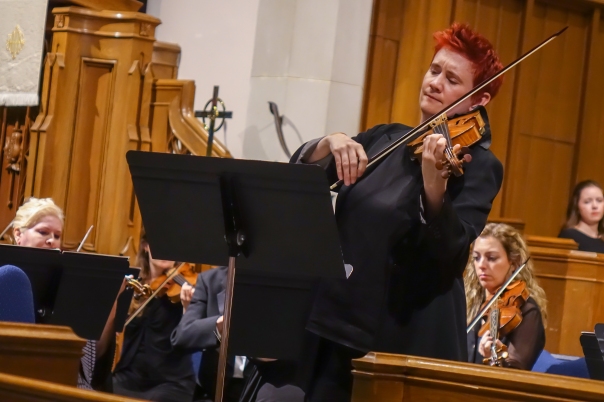
Neither of the headline pieces at the festival’s big Saturday night concerts is by the great Bach patriarch, Johann Sebastian. The big kickoff features violinist Aisslinn Nosky, who first dazzled the Queen City in 2018 playing Antonio Vivaldi’s The Four Seasons at Belk Theater with the Charlotte Symphony. Now the redhead is offering a Red Priest encore with authentic baroque instruments at the Sandra Levine Theatre at Queens University.

Of course, Vivaldi was a contemporary of Bach’s, and Johann will share the bill with Antonio, launching the Opening Concert in Tilge, Höchster, meine Sünden, a church cantata based on Giovanni Pergolesi’s famed Stabat mater – only with a new text based on Psalm 51. On the other hand, Claudio Monteverdi’s Vespro della Beata Vergine, more commonly known as the Vespers of 1610, was premiered 40 years before Bach’s birth. Or maybe 414 years before its Charlotte premiere at Charlotte Bach’s Closing Concert on June 22, also at the Levine.

Bach Akademie Charlotte, the festival presenters, performed a teaser of the complete Vespers last March at an all-Venetian concert.

“That was the one we did at Myers Park Presbyterian,” recalls Akademie president Garrett Murphy. “We had quite a good audience for that, and a preview movement of the Monteverdi Vespers. We knew at that moment we were going to do that whole piece, so the artistic leadership team designed a whole festival around that theme of what was happening in Italy.”

Vespers also gets the biggest build-up with a sequence two noonday demonstration lectures, “The Monteverdi Experience” I & II, at St. Peter’s Episcopal Church on Thursday and Friday – both free with the purchase of Vespers tickets. Clearly the festival climax.

Plus the entire piece hasn’t been played here in ages, if at all.

“Our musicians are most excited about that,” Murphy confides. “For them, that’s the festival, and they are coming together with great excitement to perform the Monteverdi Vespers and are really hoping that folks will come out.”

Leadership of the festival is also branching out in the wake of artistic director Scott Allen Jarrett’s departure. A triumvirate now reigns as artistic leaders, including Nosky, cellist Guy Fishman, and keyboardist Nicolas Haigh. While they craft the festival’s programming – and a burgeoning season of Akademie concerts between festivals – Haigh’s spouse, soprano Margaret Carpenter Haigh, corrals the talent.

Each of the four will also headline a festival concert. After Nosky’s Vivaldi on Saturday, Margaret Haigh teams up with theorbo master William Simms for Lagrime mie: Songs of Lamentation, Disdain, and Renewal next Monday at the McColl Center on N. Tryon Street. She’ll naturally be singing songs by Italians, including Giovanni Kapsberger, Luigi Rossi, Monteverdi, and of course Barbara Strozzi’s “Lagrime mie,” for she has privately labeled the entire 2024 festival “Bach Akademie Goes Italy.”

But not before she and Simms begin in the Renaissance and Elizabethan England with a sheaf of songs by renowned lutenist composer John Dowland.

Nicolas, a fixture on harpsichord and organ at past festivals, steps into the spotlight as he leads the Bach Akademie Charlotte Choir and the festival’s four vocal fellows in “The Renaissance Motet” with compositions by Giovanni da Palestrina, Giaches de Wert, Nicolas Gombert, and the marvelously innovative Englishman, William Byrd. This Wednesday night concert and the Tuesday night “Vocal Fellows Recital” preceding it bring a new site into play, both for the festival and the QC.

Apparently, the Holy Comforter Episcopal Church on Park Road is ready for its closeup.

Fishman opens another new frontier for the festival at Trinity Presbyterian on Providence Road in what promises to be one of the season’s most revelatory programs “The Cello, Ascending.” Leading an assortment of Akademie Choir and Orchestra members, Fishman will illustrate what he subtitles “The Rising Virtuosity of the Baroque Cello” as the instrument shed its subsidiary timekeeping role of providing an ensemble’s bass line and emerged as a major solo voice. The mix of composers will include Vivaldi, Handel, and Gabrielli along with less familiar names.

Arguably the most trailblazing of all the Bach Festival concerts is the Tuesday event, “Bach, the Next Chapter,” staged at a previously undiscovered underground treasure: the Kathryn Greenhoot Recital Hall, below the Levine at the Sarah Belk Gambrell Center.

Nosky leads a tight-knit group in guiding us into the influence JS had on the generation after him, including Princess Amalia of Prussia and his own most famous son, Carl Philipp Emanuel Bach. Spoiler: Johann was a very popular name in the Bachs’ day.

“Since the first time I toured Queens,” Murphy remembers, “I’ve been excited about using that Katherine Greenhoot Recital Hall downstairs, which I think is a perfect size venue for something like this. It’s beautiful, about 150 seats, I think. And very modern and a nice little space. But this is something we’re excited to share with Charlotte and are hopeful that we can continue to grow a following for C.P.E. Bach as well.”

ImaginOn almost gets its Charlotte Bach concert debut as it hosts “Lunch and Learn” at noon on Tuesday. Carolina Pro Musica’s multi-instrumentalist mainstay Holly Maurer and Weber State University professor Esther Jeehae Ahn will go over some Baroque basics and explore the influence Italian composers, from Monteverdi to Vivaldi, had on J.S. Bach in a casual bring-your-own-lunch setting. Sorry, kids, this freebie is “sold” out.

Which brings us to Charlotte Bach’s guest celebs and another free event. Peter Blanchette, the virtuoso inventor of the 11-string archguitar takes the festival’s popular Bach@The Brauhaus series to The Pianodrome on S. Brevard Street in The Historic Grace at the Brooklyn Collective. Blanchette has arranged hundreds of Bach compositions for his invention, but his repertoire ranges from medieval and Renaissance to contemporary and world music. Already this Friday’s revels are sold out.

But perhaps in honor of Simms and his many-stringed theorbo, you’ll also find a cash bar Monday night at the McColl for the Lagrime mie concert.

St. Peter’s mighty organ gets a workout as virtuoso Jonathan William Moyer plays J.S. Bach’s complete German Organ Mass – with an intermission – on Sunday evening. Then on Monday afternoon, Moyer offers an Organ Masterclass at Providence United Methodist, listening to and critiquing local organists, then showing how it’s done. This freebie, open to the public, starts at 2:00 PM.

“He is now the professor at Oberlin, and a consummate artist, doing recitals all over the world,” Murphy says about Moyer. “He’s doing the complete, as they call it, Organ Book Three, but it has a lot of familiar tunes, and it’s a pretty epic thing to hear all at once. He is just delighted to be coming and playing that organ at St. Peter’s, one of the few, I’m told, in the country that can really do that piece justice.”

Planning by the new Nosky-Fishman-Haigh troika has already begun for the 2026 Bach Festival and beyond. Meanwhile, they will be tag-teaming Bach Akademie’s upcoming regular season, just announced this week. Lift-off is set for September 7 when Fishman will play all six Bach Cello Suites, split into afternoon and evening concerts with three suites each.

A new and different kind of split happens when Nicolas Haigh leads the Bach Akademie Choir in October. They’re breaking out of town! On successive nights, October 25-27, Akademie’s choral concert will be performed in Asheville, Charlotte, and Lancaster. Fishman returns for a single concert, leading the Akademie Ensemble in Charlotte on January 25.

Then before the 6th Charlotte Bach Festival returns in 2025 on June 14-21, the regular season climaxes with another three-day marathon. Nosky and Margaret Carpenter Haigh will co-lead the Akademie Charlotte Choir & Orchestra on another Asheville-Charlotte-Lancaster tour, May 9-11.

Bach Akademie is definitely spreading the music around, even into the Palmetto State. Spread the word!