Tag Archives: Corlis Hayes

“Raisin” Remains an Aspirational Reminder

Review: A Raisin in the Sun at Matthews Playhouse

By Perry Tannenbaum
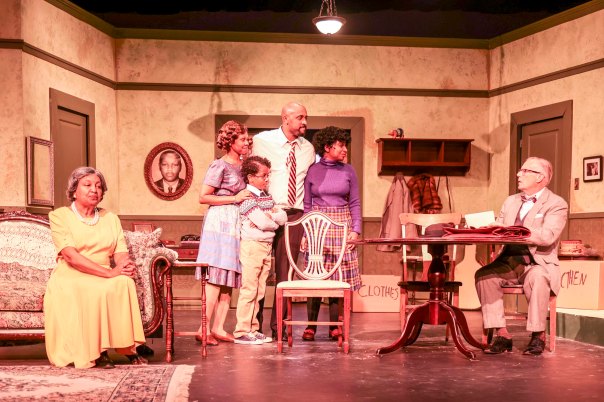
Did somebody just say something about FREE SPEECH?? Yeah, about a billion times per second if you’re tracking social media, college campuses, nation’s capitals, and late night TV. Still no theatre critic we know would dare suggest in today’s torrid media climate that the subject generates too much heat and too little light – or that babble about free speech serves as a black hole for time and breath better spent discussing other freedoms.

Addressing the US Congress in 1941, Franklin Delano Roosevelt looked forward to “a world founded on four essential freedoms.” Useful, breathtaking, and a better way to spend January 6 than a subsequent US President chose. When I was graduating junior high more than a half century ago, those four freedoms were still on the curriculum, and my entire class wrote essays about them.

For the record, I wrote about FDR’s Freedom #4, Freedom from Fear.

One of the things we love about Afro-American literature is that their writers show us that freedoms worth prizing are as numerous as personalities – that those dearest to us are an uphill struggle to achieve. In Lorraine Hansberry’s A Raisin in the Sun, returning to the Metrolina area for at least the sixth time this century, every member of the Younger family knows the struggle from the moment they rise in the morning.

Now some of these struggles are fairly picayune, giving a homey warmth to Hansberry’s various yearnings for freedom that we easily empathize with. Take little Travis (Solomon Doleman), for instance, yawning himself awake with his mom’s help for another school day. The youngest Younger doesn’t have a room or a bed of his own, sleeping right before our eyes on the living room couch as the lights go up.

Hell, he doesn’t even have a regular bedtime, since we’ll soon learn that he cannot claim his place on the couch until Dad has finished scheming and schmoozing with his ambitious pals. Walter Lee and his son Travis may both be sleep deprived due to the drinking and scheming of the previous evening, but their first challenge of the day requires teamwork.

Otherwise, they won’t be able to visit the toilet or groom themselves for the day. As if out in the wild, the family must post a lookout on the hallway, so that they can seize control of the single bathroom that serves multiple families in their Chicago tenement. Then this treasured privacy must be passed along to another member of the clan. Yes, it’s a bit comical to watch so much family tension generated over so little. Yet this is part of the layout of the Youngers’ survival.

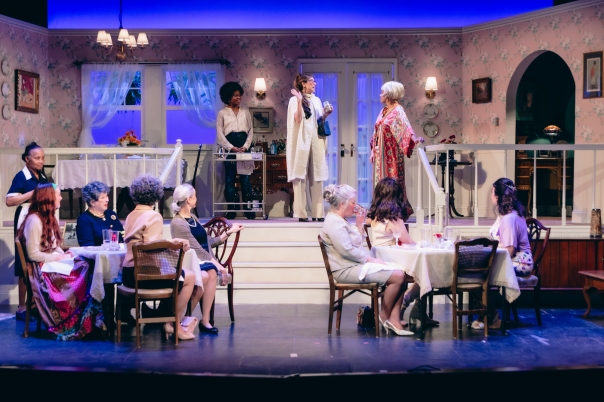
FDR’s Freedom #2, Freedom from Want, is also in the foreground as the Youngers’ successful capture of the bathroom plays out as a backbeat in opening scene. Looking at the Youngers’ apartment for the first time at Matthews Playhouse, we find that director Corlis Hayes and set designer Bob Croghan have pulled back a little in rendering the wear and weariness we should be seeing if Hansberry’s description of the kitchen-dining-living room were followed to the letter. “Cracking walls”? Didn’t see them.

Throughout the evening, there’s a similar shift away from the groaning and wailing tones you might remember from the last time you saw Raisin. That suffering patina has been natural for Raisin since it premiered as the first drama by an African-American female playwright to reach Broadway in 1959. The weight of ancestors hung in the Ethel Barrymore Theatre on opening night, and the fate of the race seemed tethered to the audience’s response.

Likely, at the tender age of 29, Hansberry didn’t view her rise to prominence with such solemnity. The heritage of her family and its struggles, including her father’s fight against a restrictive Chicago housing covenant, are in the annals of the Supreme Court and resulted in a Hansberry v. Lee victory in 1940. As seething, cautionary, and defiant as Raisin often seems, we can look at all the Youngers and see them as positive, determined, and aspirational.

Her banner is Langston Hughes’s 1951 poem, “Harlem,” and its main subject, “a dream deferred.” Hughes offers half a dozen prognostications of what might happen to it. Next to sugaring over, drying like a raisin would seem to be the most benign outcome.
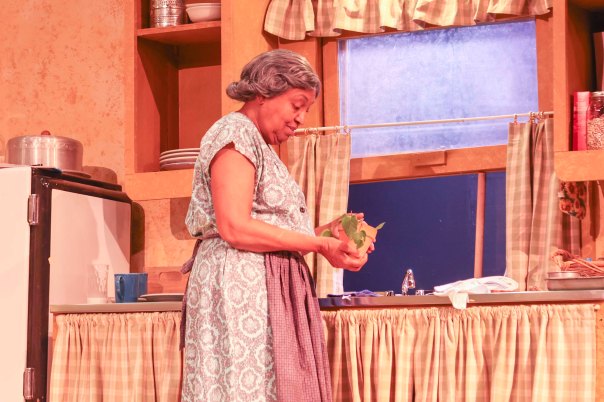
Walter Lee’s dream of opening a liquor shop can hardly be deferred for more than a day, when his mama Lena expects a $10,000 check from his late father’s life insurance. Before he even has his necktie on properly, Walter Lee is lobbying his wife Ruth to soften Lena up so he can calmly present his business plan to his god-fearing mama. Ruth has other concerns: on the surface, it’s feeding her guys breakfast and getting them out the door.

Deeper, and still hidden from everyone else, Ruth is also considering the future of her family from her perspective as a mother.
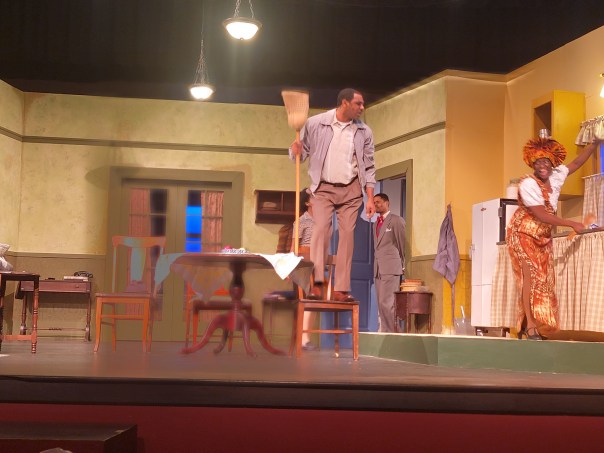
Ruth’s worries and dreams do not align with her husband’s at all – aside from wishing him success. Two other dreams vie for priority in the family. The comparatively breezy Beneatha wants to go to medical school. But not right now. First, Walter Lee’s younger sister wants to start guitar lessons. Or to see what new revelations from Africa come her way from her new Nigerian acquaintance, Joseph Asagai, who clearly aspires to supplant Beneatha’s current beau, the starchy and monied George Murchison.

But the $10,000 check will be in Lena’s name, so what does she want? Here the BNS Productions’ dingy set is absolutely true to Hansberry’s spirit, for Croghan only provides a sliver of a window to allow any light in from the outdoors. It’s barely enough for Lena’s scraggly little houseplant, propped up with wee splints, to survive. Hardly big enough for more than a couple of Youngers to gaze out at the street.

Lena isthe Younger who cherishes the dream of Carl Augustus Hansberry, the playwright’s father, to live in a house that can accommodate all her family – along with a little plot for her to maybe grow a garden. If the best value for her money happens to be in Clybourne Park, a whites-only subdivision, fine: her family will certainly not trouble anyone else’s.

Such a rock! Yet Lily Oden plays Lena with a maternal softness, speaking her mind clearly, but never thundering like a prophet on a mountaintop. She does come off as old-fashioned in her confrontation with the godless Beneatha. The slap is still there, life-sized rather than the hand of God. While it may serve to compromise her moral authority, it emphasizes the intensity of her dream, coloring it with a determination to somehow repair and unify her crumbling family.

Along the way, we can feel that Oden has her recognizing that slapping and bullying aren’t always the best paths. That’s especially true in this Playhouse version where BNS mainstay Jonavan Adams is Walter. The way Adams gazes out at us as he articulates his dreams is a bit drier and wearier than most Walters we’ve seen, needing less of a gap to close before shedding his supplicating impulses and coming into manhood.

It appears as if he may let us down in the crunch, but Hayes gives him a life raft at a key moment in his planned capitulation to the white homeowners’ representative: a portrait of Walter’s father, “Big Walter,” hanging on an upstage wall. We see this – and Lena’s insistence that Travis remain in the room – working on Adams at his tipping point.

Unless you’ve seen Renee Welsh-Noel and her wackier exploits at Children’s Theatre of Charlotte, you might not fully appreciate all the nuance and texture she brings to Ruth and her strained position among the Youngers. She’s the bad cop tasked with prodding the menfolk awake, getting them fed, and off to work and school on time… the responsible parent who must deny Travis his 50¢ for school because the family can’t afford it.

Over and over, she is overruled by Walter and Lena, who can point proudly to Beneatha as the outcome of their spoiling. It’s almost as if Ruth doesn’t have aspirations anymore – until the breaking point when her yearnings and her resolve gush forth.

About the only flaw I found in the Regal cast (a second, overlapping Grove cast takes on all the morning and afternoon performances) was K. Alana Jones’s portrayal of Beneatha. I like how Jones plays and exploits the two men who are dating B, and the relationship with Walter is pitch-perfect. But Jones doesn’t seem to get how brainy and rad Beneatha is for a Southside Chicago co-ed in the ‘50s – or how full of herself and entitled she feels as such a progressive try-everything visionary.

The boyfriends for this BNS-Matthews Playhouse production are exactly as you remember them. Sha’Heed J. Brooks is delightfully starchy as George, the snobbish plutocrat who looks down upon Beneatha’s kin, particularly Walter, to his peril. By contrast, Dionte Darko as Asagai wonderfully captures both the exotic and the naïve aspects of the foreign exchange student. Yet with a worldly urbanity mixed with ancient wisdom, Asagai can effortlessly put Beneatha on the defensive.

With brisk pacing – and maybe some deft cutting – the production speeds by, the three original acts performed with one intermission. Yet Hayes somehow squeezes in the visit from the Youngers’ neighbor, Mrs. Johnson, whose scene and character has been dropped from every Raisin production to reach Broadway, including the revivals that featured Phylicia Rashad in 2004 and, ten years later, Denzel Washington.

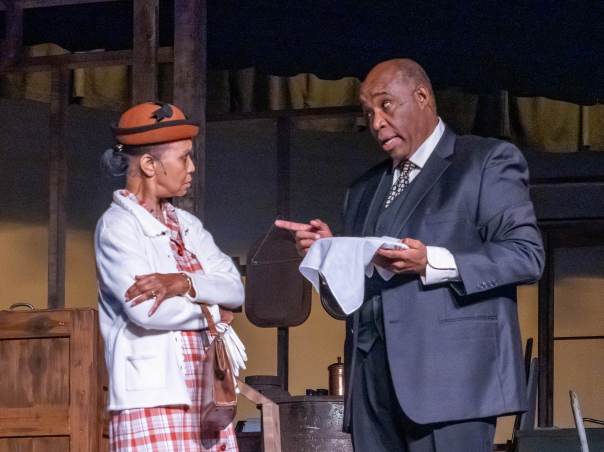
Ericka Ross is quite obnoxious and brassy as Johnson, chiding Lena for buying into a white neighborhood and forecasting doom, even if she won’t convince everyone that the scene should stick. Bobby Tyson as Bobo and Henk Bouhuys as Karl Linder stand on firmer ground – and draw more dramatic assignments.

Nattily dressed in one of costume designer Emily McCurdy’s most stylish creations, Tyson is the only person during the whole liquor store scheme who doesn’t merely phone in. He has the guts to come by and deliver the bad news to his crony in person … and the moxie to show his irritation when Walter doesn’t immediately grasp how thoroughly they’ve both been screwed.

You’ll notice an awkward exit or two from guests at the Younger abode but none more heated or satisfying than the retreats of Mr. Linder, the Clybourne Park emissary. Bouhuys endows him with all the patronizing pomposity you might expect from an upper level Wells Fargo executive. Hayes strips Linder’s scenes of the buffoonery we may remember in past productions, where it might have seemed proper to boo and hiss his every word.

Bouhuys doesn’t bumble, but he does seem doubly non-plussed. He really cannot grasp why the Youngers won’t defer their dream any further when faced with the absurdity of moving into a neighborhood where they are not wanted – so not wanted that community has banded together to buy them out. Don’t they understand the arithmetic? By accepting Clybourne Park’s offer they could make a profit!

Or at least they could negotiate. Who are these maniacs that refuse to cash in?

What’s often overlooked in the onrush of the great Raisin in the Sun climax is how pivotal Walter Lee’s most humiliating moments are in triggering his turnaround. Yes, he stoops to Stepin Fetchit minstrelsy in furiously declaring his determination to ask Linder back and accept his offer, rightfully drawing Beneatha’s disgust. But Adams shows us that Walter has also seen the spectacle he has made of himself.

“The Play That Goes Wrong” Fits Perfectly at The Barn

Review: The Play That Goes Wrong at Theatre Charlotte

By Perry Tannenbaum

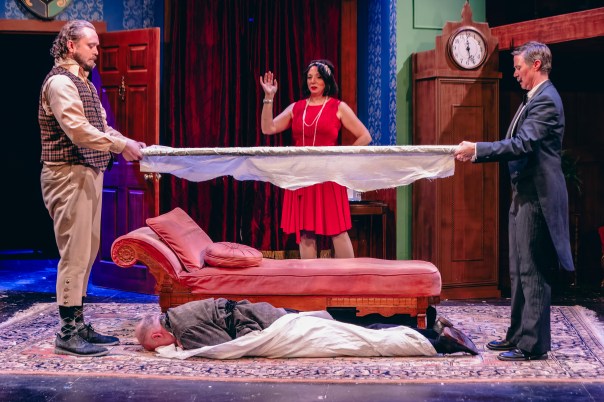
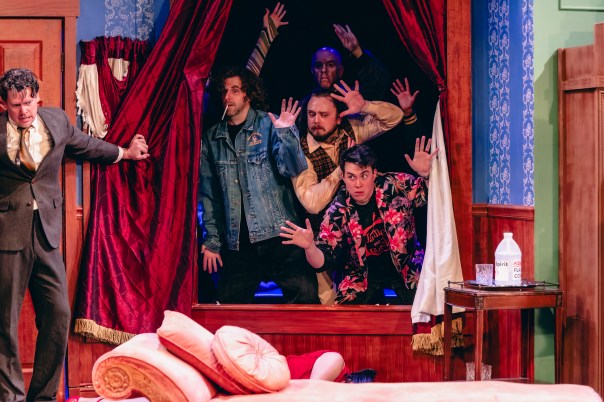
Every time Inspector Carter declares his determination to solve “The Murder at Haversham Manor,” lights at Theatre Charlotte suddenly turn a lurid red to triple-underline the melodrama. This may be the only technical element that consistently goes right in The Play That Goes Wrong, now running – and decomposing before our very eyes –through February 23.

The mantelpiece over the fireplace in Charles Haversham’s study remains a work-in-progress long after the master is murdered. The painting above the mantle – clearly the wrong painting – doesn’t stay where it belongs, and a pesky door stubbornly resists efforts to unlock it when it isn’t wandering off its hinges. In similar disrepair, we may count the phone, the intercom, the elevator leading up to the second-floor office, and the walls themselves.

It is a precisely flimsy set, lovingly put together by Theatre Charlotte artistic director Chris Timmons, so precisely flimsy that it must conform to approximate dimensions to accommodate the cast. So active that the set predictably won the Tony and Drama Desk Awards for best scenic design in its 2017 Broadway debut. Like Michael Frayn’s famed Noises Off, another British play-within-a-play that goes comically wrong and wronger – but on a stage that revolves a full 180ᵒ – the set is like a machine. It could be packaged like an Ikea kit.

Written by Henry Lewis, Jonathan Sayer & Henry Shields, The Play That Goes Wrong nestles more naturally at the Old Queens Road Barn than at Knight Theater, where the national tour touched down in the QC six Novembers ago. The basic concept is that a small-time community theatre, perennially understaffed and underfunded, has suddenly received a grant that will finally enable it to present a full-fledged production.

No longer will Chekhov’s classic Three Sisters be reduced to Two Sisters at the Cornley University Drama Society. Nor will Lloyd Webber’s resplendent Cats be shrunk to Cat. It’s the birth of a new era!

But unfortunately, the new era hasn’t ushered in an influx of fresh acting talent and technical know-how. Dennis struggles with her lines and usually mispronounces the tough words written on her hands. Jonathan repeatedly re-enters the action before he’s supposed to. Sandra has an unfortunate knack of being in the wrong place at the wrong time; and her understudy, Annie, after subbing for Sandra when she’s knocked unconscious, reads terribly. Yet she refuses to yield back her role when Sandra revives.

Props aren’t reliably placed in their assigned locations by the incompetent crew. When they are properly placed or deployed, like the stretcher needed to carry the corpse through the finicky front door, they may not function properly. The Duran Duran CD, sought after by lighting-and-sound man Trevor before the play begins, will turn up inconveniently onstage deep into Act 2.

Which reminds me: even though those redlight cues are absolutely reliable, the portentous sound cues accompanying them are not.

Tonya Bludsworth directs all this carefully calibrated chaos with an able assistant director, Brian Lafontaine. Together, they and Brandon Samples as Chris bring out a key point that didn’t strike home for me as forcefully when I saw the touring version in 2019. Chris not only plays the plum role of Inspector Carter in The Murder at Haversham Manor, but he also serves as the stage director, prop maker, box office manager, and PR rep – totally responsible for this catastrophe, and obviously overstretched.

On the smaller Theatre Charlotte stage, Samples is closer to us and we can focus on him more sharply than if his flop sweat were dripping down at Knight Theater. Makes a difference when one protagonist seems to be especially invested in the worsening outcome, valiantly trying to cover up the metastasizing miscues, and gaping at the sheer scale of his own mismanagement and incompetence.

For me, Sample’s visible struggles – from his nervous shit-faced grins on up to his hissy fits – made Chris a little more poignant for me. Here is a man who cares so much about theatre, and he’s watching all his multiple shortfalls in artistry and management implode so spectacularly. We can feel for the rest of this woeful team, but not nearly as much.

Lee Thomas earns a distant second place in our sympathies just for the physical punishment he takes as Charles Haversham, the stepped-on, sat-on, and mishandled murder victim. Or for the dismal ratio of abuse absorbed to dialogue delivered. When he finally does speak, maybe for the first time at Theatre Charlotte since 2020, it is as an actor of mind-boggling incompetence, eclipsing nearly all of his castmates. Thomas is rather good at looking quietly embarrassed, confused, and discombobulated.

Jenn Grabenstetter as Sandra starts off in a sympathetic slot, cast as Florence Colleymore, the murder victim’s bride-to-be. Our empathy for her slackens when we learn that Charles’s brother, Cecil Haversham, is Florence’s true love. Or when we see how stylized Sandra is as a performer. Or when she skips ahead one line, answering Inspector Carter’s questions before he asks them. But we feel for her – a little bit, anyway – when the front door flattens her and her castmates prop her up inside a clock. When Florence revives, she has to battle Annie to reclaim her role with some fine screwball fight choreography by Allison Collins.

The character arc for Rachel Mackall as Annie is even more transformational, for her Florence starts off in a near-catatonic monotone until she does the first of her pratfalls, scattering the pages of her script and maybe dislodging a contact lens. That raises Annie’s energy level, leading to the subsequent miracle where, battling Grabenstetter for the spotlight, she suddenly has her lines memorized while becoming a vicious gladiator.

More WWWF-style action would not have been amiss, but there’s still plenty.

Like Selsdon in Noises Off, Dennis’s prime reason for existing in The Play That Goes Wrong is to roundly muck things up. Lewis, Sayer & Shields seem to be indicating that he’s inept, miscast, or over-the-hill. What the hell, Bludsworth casts a woman in the role, the venerable Andrea King, who may have actually portrayed more women on QC stages than men and describes herself like a cute puppy for sale in the digital playbill.

With so much incompetence surrounding the Haversham Murder production, it’s a bit cruel to arraign her as the sole culprit for substituting turpentine when a decanter of adult beverage is served to guests at the Manor. Or it is when that happens for the first time. It’s on her when the screwup is repeated, sparking a prolonged series of spit-takes because she has also forgotten a line that would propel the action forward instead of casting it into a never-ending loop.

King maintains a cheery insouciance no matter what kind of havoc she causes, enabling Cody Robinson as Robert to become king of the spit takes as the bride-to-be’s brother, Thomas Colleymore. With a preternatural Joe Belushi energy, Robinson demonstrates that Robert’s distaste for “White Spirit” can actually increase with each sip! When we think Robinson’s frustration and rage have peaked or even exceeded expectations, he still turns it up a couple of notches.

Adam Peal as Robert and Roman Michael Lawrence as Trevor fill out the roster of actors implicated in the murdering of The Murder at Habersham Manor. Robert is not only amateurish but also a carefree hambone, so naturally Chris gives him two roles to botch. Initially, Peal appears as Cecil Haversham, Charles’s scheming brother and Florence’s true love. But there’s more to butcher when Robert resurfaces as Arthur the gardener, laying on some eyewitness evidence.

Did I mention that Trevor, after losing track of his Duran Duran treasures, must abandon his functions as lighting and soundman when Annie, replacing Sandra, is also stricken? That script-scattering pratfall was just the beginning of her misadventures. While Lawrence has already shown us – and will continue to show us – how badly Trevor performs at his chosen specialties, we can brace ourselves for his slaughter of Florence Colleymore, postponed only by his reluctance to play the role.

On my second viewing, it was possible to pay more attention to the convoluted mystery plot by “Susie H. K. Brideswell.” Now I can confidently proclaim that Habersham Manor is a masterpiece of implausibility. Doesn’t work at all.

Woefully, Theatre Charlotte doesn’t seem to have experienced a financial windfall that parallels Cornley University’s. That would have enabled them to append a faux playbill for the Habersham Manor production to the conventional Play That Goes Wrong program. Then we could learn the last names of the players and the Habersham roles they play with less fuss and bother. A few tidbits about the players also enriched the experience of the touring production.

Apparently, when the playwrights founded their Goes Wrong franchise (Peter Pan and The Nativity are among the spin-offs), they must have been focused on crafting three of the roles for themselves to perform in London and Broadway – and meshing with Nigel Hook, their mad genius set designer. So they didn’t insist that their faux playbill must be printed to accompany the show.

That lack of detailing serves to emphasize where The Play That Goes Wrong doesn’t measure up to Noises Off! Frayn’s work fleshes out relationships between the actors onstage when they’re backstage and, with its first-act rehearsal scene, gives us a more vivid idea of how the play-within-a-play is intended to go. For that reason, despite all the hilarity that Lewis, Sayer & Shields deliver, I’d hesitate to recommend The Play That Goes Wrong to anyone who is new to theatre – or hasn’t experienced a play that goes right.

But for sheer fun in frightening times, this show is welcome medicine for everyone else. TikTok & Friends may have brought nostalgia for America’s Home Videos to a screeching halt, but this latest romp at the Queens Road Barn revives the special pleasure – and laughter – of similar train wrecks large and small running right at us, non-stop, on a live stage.

Joe Turner’s Come and Gone, directed by Corlis Hayes, last came and went at Central Piedmont Community College in 2015. Back then, the production demonstrated how ill-suited even a renovated Pease Auditorium was for the best of August Wilson’s dramas. Panoramic Pease has now been demolished, so it will be interesting to see Hayes come back again to the CP campus, along with Jonavan Adams reprising his role as Herald – at a real theater in the fledgling Parr Center. Dominic Weaver, also in the mix ten years back, gets a juicier role this time as Bynum, the conjuring root doctor.

Turner, the second play in Wilson’s decade-by-decade traversal of the 20th century, The Pittsburgh Cycle, is set at a Pittsburgh boarding house in 1911. Rather than hinting at WW1 later in the decade, the drama hearkens back to slavery, the Civil War, and their aftermath, both glorious and sad.

“Every character has a story, and every story has a song,” says Hayes. “The play explores African American identity, healing from trauma, and the power of community and self-discovery. More significantly the play is an examination of Black people in transition during The Great Migration.”

This weekend only!

“One Year to Die” Is a Premiere to Be Proud of in Matthews

Review: One Year to Die at Matthews Playhouse

By Perry Tannenbaum

September 11 has been part of LaBorde family lore much longer than for nearly all other American families. On that date in 1943, the USS Rowan was sunk in Mediterranean waters by German torpedoes after delivering an arms shipment to Italy to combat the Nazis. Local actor/director/playwright/school principal Charles Laborde’s Uncle Joe was among those aboard the Navy destroyer lost on that day, along with 201 other officers and crew. Only 71 survived the attack, rescued by the USS Bristol.

Curiously enough, the official date of Uncle Joe’s death is listed as September 12, 1944 – still a full five years before Charles was born – because none of those 202 bodies was recovered. As the Naval Officer informs Charles’s grandma Edwina with full-dress formality in LaBorde’s new play, One Year to Die, Joe was officially “missing” after the Rowan was torpedoed until one year and one day had elapsed. Then the Naval Death Certificate would be issued.

The world premiere of LaBorde’s play opened last week at Matthews Playhouse and runs through September 29 at the Fullwood Theater.

While it’s intriguing to wonder how Charles’s grandparents, Oscar and Edwina, coped with this limbo year of unofficial death – maybe holding out hopes of a miracle for a few weeks or months – it’s hardly the stuff of sustained suspense and drama. To achieve these enhancements, LaBorde applies some research, imagination, and basic math.

Time-travelling back to his grandparents’ farm in Hessmer, Louisiana, which wasn’t big enough to be incorporated until 1955, LaBorde modestly multiplies the number of local families impacted by the Rowan’s sinking. Now two moms down in Cajun country are grieving over their lost sons, Edwina and Ella Broussard, an ailing black washerwoman who takes in laundry from the richer families in the region.

Everybody seems to know everyone else around town, so when the Naval Officer shows up on Edwina’s front porch to deliver his sad news, she can point him in the right direction toward the part of town where Ella presumably lives. The fact that LaBorde has invented her makes no difference. But it’s going to take far more resourcefulness from the playwright for him to even begin exploring the racial divisions and tensions that prevailed in the little town of Hessmer when the dark days of Jim Crow hadn’t been dispelled, even after African Americans were welcomed by our military.

No, for that to happen, LaBorde had to find a compelling reason for Ella to appear at Edwina’s doorstep. Indeed, to fully engage us and win our admiration for Ella, the mission driving her to Edwina’s farmhouse had to be compelling enough for her to knock on the LaBordes’ front door. Now you have an action sufficiently outré to set a little Jim Crow town in turmoil.

What on earth could be so important for Ella to commit such an effrontery?

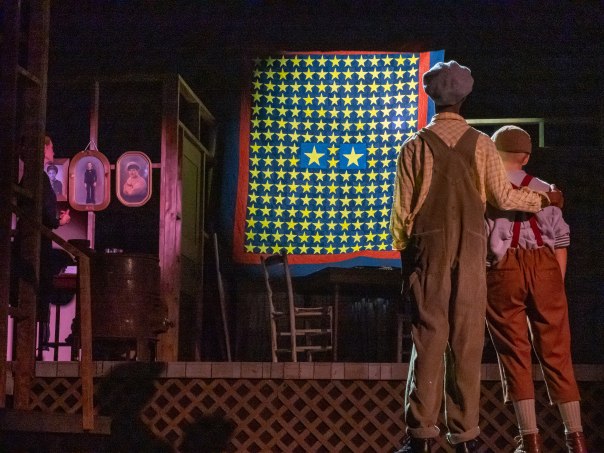
She has enough imagination and ambition to match her chutzpah, for she plans to pay tribute to both her son Lonnie and Edwina’s Joe – along with all the other 200 soldiers aboard the USS Rowan who perished fighting the Nazis. The tribute will be a quilt of 202 gold stars on a field of blue, with the two stars representing Lonnie and Joe conspicuously larger than the 200 others.

The project is worthy, and quilting 202 squares with 202 perfectly centered stars, along with a suitable border to frame it all, seems to be a sufficiently monumental task to occupy two women for the better part of a year – once the ladies have solved the math problem of how to symmetrically configure those 202 stars. Director Dennis Delamar certainly isn’t going to gloss over the problem of getting the math exactly right.

But that front door thing is key (even though Edwina is proud to say it’s unlocked) and obliges LaBorde’s family to be tested onstage in a manner they probably never faced in real life. To the playwright’s credit, neither of his kinfolk is perfect in receiving their surprise guest – who should, as everybody in Hessmer knows, be knocking at the back door.

That is the attitude here from both Edwina and Oscar when they first encounter this unfathomable cheek. Just to double-underline the point that the LaBordes are not perfection, Edwina rebuffs Ella twice. Yet we soon see that they are willing to evolve, uniting with Ella’s cause once they’ve heard her out. Granting her the unique privilege of entering by the front door. But what about the rest of the town? Here is where LaBorde can inject suspense, drama, and a sprinkling of terror.

Joshua Webb’s set design, with its wood-burning stove and perpetual coffee pot centerstage, has a rusticity that allows for a wisp of primal danger and violence lurking beneath its humble domesticity. Both kitchens are lovingly dressed, but sightlines are a rather dreadful problem: unless you’re seated in the center or toward the right side of the Fullwood Theater audience, you might go home never knowing that Oscar had been visible building his stone wall – hidden by the Broussard kitchen to those of us sitting on left – in defiance of stone-throwing yahoos (or KKK) repeatedly breaking the LaBordes’ windows.

Complemented by Sean Ordway’s moody lighting design, which casts a spell even before the action begins, Yvette Moten’s costume designs have the timelessness of Norman Rockwell paintings on the covers of old-timey Saturday Evening Post magazines. It’s hard to resist the visual charm of this production as Delamar frames one memorable tableau after another. From the time we first see the spirits of Young Lonnie and Joe (Aaron Scott Brown and Bennett Thurgood in rather touching non-speaking roles) to the great starry quilt reveal, Delamar lavishes a series of freeze-frames that are a memorable slideshow within the show.

Some discreet subtraction is applied to LaBorde family history that results in somewhat awkward casting for the leading ladies, Paula Baldwin and Corlis Hayes. Nowadays, we’d expect moms of strapping young military enlistees to be in their forties or fifties, not 60+ – but the real Edwina had way more offspring than two sons, so she actually was aged 60 at the time of Joe’s death.

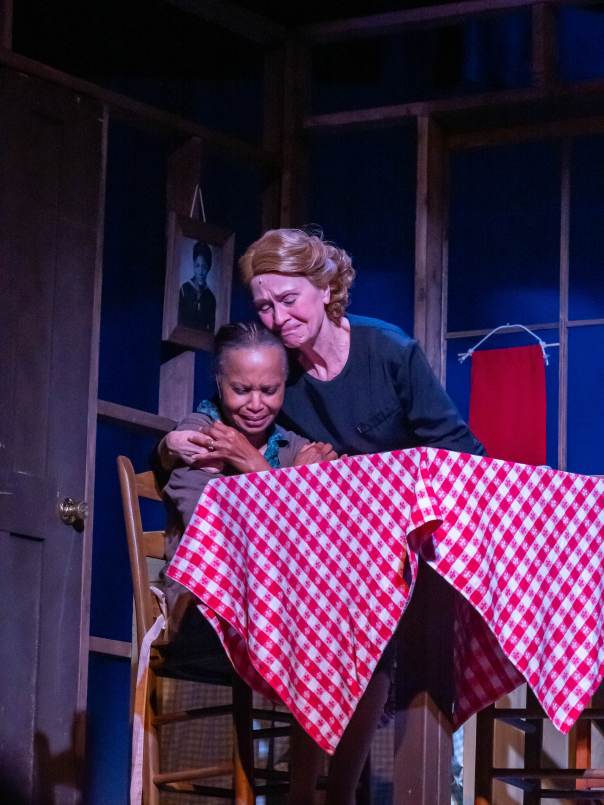
So sitting at her kitchen table, sustaining her renown as the county’s quilting queen, and looking rather matronly, Baldwin is exactly what LaBorde envisioned as Edwina. Life on the bayou does take its toll here, so Joe will merely be the beginning of Edwina’s ennobling griefs. Baldwin endures these crucibles like so many we’ve seen from her over her distinguished QC stage career, with signature stoicism. Neither Delamar nor LaBorde had any hesitation in casting her.

As for Hayes, I first encountered her at Johnson C. Smith in 1988 when she directed for colored girls at the tender age of “24” – just guesstimating here – so she’s also perfectly cast as Ella. Maybe the most heartwarming aspect of this production is the gift LaBorde has given her with a world premiere credit in this role. Confronted by both black and white folk, Ella is a far more nuanced and varied character than we normally see Hayes portray.

We instantly see the strong spine that brings her to Edwina’s door – twice – and we see her pragmatism in backing off the first time. She seethes back home and resolves to repeat her effrontery, still knocking at the front door. Then there’s the beautiful passive aggression when Edwina belatedly agrees to allow Ella over her front threshold. Hayes pointedly hesitates, referencing the insults she has previously absorbed and the dignity she maintains.

LaBorde has obviously labored over Ella, for she has her maintaining this steely dignity when confronted by her minister, Reverend Johnson, and even when she is complimented by white churchlady Nodie Ardoin, Edwina’s nemesis. Yet there’s one more telling Easter egg to be found in LaBorde’s script, that Hayes and Delamar brilliantly emphasize. As soon as Ella gets the first clear sign from Oscar that she might not be welcome in his kitchen, we see Hayes instantly cowering, clutching her pocketbook, and readying for a quick exit.

That’s the kind of good sense Ella has, for all of her sturdy spine. We can be thankful that this rich role has finally found Hayes.

If it weren’t obvious before, One Year to Die signals that Matthews Playhouse has joined the ranks of Metrolina community theatres that consistently present pro-grade work. The standard set by Hayes and Baldwin is met by the men who portray the Hessmer clergy, Steve Price as the soulful Father Morton only slightly upstaged by the charismatic Keith Logan as Rev Johnson. LaBorde would have done better by both of these religious leaders if he had refrained from broadly hinting that Catholic and Baptist ministers follow the exact same script when upbraiding wayward lady congregants.

Aside from Oscar, the other guys we see onstage are military, so we never sample the boorishness or the toxic philosophies of the town’s window breakers. The military cameos, however, are beautifully handled by Vic Sayegh as the Naval Officer who rocks the LaBordes’ world and Brian DeDora, who appears as The Sailor after the Normandy invasion.

Possibly, LaBorde dropped the idea of including the rock-slingers onstage, for Nodie bears the same last name as one of them. Robin Conchola as Nodie is actually the more benign of the “watchin’ committee” that darkens Edwina’s doorstep to register their condemnation, a lot more conflicted than Barbara Dial Mager as Sarah Jeansonne. It’s Conchola as Nodie who has the chance to be rebuffed by Hayes. Sarah is slower to evolve, so we can despise Mager longer, if only for her horrid wig.

As Oscar, also aged 60 when Joe perished at sea, Henk Bouhuys is delightfully homespun, although there’s still enough Jim Crow ingrained in him to be shocked by the ladies’ audacity. Bouhuys continues to project ambivalence long after Oscar decides the memorial project is worth doing no matter how the rest of Hessmer may think. Once he gives Edwina his assent, his loyalty is as steadfast as his love.

Whether it was absent-mindedness or a directive from Delamar, Bouhuys only intermittently sounded Cajun on opening night – while the rest of the players hardly bothered with an accent. So it was startling when Oscar became full-out Cajun just before intermission after a cowardly attack on the LaBorde farmhouse. Out of nowhere, the accent was stunningly convincing, adding some sharp ethnic spice to the most fiery monologue of the night.

Photos by Perry Tannenbaum

Kennedy’s Bridge Circle Meets Its Quota of Quips – and More

Review: The Thursday Bight Bridge Circle at Theatre Charlotte

By Perry Tannenbaum

Since 1987, the last time I watched a live performance at St. John’s Baptist Church, I haven’t cut a deck, played a hand, won a rubber, or even bid a single No Trump – I’ve even lost track of my copy of Charles H. Goren’s Point Count Bidding. But since that night when PlayWorks staged The Octette Bridge Club at St. John’s, I haven’t needed much knowledge about the game of bridge or its culture. My last brushes with the game were in Sunday columns I would read in the arts section when The Charlotte Observer was a traditional newspaper.

So it was a little concerning, when I sat down at Theatre Charlotte for the premiere of Ray Kennedy’s The Thursday Night Bridge Circle, that I found no less than four bridge teachers were credited in the playbill for their contributions. My concerns were thankfully unfounded. Visitors to the Queens Road barn will not be assailed with bridge terminology, the intricacies of bidding, or even extensive card play.

Louise Kennedy’s circle is a looser agglomerate than P.J. Barry’s octet, which was an unwavering group of eight sisters. And it’s only Louise’s circle tonight because hostess chores hopscotch from member to member on successive Thursdays. Nor are participants constant, we learn, as Louise welcomes us to her cheery, symmetrical, split-level living room – two tables flanked by two sofas – a luxe scenic design by Tim Parati that gives us peeps at the garden and the foyer.

Tonight, for example, Louise’s college co-ed daughter, Mary Carter Kennedy, is in town to play one of the hands, to be partnered with Louise’s mother-in-law, Mrs. Kennedy, who has earned a risqué reputation in LaGrange, North Carolina, as a liberal. Since one of the regulars can’t make it this week, dear Louise is bracing herself for the arrival of Miss Virginia, who will likely be roaring drunk as soon as she can guzzle sufficient booze. Excitement is ratcheted up further by a new player that only our host knows, Carmella, feared to be a judgmental Yankee – and to have a profession!

Imagine that!

The two tables are filled out by Bootsie and Cluster, gals from Louise’s generation, and two more elders, Miss Caroline and the eternally disapproving Mrs. Coltrane, Louise’s mom. You can bet there will be plenty to rouse Mom’s umbrage, beginning with the fact that housemaid Margaret and her daughter Bernice will be mixing drinks, pouring beverages, and preparing the hors d’oeuvres. Mary Carter also has a truckload of disclosures that will disconcert her granny.

Hosting such an exhilarating event is so intricate, complex, and daunting that Louise – or anyone who hosts the circle – cannot be expected to participate in the cardplaying. The standard of perfection is too high for a hostess to divide her attention. Tables must be carefully set, partners thoughtfully chosen, and place cards placed exactly so at every chair.

Sadly, Carmella hasn’t chosen the best night for her first sampling of Southern hospitality – or the best year. It’s 1970, LBJ is midway through his second term and the backwater of LaGrange still has separate black and white schools, bathrooms, and post offices. “It’s always been that way,” Miss Caroline complacently declares, and none of the LaGrange ladies except the liberal Mrs. Kennedy seems to suspect that Margaret or Bernice might be discontented with the racist status quo.

Needless to say, Kennedy has concocted a comical time bomb that is primed to explode before our eyes. Desegregation has arrived and Louise’s mom and husband have decided to send their imperiled offspring to military school – a betrayal of Louise’s bestie, Bootsie, who was counting on her public-school solidarity. Nor will Mary Carter, an activist at school, take this well, while Carmella and Mrs. Kennedy will be reliably alarmed. Toss in a stray N-word from Virginia when she’s sufficiently lubricated and you may conclude that a polite evening of bridge has been scuttled.

Before his fictional kindred took the stage on opening night, the playwright Kennedy spoke to us about his autobiographical work and introduced us to the real-life Mary Carter, proudly sitting in the third row. So when Tonya Bludsworth entered as Louise, it was a bit like a continuation of the playwright’s monologue, except that the hostess was giddier with excitement and nervousness because she didn’t know how the evening would go.

Sketching each lady who would sit in each bridge chair, the intro was a bit draggy despite Bludsworth’s fretful charm, particularly since the playwright doubles down on his intros by granting Louise mystical foresight into who is arriving at her front door – tripling down when she greets them by name. Most people will be delighted with Kennedy’s style, which endows most of his characters with the ability to come up with a Southern-fried quip or a salty simile in nearly every sentence.

Almost by magic, Kennedy is able to differentiate between his ladies anyway, thanks to the big family squabble and the political, class, and age divides. Dennis Delamar’s stage direction is as handsome as Parati’s set, elegantly accessorized by “props team” Lea Harkins and Lois Marek. No doubt Delamar’s successes are facilitated by the presence of at least three more actor-directors in his cast, Corlis Hayes as Margaret, Paula Baldwin as Mrs. Kennedy, and Bludsworth as the fourth ace. Assistant director Dee Abdullah is no slouch, either, as a dramaturge.

Kennedy’s lapses into logorrhea may be the result of his not realizing the full power of his script, which bursts forth with terrific force on Queens Road, first when Hayes reacts to the bombshell dropped by Kathryn Stamas late in Act 1 as the soused Virginia (which Grace Ratledge as Mary Carter and Ashley Benjamin as Bernice refuse to let go) and then a stunner by Ann Dodd as Mrs. Coltrane when she is unexpectedly confronted deep in Act 2.

Costume designer Angeli Novio accepts the challenge of making the hotsy-totsy New York lawyer, Stephanie DiPaolo as Carmella, stand out among the local LaGrange fashionistas in her haute couture. DiPaolo does her Long Island accent lightly enough to maintain her stature as an evolved Yankee outsider, but instead of leaning more into her legal expertise and feminist superiority, the playwright lets her devolve into an excuse to more thoroughly introduce us to the natives.

No matter how charmingly Jenn Grabenstetter as Bootsie and Amy Pearre Dunn as Cluster expound on the origin of their Dixie nicknames, I just don’t care, even if it did incentivize them to audition. Let’s get to the juicy stuff quicker! And when we do get there, let Baldwin have more space to bemoan and bewail how her son could conspire with Mrs. Coltrane to send her dear grandson off to a boarding school. It’s a glaring plot point that needs to be addressed – and weren’t we in the middle of a war in 1970?

Regardless of how much more meat Kennedy could pile onto our plates (and how much candy he could discreetly remove), Hayes makes an enduring impression in her climactic monologue, deftly calibrated by the playwright not to become a tirade. Ginger Heath, anointed my first Best Actress many years ago, get surprisingly little to sink her teeth into here despite her imposing wig, but that only spotlights the exploits of the newbies all the more.

Benjamin absolutely commands the stage when she unexpectedly returns in Act 2 as Bernice, a bit of a surprise after her badly miked debut as Tinman last September. That leads to a rather memorable sequence of assertiveness, contrition, and reconciliation begun by Dodd in her QC debut as the formidable Mrs. Coltrane. I didn’t expect to weep after intermission, but I did, even while the quips kept landing.

Dialing Up the Almighty in Memphis

Review: The Mountaintop at Theatre Charlotte

by Perry Tannenbaum

A stage with a particularly authentic – or imaginative – set design is a good start for a director who wishes to immerse you in the world of a play. Yet few productions surround you with the theatre experience, making you feel outside your own world and inside theirs. Sleep No More was dedicated to achieving this mission with a Macbeth makeover up in Manhattan’s Chelsea district at a spooky hotel, where I saw it in 2015. So was Then She Fell the following night in Brooklyn, where I was plunged into the imagination – and mental illness – of Lewis Carroll.

In Charlotte, such efforts have been comparatively infrequent, but not unknown: Chickspeare’s Fefu and Her Friends on Cullman Avenue in 2001, numerous “environmental” productions by Carolina Actor’s Studio Theatre (CAST) in their days on Clement Avenue, and Matt Cosper’s legendary Bohemian Grove of 2014 that was staged god-knows-where – you had to agree to be kidnapped in a van by The Machine at the Actor’s Theatre parking lot to attend.

They do make an impression, these hyper-immersive presentations.

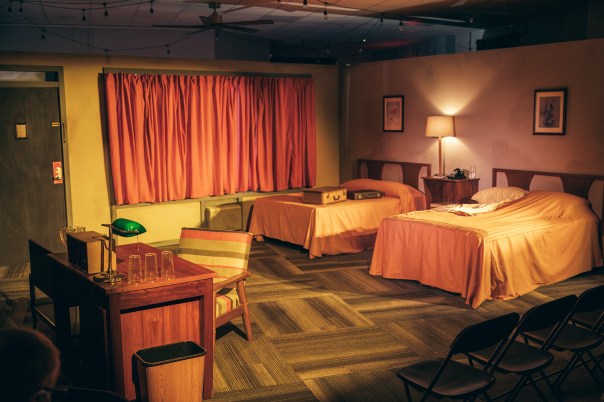
Cut to the legendary Queens Road Barn for the latest Queen City experiment in environmental staging. Yes, that’s Theatre Charlotte – in Myers Park! – on the cutting edge with its new production of Katori Hall’s The Mountaintop. Directed by the ageless Corlis Hayes and designed by Chris Timmons – with a nine-person “Lobby Transformation” team – this is the first fully-staged drama my wife Sue and I have seen in the 501 Queens Road lobby since the spare and forlorn Waiting for GODot in 2007.

Together with invaluable help from David Gallo, set designer for the 2011 Broadway production, and props designer Brodie Jasch from Fayetteville’s Theatre Squared, Dr. Hayes and her production team aim to take us back to the Lorraine Motel in Memphis on the night of April 3, 1968. Rev. Martin Luther King, Jr., returns from the Mason Temple, where he has just delivered his eerily prophetic “I’ve Been to the Mountaintop” speech.

Every detail of the last room occupied by MLK has been replicated with meticulous authenticity – night tables and their contents, lamps, the chair and its fabric next to the window, the window curtains, the bed coverings – all the way down to the upside-down zero on the door to Room 306. With walls within walls, you must enter through this door to get your first view of the new theatre space in the lobby created for this production. Only the ceiling remains unaltered, with its fans and extinguished holiday lights. Explanations are appended in the digital program for those details which couldn’t be ascertained and those that would have conflicted with Hall’s script.

Since there is no intermission and all the usual concession outposts have been whisked away, they have thoughtfully made “Room Service” available to ticketholders via a QR code. In more ways than one, we are treated like kings at The Lorraine. Fun fact: the fateful motel was actually named after the hit 1928 song, “Sweet Lorraine,” popularized by jazz artists Teddy Wilson and Nat “King” Cole.

For all of Dr. Hayes’s reverent devotion to getting the look and feel of The Lorraine recreated as faithfully as she can, we soon see that it isn’t a shrine. Hayes is equally bent on getting to the heart of Hall’s pointedly irreverent drama. Hall provides ample time for solemnity and anguish at the end, but until then, she wants us to see the soon-to-be-martyred icon as a man, not a god, and not even as a holy man. The real Martin – or as God likes to call him, Michael – had his foibles, vices, and infidelities.

And notwithstanding the resounding valedictory declarations of the Memphis speech we’ve heard over and over – “So I’m happy, tonight. I’m not worried about anything. I’m not fearing any man” – Hall insists on reminding us that King did have worries and fears.

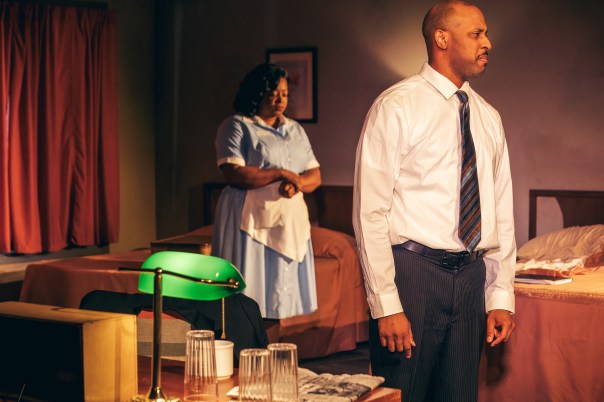
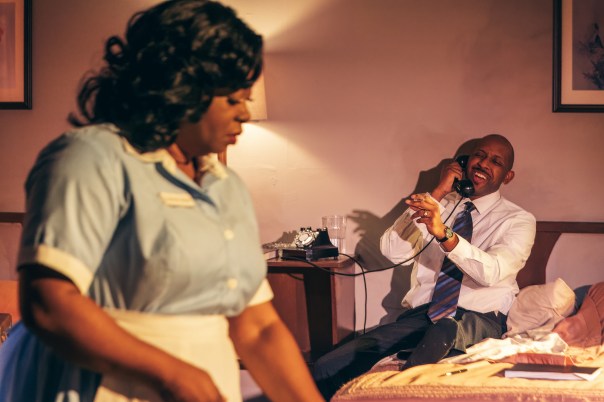
All obeisance to King’s saintly aura is swiftly discarded almost as soon as we see Justin Peoples taking on the role, before he walks through the audience to take a pee. Not only is he unkempt after his oratorical exertions and his walk through the rain, he has largely dropped his dignified public persona, at ease if not quite relaxed. Though he diligently examines his room’s rotary phone to make sure it isn’t bugged, we can hear that he has switched from formal to casual mode as soon as he speaks. It’s with an unmistakably Southern accent!

Immediately disarming. Neither the touring production by the famed Penumbra Theatre of Minneapolis that ran at Booth Playhouse in 2014, nor the homegrown Actor’s Theatre run of 2018 at Queens University, directed by April Jones, had quite the same spontaneous or undignified impact. The smallness of the lobby space at the Queens Road Barn certainly helps in establishing a closer intimacy with King and a sharper look at his vulnerabilities.

Maybe that folksy drawl would have been even more impactful if Peoples had held back on it until MLK had dialed room service after normal closing hours. The arrival of LeShea Stukes as the fetching Camae, a housemaid moonlighting as King’s waitress, would have been a good moment for Peoples to turn on the Southern charm. But for those of us who have seen The Mountaintop before, Stukes brings with her more than Camae’s sensual allure, more than her extra Pall Malls to satisfy King’s chain-smoking, and more than her working-class sass.

She now gives us solemn glances from behind King’s back, fully aware of the gravity of her true mission before she discloses it, morphing from pursued damsel to admonishing paramour to chum to messenger of God. None of these fresh wrinkles quite accounts for the marvelous voodoo or the juju that Hayes, Peoples, and Stukes have conjured up in creating the playful, poignant, and profound chemistry of this Camae and MLK.

Lighting designer Jennifer O’Kelly gently signals those moments when Camae might be contemplating why she’s there, foreshadowing the AV extravaganza that will accompany Stukes’ final mountaintop revelations. She will almost be speaking in tongues when we reach this visionary summit.

There’s little theology here, for when King dials up the Almighty, pleading his case for more time on this turbulent planet, she hangs up on him. Yet there just may be some deep dialectic in Hall’s scheme that narrows the gap that we might feel between God’s biblical judgment upon Moses at Mount Nebo and the judgment upon Martin in Memphis.

Moses was given a precise catalog of his greatest sins. Maybe in an afterlife he learned not to shatter any holy tablets or assault a boulder without God’s approval. But what was the great sin that deprived MLK of the Promised Land that awaited his people? The answer never comes explicitly in the play, but King’s sins – though relatively petty until we consider possible adultery – are graven in its marrow.

In an age when not a day goes by without yielding fresh images, outrages, and crimes committed by a lying orange buffoon, we might find ourselves shocked to be shoved towards such traditional moral moorings. Some of these values were written long ago in our marrow. Leading a people may still require adhering to a higher standard in God’s job description, not flouting the laws and proprieties that apply to everyone else.

Peoples and Stukes, with plenty of finely judged assistance, have found a way to make The Mountaintop more poignant, relatable, and human. Hall’s work becomes more touching, meaningful, and necessary each time I see it.

Spacious Setting at Halton Theater Creates Fresh Perspective for “You Can’t Take It With You”

Review: You Can’t Take It With You

By Perry Tannenbaum

THEA2021-DLV-0923-4498

Picking up our tickets for You Can’t Take It With You in the Overcash lobby outside Halton Theater, I was asked how many times I had seen this comedy by George S. Kaufman and Moss Hart before. Reflexively, I answered four or five times – discovering, to my surprise, that I was replying without a groan. My later researches proved my estimate to be correct, for I have now seen local productions on at least five occasions dating back to 1990, including presentations by Charlotte Shakespeare, Old Courthouse Theatre (1991), and two at Theatre Charlotte (2001 and 2016), along with the current Central Piedmont Theatre effort. Over the years, I’ve gradually warmed to the script, perhaps because it’s better-respected now than when the 1937 Pulitzer Prize winner was turned into a star-studded screwball extravaganza in the 1938 Oscar-winning film.

Each time I’ve beaten back my resistance to reviewing You Can’t Take It on recent occasions, I’ve found myself taking away something new. The last time I saw the comedy, just days after the 2016 election, I found myself imagining how in tune with public sentiment the Kaufman-Hart concoction must have seemed when it first premiered – after the 1936 election. Hardly shocked or even surprised anymore by the cavalcade of eccentricity in the Sycamore family and their outré circle, I found myself newly fascinated by patriarch Martin Vanderhof’s anti-government stance and the playwrights’ decidedly anti-Wall Street sentiments. Of course, I had no idea at that time how much I could come to loathe a President who boasted about not paying his income taxes.

Nearly five years later, the similarities – and dissimilarities – between Martin and The Donald have popped into sharper focus, creating a provocative tension. What struck me most forcefully this time around was how much You Can’t Take It With You is about the classic clash of New York values, the free-thinking Bohemian chaos at the Vanderhof home, around the corner from Columbia University, and the stuffy, moneyed callousness of Wall Street, the planet’s financial capital, still wobbling after the crash. Maybe the other thing that struck me with new force was also a result of the Trump Effect. This play is absolutely crawling with Russian influences: emigres, ballet, socialism, Stalinism, Trotskyism, and blintzes. No wonder at all why the place gets raided by G-Men.

Kaufman and Hart would have no doubt delighted in Jennifer O’Kelly’s vast set design, for they described this expanse as an “every-man-for-himself room,” where every member of the household has the freedom – and space – to do whatever he or she pleases. “For here,” they added, “meals are eaten, plays are written, snakes collected, ballet steps practiced, xylophones played, printing presses operated – if there were room enough there would probably be ice skating.” With admirable restraint, there is no Zamboni in sight under Paula Baldwin’s deft direction, and the wide vista of the O’Kelly’s set encourages players to move quickly to answer the front door at stage left, to step lively in reaching centerstage, and to speak loudly so that all might hear. Baldwin was also spied at the back of Halton Theater on a couple of occasions, perhaps after hovering near the soundboard, for the sound from body mics onstage was exceptionally problem-free. Sound design by Ismail Out, including cuts of Johnny Mercer’s “Goody Goody” from 1936, was also on-target.

THEA2021-DLV-0923-4527

The plot revolves around the possible nuptials between Alice Sycamore, Martin’s granddaughter, and her Wall Street boss, Tony Kirby. As Alice sees it, the multitudinous eccentricities of the Vanderhof household are an insuperable barrier between her and the ultra-respectable Kirbys. Obviously, Alice is conflicted about her family, loving them all while seeing them with the clarity of the only household member in daily contact with the outside world. Tony, as it turns out, is no less attuned to the shortcomings of his own family, so he pushes for a meeting with Alice’s family and then for the inevitably explosive rendezvous between his folks and hers. Did we mention that Alice’s dad, Paul, fashions fireworks with his faithful assistant, Mr. De Pinna? No, because all of those chemical reactions happen down in the cellar, out of view.

THEA2021-DLV-0923-4629

Having to move so quickly across O’Kelly’s arena seems to endow all the residents of the Vanderhof home with an enthusiastic complacency, so engrossed are they all in their eccentricities. Pam Coble Newcomer is the restless artist of the family as Martin’s daughter, Penny Sycamore, working on a couple of her 11 unfinished playscripts as we watch, until she decides it’s time to resume work on painting a portrait of Mr. De Pinna posing in a Grecian tunic that she abandoned years ago. Abigail Adams is Penny’s eldest daughter, Essie, the perennial ballet student who also makes candies, and Braden Asbury is her husband, who mostly splits his time between the xylophone and the printing press in his nook. He also likes to make masks and serves as Essie’s candy seller and the family pamphleteer. Busy fella. So you’ll notice that Kaufman and Hart enjoy piling multiple enthusiasms on their characters.

THEA2021-DLV-0923-4561.jpg

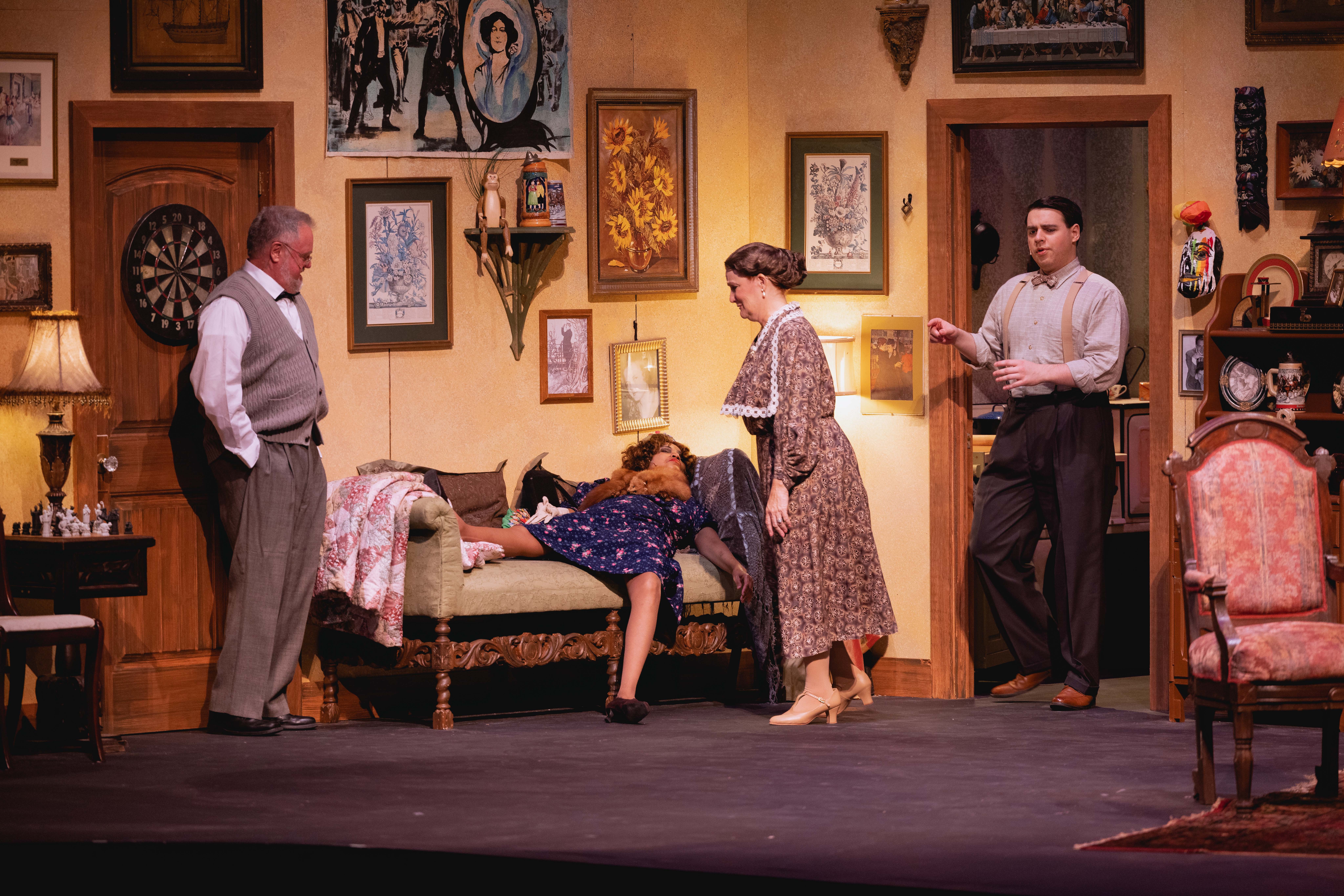
Contrasts can be extreme, sometimes with a zany logic. As Boris Kolenkhov, Essie’s ballet teacher, John Sexton can beat a taskmaster’s cane on the floor in perpetual frustration, since Essie shows no promise whatsoever, and then, at the most inopportune moment, reveal his zest for wrestling. It’s a lot for the Kirbys to digest all at once, but other weirdos like Mr. De Pinna are likely to show up on the Vanderhof doorstep and never leave. Weirdest of these may be Corlis Hayes as Gay Wellington, a flamboyant actress who would steal every scene if she weren’t spending so much time passed out on the settee from excess drink. Of course, cameos from those government raiders and an overnight stay in jail didn’t improve the Kirbys’ first impressions of Alice’s family. Nor do the fireworks down in the cellar remain inert. As the elder Kirbys, Rick Taylor and Pamela Thorson were as starchy as can be, but Thorson was especially regal in taking affront.

THEA2021-DLV-0923-4325In the face of such humiliating catastrophe, Alice wished to exile herself to the Adirondacks, but Charlie Grass managed even here not to be overly annoying in her shame and mortification as the one “normal” member of her family. Love and practicality are nicely mixed in this Alice. Serene and optimistic as ever, Martin, Penny, and Paul are able to laugh off the misadventures of the previous night. Newcomer as Penny, Jeremy Cartee as Paul, and Dennis Delamar as Martin became especially endearing from this moment forward, maintaining their equanimity after this buffeting of adversity. Galumphing and awkward in the early going, in and out of his mad scientist coveralls, Cartee showed some touching solicitude toward the wife and daughter when crisis struck. Delamar, in his second go-round as Martin, has thoroughly mastered his dignity and glow, aided by Emily McCurdy’s costume design and James Duke’s lighting.


Whether or not Baldwin was looking for a James Stewart type in replicating the onscreen chemistry between Alice and Tony (judge for yourself when you see Grass’s hair), Timothy Hager brings some of the same height and charming gawkiness to the role. Although O’Kelly does her best to clutter up her set, there is never the sense that Tony is slumming because the space is so expansive. That spaciousness also tends to dilute whatever humble, homespun quality you might have associated with Vanderhof and his clan in past viewings.

THEA2021-DLV-0923-4455

With Baldwin’s staging, you’ll likely find that the wide-open space enhances Delamar’s eloquence when he delivers Martin’s signature monologue in the final act. If you can tear your eyes away from Delamar, you’ll notice that Newcomer has been deployed far to stage right, leaning forward on the sofa in rapt attention, beaming and proud of her daddy. Most other family members have been spread out around a stage that has more than a couple of times been teeming with tumult. All eyes are Grandpa, all the family are respectfully still, radiating pride and content. It gives a special moment an extra aura.

Sports Seasons and Generations Clash in Brand New Sheriff’s “Fences”

Review: August Wilson’s Fences

By Perry Tannenbaum

DSC07128

Sports fans quickly get a feel for what time of year it is in August Wilson’s Fences, set in 1957 Pittsburgh. Baseball seems to be supreme as you walk in to Brand New Sheriff’s production at Spirit Square. James Duke’s impressive set design doles out the left side of the Duke Energy Theater stage to a ramshackle two-story house. But a shabby yard dominates the right side, where a baseball dangles on a rope from an old gray tree. Pick up a bat, this is Troy Maxson’s place.

Maxson, an ex-baseball great, talks about the icons of the game, past and present, mostly contemptuous toward the white men who dominate the scene, while his friend Jim Bono rates Troy only below Babe Ruth and Josh Gibson as the best who have ever played. Since Gibson played in the Negro Leagues for the Homestead Grays, based in a mill town adjacent to Pittsburgh, it’s likely that he’s seen Josh far more often on the field than the Babe – especially since he introduced Troy to the sport during a prison stretch.

By the time Jackie Robinson had broken Major League Baseball’s color line in 1947, Troy was already 43, just missing the boat to national fame and power-hitting glory. Instead, he’s a garbage collector when we first see him on a Friday Night, as he and Jim observe their weekly ritual of getting drunk in Troy’s yard. We’ll hear mentions of Pittsburgh Pirates players, Dick Scofield and the under-utilized Roberto Clemente, who seems promising to Troy’s keen eye, so baseball is always in the air.

DSC07579

We begin to zero in on the time of year it is when Troy’s son Cory first appears, trying to get dad’s permission for a visit from a college scout wanting to offer the kid a football scholarship. Troy doesn’t want Cory to give up his job to start his final season with his high school team, and in subsequent scenes, we’ll see his football jersey and shoulder pads, further assuring us that we’ve reached that point in the year when baseball and football seasons overlap. We hear about the Milwaukee Braves leading the National League pennant race, their wicked pitching duo of Warren Spahn and Lew Burdette, and their young slugger, Henry Aaron.

Hank, we hear, has hit 43 homers in a year he finished with 44, so it must be late September. Within a few weeks, the Brooklyn Dodgers and the New York Giants will play their last home games in New York City before moving out to California, and Aaron – destined to surpass the Babe on the all-time home run list – will lead the Braves to victory over the Yankees in the World Series.

As Troy’s pal Bono and his wife Rose keep telling him, times are changing. A Goliath among ballplayers, accustomed to idol worship, Troy doesn’t easily change his thinking, so it’s interesting to watch how Bono and Rose make headway on those rare occasions when they do. Cory really doesn’t stand a chance against Troy’s tyrannical whims unless Rose intercedes on his behalf. Maybe he should have chosen baseball over football?

The father-son relationship is complicated by jealousy and resentment on both sides. Troy is ambivalent about seeing his son succeed in a way that he couldn’t, and Cory is wary of comparisons with his legendary dad, perhaps seeking to sidestep his shadow by turning to a different sport.

Wilson doesn’t downplay the Troy legend. On the contrary, he delightfully magnifies his mythic dimensions. Troy tells us how he has stared down the Devil, tells us how he wrestled with Death for three days, and he shouts his defiance toward the Grim Reaper before our eyes. So Troy’s practical advice toward his son clashes with his own swollen self-regard – and with his disregard for social norms. On the job, his strength and pugnacity will enable him to become the first black garbage truck driver in town, but at home, his unchecked infidelity will cost him.

DSC06873

Part baseball legend, part Greek epic hero, and – as Bono observes – part “Uncle Remus,” Troy is the powerhouse that makes Fences among the most produced and anthologized of Wilson’s plays. Of the four productions I’ve seen in Charlotte, beginning in 1991 when Charlotte Repertory Theatre presented the local premiere, Brand New Sheriff’s best demonstrates how a strong overall cast elevates the script to the stratosphere of a classic.

And we’re seeing the best Troy we’ve had here in Jonavan Adams, who combines Ed Bernard’s physical presence from the Rep production of 1991 with the corrosive meanness and fiery defiance of Wayne DeHart at Theatre Charlotte in 1996. Snarling, cajoling, roaring, and willing us to see his distorted vision of the world, Adams is more outsized and supernatural than we’ve seen him before.

It likely helps that he and director Corlis Hayes are on their second go-round with Fences. The 2013 version at CPCC, where Adams played Lyons, Troy’s jazzy musician son, wasn’t the best of the previous versions, to be honest. But the current BNS production sure does demonstrate the benefits of taking a second shot at a work you revere. Cumulative experience with the playwright helps, too, for Adams builds upon what he learned in other parts of Wilson’s century-spanning Pittsburgh Cycle, with roles in The Piano Lesson, Two Trains Running, Ma Rainey’s Black Bottom, and Joe Turner’s Come and Gone.

With BNS committed to presenting all of Wilson’s Cycle, others who have appeared with the company and in plays by this playwright are also shining lights here, most conspicuously Tim Bradley as Bono and LeShea Nicole as Rose. Audience members who hopped aboard the Pittsburgh train in 2017 with Jitney are certainly enjoying the ride the most. Bradley has been onstage at Duke Energy at every stop so far, and his Bono is a worthy – and compatible – longtime companion for Troy, not quite as righteous and upstanding as Memphis from Two Trains but strong and honorable when Troy could use a reality check.

DSC06918[6]Nicole was paired with Adams last year in Two Trains, so their rich and nuanced chemistry as Rose and Troy shouldn’t be a surprise. Rose is a stronger woman here, so when she holds out her hand on Friday nights, she isn’t merely asking for Troy’s pay envelope. Rose is Troy’s equal, and then some – the family nucleus. Everybody but Troy seems to get that until her climactic utterances deep in Act 2.

Still a junior at UNC Charlotte, Dylan Ireland is no stranger to BNS, having starred as Huey in Rory Sheriff’s Boys to Baghdad. As Cory, Ireland stands up to his dad without strapping on his shoulder pads. Eventually, he even disrespects Troy when he’s drunk and blocking the front door.

It’s a complex role for Ireland, who must forcefully declare that he doesn’t fear his father while imperfectly hiding that he does. He’s the reluctant, resentful free labor that Troy enlists to help build a fence around his property. So Ireland’s confrontations with Adams – along with Troy’s run-ins with Death – will come to mind when you contemplate the meaning of Wilson’s title.DSC07475

Graham Williams, lately the Tin Man in BNS’s Be A Lion, has the cool-cat swagger you expect to see from Lyons. Though he does scrupulously pay Dad back on his loans, Lyons does not prosper as a musician, and Williams gives us a poignant picture of his decline. Seven-year-old Raynell appears late in the show, a bit of a consolation for the misfortunes that befall the other Maxsons, and Lauren Vinson plays her sweetly, only slightly difficult to manage.DSC07936

Seven years younger than his brother Troy, Gabriel is a World War 2 vet who came back from the battlefield delusional, with a metal plate in his head. Troy may have seen Death and the Devil, but Gabriel believes that he has seen St. Peter and that he is the archangel Gabriel, destined the blow his junky trumpet on Judgment Day. James Lee Walker II plays this extravagant simpleton, the only cast member from the 2013 CPCC production to return in the same role.

More than ever, I must lament that I missed Walker when I reviewed the Sunday matinee of the 2013 production, when he was replaced by an understudy. Walker’s crazed, sunshiney energy this time around is a constant joy, and the ending, botched by the understudy or Hayes’ stage direction back then, was absolute perfection when I saw it on Saturday night. The glow of that ending may convince many that Fences is Wilson’s finest drama, and there’s plenty of firepower from the rest of the cast to fuel that feeling.


ShakesCar’s Dystopia Is as Serious as a Cartoon

Review: Shakespeare Carolina’s production of Mr. Burns at Spirit Square

By:  Perry Tannenbaum

2019~Mr Burns-12.jpg

If your Simpsons erudition doesn’t extend far beyond Bart, Homer, and “D-oh!” you likely haven’t the foggiest notion about who the evil owner of the Springfield Nuclear Power Plant might be. Good reason for boning up on the 30-year-old animated TV series before you go and see Shakespeare Carolina’s production of Mr. Burns, Anne Washburn’s strangely imagined “Post-Electric Play,” at Spirit Square.

The Simpsons is very much at the heart of Washburn’s myopic dystopia, beginning not too long from now, somewhere south of devastated Boston – at a safe distance from obliterated Pennsylvania. Not an ardent lobbyist on behalf of nuclear power, Washburn doesn’t trigger her nuclear winter with weapons unleashed after treaty breaches, miscalculated escalations, or some jerk’s pudgy finger on the nuclear hot button.

Instead, we seem to have been decimated by a chain reaction of nuclear reactors.

2019~Mr Burns-03

Certainly, the evil Mr. Burns has triumphed over humanity in Washburn’s scenario, but it’s unclear whether she views that as her ultimate horror. For as a few survivors sit around a campfire, we might gather that The Simpsons has outlived all other recognizable trappings of civilization. Matt, Jenny, Maria, and Sam aren’t preoccupied with reaching out to other clusters of survivors or isolated wanderers – or in re-establishing the nation’s electrical grid. Rather they’re engaged, sometimes excitedly, in piecing together an old episode of The Simpsons that they have all watched years ago.

Presumably a rerun, for the “Cape Feare” episode, the core of the reconstruction, first aired in 1993, twenty years before the off-Broadway premiere of Mr. Burns.

A newcomer named Gibson wanders into the campsite with the bad tidings from Boston. He is also familiar with this seminal episode of The Simpsons and contributes to the group reclamation. Aside from a ritual sharing of possible survivor info, that’s pretty much all of the Act 1 action.

Colleen 2.JPG

Not at all interested in adhering to established theatre traditions, Washburn gives us two intermissions instead of the usual one. And if you think the opening act was a bit impersonal, wait till you see the acts that follow. It’s seven years later and Colleen, recumbent and silent throughout Act 1, has become a post-electric TV director, and the company has grown to seven with the addition of Quincy.

We see the group rehearsing an odd amalgam of quick TV sitcom blackouts and commercial breaks, where “Cape Feare” has evolved and commercials are no less revered for their nostalgic content. Apparently, touring with such rudimentary fare has become a cutthroat industry. Lines, slogans, and episodes are licensed, and competition for rights to them is fierce – and perhaps more important than the quality factor.

Pret a Manger

Zoom ahead 75 years and, under Amanda Liles’ ritualistic direction, you’ll be able to visualize “Cape Feare” as either a solemn religious rite or as an eerie melodramatic opera, for most of the music written by Michael Friedman to Washburn’s lyrics resides here. Liles and the ShakesCar cast also leave the ending ambiguous. We’re either watching the near-revival of the electrical grid or a re-enactment of the original flameout.

Mr. B finally emerges emphatically during this savage spectacle, not as the evil and greedy capitalist of yore but as a demonic destroyer. Homer, Bart, and Marge are now as foundational as Abraham, Isaac, and Jacob – though their sacrificial fates bring in a New Testament flavor. Stray wisps of Washburn’s referential comedy still remain, though, as when the Simpsons make merry with new lyrics to The Flintstones’ theme song.

2019~Mr Burns-23.jpg

My suspicion is that enjoyment of Mr. Burns will be proportionate to how readily you can see yourself sharing in the opening bursts of enthusiasm that the nuclear holocaust survivors have in reconstructing “Cape Feare” on The Simpsons. Lacking more than rudimentary Simpsons erudition – Homer’s voice will send my hand flailing toward my remote a bit more quickly than Bart’s – I’ll have to admit that I struggled. My memories of Homer’s zenith had faded into forgetfulness long before 2013.

An apocalyptic landscape such as Washburn’s is obviously frill-averse, so if Jess Clapper’s costume designs look somewhat makeshift, no harm done. The cylindrical blue headdress that Jen Jamsky-Pollack wears as Marge works fine, recognizable in an instant for The Simpson faithful, while Rasheeda Moore’s get-up as Bart looks comparatively thrown together. Viking shoulder plates? Why not.

Nor does an outdoor campsite in the middle of the night – or the scenes to follow – require that Liles seek out a set designer, though the final flashes of zonked light presumably required some technical derring-do from James Cartee. The design and tech needs of Mr. Burns really do jibe well with ShakesCar and their fundamental Elizabethan fare.

Except that, in Mr. Burns, we never become more than superficially acquainted with anyone onstage. In Act 2, we can at least conclude that we’re watching a director with a company of actors, all of whom discuss the production they’re rehearsing and the biz. In the outer acts, Shakespearean ripeness is pretty much deep-sixed. The characters they’re portraying or debating are more important than who Matt, Jenny, Gibson, Colleen and the rest really are. By the time we’re 75+ years hence, when all these folks are sporting various configurations of face paint, they can’t really be the same people we were introduced to.

It’s not just a surrender to a debased pop culture that Washburn seems to be sketching – it’s a surrender of identity. Maybe that’s the point that the playwright wants to make, irrespective of nuclear threats, and maybe she was worried that we wouldn’t notice or be alarmed.

2019~Mr Burns-21.jpg

Most people who enter Duke Energy Theater for an evening with Mr. Burns – or the actor who plays the actor who eventually portrays Mr. Burns – will likely wish that Washburn were a little more worried about our perceptions of her script and a little more proactive. While I may need to evolve into a post-critic to properly evaluate Washburn’s post-characters, I’ll start with David Jamsky-Pollack as Matt, the geekiest Simpson preservationist in Act 1.

Although he lays relatively low in the middle act, Matt morphs into Mr. Burns, and more than anyone else, Jamsky-Pollack incorporates the pop-eyed essence of The Simpsons into his portrayal. That creates a credible bridge with Matt, whom Jamsky-Pollack makes the most hyper and paranoid of the people around the campfire. As Colleen, Corlis Hayes is another near-person we pay attention to, primarily in Act 2 while she is the company director and Matt is in eclipse. Hayes is moderately bossy, a bit yielding when her authority is challenged – everything her role demands.

Dervin Gilbert is arguably the nearest to a three-dimensional person as Gibson in the first two acts. With multiple guns pointed at him as he enters the campsite, we can empathize with his trepidations and attempts to ingratiate himself, and seven years later, Gibson is Colleen’s leading man, a temperamental artiste in an arts wasteland. Matt Kenyon as Sam/Homer, Melody McClellan as Maria/Lisa, and Jen Jamsky-Pollack as Jenny/Marge are most memorable during the sacred Simpsons rites, successfully achieving and slightly transcending cartoon reality.

2019~Mr Burns-17.jpg

Among the latter-day Simpsons, I was most taken with Moore, who doesn’t arrive until after the first intermission as Quincy, a singer with as much artistic pretension as Gibson. It does make sense that Quincy would get to chew nearly as much scenery as Matt when the Simpsons ritual becomes a life-or-death struggle between good and evil. Cartoon or not, Moore’s writhing, struggling, despairing, and rallying are key reasons why we see the horror in Mr. Burns, whatever it may mean.

BNS Productions’ “Two Trains Running” Runs at Full Steam With a Deep Cast

Review: Two Trains Running

By Perry Tannenbaum

DSC05592

Like all of the other plays I’ve seen in August Wilson’s epic Pittsburgh Cycle ­ and I’ve now seen nine of the 10 – Two Trains Running is about community struggle and personal redemption. Each of the dramas digs into one of decades of the 20th century, and after Brand New Sheriff began its Wilson explorations with Jitney and the 1950s, their sophomore effort at Spirit Square takes us into the turbulent 1960s.

With so much memorable social and civil rights upheaval in that decade, not to mention the horrifying Birmingham church bombing and the assassinations of Medgar Evers and MLK, it’s no surprise that community struggles are more at the forefront of this Wilson work than the others. As it was in the ‘50s, when we looked on the city through Jitney, Pittsburgh is continuing its predatory campaign to demolish the predominantly black Hill District in the name of urban renewal. After Becker’s gypsy cab depot in Jitney, the city is moving in on Memphis Lee’s Restaurant.

DSC05659

Another young man is returning from incarceration and trying start a new life – but not quietly this time. Sterling is handing out leaflets for an upcoming Black Power rally and befriending Hambone, a mentally handicapped person who was cheated years ago by the white grocer across the street. At the same time, Sterling is seeking out a job or at least a lead from everyone else he speaks to at the restaurant. Standing up for other black people cheated by a white system – and for himself – Sterling is clearly a powder keg that will soon go off.

Memphis estimates that he’ll be back in prison in three weeks. As the days pass and he sees more of Sterling, who grabs whatever he can, Memphis will revise that estimate downwards.

DSC05797

Sterling teaches Hambone a Black Power slogan, but Memphis isn’t so easily swayed. It’s the central issue for black people of that time, especially here in 1969 after the MLK murder. Do they wait patiently and peacefully for what is rightfully theirs, marching and petitioning to make their wishes known – or do they resort to the same kind of violence that kept their people down? Memphis insists on doing things the right way, holding out for a fair price from the city for his property, firing the craven lawyer who advises him to cave.

Looking at Memphis’s regular customers, you’ll find additional evidence that MLK’s ideas didn’t die with him. Nobody intends to join the rally. A more popular road to self-fulfillment is winning the daily numbers game at odds of 600-1, and it’s Wolf who haunts the place, taking all bets, often through unauthorized use of the restaurant’s phone. The sagely and cynical Holloway will play a number as readily as Memphis or Sterling, but to change your life, Holloway recommends a visit to Aunt Ester, the 322-year-old soothsayer who lurks behind a faithfully guarded red door in an alley down the block.

Risa, the troubled waitress who has scarred herself, disparages the men who throw their money away on the numbers. To her mind, they’d get a better return from their quarters if they just dropped them in the jukebox. Until recently, she’s been a follower of the Prophet Samuel, but currently her rock and redeemer is lying in state across the street at West’s Funeral Home. She has no desire to see the man in a casket, but Sterling goes through the long lines waiting to see the Prophet and snatches flowers from the site and presents them to Risa, whose head he’s trying to turn.

DSC05549

It’s another illustrative instance of Sterling flouting decorum and convention. Why should her qualms get in the way of enjoying a few beautiful flowers that would die and be trashed in the next couple of days if she weren’t caring for them? West certainly doesn’t notice or mind, Sterling maintains. It’s true. When West comes by every day, he’s looking for Risa to serve him another cup of coffee and Memphis to accept his latest lowball offer for the restaurant.

The parallel rituals are significant, two of the sparkplugs that keep Wilson’s drama humming. The grocer fends off Hambone’s daily demand for the ham that was promised to him, and Memphis refuses to allow West to steal his property away for a bargain price.

BNS and director Corlis Hayes, in their second Wilson outing at Duke Energy Theater, are getting really good at this. Although smaller than the design the playwright describes, James Duke’s set captures the spirit of the time beautifully, perfectly calibrating the restaurant’s waning appeal so that we see it as a warm, welcoming place. Or at least we can imagine it that way, for Tim Bradley as Memphis is not at all the deferential restauranteur, arguing with customers, barking at Wolf for running numbers on his phone, bragging about duping West, bossing Risa unnecessarily, and expressing general disdain for his lazy people.

That’s all very much on the page, so Bradley finds ways to keep us empathizing with Memphis. Hayes and LeShea Stukes have far more latitude with Risa as we watch the waitress going about her job and reacting to various advances. Stukes plays her as sullen and cynical, allowing Risa’s resentment of her boss’s scolding tone to occasionally surface. Seeing her smile late in Act 2 is like seeing the sun come out after fives days of stormy weather. By the time that happens, we may suspect that the jukebox being out of order is troubling Risa as much as Prophet Samuel’s death and her boss’s bossiness.

DSC05563

Devin Clark struts around as Wolf like an arrogant sleazeball, but there are more depths, contours, and vulnerabilities to him than the iconic Sportin’ Life as he talks about himself and strikes out with Risa. Ramsey Lyric’s costume designs certainly help Clark strut his stuff, but they also help us to chart Jonavan Adams’s progress in his portrayal of Sterling, fresh out of prison. Hayes and Adams have worked together before on Wilson’s plays, so they both know the strength, the brashness, and the seething frustrations of these strapping young men. Trust me, Adams’ work as Sterling is even more powerful and nuanced than his 2017 outing as Levee in Ma Rainey’s Black Bottom.

BNS continues to have admirable depth in their Wilson lineups. You can understand why Jermaine A. Gamble would gravitate to a role as salty as Holloway, whose sharp observations are mixed with a strong belief in the supernatural, expressed in an unwavering advocacy of Aunt Ester’s powers. Gamble makes Holloway a reasonable man, good reason for having this kind of restaurant around. He’s the neighborhood. But the disruptive Hambone, restricted to little more than one repeated line, wouldn’t jump out at you as a plum role to audition for. Dominic Weaver makes it one in a performance of astonishing intensity and authenticity.

It was probably a group effort to make Weaver look so frightfully grubby as Hambone, but Lyric and Hayes draw my kudos for the sensation West makes each time he enters. Wilson prescribes that the undertaker is always dressed in an all-black outfit, including black gloves that he wears indoors, but designers only add a black hat in about half the productions I’ve tracked on YouTube – and none of them are as imposing as the formal chapeau Lyric chooses for Sultan Omar El-Amin. Hayes layers onto this formality, decreeing that El-Amin must meticulously spread a napkin across his lap at each sitting.

With such outré ammo, El-Amin steals each of his scenes without raising his voice to a level that might lead you to seriously suspect that he doubts his own power. By the manner he holds his cup and saucer, you’d think he was at high tea! From a man who has specialized in portrayals of angry, resentful, and mixed-up young men, El-Amin’s confidently restrained performance as an established 60-year-old widower is a stunner.

Two Trains Running at Spirit Square is a good place to climb aboard the complete Pittsburgh Cycle that BNS is planning to present in coming seasons. You won’t miss a thing because BNS is planning to reprise its previous production of Jitney in May. Then they plan to present Radio Golf, the final drama in the Cycle – and Wilson’s last completed play – next season. Two Trains is not the last stop, but you’ll need to catch it this week before it closes.


New Sheriff Greenlights a Complete Cycle

Preview: Two Trains Running

By Perry Tannenbaum

DSC05583

Rory Sheriff, the founder and producer at Brand New Sheriff Productions – and the author of two works staged at Spirit Square, Be a Lion and Boys to Baghdad – has a special affinity with the work of August Wilson. After presenting Wilson’s Jitney at Duke Energy Theater in 2017, BNS is back this Thursday with Two Trains Running, another drama from Wilson’s acclaimed 10-play Pittsburgh Cycle.

The special appeal of America’s pre-eminent black playwright for Sheriff is twofold – as a writer and as a Pennsylvanian.

“As a playwright myself,” Sheriff explains, “I am fascinated with August Wilson’s style of writing, more so the characters he writes about. Growing up in Reading PA, I can relate to every last character, situation and location he speaks about in Two Trains Running. The beautiful thing is I can now see and understand these people from an adult point of view. They are my dad, his friends, my uncles, my neighbors. I guess what I’m trying to say is I’m reliving my childhood through the works of Mr. Wilson.”

Each of the plays in Wilson’s Cycle is set in a different decade of the 20th century, and all of them are set Pittsburgh’s Hill District, except for one Chicago excursion representing the 1920s, Ma Rainey’s Black Bottom. The only play that predates Ma Rainey was the one Sheriff first plunged into, Jitney, which premiered in 1982 and represents the 1940s. By the time Two Trains, representing the 1960s, premiered in 1990, Wilson had already finished six of the plays in his Cycle.

So Sheriff has honed in on decades that his dad and uncles would recognize, but as he takes us back to the days of Malcolm X and the rise of the Black Panthers, Sheriff is promising that Two Trains won’t be his last stop.

“Yes,” he proclaims, “BNS Productions is committed to producing all ten of Mr. Wilson’s works. We will produce at least one of his works every season. Here’s an exclusive: We will be ending this season with Jitney, and next season we will be doing Radio Golf.”

This extraordinary announcement comes during an extraordinary launch of Black History Month, with three theatrical productions featuring black performers opening in the same week – making some unprecedented Charlotte history. While Theatre Charlotte is waiting until the first of the month on Friday to open Ain’t Misbehavin’, Actor’s Theatre is jumping the gun, officially opening Nina Simone: Four Women on Wednesday.

None of these productions is miniscule, testifying to the depth of black acting and musical talent across the Queen City. So the time is ripe for Brand New Sheriff to be making bolder, more confident and ambitious plans.

Sheriff is definitely packing some high-powered ammunition onstage for Two Trains.

DSC05863

“All of the actors in Two Trains Running have been in at least one Wilson play,” says Corlis Hayes, who will direct. Hayes is no slouch herself. Combined with the four she has directed at CPCC, where she teaches in the drama program, Hayes has now directed six of the 10 Pittsburgh plays, including the two Pulitzer Prize winners, Fences and The Piano Lesson.

Like Jitney, the action in Two Trains Running takes place in a building slated for acquisition and demolition by City of Pittsburgh. The wrongheaded concept of urban renewal evidently had a cancerous grip on black community life for a long time. Here it’s a restaurant rather than a gypsy cab company facing its doom, and the restaurant owner, Memphis, is our protagonist. He’s holding out for a fair price on his property – against the lowball bids of both the city and the ghoulish, rapacious West, who owns West’s Funeral Parlor across the street.

DSC05592

Memphis also has some unfinished business back in his hometown of Jackson, Mississippi, where he was driven off his land many years earlier and not paid a dime. He’s typical of the black men in Wilson’s plays, struggling against a system that white society has rigged against them. Echoing that reality – or responding to it – men in both Jitney and Two Trains Running play the numbers, hoping that luck will supply the boost that honest work doesn’t.

Recently discharged from prison, another recurring Wilson motif, Sterling is trying to interest Memphis and his male customers in attending an upcoming Black Power rally. Jonovan Adams, who has performed in all the Wilson plays that Hayes staged at CP, will portray the restless, volatile Sterling. Activism isn’t his only pursuit: he asks everybody he speaks with for a job or at least a lead, and he’s persistently trying to make headway with Risa, Memphis’s troubled waitress.

DSC05659

Estranged from his wife, Memphis seems to have a blind spot when it comes to women. Debating with Holloway, one of his older customers, about why Risa has mutilated herself, Memphis labels her dangerous while Holloway sees her as searching for someone who will love her true inner self.

“I feel both of these men hit on some truths about Risa,” says actress LeShea Nicole, whose previous venture into Wilson’s world was as Vera in the On Q Performing Arts production of Seven Guitars in 2015.

“Dangerous is definitely not a word I would use to describe Risa, because she never resorts to violence or threats, but I believe she feels ruined from some form or forms of abuse that she encountered in her past that has caused her to shut down socially/emotionally and even distort her appearance. Risa may feel ruined, but not beyond repair. She seeks guidance and solace from Prophet Samuel, which, in my eyes, equals hope.”

Working on her second Wilson drama, Nicole is switching companies and directors. The legendary Lou Bellamy, founder of Penumbra Theatre Company in St. Paul, Minnesota, worked directly with Wilson on multiple occasions. Bellamy not only directed Nicole for On Q, he also directed her as an understudy for the Blumenthal Performing Arts production of The Mountaintop that played at Booth Playhouse in 2014.

In their first-ever collaboration, Nicole says that Hayes measures up.

DSC05797


“I am extremely pleased and energized with her process of directing,” Nicole says. “She’s well versed and makes it her mission to stay true to Wilson’s vision. Dr. Hayes allows actors to explore, find depth in our characters and tap into our creative freedom without jeopardizing the integrity of the production. It is a tricky balancing act that she masters effortlessly. Hayes’ extensive acting career truly makes her an ‘actor’s director’ which is wonderful.”

Whether it’s Prophet Samuel, who lies in state at West’s funeral parlor, or it’s hitting the numbers; whether it’s promoting a Black Power rally or gleaning wisdom from the mysterious Aunt Ester, a 322-year-old soothsayer; the people of Two Trains Running are seekers. The emphasis on ritual especially sets this play apart from other plays in the Pittsburgh Cycle, according to Hayes, but there’s still a common thread.

“Always with Wilson,” Hayes observes, “reunion and reconciliation with the past heals the wounds of the present, bridges gaps between loved ones, and clears the path for a promising future.”