Tag Archives: Caleb Sigmon

The Delphic Oracle Sings The Go-Go’s

Review: Head Over Heels at Duke Family Performance Hall by Davidson Community Players

By Perry Tannenbaum
Heaven, Elysium, Utopia, Paradise, and Arcadia are all perfect places in our minds, too placid and static to be considered as settings for comedy, thrilling action, or drama. If you were in search of a perfect backdrop for the music of The Go-Go’s, you would more likely pick a city on the California coast, Las Vegas, or even Indianapolis than opting for heaven or the Elysian Fields.

That’s not how Jeff Whitty saw it when he conceived Head Over Heels. You get the idea that, after birthing Avenue Q, Whitty almost had free rein from the Oregon Shakespeare Festival to do anything he pleased. Whether he was inspired by the Elizabethan aura of OSF’s outdoor and indoor stages in greeny Ashland, Oregon – or bound to play up to them – Whitty reached back to The Countess of Pembroke’s Arcadia by Sir Philip Sidney, first published by the Countess in 1593.

Whitty had absolutely no intention of bridging the two eras – or smoothing the discordance between Elizabethan and Go-Go’s English. Whitty does tone it down a bit when Philoclea, the younger daughter of Arcadia’s King Basilius, tells her ardent admirer Musidorus to “Speak English, not Eclogue” when the shepherd boy begins his wooings.

At about the time that Head Over Heels premiered at OSF in 2015, Something Rotten!, with Will Shakespeare as its rockstar, was premiering on Broadway. That might explain the lukewarm reception that greeted Whitty’s show when it had its NYC premiere in 2018, for its Broadway run fizzled out in less than six months.

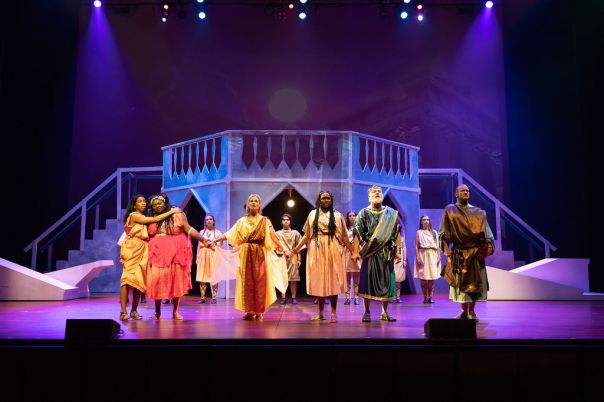
You can judge for yourself at spacious Duke Family Performance Hall as Davidson Community Playhouse rather splendidly presents its summer musical in nearly all of its gender bending glory. For this Metrolina premiere, projection designer Caleb Sigmon, scenic designer Ryan Maloney, and costume designer Yvette Moten fill the Broadway-sized stage on the Davidson College campus with eye-popping color and Hellenic style.

With the disclaimer that I’d never heard a single bar of Go-Go’s music before Head Over Heels came to our region, I can say that I delved into The Go-Go’s greatest hits afterwards on Spotify and listened to the original Broadway cast album. From the opening “We Got the Beat” onwards, the two generations of singers up at Exit 30 on I-77 beat them both.

Word of DCP’s excellence has extended its reach, and director Chris Patton and music director Matthew Primm have reaped the benefits. Belting the Go-Go’s “Beautiful” to her own mirror, Jassi Bynum is the vain elder sister, Pamela (a name apparently invented by Sir Philip). No less capable of letting loose, Kiearra Gary is the obedient “Good Girl” sister, Philoclea. And the well-established powerhouse, Nonye Obichere, is Mopsa, who seems for awhile to be a third sister until we learn that she is actually the daughter of the King’s steward, Dametas.

When Mopsa’s heart is broken, she will flee to Lesbos (wink, wink) and sing “Vacation.” Obichere slays at least as convincingly as the sisters.

It’s easy enough to get confused by the parents because they’re all white folk who fit nicely into Sidney’s Grecian mold but look nothing like their offspring. Yet Lisa Schacher, not seen hereabouts in a truly breakout musical role since the early days of QC Concerts, keeps her where-have-you-been-all-my-life belting capabilities under wraps until after intermission as Gynecia, the Arcadian queen. We’re not just talking Judy Garland belting, for Schacher crosses over the borderline to Whitney Houston territory along with Bynum, Gary, and Obichere.
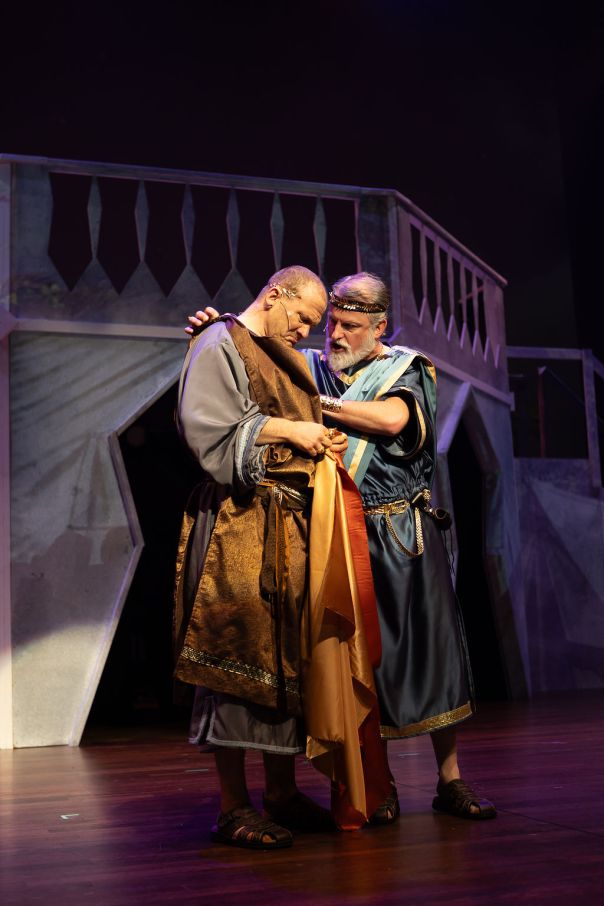
Once whatever was clogging Tommy Foster’s larynx in the first moments of Saturday night’s performance as Dametas was expelled, the longtime veteran reminded us that he could also wail. Saddled with a more earthbound voice, Rob Addison brings a nicely grizzled dignity to King Basilius that is forceful enough for the lead vocal of “Get Up and Go” and his climactic king-and-queen duet with Schacher, “This Old Feeling.”

Kel Wright, whose pronouns are Kel and I in her coy bio, is the gender-fluid complication roiling the eternal placidity of Arcadia. She is the ardent shepherd boy Musidorus, Philoclea’s bestie since her tomboy days, who must disguise himself as an Amazon warrior, Cleophila, after he’s banished from Arcadia in order to regain access to his lady love.

Everybody seems to be attracted to Cleophila, though they come to all the possible conclusions about the Amazon’s true gender. It’s a mess – a hormonal thundershower that afflicts the King, the Queen, and their daughters. All of them scurry about in a mad passion that comes off with all the innocent merriment of a musical comedy. Adding to all of this hilarity is the disconnect between Wright’s tinniness and the Amazon’s virility, so feverishly irresistible to Pamela and her mom.

All of this mad pursuit, however, happens under the cloud of a prophesy that threatens Arcadia’s doom. A snake sent by Pythio, the Delphic Oracle, lets loose of a letter summoning King Basilius to the temple to hear the Oracle’s oracle. In Sidney’s original manuscript, not recovered until 1908, the prophecy is given concisely in verse at the end of the novel’s opening paragraph.

Thy elder care shall from thy careful face

By princely mean be stolen and yet not lost;

Thy younger shall with nature’s bliss embrace

An uncouth love, which nature hateth most.

Thou with thy wife adult’ry shalt commit,

And in thy throne a foreign state shall sit.

All this on thee this fatal year shall hit.

Whitty actually retains the adultery line – with its apostrophe! – but flips the plotlines of the elder and younger daughters. In Arcadia, Basilius is seeking to preserve his family and kingdom, but in Head Over Heels, he’s also battling to ward off the mass extinction of Arcadians. Forget about the “fatal year”: Each time one of the four prophecies is fulfilled, a flag will fall. If Basilius fails to confound the Delphic Oracle’s prophecy and the fourth flag falls… game over. If he succeeds in thwarting the prophecy even once, Arcadia is saved.
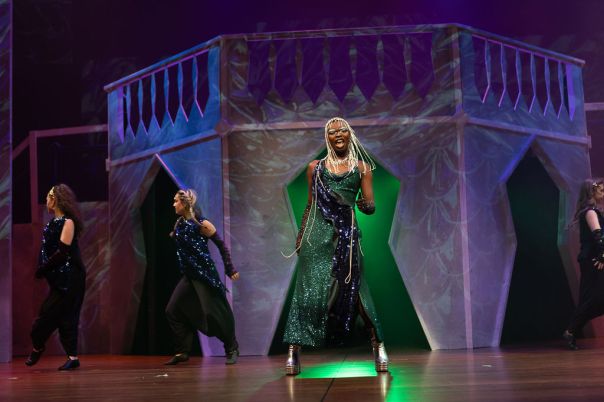
The roadblock to all this heroic questing and defying taking hold at Duke Family is the sensational Treyveon Purvis as the glittery Pythio, who describes themselves as a “non-binary plural.” No, that isn’t verbatim from Arcadia. We don’t need to understand every word of “Vision of Nowness” instantly as Pythio bodaciously belts it. If you don’t catch a phrase the first time or Purvis slurs it, you’ll get a second chance. Besides, the Go-Go’s lyrics are of little consequence once the song is done.

But the four prophecies and the fluttery flag drops are the whole damn evening, so when Purvis garbled every one of Pythio’s pronouncements – and the flag bit as well – much of what followed became equally incomprehensible. Why were those flags falling again? Was Foster wildly excited when he caught those falling flags, or was his Dametas frantically panicked?

Never could get a read on all these things until I sorted them out later at home. A few other gems had eluded me when I perused the script. For example, when Wright is lavishing her outsized voice on Musidorus’s “Mad About You,” the shepherd’s backup group are his sheep, altering the Go-Go’s deathless lyric to “Ma-ad about ewe.” Bleating as they sang? I don’t remember.

Nor did it quite register that Pythio’s backup were all snakes. So there was little chance for me to savor Purvis’s best line of the night: “Snakelettes, slither hither!” They are only named that one time, so catch it if you can.

Arguably, the main historic aspect of Head Over Heels was that it offered Peppermint, as Pythio, the opportunity to be the first openly trans actor taking on a major role on Broadway. There’s summery breeziness to this show and a cozy ending, not nearly as biting as Avenue Q. Maybe if the Broadway production had had the chance to run for a full summer, it might have found its legs instead of perishing in the dead of winter.

It’s the Go-Go’s, after all. Just don’t go in expecting the usual Jack-shall-have-Jill windup. Whitty remains a bit queer.

Christmas at Pemberley Gets a Gendered Makeover

Review: Miss Bennet: Christmas at Pemberley @ the Cain Center

By Perry Tannenbaum

If it weren’t for all the adaptations we hear about on TV and in movies, we could say that it required supreme audacity for Lauren Gunderson and , to tread in Jane Austen’s footsteps and pen a sequel to Pride and Prejudice, her wittiest and most beloved novel. But despite the obvious commercial bent of Miss Bennet: Christmas at Pemberley, Gunderson and Melcon have aimed to capture Austen’s essence and bring fresh life to her characters.

As you’ll find up at the Cain Center in Cornelius, no small thanks to the audacious direction of Steve Kaliski, the script sprinkles a bit of modern perspective on the Bennet sisters and their beaus – occasionally forcing us to recognize that Austen’s times are not so different from our own. Elizabeth Darcy, the heroine of the novel, still retains enough decorum not to call Fitzwilliam Darcy by his first name. Even in the privacy of their own home!

Likewise, elder sister Jane and her beloved Charles address each other as Mr. And Mrs. Bingley. “Happy Christmas” rather than “Merry Christmas” is the greeting norm, and the Christmas tree tradition has yet to take root in England in December of 1815. It’s Elizabeth’s audacity that brings this German custom to the Pemberley drawing room with its attached library.

In some ways, history has circled back. Back in college, my professor instantly drew our attention to the epistolary nature of Pride and Prejudice. The story is largely driven by letter writing. A chief turning point in the story is contained in a letter from Darcy addressed to Elizabeth, debunking her previous prejudices against him!

The prevalence of letter writing astonished us then – and felt alien. Ancient. Forty-plus years later, the sight of Mary Bennet, her sister Lydia, and Arthur de Bourgh exchanging billets-doux while under the same roof has to remind me of today’s texting, Instagramming youth, perpetually thumbing their cellphones. Buttressed by books, these youngsters can put quill to paper.

With Kitty off in London, not expected to arrive until Christmas Day with her parents, Mary is the only Miss Bennet we see and unexpectedly the leading lady. Arthur is an entirely new character, rivalling Mary in his bookishness. Resigned to spinsterhood, Mary is shocked to find that they’re hitting it off.

The forward-looking Gunderson and Melcon, proclaiming that Austen is for everyone, encourage diverse casting. But Kaliski and his Davidson Community Players go further, bringing us an all-female/non-binary cast. It’s an added semicircle backwards to Elizabethan days when only boys and men were permitted to perform onstage.

All three of these transpositions – Brooke McCarthy as Darcy, Rhianon Chandler as Bingley, and Jennifer Adams as De Bourgh – add a fresh patina of mirth and comedy. As for the playwrights, they inject plenty of wit and sparkle of their own. Speaking to Darcy before we see that Jane is seven-months pregnant, Elizabeth broadly hints she is arriving “safely and enormously.” Lizzy is more tactful when the expectant mother enters and they exchange greetings:

Lizzy: Look at you! You’re radiant.

Jane: I’m as large as a cottage.

Lizzy: And exactly as a cottage, you are warm, filled with life, and lit from within.

Although McCarthy plays him with some florid gestures, we soon see that he is richly endowed with breeding and tact. When the punctilious Mary presumes to correct Bingley, by informing him that the tree standing before them is a spruce and not a fir, Darcy pointedly intervenes. Before any dispute can begin, he proposes that he and his longtime chum exit for a brandy.

The ladies can now rebuke Mary, if they wish. They do, while gradually discovering that their younger sister has more charm and talent than previously suspected. Arthur’s admiration for her shocks them as much as it shocks Mary herself. As it turns out, Lizzy and Jane better be witty and perceptive, for Mary and Arthur are the plumiest roles. Fortunately, with the arrival of Lydia, the silly sister with the sham marriage, Lizzy and Jane can redirect their sharpest barbs.

Arthur is the heir to the nearby Rosings estate, but he is a distant nephew of the late Lady Catherine and has never lived there. There is some juicy history at that estate, left over from Pride and Prejudice,chiefly the presumption that Darcy would marry Milady’s daughter and not the comparatively lowborn Lizzy. Not to worry, Pemberley gracefully catches us up if we don’t remember Austen’s original.

What makes the role of Arthur so appealing is that he has no clue how to run an estate – and no solid experience with other men, women, or people. Adams carries a book around with her as if it were Arthur’s security blanket. Without one, Adams seems at a loss for what to do with her hands and arms, so we see Arthur almost perpetually in a scholarly or supplicating pose.

Attempting a billet-doux, Adams as Arthur reminded me of Christian in Cyrano de Bergerac, only he has nobody to help him out. When Arthur learns that his cousin Anne, after getting jilted by Darcy, now presumes she is betrothed to him, Adams’ awkwardness and shyness veer toward desperation and panic. When bliss is achieved, Adams’ glow is mesmerizing.

Crippled by a similar lack of self-esteem, Sahana Athreya as Mary is no more experienced and no less shy than Arthur – so she can range from being pedantic and irritating to heartbroken and pitiful to vivacious and adorable. Athreya can also freely gesticulate with her arms and sit down regally at the pianoforte.

The central triangle is further complicated by Destiney Wolfe as the compulsively silly Lydia. Glossing over her troubled marriage doesn’t inhibit Lydia from flirting shamelessly with Arthur, giving us extra tastes of how unaccustomed he is to such attentions. Nor does Kaliski bar Wolfe from being as irritating as Mary at her worst. On the contrary. Wolfe, when she isn’t pouncing, is often prancing.

At the center of all the overtures from Mary and Lydia – and the strict orders from Agatha Emma as the imperious Anne – Adams gets to be meaningful as well as stressed and sympathetic. For Mary and Lizzy, in the face of Arthur’s inclination to yield to Anne, are at considerable pains to remind him that he has what women don’t: a choice.

Of course, when Gunderson and Melcon wrote their merry comedy in 2016, they had no inking that “Your body, my choice” would be staging a comeback. But the playwrights are far from declaring that women were powerless. Even before her Christmas awakening, Mary is strong enough to proclaim that she would rather wed a plant than an unsuitable man.

Caring about their sisters, Lizzy and Jane sustain their relevance, Skylar Schock as Lizzy warming up to Mary and Emma Kitchin as the Jane becoming Lydia’s tactful benefactor. Christmas can even be celebrated by Emma, for it turns out that there’s kindness in Lydia beneath her silly, meddlesome surface.

Kaylen Gess’s scenic and lighting design complement each other handsomely, with Caleb Sigmon’s projections adding an extra festive luster. I’d imagine that Gunderson and Melcon would have envisioned a much larger, more intrusive tree at Pemberley. But as a Tannenbaum, I’m probably prejudiced.

The tree outside Cain Center, let me add, is big and bright enough for anyone.

“Matilda” Is Less Sweet and More Abrasive at ImaginOn

Review:  Matilda The Musical

By Perry Tannenbaum

The time lag between what opens on Broadway and what tours at Belk Theater has narrowed in recent years. Likewise, the gap between when the tour comes through town and when local companies get their hands on Broadway properties has also shrunk. With the arrival of Matilda The Musical at ImaginOn last weekend just two years after it played Belk Theater, it became apparent that CPCC Summer Theatre, Theatre Charlotte, or Children’s Theatre can expect to mount Broadway hits that are just as fresh from their New York runs as the off-Broadway sensations that Actor’s Theatre brings us.

Even with this slimmer interval, I fear that Roald Dahl‘s Matilda isn’t aging gracefully as a children’s story at McColl Family Theatre. It returns a bit awkwardly in a year when children are cruelly and inhumanely seized as pawns to discourage asylum seekers from Latin America. You might feel more comfortable with this story than I did just two days after I’d watched a Supreme Court nominee opt for yelling and indignation as his go-to defenses against credible accusations of sexual assault in sworn testimony on Capitol Hill.

I’m not sure which aspect of the Saturday afternoon performance disturbed me more. Was it director Adam Burke and his star, Tommy Foster, conniving to make the evil Miss Trunchbull more realistic than she had been in 2016; or was it the parents in the audience, bringing their anklebiters to the show and ignoring recommendations that it was suitable for 6-and-up? I was surprised – and slightly reassured – when so many stayed after intermission but not at all shocked when the adults sitting next to us fled.

Foster had some comical tricks up his beefy sleeves as the hammer-throwing harridan, turning a couple of unexpected cartwheels and almost executing a split. But Trunchbull’s implacable cruelty sometimes verged on rabid, when she unveiled all the “chokey” dungeons reserved for misbehaving and disobedient students at her school or when she pulled the ears of one cowering student about a foot away from his head. Neat technical effects, but perhaps too realistic for comfort.

Dahl wrote his Matilda in 1988, a decade before Lemony Snicket’s Series of Unfortunate Events took off – and before some of the edgier “anti” musicals like Urinetown began to invade Broadway. So his macabre sensibility here became more and more in tune with the times. With all its demonic cogs and gears, HannaH Crowell’s set design (fiendishly augmented by Kelly Colburn’s projections) brought home to me how Dahl’s sensibility had morphed during the quarter of a century following Willy Wonka and his iconic chocolate factory. Nothing particularly sweet here.

Matilda Wormwood certainly had more natural talents and gifts than Charlie Bucket, who snagged the lucky ticket to meet Wonka and taste his chocolate wonders. She is a precocious reader, which disgusts her dimwit parents and astounds Miss Honey, her timorous first grade teacher. As a storyteller, she holds the local librarian spellbound. Pitted against the fearsome, sadistic Trunchbull, Matilda turns out to have a combination of psychic and telekinetic powers that bring her victory – wielded with a sly naughtiness.

You need more than Orphan Annie pluck to play this role, and Allie Joseph has it. She nails Matilda’s signature solos, “Naughty” and “When I Grow Up,” and she sparkles in the spotlight – Colburn’s projections going wild behind – telling her four part “Acrobat Story” to Mrs. Phelps, the librarian. There’s a touch a grim determination in Joseph’s naughtiness that nicely counterbalances the added malignity that Foster brings to Trunchbull. Without too much suspension of disbelief, Joseph also passes for a first grader.

Also supplying counterweight to Trunchbull’s regimentation and brutality are Matilda’s other tormentors, her nutball parents. Caleb Sigmon gets to do the heavier comedy lifting as Mr. Wormwood, loudly dressed by costume designer Magda Guichard, victimized by Matilda’s vicious pranks, and cuckolded by his wife. A crooked used car salesman way beyond his depth in attempting to hoodwink Russian mobsters, Matilda’s dad deserves every indignity that comes his way, especially when he tears up his daughter’s library book. Yet Sigmon retains a wonderful energy amid all Dad’s atrocities, vicissitudes and cluelessness.

Wrapped up in her competitive ballroom dancing – and her sleazy partner Rudolpho (the lithe Paul Montagnese) – Matilda’s mom doesn’t realize she’s nine months pregnant with an unwanted second child when Matilda is born. That’s a high level of stupidity to sustain, but Lucianne Hamilton is more than equal to the task as Mrs. Wormwood, particularly when she schools Miss Honey on her philosophy of education.

Absorbing this lecture as well as Miss Trunchbull’s tirade, Miss Honey earns the right to sing “Pathetic” as her signature song, yet Bailey Rose builds Honey’s strength on stoical acceptance and self-awareness, her warmth toward Matilda counting for far more than her passivity. More comical appreciation comes from Janeta Jackson as Mrs. Phelps, the librarian who listens so raptly to Matilda’s acrobat saga.

Dennis Kelly‘s adaptation of Dahl’s novel is admirably intricate and well-crafted, but I find myself less impressed with Tim Minchin‘s music and lyrics, which might be more palatable with the vitality of Annie or the wit of Avenue Q. You still need to listen – carefully – to the cast album to decipher what the kids’ choruses are singing. Whether the older kids are rattling their cages in welcoming the first-graders on their first day or Matilda’s class is celebrating victory over Trunchbull, the music sounds a bit savage, as if Annie and her fellow orphans were on a bad acid trip. The transition from Belk Theater to the smaller McColl seemed to augment the abrasiveness.

Yet some of Matilda’s classmates do distinguish themselves. Calvin Jia-Hao Mar is consistently adorable as Nigel, who spends much of his time cowering or fainting whether or not Trunchbull is persecuting him. Ryan Campos is a more formidable martyr as the heroic Bruce, a young glutton who steals a piece of Trunchbull’s chocolate cake and is forced to eat the whole thing as his punishment. And though I can’t tell you why we’re bothered with Matilda’s best friend Lavender, Jeannie Ware made her charmingly self-important when we returned from intermission.

Homespun “Barbecue Apocalypse” Improves With Age

Reviews: Barbecue Apocalypse, The Sherlock Project, Life Is a Dream, and Madagascar

By Perry Tannenbaum

IMG_5740

In a year that included Lucas Hnath’s The Christians, Robert Schenkkan’s The Great Society and Rebecca Gilman’s Luna Gale among the top contenders, I could only give Matt Lyle’s Barbecue Apocalypse a lukewarm endorsement for best new play of 2015, ranking it #13 among 27 eligibles that I read for that year’s Steinberg Awards. Nor did colleagues from the American Theatre Critics Association strongly disagree with my verdict, since Lyle’s dystopian comedy didn’t make the cut for the second ballot, when we considered our consensus top 10.

But before Charlotte’s Off-Broadway decided to stage this show at The Warehouse PAC up in Cornelius, they did some reading and balloting of their own. From January through March, the company offered monthly “Page to Stage” readings presenting two different plays on each occasion. Then they asked ticketholders to vote on which of the six plays they would like to see in a fully staged production. Less than two months after the votes were counted, Barbecue is back for my reconsideration as the audience favorite.

And on further consideration, I must credit director Anne Lambert and her professional cast for convincing me that Barbecue Apocalypse is even better than I thought it would be – far more to my liking than real barbecue.

IMG_5885

Lyle would probably concur, since his patio hosts, Deb and Mike, are only grilling and basting because they want to avoid the embarrassment of having their friends – who are more trendy, stylish, and successful – see the interior of their home, decorated with lame movie posters. Deb succinctly describes her strategy as lowering expectations for the cuisine and the ambiance. Outdoors, she can point with pride to the fact that Mike has built the rear deck himself. Yet the barbecue event has obligated Mike to buy a propane grill off Craig’s List, and he’s afraid to light it.

He would also like Deb not to mention that he’s a professional writer, for his career earnings, after one published short story, now total 50 bucks.

All four of the guests feed the hosts’ sense of inadequacy. Deb is a decorator, foodie, and gourmet cook who makes sure to bring her own organic meat, and her husband Ash is a gadget freak, armed with the best new smartphone equipped with the most awesome apps. Win pretty much embodies his name, a former high school QB, now a successful businessman with Republican views. He lives to put Mike down and can seemingly get any woman he wants. Even his bimbo of choice, Glory with her Astrodome boobs, can claim formidable accomplishments, arriving late to the barbecue after nailing her Rockette audition.

What ultimately happens to this insulated suburban group reminds me of The Admirable Crichton, the excellent James M. Barrie tragicomedy I came across a couple of times during TV’s golden age, when colleges had core curriculums. A perfect butler to the Earl of Loam in Mayfair, London, Crichton and his betters were shipwrecked on a desert island in the Pacific, where his natural superiority emerged.

There are two basic differences between Barrie’s back-to-nature tale and Lyle’s. The shipwreck situation was reversible with rescue. Apocalypse isn’t. More to the point, Barrie was clearly targeting the blind rigidity of class distinctions. Here if we consider the implications of Barbecue Apocalypse, Lyle seems to have modernity in his crosshairs – how our world warps our aspirations and our self-worth, how it channels us into modes of living that are far from our authentic selves.

In the cramped storefront confines of the Warehouse, Lambert doesn’t attempt to design a deck that lives up to Mike’s pretensions, and Donavynn Sandusky’s costume designs are similarly déclassé, especially for the nerdy Ash. This robs Lyle’s concept of much of its slickness, which for me turned out to be a good thing. Aside from the Craig’s List mention, Lambert also dropped in a couple of local references that added to the overall homespun flavor.IMG_6440

Becca Worthington and Conrad Harvey were nearly ideal as our hosts, keenly aware of each other’s limitations and their own, yet visibly crazy for one another. Worthington with her status-conscious rigidity and stressing was clearly the closest actor onstage to Lyle’s vision, beautifully flipping her “We suck” persona after intermission and the apocalypse, when a full year of roughing it has elapsed. Harvey was more than sufficiently cuddly and self-deprecating – but credulity is stretched when a man of such size and stature is repeatedly dominated by his adversaries.

If you can accept that Greg Paroff was ever on a football field, let alone as a QB, you’ll be quite pleased with how he handles Win’s asshole antics. He is confident, he is arrogant, and if he’s possibly past 40, that only increases the disconnect between Win and his limber Rockette. Julia Benfield is absolutely adorable as Glory, and I absolutely adore how she’s still mincing around in high heels when she makes her disheveled entrance in Act 2. We totally believe that her familiarity with Tom Wopat doesn’t extend to The Dukes of Hazard in the ‘80s.

Probably not the best moment for Lambert when she cast Cole Pedigo and Jenn Grabenstetter as Ash and Lulu. They should remember the ‘80s, but I needed to stifle my doubts. Wardrobe and just the way he’s absorbed in his iPhone might help Pedigo out – and make him less wholesome, winsome, and juvenile before the apocalypse. Grabenstetter overcomes all objections when free-range Lulu gets snockered on generic canned beer, and both Pedigo and his scene partner truly click when adversity brings Ash and Lulu to a new lease on life in Act 2. I believe that’s an antler dance.

I won’t disclose what happens when Maxwell Greger walks on for his cameo deep in Act 2, but I do respect how Lyle makes him earn his paycheck with a sizable monologue. Greger does the denouement with a slight manic edge, and the technical aspects of his departure are impressively handled.

So it’s fair to say that apologies are in order for rating Barbecue Apocalypse in the middle of the pack when I first read it. Or excuses, since a rational man resided at the White House in 2015, and apocalypse seemed so fantastical.

But hold on. Charlotte’s Off-Broadway has already programmed two other plays from their “Page to Stage” readings for two fully-staged productions in the near future, Susan Lambert Hatem’s Confidence (and The Speech) for September and Lauren Gunderson’s Exit, Pursued by a Bear for next February. Maybe when these runner-ups get fleshed out, supporters of Lyle’s winning script might reconsider their votes!

A Catch-All Catch-Up

Our recent travels to Greece, Israel, and Jordan compelled us to miss a bunch of high-profile openings after we reviewed the reinvented Rite of Spring at Knight Theatre on April 6 and CP’s On Golden Pond the following evening. Even before we left, we had to pass on the Charlotte Dance Festival and CP’s Elixir of Love so we could adequately prepare for our trip. To see the birthplace of theatre, the Holy Land, and Petra, we had to miss out on the BOOM Festival, the reprise of Beautiful: The Carol King Musical, and the opportunity to host a pre-show preview of The Marriage of Figaro for Opera Carolina.

New openings when we returned were a must, so we hit the ground running with Charlotte Ballet’s Spring Works and Symphony’s Brahms-and-Bartok program. But our need to catch up with Carolina Shakespeare’s Life Is a Dream made us put off seeing PaperHouse Theatre’s Sherlock Project until it second week. It gets complicated. But I’ve tried to get up to speed while working on more reviews and features. File these under gone but not forgotten:

The Sherlock Project So a dozen actors and writers collaborated on PaperHouse Theatre’s mash-up of Sir Arthur Conan Doyle’s short story gems, producing a script that follows three guiding principles: keep it funny, keep it moving, and don’t, don’t, don’t ever explain how the great Sherlock Holmes arrives at his incredible deductions. Going back to their roots at the Frock Shop on Central Avenue, PaperHouse and director Nicia Carla found a frilly complement to the Victorian chronicles of Dr. John Watson.

But the frame of the story was wholly new, telling us that the deadeye detective in the deerstalker cap is a woman. Watson protects the woman who should be credited with all the purported exploits of Scotland Yard’s Inspector Lestrade because he knows that Sherlock is right: The general public is even less prepared to believe a female is capable of such brilliancies than Watson is.

Besides all of the Sherlockian brilliance and nonchalant arrogance, Andrea King reveled in all of the detective’s eccentricities, whether it was shooting up a 7% solution of cocaine, tuning up a violin, or lighting up a calabash pipe. Opposite King’s insouciant self-confidence, Chaz Pofahl wrung maximum comedy from Watson’s wonder and timidity – a phenomenon compounded by the gender factor as Pofahl switched from paternal protectiveness to awe or terror while King wryly twinkled and smiled.

The two main supporting players slipped into multiple roles, Angie C as a cavalcade of damsels in distress and Berry Newkirk in the plumiest cameos, ranging from the dull-witted Lestrade to the razor-sharp Professor Moriarty, mythically uncatchable. Apart from directing behind the scenes, Carla conspired in the action as Mrs. Hudson, Holmes’s discreet housemaid. Carla not only ushered in Sherlock’s distraught clientele or evil adversaries, she also presided over scene changes, when audience members had to exit the Frock Shop’s parlor to a murder scene in the adjoining room or out on the porch when Sherlock was pursuing… something. Had to do with fire.

Or when it was intermission, time for little cucumber sandwiches.

The whole show was a wonderful diversion. PaperHouse had to add another performance to their run, which we caught last Wednesday, and the remaining nights were already sold out. Like the PaperHouse faithful, I couldn’t get enough of The Sherlock Project. I wanted lots more – beginning with how did Sherlock deduce that Watson had just come from Afghanistan when they first met?

Life Is a Dream – Convinced it was a comedy rather than a political melodrama, Shakespeare Carolina and director S. Wilson Lee kidnapped Pedro Calderón de la Barca’s classic, written during Spain’s Golden Age, and transported it more than three centuries forward from a mythical Poland to a mythical Las Vegas. There in a seedy club on the strip, the two factions with their eyes on the throne were Frank Sinatra’s Rat Pack and Marlon Brando’s Wild Bunch.

Lee’s wild conceit didn’t do nearly as much harm as I thought it would, mainly because ShakesCar didn’t have the budget to carry it too far at Duke Energy Theatre, and the strong cast mostly played their roles as the text, sensibly adapted by Jo Clifford, said they should. So much depended on the broad shoulders of David Hayes as Segismundo. Heir to the throne of Poland, Segismundo has been locked away Prometheus-like in a mountain dungeon for his whole life by his father, King Basilio, who is foolishly trying to ward off the dire destiny predicted by an astrologer.

A boiling rage seethes inside of Segismundo, and a less mightily built actor than Hayes might need to strain himself to encompass it. Hayes projected the mighty rage rather naturally, which made it easier for him to flow convincingly into Segismundo’s softer emotions when – before he has even suspected his royal lineage – he is handed the Polish throne and the power to act on his newly awakened sexual urges as he sees fit.

Called upon to give a far more nuanced performance as Basilio, Russell Rowe delivered. Yes, he was cruel, but also conflicted, with a lifelong dread deftly mixed into his forcefulness. Though I feared the convoluted plot might be abridged or simplified, the intrigue, the complexity, and the epic monologues were almost entirely intact. As the vengeful Rosaura, Teresa Abernethy brought forth the masculine-feminine blend that the transgendered Clifford was aiming for in her translation, and James Cartee, an actor who often keeps nothing in reserve, showed unusual probity and maturity as Clotaldo, even as he tried to figure out his long-lost child’s gender.

Nobody was more suavely dressed by costume designer Mandy Kendall than James Lee Walker II as Astolfo, the successor that Basilio wanted if the true heir didn’t pass his test. But if anybody was victimized by Lee’s Rat Pack concept, it was Walker. I have no idea why he persisted in speaking so rapidly and unintelligibly, unlike any work I’d seen from him before. Was he attempting a Sammy Davis Jr. imitation? Couldn’t figure out what accounted for this curious outing.

Betrothed to this strange hipster, Maggie Monahan beautifully brought out the agonies of queen-to-be Estrella. Maybe the most Shakespearean role in this ShakesCar production was Ted Patterson as Clarin, who tags after the disguised Rosaura from the opening scene, as either her companion or servant – but definitely our clown.

On the strength of this effort, theatergoers can be excited about ShakesCar’s next invasion of Spirit Square, The Tragical History of the Life and Death of Doctor Faustus at Duke Energy from June 28 to July 7.

DSC03442

Madagascar – Okay, so I’ll grant that the musical adaptation of the 2005 Dreamworks film didn’t have the gravitas of the greatest Children’s Theatre of Charlotte extravaganzas of the past like their Boundless Grace and The Lion, the Witch, and the Wardrobe – or the bite of Ramona Quimby and Tales of a Fourth-Grade Nothing. But this confection was nearly perfection. Under the direction of Michelle Long, Madagascar hit a family-friendly sweet spot, straddling the realms of cartoon silliness, cinematic adventure, and theatrical slapstick and dance. I just didn’t like the deejay, everybody-get-up-and-act-stupid thing.

Scenic design by Jeffrey D. Kmiec never lost its freshness thanks to a slick stage crew and the eye-popping lighting by Gordon W. Olson, while the animal costumes by Magda Guichard probably made the strongest case for live theatre against multiplex animation. Choreography by Tod A. Kubo chimed well with Long’s direction, which used areas of McColl Family Theatre that rarely come into play.

Centering around four animals that break out of Central Park Zoo, Madagascar introduced us to Marty the zebra and his wanderlust. We moved swiftly from there. Following the lead of four penguins bound for Antarctica, Marty escaped the zoo, seeking a weekend in Connecticut. Not only are police, animal control, and TV bulletins on his trail, so were his pals Gloria the hippo, Alex the lion, and Melman the giraffe. Embarking underground in the Manhattan subway, Marty hardly stretched credulity much further by winding up off Africa.

Deon Releford-Lee was a spectacular triple-threat as Marty, but what dazzled most was the multitude of gems in this supporting cast, beginning with an intimidating Alex from leonine Traven Harrington and – on stilts, of course – a timorous Melman from Caleb Sigmon. Dominique Atwater disappointed me as Gloria, but only because we didn’t get enough of our hippo after her first big splash. Olivia Edge, Allison Snow-Rhinehart, and Rahsheem Shabazz fared better, drawing multiple roles.

While the book by Kevin Del Aguila shone more brightly than the musical score by George Noriega and Joel Someillan, I was amazed that so much story and song could be squeezed into barely more than 60 minutes. Combined with last October’s Mary Poppins, the exploits of Madagascar prove that musical production is an enduring strength at Children’s Theatre. I can’t think of a season at ImaginOn that had sturdier bookends than these musicals that began and concluded 2017-18. The crowd that turned out for the final performance affirmed that the 7th Street fantasy palace has perfected the craft of producing family fare.

Not only that, it showed me that Charlotte families have spread the word.