Tag Archives: Ben Ingel

“Wuthering Heights” Dances Madly to the End of Love

Review: Wuthering Heights

By Perry Tannenbaum

In the epigraph to his new ballet, choreographer Sasha Janes spread out one of Emily Brontë’s most lurid quotes over a full page in the program booklet for Charlotte Ballet’s production of Wuthering Heights. Contemplating her love for the elegant Edgar Linton and the mysterious Heathcliff, Catherine Linton likens her love for Edgar to the leaves of a forest, decorous and mutable, while her love for Heathcliff resembles the rocks below – short on delight, but necessary and eternal.

“I am Heathcliff!” Catherine famously tells Nelly Dean, the narrator of the novel.

Janes was not merely going to tell the story of Wuthering Heights, he was signaling that he would be trying to replicate its towering emotions, manias, and passions.

Incredibly, he largely succeeds.

It helps, of course, that the technical team behind him get the atmospherics right, most notably the lighting and projection designs by Christopher Ash and the costumes by Jennifer Janes. The Janeses are obviously on the same page conceptually, for the costumes designed for Catherine and Heathcliff are folksy and flowing, while the Lintons and Earnshaws tend toward genteel formality, starchiness, and pastels. Choreography magnifies those contrasts, controlled and elegant at Catherine’s wedding to Edgar, wild and athletic in her youthful frolics with Heathcliff.

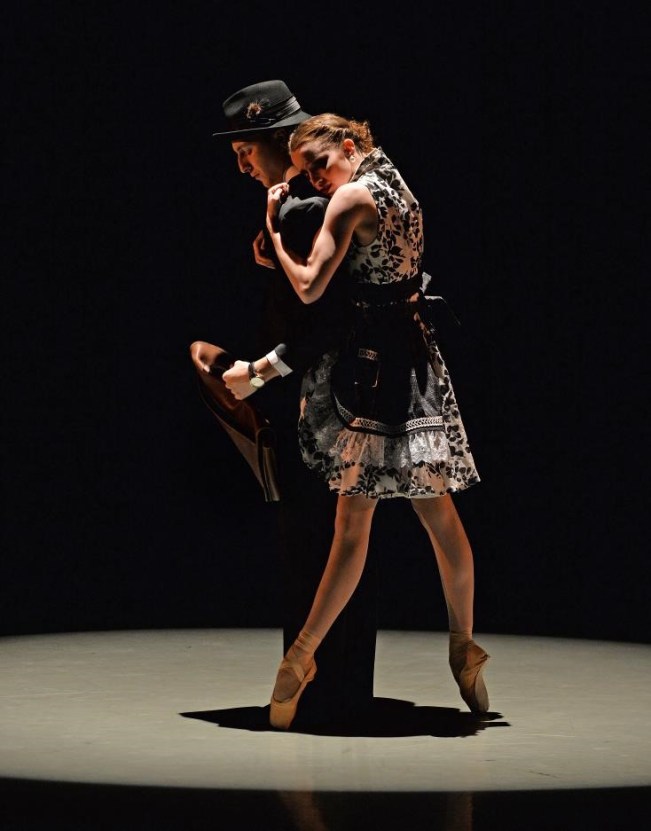
Charlotte Ballet_Sasha Janes Wuthering Heights_Josh Hall and Chelsea Dumas_1_photo by Christopher Record

As the plot thickens and the protagonists mature, the pas de deuxs between Catherine and Heathcliff become darker and more sensual – and the costumes more diaphanous and scanty. Even uncannier than his choreography, the rightness of Janes’s musical choices assures that you can hardly tear your attention away from the dancers until the overwhelming final scene.

With his dark curly hair and his robust, muscular torso, Josh Hall (alternating with Ben Ingel) was the perfect blend of savagery and beauty as Heathcliff on opening night. After the intermission interval, Hall carried off Heathcliff’s astounding transformation from unrefined rusticity to steely, seething gentility marvelously well, and his partnering in the unique final pas de deux was both powerful and heartbreaking.

Working opposite the power and virility of Hall, Chelsea Dumas very likely convinced a hefty chunk of the opening night crowd that Catherine was the role in Wuthering Heights. Hers were the moves that gave the pas de deuxs with Heathcliff their wildness. Hers were the anguish and madness when the transformed Heathcliff married her sister-in-law Isabella, avenging himself for her betrayal of their love. Through it all, she stands up for Heathcliff against her abusive brother Hindley and her jealous husband Edgar.
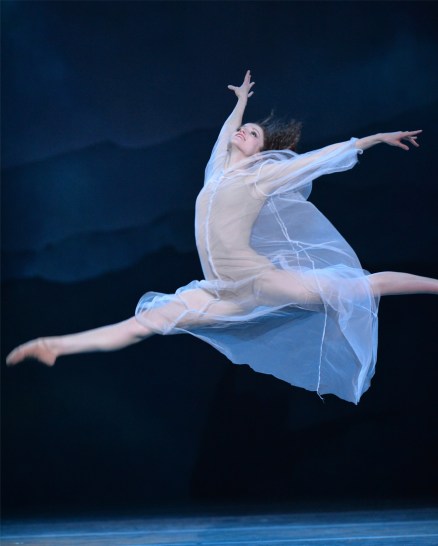
Charlotte Ballet_Sasha Janes Wuthering Heights_ Chelsea Dumas_photo by Peter Zay

Both Janes and Dumas seemed to grasp that Brontë thought of Catherine as a woman whose fierce spirit and vitality were too much for her frail frame – particularly when pregnancy and parturition were added to her stresses. In the novel, Catherine’s death is a halfway mark, where our attentions begin to shift to a new generation after a raging, grieving Heathcliff curses his beloved and calls upon her spirit to haunt him the rest of his days.

Following the lead of the 1939 film, starring Laurence Olivier and Merle Oberon, Janes makes Catherine’s death his denouement. Yet cursing and conjuring aren’t things that ballet does well. So Janes elaborates brilliantly on Heathcliff’s graveside vigil: here Hall clawed at the still fresh mound of dirt over Catherine’s body and actually pulled Dumas out of her grave. Then he danced a pas de deux with Dumas’ lifeless body, lifting and carrying her all over the stage, pouring out his love, his rage, and his grief.

Dumas remained inert as the music and the passion swelled, coming back to life for just a few precious moments, her second death intensifying Hall’s anguish and devastation. Tears flowed freely throughout Knight Theater.

Action before intermission, though clearly distinguishing the protagonists from the others, wasn’t always as brilliant. Janes tells the story well in theatrical vignettes, but there needed to be more real dancing from the supporting players. There could be more ensemble work when Catherine and Heathcliff first spy on the Lintons. By the time we do reach the outbreak of dance at the Catherine-Edgar wedding, it feels overdue and overlong.

Drew Grant as foster brother Hindley and James Kopecky as Edgar had unique dancing spots, Grant in a high-stakes card game with Heathcliff and Kopecky vying with Heathcliff for Catherine’s affections. Other supporting players – most notably Mark Diamond as Heathcliff’s foster father and Sarah Hayes Harkins as his wife Isabella – further demonstrated the depth of the Charlotte Ballet company with their exemplary dramatic work.

Though a final tribute to Jean-Pierre Bonnefoux has been hurriedly arranged for next month, Wuthering Heights was to be the last program in Bonnefoux’s 21-year tenure as Charlotte Ballet’s artistic director. Fittingly enough, the last ballet commissioned for the company under Bonnefoux’s leadership was paired with the first new work commissioned during Bonnefoux’s years, Alonzo King’s MAP, premiered when the company was still known as North Carolina Dance Theatre.

Bridging 1996-2017, the two works were a handsome frame for an impressive artistic director, president, and choreographer. Bonnefoux strengthened a company that was already excellent and made it more prominent in the city’s life. With its powerhouse educational and apprentice programs, Charlotte Ballet now plays a more important role in the city’s future. My turn to lead the cheers, Jean-Pierre. Bravo!

Two Pieces by Sasha Janes Highlight Charlotte Ballet’s Innovative Works

Review Dance: Charlotte Ballet’s Innovative Works and Its Tribute to Jean-Pierre Bonnefoux
By Perry Tannenbaum


Twenty years is a long time in the history of a dance troupe – four or more generations for Charlotte Ballet if you calculate how long the typical dancer remains before moving along or retiring. Charlotte Ballet’s artistic director, Jean-Pierre Bonnefoux, is taking the latter route after 20 seasons at the helm, an era during which excellence was admirably sustained while the organization grew in strength, most notably in its facilities and educational programming. So it was appropriate to dedicate the latest iteration of Innovative Works as a special tribute to Bonnefoux, not only because this annual showcase of new, exciting, and intimate works was his brainchild but because its current home has been the Patricia McBride and Jean-Pierre Bonnefoux Center for Dance since 2011. There’s no better place for Charlotte Ballet to celebrate.

When Bonnefoux first divulged his imminent fadeout to emeritus status a couple of years ago, he told me that he wouldn’t be choreographing any new pieces, although some new wrinkles were evident in the million-dollar makeover of his Nutcracker last fall. There were no surprises in the 2017 crop of Innovative pieces. The in-house feel of the programming still remains intact, all of the choreographers hailing from within the Charlotte Ballet orbit without any unexpected debuts.

The program began and ended with pieces by associate artistic director (and resident choreographer) Sasha Janes, whose pieces continue to grow more intriguing every year. In between, there were works by Mark Diamond, director of Charlotte Ballet II, Sarah Hayes Harkins, a longtime principal in the company, and David Ingram, a fondly-remembered alum. Continuing the tradition of recent years, each of these choreographers cut an intro that was projected on the side walls of the McBride-Bonnefoux studio before each dance began. Since Janes’ “Hallejujah” was a reprise from last year, Bonnefoux took the opportunity of subbing for Janes, reflecting back on his Innovative series while introducing a piece that was well worth its revival.

170126-peterzay48-web

Opening the program, Janes’ “Utopia” was a startling piece to come from a man who spent his formative years in Australia, born more than a decade after the songs on his playlist – by The Platters, Link Wray, Patience & Prudence, and The Teddy Bears – found their way to jukeboxes on 45 rpm discs. The Aussie’s erudition with The Platters is particularly impressive in his sardonic look at 1950’s American domesticity, where everything wasn’t the Father Knows Best bliss that Eisenhower voters would have us recall. “No Matter What You Are,” the song that bookends Janes’ piece, isn’t at all among The Platters’ greatest hits. For over a half century, it has been hidden in plain view on the flipside of “Smoke Gets in Your Eyes” – a clever hint that we’re watching the flipside of the Ike Era. With Elizabeth Truell as the Wife and Josh Hall as the Husband, we watch the typical morning scene of seeing the family breadwinner off to work. Only there was some visible desperation from Truell as she clung to her husband, handing him his hat and briefcase, the devoted housewife gone slightly berserk. Hall was visibly impatient and eager to go, irritated with all the affectionate blandishments, but as we adjourned to his office with “The Great Pretender” (The Platters’ breakthrough hit), we could see that the Husband was suffering from frustrations – and neuroses – of his own.

170126-peterzay150-web-1024x774

Enter Jamie Dee Clifton as the Secretary, to the beat – and power chords – of Wray’s “Rumble.” Her attempts at seduction got a far more welcome reception from the Husband, though there were definitely some signs of distress as he absorbed the vamping. Yet with Patience and Prudence’s “Tonight You Belong to Me,” there could be no doubting Secretary’s conquest, though the necking session was interrupted by a phone call from the patiently waiting Wife back home. Truell’s ensuing solo, begun on the couch of her Psychiatrist (Michael Menghini) was the most sensational segment of the suite for me, savagely contrasted with the cuddlesome harmonies of The Teddy Bears’ “To Know Him Is to Love Him.” The frenetic energies that preceded this therapy session came to full boil, overflowing into a primal scream that Truell delivered into the unresponsive shrink’s face (before he presented his bill). As Janes predicted in his intro, the repetition of “No Matter What You Are” and the bizarre morning send-off took on an added level of irony as we saw so much more clearly how the lyrics applied to the married couple’s daily ritual.

fix_1008-5717-web-1024x683

The other works that preceded intermission weren’t as daring, ambitious, or satisfying. Set to a Chopin favorite, Harkins’ “Gemini” never convinced me that we were seeing two aspects of the same individual, and the promised improvisation element eluded me altogether though the performances by Drew Grant and Ben Ingel were certainly intriguing. Part of the problem was the damage that the McBride-Bonnefoux acoustics did to Ingel’s monologue when he ventured into the audience. Not sitting in the center sections, I hardly understood a word. Nor could I tell what it was that Grant replied from the stage or determine whether it echoed what his partner had just spoken. In this one respect, Booth Playhouse, where Innovative was staged 1998-2009, was a better venue, though it was no better for pre-recorded music and less hospitable for lobby receptions. “Ever After” by Diamond was a better showcase for Harkins’ talents as she partnered with Hall in an abstract piece about the transition to afterlife, set to music by J.S. Bach, Ivan Spassov, and Karl Jenkins. Destined to partner in the program finale later in the evening, the Harkins-Hall duo stole most of what was left, in the wake of Rose Nuchims’ lighting design, of the focus that could have gone to the three other couples onstage. Another barrier to full appreciation was the language barrier, Bach’s German and Jenkins’ Latin.

fix_1008-4071-jeff-cravotta-web-1024x682

Following the hypnotic ecstasy of Diamond’s piece, Ingram’s new “Flamouriá” after the break was rousing and refreshing, set to the music of Luigi Boccherini, which deserves to be heard more often. The modern visuals – huge balloons suspended over the action, projections on the rear wall – clashed provocatively with the 18th century score, and a certain amount of sloppiness was built in to the concept. Movement by four couples, led by Alessandra Ball James and James Kopecky, was by the dancers, “curated” by Ingram. This sparked numerous questions as I watched. Like the other works on the program, “Flamouriá” will be danced by multiple sets of dancers as Innovative continues it run through February 18. So, will the movement change to accord with the other set of dancers – and did Ingram allow his performers any latitude, or multiple choices, in their movements? Unfortunately, some of the sloppiness I witnessed was layered on by the new projection technology that was lavished on the piece. Most of the video was blurry and, at times, edges of the projections cut randomly and inelegantly on the rear screen, stealing focus from the dancers. I’d also thought that those massive white balloons might double as projection surfaces – a potential that went unfulfilled. There were some special moments when Nuchims’ lighting was uncluttered by the new gadgetry, most notably when the dancers became silhouettes against the ginormous backlighting of the rear screen.

1454643066_crop

Little needs to be added to the raves I posted at my own website a year ago when Janes’ “Hallelujah” was first unveiled as the penultimate segment of his “Sketches from Grace,” especially since Harkins and Hall danced it last January as well. Okay, maybe not as well as they did this year after living another year with the piece and their dance partnership. The “Sketches,” originally intended by Janes as a tribute to Leonard Cohen, was deflected from its original purpose when the choreographer heard Jeff Buckley’s cover of “Hallelujah” and turned the suite into a Buckley-based sequence. But if Janes had introduced this year’s reprise instead of Bonnefoux, I suspect that he would have mentioned the Canadian troubadour’s death (on the eve of our momentous Election Day). Pared down to the originating essence of  became a fitting tribute to Cohen, with Harkins and Hall sensuously evoking the darkness of his vision through their memorial flame.