Baran Dance’s “Homegrown” Feeds on Edgy Sunshine

Preview: Homegrown at Parr Center

Perry Tannenbaum

Is Audrey Baran the lead dancer at Baran Dance or is she the lead choreographer? Yes! 

As an evening at Parr Center during Baran Dance’s Homegrown show this weekend will confirm, Baran is still the throbbing heart of her company’s performances and choreography. But after 12 years at the forefront, Baran admits she’s withdrawing — a little.

“It’s been nice for me to relinquish some of the creative work and also to lean into that mentorship role that Baran Dance is really focused on,” she explains. “For a while, when I was the only choreographer in the company, I was performing so much in my own work, which is really hard to do. So I’m leaning into being just solely the choreographer for the pieces that I make and then being a dancer in other people’s work.”

Of the eight pieces on the bill for Homegrown, scheduled for June 1-2, Baran has choreographed three, the leadoff piece, “Tumbleweeds,” and the two closers, “Blood of Fools” and “Night Vision.” Among the remaining five pieces in-between, Baran will be onstage at Central Piedmont Community College’s Parr Center dancing in another three, Carolina Quirós Otárola’s “Regresar,” Ashley L. Tate’s “Carry the Weight,” and “Ouroboros” by Rahquelah Conyers and Lydia Heidt.

For Baran to say that she is “a dancer” in these latter works is shameless modesty, grossly understating her enduring energy, her luminous grace and her expressive charisma on the floor. Nor is the originality of Homegrown limited to the performances and the choreography we will see; all of the music is also original and homegrown.

Although rehearsals for Homegrown began early in January, planning for the Baran Dance season began in early fall with all the musicians on board.

“Yeah, it’s been a lot of work, a lot of artists going into it,” Baran admits. “The musicians all were asked to create new music. And so we had most of the music or at least a rough draft from them before we started choreographing. But there was certainly a lot of conversation and back and forth with each choreographer and their respective musician about tweaking the music and — maybe the choreographers had ideas — just talking about what the music means to the musician or the band and then what the dance means to the dancers and the choreographers.”

Baran Dance is a resident company of Open Door Studios, where half of Homegrown was workshopped on Cinco de Mayo (with drinks and snacks on the side). BD2, a youth company for high school students, was layered onto the main company in 2015, and BDU, an intern program for college students, began in 2022. 

Read more: Open Door Studios Makes a New Charlotte Home Inside Eastway Crossing

The network of local colleges connected with Baran Dance includes Winthrop University and Central Piedmont Community College, while UNC Charlotte, where Baran is a visiting professor, supplies the steadiest stream.

Ties to the musical community begin close to home, as Baran’s husband Mark plays with local indie-rock foursome Moa. So why wouldn’t Moa lead singer Lindsey Ryan wish to contribute her original music to Homegrown? “Pleiades” will also showcase choreography by two company members, Lauren Bickerstaff and Kate Micham.

“I’ve known Lindsey for years and years and years,” Audrey says. “Her voice is just beautiful and ethereal, and she plays a lot of solo piano, and it’s very minimal in a lot of ways.”

Baran says that “Pleiades” is definitely the most feminist piece on the program, inspired by female friendships. A bold claim when you’re talking about a company whose dancers and choreographers are overwhelmingly female.

“Male dancers are just not easy to come by, especially in Charlotte,” Baran shrugs. “So we definitely have a feminist-leaning aesthetic, and I think choreographers coming in know that and see that. But also it doesn’t matter because, as far as partnering or roles that people might play in a piece, women partner women.”

The heaviest lifting will likely surface in the aptly-titled Carry the Weight, a collaboration between longtime musical associate Derrick J. Hines, or DJHayche4Now, and Ashley Tate, a newer colleague of Baran’s now in her second year at UNC Charlotte. 

Perhaps what Baran enjoys most about watching the piece — and dancing in it — is the different way it moves.

Baran also knew Otárola, who’s originally from Costa Rica, for years before she joined the company as a dancer in 2021.

“Carolina is also an aerialist and a circus performer, so her work is very heavy with partnering, with contact,” says Baran. “She really loves using props and posing new challenges to dancers, which I love.”

The midsection of Ortiz’s music, clocking in overall at more than 10 minutes, peels away the guitar and electronic accompaniment from the vocals to leave us with a purely yearning a capella. Through duetting or maybe sleek studio overdubbing, there’s a strong sense of female bonding. Emerging from beneath a blue fabric, Baran dances the memorable duet with Heidt.

Baran’s most impactful piece is the

Balancing this bitter mourning, Baran has programmed a celebration of youth. The most youthful Homegrown work, “Continuum,” turns out to be a family project. Guest artist Gray Laxton choreographed the piece and their twin brother Jacob created the music. 

The twins’ sister, Mikaela Laxton, is in the main company, but since she’ll be a member of a wedding party this weekend, won’t be able to perform. Meanwhile, she’s been the rehearsal director.

The Laxtons paired up to pitch Baran on ways they could combine and contribute, so she opened the door at Open Door for a youth segment in Homegrown.

“I thought this would be a great chance for them to work with some of our younger dancers,” Baran recalls. “So that piece has dancers from our apprentice company, BD2, and some of our [BDU] interns as well.”

After graduating Central Academy of Technology and the Arts in 2021, Gray Laxton relocated to the Big Apple, pursuing a double degree — BFA in choreography and a BA in graphic design — at Marymount Manhattan College. Brother Jacob’s soundtrack is cool, polished and deftly multi-tracked. We’ll hear synthesized beats and instruments, episodes of rock and turbulence, and sprinklings of squawking birds and ocean waves.

If Gray’s choreography and the dancers’ work are equal to the music, “Continuum” will be a winner, interns or not.

“Next to Normal” Is Alive at the Barn!

Review: Next to Normal at Theatre Charlotte

By Perry Tannenbaum

July 4, December 7, September 11, and October 7 are all dates we remember for their historic meaning to the nation and the world. A similar earthshaking significance can descend on a single day in the life of a relationship, a marriage, or a family that can reverberate for generations – whether you were at the event or even alive at the time.

That’s essentially what we’re watching in Brian Yorkey’s Next to Normal with music by Tom Kitt, winner of the Pulitzer Prize for Drama in 2010 after winning Tony Awards for Best Musical, Best Book, and Best Orchestrations the previous year. Instead of doing things the traditional way, setting up the location and the situation in a big opening number that stages or recaps the prime catastrophe, Yorkey fast-forwards us more than 17 years, when the original hurt in the Goodman family has marinated and metastasized – a fissionable maelstrom that will soon explode.

With a fresh set of seismic events.

Diana is at the vortex of the mushrooming crises, so it’s both interesting and wickedly deceptive that Yorkey brings us into her drugged and delusional mind for much of the opening action. We still see the basic outlines of the family turmoil clearly enough. Her husband, Dan, keeps trying to go with the flow of Diana’s bi-polar mood swings. She navigates a series of therapists, looking for either a therapeutic epiphany or the perfectly calibrated cocktail of meds.

Meanwhile, Diana’s teen daughter Natalie feels neglected and unappreciated, living in the shadow of Mom’s obsessive devotion to her older brother Gabe. Warily, Natalie navigates her self-worth issues as schoolmate Henry tries to get closer and establish a relationship. When Natalie overcomes her shame and allows Henry, after much hesitation, to meet her family, we seem to have arrived at a breakthrough.

It’s a brave move and all goes swimmingly at the Goodman dinner table between Natalie and Henry until Diana walks in with a birthday cake, all smiles, candles lit. Yorkey’s sleight-of-hand has worked so beautifully that we wonder which of the two teens is the target of the birthday surprise. Suddenly things are going downhill – off a high cliff.

Like we’ve been overdosing on the meds so far.

Yorkey is very good at these slow build-ups where we see budding new hopes dashed by a sudden disappointment and fresh Diana relapses. After portraying Dan, the long-suffering husband in Queen City Theatre Company’s fine production in 2013, Billy Ensley takes the reins at Theatre Charlotte’s slightly slicker version. His suffering, grimly stoical, was very different from Johnny Hohenstein’s unfiltered and uncontrolled anguish. It’s easier to breathe at the old Queens Road barn when emotions get a space to release.

On the other hand, the Broadway edition starring Alice Ripley in 2009 (which toured here with Ripley in 2011) took a dimmer, more skeptical view of psychiatry and pharmacology, giving those productions directed by Michael Greif a darker, satirical, mad scientist edge. Around the corner from a cluster of medical centers and hospitals, Josh Webb’s set design on Queens Road is easily the brightest and most antiseptic I’ve seen. The usual two-story scaffolding that adorns rock operas is outfitted with colorful fluorescent lighting, though some flickering occasionally marred the serene pastels (intentionally?) inside the translucent fixtures.

So in transit to Charlotte, the emphasis continues to shift more emphatically away from the quackery to the suffering. Hohenstein’s broadened performance now rivals Melissa Cook’s bipolarity as Diana, for he’s still a domesticated dad to Natalie and a cheerful host to Henry between bouts of stressing and losing it in private and with his wife. In its fits and starts, Hohenstein helps us to balance the toll mental illness takes on its victims and on their loved ones. Easily the best of Hohenstein that I’ve seen and the most intensely consistent performance of the night.

Cook’s performance as Diana is as genuine and riveting as any I’ve seen in Charlotte or on Broadway – except when it isn’t. Whether you call it resistance or retreat, there are whole songs where she is suddenly no longer a cri-de-coeur rock singer and becomes a more traditional Broadway belter: sweeter voice with noticeably less emotion and intelligibility. Suddenly, it isn’t about how sensationally Cook is acting but about the singing, likely more in her comfort zone.

I can’t say for certain that the duality was there from the start, but there should be no turning back after the big birthday reveal.

And the words here are important – I could almost hear Ensley stressing this at rehearsals – for we get the best sound in a musical production, local or touring company, since MJ stormed the Belk last September at the beginning of the season. Kudos to Ensley for his pertinacity and, if there was any acoustic work or equipment upgrades in the mojo, glory to the staffers involved in the push, beginning with artistic director Chris Timmons and managing director Scot P J MacDonald. The old barn is sounding better than ever.

It needed to. In contrast with Spirit Square’s more intimate Duke Energy Theatre, where Glenn Griffin directed Normal, a musical on Queens Road requires ample decibels to reach the back of the house. Keeping with Theatre Charlotte wisdom, music director Ellen Robison trims her rock band to six musicians while placing them behind the singers.

Instinctively, Ensley finds a perfect pathway for his cast to turn up the volume. As if inspired by grand opera, he dials up the melodrama past suburban proportions so that most of the characters are wearing their hearts on their sleeves. Craig Allen as Drs. Madden and Fine, allows himself to be callous and ghoulish for the blink of an eye when the script absolutely demands it. Otherwise, he is the throbbing soul of earnest concern – moonlighting as a rock star in Diana’s delusions.

As Natalie, the only lonely daughter, I found Cornelia Barnwell to be more shut-down and compulsive than Abby Corrigan was on her express route to stardom in 2013. Barnwell’s voice is purest rock, piercing as a poignard with no blade. She seems to be the studious type in her scenes at school or alone with Henry. But she can flip and go rogue as soon as she sings. Very appropriate for Natalie, so anti-meds at the beginning because she has seen the wreck of her mom – before following in her footsteps. At the same upstairs medicine cabinet.

If a stoner-slacker can be seen as an oasis of calm, then that’s how Zach Linick will appear as Henry, faithfully devoted, non-judgmental, discreetly giving Natalie her space. There aren’t too many laugh-out-loud moments on this bumpy road to tentative stability, but when Natalie, resistant at first to Henry’s weed, leapfrogs him into wanton pill popping, Linick’s reaction bears watching.

Melodramatic or not, Ensley’s read on Next to Normal is more in tune with our chaotic times than the 2013 original, when Yorkey likely turned to the mad laboratory aspects of pharmacology and electroshock therapy to provide a counterweight to the suffering and gloom. Everybody is wronged here as if the world were all MAGA malcontents, but the uplift and electricity of Kitt’s score have always been there to supply lightning, spirit, and zest. Ensley relies on Robison’s band to deliver and their chemistry with all the suffering Goodmans is fire.

It’s especially white-hot in the stunning performance of Joey Rising as the disembodied Gabe. What a wonderful nuisance he is, impervious to all who ignore him! Over and over, he quashes the best hopes of his mom and dad, and he’s hardly less devastating to our own. If you find it hard to imagine a mad-scientist horror movie strain in this musical, the chill of hearing Rising’s defiant, jubilant “I’m Alive” will convince you that Yorkey believes devoutly in melodrama after all.

We in audience become like the frenzied villagers in Frankenstein, collectively yearning for Gabe’s destruction while wondering at Rising’s fire. But after he beats a full retreat, he returns, fierier than before. And then he multiplies!

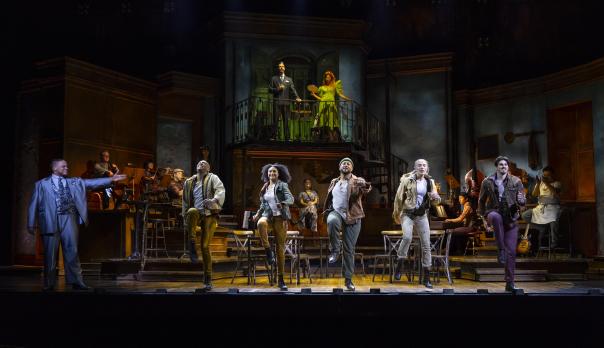
“Hadestown” Makes a Merry, Satiric Tragedy

Review: Hadestown at Belk Theater

By Perry Tannenbaum

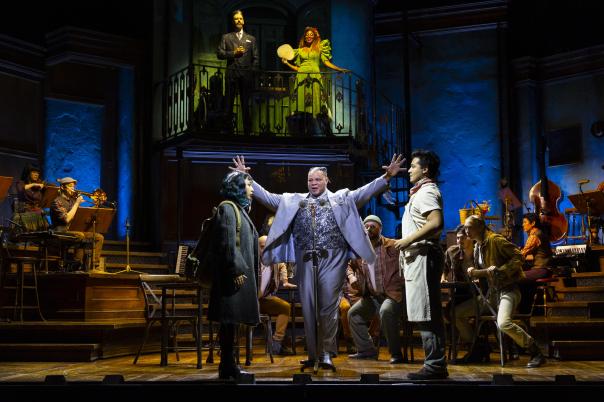
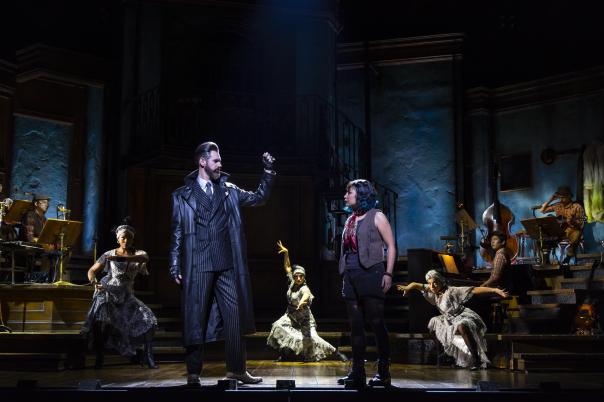
The last time HADESTOWN sauntered into town with its jazzy swagger was almost exactly 18 months ago, Election Day 2022. Perfect timing. When Matthew Patrick Quinn as King Hades brought down the Act 1 curtain with “Why We Build the Wall,” the thrust was so hideously Donald-like that two MAGA maniacs sitting in front of us, clearly offended, huffed out of Belk Theater and didn’t return after intermission.

Well, Quinn and his tectonic shelf-shaking bass baritone voice are back in the title role – the chief reason why my wife Sue would return to see Hadestown a third time if he and the Anaïs Mitchell musical should come back yet again. Yeah, he is that good. And even though The Wall is a bit in the rearview mirror as a national topic of conversation, the satanic aura of Hades still adheres to the corrupt kingpin of the GOP.

Maybe in a different way this time. More than Hades’ striking xenophobia, a strange attitude for a king of Hell, my lingering distaste was for the god’s rabble-rousing dictatorial strut. #MeToo was probably past its fullest bloom in 2022, though it still weighed on the elections, but in 2024, I couldn’t help paying closer attention to Hades’ “Hey, Little Songbird” propositioning of Eurydice.

When she eventually followed the slick monarch to the Netherworld and climbed the stairs to his boudoir, where she would sign away her soul behind closed doors… Yeah, Eurydice’s slow assenting ascent turned my thoughts northward to Stormy Daniels testifying in a Manhattan courtroom earlier that day in the hush money trial. Another little songbird.

To dwell on how deeply Hadestown resonates with the American political scene is to ignore that it first workshopped in New York before the master of Trump Tower declared his candidacy. It also disrespects how well Mitchell retold the story before it developed its adhesive powers. We see Quinn as Hades soon enough, but he doesn’t assert himself until he becomes impatient for Persephone’s annual return to the underworld after she has brought on spring and summer here above.

Until then, Lana Gordon as Persephone and Will Mann as our host/narrator Hermes are the prime charismatics. Next to their flamboyance, Orpheus and Eurydice are rather tame, despite J. Antonio Rodriguez’s pure high tenor and Amaya Braganza’s street-urchin perkiness. Musically, Mitchell lavishes her best invention on Hades and Orpheus, which makes sense since Orpheus has always represented the power of music while Hades, alias Pluto, has always stood for mindless greed.

Gordon and Mann are expected to light up the stage with their outsized personalities, their pizzaz, and eye-popping color – costume designer Michael Krass’s best – chief reasons why Hadestown rolls along so grandly, backed up less brashly by Braganza’s kooky charm and Rodriguez’s botanical magic.

But Mitchell’s book is also provocative, darkly portraying the world above as stricken by an apocalyptic nuclear winter or irreversible climate change, needing Orpheus’s musical magic to set things right and Eurydice to supply him with inspiration and encouragement to finish his cosmic song. The core of this world-changing song, appropriately enough, is wordless. Mitchell gives us a nice touch of the universal here.

Mitchell herself was the original Eurydice when her show first surfaced in New England in 2007. For me, that explains the most annoying, least enduring traits of Hadestown: its devout unpretentiousness and its dogged determination never to proceed too far without undercutting itself and reminding us that this is merely theatre. We’re having a party, y’all! Have a drink!

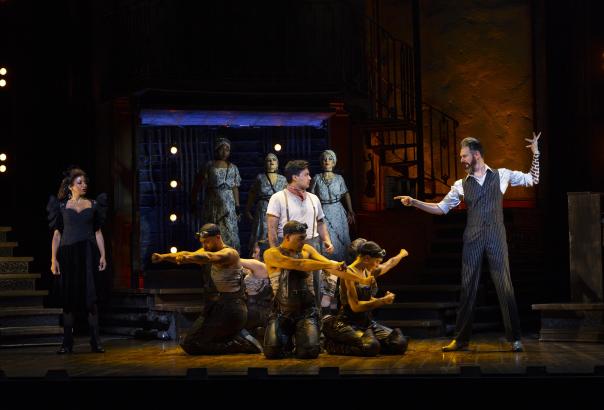
All the musicians are perennially onstage with the actors, particularly the ponytailed Emily Frederickson, who occasionally sashays among the cast with her trombone when called upon for her tastiest licks. For backup vocals, three more angels are engaged as the Fates – Marla Loussaint, Lizzie Markson, and Hannah Schreer – all of whom pick up various instruments during the evening. Could we have Orpheus trudging out of Hades, a fearful but trusting Eurydice behind him, without being tracked by a backup group?

Mitchell and director/developer Rachel Chavkin apparently didn’t think so. Maybe they’ve never experienced Christof Glück’s Orfeo ed Euridice at the Met’s Lincoln Center production, where the legendary newlyweds walk up a long, steep, irregular staircase splayed against the upstage wall, carrying torches to light up the tunnel.

Or perhaps they had seen that opera and realized that youngsters in the audience, not knowing how Vergil and Ovid told the tale, would be bummed by the tragedy if Glück hadn’t appended a happy ending. The whole evening seems cushioned by Chavkin and Mitchell’s worry that they might lose a key demographic along the way if the seriousness of the tragedy remained undiluted by mirth, merriment, and David Neuman’s most festive choreography.

Not to worry, when the Fates take their toll, the hearty, genial, and avuncular Hermes will be there to console Orpheus and all his bummed fans. Along with a big brassy jazz band. Raise another glass!

Shakespeare, Airplanes, and Jazz in CP’s “Twelfth Night”

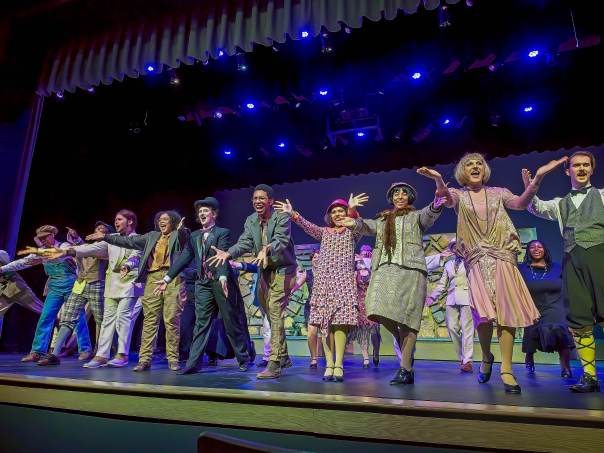
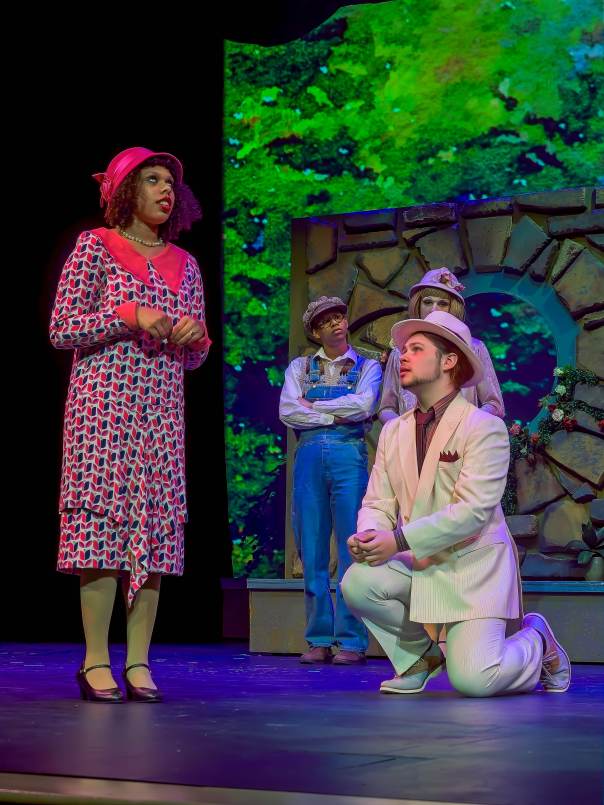
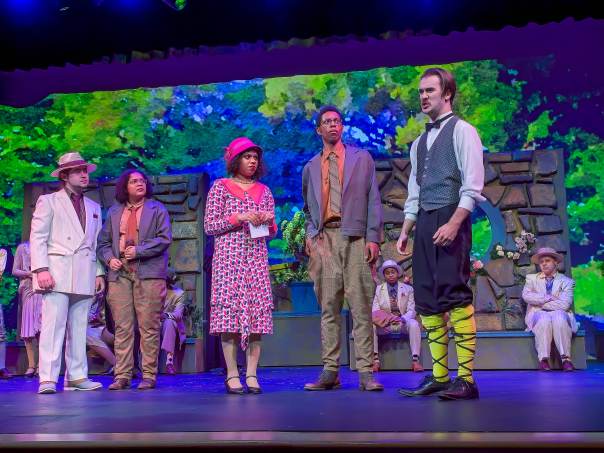
Review: Twelfth Night at the Parr Center

By Perry Tannenbaum

Shakespeare’s best comedies are bursting with multiple plots, and two of the most perfect – A Midsummer Night’s Dream and Twelfth Night – are the most dizzying and delightful. It is quite likely that the latter, later work was first performed on Twelfth Night of 1601 to celebrate the newborn century on January 5 (with a singing clown suggestively named Feste). Yet time, scholarship, and heavy-handed dramaturgy have tended to darken many modern-day productions.

That’s why the current Central Piedmont Theatre version at the Parr Center, adapted and directed by Elizabeth Sickerman, is so refreshing. Twelfth Night has at least four main plots: Viola’s separation and reunion with her twin brother Sebastian, Duke Orsino’s unrequited love for the widowed Countess Olivia (seconded by Sir Andrew Aguecheek), Viola’s crush on Orsino while disguised as his manservant, and the wicked prank concocted by Aguecheek, Sir Toby Belch, Feste, and Maria to send Olivia’s ambitious and party-pooping steward, Malvolio, to the madhouse.

Of these, the most dominant plot should be the Viola-Orsino mess, for it sprouts so many delicious complications. Acting as Caesario, Orsino’s servant, Viola is dispatched to to Countess Olivia’s manor to plead on behalf of the Duke – only to have the Countess fall in love with her. Olivia’s inclinations toward Viola/Caesario not only enflame Orsino’s jealousy, they also lead to an absurd duel with fellow coward Sir Andrew. Meanwhile, she encounters Sebastian’s close friend, Antonio, who puts all his money in Viola’s care, mistaking her for her twin. You can easily imagine what happens when Sir Andrew makes the same mistake.

Ultimately, the mistaken identities reach the giddy point where Olivia cannot recognize her own husband just hours after their marriage. Ah, a honeymoon to remember.

So to tip the balance toward empathizing with Malvolio, simply because he is incidentally berated as “a kind of puritan,” is rather perverse. Elsewhere, I’ve seen the steward outfitted with a Puritan’s hat. Far more stupidly, I’ve heard a theatre sage say Malvolio was modeled on Lord Protector Oliver Cromwell, born in 1599. Thomas Cromwell, Earl of Essex (1485-1540), instrumental in the English Reformation, is a more feasible candidate. Sickerman not only discards such nonsense, she transports the action from ancient Illyria, at the heel of Italy’s boot, to a coastal town immersed in the Jazz Age.

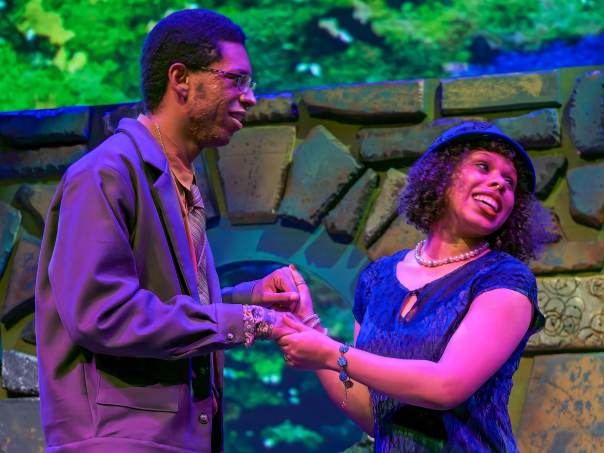
Costume designer Emily McCurdy certainly goes with the Roaring 20’s flow. Orsino and Olivia could easily pass for the recently reprised Gatsby and Daisy Buchanan on Broadway, surrounded by flappers and jazzy gallants galore. The moving pieces and projections of Jennifer O’Kelly’s scenery, more evocative of summer than winter, have enough classic detailing for Viola to sit at the foot of an Ionian pillar when describing herself sitting like “Patience on a monument.”

Nor does the music veer from the vintage of Prohibition days. Montavious Blocker has choice cuts of Duke Ellington and Sidney Bechet in his soundtrack, and just a few bars of music arranger Matt Postle’s chart for “Come Away, Death,” transformed from a lover’s lament into a jivey jump tune, are enough to conclusively vanquish melancholy, injecting Feste’s song for the lovesick Orsino with catchy mischief. The debris downstage suggests an Amelia Earhart plane crash rather than Shakespeare’s original shipwreck, and Charles Lindbergh could have inspired Sebastian and Viola’s matching outfits. Except for the tacky slacks.

If you’ve seen Twelfth Night before, Sickerman cordially adds to the Bard’s dizzying layers of identity, cutting some expositional text and casting females in key roles. Not one of them is a Chickspeare alum. Saskia Lewis as Feste, Rhianon Chandler as Antonio, and Kameal Brown as the recklessly unknighted Dame Toby Belch are all QC newcomers to me. If only Aryana Mitchell, portraying Viola, had an identical twin sister to take on Sebastian!

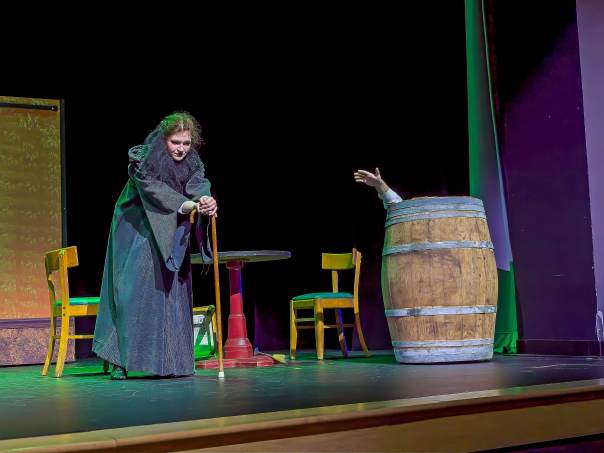
We are centuries away from the Protestant Reformation or the English Restoration, although Sickerman seems to beach the sibs closer to the Pilgrims’ beloved Plymouth Rock than to the Adriatic coast. Such oceanic distancing frees Malvolio from a dungeon of scorn when Central Piedmont’s plotters and nobles plunk their preening steward into a humble barrel to punish his prudery.

He isn’t the clown among the comical group, but Sickerman allows Truman Grant as Malvolio to loosen up, so that his usual rigidity is now almost elegance, mockable now as uppity pretense. Another sign of Sickerman’s lighthearted touch: her pick for the incredulous Sebastian is Timothy Snyder, who is at least a foot taller than his “twin.”

The disparity was so great, that I didn’t catch on at first. Brown’s outfit as Dame Toby, more like Miss Marple than a Falstaffian drunkard, compounded my early confusion, making me feel like newbie to the comedy while I got oriented. Struggling to remember a single instance when the euthanized CPCC Summer Theatre ever presented such a challenging comedy, I stumbled upon another reason why this excellent production was so refreshing.

All the cast was youthful, like the summer college grads who swarmed to Charlotte during CP summers to launch their pro careers. Not one old-timer in the bunch!

As a result of coping with all the period, costume, and gender changes, my disorientation was dispelled at the same time that I was learning to trust the youngbloods performing at CP’s New Theater, which has thankfully replaced panoramic Pease Auditorium but lamentably failed to showcase nearly as much CP talent. The mental training wheels that I had doled out to all these student efforts quickly flew away.

But along with a lightened, more secular and decadent Malvolio, there was newfound pleasure in the other creatures onstage who no longer needed to orbit around the self-absorbed steward. The Malvolio miasma that I’d felt since my first encounter with Twelfth Night in a college Shakespeare seminar, taught by a professor victimized by the prevailing obsession with the “puritan,” finally evaporated.

Twelfth Night, or What You Will has always been an awesome comedy for me. Now it was fun. I’d barely appreciated the bounty of fascinating character sketches that the Bard serves up here.

Now Viola is the patient, softspoken eye of the storm, and Mitchell is keenly sensitive, alternately anguished and bemused by all the passion and folly that surround her. Mitchell’s discreet takes, shared with us, make her a sort of co-emcee with Feste, though Sickerman asks too many eyerolls from her. Fitz Fitzpatrick is only slightly over-the-top with the lovesick gushings of Orsino, chiming well with a lounging Duke or a mob boss. Yes, that sleek robe has a Godfather aura before we see Fitz in the Gatsby threads.

As Olivia, Arianna Zappley does not yield at all to Fitzpatrick in regal dopiness. The two are as perfect a matching pair as the twins, made for each other, yet both are insanely lucky to land one of the sibs. Rounding out the symmetry of the two couples as Sebastian is the disproportioned Snyder, who does manage to nearly equal the calm of his diminutive twin – even though the Illyrians mistake him for her over and over. Playing Sebastian’s closest friend, the wrongly arrested Antonio, Chandler helps the prisoner to emerge as a neat counterweight to Malvolio, who is rightfully chastised for his presumption, though the penalty is too harsh.

There’s a little more slapstick flavor to the motley crew who bedevil Malvolio – and a bit more spice. Evelyn Ovall as Olivia’s waiting-gentlewoman Marie, who forges her mistress’s handwriting in the billet-doux that entraps the detested steward, is destined to marry Brown as Dame Toby. I’d like to think Ellington and his orchestra would have consented to play at the wedding reception, but I’m not sure.

Dopiest of the conspirators and clearly the least self-aware is Salim Muhammad as Sir Andrew, usually exiting with an absurdly military goosestep. In his challenge to Caesario/Viola, Muhammad now dons boxing gloves instead grabbing a sword, magnifying his ineffectuality with his effeminate pawing as he briefly combats the well-matched Mitchell.

Lewis effortlessly steals nearly every scene she appears in as Feste, convincing me along the way that this clown was intended to upstage all others. Not only does Feste sing lyrically and wittily – compared to the other lovers who barely stammer their effusions – she proves to be a better actress than the leading lady, Viola. Visiting Malvolio at the mouth of a barrel he believes is dark hell, Feste gives bravura performances as Sir Topas, a parson supposedly sent to determine how mad this lunatic is, interspersed with imitations of a sincere jester. Lewis cackles and coos this cruel vaudeville as bewitchingly as she swings death, ranging further than anyone else.

Photos by Perry Tannenbaum

Saltwater Glory from the CSO in Seafaring Works by Britten, Williams, and Vaughan Williams

Review: A Sea Symphony at Belk Theater

By Perry Tannenbaum

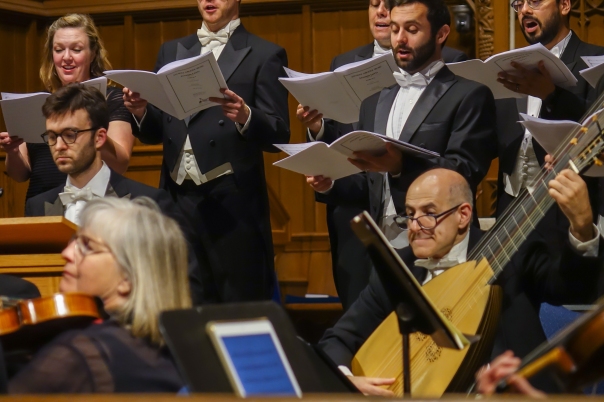
April 26, 2024, Charlotte, NC – Whether you love the sea for its surf, its tidal rhythms, its abundance of exotic creatures large and small, or its sheer vastness, Charlotte Symphony’s A Sea Symphony will deliver manifold delights – and a thrilling storm or two at no extra charge. The marquee piece, also known as Ralph Vaughan Williams’ Symphony No. 1, soars with enough poetry and ambition to be compared with Beethoven’s Ninth. The four-movement piece, studded throughout with the poetry of Walt Whitman, takes only five minutes less the Beethoven colossus to play, with the assistance of the Charlotte Master Chorale and two fine guest soloists, soprano Georgia Jarman and bass-baritone Andrew Foster-Williams. More than one Symphony season has concluded with the mighty Choral Symphony and nothing else on the bill, so it is quite generous that conductor laureate Christopher Warren-Green precedes A Sea Symphony with two other substantial seafaring works, Benjamin Britten’s Peter Grimes: Four Sea Interludes and Grace Williams’ Sea Sketches.

Artistically, opening night was a conquering hero’s triumphant return. Yet it was a mixed bag from a box office perspective. While the orchestra level was conspicuous disappointment, pocked with empty seats on a cloudy, balmy night, the grand tier was packed with loyalists and plutocrats, rewarding the performers’ upward gaze (if they ignored the sparsely populated balconies above). Warren-Green’s affinity for this music from the British Isles proved to be as deep as Vaughan Williams’ affection for Whitman.

Across the Carolinas, I’d venture to say that full-length productions of Britten operas are thinly scattered over the years, even at Spoleto Festival USA (Curlew River) or Brevard (A Midsummer Night’s Dream and The Turn of the Screw). Nobody around here realizes that Britten set another great classic, Herman Melville’s Billy Budd, to music?The scraps of Peter Grimes that Warren-Green brings us are therefore hugely philanthropic, even if they reprise a work the maestro introduced at Belk Theater ten years back.

In the first three of the four movements, Warren-Green reminded us how exquisitely he crafted color and texture. Following a dreamy “Dawn,” the middle movements were especially sublime. “Sunday Morning” was dotted with tubular bells – you could almost feel the mist they were ringing through – and that tolling was echoed in “Moonlight” with a simple conspiracy between harpist Andrea Mumm and flutist Amy Orsinger Whitehead. Not really simple if you listened closely, for the single notes they played were not in strictly regular tempo. The magical ritardando was guided by Warren-Green’s instinctive baton. Most everybody will be impressed with the orchestral power of the “Storm,” fueled upstage by the percussionists, but Britten provides an added wallop with the lull in his tempest, ominous with subterranean quaking.

If he weren’t almost a Welshman by birth, you wonder how Warren-Green would have become smitten by the music of Grace Williams (1906-1977). Looking the Welshwoman up in Spotify or Apple Music will likely steer you wrong – to a Christian music artist by the same name who looks, depending on how her hair is combed, like either Renee Fleming or Celine Dion on her album covers. If you dig a bit deeper on Spotify and Apple Classical, you can find a fine 2000 recording of the five Sea Sketches for string orchestra on the CBC label with Roy Goodman leading the Manitoba Chamber Orchestra. As you might imagine in a piece that is as meticulously pictorial as Debussy’s La Mer, a live performance discloses buried treasures above and beyond Warren-Green’s more sensitive response to the score. Most memorable for me were the ethereal “Sailing Song” and the concluding “Calm Sea in Summer,” distinguished by its beautifully modulating tempo and its simulation of the quiet wash of wet sands on the shore.

All isn’t dainty, however, though the opening “High Wind” isn’t blessed with full orchestral artillery. That movement is powerful in its own right, and “Breakers” is definitely punchy. In the middle of the five pieces, “Channel Sirens” might be the most intriguing, not seeming to target either the glamorous temptresses of The Odyssey or any kind of alarm. Williams may have been picturing tugboats in muddy or nocturnal waters, I don’t know. The music cast a uniquely portentous spell.

You really need to hear A Sea Symphony in live performance, not only for the bone-rattling surges of orchestra, chorus, and vocal soloists resounding through the Belk, but for the extended pianissimo at the end of the concluding “Explorers” movement. The outer movements, “A Song for All Seas, All Ships” and “The Explorers,” are epics in themselves, fittingly for Whitman containing multitudes. You might feel that we have reached the end of this mighty chorale when the opening movement ends, but it we are less than a third of the way into our voyage. The finale will be longer, grander, and more oceanic. In between, there’s the relative quiescence of “On the Beach at Night Alone” and the jaunty heraldic “Scherzo: The Waves,” where the Master Chorale, wonderfully prepared by Kenney Potter, give the lead vocalists a well-needed rest before their final cosmic exploits.

And if you’re familiar with Whitman’s “A Passage to India,” you know that cosmic is no exaggeration as the souls of the singers join the Good Gray Poet, in his most pantheistic and mystic dimensions, beyond the seas to the far reaches of the universe. Some big names have been attracted to the baritone part, including Thomas Hampson and Simon Keenlyside on the CDs that I own, but Foster-Williams emphatically holds his own – while Jarman easily surpasses most of the sopranos I’ve heard on recordings of this demanding work, nicely combining the power and beauty of both camps. She’s formidable as both a dramatic and lyric soprano.

“Mrs. Doubtfire” Flips Wacko to Wisdom Overnight

Review: Mrs. Doubtfire at Blumenthal Performing Arts

By: Perry Tannenbaum

Pardon me a second, but I seem to be noticing stretch marks on my suspension of disbelief. Three nights before the curtain rose on the touring version of Mrs. Doubtfire that rolled into Belk Theater, I saw a rather fine production of Twelfth Night across town at Central Piedmont College. Since both of the brief runs include at least one matinee between now and Sunday, my experience of seeing two wives who fail to identify their true husbands can be intensified, compressed into the space eight hours, if you wish, after my relatively relaxed 75-hour exercise.

In Shakespeare’s 1601 comedy, Olivia marries Sebastian – much to his delighted befuddlement – the twin brother of the disguised Viola, the woman who has actually smitten her. Later, on the same day of her wedding to Sebastian, whom she believes is Caesario (!), Olivia encounters Viola still in her disguise, who has the gall to deny they are married!

In the 1993 film starring Robin Williams and in the Broadway musical adaptation of 2021, the mix-up occurs earlier in the action – but after a lengthy Daniel-and-Miranda marriage that has produced three darling Hilliard children from its intimacies and one bitter divorce from its hostilities. The set-up for Daniel’s makeover zoomed by so quickly on opening night that, aside from throwing his son a super birthday party despite Mom’s insistence that he was grounded for his poor school grades, I really didn’t grasp how he had gotten Miranda so pissed.

Not that I blamed her. Rob McClure as Daniel was so hyper, manic, and over-the-top in his early scenes, like a cut-rate Robin Williams in his early nanu-nanu years, that it was easier to wonder why Miranda had married him than why she would file papers. This is one grating, irritating, self-absorbed dude who is spoiling his kids, always “on” in his daddy role, like a badly misfiring Williams improv shtick on latenight TV. Until suddenly, like in an epiphany, he hears the family court judge’s decree and finds himself poignantly pleading for a greater share of his children’s lives.

his is only the beginning of Daniel’s lightning-quick transformation, for it isn’t going to be merely skin- or mask-deep. In Mrs. Doubtfire, to be fair, Daniel is really trying so hard to deceive Miranda – and regain his precious access to his kids, who clearly matter more to him than their mom. So he commandeers all the advanced mumbo jumbo of modern makeup science via his gay brother Frank and his partner Andre. A true artist, he proceeds to artificially boost his bustle and decks himself out as a ragout of Miss Marple, Margaret Thatcher, and Julia Child. With a Scottish accent.

Meanwhile, our playful Daniel sabotages his ex’s email search for a nanny (a bit nasty, really) and moves himself to the head of the line of nanny telephone applicants, impersonating all the losers before shining as Mrs. Doubtfire, a name he improvises on the spot. Cunning and very much in character, except that he’s suddenly catering to his ex-wife instead of blithely ignoring her.

The nanny who appears at the Hilliards’ threshold for “her” in-person interview not only fools Miranda, he also fools his three kids. Well he might. This nanny is not at all Daniel anymore. The voice, the tempo, the personality, and the parenting approach are all radically different. Instead of his previous happy-go-lucky, laissez-faire practices, he now leapfrogs Miranda and becomes sterner, stubborner, and more demanding than she ever was.

Conceived as a stopgap avenue to his children while he regains Miranda’s trust, Mrs. Doubtfire succeeds beyond Daniel’s dreams. She’s a godsend, not only as a caretaker, but as a friend, confidante, and a chef! Miranda cannot remember when she was so happy and wouldn’t ever dismiss Mrs. D in favor of Daniel, no matter how thoroughly or sincerely he has reformed by the time the judge reconsiders custody.

This irony brings no consolation to the kids. As long as the Mrs. Doubtfire ruse continues to deceive them, they are missing their dad. The son, Christopher, has lifted his grades under the new nanny’s guidance, but he still blames himself for the divorce.

So it’s a mercy that Chris and his older sister Lydia accidentally figure it out after a few weeks. A louder tinkle in the toilet on opening night would have made it clearer how this happens.

Otherwise, the show ran better than I expected, rewarding my suspended disbelief with some zany antics and absurd predicaments. Thanks to a humorless family court social worker and an equally stolid TV showrunner, who merely doesn’t display her amusement, Daniel is forced to portray himself and Mrs. Doubtfire simultaneously on two occasions.

These crises force Daniel to enlist emergency assistance. When Romelda Teron Benjamin pops up as the frightfully upright Wanda, the social worker, for a home visit at Daniel’s shabby new apartment, Frank and Andre also show up fortuitously when Wanda wishes to interview both Daniel and Doubtfire. Aaron Kaburik as the brother is the more frantic of Daniel’s speed dressers, unable to tell a lie without raising his voice to fortissimo. Nik Alexander as Andre is the calmer and cleverer of the two, with a soupçon of flare, saving the day by secretly whipping out his cellphone.

Daniel’s second crisis builds slowly to a wonderful catastrophe as Stuart, the hunky new boyfriend, invites Mrs. Doubtfire to join him and the family to celebrate Miranda’s birthday – at the same restaurant where Daniel must meet with Ms. Lundy, the TV producer, to discuss a new series built upon his improvised personae. Once again, Frank and Andre are recruited for the quick changes – maybe in the ladies’ room. Fearing what Mom will or won’t see when she goes to see what has become of Doubtfire, Giselle Gutierrez and Sam Bird (alternating with Axle Rimmele) as the elder sibs must spring frantically to the rescue, reassuring a dubious Miranda that all is well.

McClure does his best work during this hectic denouement, and against all odds, we don’t absolutely despise Maggie Lakis as Miranda, though we’re rooting against her all evening. She and Benjamin eventually melt appealingly. Aided by Daniel’s conspicuous indifference toward his ex, despite Doubtfire’s meddlesome jealousy, Leo Roberts gradually gains our favor as Stuart, even if he is pumped-up and comparatively normal.

Music and lyrics by Wayne and Karey Kirkpatrick do little to elevate or damage the script adaptation by John O’Farrell and Karey K, which not only gives Andre a cell but equips the Hilliard home with wi-fi and spoils the kids with various screens, apps, and video games. No melody stuck with me, but I liked the energy of “Make Me a Woman” for Daniel, Frank, Andre, and ensemble. “I’m Rockin’ Now,” with Mrs. Doubtfire fronting the ensemble, brings us handsomely to intermission.

Two other comic gems can be commended, Jodi Kimura’s stone-faced turn as producer Janet Lundy and David Hibbard’s lachrymose portrayal of Mr. Jolly, the kiddie TV host that Daniel is destined to replace. Hibbard is like a Captain Kangaroo who long ago lost his hops, hopelessly lapsed into senility. It was generous of the writers to keep Jolly employed on the new show.

Private Anguish and Global Triumph Keynote “Everybody’s Got a Story”

Review: Everybody’s Got a Story at VAPA

By Perry Tannenbaum

If you like taking things apart and seeing how they work, there’s an interesting tension at the heart of Everybody’s Got a Story to Tell,the new Charlotte’s Off Broadway production at the VAPA Center. COB producer Anne Lambert describes it more accurately in her subtitle, “The One-Person Play Project.” Then if you apply a QR code reader to your program leaflet, you’ll find that Lambert pulls against the marquee title when she observes that, for some, performing onstage for an audience is a dreaded terror while for others it’s an addictive drug.

Onstage – or on The Moth Radio Hour – baring yourself to the world can be an exhilarating high, especially when you’re showered with laughter and applause. But it turns out that, although we’re certainly watching folk in the addict category, they’re not always telling us their own story. Or blurting it out to us compulsively as might be implied by Everybody’s Got a Story to Tell.

No, when you scan the three titles of the playbill, you’ll hit a roadblock to that confessional concept at the bottom of the page where you discover Eartha Kitt: Cotton to Caviar, written and performed by Toi Reynolds-Johnson. Before that title explodes any notion of a purely soul-baring evening of personal trials, the first play of the evening, Reflection: The Musical might detain you momentarily. Many, many confessions have been crafted into song. But not spontaneously. We know better.

Enriching this impure brew of personal effusions, the names that precede the titles splashed in yellow mustard typeface come into play: director Rob Coppel behind the scenes and PJ Barnes, very much up front as our host. Before we watch Reynolds-Johnson, Spencer Hawkins, and Tyler Wills perform the works they’ve written, Coppel and Barnes conspire to glue the disparate pieces together into a cohesive whole and conjure up the illusion of a natural flow.

Barnes as our emcee actually precedes us into COB’s VAPA nook, welcoming us as we enter and encouraging us to make ourselves at home. So briefly, we are part of the show for those who are already seated. The transition between greeter and emcee is as smooth as possible as the lights dim and Barnes starts strutting the stage in his more prestigious persona, weaving our everybody’s-got-a-story theme. How much of this BS is freshly improvised is hard to discern from whatever Coppel and the writer/performers have fed him in scripted form or as a sort of “head arrangement” as jazz musicians would call it. Whatever, Barnes is one slick and nicely turned-out dude.

The polished impression that Barnes makes contrasts nicely with the vulnerability Wills projects in Reflection, a glittery gay man who is freshly suffering the gut punch of a breakup and feeling the sting of a rejection that will linger for more than a month. After an opening communion in front of a vanity mirror, it’s very apparent that self-loathing is also prominent among Wills’ ills, for he resolutely removes his cruising gear – rhinestone high-heels, high-cut denim shorts with glitter belt, and matching pullover – in favor of workout wear that might be adopted during the isolation of a pandemic.

Double underlining Wills’ self-flagellation, he covers both his vanity mirror and a full-length mirror in shrouds. The powder room is transformed into a house of mourning, and reflection is now done by journaling. In a series of songs and vignettes, Wills is reliving his story rather than telling it. Dramatic intensity is paradoxically increased by Wills’ refusal to break the fourth wall and speak to us, but the intimacy of our encounter with the playwright/lyricist suffers as our peeping is prolonged.

Nor do the pre-recorded melodies, composed by pianist David Roach, dispel the oppressiveness of the 40-day vigil as Wills continues to pour out his anguish and bewail his betrayal. Three nights before Passover, the 40-day, 12-step slog toward self-acceptance and reaffirmation began to feel to me like the Israelites’ 40-year exodus in the Sinai Desert. I gradually despaired that the next song would sound much different from the one I was hearing.

Wills and Roach need to tighten up their collaboration. Or else they need to liven it up with a greater variety of mood and tempos. We’re convinced that Wills has a fine voice and vocal range while we’re frustrated at not seeing more emotional range. Another way to let more light into Reflection before the inevitable uncovering of the mirrors would be by letting us in, occasionally poking some holes in that fourth wall, breaking up the tedium of self-involvement. Just allow the piece to breathe in the here-and-now with occasional retrospective commentary.

Or maybe Wills and Roach overestimated the amount of suspense they were creating. More, please.

Notwithstanding Wills’ final affirmations, I welcomed back Barnes and his stylish patter with more enthusiasm than I’d anticipated. Hawkins and his You’re Accepted offered even more refreshing contrast, though it was also fueled by a breakup. Instead of grieving and self-quarantining, Hawkins deflected, launching into a series of spurious podcasts behind his laptop as if broadcasting his vocational and romantic woes to the wide world live from Davidson. After the parched drought of Reflections, we experienced a dizzying blizzard of sudden twists and turns, inexplicable leaps, mood swings, and casual reveals.

The more Hawkins revealed, the less authentic and autobiographical this confessional, by a Davidson College admissions officer, seemed to me. Cynical, cruelly dismissive, and burnt-out toward the pile of college admission essays on his desk, Hawkins was rather wickedly at-odds with the confessional mode of writing he was practicing himself.

Hopscotching as it does, Hawkins’ script defies a linear summary, likely because it has less to do with the troubles a college administrator has with women and his job, more to do with that cloistered academic’s difficulties in understanding and managing himself and what he’s doing. The quick pacing nicely supports our narrator’s caprices and indecision. What we wind up with is an artful and funny portrait of a peppy but unreliable narrator who lets down his guard often enough to clearly see both his charms and his flaws.

Of the two complete plays, Hawkins’ non-musical was better, but although Reynolds-Johnson’s Eartha was only presented in vignettes after intermission, it easily laid equal claim to the distinction of best on the bill. And where you had to wonder how autobiographical or authentic You’re Accepted and its admissions essays were, you could instantly perceive Reynolds-Johnson’s inspiration. Just look at her eyes! If she didn’t have the idea to portray Kitt on her own, somebody else surely suggested it. Likely on numerous occasions.

We can perversely suggest that R-J looks more like Eartha Kitt than Eartha herself, for when we see her as a child, born on a South Carolina plantation and rejected by both her parents in the opening Cotton scenes, she already looks like the woman she would become at the Caviar conclusion. And the powerhouse superstar who would one day bewitch Orson Welles, make Lady Bird Johnson weep at the White House with her Vietnam War comments, conquer Europe, and play Catwoman on the hit Batman TV series was never more than 62 inches tall.

R-J, likely no taller than her subject, revels in every phase of the Eartha bio. Even the digital playbill doesn’t say, but she’s probably as responsible for the spot-on costumes and props as she is for the writing – though Eartha wrote three autobiographies, plenty to glean from. Nor is R-J at all uncomfortable in sprinkling her various scenes and costume changes with frank narrative, engaging directly with her audience at times. Allowing the diva even more stature in her Caviar phase, Coppel brings Barnes back for one last hilarious shtick as the cabaret queen’s worshipful lackey. Although Adrienne Williams takes on her most prominent role here at the keyboard, we barely get a taste of the Evil One’s full repertoire in snippets of “C’est Si Bon” and “Santa Baby.” Just a cursory look and listen to the top stuff a Google search led me to was more than enough to convince me that there’s plenty of juicy episodes, from her tête-à-têtes with Welles to her verbatim White House harangue, remaining to be unveiled in the complete Eartha.As they stand, the vignettes at VAPA are very tasty and satisfying, but the complete Cotton to Caviar will be richer and spicier.

Photos by Perry Tannenbaum

“Turandot” Grandly Usurps Saint-Saëns at Belk Theater

Review: Opera Carolina’s Turandot

By Perry Tannenbaum

When we gauge the cultural influence of Giacomo Puccini, we’re most likely to invoke the operas he composed that were subsequently repurposed into megahit Broadway musicals. The American colonialism that fueled the domestic tragedy of Madama Butterfly eventually suffused the spectacular Miss Saigon, and La Bohème, Puccini’s verismo masterwork was Americanized – Greenwich Village filling in for Paris – and turned even more successfully into Rent.

But we don’t readily think of Puccini in terms of grand opera, ALL CAPS, unless we narrow our focus to the Italian master’s last work, Turandot, the one opera he didn’t live to complete or see premiered in 1926. The fate of nations routinely hung in the balance when Verdi selected his libretti, but for Puccini, this tale of ancient China and Peking stands apart from his more private and intimate norm. If Traviata is Verdi’s most visionary work, anticipating Puccini, then Turandot is Puccini’s grandest and most retro work.

Opera Carolina’s history with the work tallies well with its popularity. This is the sixth time the company has staged Turandot, decisively trailing Puccini’s big three, Bohème, Butterfly, and Tosca, two of which have reached double figures. Yet since James Meena, a devout Verdian, arrived on the scene in 2000, Turandot has maintained parity with its kindred, staged three times since the turn of the century.

We must, begging Milady’s pardon, bestow an asterisk next to the current incarnation of Peking’s princess. If she wasn’t exactly a last-minute or eleventh-hour replacement for Camille Saint-Saëns’ Samson and Delilah, it’s fair to say that she was an eleventh-month substitution for the previously slated season closer.

Yes, a grand opera was inserted at Belk Theater as the clock or calendar was winding down! Around the world, Maria Callas, Birgit Nilsson, and Joan Sutherland are among the celebrated dramatic sopranos who have graced the powerhouse title role, and the Franco Zeffirelli production at the Metropolitan Opera is as revered for its stateliness and splendor as the Notre Dame Cathedral.

Grand? Monumental.

Needless to say, the Opera Carolina production didn’t figure to deliver legendary grandeur. But instead of smoke and mirrors, set designer Anita Stewart and lighting designer Michael Baumgarten call upon scaffolding and projections to bridge the gap. Stage director Jay Lesenger wisely keeps the curtain down over Stewart’s barebones set until Meena, down in the orchestra pit with the Charlotte Symphony, can begin working his magic with the score. It doesn’t take long to taste its beauties, ranging from delicate to majestic, or realize Meena’s deep affection for it.

Parallel to the build-up to Prince Calaf’s climactic confrontation with Peking’s ice goddess, when the princess asks him three riddles that he must solve – or die – there’s a steady build-up of ritual. A Persian prince has failed the Trial of Three Riddles and must be beheaded. To declare his candidacy, against the fervent wishes of his father and his dear maidservant, Calaf – “The Unknown Prince” – must strike the gleaming gong near the gates of the imperial palace. To stage a new trial, there must be a public proclamation, holy men must gather, the Emperor must preside, and Turandot herself must pose the riddles.

It’s a regal crescendo of pomp, ceremony, and colorful, eye-popping costuming from Anna Oliver that ultimately matches the trumpets heralding the divine Principessa. Watching the royal entrances of Emperor, Turandot, and their respective ministers and maidservants, high up and almost level with the proscenium, I had to wonder how much more scaffolding and stairs there must be hidden in the wings so that all these nobles, old and young, could safely ascend to those lofty heights.

At ground level, my worries began as soon as soprano Jennifer Forni made her auspicious Opera Carolina debut as Liù, the maidservant who has devoted herself to dethroned Tartar king Timur simply because her son, Calaf, once smiled at her before he fled the kingdom. Forni distinguished herself within the first ten minutes with her sweet fruity timbre recounting Liù’s backstory, and her buttery soft notes put the protagonists waiting for their big moments in serious jeopardy of being upstaged. After all, Renata Tebaldi, Renata Scotto, and Montserrat Caballé are among the notables who have been drawn to this role.

If we don’t see or hear the very best of Diego Di Vietro early in Act 1, there was enough Luciano Pavarotti DNA surfacing in his tenor to assure us that he would likely be equal to Calaf’s big “Nessun dorma” moment when the curtain rose on Act 3. The extra panache that was missing before intermission arrived on time, and Lesenger made more of Calaf’s first private moment with Turandot, calling upon Di Vietro to conquer the princess with brutish aggressiveness and charm. The chemistry that was so sorely missing when Opera Carolina brought Turandot to the Belk in 2009 had finally been recovered, making for a more deeply satisfying ending.

Though Lesenger could have given her more to do during Turandot’s icy phase, Amy Shoremount-Obra was certainly majestic, intimidating, and cruel as the Principessa in the stunning trial scene. Nor am I quite sure that Baumgarten took the best approach in lighting the Princess when she first appeared. Yes, Shoremount-Obra was dazzling but blinding might be equally accurate as the lights were so dazzling that there was no chance to behold the beauty of the Princess’s face, utterly bleached by the spotlight. (My photographer agrees.)

Yet there is visual drama in this tense ceremony as Turandot gradually descends the long staircase from her lofty height as her successive riddles are solved. Shoremount-Obra visibly becomes more human and vulnerable as she comes closer to the Unknown Prince’s level at the climax of Act 2 and he proves more and more worthy of her. The dramatic soprano’s stamina wavered just slightly after intermission in her pre-dawn duet with Di Vietro, but by this time, Shoremount-Obra’s beauty had been revealed and the chemistry was kindled.

Otherwise, there was no lack of strength or color among the remaining cast. John Fortson was austere and imposing in all of the Mandarin’s proclamations. Jeffrey McEvoy, Zachary Taylor, and resident artist Johnathan White were delightful as Ping, Pang, and Pong when we needed comic relief. Garbed and bearded in gray, basso James Eder brought out a paternal spirituality in the blind King Timur, and Elliott Brown, decked out in enough gold to be declared a Sun King, was a magnificent Emperor Altoum.

Rather electrifying, all around. Bravi.

Photos by Perry Tannenbaum

Charlotte Symphony’s New Maestro, Kwamé Ryan, Thrills a Packed House

Review: Tchaikovsky & Brahms at Belk Theater

By Perry Tannenbaum

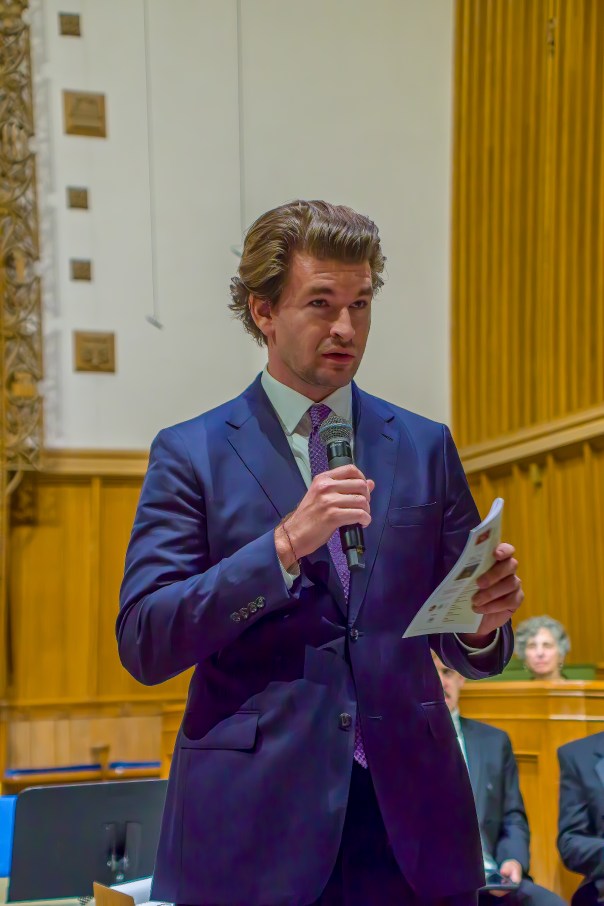
April 5, 2024, Charlotte, NC – The audience at Belk Theater didn’t rise and sing the National Anthem as we do at the start of every new Charlotte Symphony season, but the occasion – Tchaikovsky & Brahms – was auspicious enough for Symphony president David Fisk to take the stage, notes in hand, and introduce the Orchestra’s newly designated music director, Kwamé Ryan. On the heels of CSO’s announcement that they were already at over 80% in reaching its $50 million fundraising campaign goal, ensuring Symphony’s financial stability, Classics subscribers had multiple reasons to express their enthusiasm – as Fisk spoke and when Ryan made his entrance. Both events had been sufficiently ballyhooed in the press. Fisk could wait a leisurely eight minutes after the normal starting time to make his appearance, so the usual curtain-up helter-skelter of late arrivals had subsided. Unless Ryan raised his eyes to the uppermost balcony, he saw a packed house ready to erupt.

Ryan’s greeting was even more personable than Fisk’s intro, so audience adoration actually rose a couple of notches before quiet prevailed and he could put his baton to use. This really was the beginning of a new Kwamé Ryan era, and the director designate did not fail to take advantage of that vibe. Instead of the “Star-Spangled Banner,” Ryan began his reign with what felt like the next best thing. With the composer seated in the orchestra, poised to receive more audience adulation, Ryan and Symphony performed Wang Jie’s Symphonic Overture “America, the Beautiful.” A self-professed “lover of adventure on mountains and cliffs,” Wie was thrilled when the Colorado Springs Philharmonic asked her to create a work inspired by nearby landmark Pikes Peak and the song written by Katherine Lee Bates in 1895 to a melody composed more than a decade earlier by Samuel A. Ward.

The commission was not at all outré, since Bates’s original poem was inspired by her first trip to the summit of Pikes Peak. You might say, however, that Jie’s music was inspired by America in 2016, since her description of this work stresses the unifying effect of the song amid political turbulence. She aimed for a piece that acknowledges how “fractured” we are while expressing the hope that a “re-harmonized” take on the anthemic song could still have healing and unifying powers. Fractured episodes alternate with Jie’s re-orchestrated presentations of Ward’s melody, presented in chunks of eight bars each until all of “America, the Beautiful” is reprised with brassy grandeur, followed by a frantically accelerated coda. Curiously, the piece probably does sound a lot more hopeful today, eight years after it was premiered barely two weeks before Election Day. A revision today might not contain the same wan, ruminating passage from the French horns or the silvery wistfulness from concertmaster Calin Ovidiu Lupanu. Wie’s energetic balancing act was almost nostalgic.

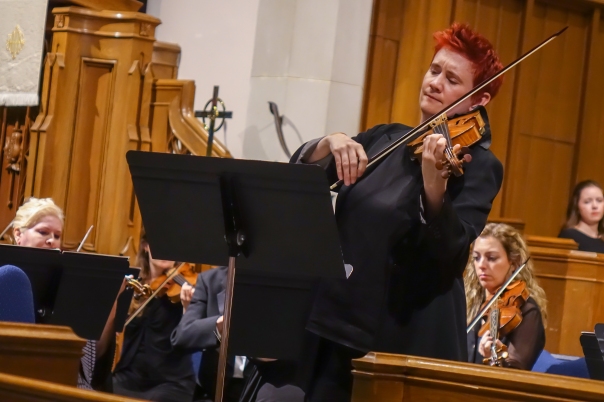
Although cellist Joshua Roman performed Tchaikovsky’s Variations on a Rococo Theme in Charlotte as recently as 2012 during an All-Tchaikovsky concert led by Christopher Warren-Green, the piece didn’t skyrocket to mountaintop status for me until Gautier Capuçon played it at the glorious Dvořák Hall during the Prague International Festival of 2019. Reaching that stratosphere would be difficult for both guest soloist Sterling Elliott and Ryan, navigating Pyotr’s score before the vivid memory of Semyon Bychkov’s exploits with the Czech Philharmonic had fully faded. Indeed, the delight and perfection of the Prague experience drifted beyond reach by the time Elliott and the CSO had traversed the mid-tempo prelude, the rococo theme modeled on Mozart, and the first two variations at a friskier pace. Ominously, it dawned on me that this was the first piece I was hearing Ryan conduct with Symphony that wasn’t composed by an American citizen.

With the onset of the dreamy Variation III, Elliott and Ryan found their footing, bringing forth the full sublimity of the Andante sostenuto. At that point, knowing that some bodacious virtuosity lay ahead in the final four Variations and the crowdpleasing coda, I resolved to try and watch Elliott from the perspective of those in the audience who were experiencing the Rococo for the first time. Wiping the slate clean not only enhanced my own experience, it plugged me into the excitement and wonder of the Belk Theater crowd as the buoyed Elliott slashed through the pyrotechnics in the latter half of Tchaikovsky’s concerto and shredded his bowstrings. If you factor in opening night jitters, Elliott’s encore figures to be even more awesome.

The Brahms Symphony No. 1 built to a similarly walloping climax after intermission. Limited rehearsal time – or simply the limited time Ryan and the Orchestra have had to become acquainted with each other – may have accounted for the somewhat listless and shapeless reading of the opening Un poco sostenuto and its subsequent transitions back and forth from Allegro. It was in the ensuing Andante sostenuto, where acting principal oboist Erica Cice had multiple chances to shine bookending principal clarinetist Taylor Marino’s eloquence, that the ensemble seemed to discover its voice, capped by some subtle soloing from Lupanu.

Marino spun a little more magic, in league with principal flutist Victor Wang, at the start of the third movement Allegretto as the ensemble ramped up for the grand finale, where Brahms First echoes Beethoven’s last. Here was where we could find the most encouraging examples of the pacing, sculpting, and exhilaration we can expect as Ryan settles in with Symphony for seasons to come. Repeatedly, principal French hornist Byron Johns was impressive, first as he hovered above the brass and later in concert with the other horns. There was admirable warmth from the strings in the big tune, with effective spotlights from Wang, Cice, and the four trombones. Everything was clicking during this finale, which crested with thunder, and the audience called Ryan back from the wings again and again with a standing ovation.

Falletta and Wilborn Dazzle at the Knight

Review: Charlotte Symphony Plays Wagner + Strauss

By Perry Tannenbaum

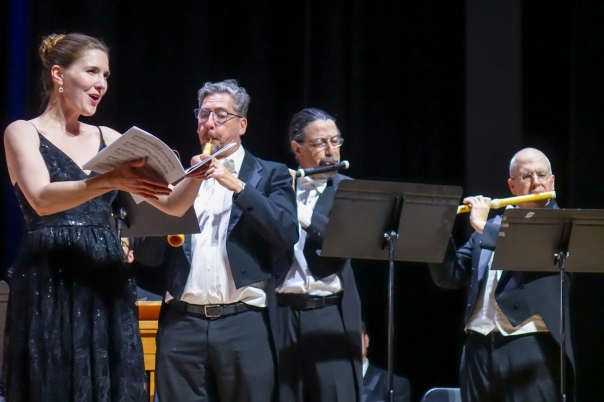
March 22, 2024, Charlotte, NC – Charlotte Symphony’s latest concert pairing, Wagner + Strauss, is logical and cohesive enough, but with the two Germans represented by the “Liebestod” (love-death) from Tristan and Isolde followed by the great Death and Transfiguration tone poem, abundant jollity seemed unlikely at Knight Theater. Wedged between these famed titans of 19th and 20th century music, however, were two lesser-knowns, Richard Strauss’s contemporary Oskar Böhme (1870-1938) and American composer Julia Perry (1924-1979). Thankfully, these composers, especially Oskar, lightened things up. Originally scheduled to perform with Symphony in August 2020, renowned conductor JoAnn Falletta returned for her first guest appearance with the orchestra since 2002, and principal trumpeter Alex Wilborn, similarly postponed by the pandemic, made his solo debut in Böhme’s Trumpet Concerto.

When former Symphony music director Christof Perick last performed the “Liebestod” at Belk Theater – almost precisely 15 years ago – he also paired the piece with a revered Strauss tone poem, Also Sprach Zarathustra. Strauss was one of Perick’s prime passions, and the Friday evening performance reaffirmed that the ardent Prelude and Liebestod remains deeply embedded in the ensemble’s DNA. Falletta’s reading, gradually peaking to a lovers’ climax, with delicious peeps at the hypnotic love theme that blossomed with promise, made me feel afterwards like asking if anybody else in the audience craved a cigarette.

Musically, it seems like a trumpet is a better post-coital sequel for Symphony than a cigarette when they finish the Liebestod, for who can contemplate Strauss’s Zarathustra without recalling its trumpet heraldry? Now that Wilborn is in the principal chair, he could bring us a virtuosic account of Böhme’s Trumpet Concerto with a surprise bonbon afterwards. The opening Allegro moderato brought forth a beautifully burnished tone from Wilborn’s horn and delectably supple phrasing, hardly seeming to challenge his technique, while Falletta emphasized the massiveness and lyricism of the orchestral accompaniment. That foundation segued nicely into the middle Adagio religioso movement, which began with stately dignity from the strings and brass and peaked with soaring aspiration from the soloist, no less pleasing than the melodic opening movement. It was only in the closing Rondo that we could savor anything close to Wilborn’s full virtuosity. Some real jollity here.

Perhaps both Wilborn and Falletta felt that the fireworks were all too brief in Böhme’s finale, for after the audience ovation, the trumpet virtuoso returned with perhaps the lengthiest encore ever heard at Knight Theater. Jean-Baptiste Arban’s “Variations on The Carnival of Venice” had all the virtuosic challenges and exploits you could ask for, with merciful orchestral interludes between the clusters of variations so that Wilborn could catch his breath. It wasn’t just speed that was demanded: in the most intense variations, we needed to make out the main melody amid a blizzard of relatively quiet filigree. The effect was sensational, exhilarating, and exhausting. Falletta showed us how much fun she was having long before she could rest her weary arms and face us again, and Wilborn, in a gesture that promised both him and his audience some respite, jokingly signaled to us when there were only three variations remaining.

Sadly, it would be an understatement to say that African American composer Julia Perry’s work has been neglected in her homeland. Only a handful of recordings – and no full-length CDs – exist from her voluminous output, which included 12 symphonies and four operas. The work unveiled in Charlotte, A Short Piece for Orchestra (1952), has only been recorded once, 14 years ago by the Imperial Philharmonic of Tokyo.

Falletta’s helter-skelter reading of the work made it feel far more modern and audacious than the more lyrical and legato Tokyo take under William Strickland’s baton. A live performance certainly brought out more textures after the raucous opening, including some dreamy reeds from principal clarinetist Taylor Marino and acting principal oboist Erica Cice. From the rear of the ensemble, a snare drum’s tattoo and some noodling from a celesta crept in. Really lovely stuff. My first exposure to Perry came just three days before her centennial birthday might be celebrated (apparently, there’s a half-billion-dollar bond deadline that’s considered to be a bigger deal).

The crisp dynamics that distinguished A Short Piece made a difference once again as Falletta turned to Tod und Verklärung. There was thunder like Perick brought to the work plus a little more electric crackle. In the more sweeping passages, the orchestral blend was as exquisite as ever, yet there were also ample opportunities for Cice, Marino, principal flutist Victor Wang, and concertmaster Calin Lupanu to shine in the hushed moments. Perick’s interpretation had more narrative cohesiveness and continental flavor, while Falletta’s took the piece in a more American direction, almost exiting the realm of a tone poem and crossing over into a concerto for orchestra. Opening up the dynamic range was certainly an intriguing and exciting approach. After waiting an extra four years, Falletta clearly triumphed in her return.