Orpheus Isn’t Calling the Tunes in Sarah Ruhl’s “Eurydice,” Told for Once from a Feminist Perspective

By Perry Tannenbaum

February 17, 2016, Charlotte, NC – The story of Orpheus and Eurydice didn’t start off as a particularly misogynistic myth. When Vergil told their story, he said it was the queen of the Underworld, Persephone, who decreed the conditions under which Eurydice was to be returned to life: that she follow behind Orpheus on the trek back to the living and that Orpheus not look back on his wife until they reached the light. After all of his musical exploits; charming the guardians, inhabitants, and rulers of the Underworld; it’s Orpheus who causes Eurydice’s second death by looking back – without the slightest provocation from her. Ovid’s subsequent retelling is even more benign, for he never states whether it was Pluto or Persephone who imposed the conditions that Orpheus violated.

In the annals of opera, the story has a hallowed place, sparking the first masterworks by Monteverdi (1607) and Gluck (1762). It’s only in Gluck’s Orfeo ed Euridice where we might find some truly cringe-worthy traces of misogyny. Not knowing the conditions of her salvation, Euridice insists upon the two things Orpheus cannot do – look back or explain – with excruciating persistence until he gives in. But after that catastrophe, Orpheus grieves so eloquently that Eurydice is revived for a second time by the God of Love and all ends happily. So why did playwright Sarah Ruhl decide to drastically revise the myth in Eurydice, her 2003 play now at the Cunningham Theatre Center on the Davidson College campus? If the impulse is feminist, it’s likely because Ruhl wished to tell the story from Eurydice’s perspective for once.

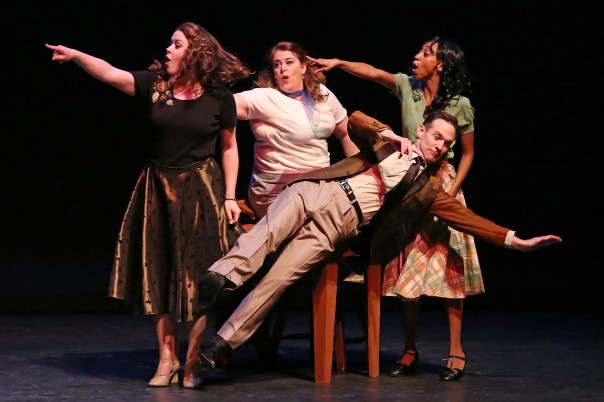
Nor is Ruhl’s tone angry, for there is plenty of whimsy in her updates and alterations. Orpheus now plays a violin instead of plucking a lyre, and Eurydice calls more of the tunes. Taking a couple of breaks from her wedding celebration, she encounters a Nasty Interesting Man who lures her with the promise of something important – a letter sent to her from the Underworld by her dead father. Rather than dying from a snakebite as she flees a lecherous pursuer, the mod Eurydice dies in the act of recovering what belongs to her, an intrepid action rather than a fainthearted one. This Davidson College Theatre Department effort, student directed by Matthew Schlerf, remains timely without any militant edges.

Scenic designer Chris Timmons brilliantly utilizes the Barber Theatre stage, dividing the action into three distinctive levels. Floor level will be the Underworld, but we begin on a broad platform high above that, where Orpheus proposes and the nuptials are celebrated. Further above, a permanent upstage stairway to the studio’s catwalk arches over the Nasty Man’s lair, offering the highest point possible for Eurydice’s fatal plunge. Death is a downer, to be sure, but Eurydice certainly isn’t chastened or humbled by her fall. Impervious to the indignity of the shower that greets her at the gateway – she has come prepared with a handy umbrella – Eurydice expects to be shown to her living quarters even though a chorus of stones has told her that there aren’t any. Not to worry, Eurydice’s father dutifully shows up to pick up her empty suitcase, guide her to her room, and begin teaching her all that she forgot in the River Lethe. I can’t say how Dad is supposed to build Eurydice’s room in Ruhl’s script, but here he weaves his magic with a rainbow-colored ball of twine threaded through eyelets on the floor and the stage-left wall, forming a gleaming cat’s cradle.

By introducing Eurydice’s father into the mythic mix, Ruhl gives her heroine a reason to linger down below and feel some ambivalence about obediently following in Orpheus’s wake. On the other hand, Dad’s pre-nup letter to his daughter becomes a precedent after her untimely death, for Orpheus dispatches a letter to his vanished beloved, relying on the worms for delivery – and Eurydice has no less confidence that what worked for her dad will work for her. The eternal comfort of this system of family correspondence is spoiled by just one thing: the Lord of the Underworld, who reeks of the Nasty Man’s unsavoriness (they’re played by the same actor), wants to make Eurydice his bride. One more reason to go with Orpheus when he finally comes knocking.

Schlerf casts judiciously, using players who are mostly sophomores but not younger. As the lovebirds, senior Cy Ferguson as Orpheus and sophomore Savannah Deal in the title role pair up magnificently. He’s good-hearted, undoubtedly vulnerable, and the perfect antithesis of his nasty rivals. Deal is up to the spoiled, imperious figure she cuts entering the Underworld, but we never catch her trying to come across any older than she is. This is a natural Eurydice, not a flawless one. That approach may not be as ideal for Collin Epstein as Father or Ryan Rotella as the nasties above and below ground. Costumes by Carolyn Bryan help Epstein as Dad and Rotella as the Godfather-like Nasty put on a few years perhaps. But both speak as naturally as Deal does, a welcome change if you’ve ever been irritated by young actors straining to look older with the aid of makeup, hair coloring, or false beards. Once we adjourn to the Underworld, Rotella is purposely portrayed as childish when he appears as Lord of this domain, wearing a dopey beanie and pedaling a trike. And if this isn’t a punitive, hellfire Underworld, why can’t Dad be any age he likes while spending eternity there? Ruhl mischievously makes up her own rules as she spins her old yarn, twisting it enough to make it new and genially provocative. There’s even a beguiling touch of mystery when we reach the ending.

© 2016 CVNC

Selling Elegance, Spirit, and History for Just a Song

Theatre Reviews: I Love a Piano: The Music of Irving Berlin and The (curious case of the) Watson Intelligence

CPCCILoveAPiano6[7]

After its most lavish and extravagant production ever, last November’s The Phantom of the Opera, what was CPCC Theatre going to do to follow up? Well, since the laws of mathematics and the logic of budgets still apply on Elizabeth Avenue, the answer was simple: economize! Rolling into the parking garage, where the second story was unusually unoccupied, I was worried the audience for I Love a Piano: The Music of Irving Berlin would be as drastically reduced as CP’s expenditures.

Not to worry, I didn’t find that many more empty seats at Halton Theater last Saturday night than I saw at last February’s How to Succeed. More importantly, considering the relative merits of Berlin and Andrew Lloyd Webber, the show attracted a competitive enough turnout at auditions to yield a cast that is worthy of the music — including holdover Ryan Deal, who you may recall in the title role of The Phantom.

Like the audience, the orchestra isn’t reduced quite as much as the funding, a quintet led by music director Ellen Robison from the keyboard. They’re a busy bunch, accompanying the cast — all six of them triple threats to various degrees — through a songbook that includes 53 different titles. A few of these songs are reprised, and at one point, when Andy Faulkenberry’s “The Girl That I Marry” is juxtaposed with Corinne Littlefield’s “Old Fashioned Wedding” — while J. Michael Beech and Megan Postle are teaming up on the counterpoint of “You’re Just in Love” — there are four different vocalists onstage singing four different melodies simultaneously.

Conceived by Ray Roderick and arranger Michael Berkeley, Love a Piano never says Berlin’s name out loud. But the 11 scenes, beginning with Tin Pan Alley in 1910 and ending in a summer stock revival of Annie Get Your Gun in the late 1950’s, take us chronologically through the composer’s career. Or roughly so: “Old Fashioned Wedding” was written for the 1966 revival of Annie Get Your Gun, and you can bet the anachronisms don’t stop there.

With a generous portion of poetic license, the show sketches a musical portrait of a composer who was consistently able to mirror his times. The title tune, “A Pretty Girl Is Like a Melody,” and “Alexander’s Ragtime Band” take us back to a sepia-tinted era when rags roamed alongside sentimentality. As we cut from band shell to speakeasy, “Pack Up Your Sings and Go to the Devil” and “Everybody’s Doing It” evoke the wicked carefree spirit of the Roaring ’20s during Prohibition.

Two scenes are devoted to the ’30s, “Blue Skies” and “I’ve Got My Love to Keep Me Warm” offering consolation during the onset of the Great Depression. Then a suite of dance tunes, including “Top Hat, White Tie and Tails” and “Cheek to Cheek,” evokes the elegance of Fred Astaire and Ginger Rogers. Thanks to Mel Brooks, the audience failed to take “Puttin’ on the Ritz” altogether seriously.

For some reason, Roderick — or perhaps CP’s director and choreographer, Ron Chisholm — bounced the heyday of dance marathons from the 1930s to the 1940s, sketching that lugubrious phenomenon with “Say It Isn’t So” and “How Deep Is the Ocean.” When we authentically reached the World War II era, it was quite obvious that Berlin more than reflected the hopes, the pride, and the humor of the times. He simply was these things, with a flowering of songs that included “Oh, How I Hate to Get Up in the Morning,” “This Is the Army,” “Any Bonds Today,” and “Count Your Blessings Instead of Sheep.”

Even those left plenty of room to bring down the first-act curtain with two of Berlin’s most enduring songs, “White Christmas” and “God Bless America.” A more judicious dividing line would have been the beginning of WW2 toward the end of the ’30s. As it stands, Roderick drops a bunch of CARE packages on the 1950s, including “Easter Parade” from 1933 and everything attached to Berlin’s sharpshooting homage to Annie Oakley, which premiered in 1946.

I Love A Piano

Photos by Chris Record

James Duke’s scenic and lighting design, relying heavily on period slides and Berlin show posters projected onto three screens, move us gracefully from era to era. But it’s Debbie Scheu who most colorfully clinches the deal with her cavalcade of costume designs. Chisholm’s choreographic demands certainly tax his cast, with Littlefield and Faulkenberry negotiating their steps with the most apparent ease. On the other hand, while Postle and Beech looked like they might not be up to their challenges, both of them surprised me with their hoofing.

Deal and Kayla Ferguson were the remaining couple, most memorable in their “Blue Skies” duet. All six of the singers proved to be quite capable, not at all fazed by the spotlight, but Deal and Littlefield were my favorite soloists. The ensembles were often very lively and charming, but a special pinch of conflict was added in the summer stock tableau when Ferguson, Littlefield, and Postle all auditioned to be Annie opposite Faulkenberry’s Frank Butler.

“Anything You Can Do,” usually a comical face-off between Frank and Annie, is set up as an audition piece. So the comedy is reborn — as a rollicking showdown between three aspiring Annies.

Eliza and Watson 3

Time and reality bend in curious ways in The (curious case of the) Watson Intelligence, now at UpStage in NoDa through February 21. But so does playwright Madeleine George’s title, so what else would you expect?

Three rather curious Watsons that we’ve already heard of are trotted out and shuffled in Three Bone Theatre’s production, directed by Robin Tynes. The first of these is a relative, shall we say, of the Watson computer that defeated its human opponents on Jeopardy in 2011. Eliza, who collaborated with IBM on the victorious Watson, is now in her living room, working independently on a new android that sports a far more human body.

We travel back to the 19th century for the other two Watsons that we know. The first of these is the Watson summoned to Alexander Graham Bell’s side when Pa Bell invented the telephone, his assistant Thomas A. Watson. But we don’t really see him, either, on that historic day in 1876. Instead, it’s Alex repeatedly calling for him in brief blackout vignettes between other scenes. No, we must wait until 1931, when Watson goes on record at Bell Labs, insisting that what his boss really said was, “Mr. Watson — come here — I want you.”

The third or fourth Watson, depending on how you tally the computer chips, is more in control of his narrative, for this is the Dr. John H. Watson who ostensibly chronicles nearly all of the Conan Doyle adventures of Sherlock Holmes. You’ll find that Watson Intelligence is all about connections Ð personal and electrical — and vague connections between the android and Sherlock’s sidekick are established by a fifth Watson, a tech dweeb hired by Eliza’s ex-husband to spy on her.

Compounding the absurdities, Tynes has chosen a black actor, Devin Clark, to play the whitest sidekick in the history of literature. What’s more, Clark is perfection as all the Watsons, human and robotic, plus a special set of scenes where he dons Sherlock’s deerstalker cap. Chesson Kusterer-Seagroves crystallizes Watson’s role as the archetypal listener, pouring out her heart to the robot and the tech dweeb in modern times and bringing an intriguing mystery to Watson at Baker Street in Sherlock’s absence.

Ken Mitten rounds out the cast as Bell and the two Merricks who cause their Elizas so much distress. He’s a powerful stage presence, but I’m sure he’ll be even better when he’s more secure with his lines and cues.

Albee’s Fantastic Day at the Beach

Theatre Review: Seascape

varwwwclientsclient1web2tmpphpoon8uj.jpg

By Perry Tannenbaum

Citizens of the Universe hasn’t announced the full details of its farewell season, but it has begun handsomely at “The Shell,” COTU founder James Cartee’s name for the suite on 2424 N. Davidson St. that CAST occupied in its latter days. The theater spaces where CAST often staged two productions at the same time have both been obliterated, stripped down to the original floors and walls, but the residue proves unexpectedly appropriate as a vast, bleak setting for Edward Albee’s Seascape, directed by S. Wilson Lee.

For awhile, the drama seems to revolve around Nancy and Charlie, a mid-life couple who bicker somewhat lethargically – compared with the titanic battles Albee staged between George and Martha in Who’s Afraid of Virginia Woolf? – about what they should do now and in the future. The weak grip this opening had on my attention was further weakened by Kylene T. Edson as Nancy, indistinctly audible when projecting her gripes over across the beach to her husband diagonally downstage. Lee would be advised to either energize Edson during these opening moments or bring her downstage more often.

Luckily, these difficulties evaporate when two ginormous lizards crawl ashore, frightening the humans as they scope them out. Since the sea is upstage, fright not only raises Edson’s energy level, it also drives her naturally toward us where she can be easily heard. Wariness is well-advised, but the lizards, Leslie and Sarah, aren’t foraging for food so much as they are reconnoitering the possibilities of life on land.

Amazingly, Leslie and Sarah speak English, if only the rudimentary kind you would expect from high school freshmen matriculating in Lancaster or Cabarrus County. There’s a lot for Nancy and Charlie to catch the reptiles up on, including the origin of the universe, the primordial soup, evolution, mammals, and the whole concept of emotions, beginning and ending with love. Shuttling between the urge to educate and the impulse to flee in terror, Nancy and Charlie might identify more with teachers in urban school districts.

The spark for this intriguing production comes largely from the extraordinary work Lee elicits from Emmanuel Barbe as Leslie, abetted by the phosphorescent glow of Kenya Davis’s makeup design. I’ve often struggled to penetrate through Barbee’s French accent when he battled against the Bard’s blank verse in Shakespeare Carolina productions. But here he is admirably slowed down by Lee – and often formidably booming. The physicality of him can be menacing enough as he advances toward you, but you really don’t want to broach the possibility that his species might lose their mighty tails during the next billion or so years of evolution. He’s attached to that tail.

By comparison, Brianna Merkel is a cute counterpart for Barbe as Sarah, as adorably clueless when she doesn’t understand concepts – matrimony, pregnancy, the list goes on – as Leslie is frustrated and antagonistic. We see a certain bond forming between Sarah and Nancy, peacemakers trying to calm their mates’ warrior instincts, and it’s here that Edson’s performance begins to blossom.

Brian Amidai is more consistently reliable as Charlie, very adept at the inertia of a husband who doesn’t wish to travel or repeat past adventures. He’s on a beach and just wants to relax, dammit, maybe get lost in a book. But Amidai’s transition between this beach potato and an instinctual protector rings viscerally true, and there’s a faint layer of comedy in the moments when he thinks he’s gone insane or died. Obliquely, I found him cuing my own reactions as this wild, mysterious fantasy unfolded.

Dahl’s “Matilda”: Don’t Mess With Mr. In-Between

By Perry Tannenbaum

We expect a fabulist like Roald Dahl to exaggerate and push reality to extremes, and so it is in Matilda the Musical, Dennis Kelly’s adaptation of Dahl’s book for second-graders-and-up with music by Tim Minchin. Parents either adore their offspring to the point of absurdity, creating a universe where all children are exceptional, or they’re like Matilda’s Mom and Dad, Mr. and Mrs. Wormwood, disdainful toward all her prodigious gifts.

Pity is, Dahl’s book was written in 1988, when middle-of-the-roaders ruled the political scene and moderation was a virtue. Dahl was outré back then. But now in a country besotted by the ideas that government can accomplish what is mathematically impossible and that government is an evil that should do nothing whatsoever, Dahl’s exaggerations nearly pale into realism. Adults really are that crazy.

Children who are this bright, luminous, and innocent have walked through such harrowing worlds before. Oliver Twist and Little Orphan Annie may be considered as Matilda’s true ancestors in literature, pop culture, and hit Broadway musicals. Amid the Fagins, the Miss Hannigans, and the Bill Sikeses, there’s always a kindly Nancy or a Grace Farrell to shine rays of hope and sunshine into the gloom. Here it’s Matilda’s first-grade teacher, Miss Honey, who lives under the thumb of the school’s horrific headmistress, Miss Trunchbull.

With the aid of outlandish costumes, the elder Wormwoods will still seem outré to the small fry in the audience, even in 2016. For the rest of us, their disdain for books and their faith in TV as an educational tool are sufficient markers. Dahl hasn’t pushed far enough, however, until he has Dad – a supreme creation of moronic conceit – insisting that Matilda is a boy from the moment she’s born, despite the evidence of her genitalia.

Nor does Dahl mess with nuance when it comes to Trunchbull. The headmistress is a former Olympic medalist in the indelicate sport of the hammer throw, and she revels so much in cruelly punishing unruly students she has designed a torture chamber expressly for that demented purpose. The preternaturally sized harridan is portrayed by the fiercely outsized David Abeles, and even he is augmented by mammaries that runneth over any cups in the county.

The frightfulness of Trunchbull and the blithe disregard of her used-car-salesman dad won’t faze any of the kids who have been baptized in Lemony Snicket, but that really isn’t the worst of this touring production’s baggage. Even on the second night of the run at Belk Theater, most of the kids were unintelligible. You’ll hear them, but what they’re saying is only fitfully comprehensible. The Observer’s review points out that printed copies of the lyrics are available in the street-level lobby, a less practical solution than supertitles when you’re sitting there in the dimly lit theater.

I caught up with the lyrics in the booklet that accompanies the Broadway cast album, which helped me to further appreciate the clever recitation of the alphabet when we reached the “School Song,” circling back to Matilda’s first day at Crunchem Hall Primary School. Even the first part of this song worked for me on a visceral level when I saw the unintelligible elder students scaling the gate to the school like caged animals and snarling at the newcomers about to enter. Yeah, that first day can be scary.

I’m assuming that the Broadway success of Matilda gives the lie to my contention that the show takes too much time to accomplish too little. Compared to the new School of Rock, which we’d seen nearly nine weeks earlier, my wife Sue and I found the kids onstage here less talented – and less molded into a genuine class by evening’s end. Three of Matilda’s classmates briefly pop into the spotlight at various moments, but there’s little rapport developing in the group, let alone camaraderie.

Sitting in the cozier 1460-seat Shubert Theatre in New York, I’d imagine we would have heard the darling children more easily. The lighting is also presumably better up yonder. I could hardly make out a word on Miss Honey’s blackboard in Act 1, which ultimately diminishes the impact of the denouement after intermission.

Three young actresses play the title role, compared with the four who share that responsibility on Broadway, but for some yet-to-be-explained reason Savannah Grace Elmer took over for Sarah McKinley Austin when the curtain rose Tuesday evening on Act 2. Both brought the requisite precocity to the table with a certain amount of British starchiness, just the thing for protagonists trapped in gray primary school uniforms.

So the grownups outshine the kids, cartoonish as most of the important ones are. Looming like an epic soldier from the Trojan War, Abeles is discombobulated enough by little Matilda’s defiance to make “The Trunchbull” a tasty villain. Cassie Silva and Quinn Mattfield as the Wormwoods have even less rapport with each other than Matilda’s classmates, bickering at those rare moments when they even acknowledge one another. Both are loudly colorful in Rob Howell’s costume designs and compete spiritedly for the edge in comical cluelessness.

It’s hard to say whether Stephen Diaz added more to Mom’s stupidity credentials or Dad’s as the mega-sleazy Rudolpho, Mrs. W’s competitive dance partner. Dad seems perfectly oblivious to their sensual tango rehearsals while Mom must miss a competition because a hospital physician informs her that she’s nine months pregnant.

The consoling women in Matilda’s life don’t offer the poor waif much in the way of guidance and wisdom. Obviously, the teacher is sweet: Miss Honey quietly defies The Trunchbull’s disciplinarian philosophy in her classroom, and Jennifer Blood strikes the right balance of timidity and righteousness when she meekly stands up to Trunchbull, advocating on behalf of her own humane pedagogy and Matilda’s special gifts. Ora Jones as Mrs. Phelps, the library lady, is a warm Gypsy-like sounding board for Matilda and a refuge from her absurdly broken home.

Phelps encourages Matilda to spin the story that will ultimately be her salvation. That’s what I like most about Matilda, for Dahl’s story-within-the-story turns out to be a miracle of rare device.

Lady Bracknell Weathers Three Storms

Reviews of The Importance of Being Earnest and The Miraculous Journey of Edward Tulane

Jon Ecklund (John Worthing) and Lance Beilstein (Algernon Moncrieff) in The Importance of Being Earnest.

They were planning to open The Importance of Being Earnest on January 22 at Theatre Charlotte, where Oscar Wilde’s “Trivial Comedy for Serious People” hadn’t played since 2002. But the snow and sleet that were icing the roads hadn’t begun to melt away on the following evening, so opening night was transformed into an opening Sunday matinee. Even if I had been able to scale my icebound driveway, I was already booked for the opera at Belk Theater.

After all the reshuffling on my iCal, my wife Sue and I were finally able to catch up with Wilde’s menagerie of smart alecks at the second Sunday matinee, nine days after the originally scheduled opening. With so many other reshufflers in the crowd, the Queens Road barn was close to capacity. An extra performance has been slated for 2:30 this Saturday to help out other migrants.

The airy sophistication of Joshua Webb’s set design boded well for the blizzard of bon mots to come, but who were these Ernests opening up the action, Lance Beilstein as the roguish Algernon Moncrieff and Jon Ecklund as the deceitful John Worthing? Beilstein had briefly blipped on my radar last year when he was cast in a stage adaptation of Casablanca that didn’t happen. and Ecklund had never performed on a Charlotte stage before nailing his audition as Wilde’s protagonist.

Yet they instantly established a fine rapport, hinting early on that Algy and Ernest — as John calls himself in London — were not only great friends but kindred spirits.

There was a problem, however, even before the divine ladies arrived. Though their chemistry was sparkling, Beilstein’s cue pickup was razor sharp while Ecklund’s was erratic. Not a symptom you would expect from your lead at the end of your second week.

Ecklund’s symptoms became more serious during the scene change between Acts 2 and 3. In fact, he was taken to the hospital, reportedly suffering from dizziness, and didn’t reappear.

Johnny Hohenstein, who plays John’s butler at his country home, bravely substituted for Ecklund during the final 19 minutes, script in hand. That forced the imperious Lady Bracknell to announce herself when she triumphantly reappeared.

The waters were already troubled in Act 1 when Jill Bloede, amply bustled in a floor-length dress, first floated in like a majestic tugboat as Her Ladyship. It was she and she alone who must approve of Ernest as the prospective husband of Algy’s cousin, Miss Gwendolen Fairfax — a grim prospect, since her wicked nephew has already devoured all the cucumber sandwiches.

Lady B attempts to be judicious. Ernest’s income of seven to eight thousand pounds, the equivalent of $1 million annually according to the Norton Edition of the text, actually counts in his favor.

It’s Ernest’s lineage that is an insuperable stumbling block, for he cannot trace his family any further back than a leather handbag! My, how Bloede huffs when she repeats that fatal word, nearly adding an extra syllable to it each time she lingers on the first letter.

Lady Bracknell’s contempt was so hilariously absolute that when she exited, leaving Ernest and Gwendolen’s hopes of marital bliss in shambles, the audience erupted in lusty applause.

By the sort of insane coincidence that Wilde uses to resolve Ernest’s difficulties, Bloede’s name rhymes with Lady. So, after her current triumph, Jill is no more: she will no doubt have to suffer being called Bloede Bracknell for the rest of her days. You may revise my headline accordingly.

Needless to say, Bloede’s arrival calmed any worries that this production, directed by Tonya Bludsworth, would be anything less than a delight. Eleven years after starring in NC Shakespeare’s Twelfth Night, Gretchen McGinty’s professionalism still gleams with vitality and caprice as Gwendolen, irresistible despite her perverse silliness. She accepts Ernest, but only for the shallowest of reasons — she’s the perfect antithesis of Juliet.

Caprice continues to rule when we arrive at John’s country home for Act 2, where we meet his lovely ward, Cicely Cardew. Her requirements for a prospective husband are not merely similar to Gwen’s.

They are exactly the same, obliging both John and Algy to make christening appointments with the Rev. Canon Chasuble. Under the watchful eyes of Cicely’s governess, Miss Prism, Algernon has snuck into John’s home, pretending to be his fictitious brother Ernest, and swept Miss Cardew off her feet. That’s partly because Miss Prism’s eyes are devotedly affixed to the Reverend.

As we’ll learn in the denouement, it’s not the first time Miss Prism’s attention has wandered.

Further complicating John and Algy’s attempts to live double lives, Gwen follows her would-be fiancé into the country — with her mother barking at her heels. The running joke of Act 2, amid all the confusion of who’s really betrothed to Ernest, is the radical shifts of sisterly love and murderous hatred between Gwen and Cicely.

Mixed in with devout cynicism and decadence, punctiliousness and pomposity squandered over trivialities are the key ingredients of Wilde’s satire, and Bludsworth has her entire cast embracing it with the proper élan.

Emily Klingman is hormone-driven innocence in a lemon chiffon dress as Cicely, assiduously transcribing Algy’s marriage proposal into her teen diary, and Hank West bumbles quite sanctimoniously as Rev. Chasuble when he manages to recall where he is. Scrunched up like a squirrel, Stephanie DiPaolo is the essence of fretful and incompetent spinsterhood as Miss Prism.

Bludsworth also differentiates nicely between the servants. Ron Turek is urbane and dignified as Algy’s man, Lane; while Hohenstein, tasked to distraction by his temperamental superiors, is more apt to let his resentments play over his face as John’s butler, Merriman. Or he was until he was obliged to pick up Ecklund’s script and stand up to Bloede Bracknell.

Edward Tulane(C)Donna Bise 6686

Photo by Donna Bise

Not at all plagued by postponements, The Miraculous Journey of Edward Tulane opened at ImaginOn last weekend in as polished a production as you’ll ever see from Children’s Theatre. It’s a gem that will no doubt remind longtime subscribers of The Velveteen Rabbit, since the title character is a rabbit doll. Ah, but Edward is fashioned entirely of porcelain, except for his furry ears and tail (he prefers not to think about the origin of his whiskers).

Adapted by Dwayne Hartford from the novel by Kate DiCamillio, Edward’s story begins when he is given to 10-year-old Abilene Tulane on Egypt Street by her mysterious grandmother Pellegrina, the only human who knows his heart.

Unlike the Velveteen, Edward does not aspire to be real or human, but he is frustrated when Abilene doesn’t set him in a place where he can see the outdoors and the stars through her window.

Even before he is severely broken many years later in Memphis, Pellegrina perceives his flaws, and the inference is that he must suffer for them. But Edward’s sufferings and adventures will be epic ­— beyond human, to tell the truth.

Our protagonist remains the three-foot doll the DiCamillio created, but Mark Sutton is always close by to articulate his thoughts, shouldering and picking a banjo as Edward morphs into Susannahr, Malone, Clyde, and Jangles during his odyssey on land and under the sea.

Margaret Dalton figures most prominently as the bereft Abilene, but she resurfaces on numerous occasions during Edward’s journey, most notably as a frisky dog. Beginning as the semi-exotic Pellegrina, Allison Rhinehart ranges across multiple roles and genders, last seen as Lucius Clark, the sagely doll mender. Devin Clark rounds out the cast, shapeshifting from fisherman to hobo to handyman when he isn’t slyly inserting sound effects. Pure enchantment for 81 minutes.

Up Close and Versatile: Michael Collins Plays Mozart, Stravinsky, Adams, and Bruch

Michael Collins | University of London Symphony Orchestra

By Perry Tannenbaum

February 1, 2016, Charlotte, NC – Michael Collins will no doubt bring pleasure to thousands later this week when he plays Mozart’s great concerto for basset clarinet with the Charlotte Symphony on consecutive nights at Belk Theater. Yet it would probably be exaggerating to say that hundreds were in attendance when the esteemed virtuoso performed another pair of concerts earlier in the week on the fourth floor of the Bechtler Museum of Modern Art – one for a lunchtime crowd and another after work. Poetic justice would have decreed that at least an equal number should bear witness when Collins, toting two other clarinets, headlined a program that not only included a complete Mozart clarinet trio but also a solo Stravinsky suite and generous samplings of works by John Adams and Max Bruch. Joining Collins were pianist Bruce Murray, who pinch-hit personably on most of the hosting, and violist Rosemary Furniss. There were a couple of links between the two pairs of concerts: Collins is playing both programs and Christopher Warren-Green, the Charlotte Symphony’s musical director conductor, is united in holy matrimony to the woman who wielded the viola.

Furniss’s hand was certainly perceptible in the choice of repertoire, since she collaborated on Mozart’s “Kegelstatt” Trio and a selection of Bruch’s 8 Pieces for Clarinet, Viola and Piano at a Davidson College concert in September 2013. These sweet trios framed the two more raucous works that Furniss sat out. All three trio members had their moments to shine from the opening Andante of Mozart’s E-flat gem. Furniss introduced the first subject at the beginning and its return at the end of the movement, answered by Murray, who laid the groundwork for Collins’ first entrance and then beamed with joy as soon as he heard the clarinetist’s first notes. With good reason. The waltzing 3/4 sway of the ensuing Menuet was instantly evident, especially since Collins himself swayed a bit with the melody while Furniss sawed an agitated countermelody. Nor was Murray idle here, at times playing two strands of accompaniment at the same time. Collins dreamily led into the concluding Rondeaux, hitting the high notes effortlessly, and Murray’s responses from the keyboard grew more elaborate. Interplay was quite delightful as Murray and Furniss led off successive rounds. At a certain point, Collins’ answers gave way to an outright takeover, with delicious filigree that dipped into the lower range of the instrument. Staccato passages near the end, when the trio chimed in together, were brimming with charm.

The first of Stravinsky’s Three Pieces for Clarinet Solo was actually a mellow, brooding thing, ideally suited for showing how much better-suited the clarinet is to the Bechtler space than a grand piano. Following this Molto tranquillo, the second piece was quick, raucous and squawking. Collins himself called attention to the hall midway through, pausing for a moment and waiting until the echo almost died away before flinging himself into that latter half. The third piece was no less fleet and raucous, but it had more of a circular, chasing feel rather than jumping around helter skelter, ending with an emphatic tweet that Collins clearly relished.

It was Collins who premiered Adams’ Gnarly Buttons in 1996, and he chose the middle movement of the piece, the shortest yet most signature of the three. “Hoe-down (Mad Cow)” would normally be associated with horses, according to the composer’s album notes, but it takes on its altered perspective as a nod to his “British friends who gave the first performance during a time of quarantine.” Recorded with the London Sinfonietta, the album cover features a wide-eyed animal that could serve as the perfect poster child for the infamous mad cow disease. It’s the most challenging of the three movements, but as Collins pointed out in his intro, in distilling the 11-piece accompaniment to the piano, the arranger had probably shifted the burden of difficulty to Murray. Indeed, Murray poured forth fistfuls of notes during this merry frolic. Interspersed with his hoe-down romping, Collins had the most minimalistic figures, which occasionally sounded like a boogie-woogie bass pattern. Clearly enjoying himself and Murray’s trials, Collins had time to point out the most important ingredient that this reduced version had to sacrifice – the sound of the lowing cow from the orchestral version. He mouthed the moo when it came around.

Scored for viola or cello (Furniss split her part with cellist Alan Black in her previous go-round), Bruch’s 8 Pieces are mostly dark and melancholy, so the four movements selected were altered from their intended sequence, leaving out the final Moderato and ending instead with the penultimate Allegro vivace, the only segment of the suite in a major key. The overtones of Murray’s introduction to the “Nachtgesang” actually emulated a clarinet’s sound, but there was no mistaking Collins’ true entry, floating in on high and dipping into darkness. Furniss’s nocturnal viola intertwined with the clarinet, before and after an exquisite Collins monologue, forming an ethereal frame. Launching the brief Allegro con moto, the viola came in darkly before before Collins echoed it from above, but the most characteristic of the Bruch pieces was “Rumänische Melodie,” with Furniss achingly setting the tone, at times reminiscent of Sarasate’s firelit Gypsy ruminations and the keening of Jewish cantorial music. Collins and Murray were at the forefront of the Allegro vivace, but Furniss was very expressive in the accompaniment, fomenting the augmented intensity when frolicsome passages veered suddenly into turbulence. Throughout the concert, I had an up-close view, less than 10 feet from Collins when he took his final bows. Nor were my seats reserved: any one of the thousands who may marvel at Collins’ musicianship this Friday and Saturday night could have snatched up the same opportunity on Tuesday, at a fraction of the ticket price.

Copyright © 2016 CVNC

Production Values Continue to Evolve at Charlotte Ballet’s Innovative Works

Innovative Works_Yamato_Dancer Ryo Suzuki

By Perry Tannenbaum

January 29, 2016, Charlotte, NC – Ever since the event was created in 2003, when Charlotte Ballet was known as North Carolina Dance Theatre, Innovative Works has been a special event in the company’s season, performed at a special venue that further set it apart. The size of these venues, the length of the pieces on the program, and the number of dancers in each work were all smaller than the big ensemble pieces staged at Belk Theater and, more recently, at Knight Theater. Charlotte Ballet artistic director Jean-Pierre Bonnefoux was not only providing a platform for edgier, lapidary pieces, he was also establishing an incubator for new choreographers, usually dancers or former dancers in the company, to expand their creativity and pave a pathway to their afterlives when they were no longer onstage.

Works first seen at Innovative have not only enriched the repertoire of Charlotte’s pre-eminent performing arts group, they have served as springboards for further choreographic creations and for the formation of new companies outside Charlotte established by the former fledglings. This year’s collection of miniatures, running at the Patricia McBride and Jean-Pierre Bonnefoux Center for Dance through February 20, presents the brainchildren of current and former troupe members wedged among works by the company’s resident choreographers. Included on the bill are pieces by Dwight Rhoden, Mark Diamond, Sasha Janes, David Ingram, Sarah Hayes Harkins, David Morse, Gregory Taylor, and Josh Hall.

That’s a bunch, to be sure, but three of the works choreographed by current dancers – the “Dancer Spotlight” – are presented in rolling rep, so each evening consists of six pieces. The first two, Rhoden’s “Ballad Unto” and Ingram’s “Omologia,” are staples in every performance of the run. Taken together, they exemplify how Innovative has evolved. Intimacy and chamber size are no longer requisites of new choreography unveiled at the McBride. Both of these pieces were long enough to present on the Knight Theater mainstage, and by the time they were done, we had seen 18 dancers perform, including three up-and-comers from the satellite Charlotte Ballet II company.

Although scenery is still outlawed in this studio setting, lighting has become very sophisticated. In fact, the hard-edge lighting designs by Jennifer Propst are very much at the forefront of both experiences. Further blurring the difference between Knight and McBride presentations, the previously filmed “Behind the Dance” segments, where the choreographers talk about either their aesthetic or the genesis of the piece we’re about to see, are now as much a part of Innovative as they were last October in Fall Works at the Knight.

Innovative Works_Dwight Rhoden_Ballad Unto

Photos by Peter Zay

Rhoden’s “Ballad Unto” sets Bach’s famed Chaconne, prerecorded on violin, upon five couples, yet this destination is preceded by a setting to assorted sounds, textures, and rhythms that seemed equally long and substantial. Jamie Dee Clifton and Josh Hall were the couple that grabbed my attention most dynamically, but Ben Ingel and Raven Barkley were also charismatic standouts. All ten of the performers delighted in both the high-speed handwork and the footwork that Rhoden challenged them with, consistently accenting the beat with precision. Rhoden himself had fresher, livelier ideas than you might expect from him this deep into his career responding to Bach. Propst had a fairly a fairly stunning reaction to the choreography, setting five squares on the floor in an M formation for the five couples, occasionally replacing them with – or superimposing them on – an inverted V.

Interaction between the dancers and Propst’s lighting design was even more salient in Ingram’s “Omologia.” As the eight dancers advanced toward us at the outset of the piece, set to Corelli’s “La Follia,” a bright illuminated line across the stage seemed to daunt their progress. Once the dancers took possession of the stage, we discovered that there would be two more lines of lights connected to the first – and that each of the three lines was actually comprised of three adjacent squares. So while the dancers danced in close sync with the music, the nine pre-programmed squares, blinking on and off, were similarly wed to the movements and the shifting tableaus of the dancers. Numerous permutations of the nine squares flashed before us, including U shapes formed by seven of the squares that opened out at various moments to all four points on the compass.

From these lengthy baroque abstractions, we suddenly transitioned to a very real subject with Harkins’ “#Hatehurts,” the sort of high-concept piece that has typified Innovative in the past. Diagonally across the stage from each other when the lights came up, Sarah Lapointe in the foreground and Ingel upstage sat in front of laptop computers, reacting to online bullying and its fatal consequences. Of the six dances, this was the only one that didn’t come to us paired with a filmed introduction. Sure, it was the piece that least required explanation, but it was also so short that a prelude may only have drawn further attention to the piece’s brevity. Perhaps if the seated opening tableau didn’t seem to be such a substantial portion of the piece, the effect would have been more powerful, for the dance seemed to end as it was just getting started once the couple converged at the middle of the stage. The ratio between the prerecorded bullying and suffering we heard about and the anguish we saw live from the dancers ultimately struck me as too message-rich, an effective presentation for middle schoolers, perhaps, but artistically too thin for me.

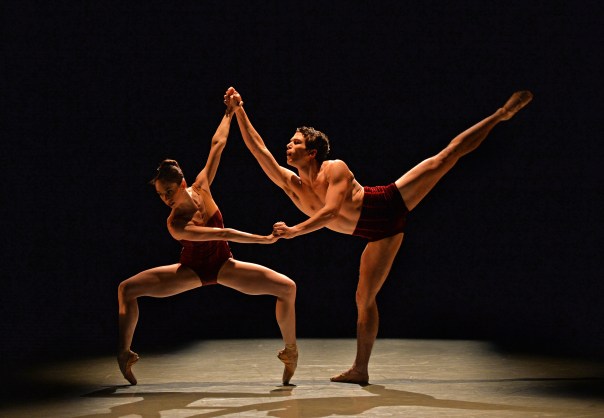
John Adams’ “Short Ride in a Fast Machine” served as both title and soundtrack for David Morse’s piece, brilliantly danced by Harkins and Hall. In costuming, lighting, and choreography, Morse divides his work in two. The dancers come on in dim light, Hall in a waistcoat and Harkins in a long flowing blouse. Turning up their intensity, the dancers shed these upper garments as the lights come up fully. This moment of liberation is amplified by the ensuing choreography, which utilizes the entire stage. Morse’s piece returns to the rotation during the evenings of the final weekend of the run, February 18-20. Next weekend, Morse’s spot is taken by Gregory Taylor’s “Requiem of a Meaning,” and Hall shows off his “Social Butterfly” on the third weekend.

Hall will be borrowing rookie dancer Ryo Suzuki for his solo piece. Meanwhile, he is featured in “Yamato, earth/nature/drum,” a three-part celebration of Japan by Diamond, demonstrating that he’s no less eager to pursue new directions than Rhoden. The 12 people in this piece form a spherical mass as Propst’s shimmering lighting comes up, with Suzuki slapped across it horizontally. Then the ball explodes in big-bang fashion to an original score arranged by Rocky Iwashima, heavy with taiko pounding. Ultimately, the group regathers downstage in a tableau that is analogous to the spherical beginning but with Suzuki in an uplifted, triumphal posture. Inside of this effective framing, Suzuki and Addul Manzano are the dominant presences, although Barkley is hard to ignore whenever she’s involved.

Charlotte Ballet Innovative Works by Christopher Record

Photo by Christopher Record

For his new work, “Sketches from Grace,” Janes veered from his intent to create settings for works by Leonard Cohen, opting instead for a four-piece suite of settings to cuts by Jeff Buckley – including his cover of Cohen’s “Hallelujah,” which became a posthumous #1 hit for Buckley in 2008. The work showcases a punkish set of costumes by Katherine Zywczyk with faint, silvery highlights, beginning with Buckley’s most distinctive original, “You and I,” a brooding, floating, dreamy song that would seem to defy choreography. Yet Chelsea Dumas and James Kopecky fully conveyed the smoldering energy lurking in the lyric. Once covered by Nina Simone, “Lilac Wine” took the tempo up to a bluesy dirge, given an aching elegance by Ingel partnering with Alessandra Ball James. Bringing the tempo further up to a lethargic shuffle, “Hallelujah” was undoubtedly the climax of the suite, danced with such heartbreaking perfection by Hayes and Hall that the audience applauded as if it were the finale, although Janes’s video intro had promised us that all three couples had a concluding segment together. That closing ensemble was a more driven Buckley original, “Lover You Should Have Come Over,” very appropriate for the hubbub of three couples strutting their stuff simultaneously. Those last pushes in tempo, spectacle, and animation gave the audience one more reason to cheer.

Opera Carolina’s “Roméo et Juliette” Conquers Adversity and Inhibition

The final duet.
 

By Perry Tannenbaum

January 28, 2016, Charlotte, NC – It’s obvious that James Meena has a special fondness for Charles Gounod’s Roméo et Juliette, since no other Opera Carolina maestro had ever presented the work before – and now Meena has brought the tragic Shakespeare adaptation back eight seasons later. Both productions have been somewhat star-crossed. When Meena introduced the opera in 2007, the soprano couldn’t quite scale the heights of the stave in Juliette’s arias and the tenor who adored her couldn’t take his eyes off Meena’s baton when he sang, a rather wooden Roméo. This time around, weather and illness have been the adversities that Opera Carolina has been forced to conquer.

Days ahead of the Sunday afternoon opening, forecasts of the superstorm that would cripple the city caused Opera Carolina to offer special discounts for intrepid ticket buyers willing to brave the elements. My driveway was still so encased in ice at curtain time that my wife Sue and I couldn’t reach the street at the top of the hill where we had parked our car. After rescheduling for Thursday, we had barely settled into our seats at Belk Theater when we learned from Meena that the soprano slated for the title role, Marie-Eve Munger, had come down with bronchitis, sounding less like Juliette than Friar Laurence when the conductor had spoken to her earlier in the day.

There was a positive twist to this adversity. Although I had missed Munger’s debut, I would catching the first performance by Sarah Joy Miller with the company. Slated to perform as Juliette when this co-production moves on to Grand Rapids in April and Baltimore in May, Miller not only appeared to be acclimated to the role and Bernard Uzan’s stage direction, she also appeared comfy in the clinches with Jonathan Boyd, who will be paired with Miller in those upcoming productions.

In contrast with the 2006 Spoleto Festival USA, which remodeled the two ancient warring Montagues and Capulets into families in the Godfather mold, both of the Opera Carolina productions have been refreshingly traditional. You might even say radically traditional, since the supertitles of the current production revert to the original Shakespeare whenever possible, even at the cost of mistranslating the French of librettists Jules Barbier and Michel Carré. Production design by Uzan and Michael Baumgarten is nearly as traditional, evoking Verona very much the way old-school Shakespearean productions do. Three sets of Romanesque arches, rearranged and dressed between scenes, serve admirably for the Capulet palace, Juliette’s balcony, Juliette’s bedroom, Friar Laurence’s chapel, and that gloomy vault where Roméo finds the sleeping Juliette on her tomb. Baumgarten’s lighting and his superb projection designs also help to differentiate the scenes.

While Gounod and his librettists will bring down the curtain when the two lovers perish, Uzan contrives to stage the aftermath – the grim reconciliation of the feuding families – as this production’s prologue, where Shakespeare originally had his chorus. While this necessitates an extra scene change, whisking away the tomb where the dead lovers lie and bringing the lights back up on the festive night when they first met, the alteration plays as if that’s what Gounod always intended, particularly since he wrote enough gorgeous music to cover the subterfuge and the Charlotte Symphony Orchestra plays it so lustily under Meena’s baton. Nor is it much of a stretch for the Opera Carolina Chorus to sound funereal in the hushed opening passages.

An adequately majestic staircase is placed centerstage at the Capulet palace for Juliette’s entrance, and the dazzling dress that Miller gets to wear throughout this giddy evening for her birthday party makes it count. Miller herself was not quite so dazzling when she soon reached Juliette’s signature “Je veux vivre dans ce rêve” aria, straining to reach the high notes, getting there but not comfortably. She began to settle down in the iconic first encounter with Roméo: the “Ange adorable” duet, staged chastely with Boyd in a pleasing palm-to-palm style as the lovebirds circled one another.

Boyd sang beautifully and securely all evening long, but the most transporting moment came when he sang Roméo’s great “Ah! lève-toi, soleil” to launch the balcony scene. Juliette’s nightgown is no less bright than her party dress, dramatically lit by Baumgarten as she makes her way into the moonlight, so there can be no mistaking what Shakespeare meant when he wrote, “It is the East, and Juliet is the sun!” It hits with seismic force here, and the “Ah, ne fuis pas encore!” duet that closes the scene is even more enchanting than the lovers’ first meeting.

There’s considerably more chemistry between Boyd and Miller in this production than there was when Gaston Rivero and Sari Gruber sang the title roles in 2007, and Uzan pushes it in the bedroom scene, where the lovers’ awakening is nearly as sensual as the opening scene of Sondheim’s Passion. For anyone who thinks that opera is pathologically stiff and glum, this Opera Carolina effort will be an eye-opener. Miller caught fire when we needed it most, carrying us over the climactic aria where Juliette chooses between stabbing herself and drinking Friar Laurence’s sleep potion.

Supporting roles are wonderfully cast and sung, mostly by newcomers. Imposing enough to be Shakespeare’s Capulet, Ashraf Sewailam was the most impressive of the baritones, expansive in his geniality as party host yet more than sufficiently authoritative as the family patriarch. Efrain Solis obtained maximum mileage from Mercutio’s “Queen Mab” ballad, more effective as a satirical cut-up than he was subsequently as a tragic calumniating victim.

Remember Romeo’s page, Stephano? Of course not. Gounod added her – it’s a soprano pants role – to spark the strife between Tybalt and Mercutio before the fatally pacific Roméo arrives and intervenes. Kim Sagioka makes a startling debut in this odd cameo. Among the old hands, bass Kevin Langan has all the dignity and warmth we want in the helpful Friar, and tenor Brian Arreola is perfectly pugnacious as Tybalt – actually so dashing in his wig and costume that I wished that the Capulets and the Montagues had switched uniforms so that Roméo could look more cavalier.

There’s a whole mini-ballet in Gounod’s score, 18 minutes long on the EMI Classics recording, that nearly all companies skip, but to me, cutting the next two scenes is a bit like tossing away the baby with the bathwater. After justifiably axing the choreography expense and the dancer payroll, I’d love to see the wedding scene where Juliette drops dead just as Paris is putting the ring on her finger. Soap opera and grand opera unite!

We save on having a Friar John in the cast (if the Duke of Verona doesn’t double) when we omit the next scene where Friar Laurence learns that Roméo never got the sleep potion memo, but why not leave it in for the few folks who may be coming to the story for the first time? Eric Loftin would certainly approve of restoring the wedding, since the tenor gets too little opportunity to show his mettle in his Opera Carolina debut as Paris.

Quibbles aside, this is one outstanding production that has it all: merriment, chaste romance, spectacle, sensual passion, a touch of comedy, and the ultimate tragedy. All the members of this sterling cast and chorus were as much into the drama as they were into the music, and the singers and musicians were constantly feeding off one another. As a result, the three hours joyously flew by.

Copyright © 2016 CVNC

Goings and Bearden Double-Team Black History in The Children of Children Keep Coming

Adapter-director Quentin Talley (top center) stands with his fine cast for “The Children of Children Keep Coming.”

By Perry Tannenbaum

January 27, 2016, Charlotte, NC – Suffering, persistence, and indomitable creativity are the threads that Russell L. Goings has used to weave The Children of Children Keep Coming, an incantatory and poetic account of the Afro-American journey. Quentin Talley, the artistic director of On Q Productions, has adapted and directed Goings’ “Epic GriotSong” for the stage, adding chants, work songs, blues, jazz, gospel, dance, hand clapping, foot stomping, ceremonial movement, and a cast of characters who all moonlight as members of a Greek-style chorus. The drawings that appear in the hardcover book by Romare Bearden are incorporated into Jeremy Cartee’s video design, losing a little of their impact in the transition from the page to the Duke Energy stage at Spirit Square, but quotes from Frederick Douglass, Marcus Garvey, Paul Laurence Dunbar, Langston Hughes, Adam Clayton Powell, and Martin Luther King are sprinkled into the script to take up the slack. With varying degrees of success in the singing impersonations, we also had cameos from Ma Rainey, Marian Anderson, Mahalia Jackson, and Sarah Vaughan.

Theatrical history isn’t littered with successful adaptations of epic poetry, so the task that Talley has undertaken would be difficult even if Goings’ poem came equipped with affecting character development and a graceful narrative arc. Aside from a generic Grandmother and Grandfather, none of the characters actually converse, and after we’ve been immersed in the slavery experience, the road – or train – to freedom is more of a cyclonic swirl than a straight or winding path. We go back and forth to various historical landmarks. Reaching Rosa Parks is no guarantee that won’t be doubling back abruptly to revisit the roots of jazz or even the Civil War – or that we won’t return to Rosa afterwards, still refusing to move to the back of the bus.

Talley gives a remarkable, evangelistic performance as our Narrator, but his work directing his fellow actors – and extra chorus members from the West Mecklenburg High School Drama – struck me as his most astonishing feat. Every one of the actors has numerous quick lines that don’t really respond to the line just spoken. Most of the lines throughout 110-minute show simply follow a cue line. Unless we see an actor moving toward a spot on the stage – or an actress making an onstage costume change while the Narrator is speaking about her character – we usually don’t know who will speak next. That means we need to amp up our concentration level as The Children of Children careens unpredictably from one speaker to another and fromone historical subject to another. The core cast of eight performers face an even more daunting task, keeping the ping-pong of the choreopoem format moving along briskly while executing the intricate patterns of the ensemble’s physical movement.

Even when you’re delivering your line on cue, one further level of concentration often comes into play. From his spot upstage, Talley might be saying the same line slightly ahead or after you. Or the chorus may be saying something else in unison altogether. Remarkably, this rapid-fire choral presentation only sputtered occasionally – and then only slightly – as this unique show sustained its impressive momentum. Helping to maintain order, Talley has strewn three mobile reading stands across the upstage. These stands not only help him to overlap without memorizing all those additional lines and cues, it helps with the daunting multitasking he must pull off as star and director of a fairly massive production.

We can also view this setup as an intermediate stage in the development of this On Q property. When the company unveiled the new script, first at Johnson C. Smith University in 2012 and in 2013 at Duke Energy Theater, it was as a reading stage production. Now with the entire chorus virtually off-book – and one glaring technical shortcoming – we can categorize the 2016 edition as a workshop production. Talley may have been partially aware of the technical gap still remaining in this project, since the program booklet still doesn’t list a lighting designer. Amid all of his multitasking (and the absence of an assistant director to be his eyes when he’s onstage), Talley has missed how sorely a lighting designer is needed. Time after time when he was declaiming from his spot behind the central reading stand, a thick, disconcerting bar of shadow covered him from head to toe, separating him from the light surrounding him.

Yet the energy continued to pour out from him, largely because the pace and the gusto of his cast bounced the energy right back to him. All of the major singing voices are new to this remount. Shar Marlin has become On Q’s go-to vocalist over the past two years, portraying Bessie Smith on multiple occasions, so it figures that she would get the nod when it came time to trot out Ma Rainey, Mahalia, and Lawdy Miss Clawdy. Andrea Michele, on the other hand, has only appeared on my radar previously as the tomboyish lead in Pauline Cleage’s Flyin’ West when Davidson Community Players produced it nearly two years ago. Michele’s singing voice as Evalina turns out to be very fine. Kenya Templeton is even more impressive in the more central role of Calli of the Valley, and she sang purely and sweetly as Marian Anderson, though she missed the famed contralto’s distinctive timbre by a wide margin. Most memorable is how Templeton’s scat singing Ella-vates the bebop segment and makes it a celebratory highlight.

The familiarity of the recorded legacy put Omar El-Amin on shaky ground when we reached MLK, but the efforts at elongating his syllables did not obliterate the goodwill El-Amin had built up in his evocations of Douglass, all of those seeming to come from the heights of Sinai or Rushmore. Few members of most audiences are familiar with the barking Caribbean patois of Marcus Garvey, Jr., so Shiduan Campbell wasn’t saddled with the objective of duplicating the notorious revolutionary in his Charlotte debut. There was also some promising versatility in his more genial stints as Grandfather and Banjo Pete, though the latter role didn’t come equipped with either an instrument or a vocal solo. Playing opposite Campbell as Grandmother, Soumayah Consuela Nanji also didn’t have a vocal solo in her debut, and she frankly mystifyied me a little. She was a fine Grandma and Rosa Parks at first blush, but between her two stints as Rosa, she was nearly inaudible when called upon to address us from the upstage platform. The ensuing rendezvous with Rosa was equally underpowered, as if she had lost her voice in the middle of the performance.

Yet Nanji’s vitality was undimmed when she danced with Campbell each time the grandfolk grew frisky. I wouldn’t be surprised if Talley had his eye on her for choreographic chores in future On Q presentations, including the full production of The Children of Children. Other things to think about as this project enters its next step, besides establishing a more linear scenario, is being more informative about the cavalcade of notables mentioned during the course of the evening. They enrich the experience for the initiated, but they’re likely to be nothing more than dropped names for youngsters or people who may be dipping into the sea of Afro American culture for the first time. The hardcover edition of Goings’ epic is followed by a 38-page glossary, a useful tool if you’ve never heard of Ben Webster, Claude McKay, or James Meredith before. I’m hopeful that Talley’s stage version, so rich in the music and the essence of the Afro-American experience, will evolve into something more than a handsome gateway to the book on sale in the lobby. Already the living performance is showing the potential of transcending the poem.

Copyright © 2016 CVNC

Jazz: The Best CDs of 2015

New Releases

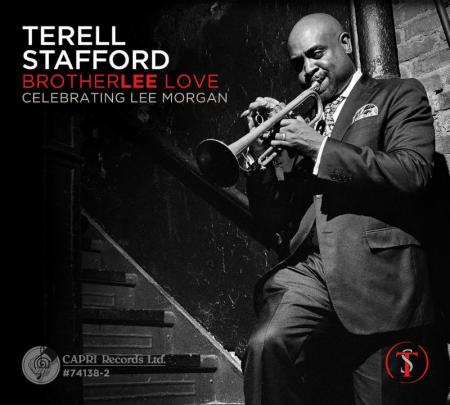
Terell-Stafford-BrotherLee-Love

  1. Terell Stafford – Brotherlee Love (Capri)
  2. Harold Mabern – Afro Blue (Smoke Sessions)
  3. The Gary McFarland Legacy Ensemble – Circulation: The Music of Gary McFarland (Planet Arts)
  4. Matt Mitchell Quintet – Vista Accumulation (Pi)
  5. Arturo O’Farrill – Cuba: The Conversation Continues (Motéma)
  6. Cécile McLorin Salvant – For One to Love (Mack Avenue)
  7. Jazz at Lincoln Center Orchestra with Wynton Marsalis – Live in Cuba (Blue Engine)
  8. Charles Lloyd – Wild Dance (Blue Note)
  9. Maria Schneider Orchestra – The Thompson Fields (ArtistShare)
  10. Kurt Elling – Passion World (Concord Jazz)
  11. Jack DeJohnette – Made in Chicago (ECM)
  12. Dave StrykerMessin’ With Mister T (Strikezone)
  13. Rudresh Mahanthappa – Bird Calls (ACT)
  14. Scott Hamilton – Hamilton & Hamilton Live in Bern (Capri)
  15. Alexis Cole & Bucky Pizzarelli – A Beautiful Friendship (Pony Canyon)
  16. Joe Locke – Love Is A Pendulum (Motéma)
  17. London, Meader, Pramuk & Ross – The Royal Bopsters Project (Motéma)
  18. Ryan Truesdell’s Gil Evans Project – Lines of Color: Live at Jazz Standard (ArtistShare)
  19. Snarky Puppy – Sylva (Impulse)
  20. Chris Potter Underground Orchestra – Imaginary Cities (ECM)
  21. Karrin Allyson – Many A New Day (Motéma)
  22. Harris Eisenstadt – Canada Day IV (Songlines)
  23. Richard Nelson Aardvark Jazz Orchestra – Deep River (Heliotrope)
  24. Dee Dee Bridgewater – Dee Dee’s Feathers (OKeh)
  25. David Chesky /Jazz In The New Harmonic – Primal Scream (Chesky)
  26. Dafnis Prieto Sextet – Triangles and Circles (Dafnison Music)
  27. John Fedchock Quartet – Fluidity (Summit)
  28. Vincent Herring – Night and Day (Smoke Sessions)
  29. Chico Freeman & Heiri Känzig – The Arrival (Intakt)
  30. William Parker – Great Spirit (Aum Fidelity)
  31. Hayden Chisholm – Breve (Pirouet)
  32. Heads Of State – Search for Peace (Smoke Sessions)
  33. Pablo Held Trio – Recondita Armonia (Pirouet)
  34. Amina Figarova – Blue Whisper (In+Out)
  35. Kamasi Washington – The Epic (Brainfeeder)
  36. Myra Melford – Snowy Egret (Enja)
  37. Mathias Eick – Midwest (ECM)
  38. Anat Cohen – Luminosa (Anzic)
  39. John Scofield – Past Present (Impulse)
  40. Marta Sánchez Quintet – Partenika (Fresh Sound New Talent)
  41. Hadar Noiberg – From the Ground Up (Dot Time)
  42. Charles McPherson – The Journey (Capri)
  43. Marcus Miller – Afrodeezia (Blue Note)
  44. Joshua Redman – The Bad Plus Joshua Redman (Nonesuch)
  45. Joey Alexander – My Favorite Things (Motéma)
  46. Oded Tzur – Like a Great River (Enja)
  47. Carol Saboya/Antonio Adolfo/Hendrik Meurkens – copaVILLAGE (AAM)
  48. Charenee Wade – Offering: The Music of Gil Scott-Heron (Motéma)
  49. Mostly Other People Do The Killing – Mauch Chunk (Hot Cup)
  50. Branford Marsalis Quartet – Coltrane’s A Love Supreme Live in Amsterdam (Sony Masterworks)


Best of the Rest, Alphabetically

Gabriel Alegria Afro-Peruvian Sextet – 10 (Zoho)

Peter & Will Anderson – Déjà vu (Gut String)

Don Braden – Luminosity (Creative Perspective)

Joshua Breakstone – 2nd Avenue (Capri)

Ron Carter – My Personal Songbook (In+Out)

Alex Conde – Descarga for Monk (Zoho)

Matt Criscuolo – Headin’ Out (Jazzeria)

Steve Davis – Say When (Smoke Sessions)

Aaron Diehl – Space, Time, Continuum (Mack Avenue)

Duo Doyna – Sammy’s Frejlach: Modern Klezmer (Pool Music)

Yelena Eckemoff – Everblue (L & H)

Sinne Eeg – Eeg-Fonnesbæk (Stunt)

Essiet Okon Essiet – Shona (Space Time)

Oran Etkin – What’s New? Reimagining Benny Goodman (Motéma)

Expansions: The Dave Liebman Group – The Puzzle (Whaling City)

John Fedchock New York Big Band – Like It Is (Mama)

Nick Finzer – The Chase (Origin)

George Freeman/Chico Freeman – All in the Family (Southport)

Charlie Haden & Gonzalo Rubalcaba – Tokyo Adagio (Impulse)

Eddie Henderson – Collective Portrait (Smoke Sessions)

Fred Hersch – Solo (Palmetto)

Jon Irabagon – Behind the Sky (Irrabagast)

The Chuck Israels Jazz Orchestra – Joyful Noise: The Music of Horace Silver (SoulPatch)

Jazz at Lincoln Center Orchestra with Wynton Marsalis – Big Band Holidays (Blue Engine)

Jacques Lesure – Camaraderie (Wj3)

Allegra Levy – Lonely City (SteepleChase)

Mack Avenue SuperBand – Live from the Detroit Jazz Festival (Mack Avenue)

Nilson Matta – East Side Rio Drive (Krian)

Josh Maxey – Celebration of Soul (Miles High)

Christian McBride Trio – Live at the Village Vanguard (Mack Avenue)

Paul Motian – Standards Plus One (1201 Music)

Christian Muthspiel/Steve Swallow – Simple Songs (In+Out)

William Parker – For Those Who Are, Still (Aum Fidelity)

Gary Peacock Trio – Now This (ECM)

Lucas Pino – No Net Nonet (Origin)

Powerhouse – In An Ambient Way (Chesky)

Prism Quartet – Heritage / Evolution, Vol. 1 (Innova)

Aki Rissanen – Aki Rissanen // Jussi Lehtonen Quartet With Dave Liebman (Ozella)

The Rodriguez Brothers – Impromptu (Criss Cross)

Adam Rogers – R&B / Rogers & Binney (Criss Cross)

Emiliano Sampaio / Mega Mereneu Project – Tourists (Sessionwork)

Antonio Sanchez – Three Times Three (Camjazz)

Christian Scott – Stretch Music: Introducing Elena Pinderhughes (Ropeadope)

Matthew Shipp Trio – The Conduct of Jazz (Thirsty Ear)

John Stowell – Live Beauty (Origin)

Symphonic Jazz Orchestra – Looking Forward, Looking Back (Mack Avenue)

Steve Turre – Spiritman (Smoke Sessions)

Michael Waldrop Big Band – Time Within Itself (Origin)

Johannes Wallmann – The Town Musicians (Fresh Sound New Talent)

Steve Wilson & Wilsonian’s Grain – Live in New York: The Vanguard Sessions (Random Act)

John Wojciechowski – Focus (Origin)

Kemasi Washington_The_Epic

Best Debut Recording

Kamasi Washington – The Epic (Brainfeeder)

Best Vocal Recording

Cécile McLorin Salvant – For One to Love (Mack Avenue)

Best Latin Recording

Arturo O’Farrill – Cuba: The Conversation Continues (Motéma)


Reissues or Historical Recordings

  1. Thelonious Monk – The Complete Columbia Live Albums Collection (Columbia)
  2. Red Garland – The Quota (MPS)
  3. Erroll Garner – The Complete Concert by the Sea (Columbia/Legacy)
  4. Thelonious Monk – The Complete Riverside Recordings (Riverside/Concord)
  5. Horace Silver Quintet – June 1977 – Livelove Series, Vol. 2 (Promising/ HGBS)
  6. Art Pepper – Neon Art: Volume One (Omnivore)
  7. Sam Most – From the Attic of My Mind (Elemental)
  8. Miles Davis – Miles Davis at Newport: 1955-1975: The Bootleg Series, Vol. 4 (Columbia/Legacy)
  9. Barry Harris – Barry Harris Plays Tadd Dameron (Elemental)
  10. Keith Jarrett / Charlie Haden / Paul Motian – Hamburg ’72 (ECM)
  11. Jimmy Heath – Picture Of Heath (Elemental)
  12. Cassandra Wilson – Introducing M-Base (1201 Music)
  13. Various Artists – Detroit Jazz City (Blue Note)
  14. John Abercrombie – The First Quartet (ECM)
  15. Buddy Rich – Birdland (Lightyear)