Two-Thirds of Charlotte Ballet’s “Innovative Works” Are Truly Innovative – and Mesmerizing

Review: Innovative Works

By Perry Tannenbaum

What I especially love about Hope Muir’s first season as artistic director of Charlotte Ballet is the new blood she has infused into the choreography, bringing works by Javier de Frutos and Johan Inger to the city for the first time. So it was with considerable excitement that I went to see the 2018 edition of Innovative Works, premiering pieces by Myles Thatcher and Robyn Mineko Williams, choreographers we haven’t seen here before.

Staged at the McBride-Bonnefoux Center for Dance, where Innovative runs through February 17, both of these new imports triumphed – not only with their bold concepts but in the bravura performances that brought them to life. In between, however, we were subjected to the premiere of “The Weight of Darkness,” a lugubrious and monochromatic work by Sasha Janes that struck me as more inert than innovative. Murky lighting by Burke Brown and all-black costume designs by Aimee j. Coleman didn’t perk things up.

Usually, we can count on Janes to engage us with the sensuous, lyrical, and romantic elements of his work, often with a soupcon of eroticism. But here, commissioned by Angela and Robert McGahan to memorialize Angela’s sister, Irene Ross, Janes goes astray outside his comfort zone. Instead of celebrating Irene’s life, he uses the idea that 4am is the “death hour” as the starting point for his five-part broodings. Of course, the music he has chosen by Nico Muhly and Nico Muhly is neither uptempo nor uplifting.

Chelsea Dumas and Ben Ingel were an attractive couple in the first pas de deux that Janes created for this piece, and the pair of Alexandra Ball James and Josh Hall brought their nonpareil elegance to the second. Trouble was, there was nothing I haven’t seen before in the sequences of ballet moves that Janes doled out to these couples and nothing I’d clamor to see again. In the segments that framed the piece, the four couples of the ensemble only multiplied the tedium.

Perhaps “The Weight of Darkness” wouldn’t have seemed like such a thudding bore if Williams’ “To Clear” hadn’t been so utterly fresh and original. The language of dance movements and the vocabulary of the dancers’ interactions were both striking and new. At the heart of the asymmetrical structure Amelia Sturt-Dilley personified the angularity, restlessness, and urgency of Williams’ concept, appearing at the outset in the most outré of Coleman’s defiantly drab and casual costume designs.

When we first notice Sturt-Dilley perched on a chair, we’re not sure if she’s cautiously settling into it or getting set to flee in terror. Six other dancers, less vividly characterized, ride the wave of the original music score composed by Robert F. Haynes and Tony Lazzera. You might find their synthesis of organic flow with the mechanized pulsations of machines and hip-hop to be a little disconcerting. Fused with the unnatural, yet irresistibly fluid and rhythmic movement of the dancers, it’s just as likely that you will find it mesmerizing and utterly persuasive.

This is who we are, what we’ve become. That’s a strange takeaway from a piece that Williams says started with a thoughtful Bryan Ferry-styled contemplation of a woman, but something else in the choreographer’s filmed intro strikes closer to home. The close, not-quite-connecting interactions between the dancers always seem to deflect them in directions they had not anticipated taking. Totally involving and fascinating.

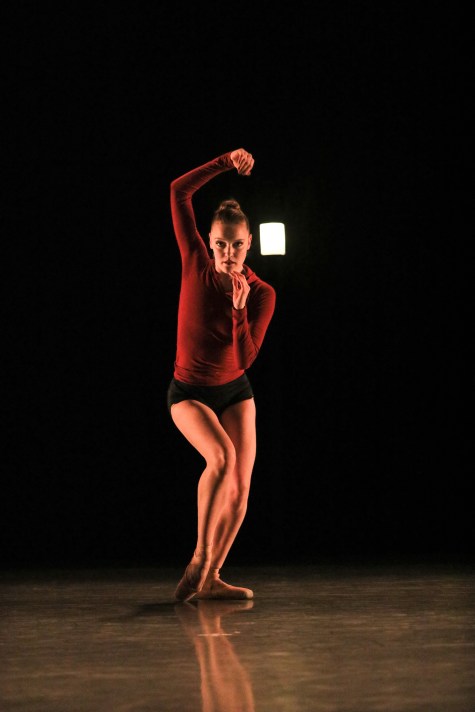
Concluding the program, Myles Thatcher’s “Redbird” remains abstract, but with Sarah Lapointe brilliantly dancing the title role, there are tantalizing suggestions of a storyline. Coleman dresses Lapointe in a bright red blouse – plus red hoodie, completing the cardinal evocation – that distinguishes her from the other seven dancers until the end when she sheds this plumage. In his intro, Thatcher shares that his choreography was a reaction to “a loss,” a way of processing grief.

Lanterns solemnly brought forth by the other dancers toward the conclusion of the piece may be signaling empathy, so when the redbird sheds her plumage, it’s quite possible she’s accepting their consolation and returning to the fold – and to what she looked like before she was aggrieved. Yet as Lapointe lets herself be absorbed into the group, in a gorgeous ritualistic tableau, there’s no telling for sure whether she has been consoled or coerced. Her outsider color may be unacceptable to the others. Or perhaps it is acceptable for a period of time mysteriously established by tradition.

The process may not work perfectly, but there’s comfort in knowing that you and your tribe are honoring it. And maybe an echo of the agony lingers.

New Plays, New Place, and New Hope at Actor’s Theatre

Preview of The Luckiest People

Maker:L,Date:2017-9-22,Ver:5,Lens:Kan03,Act:Kan02,E-ve

By Perry Tannenbaum

Trashy musicals, irreverent spoofs, and trendy new works by black and feminist playwrights aren’t the only things Actor’s Theatre of Charlotte has done well over the past 29 years. Around the country, when their artistic and administrative staff attend national conferences with their colleagues, they find that a big part of the company’s reputation rests on their commitment to nurturing new plays.

After two years of instability and uncertainty – and two full seasons without reviving their NuVoices Festival – Actor’s Theatre is getting back to that. This week, they’re opening Meridith Friedman’s The Luckiest People, part of a rolling world premiere that began in Denver. In May, the company will be part of another rolling world premiere, presenting David Valdes Greenwood’s The Mermaid Hour.

Both of these new plays were previously presented in reading stage productions at NuVoices 4 in January 2016, with all of the actors performing script-in-hand. No scenery, no costumes, and limited rehearsal.

NuVoices 4 was one of the last events at 615 E. Stonewall Street, ATC’s last permanent home before developers’ wrecking balls demolished the site. After a misadventure in the Belmont neighborhood near Plaza-Midwood, the company was supposed to reopen at 2219 Freedom Drive late in October 2016.

Instead, they had to move Toxic Avenger a block away to the City Center Church, of all places, the first of four unforeseen sites where ATC’s 2016-17 season was staged. Until last fall, when Actor’s Theatre launched their current season with American Idiot, subscribers never knew where the next production would crop up.

That’s when ATC announced that Freedom Drive was still on hold and that their next two productions would remain at Hadley Theatre on the Queens University campus. But after that?

Now we know. Luckiest People, Mermaid Hour, and The Mountaintop will all be at the Hadley. More importantly, ATC artistic director Chip Decker and John Sisko, dean of Queens U’s College of Arts & Sciences, have just inked a deal that will keep ATC on campus as the U’s resident theatre company for the next five years.

From necessity to desperation to near-relief, it’s been quite a rollercoaster for Decker, his board members, and ATC’s loyal fans. “We’re off life support but still in ER,” Decker quips. “In a better hospital.”

Sisko arrived at Queens in the summer of 2016, when all seemed to be going smoothly with ATC’s relocation. After the abortive opening in October and a subsequent revival of The Great American Trailer Park Christmas Musical at the McBride-Bonnefoux Dance Center – a horrid acoustic mismatch for a live musical – Sisko wasn’t hearing any signs of life, so he reached out.

Down at Freedom Drive, one hurdle was following another. Parking had to be upgraded to satisfy the City, architects’ drawings kept getting sent back for tiny inaccuracies. Think about this one the next time you walk through the metal canyons of a parking lot to find your car: Decker and his company had to shell out thousands of dollars to get an engineer to certify that the concrete slab – one that had held up a mechanic’s shop and the building itself for 50 years – could support an audience.

“We were slowly bleeding money to death.”

After Bootycandy ran at Mint Museum, Stupid Fucking Bird was staged at the Hadley last spring, a clear signal that Sisko and Queens U brass were unfazed by ATC’s edgy fare. Decker quickly recognized that this would be the finest venue his company had ever performed in. By far.

Maker:L,Date:2017-9-22,Ver:5,Lens:Kan03,Act:Kan02,E-ve

The lightbulb came on, and Decker invited Sisko out to grab some coffee and chat about the future.

“It took me a long time to quit beating my head against the wall to make Freedom Drive happen,” Decker recalls. “Having the passion for something and wanting it so bad, I kind of started being blind to the writing on the wall. We were at the point, Perry, and I shared this with John, and I said, ‘We’re do or die. We’re either going to close, or something different is going to work.’”

When Sisko saw how well Stupid Bird went, concern about ATC’s struggle gave way to recognizing the opportunities that bringing the company on board could open. ATC could offer technical support for Theatre Department productions during the academic year, they could offer internships to graduating students, they could oversee a summer theatre festival with performances on the quad under the stars, and they could teach courses about theatre production and administration.

“ATC is the backbone of the Queens theatre program, and it’s a mutually beneficial relationship,” Sisko says. “We have parents who are a little worried about their children being an arts major. But when they’re an arts major and they have 30 credits on the business side of the arts as well, then they are in better position when they face post-graduation.”

Talks are already under way on prospects of reviving the NuVoices Festival as early as this summer, and Decker is already salivating at the prospects. At previous festivals, the four playwrights, four directors, and their casts had to rehearse and perform on a single space at Stonewall. On the Queens campus, there will be multitudes of classrooms at ATC’s disposal, playwrights will be able to interact and talk shop, or simply do rewrites – on the quad, in some greenspace, or in a classroom instead of a hotel.

“They can all come together and talk about the process of playwriting, what it takes to get it produced,” says Decker. “Queens can bring in their MFA creative writing students for master classes with the playwrights on how do you get seen, how do you get published, how do you get your word out there, what it literally takes to become a professional writer on the scene.”

With the opening of The Luckiest People this week, ignition for whole process gets revved up again, because NuVoices is one of very few festivals across the country that promises a full production for every winning entry.

Dennis Delamar, a longtime actor and director at ATC, is doubly excited: he’s reprising the central role of Oscar Hoffman two years closer to the irascible old SOB’s actual age, and he’s performing for the first time at the Hadley knowing that the company has their feet back under them.

Under cross-examination, Delamar can catalog why Oscar is so difficult as he seeks to impose himself on his son’s household – just when he and his male partner are adopting a son. There’s the culture shock of moving from Great Neck, NY, to California; the many physical torments of Paget’s disease; the recent death of his devoted wife; and the pure cussedness of a Jewish trial lawyer who revels in disputation. Even his sharp sense of humor is thorny.

NuVoices gives this role an extra charge. “Being on the ground floor of a new piece of theatre is pretty thrilling,” says Delamar, “a professional collaboration that offers one an opportunity to offer one’s own unique interpretation while the playwright is still in the ‘making it better’ stages.”

Participating in NuVoices gave Delamar the opportunity to meet the playwright and learn first-hand how she drew his character from her own Great Neck grandfather. Thanks to Facebook, Delamar stayed in touch, conferring with Friedman when she made further revisions.

“I felt quite comfortable to write to her about a significant moment for Oscar I noticed had been changed,” he confides. “Taking time to explain to me the history and logic of the change, Meridith reminded me how much I appreciate working with this gifted and open minded writer. She listens. She is wise. I agreed with the change and loved that we could confer so openly about it.”

Yes, the thrill is back at ATC – with new plays and new hope.

“All the signs from this last year together suggest that it’s going to work out extremely well,” says Sisko.

African Children’s Choir Brings Youthful Exuberance, Wonder, and Hope to Mint Hill

Review:  African Children’s Choir

By Perry Tannenbaum

Unless you’ve seen them before, visited their website, or read their publicity releases, you might assume that the African Children’s Choir, singing at the Arlington Baptist Church in Mint Hill, was a group of inner city Charlotte kids spreading their wings to the edge of Mecklenburg County and into the suburbs. I was quickly disabused of that notion when I walked into the assembly hall, which doubles as a cozy basketball arena. There were three tables at the rear of the hall, on the near side of the sound and video equipment, peddling merchandise and brochures, including one that was selling a generous selection of the dozen CDs that the Choir has recorded over the past 25 years.

It all began in 1984, according to the website – and one of the film breaks in the Children’s Choir concert – during a visit to Uganda by human rights activist Ray Barnett, who was inspired to form the Choir “by the singing of one small boy.” By the end of that year, the first Choir, made up of boys and girls aged 7-10, was touring North America. Many of the choristers had lost one or both parents amid Uganda’s bloody civil war, and the entire 1st Choir had been born during the pernicious reign of Idi Amin. An overarching concern of Music for Life, the group that runs African Children’s Choir, is the education and welfare of the children – and impacting the future of the continent – so Music for Life has established children’s homes across the seven countries they serve.

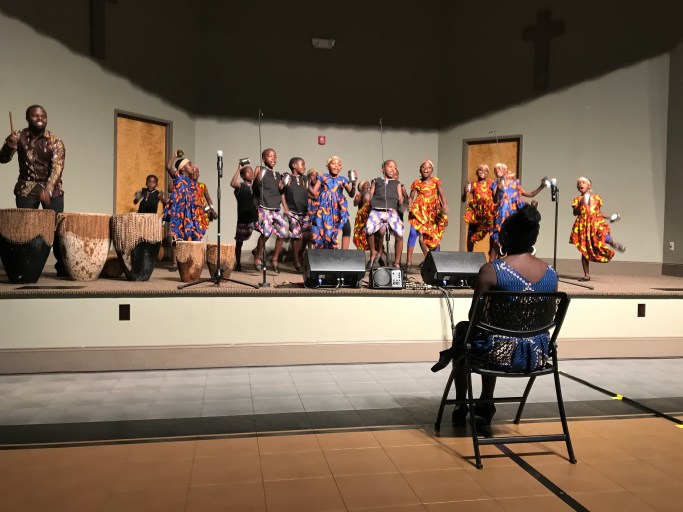
Mint Hill was the fourth stop – and the fifth concert – on the 48th Choir’s current 34-city, 40-concert tour, their last stop in North Carolina until the penultimate concert in Fayetteville on April 5. With just a couple of exceptions, the performances will be given in churches, so the format I witnessed is presumably typical. It began with lead pastor Rick Whittier offering an invocation and introducing choir director Alice Nambooze, who shifted focus from prayerful thanksgiving to firing up the audience so that we’d greet the 18-member Choir enthusiastically. Enthusiasm was certainly warranted, for the children were clad in unmistakably African costumes, free-flowing prints filled with bright yellow, red, and green accents. Opening with “Rejoice,” the title song of their newest CD, the African Children’s Choir matched the liveliness of their costumes with the joy of their singing.

The ebullient ensemble more than counterbalanced what you don’t ordinarily encounter at adult choir concerts – appeals, collections, testimonials, and infomercials – with a multitude of energetic ingredients we should count on from grownups. All of these kids danced, banged on tin cans, rhythmically clapped hands, and twice changed costumes, a radical departure from the staid and colorless decorum that adult choirs with their dignified directors impose on us. Some of the kids beat on the drums, Africa’s iconic instrument, some of them introduced the songs, some performed solo vocals, some interjected chants or recitations, and others hawked merch during the most charming commercial break. All of them – this was also adorable – introduced themselves. Nor was the music religiously live and a capella. Prerecorded soundtracks for most of the selections helped keep the kids on the same beat.

Seated in front of the stage, Nambooze directed the children with a minimum of fuss, returning to the spotlight on just a few occasions, most notably to sing a lead vocal after launching a wake-up tableau and to preside over the more extended break halfway through the concert, when donations were asked. The head teacher who travels with the group, Timothy Kawuma, identified himself as “Uncle Timothy” and turned out to be the most bodacious drummer we would see. Kawuma and Nambooze also offered personal testimonies, linking themselves with the beginnings of the Children’s Choir – when both were members of Choir 19 – and ending by proudly announcing the college business degrees they had earned, she in administration and he in statistics. Future of Africa.

The present in Mint Hill leaned heavily on tunes from the new CD and familiar old favorites, each of them delightfully Africanized. Very appropriately, “He’s Got the Whole World in His Hands” was punctuated with handclaps – patty-cake style to add an extra childish tang leading into intermission. “Amazing Grace” was deceptively conventional through its opening stanza, but it grew suddenly catchy and I daresay groovy when the arrangement became a gleeful call-and-response. For their encore, the kids sang “This Little Light of Mine” with such celebratory gusto that I have to wonder how much longer it will be missing from their discography.

Songs from the newest album came with a little more zest in live performance, without any loss in choral richness. The glee-club energy of “Rejoice” showed harmonious maturity in its latter stages, but with only drums for accompaniment, the shorter “Njuba” took me more convincingly to Africa with rich harmonies resembling those of the famed Ladysmith Black Mambazo group – and with purely African lyrics. The other two newborns were more anthemic, mixing English and African into their lyric tapestries. “Our God” bounced along more jauntily, with more youthful exuberance, over a simpler soundtrack featuring guitar, keyboards, and percussion. “Cornerstone” started with an African refrain from the full chorus, breaking into English with a boy’s solo vocal after a solemn instrumental vamp. The whole choir repeated the boy’s stanza, presumably translated into African, before we reached the powerful “Christ alone, cornerstone” refrain. The arrangement kept building and, in the final repetitions of the refrain, the choir split in half, as the English “Cornerstone” chants overlapped the original African one. In a way, it capsulized what Barnett had set out to achieve 33 years ago.

With all the bright costuming, African percussion, and synthetic prerecorded sounds, Children’s Choir still carved out a precious moment when the mood became sacred in a purely Western way. I couldn’t find the African Children’s Choir version of Psalm 139, but it’s a very satisfying setting, discreetly stripped of the more bellicose – and unchildlike – verses between 1-18 and 23-24. There are so many lines and songs that sound strange or awkward coming from children. Others sound to us like something we already know, vividly refreshed. But the wonder and youthful hope of these lines, lifted and not let down by the melody and the widely smiling singers, reminded us of what is most unique and cherishable in the hearts of children.

Amid a Record Cold Wave, Nosky Brings the Heat of Vivaldi’s “Four Seasons”

Review:  Vivaldi’s Four Seasons

By Perry Tannenbaum

With only string players on assignment, Charlotte Symphony was a noticeably smaller orchestra at Belk Theater last Saturday night. But with Vivaldi’s Four Seasons on the program and redheaded Aisslinn Nosky both playing the violin solos and guest conducting, the house was as unusually full as the stage was empty. People don’t merely adore Antonio Vivaldi’s signature set of concertos. If WDAV, Charlotte’s notably successful classical FM station, has it right, they also dig all things baroque.

Aside from an excursion into Felix Mendelssohn’s Sinfonia for Strings No. 1 – written when the prodigy was a boy of 12 – that’s what Nosky brought to the podium. Nosky is one of the pre-eminent authenticists on the continent, having served as concertmaster for both Tafelmusik in Toronto and the Handel and Haydn Society in Boston. Historical practices and authentic historical instruments are her customary métier.

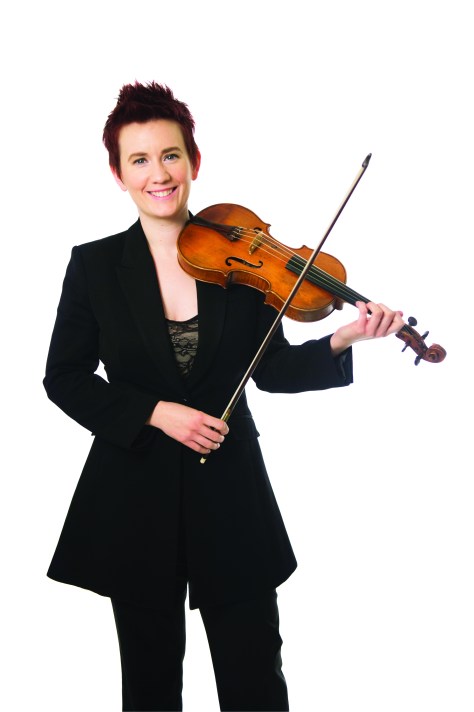
So is rocking a punk hairdo, flaming pink or fuchsia on some nights, and anchoring I Furiosi, an avant-garde quartet. With fellow emissaries from H+H, Nosky has gigged at Le Poisson Rouge, one of the hippest clubs in Greenwich Village. An aura of unpredictability shimmers around her.

Of course, Nosky adapted to Symphony by playing a modern violin, but tantalizing stylistic questions needed to be answered on how she would approach the music and Charlotte’s classical audience. Bach’s Violin Concerto No. 1 provided answers at the top of the program.

Nosky’s tone on the modern violin was laser thin and strong, most attractive just before her highest notes and infectiously cheerful with Symphony’s strings. The brisk pace that Nosky called for added to the sunniness of the opening movement, yet there was no superficiality to the lightness. When we moved to the middle Andante movement, Nosky entered with an exquisite pianissimo that was barely audible at first, swelling to full bloom while still allowing the cellos to dominate with their spare accompaniment. Spikey hairdo or not, Nosky subtly sculpted the closing Allegro, achieving a fine balance between her violin and the ensemble, building almost imperceptibly to the climax with gradual acceleration and crescendo.

As her concert-black outfit had signaled, Nosky wasn’t out to create outré sensations. The warmth of her chat with the audience, introducing Georg Philipp Telemann’s Don Quixote Suite, was an extension of principal cellist Alan Black’s earlier intro to the whole baroque program. Nosky reminded us that pianists and violinists, many doubling as famed composers, had led orchestras through most of classical music history, and she dished on the friendly rivalry between Bach and Telemann.

Notwithstanding the spikey punk do, you could bring this redhead home to meet your Republican dad.

I’ve found a CD, played and conducted by Jan Stanienda, that programs The Four Seasons and Don Quixote together, and the pairing makes sense. Both pieces are very imagistic, so the Telemann served as a fine foreshadowing for the Vivaldi. It would have been helpful, especially in the absence of any detailing from Nosky in her intro, to have seen the descriptive titles of the eight segments of the suite on the page with the program listings.

Flip ahead to the program notes, however, and the titles printed there would have better prepared you to fully savor the woeful waking of the Don, his adoration of Princess Dulcinea, Rosinante, Sancho, and the renowned windmills. What came through best without these prompts were the horsey flavors of the suite, the stately cantering of the overture, the quarter horse sprint of the windmill sketch, the sudden crowdpleasing interjections evoking Sancho’s donkey (effects Haydn would perfect), and the farewell gallop of the finale, ending not with a Rossini-like bang but with a surprising, slightly affecting fadeout.

Spearheaded by Nosky, the Symphony strings made an excellent case for the outer movements of Mendelssohn’s C Major Sinfonia, the second Allegro particularly impressive for its precocity. By comparison, the middle Andante in A minor struck me as moribund. Or I should say that it hardly struck me at all.

Nosky jokingly told us that, in view of the record cold weather outside the concert hall, she had considered only playing Vivaldi’s “Summer” concerto to warm us up. Then she promised there would be additional heat in the other Seasons – even in “Winter” – and there was. Written within the framework of four Italian sonnets, conveniently translated in our programs, the musical imagery of Four Seasons is probably best followed by playing a CD with the text in front of you, so Vivaldi’s backtracking refrains and mood-shifting don’t make you lose your place.

Not an absurd expectation at all: Symphony’s pre-New Year’s email blast to subscribers not only offered concertgoers a link to the translated poems, it also provided a Spotify playlist to The Four Seasons and the rest of last week’s Classics concert. Another handy subscription for Symphony supporters. Lack of such prep accounted for the major glitch of the night, when the audience applauded prematurely, forcing Nosky to confide that “Winter” was yet to come.

At the beginning of Four Seasons, “Spring” crests with a thunderstorm in the second half of its opening Allegro, and the onset demonstrated that there was sufficient artillery onstage at Belk Theater for the fireworks and hailstones to come. Nosky was at her most soulful in the middle Largo as the goatherd lay down to sleep in the meadow, and the sweetness lingered into the concluding pastoral dance with a nice attention to the strings’ harmonies.

Forebodings of the ultimate storm in the “Summer” concerto spread dramatic contrasts throughout the first two movements, both of which have fast sections, but it wasn’t until the concluding Presto that Vivaldi and Nosky reached their fullest fury. Here the flaming redhead was clearly torching the Red Priest, finally breaking into her bacchante mode, sustaining the lightning with a sizzling cadenza.

She is too authentic to linger in sensationalism, and there was plenty of artistry to display in the remaining concertos. Soloing in “Autumn,” it seemed to me that Nosky was caricaturing one of Vivaldi’s drunken peasants with a witty twist of her glissandos, and she made sure to emphasize the fadeout at the end of this season, reminding us of the kinship between Vivaldi’s sketchings and Telemann’s.

“Winter” was not only the most shivery season, it was also the darkest, bleakest, and loneliest as Nosky gave us a wan cadenza backed only by Black on cello. North winds howl in the final Allegro, allowing Nosky and Symphony to whip up one last tumult. Maybe the sun didn’t quite shine through this icy gloom, but the joy and warmth of the music did, just as the Red Priest prescribed.

“School of Rock” Sports Heavy-Metal Vulgarity

Review:  School of Rock

By Perry Tannenbaum

Dewey Finn is not your model citizen. A wayward adherent to the religion of hard rock and heavy metal, Dewey is vastly self-absorbed. When he gets booted out of his No Vacancy band, presumably for stealing focus from the shirtless lead singer, Dewey sponges contentedly and thanklessly off former bandmate Ned Schneebly. Worse, when an opportunity opens for Ned as a substitute teacher at a prestigious private school, Dewey steals it.

Masquerading as Ned, Dewey remains true to his slovenly egocentric creed, arriving to his first day at work late and hung over. More alert on Day Two, he discards the normal schedule and curriculum, ditching math and social studies in favor of turning his students into a rock band. Dewey remains steadfast in his ambition to qualify for, compete in, and emerge victorious in the upcoming Battle of the Bands.

After heroes and antiheroes that included the biblical Joseph and Jesus, the Phantom of the Opera and Grizabella, Evita Peron and Norma Desmond, you could say that Dewey Finn shattered the mold for Andrew Lloyd Webber protagonists when School of Rock opened on Broadway in December 2015. Although it never became anything like the moneymaker Phantom still is after 30 years, Rock is still running – while subsequent revivals of Cats and Sunset Boulevard are not.

From what I could see at Ovens Auditorium on opening night, word-of-mouth in Charlotte will concur with the Broadway verdict.

What makes Dewey appealing is his sheer vulgarity, which nearly reaches full John Belushi proportions. But there’s more, mainly the unsavoriness of all the other adults onstage, beginning with the No Vancancies who let Dewey go. Ned is preternaturally wimpy, more dependent on his inhaler than a meth addict, and his girlfriend Patty is dominatrix-grade hostile.

At school, Dewey’s colleagues are suburban bland. At home, the students’ parents are variously unloving and/or unsupportive. The principal, Rosalie Mullins, is the essence of by-the-book rigor, believing that this is what those wealthy parents are paying for. Winning Rosalie over is the key to realizing Dewey’s hard rockin’ aspirations, and he hits upon the perfect scheme, asking her out to a local dive and plying her with cheap beer and Stevie Nicks.

Scenic and costume designs by Anna Louizos have the same look on tour as they had on Broadway – as far as Ovens will allow. When the School of Rock band finally gets their shot at the Battle of the Bands showdown, there’s no visible spot for the skeptical parent to sit – like, say, the box seats at Belk Theater? – while the kids prove themselves.

The size of cavernous Ovens, seating over 60% more than the Winter Garden on Broadway, makes it more difficult to hear Dewey’s fifth graders clearly – and more difficult for most ticketholders to see the mutually beneficial relationship developing between them. Really, I couldn’t find any distance between Rob Colletti’s disheveled charm on tour and Alex Brightman’s on Broadway, nor were the kids’ talents any less precocious than those I witnessed at the Winter Garden.

But the mojo that starts happening in the classroom with “You’re in the Band,” as Dewey matches students with their instruments (no, I don’t know how he snuck in a complete drum kit), seems comparatively muted and diluted in the vast Ovens space. Here’s where the kids get their first fix of that you’re-really-good intoxicant their sub is dishing out while Dewey gets his first inkling of how fulfilling it can be to do something for somebody else. On Broadway, this is where I knew that Lloyd Webber was onto something when he decided to adapt the 2003 film starring Jack Black. At Ovens, we’re still unsure.

We never tap in quite as intimately to Dewey’s growth and transformation. It hits us more at big moments that are outsized signposts along the way. Fortunately, there are enough of these broad advances in Julian Fellowes’ adaptation of Mike White’s screenplay to add up to a satisfying jolt when the big crises hit midway through Act 2. The essence of these advances is the beneficial effect he has on the kids, on Rosalie, and even Ned – a medical miracle, since the wimp suddenly tosses away his inhaler and become a mean rockin’ machine – along with new outbreaks of generosity, tact and caring.

Colletti carries the show on his broad sloping shoulders, his big belly, and purest chutzpah, but it’s the kids who give the show its impish, wholesome Monkees energy. Dynamic Phoenix Schuman on guitar, nerdy Theo Mitchell-Penner on keyboard, grumpy Theodora Silverman on bass, and hipster Gilberto Moretti-Hamilton on drums are a cornucopia of musical precocity. The mini character roles have the same Broadway excellence, bossy little Ava Briglia emerging as company manager, effeminate John Mitchell Pitera finding his passion in costume design, and withdrawn Gianna Harris breaking out of her cocoon with a smashing a cappella “Amazing Grace.”

There’s a latent sexiness to Lexie Dorsett Sharp as Rosalie that peeps through early on when she exits Dewey’s classroom after a precise and military left-face. Our principal also displays a formidable soprano in “Queen of the Night” excerpts, though the highest note in the Magic Flute aria is always scaled with the aid of a student tapping a triangle. There’s a certain British delicacy in the way Sharp eventually melts, removing her glasses but never letting her hair down.

Director Laurence Connor allows more latitude to Dewey’s put-upon hosts with only middling results. Patti is a fairly standard-issue shrew, and Emily Borromeo does little to transcend her, pitch-perfectly annoying in her yammering. Matt Bittner, so hopelessly asthmatic early on, does deliver a shocking metamorphosis when he grows a pair. Maybe he could survive in a classroom!

There are no memorable power ballads from Lloyd Webber this time around, but he’s clearly having fun, stealing from Mozart and Deep Purple in the same score – and proving, in case you’ve forgotten, that he really can rock. “When I Climb to the Top of Mount Rock” cooks at medium heat to start things off, and later, “Stick It to the Man” and “You’re in the Band” actually achieve a slight metallic edge.

Implausibly, the climactic title tune misfires. Lloyd Weber’s melody, perhaps to satisfy demands of the plot that don’t need satisfying, doesn’t reach the anthemic stature we’d expect from a revelatory rock band’s signature tune. Glenn Slater’s lyrics, reliable throughout the evening, are dreadful here, incoherent and not at all believably from a fifth grader’s imagination.

Not to worry, Weber hasn’t lost it at the end. Order is restored when he reprises the crowd’s favorite, “Stick It to the Man.”

A Flaming Redhead Scorches the Red Priest

Preview:  Vivaldi’s Four Seasons

By Perry Tannenbaum

Even in Charlotte, the would-be crown of the New South, you occasionally hear the grumblings backstage – or in the boardrooms of our leading performing arts companies. Our audiences are graying. Who ya gonna call? For Charlotte Symphony, this week’s startling answer is their guest soloist, Aisslinn Nosky, a redheaded violinist – sometimes fire engine red when the mood hits – who usually rocks a punk hairdo.

A blatant appeal, you could say, to younger people who might otherwise be wary of a formal concertgoing experience or just plain classical-averse. But that’s hardly half of the Nosky story. Far from dolling up and dumbing down the music she plays, Nosky is highly regarded as one of today’s prime exponents of music by Antonio Vivaldi, Johann Sebastian Bach, Georg Philipp Telemann, and Franz Joseph Haydn.

Canadian born, Nosky has strong ties to three of the most important groups in North America that specialize in this music. She’s a core member of the Toronto-based I FURIOSI Baroque Ensemble and the concertmaster at Boston’s Handel and Haydn Society. Nosky’s 10 years with the famed Tafelmusik Baroque Orchestra culminated in the 2015-16 season when she toured as their featured soloist.

Although she’ll be playing a modern violin when she teams up this weekend for a concert that will showcase works by Bach, Telemann, and Mendelssohn – while headlining Vivaldi’s Four Seasons – Nosky usually plays authentic period instruments when she performs and records with H+H or Tafelmusik. She dismisses the notion that there’s some kind of disconnect between her punkish stage persona and her punctilious preservation of authentic practices.

“I can see how on the surface it might strike some people as a jarring contradiction,” Nosky admits. “What our current audience may not know is that the idea of classical music being a highbrow/conservative art form was born entirely in the 19th century. In the 18th century, the star singers of the opera world and the most famous instrumental performers were treated like rock stars. One need only read contemporary accounts of audiences’ reactions to someone like the great opera star Farinelli to have a glimpse into the excitement and glamor which was a part of experiencing Western art music in the past.”

Many other classical musicians, conductors, or academicians are on the record with similar observations about classical music’s less stuffy, more spontaneous past. Nosky separates herself from those laments, living that bygone spontaneity right now. Check out the I FURIOSI website if you have any doubts. Or watch Nosky rockin’ out on Bach with Tafelmusik in a YouTube video.

Something unusual there: Nosky is not only playing with the ensemble, she’s directing it. That’s the plan for this weekend at Belk Auditorium. In both the Bach Violin Concerto No. 1 and the Four Seasons, Nosky will be soloing while leading the orchestra. Although the ensemble doesn’t figure to be as small as Tafelmusik’s, with 19 full-time members, you can count on Charlotte Symphony to field a smaller armada of musicians than the one that played Brahms and Beethoven back in November.

Trimming the size of the ensemble performing Haydn and Mozart became a routine practice at Symphony during the aught decade when Christof Perick wielded the baton as music director. But aside from Bach’s B Minor Mass (2002 and 2009), a Vivaldi Piccolo Concerto rearranged by and for percussionist Evelyn Glennie (2005), nothing written before Papa Haydn was presented at the Belk to Symphony’s Classics Series subscribers during those years.

Curiously enough, that Vivaldi Piccolo Concerto was conducted by Christopher Warren-Green, five years before he took over as Symphony’s maestro for the 2010-11 season. So it figured that Warren-Green would be programming more baroque at the Belk than his predecessor.

“Musicians of a symphony orchestra are expected to be extremely versatile and be able to juggle different musical styles,” says Calin Ovidiu Lupanu, Charlotte Symphony’s concertmaster since 2003. “We usually switch from a classical repertoire to a more jazzy or Broadway type of repertoire, from modern classical to baroque. Especially with the arrival of Maestro Warren-Green in Charlotte, the number of baroque programs has increased. I am sure that Aisslinn will bring her own interpretation and expertise to the stage.”

What might seem unusual, a concertmaster leading an orchestra while he or she plays the solos, is often the practice when performing Four Seasons, according to Lupanu. That didn’t happen the last time Symphony presented Vivaldi’s most famous composition in early 2010. Lupanu would know. On that January night, with Michael Christie as guest conductor, Lupanu himself was the soloist.

Oh, and this just in: Lupanu kicked off a new Charlotte Symphony chamber music series in October at Tate Hall on the CPCC campus, leading a “conductorless” concert of works by Elgar, Britten, and Shostakovich. So for the record, he set the precedent.

Nosky has a different perspective on compounding her instrumental work with conducting, reminding us that before the 19th century, concertmaster and director were interchangeable titles.

“Tafelmusik Baroque Orchestra was directed from the concertmaster’s chair by Jeanne Lamon,” Nosky recalls. “It never occurred to me that playing baroque and classical music needed to be done any other way. In fact, after a lot if research into the subject, I can say positively that the majority of orchestra music before the 20th [century] was directed by either the concertmaster or the keyboard player. People may forget that Vivaldi and Telemann and Bach initially achieved their enormous fame as performers!”

Both concertmasters, Lupanu and Nosky, cite chamber music as central to their tastes and training, so both are comfortable in reduced-size ensembles where all the musicians must keep a sharp ear out to blend and synchronize with their colleagues. Where the two seem to part company is in the outré flair that Nosky brings to the task.

“In a culture that is geared towards young performers playing for an older audience,” Lupanu observes, “someone of Aisslinn’s quality can be extremely helpful in bringing more of the baroque and early music repertoire in the concert halls. And – why not? – maybe having the younger audience attracted to this kind of music.”

Nigel Kennedy? Peter Sellars? Peter Pan? Nosky pushes back against the notion that her spiky hairdo is modeled on anybody else’s – or that it’s calculated to position her as a Pied Piper for a new generation of classical audience.

“All I can say is that my inspiration comes completely from what makes me feel comfortable when I perform. I couldn’t possibly try to look like or be anybody other than myself. If I did, I would not be true to myself. Or the music.”

Nonetheless, when Nosky moves from Handel and Haydn to the music of Vivaldi, her spiky red do inevitably takes on the tinge of an homage. Born in 1678 and ordained in 1703, Vivaldi was nicknamed the Red Priest because of his curly red locks.

It’s uncertain how much red Nosky will be sporting onstage as she plays her concertos and leads Charlotte Symphony in a Sinfonia by Mendelssohn and a “Suite from Don Quixote” by Telemann. There’s a 2013 video of Nosky clad in red lapels when she played with an H+H quartet at Le Poisson Rouge in Greenwich Village. On second glance, maybe those silky lapels were fuchsia.

One thing is certain: Just being herself, Nosky will surely be a redhead playing the Red Priest, often at a fiery clip. It will be interesting to see how many other punks show up.

Christopher Warren-Green Conducts a Dramatic, Joyful “Messiah” at Knight Theater

Review: Messiah

By Perry Tannenbaum

Until my first year of college, I thought I knew all that operatic singers and composers could do. My parameters were set by the matinee performances of the Metropolitan Opera and the iconic Texaco broadcasts. But on a freezing December evening at Colden Auditorium on the Queens College campus in New York, I attended my first live performance of George Frederic Handel’s Messiah, my first inkling that there were whole vocal worlds beyond Verdi, Puccini, Mozart, Wagner, and Verdi. The first hint that I was in unexplored territory was when the tenor sang his “Ev’ry Valley Shall Be Exalted” air, where the melody line straightens out the crooked and makes the rough places plain.

More jarring than that was the sound of a bass baritone shortly afterwards in the “Thus Saith the Lord” recitative performing the coloratura runs declaring he will “shake all nations.” I’d previously assumed that such virtuosic runs were reserved for higher voices – almost always female. Since then, I rarely allow a Yuletide season to go by without revisiting Handel’s most frequently performed oratorio. During those years, a couple of trends have impacted how we hear the operas and oratorios by Baroque and pre-Romantic composers. Both were in evidence as Christopher Warren-Green, for the first time in his eight seasons as music director of the Charlotte Symphony, conducted Messiah at the Knight Theater.

Both trends, when they hit, were championed in the name of authenticity. The first had to do with the modern tendency to perform Early and Renaissance music on modern instruments with larger orchestras. Authenticists trimmed the size of their orchestras and brought back original instruments. Then came the countertenors to further shake up authentic performance. Although Alfred Deller was established in his career in the late 1940s, but there was no mass influx of countertenors, reclaiming the roles originally assigned by early opera composers to castrati, until at least 50 years later.

Charlotte Symphony subscribers may have been surprised to see countertenor Brennan Hall singing the alto parts formerly taken by contraltos or mezzo-sopranos, but those who were knowledgeable could hardly have been shocked. In years gone by, purists spearheading the authentic instruments trend might have bridled at the idea that Warren-Green was bowing to ancient practice by trimming the size of his orchestra without adapting original instruments, but the requisite treaties in those wars were tacitly signed a couple of decades ago.

The zest that Warren-Green brought to the task wasn’t fully manifested until we reached the mighty “Hallelujah Chorus” at the end of Part 2. Somehow, while the audience was rising to their feet, two trumpeters and timpanist Leonardo Soto made their way through the Knight Theater’s acoustic shell, filling out the Symphony ensemble to 29 members. The hall shook with the sound of the orchestra and the more than nine dozen singers of the Symphony Chorus. Warren-Green was transported enough at one point to leap into the air, and the collective power of his “Lord of Lords” sent chills through me.

There was not only thunderous applause at the conclusion but also bows from the orchestra, the chorus, and the soloists, though Part 3 still lay ahead. More chills came with the tender contrast of soprano Kathryn Mueller singing “I Know That My Redeemer Liveth” after we were back in our seats. I’m not sure that I’ve ever heard Mueller’s last phrase, “the first fruits of them that sleep,” delivered with such beguiling fructose.

Those dramatic contrasts typified Warren-Green’s approach. Tempos were quicker than we usually hear on the familiar “For Unto Us a Child Is Born” and “All We Like Sheep,” further lightened by a noticeably more staccato attack from the singers. Yet the excellent tenor, William Hite, could follow the choir’s gamboling “Sheep” with an unusually strong rendition of the “All They That See Him” recitative. Other moments foreshadowing the “Hallelujah” thunder were the declamatory “The Lord Gave the Word,” a choral segment that usually escapes notice, and Symphony’s fierce introduction to bass baritone Troy Cook’s “Why Do the Nations So Furiously Rage Together?”

Cook seemed to grow continuously in power throughout the evening. His “Thus Saith the Lord” was more stolid than the best I’ve heard, not nearly in the same class as his “Why Do the Nations?” after intermission. I had already hoped for mightier deeds when I heard Cook’s unexpected sweetness in his “For Behold, Darkness Shall Cover the Earth” recitative. But the baritone’s finest moments came later with the recitative and air that culminated in “The Trumpet Shall Sound,” volleying back and forth with principal trumpeter Richard Harris, who was in fine form. Along with Mueller’s sweetness, these two men conspired to prove that Part 3 isn’t at all an anticlimax after the mighty “Hallelujah.” Warren-Green discreetly axed four segments from Part 3, “Oh Death, Where Is Thy Sting?” the most familiar, to help keep that notion afloat.

The other soloists distinguished themselves before Part 3. Hall had a more suitable range for “O Thou That Tellest Good Tidings to Zion” than many contraltos I’ve heard, though his runs weren’t the most even. Together he and Warren-Green emphasized the 3/4 meter of this air more delightfully than I could recall hearing before. The countertenor was most affecting after intermission when he sang “He Was Despised and Rejected,” layering on a superb soulfulness as he sang the verse from Isaiah for the last time.

I was even more impressed by Hite’s emotional range, whose power was the last of his attributes to be revealed. The tenderness of the tenor’s rendition of “Comfort Ye, My People” – a slight sob detectable in his delivery – served instant notice that this was going to be a special Messiah, one that respected the Charles Jennens libretto culled from the Old and New Testaments, and Hite’s “Ev’ry Valley” signaled that it would be wrapped in joy. Anyone who doubts that Warren-Green adores this score only needs to hear him conduct it.

Charlotte Ballet’s Flatter Slim-Fast “Nutcracker” Still Dazzles With Scenic Splendor and Scintillating Dance

Review : Nutcracker

1718Nutcracker_Chelsea Dumas and Juwan Alson_171208-Photo by PeterZay4286[13]

By Perry Tannenbaum

When I first heard that Charlotte Ballet would be trotting out its newish Nutcracker down in Charleston before bringing it back to the Belk Theater for its customary two-week run, it struck me as a good thing – spreading the word to South Carolina at the gloriously revamped Gaillard Municipal Center. But I hadn’t considered how the economies of putting the show on the road might affect the product at home. Musicians from the Charlotte Symphony Orchestra have been reduced this year from 60 to 35, according to Jean-Pierre Bonnefoux, the Nutcracker choreographer and past Charlotte Ballet artistic director. Furthermore, the mini-chorus that always sang from the orchestra pit in the “Waltz of the Snowflakes” at the end of Act 1 is gone. At least one orchestra member I’ve heard from isn’t pleased by the various transpositions required when you ditch the bass clarinet and are no longer tripling the flutes.

This slimmed-down score comes on the heels of last year’s million-dollar redesign of sets and costumes, austerity following ballyhooed largesse. The new sets sparkle with bright colors at the Stahlbaums’ holiday party in Act 1 and in the Land of the Sweets after intermission. The snow scenes literally glitter in both acts – and the cute little Angels float on a bed of clouds created by nicely tamed fog machines. Yet there was a two-dimensional quality to many of the new props introduced last year that, er, fell flat for me. It began, amusingly enough, with a lifesize cardboard housemaid that was wheeled out to the Stahlbaums’ anteroom and collected all the guests’ hats, coats, and scarves before wheeling back to the wings. But the two-dimensional motif didn’t end there, for the toy soldier that Herr Drosselmeyer brings for Fritz, the creatures that file off into the wings when the clock strikes midnight, the reindeer that peep into the Land of Snow, and Mother Ginger’s house are all pancake flat.

All this flattening muted bustle of the holiday party, which was deprived of the formerly grand arrivals of the Toy Doll and the Toy Soldier in cabinets, caskets, or palanquins. Mark Diamond’s shtick as Herr Drosselmeyer was radically hamstrung, stripped of his former hocus-pocus emceeing for the gift reveals, and while his leave-taking compensates a little for his no-longer-baroque-and-fussy entrance, most of the physical comedy is either gone or has lost its patina. Even the wrench Drosselmeyer used to fix Clara’s broken nutcracker seemed a shadow of its former absurdity. Where the flatness meshes with the new scenic design by Alain Vaës, the result is notably spectacular when the Christmas tree chez Stahlbaum grows to fill the entire upstage. The enchantment doesn’t stop there, for new scenery emerges behind it. Most spectacular, exceeding even Clara’s departure from the Land of Snow (escorted by the victorious Nutcracker), is Clara’s landing in the Land of Sweets below the clouds where the cute little Angels glide.

Worse than the absence of the bass clarinet for the “Dance of the Sugar Plum Fairy” (a bassoon doesn’t do) or the three flutes for the “Dance of the Reed Pipes” (barely noticeable) were the strings subbing for the mini-chorus. No matter how well they’re played, violins can’t say “Ah!” Under the baton of assistant conductor Christopher James Lees – and under the Belk stage – the Charlotte Symphony filled the hall rather nicely. With Sarah Lapointe and James Kopecky among the most elegant who have danced Sugar Plum and Cavalier, the climax of the grand “Pas de deux,” still sounded very powerful. But a subsequent listening session at home with a couple of reference recordings disclosed a shrieking piccolo that was probably missing from Tchaikovsky’s clangor at Belk Theater.

Charlotte Ballet’s dancers lifted the production high above any quibbles about props or orchestral instrumentation. The main corps and the satellite Charlotte Ballet II dancers maintained the high standard of past years while the work from apprentices, trainees, and students from the company’s academy and conservatory continues to ascend to new heights. Bonnefoux rehearsed the show in his first year away from the daily operations of the company, a great way for him to reconnect – and maybe a great burden lifted from anybody else who ventured to take on the complexities of Nutcracker casting. I was discreetly funneled into the Saturday evening performance so that I would be reviewing Cast A, the dancers who appear in all the publicity shots. An amazing 121 roles are double cast, so you can definitely say there is a Cast B. Yet there are also 21 roles that are triple cast, eight quadruples, and three – major roles – that rotate among five dancers. So on just one given night, over 150 splendid Holly Hynes costumes are in play backstage, and Bonnefoux is making sure that the cast du jour – no matter what the permutation – is in step. You can bet that he appreciates the expertise of Anita Pacylowski-Justo and Laszlo Berdo in staging and rehearsing all the student dancers.

It’s Clara and Fritz who must carry the action until Drosselmeyer dominates, so the Charlotte Ballet students aren’t merely background ornaments. Ava Gray Bobbit and Pierce Gallagher were the Stahlbaum sibs on opening night with Cast A, Gallagher one of two Fritzes and Bobbit one of four Claras. Though Gallagher absolutely reveled in Fritz’s energy and mischief making, Bobbit especially impressed me with her supple line, her perfectly calibrated childishness, and the utter ease and confidence she brought to every step. Only when Giselle MacDonald danced the Toy Doll did we ascend to the level of Charlotte Ballet II and when Maurice Mouzon Jr. followed as the Toy Soldier, we had our first brief sighting of the main company. Diamond has danced Drosselmeyer forever – yes, he gets a chunk of “Grandfather’s Dance” to strut his stuff – but he’s director of Charlotte Ballet II, not a company dancer. Even the rival rulers of the great Nutcracker war, Evan Ambrose as the Mouse King and Michael Manghini as the Nutcracker, were second-string members of Diamond’s company. Cast B digs even deeper, with company apprentices leading the Mice and the Nutcracker brigade into battle.

1718Nutcracker_Alessandra Ball James and Josh Hall_ Sugar Plum_Photo by Jeff Cravottafix_1112-8058_square[11]

Obviously, Bonnefoux has bequeathed a very deep bench to Hope Muir, his successor as artistic director. Aside from the athleticism of Mouzon, the varsity never trod the early earthbound scenes of this resplendent Nutcracker. Only when Sarah Lapointe and James Kopecky greeted us – and the dreaming Clara – in the Land of Snow, were we finally favored with the grace of the top-tier dancers. Lapointe and Kopecky were one of four couples who will perform these rites. Each of them will rotate in some of the upcoming shows into the higher empyrean as Sugar Plum Fairy and Cavalier, welcoming Clara to the Land of Sweets. Alessandra Ball James and Josh Hall took on these starring roles at the Saturday night opening, and Ball even surpassed herself. Her line and fearlessness now nearly match her peerless musicality. No less than five different couples get to excel in Tchaikovsky’s grand “Pas de deux” during the Nutcracker run.

The new Hynes costumes against the Vaës backdrops really do make the divertissements seem even more spectacular than before, showcasing the fine men in the company. Ryo Suzuki scintillated in his first year with the troupe, so his exploits now in third year fronting the “Gopak” weren’t revelatory. On the other hand, Juwan Alston brought amazing hangtime to his leaps in “Candy Cane,” even if he did teeter a bit on his final landing, and Humberto Ramazzina from Ballet II had an eye-popping precision in the “Chinese Tea.” Amelia Sturt-Dilley and Ben Ingel weren’t the most exotic purveyors of the Arabian “Coffee” duet that I’ve seen over the years, but they radiated sizzling sensual heat.

You almost wished that Charlotte Ballet could have trotted out an overhead camera or mirror when the last of the company’s great ballerinas, Sarah Hayes Harkins, made her decorous appearance as Rose at the center of the gorgeous “Waltz of the Flowers.” At the florid beginning and ending of the piece, Harkins was encircled by a dozen Flowers – petals, really, in Bonnefoux’s imagery – her height vis-à-vis the student dancers beautifully highlighted. Nothing less than the climactic “Pas de deux” could follow such pure, innocent beauty.

A Transcendent New Perspective on Verdi’s Requiem – as Sung by Jewish Prisoners Earmarked for Extermination by the Nazis

Review: Defiant Requiem: Verdi at Terezín

By Perry Tannenbaum

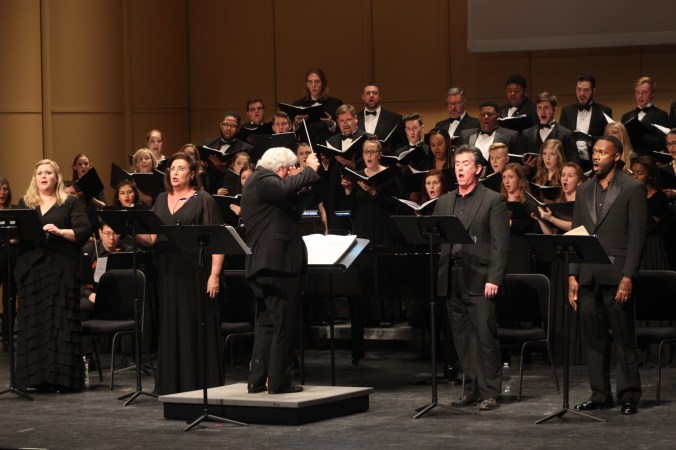
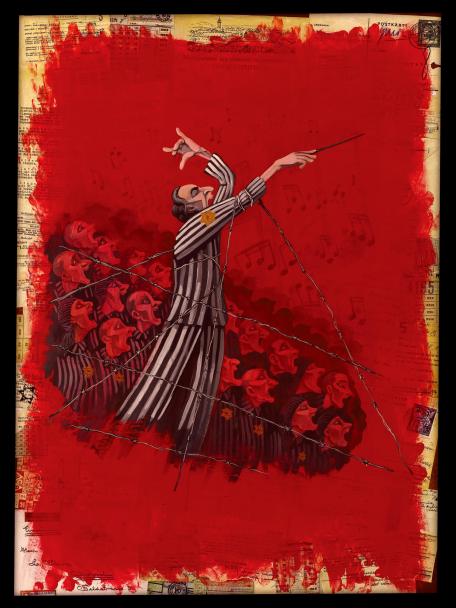
Ever since Verdi’s Requiem was first presented in 1874, singers and musicians have often observed that the composer, not a particularly religious man, steered the text of the Roman Catholic funeral mass in the direction of opera. Considering that Verdi had begun this work as a tribute to Rossini shortly after his death in 1868, those observations may be precisely what Verdi intended. Arranger/conductor Murry Sidlin offered a new perspective in Defiant Requiem: Verdi at Terezín with his new version of the Requiem for chorus, soloists and piano that premiered at the Anne R. Belk Theater on the UNC Charlotte campus. His pared-down instrumentation was not an arbitrary choice. Sidlin was aiming to pay tribute to Rafael Schächter, the Holocaust victim who organized and led the choir of Jewish prisoners that performed for the International Red Cross during their infamous inspection of the Theresienstadt concentration camp in June 1944.

In a miracle that faintly echoes the Hanukkah miracle, Schächter only had a single musical score – for piano and chorus – when the pianist-conductor arrived at Terezín. From that one little musical light, Schächter forged a chorus that offered solace to its members at evening rehearsals after hard days of labor at the concentration camp. And in the text of the Requiem, he found a massive voice that would “sing to the Nazis what we cannot say to them.”

Interspersed with a recreation of the 16 performances that Schächter conducted for the edification and delight of their fellow prisoners (there is no evidence that the Nazis in attendance were ever entertained or that those Red Cross emissaries were ever enlightened), Sidlin has interspersed clips from Defiant Requiem, a documentary that tells the story of the Theresienstadt Chorus with help from filmed interviews of its living survivors. There were also segments where Sidlin himself, turning towards us after conducting a section of the Requiem, would add his voice to the narrative. If that weren’t enough to evoke the presence of Schächter and the role he played at the original performances, one of the two actors who stepped out of the chorus and participated in this unique concert drama also portrayed Schächter.

Defiant Requiem: Verdi at Terezín has been around since 2002 and has twice been presented at New York’s Lincoln Center in Avery Fisher Hall. But those 2013 and 2015 performances at the home of the NY Philharmonic were with full orchestras. What we saw at the Anne R. Belk may have literally proven that less is more, for the replication of Schächter’s performances was certainly more faithful with just a single piano – plus a violin – replacing the orchestra at a more intimate venue. Nor was the drama diminished when we learned that the final Theresienstadt Requiem for the Red Cross was performed by a depleted choir of about 60 members: the choral group standing before us, from The University Chorale and We Are Sine Nomine, numbered 62 according to our program booklets.

Stripped down to these essentials, and replenished with the contexts supplied by Sidlin and the documentary, what usually sounds devotional and fearful now felt, by turns, poignant and defiant, dripping with vengeful fury. The “Kyrie eleison” (Lord, have mercy on us), sung first by tenor soloist Brian Cheney and followed by bass Carl DuPont, soprano Christina Pier, and mezzo Victoria Livengood sounded less like a supplication than a demand.

When the full chorus broke in with their first “Dies irae” (Day of wrath), the performance actually increased in its defiance. Prior to the ensuing “Tuba mirum” chorale, an extended solo from Arlene Shrut firmly established that the piano wasn’t to be limited to passive comping. The hushed pianissimos after DuPont softly uttered his last “Mors stupebit” (Death shall stand amazed) had a solemn eeriness that was unprecedented in the performances and DVD that I’d previously witnessed. Livengood, more reliably dramatic than on-pitch, was regally up to her supreme moment of defiance in “Liber scriptus” (Written book), where she proclaimed – with prophetic volume and fury – that on the Day of Judgment, “what is hidden shall be made manifest, nothing shall be unavenged.”

Spitting defiance in the face of the Nazis and obliquely sending an SOS to the Red Cross were the most important aspects of Schächter’s payload, but the intervening narrative gave us more nuance. There were Jews at Terezín who objected to the embrace of a Catholic Mass – and to the danger that the conductor was subjecting his choristers to should their defiant message be fully grasped by the Nazis. These nuances came from the lips of the survivors on film, who clearly viewed Schächter as an inspiration, a godsend, and even a lifesaver.

idlin’s concert drama also drove home the point that, for the Terezín singers, the “Libera me” (Deliver me) was no longer a plea to be spared from fires of hell sometime in the indeterminate future but a plea to be delivered now from their monstrous captors. Another set of testimonies told us of the uplift that the choristers felt singing the “Sanctus” (Holy, holy, holy) section of the Requiem. Somehow it escaped Sidlin that the first two lines of this section are translated from one of the most sacred Hebrew prayers, when pious Jews not only rise to recite the words but also rise on tiptoe for each of the three “Holies.”

There was plenty of engaging lagniappe to make up for this omission, including a memorable evocation of the artistic beehive of musical activity happening nightly at Theresienstadt, intertwining wisps of Schubert’s “Trout” with “Bei Mir bist du Schoen” and the bittersweet Russian Yiddish folksong, “Tumbalalaika.” But the most sobering addition that Sidlin made to his drama came in the coda that he added on after the Requiem. Instead of the customary applause, we were prompted to remain silent as the musicians filed down the aisles through hall and out into the lobby.

Violinist Oliver Kot was the only musician who remained onstage, and the exit music that he played was the melody to another prayer, the “Oseh Shalom.” It’s not only the most frequently uttered sentence in synagogue, it’s also the ending to two of our most important prayers, the “Amidah” and the various permutations of the “Kaddish” – half, full, teachers’ and mourner’s. “The maker of peace in his high places, he will make peace for us and for all Israel, and let us say, ‘Amen.’” Iconic last words, for it is customary to say them in Hebrew while taking three steps backwards, as if taking leave of a king.

Poster_Art

The new ending (a clarinetist had played it in previous orchestral performances) doubly evoked Fiddler on the Roof for me. All productions of Fiddler begin with the sound of a single violinist and many end that way. When I played Motel the Tailor in a 1987 production by Rock Hill Little Theatre at Winthrop University, it was my honor, under the cover of all the helter-skelter of Jews leaving Anatevka by decree of the Russian Czar, to light a single candle. That candle remained lit – on Tevye the Dairyman’s wagon – after the entire cast had left the stage, our tribute to the Six Million. Sidler’s staging could be taken the same way or as a direct tribute to Schächter and the Theresienstadt choristers who didn’t survive the Holocaust. We learned that Schächter had been deported to Auschwitz in October 1944, four months after the Red Cross Requiem. He survived his time there, but in the spring of 1945, he died in a death march, a month before Czechoslovakia was liberated. With that last “Oseh Shalom” tacked on, Sidler succeeded in creating the illusion that we had just witnessed something tantalizingly close to the promising conductor’s final performance.

Of course, we had the luxury of listening to better singers who had musical scores and could read them. I was most impressed overall by Cheney, who excelled in the “Ingemisco” (I groan) tenor aria. Pier sang very sweetly but was occasionally underpowered compared to some of the divas who have taken on the soprano role, so her best moment wasn’t in the powerful entrance to the “Libera me” but later on after the final “Dies irae” thunder from the chorus. Cheney’s “Requiem aeterna dona eis” (Grant them eternal rest) was nothing less than sublime, floating ethereally over the hushed chorus, a timeless little capsule that reminded me how live performance can triumphantly transcend any recording.

High-Grade, Homegrown and Professional

Preview:  Three Days of Rain

By Perry Tannenbaum

Maybe you’ve noticed: since the beginning of September, there has been an abundance of high-quality, homegrown and professionally crafted theatre productions around town – from new or returning companies as well as the usual suspects. Brand New Sheriff ignited the upswell with Jitney, the best drama of the year, and the drive continued with scintillating efforts by donna scott productions, OnQ Performing Arts, and The Playworks Group.

And that was just during the first three weeks!

3Days-ART[8]

Within the next two weeks, Actor’s Theatre unveiled a fiery American Idiot, PaperHouse Theatre trailblazed at the Goodyear Arts Center with The Revolutionists, and Children’s Theatre outdid themselves at ImaginOn with a high-flying Mary Poppins. Three Bone Theatre has sustained the seasonal glow with Fahrenheit 451 and the Actor’s Theatre encore, Hand to God, was merely better than the Broadway production.

You have several more chances to experience professional-grade excellence in local theaters before the winter solstice, including reprises by Chickspeare, OnQ, Children’s, and Actor’s of holiday faves. But if you’re itching to get a taste of the grassroots fervor that has gripped the Queen City throughout the fall theatre season – and escape the oncoming blizzard of Christmas repeats – your only choice is to check out Charlotte’s Off-Broadway.

Gestating at the Warehouse PAC up in Cornelius for the past five years in storefront productions, Charlotte’s Off-Broadway is staging an Uptown rebirth with the Metrolina premiere of Richard Greenberg’s Three Days of Rain. For founding producer Anne Lambert and her company, it’s their first presentation at Spirit Square since 2005 – and their first Actors’ Equity production ever.

Lambert isn’t coy about what she hopes will begin sprouting from all the recent professional grassroots action around Charlotte this season – a professional company with the same regional status and prestige that Charlotte Repertory Theatre had before it folded in 2005.

“Yes,” says Lambert, “I do see Three Days of Rain as a project that represents the beginning of a concerted effort to lift Charlotte’s Off-Broadway to a new level, to impact the city’s theatre scene and, yes, to move Charlotte closer to re-establishing ourselves as a logical home for a LORT (League of Resident Theatres) company.”

It begins by consistently producing high-quality shows that the community will continue to come out and see – and continue to hit their wallets and support. Butts and bucks. Part of the push on Lambert’s side is signing Equity contracts with her actors so that they are all treated and paid according to union standards. Two of the three Equity players, Caroline Bower and Brian Lafontaine, are longtime Charlotte favorites.

Lafontaine is also co-producing. He and Lambert last collaborated in 2003 when he acted in The Hotel Project, a pair of one-acts produced by Lambert and Matt Olin while they were, respectively, director of development and managing director at Charlotte Rep during its sunset years. More recently, Lambert and Lafontaine have been attending Creative Mornings, a monthly happening for Charlotte creatives organized by Olin and Tim Miner.

The old mojo began to work again during the supercharged meet-ups. Three Days of Rain was among the scripts that Lafontaine had brought with him from New York when he moved back to Charlotte. He was at a point in his career where he was thinking about producing a show that he wanted to do – at a professional level.

“Anne had told me if I ever wanted to get a show produced, she could get it done for me after we had worked together on The Hotel Project,” Lafontaine remembers. “I know how passionate she is, and how capable she is. She loves theater. She loves actors, and she loves contributing in any way that she can to the artistic community in Charlotte. She’s an incredible partner. There’s no way this would be happening without her.”

There was a notorious Broadway run of Three Days of Rain back in 2006 starring Julia Roberts, so Lambert had heard of the script when Lafontaine brought it to her. But she hadn’t read it. Months of discussions culminated in opting for the Greenberg play.

“It’s a well-written, Pulitzer Prize-nominated script,” Lambert stresses. “It’s sophisticated, it’s funny, it’s compelling, and it’s mysterious, full of Easter Eggs that reward the attentive audience member. It has six completely beguiling characters. I’m excited by the device of the dual roles, where the actors we see portraying Walker, Nan and Pip in Act 1 turn around in Act 2 and play their parents. These three talented actors in our show are so adept, so good at what they’re doing, they really are two different characters for me.”

Notwithstanding all that Roberts hoopla, Walker and Ned, the son and father Lafontaine will play, have always been the core characters at the heart of Three Days. Both are startlingly eccentric – and brilliant. After his dad’s funeral, Walker had vanished so completely that his sister Nan, the sensible branch of the Janeway family, had given him up for dead while he was holed up in Italy for a year. The siblings now meet at an unoccupied loft where, 35 years earlier, Walker’s dad had designed his masterwork, Janeway House.

But wait a second. When they finally read Daddy’s will, the sibs discover that, instead of going to them, the Janeway House has been inherited by their longtime friend Pip, the son of Theo Wexler, who was Ned’s partner at their architectural firm. It’s a mystery. To get to the bottom of it, Walker obsessively pores through his dad’s terse diary, which he discovered soon after he returned to the loft.

Friction, mystery, and brilliant minds are all in the mix.

“The dialogue is fantastic,” Lafontaine enthuses. “It has an almost Aaron Sorkin feel to it. Sure, I think it’s funny in a lot of places. Thank God. Otherwise, I think we’d be driving audience members to therapy after. And the mystery adds another interesting element to the play. But for me, it really is more of [a dramatic] study about the relationship between children and parents.”

Bower, who plays Nan and her mom Lina, burst onto the Charlotte scene in 2007 with starring roles in Thoroughly Modern Millie and The Wizard of Oz. By the time she dropped out in 2014, Bower had drawn acting paychecks from every company in town that cuts them – Actor’s, Children’s, and CPCC Summer Theatre. She became the most persuasive poster child we had for the notion that stage acting could be a viable profession in Charlotte.

Then she took a position as teacher and director at Providence Day School to expand the theatre program there and carry herself from car payment to car payment. She came out of “hiding” this past summer, choreographing Cry Baby at Theatre Charlotte, and now she is acting under her second Actor’s Equity Association contract within the space of two months.

“I am so lucky to have been a part of The Revolutionists and Three Days of Rain. Being a part of two projects that care enough about their actors to jump through the AEA hoops is humbling. Not only do the production teams care about their actors, but both of these scripts are the best of the best.”

Paige Johnston Thomas, who directs, brings an additional chunk of Charlotte Rep DNA to the Lambert-Lafontaine production team. Her first acting gig in the Queen City was in another three-person cast, playing C in Rep’s 1995 production of Edward Albee’s Three Tall Women. Thomas’s most recent paying gigs in theatre have been directing at Theatre Charlotte and Davidson Community Players.

But her most important role on the local scene is as an “anti-relocation advocate,” having founded C&J Casting with Mitzi Corrigan to help local theatre pros get steady work in commercials and film.

Thomas saw Bower’s outing at Goodyear Arts, where she portrayed a vain, charismatic, and bubble-headed Marie Antoinette.

“I texted her this after the show: ‘I couldn’t keep my eyes off you,’” Thomas relates. “Which in real life sounds kinda creepy, but in the acting world, it’s a huge compliment. She has an innocence that is constantly being belied by her quick intellect and emotional depth. It makes for great conflict, which makes great drama.”

Head for Duke Energy Theatre if you want to see it. Then consider hitting your hip if you like what you’ve seen.