Category Archives: Theatre

Free Reign’s “Saint Joan” Handsomely Shaves a Shavian Tragedy

Review: George Bernard Shaw’s Saint Joan

By Perry Tannenbaum

Saint Joan at Duke Energy in Charlott

Didacticism and verbosity are probably the chief reasons why George Bernard Shaw has fallen out of favor, even if those charges are often overblown and undeserved. The Anglo-Irish playwright’s works, faithfully presented each summer in rotation at the Shaw Festival in beautiful Niagara-on-the-Lake up in Ontario, can seem musty and intimidating compared to today’s snappy sitcom dialogue or yesteryear’s sleek Oscar Wilde epigrams.

Of course, the more didactic and verbose a GBS play might be, the less a director might feel she or he can reshape it. So there’s often a backstage disinclination to wrestle with Shaw’s once-revered scripts that conspires with the audience fear factor.

Maybe that explains why the last two Shaw productions I’ve seen, nearly five years apart, have both been Saint Joan. My first live encounter with Shaw’s only tragedy was at the Lynn Redgrave Theatre in New York in a lively Bedlam Theatre production. Almost instantly, I could see that this is one play where the playwright has loosened his tight grip on his stage characters. Here the story has a grip on him, and even before I found it confirmed in his humongous preface (more than half the size of the play), it was obvious that he not only deeply researched the exploits of Joan of Arc, but he had also meticulously studied the transcripts of her witchcraft trial.

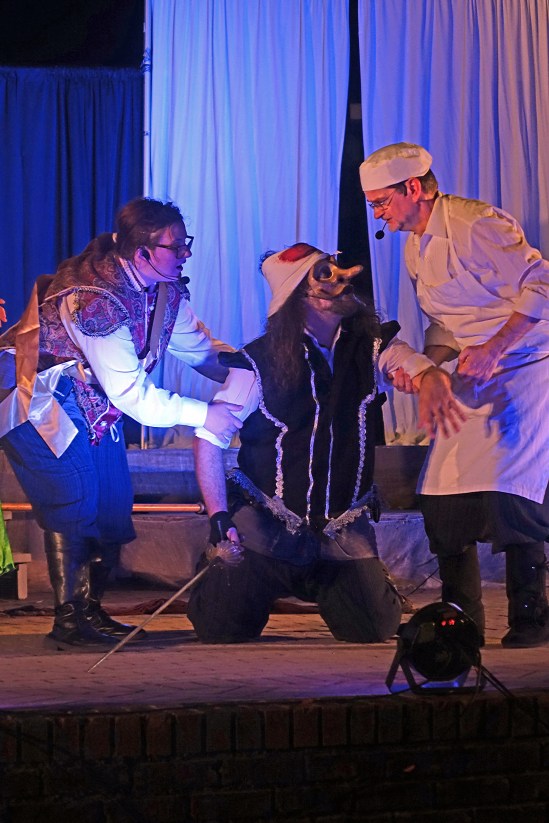
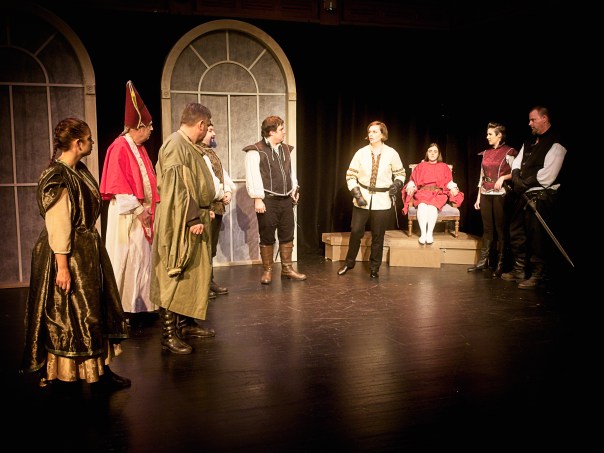
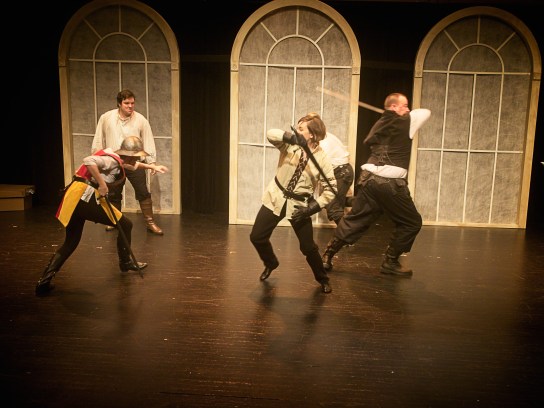
Saint Joan at Duke Energy in CharlottActor/director Eric Tucker and his Bedlam cast had a field day with the script, divvying up 25 roles among four actors. Shaw’s contention that there was no villain in the Maid of Orleans’ undoing came through vividly in an evening that mixed some fun into the high seriousness – but the evening was three hours long, hardly making a dent in GBS’s notorious loquacity. The new Free Reign Theatre production, currently at Spirit Square, brings Saint Joan more fully into the realm of accessibility. Director David Hensley noticeably shaves the Shavian discourse, and company founder Charles Holmes has free rein to ply his fight directing craft. Multiple episodes of spirited swordplay are sprinkled amid the wordplay.

Hensley deploys four times as many actors on the drama, allowing it to breathe more naturally than Bedlam’s insane reduction, where one of the actors might actually change roles mid-sentence and reply to himself. A more benign form of such absurdity persists with Free Reign, where the same French faces we saw opposing and abetting Joan’s miraculous rise to military leadership suddenly transform into her enemies in the angry and confounded English camp.

In a role that has been mainly populated by the great dames of theatre history rather than precocious teens, Amy Cheek makes an amazing splash the first time I’ve seen her in Charlotte. There were times, over the course of the evening, a relatively svelte 2:15 at Duke Energy Theater, when I felt that her excellence was all that was necessary. There is, as her elders say repeatedly, something about her – an ardent belief that infuses a Peter Pan cocksureness yet never crosses over into presumptuous arrogance.Saint Joan at Duke Energy in Charlotte

At times, the light radiating from within, kindled for Joan by the voices of the warrior archangel Michael and Saints Margaret and Catherine, made me believe Cheek was the ideal age for this role. Predecessors have included the likes of Uta Hagen, Katharine Cornell, Sybil Thorndike, Judi Dench, and the aforementioned Redgrave.

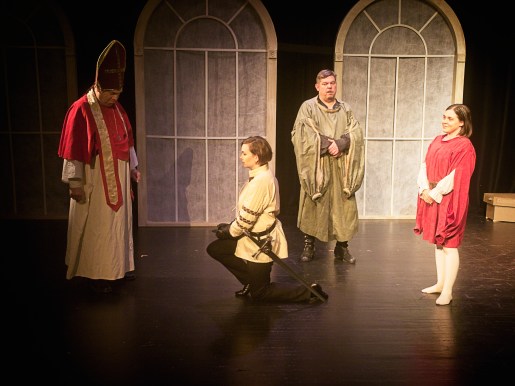
It tickled me that most of the other Free Reign players did so well – and that Hensley decreed that they aren’t all men. Five women flit through this surprisingly nimble evening. Particularly delightful was the idea of having the pert and diminutive Alexandria Creech portraying the timorous Dauphin, the future King Charles VII of France. The holy coronation at Rheims Cathedral can only happen if Joan can prod him into standing up for himself and forcefully claiming his rightful throne. With Russell Rowe thundering as the Archbishop of Rheims, Holmes glowering as military commander-in-chief Monseigneur de la Trémouille, and both of them towering over Creech, chances for an upswell of valor from the Dauphin look slim.

Saint Joan at Duke Energy in CharlottCreech can not only hide behind her courtiers when the Dauphin stages his first audience with Joan, she can nearly disappear. But Cheek also towers over this Dauphin – a little bit – so it’s a nifty tug of war for the future king’s favor. Holmes retains his bellicosity when he briefly appears at the English encampment as the Black Prince, but he becomes slightly more sympathetic at the trial as Peter Cauchon, somewhat doubtful that La Pucelle is a witch but absolutely certain that she is the worst of heretics.

Rowe follows a more interesting arc when he changes into an Englishman, becoming the implacable and somewhat stupid Chaplain John de Stogumber, who believes so rabidly in Joan’s witchery that it’s alarming. At the trial, he appears to be a mashup of the Chaplain and the Canon de Courcelles, who zealously brings over 60 charges against The Maid to the bench. Stogumber seethes mightily when Cauchon trims those charges to a mere 12, violently advocating that Joan be burnt at the stake – until he actually sees her on fire. He was so shaken and chastened by the spectacle that I almost pitied him, a truly wrenching turnaround.Saint Joan at Duke Energy in Charlotte

The Maid attracts believers and followers along the way, of course, and the most impressive of these are the hulking David Hayes as Bertrand de Poulengey, Joan’s first champion, and Robert Brafford as the wily renegade Dunois, who shrewdly sizes up her military acumen. Hayes resurfaces at La Pucelle’s side in the pivotal battle scenes before drawing a fearsome, taciturn role as her Executioner. Brafford sheds his good heartedness but retains his craftiness when he becomes The Earl of Warwick. The coolest of Joan’s enemies, Warwick is willing to offer a bounty to anyone who betrays The Maid – not the most dramatic thrust in Shaw’s script, so I suspect the suave and calculating Brafford was the most victimized by cuts to the script.

Every now and then, as in Boeing Boeing, we get the treat of seeing Emmanuel Barbe in a French role. As Robert de Baudricourt, the first nobleman to be won over by Joan’s eloquence and spunk, Barbe helps to get things off to a flavorful start. By the end of the first scene and its exhilarating little coda – and miracle! – this Free Reign production had already captivated me. As Shaw well knew, Joan’s story has that power.


Simmering Cauldrons in a Lonely Desert Town

Review: The Band’s Visit

By Perry Tannenbaum

iJMt08zc

Loneliness. Isolation. Boredom. Stagnation. No, those aren’t the ways we think of the Middle East when all the newsclips we see splatter blood, anger, violence, terrorism, explosive devastation and mass migration in our faces. But in 2007, Israeli screenwriter and director Eran Kolirin explored a different side of the region in The Band’s Visit, a film that unearthed all those sorrowful and solitary dimensions we hadn’t seen before. Critics had no problem in perceiving that Kolirin was onto something, and the film garnered awards at festivals far beyond its native land in Cannes, Zurich, Montreal, and Australia – to name a few.

Nine years later, with music and lyrics by David Yazbek and book by Itamar Moses, a musical adaptation of The Band’s Visit opened for a monthlong run Off-Broadway, moving to Broadway in 2017 after copping the Obie Award for best musical. Loneliness, isolation, boredom, and stagnation were still unapologetically intact, a rather lowkey brew for a Broadway musical. But 10 years after Kolirin’s film premiered, The Band’s Visit carried home 10 Tony Awards, a rather loud success.

w4S0J44z

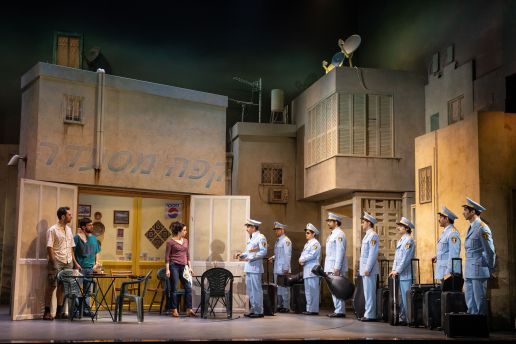
Against such éclat, you’ll need to brace yourself for heavy doses of calm, quietude, and smoldering ennui in the touring version, now entering its second week at Knight Theater. The story begins at a Tel Aviv bus station, where the Alexandria Ceremonial Police Orchestra is expecting to be greeted by emissaries from Petah Tikva, where the band is scheduled to keynote the opening of a new Arab cultural center tomorrow evening. A two-minute wait on the Broadway stage is equivalent to a numbing five-hour vigil in real life. So instead of waiting any longer, the bandleader, Tewfiq, decides that the ensemble will take the bus.

Oy vey.

Just as the English language doesn’t have a consonant like the guttural “h” at the end of Petah, Arabic doesn’t have an authentic parallel to the “p” sound, which was added to contemporary written Arabic to accommodate such foreign words as Pepsi (and Palestine). When the dreamboat trumpet player Haled goes to the ticket window, he returns with tickets to Bet HaTikva.

Now Petah Tikva is a real city with nearly a quarter of a million people, less than seven miles east of Tel Aviv. Bet HaTikva is another story – a fictional one – a dusty little town somewhere in the middle of the Negev Desert. It seems to boast a street café, a restaurant, a roller-skating rink, a pay phone, and a park bench that passes for the town’s park. But no hotel, and the next bus out of town isn’t coming till the following morning.

srWEryT3

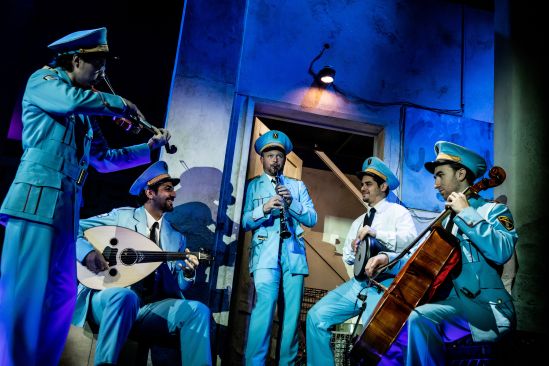
POV is a powerful tool, but it can also be a subtle one. By the time the Police Orchestra arrives in Bet HaTikva, clad in powder blue uniforms that might remind you of Paul McCartney on the cover of Sgt. Pepper, we can empathize with the disorientation of this Egyptian band. Because at one time or another, we’ve likely had that same sinking feeling of tourists who are lost in a strange place – and because the Egyptians don’t seem to be carrying any political beliefs in their baggage. These musicians carry themselves with dignity and a blend of meekness, restraint, and regimented discipline. Just what you would expect from cultural ambassadors who will be held accountable when they return.

The Bet HaTikva natives buy their story, but what are they to do with their visitors? Dina, the café owner, takes the lead – in cuing her friends on what tone to take toward their guests, distributing band members among neighboring households for their overnight stay, and in romantically pursuing Tewfiq. From there, the story splits into three, tracking Tewfiq, the more gregarious Haled, and Simon, one of the two clarinetists in the band.

LeOeRYCw

Contrasts between the band and the townsfolk are obvious, but they aren’t always what you would expect, and they never boil over into outright Arab-Israeli hostility. Here it’s the Egyptians from Alexandria who are the urban sophisticates while the Israeli desert dwellers are the rubes. Haled’s hosts are nonplussed when he repeatedly asks if they know Chet Baker, even after he imitates the trumpet legend’s vocal on “My Funny Valentine.” On the other hand, Tewfiq is incredulous when Dina reveals that she listened to music on Egyptian radio as a child and confesses her crush on Omar Sharif.

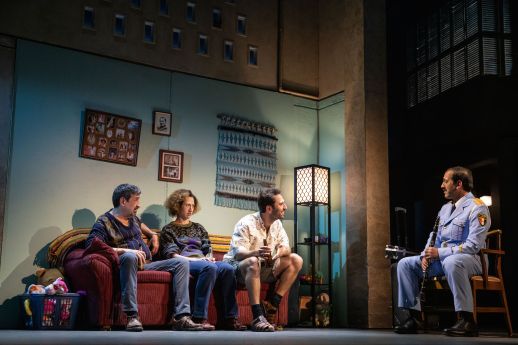
Music is the obvious bridge between the two peoples, deepening when Dina coaxes Tewfiq into singing the Arabic song he once sang to his now-deceased wife. There’s more rapprochement when Simon, staying the night with Itzik and his resentful wife Iris, soothes their crying baby with a lovely little half-tune on his clarinet, disarming Iris’s hostility on the spot and leading to the couple’s reconciliation after an earlier blow-up.

ObBX6gbZ

Curiously, that little tune is emblematic of the less obvious bridge that binds these people together: inertia. Simon wrote the beginning to his concerto a while ago, but he has no special desire to continue or finish his composition, no matter if people keep telling him it’s damn good. Dina broke up with her husband sometime back, once had ambitions of becoming a dancer in her Tel Aviv days, and doesn’t know why she stays in this in this one bus-stop town. Tewfiq is in no special hurry to move on from sorrowing over his family tragedies, and Itzik and Iris’s upward immobility, quarreling, and reconciliation seem to be in an endless loop.

ugq_LgmPMost absurd is the Telephone Guy, who stands vigil at the outdoor pay phone night after night, waiting for his long-gone girlfriend to ring him up.

Like a boring family get-together, The Band’s Visit has time to coast through a recital from Itzik’s father-in-law on how he and his wife bonded over the Gershwin brothers’ “Summertime.” The livin’ is easy in this cumulatively powerful musical, and tempo is certainly not rushed under David Cromer’s deft direction. But there’s nothing lazy about the way Scott Pask’s scenic design slickly whisks us from location to location, indoors and out, with a turntable to speed up the skaters. I half expected a bus to ease onto the stage when it came time for the band to depart.

There’s unquestionable DNA from the 2007 film in the current tour, with Sasson Gabay returning to his award-winning role of Tewfiq and his son Adam Gabay scooping up a smaller plum as the painfully shy Papi. Sasson established admirable chemistry with Chilina Kennedy opposite him as Dina, absolutely definitive, but 12 years after that film, the age gap between him and his leading became conspicuous. If Tewfiq is so tentative and unwilling, why doesn’t Dina hasten to go after the younger bucks who might be more receptive and responsive?

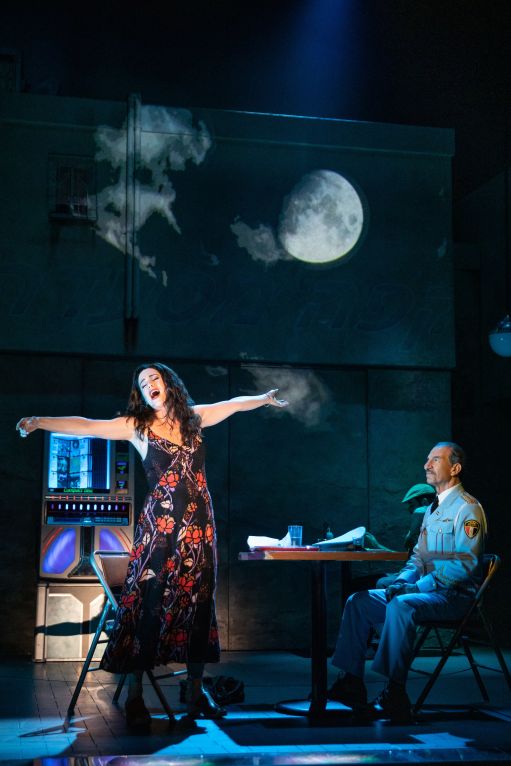
More problematic on opening night was Sasson’s energy shortage and Kennedy’s tendency to mute her sassiness to be more compatible. I’ll need to read the script or watch the film to get the full gist of their Omar Sharif intimacies. On the other hand, when Kennedy gets to belt and vamp on “Omar Sharif” and “Something Different,” she shows us that there’s a tender, sensuous side to the tough and brusque sabra she first reveals at her café. And even at low volume, Sasson’s restrained emotion comes through powerfully when he sings “Itgara’a” in a cappella Arabic.

Pleasant surprises come from the humbler members of the supporting cast as Papi’s panic attack on a blind date at the roller rink becomes a “Papi Hears the Ocean” showstopper for Adam Gabay, and Mike Cefalo comes vividly to life as The Telephone Guy with a potently plaintive “Answer Me.” Throughout this intermission-less treat, Yazbek’s score shuttles between familiar showtune style and Arabian exotica, percolating with pluckings from a lute-like darbouka (Roger Kashou), a mandolin-like oud (Ronnie Malley), and – what truly does boil over here – the pounding of Arabic percussion (Shai Wetzler).

skJN_il5

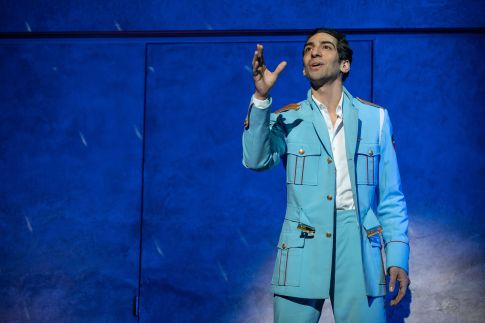
Given Haled’s cool Chet Baker proclivities and his brash breaches of police decorum, we shouldn’t be surprised that when Joe Joseph sings “Haled’s Song About Love” to calm Papi’s panic attack and supply him with encouragement, he sports the hip jazzy sound of early Frank Sinatra, late Baker, and contemporary Seth MacFarlane. Took me by surprise, because it’s so smoothly different from everything else we hear. Spoiler: it definitely works when Joseph sings it, with a kind of Zachary Levi charm.

Both Kennedy (Beautiful) and the elder Gabay (Band’s Visit) have starred in Broadway productions, albeit in replacement casts, so the top-tier quality of this touring edition begins at the top – when the co-stars aren’t allowing their energies to flag. Small and relatively quiet with its nine-piece instrumental ensemble, this Yazbek-Moses gem manages to cover a fairly wide swathe of Israeli life. We get perceptive sectors on midlife yearnings and regrets, bachelor urges and trepidations, and the simmering cauldron of domesticity. With Pomme Koch as Itzik and James Rana as Simon, the two knowing husbands we see onstage, the top-tier quality extends far and deep.

ATC’s Outdoor “Midsummer” Is Electrifying Fun

Review: Actor’s Theatre of Charlotte A Midsummer Night’s Dream

By Perry Tannenbaum

MSND 2

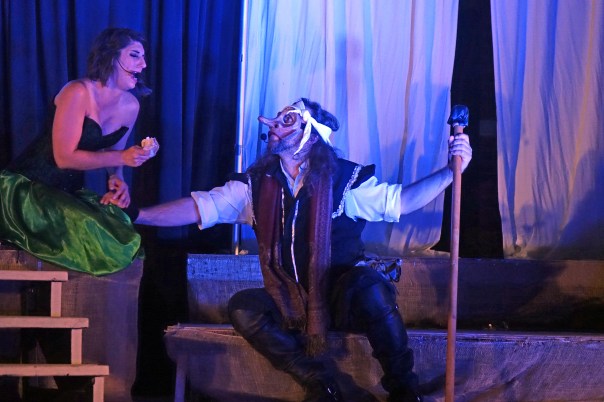
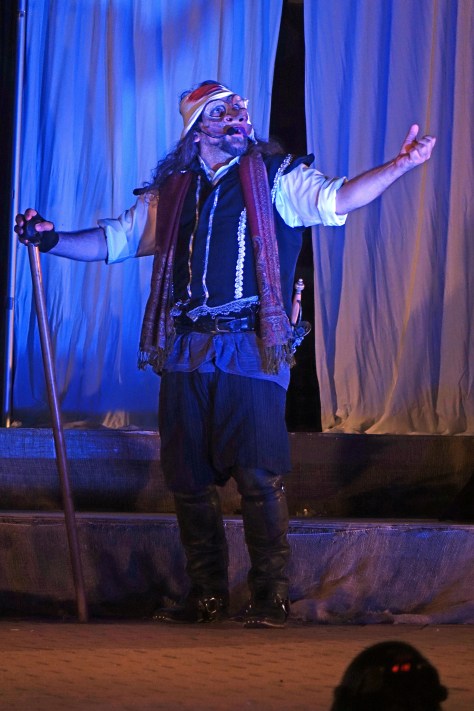
Aside from sporadic Chickspeare ventures in the NoDa Brewing parking lot and a tentative CPCC Shakespeare on the Green production up at their Cato campus two summers ago, we haven’t seen anybody commit to an annual series of outdoor Bard since the Queen City’s second Charlotte Shakespeare bit the dust in 2014. If you’ve been hankering for some good Shakespearean comedy under the moon, with a refreshing beverage in your beach chair’s cup holder and a trusty cooler at your side, the long drought is over.

Actor’s Theatre of Charlotte has made good on their promise, announced at the dawn of their new residency relationship with Queens University, that they would launch an annual Midsummer Nights @ Queens series, starting with the most logical choice, A Midsummer Night’s Dream. Now Shakespeare hasn’t exactly been in Actor’s Theatre’s wheelhouse during its first 30 years. Nor has any classic playwright dating further back than Edward Albee. Perhaps for that reason, ATC executive director Chip Decker tamped down expectations when he first unveiled his plans, saying this would likely be a cooperative effort featuring students in the Queens U theatre program.

2019~Midsummer @ Queens U-21

He lied. Directed by Chester Shepherd, this Midsummer is as professional as any homegrown Shakespeare production we’ve seen in the Metrolina area since the first Charlotte Shakespeare folded in the early ‘90s. Even though admission is free, production values are not at all cheap. Costume designs and props by Carrie Cranford are literally electrifying in a few instances and, while there isn’t any scenic design, Shepherd leads his players up and down, up and down, taking advantage of a bush here and a tree there, borrowing the stone stairway and entrance to campus building for the Athens scenes and kidnapping a toddler from the audience when we adjourn to the forest and the fairies.

That’s not to say that there aren’t some serious economies, but they don’t include forswearing playbills, which are handed out to audience members by wingèd ushers. Although the roles of Athens royals Theseus and Hippolita are often doubled with those of Oberon and Titania, the fairy king and queen, here we’re confronted with an orgy of doubling – nine actors in 18 roles. Except for Peter Finnegan as Bottom, all the mechanicals are moonlighting as Athenian nobles.

2019~Midsummer @ Queens U-12

So the looney lovers who are confounded and enchanted in the woods by the fairies cannot mock the mechanicals when they present their “Tragical History of Pyramus and Thisbe” – they’re performing it, you see. Their lines disappear with them, part of a shrinking process that yields a playing time of less than 100 minutes. That’s another economy. Anybody who has memorized the lines uttered by Peaseblossom, Cobweb, Moth, and Mustardseed will notice that these fairies have also been vaporized – or compressed into the generic Fairy played by Kerstin VanHuss.

Steven Levine is certainly manly and commanding as Theseus and Oberon, but he is upstaged by the antics of Sarah Molloy as Puck and the misplaced amorousness of Nonye Obichere as Titania – not to mention their outré costumes. Obichere has only to swish her illuminated blue cape to dazzle us, and Molloy’s outfit is even wilder than Bottom’s. Of course, Finnegan’s hambone bravura must begin before Puck mischievously transforms Bottom into an ass, and we benefit from the minimalist design decision not to obscure the actor’s face when Titania plies her charms.

Finnegan really takes over when he stars as Pyramus for Theseus and Hippolita. More than one actor has made the death of Pyramus into a full meal. Finnegan aims for a banquet.

2019~Midsummer @ Queens U-36

Among the befuddled lovers, the women get the most comical opportunities. Iesha Nyree as Hermia and Anna Royal as Helena both make good on their mightily distressed episodes, and Shepherd hasn’t erred in stressing the height differential between them in his casting. With so much thunder stolen from their benighted partners, it’s actually fortunate that Adam Griffin and Jonathan Ford, Demetrius and Lysander respectively, get to moonlight as mechanicals, Griffin as Snout and Ford as Flute.

The caution that free insect repellent was available at the theater site proved to be unnecessary on Saturday night, but in the early part of the evening, I found it welcome to have some cold liquid at hand. Microphones consistently operated well, so you can expect audibility to be less of a challenge than Elizabethan English. The plenitude of physical comedy supplies ample translation.

A couple of real concerns: handicapped access begins on Selwyn Avenue, to the left of the Queens U traffic circle, not in the traffic circle itself. And counterintuitively, the worst seating is in the middle of the greensward facing the stage. The further you sit toward either side, the more easily you’ll see past obstacles in the center, namely a table, a slatted bench, a soundboard, and the technician standing over them.

Get there early, select a good sightline, and your Midsummer Night @ Queens should be quite dreamy.

Charleston Heatwave and Steamy “Salome” Set Spoleto Ablaze

Review: Spoleto Festival USA in Charleston, SC

By Perry Tannenbaum

salome_47926123648_o

Hold your horses! That was the directive that went out to operators of horse-driven carriages that usually swing Memorial Day tourists around Charleston during Spoleto Festival USA. It takes readings of 95º or higher for tourism officials to order the drivers and their carriages back to their stables. During this year’s festival, the mercury hit that mark on the first Saturday and eclipsed that high for five consecutive days afterwards. On Memorial Day – and the next day– official highs hit 100º, the first times that plateau had ever been reached during the month of May.

Naturally, the heatwave was the hottest topic among concert audiences and operagoers during the first week of Spoleto. The sensational – or sensationalized – new production of Richard Strauss’s Salome was a distant second in generating buzz, while the proliferation of new music at all of Spoleto’s music venues hardly generated a peep.

You could say that grumblings about new music had receded because new opera at Spoleto had retreated. Although the directing team of Patrice Caurier and Moshe Leiser, rethinking their 1987 approach to Salome, had made their modernized version steamy enough to rival the weather, it stood alone. There were no new operas at the festival, such as last season’s Tree of Codes or Quartett from the year before, both given their American premieres. Nor were there any exciting excavations like the past two seasons’, when we saw Donizetti’s Pia de’ Tolomei and Vivaldi’s Farnace in American premieres.

chamber-music-iii_47958938543_o

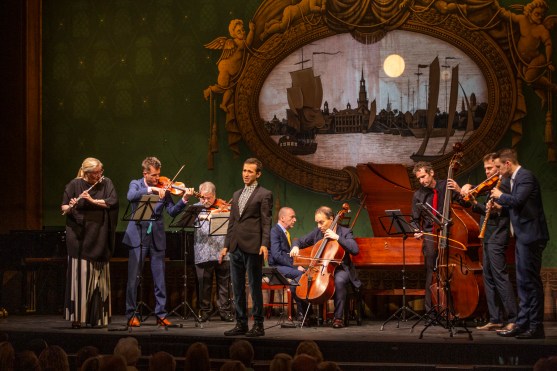
On the other hand, you could also say that orchestral director John Kennedy, Westminster Choir leader Joe Miller, and chamber music director Geoff Nuttall have opened the gates to new music to such a degree that it now permeates Spoleto’s classical programming. At Dock Street Theatre, the chamber music venue dripping with antiquity, I don’t recall an after-concert buzz that quite equaled what I heard when Karen Gomyo made her festival debut. On the heels of a gorgeous Bach sonata from flutist Tara Helen O’Connor and an exhilarating Concerto for Two Celli by Vivaldi, featuring cellists Joshua Roman and Christopher Costanza, Gomyo gave an electrifying account of Sarasate’s “Carmen Fantasy” that left me trembling.
chamber-music-i_47958924527_o

That performance seemed the obvious choice when I reached the outdoor courtyard, probably no warmer than 98º, and I overheard one guy asking his lady which piece she had liked best. After a couple of seconds of reflection, she answered, “I think I preferred the quartet!” That piece was When the Night for Cello Quartet by composer-in-residence Paul Wiancko, with Roman, Costanza, the composer, and Nina Lee in her Spoleto debut. Introducing the piece, Nuttall outed Lee as the musician who had asked Wiancko where his title had come from. Then he had Wiancko play the bass intro to Ben E. King’s “Stand by Me” and, to complete Lee’s hazing, asked everybody who knew the first three words to sing them. We were fairly loud responding to our cue. Twice.

Like Charles Wadsworth before him, Nuttall feels no compulsion to solemnly match the mood of his intros to the music that will follow. So it’s typical of his hosting style that, while pranking the newbie, Nuttall also let us know that the three movements of When the Night would be ethereal and serene.

Wiancko’s previous pieces had been more multicolored in mood and instrumentation. Closed Universe, written in the wake of the 2016 election, pondered the dark days to come with Costanza tilting the instrumental makeup of a piano quartet toward his solo cello. The composer added another intriguing twist, playing a second cello and a glockenspiel, which chimed in to signify the glimmers of hope he felt amid the gloom. On Program III, oboist James Austin Smith and the St. Lawrence String Quartet premiered Wiancko’s newest piece, Faults. It was also the brightest of the works played during the composer’s residency, with abrupt shifts between lyrical beauty and discordant chaos – with a little mischief tossed in. Smith seemed to be having fun on the bumpy terrain, particularly late in the piece when he and St. Lawrence violist Lesley Robertson performed a clapping accompaniment for the other players. Playing first violin with his quartet, Nuttall was so gleeful that he seemed like a kid.

In the more traditional repertoire, Nuttall was playing with more fire and flair than we had seen from him since he took over as chamber music director after the 2009 festival. Following on the heels of Closed Universe in Program I, Nuttall absolutely scorched the first violin part of Ernst von Dohnányi’s Piano Quintet, smiling as he burned with pianist Stephen Prutsman and the St. Lawrence. Nuttall and the St. Lawrence also played the coveted finale spot – with its guaranteed standing O – in Program II, Haydn’s “Emperor” Quartet, after the violinist’s alert that the “Deutschland über alles” melody was upcoming in the quiet second movement.

If we can accept that Ben E. King would go on to upstage Carmen, then I’m emboldened to proclaim that Prutsman turned the St. Lawrence’s heroics with Haydn into something of an anticlimax in his rendition of Beethoven’s “Moonlight” Sonata. Nuttall’s intro stressed the range of emotions we were about to experience, warning the Dock Street audience that the opening Adagio sostenuto might bring them to tears. My tears actually welled up in the closing Presto agitato, one of my favorite piano pieces, for I’d never heard it played live with such white-hot ferocity and fury.

As far as audience favor that afternoon, that may have been secured by the chunk of Ovid’s Metamorphoses that bassist-composer Doug Balliett so charmingly modernized in his Echo and Narcissus, with countertenor Anthony Roth Costanzo singing both of the title roles and the composer narrating. Prutsman was literally upstaged in Program IV when he performed a rollicking film score for piano quintet – with Nuttall doubling on a cheesy toy trumpet – that he composed for Buster Keaton’s 1927 silent film, College. At the start of the concert, Nuttall promised that anybody who didn’t laugh hard at least once could ask for his or her money back at the end of the show. Projected on a fairly wide screen while the musicians played off to the side, Keaton’s antics prevailed. Even if I hadn’t been comped, I couldn’t have collected.

Prutsman also had a salutary impact on Kennedy’s more militantly modern Music in Time series, which split its four concerts between the funky Woolfe Street Playhouse, with its Bohemian cocktail tables and faux candles, and the Simons Center Recital Hall with its clean-room sterility. Looking very much at ease at Woolfe Street, Prutsman introduced his 30: An American Kaleidoscope and left the performing to a string quartet comprised of four Spoleto Festival USA Orchestra members – except for the pre-recorded soundtrack that the composer provided for accompaniment. The idea was to simulate a road trip across the US, the quartet acting as the riders and Prutsman’s audio imitating the sound of a car radio as the travelers sped in and out of the wavelength of stations that they passed. Sped might be an understatement, since Prutsman claimed to have condensed snips of some 400 songs into his soundtrack, far more than he stole for his feature-length College score.

Kaleidoscope was somewhat unique in the “Rebellion in Greenery” concert, since Britta Byström’s title piece, Pauline Oliveros’ From Unknown Silences, and Anna Thorvaldsdottir’s were all more tranquil nature studies, not speedy at all. was easily the most exotic, with bass flute and bass clarinet included in the texture, and punctuations on the piano that included hitting the strings with a mallet. Percussionist Ye Young Yoon had even more outré assignments: rubbing a drum with a disc, bowing a vibraphone, applying a crumpled piece of paper to gong, and simply crumpling a second piece of paper! Except when Yoon banged the bass drum, the music hardly rose above a whisper, mesmerizing.
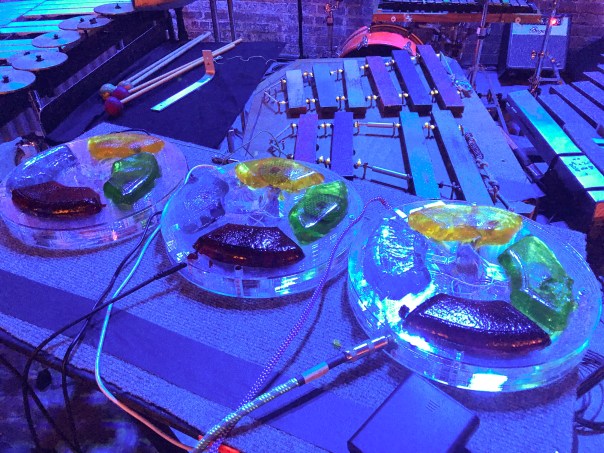
Jello Xylo

Dedicated to bringing rock instrumentation to new – and old – classical music, The Living Earth Show was more rowdy, raucous, and crowdpleasing in their second Spoleto appearance. Both members of this Left Coast duo, stoked percussionist Andy Meyerson and slightly mellow guitarist Travis Andrews, took turns personably introducing their repertoire along with one or two of the many instruments that littered the stage. By far the most unusual of these was the electric percussion instrument Myerson played with mallets during Dennis Aman’s Prelude #5/Fugue #4, based on Bach. It seemed to be fashioned from three plastic disks, about the size of an old studio tape reel, each of which sported four blobs of primary colored Jell-O – lemon, lime, blueberry, and cherry – sufficiently solidified so they wouldn’t splatter.

Living Earth’s exploration of what is possible was fun. Before Nicole Lizée’s Family Sing-A-Long and Game Night, I’d never seen anybody bowing a guitar, and before Raven Chacon’s Tributary, I’d never contemplated the musical possibilities of smashing a drinking glass into a bucket and mucking around with the broken shards. Also memorable was Sarah Hennies’ update of Bolero, emphasizing the snare drum tattoo until the piece dissolved into a percussion orgy.

As opposed to the more retro and conservative music performed at Woolfe Street, mostly by female composers, the slate at Simons was strictly modern, often minimalistic, and exclusively male-composed. In the “Stay on It” concert, the title piece by Julius Eastman was preceded by two more recent works by Steve Reich, Pulse and Runner. Before conducting, Kennedy prefaced the Reich works, comparing Pulse (2015), in particular with the late symphonies of Haydn for its clarity. A bit of a stretch, I thought when the piece was done, so the whoops of enthusiasm that welled up from the audience took me a little aback. Patches of fanatical support enlivened the entire Music in Time series.

Written for two orchestras, each deployed to one side of the stage, Runner (2016) struck me as livelier and more engaging, but the Eastman piece, exhumed from 1973, had the most color and chaos, with stretches of jungle riot and jazz. Soprano saxophonist Jeffrey Siegfried led the ensemble, playing with and without his mouthpiece and reed, contributing the elephant roar to Eastman’s sonic Africa.

After my Spotify preview, I had somewhat dreaded staying an extra day for Georg Friedrich Haas’s in vain (2000), but Kennedy hinted that seeing the work staged would add an extra dimension, and he was right. Aside from its tuning complexities, this apocalyptic work, over an hour in length, was written to be played through two extended periods of total darkness. Not only did the 24 musicians from the Spoleto Orchestra need to memorize long stretches of their parts, they needed to play them together without Kennedy’s direction, shifting dynamics and tempos by listening to each other.

I found myself getting more accustomed to the gloom during the second episode of darkness, able to see Kennedy’s motionless silhouette – and also able to more keenly perceive the musicians’ striving for unity and community. Their struggles were all the more poignant when brief flashes of light pierced the darkness without providing any help.
classical-showcase_47965422063_o

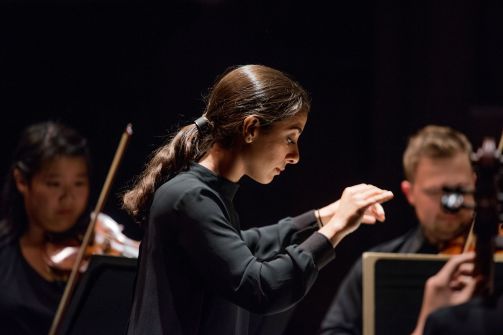
Kennedy was one of five conductors at the podium for Spoleto’s larger musical productions. After serving as assistant director for the 2017 production of Eugene Onegin, Michelle Rofrano made her formal debut conducting a groundbreaking Classical Showcase concert that brought the Spoleto Festival USA Orchestra out of the pit and onto the stage at Dock Street Theatre. She also brought Fanny Mendelssohn’s Overture in C on board to share the stage with works by Bach, Stravinsky, and Beethoven. A hefty piece it was, for there were more musicians exiting after the Mendelssohn than entering for Beethoven’s Symphony No. 1.

city-symphonies_45470846404_o

Memminger Auditorium, where Amistad, Peony Pavilion and Paradise Interrupted have been staged, was the right choice for Michael Gordon’s City Symphonies trilogy, paired with films by Bill Morrison. Kennedy took on this edgier fare, getting wonderful work for the Festival USA Orchestra, but the most provocative elements of this evening were Morrison’s depictions of New York in Gotham, LA in Dystopia, and – let there be color! – Miami in El Sol Caliente.

Aside from the customary Westminster Choir concerts, which included touching tributes to their late former director Joseph Flummerfelt, Miller and his Princeton-based ensemble were unusually active. Before and between the two choral potpourris at St. Matthew’s Lutheran Church, there were two blockbusters at Gaillard Center, Joby Talbot’s Path of Miracles and Bach’s St. John Passion.

Stage directed and set designed by John La Bouchardière, Spoleto’s Path of Miracles took a score that wasn’t intended for the stage and plopped it down at St. James the apostle’s tomb in Santiago and the Camino de Santiago path across Spain that pilgrims take to the shrine to be healed and shriven. Talbot’s music handed out 17 different vocal lines to the Choir, set to a Robert Dickinson libretto in seven languages. Seven, including Basque.

path-of-miracles_47954465041_oA circle of rocks onstage seemed to allude to the circle of stars that originally helped a hermit to discover what is called Santiago de Compostela – Saint James of the field of stars. Having seen so many Westminster concerts before, I was probably more disoriented than anyone. La Bouchardière began with a procession of choristers parading down the aisles to the stage, skipping over the miraculous 9th century discovery of St. James’s tomb and introducing us immediately to the flocks of pilgrims trudging there on foot.

Didn’t La Bouchardière know that Miller does that same processional shtick at the beginning of every Westminster concert? Yes, he did it this year, too.

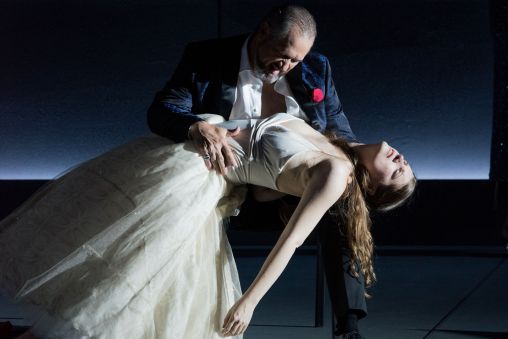
Somewhat overshadowed by Caurier and Leiser’s bold restaging of Salome – and the outstanding cast he was fortunate enough to lead – Steven Sloane did not instantly emerge as the most outstanding conductor at the festival this year. Sure, the score absolutely crackled under his baton, but the new twists were sensational, Salome baring her breasts as she attempted to seduce Jokanaan and a “Dance of the Seven Veils” set to a full ten-thrust sexual encounter with Herod. Hail, Viagara! The modernized rooftop set design by Christian Fenouillat became spectacular when he dropped Jokanaan’s entire bedroom down on it, glowing against the nighttime sky.
salome_47926126663_o

Scenery and stage directing screamed audacity, but consider: Sloane’s Salome, soprano Melanie Henley Heyn, was singing professionally for the first time ever in a full-length operatic production – and she was amazing, validating the awesome risk of casting her. Heyn wasn’t a temptress; she was more of a petulant Salome, a privileged teen accustomed to being worshipped. So she wasn’t tasked with performing diva exploits when she came on to rich-voiced baritone Erik Van Heyningen in Jokanaan’s bedroom, and she could be unusually passive – if not absolutely a victim, since she knew she would be repaid! – when tenor Paul Groves dropped his pants for the “Seven Veils” dance.

The hauteur and conceit of Salome came across best when she prevailed upon the helplessly enamored tenor Zach Borichevsky as captain of the guard Narraboth (easily on a par with Groves and Van Heyningen in this admirably deep cast) to let her visit Jokanaan in his cell – and later when she demanded his head, stretching his name each time to seven chilling syllables. Caurier and Leiser stumbled a bit after Herod hitched his belt, for they didn’t make a serious attempt to equal the shock value of Salome’s failed seduction and faux dance when she claimed her prize. Heyn and Sloane were arguably most impressive there, because the succeeded in making up the slack.

Newly appointed as music director of the Jerusalem Symphony, Sloane may have been the most underappreciated conductor at Spoleto this year in his mostly underground performance, but Evan Rogister vied with him for excellence in a program of Prokofiev and Shostakovich. He also has big things in the works as the newly appointed principal conductor of Washington National Opera. What all these conductors accomplish with the Spoleto Festival USA Orchestra, young professionals and grad students freshly gathered through nationwide auditions every year, is routinely astonishing.
prokofiev-and-shostakovich_47985705607_o

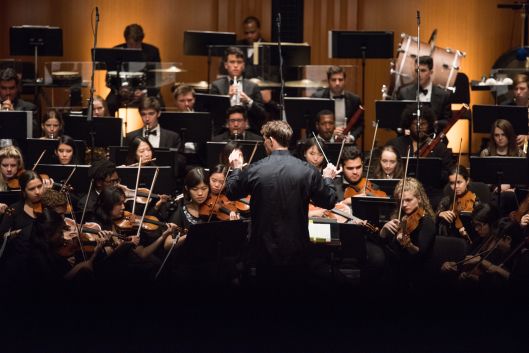
But with selections from Prokofiev’s two Romeo and Juliet orchestral suites, what Rogister achieved was unique for me. What I heard at Gaillard not only eclipsed every live or recorded performance I’d experienced before, it made me admire and thrill to music that I had strained to tolerate before, beginning with the familiar “Montagues and Capulets” theme that had grown hackneyed and noxious for me. I can hardly explain the difference other than to say that Rogister had channeled the youthfulness and energy of this orchestra and somewhat pierced through to the soul of the gritty, grudgy, and utterly rhapsodic story Shakespeare had written, a story whose essence is youth. Of course, the proficiency of the musicians and the acoustics of the hall didn’t hurt.

A window into how Rogister accomplishes such wonders may have been opened when he prefaced the Orchestra’s rendition of Shostakovich’s Symphony No. 5. He went beyond talking about Shostakovich’s tribulations during the Stalinist regime, the framing of this symphony as a penitential offering, a step toward political and cultural rehabilitation. Rogister took an additional moment to pay tribute to three virtuosi who made so much of modern Russian music possible with their encouragement, sponsorship, and artistry – cellist Mstislav Rostropovich, pianist Sviatoslav Richter, and violinist David Oistrakh.

That’s valuing musicians to the highest degree.
ShakesCar’s Dystopia Is as Serious as a Cartoon

Review: Shakespeare Carolina’s production of Mr. Burns at Spirit Square

By:  Perry Tannenbaum

2019~Mr Burns-12.jpg

If your Simpsons erudition doesn’t extend far beyond Bart, Homer, and “D-oh!” you likely haven’t the foggiest notion about who the evil owner of the Springfield Nuclear Power Plant might be. Good reason for boning up on the 30-year-old animated TV series before you go and see Shakespeare Carolina’s production of Mr. Burns, Anne Washburn’s strangely imagined “Post-Electric Play,” at Spirit Square.

The Simpsons is very much at the heart of Washburn’s myopic dystopia, beginning not too long from now, somewhere south of devastated Boston – at a safe distance from obliterated Pennsylvania. Not an ardent lobbyist on behalf of nuclear power, Washburn doesn’t trigger her nuclear winter with weapons unleashed after treaty breaches, miscalculated escalations, or some jerk’s pudgy finger on the nuclear hot button.

Instead, we seem to have been decimated by a chain reaction of nuclear reactors.

2019~Mr Burns-03

Certainly, the evil Mr. Burns has triumphed over humanity in Washburn’s scenario, but it’s unclear whether she views that as her ultimate horror. For as a few survivors sit around a campfire, we might gather that The Simpsons has outlived all other recognizable trappings of civilization. Matt, Jenny, Maria, and Sam aren’t preoccupied with reaching out to other clusters of survivors or isolated wanderers – or in re-establishing the nation’s electrical grid. Rather they’re engaged, sometimes excitedly, in piecing together an old episode of The Simpsons that they have all watched years ago.

Presumably a rerun, for the “Cape Feare” episode, the core of the reconstruction, first aired in 1993, twenty years before the off-Broadway premiere of Mr. Burns.

A newcomer named Gibson wanders into the campsite with the bad tidings from Boston. He is also familiar with this seminal episode of The Simpsons and contributes to the group reclamation. Aside from a ritual sharing of possible survivor info, that’s pretty much all of the Act 1 action.

Colleen 2.JPG

Not at all interested in adhering to established theatre traditions, Washburn gives us two intermissions instead of the usual one. And if you think the opening act was a bit impersonal, wait till you see the acts that follow. It’s seven years later and Colleen, recumbent and silent throughout Act 1, has become a post-electric TV director, and the company has grown to seven with the addition of Quincy.

We see the group rehearsing an odd amalgam of quick TV sitcom blackouts and commercial breaks, where “Cape Feare” has evolved and commercials are no less revered for their nostalgic content. Apparently, touring with such rudimentary fare has become a cutthroat industry. Lines, slogans, and episodes are licensed, and competition for rights to them is fierce – and perhaps more important than the quality factor.

Pret a Manger

Zoom ahead 75 years and, under Amanda Liles’ ritualistic direction, you’ll be able to visualize “Cape Feare” as either a solemn religious rite or as an eerie melodramatic opera, for most of the music written by Michael Friedman to Washburn’s lyrics resides here. Liles and the ShakesCar cast also leave the ending ambiguous. We’re either watching the near-revival of the electrical grid or a re-enactment of the original flameout.

Mr. B finally emerges emphatically during this savage spectacle, not as the evil and greedy capitalist of yore but as a demonic destroyer. Homer, Bart, and Marge are now as foundational as Abraham, Isaac, and Jacob – though their sacrificial fates bring in a New Testament flavor. Stray wisps of Washburn’s referential comedy still remain, though, as when the Simpsons make merry with new lyrics to The Flintstones’ theme song.

2019~Mr Burns-23.jpg

My suspicion is that enjoyment of Mr. Burns will be proportionate to how readily you can see yourself sharing in the opening bursts of enthusiasm that the nuclear holocaust survivors have in reconstructing “Cape Feare” on The Simpsons. Lacking more than rudimentary Simpsons erudition – Homer’s voice will send my hand flailing toward my remote a bit more quickly than Bart’s – I’ll have to admit that I struggled. My memories of Homer’s zenith had faded into forgetfulness long before 2013.

An apocalyptic landscape such as Washburn’s is obviously frill-averse, so if Jess Clapper’s costume designs look somewhat makeshift, no harm done. The cylindrical blue headdress that Jen Jamsky-Pollack wears as Marge works fine, recognizable in an instant for The Simpson faithful, while Rasheeda Moore’s get-up as Bart looks comparatively thrown together. Viking shoulder plates? Why not.

Nor does an outdoor campsite in the middle of the night – or the scenes to follow – require that Liles seek out a set designer, though the final flashes of zonked light presumably required some technical derring-do from James Cartee. The design and tech needs of Mr. Burns really do jibe well with ShakesCar and their fundamental Elizabethan fare.

Except that, in Mr. Burns, we never become more than superficially acquainted with anyone onstage. In Act 2, we can at least conclude that we’re watching a director with a company of actors, all of whom discuss the production they’re rehearsing and the biz. In the outer acts, Shakespearean ripeness is pretty much deep-sixed. The characters they’re portraying or debating are more important than who Matt, Jenny, Gibson, Colleen and the rest really are. By the time we’re 75+ years hence, when all these folks are sporting various configurations of face paint, they can’t really be the same people we were introduced to.

It’s not just a surrender to a debased pop culture that Washburn seems to be sketching – it’s a surrender of identity. Maybe that’s the point that the playwright wants to make, irrespective of nuclear threats, and maybe she was worried that we wouldn’t notice or be alarmed.

2019~Mr Burns-21.jpg

Most people who enter Duke Energy Theater for an evening with Mr. Burns – or the actor who plays the actor who eventually portrays Mr. Burns – will likely wish that Washburn were a little more worried about our perceptions of her script and a little more proactive. While I may need to evolve into a post-critic to properly evaluate Washburn’s post-characters, I’ll start with David Jamsky-Pollack as Matt, the geekiest Simpson preservationist in Act 1.

Although he lays relatively low in the middle act, Matt morphs into Mr. Burns, and more than anyone else, Jamsky-Pollack incorporates the pop-eyed essence of The Simpsons into his portrayal. That creates a credible bridge with Matt, whom Jamsky-Pollack makes the most hyper and paranoid of the people around the campfire. As Colleen, Corlis Hayes is another near-person we pay attention to, primarily in Act 2 while she is the company director and Matt is in eclipse. Hayes is moderately bossy, a bit yielding when her authority is challenged – everything her role demands.

Dervin Gilbert is arguably the nearest to a three-dimensional person as Gibson in the first two acts. With multiple guns pointed at him as he enters the campsite, we can empathize with his trepidations and attempts to ingratiate himself, and seven years later, Gibson is Colleen’s leading man, a temperamental artiste in an arts wasteland. Matt Kenyon as Sam/Homer, Melody McClellan as Maria/Lisa, and Jen Jamsky-Pollack as Jenny/Marge are most memorable during the sacred Simpsons rites, successfully achieving and slightly transcending cartoon reality.

2019~Mr Burns-17.jpg

Among the latter-day Simpsons, I was most taken with Moore, who doesn’t arrive until after the first intermission as Quincy, a singer with as much artistic pretension as Gibson. It does make sense that Quincy would get to chew nearly as much scenery as Matt when the Simpsons ritual becomes a life-or-death struggle between good and evil. Cartoon or not, Moore’s writhing, struggling, despairing, and rallying are key reasons why we see the horror in Mr. Burns, whatever it may mean.

CP’s Gentleman’s Guide Sports a Solid Cast but Overthinks Our Scruples

Review:  A Gentleman’s Guide to Love and Murder

By Perry Tannenbaum

CENTRAL2019-DLV-0718-0976(1).jpg 

It’s been 70 years since Kind Hearts and Coronet, based on Roy Horniman’s Israel Rank: The Autobiography of a Criminal, became a delightfully wicked vehicle for Alec Guinness, who was murdered multiple times during the film as he portrayed various members of the aristocratic D’Ascoyne family – one of them female. Jefferson Mays drew similar kudos in 2013 when Horniman’s novel was the source of A Gentleman’s Guide to Love and Murder, with all of Guiness’s D’Ascoynes discreetly converted into more singable D’Ysqiths – and featuring an additional lady among the slain. Lauded by the press, Gentleman’s Guide didn’t click at the box office until the Tony Award nominations were announced in the spring of 2014. When the show and its book by Robert L. Freedman won the Tonys, the victory bump carried into early 2015. But the run barely lasted into 2016, a full three months short of reaching the 1000-performance mark when it closed.

A Gentleman's Guide to Love & Murder, Final Dress Rehearsal; July 18th, 2019

The touring version of Gentleman’s Guide was all the more fresh when it opened at Knight Theater that same November, and the Charlotte audience welcomed it heartily. Directed by Tom Hollis, the current CPCC Summer Theatre version reminded me of the charms and shortcomings I saw in the original Broadway production while setting in bold relief a couple of the technical difficulties it overcame. Even though I had seen the show twice before, I was struck afresh by the artificiality of Freedman’s concept, which decrees that our hero Monty D’Ysquith Navarro’s recollections are staged under a proscenium within the Halton Theater proscenium at CP. Puzzling over why critics so adored this artificiality, I hadn’t pondered why Freedman had insisted on it.


A Gentleman's Guide to Love & Murder, Final Dress Rehearsal; July 18th, 2019My best guess is that Freedman wished to double-underline the idea that we were watching a comedy as Monty murderously ploughed through most of the eight D’Ysquiths who stood in his path to becoming the next Earl of Highhurst. Before we even see Monty at his desk in prison, writing the confessional memoirs that will flash us back to the story of his crime spree, an ensemble dressed in funereal black advises us to depart immediately if we don’t have the stomach for the carnage to come. Whether intentionally or not, Hollis further shields us from the notion that Monty is a heartless murderer, aided chiefly by Kevin Roberge playing all the D’Ysquiths that Monty knocks off.

A Gentleman's Guide to Love & Murder, Final Dress Rehearsal; July 18th, 2019

Roberge made them less eccentric, less broadly comical, maybe a tad meaner, and worthier of extermination. Touches of the original comedy remained when he was Henry D’Ysquith, the beekeeping squire, and in the denouement where Lord Adelbert, the present Earl of Highhurst, was poisoned. But there was less marital shtick between Asquith and his wife, Lady Eugenia, at that climactic banquet, and Roberge got less comedy mileage out of the women he portrayed, the crusading Lady Hyacinth and actress Lady Salome. Maybe the blame should be spread to costume designer Robert Croghan and wig designer Barbi Van Schaick for failing to outfit Roberge with more outré femininity, though I’d be lying if I said there was abundant treble or prissiness in Hyancinth or Salome’s voices. The fakey whiskers and mustaches that Roberge wore and discarded further damaged the aura of his versatility.

A Gentleman's Guide to Love & Murder, Final Dress Rehearsal; July 18th, 2019

Audience members unfamiliar with the exploits of Guinness and Mays were likely to come away with a better impression of Roberge’s work than mine, but no such concessions were necessary on the love side of the action. In his third substantial role of the 2019 CP Summer season, Ashton Guthrie proved that he could ease us from Monty’s initial innocence to his ultimate roguishness while sustaining his appeal. Without those horrid mustaches, Roberge might have been more winsome in Adelbert’s “I Don’t Understand the Poor” than Monty was singing “Poison in My Pocket,” but Guthrie flipped my previous preference.

A Gentleman's Guide to Love & Murder, Final Dress Rehearsal; July 18th, 2019

When Monty’s eyes are opened to his noble pedigree, his innocence is more than slightly eclipsed by his rapacious and romantic instincts. During this transition, two contrasting women whet Monty’s ambitions while humanizing him. Emily Witte as Sibella Hallward is the stylish social-climber who appeals to Monty’s eyes and loins, while Karley Kornegay as Phoebe D’Ysquith appeals to his heart, mind, and bank balance. Apart from a woefully floppy wig when she first appears, Croghan and Van Schaick were consistently inspired by Witte, but compared with the regalia they whipped up for her in Jekyll & Hyde four weeks earlier, they consistently let Kornegay down.

No such disparity is evident when Witte and Kornegay ply their respective charms or sing their songs, and Guthrie’s reactions beguile us into believing that Sibella and Phoebe are exquisitely balanced in Monty’s eyes. All three collaborate brilliantly in the farcical “I’ve Decided to Marry You” scene when Monty entertains both of his ladies simultaneously at his bachelor pad in two rooms that face the same foyer. The synchronicity of this trio, obviously well-rehearsed, was quite delectable, though Croghan’s mini-set seemed shaky in surviving the door-slamming abuse.

What really took its toll on Witte’s and Kornegay’s performances was the sound system. Perhaps because of the effect that the proscenium-within-the-proscenium set had on the Halton’s acoustics, sound designer Stephen Lancaster couldn’t deliver the admirable clarity we had heard there earlier this season. Ensembles were consistently garbled, and so were the higher voices. The swifter and cleverer the women’s lyrics became, the more apt they were to succumb to distortion, penalizing Witte slightly more since Sibella has a bit more Gilbert and Sullivan flowing in her veins.

A Gentleman's Guide to Love & Murder, Final Dress Rehearsal; July 18th, 2019

Hollis manages to stage all this artificial mayhem with a cast of 10, two fewer than performed on Broadway. Only two that haven’t been mentioned get to sing outside their ensemble assignments, and both have shining cameos. Among multiple roles, Allison Rhinehardt was eccentricity personified as Miss Shingle, the mysterious family acquaintance who divulges Monty’s lineage after his mother’s death in “You’re a D’Ysquith.” Lucianne Hamilton was more briefly in the spotlight as Miss Barley, Asquith Jr.’s mistress until their unfortunate skating accident.

Of course, the Halton audience lapped up each of the artful murders. Yet the script and the production struck me as overly worried about whether we would properly digest the D’Ysquiths’ brutally unjust fates. Justice is too often miscarried in fiction and in life to have such scruples. Frankly, Horniman’s storyline fortifies the ambivalence that Americans already have toward the wealthy and the well-born. We blithely allow them to get away with rape and murder while hating them to the bone.

Hello, Betty!

Review:  Hello, Dolly!

By Perry Tannenbaum

7_Betty Buckley & Hello, Dolly! National Tour Company - 2018, Julieta Cervantes.jpg

You don’t win many friends among theatre fanatics if you fault any of the divas who have portrayed Dolly Gallagher Levi onstage on the Great White Way. You’ll never catch me saying a word against how Carol Channing, Ethel Merman, Pearl Bailey, Ginger Rogers, Bette Midler, Donna Murphy, Bernadette Peters, or Ruth Gordon played the role on Broadway. Yes, that Ruth Gordon. She was the original Dolly in Thornton Wilder’s The Matchmaker before the “Farce in Four Acts,” set to music by Jerry Herman with a two-act book by Michael Stewart, blossomed into the pure box office gold of Hello, Dolly!

Obviously, David Merrick knew a hot property when he saw it. Merrick produced the 1955 farce and the 1964 musical, installing Channing in the star turn that ensured her place in the theatre firmament. Notwithstanding the merits of all the other greats who have done Dolly afterwards, Channing stands apart, reviving her triumph in 1978 and 1995.

Superiority is a different question, as you might decide after seeing Betty Buckley, her name flying proudly above the title in your playbill, in the current touring version at Belk Theater. With four-time Tony Award winner Jerry Zaks directing and four-time winner Santo Loquasto helming sets and costumes, this is one roadshow with unmistakable Broadway polish and sparkle. On such a wondrous platform – with a notably strong supporting cast – Buckley confidently takes her place in the Dolly pantheon.

5_Betty Buckley and Lewis J. Stadlen in Hello, Dolly! National Tour - 2018, Julieta Cervantes.jpgGiven free rein by Zaks, Buckley may well be the most multi-faceted of them all. Aiming her soliloquies to the uppermost balcony, Dolly’s pleadings to her dearly departed Ephraim, asking him to release her before it’s too late so that she can make one last match for herself – so she candiscard her eternal hustling and meddling and for once, dammit, enjoy life – are as poignant as you’ll ever see them. Yet her moments of comedy, shamelessly hambone, are invariably on-target, whether she’s working the audience or leading Yonkers merchant Horace Vandergelder on a merry chase into her own arms.

She literally makes a meal out of Dolly’s long, epicurean insouciance before deigning to participate in the climactic courtroom trial of the Harmonia Gardens revelers – and we enjoy every bite.

3_Hello, Dolly! National Tour Company - 2018, Julieta Cervantes.jpg

Yet while she’s confounding and dazzling Horace, Buckley somehow remains regally apart from the repressed underlings at Vandergelder’s Hay and Feed Store, Cornelius Hackl and Barnaby Tucker, who are also bamboozling Horace, AWOL from their Yonkers clerking jobs. They are doubly freed from humdrum Yonkers, for space is cleared away for their farce to shine when they all converge at Mrs. Molloy’s Hat Shop on Water Street in Manhattan.

It’s a fizzy whirl when Cornelius and Barnaby, smitten by Molloy and her clerk, are cornered as Dolly and then Horace arrive – for the widowed Irene Molloy is the specious match that Dolly has hand-picked for her esteemed Yonkers client. On one level, Dolly is helping Cornelius and Barnaby to prevent their boss from discovering their truancy. On the other, she’s helping to sustain the humble lackeys’ chances with the women by not blowing their respectable well-to-do covers.

2_Hello, Dolly! National Tour Company - 2018, Julieta Cervantes.jpg

Portents of farce are strewn among earlier scenes, beginning with Dolly’s having a business card for every human need under the sun. When Horace explains why he has decided to marry again in “It Takes a Woman,” the entire male population of Yonkers materializes at his store (the “Instant Glee Club” according to your playbill) for the refrains and vanishes just as instantaneously for the widower’s verses. In the ensuing scene at the Yonkers railway depot, when Horace and Dolly set off for their big city adventures, the bustle of the townsfolk smacks us with costume colors as pastel-bright as the most tempting bakery marshmallows.

The victim of multiple deceptions, Lewis J. Stadlen feasts most heartily on the farce as Horace, a whirlwind of frustration and confusion. The little speech before “It Takes a Woman,” lifted intact from Wilder, gives us a rare glimpse into why Horace is actually worthy of Dolly’s love, but unlike Charles LaBorde, who played the role at Halton Theater the last time CPCC presented Dolly, Stadlen doesn’t bother embedding that latent homebody goodness in his portrayal. Horace’s proposal, after countless peremptory refusals of Dolly’s hints, struck me totally out of left field this time around.

Hard to explain, but Stadlen’s approach works beautifully, nearly as touching as Buckley’s confabs with her dear Ephraim. Extra bonus: Stadlen starts off Act 2 with “Penny in My Pocket,” a song that was axed from Herman’s original score before the 1964 Broadway premiere and finally restored in the 2017 revival.

8_Hello, Dolly! National Tour Company - 2018, Julieta Cervantes.jpg

Horace’s solo spotlight only detains us momentarily from the comedy of his penniless Yonkers clerks and the fashionable Manhattan milliners who have captivated them. Yet this second-tier story is hardly a detour, for the contrast between timid penny-pinching Barney and the driven adventuresome Cornelius echoes the clash between Horace’s provincial prudence and Dolly’s cosmopolitan joie de vivre. You can also spy a similar disparity between Minnie Fay and her boss Irene, both of whom are courted by kindred spirits.

As a foursome, the younger generation serves up more frenetic comedy at the Hat Shop and Harmonia Gardens. You won’t have any problem taking to Analisa Leaming’s elegance as Irene or Kirsten Hahn’s adorable shyness as Minnie, and Sean Burn’s high anxieties are often throwback treats comparable to Stadlen’s. What really made me sit up and take notice as I watched the younger lovebirds in their mating dances was Nic Rouleau, who demonstrated what a star quality voice can do for the role of Cornelius.

Hello, Dolly!

Any sailor from the 1920’s onward – and many, many teens today – would snicker at Cornelius’ notion of taking a train down to New York and not returning to Yonkers until he had been kissed by a woman. But corny Cornelius isn’t a sailor or a hip teen. He’s a Yonkers clerk in the early 1880’s who has seriously languished for a long, long time in Vandergelder’s cellar instead of living it up. When Rouleau sings “It Only Takes a Moment,” it doesn’t obscure the objective fact that Herman’s lyrics are pure twaddle, but the undeniable authenticity of Cornelius’ first-time reaction ransoms it from hyperbole.

Similarly, you might notice that Buckley adds a little contemplative weight to the opening section of “Before the Parade Passes By,” registering the sadness of squandering years in facilitating and manipulating that could have held more satisfaction if they had simply been enjoyed. Yes, we get the usual evocations of trombones, brass bands, and batons before the curtain falls for intermission. But the ascent to that moment gets steeper after Buckley’s rueful recognition of how precious every moment of life is.

It’s a performance and a production that occasionally take us back to the Our Town essence of Thornton Wilder.

nuVOICES NEW PLAY FESTIVAL Bucks the Patriarchy

Review: Actor’s Theatre of Charlotte staged their nuVOICES NEW PLAY FESTIVAL

By Perry Tannenbaum


BWW Review: nuVOICES NEW PLAY FESTIVAL Bucks the Patriarchy


It’s been over three years since Actor’s Theatre of Charlotte actually staged their previous nuVOICES NEW PLAY FESTIVAL, but it may not seem like that long to fans of the company and fans of the festival. For one thing ATC commits to presenting the winner of the festival – as selected by audiences and/or a panel of judges who attend staged readings of the plays – in a full-length production the following season. ATC was unusually generous toward the four playwrights whose plays were read in 2016, for two of their works were presented two years later at Queens University in 2018, Meridith Friedman’s The Luckiest People in January and David Valdes Greenwood’s The Mermaid Hour last May.

Although nuVOICES languished for the next two seasons, ATC remained productive, managing to stage four shows during the 2016-17 season while landlords, landowners, and city inspectors screwed over them. Queens University opened their arms to the wanderers in the spring of 2017 as they searched for a new home, and by the start of 2017-18, the 30-year-old ATC became the university’s resident theatre company. Stability! For ATC’s fans, seeing the resumption of nuVOICES has taken a backseat to the satisfaction of their survival.

Well, in one respect, nuVOICES was not only back but better than ever, for the fifth edition of the festival won a sizable grant from the National Endowment for the Arts. The influx of NEA support seemed to raise the technical polish of the staged readings somewhat, for the handiwork of sound designer Kathryn Harding and lighting designer Evan Kinsley occasionally came into play.

Although seven of the 13 festival script readers were men, all four of the chosen scripts at nuVOICES 5 were by women. Yet there was plentiful ethnic diversity among the characters the playwrights presented onstage – and among the playwrights themselves.

First up was Nora Leahy’s Girl with Gun, a one-woman show starring Caroline Renfro as Lynette “Squeaky” Fromme. We caught up with Squeaky on Christmas Eve 1987 shortly after her escape from a prison in West Virginia. When apprehended, she had been on her way to rendezvous with Charles Manson, imprisoned (and seriously ailing) across the country in the California State Pen. Now as she speaks, occasionally to an unseen guard but usually to nobody in particular, she’s being detained at a ranger station, awaiting transport to Fort Worth.

We learned a few things about Squeaky that I hadn’t known, including her appearance as a kid on the Lawrence Welk Show, how she got her weird nickname, and that her bad behavior in prison also included bludgeoning a fellow inmate with a hammer. In the talkback after the show, conducted as a video call with a big-screen monitor, the playwright revealed that her play had been commissioned as a historical portrait and that she is thinking about adding 20 minutes to its current 55-minute length.

In their staged reading of Themba by Amy da Luz with Kamilah Bush, nuVoices broke with precedent by not having any talkback at all. Both the playwright and dramaturg were in town, making themselves available for a pre-show interchange with festival director Martin Kettling. A bad idea for numerous reasons. People who hadn’t already seen Girl with Gun at 6pm would not have gotten word that the customary playwright powwow was happening before the 9pm performance of Themba and not after. This likely deprived them of actually seeing the pre-show before Themba and definitely robbed them of their chance to have their questions answered afterwards. Or simply voicing their reactions.

Of course, the Bush-da Luz team also missed out on getting feedback from this Thursday night performance, though they would get a second opportunity at the twilight performance on Saturday. Really, the process should be uniform for everyone involved – audience, performers, and playwrights. If you’ve written a play that gets a nuVOICES reading, you should be able to commit to appearing in person at talkbacks.

Da Luz changed the title of her play after ATC announced their final four, so her team clearly viewed their time in Charlotte as part of a developmental process. Like Leahy’s study, Themba was a docudrama, oozing with personal stories and intensive research. At the unseen vortex of the story was Lola, a young African girl who is the beneficiary – and/or victim – of a missionary adoption in war-torn Uganda, which may not have been legal. That question comes up in a roundabout way after the adoptive father has died and his two sisters, evangelical Mary and theatre director Sarah, wrangle over who should get custody.

Ah, but the story doesn’t remain centered solely on the white adoptive family. To fortify her claim, Sarah brings her partner Fran, a Black playwright, into the fray. Fran sees that she’s being used, wonders how the father was approved, and begins to probe into the process, asking the Black adoption official Jelani some pointed questions. The probe widens, becomes a formal government investigation, and the four young women who have been lurking in the wings – until now detached from the main action but intermittently interrupting it to tell their stories – suddenly become factors in the main plot.

The four are certainly not a homogeneous group. Recognizing that they were likely rescued from poverty, slaughter, or disease, they are not universally comfortable with Christianity or the USA. Some of them are as antagonistic towards Jelani as Fran was – and the young women vented considerable animus toward each other. We had a lot to think about after Themba. In the nine-person cast directed by Heidi Breeden, Stephanie Gardner as Sarah, Lisa Hatt as Mary, Valerie Thames as Fran, and Angela Shannon as Jelani drew the juiciest roles. Nonye Obichere as an adoptee and Dennis Delamar as the sibs’ preacher dad delivered the tastiest cameos.

Friday night’s schedule went off without any further rule-breaking, beginning with Mingus, a two-hander by Tyler English-Beckwith. The basic structure reminded me fairly quickly of David Mamet’s Oleanna, with newcomer Amberlin McCormick portraying B Coleman, a college student who comes to the office of Harrison Jones, a distinguished professor of black studies portrayed by Ron McClelland. B hopes to get a letter of recommendation from Harrison and an assessment of an essay she’s planning to submit for a prestigious award.

Harrison’s acceptance is conditional. He’ll write the letter if, with his help, she sufficiently improves her essay. Thanks to Rory Sheriff’s crafty direction, we had to go very deep into this play trying to figure out who was exploiting whom, maybe misreading signals about who’s in love with whom and how that will ultimately affect their relationship. In Mingus, Harrison’s past is referenced in the title, for he aspired to play the bass like his jazz idol, Charlie Mingus, before joining the Black Panthers and being forced to alter his dreams. It may also serve as a marker for the spot where he allows his professional relationship to become personal. As in Oleanna, the student takes formal action against her mentor, but for most of us, I suspect the reason was a surprise. Final score: #MeToo 1, Patriarchy 0.

Last up was the most bizarre and comical of the nuVOICES 5 plays, Diana Burbano’s Ghosts of Bogota. Reunion plays are certainly not a rarity, and the friction between the two sisters, Lola and Sandy, was very much in the cosmopolitan-vs.-judgmental vein we had seen the night before from Sarah and Mary – with a generous sprinkling of Latinx spice. Only here the reunion is transcontinental, the Spanish-speaking sisters returning to their parents’ hometown in Colombia with their younger nightlife-loving, sleep-averse brother, who knows very little Spanish at all.

Ancient history bubbles up in Bogota as they prepare for the funeral of their grandfather. The old man, Lucho, was not beloved by any of the siblings, and he repeatedly abused Sandy. She needs to see the predator buried physically and spiritually, facing off with his ghost. Meanwhile Lola is upset because she feels she should have known what was going on and should have protected her younger sister. The ghost she needs to exorcise is her grandmother Teresa, the knowing enabler. Lucho may not be a nuanced pervert, mostly snarling when he appears, but Teresa, a product of her upbringing, is a different story.

Aside from the petty squabbles between drama queen Lola and prissy resentful Sandy, what tips this drama toward comedy is the living-the-dream insouciance of Bruno, who registers such hardships as Internet deprivation, and the scene-stealing exploits of a very lifelike head in a jar. Nothing can go terribly wrong with Creepy Jesus on the case. Kudos to Adyana De La Torre-Brucker as Lola, Glynnis O’Donoghue as Sandy, and newcomers Neifert Enrique as Bruno and Grant Cunningham as Jesus. Director Adrian Calabrese also made an auspicious debut.

nuVOICES 5 was presented at Queens University as a pay-what-you-can event, and by Friday Evening, Hadley Theatre was teeming with festival enthusiasts. An outdoor Midsummer Night’s Dream will run on the campus quad beginning on August 12, and ATC’s 31st season will begin with Silence! The Musical on August 15. The talent onstage at Hadley last week and the technical artistry behind the readings served as compelling inducements to check out those upcoming productions.

Waiting for Tina, Janis, and Aretha

Review:  Beehive The 60’s Musical

By Perry Tannenbaum

Beehive Dress Rehearsal; July 4th, 2019

Lovers of The Chiffons, The Ronettes, Donna Loren, and Lesley Gore, rejoice! Or if you’ve never heard of The Chiffons and The Ronettes – or you’ve simply despised Lesley Gore for the past 50 years – have a little patience. Beehive The 60’s Musical, Larry Gallagher’s jukebox revue, has wended its way at long last to Halton Theater. The show has kicked around for over three decades since its New York debut at the Village Gate nightclub in 1986 (the show never ran on Broadway) and my Google searches of past productions – and the original cat album on Spotify – testify to a songlist that has been frequently in flux.

Like a jukebox.

I’ve found accounts of the show that report a full two hours of music, compared to the current CPCC Summer Theatre production that clocked in at a shade over 79 minutes plus a 16-minute intermission. Other reports indicate reprises of hits by the Shangri-Las, Shirley Bassey, Petula Clark, Janis Ian, Sonny & Cher, and Brenda Lee. Most of them opt for a different selection of hits by Janis Joplin.

Beehive Dress Rehearsal; July 4th, 2019

But the good news is that while we endure the Beach Blanket Bingo dross of Loren, Gore & Co. throughout Act 1, there are gems we remember from The Shirelles and The Supremes – and the kooky fun of Shirley Ellis’s “The Name Game” – mixed in with the insufferable pap that prevails. And the 40 minutes after intermission are much improved over the 39 before. We reach a Promised Land of singles originated by Dusty Springfield, Mama Cass, and Jefferson Airplane. We sojourn with the likes of Tina Turner, Janis, and Aretha.

Under the lively direction of Tod Kubo, who also choreographs, Beehive sustains the same high level of artistry and polish that lifted Jekyll & Hyde earlier in the CP Summer season. With wig designs from Barbi Van Schaick, hair reached heights you have to expect from Beehive. Costume designers Bob Croghan and Jennifer O’Kelly, held oddly in check at the outset, break free flamboyantly after intermission, especially when Tina and Janis strut the stage.

Beehive Dress Rehearsal; July 4th, 2019

Defying the Halton’s spacious stage, O’Neill’s scenic design strives to simulate a nightclub feel. Conspiring in the scheme, music director Amy Boger Morris and her band camp upstage, often in plain view and often under a funky “Beehive” logo that helps to fill in the vast expanse of drapery above them.

My apologies if you have not realized that Beehive is an all-woman show, sort of the partner to the all-male Forever Plaid, another jukebox revue that never made it to Broadway. The basic difference between the two, besides gender, is that Beehive has lost all pretenses of sporting a plot. Iris DeWitt as Wanda serves intermittently as our emcee, and the only discernable reason why the other women have character names is so they don’t have to look beyond the script when they introduce themselves in “The Name Game” as Pattie, Alison, Laura, Jasmine, and Gina.

They also go out into the audience and pick out more people to play. Got me on Saturday night! Sorry, no photos or recordings were allowed.

DeWitt, who was quite the authority figure in a 2016 production of Pride and Prejudice at CP, turns out to be a powerful vocalist as well, particularly in “Natural Woman,” her segment in the Aretha trilogy. Caryn Crye is no less revelatory as Laura, since I’ve only seen her in dramas before, most memorably at Theatre Charlotte as Mina Harker in Dracula and as Goody Proctor in The Crucible at CP. She’s stretched a little too far in her Janis Joplin trilogy in “Try (Just a Little Bit Harder),” but her “Me and Bobby McGee” – when she sheds her Pearl fur coat and lounges in her Woodstock gladrags – is a definite highlight.

Beehive Dress Rehearsal; July 4th, 2019

Making her Charlotte debut as Alison, Grace Bell doesn’t get much of a taste of Act 2, but she’s definitely a highlight in the early action, singing The Angels’ “My Boyfriend’s Back” and bringing more to Kubo’s choreography than anyone. Bell’s one spotlight after intermission is a dazzler as she shares the stage with Ava Smith on Jeff Airplane’s “Somebody to Love.” If you’ve seen Smith’s high-energy performances at CP as Frenchy in Grease or at Theatre Charlotte as Annette in Saturday Night Fever, expect more of the same now in Beehive, complementing Bell’s Rockstar moves, aggressively engaging with a guy in the front row, and doing a Pattie solo on Dusty Springfield’s “Son of a Preacher Man.” Sadly, she also draws two Lesley Gore clunkers, but that’s showbiz.

After playing second fiddle to Tyler Smith in Ragtime and Show Boat, Brittany Harrington Currie reminds us here that she also appeared in an Andrew Lloyd Webber revue at CP and is quite comfortable in that format. Currie reveals some truly awesome wheels in “Proud Mary” with her Tina Turner vocal and her frenetic moves. Her vocal on The Shirelles’ “Will You Still Love Me Tomorrow” is a bright spot before we descend into Connie Francis, and her “Never Loved a Man (The Way I Loved You)” keeps the Aretha heat smoldering.

Beehive Dress Rehearsal; July 4th, 2019

Coming over to CP after a series of scintillating outings at Children’s Theatre, including Mary Poppins and Three Little Birds, Janeta Jackson flies under the radar for most of the evening, drawing nothing better than The Chiffons’ “One Fine Day” before intermission. We get a better sampling afterwards, when Jackson leads off the Aretha set with “Chain of Fools,” but it wasn’t enough for me.

I could have said the same about the show if it were possible to restore some of the hits that are no longer available with the rights to perform Beehive. Aretha’s “Respect” and “Do Right Woman” from the cast album would top my list of restorations, making it worthwhile to linger longer at Halton Theater, along with Joplin’s “Piece of My Heart” and her “Ball and Chain.” Unerring with their tempos, Morris and her band squeeze more than 30 tunes into the evening. Sometimes that mitigates the irritants, and sometimes that abbreviates the pleasures.

Bringing Back the Bedside Bar Mitzvah

Review: Falsettos

By Perry Tannenbaum

f - The Company of FALSETTOS - 0266r

Amazing how edgy and new an old-hat musical can seem these days. At intermission during opening night of William Finn and James Lapine’s Falsettos, I ran into a collegial culture vulture in the Knight Theater lobby who asked, “Do you think Charlotte is ready for this?” Not very different from the local director who said, “Charlotte is a hard market for this kind of thing, you know?”

Except that director was Steve Umberger, talking about Falsettos a few weeks before Charlotte Rep first presented it at Booth Playhouse in the autumn of 1993 – a year after Finn and Lapine won Tony Awards for their work. An alternative newsweekly named Creative Loafing sponsored that production, I recall, and Queen City Theatre Company revived the musical briefly in a concert edition at Duke Energy Theater in 2012.

So not withstanding some grumbling inside Knight Theater and a few walkouts, Charlotte has been ready for Falsettos for over 25 years.

Upscaled from the Duke and the Booth, the current touring version directed by Lapine is glitzier and brasher than previous productions staged here, overmiked and maybe a little overacted. What started out as “Four Jews in a Room Bitching” repeatedly became one Broadway diva on a stage belting.

While Finn and Lapine never envisioned the new frontiers beyond the boundaries of the binary sexual template, they tilted toward an inclusiveness that was fresh and daring. When we reach the bedside bar mitzvah scene, a climax that brought me to tears even though I knew it was coming, the six adults celebrating Jason’s Jewish coming of age are neatly divided into homosexual, heterosexual, and lesbian couples.

Back at Booth Playhouse in 1993, this stage tableau was Charlotte’s foretaste of what was heading our way with Tony Kushner’s Millennium Approaches, still in its first run on Broadway and already taking us to a new chapter in America’s ongoing culture wars – a first step toward the diversity we now take for granted on TV sitcoms a quarter of a century later.

Of course, a certain amount of crafty contrivance helps in forging the neat division of sexual orientations in Falsettos. Even before the four Jews dance in from the wings, taking their place in front of a Rubik’s cube-like construct that will become the set, Marvin has deconstructed his marriage – and come out of the closet – to move in with Whizzer, a debonair cruiser with a designer wardrobe. Trina, Jason’s mom, isn’t taking Marvin’s exit or his sexual realignment very well. Angry? Jealous? Overwhelmed? Yes.

d - Trina and Mendel - 1030r2

The family shrink, Mendel, is there to help Trina pick up the pieces – which jibes well with the psychiatrist’s own intentions of picking up Trina. So the remainder of the first act, originally presented separately Off-Broadway as The March of the Falsettos in 1979, is an orgy of jealousies, self-doubts, and couples conflicts. Marvin, not at all a model of maturity, is uncomfortable with Trina’s budding relationship with Mendel and beginning to wonder whether he truly loves Whizzer.

Meanwhile Mendel is weighing the freedom and loneliness of continued bachelorhood against the intimacy and responsibilities of matrimony and step-fatherhood. Whizzer? Doesn’t think he loves his man, although Marvin is an excellent provider, and isn’t at all sure about this monogamy deal. No, overmiking doesn’t help all this stressing, bickering, and childishness.

“Bitch, bitch, funny, funny,” the four Jews sing at the beginning, and Act I is every bit of that – but not especially Jewish after that opening song. Then comes Falsettoland, which is what the second act was called when it premiered separately Off-Broadway in 1990. In the 11-year interval between these two one-acts, Finn and Lapine advanced the action a mere two years, from 1979 to 1981, which you’ll see referenced in an effigy of Nancy Reagan if you haven’t scrutinized your playbill.

b - Trina Jason and Marvin - 0287r

Now it’s time for Jason to study for his bar mitzvah, for Marvin and Trina to bicker over whom to invite to the reception – and to decide the utmost practicality, the caterer! Just so happens that one of the two lesbians who have newly moved in next door, Cordelia, is a caterer. The other, Charlotte, is a doctor of internal medicine, which comes in very handy when there’s another new arrival in the neighborhood: AIDS.

Finn and Lapine vividly recapture the early days of the fearful epidemic when Dr. Charlotte leads a quartet in singing “Something Bad Is Happening” – before the disease even had a name. Before evangelicals had the audacity to declare AIDS a curse from God aimed at homosexuals. Compared to the Rep cast of ’93 who all lived through those days, the touring cast now at Knight Theater comes in with a disadvantage, compounded by the fact that so many in the audience weren’t even born during those turbulent times – and hadn’t had the luxury of studying up before Falsettos turned from “funny, funny” to deadly serious.

a - Marvin and Whizzer - 0457rAudio had been dialed down a little from the soundbooth when we crossed over to Falsettoland, so I felt more comfortable with the Knight Theater cast after intermission when the frenetic action calmed down and our adults became more adult and self-aware, with the sort of insight Sondheim brings to the post-fairytale of married life. Max Von Essen improved the most in the transition as Marvin. Yes, it’s true that Marvin is a self-centered jerk when he emerges from the closet, and we should, on balance, despise him. But a wisp of nebbishy Woody Allen bewilderment and insecurity would have brought so much to Marvin’s character and Finn’s lyrics. When Marvin begins to get a grip and reconciles with Whizzer, it was very gratifying to see Von Essen find him.

Maybe Nick Adams’ somewhat laid-back approach to Whizzer had Von Essen believing that he was the stud in this relationship. I never lost sight of Adams’ understated self-confidence and vanity, but Whizzer has the only Broadway-sized ego in this gallery. Adams seemed to be a comedy bombshell kept in check, and I found it disappointing that Lapine in his direction let someone else loose. Yet when his moment came to sing “You Gotta Die Sometime,” Adams rose to the drama.

On the other hand, Von Essen may have judged that the Woody Allen bewilderment domain had been sufficiently occupied by Nick Blaemire as Mendel, lovable no matter how agnostic and indecisive the psychiatrist may be. Eden Espinoza certainly makes Trina a formidable leap for Mendel from bachelorhood and therapeutic detachment. We can also admit that, in adding her showpiece, “I’m Breaking Down,” to the songs they had already written for March of the Falsettos and Falsettoland, Finn and Lapine had always intended to enhance the Broadway heft of their score.

Trouble is, Espinoza spreads its one Mama Rose dramatic moment over the whole song, which should play more like a frazzled Lucille Ball. As with Von Essen, I started liking Espinoza more after intermission as she relaxed a little watching Jason’s misadventures in baseball – and she hit stride in her big second act song, “Holding to the Ground,” which was more in her wheelhouse.

Although he splits the role with Thatcher Jacobs in alternating performances, it’s obvious that Jonah Mussolino as Jason has all the grit and talent necessary to hold up his end of the quartets that begin each act. Even if his bar mitzvah Hebrew was garbled and unrecognizable, it was gratifying to see Mussolino, so integral to this show, finally get his solo spots after intermission, especially in his climactic “Another Miracle in Judaism.”

e - Cordelia and Dr Charlotte - 0770r2

Bryonia Marie Parham and Audrey Cardwell balance each other nicely as the lesbians next door, Cardwell slightly ditzy and hugely self-doubting as the caterer and Parham dignified, unsettled, and empathetic as Dr. Charlotte amid a shifting medical landscape that shook people’s confidence everywhere. They really do become a part of Jason’s extended family, Doc Charlotte with her bedside manner, Cordelia with her gefilte fish.

David Rockwell’s set design becomes slicker and more metropolitan between acts, but I loved how Lapine had his company join in reassembling the original Rubik’s cube. Then with lighting designer Jeff Croiter artfully dimming the closing scene, a single piece was removed to become a touching marker. A little more of that artful simplicity – and a little less loudness and glitz – would bring this Falsettos closer to perfection. At its heart, it’s a show that hasn’t aged one day since 1993.