Category Archives: Opera

Spoleto’s “Turn of the Screw” Upstages Theatre Launches

Reviews: White Box, Polar Bear & Penguin, and The Turn of the Screw

By Perry Tannenbaum

Programming at Spoleto Festival USA is noticeably more fragmented and bunched-up this season (May 23-June 8), making it a little easier for jazz fans and theatergoers to see the entire sets of offerings without overstaying their budgets. Most of the jazz performances are blocked together on the tenth day through the sixteenth day of the 17-day festival, though Cecile McLorin Salvant and Phillip Golub could be savored on Days 5 and 6. Theatre presentations, however, were not to be seen at all until Day 7, and will continue – though never more than three of the five at once – until the last evening of the festival.

But the best theatre you’ll see here in Charleston this season may turn out to be an opera, Benjamin Britten’s The Turn of the Screw, with a script by Myfawnwy Piper adapted from Henry James’s ghostly novella. The world premiere production is directed by Rodula Gaitanou, who triumphed so decisively with her revival of Samuel Barber and Gian Carlo Menotti’s Vanessa two seasons ago.

The Piper script is certainly more family-friendly than the James novella – but not altogether stripped of the novella’s wispy psychological complexities. Scenes are more fragmentary than most old-time operas, more in keeping with the layout of a Renaissance tragedy. Yet Gaitanou doesn’t settle for our imagining the scene shifts from indoors to outdoors or from night to day.

Each scene change in Yannis Thavoris’s extremely supple, elegant, and creepy scenic design is punctuated at Dock Street Theatre – which itself dates back to 1736 – with the drop and rise of a black scrim. These blackouts take us back to the days of silent film, before the simplicity of jump-cuts was imprinted into our DNA. They also place a greater emphasis on the wonders of Britten’s interstitial music, which almost covers every scene change behind the curtain perfectly.

In the one exception, where the scene change must happen without musical cover, soprano Elizabeth Sutphen as James’s famously inexperienced and beleaguered Governess steps in front of the curtain for the space of an aria while the scenery changes behind her. The whole effect of Gaitanou’s staging was magnificent in a way that I hadn’t anticipated. Britten’s music seemed to infuse the pores of every actor, even boy soprano Everett Baumgarten as the possessed Miles, whose vocal lines were as simple and pure as a choir boy’s.
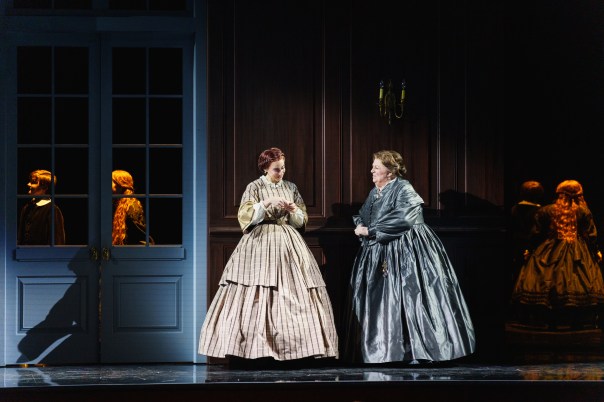
No wonder legendary soprano Christine Brewer as Mrs. Grose, the housekeeper, believes that Miles was incapable of violence. And indeed, the horrific denouement hinges on the boy’s natural delicacy. All is not placid when the child draws our attention. There is major orchestral turbulence when Miles, behind the Governess’s back, tears up the letter she has written to his uncle – and wild skittering sounds when he hurriedly gathers up the pieces of paper from the floor.

Not only does Thavoris’s scenery harmonize with his costume designs and synchronize with Britten’s music, it is wondrously detonated by Paul Hackenmueller’s lighting. At key moments throughout the two-act opera, the huge mirror that nearly dominates the set turns translucent or transparent, revealing the ghosts that haunt the estate. These ghosts might simply stand there in Hackenmueller’s eerie blue light or they might come to melodramatic musical life and sing.

Omar Najmi sings the narrative prologue before tackling the charismatic tenor role of Peter Quint, the more malignant of the two ghosts. His wholesome and romantic appearance, like Miles’, belie the evil lurking within – but Quint’s evil is never under musical restraint. There never needs to be any question that Quint is a madman, and Najmi never leaves any doubt.

The struggle between Quint and Miles is more titanic than that between the other ghost, Miss Jessel, and Miles’ sister, Flora. Yet an extra eeriness had wafted into this Spoleto world premiere on opening night because the singer portraying Jessel, Mary Dunleavy, was still recovering from an illness. She still acted the role, lip-synching to Rachel Blaustein, who sang the role from offstage. Blaustein sometimes sounded sepulchral and indistinct from wherever she was sequestered, in and outside Dunleavy’s body, depending on where she stood.

Fortunately for Blaustein and all the other treble voices at Dock Street, but especially for us, there are English subtitles on hand when the text might otherwise be lost. Sometimes, as when Baumgarten sings “Malo, malo,” it’s just good to have the projected text above the proscenium to confirm what we’re hearing!

Aside from the oddity of these subtitles for a Broadway show, it’s hard to see why this gripping production couldn’t be a hit. Dunleavy’s interactions with Israeli soprano Maya Mor Mitrani, singing the role of Flora, are particularly outré and suggestive. Though the text never seems to give her enough to justify her take, Mitrani’s brattiness only clashes with the elegance of her lavish Victorian dress, and there’s a frequent sense of jealousy toward Miles because of the attention he draws under Quint’s spell.

In the climactic lake scene, where the ghost of Jessel supplicates Flora, Gaitanou tosses aside any notion from fussy modern lit critics that there is ambiguity on whether James’s ghosts are real or figments of the Governess’s fevered imagination. We see Jessel, floating above Flora in her boat on the lake, long before the Governess does. Until then, she’s quietly ashore on a quaint little bench, absorbed in a book.

Numerous creepy touches abound, not the least of them involving the onstage curtains that hide or highlight the ghosts lurking behind the huge mirror. Suddenly the curtain begins rustling behind the children and adults onstage – yet nobody there notices for the duration of the scene. But we do.

White people obsessed by the white polar regions has been a powerful theme since Mary Shelley wrote Frankenstein (1818) and Edgar Allen Poe wrote The Narrative of A. Gordon Pym (1838). It was still in the air when Swedish adventurer Salomon August Andrée proposed a new method of mapping out the North Pole to the Royal Geographic Society in 1895: exploring the region in a hydrogen balloon.

Once again, wind conditions weren’t ideal. But Andrée, more adventurous than patient, lifted off with his comrades anyway and… vanished. For 33 years, nobody knew their fate for certain until their remains were recovered and brought back ceremoniously to Stockholm in 1930. The fullest narrative took another 66 years to recover, pieced together with the journals of the three explorers and the partial restoration of Strindberg’s photographs.

Sabine Theunissen rewinds the story in White Box in its US Premiere at Emmett Robinson Theatre on the College of Charleston campus. From a theatrical standpoint, it’s a very quirky and visual retelling, making liberal use of Nils’s photographs and primitively enhanced animations. He seems to be more of Theunissen’s protagonist than Andrée, but none of the three men onstage has any dialogue.

Thulani Clarke and Fana Tshabalala are designated as Dancers in the Spoleto program book, while Andrea Fabi is labelled Performer, presumably because he shapeshifts between Nils and Andrée. Given the silence of the humans, the old-timey camera, mounted on a wooden tripod and occasionally capable of a life of its own (thanks to puppeteer Meghan Williams), could be regarded as a fourth character.

So far what we’re describing might be viewed as akin to silent film, even though Catherine Graindorge adds violin and viola from one side of the hall and Angelo Moustapha adds piano and percussion from the other. Not even granted a bio in the program – or present for the final bows – Maria Weisby delivers all the info we can hear via pre-recorded Voice Over.

It’s hard to detect any consistent intent or message in Theunissen’s various caprices. Her Dancers are part of the expedition party and they aren’t. Their choreography from Gregory Maqona is more African than Nordic and so are their skins. The same disconnect doesn’t always apply to Graindorge’s music composition, but aside from the honky-tonk piano by Moustapha bookending the narrative, his percussion has more of a jungle flavor than an evocation of windswept Arctic tundra and ice caps.

And Theunissen’s declaration that she must tell her tale backwards to tell it right isn’t religiously carried out – though we did learn why the expedition was doomed from the start toward the end of the show. Somehow, all of Theunissen’s quirks and incongruities worked beautifully, even poetically. And viscerally.

When Nils stands doomed on a sea of ice, dancing with his mammoth camera, we can join him in tossing accuracy and logic to the winds.

Even more fanciful was the children’s show that opened on the same Saturday that White Box closed, Polar Bear and Penguin, written and acted by John Curivan and Paul Curley. Brrrrr! So theatrically speaking, it was a bipolar weekend in balmy Charleston.

Curivan and Curley (who better to concoct this alliterative title?) had some bipolar intentions of their own. For polar bears are only found natively in the northern hemisphere while penguins are natively confined to the south. Wherever they bump into each other on runaway icecaps, their personalities are also poles apart, replicating the ancient grasshopper and the ant fable. In floating igloos.
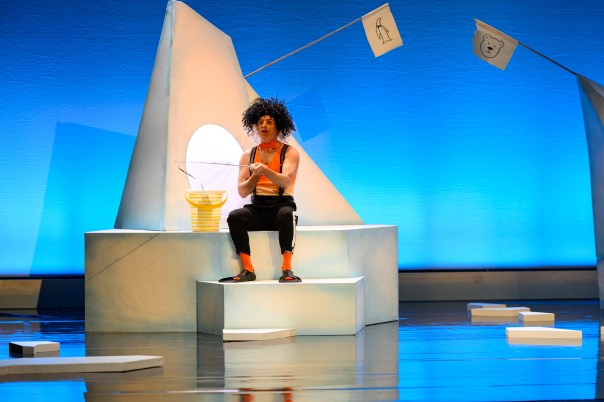
As Polar Bear, Curivan is all carpe diem: see a fish, catch a fish, eat a fish. Curley is more communal, considerate, and calculating as Penguin. In the here-and-now, Penguin will catch a fish and share a fish. Longterm, he will catch another fish and save it for later. Curivan uses his paws to bash a hole in the ice and grab his prey. The more sophisticated Curley – yes, Clara Fleming’s costume design includes full-length tux jacket and tails – extracts a fishing pole from Penguin’s little cave.

Ah, but they don’t merely catch fish out there in the frozen North or South. Penguin hooks a bottle, Polar Bear hooks a shoe, and something with buttons pops out of the deep, maybe a cell. Curivan and Curley subtly remind us with these human throwaways – and the occasional sound of airplanes above – that these primal and adorable creatures are cast adrift and endangered by the overreach of civilization.

Global warming.
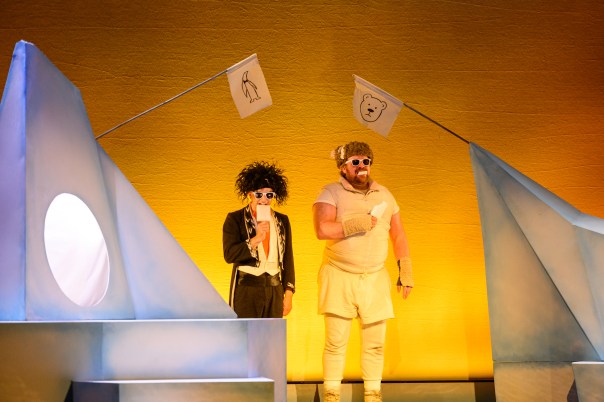
Meanwhile, Polar Bear and Penguin demonstrate that their differences can be bridged as they become best friends. Until a crisis emerges at a cookout that irresistibly engaged the participation of the ankle-biters in the audience. Penguin was cooking up a glorious fish dinner from a hidden spot upstage while Polar Bear was downstage waiting for dinner, sorely tempted by an overflowing pail of raw fish that they had caught and agreed to save for later.

Each time Penguin exited to tend his unseen campfire, a new wave of temptation assailed Polar Bear. As if Peter Pan and Tinkerbell were hovering somewhere in the darkened hall, children all over the Rose Maree Myers Theatre in North Charleston began hollering to Polar Bear not to eat the damn fish.

In some ways, our innocence remains intact.

But Curivan and Curley didn’t leave us with a happily-ever-after ending. Before the lights went down, Polar Bear and Penguin reconciled, closer friends than ever before. Bear achieves better impulse control while Penguin tempers his hoarding tendencies. All that chumminess, sad to say, didn’t prevent a further thaw of the ice that connected their little caves. So they finally drifted towards opposite wings of the stage, separated forever.

A little girl sitting in front of us burst into tears, inconsolable as her mom carried her away. She likely got the point more keenly than her peers – and likely better than many of her elders here in Trump Country.

The bulk of Spoleto’s theatre lineup has yet to open, The 4th Witch opening on June 4, Remember This: The Lesson of Jan Karski making its bow on June 5, and Mrs. Krishnan’s Party arriving on June 6. Until then The Turn of the Screw reigns as my top pick, with a final performance on June 6.

Must-See Classical Abounds at Spoleto Festival USA

Reviews: Opera, Chamber Music, Orchestral Music, and Alisa at Spoleto

By Perry Tannenbaum

Three different sea changes have reshaped Spoleto Festival USA since Nigel Redden, responding to the WSYWAT turmoil that followed in the wake of George Floyd’s brutal murder, departed after the 2021 season. Redden saw himself in the crosshairs of the 2020 We See You White American Theatre manifesto, though he wasn’t strictly a theatre person, and felt that steeping as aside was the honorable thing to do.

Diversity has never been inimical to Spoleto, which has always looked more Euro and Afro than American. Yet as Spoleto 2025 concludes, a near-total change of artistic leadership has transpired – with an unmistakable lean toward diversity. Mena Mark Hanna has replaced Redden as general director. Paul Wiancko has filled the void left by the charismatic Geoff Nuttall’s sudden death, taking over the reins of chamber music programming. When John Kennedy was abruptly dismissed after the 2023 season, Timothy Myers became music director, wielding the Spoleto Orchestra baton.

And Joe Miller, after 20 seasons as director of choral activities, is resigning to lead the Vocal Arts Ensemble in Cincinnati. His Spoleto farewell, Bach’s Mass in B Minor, will be followed soon by an announcement of his successor in Charleston.

Conversely, Spoleto is responding to fiscal, box office, and government funding pressures to be more self-sufficient. While Kennedy’s programming arguably made the  festival America’s chief hub for 21st century classical music composition, his afternoon Music in Time programs were as much box office poison as they were cutting edge. That experimental ghetto has disappeared while Wiancko and Myers have integrated more infusions of contemporary, new, and world premiere music into the festival’s chamber music and orchestral offerings.

Beyond shrinking the outré and avant garde, Spoleto is expanding its pop, punk, folk, and R&B presentations to no less than a dozen Front Row events with Patti Smith, Band of Horses, Mavis Staples, Lucinda Williams, and Jeff Tweedy among the headliners. The strategy is to “expand the aperture” in Hanna’s words, offset the losses of more adventurous fare, and make Spoleto more accessible to a wider audience. Hopefully, these newbies may be tempted into tasting the 17-day festival’s higher protein offerings.

Other belt-tightening measures include offering 15%-off discount packages of tickets to multiple events, and ending of the longstanding tradition of inviting a theatre company from abroad to co-tenant the Dock Street Theatre with the lunchtime chamber music series. Wilder still, two of the Dock Street chamber music concerts were staged during evening hours! Sacrilege.

Finally, little touches in the festival brochure and the program booklet underscored a deepset commitment to making Spoleto more navigable and customer-friendly. Jazz fans could gorge on all the Spoleto headliners within the space of 10 days, while theatre lovers could get their fill in seven.

While both of these lineups were tilted toward the latter half of the festival; opera, dance, and orchestral music could be largely traversed within the first 10 days; along with seven of the eleven chamber music programs. As compacted as the scheduling was for festivalgoers devoted to one genre, omnivores like me who preferred a mix found themselves stretched. For us, the scheduling was scattered and fragmented.

How appropriate, then, that the most awesome classical music event this season, intertwining 27 new works by living composers with J.S. Bach’s Six Cello Suites, was Alisa Weilerstein’s FRAGMENTS. Conceived during the global pandemic, FRAGMENTS has some of the randomness and the quirky, curated individuality of a mixtape. Weilerstein did not commit herself to playing the Suites in their entirety or – within each Suite – in their traditional order. Or tempo.

Beyond that, in commissioning 27 three-part compositions roughly 10 minutes long, Weilerstein obtained the right to shuffle the order of the parts and to slice and dice the new works to create smooth transitions into each other and the Bach. Layering on stage direction at Sottile Theatre by Elkhanah Pulitzer, scenic and lighting design by Seth Reiser, and costumes by Molly Irelan, Weilerstein crafted her FRAGMENTS into a creation you literally had to see.

As revealed in an interview event moderated by Martha Teichner, Weilerstein has no intentions of releasing an audio recording of FRAGMENTS. Video only. However, the cellist will honor the composers she commissioned by recording their works as written. All in all, Weilerstein was onstage soloing and fielding interview questions for more than seven hours spaced over six days, capped with world premiere performances of FRAGMENTS 5: Lament and 6: Radiance on her final day.

Alyson Cambridge Turns Up the Voltage Reprising the Sass and Savagery of Carmen

Review: Opera Carolina’s Carmen at Belk Theater

By Perry Tannenbaum 

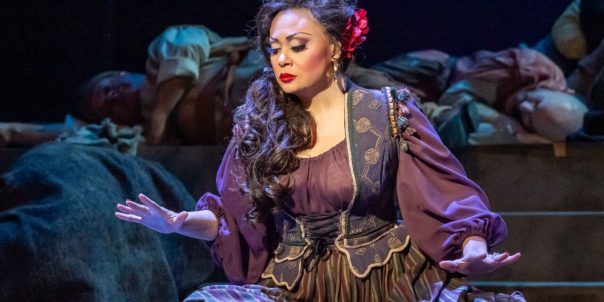
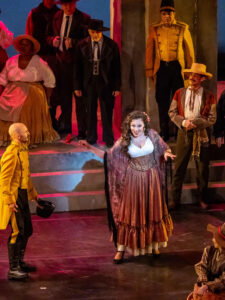
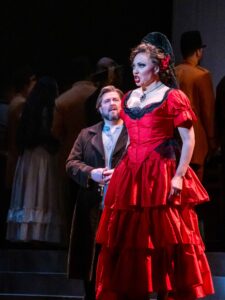
“Prends garde à toi!” You better watch out when la Carmencita gazes at you lovingly. The queen of Seville’s cigarette girls proclaims this insolent challenge – to the men she slinks past in the town square and a detachment of lascivious soldiers lazing on guard duty – almost as soon as we see her in Bizet’s Carmen. Differences between her and Micaëla, Corporal Don José’s fiancée, are artfully shown to go much deeper than city-girl brunette and country-girl blonde. When the drooling men in uniform offer their hospitality to Micaëla while she awaits Don José’s arrival, the chaste damsel skitters away in distress, promising to return later. Carmen quickly proves to be much different: shameless, seductive, and fearless, a wicked brew of beauty, passion, playfulness, and gypsy flair.

And yet we’ve still haven’t seen all the colors and facets of her portrait – or realized the full depths of what we’ve already seen in the eleven French scenes of Act 1. Alyson Cambridge, striking in appearance and lithe as ever in her movement, satisfied almost instantly at Belk Theater on opening night in reprising her Opera Carolina triumph of 2019, igniting and seething sooner as she built to the frenzy of the “Chanson Bohème” (“Les triangles des sistres tintaient”) that torches the opening of Act 2. Cambridge is as much the temptress now as she was in 2016 when she took on a title role in the special 40th Anniversary production of Porgy and Bess at Spoleto Festival USA. If anything, she’s more brazen and confident than she was as Tosca late in 2022, when she also seemed to be saving her strength for the more tempestuous final acts.

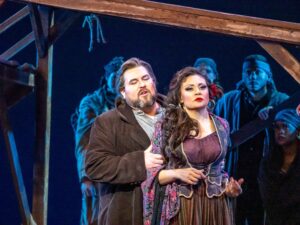
Certainly, stage director Dennis Robinson, Jr. deserves some of the credit for this higher-voltage Carmen, but so does the contrast so vividly framed by soprano Melinda Whittington as the sweetheart Micaëla, quaintly relaying a kiss to Don José from his dear ailing mother back home. Each of Whittington’s plaintive arias in the first three acts is a gem, wafting an anthemic lyricism from Micaëla’s native countryside over the stage and threatening to steal Carmen’s thunder. Cambridge must respond! Yet the new dimension for me came from the men who capture Carmen’s flitting fancy, tenor Jonny Kaufman as Don José and baritone Daniel Scofield as Escamillo, the dashing bullfighter.

No disrespect to tenors Ramón Vargas and the charismatic Roberto Alagna, both extremely capable vocalists that I’ve seen at the Metropolitan Opera as José, but neither was a hulking or intimidating presence. With or without his pearly smile, Kaufman does stand out among his fellow dragoons. Discarding the smiling ease of his welcome to Micaëla for the torments of love and passion that Carmen arouses, Kaufman is already anguished by the end of Act 1, two months before the deeper agonies of Act 2. Between this José and this Carmen we saw a battle between fidelity and wanton caprice. That’s what we expect from Bizet’s masterwork, and it escalated through Act 4 when Carmen’s fatal presentiments were fulfilled.

What comes into focus more sharply in this Opera Carolina revival, on top of the palpable danger of loving a woman who flouts soldiers, hangs out with smugglers, and dishes out a mean lap dance, is that Carmen is drawn to formidable strong men – able to see the violence lurking within before we do. She embraces the scent of danger. She loves the hunt, the capture, the freedom, the risk, and the danger of a wild predatory life. We saw a Carmen bent on living life on her terms, willing to die for it.

Scofield delivers the goods better than most of the Escamillos we’ve seen at the Belk parading into Pastia’s Tavern with his torchlit “Toreador Song,” but while all Josés we’ve seen are credible as the great matador’s fans, none have been as formidable as adversaries. That makes the outcome of the Act 3 knife fight between the rivals, by far the best of Dale Girard’s fight choreography here, as credible as José’s candid admiration. Carmen can see what this soldier is capable of in this production, believe in the terrible fate that her deck of cards predicted, and spit in his face anyway.

A production this well-staged, acted, and sung deserves a grander set design than the one we see here from Annabelle Roy, but the costumes by Susan Memmott Allred – on loan from Utah Opera – go far in making up for the colorlessness of this Seville. In fact, the yellow-gold of the dragoons’ uniforms vividly reminded me of the amazing clay surface of the Plaza de Toros and its dazzling buttery hue, where bulls and bullfighters shed their blood, more like Seville for me than Roy’s standard-issue arches.

When performances are this committed and intense, whether from conductor James Meena and the Charlotte Symphony or from Cambridge as the Gypsy temptress, even a moment of slackness can be instantly telling. Such a moment happened on opening night when the trumpets’ retreat was sounded – seemingly from backstage – summoning José back to his barracks right in the middle of Carmen’s quiet, sexy, up-close dance for him alone. Riled up by Kaufman’s impulse to depart in mid-enchantment, Cambridge yielded up to Carmen’s full insulted fury – except when she took off her castanets and carefully set them down on a nearby café table instead of flinging or slamming them down, breaking character for nearly a full second. By the time she flung José’s saber and hat to the floor, she was fully returned to raging diva mode. Kaufman was just one among multitudes in the house who would now follow Cambridge anywhere.

Down at Spoleto USA, the Vibe Is Shifting

Review: Spoleto Festival USA in Charleston

By Perry Tannenbaum

‘Song of Rome’ at Spoleto Festival USA in Charleston. (Photo by William Struhs)

Looking down benignly at his Dock Street Theater audience, the newly anointed host of Spoleto Festival USA’s chamber music series, Paul Wiancko, gave us a slight ceremonial nod. “You have chosen wisely,” he said sagely.

But he wasn’t exactly speaking to me, since this was already the fifth program in the noonday series – the backbone of Spoleto – that I was attending this year. Nor was he speaking to the “eleven-ers” in the audience who were signed up for the complete set of programs down in Charleston through June 9.

He was speaking directly to those in the audience who would only attend one of the concerts. Today. And he would go on to ask us all to participate in making the experience special and unforgettable.

It would be very special – beginning with a Beethoven piano trio that showcased Amy Wang at the keyboard, Benjamin Beilman on violin, and Raman Ramakrishnan on cello. How’s that for diversity? My love affair with Wang’s artistry and demeanor had begun just two hours earlier when she played the Schumann Violin Sonata, teamed up with the Slavically expressive Alexi Kenney.

Enough to mightily crown most concerts, the Beethoven was merely a satisfying appetizer. For Wiancko had cooked up a powerful combo, calling upon two living composers that I was barely familiar with, Jonathan Dove (b. 1959) and Valentin Silvestrov (b. 1937).

Our contribution to the magic would be to withhold our applause between the two pieces. It was easy enough to maintain stunned silence after In Damascus, Dove’s heartfelt setting of Syrian poet Ali Safar’s grieving – and aggrieved – reaction to a senseless car-bombing in his nation’s war-torn capital.

The prose poems were achingly and angrily sung by tenor Karim Sulayman, perhaps most indelibly after an extended instrumental interlude, turbulently delivered by a string quartet that included Kenney, Beilman, Wiancko (on cello), and violist Masumi Per Rostad.

“We will be free,” Sulayman sang in Anne-Marie McManus’s ardent translation, “of our faces and our souls – or our faces and our souls will be free of us. And the happy world won’t have to listen to our clamor anymore, we who have ruined the peace of this little patch of Earth and angered a sea of joy.”

Sulayman was visibly in tears as the lights went down on In Damascus and pianist Pedja Mužijević entered with his iPad and sat down at the Steinway. In the dimness, Mužijević played Silvestrov’s Lullaby, an appropriate coda to a song sequence that began with the children of the Zuhur neighborhood in Damascus who would never wake from their sleep – or survive a bogus “holiday truce” – and ended with the evocation of mothers and loved ones who would always await their return.

Amazingly enough, this isn’t the only instance where Sulayman is singing about children caught in the web of brutal war and barbaric terror, for his wondrous voice also figures at Spoleto in the world premiere of Ruinous Gods, a new opera with exotic music by Layale Chaker and libretto by Lisa Schlesinger.

Co-commissioned by Spoleto, Nederlandse Reisopera, and Opera Wuppertal, Ruinous Gods is a fantastical deep dive into the mindworld of Uppgivenhetssyndrome, a rare traumatic response to living in the limbo of displacement. It was first observed in children detained in Sweden, but the syndrome has now been observed in refugee camps around the world. Hopeless children simply go to sleep in reaction to their endlessly unresolved status. Some die, others lapse into coma – sustained only by a feeding tube.

Encased in a surreal bubble over a grassy bed from scenic designer Joelle Aoun, that is how we find our sleeping-beauty protagonist, Teryn Kuzma as H’ala, when the opera begins. Mezzo-soprano Taylor-Alexis DuPont as her mom, Hannah, is stressing and blaming herself while two doctors, Overcast and Undertow, hover over their patient, unsympathetic researchers hoping to analyze and classify the disease.

Meanwhile, Sulayman is decked out in a feathery all-black outfit as Crow, the mentor who, like Dante’s Virgil, guides all these comatose children from around the globe into a common underworld dreamscape where all are free. Is that a spaghetti rainbow dropping down across the Sottile Theatre stage from the fly loft as the imprisoning globule lifts off H’ala, or is there an unfathomably large jellyfish floating above?

Sinuous, jazzy, and sensuously obsessive, Chaker’s music resurfaced in the jazz sector of Spoleto 2024 – at Charleston Music Hall, a venue never used by the festival before. Bigger than Spoleto’s customary hall for chamber jazz (and eccentric modern music), the Emmett Robinson at the College of Charleston, the Music Hall was an acoustic revelation and a welcome escape from the Robinson’s clean-room sterility. Bonus points for the stars that lit up on the black backdrop.

Attendance was astonishing, more than could ever be seated at the Robinson, as Chaker, leading her Sarafand quintet on violin – with an occasional vocal – delved into her two most recent albums, Radio Afloat (2024) and Inner Rhyme (2019). Having worked with Daniel Barenboim and his West-Eastern Divan Orchestra, Chaker has created a jazz equivalent in Sarafand with Phillip Golub on keyboards, Jake Charkey on cello, John Hadfield on drums, and Sam Minaie behind the bass.

Compared to her opera, Chaker’s jazz and her Sarafand personnel made subtler political points. But this wasn’t the only jazz gig that came loaded with extra cargo. Terri Lyne Carrington returned to Cistern Yard for a pointedly themed concert under the moon and the live oaks – with political firebrand diva (and NEA Jazz Master) Dianne Reeves as her special guest.

Carrington’s cargo was collected into her Grammy-winning album of 2022, New Standards, Vol. 1, the first studio sprouting of her pathfinding songbook collection, New Standards: 101 Lead Sheets by Women Composers. So without much preaching, her set was a celebration of Geri Allen, Gretchen Parlato, Eliane Elias, and – at a high summit where Reeves duetted for the first time with Christie Dashiell – the great Abbey Lincoln and her mesmerizing “Throw It Away.”

All these greats joined together again on Allen’s “Unconditional Love,” with Kris Davis on piano, Matthew Stevens on guitar, and trumpeter Etienne Charles all getting in their licks, plus spoken and dance stints from Christiana Hunte. Wow.

Theatre at Spoleto this season is densely messaged. Or not. The Song of Rome was deeply immersed in issues of immigration and sexism, with an overarching interest in the fate of republics, in ancient day Rome and 21st century USA. Cassette Roulette, on the other hand, was pure frivolity, barely deeper than its title and whole lot bawdier.

After starring in An Iliad last season, Denis O’Hare could be logically expected to follow up that one-man conquest with An Odyssey. Well, he has, sort of. O’Hare co-wrote A Song of Rome with Lisa Peterson, his Iliad writing partner, but this time he doesn’t appear onstage, handing over the acting chores to Rachel Christopher and Hadi Tabbal.

Christopher is Sheree in modern times, a grad student striving to learn Latin, and Octavia, Emperor Augustus’s sister at the dawn of the Roman Empire. Tabbal is Azem in present day, Sheree’s immigrant Latin tutor – and our overall storyteller – and the poet Virgil during the reign of Augustus.

So O’Hare is skipping over the rest of Homer to engage with Rome’s great epic, The Aeneid, knowing full well that Virgil based the first six books of his masterwork on The Odyssey and the last six on The Iliad. As a thematic bonus, O’Hare and Peterson discovered during their research for this world premiere that Virgil himself was a refugee, forced out of his ancestral home in Northern Italy by Roman avengers of Julius Caesar who got Dad’s estate for their prize.

Although Virgil’s epic was likely commissioned by Emperor Augustus, aka Octavian, doubt remains whether The Aeneid is a work of propaganda justifying the Roman Empire as divinely ordained – tracing Octavian’s ancestry back to Aeneas and Venus as meticulously as the New Testament traces Jesus back to King David, son of Jesse – or a subversive work by an immigrant genius settling a score. While getting handsomely paid to do it.

Octavia and Virgil go back and forth on this point because the Emperor’s sister is both an admirer and a keen reader, but both are critical of Octavian, who is hell-bent on buttressing the legitimacy of Rome while closing off its path back to a glorious Republic.

“The Republic is over,” they agree. And how about ours?

While Sheree is learning about the Roman issue that comes up as Virgil delivers more and more manuscript pages to Octavia over the years, Sheree must face the issue in American terms when Azem receives a deportation notice. Does she instantly jump to his defense and rescue, or does she immediately suspect him of criminal activity?

Meanwhile, Sheree is reading The Aeneid differently from Azem and Octavia. Why is Octavia left out of literary history if she played such a key role? Why are Virgil’s women, particularly Dido and Lavinia, so passive and pathetic while the strong woman, Camilla, is a she-devil?

Finding this insidious neglect and defamation rampant in literary history and beyond, Sheree comes up with a radical, shocking solution that she announces on her podcast. She will pour fuel over every single book piled on the Dock Street stage and burn them all.

When will all this vicious animosity end? Citing the end of Virgil’s epic, where Aeneas, the immigrant from far-off Troy, killed the vanquished Turnus instead of offering peace, conciliation, and mercy, Sheree answers us curtly lighting the flame: it won’t. Opting for chaos, she almost says it aloud – to hell with the immigrants. (Or give it to the immigrants, if you’ve heard of the Goths.)

Moments like that land hard at Spoleto. Deep in Trump Country, at the Sunday matinee of Ruinous Gods, there was a loud boo among all the lusty cheering as the singers took their bows. Good. The nurturing point of the opera, gushing with empathy toward immigrants worldwide, had hit home, no matter how you feel about it.

Depending on whether you were attuned to John Cameron Mitchell’s Hedwig and the Angry Inch cache, or whether you resonated with Amber Martin’s worship of Reba McIntyre, Bette Midler, and Stevie Nicks, Cassette Roulette was hit-and-miss, redeemed or further cheapened by Martin’s bawdiness. Nicks’ “Rhiannon” was the crowd fave and mine on the night I attended, getting a far more epic performance that you’ll hear on AM radio or an elevator. But neither David Bowie nor Midler got much of a rise. The diet of ‘70s and ‘80s hits didn’t draw much of a youth crowd to Festival Hall, which was made over to a quasi-cabaret setup.

Trombone Shorty slayed far more decisively at TD Arena, where his outdoor revels with Orleans Avenue were abruptly moved when rain threatened. At the height of the indoor bacchanale, Shorty paraded through the audience at the home of College of Charleston basketball with key members of the band (none of whom were named in Spoleto’s fabled program book). They slashed up the rear aisle of the stadium, swung around to the side of the gym and came down along the side.

Snaking through the stadium, Shorty & Orleans reigned over the reigning pandemonium. The prohibition against photography was washed out to sea in a riptide of glowing cellphones.

Shoot, the band was taking selfies! And through it all, the sound remained perfect, Shorty and his brass perfectly aligned with the rhythm section on the TD stage, absolutely distortion-free. Sure, a few dissenters and defectors also trickled through the aisles, accompanied by true believers seeking and returning with beverage.

The most pathetic sufferer sat right across the aisle from my wife Sue and me, hunched over, elbows on kness, with his hands tightly cupped over his ears. Probably needed a ride to escape. Maybe he would have fared better in the open air, where at least some of the sound could have escaped skyward through the live oaks of Cistern Yard.

Final week highlights: Bank on it, the Bank of America Chamber Music series has four more different programs to offer – and a dozen performances – before Spoleto wraps up on Sunday. The Wells Fargo Jazz lineup continues strong, with an all-star Latin twist. Puerto Rican saxophonist Miguel Zenón and Venezuelan pianist Luis Perdomo bring their Grammy-nominated El Arte Del Bolero albums to life at the Dock Street Theatre in a three-day, five-performance engagement (June 6-8) while Cuban percussionist extraordinaire Pedrito Martinez lights up Cistern Yard with an Afro-Cuban stewpot of infectious rhythm, Echoes of Africa (June 7).

After distinguishing themselves in Mahler’s Fifth, the Spoleto Festival USA Orchestra returns to Gaillard Center with Beethoven’s Third (June 5), plus a Rachmaninoff concerto for piano + trumpet and composer-in-residence Reena Esmail’s “Testament” for tabla and orchestra. Upstaged by a visitation from the Charles Lloyd Sky Quartet this past weekend, the Spoleto Festival USA Chorus rebounds with a two-performance run of The Heart Starts Singing (June 6-7), sporting another Esmail piece that will feature Wiancko’s cello – and an eclectic mix of works by Tomás Luis de Victoria, Rachmaninoff, Irving Berlin, and more.

The Festival Finale of yore is gone this year, but there’s more folk, funk, Americana, and alt-country in this year’s Spoleto lineup. Still to come are Andrew Marlin and Emily Frantz’s latest partnering, Watchhouse (June 5), with their own band-backed experiments in folk-rock playing at Cistern Yard; Grammy Award winner Aiofe O’Donovan (June 7) returns with the SFUSA Orchestra to Sottile Theatre; and Jason Isbell (June 8-9) headlines the final weekend with a two-night stint at the Cistern.

Theatre continued during Spoleto’s second weekend with sharply contrasting shows, the wholesome Ugly Duckling from Lightwire Theater and the savagely satirical send-up of the American West, Dark Noon, from the Danish fit + foxy company in its US Premiere. A similar dichotomy prevails this week as Australian company Casus Creations takes over Festival Hall with Apricity (June 6-9), a family-friendly mix of aerial and acrobatic astonishment, with sprinklings of comic shtick and moody music.

On the edgy side, RuPaul’s Drag Race fans can rejoice greatly as Season 9 champion Sasha Velour deigns to bring her presence to Gaillard Center with The Big Reveal Live Show! (June 6). Is Charleston’s big house big enough for drag’s Queen of Queens? The Holy City and Spoleto haven’t been so sensationally desecrated since Taylor Mac ruled the festival.

“Turandot” Grandly Usurps Saint-Saëns at Belk Theater

Review: Opera Carolina’s Turandot

By Perry Tannenbaum

When we gauge the cultural influence of Giacomo Puccini, we’re most likely to invoke the operas he composed that were subsequently repurposed into megahit Broadway musicals. The American colonialism that fueled the domestic tragedy of Madama Butterfly eventually suffused the spectacular Miss Saigon, and La Bohème, Puccini’s verismo masterwork was Americanized – Greenwich Village filling in for Paris – and turned even more successfully into Rent.

But we don’t readily think of Puccini in terms of grand opera, ALL CAPS, unless we narrow our focus to the Italian master’s last work, Turandot, the one opera he didn’t live to complete or see premiered in 1926. The fate of nations routinely hung in the balance when Verdi selected his libretti, but for Puccini, this tale of ancient China and Peking stands apart from his more private and intimate norm. If Traviata is Verdi’s most visionary work, anticipating Puccini, then Turandot is Puccini’s grandest and most retro work.

Opera Carolina’s history with the work tallies well with its popularity. This is the sixth time the company has staged Turandot, decisively trailing Puccini’s big three, Bohème, Butterfly, and Tosca, two of which have reached double figures. Yet since James Meena, a devout Verdian, arrived on the scene in 2000, Turandot has maintained parity with its kindred, staged three times since the turn of the century.

We must, begging Milady’s pardon, bestow an asterisk next to the current incarnation of Peking’s princess. If she wasn’t exactly a last-minute or eleventh-hour replacement for Camille Saint-Saëns’ Samson and Delilah, it’s fair to say that she was an eleventh-month substitution for the previously slated season closer.

Yes, a grand opera was inserted at Belk Theater as the clock or calendar was winding down! Around the world, Maria Callas, Birgit Nilsson, and Joan Sutherland are among the celebrated dramatic sopranos who have graced the powerhouse title role, and the Franco Zeffirelli production at the Metropolitan Opera is as revered for its stateliness and splendor as the Notre Dame Cathedral.

Grand? Monumental.

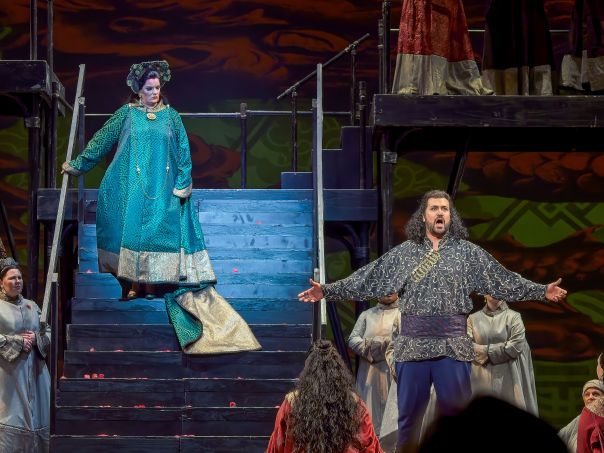
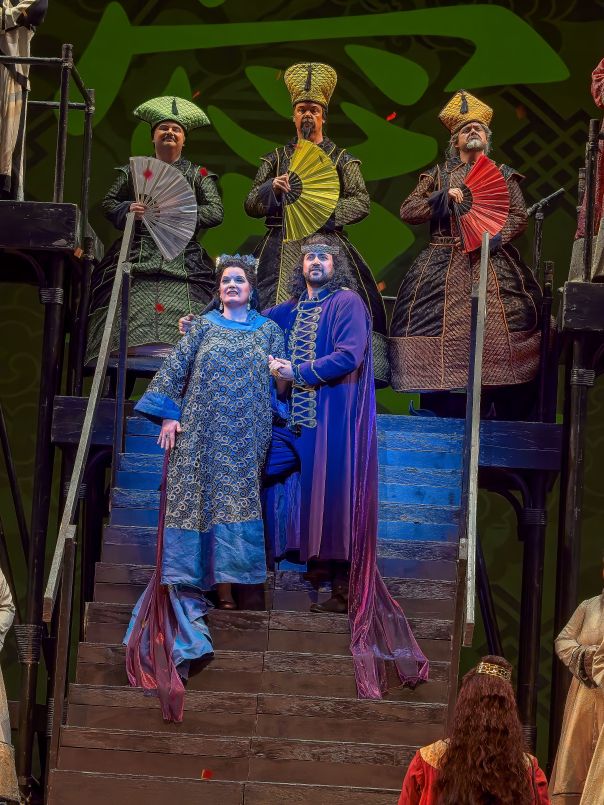
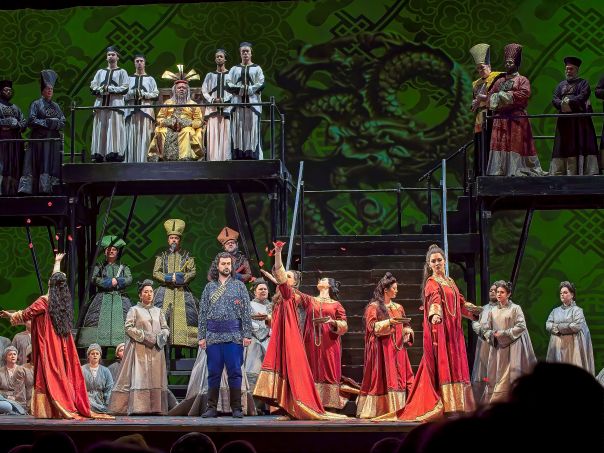
Needless to say, the Opera Carolina production didn’t figure to deliver legendary grandeur. But instead of smoke and mirrors, set designer Anita Stewart and lighting designer Michael Baumgarten call upon scaffolding and projections to bridge the gap. Stage director Jay Lesenger wisely keeps the curtain down over Stewart’s barebones set until Meena, down in the orchestra pit with the Charlotte Symphony, can begin working his magic with the score. It doesn’t take long to taste its beauties, ranging from delicate to majestic, or realize Meena’s deep affection for it.

Parallel to the build-up to Prince Calaf’s climactic confrontation with Peking’s ice goddess, when the princess asks him three riddles that he must solve – or die – there’s a steady build-up of ritual. A Persian prince has failed the Trial of Three Riddles and must be beheaded. To declare his candidacy, against the fervent wishes of his father and his dear maidservant, Calaf – “The Unknown Prince” – must strike the gleaming gong near the gates of the imperial palace. To stage a new trial, there must be a public proclamation, holy men must gather, the Emperor must preside, and Turandot herself must pose the riddles.

It’s a regal crescendo of pomp, ceremony, and colorful, eye-popping costuming from Anna Oliver that ultimately matches the trumpets heralding the divine Principessa. Watching the royal entrances of Emperor, Turandot, and their respective ministers and maidservants, high up and almost level with the proscenium, I had to wonder how much more scaffolding and stairs there must be hidden in the wings so that all these nobles, old and young, could safely ascend to those lofty heights.

At ground level, my worries began as soon as soprano Jennifer Forni made her auspicious Opera Carolina debut as Liù, the maidservant who has devoted herself to dethroned Tartar king Timur simply because her son, Calaf, once smiled at her before he fled the kingdom. Forni distinguished herself within the first ten minutes with her sweet fruity timbre recounting Liù’s backstory, and her buttery soft notes put the protagonists waiting for their big moments in serious jeopardy of being upstaged. After all, Renata Tebaldi, Renata Scotto, and Montserrat Caballé are among the notables who have been drawn to this role.

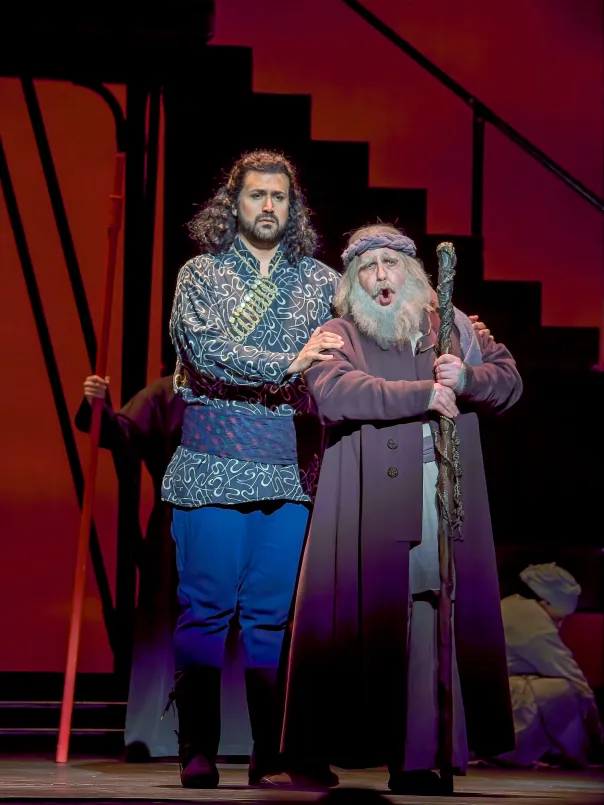
If we don’t see or hear the very best of Diego Di Vietro early in Act 1, there was enough Luciano Pavarotti DNA surfacing in his tenor to assure us that he would likely be equal to Calaf’s big “Nessun dorma” moment when the curtain rose on Act 3. The extra panache that was missing before intermission arrived on time, and Lesenger made more of Calaf’s first private moment with Turandot, calling upon Di Vietro to conquer the princess with brutish aggressiveness and charm. The chemistry that was so sorely missing when Opera Carolina brought Turandot to the Belk in 2009 had finally been recovered, making for a more deeply satisfying ending.

Though Lesenger could have given her more to do during Turandot’s icy phase, Amy Shoremount-Obra was certainly majestic, intimidating, and cruel as the Principessa in the stunning trial scene. Nor am I quite sure that Baumgarten took the best approach in lighting the Princess when she first appeared. Yes, Shoremount-Obra was dazzling but blinding might be equally accurate as the lights were so dazzling that there was no chance to behold the beauty of the Princess’s face, utterly bleached by the spotlight. (My photographer agrees.)

Yet there is visual drama in this tense ceremony as Turandot gradually descends the long staircase from her lofty height as her successive riddles are solved. Shoremount-Obra visibly becomes more human and vulnerable as she comes closer to the Unknown Prince’s level at the climax of Act 2 and he proves more and more worthy of her. The dramatic soprano’s stamina wavered just slightly after intermission in her pre-dawn duet with Di Vietro, but by this time, Shoremount-Obra’s beauty had been revealed and the chemistry was kindled.

Otherwise, there was no lack of strength or color among the remaining cast. John Fortson was austere and imposing in all of the Mandarin’s proclamations. Jeffrey McEvoy, Zachary Taylor, and resident artist Johnathan White were delightful as Ping, Pang, and Pong when we needed comic relief. Garbed and bearded in gray, basso James Eder brought out a paternal spirituality in the blind King Timur, and Elliott Brown, decked out in enough gold to be declared a Sun King, was a magnificent Emperor Altoum.

Rather electrifying, all around. Bravi.

Photos by Perry Tannenbaum

The Passion of Mary Cardwell Dawson Brings a Neglected Pioneer Back into the Spotlight

Review: The Passion of Mary Cardwell Dawson at the Parr Center

By Perry Tannenbaum

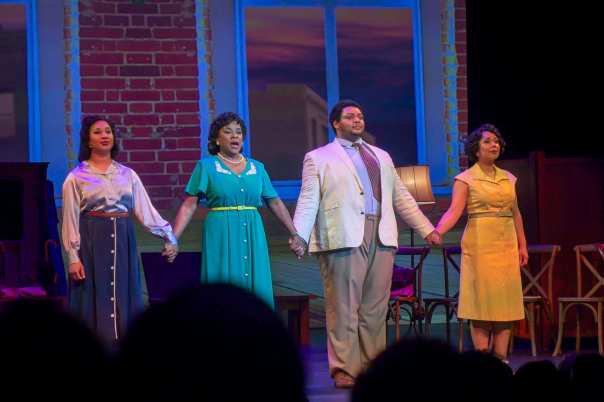
  February 15, 2024, Charlotte, NC – Commissioned by the Glimmerglass Festival and premiered there during the summer of 2021, The Passion of Mary Cardwell Dawson is a fascinating, informative, and inspiring hybrid. Part documentary, partly a new play by Sandra Seton with operatic arias composed by Carlos Simon, and partly an eye-opening “Building the Stage” exhibition, the new co-production by Opera Carolina and The Denyce Graves Foundation have found a perfect landing spot at the posh Parr Center on the CPCC campus.

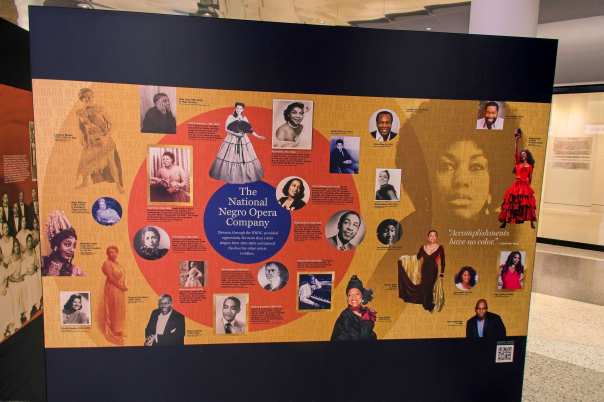
With numerous glitterati on hand from Charlotte’s African American community to celebrate opening night, Dawson, and Black History Month, the Parr Center lobby dazzled as never before. Just 15 minutes before the curtain was scheduled to rise, I encountered a roomful of beautiful people and formalwear; imposing billboard-sized exhibits of museum quality devoted to Dawson, the National Negro Opera Company she founded, and the luminaries of opera – and jazz – that she tutored; accessorized with video stretching from one entrance to the New Theater to the other. All the bells, whistles, and glamor you could want, with a live bass and alto sax duo playing Charlie Parker bebop in the background.

The production was certainly equal to the new hall. Accompanied solely at this point of its development by pianist Gregory Thompson, The Passion would seem smallish at Belk Theater with its cast of four and an orchestra of one. Unfortunately, the Seaton-Simon creation also struck me as too small for Dawson, its subject, and too small for Graves, its star. With a sympathetic director like Kimille Howard already on board, and Op Carolina’s set designer demonstrating fresh possibilities with his wonderful projections on the upstage wall, the avenues are certainly opened for a fuller exploration of Dawson’s talents and achievements.

Seaton places all of the action in Pittsburgh, mostly at the headquarters of Dawson’s company on Apple Street, in a studio upstairs from her husband Walter’s electric company. Her compressed timeline results in a format that wavers between masterclass and a professional rehearsal. On one side of the stage, Thompson presides at a Steinway, and at the other, we see three humble chairs that might be occupied by students in a Dawson masterclass. If the libretto were allowed to breathe a little, the curtain would rise on the three students we will see, either seated and ready to perform or engaged in conversation, giving Simon – composer-in-residence at the Kennedy Center in DC – a chance to begin penning some recitative, and giving Graves a grander entrance.

Alas, this is a rehearsal of Bizet’s Carmen on the day that the Negro Opera Company’s production is set to premiere on a floating outdoor stage by the shore of one of Pitt’s famed three rivers. This setup gets more improbable as the story unfolds, undercutting Dawson’s wisdom as a performing artist, an opera director, and a business person. Would an operatic director allow her performers to risk overtaxing their voices by rehearsing on the day they perform? Wouldn’t the entire cast be summoned to a last-minute rehearsal? Wouldn’t it be in full dress? Wouldn’t standard rep like Carmen be so far under the belts of professional-grade singers that their director wouldn’t feel compelled to instruct them on how to present Bizet’s music or penetrate to his protagonists’ cores?

By heightening her drama on the day of the opening, Seaton actually manages to be more unflattering to the Dawsons. A rainstorm is raging across Pittsburgh, threatening the cancellation of tonight’s outdoor performance and the ruination of Dawson’s company. Administrators at Spoleto Festival USA and ticketholders from around the globe would laugh out loud at the notion that a scheduled outdoor production would bring in national and international stars to Charleston without making contingency plans for bad weather beforehand. Not sound judgment for Dawson or her husband, who handled her company’s business end.

Of course, Seaton’s scheme makes it easier for The Passion to have legs, because the roles of Dawson’s singers – Isabelle as Micaela, Phoebe as Carmen, and Frank as Don José – only need to be versed in their presumably familiar Bizet music rather than having to learn anything written by Simon. Even so, Diana Thompson-Brewer as Isabella, Ladejia Tenille as Phoebe, and Johnnie Felder as Frank, are all forced to look and sound slightly amateurish at times during their lamentably brief moments in the spotlight. Howard helps them all out from her director’s chair, occasionally obliging Graves to be a bit fussier – and a lot more prudish – than Seaton may have imagined Dawson when she wrote the script.

I was most impressed by Felder in the tenor role, and wondered how much his superiority might have figured in Seaton’s concept or Howard’s casting. Most of Graves’ vocal coaching, after all, is reserved for the younger women onstage and the music she has excelled in all the way the Metropolitan Opera, Covent Garden, and the Vienna Staatsoper, to name a few – so it would be a pity not to hear Graves in this repertoire while we have her here and not perceive her superiority to Dawson’s protégées. The diva and the drama deserve that. Simon’s music, scant as it is, is also worthy of Graves. Those two arias, when Dawson is alone with her thoughts and later when her class/rehearsal is done, both have the qualities of the best arias sung at Spoleto’s production of Barber’s Vanessa last spring.

A fuller version of The Passion of Mary Cardwell Dawson would be a full-length opera with a fuller view of Dawson as a singer, teacher, and impresaria. Ideally, it would take us back to the North Carolina native’s childhood and the foundations of her love for music and opera, but we should at least cover the arc of Dawson’s founding of her company, a more substantial exploration of her teaching methods and philosophy, and a nicely drawn arc of her prize students’ development into professional opera singers that do full credit to Dawson and her pioneering company in their Carmen. A full opera company at the end – with a fuller orchestra – would bring the entire enterprise up to scale. Make no mistake, though, this handsome Opera Carolina production is an exciting coup for Charlotte and a compelling argument for Denyce Graves’ project to reach its fullest fruition.

“Cavalleria Rusticana” Returns After a Long Absence With a Gently Rebuked “Pagliacci”

Review: Pagliacci With Cavalleria Rusticana @ Opera Carolina

By Perry Tannenbaum

October 28, 2023, Charlotte, NC – Long coupled in double bills around the world, Pietro Mascagni’s Cavalleria Rusticana and Ruggiero Leoncavallo’s Pagliacci parted ways at Opera Carolina nearly 30 years ago, immediately after the two were finally wed in Charlotte. Until then, the operas had appeared separately or in successive engagements during the seasons of 1957-58, 1969-70, 1974-75, and 1986-87.

The transcendent popularity of Canio’s climactic aria in Pagliacci, “Vesti la giubba,”has given that opera a stronger grip in the repertoire, which accounts for Opera Carolina programming its most recent presentations of the work in 2006 and 2015 in tandem with two other one-acts. Yet the coupling with Cavalleria is very natural, since Leoncavallo wrote his opera in response to seeing Mascagni’s, and the two premieres were almost exactly two years apart.

Natural and convenient, for the current Opera Carolina production, conducted by James Meena and directed by Garnett Bruce, demonstrates how seamlessly two distinctively different works can be fused together – in their casting and design – after thousands of precedents spanning more than a century. We’ve seen greater scenic alterations in most opera productions at Belk Theater than we saw here from designers John Farrell and Michael Baumgarten for this twin-bill.

On stage right, the church façade remained the same, and across on stage left, a boxcar café was discreetly modified at intermission to become a boxcar theater. Between these, projections by Baumgarten could recycle the centerstage backdrop in the blink of an eye. More radical were the costume changes provided by Allison Collins, who reveled in bringing us the harlequin costumes of the Pagliacci clown troupe, and brought a more urban World War 2 flavor to the garb of the townspeople and visiting soldiers on leave.

Although billed on the OpCarolina website as “Pagliacci With Cavalleria Rusticana,”the two operas are presented in chronological order – the right choice if you’re building to a climax at the end of the evening. With extended instrumental sections at the start, Cavalleria isn’t as instantly impactful as Pagliacci, which begins with a member of Leoncavallo’s commedia troupe directly addressing the audience. For a one-act, the exposition of Cavalleria proceeds at a surprisingly glacial pace, all the more reason to be pleased with how beautifully Meena and the Charlotte Symphony perform the bountiful orchestral episodes.


We didn’t have to wait until the famous “Vesti la giubba” for the vocal splendor of this production to become manifest. Soprano Barbara Frittoli was already a rising star, soon to debut at the Metropolitan Opera, the last time Cavalleria Rusticana was performed in Charlotte, and now she’s the leading lady in both Cav as Santuzza and Pagliacci as Nedda in her Opera Carolina debut – though Yunah Lee will give her a breather in the Sunday matinee performance of the curtain raiser. Nearly as auspicious, baritone Leo An made his debut as the malevolent Alfio in Cavalleria and reappeared almost immediately as Tonio, the odious clown who greets us after intermission.

These are two marvelous singers, normally filling the quota of marvels we have heard in past years at Belk Theater. But we seemed to be entering a new golden age as the curtain rose on Pagliacci, for those two notables were joined onstage by baritone Nmon Ford as Silvio, Nedda’s secret lover, and Carl Tanner’s long-awaited return to the Belk as Canio, after his 2010 triumphs in Carmen and Otello. Nor did resident company member Jonathan Kaufman sound at all outclassed in the tenor role of Turiddu, the soldier who heartlessly yet helplessly abandons Santuzza for Alfio’s wife, Lola. Likewise, mezzo Julia Woodward held her own as Lola, not at all hindered by a flaming red dress.

Everything is beautifully sung, but it was fascinating to note how Bruce navigates the inevitable changes in attitudes and social norms that have occurred since 1890, when Cavalleria Rusticana premiered. Audiences in 2023 may wonder why Santuzza, seduced by Turiddu, feels unworthy of entering a church on Easter Sunday after the adulterers betrayed her. Bruce inserts some silent business between Frittoli and a stranger that might be interpreted as solicitation, but otherwise, he ignores the question, leaving us to assume that Santuzza’s sin is not getting a marriage proposal before sleeping with Turiddu. On the other hand, Bruce and Tanner must confront the reality that Tonio is not a pitiful cuckold we can empathize with anymore when he cold-bloodedly plots to murder his wife and her lover.

Tanner was a volatile volcano of jealousy almost instantly as Canio, and he didn’t sob the final notes of his signature aria to milk our sympathies. Distancing us further, Bruce took the final words of the evening from Canio and gave them to the sardonic and vengeful Tonio. Even here, political correctness reigns, for our host is no longer hunchbacked or deformed, though the ugliness of Tonio is retained from Leoncavallo’s libretto. Opera Carolina’s Pagliacci is thus cleansed while it is so magnificently sung, no longer asking us to empathize with Canio’s vendetta or assuming that we will connect Tonio’s warped morality with his appearance. Most amazing, perhaps, were the Frittoli-Ford duets, still youthful and sensual. Great music can rejuvenate us all.

ILA Summer Fest Overachieves With Semi-Staged “Tales of Hoffmann”

Review: The Tales of Hoffmann at the International Lyric Academy Festival

By Perry Tannenbaum

July 5, 2023, Charlotte, NC – Maybe Charlotte’s best-kept cultural secret ever, the 29th International Lyric Academy Summer Festival was officially announced by its partner, Opera Carolina, two days after it had actually begun! From as far away as Cape Town and Seoul, around 150 singers, teachers, accompanists, and conductors had converged on the Central Piedmont Community College to begin a transcontinental five-week program in the Queen City.

The Charlotte segment of this intensive training for young and emerging artists hopscotched from classrooms and rehearsal halls behind-the-scenes during ILA’s first week to CP’s grandest stage, the Dale F. Halton Theater, for the public performances marking the second week. Amid the hullabaloo, two of the College’s venues were discarded from the original festival announcement and poster art, Tate Recital Hall and the new Parr Center, adding to the impression of hurry, indecision, and feverish excitement during the ILA Festival’s opening nights.

Yet the performances I’ve seen have gone marvelously well, showcasing a wide-range of vocal talent and experience, affording us tantalizing glimpses of youngsters taking the stage for the first time and emerging artists well-poised to embark on professional careers. The opening holiday weekend featured two Florilegium concerts offering a potpourri of solo arias; a Mozart Marathon that provided arias from Don Giovanni, Cosi fan Tutte, The Magic, and generous foretastes of La Nozze di Figaro; and a sampling of opera scenes, often spotlighting multiple singers and occasionally venturing into the realm of Broadway musical theatre. Of course, as the middle week unfolded, we could look at the pocket-sized Festival Program and piece together where the singers who were performing in concert would fit into the lineups for the two opera productions that would highlight the final week of this Festival’s US premiere, a semi-staged The Tales of Hoffmann bookending a pair of fully-staged presentations of The Marriage of Figaro.

As the veil lifted from the quality of talent we would witness in the ILA Festival’s climactic week of opera productions, an aura of mystery still lingered over what the upcoming “semi-staged” Tales of Hoffmann might look like. Would it borrow the scenery from Figaro, which is taking over the Halton for the next two nights? Would there be any props, costumes, or furnishings onstage? Will the main singers be holding scripts for the dialogue or scores for the music? Reading stage productions by Charlotte’s theatre companies, I know very well, have taken many shapes over the years, sometimes as austere as actors dressed devoutly in black-and-white, delivering their lines behind music stands. Directors who stick to that format are heartless brutes in my eyes.

Opera lovers across the Metrolina area – and across the Carolinas – can rest assured that the ILA Summer Festival is for real, dispenses with scripts and scores, and delivers the goods. James Meena, Opera Carolina’s artistic director, has revealed that the process of advertising, taking applications, and auditioning for spots at the festival – in six different cities – began last July. However new the template was to Meena and the US, it has obviously proved tried-and-true in Rome, where ILA was founded, and in Vicenza where it resides today.

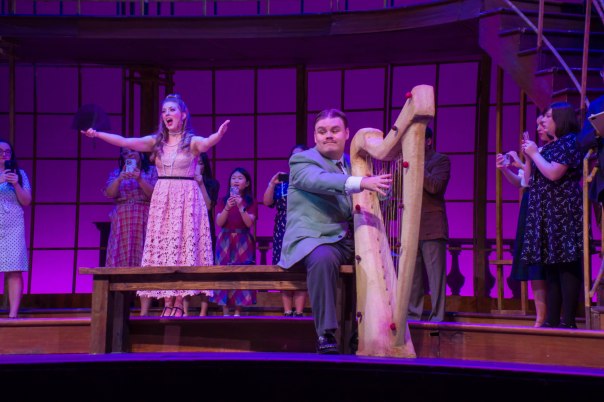
With Meena in the orchestra pit directing an ensemble of at least 20 musicians, and Peter Boon Koh stage directing a cast of 25 actors and choristers, the production looked very polished and not at all bare-boned. Koh deftly had most of the players in modern dress, many of them sporting cellphones in the crowd scenes in Acts 1 and 3. When Olympia winds down, soprano Amber Romero as the life-size automaton who enchants Hoffmann droops forward as usual, but instead of winding her back up with a conspicuous key, tenor Ethan Stinson as dollmaker Spallanzani simply waves a remote control at her while seated behind his garish cut-rate harp.

Meena and Koh have trimmed the opera, which runs between 130 and 140 minutes on recordings, to a sleek 90 minutes, cutting the Prologue and thus depriving South African tenor Luvo Maranti as Hoffmann of his most winsome aria, detailing the legend of Kleinzach, the hunchbacked court jester. We go straight into his misadventures with three iconic sopranos, Huiying Chen as the frail Antonia following Romero, and Ruijing Guo bringing ruination to Hoffmann as femme-fatale courtesan Giulietta. All of these voices exceeded expectations, but the most astonishing were Maranti, Romero, and baritone Zhenpang Zhang who slithered across the stage in three demonic roles as Hoffman’s perennial nemesis, mad scientist Coppelius, quack Doctor Miracle, and – most menacingly – the sorcerer Dappertutto.

The excellence did not stop there, for as Stinson was performing his comical exploits as the devious dollmaker, tenor Jonathan White was beginning his medley of comical turns as his servant Cochenille, culminating in his Act 2 showstopper as Frantz, the cruel and possessive Crespel’s blissfully deaf old servant. The skeletal scenery borrowed from Figaro has a winding staircase leading gracefully upwards to a balcony level, where the portrait of Antonia’s mother can come to life and the temptress Giulietta can begin her imperious and bewitching descent. Supertitles are shown on TV monitors flanking the stage, amply sized so your neck gets a good workout keeping up with the French.

With ticket prices topping out at $35, productions like this and the upcoming Figaro are as accessible as they are irresistible. The US festival concludes on Saturday night with the encore performance of the Offenbach after two consecutive nights of fully-staged Mozart at the same prices. For those who prefer the Broadway style, there’s a Saturday matinee, With a Song in My Heart, paying tribute to Richard Rodgers. Then ILA 29 takes flight to Vicenza, near Venice and Verona, for an additional two weeks of training and performances. Surely, Halton will be more crammed with young and old operagoers in years to come as the ILA Summer Festival continues to grow and word-of-mouth proclaims its high quality. Like Spoleto Festival USA, it’s another great coup for the Carolinas.

Opera Carolina Takes Off on an International Flight

Preview: International Lyric Academy Summer Festival

By Perry Tannenbaum

Look up, look around, and look quick. There’s a new international music festival here in Charlotte, and it’s already in progress. Opera Carolina announced their new International Lyric Academy Summer Music Festival mid-week a week ago, two days after the 86 singers who will performing arrived in the Queen City to begin master classes and rehearsals. The first Festival event, a Florilegium concert, was staged on Wednesday night at Central Piedmont Community College.

Apparently, Charlotte was not caught by surprise. Both the Wednesday and Friday night performances of Florilegium were moved from the upstairs Tate Recital Hall in the Overcash Building to the larger Dale F. Halton Theater below, where the popular CP Summer Theatre resided in the good old days.

Founded in Rome and now based in Vicenza, Italy, the International Lyric Academy has staged 28 Summer Festivals since 1995, but the 2023 will be the program’s first festival in the US. So yeah, this is quite a coup for Opera Carolina and artistic director James Meena.

Singers in the opera program will perform two additional concert programs, a Mozart Marathon (June 29) and an Opera Scenes Program (July 3) before two operas take over the Halton stage for two performances each, a semi-staged Tales of Hoffman (July 5 and 8) and a fully-staged Marriage of Figaro (July 6-7). Meanwhile, 30 more singers are flying into Charlotte for the Broadway musical component of the ILA Summer Festival.

Before ILA’s first US festival concludes next Saturday with the evening performance of Tales of Hoffman, the musical theatre singers will sparkle on the Halton stage with a matinee tribute to Richard Rodgers, With a Song in My Heart. For the opera singers, the show will go on – to Vicenza, where they will reprise their US opera and concert performances.

“The whole company gets on a plane and we go to Italy for two weeks and do classes with different master teachers there and perform in the theater,” says Meena, who is ILA’s guest conductor in Italy. “Vicenza is between Venice and Verona. So basically, we take over the theater for two weeks. These emerging artists get to perform here, and then they actually get to perform in Italy. We’ve invited a handful of intendants [opera impresarios] from Italian theaters to come to the performances and hear the kids. So it’s an amazing opportunity for them.”

The new festival in Charlotte represents a quantum leap in Opera Carolina’s youth education program and a magnificent expansion of their resident company. Now that the pilot program has emerged from under the radar, Meena will be meeting with his board to decide whether they will authorize a complete integration of the Academy into Opera Carolina – or whether they will continue working as separate entities to produce future Summer Festivals.

Working with so many emerging artists at the same time clearly had Meena excited when we spoke. While he was in rehearsals getting ready to conduct next week’s performances of Jacques Offenbach’s The Tales of Hoffman, Stefano Vignati, ILA’s artistic director and founder, was readying the full-dress version of Mozart’s The Marriage of Figaro, a comedy masterwork that figures prominently in any serious discussion of the greatest operas ever written.

The breadth of the program is as breathtaking as its sudden arrival.

“Our education department all of a sudden becomes youth through young adults!” Meena exults. “So it’s really pretty audacious. No other company that I know of other than Chicago Lyric and the Met and San Francisco are providing professional opportunities like this for emerging artists. So it’s pretty cool. We’re pretty excited about it all.”

Advertisements to attract young artists to the program began last July, and the program already has a network of university instructors spreading the word – in Toronto, Cape Town, Seoul, LA, and other US locations. The audition process began virtually before the decisive live auditions in six different cities.

When you add up the 86 opera aspirants with the 30 musical theatre recruits, you have a youth program that begins to rival that of Spoleto Festival USA, the annual arts behemoth that takes over Charleston for 17 days. Meena doesn’t shy away from the comparison.

“If we do this well,” he says, “this can become different than Spoleto but on that scale.”

There’s certainly a niche for it, since Spoleto has never done Sweeney Todd or West Side Story – and CP Summer Theatre staged both of those Broadway classics in its long history before making a quiet exit last year. But the combination of opera and musical theatre, in programming or in pedagogy is nothing new.

“We’ve been blurring the lines between American music theater and opera for decades, really,” Meena explains, “since Beverly Sills first started the City Opera, when she did Brigadoon. So it makes sense for us to get music theater kids, teach them a bit about classical singing, which can only help their performing, and then work that curriculum, really, to add some more diversity to the performances. If we do this well, by 2024, the music theater program will be probably two weeks. The opera program would be four weeks.”

Not only a big deal but a great deal. Two of the ILA Summer Festival concerts are free, and ticket prices top out at $35 for the rest. Festival passports are also on sale.

Spoleto Festival USA: More Diverse, Hybrid, and Inclusive Than Ever

By Perry Tannenbaum

With so many theatre, dance, opera, jazz, orchestral, choral, and chamber music events to choose from – more than 300 artists from around the world, streaming in and out of Charleston over 17 days (May 26 through June 11 this year) – planning a dip into Spoleto Festival USA is always a challenge. Even Spoleto’s general director, Mena Mark Hanna, struggles to prescribe a strategy, as hesitant as a loving mother of 39 children to pick favorites.

“My suggestion for a first-time participant,” he says, sidestepping, “would be to see two things you like and feel comfortable about seeing, maybe that’s Nickel Creek (May 31-June 1) and Kishi Bashi (June 3), and two things that are really pushing the envelope for you. So maybe that’s Dada Masilo (June 1-4) and Only an Octave Apart (June 7-11).”

Nicely said. Only you can easily take in the first three events Hanna has named within three days, but you’ll need another four days before you can see singer-songwriter phenom Justin Vivian Bond and their monster opera-meets-cabaret-meets-pop collaboration with countertenor sensation Anthony Roth Costanzo. If you happened to see the recent Carol Burnett tribute on TV, the cat is out of the bag as far as what that will sound like, if you remember the “Only an Octave Apart” duet with opera diva Beverly Sills – recreated for Carol by Bernadette Peters and Kristin Chenowith.

What it will look like can be savored in the Spoleto brochure.

The giddy Bond-Costanzo hybrid is one of the key reasons that my wife Sue and I are lingering in Charleston through June 9. Equally decisive is the chance to see jazz legends Henry Threadgill (June 6) and Abdullah Ibrahim (June 8), the Spoleto Festival USA Chorus singing Thomas Tallis’ Spem in alium (June 7-8),and Jonathon Heyward conducting Hector Berlioz’s Symphonie Fantastique (June 9).

One other irresistible lure: the opportunity to see Maestra Mei-Ann Chen conduct Antonín Dvořák’s New World Symphony (June 7), along with works by Florence Price and Michael Abels – less than four months after her scintillating debut with the Charlotte Symphony.

Abels, you may recall, teamed with Rhiannon Giddens last year in composing Omar, the new opera that premiered at Spoleto – after an epic gestation that spanned the pandemic – and won the Pulitzer Prize for Music earlier this month. It was a proud moment for Spoleto, for Charleston, and for the Carolinas. For Hanna, it was an extra special serendipity to help shepherd that work to completion.

“I mean, it’s kind of incredible,” he explains, “to be someone who comes from Egyptian parentage, speaks Arabic, grew up sort of fascinated by opera and stage work and spent their career in opera and was a boy soprano – to then have this opportunity to bring to life the words of an enslaved African in Charleston, South Carolina. And those words are Arabic!”

We may discern additional serendipity in the programming of this year’s opera, Samuel Barber and Gian Carlo Menotti’s Vanessa (May 27-June 10), which garnered the Pulitzer in 1958. Revived at Spoleto in 1978, the second year of the festival – with festival founder Menotti stage directing – the production was videotaped by PBS and syndicated nationwide on Great Performances, a huge boost for the infant fest. That revival also sparked a critical revival of Barber’s work.

Omar was the centerpiece of a concerted pushback at Spoleto last year against the Islamophobia of the MAGA zealots who had dominated the headlines while the new opera was taking shape. Vanessa is part of what Hanna sees as a subtler undercurrent in this year’s lineup, more about #MeToo, Black Lives Matter, and the repeal of Roe v. Wade.

“I want there to be a kind of cohesiveness without necessarily us being able to see what the theme is,” Hanna reveals. “If there is something that unifies a lot of these pieces, it’s about understanding that we are telling stories from our past, some of them the most ancient stories that we have in our intellectual heritage. We are looking at these stories with a different sense that takes on the reverberations of today’s social discourse.”

Among other works this season at Spoleto that Hanna places in his ring of relevance are An Iliad (May 26-June 3), a one-man retelling of Homer’s epic featuring Denis O’Hare; Igor Stravinsky’s The Rite of Spring (June 5), as an orchestral concert and the inspiration for Masilo’s The Sacrifice; Helen Pickett’s new adaptation of Arthur Miller’s The Crucible for Scottish Ballet (June 2-4); and A Poet’s Love (May 26-30), a reinterpretation of Robert Schumann’s Dichterliebe song cycle by tenor/pianist Jamez McCorkle, who played the title role in Omar last year – with stagecraft, shadow puppetry, and projections by Miwa Matreyek.

“Going back to the Trojan War, An Iliad is as much about war and plague then as it can be today with the reverberations of Ukraine and the pandemic,” says Hanna. “Vanessa, is reinterpreted here through the lens of a remarkable female director, Rodula Gaitanou. The cast is just killer: You have Nicole Heaston as the lead with Zoe Reams and Edward Graves and Malcolm McKenzie and Rosalind Plowright, just a world class cast at the very, very top. And it’s also really cool to see these roles, which are traditionally sung by Caucasian people, being sung by people of color.”

Aside from the recurring motif of reclusion, so vividly resonant for all of us since our collective pandemic experience, Hanna points to a key turning point in the opera. Menotti left it mysterious and ambiguous in his libretto at a key point when Vanessa’s niece, Erika, either has a miscarriage or – more likely – an abortion.

For Hanna, that brings up an important question: “What does that mean now when we are looking at a renewed political assault on female autonomy? So these stories take on new messaging, new reverberation in 2023. And we need to retell these stories with the new lens of today.”

Especially in the Carolinas.

Long accompanied by a more grassroots and American-flavored satellite, the Piccolo Spoleto Festival, Menotti’s international arts orgy has taken a long, long time to shed its elitist mantle. Now it is moving forcefully in that inclusive direction with a new Pay What You Will program, offering tickets to about 20 performances for as low as $5 – thanks to an anonymous donor who is liberating about $50,000 of ticket inventory.

Hanna brought this exciting concept to the unnamed donor, hasn’t talked to him or her or them – yet – about sponsoring the program in future years, but he is pledging to continue it regardless.

“What art can do is endow you with a new experience, a transformational experience that you did not have before you took your seat,” he says. “It can help create an understanding of another side that is normally seen by one perspective as socially disparate, as highly politicized, as a discourse that’s just way too far away. Art can break down that barrier through the magic and enchantment of performance. To me, having those artists onstage, representative of a demographic we wish to serve, only takes us so far. We also have to lower the barrier of entry so that we can actually serve that demographic.”

Kishi Bashi not only continues Spoleto’s well-established outreach to Asian culture, he also typifies the more hybrid, genre-busting artists that Hanna wants to include at future festivals.

“We want to try to find these artists that are like pivot artists, who occupy these interstitial spaces between dance and theater and classical music and jazz and folk music,” Hanna declares. “And Kishi Bashi is one of those. He plays the violin on stage. He has all of these violinists on stage with him, but it’s this kind of strange, hallucinatory, intoxicating music that’s like somehow trance music and Japanese folk music, but using sort of Western classical instruments. Yet it’s very much in an indie rock tradition as well.”

Other wild hybrids include Leyla McCalla (May 26), the former Carolina Chocolate Drops cellist who blends Creole, Cajun, and American jazz and folk influences; Australian physical theatre company Gravity & Other Myths (June 7-11), mixing intimate confessions with acrobatics; Alisa Amador (June 7), synthesizing rock, jazz, Latin and alt folk; and the festival finale, Tank and the Bangas (June 11), hyphenating jazz, hip-hop, soul, and rock. Pushing the envelope in that direction is exciting for Hanna, and he promises more of the same for the ’24, ’25, and ’26 festivals.

Until the Pulitzer win, the year had been pretty rough on Hanna, losing Geoff Nuttall, the personable host of the lunchtime Chamber Music Series at Dock Street Theatre. Nuttall was the artist who convinced Hanna to come to Spoleto. At the tender age of 56, Nuttall had become the elder of Spoleto’s artistic leadership when he died, beloved for his style, wit, demonstrative fiddling, and his passionate advocacy of the music. Especially Papa Haydn.

The special Celebrating Geoff Nuttall (May 26) concert will gather his close friends and colleagues for a memorial tribute at Charleston Gaillard Center, including violinist Livia Sohn, cellist Alisa Weilerstein, countertenor Anthony Roth Costanzo, tenor Paul Groves, pianist Stephen Prutsman, and surviving members of the St. Lawrence Quartet. The occasion will be enhanced by the Spoleto Festival USA Orchestra and Atlanta Symphony’s Robert Spano – plus other guests soon to be announced.

Hosting chores for the lunchtime 2023 Chamber Music series, spread over the full festival, 11 different programs presented three times each (16 performances at 11:00am, 17 at 1:00pm) will be divvied among vocalists and instrumentalists who perform at the Dock. It was totally inappropriate, in Hanna’s eyes to replace Nuttall onstage this year, but he will begin to consider the charismatic violinist’s successor during the festival and into the summer. Hanna assured me that the player-to-be-named later will be a performer who participates in the musicmaking.

Continuing on the trail blazed by Amistad (2008), Porgy and Bess (2016) and Omar, Hanna wants to place renewed emphasis on the Port City and its African connection. It must run deeper than seeing Vanessa delivered by people of color.

“Charleston was the port of entry for the Middle Passage,” Hanna reminds us. “And Charleston has at its core an incredibly rich Gullah-Geechee-West African-American tradition that is part of the reason this is such a special, beautiful place to live in with its baleful history. So I think that you see that this year, you see that with Gakire Katese and The Book of Life (June 1-4), you see that with Dada Masilo and The Sacrifice, you see that with Abdullah Ibrahim and Ekaya.”

Resonating with the brutalities of Ukraine, Ethiopia, and Syria on three different continents, the US Premiere of Odile Gakire Katese’s The Book of Life may be the sleeper of this year’s festival, crafted from collected letters by survivors and perpetrators of Rwanda’s 1994 genocide and performed by Katese, better known as Kiki. “After the unthinkable, a path forward,” the festival brochure proclaims. The finding-of-hope theme will be underscored by music created by Ingoma Nshya, Rwanda’s first-ever female drumming ensemble, founded by Katese.

“Kiki is engaging with how a country tries to reconcile with its recent, terrifically horrific past of the Rwandan genocide as someone who grew up Rwandan in exile. You see that in the work of Abdallah Ibrahim, who was really one of the great musicians of the anti-apartheid movement, who composed an anthem for the anti-apartheid movement, was in a kind of exile between Europe and North America in the 80s. And then when he finally came back to South Africa for Nelson Mandela’s inauguration, Nelson Mandela called him our Mozart, South Africa’s Mozart.”

Marvelous to relate, you can hear more of South Africa’s Mozart this year at Spoleto Festival USA than Vienna’s Wolfgang Amadeus – or Germany’s Ludwig von Beethoven. That’s how eclectic and adventurous this amazing multidisciplinary festival has become.

See for yourself.