All posts by perryt77

Hollywood Superstars Who Graced the QC’s Park-N-Shop

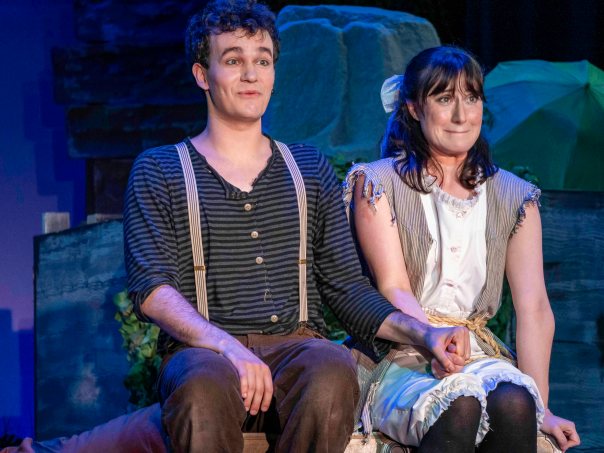
Preview: QC Concerts’ Side Show at Booth Playhouse

By Perry Tannenbaum

When Louella Parsons, the undisputed queen of Hollywood gossip, saw the Hilton Sisters’ first movie in 1932, she proclaimed: “For pure sensationalism, Freaks tops any picture yet produced. It’s more fantastic and grotesque than any shocker ever written.” At the height of their fame, Daisy and Violet Hilton could fill a large stadium.

Or at least, they tried. On July 18, 1936, billboards all around Dallas – some as large as 60 feet tall – invited the public to the Centennial Exposition at the Texas State Fairgrounds. For just 25 cents, you could enter the Fair Park Stadium, newly rebranded as the Cotton Bowl, and attend Violet’s wedding, with twin sister Daisy as her maid of honor. Afterwards, the sibs would perform with their dance band.

How could it be otherwise? For Violet and Daisy were Siamese twins, joined at the hip. Superstars. During their careers, they performed with Bob Hope, Jack Benny, and Burns & Allen. Hope and Burns were the sisters’ most illustrious dance partners! But the Hiltons died in relative obscurity. When they hadn’t shown up for work at the Park-N-Shop on Wilkinson Boulevard for a few days, Charlotte Police found them dead in their nearby apartment on January 4, 1969 at the age 0f 60.

The Siamese twins – actually born in Brighton, England – had succumbed to the Hong Kong flu. Blame it all on the Asians, right?

There should be a soft spot in Charlotteans’ hearts for two of our own and for Bill Russell’s Side Show, the 1997 Broadway musical about the Hilton Twins’ rise to fame. But no matter how thoughtful and intriguing the original version and the revised 2014 revival were to reviewers, neither production gained box office traction in New York and neither toured here.

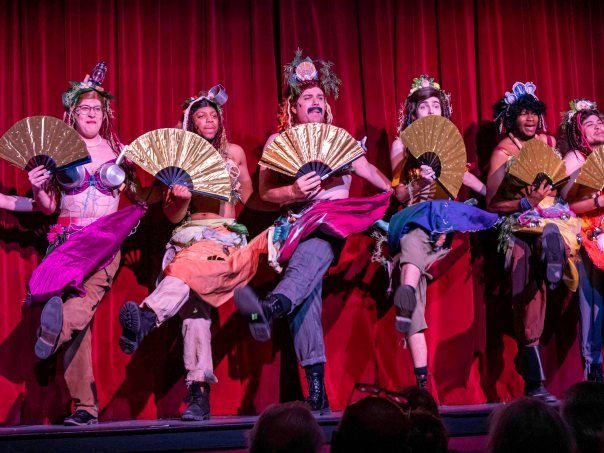
Until now, the only adult company to present Side Show in the Queen City was the Queen City Theatre Company at McLohon Theater in 2008. The McLohon was an ideal locale for the seedy, carnival ambiance of Side Show. Russell’s cast includes not just the Twins, after all, but also a Cannibal King, a Snake Woman, a Reptile Man, three Harem Girls, and – perhaps most monstrous of all – The Boss who employs, exploits, and abuses them.

Though pennies won’t get you into this show unless you have a huge jarful, the freaks return to Charlotte this week – with their startling welcome.

Come look at the freaks

come gape at the geeks

come examine these aberrations

their malformations

grotesque physiques

only pennies for peeks

Once again, The Boss will invite you into his “odditorium.” While the McGlohon and its Spirit Square cohort, Duke Energy Theater, remain in hibernation until 2027, undergoing their makeovers, Queen City Concerts is reviving Side Show at Booth Playhouse. It’s a more intimate Blumenthal Arts venue than the McGlohon, true enough, but not quite as creepy.

Chief chef directing this colorful cast – and leading a full orchestra playing Henry Krieger’s music in Harold Wheeler’s original orchestral arrangements – is QC founder Zachary Tarlton. Adoration of the original score is Tarlton’s specialty, but here he had the luxury of cherry-picking from two Broadway versions, maybe shuffling the songlist a little and restoring some of the 1997 tunes that had been dropped in crafting the more historically accurate 2014 revision.

“We chose to do the original 1997 Broadway version of Side Show,” says Tarlton, “because it is Side Show in its purest form. While the show closed quickly, it garnered several Tony nominations and launched the careers of its leading ladies: Alice Ripley and Emily Skinner. For those unfamiliar with the original show, the 2014 production seemed polished and pristine. For fans of the original, it was met with harsh criticism.”

Fans of the original, Tarlton will tell you, are a cult following. Whether the stars of the new QC Concerts production, Ava Smith as Daisy and Sierra Key as Violet, are members of that cult is an open question. But they are both fervid admirers of the show.

Before Tarlton saw her as his Daisy, Smith had portrayed Violet in a Teen City Stage presentation at CPCC’s Pease Auditorium in 2016 – while she was still a high schooler in Gastonia. Key was also in high school when she first met Smith in 2013, and they’ve been besties ever since their first show together.

Naturally, Key saw the 2016 show that starred her bestie. In a freakish reenactment of Side Show scheduled for later this year, Smith will be one of Key’s bridesmaids at her wedding.

“A little fun fact,” Smith adds, “people often mistake us for sisters! Just like Daisy and Violet, we have stood by each other through the good and bad times. Our connection in real life makes the necessary onstage connection come naturally.”

Russell sharply differentiates Daisy from Violet early on in his script, while they’re still slaving on the midway. Two young men, Terry Connor and Buddy Foster, secure a private audience with the sibs after their freakshow. Buddy’s idea is that he could teach the Hilton Twins how to sing and dance while Terry can get them a shot in vaudeville as their booking agent.

Both of the women would jump at the chance to escape the side show, but until now, they haven’t been offered a feasible alternative. The Boss keeps them under lock-and-key as part of his freak collection.

It’s Terry, not quite on board with the vaudeville scheme, who asks what the sisters yearn for.

“Daisy is bold, outgoing, stubborn, and determined to be famous,” Smith says. “She loves performing and knows exactly what she wants. Violet is shy, sensitive, and just wants a simpler, quieter life. But even with those differences, they share such a deep love for each other and a longing to just be ‘Like Everyone Else.’ I believe Daisy and Violet really are two halves of a whole.”

As halves or opposites, they are both keenly and perpetually aware of how laughable their aspirations are to their captors and the people who pay to peep at them. Even if they are at odds, every choice they’ve made individually has been with the tacit agreement of their twin. Yes, the fiery Daisy can aspire to vengeance against the mockers and the detractors while Violet merely hopes to prove them wrong and be rid of them.

But they must move together, whatever they do, and cannot pretend they’re the same as everyone else. Daisy aims higher, fired by the full breadth of the American dream, but it’s Violet, no less American, who is more poignant and relatable.

“What’s so powerful about Side Show,” Key declares, “is that it tells the story of people who are seen as ‘different’ simply for existing in the world as they are. As someone who is part of the LGBTQ+ community, that resonates with me deeply – especially right now, in a time where identity and visibility are still so politicized and debated. Violet’s longing for love, acceptance, and belonging is incredibly human, and that’s what I focus on.

“The physical connection with another actor may be unusual, but it’s all in service of telling a story that challenges perceptions and invites empathy.”

Going back eight or nine decades, Russell can take us beyond empathy and show us quite bluntly how the Hiltons themselves had yet to evolve. Their strongest champion before Buddy and Terry arrive as deliverers is Jake. He’s not really a Cannibal King “from the inky jungles of the darkest continent,” as The Boss would have us think, nor a poster boy for his collection of “god’s mistakes.”

He’s simply a rather strong African-American man. With a very soft spot for Violet. His inability to say no to her becomes the ticket to the Hilton Twins’ freedom.

So yes, they are also capable of prejudice and exploitation.

“One of the darkest moments in the show comes late in Act Two,” Tarlton observes, “when Jake asks Violet why she will not accept his deformities when he accepts hers, acknowledging the color of his skin while he accepts her as a conjoined twin. While that was during the Great Depression, we realize this same conversation could just as easily have been today. It is a show that is challenging at the core.”

Amen. Two of my most unforgettable moments in a Broadway theater happened on the evening when I first laid eyes on Ripley and Skinner. They didn’t instantly appear as the two Hilton sisters. They converged from opposite sides of the Richard Rodgers Theatre, facing each other as they sang and, just seconds afterwards, facing us. Then they conjoined right there, magically becoming one and moving as one – as naturally as Daisy and Violet had presumably done all their lives – for the remainder of the evening until taking their bows.

This must have been exactly as Russell envisioned it. “In the Broadway production,” he wrote in his Production Note. “Daisy and Violet’s connection was created by the two actors standing side by side. They were never literally connected by corsets, Velcro or any other costume piece. This allowed the audience to participate in creating the twins’ connection with their collective imagination and made the actors’ achievement of appearing to be joined all the more impressive.”

Even more primal and gripping was The Boss’s follow-up introduction as we were led inside his side show tent alongside the other freak seekers who had paid their dimes. “Please remain in your seats,” he told us commandingly, “to experience our premiere attraction in its most revealing display.”

A dazzling blast of backlight assaulted us as the conjoined twins, standing together with their limbs splayed out, appeared in dark silhouette. The sight was shocking, like a gigantic black spider writhing before us, twice the size of a normal person.

Fascinating. Fearsome. And yet… hauntingly beautiful.

Hohenstein Gets Greedier in His Second Go-Round With “Peter and the Starcatcher”

Review: Peter and the Starcatcher at Matthews Playhouse

By Perry Tannenbaum

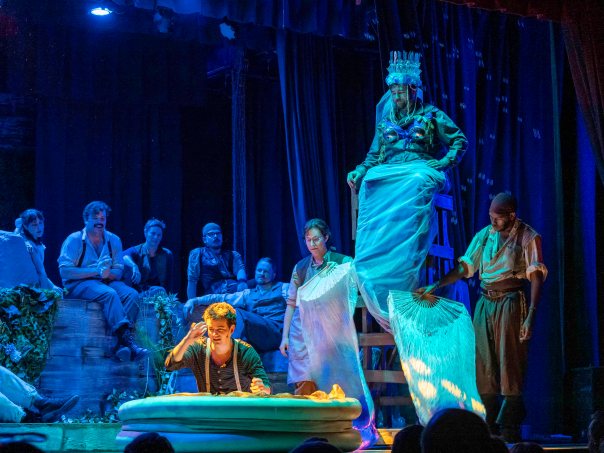
July 12, 2025, Matthews, NC – Though their names are similar and they’ve both written about Peter Pan, the temperamental gap between James M. Barrie and Dave Barry would seem to be as wide as oceans. Barrie created Peter in 1904 as an embodiment of eternal youth and the spirit of noble adventure. A century after Peter made his stage debut (played by a woman, of course), Barry teamed up with Ridley Pearson to write a novel-length prequel, Peter and the Starcatchers, keeping the non-fantasy base of the story in Victorian England while snatching Neverland from up among the stars and plopping it down on an earthly ocean.

What Rick Elice seems to have done, in returning the Barry-Pearson preteen page-turner to its stage origins, is to worshipfully replicate all the seagoing pirate action of Starcatchers along with Barry’s choicest quips. Then to supercharge the effect, Elice seems to concentrate it all so that it flies by in a blizzardy blur, all the more frenetic because scenery is stripped so bare – people become doors, ropes become ocean waves, and flag streamers are crocodile teeth – that we’re exercising sizable hunks of imagination to fill out what’s actually happening before our eyes.

Barrie fairies were jubilantly diced and desecrated by Barry’s mischief and mirth: or so it seemed the first three times I saw Elice’s Peter and the Starcatcher – on Broadway, on tour, and at Theatre Charlotte, directed by Jill Bloede. Having read Barry’s Pulitzer Prize-winning humor pieces for decades, I was so sure of my familiarity with America’s beloved joke-and-quip machine that I never bothered to read a single page of his Starcatchers. My naïve conclusion was that Elice had simply let the Barrie-Barry mashup work its magic with as little intervention – and budget – as possible.

My fourth encounter with Starcatcher at Matthews Playhouse, once again directed by Bloede, helped to enlighten me. In her previous work with the script, the evanescence of the budding relationship between Peter and Molly Aster – and the poignancy of their parting – felt more touching to me than previously. That’s significant compensation for anyone who adores Barrie’s original story, whose magic can seem drowned in humor, wit, and shtick when first encountering Starcatcher.

This time around at Matthews Playhouse, another thematic thread struck me for the first time: Elice’s orphaned Peter reaches puberty without ever having a first or last name. By now, it will only come with his consent. At the other end of the moral spectrum, Black Stache has been searching throughout his pirate career for a hero antagonist who will perpetuate his fame.

So their first grand meeting and tussle have biblical Israel-Angel proportions and consequences, or Robin Hood-Little John echoes if you prefer a secular, literary parallel. Two combatants become permanently linked and one of them emerges with a new name. Bloede’s staging here, when Peter gets his name from Stache – and later when Pan is added on – brought a new aura to those moments.

That’s what sent me to the web in search of Barry-Pearson’s actual text. Elice’s wit and humor seemed to chime with the belly laughs Barry’s newspaper columns repeatedly deliver. But is the class clown who grew up no less jokey truly capable of such yiddishe flavor and mythic depth? My suspicions were confirmed in the very first sentence of Barry’s saga: it already includes Peter’s name! An even more amazing revelation awaits if we read on. The jokey Barry tone we know and love is nowhere to be found in the opening chapters we can sample at Amazon. Instead, Barry and Pearson were following along on the dark gallows humor path that Lemony Snicket had pioneered with his Series of Unfortunate Events books for kids.

Deep breath. In my previous reviews of Starcatcher, I repeatedly gave Barry too much credit and blame for what I had seen and much too little to Elice. Both the jokiness and the mythic dimensions of Starcatcher can be credited to Elice – with additional bravos for how thoroughly he convinces us that this is how Barry would tell the origin story of Peter Pan.

Meanwhile, community theatre in Davidson, Charlotte, and Matthews continue to reap the dubious benefit of having so little professional-grade theatre in the Queen City. What a cast Bloede has assembled! Before the show began, representatives from the North Carolina Theatre Conference presented artistic director Sarah Bumgardner with their Theatre of the Year Award for 2024. So the folks backstage with their costumes on, waiting overtime for the ceremonies to conclude, were obviously under extra pressure to deliver. Even Bloede was nervous!

No matter how good your cast is, there’s plenty of stage business to be nervous about in running Starcatcher.Actors must move all the props and furniture around and keep track of all the many Yvette Moten costumes they must find and change in and out of as we move from a London dock to two sailing ships to a faraway island with a beach, a mountain, and a jungle. Stage manager Jessie Hull had to be preternaturally adept. Molly must float in the air. Peter and some nameless alley cat must fly. A lot going on while the quips shoot out at us, many of them newly minted to mock Myers Park and nearby country clubs.

Nearly all of these players were newcomers to Starcatcher, beginning with Joshua Brand as Peter and Emma Brand as Molly, presumably arriving on the Fullwood Theater stage with ready-made chemistry. Their boy-girl antipathy is no less charming than their tentative stabs at intimacy, and both can seem fueled by the promise of adventure and ignited by its thrill. The only holdover from Bloede’s 2018 cast is Johnny Hohenstein, who in bygone days crossdressed to portray Mrs. Bumbrake, Molly’s flirtatious nanny.

With even more liberties, including more than a slight leftover effeminacy from Bumbrake, Hohenstein burst into full flower as the carnivorous Black Stache, heartily devouring the scenery in Stache’s emblematic amputation scene. His eyes shone greedily as he attacked the hambone bits, and yet a queer kind of avuncular calmness came over him as he finally met his predestined antagonist and named him. For some reason, Hohenstein drew the only problematic microphone on opening night but remained unflustered by its fussiness.

Of course, one of the glories of Peter Pan is its superabundance of meanies and piratical buffoons, and we do not lack them here. In her latest crossdressing exploit, Andrea King was the perfectly servile and supercilious Smee, with glints of valor and wickedness. Chip Bradley was the wily Slank, Captain of the Neverland,who steals the precious trunk full of starstuff from under the nose of Lord Aster, the Queen’s devoted ambassador and most eminent Starcatcher. Andrew Pippin portrayed the austere Aster with sufficient British crust, entrusted with the mission of transporting the precious starstuff cargo to Rundoon, where the trunk can be dumped into a nearby volcano and kept out of evil hands.

When we reach the faraway island where Peter and the trunk of starstuff serendipitously wash ashore, we will find that Neifert Enrique is the outré and eccentric King Fighting Prawn, monarch of the Mollusk natives. Was this the wildest of Moten’s costumes, or was it Hohenstein’s at the start of Act 2 during his brief song-and-dance as one of the Mermaids? Maybe Ryan Caulley snatches the prize toward the very end as Teacher, a salmon magically transformed into a Mermaid sage atop a lifeguard’s chair. It was a fitting reward for Caulley after a full evening gagged as Captain Scott from the first moment we saw him aboard his ship, the Wasp.

Ben Allen as Prentiss and Alijah Wilson as Ted were more individualized than Peter’s fellow orphans had been in previous productions I’d seen, and Miles Thompson was more rounded and nuanced as Alf, the smelly sailor who woos and distracts Molly’s nanny. Davis Hickson wasn’t as giddy and over-the-top as Hohenstein had been as Bumbrake at Theatre Charlotte in days of yore, so the Alf-Bumbrake thing (with Alf breaking most of the wind) was less orgiastic now and more genuinely warm.

The Delphic Oracle Sings The Go-Go’s

Review: Head Over Heels at Duke Family Performance Hall by Davidson Community Players

By Perry Tannenbaum

Heaven, Elysium, Utopia, Paradise, and Arcadia are all perfect places in our minds, too placid and static to be considered as settings for comedy, thrilling action, or drama. If you were in search of a perfect backdrop for the music of The Go-Go’s, you would more likely pick a city on the California coast, Las Vegas, or even Indianapolis than opting for heaven or the Elysian Fields.

That’s not how Jeff Whitty saw it when he conceived Head Over Heels. You get the idea that, after birthing Avenue Q, Whitty almost had free rein from the Oregon Shakespeare Festival to do anything he pleased. Whether he was inspired by the Elizabethan aura of OSF’s outdoor and indoor stages in greeny Ashland, Oregon – or bound to play up to them – Whitty reached back to The Countess of Pembroke’s Arcadia by Sir Philip Sidney, first published by the Countess in 1593.

Whitty had absolutely no intention of bridging the two eras – or smoothing the discordance between Elizabethan and Go-Go’s English. Whitty does tone it down a bit when Philoclea, the younger daughter of Arcadia’s King Basilius, tells her ardent admirer Musidorus to “Speak English, not Eclogue” when the shepherd boy begins his wooings.

At about the time that Head Over Heels premiered at OSF in 2015, Something Rotten!, with Will Shakespeare as its rockstar, was premiering on Broadway. That might explain the lukewarm reception that greeted Whitty’s show when it had its NYC premiere in 2018, for its Broadway run fizzled out in less than six months.

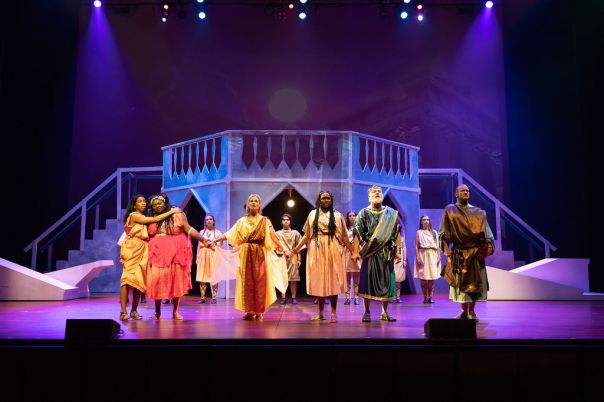
You can judge for yourself at spacious Duke Family Performance Hall as Davidson Community Playhouse rather splendidly presents its summer musical in nearly all of its gender bending glory. For this Metrolina premiere, projection designer Caleb Sigmon, scenic designer Ryan Maloney, and costume designer Yvette Moten fill the Broadway-sized stage on the Davidson College campus with eye-popping color and Hellenic style.

With the disclaimer that I’d never heard a single bar of Go-Go’s music before Head Over Heels came to our region, I can say that I delved into The Go-Go’s greatest hits afterwards on Spotify and listened to the original Broadway cast album. From the opening “We Got the Beat” onwards, the two generations of singers up at Exit 30 on I-77 beat them both.

Word of DCP’s excellence has extended its reach, and director Chris Patton and music director Matthew Primm have reaped the benefits. Belting the Go-Go’s “Beautiful” to her own mirror, Jassi Bynum is the vain elder sister, Pamela (a name apparently invented by Sir Philip). No less capable of letting loose, Kiearra Gary is the obedient “Good Girl” sister, Philoclea. And the well-established powerhouse, Nonye Obichere, is Mopsa, who seems for awhile to be a third sister until we learn that she is actually the daughter of the King’s steward, Dametas.

When Mopsa’s heart is broken, she will flee to Lesbos (wink, wink) and sing “Vacation.” Obichere slays at least as convincingly as the sisters.

It’s easy enough to get confused by the parents because they’re all white folk who fit nicely into Sidney’s Grecian mold but look nothing like their offspring. Yet Lisa Schacher, not seen hereabouts in a truly breakout musical role since the early days of QC Concerts, keeps her where-have-you-been-all-my-life belting capabilities under wraps until after intermission as Gynecia, the Arcadian queen. We’re not just talking Judy Garland belting, for Schacher crosses over the borderline to Whitney Houston territory along with Bynum, Gary, and Obichere.

Once whatever was clogging Tommy Foster’s larynx in the first moments of Saturday night’s performance as Dametas was expelled, the longtime veteran reminded us that he could also wail. Saddled with a more earthbound voice, Rob Addison brings a nicely grizzled dignity to King Basilius that is forceful enough for the lead vocal of “Get Up and Go” and his climactic king-and-queen duet with Schacher, “This Old Feeling.”

Kel Wright, whose pronouns are Kel and I in her coy bio, is the gender-fluid complication roiling the eternal placidity of Arcadia. She is the ardent shepherd boy Musidorus, Philoclea’s bestie since her tomboy days, who must disguise himself as an Amazon warrior, Cleophila, after he’s banished from Arcadia in order to regain access to his lady love.

Everybody seems to be attracted to Cleophila, though they come to all the possible conclusions about the Amazon’s true gender. It’s a mess – a hormonal thundershower that afflicts the King, the Queen, and their daughters. All of them scurry about in a mad passion that comes off with all the innocent merriment of a musical comedy. Adding to all of this hilarity is the disconnect between Wright’s tinniness and the Amazon’s virility, so feverishly irresistible to Pamela and her mom.

All of this mad pursuit, however, happens under the cloud of a prophesy that threatens Arcadia’s doom. A snake sent by Pythio, the Delphic Oracle, lets loose of a letter summoning King Basilius to the temple to hear the Oracle’s oracle. In Sidney’s original manuscript, not recovered until 1908, the prophecy is given concisely in verse at the end of the novel’s opening paragraph.

Thy elder care shall from thy careful face

By princely mean be stolen and yet not lost;

Thy younger shall with nature’s bliss embrace

An uncouth love, which nature hateth most.

Thou with thy wife adult’ry shalt commit,

And in thy throne a foreign state shall sit.

All this on thee this fatal year shall hit.

Whitty actually retains the adultery line – with its apostrophe! – but flips the plotlines of the elder and younger daughters. In Arcadia, Basilius is seeking to preserve his family and kingdom, but in Head Over Heels, he’s also battling to ward off the mass extinction of Arcadians. Forget about the “fatal year”: Each time one of the four prophecies is fulfilled, a flag will fall. If Basilius fails to confound the Delphic Oracle’s prophecy and the fourth flag falls… game over. If he succeeds in thwarting the prophecy even once, Arcadia is saved.

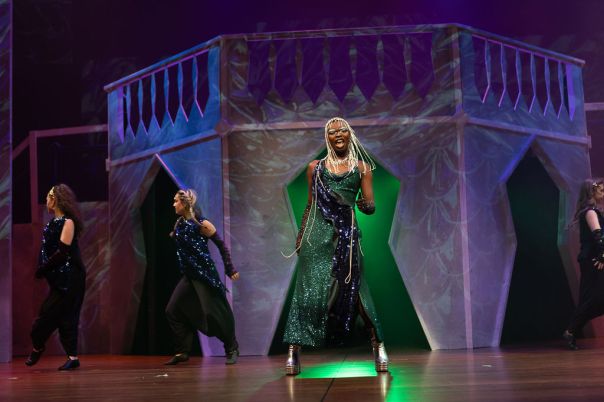
The roadblock to all this heroic questing and defying taking hold at Duke Family is the sensational Treyveon Purvis as the glittery Pythio, who describes themselves as a “non-binary plural.” No, that isn’t verbatim from Arcadia. We don’t need to understand every word of “Vision of Nowness” instantly as Pythio bodaciously belts it. If you don’t catch a phrase the first time or Purvis slurs it, you’ll get a second chance. Besides, the Go-Go’s lyrics are of little consequence once the song is done.

But the four prophecies and the fluttery flag drops are the whole damn evening, so when Purvis garbled every one of Pythio’s pronouncements – and the flag bit as well – much of what followed became equally incomprehensible. Why were those flags falling again? Was Foster wildly excited when he caught those falling flags, or was his Dametas frantically panicked?

Never could get a read on all these things until I sorted them out later at home. A few other gems had eluded me when I perused the script. For example, when Wright is lavishing her outsized voice on Musidorus’s “Mad About You,” the shepherd’s backup group are his sheep, altering the Go-Go’s deathless lyric to “Ma-ad about ewe.” Bleating as they sang? I don’t remember.

Nor did it quite register that Pythio’s backup were all snakes. So there was little chance for me to savor Purvis’s best line of the night: “Snakelettes, slither hither!” They are only named that one time, so catch it if you can.

Arguably, the main historic aspect of Head Over Heels was that it offered Peppermint, as Pythio, the opportunity to be the first openly trans actor taking on a major role on Broadway. There’s summery breeziness to this show and a cozy ending, not nearly as biting as Avenue Q. Maybe if the Broadway production had had the chance to run for a full summer, it might have found its legs instead of perishing in the dead of winter.

It’s the Go-Go’s, after all. Just don’t go in expecting the usual Jack-shall-have-Jill windup. Whitty remains a bit queer.

Spoleto’s 2025 Jazz Lineup Cements the Festival’s Place Among America’s Finest Jazz Showcases

Reviews: Phillip Golub, Cécile McLorin Salvant, Branford Marsalis, Vijay Iyer, Etienne Charles, and Ambrose Akinmusire

By Perry Tannenbaum

June 6, 2025, Charleston, SC – Jazz roots run deep in the Carolinas, where such international jazz ambassadors as Thelonious Monk, Dizzy Gillespie, Nina Simone, and John Coltrane were born. Though we’re usually not mentioned in the same breath as Newport, Monterey, SFJazz, DC, or Montreal, the Carolinas are home to significant festivals worth celebrating in High Point, Columbia, and – in years when we get our act together – Charlotte. Yet our most significant jazz festival has been hiding in plain view for nearly 50 years: Spoleto Festival USA. From its first year in 1977; when the headliners included Phil Woods, Urbie Green, and Louis Bellson; jazz has been a constant at Charleston’s international performing arts revels. Unlike visual arts, country music, puppetry, or circus, jazz has been on the bill at every Spoleto.

Of course, so much more besides jazz is offered at Spoleto. Any of the staple components of the festival – opera, theatre, chamber music, choral music, or dance – can find itself hiding in plain view amid the prodigious entirety of the festival, 120+ performances this year over 17 days. Strip away that mass of other stuff and it isn’t really hard to see that the 2025 lineup down in Charleston measures up with the best in North America. Cécile McLorin Salvant, Branford Marsalis, Vijay Iyer, Ambrose Akinmusire, Phillip Golub, and Etienne Charles not only match up well with the most elite festivals on the continent. Two of them, trumpeter Akinmusire and keyboardist Golub, lingered at multiple festival sites for three-day residencies, giving four and six performances respectively.

Thanks to the efforts of general director Mena Mark Hanna to make the massive festival more navigable, the jazz artists were listed on consecutive pages in the festival’s promotional brochure and the free – and comprehensive – festival program books for the first time. Scheduling was also conveniently compressed so that you could sample all of these jazz giants within the space of 10 days. Mavis Staples and Arooj Aftab, headliners at multiple jazz festivals around the country, were also slotted into Spoleto’s Front Row pop/country/rock/folk series, and accessible during that same timeframe.

My own jazz feast started on Day 5 of the festival with Golub’s quintet, his final program at the Circular Congregational Church. My fondest memory of the Circular dates back to 1997 when Spoleto’s production of Benjamin Britten’s moody Curlew River was staged there in dim gilded light. As a jazz venue, the Church was most unkind to Golub’s piano, which seemed to emerge from its corner as a somewhat muffled echo, though the bandleader’s perch was fortified with a Rhodes synthesizer. Neither Alec Goldfarb’s electric guitar nor Daniel Hass’s cello was spooked by the hall’s acoustics, and the remainder of the rhythm, Sam Minaie’s bass and Adriano Vicentino’s drums, may have actually been enhanced.

The quintet played Golub’s Abiding Memory Suite in its entirety, with Vicentino as the only newcomer to the ensemble that recorded the studio album released in 2024. Once the piece, played without significant pauses, drifted away from the piano, it proved to be nicely varied and unpredictable. After Goldfarb’s guitar pierced the hall with its ethereally thin and silvery timbre in “Threads Gather,” the oddest, most scattered and modernistic episodes, “A Regrouping” and “Unspooled (Waiting Quietly),” cast a quiescent spell. “In a Secret Corner” carried that irregular flow forward, building gradually before breaking back into metrical jazz. Though he played provocatively in spots, Hass seemed underemployed until late in in the suite, when he at last justified his presence with some memorable solo work in “At the 11th Hour.”

It was fascinating to see and hear various configurations of the Spoleto Festival USA Orchestra throughout our 12-night stay. Massenet’s Thaïs, a Mozart symphony, Britten’s The Turn of the Screw, the Sibelius Violin Concerto, and Cécile McLorin Salvant each had a uniquely configured ensemble – led by three different conductors. It was a bit surprising for me, nonetheless, that the ensemble playing behind Alexi Kenney in the Sibelius underperformed compared with the superb support Salvant received three nights earlier in the same hall, Gaillard Center.

There was a sense, after three previous appearances at Spoleto, that both the festival and Salvant were wanting to try something different and reach higher. And until the festival premiered its production of The Turn of the Screw, Salvant was incontestably the highlight. We haven’t seen a new album from Salvant in two years, but none of Darcy James Argue’s orchestral arrangements were from that mostly French Mélusine release. Neither of the songs in the set that the diva has recorded, her own “Left Over” and Noël Coward’s “Mad About the Boy,” had orchestral arrangements before Salvant brought them to Charleston, and she sat down at the piano to replace the esteemed Sullivan Fortner (cover boy on the February 2025 issue of DownBeat) for her own original.

The highlights of the set were Salvant and Argue’s fresh takes on Duke Ellington’s “Sophisticated Lady” and Billy Strayhorn’s “Lush Life,” perhaps their most beloved ballads. But the audience showed even more enthusiasm for Stephen Sondheim’s “Send in the Clowns” and Michel Legrand’s “I Will Wait for You” from The Umbrellas of Cherbourg. With a disdain that would have pleased Parisians, Salvant sang the original French lyrics, “Je ne pourrai jamais vivre sans toi,” without a single interpolation of the English lyric. Salvant’s “Send in the Clowns” reminded us of the quirkiness that charmed the world from the outset of her career, flouting the usual 3/4 groove, speak-singing some of the familiar lyric, and wiping away some of the usual nostalgia and sentimental goo. Best version I’ve heard since Carmen McRae.

Naturally enough, since Branford Marsalis was on the May cover of DownBeat, he and his quartet surely do have a new album out there to tour with, Belonging. Marsalis didn’t lean on the recent release as heavily as Golub leaned on his, but he certainly referenced his magazine celebrity with the two titles he did pluck from that CD, “’Long as You Know You’re Living Yours” and “Blossom.” Both were Keith Jarrett compositions, chiming well with the front page May headline, “Marsalis Tackles Keith Jarrett.”

Branford was pretty cool as a bandleader, usually slipping away after his soprano or tenor sax solos were done – often abruptly – behind Justin Faulkner and his drumkit when others were soloing. Pianist Joey Calderazzo not only had ample chances to shine in the Jarrett pieces, but he also had two of his compositions, “The Mighty Sword” and “Conversation Among the Ruins,” prominently featured on the setlist.

With past stints jammin’ with Sting and leading The Tonight Show band, it would appear Branford’s appetite for celebrity has long since been satisfied. Bassist Eric Revis also got some love when Marsalis called for his “Nilaste” toward the end of the concert. Lighter gems – and more popular with the Charleston Music Hall crowd – were Jimmy McHugh’s “On the Sunny Side of the Street” and the rousing encore, “My Bucket’s Got a Hole in It” (more likely by Buddy Bolden or Clarence Williams than Hank Williams).

Iyer took over Sottile Theatre with his supertrio two nights after Marsalis. Like Iyer, bassist Linda May Han Oh and drummer Tyshawn Sorey (a fellow MacArthur Fellow) had both headlined at Spoleto in past festivals. As a group, they’ve put out two albums in the past four years, but in live performance, it was hard to see them as close-knit. Whether they wished to simulate a recording studio ambiance or someone in the group wished to remain unmasked despite COVID fears is anyone’s guess. But they sat and stood at more than the customary distance away from each other. When I last saw Iyer play at the Jazz Standard in New York, my wife Sue and I were seated closer to Iyer than either Sorey or Oh.

Despite the trio’s separation, their chemistry and interaction were all the more amazing. Each appeared to be in his or her own world, yet they were constantly interconnected. If one of them was not playing, he or she seemed to have peeled off at a predetermined or spontaneously signaled moment. Intensity didn’t wane in those moments when balances shifted among the players. Sorey could assert himself with a single stroke anywhere in a measure and take complete control with a sudden flurry, endlessly inventive and colorful. Oh showed us once and for all that she is a composer/improviser who can easily hold her own in the presence of two major virtuoso composers – even though her bass didn’t penetrate at the Sottile like it does on the trio’s recent Compassion recording, where it’s as intimate as your heartbeat.

As for Iyer, he once again proved nonpareil. In the space of a single piece or solo, he could build to the epic force of McCoy Tyner, jet through that thunderous cloud he and Sorey stirred up, and emerge with all the purposefulness, lyricism, and freedom from mannerism of Bill Evans. “Overjoyed,” a very inventive and angular cover of Stevie Wonder’s tune, was probably the easiest for newcomers to Iyer’s music to latch onto. The “Free Spirits/Drummer’s Song” pairing was far more exciting for me because Sorey was so much sparer, explosive, and creative than he was on the Compassion track. Other trios might have swung harder, but since the great Evans trios, none I’ve heard was more beautiful or compelling.

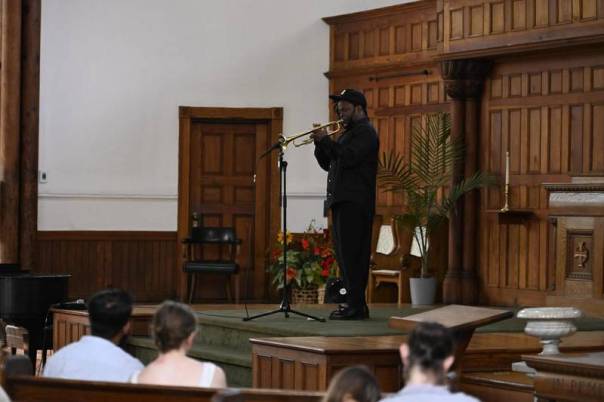
Since I had seen him live at the Seixal Jazz Festival in Portugal with his quartet less than three years earlier, Akinmusire’s residency was by far the most intriguing for me. But we had to find out what “An Evening with Isaac Mizrahi” was all about – the festival brochure and program book seemed to imply that Mizrahi was everything – so we had to miss out on Akinmusire’s quartet and trio concerts, both of which overlapped. It was especially brutal for me not to attend what would have been my first jazz concerts at Dock Street Theatre after more than 30 years of attending Spoleto, but Sue’s reactions to the giddy Mizrahi and the cutting-edge trumpeter vindicated my choice.

Akinmusire’s gig at the Sottile, our last event in the Holy City this year, was likely the most unique and accessible of his residency, though I’m still bemoaning my lost opportunity to behold an Akinmusire-Fortner-Sorey trio at the Dock. The nine performers in the Honey from a Winter’s Stone concert, including the PUBLIQuartet and vocalist Kokayi, were spread out across the Sottile stage even more widely than the Iyer Trio. Boundaries between what was written by Akinmusire for the string quartet and what was improvised by his quartet were more distinct, but it seemed like Kokayi’s rap rants, rhythmic and melodically on key, straddled those boundaries as the speed of the spewed verbiage increased. Most infectious rap performance I’ve ever experienced, even though most of the words weren’t clear.

Reggie Washington on electric bass and Justin Brown on drums counterbalanced the strings and Kokayi by sticking to their jazz rhythms, but keyboardist Sam Harris brought an acoustic and an electric instrument to the stage, another straddler. Through the course of the evening, as the group traversed their 2025 honey from a winter’s stone recording – with nearly identical personnel – Harris might lay down a vamp on his synthesizer or trigger a modulating drone as frequently as he soloed. Generous space was also set aside for Brown’s thrashings.

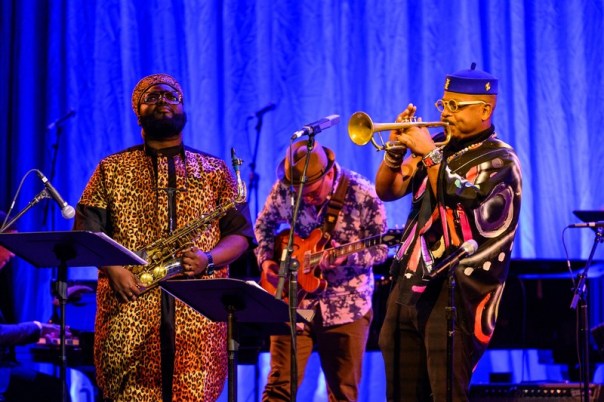
Akinmusire had little to say between selections, usually pointing to and naming one of his bandmates, but his horn said plenty, with judicious electronic alterations here and there. You could argue that Akinmusire had somehow synthesized the earliest electronic explorations of Bitches Brew Miles Davis with the two acoustic periods that preceded that revolution, the Kind of Blue period and Davis’s playing with the quintet he led that introduced Herbie Hancock and Wayne Shorter to the universe. But the living trumpeter is undoubtedly building upon that legacy.

None of this year’s jazz events took place outdoors at Cistern Yard, the temple of Spoleto jazz in years gone by. Like last year, when Trombone Shorty had to move his show to the College of Charleston’s TD Arena, weather intervened between us and seeing Etienne Charles and his Gullah Roots band under the live oaks. By now, such last-minute schedule switches are almost routine at the festival: the sound system is tight and the lurid outdoor lighting arrives somewhat intact. Charles’s show was not quite as rambunctious or gaudy as Shorty’s extravaganza had been, but his suite – soon to be officially released on CD – was far more profound, moving, and relevant.

Nor was there any lack of showmanship in the presentation of this epical suite, which traversed the arrival of the Gullah in the New World via the Middle Passage to the morning when Lincoln’s Emancipation Proclamation took effect. In three stages, the Gullah Roots ensemble grew from six to seven, seven to eight, and eight to 14 as the massiveness of Charles’s concept enlarged. Those two historical watersheds were both marked with two-part compositions, “Igbo Landing” and “Watch Night.” After the foundational “Gullah Roots” piece, special guest Quentin Baxter, a longtime Charleston-and-Spoleto fixture, joined the group as a second percussionist for the dramatic “Landing.” Later for “Bilali,” Samir LaGus came forth in more striking African garb than we had seen before, bringing with him a guembri, a three-stringed lute-like instrument that merited its own introduction from Charles.

For “Watch Night,” taking us back to New Year’s Eve on December 31, 1862, a four-woman choir (The Wives), vocal soloist Quiana Parker, and organist/choir conductor Damian Sneed joined the solemn vigil and ultimate jubilation. Visually the spectacle was as grand as the music as Sneed and his singers filled the side of the stage opposite LaGus and the percussion. Issued on September 22, the iconic Proclamation would become law at midnight, the beginning of Freedom Day. One day after Juneteenth 2025, Charles brought his Gullah Roots to the Stage Door at Blumenthal Center for what promised to be a very special Jazz Room concert presented by JazzArts Charlotte.

Spoleto’s “Turn of the Screw” Upstages Theatre Launches

Reviews: White Box, Polar Bear & Penguin, and The Turn of the Screw

By Perry Tannenbaum

Programming at Spoleto Festival USA is noticeably more fragmented and bunched-up this season (May 23-June 8), making it a little easier for jazz fans and theatergoers to see the entire sets of offerings without overstaying their budgets. Most of the jazz performances are blocked together on the tenth day through the sixteenth day of the 17-day festival, though Cecile McLorin Salvant and Phillip Golub could be savored on Days 5 and 6. Theatre presentations, however, were not to be seen at all until Day 7, and will continue – though never more than three of the five at once – until the last evening of the festival.

But the best theatre you’ll see here in Charleston this season may turn out to be an opera, Benjamin Britten’s The Turn of the Screw, with a script by Myfawnwy Piper adapted from Henry James’s ghostly novella. The world premiere production is directed by Rodula Gaitanou, who triumphed so decisively with her revival of Samuel Barber and Gian Carlo Menotti’s Vanessa two seasons ago.

The Piper script is certainly more family-friendly than the James novella – but not altogether stripped of the novella’s wispy psychological complexities. Scenes are more fragmentary than most old-time operas, more in keeping with the layout of a Renaissance tragedy. Yet Gaitanou doesn’t settle for our imagining the scene shifts from indoors to outdoors or from night to day.

Each scene change in Yannis Thavoris’s extremely supple, elegant, and creepy scenic design is punctuated at Dock Street Theatre – which itself dates back to 1736 – with the drop and rise of a black scrim. These blackouts take us back to the days of silent film, before the simplicity of jump-cuts was imprinted into our DNA. They also place a greater emphasis on the wonders of Britten’s interstitial music, which almost covers every scene change behind the curtain perfectly.

In the one exception, where the scene change must happen without musical cover, soprano Elizabeth Sutphen as James’s famously inexperienced and beleaguered Governess steps in front of the curtain for the space of an aria while the scenery changes behind her. The whole effect of Gaitanou’s staging was magnificent in a way that I hadn’t anticipated. Britten’s music seemed to infuse the pores of every actor, even boy soprano Everett Baumgarten as the possessed Miles, whose vocal lines were as simple and pure as a choir boy’s.

No wonder legendary soprano Christine Brewer as Mrs. Grose, the housekeeper, believes that Miles was incapable of violence. And indeed, the horrific denouement hinges on the boy’s natural delicacy. All is not placid when the child draws our attention. There is major orchestral turbulence when Miles, behind the Governess’s back, tears up the letter she has written to his uncle – and wild skittering sounds when he hurriedly gathers up the pieces of paper from the floor.

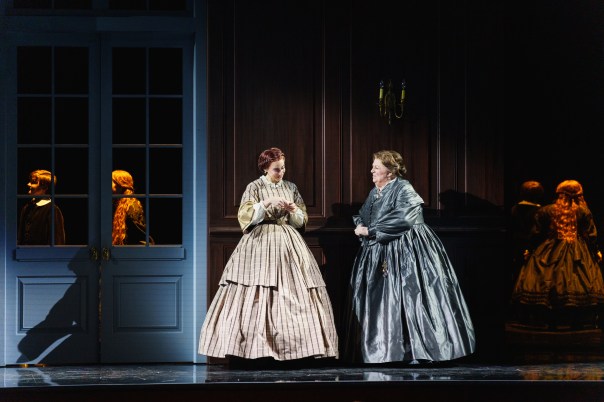
Not only does Thavoris’s scenery harmonize with his costume designs and synchronize with Britten’s music, it is wondrously detonated by Paul Hackenmueller’s lighting. At key moments throughout the two-act opera, the huge mirror that nearly dominates the set turns translucent or transparent, revealing the ghosts that haunt the estate. These ghosts might simply stand there in Hackenmueller’s eerie blue light or they might come to melodramatic musical life and sing.

Omar Najmi sings the narrative prologue before tackling the charismatic tenor role of Peter Quint, the more malignant of the two ghosts. His wholesome and romantic appearance, like Miles’, belie the evil lurking within – but Quint’s evil is never under musical restraint. There never needs to be any question that Quint is a madman, and Najmi never leaves any doubt.

The struggle between Quint and Miles is more titanic than that between the other ghost, Miss Jessel, and Miles’ sister, Flora. Yet an extra eeriness had wafted into this Spoleto world premiere on opening night because the singer portraying Jessel, Mary Dunleavy, was still recovering from an illness. She still acted the role, lip-synching to Rachel Blaustein, who sang the role from offstage. Blaustein sometimes sounded sepulchral and indistinct from wherever she was sequestered, in and outside Dunleavy’s body, depending on where she stood.

Fortunately for Blaustein and all the other treble voices at Dock Street, but especially for us, there are English subtitles on hand when the text might otherwise be lost. Sometimes, as when Baumgarten sings “Malo, malo,” it’s just good to have the projected text above the proscenium to confirm what we’re hearing!

Aside from the oddity of these subtitles for a Broadway show, it’s hard to see why this gripping production couldn’t be a hit. Dunleavy’s interactions with Israeli soprano Maya Mor Mitrani, singing the role of Flora, are particularly outré and suggestive. Though the text never seems to give her enough to justify her take, Mitrani’s brattiness only clashes with the elegance of her lavish Victorian dress, and there’s a frequent sense of jealousy toward Miles because of the attention he draws under Quint’s spell.

In the climactic lake scene, where the ghost of Jessel supplicates Flora, Gaitanou tosses aside any notion from fussy modern lit critics that there is ambiguity on whether James’s ghosts are real or figments of the Governess’s fevered imagination. We see Jessel, floating above Flora in her boat on the lake, long before the Governess does. Until then, she’s quietly ashore on a quaint little bench, absorbed in a book.

Numerous creepy touches abound, not the least of them involving the onstage curtains that hide or highlight the ghosts lurking behind the huge mirror. Suddenly the curtain begins rustling behind the children and adults onstage – yet nobody there notices for the duration of the scene. But we do.

White people obsessed by the white polar regions has been a powerful theme since Mary Shelley wrote Frankenstein (1818) and Edgar Allen Poe wrote The Narrative of A. Gordon Pym (1838). It was still in the air when Swedish adventurer Salomon August Andrée proposed a new method of mapping out the North Pole to the Royal Geographic Society in 1895: exploring the region in a hydrogen balloon.

Once again, wind conditions weren’t ideal. But Andrée, more adventurous than patient, lifted off with his comrades anyway and… vanished. For 33 years, nobody knew their fate for certain until their remains were recovered and brought back ceremoniously to Stockholm in 1930. The fullest narrative took another 66 years to recover, pieced together with the journals of the three explorers and the partial restoration of Strindberg’s photographs.

Sabine Theunissen rewinds the story in White Box in its US Premiere at Emmett Robinson Theatre on the College of Charleston campus. From a theatrical standpoint, it’s a very quirky and visual retelling, making liberal use of Nils’s photographs and primitively enhanced animations. He seems to be more of Theunissen’s protagonist than Andrée, but none of the three men onstage has any dialogue.

Thulani Clarke and Fana Tshabalala are designated as Dancers in the Spoleto program book, while Andrea Fabi is labelled Performer, presumably because he shapeshifts between Nils and Andrée. Given the silence of the humans, the old-timey camera, mounted on a wooden tripod and occasionally capable of a life of its own (thanks to puppeteer Meghan Williams), could be regarded as a fourth character.

So far what we’re describing might be viewed as akin to silent film, even though Catherine Graindorge adds violin and viola from one side of the hall and Angelo Moustapha adds piano and percussion from the other. Not even granted a bio in the program – or present for the final bows – Maria Weisby delivers all the info we can hear via pre-recorded Voice Over.

It’s hard to detect any consistent intent or message in Theunissen’s various caprices. Her Dancers are part of the expedition party and they aren’t. Their choreography from Gregory Maqona is more African than Nordic and so are their skins. The same disconnect doesn’t always apply to Graindorge’s music composition, but aside from the honky-tonk piano by Moustapha bookending the narrative, his percussion has more of a jungle flavor than an evocation of windswept Arctic tundra and ice caps.

And Theunissen’s declaration that she must tell her tale backwards to tell it right isn’t religiously carried out – though we did learn why the expedition was doomed from the start toward the end of the show. Somehow, all of Theunissen’s quirks and incongruities worked beautifully, even poetically. And viscerally.

When Nils stands doomed on a sea of ice, dancing with his mammoth camera, we can join him in tossing accuracy and logic to the winds.

Even more fanciful was the children’s show that opened on the same Saturday that White Box closed, Polar Bear and Penguin, written and acted by John Curivan and Paul Curley. Brrrrr! So theatrically speaking, it was a bipolar weekend in balmy Charleston.

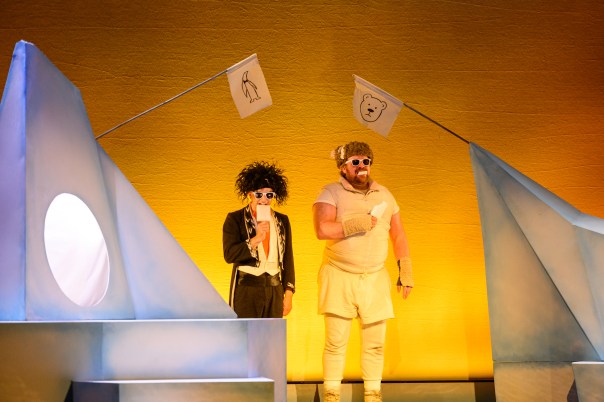
Curivan and Curley (who better to concoct this alliterative title?) had some bipolar intentions of their own. For polar bears are only found natively in the northern hemisphere while penguins are natively confined to the south. Wherever they bump into each other on runaway icecaps, their personalities are also poles apart, replicating the ancient grasshopper and the ant fable. In floating igloos.

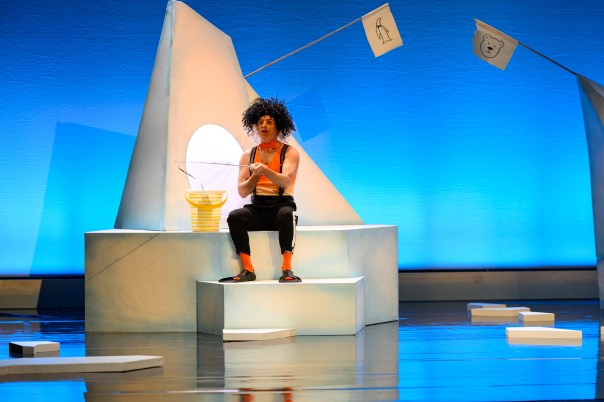
As Polar Bear, Curivan is all carpe diem: see a fish, catch a fish, eat a fish. Curley is more communal, considerate, and calculating as Penguin. In the here-and-now, Penguin will catch a fish and share a fish. Longterm, he will catch another fish and save it for later. Curivan uses his paws to bash a hole in the ice and grab his prey. The more sophisticated Curley – yes, Clara Fleming’s costume design includes full-length tux jacket and tails – extracts a fishing pole from Penguin’s little cave.

Ah, but they don’t merely catch fish out there in the frozen North or South. Penguin hooks a bottle, Polar Bear hooks a shoe, and something with buttons pops out of the deep, maybe a cell. Curivan and Curley subtly remind us with these human throwaways – and the occasional sound of airplanes above – that these primal and adorable creatures are cast adrift and endangered by the overreach of civilization.

Global warming.

Meanwhile, Polar Bear and Penguin demonstrate that their differences can be bridged as they become best friends. Until a crisis emerges at a cookout that irresistibly engaged the participation of the ankle-biters in the audience. Penguin was cooking up a glorious fish dinner from a hidden spot upstage while Polar Bear was downstage waiting for dinner, sorely tempted by an overflowing pail of raw fish that they had caught and agreed to save for later.

Each time Penguin exited to tend his unseen campfire, a new wave of temptation assailed Polar Bear. As if Peter Pan and Tinkerbell were hovering somewhere in the darkened hall, children all over the Rose Maree Myers Theatre in North Charleston began hollering to Polar Bear not to eat the damn fish.

In some ways, our innocence remains intact.

But Curivan and Curley didn’t leave us with a happily-ever-after ending. Before the lights went down, Polar Bear and Penguin reconciled, closer friends than ever before. Bear achieves better impulse control while Penguin tempers his hoarding tendencies. All that chumminess, sad to say, didn’t prevent a further thaw of the ice that connected their little caves. So they finally drifted towards opposite wings of the stage, separated forever.

A little girl sitting in front of us burst into tears, inconsolable as her mom carried her away. She likely got the point more keenly than her peers – and likely better than many of her elders here in Trump Country.

The bulk of Spoleto’s theatre lineup has yet to open, The 4th Witch opening on June 4, Remember This: The Lesson of Jan Karski making its bow on June 5, and Mrs. Krishnan’s Party arriving on June 6. Until then The Turn of the Screw reigns as my top pick, with a final performance on June 6.

Must-See Classical Abounds at Spoleto Festival USA

Reviews: Opera, Chamber Music, Orchestral Music, and Alisa at Spoleto

By Perry Tannenbaum

Three different sea changes have reshaped Spoleto Festival USA since Nigel Redden, responding to the WSYWAT turmoil that followed in the wake of George Floyd’s brutal murder, departed after the 2021 season. Redden saw himself in the crosshairs of the 2020 We See You White American Theatre manifesto, though he wasn’t strictly a theatre person, and felt that steeping as aside was the honorable thing to do.

Diversity has never been inimical to Spoleto, which has always looked more Euro and Afro than American. Yet as Spoleto 2025 concludes, a near-total change of artistic leadership has transpired – with an unmistakable lean toward diversity. Mena Mark Hanna has replaced Redden as general director. Paul Wiancko has filled the void left by the charismatic Geoff Nuttall’s sudden death, taking over the reins of chamber music programming. When John Kennedy was abruptly dismissed after the 2023 season, Timothy Myers became music director, wielding the Spoleto Orchestra baton.

And Joe Miller, after 20 seasons as director of choral activities, is resigning to lead the Vocal Arts Ensemble in Cincinnati. His Spoleto farewell, Bach’s Mass in B Minor, will be followed soon by an announcement of his successor in Charleston.

Conversely, Spoleto is responding to fiscal, box office, and government funding pressures to be more self-sufficient. While Kennedy’s programming arguably made the  festival America’s chief hub for 21st century classical music composition, his afternoon Music in Time programs were as much box office poison as they were cutting edge. That experimental ghetto has disappeared while Wiancko and Myers have integrated more infusions of contemporary, new, and world premiere music into the festival’s chamber music and orchestral offerings.

Beyond shrinking the outré and avant garde, Spoleto is expanding its pop, punk, folk, and R&B presentations to no less than a dozen Front Row events with Patti Smith, Band of Horses, Mavis Staples, Lucinda Williams, and Jeff Tweedy among the headliners. The strategy is to “expand the aperture” in Hanna’s words, offset the losses of more adventurous fare, and make Spoleto more accessible to a wider audience. Hopefully, these newbies may be tempted into tasting the 17-day festival’s higher protein offerings.

Other belt-tightening measures include offering 15%-off discount packages of tickets to multiple events, and ending of the longstanding tradition of inviting a theatre company from abroad to co-tenant the Dock Street Theatre with the lunchtime chamber music series. Wilder still, two of the Dock Street chamber music concerts were staged during evening hours! Sacrilege.

Finally, little touches in the festival brochure and the program booklet underscored a deepset commitment to making Spoleto more navigable and customer-friendly. Jazz fans could gorge on all the Spoleto headliners within the space of 10 days, while theatre lovers could get their fill in seven.

While both of these lineups were tilted toward the latter half of the festival; opera, dance, and orchestral music could be largely traversed within the first 10 days; along with seven of the eleven chamber music programs. As compacted as the scheduling was for festivalgoers devoted to one genre, omnivores like me who preferred a mix found themselves stretched. For us, the scheduling was scattered and fragmented.

How appropriate, then, that the most awesome classical music event this season, intertwining 27 new works by living composers with J.S. Bach’s Six Cello Suites, was Alisa Weilerstein’s FRAGMENTS. Conceived during the global pandemic, FRAGMENTS has some of the randomness and the quirky, curated individuality of a mixtape. Weilerstein did not commit herself to playing the Suites in their entirety or – within each Suite – in their traditional order. Or tempo.

Beyond that, in commissioning 27 three-part compositions roughly 10 minutes long, Weilerstein obtained the right to shuffle the order of the parts and to slice and dice the new works to create smooth transitions into each other and the Bach. Layering on stage direction at Sottile Theatre by Elkhanah Pulitzer, scenic and lighting design by Seth Reiser, and costumes by Molly Irelan, Weilerstein crafted her FRAGMENTS into a creation you literally had to see.

As revealed in an interview event moderated by Martha Teichner, Weilerstein has no intentions of releasing an audio recording of FRAGMENTS. Video only. However, the cellist will honor the composers she commissioned by recording their works as written. All in all, Weilerstein was onstage soloing and fielding interview questions for more than seven hours spaced over six days, capped with world premiere performances of FRAGMENTS 5: Lament and 6: Radiance on her final day.

Get as Close as You Can to “She Kills Monsters”

Review: She Kills Monsters at the Parr Center

By Perry Tannenbaum

When you think about it, not too many comic books get to be adapted into plays or musicals. Movies and TV seem to be the hallowed afterlife of superheroes and Marvel headliners – except for that regrettable Spiderman the Musical fiasco. Only video games, if memory serves, make it to the big screen. But never to a live stage. Monopoly, Chutes & Ladders, and other pop culture board games were similarly neglected until Clue proved that it could have legs onstage.

So now we have playwright-director-choreographer Qui Nguyen’s She Kills Monsters, inspired by the legendary Dungeons & Dragons board game, onstage in Charlotte for at least the third time in the last 10 years, beginning with a UNC Charlotte production in 2016. In some ways, the current Central Piedmont Theatre production is an upgrade from the 2022 version presented at the Arts Factory by Charlotte’s Off-Broadway.

The bigger, newer Parr Center offers the spaciousness for scenic-and-projections designer James Duke to make Nguyen’s spectacle more spectacular. In cahoots with lighting designer Jeff Childs, costume designer Freddie Harward and prop designer Maxwell Martin have the equipment and budget to splash additional color across the Parr stage. Add the sound designs of Montavious Blocker and Carly McMinn and you have a sensory-rich fantasy brew.

To stage his own scripts and bring martial arts action into live theatre, Nguyen established the Vampire Cowboys Theatre Company in 2000 – and himself as the godfather of “Geek Theatre.” Presumably, he was convinced stage combat and martial arts could be a more visceral experience in live performance than it is on film, even if the resources of slow-motion photography, AI, and animation had to be tossed aside.

Much of Nguyen’s geekery can be comic book silliness and free-range Gothic imagination, delighting as much in creating outré villains as in birthing super-powered heroes – with a smattering of witchery and magic on both sides. What makes She Kills Monsters especially clever and brilliant is Nguyen’s use of Dungeons & Dragons as a game within a drama. His hero, Agnes Evans, uses D&D as a tool to recover the essence of her younger sister Tilly after her untimely death.

You will wonder how this can be possible if you don’t already know that D&D can be deeply and extensively personalized. You can create your own module for the game and envision heroes and monsters based on your own friends and enemies: a wonderful way for high school teens to vent their thwarted loves and seething hates.

Key example: Tilly, venerated as Tillius the Paladin among D&D geeks in Athens, Ohio, was jealous of her elder sister’s boyfriend, Miles. So along the path of Tilly’s scenario, Agnes will discover that Miles is a villainous force who must be vanquished, even though the evildoer has been imprisoned in a huge gelatinous cube.

That discovery will pale in comparison with the discoveries Agnes makes about Tilly’s sexuality. Geeks are merging with Greeks in Athens, as Nguyen is quite aware, so his female warriors will not be as straight as Homer’s Amazons.

Nor can Nguyen’s Athens be down in Georgia, for he has ordained that Agnes is average – the birthright of all Ohio citizens. For Agnes, it’s a journey into the underworld just to meet Chuck, who will serve as Dungeon Master for the surviving sister while entrusted with the precious posthumous work of Tillius the Paladin.

Layered onto all this teen angst (Tilly’s) and Agnes’s quest to recover her dead sister’s lost soul – both in the D&D game and in real life – is another Narrator, a high school guidance counselor, and numerous mundane classmates that Tilly has mirrored and immortalized in “The Lost Soul of Athens.” My picks for most lethal are the Athens High cheerleaders, Tina and Gabbi, turned into succubi in the D&D realm.

Carly McMinn directs the show, immersing herself and her cast in the action to a fault. I’m not sure McMinn sat herself more than three rows away from her players during rehearsals at the Parr Center. By the time Nguyen’s words reached my party in Row G, much of the Vietnamese playwright’s snappy dialogue had become unintelligible.

Get as close as you can if you wish to hear as joyfully as you’ll see.

If you don’t mind experiencing She Kills Monsters like Greek drama, knowing the plot beforehand, you can freely read and/or download the script online. Otherwise, you’re adding the Neil Simon layer afterward. If at all.

Generally speaking, the vaunts, boasts, and challenges within the game are louder than the conversations inside Agnes’s apartment, Chuck’s store, or the guidance counselor’s office – and more often competing with the soundtrack, which is not at all Dean Martin. Is it Beck’s “Loser” or LL Cool J’s “Mama Say Knock You Out” or Smashing Pumpkins as suggested by the script? Couldn’t say.

McMinn and her choreographers capture the spirit of Agnes’s odyssey beautifully, true to Nguyen’s saucy mix of fantasy and reality, silliness and profundity, fun and feeling, play and play. Fight choreographer Elizabeth Sickerman and dance battle choreographer Becky Rooney both grasp the double layer of artificiality that protects us from viewing violence, injury, blood, or death in the D&D world as any more serious than AEW on TNT.

But unlike AEW, Sickerman and Rooney can take advantage of the outright artifice for comedic purposes. How bad is it, then, if Tillius the Paladin wields her mighty sword – The Eastern Blade of the Dreamwalker, forged from the fiery nightmares of Gods and blessed by the demons of Pena – and slashes at a Bugbear, missing her target by two yards? Not at all. Especially if the Bugbear is mortally wounded anyway. Or if any other fearsome adversary writhes in agony, breathing its last for no apparent reason.

A little of this ridiculous fakery goes a long way.

To be fair, if McMinn doesn’t have her protagonists consistently declaiming at sufficient decibels, she has the wisdom to see that their character arcs are moving in opposite directions to make reconciliation – or even acquaintanceship – possible. Nguyen takes more care with the nuances of Agnes’s evolution since it’s moving in parallel directions in altering her relationships with Tilly and with Miles.

So Saskia Lewis as Agnes has a bunch of calibrating to do as she moves from average and static to insightful and savage. Lewis must be awkward for a while with her blade, shield, and helmet before Agnes the Ass-hatted can morph into Agnes the Badass. She also goes through gauche stages with Miles, with Vera the guidance counselor, and her squeamish attitude toward Chuck (some of it quite warranted).

It’s a curve that Lewis delineates well, though she never quite figures out how to give Average Agnes any spark or gusto. A little dopiness might do it. Or a little surprise when Agnes discovers she can have fun.

Whether or not McMinn saw the 2022 Monsters at the Arts Factory, she and Claire Grant demonstrate that less can be more in portraying Tilly and Tillius. Grant is never quite the legend Charlie Grass was as Tillius in 2022. There is no warpaint on Grant. You might even catch her slouching once or twice. She is mighty, yes, but we also see her as vulnerable. This Tillius is one that Agnes can envision, not the invincible Tilly she wants her to see.

Very likely, Brian DeDora was mostly enticed by the monster-in-gelatinous-cube side of Miles when he auditioned for the role, but I couldn’t help liking him even more as the wholesome boyfriend. Nguyen gives DeDora a wonderful pathway into making mundane Miles likable, for he earnestly wants to be a part of the D&D fun and fantasy once Agnes has gotten the bug.

Aside from Kameal Brown as the guidance counselor, slightly tainted by adulthood, all the other women get to revel in D&D nastiness and badassery. My favorite is Ashlie Hanke as Lilith Morningstar, Tilly’s right-hand fantasy demon, followed closely by Anaiah Jones and Kristina Ishihara as the Evil cheerleader succubi.

Hanke gets the best crossover into reality as Lily, more closeted at Athens High than Tilly. To Hanke’s credit, Lily is poignantly burdened with the sad consequences of spurning real-life Tilly to keep her cover. When they aren’t tormenting Tillius & Crew as succubi, Jones and Ishihara can tag-team Tilly, cruelly teasing her over her sexuality. Even if they’re a bit stereotyped as cheerleaders, they make Athens High more real.

All three of these wicked slayers are radically red-faced in New Landia, the country where Tillius tries to recover her lost soul. Their having to un-paint and repaint is the only good excuse I can imagine to explain why everyone onstage isn’t miked. So for me, it’s a love-hate relationship with these vicious vixens.

Among the remaining men, we should first consider the storytellers, Elon Womble as our Narrator and Maximilian Novick as geek master Chuck. Nguyen doesn’t specify how our Narrator should be attired, but he broadly suggests that she or he radiate a Lord of the Rings aura. Accordingly, Novick sports a garish green medieval outfit over long black boots, an implicit invite for us to straddle the real and fantasy worlds as the story unfolds.

Novick can roam more freely between teen nerdiness and master of the dark arts, a transition marked by donning a monkish cowl and deepening his voice. There’s also a mix of gawkiness, horniness, and bravado that Novick obviously relished.

As Orcus, the retiring Demon Overlord, Truman Grant gets to wear more majestic horns than those sported by Lilith (some history between them is hinted at). For old-school aficionados of The Wizard of Oz, Orcus might pleasantly echo the roaring veneer of the Cowardly Lion. Grant’s demon doesn’t suffer from self-image hangups, and he’s more of a careless, world-weary slacker than timid, having shrewdly traded Tillius’s soul for a badass TV/VCR combo.

Evangelicals and assorted homophobes despise She Kills Monsters, especially when it defiles their precious schools. Once again, such harmless and rollicking sacrilege is happening again in the QC. It’s particularly distressing for the haters to see Tillius and Orcus uniting with Agnes on her adventure. Both of them can tell the Ass-hat a thing or two about how to die.

Renée Fleming Provides the Glitter in Symphony’s Glitzy Spring Gala

Review: Charlotte Symphony @ Carolina Theatre

By Perry Tannenbaum

March 28, 2025, Charlotte, NC – In so many ways – for me, for Charlotte Symphony enthusiasts, and for the city – last week’s Spring Gala at the Historic Carolina Theatre was a thrilling revival and an orgy of nostalgia. First and foremost was the reopening of the ancient movie theater and concert hall, dormant movie-wise since 1978 and briefly revived in the late 1990’s by Moving Poets Theatre of Charlotte and the beloved Creative Loafing Theatre Awards. The Carolina has stood in midtown Charlotte since 1927 and the Charlotte Symphony Orchestra sprang to life there with its first public performance on March 20, 1932. So a couple of auspicious centennials are on the horizon during the next decade.
On the other hand, Carolina Theatre crystallizes what Symphony has become in its recent years of modernization. Within the past month alone, our orchestra has performed in front of movie screens on three programs, John Luther Adams’ Become Ocean, John Powell’s How to Train Your Dragon in Concert, and the glittery Spring Gala featuring Renée Fleming. If memory serves, we hadn’t seen Fleming perform with the Charlotte Symphony since 2004, and the last time my mom and I saw her at the Metropolitan Opera was in 2014, playing the title role of The Merry Widow.

The epic assemblage of National Geographic footage added extra dimensions to Fleming’s live rendition of her Grammy Award-winning album of 2021, Voice of Nature: The Anthropocene – or it would have if the soprano had actually sung more than two of the album’s 17 tracks in front of the lushly cinematic backdrop. Two additional screens flanked the stage, not only tripling the Geo cinema to near-surround proportions but also supplying the texts or translations of the songs if you could peel your eyes away from Fleming, still glamorous at 66, accompanied by pianist Bradley Moore.

Cinematically and acoustically, the renovated Carolina Theatre was quite good for its age, too, but not spectacular. If you came to behold the sensational, that was taken care of before you entered the hall, for the glow of the lobby and the Carolina signage could be seen from blocks away as you began grappling with the riddle of where to park. Inside the lobby, where the sleek glassy modernity of the hall clashes with the quaintness of the updated Roaring Twenties marquee, you’re already in the presence of something unique, but when you enter the hall, spanking new with all its old-timey trimmings, you feel like you’re inside a time capsule.

So it’s hard for a critic to be churlish about Fleming delivering less than a quarter of her original Anthropocene in live performance when the 15 songs she substituted were so well-chosen and – mostly – flawlessly sung. From the album, Kevin Puts’s “Evening” and Reynaldo Hahn’s “L’heure Exquise” were the most delightful, but an objective assessment of Nico Muhly’s “Endless Space” was impossible for me. This was where the screens surrounding Fleming exploded with National Geo imagery: the glories of sky, ocean, rivers, and ice, followed by the ravages of fires, floods, drought, and sunbaked skeletons. Hazel Dickens’ “Pretty Bird” and an aria from G.F. Handel’s Atalanta were charming enough, but chiefly backed by massive tree trunks, comparatively sleepy on celluloid.

My favorites among Fleming’s inserts were Curtis and Pearce Green’s “Red Mountains Sometimes Cry,” Maria Schneider’s “Our Finch Feeder” from Winter Morning Walks,Giacomo Puccini’s “O mio babbino caro” from Gianni Schicchi,Rodgers & Hammerstein’s “The Sound of Music” and Joseph Cantaloube’s “Baïlèro” from his Chants d’Auvergne. Allow me a little churlishness on “Baïlèro”: although it was the most achingly lovely song that we heard before intermission, still magical though stripped down to Moore’s accompaniment, a full orchestral version with Symphony could have elevated the magic to sublimity with its lovelorn oboe passages and sprinklings of harp. Recorded versions by Frederica von Stade, Kiri Te Kanawa, and Victoria de los Angeles are the best – along with Fleming’s own, the final track on her 1998 Beautiful Voice album.

When Charlotte Symphony finally assembled onstage, it was more than an hour after president and CEO David Fisk and Charlotte Mayor Vi Lyles graced the evening with their gala presences and welcoming remarks. A bit undermanned for guest conductor Courtney Lewis in his Charlotte debut, the Orchestra sounded lackluster in the Overture to Mozart’s Le nozze di Figaro and downright moribund in the Overture to Gabriel Fauré’s Masques et bergamasques. It amazed me to find that nothing could mar or spoil this occasion when you felt privileged to be there. Partly because our expectations had been politely lowered, Lewis and Symphony seemed to overachieve in Richard Rodgers’ “Waltz” from Carousel.

Fleming’s voice has lost some of its creaminess above her midrange and I found myself rooting for her to easefully reach her top as she climbed to the climax of R&H’s “You’ll Never Walk Alone.” But Renée had banked plenty of his goodwill for arts lovers long before she resigned recently from the tainted Kennedy Center. Decades before she put her heart post-pandemic into the global environment, she championed American opera, most notably in 1998 when she premiered the role of Blanche in André Previn’s A Streetcar Named Desire while also collecting American arias into an 11-track album representing nine composers, I Want Magic! The aging diva is still banking residuals and Spotify pennies for her exemplary recorded output. Meanwhile, each time Charlotte Symphony had the chance to play live behind Fleming, they seemed to play better, producing fresh magic aplenty for us all – with the promise of much more from Fleming and the Carolina Theatre in years

Uhry’s “Parade” Marches on, Trampling Justice for Leo Frank

Review: Parade at Belk Theater

By Perry Tannenbaum

A couple of simple online searches confirm the widespread shibboleth. “Everyone loves a parade” summons up millions of quotes and images – not to mention the occasional book, song, movie title, and a BRAND NEW sealed board game on eBay. Try “everyone does not love a parade” on Google and the engine blinks, seizes up, and drops a couple of pistons, yielding pretty much the same results, except for a couple of incredulous newspaper headlines.

“Who Doesn’t Love a Parade?” asked the New York Times in an opinion piece back in 2018. Jim Tews, the author of the piece, breaks rank with his headline in his opening sentence: “I love a parade.” No, we must go further back to 2007, when opinion writer Susan A. Nielsen wrote in the Seattle Times – on the Fourth of July! – asking, far more accusingly, “What kind of sick person doesn’t love a parade?”

“I recently became aware,” she begins solemnly, “that some people, including my spouse and closest friends, hate parades.” Mercifully, she does not name names, but you can almost hear their diabolical cackles in the background.

Not a peep of dissent from the Google results on the rest of that webpage or the next five. Everybody loves a parade; that’s the settled truth. Unless they are still alive and sequestered in Seattle.

So be forewarned: in Alfred Uhry’s retelling of the events that led up to Leo Frank’s murder trial in 1913 and his lynching two years later, his protagonist/victim is a man who despises a parade. A specific parade. Instead of attending the Confederate Memorial Day parade in Atlanta on April 26, 1913, he opted to go to work at the National Pencil Company, where he was superintendent. It will cost him.
Onstage at Belk Theater, where the touring version of Uhry’s PARADEopened on Tuesday, Frank gets to say that, as a Jewish man from the borough of Brooklyn, he still feels like an outsider: “How Can I Call This Home?” he laments. His bad feelings would only be exacerbated if he were to attend a parade celebrating the Confederacy. What is there to celebrate?

Atlanta prosecutor Hugh Dorsey and extremist pamphleteer Tom Watson were the foremost public figures – and the loudest – to proclaim that such an explanation for Frank’s truancy from the parade was impossible. No, the real reason he went to National Pencil that day was to ambush, rape, and murder 13-year-old Mary Phagan, who came to her workplace simply to collect her weekly pay. Quaintly enough, in cash.
For those who rushed to judgment against Frank without solid evidence to back their convictions, The Confederacy, civic pride, and celebration were all synonymous with this spurned parade. Just by choosing Parade for his title, Uhry was taking Leo’s side, flouting the idea that the word blends naturally with bliss. Led by Watson and Dorsey, the parading goes on despite criticism or opposition, becoming an orchestrated stampeding of Frank’s rights and humanity, deeply drenched in antisemitism.

Retribution for Dorsey and Watson? Hardly. Dorsey would subsequently be elected Governor of Georgia and Watson would become a U.S. Senator.

Plagued by technical difficulties when Halton Theater was young, the 2006 production of Parade at CPCC Summer Theatre didn’t rock my world, though my world is deeply drenched in Judaism and Jewish culture. So my wife Sue and I were surprised by how powerfully this touring production impacted.

It was like a stunning gut punch for me in the wake of Charlottesville, Pittsburgh, and the uptick of antisemitism since October 7. I felt physically nauseous as this horror of sensationalized press, suborned testimony, and a grotesque parade of cookie-cutter witnesses – factory girls who were obviously coached – took on the rancid smell of an inevitable conviction.

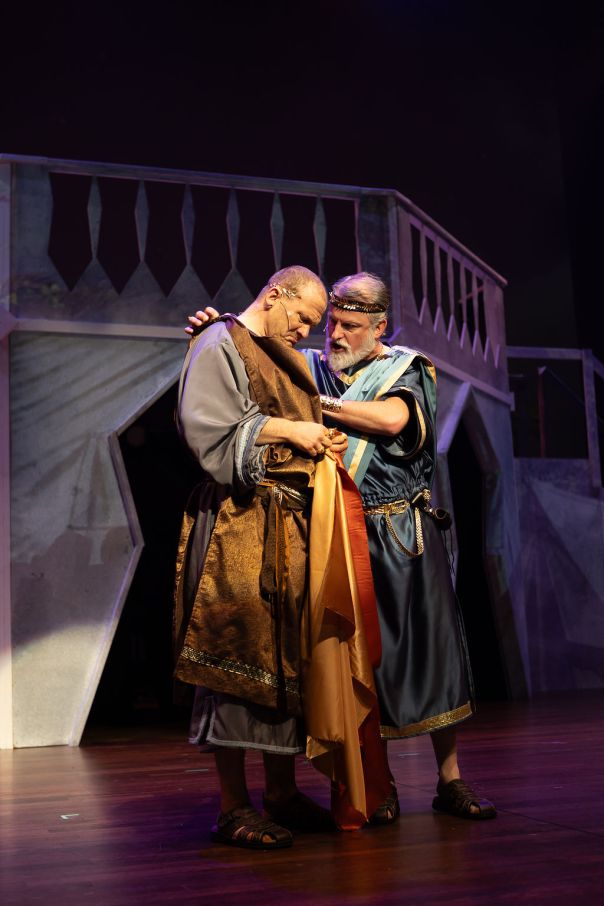
You could see Frank’s righteous self-confidence crumbling along with the suave composure of Luther Rosser, his cocksure defense attorney. Long before vigilantes entered the picture.

For others without my Ashkenazi DNA and yeshiva background, Parade might not elicit the same visceral response. It would be interesting to see whether Uhry, the Atlanta native who also gave us Driving Miss Daisy and The Last Night of Ballyhoo, would have had more success if he had worked alone on Parade – without the music and lyrics of Jason Robert Brown and the co-conceiving of the esteemed Harold Prince, who also directed the original production.

The upscaling of Uhry’s script was certainly warranted by the Leo Frank tragedy – and the crucial action that must unfold in a chaotic courtroom – but the timing was not ideal after Ragtime, painted on a far broader canvas, opened earlier in 1998 in a bigger house. Michael Arden’s restaging for the 2023 revival of Parade can also be off-putting if you don’t care for actors lurking silently around the action between scenes and becoming stagehands during transitions.

We cannot accuse the lead performances of any such artificiality. The passion of both of the principals reaches deep down into this cast, from Max Chernin as Leo to Jack Roden as Mary Phagan’s aspiring boyfriend. So the level of melodrama in their voices, ardently singing Brown’s Tony Award-winning music, rises to operatic levels and beyond.

Chernin is freed from meek innocence during Leo’s trial, becoming his own demonic caricature in “Come Up to My Office” as the robotic factory girls horrifically distort his personality. It was painful to watch him rise from his seat at the defense’s table, climb to the platform where witnesses gave sworn testimony – and Judge Leonard S. Roan presided – only to surrender totally to the girls’ perverse depiction of him and jubilantly surpass it.

Easily as talented as Chernin, Talia Suskauer struggles to clarify Lucille Frank’s marital problems with Leo, perhaps because her biggest opportunity, “What Am I Waiting For?” is saddled with lyrics by Brown that are too subtle. They have an arranged marriage in Uhry’s telling. While Leo has yet to cope with the cultural distance between Brooklyn and Atlanta, there is still an intimacy gulf after four years.

It would help a little if Suskauer sounded Southern more often, but if Parade is already grabbing you with its systemic intolerance, Lost Cause immorality, Gestapo cops, and hypocritical pomposity, the drawl deficit will evaporate amid the deluge of her straightforward “You Don’t Know This Man.” One of the chief beauties in Uhry’s script, true history be damned, is the growth of Lucille in Act 2, triggered by her “Do It Alone,” flung at Leo while he’s festering in jail, hoping for a retrial.

On the cast album, that song sounds like a vehicle for Streisand at her most histrionic, but Suskauer blazes her own trail. Implausibly, I haven’t found a single cover of this raging powerhouse outside of cast albums on Spotify.

As the ranting Tom Watson, we get Griffin Binnicker in a Colonel Sanders suit feverishly waving a bible – like a nightmare premonition of a J.D. Vance presidency. No less irritating or unscrupulous, Andrew Samonsky as prosecutor Hugh Dorsey is yet another evocation of the sort of pure evil politician we thought was ancient history.

There is more than a sprinkling of prejudice in Leo’s views of the South and his sexism. These go unchecked until Lucille rightfully scolds him and proves herself. As for Leo’s chronic alienation, aloofness, and lack of social skills, Uhry seems to overlook the fact that Frank was elected president by the 500 members of his local B’nai Brith and was instrumental in getting the national organization to stage its 1914 convention in Atlanta.

As a truly innocent little weakling, Olivia Goosman still stands out as Mary Phagan, and the creators are wise to bring her back to life a couple of times – during the courtroom trial and when the lynching becomes imminent. The only taint on her is her susceptibility to her dearest admirer, Roden as Frankie Epps.

It wasn’t her fault that Roden reminded me so chillingly of Hitler Youth once the mass hysteria began, another flashback to fascism that refuses to die.

Maybe the most delicate part of the storytelling is Uhry and Prince’s concept of the three African Americans who testify against Frank. Though both men are likelier suspects than Leo, neither Robert Knight as janitor Newt Lee nor Ramone Nelson as escaped prisoner Jim Conley comes off as a mouth-breathing predator. Knight is the meeker character (and the likelier suspect), yet even without Leo’s Ivy League education, Newt has a better grasp of how to deal with cops.

Same with Nelson, though as Conley he is gifted with a more elegant and dangerous street wisdom. You might easily associate him with the world of Porgy & Bess if you can imagine him as the best of Sporting Life and Crown – capsulized to a point where it under-employs Nelson’s talents.

Most nuanced among the Jim Crow roles is Danielle Lee Greaves as the Franks’ housemaid, Minnie McKnight. Scenic designer Dane Laffey gives us a playing space that looks more like a lumberyard or a construction site than a battlefield, a boulevard, a governor’s mansion, a courthouse, or a business executive’s home. We’re more inclined, in this hardscrabble world, to empathize with Minnie’s corruptibility or tribal loyalty.

And she has regrets over her incriminating testimony to luxuriate in after the trial. Unlike Chris Shyer as Governor Slaton, Greaves has little power to act on her remorse. Shyer has a wider, more satisfying character arc to work with. Thanks to projection designer Sven Ortel, we get stage-filling front-page headlines every step of the way, a parade of Watson-sparked alarms from the first news of the Phagan’s murder until Leo is hanged. So our first visit to Slaton’s mansion after the murder shows him prodding Dorsey to find and convict the killer as quickly as possible.

Capitulating to media pressure.

Later, once Lucille gets the green light to advocate on Leo’s behalf, the Governor of the great state of Georgia becomes Lucille’s private investigator, a white-haired Paul Drake to her Perry Mason. Then, in a U-turn to real life, he commutes Leo’s sentence. Nice try, Guv!

We have some empathy as well for Michael Tacconi as on-the-skids reporter Britt Craig, who “scoops” all other Atlanta reporters in spreading malicious disinformation about the case. Until he sees the light, he may seem like a tool for Dorsey and Watson. Just an average Joe grasping where his bread will be buttered.

Not a bit of empathy goes out to Evan Harrington as the Old Confederate Soldier and Judge Roan. Because of their majestic dignity, neither of these upright gargoyles has any regrets. To our great misfortune, such folks are still around, still waving their flags, and still parading.

“Violet” Comes from Country in a Musical Teeming with Blues and Gospel

Review: Violet at Theatre Charlotte

By Perry Tannenbaum

So here’s something we’ve learned over the past month on the Charlotte theatre scene. There are two schools of thought on how to portray a horrifically scarred woman onstage. Back in late February, Carolina Actors Studio Theatre took the cinematic approach at the original Mint Museum on Randolph, painstakingly applying makeup to their leading lady, Zoe Matney, before every performance of Alabaster, down the entire left side of her body from head to ankle.

Now we have the Violet approach at Theatre Charlotte, where Destiney Wolfe stars in the title role with a hideous scar that looks more like a fine line drawn with a red ballpoint pen than a shocking horror. So it was – minus the fine red line – when Lauren Ward originated the role in 1997 on Broadway and when Sutton Foster revived it there in 2014.

Besides the risk of an Emperor’s New Clothes moment from an innocent child (“But Mommy, Violet doesn’t have any scar!”), it figures to be more effortful to watch Wolfe without the scar everybody onstage is talking about and constantly having to imagine a scar we are not seeing. That’s different from reading “The Ugliest Pilgrim” by Doris Betts, the short story that this Jeanine Tesori-Brian Crawley musical is based on.

Until the fourth page, the scar isn’t explicitly mentioned. Once the word is seen, it quickly becomes the center of the story – the reason why Violet is on a bus from Spruce Pine, NC, to Tulsa, where she ardently believes a venerated TV preacher will heal her terrible affliction. Nothing on the remaining 25 pages contradicts the image engraved in our imaginations.

Within the blissful two dimensions of a book, we don’t need to keep imagining what isn’t. Perhaps more subtly, as demonstrated by Matney’s portrayal of June in Alabaster,we can gradually get used to the disfigurement, look past it, and see the person. Along the way, we could also find plenty of relief looking at June’s unscathed side.

Notwithstanding her terrible scar and her pathetic reliance on Oral Roberts – oops, I mean the famed Oklahoma preacher – Violet is clearsighted enough to grasp her most valid reason for boarding the bus. Spruce Pine is a very small-minded town. Her elders stare at her in pity and her peers are worse, shunning her, mocking her, and pranking her.

As the saying goes, she needs to get out and meet people. Spruce Pine isn’t the place for it.

Betts had Violet saying that in a more biblical way: “Good people have nearly turned me against you, Lord. They open their mouths for the milk of human kindness and boiling oil spews out.”

Told objectively by Crawley rather than in first-person by Betts’s Violet, we see the townsfolk clearly sooner rather than judging them on a single casual quote. Scarred or not, Crawley and Betts agree on one key point: Violet is way too thin-skinned.

Meanwhile, reasons for dismissing Violet’s self-pity – and doubting her self-awareness – are multiplying. Before the bus reaches Arkansas, she has hooked up with two military men who are quickly captivated by her. Both of them, one black and one white, are eager to show their ardor on a stopover in Memphis, where they spend a night out together.

So the necessity of imagining that hideous scar becomes more urgent for us.

Thankfully, the Memphis sojourn allows Tessori to naturally widen her musical palette, welcoming us to the blues along with the Beale Street underbelly of town. Violet’s dream of healing and her actual Oklahoma encounters with the Preacher are welcome prompts for Tessori to branch out further into righteous, stomping, spirit-of-the-Lord gospel.

A five-piece band led from the keyboard by Danielle Barnes Hayes leaned into the gospel music at the Preacher’s revival meeting as lustily as the more countrified tunes that had gone before. Our eagerness to hear those gospel strains was certainly piqued and primed last Saturday when a seven-voice choir greeted us in the lobby of the old Queens Road Barn, accompanied by a wee electric keyboard, singing hymns and shouts for a half hour before showtime.

While director Stuart Spencer skimps on makeup design, he is deeply attuned to the material, having been part of the Davidson Community Players cast when Violet had its regional premiere in 2010. Was it a makeup job on Cassandra Howley Wood that gave me such a favorable impression of her local debut and the show? Or was it simply the intimacy of Armour Street Theatre, bridging the gap between first-person narrative and Broadway musical?

At the bus station where Violet embarks on her odyssey, at the Memphis music hall where Asley Benjamin belts a couple of songs, and at the Tulsa TV revival, a bigger stage is surely better. More space for more people and more decibels! More opportunities for lighting designer Gordon Olson to colorize costumer Sophie Carlick’s shiny robes for the Preacher’s hallelujah choir – and to add pizzazz to Sharlie Duncan’s choreography!

To their credit, neither of the soldier boys seriously believes that Violet will look any better after her Oral rendezvous in Tulsa when she reboards her Greyhound bus, heads back home to Spruce Pine, and stops off in Arkansas for another meet-up. With Sean Bryant as Flick and Ethan Vatske as Monty, the interracial relationship and rivalry between the soldiers occasionally becomes more compelling and suspenseful than Violet’s cosmetic quest.

Bryant gets the advantage of a more instructive interracial relationship between Flick and Violet. On the way to learning that her inner scars are more debilitating – and curable – than her outer ones, it’s necessary for her to appreciate that there are other, more serious skin problems in life. Beginning with pigment. In the Betts story, there’s one other huge hurdle in Violet’s spiritual growth that we don’t hear about onstage: her use of the N-word. More of Spruce Pine needs to be exorcized from her soul than she realizes.

On top of that, this thin-skinned Violet is stubborn, too. As dynamic as Wolfe’s vocals are, her adamant refusal to believe that anyone besides her daddy could love her is the most startling aspect of Violet we must encounter. We recognize this trait in people we’ve met, maybe in ourselves. Violet’s stubbornness goes so irrationally deep that it not only prolongs her path to enlightenment, it obliges Crawley to pile on a flashback recalling a cruel prank that was played on her by her schoolmates.

Counterbalancing Bryant’s shyness and vulnerability as Flick, Vatske draws the luxuries of being the more cocksure and aggressive Romeo. Just sitting down to play poker with Flick and Violet softens us up to Monty, and confident as he is, Vatske keeps us a little in suspense about with whether he’s playing with the lass or serious. The way Vatske is playing him, you’re not sure whether Monty is sure himself.

This upsized Violet is a special boon for Henk Bouhuys, who draws two plum roles, the sometimes surly, sometimes avuncular Bus Driver and the charismatic Preacher. Never mind that that the Preacher is surrounded by a fervid Gospel Choir, both in the TV flashback and in Tulsa, Bouhuys dominates the stage with his fiery motormouth exhortations.

It’s awesome enough to make his backstage powwows with this pilgrim unexpectedly tender and poignant – a quietly dazzling reality check – and allows Wolfe to enlarge upon Violet’s devotional and delusional traits.

Unfortunately, on a big musical stage, Bouhuys’s dazzle and the decadence of Memphis nightlife tend to cast the flashback scenes between Young Vi and her Father into comparatively dreary shadow. To put it bluntly, when Tessori worked with the multiple Allisons of Fun Home in 2015, she had a superior book and lyrics from Lisa Kron.

So Spencer, Abigail Sharpe as Young Vi, and Nick Southwick as her dad are doing the best they can with the weak hand they are dealt here. It’s heartwarming to see the widower dad teaching Young Vi how to play poker in order to jumpstart her math skills. “Luck of the Draw,” blending this flashback with Violet’s cardplaying triumph over Monty and Flick, puts Sharpe and Southwick to their best use.

But these flashbacks, before and after the catastrophic accident that scars Violet, are also the best reason why we never see that scar on the face of either protagonist. It would need to be applied to Young Vi during the show, a fearsome hurdle for a makeup artists and stage managers.

The script and the dumpy cardigan sweaters the Violets wear supply a wonderful way to differentiate between the two. When we first see Wolfe huddled at the bus station and boarding her bus, she looks more homeless than scarred. It’s only after dark in Memphis, when she’s escorted to the music hall by two strapping soldiers, that Wolfe tosses her cardigan aside and shows signs of full-blooded womanhood.

Miracle of miracles, she becomes flirty!