Jazz Roundup: Spoleto Festival USA
By Perry Tannenbaum
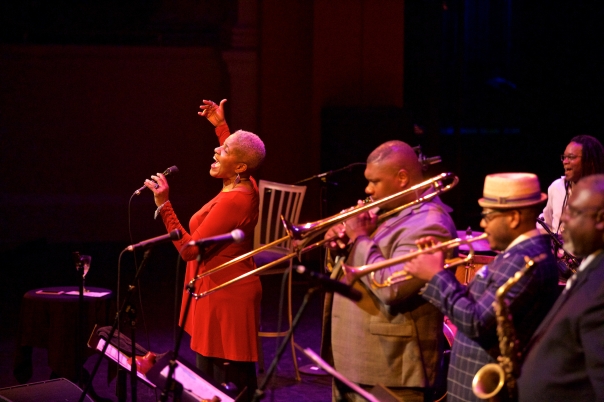
Weather veered to extremes during the first week of Spoleto Festival USA this year. Thunderstorms forced Arturo O’Farrill and the Afro Latin Jazz Orchestra to abandon the great outdoor Cistern Yard concert venue on Saturday night for another College of Charleston facility, the TD Arena. But René Marie, with a sextet that boasted Wycliffe Gordon and Etienne Charles, was untroubled by the elements the following evening as she became the first jazz headliner to perform at the totally rebuilt Gaillard Center.
By the time Randy Weston brought his African Rhythms Sextet to the Gaillard on the following Thursday, heat and humidity had risen to summertime levels, firing a shot of Africa right back at the musicians. Opening night of the 40th annual festival set the tone, as Spoleto celebrated the new Gaillard with a dazzling new production of Porgy and Bess, the Gershwin Brothers’ folk opera that has been a wellspring of inspiration for American jazz.
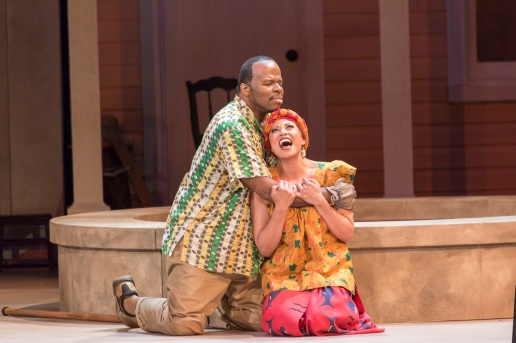
To tell the truth, the grand new hall proved to be better suited to amplified jazz than to grand opera. Alyson Cambridge, as Bess, was often unintelligible to those sitting deep in the house, and at the last two Spoleto performances of the festival, supertitles were added to combat the problem. Loudspeakers didn’t make their way into Gaillard until the second night of the festival at the 40th-Season Celebration Concert. Marie appeared briefly, singing two arias from Heiner Goebbels’ Surrogate Cities (originally presented at the 1999 festival), and it was obvious that the amplified acoustics would be marvelous the following evening.
From the outset, so was Marie, beginning with “Be the Change,” a powerful song that she wrote as a tribute to the victims of last year’s shootings at the Emanuel A.M.E. Church – across the street from the Gaillard. Inspired by her father, Lester, “The South Is Mine” was nearly as apropos for the occasion. While all the songs that followed were from her new The Sound of Red album, when she arrived at “Blessings,” Marie turned her original song into another opportunity to offer her love to Charleston.
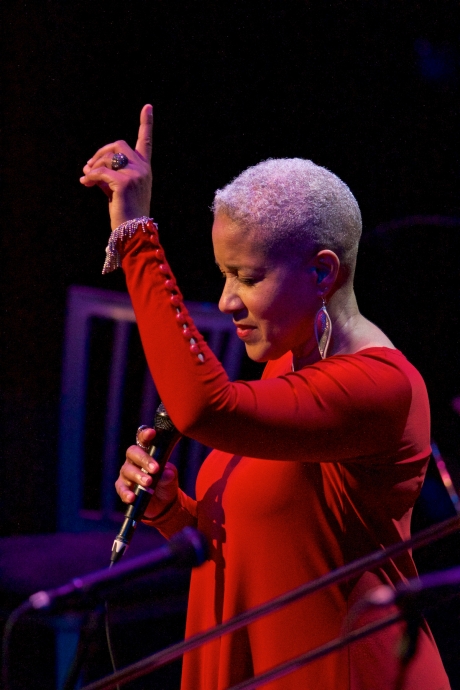
All the songs on the program were, in fact, Marie originals, but the headliner gave her distinguished sidemen and her working trio ample space to shine. Though unacknowledged in the Festival’s prepublicity – or its lavish program book – altoist Sherman Irby was certainly a force to be reckoned with among the soloists, taking two spots in the arresting opener. Focus shifted to Charles and Gordon in “The South,” the trumpeter muted before the trombonist worked his customary magic with his plunger.
“Lost,” a musical portrait of Marie’s sister, and “If You Were Mine” narrowed the focus to Marie and her working trio, particularly pianist John Chin and bassist Elias Bailey, who both soloed admirably. Somewhat abbreviated compared with the album versions, both of Marie’s vocal performances were epic – delivering all of the scat and “Battle Hymn of the Republic” pyrotechnics from “Lost” (minus the drums) and more edge on the conversational parts of “Mine.”
Time borrowed from these arrangements was added onto a far more lavish version of “Colorado River Song” as the concert slipped into a more relaxed groove. Everybody chipped in solo spots, including drummer Quentin Baxter, who traded 4’s with all the horns after their solos. Marie herself replaced the recorded whistling chorus with a healthy helping of scat before the blowing began. “Blessings” sounds like a pop anthem on the new CD and retained its kinship with Dylan’s “Forever Young” in live performance but with a more fervid sanctified flavor as the horns joined in.
Chin, Gordon, Irby, and Charles all took tasty solos in the concluding “Joy of Jazz,” adding new fire to the piece and transforming the celebratory dance of the studio version into an exuberantly dancing celebration. People who are listening to The Sound of Red as it gets increasing airplay are getting the flavor of Marie’s new compositions, but at the Spoleto concert, we heard their power.
Marie was performing for the fourth time at Spoleto in the past 10 seasons, having already achieved Gaillard prestige at the old Auditorium back in 2009, but Weston appeared at the Gaillard for the first time this season, returning to the festival 35 years after his 1981 debut at Cistern Yard, where he and his sextet shared the bill with Taj Mahal. Weston’s return was a doubly auspicious occasion, since no purely instrumental jazz combo had headlined at the Gaillard since 1996-98, when Sonny Rollins, Ahmad Jamal, and George Shearing performed in successive years.
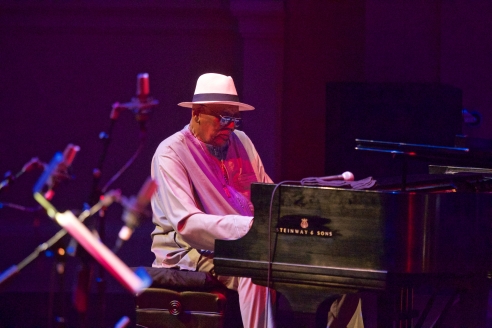
While the name was slightly different from the Randy Weston & African Rhythms with Billy Harper group that I saw at Dizzy’s Club Coca-Cola in 2011, the personnel were nearly the same, omitting only trombonist Robert Trowers. The one common thread running through the two sets was Weston’s “Blue Moses,” aptly referencing the 1972 album with that title, a more exotic release than other CTI recordings of that era. With Neil Clarke on African percussion, Lewis Nash on drums, and T.K. Blue occasionally on flute, the soundscape vividly echoes what Airto, Weston’s son Azzedin, and Hubert Laws etched so memorably into vinyl.
The ensemble seemed grander, more seasoned, and more African at the Gaillard than they had at Columbus Circle. On “Moses,” where Blue had soloed on soprano sax in New York, he now played flute over Harper’s tenor before breaking into his solo, heavily flavored with “Wade in the Water.” After Harper wailed, Clarke went to work slapping his African drums with answering claps from the audience cued by bassist Alex Blake. Then Blake, as he is so prone to do, upstaged everyone with his rich soloing, zestfully plucking and slapping and pouring out vocalese as he had done on two previous tunes. But the delight of it hadn’t worn thin.
As for Weston, he contented himself with long ruminative intro to “Moses” that nearly had me in tears before we finally arrived at the melody. The man has just passed 90, and he still plays marvelously well. He drew a direct connection between his African music and the sounds of nature, so in that respect the opening piece, “The Healer,” was the most successful of the night, culminating in group improv that conjured up a rainforest with Blue’s flute providing a glint of sunlight and birdsong. Weston led it off with a moody intro followed by Blake and his percussive work on bass. Flute and tenor layered on before Harper established his sax as king of this jungle.
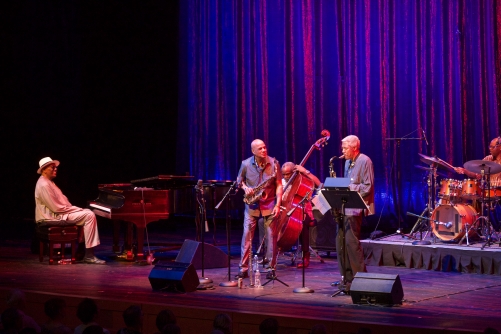
“African Sunrise,” one several African Weston titles that is now 60 years old, still sounds pristine, though Blue’s alto solo hasn’t stopped quoting “Manteca” and other Gillespiana heard on Weston’s live 2010 Storyteller album. Weston’s outro, over Blake’s scatting bass, was a fresh wrinkle. “Little Niles” sounded surprisingly raw, Harper’s tenor and Blue’s alto screaming back and forth at each other, more agonized than waltzing – perhaps because, as Weston mentioned in his preface, he had outlived the son it was written for. The closer, “Niger Mambo,” brought more focus to Weston’s muscular playing but really served as a belated showcase for Nash, equally impressive with sticks and brushes.
While the Gaillard reconstruction was going on through the past three festivals, Marie, Béla Fleck, and Angelique Kidjo were among the performers who proved that TD Arena was a serviceable music venue. But longtime festivalgoers had to wonder whether we would return to the thrilling days of yesteryear when the old Gaillard served as the backup for outdoor concerts at the Cistern when they were forced to seek shelter from springtime storms. Ticketholders for O’Farrill’s concert were informed by email more than eight hours in advance that the concert had been moved to TD. With just one other Spoleto event scheduled at the basketball arena during the entire festival, the concert would not have to be delayed as usually happened at the Gaillard.
Leading from a keyboard or from behind a centerstage mic where he also introduced tunes, O’Farrill brought a brassy 17-piece band with him, including four trombones, four trumpets, and five saxes. Brash music that moved restlessly through Latin and South America, the first two-thirds of the set list came from the three Afro Latin Jazz Orchestra albums released over the past five years, beginning with “Rumba Urbana” from the 40 Acres and a Burro compilation of 2011 and zigzagging afterwards between that album, The Offense of the Drum (2014) and Cuba: The Conversation Continues (2015).
“On the Corner of Malecón and Bourbon” was the most exciting and majestic of the arrangements, shuttling from ragtime to Latin to “St. James Infirmary” on an epic path blazed by multiple piano and baritone sax spots, blaring brass ensembles, a four-trumpet free-for-all, and a bowed bass solo. “Guajira Simple” offered a greater variety of moods as O’Farrill played a dreamy intro as the stage lights were dimmed, with trombone, soprano sax and trumpet layering on as the bandleader quickened the tempo. Then came a quiet interlude as Ivan Renta soloed soulfully on tenor, followed by Bobby Porcelli on flute before O’Farrill triggered a huge orchestral build from the keyboard.
Like Marie and Weston, O’Farrill had a message for Charleston, only it wasn’t consolation for murdered churchgoers or a benison of nature and healing. After he and his band rocked the house with Emilio Solla’s “Llegará, Llegará, Llegará,” O’Farrill strode up to the microphone and declared that he was a proud Mexican American – and not a rapist, a murderer, or a drug dealer. To make sure that the target of his remarks was not misunderstood, O’Farrill apologized in advance for his language in advance and announced that the title of the next piece would be “Trump, Fuck Trump.”
Not surprisingly in South Carolina, one of the states that The Donald won during the Republican primaries, more than a couple of people responded by walking out amid the general approval for what O’Farrill was saying. There were some purposeful anti-musical moments in the composition, to be sure – and a brief, pitch-perfect Trump impersonation by trumpeter Seneca Black, judiciously (and cryptically) limited to a single word: “China!” After this memorable episode, the concert ended with “Obsesion,” with Rafi Malkiel offering the last of his fine trombone solos and tenor saxophonist Chad Lefkowitz-Brown, heretofore anonymous, getting a chance to shine.
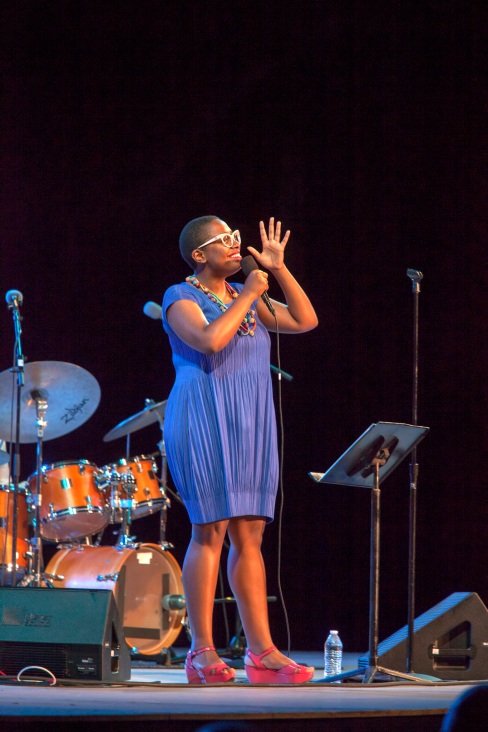
Time seems to stand still when Cécile McLorin Salvant comes to sing with her tight trio. You can listen to Salvant’s lightly dramatized versions of “The Trolley Song” or “Wives and Lovers” and imagine that she is subverting their archaic attitudes with a subtle feminist archness. Or you could just as easily conclude that she’s wholeheartedly immersing herself in Judy Garland’s pop Cinderella or Burt Bacharach’s domesticated Barbi.
Fortunately, there always seems to be a modicum of restlessness in the way Salvant selects her material. While I’ve heard her treatments of Bob Dorough’s “Nothing Like You,” Leonard Bernstein’s “Something’s Coming,” and her own original “Fog” before, it was interesting to see that Salvant’s new excavations include “Somehow I Never Could Believe.” Introduced as an aria from Kurt Weill’s 1947 Street Scene, Salvant transformed the Langston Hughes lyric into an urban odyssey.
“What’s the Matter Now?” swiped from the Bessie Smith songbook had some of the friskiness Salvant fans crave, with a tasty solo from bassist Paul Sikivie that far outshone his work on “So in Love” and a splashy solo from pianist Aaron Diehl that nicely set up Salvant’s honky-tonk reprise and his own outro. “Wild Women Don’t Have the Blues” offered much of the same earlier in the set, but there was never a fully seismic Salvant eruption of “Growlin’ Dan” or “You Bring Out the Savage in Me” proportions, if that was among your expectations.
No, Salvant’s lava flow was relatively under control this time with titles like “I Get a Kick Out of You” and “Wild Is Love” on the set list. Lawrence Leathers never really had the opportunity to stand out on his own on drums, but he mixed it up tellingly on “I Get a Kick” and “Something’s Coming.” What Diehl and Leathers did on “The Trolley Song” was more of a marvel than a mere accompaniment, for their intro and their interjections became part of the storytelling ride.
You probably heard about Jason Moran’s All Rise tribute to Fats Waller a couple of years back, but that CD was actually the studio version of a live event that Moran had conceived for the Harlem Stage Gatehouse in 2011. The event, a Fats Waller Dance Party, features Moran at both acoustic and Fender Rhodes pianos, often wearing a huge papier-mâché mask created by Didier Civil as he plays. Moran has taken the event all over the country, and the amount of dancing and partying that he, his combo, his dancers, and his vocalists have been able to spark has varied from city to city.
High humidity persisted at Spoleto into its second weekend, and the temperature still hovered above 80°F for Moran’s Cistern Yard concert. So I was not at all eager to rise from my seat and dance, no matter how heartily vocalist Lisa E. Harris or trumpeter Donvonte McCoy urged us on. Most of the audience shared my disinclination, Moran himself frequently couldn’t take the heat under his mask, and even the ebullient Harris removed her chapeau for a spell of relief.
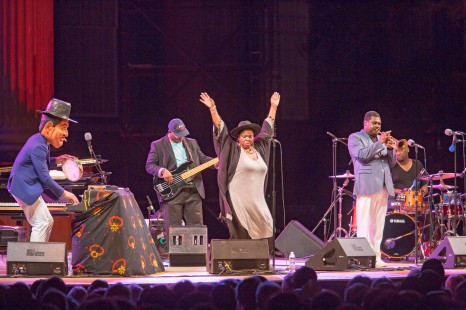
How much you might have liked this Waller Party – and how much I tended to dislike it – can be sampled by streaming the “Honeysuckle Rose” and “Ain’t Misbehavin’” tracks from All Rise. I’m not on board with thinking these are inspired re-imaginings of Waller’s music befitting a MacArthur genius. They strike me as listless, simplified, bridge-averse descents into stultifying Motown doo-wop. Above this norm, “Yacht Club Swing” and “I Found a New Baby” had genuine spark; and Moran’s newer additions, his original “Fat Lick” and a Wallerized version of Ornette Coleman’s “Lonely Woman,” won me over.
But while “Honeysuckle” and “Misbehavin’” may indeed fulfill Moran’s “joyful elegy” concept for some, I couldn’t find a flicker of mirth in the lugubrious dirge that Harris made out of “Ain’t Nobody’s Business.” Compounding my frustrations with Harris, trumpeter McCoy not only looked a lot like Waller, he sounded like him as well in his only vocal on “Two Sleepy People.” More McCoy would have meant more Waller at the party.
The pluses didn’t end there for those of us susceptible to the precocity of 12-year-olds. Right before “Yacht Club Swing,” Moran introduced his twin sons, Malcolm and Jonas, saying he had only recently witnessed the results of their tutelage at the Alvin Ailey School. Whether or not the lithe moves they proceeded to cut were part of the Ailey curriculum, they certainly added youthful energy to Moran’s fitfully eventful vamp. But party lift-off didn’t occur until the unexpected invasion of cast members from Grace Notes, a curious blend of music, poetry, and dance that had premiered earlier in the evening a block away.
Dancers from that production streamed onto the stage during “The Joint Is Jumpin’,” not only dancing with Harris and the Moran twins but also forming a whirling dance circle around the musicians. Topping off the invasion, trombonist Craig Harris, part of the Grace Notes jazz band, came up onstage and soloed with righteous conviction. While this explosion didn’t turn the tide out in the audience, a substantial number of people migrated off to the side of the stage and turned it into a dance floor – once the funereal “Ain’t Nobody’s Business” was done – proof that Moran’s brand of Waller was connecting with younger listeners.
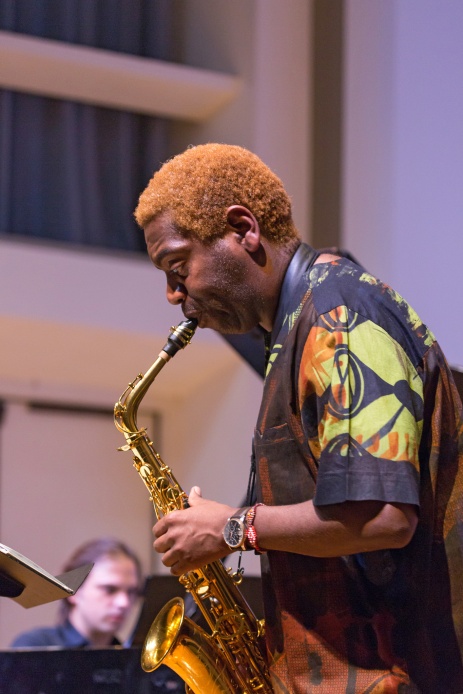
While shuttling back and forth between Africa and Latin America for his wondrous Grammy-nominated New Throned King music, saxophonist-composer Yosvany Terry was also on an alternate path. His Bohemian Trio was formed at about the same time that the Afro-Latin album was in production, with Cuban-born pianist Orlando Alonso and Franco-American cellist Yves Dharamraj. The music they play isn’t as exuberant or raucous as the tracks on New Throned King, calmer for its classical and European elements, so the intimate Simons Center Recital Hall was a more fitting place for them to perform than the Cistern or the Gaillard.
The eclecticism of the trio’s approach was evident from the outset as Terry on alto sax, Dharamraj, and Alonso brought out the classical flavor in the fugue-like opening of Pedro Giraudo’s “Push Gift.” Past the midpoint of this arrangement, Terry broke through its formality with an extended solo. Giraudo was a composer who might naturally be expected to be represented in a Terry concert, but the next two offerings took us to works by André Previn and Sonia Jacobsen.
The Trio’s performance of “White Raven” from Jacobsen’s Fables Macabres was a radical transformation, turning an orchestral piece with strings into chamber music, with Terry once again taking charge in the middle. Playing the fifth prelude from Previn’s “The Invisible Drummer,” Alonso may not have played on the piece but he surely played with it, making the “invisible” drumming quite audible with his insistent pounding. That repurposed prelude became an introduction for Terry’s original, “Punto Cubano de Domingo,” where cello and soprano sax launched the piece in canonical fashion and both Terry and Dharamraj took solos.
Compositions in the latter part of the program didn’t drift away from the Western Hemisphere, with second helpings of works by Terry and Argentinian bandleader Giraudo, plus an additional dose of Argentina from Emilio Solla. The Bohemian version of Solla’s “Llegará, Llegará, Llegará” didn’t have the epic build of the composer’s recent Second Half album (or the firepower of O’Farrill’s cover at the Cistern), but it was a fine showcase for Alonso, whose piano solo revealed definite Chick Corea inclinations with Terry backing up on chékere.
Terry’s sound is most distinctive on soprano, and “Tarde en La Lisa” was the best example of the exuberance and plenitude of his ideas. Alonso’s backing had steely force as the composer played the line, a perfect launch pad for the soprano rant that followed. Then the piano was an island of calm, setting us up for a full round of vigorous Bohemian solos before Terry circled back to the melody. “Hiroshima,” the placid finale on the Giraudo Jazz Orchestra’s 2009 El Viaje release, was not radically altered at all as the Bohemians’ valedictory. Dharamraj eloquently played the line before Alonso and Terry, still on soprano, paid their soulful, subdued respects.
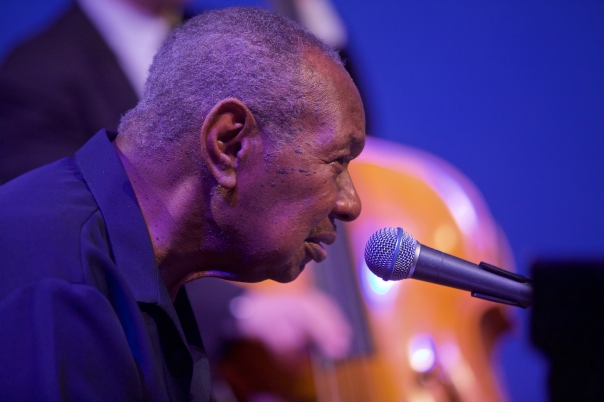
Yielding in seniority at this Spoleto only to Weston, Freddy Cole and his quartet still sounded fresh although the leader is nearing 85. Cole’s voice isn’t as rich and rounded as it was when he cut his first album in 1964, but there are still moments when he sounds like his elder brother Nat in his prime. Thanks to the exploits of guitarist Randy Napoleon, there are also moments when the new quartet sounds instrumentally like the vintage King Cole Trio of the 1940’s, for little brother can still solo deliciously at the keyboard.
Although Cole’s set list included a healthy number of familiar titles, they weren’t necessarily those you’d expect: “Cottage for Sale,” “Love Walked In,” and “Easy to Remember” slipped in with the more predictable “Pretend,” “Route 66,” and “L-O-V-E.” Before we reconnected with these songs, Cole walked us down less-trodden paths, beginning with “Wonder Why” and continuing with “Where Can I Go Without You?” “A Lovely Way to Spend an Evening,” and “How Little We Know.”
Even when Cole began stirring up old memories, there were rarer gems mixed in, “I Just Found Out About Love” after “Pretend,” then “Maybe It’s Because” and “To the Ends of the Earth” after “Route 66.” Cole sings with such simplicity and assurance that the rather bland Simons space was transformed into a moody nightclub as he performed. With solos by Napoleon on 11 of the 13 tunes – and occasionally two on a single arrangement – to go along with six piano solos from the leader, it seemed like there was all the time in the world for each song, old or new, to etch its way into memory.
There seemed to be no end to the number of familiar and unfamiliar songs Cole knew and could effortlessly sing – with a familiarity that reached their depths, along with a hip swing that must be a family heirloom. Under Cole’s spell, the old songs seemed as new as the ones I’d never heard. Getting acquainted with the Jimmy Van Heusen lyrics for “How Little We Know,” where “two tingles intermingle” and we find “how ignorant bliss is,” was like a first visit to a garden of delight.

![CENTRAL_THEA_Chicago_02[11]](https://artonmysleeve.net/wp-content/uploads/2016/06/central_thea_chicago_0211.jpg?w=665&h=444)



 Art on My Sleeve