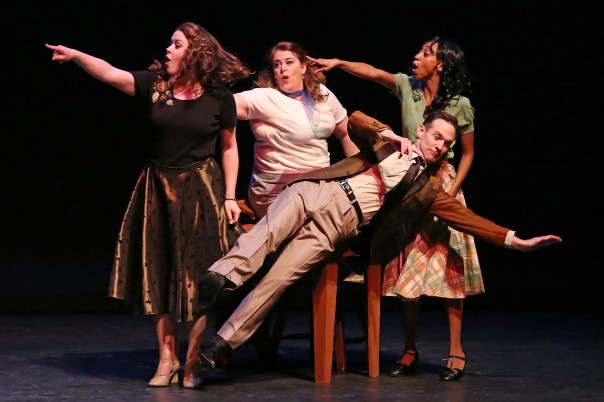
![CENTRAL_THEA_Chicago_02[11]](https://artonmysleeve.net/wp-content/uploads/2016/06/central_thea_chicago_0211.jpg?w=665&h=444)
Theater reviews: Chicago and Manifest Pussy
By Perry Tannenbaum
When I saw Annie at Halton Theater earlier this month, I had a theory about why the first show in CPCC Summer’s 43rd season boasted such opulent production values. Surely they had chosen to follow up with Kander and Ebb’s Chicago because this decadent vaudeville could be produced so cheaply, freeing funds for the other musicals on CP’s summer slate.
Thanks to the set and costume designs by Robert Croghan, I could discard that theory almost as soon as I settled into my seat. The onstage band, led by musical director Drina Keen, is mostly concealed by an art deco façade with wooden frames and chrome bars. An overarching bridge that crests in the middle covers the band, with a backlit outline of Chicago’s skyline stretching up into the fly loft.
When Roxie Hart dreams of the vaudeville stardom that will come with her killer celebrity, a huge luridly lit marquee drops down from the fly loft, and when Roxie and fellow murderess Velma Kelly achieve that dream together, another fresh marquee drops down. The entire proscenium has been redone to chime in with the art deco style. Its stripes don’t seem to be electrified, but at the denouement, reflections from a row of red footlights set them aglow. The lurid footlights are the cherry on the bottom of Gary Sivak’s outstanding lighting design.
Croghan’s costumes are even bolder. Prison bars descend from the flies when we arrive at the Chicago jail, and Croghan doesn’t let us forget that the women inmates are celebs. The black stripes on their prison uniforms are far wider than normal, twinkling with glitter. I can’t remember any version of “Cell Block Tango,” either locally produced or in a national tour, that oozed so much sinful glamor.
The wildest wrinkle comes later when we reach Billy Flynn’s incomparably corrupt pretrial “Razzle Dazzle” peptalk. Very much like the recent Broadway revival of Pippin, the stage is transformed into a circus with colorful costumes, a flashier onset of glitter and an outbreak of acrobatics. Much of this Pippin-effect lingers through Roxie’s travesty of a trial.
Of course, choreographer Tod Kubo and stage director Ron Chisholm are involved in this circus conspiracy, for every woman in the cellblock seems able to do a split. Both Roxie and Velma can also turn cartwheels. Chisholm is also a splendid choreographer, so casting demands must have been precise and rigorous with Kubo’s work very much on his mind.
Aside from the inevitable orphans, the excellence of Annie under Tom Hollis’s direction mostly emanated from seasoned performers, Beau Stroupe as Daddy Warbucks, Susan Gundersheim as Grace Farrell, and Allison Rhinehart as Miss Hannigan. Even where Chisholm might have looked for more fully aged talents; in less athletic roles such as Amos Hart, lawyer Flynn, and corrupt prison matron Mama Morton; he opts for youth.
For the most part, we can overlook the profusion of college students and recent grads onstage at the Halton, but overall, Chicago needs a bit more swagger and arrogance than I was seeing, and the superabundance of youth is to blame. Justin Miller doesn’t always seem to grasp the full magnitude of Flynn’s slickness and hypocrisy, and as Velma, Caroline Chisholm occasionally loses the edge of the baddest broad in the cellblock and starts worrying whether she’s executing her dance routines correctly.
Both Miller and Chisholm often bring fresh juice to Billy and Velma, but it’s Meredith Zahn as Roxie who demonstrates what happens when you add swagger and arrogance to the package — or you simply inhabit Roxie’s clever wickedness every moment. Zahn isn’t the best singer or dancer on the stage, but her “Funny Honey” solo elevates the show before “Cell Block Tango” sustains that plateau. Most importantly, in the climactic courtroom scene, when Flynn becomes the ventriloquist behind Roxie’s every word on the witness stand, Zahn’s floppy antics as the lip-syncing ragdoll sitting on Billy’s lap are by far the best I’ve seen.
Stephen Stamps isn’t quite as innocuous as a true “Mister Cellophane” should be, but that number remained a uniquely quiet showstopper — and the scenes with Roxie had the right combination of intensity and cluelessness as Amos processed the fact that his wife had been screwing around with the furniture guy and expected him to take the blame for killing him. Alex Aguilar doesn’t quite have the high notes for Mary Sunshine’s bleeding heart vocal, but her unmasking is a hoot.
A little bit more nastiness and downright vulgarity wouldn’t have hurt Jessica Rebecca as Mama Morton, but she’s a very formidable stage presence. What was so jaw-droppingly good about the “Class” duet with Chisholm wasn’t how crass it was on the eighth time I’d seen it but how beautifully harmonized it is when the two sing together.
So I’ve revised my theory. The significant anniversary that has happened on Elizabeth Avenue isn’t CPCC Summer’s 43rd. No, it’s the Halton’s tenth anniversary that has sparked the continuing turnaround, which began with the landmark production of The Phantom of the Opera last fall. Now if I had presented that show, I might have resolved, “Enough of these ‘Nice try, kid’ productions!” and maybe that’s how Hollis, CPCC’s Theatre Department chair, looked at it.
Or maybe Hollis and CPCC’s administration got on board with the idea that theatre at the Halton should always strive for the same level of excellence. Whatever is going on behind the scenes, the CPCC Summer product is more polished at the Halton than ever before, not only because the sound system problems have been exorcised but because they’re beginning to utilize the full capabilities of the stage.
If that’s the new reality, the Halton may now be the best place in Charlotte to see a live musical. Maybe CPCC will need to start selling their balcony seats again once the word gets around.
As I climbed the stairs to UpStage last Wednesday to see the Charlotte stop on Shakina Nayfack’s Manifest Pussy tour, three worries concerned me: that it would be too preachy, too raunchy and too loud. Nayfack was bringing her one-woman show to North Carolina in response to HB2, and she’d been photographed with panties down, sitting on a urinal (see cover of our June 9 issue).
The bandstand set-up for four pieces, including a guitar, a keyboard, a drum set and an electric bass, seemed to confirm my fear that I’d be rocked to uncomfortable decibel levels.
What I witnessed turned out to be two autobiographical rock musicals artfully woven together to form a narrative that reminded me a lot of Hedwig and the Angry Inch and a little of The Vagina Monologues. Instead of cooing over and affirming the glory of having a vagina as Monologues does, Pussy dwelt on worries, misgivings and anxieties Nayfack went through in getting her vagina via a complex surgery in Thailand. And unlike Hedwig, which tells about the heartaches experienced by a rock singer after a botched sex-change operation, Pussy stays focused on what it feels like to go through the procedure — also partially botched — and waking up to find a railroad of 640 stitches framing a fragile canal where your penis once was.
Bottomline, I liked Pussy better than either Vagina or Hedwig. Nayfack isn’t as cute or coy as the Vagina monologists nor as offputting as Hedwig. Some of Nayfack’s songs are jangly and metallic, but others are quite beautiful. Above all, I learned more about the inner trials that transgender people go through — physically and mentally — than I ever thought I could know.

![CPCCILoveAPiano6[7]](https://artonmysleeve.net/wp-content/uploads/2016/02/cpcciloveapiano67.jpg?w=604)


 Art on My Sleeve