Tag Archives: Rachel Engstrom

Vox Populi Deafeningly Lauds “Little Shop” at The Barn

Review: Little Shop of Horrors at Theatre Charlotte

By Perry Tannenbaum

Sunny, frolicsome, dark, and bizarre: it’s tough to say whether the best landing spot for Little Shop of Horrors is during the spring, that fragrant time of flowering hope and romance, or the fall, that decaying season of colorful rot and the macabre. All of the Metrolina theatre companies and colleges that have taken us back to Skid Row this century have chosen one of those two seasons for reprising Howard Ashman’s 1982 adaptation of Roger Corman’s cult comedy flick.

The tally among executive directors, department heads, and boards has been decisively autumnal. Judging by the full house on opening night last week at Theatre Charlotte, which previously staged Little Shop in the spring of 2008, I’d say that the movers and shakers at the Queens Road Barn have seen the light and aligned with the popular vote.

No other explanation for the robust turnout – or the rabid response – springs to mind. There was nothing novel or pricey about TC’s prepublicity, unless Facebook and Instagram are suddenly breakthroughs. Nor is name recognition a factor when you consider the director, the lead couple, or the choreographer.

Only if they knew that Kevin Roberge would be can’t-miss as Mr. Mushnik, owner of a perishing Skid Row flower shop – or that real-life dentist Nehemiah Lawson would be don’t-miss as sadistic dentist Orin – would people be flocking to Queens Road with raised expectations. And if you hadn’t seen their award-winning collaboration in Next to Normal down at Fort Mill Community Playhouse two years ago, you wouldn’t know if it was director Scott Albert who chose Peter Liuzzo as his preternaturally nebishy Seymour or the other way around.

Sometimes you need to listen to the vox populi, and sometimes you must try to blot it out. For me on opening night of Little Shop, it was both. My Apple Watch faithfully notifies me the next morning when sound pressure levels reach or exceed 95dB at concerts, musicals, or plays attended the night before. If the noise tops 100dB, the usual number of notices is one to three.

Little Shop smashed that norm, hitting or exceeding the 100dB bar 14 times, and topping out at an astonishing 115dB. I could see it coming when Liuzzo and Gabriella Gonzalez as Audrey, his newly-won sweetheart, merged their voices in the climactic “Suddenly Seymour.” Three doo-wop vocalists emerged from a tenement apartment door, adding glitz, glamour, and sensuality to the spectacle: Olivia Greene as Ronnette, Tia Robbins as Crystal, and Jessica Milner, a trio of rookies.

Then as Seymour and Audrey responded to each other, Liuzzo dug out his coming-into-manhood voice and began belting wildly. Not to be upstaged, Gonzalez, previously confined to the sugary “Somewhere That’s Green,” let loose with her piercing pipes.

When something is this sensational in a community theatre production, I often find myself weeping or sobbing. This time, my instincts had me clamping my hands over my ears in self-defense. Didn’t do much good.
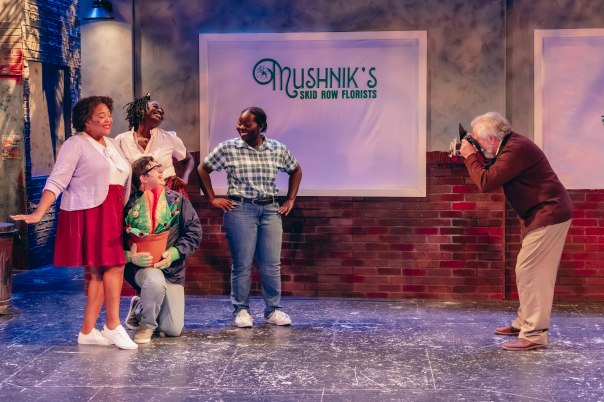
Tinted by J.P. Woody’s groovy lighting, scenic design by Gordon Olson revels in the squalor of the skids with a doo-wop funk and loving detail that reminded me of Mad Magazine comic strips devoured in my youth. The era is the prehistoric ‘50s, when teens toted transistor radios to stay in touch with the Top 40, and Alan Menken’s musical score reveres those vibes as if they are gospel.

From Seymour’s nerdy sweater vest to Orin’s biker black jacket, Rachel Engstrom’s costume designs are also onboard with the ‘50s beat, with such an outrageous variety of looks for the vocal trio that you can look at them as district goddesses. Props, including a mini press camera and various-sized potted Audrey 2’s that double as puppets, are also a treat from Lea Harkins – plus Orin’s diabolical dentist’s drill.

Besides getting the right moves from his talented cast alongside choreographer Georgie DeCosmo, Albert’s stage direction fosters all kinds of synergies that pave the way for Audrey 2 to have the sleek looks of a garish concept sports car and the voice of a rabid boar. Named after his idolized co-worker, Audrey 2, the carnivorous plant that Seymour suddenly discovers during a total eclipse of the sun, has a special cunning, speaking only to Seymour to get his way.

The voice comes lustily from Toni “Aideem” Morrison, and the movements of her leaves and tendrils come mostly from a team of three unseen puppeteers. When the side wall of Mushnik’s Skid Row Florists slides shut to hide the store, a beehive of activity with puppeteers and stagehands is dressing the interior more and more lushly with Audrey 2’s foliage as the bloodthirsty monster grows.

By the end of opening night, that side wall had been dinged with cracks and bruises, and one stagehand, in damage-control mode, was seen frantically exiting at the end of a scene change. The tech perfection extended similarly to the sound: just one brief dropout assailed Gonzalez, and that’s all. Every note from the four-piece band led by Ellen Robison from the keyboard came through undimmed.

Except when the audience broke loose.

Aside from the original Audrey, none of the main characters is burnished with virtue. Seymour’s origins, though not otherworldly, are no less mysterious than Audrey 2’s, orphaned at the flower shop’s doorstep as a babe and living there ever since. His homicidal tendencies, awakened by the arrival of Audrey 2, prove to be benign when he has to pull the trigger.

Munchnik is no less compromised. Although he has opened his door to Seymour, the lad has always slept out front under the cash register. Until he overhears Orin advising Seymour to leave Skid Row with his newfound cash cow, Mushnik never considers adopting the waif or making him his heir. In the hard times, when Mushnik is on the verge of permanently shutting down his shop, there’s not a peep from him that indicates he has given Seymour’s future so much as a thought.

Liuzzo plays his side of this relationship with gratitude, servility, and fear, while Roberge as Mushnik can load up on scorn, exploitation, and intimidation. Nebishy meets nasty. With those considerable hits to Seymour’s self-esteem, Liuzzo’s timidity can extend toward keeping his feelings for Audrey hidden, especially since she is already in Orin’s firm and abusive grasp.

Framed by the threats of an insanely sadistic dentist and a man-eating alien plant with dreams of global domination, the mundane frictions between Seymour and Mushnik can seem comical. But the best comedy contrivance, preserved by Ashman from the Charles Griffith screenplay, is the mutual non-relationship between Seymour and Audrey: both of these sweethearts have good reason to feel unworthy of the other.

It’s pretty classic how clearly Liuzzo and Gonzalez venerate one another before they connect – adding fuel to the explosive audience reaction in Act 2 when they have their “Suddenly Seymour” moment. Roberge coming up on them and taking it all in during an extended smooch is a cherry on top.

Contrasting with all this bliss and twisted domesticity are the crazed, barbecued voices of Lawson and Aideem. Since the days of silent film, dentistry has proudly perched on the knife’s edge between comedy and horror. Thanks to this delicious script, Lawson gets to sharpen that blade more keenly by adding masochism. Not to worry, after Orin nourishes Audrey 2 piecemeal, Lawson returns after intermission in a series of cameos to entice Seymour with additional money-making opportunities.

Yet it’s Aideem who endures forever as Audrey 2, aided by a wonderful tech flourish in the epilogue. His bubbly vibrato is not the deepest I’ve heard out of Audrey 2’s maw, but it’s more than sufficiently low, spirited, and spicy. Aideem’s performance will likely draw another noise notification if you’re wearing an Apple Watch. The final bows certainly will.

Follow the Yellow Brick Road to the Queens Road Barn

Review: The Wizard of Oz at Theatre Charlotte

By Perry Tannenbaum

With her rustic picnic basket, her toy dog Toto, her beribboned pigtails, and her iconic gingham dress, the 1939 movie version of L. Frank Baum’s imperishable heroine, Kansas-born Dorothy Gale, was designed to closely echo the Dorothy found on the pages of Baum’s 1900 novel. She was conceived in the lineage of Little Red Riding Hood and Lewis Carroll’s Alice as a little girl – credulous, easily surprised or disappointed.

Judy Garland was 16 years old when she began shooting The Wizard of Oz at MGM Studios. Her sub-5-foot stature bridged some of the age gap, but director Victor Fleming and the MGM braintrust didn’t stop there, trussing Garland up to hide her curves. All of this subterfuge (some would call it barbarity) was logical only because Hollywood, suspicious of fantasy and children’s fiction, wanted to reassure us that Oz, The Wizard, the Witches, the Winkies, and the ruby slippers were all nothing more than a little girl’s dream.

Noel Langley’s screenplay, revised chiefly by Florence Ryerson and Edgar Allan Woolf, went to extraordinary lengths to frame Dorothy’s adventures as a dream. The celluloid version supplied the Scarecrow, the Tin Man, the Cowardly Lion, Glinda, the Wicked Witch, and The Wizard with Kansas counterparts she will transform into Ozians. Baum never created a Miss Gulch or a Professor Marvel. In fact, when he adapted The Wonderful Wizard of Oz for the stage in 1902, Baum actually expelled Toto and the Wicked Witch from his cast – and did not permit the Lion to speak.

Langley obviously hasn’t gotten enough credit for his contributions to Oz mythology. The whole preamble to the cyclone and Oz is his, along with the wholesome welcome home to Kansas that crowds the screen with patronizing adults. Aunt Em is the only person who greets Dorothy in the book, where the ending is dispatched in less than 75 words. Dorothy finds a new farmhouse that Uncle Henry has built to replace the old one that killed the Wicked Witch of the East. No question in Baum’s mind: Dorothy has been away to a real place in real time.

When John Kane adapted The Wizard of Oz for the Royal Shakespeare Company in 1987, he went with Langley’s version of the story. Not only were the songs by Harold Arlen and the lyrics by Edgar “Yip” Harburg brought along for the ride, so was “The Jitterbug,” an Arlen-Harburg song that didn’t make the film’s final cut. If anything, Kane’s additions to the screenplay served to underscore the idea that Oz was a dream, dropping more key words and phrases that linked the magical land to Kansas. Auntie Em and Uncle Henry were added to the roster of Kansans who change costumes and join Dorothy in Oz.

That’s the version we have now as Theatre Charlotte kicks off its 96th season with a rousing trek down the familiar Yellow Brick Road. After her TC debut in 2022 at Camp North End during the company’s vagabond season, Allison Modafferi Brewster directs for the first time at the Queens Road barn. Leaning heavily on projection designs by Alison Nicole Fuehrer to navigate the geographies of Kansas and Oz, Modafferi and her cast of 40 (plus nine “Ruby” Munchkins who timeshare with the “Emerald Cast” that performed on opening night) heartily buy into the notion that Oz is a dreamland.

But in choosing Winthrop University senior Cameron Vipperman as the lead, Modafferri and costume designer Rachel Engstrom are pushing back against the idea that Dorothy must be a child. Or, to cite the range prescribed for auditions in 2006, when Central Piedmont presented this Wizard as their first summer extravaganza at the newly-built Halton Theater, between the ages of 14 and 17.

Gone are the ribbons, the pigtails, and the gingham dress, though Vipperman’s do does sport a couple of fairly subtle weaves. Nor does this energetic production go along with the notion that Miss Gulch and the Wicked Witch of the West must be gnarly old crones. Wielding her broomstick in a rather gladiatorial black outfit, Mary Lynn Bain was quite the action figure as the Wicked One. No corny cone hat for her!

Unless you’ve scouted productions down at Winthrop and Matthews Playhouse, neither of these antagonists will be a familiar name. Casting is no less adventurous for Dorothy’s Yellow Brick pickups. As the Scarecrow, Devon Ovall comes to the Queens Road barn by way of Northwest School of the Arts. Ashley Benjamin, the first female Tin Man we’ve ever seen in Charlotte, seems to be freshly arrived from Georgia in her digital bio. Only Kyle J. Britt can boast previous Queen City exploits prior to his present turn as the Cowardly Lion, having appeared at the barn in last year’s Christmas Carol as the Ghost of Christmas Present.

Noticeably younger than any Oz supplicants you’ll ever see again in an adult production – so close to Dorothy’s age that they seem to be her pals and never her protectors – this youthful trio is remarkably appealing. Ovall flops around and collapses with infectious glee as Scarecrow. Aided by strategic sound effects, Benjamin brought plenty of creaky stiffness to the Tin Man, but she often needed stronger miking.

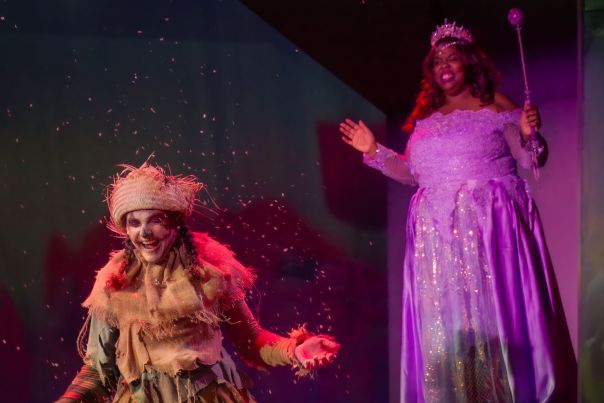
Rachel Engstrom’s costume designs for these two weirdos are masterworks of simplicity, but her greatest triumph may be her Lion, little more than a wig gone wild and a couple of fringed sleeves. This is sufficient armament for Britt to make delicious meals of both his Cowardly highlights, blustering his “top-to-bottomous” bravado with gusto and regally rolling his r’s on “King of the Forest” – with an extra-chesty baritone.

Modafferri’s infusions of diversity and gender switching don’t stop with Benjamin. Brandie Hill brings a righteous gospel flavor to Aunt Em and especially to Glinda the Good, while D. Laverne Woods brings out the gypsy in Professor Marvel and the sass in the Wizard. Darren Spencer as Uncle Henry is a softer, more indulgent contrast to Aunt Em’s law-abiding rigor, making him the obvious choice to play the softy old Guard at Oz’s palace.

Mostly at the service of Fuehrer’s projection designs, set designer Chris Timmons’ neutral-toned slabs don’t quite allow the colors to pop until we first espy the poppy field and Emerald City beyond. The cityscape lingered a few seconds too long as we transitioned from Oz to the wicked West, my first inkling that there was more than one projector in play. The more concerning miscue on opening night was the stage crew’s failure to secure the flight of stairs leading up to the platform where the Wicked Witch makes her immortal “What a world!” exit.

Poor Bain took a nasty little tumble trying to get up there, nearly breaking her neck before she had a chance to melt, prompting Vipperman to be very careful when she climbed up after her. The wonderful reversal was still effective.

That climactic scene cannot be withheld from an adoring public, so Timmons had to choose between the complexities of using a trapdoor in the middle of his stage or building a platform. The latter solution is likely simpler, but its hazards were frightfully exposed last Friday. No doubt all the furniture moving and fastening will go better this week as the run resumes.

Technically, the Theatre Charlotte version of The Wizard is nowhere near as dazzling as the CP version of 2006, when the Witches, the Wizard, Dorothy, the Scarecrow, Miss Gulch, and a cow all flew, and Glinda floated gloriously in a bubble. Such lavishness is probably the main reason why CP shitcanned its Summer Theater programming this season – after four decades of serving as the best launching pad for emerging professional talent that Charlotte has ever seen.

Musically, the lack of a live orchestra dulls the brilliance of Herbert Stothart’s scoring, but music director Matt Primm and his talented cast rescue things nicely. After a shaky start, when Vipperman was too studiously on the beat, “Over the Rainbow” came to full bloom. Surrounded by the loosey-goosey shenanigans of Ovall and Britt, she blossomed even more in Oz. Pepper Alpern as Toto remained a wild card. Nobody knew what the mutt would do next, behaving, barking, or otherwise stealing focus.

Engstrom and choreographer Vanessa Zabari held a deck full of winning cards to counteract this earthbound production’s lack of aerial aces. Dance numbers greatly enlivened the arrivals in Oz and the Emerald City when a bevy of Munchkins, a Youth Ensemble, and an Adult Ensemble strutted their stuff, captained by Aidan Conway. Punctuating the action at key moments with assorted tumbles, somersaults, and splits, Conway was also a pro-grade soloist when he wasn’t fronting the ensembles.

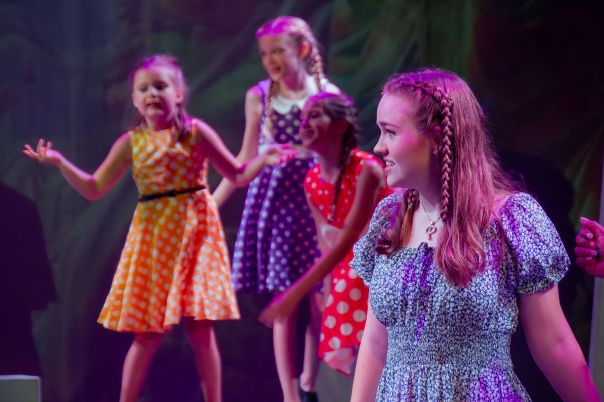
Thanks to Engstrom, Emerald City was a sea of multitudinous greens, and the changes of dresses for the adorable Munchkins were more than enough to convince me anew that Oz truly is a merry old land. But for the next two months, I’d be quite content if I didn’t see another damn polka dot.

Theatre Charlotte’s “The Producers” Is More Politically Incorrect Than Ever

Review:  The Producers

By Perry Tannenbaum

IMG_0681

When I first saw Mel Brooks’ The Producers on Broadway in 2001, my disappointment in not seeing Nathan Lane in the role of Max Bialystock was assuaged by the realization that the show was still so damn good with last-minute replacement Brad Oscar filling the megastar’s shoes. Each of the successive versions I’ve seen in Charlotte – the national tour at Ovens Auditorium in 2004 and the CPCC Summer Theatre production at Halton Theater in 2009 – has only strengthened my conviction that Lane was not an essential ingredient in the show’s success.

But isn’t it too much to expect a smashing Producers at Theatre Charlotte, where they don’t have a Broadway-sized budget – or even a spacious orchestra pit like the Halton’s? Make a couple of allowances and then prepare to be astonished.

Scenic design by Chris Timmons is cheesy, even by community theatre standards, and there are no live musicians in sight – or out of sight – at the Queens Road barn. Once you get past those visible and audible austerities, you can revel in the costume designs by Rachel Engstrom, so crucial to the big “Springtime for Hitler” climax, and in the deep cast, so necessary in putting over Brooks’ comedy and his schlocky score.

Benefitting from the embarrassment of riches that showed up at auditions, director Caroline Bower hasn’t squandered her good fortune. In David Catenazzo as Max, she has found a leading man who is as seedy as Timmons’ scenery. Mostly a secret kept in recent years by JStage at the Levine Jewish Community Center, where he has starred in A Year With Frog and Toad and Fiddler on the Roof, Catenazzo proves to have a strong singing voice to go along with his comedic gifts. He absolutely oozes corruption, eager to enlist humdrum accountant Leo Bloom to cook his books, eager to bilk show investors in a surefire flop, and rabid to shtup Ulla, the voluptuous Swedish actress who turns up early for auditions.

A second solid gold debut comes from Landon Sutton as the diffident Leo, more than nerdy enough for a numbers crusher who discovers how to pocket a shady profit from a Broadway flop. There’s pallid innocence to Sutton’s manner as Leo, plus a little endearing pudginess, that works well when he’s too timid to plunge into the crooked scheme he has inspired. But there’s a surprisingly strong and smooth singing voice when Leo jumps aboard on the reprise of “We Can Do It,” and hormonal heat in “That Face,” his serenade to Ulla.

Brooks’ book and lyrics are so politically incorrect that they still seem to draw a pass from the audience – apparently willing to overlook the sexist attitude toward Ulla and the mockery directed at Franz Liebkind, the pigeon-keeping diehard Nazi who has penned the worst musical script that Max has ever read, Springtime for Hitler. Bower makes the right choices in casting the very un-Swedish Hailey Thomas as Ulla, draping her curves with a modicum of modesty, and limiting her flirtatiousness in comparison with Max’s leering. The Sveedish accent is ba-a-a-d, which is paradoxically good, and she’s positively smashing in her Nazi eagle outfit.

Neo-Nazis are less of a laughing matter than they were 18 years ago, so it’s also wise to have Chip Bradley tone down Franz’s achtung authoritarian qualities and pile on some extra daffiness. The result is the best performance I’ve seen from Bradley, particularly when he shows us all how Hitler should be sung at Springtime auditions. Bradley’s eccentric excellence is sustained when we encounter the Greenwich Village artistes who will direct Franz’s stinker, Roger De Bris and his loyal assistant Carmen Ghia, handpicked for their inabilities.

Here we are blessed with the gay flamboyance of Matt Kenyon as Carmen and the Ethel Merman regality of Paul Reeves Leopard as Roger. It takes a professional-grade queen to pull off Carmen’s arrogant servility and Roger’s ornate Chrysler Building party dress. Kenyon and Leopard have the goods. Leopard is certainly a different kind of Hitler than Bradley when Roger must sub for Franz on opening night.

On my fourth go-round with The Producers, I wasn’t laughing out loud until the Springtime for Hitler auditions, where I found myself enjoying the outrageousness as much as the newbies in the audience. I suspect their expectations were surpassed as much as mine were 18 years ago when Lane’s absence was announced as I stood in line outside the St. James Theatre. Enthusiasm for the Little Old Ladies and their tap-dancing walkers crackled like I remembered it even if the shtick has gone a little stale for me.

Iesha Nyree as Lick-me Bite-me and Layla Sutton as Hold-me Touch-me rounded out the named characters in the cast, which lists another 14 ensemble members who make choreographer Lauren “Loz” Gibbs look good. So what ever happened to the biddie named Kiss-me Feel-me? A victim of downsizing, we must presume.

Family and Romance Tug at an Iowa Housewife in “Madison County”

Review:  The Bridges of Madison County

By Perry Tannenbaum

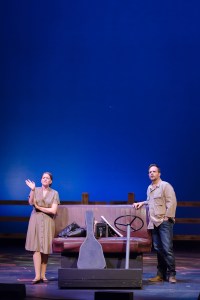
When the touring production of The Bridges of Madison County came to Knight Theater in the spring of 2016, I can easily imagine CPCC Theatre set designer James Duke watching the rusticated wooden bridge as it descended from the fly loft. “We can do that!” he would be thinking to himself. And nearly 17 months later at Halton Theater, he has done it, in a spare, taciturn design style that works well with the Midwest – in this case, Iowa – ably complemented by Jeff Childs’ lighting design.

One additional inverted V goes a long way to simulating the lonely Johnson homestead where roaming National Geographic photographer Robert Kincaid falls in love with Francesca, a stoically transplanted Italian housewife marooned on the prairie after raising a wholesome 4H family. Scenery pieces at ground level aren’t quite as mistakable for the touring version, largely because crew and cast shuffle them in and out of the wings with conspicuously less professional polish.

Once everything is set in place, the sound of the current CPCC Theatre production consistently overachieves. I can also imagine Rebecca Cook-Carter, CPCC Opera Theatre’s artistic director, looking at the touring version of Madison County and saying, “We can do that!!” Look down in the orchestra pit at the Halton and you won’t find brass, woodwinds, and batteries of electric guitars and keyboards. Musicians are overwhelmingly classical string players, and their conductor, Craig Estep, has made valuable contributions to both theatrical and operatic productions at CP in the past.

In adapting the wildly popular bestseller by Robert James Waller, James Robert Brown’s score does occasionally soar toward opera in its ambitions when we listen to his melodies and orchestrations, both of which won Tony Awards. But there’s a very relaxed vibe to the roving photographer that contrasts with Francesca’s operatic frustrations, swooping toward chamber and country music. When the storyline detours toward the nosy neighbors and the raucous State Fair, velvety classical violins are likely to mutate into bluegrass fiddles.

If she hadn’t been on my radar in 2011, playing a supporting role in the CPCC Summer Theatre production of Hello, Dolly! I would have thought that Sarah Henkel was a genuine Italian neophyte as Francesca. Hand movements were shy, awkward, and clichéd at first when we looked at the opening wartime scene that tied Francesca’s fate to the uniformed Bud, who pales to humdrum farmer by the time we see him again in Iowa.

With Robert’s arrival, the shy awkwardness begins to work for Henkel, and as the couple’s intimacy increases, the fumbling and tentativeness dissolve, so there’s no longer a disconnect between Henkel’s actions and her soaring mezzo-soprano voice. I still missed a lot of the lyrics she was singing, but as passion took the place of preliminary exposition, that difficulty mattered much less. Compared with the virtually indecipherable Elizabeth Stanley on the national tour, Henkel was clarity itself.

Since I raved about Andrew Samonsky as the lanky dreamboat who captivated Francesca on tour, its no small compliment to say that Ryan Deal is nearly as fine as Robert. Deal may even be better at getting into the vagabond country lean of the music. As passionately as many local theatergoers might feel that he will never surpass his previous autumn exploits in Phantom of the Opera and Les Miz at the Halton, Deal delivers here, seemingly more comfortable in this music.

While Deal is not likely to be mistaken for a lean, rugged Marlboro man, the gap between him and Samonsky might have been bridged at least partially if Deal, along with director Cary Kugler and costume designer Rachel Engstrom, had seriously considered what a hippie looked like in 1965. To get instantly labeled as a hippie by a provincial Iowan, more hair and looser, more casual clothes are required. An untucked sport shirt just won’t do.

Politeness and consideration, mixed with a heavy sprinkling of artistic intensity, are also part of Robert’s appeal, and Deal conspires very nicely with Henkel on the chemistry of the mutual seduction. Looking at how Kugler directs and how Engstrom dresses the townsfolk, you will likely think that Marsha Norman borrowed heavily from Meredith Willson’s Music Man in crafting the Iowans in her script.

Next door neighbors, Taffy Allen as Marge and Jeff Powell as Charlie, are exactly as you would expect. She’s unsatisfied unless she’s ferretted out every spec of scandalous gossip while, even when she’s most annoying, he can be mollified with a fresh slice of pie. Closer to the vortex of the central romance, Francesca’s family is humdrum rather than silly. Steven Martin as Bud, the husband, is a solid and confident blockhead, but we get the hint from Martin that some of his cocksureness comes from Francesca’s support.

Yet Bud is the primary reason that the kids need Mom. Gabe Saienni as Michael needs Mom to help him convince Dad that there is an alternative future for him that doesn’t include taking over the farm. Sharing the role with Olivia Aldridge from night to night, Leigh Ann Hrischenko convinces us that Carolyn’s needs are even more acute and poignant. Mom stands as buffer between Carolyn and her father’s brusqueness, and despite the fact that she may have raised a prize-winning steer, it’s Mom who must bolster the younger sib’s determination and self-confidence.

As the romance heats up, Francesca must choose between her inner drive to break free and globetrot with Robert or the tug of her loyalty, calling upon her to remain in Iowa with a family that needs her. After two hours and 18 minutes, plus a 20-minute intermission, you wouldn’t want the choice to be easy, would you?


Bravura Aplenty in Theatre Charlotte’s “Memphis”

Review:  Memphis

By Perry Tannenbaum

As you may have found out, ignorant buffoons can make it big in America. So why not ignorant eccentrics? If Huey Calhoun didn’t make it big as a ‘50s deejay in Memphis, the musical by Joe DiPietro and David Bryan, then his fall from celebrity wouldn’t be nearly as reckless or spectacular. When he has lost his local TV show, tossed away his shot at national fame, and blown his romantic chances with the R&B queen he has catapulted to stardom, Huey defiantly delivers the anthem he has earned, “Memphis Lives in Me.”

“One more drink and you’ll see God everywhere,” sings Huey in tribute to his chief consolation: a bluesy Beale Street honky-tonk bar. It’s the culmination of a Broadway- caliber performance that Joe McCourt is currently giving at Theatre Charlotte in the lead role that DiPietro patterned after legendary rock pioneer Dewey Phillips.

Contrary to the preproduction signals that McCourt and director Corey Mitchell were sending, McCourt hasn’t muted Huey’s nasal drawl or portrayed him as much less of a rube than Chad Kimball did on Broadway. That’s a good thing. “Sounds just like him!” my wife Sue concurred at intermission.

Whether it’s the pork-pie hat and costume by designer Rachel Engstrom, or Huey’s sidling walk – seemingly unable to unbend his knees, straighten his back, or take two consecutive steps in the same direction – McCourt also looks a lot like Kimball’s Tony-nominated portrait. Perhaps rehearsals with Dani Burke as hot young singer Felicia Farrell revealed that, if McCourt were to tone down Huey’s goofball attributes, he would come off as more of a creepy stalker.

Ultimately, McCourt has arrived at a very likable blend of naïveté, chutzpah, neediness, awkwardness, and hipness – not the easiest elements to combine – and as usual, he torches every song he touches. For her part, Burke hasn’t lost any of the voltage she first brought to the Queens Road barn when she electrified audiences with “Aquarius” in the 2014 production of Hair.


Felicia isn’t nearly the plum role Huey is, but Burke proves to be fairly formidable in her first full-fledged lead. A few of Engstrom’s creations glam her up, and I liked Burke’s regality at the “WRNB” studio, where Huey has the nerve to ask Felicia to perform live. We’ve only seen Felicia in a seedy honky-tonk before, and the top radio station in Memphis also looks pretty shabby, but Burke demands, “Where are my backup singers?” as if she’s already a star.

What’s happening here in Memphis doubly crosses racial lines as Huey brings black music to the middle of the AM radio dial and presumes to romance Felicia while promoting her talent. Both of these audacities bring powerful characters into the flow of the action. Station owner Mr. Simmons is easily the most comical of these, and Mike Carroll beautifully brings out the businessman’s starchy pomposity – and astonishment – each time a new Huey atrocity increases his listening audience, his sponsor’s satisfaction, and finally his own teenage son’s admiration.

I hardly even remembered the role of Huey’s mom from the original Broadway production, so I was fairly blown away by the heart – and the pipes – that Allison Snow Rhinehart brings to Mama. Of course, she’s as déclassé as Huey, so his outsized dreams and successes are a total shock to her, not to mention coming home one day to find his black girlfriend in her kitchen. But Mama’s prejudices occupy the same space as her love and loyalty, so Rhinehart has a couple of gratifying surprises in store for us after intermission.

Least surprising, after his triumph as Coalhouse Walker in last winter’s CPCC production of Ragtime, is Tyler Smith’s powerful portrayal of Delray, Felicia’s fiercely protective brother and owner of the dive where Huey discovers her. It doesn’t take long to catch on to Smith’s power, since he’s toe-to-toe with Burke in the opening “Underground” ensemble, and he’ll prove equally capable of facing off with McCourt on “She’s My Sister” when Delray flares up about Felicia’s interracial affair. In fact, when the catastrophe strikes that ends Act 1, I suspect that Mitchell may have imposed some unnecessary restraint on Delray’s ferocity.

But there was more than enough power from all the frontliners to justify the “Why didn’t you tell me about this place?” comments I was overhearing during the break. Apparently these newbies were undeterred by the lackluster scenic design by Chris Timmons or the generic choreography by Ashlyn Summer, which never reminded me of what my teen elders were dancing on Dick Clark’s American Bandstand or Alan Freed’s The Big Beat. Victoria Fisher’s lighting design goes a long way to redeeming the drab sets, and music director Zachary Tarlton makes sure there is always a lively jump to Bryan’s score when needed.

Maybe the best reason to be wowed by Theatre Charlotte’s Memphis is how deep the excellence goes in this cast. After AJ White literally glows in a lemon yellow outfit as Wailin’ Joe on the first R&B track that Huey spins, there are two marvelous rebirths among the black folk that Huey’s musical mission reaches. First there’s Traven Harrington as Bobby, the radio station janitor, who will pile one shocker upon another before he’s done. Then there’s Clayton Stephenson, whose transformation as Gator may leave you weeping as Act 1 climaxes.

It ain’t perfect, but Mitchell has directed one of the best efforts I’ve ever seen on Queens Road in 30+ years of covering Theatre Charlotte. Chances are better than even that Memphis will live in you if you’re in the house when this company comes out for their final bows.

CP Summer’s “Sleuth” Plays Its Mind Games With Exceptional Polish

Theater Review: Sleuth

By Perry Tannenbaum

Between the time that Edward Albee was the playwright of the moment on Broadway with Who’s Afraid of Virginia Woolf? in 1962 and the torch was passed along to Peter Shaffer when Broadway unveiled his two sensations, Equus in 1973 and Amadeus in 1979, Peter’s twin brother, Anthony, probably came the closest to equaling their éclat with Sleuth in 1970. Central Piedmont Community College produced Amadeus at Pease Auditorium in 2006, so they can no longer be accused of favoritism between the twins now that they’re bringing Sleuth to the same venue. Sleuth is tricksy, twisty, and suspenseful, a battle of wits between a successful mystery writer and a younger travel agent who plans to wed the writer’s wife once the estranged couple is legally divorced. Above all, Sleuth is brainy, witty entertainment with undeniable appeal.

Andrew Wyke, the celebrated detective novelist, while cultivating lavish and eccentric tastes, has a keen sporting zest for game playing – and takes vicious delight in besting an opponent. But Wyke underestimates Milo Tindle, a scrappy fellow of humbler origins who turns out to be far more resilient and resourceful than we might have thought.

When Anthony’s Sleuth burst on Broadway, it logged more performances in its initial run than either of Peter’s hits in their original runs – more performances, in fact, than Virginia Woolf has logged to date in all four of its Broadway engagements combined. Sleuth still has not achieved the prestige – or sparked the Broadway revivals – of the others. It’s noticeably lighter; the whole game playing motif seems borrowed from Virginia Woolf, particularly when Sleuth becomes a best-two-out-of-three affair – and the movie version starring Michael Caine and Laurence Olivier seems so definitive. It may have been more than 40 years since I last saw this film, but as the action unfolded at Pease, I remembered Olivier’s distinctive way of reading “Punchinello” a minute before the moment arrived, and Wyke’s wounded, “You mocked Meridew!” evoked a similar echo.

At Halton Theater, where CPCC Summer Theatre launched their 2016 season with Annie and Chicago, production polish – including the Halton’s historically wayward sound system – has risen to unprecedented heights. With James Burns’ scenic design and Don Ketchum’s technical direction, that trend continues at panoramic Pease, where the width of the stage may be four times its height. Under these constraints, Burns delivers the most luxurious set ever seen at Pease for Wyke’s country home, lavishly outfitted with more props, furnishings, and glazed windows than the script requires. The big maritime dummy that must laugh at Wyke’s wit, the crockery that must shatter under gunfire, and the concealed wall safe that must explode all responded reliably on cue, though a little more volume and smoke from the dynamite would not be amiss. Really, it’s a kind of synergy: Burns’ set establishes confidence in the solidity of the production and Ketchum’s tech makes good on it.

Gerry Colbert was masterful in bringing out the charming and the vile aspects of Wyke’s fine breeding, a wily spider meticulously weaving a fatal web to ensnare his younger, less urbane guest. Christian Casper wasn’t the most docile patsy as Milo, all the better as Wkye gradually, skillfully exposes and preys upon his weaknesses and insecurities. It was delightful to see Milo’s comeback in Game Two after intermission, though I needed to depend on overheard audience reaction after the show to confirm that the disguise devised for Casper by costume designer Rachel Engstrom really worked. Watching Wyke crumble under Inspector Doppler’s examination was perhaps the most satisfying part of Colbert’s whole performance, a retribution the patrician brute richly deserved.

Only Game Three of the drama failed to meet my highest expectations. Directing the show, Carey Kugler uses the full width of the Pease stage as skillfully as you’ll ever see, but in opting for clarity at the end instead of heightened tension and urgency, the thrill of this thriller is diluted. The ten minutes that Wyke has to solve Milo’s three riddles before the cops arrive felt like 20. Getting Milo’s clues clearly and following Wyke’s ratiocination isn’t as important as conveying his terror. In the aftermath, I was quite satisfied with how Colbert and Casper ended their joust, but Kugler and lighting designer Sarah Ackerman need to find a way to frame it more dramatically.

If you haven’t seen Sleuth before, there are some twists and deceptions from Shaffer that I must not betray. Watching these unravel for the first time in live performance is a special pleasure, but those coming back to Sleuth will find a unique joy in listening to the whoops of surprise during and after the show. For that reason, I can’t comment in any detail on the work of newcomers Stanley Rushton as Inspector Doppler, Robin Mayfield as Detective Tarrant, and Liam McNulty as Constable Higgs. I can only give you my word that they were every bit as effective as Phillip Farrar, Harold K. Newman, and Roger Purnell were in the original Broadway production.