Tag Archives: Nehemiah Lawson

Vox Populi Deafeningly Lauds “Little Shop” at The Barn

Review: Little Shop of Horrors at Theatre Charlotte

By Perry Tannenbaum

Sunny, frolicsome, dark, and bizarre: it’s tough to say whether the best landing spot for Little Shop of Horrors is during the spring, that fragrant time of flowering hope and romance, or the fall, that decaying season of colorful rot and the macabre. All of the Metrolina theatre companies and colleges that have taken us back to Skid Row this century have chosen one of those two seasons for reprising Howard Ashman’s 1982 adaptation of Roger Corman’s cult comedy flick.

The tally among executive directors, department heads, and boards has been decisively autumnal. Judging by the full house on opening night last week at Theatre Charlotte, which previously staged Little Shop in the spring of 2008, I’d say that the movers and shakers at the Queens Road Barn have seen the light and aligned with the popular vote.

No other explanation for the robust turnout – or the rabid response – springs to mind. There was nothing novel or pricey about TC’s prepublicity, unless Facebook and Instagram are suddenly breakthroughs. Nor is name recognition a factor when you consider the director, the lead couple, or the choreographer.

Only if they knew that Kevin Roberge would be can’t-miss as Mr. Mushnik, owner of a perishing Skid Row flower shop – or that real-life dentist Nehemiah Lawson would be don’t-miss as sadistic dentist Orin – would people be flocking to Queens Road with raised expectations. And if you hadn’t seen their award-winning collaboration in Next to Normal down at Fort Mill Community Playhouse two years ago, you wouldn’t know if it was director Scott Albert who chose Peter Liuzzo as his preternaturally nebishy Seymour or the other way around.

Sometimes you need to listen to the vox populi, and sometimes you must try to blot it out. For me on opening night of Little Shop, it was both. My Apple Watch faithfully notifies me the next morning when sound pressure levels reach or exceed 95dB at concerts, musicals, or plays attended the night before. If the noise tops 100dB, the usual number of notices is one to three.

Little Shop smashed that norm, hitting or exceeding the 100dB bar 14 times, and topping out at an astonishing 115dB. I could see it coming when Liuzzo and Gabriella Gonzalez as Audrey, his newly-won sweetheart, merged their voices in the climactic “Suddenly Seymour.” Three doo-wop vocalists emerged from a tenement apartment door, adding glitz, glamour, and sensuality to the spectacle: Olivia Greene as Ronnette, Tia Robbins as Crystal, and Jessica Milner, a trio of rookies.

Then as Seymour and Audrey responded to each other, Liuzzo dug out his coming-into-manhood voice and began belting wildly. Not to be upstaged, Gonzalez, previously confined to the sugary “Somewhere That’s Green,” let loose with her piercing pipes.

When something is this sensational in a community theatre production, I often find myself weeping or sobbing. This time, my instincts had me clamping my hands over my ears in self-defense. Didn’t do much good.
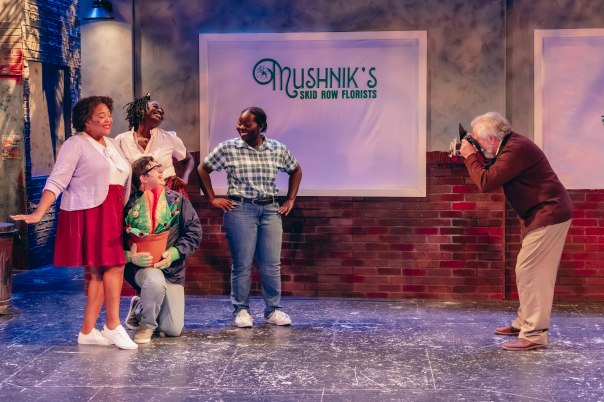
Tinted by J.P. Woody’s groovy lighting, scenic design by Gordon Olson revels in the squalor of the skids with a doo-wop funk and loving detail that reminded me of Mad Magazine comic strips devoured in my youth. The era is the prehistoric ‘50s, when teens toted transistor radios to stay in touch with the Top 40, and Alan Menken’s musical score reveres those vibes as if they are gospel.

From Seymour’s nerdy sweater vest to Orin’s biker black jacket, Rachel Engstrom’s costume designs are also onboard with the ‘50s beat, with such an outrageous variety of looks for the vocal trio that you can look at them as district goddesses. Props, including a mini press camera and various-sized potted Audrey 2’s that double as puppets, are also a treat from Lea Harkins – plus Orin’s diabolical dentist’s drill.

Besides getting the right moves from his talented cast alongside choreographer Georgie DeCosmo, Albert’s stage direction fosters all kinds of synergies that pave the way for Audrey 2 to have the sleek looks of a garish concept sports car and the voice of a rabid boar. Named after his idolized co-worker, Audrey 2, the carnivorous plant that Seymour suddenly discovers during a total eclipse of the sun, has a special cunning, speaking only to Seymour to get his way.

The voice comes lustily from Toni “Aideem” Morrison, and the movements of her leaves and tendrils come mostly from a team of three unseen puppeteers. When the side wall of Mushnik’s Skid Row Florists slides shut to hide the store, a beehive of activity with puppeteers and stagehands is dressing the interior more and more lushly with Audrey 2’s foliage as the bloodthirsty monster grows.

By the end of opening night, that side wall had been dinged with cracks and bruises, and one stagehand, in damage-control mode, was seen frantically exiting at the end of a scene change. The tech perfection extended similarly to the sound: just one brief dropout assailed Gonzalez, and that’s all. Every note from the four-piece band led by Ellen Robison from the keyboard came through undimmed.

Except when the audience broke loose.

Aside from the original Audrey, none of the main characters is burnished with virtue. Seymour’s origins, though not otherworldly, are no less mysterious than Audrey 2’s, orphaned at the flower shop’s doorstep as a babe and living there ever since. His homicidal tendencies, awakened by the arrival of Audrey 2, prove to be benign when he has to pull the trigger.

Munchnik is no less compromised. Although he has opened his door to Seymour, the lad has always slept out front under the cash register. Until he overhears Orin advising Seymour to leave Skid Row with his newfound cash cow, Mushnik never considers adopting the waif or making him his heir. In the hard times, when Mushnik is on the verge of permanently shutting down his shop, there’s not a peep from him that indicates he has given Seymour’s future so much as a thought.

Liuzzo plays his side of this relationship with gratitude, servility, and fear, while Roberge as Mushnik can load up on scorn, exploitation, and intimidation. Nebishy meets nasty. With those considerable hits to Seymour’s self-esteem, Liuzzo’s timidity can extend toward keeping his feelings for Audrey hidden, especially since she is already in Orin’s firm and abusive grasp.

Framed by the threats of an insanely sadistic dentist and a man-eating alien plant with dreams of global domination, the mundane frictions between Seymour and Mushnik can seem comical. But the best comedy contrivance, preserved by Ashman from the Charles Griffith screenplay, is the mutual non-relationship between Seymour and Audrey: both of these sweethearts have good reason to feel unworthy of the other.

It’s pretty classic how clearly Liuzzo and Gonzalez venerate one another before they connect – adding fuel to the explosive audience reaction in Act 2 when they have their “Suddenly Seymour” moment. Roberge coming up on them and taking it all in during an extended smooch is a cherry on top.

Contrasting with all this bliss and twisted domesticity are the crazed, barbecued voices of Lawson and Aideem. Since the days of silent film, dentistry has proudly perched on the knife’s edge between comedy and horror. Thanks to this delicious script, Lawson gets to sharpen that blade more keenly by adding masochism. Not to worry, after Orin nourishes Audrey 2 piecemeal, Lawson returns after intermission in a series of cameos to entice Seymour with additional money-making opportunities.

Yet it’s Aideem who endures forever as Audrey 2, aided by a wonderful tech flourish in the epilogue. His bubbly vibrato is not the deepest I’ve heard out of Audrey 2’s maw, but it’s more than sufficiently low, spirited, and spicy. Aideem’s performance will likely draw another noise notification if you’re wearing an Apple Watch. The final bows certainly will.

“Thoughts of a Colored Man” Lauds Three Strong Women

Review: Thoughts of a Colored Man at the Arts Factory

By Perry Tannenbaum

So Lust and Passion walk into a bar… You can imagine how fervently I’ve longed to lead off a review with a line like that for close to 40 years. Well, now that Keenan Scott II’s Thoughts of a Colored Man has almost provided that opportunity, you can see that I’ve pulled the trigger. Jumped the gun. For in multiple scenes of Scott’s 2021 script, we can find Love, Lust, Depression, Passion, and Happiness all congregated in a Brooklyn barbershop run by Wisdom and Anger.

Scott gives us more than a hint that Colored Man was written as a companion piece of Ntozake Shange’s for colored girls who have considered suicide / when the rainbow is enuf. That 1976 “choreopoem” had seven women with similarly abstract names, corresponding with the colors of the rainbow, and it is similarly studded with monologues and poetry. Scott’s newer piece at the Arts Factory, flawlessly cast by director Sidney Horton for Three Bone Theatre and imbued with just the right sizzle and raw edge, comes at us evolved into SLAM poetry rants rather than incantatory spells.

Less obviously, Scott’s form is modeled on “Four Women,” one of Nina Simone’s signature songs. Simone gives us the names of her women after she has told their stories, but we’re usually not in suspense for appreciably more than a minute as the complete sequence clocks in at under five. Unless you’ve paid close attention to your playbill before the lights dim, this playwright will make you wait nearly the full intermission-less 90 minutes until, one by one, we get the group reveal.

Thankfully, plenty of names pop up in various scenes. At the barbershop, Kobe, LeBron, and MJ are upheld as the GOAT by bickering customers and kibitzers, moving right along to a similarly lightweight comparison of rap giants past and present. Equally memorable, and no less intense, there’s a lengthy dispute about the best basketball sneakers of all time as the group stands in line for a latenight release of the newest Jordans carrying the legendary Jumpman logo.

Wisdom welcomes us to Joe’s Barbershop, but it becomes clearer as the meandering chatter proceeds that old Joe has retired or passed away, leaving him in charge. Nor does anybody identify Depression as he’s bagging groceries, retrieving carts, or stocking shelves at Whole Foods, though he relays boss’s orders to an offstage Timmy. So as Scott veers and swerves on his path of SLAM poetry and raw prose, with some rhythmic prose bridging the gap, he is also at play with raw specifics and unspoken generalities.

The opening question that Depression poses, “Who is the Colored Man? Is he a king… or is he a slave?” invites that kind of approach. Or evasion. Ironically, only Depression will introduce himself well before the evening is over – at a little past 7:30 PM. One of the ways Scott has of stringing out his opposing tracks is by offering signposts in his stage directions that tell us what time of day it is, steadily moving us forward. Horton has these projected on the upstage wall perfectly on cue.

And whether you’re Love or Lust, Depression or Happiness, you have a personal story. Depression, for example, fumbled an opportunity to break away from Brooklyn and attend MIT on a full scholarship. Giving that up by taking care of his mom – without a moment’s hesitation – he settled for the ongoing indignity of Whole Foods.

On the other hand, Happiness is a stranger in town, living with his fiancé. He grew up in the South, his parents were the first in his family to earn six figures, and that’s why he was shunned by the relatives back home. Up in Brooklyn, he feels no less alienated, because he is prosperous and because he is gay.

Scott is pulling hard here against answering his own opening question. The reason that such fascinating hostility flares up between Depression and Happiness in an aisle at Whole Foods is that neither one can answer “Who is the Colored Man?” when they meet one. Both pointedly tell each other “you don’t know me” – which is what any of Scott’s characters could have shouted at us at the beginning if the playwright were less designing and discreet. Or if he hadn’t been aware that Colored Men themselves cannot answer any better than by telling us, one by one, who they are.

It’s hard for me to resist applying the same observation more widely to the whole Black theatre scene in Charlotte these days. Having sampled Penumbra in Minneapolis presenting August Wilson, Black Ensemble in Chicago celebrating Marvin Gaye, and a multitude of companies from across the US bringing their best to the National Black Theatre Festival in Winston-Salem in even numbered years – ahem, the International Black Theatre Festival for 2024 (July 29-August 3) – I’m always telling people that the Black performers, directors, and theatercraftsmen that we have in the QC are second to none.

Catch is: not only doesn’t the Charlotte theatergoing public seem to realize the bounty in our midst. The artists themselves seem to be sleeping on it. To a greater degree now than ever before, when we were merely equals.

Lesser performers and directors might struggle with the challenge of portraying Anger, Passion, or Wisdom and real people at the same time. Horton and his able cast wisely let it slide. When he’s not shaving, shearing, and trimming at Joe’s, Devin Clark as Anger trains and does drills with highly-ranked basketball players who aspire to the big-name colleges, the NBA draft, and huge commercial endorsements. Now they’re possible in college! Or he drifts into nostalgic recollections of his peak playing days when he was “nice.” He earned his scholarship back in the day, so he’s worried about how today’s NIL generation will maintain their dedication – and their grades, if b-ball doesn’t pan out.

Jonovan Adams, another mainstay on the local scene, also assumes a mentor’s role as Passion, a seasoned teacher of 26 students – plus cameo roles as social worker, psychiatrist, and surrogate parent, depending on the kid and his or her homelife. Neither Passion nor Anger is likely to strike you as particularly tough: more likely, Clark and Adams will come across as personable and authentic as ever.

It is well that Passion invokes the OGs of yesteryear who helped him growing up, hanging around the hood and doling out free advice. He wants to be one of those old heads now, a street scholar. That’s what cool, easygoing-yet-stern Graham Williams personifies at his shop as Wisdom, conscientiously doling out sharp cuts and implacably demanding a buck for the swear jar each time a customer – or Anger – curses or breaches decorum.

Dionte Darko as Lust is the most-often-fined in the group, a youngblood with repeat offenses in swearing, misogyny, and homophobia in and out of the barbershop. With his undimmed geniality, Darko is so useful to have around. Aside from needing to apologize to Wisdom for his multiple trespasses, he also riles up the romantic Daylon Jones as Love, so vulnerably poetic in his amatory feelings that he has not yet dared to approach his beloved – while Lust will instantly harass any skirt that walks by, previously known or not.

With similar boorishness, Lust also runs afoul of Nehemiah Lawson as Happiness. Renowned as the Minstrel of Something Rotten and Leading Player of Pippin at Theatre Charlotte, lead Drifter in Beautiful at Matthews Playhouse, and _thesingingdentist on Instagram, Lawson has more than sufficient urbanity and polish for portraying a relatively mundane financial director, so it’s interesting to see him in a performance that discards stage magic in favor of wariness, loneliness, and a touch of anxiety.

Maybe Scott would have preferred someone older than Lawson in Happiness’s encounters with Lust and Depression, but in the Whole Foods scene especially, Horton’s calculus paid off for me though it changed the chemistry. If there was any bullying flavor intended in the hostility between Lust and Happiness, that is gone.

Marvin King bookends the show as Depression and, with a long white tunic that echoes the twin white fires of his flowing beard, sanctifies it with a mystic, ceremonial aura that the more worldly SLAM poetry and prose never dispels. King’s mighty presence certainly endures when he descends to the degradation of a Whole Foods grocery drudge, and the reason why he discloses his name before anyone else will become clear enough if we’ve watched closely. In this cityscape of living, breathing, struggling abstractions, Depression is probably the one who best encompasses them all. By that time, Scott has fastened upon a fresh muse, supplanting Shange’s Colored Girls and Simone’s “Four Women.” This third inspiration is Lorraine Hansberry’s Raisin, handed down from Langston Hughes, and the effects of the sun are still the same as they were at the height of the Harlem Renaissance

Ensley and Schroeder Check All the Beautiful Boxes in Matthews

Review: Beautiful The Carol King Musical at Matthews Playhouse

By Perry Tannenbaum

When you think of singer/songwriter Carole King and Broadway musicals, there’s an instant disconnect: the humble simplicity of King’s Tapestry album cover clashing with the glitz and blare of the Great White Way. So a Broadway musical about King’s career is more of a stylistic stretch than a biomusical about most rock stars, pop stars, or jazz & blues divas. Everyone involved behind the scenes of the original 2014 production of Beautiful The Carol King Musical seemed keenly aware of the dichotomy, including director Marc Bruni, orchestrator/arranger Steve Sidwell, and scriptwriter Douglas McGrath.

Their idea of coping with the problem was by leaning into it. Not too subtly, they conspired to make the early stages of King’s career seem crass and commercial, as if she were trapped in the dog-eat-dog maw of the pop music industry. King and her writing partner, lyricist Gerry Goffin, write the songs while producer Don Kirshner finds the singers and the groups who will cut the singles – the likes of Bobby Vee, Little Eva, The Drifters, and The Shirelles. Yet somehow the hierarchy is flipped in the famed Brill Building in NYC.

Carole and Gerry are slaving for Kirshner, a genial industry mogul and taskmaster, and the couple’s best early music loses a lot of its luster when it’s farmed out, especially when “Up on the Roof” falls into the hands of The Drifters and “Will You Still Love Me Tomorrow?” is butchered by The Shirelles, thanks to excessively ornate Sidwell arrangements that would be more at home on Broadway or Vegas than Motown. These excesses helped Jessie Mueller to shine all the more brightly in the original cast – and for her sister, Abby Mueller, to shine equally when the touring version hit the QC in April 2016.

So a downsized production, like the one currently running at Matthews Playhouse, actually has the potential to be better than the Broadway and touring versions – with the right personnel and sufficient pizzazz. With Billy Ensley directing and Lindsey Schroeder leading a heavyweight cast, both those boxes are checked. The Broadway ensemble sheds two of its three keyboards nestling into Matthews, one its two guitars, and one of its percussionists. The slimming helps. No longer smothered by their orchestrations, Neil Sedaka’s “Oh! Carol,” Gene Vincent’s “Be Bop a Lula,” and Little Eva’s “Loco-Motion” sound more like rock music and less like mockeries.

Ensley targets the megahit by the King-Goffin duo’s friendly rivals, Barry Mann and Cynthia Weil, for his most farcical treatment. Not only is the arrangement of “You’ve Lost That Lovin’ Feelin’” garishly distorted, amped up from the swampy-echoey-churchy vibe of the original single, but the gulf between the bass and tenor voices of the Righteous Brothers is greatly emphasized, exaggerated, and comically exploited by Johnny Hohenstein and Zach Linick.

McGrath’s book is most affecting when it deals directly with King, though there’s bold poetic license in his voodoo, historically speaking. Pressured by Kirshner to come up with a new hit overnight for The Shirelles (in real life, they only had one hit record so far), King writes the music and goes to bed with Goffin. Perfect setup. Wouldn’t you like to wake up in the morning and find the handwritten lyrics for “Will You Still Love Me Tomorrow” perched on your piano – and be the first person on Earth to read and sing them?

No disrespect to the great Bobby Vee, but we’ve suddenly ascended more than a few notches above “Take Good Care of My Baby.” This moment still grabs me, but there are more moments like this after intermission, when “You’ve Got a Friend” and “A Natural Woman” are unveiled, that choke me up even more – as King breaks away from the Brill Building and starts to do her own thing. Schroeder replicates the sandy sound of Carole’s voice from the beginning, but as she transforms from a demo singer behind an upright piano to a chart-topping performer, watch out.

Schroeder can not only belt – she can tear your heart out.

McGrath’s dramatization heightens the magic most memorably when “You’ve Got a Friend” is reframed as a not-quite-farewell song, when King embarks for her solo career in LA with Kirshner’s blessing, and both Barry and Cynthia gather round the old upright with her to sing this newborn masterpiece. The song didn’t really come out until her second album, but who’s counting, right?

Nick Southwick as Barry and Sophie Lanser as Cynthia (get that woman a more reliable mic!) deliver polished performances all evening long, but they also grow more gravitas after intermission. Lanser sheds the frivolity of a “Happy Days Are Here Again” parody and “He’s Sure the Boy I Love” and joins Southwick – previously mired in the silliness of “Who Put the Bomp” and the wrong-key version of “You’ve Lost That Lovin’ Feelin’ – in a heartfelt “Walking in the Rain” duet.

Then if you haven’t started weeping with Schroeder’s “It’s Too Late,” you’re at the mercy of “You’ve Got a Friend” when Lanser and Southwick join in on the quivering-lip goodbyes. After playing Kirshner with avuncular savvy throughout King’s formative years, Ryan Dunn sprinkles some welcome laughter into this maudlin scene with a (purposely) bad attempt at vocalizing.

I’d forgotten that Carole had Aretha’s 1967 hit in her hip pocket when she cut Tapestry out on the Left Coast in 1971, so I found myself suddenly suppressing sobs when “A Natural Woman” began. Here it felt very right that Sidwell’s arrangement brought added vocalists and brass to beef up the simplicity of King’s version – and freed Schroeder to narrow the gap between Carole and the Queen of Soul with some fervent belting.

Marty Wolff’s simple two-story set design, with four wide strips of stained-glass paneling running vertically upstage in front of the eight-piece band led by Ellen Robison from the keyboard, needs only JP Woodey’s lighting to give it a rockin’ modernistic zing. Lisa Blanton’s choreography is devout doo-wop, most praiseworthy for how well the groups stay in sync, and Chelsea Retalic likely cranked out between 75 and 100 costumes for this large cast – all of them, from the sleekest to the grungiest, on point.

And the wigs! The only misfire here, among dozens of triumphant coifs – several for Schroeder – was the oceanic profusion of waves that perched on Joe McCourt’s head as Gerry Goffin, making him virtually unrecognizable. McCourt, a musical mainstay in the QC since his debut in 2008 as the lead in Godspell, has suavity to spare to spare and, in contrast with Southwick’s quirky neuroses as Barry, gets a nice and bumpy character curve as the only troubled soul we see.

This image has an empty alt attribute; its file name is beautiful24-139.jpg

As for the Afro-American doo-woppers… my, oh my! By bringing Nehemiah Lawson aboard to take over “Some Kind of Wonderful” from Schroeder and McCourt and then to bring him back again and again to sing “Up on the Roof” and “On Broadway,” the latter one of Weil & Mann’s best, Ensley and Robison signal that they have no plans of dissing The Drifters. Meanwhile, two lead singers are embedded among Ensley’s Shirelles. As Janelle Woods, the Shirelle who denigrates “Will You Still Love Me” as “too country” before fronting the breakthrough single (first Billboard #1 for an African-American girls’ group), Brianna Mayo gets a chance to show that her acting chops are as strong as her singing skills.

Shortly afterwards, Raven Monroe emerges from the backup Shirelles to become Little Eva and ignite “The Loco-Motion.” Until then, she moonlights as King’s babysitter during the leading lady’s brief marriage to the restless Goffin.

There’s a formulaic circle to McGrath’s storytelling that’s not at all displeasing, starting and ending with King as a star behind a grand piano singing a song from Tapestry. We flash back to her youth in Brooklyn and eventually touch down at Carnegie Hall, surely a kind of Jerusalem for a humble Jewish girl. Alongside her at the beginning and at the end is Carol Weiner as Genie Klein, King’s mother. Both were abandoned by her no-good father, steeled by adversity. Along the way to Carnegie, Weiner peeps in with a couple of overprotective warnings, a few salty quips, and a proud Mama’s lie.

If McGrath can embellish a good story, why shouldn’t she

“Pippin” Is Mostly Magical at Theatre Charlotte

Review: Pippin at Theatre Charlotte

By Perry Tannenbaum

TC95-Pippin-018

There was plenty of magic to do last Friday night as Theatre Charlotte opened their new production of Pippin at the Queens Road barn. Opening night was happening in the wake of a dazzling Broadway Lights reveal at Belk Theater of a star-studded touring version of Into the Woods just three nights earlier. That compounded the new challenges already added by the 2013 Broadway revival of Stephen Schwartz’s 1972 hit, layering on new illusions, flying effects, circus acrobatics, and fire.

Behind the scenes, budgets and available talent are also stressed and stretched. Theatre Charlotte is embarking on an unprecedented series of four consecutive shows, hosting performances of Detroit ’67 (opening May 26) and I and You (June 16) at the old barn through June 25, after an excursion to the Uptown Mint Museum, where Picasso at the Lapin Agile will pay a visit beginning on May 5, the weekend after Pippin shutters. At home and on the road, TC’s running crews are booked for the next 10 weekends.

At first blush, it was tough for me to escape the notion that Woods witch Montego Glover’s wardrobe alone – not to mention her paycheck – was more expensive than this entire pipsqueak Pippin production. But the five-piece stage band directed by Lindsey Schroeder is tight, the ensemble directed by director/choreographer Lisa Blanton is brash and teeming with pro-grade talent, and the dance stylings by Sterling Masters-Deeney (home from a 12-year stint with the Broadway company of Wicked) are besprinkled with Fosse hands and pizzazz.

Before he composed Wicked, Schwartz wasn’t exactly sold on serious storytelling, so it isn’t difficult to swap out the narrative frameworks of Godspell and Pippin. Not for directors and most of the design team, anyway. For the acting troupe, most of whom are billed as Players; and for those designing the new Pippin effects and teaching performers how to execute them; it’s a different story. A granny on a trapeze? The original Javert from Les Miz learning parlor tricks? Tall orders.

Community theatres have scaled-down prep schedules as well as Slimfast budgets, so there were a few times – particularly when fire is involved – when you’ll need to brace yourself for disappointment. Otherwise, the acrobatics, the sawed woman, and the levitation stunt overachieved magnificently. Who knows, maybe by the second weekend, the kinks will be ironed out of the flame-throwings.TC95-Pippin-275

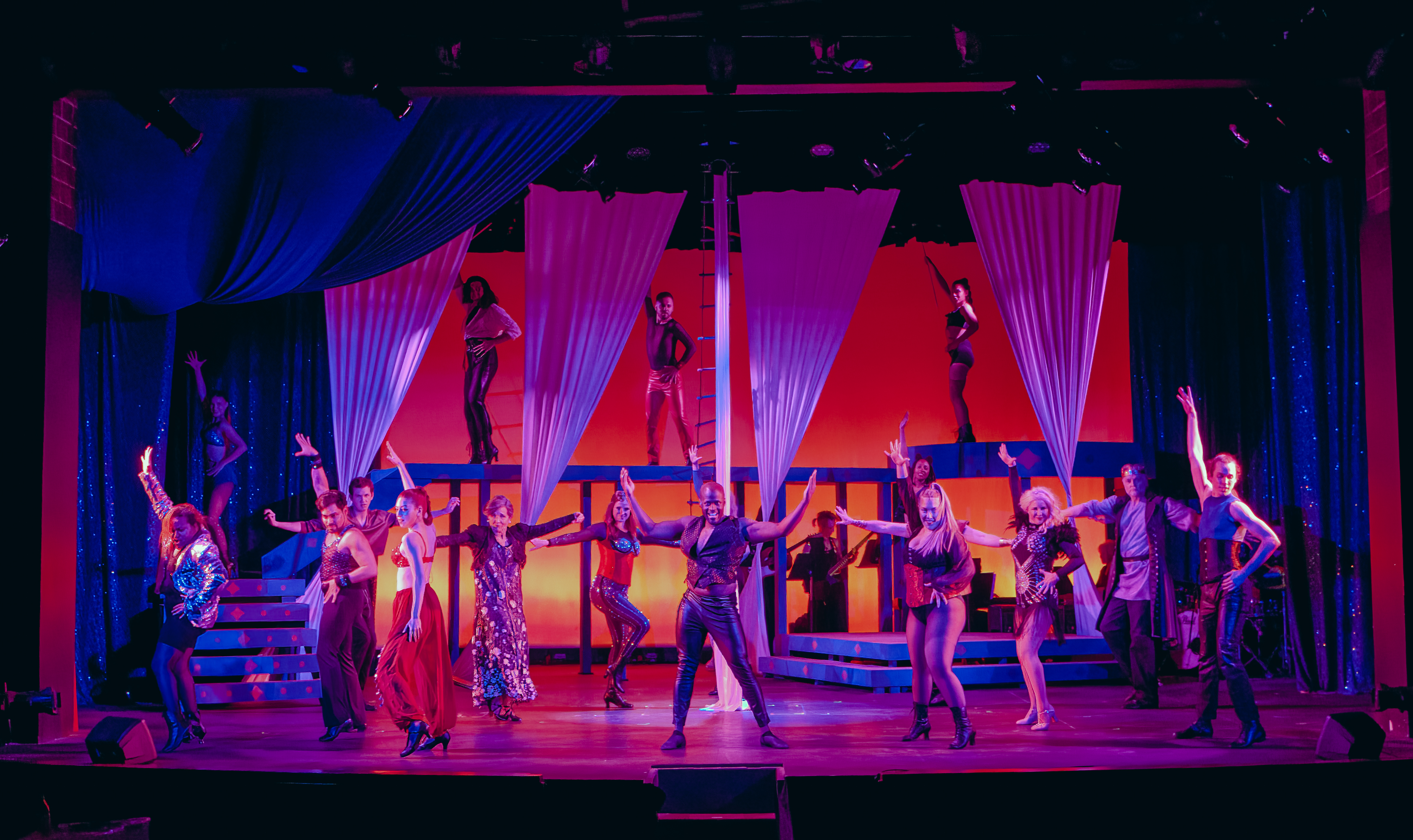
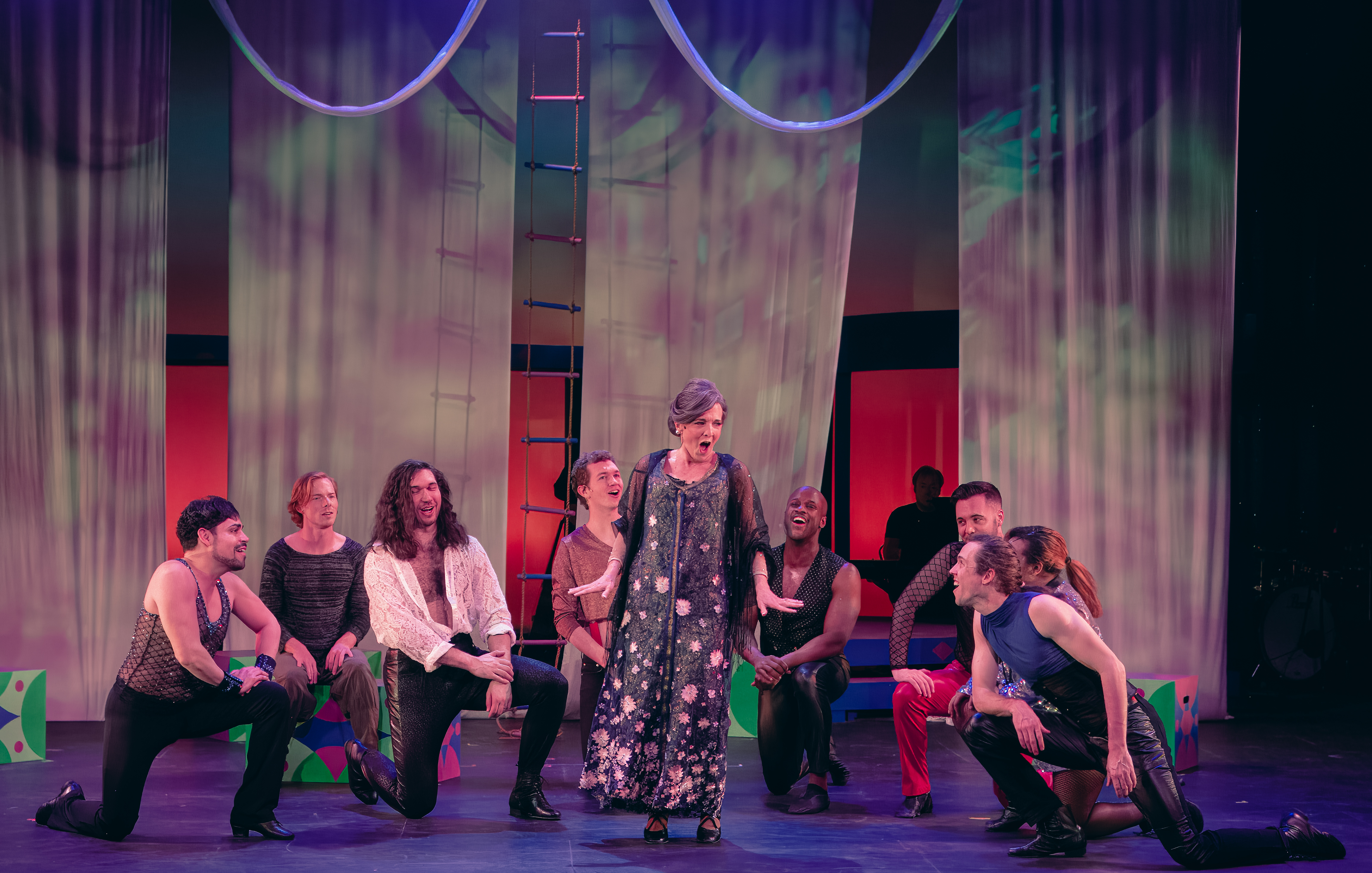
With Nehemiah Lawson as the Leading Player and Bart Copeland in the title role, both emerging from the ensemble of Theatre Charlotte’s Something Rotten, the bulk of Schwartz’s music and lyrics is in good hands. Lawson is a powerful presence and an excellent dancer, and the costume Beth Killion has designed for him strongly suggests black magic wizardry. Yet Lawson sometimes undercuts his own authority when he appears to be striving to precisely execute the choreography instead of taking over his moves, manhandling them, and making them his own.

The flimsy book by Roger O. Hirson is already lax in reminding us that the Leading Player is in charge of all the other players and their storytelling, so Lawson’s occasional spasms of fidelity don’t help. Yet his scenes with Sophie Lanser as the flawed and recalcitrant Catherine, Pippin’s true love, are beautifully calibrated in their give-and-take, and his climactic tantrum when Pippin rejects martyrdom is fairly breathtaking.

As Prince Pippin, Holy Roman Emperor Charlemagne’s son, Copeland is disarmingly wholesome, earnest, and at ease. His dancing prowess seems to improve before our eyes as he ages and becomes more worldly-wise, with an added grace that may stem from Copeland’s not taking himself seriously as a dancer. That kind of modesty works well for the major Pippin role that hasn’t won two Tony Awards (Ben Vereen in 1973 and Patina Miller in 2014), particularly when you’re a protagonist who finds himself beaten down in life no matter which path he follows toward fulfillment, his ”Corner of the Sky.”TC95-Pippin-154

While we savor the blithe amorality of Darren Spencer as Charlemagne, more aristocratic zest emanates from two female royals. Reveling in her corruption as Fastrada, Charlemagne’s current wife, Alyson Lowe gets to scheme against both her Emperor husband and her stepson Pippin, slyly maneuvering to install her valorous dimwitted son Lewis on the throne. Louann Vaughan draws the sunnier role as Charlemagne’s mom, exiled from court by the conniving Fastrada.

Her sunnier song, “No Time at All,” is the catchiest, a carpe diem song from Granny that espouses hedonism to Pippin as a better path than ambition. It also draws some of the most surprising staging as Berthe proves she hasn’t sunk into stagnant retirement. She’s as much of an opposite of Catherine as the cold-blooded Fastrada, for Lanser quickly forms a domesticated trio with Copeland and Logan Campbell as the widow’s son Theo, bonding together in the precious “Prayer for a Duck.”

Common farmer she may be – and maybe, according to Leading Player, the lowliest actor in the troupe – but Lanser reminds us she isn’t a doormat, aggressively seeking out a replacement husband when she’s on script in the Leading Player’s story and then pugnaciously inserting a song that he has not approved. Catherine needs Pippin and her “I Guess I’ll Miss the Man” is a long way from worshipful.

Matt Howie is the only other cast member who speaks, giving Pippin’s half-brother Lewis a surprisingly sweet tinge. After seeing him in numerous productions, most recently in Something Rotten, I’m not sure he can help it. Among the dozen dancers in unnamed roles, captains Georgie DeCosmo and Mitchell Dudas consistently excelled. Charlton Alicia Tapp also stood out as a slick ballroom lizard, and lithe Riley Gray breathtakingly took acrobatic honors ascending and descending the silks.

Shakespeare Is a Thieving Magpie in Theatre Charlotte’s “Something Rotten!”

Renovated Queens Road Barn is ready for its closeup

By Perry Tannenbaum

Something Rotten

 We are all stupid and silly – and we all love smart-ass musicals that tell us so. That’s the deep message of Something Rotten! Theatre Charlotte’s brash, big-ass extravaganza that’s raising the curtain for the grand reopening of the iconic Queens Road barn.

Yeah, it’s been awhile since a musical opened at our venerable community theatre’s home. That was early September 2019, when Oliver! launched what would have been the 2019-20 season. But COVID-19 shut everything down in early March, before auditions or rehearsals could even begin for Dreamgirls, scheduled to open in late spring. Then a latenight fire in the waning hours of 2020 gouged a huge hole in the theater floor, smoked the ceilings, and fried all the precious electronics – lights, audio, AC, computers – and kicked the company out of their house.

For over two years, while more than $1 mil in repairs, renovations, and new equipment requisitions could be authorized and completed, artistic planning continued while navigating insurance adjustments and jumping municipal hurdles. While the new 501 Queens Road gestated and marinated for more than two years, the company hit the road, resuming production in September 2021 and hopscotching the city to keep Theatre Charlotte alive in Charlotte. The Palmer Building, Halton Theater at CP, and the Great Aunt Stella Center were the first three stops on the season-long 2021-22 road trip.

Now there have been five or six shows at the old barn, in play or concert format, since Oliver! closed back in 2019, including two iterations of A Christmas Carol, a Theatre Charlotte gotta-do-it tradition. But nothing short of a musical, one with an authentic exclamation point yelling out its title, can truly show off a theater’s brand-new bells and whistles – or put them to their ultimate test.

Of course, there had to be some extra drama, an extended drumroll, before Something Rotten! could give the renovated Queens Road barn its much-anticipated relaunch. Scheduled for its closeup last October, the revamped site wasn’t going to be ready for opening night. The 2022-23 season had to be reshuffled, and the wondrous Shakespearean mashup of a musical was postponed.

A construction project. In Charlotte! Can you believe it wasn’t finished on time??

Billy Ensley, after directing the first little musical away from TC’s home, The Fantasticks, now pilots the first leviathan since the company’s return. Three of his mates from that Palmer Building gem back in 2021 are on board with Ensley for this new voyage, all of them playing major roles and all of them delivering.

I was fairly bowled over by the brash irreverence of Something Rotten! when I first encountered this Karey and Wayne Kirkpatrick concoction on Broadway in 2016. You might wonder if the Kirkpatricks had the zany antics of The Compleate Wks of Wllm Shkspr (Abridged) on their minds when they decided to take aim at the Bard of Avon and musicals.

Certainly the methods of their madness can be traced to the Reduced Shakespeare Company – with genetic material from Forbidden Broadway and The Producers also in the DNA. The Kirkpatricks discard the merely dubious ideas that Shakespeare’s works were written by someone else, or that his awesome greatness was only fully appreciated after he died. They ignore the reality that there’s only faint, sketchy traces of the man over the course the grand Elizabethan Era.

No, all those tropes are toast. The Kirkpatricks, with John O’Farrell collaborating on the book went full-bore misinformation and alternate reality. Months before The Donald descended the Trump Tower escalator.IMG_2969-2

Shakespeare is no longer a dim peripheral figure on the Elizabethan cultural scene. He’s a full-blown superstar, recognized and wildly adored wherever he goes. Mobbed by his rabid fans, he gives outdoor spoken-word concerts to sustain the mass hysteria.

The secret of the Bard’s genius is revealed. Like the Reduced Shakespeares, Forbidden Broadway, and the Kirkpatricks after him – not to mention The Donald – the real Shakespeare was a thieving magpie. Not only did he steal from ancients like Plutarch and Ovid, predecessors like Chaucer and Boccaccio, and contemporaries like Christopher Marlowe, he cribbed from unknown wannabes and the man or woman on the street.

Case in point: after defecting from Nick Bottom’s struggling theatre company, Will takes his former boss’s name with him and dumps it into A Midsummer Night’s Dream. Another case in point: Sniffing out the possibility that Nick is working on something revolutionary for the stage, Shakespeare embeds himself in his former company, where he swipes the complete manuscript of Hamlet from its true author, Nigel Bottom. Because big brother Nick has astutely told him that “to be or not to be” is trash. Not to be.IMG_2417

A hapless mediocrity, Nick is our hero. In his crazed search for the next new thing in theatre, Nick seeks out a soothsayer to look into the future, a rather Shakespearean ploy. The eccentric soothsayer that Nick picks, Nostradamus, turns out to be a genuine visionary, but his inner crystal ball seems to be afflicted with astigmatism. Skipping over the breakthrough artform of opera on the near horizon, soon to be birthed in Italy, Nostradamus is himself amazed to see… a musical!

So powerful is this concept that Nostradamus cannot even say the word without a vatic, conjuring sweep of his right arm. He wants Nick – and us – to see it clearly, too. Nick, poor thing, doesn’t have as juicy a role as the raving Nostradamus, who must convince his skeptical client that such an impossibility can be created, believed, and become universally popular. He’ll be able to bring my play to a complete stop and have my speaking characters suddenly start singing? And he’ll be able to interrupt this blatant interruption with a whole crowd of people dancing? Tap dancing?IMG_2703

Yes, yes, and yes, Nostradamus prophesies, and audiences will lap it up. We do see, for we were living proof of this seeming insanity at the Queens Road barn, just like I was at the St. James Theatre in 2015.

Over and over, the Kirkpatricks reinforce the idea that the road from brilliant concept to acclaimed masterwork is strewn with pitfalls. Nick begins with a colossal misstep, an upbeat number called “The Black Death,” which strives to match Mel Brooks’ “Springtime for Hitler” in utter tastelessness.

So Nick hurries back to his soothsayer. What will Shakespeare’s greatest triumph be, he asks, determined to beat the Bard to the punch. Pushing away invisible cobwebs between him and the future, Nostradamus proclaims, Omelet, the Musical is the future, confident he’s setting Nick on the right track.

With creditors and prudish censors dogging his way, Nick has ample complications to overcome. The backbreaker is Nigel’s resistance. Instead of sticking to the yolks and the big egg picture, Nigel is spouting useless lines like “To thine own self be true.”

Another Shakespearean device comes into play with little brother, the double plotline. While tasked with writing the world’s first libretto, Nigel is smitten by Portia, the lovely daughter of Brother Jeremiah, the most sanctimonious and censorious Puritan in London. Avid admirers of Shakespeare, both Portia and Nigel can see the parallel between their star-crossed plight and the tragedy of Romeo and Juliet, their idol’s newest hit.IMG_3812

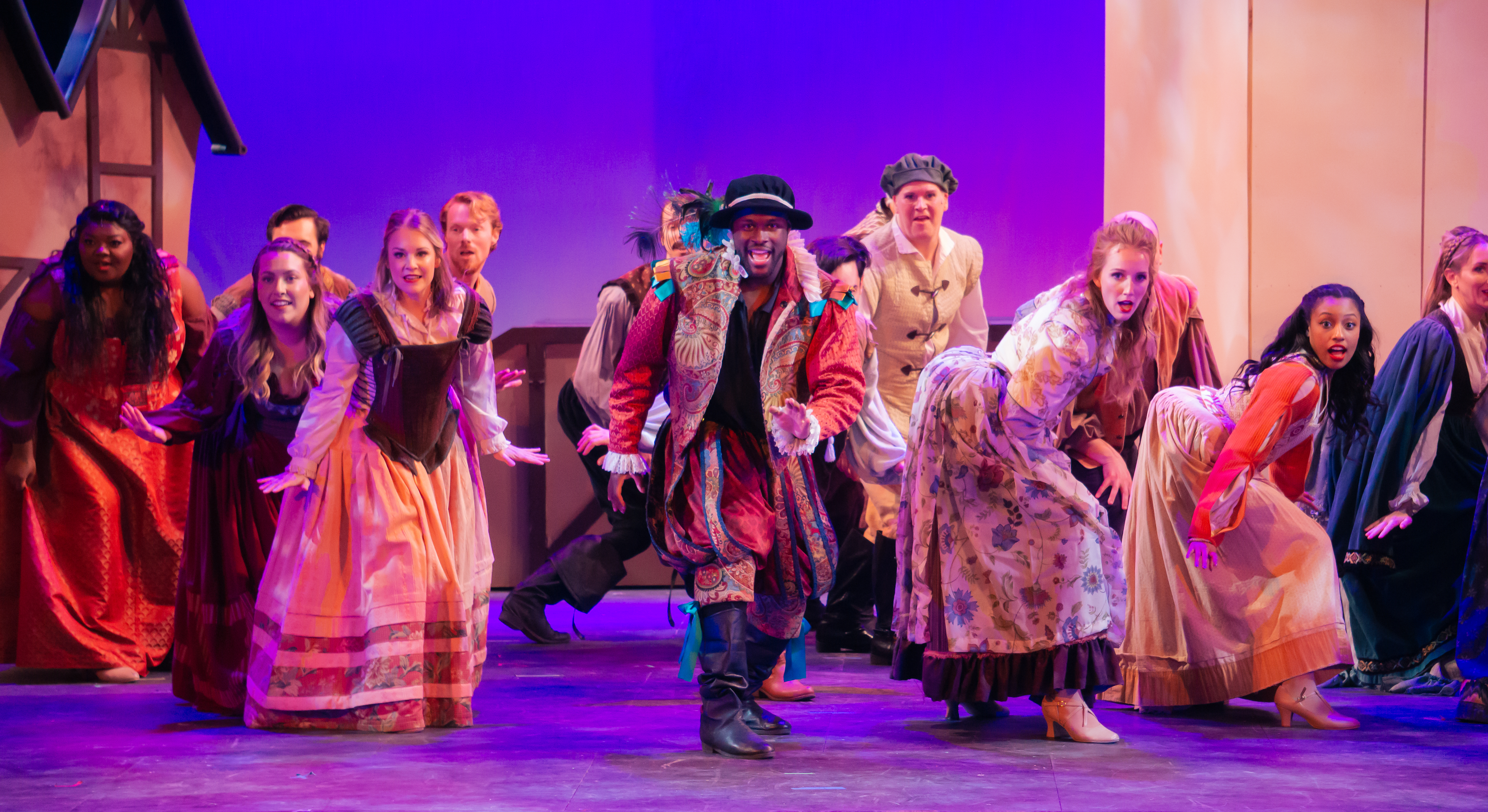
Ensley’s eager, able, well-drilled cast of 25 can seem like a teeming city in the confines of a barn, heartily welcoming us to two Renaissances, really, with Nehemiah Lawson as the Minstrel leading the ensemble’s bustling greeting – to the refurbished theater and olden days – when the curtain rises. They can form a credible mob around Will when he struts upon his stage.

Along with such teeming scenes, Ensley and choreographer Lisa Blanton and headshot sketch artist Dennis Delamar can pour in numerous references to familiar, beloved musicals we all know. Explicit references to Phantom, Les Miz, Cats, Sound of Music, and Chess are in the Kirkpatrick-O’Farrell script, but what about the sly nods to Annie, A Chorus Line, The Producers, and West Side Story?

There are more Broadway allusions than I’ve mentioned and still more that I may have missed. Ensley keeps the pace brisk.

Twice cast as Jesus at Theatre Charlotte in past seasons; along with leads in Rent, Memphis, and Arsenic and Old Lace; Joe McCourt steers us through Nick’s sea of troubles. Folks out in Matthews would remember McCourt’s exploits in Bonnie and Clyde more vividly, his first team-up with Ensley. The Arsenic and Old Lace agitation as Mortimer, when McCourt strayed from musicals into comedy, served as a nice precedent for his work here. When he leans away from straight-man chores opposite Will and Nostradamus, and into Nick’s showpieces, McCourt flashes his confident charisma – with comical seasoning – when he fumes “God, I Hate Shakespeare.”

McCourt is no less in command when he brings down the curtain for intermission with “Bottom’s Gonna Be on Top,” though his best soufflé may rise when he greets his troupe for the first Omelet rehearsal, absurdly exclaiming “It’s Eggs!” Yet this wannabe turn is decisively upstaged by the conceited rockstar and the wild-eyed prophet.

Perfectly cast at the Palmer in The Fantasticks, Mitchell Dudas and Kevin Roberge are even more smashing now. Dudas was a wonderfully swashbuckling El Gallo, the beguiling Fantasticks narrator, but he’s far slicker and more self-absorbed here, shining in his wicked showpieces, “Will Power” and “Hard to Be the Bard.” And the sheer arrogance of him when Dudas flashes his Shakespearean smile! You expect little LEDs to twinkle at the edges of his teeth.

Since “The Black Death” is an ensemble slaying, it’s Roberge who gets the killer solo of the night, “A Musical,” indoctrinating McCourt so thoroughly that the conjuring sweeps of Nick’s arm become nearly as prophetic. After his portrait of the more blustery Fantasticks dad, Roberge turns up his leonine energy more than a few notches. And the hair! Far more eccentric than the Einstein in Verizon ads. Think Charlton Heston on top of Sinai in The Ten Commandments.

Matt Howie, the naïf swain from Ensley’s Fantasticks, and Cornelia Barnwell mesh beautifully as the confidence-challenged Nigel and the overprotected Portia. But they’re overshadowed by a slew of quirkier characters who don’t sing nearly as much. Who comes first? Maybe Lindsey Schroeder as Bea, Nick’s proto-feminist wife, who fills out the contours of Shakespeare’s Portia in a memorable courtroom scene.

Certainly Hank West vies for the honor of favorite minor character as the shifty and resourceful Shylock, who remains a moneylender in Shakespeare’s world but transforms into the first theatre producer in Nick’s troupe and the New World. Delamar, our sketch artist and longtime Theatre Charlotte idol, gets props here for portraying a pair of pomposities: Lord Clapham, Nick’s skittish financial backer, and the Judge who must sentence Nick for his trumped-up crimes.

If there’s space for a feminist, a theatre producer, and a rockstar in this Renaissance makeover, there’s also room for a gay preacher and an outré transvestite. J. Michael Beech’s homosexuality as Brother Jeremiah is hardly latent at all as he strives to keep himself closeted with indifferent success, and we can presume that Paul Reeves Leopard as Robin gets the pick of the women’s roles in the Bottoms’ troupe, perennially dressed and simpering for the part.

Brave New World!

If the players I’ve named thus far decided to form a professional theatre company, I’d only be mildly surprised by their audacity. The new Old Barn made them all look good, first with the opulence of Chelsea Retalic’s period costumes – and the stark anachronism of Shakespeare’s glitter. Chris Timmons’ set designs didn’t look like he was working on a shoestring budget, either, indoors or out.

Better yet, the renovated 501 Queens Road facility has remained true to itself, in its lobby and its theater space. In the lobby, there are new, more modern-looking ceiling fans, which sit admirably flush to the upgraded ceiling. There were still extensive lines to the restrooms, so my inspections of the toilet – and the new backstage – must await visits to come.

In the theatre hall, the skeleton of the new scaffolding isn’t fleshed out at all with sheetrock, so the roofbeams are visible all the way to the bricks that meet it at the proscenium wall. More like a beloved old barn than ever! Artistic director Timmons, wearing his second hat as acting executive director, told me that the renovations made it possible to raise the stage proscenium. Yet there was a shower of confetti to climax the finale, where the “Welcome to the Renaissance” melody completes its last rebirth as “Welcome to America.”

Can’t remember the last time, if ever, that I had seen evidence of a functional fly loft at the Queen Road barn.

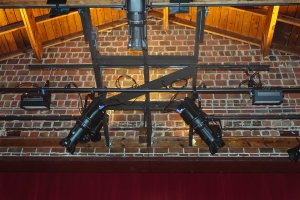
Best of all, there was a profusion of theatre lights shining in many colors, along with strategically spaced audio speakers. All are discreetly black, of course, so I couldn’t resist taking flash photos to confirm that all this equipment is spanking new. Everything worked flawlessly, including Theatre Charlotte’s soundboard. Nor did I notice any coughing or humming from the heating system. All was bliss, best feet forward, with nothing rotten except the show’s title.

Don’t be shocked to find that Something Rotten! is sold out for the rest of its current run. The show, the production, and the newborn theater are all that good. Timmons & Co. may need to add performances to meet the well-deserved demand.