Tag Archives: Lindsey Schroeder

Let “The Drowsy Chaperone” Hypnotize You

Review: The Drowsy Chaperone at Theatre Charlotte

By Perry Tannenbaum

My advice for best enjoying The Drowsy Chaperone at Theatre Charlotte is to listen to the Man in the Chair – and yield to his pitch-dark hypnosis. Yes, before the lights even go up at the old Queens Road barn, he’s in his chair speaking to his audience and conjuring up what we should hope and pray for: “I just want to be entertained. Isn’t that the point?”

As the show unfolded, brilliantly directed by Billy Ensley with what must be the local cast of his dreams, I realized that, as a critic, I shou

ld heed that hypnotic suggestion devoutly. Discard my usual pointy critical and analytical tools. What’s more, I came to believe more and more strongly that, if actors and directors of previous Drowsy Chaperones I’d seen had followed that simple mantra, I would have fallen in love with the show long before last Friday night.

When the lights came up a few minutes deeper into the Man in Chair’s monologue, we saw him locking the front door of his humdrum apartment with four or five assorted deadbolts and chains. It’s a bit of an abrupt swerve, but we’re suddenly aware that this Broadway musical devotee is a recluse and a bit paranoid. Each time the phone rings, we’ll see that the Man in Chair fails to answer, yet another confirmation of these traits.
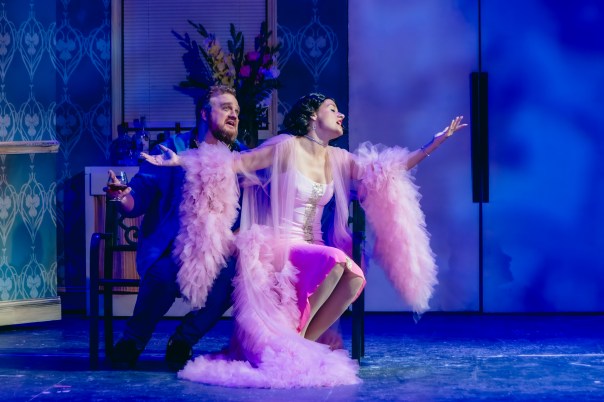
By the time the title character of the fictional “Drowsy Chaperone” is a few wobbly notes into her showstopping “As We Stumble Along,” we already should know that the Man in Chair is gay, which accounts for Lisa Smith Bradley delivering the song as a living fetishization of Ethel Merman and Judy Garland – Merman’s vibrato wedded to Garland’s glitter, slacks, and drug dependency.

Yet when we’re watching Kyle J. Britt as our genial host, we need not attribute his reclusiveness or paranoia to being a gay man. As a Broadway musical fanatic, this Man in Chair identifies more readily as a New Yorker with Innerborough hangups. Meanwhile, Bradley is sufficiently over-the-top as both gay icons – especially Merman – to be accused of impersonating a female impersonator.

We might say that Ensley & Co. have decided that being gay in 2024 isn’t nearly the leaden weight it was in 2006 when Drowsy Chaperone premiered in the Big Apple or in 1996 when Angels in America tore the QC apart and made us a laughingstock. Pretentiousness, solemnity, and subtlety really are inimical to this delicate relic. Britt handles it with audiophile care as removes the vinyl disc – a rare original cast recording of his favorite 1928 musical – from its LP sleeve and gives both sides a loving once-over with a Discwasher brush before lowering his treasure onto a turntable.

The same can be said of size and scale, which may also have muffled my enjoyment of productions at Belk Theater in 2007 and Halton Theater. There’s something so right about our little séance in the dark at the Old Barn on Queens Road that it cannot attain in a more modern and spacious hall where the Man in Chair must project his spell into a distant balcony. The homeliness of the Man’s urban dwelling also sits better on Queens Road than in the bowels of a bank building on Tryon Street.

To be honest, it’s Broadway Lights and the late CP Summer Theatre that should apologize for not matching the unpretentiousness of Josh Webb’s scenic design. Of course, it would be nice if Webb’s scenery could transform spectacularly into Broadway splendor when the stylus of our host’s turntable comes down – with its signature thump – onto the vinyl and the mythical “Drowsy Chaperone” comes to life. In the less-is-more world on Queens Road these days, these shortcomings are comedy assets, part of the overall charm.
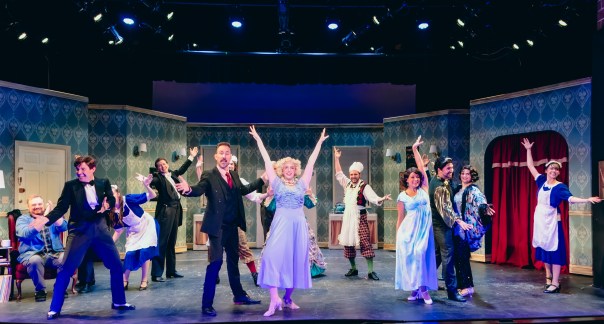
On the other hand, our time travels to 1928 get a softer landing thanks to the costumes by Beth Killion, notable for their flair, their formality, and their discreet dashes of color. We’re awaiting the wedding of Robert Martin and Janet van de Graaf, so there are actually multiple levels of time travel here, for Bob Martin actually co-wrote the Drowsy Chaperone book with Don McKellar – and starred in the original Broadway production as Man in Chair – while he was married to the real-life Van de Graaf.

In fact, this originally Canadian work, which eventually layered on music and lyrics by Lisa Lambert and Greg Morrison, was gestated at Martin’s stag party in 1997, nearly 70 years after these fictional nuptials. More reasons not to view this lark as a gay cri de cœur.

Rare as his vinyl treasure may be, Britt comes across less as a scholar or a critic than as a fanboy, occasionally panting like an eager puppy as he presumes to approach his fantasy idols more and more closely. More than once, the principals will obligingly freeze for him. Nor does this Man in Chair seem to favor the men over the ladies with his adoration, only tipping the scales just before the final bows. Charmingly enough, there are overtones of scholar and critic as he dishes tasty trivia about the fictitious “Drowsy” cast members or advises us to be on the lookout for some truly dreadful lyrics.

These glamorous, theatrical, servile, and criminal characters are all blissfully ignorant of the nerd who has conjured them up, preoccupied with their conflicting efforts to carry off the planned wedding or ruin it. The bride herself, Lindsey Schroeder as Janet, seems to be grandly ambivalent about becoming Robert’s wife, sacrificing her glittery stage career and the adoration of millions, while suppressing her basic instinct to “Show Off.” Love is at comical war with vanity. Carried away by the swiftness of this whirlwind romance, Andy Faulkenberry as Robert also has his doubts.

Aside from Janet’s drunken chaperone, politely labelled as Drowsy, there are a butler Underling, an eccentric Mrs. Tottendale, and Robert’s best man George shepherding the loving lambkins to the altar. Only Zach Linick as George seems to be afflicted with any degree of competence or reliability. More importantly, he and Faulkenberry make up a formidable tapdancing duo. (Thank-yous to choreographer Lisa Blanton.) Allison Rhinehart as a frilly, bustling Tottenham and Darren Spencer as the gray and starchy Underling are no less inevitably channeled toward blithe entertainment.

Counterbalancing the fragile determination of the bride and groom, compounded by the flimsy protection of their good friends, we have an exquisite mix of bumbling baddies trying to sabotage the wedding. These are led by Joe McCourt as Broadway producer Mr. Feldzeig (Feldzeig Follies ring a bell?), under pressure from his mobster backers, who consider Janet to be the cash cow of the Feldzeig franchise. The sneering McCourt is bedeviled by Gangster 1 and Gangster 2, armed emissaries – Titus Quinn and Taylor Minich – masquerading as hired chefs to ensure a catastrophe.

Ah, but it isn’t simply muscle aimed at swaying the maiden and returning her to showbiz. Somehow, a predatory Lothario is among the wedding guests – although he has never met anyone else there. Mitchell Dudas is this egotistical Adolpho, far more arrogant than Feldzeig, a mixture of Erroll Flynn and Bela Lugosi with a thick Iberian accent. Feldzeig has no trouble at all convincing Adolpho that he was born to seduce the bride-to-be.

Equally dumb, Autumn Cravens as Kitty is a ditzy chorine, constantly nagging her boss and wedding escort Feldzeig to let her fill Janet’s shoes in his next Follies. Effortlessly, Dudas will outperform Cravens in thwarting Feldzeig’s schemes. Love conquers all, but it would be a huge spoiler to say how many times when we reach this very happy ending.

Just one more wild card is needed to tie up all the festivities. Be on the watch for Trinity Taylor as Trix the Aviatrix, who descends from the skies at just the right moment with a voice of thunder. For a few moments, she even upstages Britt and Schroeder who are so fabulous.

It would be a mistake to miss the craftmanship lavished on this plot with its stock characters by Martin and McKellar, brought out so brilliantly by Ensley and his dream cast. For instance, think how perfectly 1928 was chosen: between Lindbergh’s transatlantic flight, Babe Ruth’s 60 homers, The Jazz Singer of 1927 and the Wall Street Crash of 1929. A brief last window of bliss before global misery. In the real world, the parade of yearly Ziegfeld Follies revues would be halted after 1927 – until 1931.

Ensley and Schroeder Check All the Beautiful Boxes in Matthews

Review: Beautiful The Carol King Musical at Matthews Playhouse

By Perry Tannenbaum

When you think of singer/songwriter Carole King and Broadway musicals, there’s an instant disconnect: the humble simplicity of King’s Tapestry album cover clashing with the glitz and blare of the Great White Way. So a Broadway musical about King’s career is more of a stylistic stretch than a biomusical about most rock stars, pop stars, or jazz & blues divas. Everyone involved behind the scenes of the original 2014 production of Beautiful The Carol King Musical seemed keenly aware of the dichotomy, including director Marc Bruni, orchestrator/arranger Steve Sidwell, and scriptwriter Douglas McGrath.

Their idea of coping with the problem was by leaning into it. Not too subtly, they conspired to make the early stages of King’s career seem crass and commercial, as if she were trapped in the dog-eat-dog maw of the pop music industry. King and her writing partner, lyricist Gerry Goffin, write the songs while producer Don Kirshner finds the singers and the groups who will cut the singles – the likes of Bobby Vee, Little Eva, The Drifters, and The Shirelles. Yet somehow the hierarchy is flipped in the famed Brill Building in NYC.

Carole and Gerry are slaving for Kirshner, a genial industry mogul and taskmaster, and the couple’s best early music loses a lot of its luster when it’s farmed out, especially when “Up on the Roof” falls into the hands of The Drifters and “Will You Still Love Me Tomorrow?” is butchered by The Shirelles, thanks to excessively ornate Sidwell arrangements that would be more at home on Broadway or Vegas than Motown. These excesses helped Jessie Mueller to shine all the more brightly in the original cast – and for her sister, Abby Mueller, to shine equally when the touring version hit the QC in April 2016.

So a downsized production, like the one currently running at Matthews Playhouse, actually has the potential to be better than the Broadway and touring versions – with the right personnel and sufficient pizzazz. With Billy Ensley directing and Lindsey Schroeder leading a heavyweight cast, both those boxes are checked. The Broadway ensemble sheds two of its three keyboards nestling into Matthews, one its two guitars, and one of its percussionists. The slimming helps. No longer smothered by their orchestrations, Neil Sedaka’s “Oh! Carol,” Gene Vincent’s “Be Bop a Lula,” and Little Eva’s “Loco-Motion” sound more like rock music and less like mockeries.

Ensley targets the megahit by the King-Goffin duo’s friendly rivals, Barry Mann and Cynthia Weil, for his most farcical treatment. Not only is the arrangement of “You’ve Lost That Lovin’ Feelin’” garishly distorted, amped up from the swampy-echoey-churchy vibe of the original single, but the gulf between the bass and tenor voices of the Righteous Brothers is greatly emphasized, exaggerated, and comically exploited by Johnny Hohenstein and Zach Linick.

McGrath’s book is most affecting when it deals directly with King, though there’s bold poetic license in his voodoo, historically speaking. Pressured by Kirshner to come up with a new hit overnight for The Shirelles (in real life, they only had one hit record so far), King writes the music and goes to bed with Goffin. Perfect setup. Wouldn’t you like to wake up in the morning and find the handwritten lyrics for “Will You Still Love Me Tomorrow” perched on your piano – and be the first person on Earth to read and sing them?

No disrespect to the great Bobby Vee, but we’ve suddenly ascended more than a few notches above “Take Good Care of My Baby.” This moment still grabs me, but there are more moments like this after intermission, when “You’ve Got a Friend” and “A Natural Woman” are unveiled, that choke me up even more – as King breaks away from the Brill Building and starts to do her own thing. Schroeder replicates the sandy sound of Carole’s voice from the beginning, but as she transforms from a demo singer behind an upright piano to a chart-topping performer, watch out.

Schroeder can not only belt – she can tear your heart out.

McGrath’s dramatization heightens the magic most memorably when “You’ve Got a Friend” is reframed as a not-quite-farewell song, when King embarks for her solo career in LA with Kirshner’s blessing, and both Barry and Cynthia gather round the old upright with her to sing this newborn masterpiece. The song didn’t really come out until her second album, but who’s counting, right?

Nick Southwick as Barry and Sophie Lanser as Cynthia (get that woman a more reliable mic!) deliver polished performances all evening long, but they also grow more gravitas after intermission. Lanser sheds the frivolity of a “Happy Days Are Here Again” parody and “He’s Sure the Boy I Love” and joins Southwick – previously mired in the silliness of “Who Put the Bomp” and the wrong-key version of “You’ve Lost That Lovin’ Feelin’ – in a heartfelt “Walking in the Rain” duet.

Then if you haven’t started weeping with Schroeder’s “It’s Too Late,” you’re at the mercy of “You’ve Got a Friend” when Lanser and Southwick join in on the quivering-lip goodbyes. After playing Kirshner with avuncular savvy throughout King’s formative years, Ryan Dunn sprinkles some welcome laughter into this maudlin scene with a (purposely) bad attempt at vocalizing.

I’d forgotten that Carole had Aretha’s 1967 hit in her hip pocket when she cut Tapestry out on the Left Coast in 1971, so I found myself suddenly suppressing sobs when “A Natural Woman” began. Here it felt very right that Sidwell’s arrangement brought added vocalists and brass to beef up the simplicity of King’s version – and freed Schroeder to narrow the gap between Carole and the Queen of Soul with some fervent belting.

Marty Wolff’s simple two-story set design, with four wide strips of stained-glass paneling running vertically upstage in front of the eight-piece band led by Ellen Robison from the keyboard, needs only JP Woodey’s lighting to give it a rockin’ modernistic zing. Lisa Blanton’s choreography is devout doo-wop, most praiseworthy for how well the groups stay in sync, and Chelsea Retalic likely cranked out between 75 and 100 costumes for this large cast – all of them, from the sleekest to the grungiest, on point.

And the wigs! The only misfire here, among dozens of triumphant coifs – several for Schroeder – was the oceanic profusion of waves that perched on Joe McCourt’s head as Gerry Goffin, making him virtually unrecognizable. McCourt, a musical mainstay in the QC since his debut in 2008 as the lead in Godspell, has suavity to spare to spare and, in contrast with Southwick’s quirky neuroses as Barry, gets a nice and bumpy character curve as the only troubled soul we see.

This image has an empty alt attribute; its file name is beautiful24-139.jpg

As for the Afro-American doo-woppers… my, oh my! By bringing Nehemiah Lawson aboard to take over “Some Kind of Wonderful” from Schroeder and McCourt and then to bring him back again and again to sing “Up on the Roof” and “On Broadway,” the latter one of Weil & Mann’s best, Ensley and Robison signal that they have no plans of dissing The Drifters. Meanwhile, two lead singers are embedded among Ensley’s Shirelles. As Janelle Woods, the Shirelle who denigrates “Will You Still Love Me” as “too country” before fronting the breakthrough single (first Billboard #1 for an African-American girls’ group), Brianna Mayo gets a chance to show that her acting chops are as strong as her singing skills.

Shortly afterwards, Raven Monroe emerges from the backup Shirelles to become Little Eva and ignite “The Loco-Motion.” Until then, she moonlights as King’s babysitter during the leading lady’s brief marriage to the restless Goffin.

There’s a formulaic circle to McGrath’s storytelling that’s not at all displeasing, starting and ending with King as a star behind a grand piano singing a song from Tapestry. We flash back to her youth in Brooklyn and eventually touch down at Carnegie Hall, surely a kind of Jerusalem for a humble Jewish girl. Alongside her at the beginning and at the end is Carol Weiner as Genie Klein, King’s mother. Both were abandoned by her no-good father, steeled by adversity. Along the way to Carnegie, Weiner peeps in with a couple of overprotective warnings, a few salty quips, and a proud Mama’s lie.

If McGrath can embellish a good story, why shouldn’t she

“Pippin” Is Mostly Magical at Theatre Charlotte

Review: Pippin at Theatre Charlotte

By Perry Tannenbaum

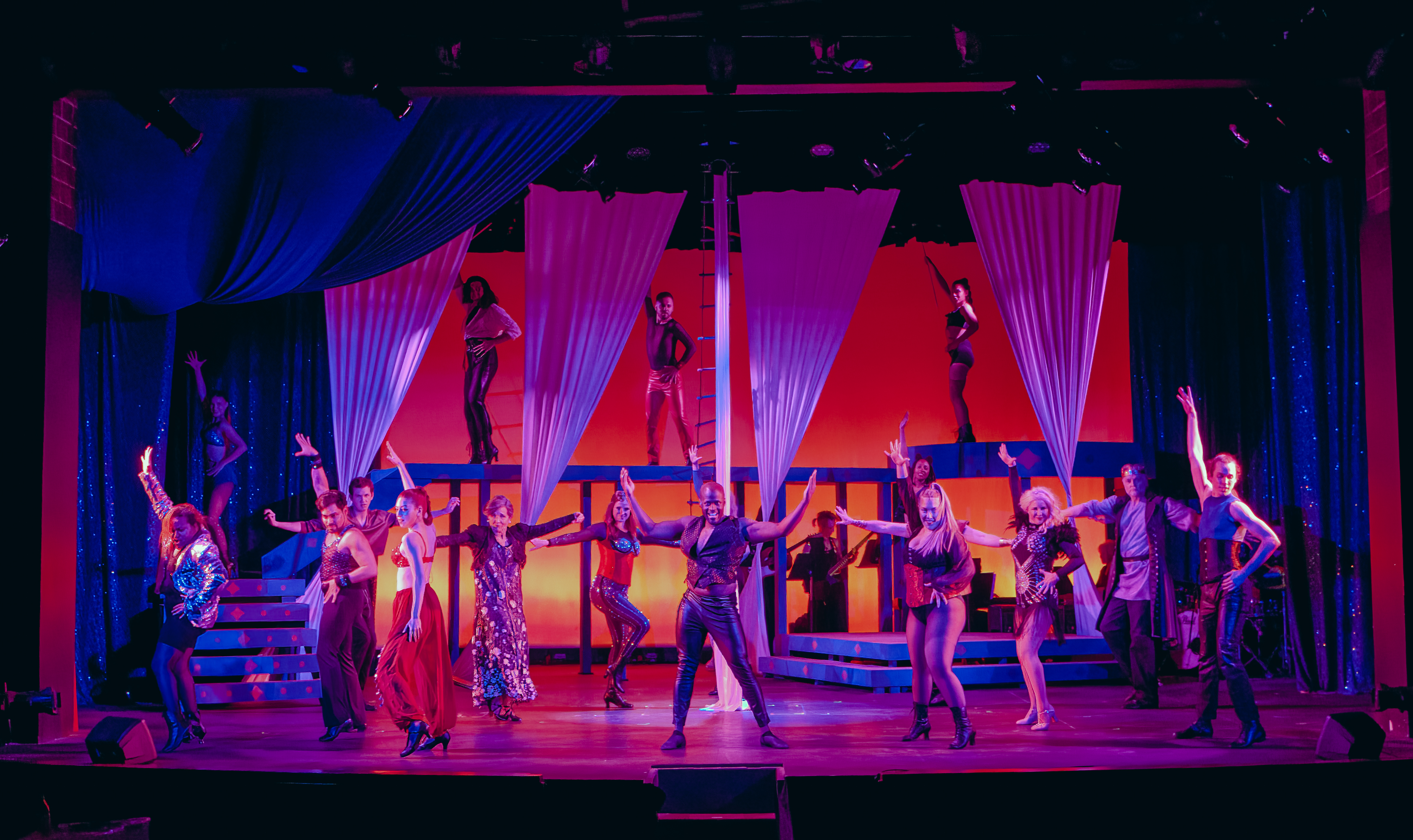
TC95-Pippin-018

There was plenty of magic to do last Friday night as Theatre Charlotte opened their new production of Pippin at the Queens Road barn. Opening night was happening in the wake of a dazzling Broadway Lights reveal at Belk Theater of a star-studded touring version of Into the Woods just three nights earlier. That compounded the new challenges already added by the 2013 Broadway revival of Stephen Schwartz’s 1972 hit, layering on new illusions, flying effects, circus acrobatics, and fire.

Behind the scenes, budgets and available talent are also stressed and stretched. Theatre Charlotte is embarking on an unprecedented series of four consecutive shows, hosting performances of Detroit ’67 (opening May 26) and I and You (June 16) at the old barn through June 25, after an excursion to the Uptown Mint Museum, where Picasso at the Lapin Agile will pay a visit beginning on May 5, the weekend after Pippin shutters. At home and on the road, TC’s running crews are booked for the next 10 weekends.

At first blush, it was tough for me to escape the notion that Woods witch Montego Glover’s wardrobe alone – not to mention her paycheck – was more expensive than this entire pipsqueak Pippin production. But the five-piece stage band directed by Lindsey Schroeder is tight, the ensemble directed by director/choreographer Lisa Blanton is brash and teeming with pro-grade talent, and the dance stylings by Sterling Masters-Deeney (home from a 12-year stint with the Broadway company of Wicked) are besprinkled with Fosse hands and pizzazz.

Before he composed Wicked, Schwartz wasn’t exactly sold on serious storytelling, so it isn’t difficult to swap out the narrative frameworks of Godspell and Pippin. Not for directors and most of the design team, anyway. For the acting troupe, most of whom are billed as Players; and for those designing the new Pippin effects and teaching performers how to execute them; it’s a different story. A granny on a trapeze? The original Javert from Les Miz learning parlor tricks? Tall orders.

Community theatres have scaled-down prep schedules as well as Slimfast budgets, so there were a few times – particularly when fire is involved – when you’ll need to brace yourself for disappointment. Otherwise, the acrobatics, the sawed woman, and the levitation stunt overachieved magnificently. Who knows, maybe by the second weekend, the kinks will be ironed out of the flame-throwings.TC95-Pippin-275

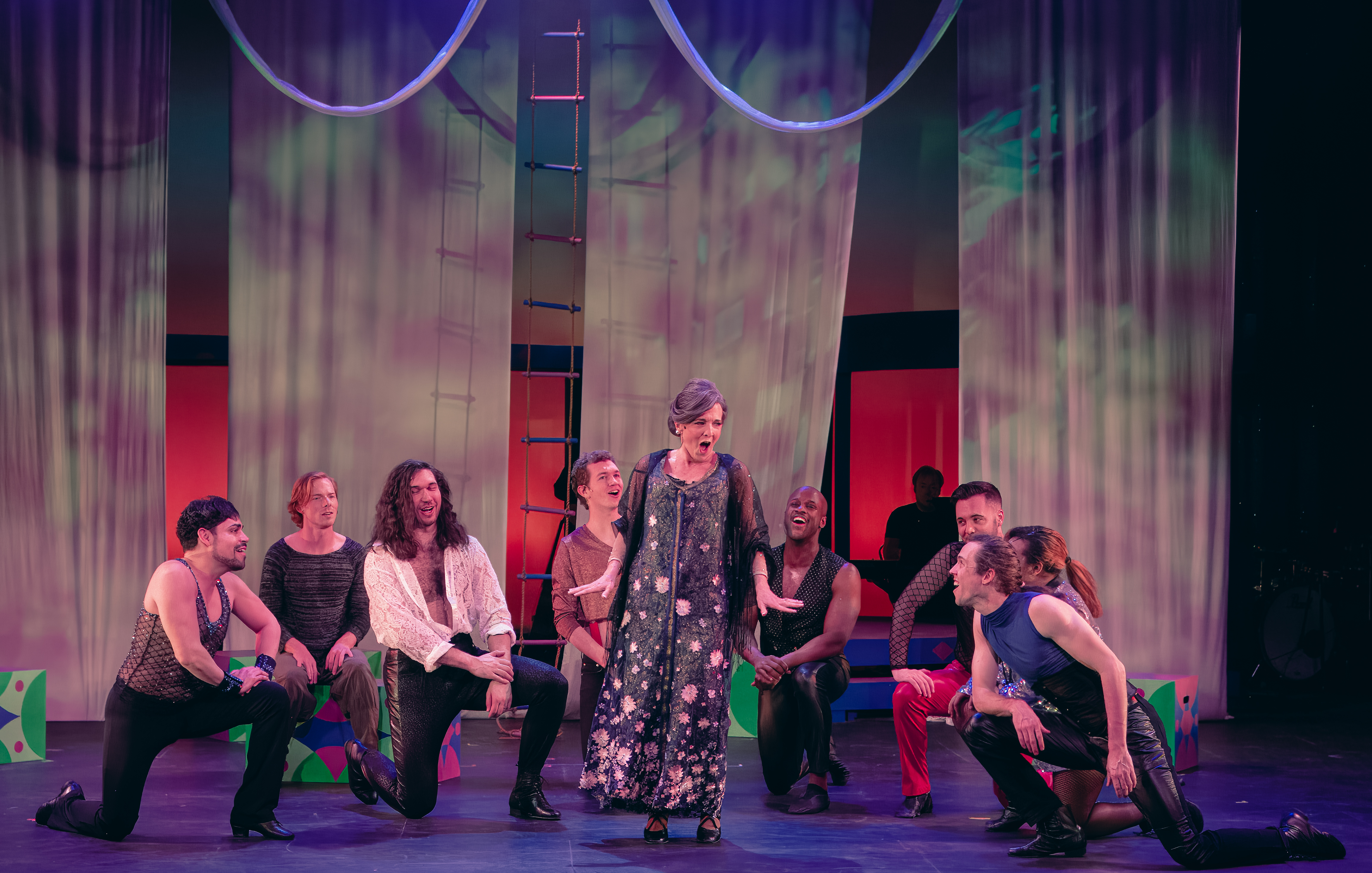
With Nehemiah Lawson as the Leading Player and Bart Copeland in the title role, both emerging from the ensemble of Theatre Charlotte’s Something Rotten, the bulk of Schwartz’s music and lyrics is in good hands. Lawson is a powerful presence and an excellent dancer, and the costume Beth Killion has designed for him strongly suggests black magic wizardry. Yet Lawson sometimes undercuts his own authority when he appears to be striving to precisely execute the choreography instead of taking over his moves, manhandling them, and making them his own.

The flimsy book by Roger O. Hirson is already lax in reminding us that the Leading Player is in charge of all the other players and their storytelling, so Lawson’s occasional spasms of fidelity don’t help. Yet his scenes with Sophie Lanser as the flawed and recalcitrant Catherine, Pippin’s true love, are beautifully calibrated in their give-and-take, and his climactic tantrum when Pippin rejects martyrdom is fairly breathtaking.

As Prince Pippin, Holy Roman Emperor Charlemagne’s son, Copeland is disarmingly wholesome, earnest, and at ease. His dancing prowess seems to improve before our eyes as he ages and becomes more worldly-wise, with an added grace that may stem from Copeland’s not taking himself seriously as a dancer. That kind of modesty works well for the major Pippin role that hasn’t won two Tony Awards (Ben Vereen in 1973 and Patina Miller in 2014), particularly when you’re a protagonist who finds himself beaten down in life no matter which path he follows toward fulfillment, his ”Corner of the Sky.”TC95-Pippin-154

While we savor the blithe amorality of Darren Spencer as Charlemagne, more aristocratic zest emanates from two female royals. Reveling in her corruption as Fastrada, Charlemagne’s current wife, Alyson Lowe gets to scheme against both her Emperor husband and her stepson Pippin, slyly maneuvering to install her valorous dimwitted son Lewis on the throne. Louann Vaughan draws the sunnier role as Charlemagne’s mom, exiled from court by the conniving Fastrada.

Her sunnier song, “No Time at All,” is the catchiest, a carpe diem song from Granny that espouses hedonism to Pippin as a better path than ambition. It also draws some of the most surprising staging as Berthe proves she hasn’t sunk into stagnant retirement. She’s as much of an opposite of Catherine as the cold-blooded Fastrada, for Lanser quickly forms a domesticated trio with Copeland and Logan Campbell as the widow’s son Theo, bonding together in the precious “Prayer for a Duck.”

Common farmer she may be – and maybe, according to Leading Player, the lowliest actor in the troupe – but Lanser reminds us she isn’t a doormat, aggressively seeking out a replacement husband when she’s on script in the Leading Player’s story and then pugnaciously inserting a song that he has not approved. Catherine needs Pippin and her “I Guess I’ll Miss the Man” is a long way from worshipful.

Matt Howie is the only other cast member who speaks, giving Pippin’s half-brother Lewis a surprisingly sweet tinge. After seeing him in numerous productions, most recently in Something Rotten, I’m not sure he can help it. Among the dozen dancers in unnamed roles, captains Georgie DeCosmo and Mitchell Dudas consistently excelled. Charlton Alicia Tapp also stood out as a slick ballroom lizard, and lithe Riley Gray breathtakingly took acrobatic honors ascending and descending the silks.

Shakespeare Is a Thieving Magpie in Theatre Charlotte’s “Something Rotten!”

Renovated Queens Road Barn is ready for its closeup

By Perry Tannenbaum

Something Rotten

 We are all stupid and silly – and we all love smart-ass musicals that tell us so. That’s the deep message of Something Rotten! Theatre Charlotte’s brash, big-ass extravaganza that’s raising the curtain for the grand reopening of the iconic Queens Road barn.

Yeah, it’s been awhile since a musical opened at our venerable community theatre’s home. That was early September 2019, when Oliver! launched what would have been the 2019-20 season. But COVID-19 shut everything down in early March, before auditions or rehearsals could even begin for Dreamgirls, scheduled to open in late spring. Then a latenight fire in the waning hours of 2020 gouged a huge hole in the theater floor, smoked the ceilings, and fried all the precious electronics – lights, audio, AC, computers – and kicked the company out of their house.

For over two years, while more than $1 mil in repairs, renovations, and new equipment requisitions could be authorized and completed, artistic planning continued while navigating insurance adjustments and jumping municipal hurdles. While the new 501 Queens Road gestated and marinated for more than two years, the company hit the road, resuming production in September 2021 and hopscotching the city to keep Theatre Charlotte alive in Charlotte. The Palmer Building, Halton Theater at CP, and the Great Aunt Stella Center were the first three stops on the season-long 2021-22 road trip.

Now there have been five or six shows at the old barn, in play or concert format, since Oliver! closed back in 2019, including two iterations of A Christmas Carol, a Theatre Charlotte gotta-do-it tradition. But nothing short of a musical, one with an authentic exclamation point yelling out its title, can truly show off a theater’s brand-new bells and whistles – or put them to their ultimate test.

Of course, there had to be some extra drama, an extended drumroll, before Something Rotten! could give the renovated Queens Road barn its much-anticipated relaunch. Scheduled for its closeup last October, the revamped site wasn’t going to be ready for opening night. The 2022-23 season had to be reshuffled, and the wondrous Shakespearean mashup of a musical was postponed.

A construction project. In Charlotte! Can you believe it wasn’t finished on time??

Billy Ensley, after directing the first little musical away from TC’s home, The Fantasticks, now pilots the first leviathan since the company’s return. Three of his mates from that Palmer Building gem back in 2021 are on board with Ensley for this new voyage, all of them playing major roles and all of them delivering.

I was fairly bowled over by the brash irreverence of Something Rotten! when I first encountered this Karey and Wayne Kirkpatrick concoction on Broadway in 2016. You might wonder if the Kirkpatricks had the zany antics of The Compleate Wks of Wllm Shkspr (Abridged) on their minds when they decided to take aim at the Bard of Avon and musicals.

Certainly the methods of their madness can be traced to the Reduced Shakespeare Company – with genetic material from Forbidden Broadway and The Producers also in the DNA. The Kirkpatricks discard the merely dubious ideas that Shakespeare’s works were written by someone else, or that his awesome greatness was only fully appreciated after he died. They ignore the reality that there’s only faint, sketchy traces of the man over the course the grand Elizabethan Era.

No, all those tropes are toast. The Kirkpatricks, with John O’Farrell collaborating on the book went full-bore misinformation and alternate reality. Months before The Donald descended the Trump Tower escalator.IMG_2969-2

Shakespeare is no longer a dim peripheral figure on the Elizabethan cultural scene. He’s a full-blown superstar, recognized and wildly adored wherever he goes. Mobbed by his rabid fans, he gives outdoor spoken-word concerts to sustain the mass hysteria.

The secret of the Bard’s genius is revealed. Like the Reduced Shakespeares, Forbidden Broadway, and the Kirkpatricks after him – not to mention The Donald – the real Shakespeare was a thieving magpie. Not only did he steal from ancients like Plutarch and Ovid, predecessors like Chaucer and Boccaccio, and contemporaries like Christopher Marlowe, he cribbed from unknown wannabes and the man or woman on the street.

Case in point: after defecting from Nick Bottom’s struggling theatre company, Will takes his former boss’s name with him and dumps it into A Midsummer Night’s Dream. Another case in point: Sniffing out the possibility that Nick is working on something revolutionary for the stage, Shakespeare embeds himself in his former company, where he swipes the complete manuscript of Hamlet from its true author, Nigel Bottom. Because big brother Nick has astutely told him that “to be or not to be” is trash. Not to be.IMG_2417

A hapless mediocrity, Nick is our hero. In his crazed search for the next new thing in theatre, Nick seeks out a soothsayer to look into the future, a rather Shakespearean ploy. The eccentric soothsayer that Nick picks, Nostradamus, turns out to be a genuine visionary, but his inner crystal ball seems to be afflicted with astigmatism. Skipping over the breakthrough artform of opera on the near horizon, soon to be birthed in Italy, Nostradamus is himself amazed to see… a musical!

So powerful is this concept that Nostradamus cannot even say the word without a vatic, conjuring sweep of his right arm. He wants Nick – and us – to see it clearly, too. Nick, poor thing, doesn’t have as juicy a role as the raving Nostradamus, who must convince his skeptical client that such an impossibility can be created, believed, and become universally popular. He’ll be able to bring my play to a complete stop and have my speaking characters suddenly start singing? And he’ll be able to interrupt this blatant interruption with a whole crowd of people dancing? Tap dancing?IMG_2703

Yes, yes, and yes, Nostradamus prophesies, and audiences will lap it up. We do see, for we were living proof of this seeming insanity at the Queens Road barn, just like I was at the St. James Theatre in 2015.

Over and over, the Kirkpatricks reinforce the idea that the road from brilliant concept to acclaimed masterwork is strewn with pitfalls. Nick begins with a colossal misstep, an upbeat number called “The Black Death,” which strives to match Mel Brooks’ “Springtime for Hitler” in utter tastelessness.

So Nick hurries back to his soothsayer. What will Shakespeare’s greatest triumph be, he asks, determined to beat the Bard to the punch. Pushing away invisible cobwebs between him and the future, Nostradamus proclaims, Omelet, the Musical is the future, confident he’s setting Nick on the right track.

With creditors and prudish censors dogging his way, Nick has ample complications to overcome. The backbreaker is Nigel’s resistance. Instead of sticking to the yolks and the big egg picture, Nigel is spouting useless lines like “To thine own self be true.”

Another Shakespearean device comes into play with little brother, the double plotline. While tasked with writing the world’s first libretto, Nigel is smitten by Portia, the lovely daughter of Brother Jeremiah, the most sanctimonious and censorious Puritan in London. Avid admirers of Shakespeare, both Portia and Nigel can see the parallel between their star-crossed plight and the tragedy of Romeo and Juliet, their idol’s newest hit.IMG_3812

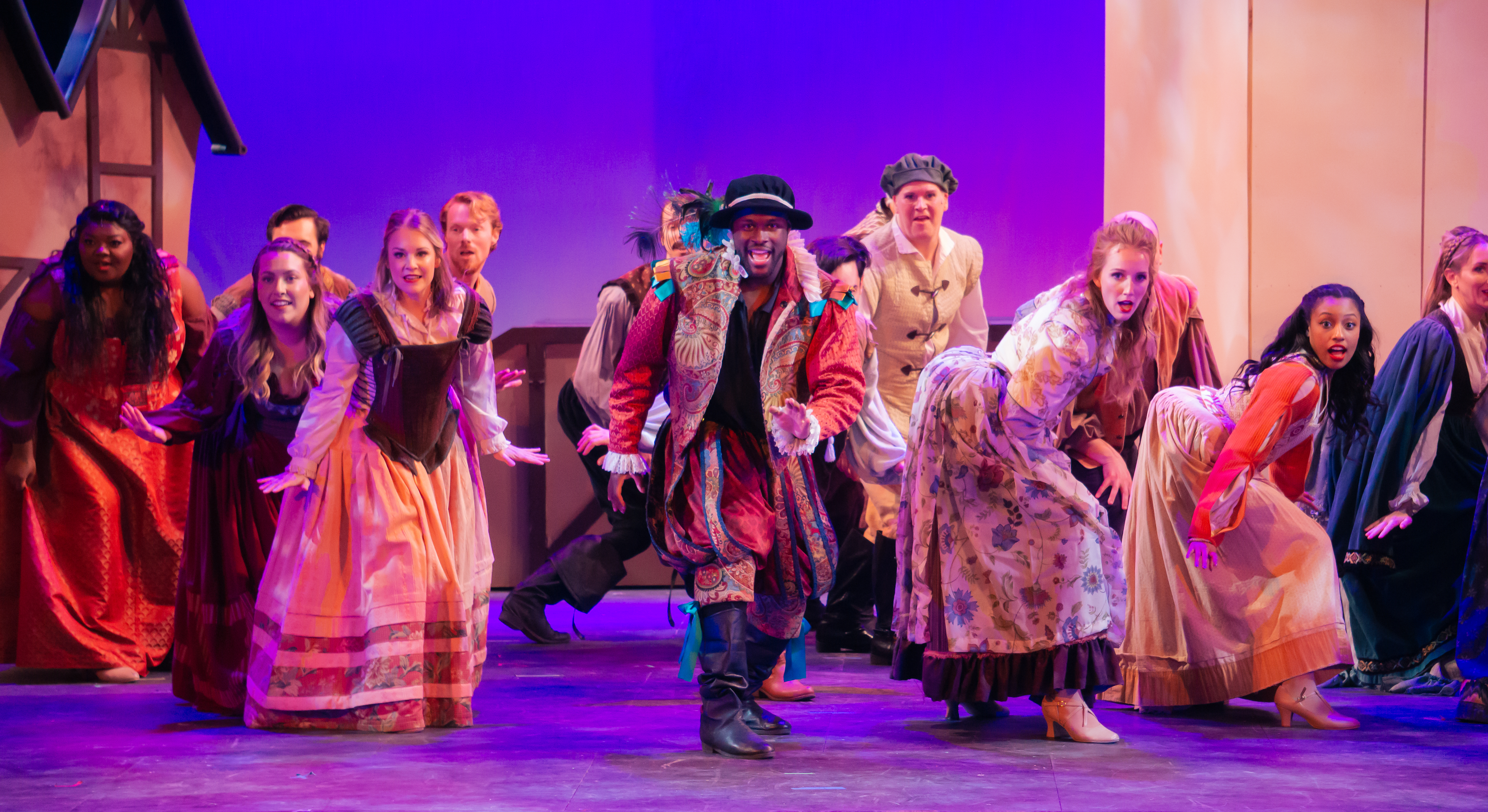
Ensley’s eager, able, well-drilled cast of 25 can seem like a teeming city in the confines of a barn, heartily welcoming us to two Renaissances, really, with Nehemiah Lawson as the Minstrel leading the ensemble’s bustling greeting – to the refurbished theater and olden days – when the curtain rises. They can form a credible mob around Will when he struts upon his stage.

Along with such teeming scenes, Ensley and choreographer Lisa Blanton and headshot sketch artist Dennis Delamar can pour in numerous references to familiar, beloved musicals we all know. Explicit references to Phantom, Les Miz, Cats, Sound of Music, and Chess are in the Kirkpatrick-O’Farrell script, but what about the sly nods to Annie, A Chorus Line, The Producers, and West Side Story?

There are more Broadway allusions than I’ve mentioned and still more that I may have missed. Ensley keeps the pace brisk.

Twice cast as Jesus at Theatre Charlotte in past seasons; along with leads in Rent, Memphis, and Arsenic and Old Lace; Joe McCourt steers us through Nick’s sea of troubles. Folks out in Matthews would remember McCourt’s exploits in Bonnie and Clyde more vividly, his first team-up with Ensley. The Arsenic and Old Lace agitation as Mortimer, when McCourt strayed from musicals into comedy, served as a nice precedent for his work here. When he leans away from straight-man chores opposite Will and Nostradamus, and into Nick’s showpieces, McCourt flashes his confident charisma – with comical seasoning – when he fumes “God, I Hate Shakespeare.”

McCourt is no less in command when he brings down the curtain for intermission with “Bottom’s Gonna Be on Top,” though his best soufflé may rise when he greets his troupe for the first Omelet rehearsal, absurdly exclaiming “It’s Eggs!” Yet this wannabe turn is decisively upstaged by the conceited rockstar and the wild-eyed prophet.

Perfectly cast at the Palmer in The Fantasticks, Mitchell Dudas and Kevin Roberge are even more smashing now. Dudas was a wonderfully swashbuckling El Gallo, the beguiling Fantasticks narrator, but he’s far slicker and more self-absorbed here, shining in his wicked showpieces, “Will Power” and “Hard to Be the Bard.” And the sheer arrogance of him when Dudas flashes his Shakespearean smile! You expect little LEDs to twinkle at the edges of his teeth.

Since “The Black Death” is an ensemble slaying, it’s Roberge who gets the killer solo of the night, “A Musical,” indoctrinating McCourt so thoroughly that the conjuring sweeps of Nick’s arm become nearly as prophetic. After his portrait of the more blustery Fantasticks dad, Roberge turns up his leonine energy more than a few notches. And the hair! Far more eccentric than the Einstein in Verizon ads. Think Charlton Heston on top of Sinai in The Ten Commandments.

Matt Howie, the naïf swain from Ensley’s Fantasticks, and Cornelia Barnwell mesh beautifully as the confidence-challenged Nigel and the overprotected Portia. But they’re overshadowed by a slew of quirkier characters who don’t sing nearly as much. Who comes first? Maybe Lindsey Schroeder as Bea, Nick’s proto-feminist wife, who fills out the contours of Shakespeare’s Portia in a memorable courtroom scene.

Certainly Hank West vies for the honor of favorite minor character as the shifty and resourceful Shylock, who remains a moneylender in Shakespeare’s world but transforms into the first theatre producer in Nick’s troupe and the New World. Delamar, our sketch artist and longtime Theatre Charlotte idol, gets props here for portraying a pair of pomposities: Lord Clapham, Nick’s skittish financial backer, and the Judge who must sentence Nick for his trumped-up crimes.

If there’s space for a feminist, a theatre producer, and a rockstar in this Renaissance makeover, there’s also room for a gay preacher and an outré transvestite. J. Michael Beech’s homosexuality as Brother Jeremiah is hardly latent at all as he strives to keep himself closeted with indifferent success, and we can presume that Paul Reeves Leopard as Robin gets the pick of the women’s roles in the Bottoms’ troupe, perennially dressed and simpering for the part.

Brave New World!

If the players I’ve named thus far decided to form a professional theatre company, I’d only be mildly surprised by their audacity. The new Old Barn made them all look good, first with the opulence of Chelsea Retalic’s period costumes – and the stark anachronism of Shakespeare’s glitter. Chris Timmons’ set designs didn’t look like he was working on a shoestring budget, either, indoors or out.

Better yet, the renovated 501 Queens Road facility has remained true to itself, in its lobby and its theater space. In the lobby, there are new, more modern-looking ceiling fans, which sit admirably flush to the upgraded ceiling. There were still extensive lines to the restrooms, so my inspections of the toilet – and the new backstage – must await visits to come.

In the theatre hall, the skeleton of the new scaffolding isn’t fleshed out at all with sheetrock, so the roofbeams are visible all the way to the bricks that meet it at the proscenium wall. More like a beloved old barn than ever! Artistic director Timmons, wearing his second hat as acting executive director, told me that the renovations made it possible to raise the stage proscenium. Yet there was a shower of confetti to climax the finale, where the “Welcome to the Renaissance” melody completes its last rebirth as “Welcome to America.”

Can’t remember the last time, if ever, that I had seen evidence of a functional fly loft at the Queen Road barn.

Best of all, there was a profusion of theatre lights shining in many colors, along with strategically spaced audio speakers. All are discreetly black, of course, so I couldn’t resist taking flash photos to confirm that all this equipment is spanking new. Everything worked flawlessly, including Theatre Charlotte’s soundboard. Nor did I notice any coughing or humming from the heating system. All was bliss, best feet forward, with nothing rotten except the show’s title.

Don’t be shocked to find that Something Rotten! is sold out for the rest of its current run. The show, the production, and the newborn theater are all that good. Timmons & Co. may need to add performances to meet the well-deserved demand.

CP’s “Joseph” Connects With Talent and Style, Frustrates With Ongoing Audio Woes

Review:  Joseph and the Amazing Technicolor Dreamcoat at Halton Theater

By Perry Tannenbaum

THEA2021-DLV-0708-2138

Before this weekend, Halton Theater hadn’t opened its doors to a theatre crowd since February 2020, and Central Piedmont Community College Summer Theatre had been dark since July 2019, when they closed their five-show season with A Gentleman’s Guide to Love and Murder. Returning to the Halton stage as guest director of Andrew Lloyd Webber’s Joseph and the Amazing Technicolor Dreamcoat, Tom Hollis posed a poignant question during his introductory remarks. Does it really count as a season when a company offers its audience just one production? Even the most loyal Central Piedmont supporter can’t buy a 2021 season ticket, that’s for sure. And until Central Piedmont Community College completes its recovery from a debilitating ransomware attack this past winter, they won’t be able to accept credit card payments at their Overcash ticket windows. Cash or checks for walk-ups, plastic for online sales only.

Opening night at Halton was a cautious first step back toward pre-pandemic norms – with a Delta-be-damned giddiness to it as COVID protocols were loosened at last. For most of the crowd mingling in the Halton lobby before and after the show, this was probably the first public event they had risked in at least 16 months, a milestone moment. For the theatre folk scattered among us, it was an emotional reunion – an affirmation.

Last season was originally envisioned as Hollis’s grand valedictory after nearly four decades at Central Piedmont, his latter years as theatre department chair. An encore reset of the lost 2020 season was rumored for a while as Central Piedmont scrambled with their winter programming, so Joseph is a double surprise – not among the shows announced for the lost 47th Central Piedmont Summer Theatre season and the only show replacing them. Previously mounted in Summer 1993 and revived in Summer 2001 at the now-demolished Pease Auditorium (the CPCC Theatre production of 2008 at the Halton was a wintertime affair) – with rousing success on all occasions – Joseph is likely more bankable than Footloose, lighter on the budget than The Music Man, and far better-known and cheaper to produce than Something Rotten! Additionally, there is likely a finely calculated ecology in a true Central Piedmont Summer season that allows the college the biggest bang for their bucks when auditioning and casting their overall troupe of performers and designers. These discarded musicals, plus Peter Pan Jr. and a Ken Ludwig comedy, might conceivably be in cold storage, slated for resurrection in 2022.THEA2021-DLV-0708-1267

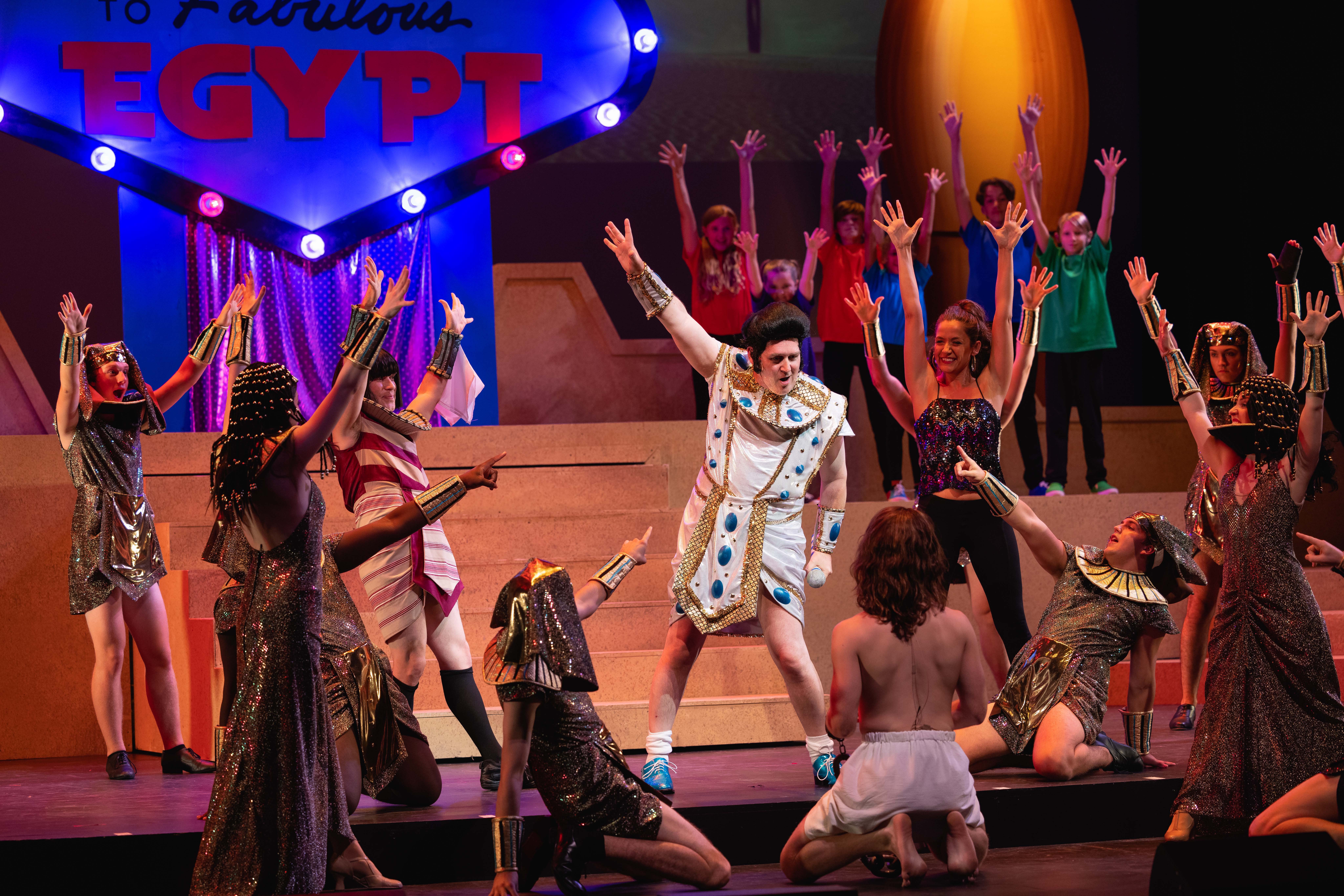
Sitting in Row K, I only noticed one gentleman taking a restroom break during this intermission-free presentation, and I was somewhat surprised that the cast began taking their bows a mere 71 minutes after the show commenced. Another eight minutes came packaged in a “Megamix” reprise of Webber’s most bodacious songs – or parodies, since the composer delights in shuttling among an unlikely array of genres in retelling the most epic tale from the Book of Genesis, aided by Tim Rice’s lyrics. The news of Joseph’s demise is delivered to his doting father, Jacob, in the form of a sobbing lone-prairie cowboy song. Pharaoh is transformed into a pre-historic Elvis as he rocks his account of his prophetic dreams. The poverty of Joseph’s 11 brothers during the years of famine takes on the nostalgic air of a sad French café, complete with Apache dancer, and Naphtali’s pleas for the innocence of little brother Benjamin come in the form of a Caribbean calypso.THEA2021-DLV-0708-1815

Curiously, the irreverence and multitudinous anachronisms of this Webber-Rice concoction, not to mention the narrative alterations of Holy Writ, have never seemed to spark any massive public outcry from Judeo-Christian clergy. Maybe the outright anachronisms, beginning with the Technicolor in the title, insulate all the irreverence and textual tinkering from being taken seriously. James Duke’s scenic design and Bob Croghan’s costume design underscore the assurance that we are not in the immediate vicinity of ancient Egypt or Canaan, fortified by the equally anachronistic projection designs by Infante Media. No, this is more like a Disney or a Las Vegas style of Egypt, with Duke taking full advantage of the lordly height of the Halton stage compared with Pease’s pancake panorama. Our Elvis is also a Vegas version, clearly the sequined, jumpsuited, decadent superstar of his latter days. The Duke-Infante collaboration is so glittery and colorful that it is only slightly upstaged by Croghan’s creations for Pharaoh and Joseph.THEA2021-DLV-0708-1357

You don’t often get the chance to design a costume that is hyped in the title of a show, and Croghan, on the Charlotte scene even longer than I, doesn’t disappoint. The impact of this mid-pandemic return to live theatre caught me off-guard several times. Each time a major character made his or her first entrance – Lindsey Schroeder as our Narrator, Rixey Terry as Joseph, and J. Michael Beech as Pharaoh – I had that tingling sensation of recognizing something basic and exciting that had been missing in my life for over a year.

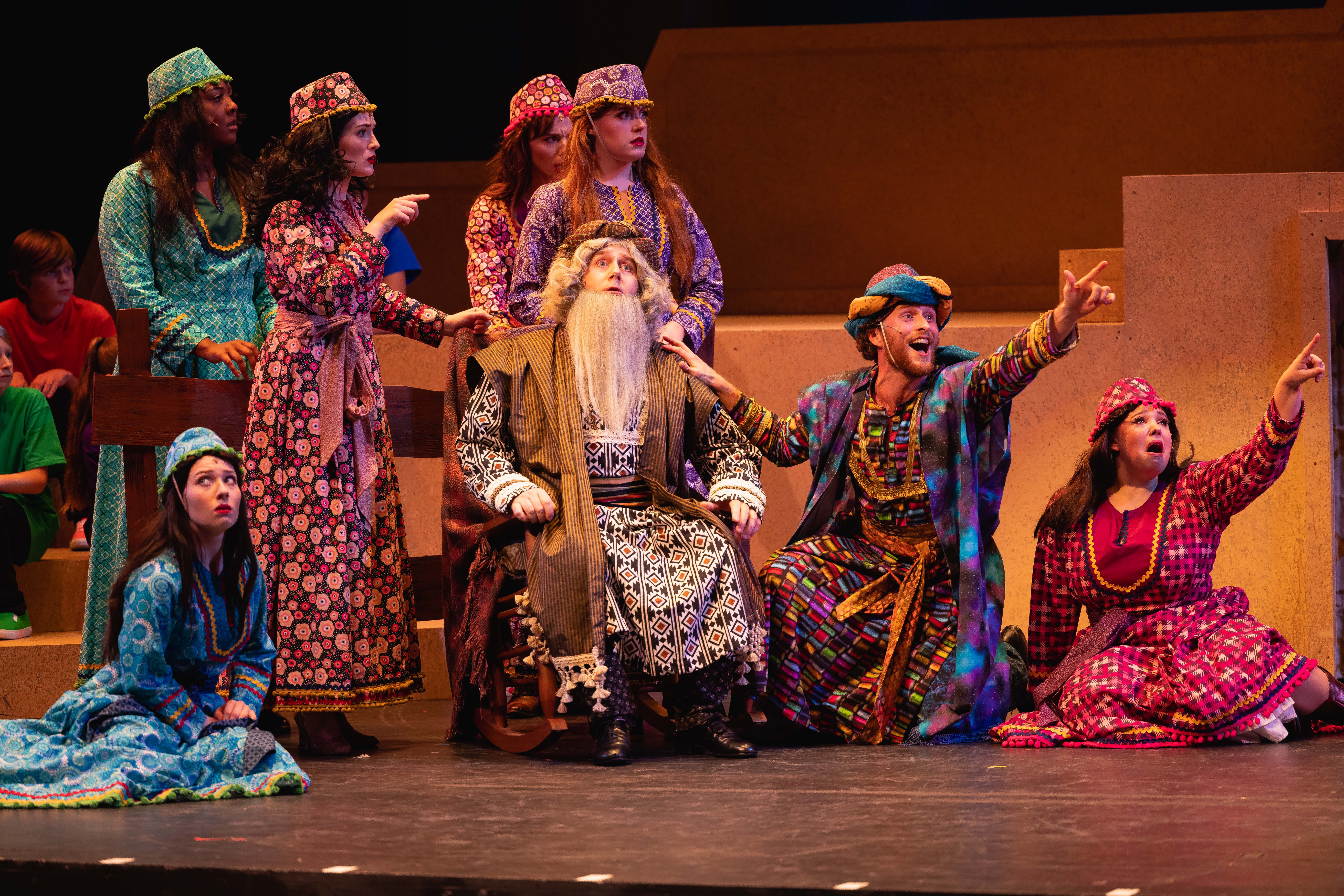
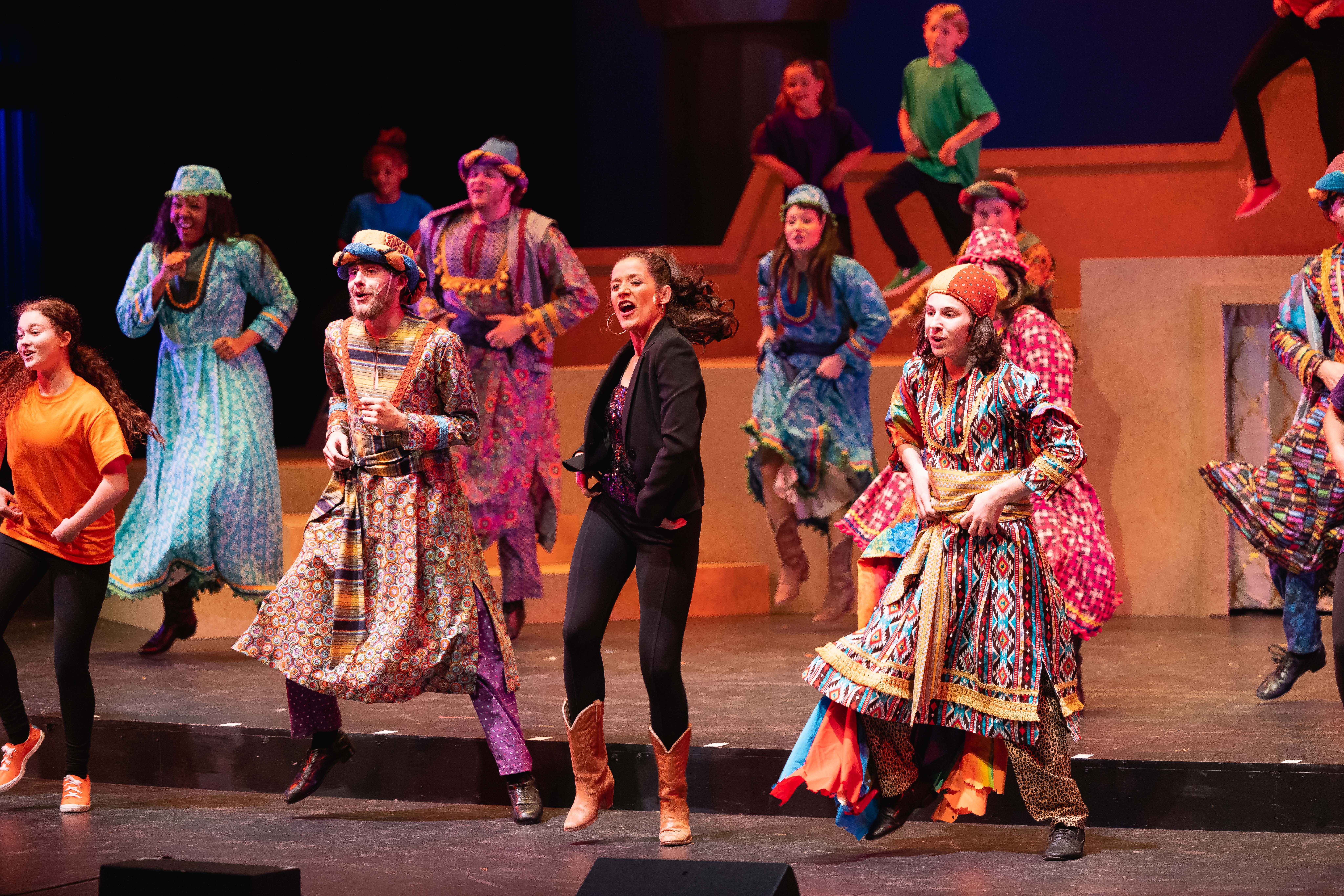
My biggest surprise, a frisson of renewal, came from the audience when they reacted to the most iconic moment in Joseph, when the brothers picked up the skirts of Croghan’s knockout dreamcoat so that it formed a pinwheel around Rixey, spinning around as he, Schroeder, and the ensemble sang “Joseph’s Coat.” Anybody even glancingly familiar with musical theatre anticipates this moment before it happens, or at least recalls it fondly from a previous encounter. But part of the audience at Halton erupted in delighted and surprised laughter, recalling what the first London and Broadway and high school audiences must have experienced when Joseph was new and reminding me of my own delight back in 1993.THEA2021-DLV-0708-1130

Rixey walked a treacherous tightrope, blending innocence with vanity as beautifully and energetically as any Joseph I’ve ever seen, lacking the cloying wholesomeness that only true Donny Osmond fans will miss. Maybe a plunge or two into that saccharine syrup might make Rixey more memorable in “Any Dream Will Do,” but I would prefer that he add a sprinkling of excess to those melodramatic moments when he is unjustly imprisoned, crying out his “Close Every Door.” Lighting designer Jeff Childs does come to the prisoner’s rescue, adding some spiritual gravitas.

Schroeder was brimful of brilliance as the Narrator, infusing enough energy into her string of recitative that it never devolved into tedious singsong, though she was often unintelligible. Beech’s misfortunes with his microphone were even more egregious as Pharaoh, including intermittent sonic dropouts, but his audio setup was likely jostled over the course of the evening, since he donned different costumes and headgear for his other roles – Jacob, Potiphar, and the doomed Baker.

Admittedly, it’s churlish of me to keep harping on Central Piedmont’s defective sound equipment and the cavalcade of professional-grade technicians who have failed to tame it. North of $115 million are being spent on replacing Pease, originally a lecture hall, with a genuine theatre facility, while Central Piedmont’s audio woes have gone unaddressed since 2005, when the Halton was new. But new generations come to the Halton every year, and new summer visitors from afar get their first taste of Charlotte theatre there – and they still need to be cautioned. By the time the “Megamix” came around on opening night, Beech’s “Song of the King” was only fitfully audible and Schroeder’s mic was intermittently dropping out.

THEA2021-DLV-0708-1993

More power, then, to the performers onstage who merrily soldiered through. Even the charade of the brothers’ mournful moments was untarnished. All of the cameo solos hit their marks. Matthew Howie was hilariously rusticated as Reuben delivering the bad news to Jacob with “One More Angel,” and Neifert Enrique as Simeon – aided by his brothers and Emma Metzger’s scene-stealing table dance – brought a boulevardier’s wistful regret to “Those Canaan Days,” with more than a soupçon of self-mockery in his lamentations.

Even more THEA2021-DLV-0708-2049irrepressible and irresistible was the calypso lightness and joy that Griffin Digsby brought to the “Benjamin Calypso” as Naphtali. Around the third or fourth time Digsby reached the “Oh no! Not he!” refrain, I had to stop myself, for I had started to sing along. Just another adjustment I’ll need to make after 16 months of consuming theatre in front of my computer monitor and TV set. It was hard to be displeased by anything that accompanied this welcome change.

Debased Jekyll and Monstrous Hyde Still Have Admirers at CP

Review:  Jekyll & Hyde

By Perry Tannenbaum

CPCC "Jekyll & Hyde" Final Dress Rehearsal, June 20th, 2019 

Like other famed works of literature that have been turned into films, plays, and musicals, the story and characters of Strange Case of Dr Jekyll and Mr Hyde have long ago ceased to belong exclusively to their creator, Robert Louis Stevenson. The most obvious measure to thicken the plot – my paperback copy is a scant 68 pages – is to supply Jekyll with a fiancé to agonize over when he can’t control his nightmarish transformations into Mr. Hyde. After that initial blandishment for the stage, Hollywood added a second woman for Hyde to prey upon.

CPCC "Jekyll & Hyde" Final Dress Rehearsal, June 20th, 2019

In rewriting the story for Frank Wildhorn’s musical Jekyll & Hyde, Leslie Bricusse layered on additional refinements. Bolstering Jekyll/Hyde’s motivations, Bricusse added a board of governors at a hospital that turns down the Dr.’s highly risky experimental research. Though the board’s decision looks better and better as Jekyll’s experimentation on himself becomes more and more catastrophic, we can see why Hyde is targeting Bishop Basingstoke, Lady Beaconsville and others for his brutality.

Before Jekyll’s wedding day is over, Hyde has collected the complete set of governors with the exception of his prospective father-in-law, who abstained with his vote. So much for the board’s cautious medical judgment. After all, distilling the essence of man’s evil nature was a fabulous idea, was it not?

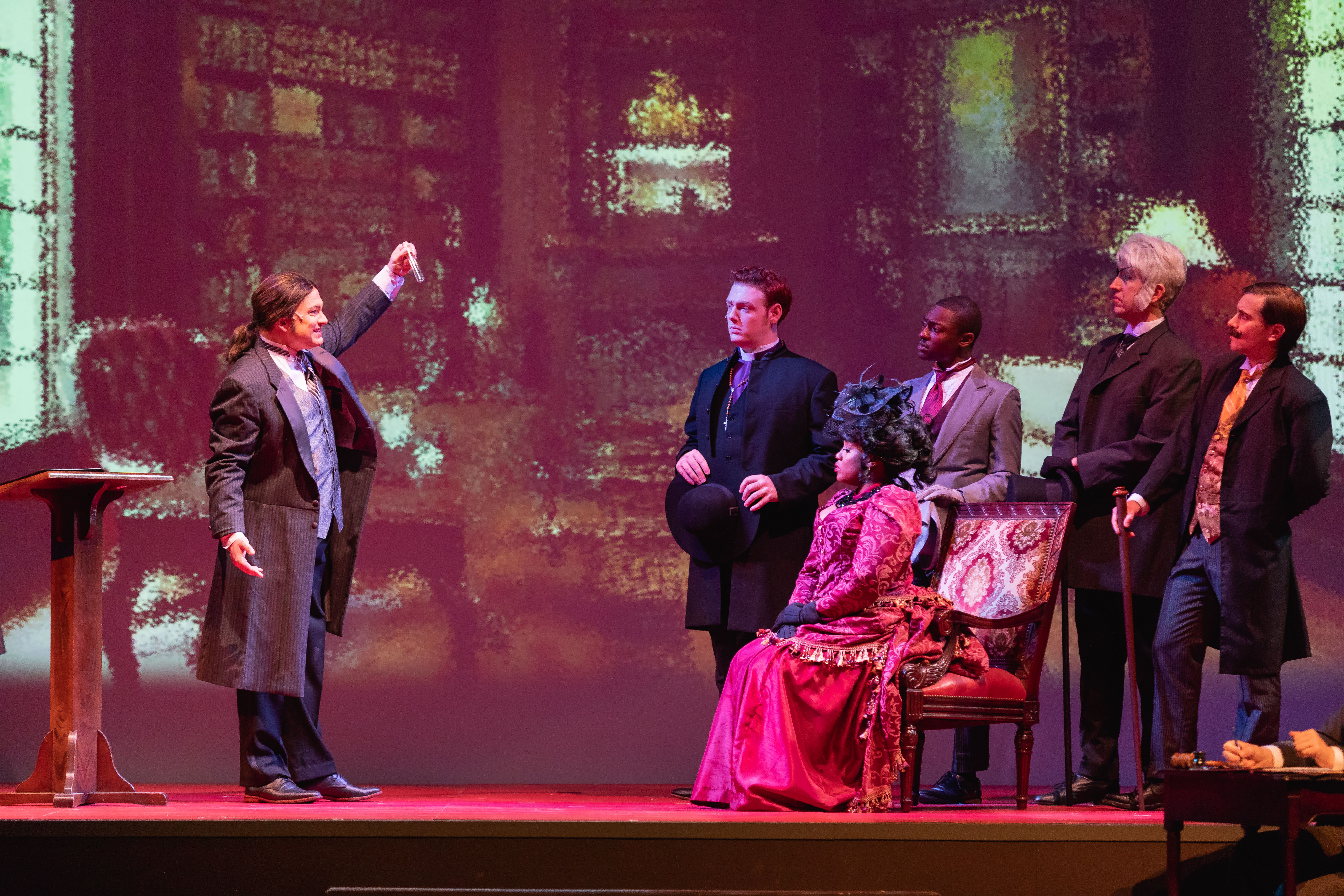
Presenting the Wildhorn musical for the first time at CPCC Summer Theatre in 17 seasons, director Tom Hollis goes with a version of the show that’s closer to the 2013 Broadway revival of J&H than the original 1997 adaptation. Wading through the alternatives of how to present the climactic “Confrontation” solo duet – Jekyll and Hyde switching repeatedly back and forth – Hollis and his star, Tommy Foster, go retro with some major electronic enhancements. You’ll see Foster’s face when he’s Jekyll, demanding that Hyde set him free, and when Hyde retorts, “you are me,” his long mane of black hair covers all.

No pre-recorded Hyde for Foster, who doesn’t chew his locks too many times during his Hyde hair flips. Scenic designer Robert Edge, leaning heavily on video for many of the scene changes, projects a spinning vortex behind Hyde a la Hitchcock’s Vertigo as the murderer gets the upper hand, but sound designer Stephen Lancaster has more dramatic impact. From the time Hyde first emerges, Foster differentiates his voice from Jekyll’s, but during Act II, as Hyde becomes more monstrous, Lancaster dials in more huffy echo-laden feedback.

Remembering that the sound system at Halton Theater has been treading water at best since the hall was first opened in late 2005, we have to acknowledge that Lancaster, moving beyond adequacy to creativity, has achieved a breakthrough. Notwithstanding those electronic embellishments, Foster’s performance sizzles and electrifies on its own. Forget the power ballads that he torches – I’d actually like to forget a few of those American Idol abortions that clutter the score – and just see what Foster does, as Hyde alone, with the demonic energy of “Alive!” as Act I ends. Riveting.

Yet the most daring and brilliant choice that Hollis and Foster make is with Jekyll, making him more of a hothead than I’ve ever seen before, doctor or not. This guy is on the brink of losing his grip while he’s being questioned by the governors and even more so when he is turned down. That garish fluid Jekyll injects into himself still isn’t a placebo, but the thought crossed my mind.

CPCC "Jekyll & Hyde" Final Dress Rehearsal, June 20th, 2019

While all that Foster, Hollis, and his design team do with the dual leads make Jekyll and Hyde more exciting and cohesive, they sure don’t enhance my regard for his way overindulgent leading ladies. When Lucy, the loose saloon girl fatally attracted to Hyde, is told that she needs to leave London immediately to escape the deranged murderer, she sings, “A New Life” and goes to bed. Even as she pours out her heart into her fourth or fifth power ballad, you know she’s staying.

Emma, the pure-hearted fiancée, is another piece of work. At the climactic wedding scene, she watches Jekyll turn into Hyde, watches him murder the last of his enemies in cold blood, and does she turn away in horror or disgust when he perishes? Not exactly. The final tableau, with Emma huddled over the fallen Jekyll, is more like a Pietà. Utterly loathsome.

Times have changed since Linda Eder, who would become Wildhorn’s wife, originated the role of Lucy on Broadway in 1997. Grown lurid and rancid, the storylines of Lucy and Emma both sorely need a refresh.While Hollis made both of the ladies’ final scenes a bit cringeworthy, he certainly didn’t err in his casting. No daring or brilliance was necessary here. Karley Kornegay was the devilish leading man’s “Angel of Music” when Hollis directed Phantom of the Opera in 2015, and now she’s Jekyll’s angelic Emma. More recently, Lindsey Schroeder was the coarse lady outlaw in Wildhorn’s Bonnie and Clyde at Matthews Playhouse, and now she’s his wanton Lucy. Any questions about whether they’re right for their roles is answered long before they sing their wondrously unwoke duet, “In His Eyes,” idolizing both halves of our hero’s split personality simultaneously.

In a grotesque way, “In His Eyes” and “The Confrontation” are a matched set.

CPCC "Jekyll & Hyde" Final Dress Rehearsal, June 20th, 2019

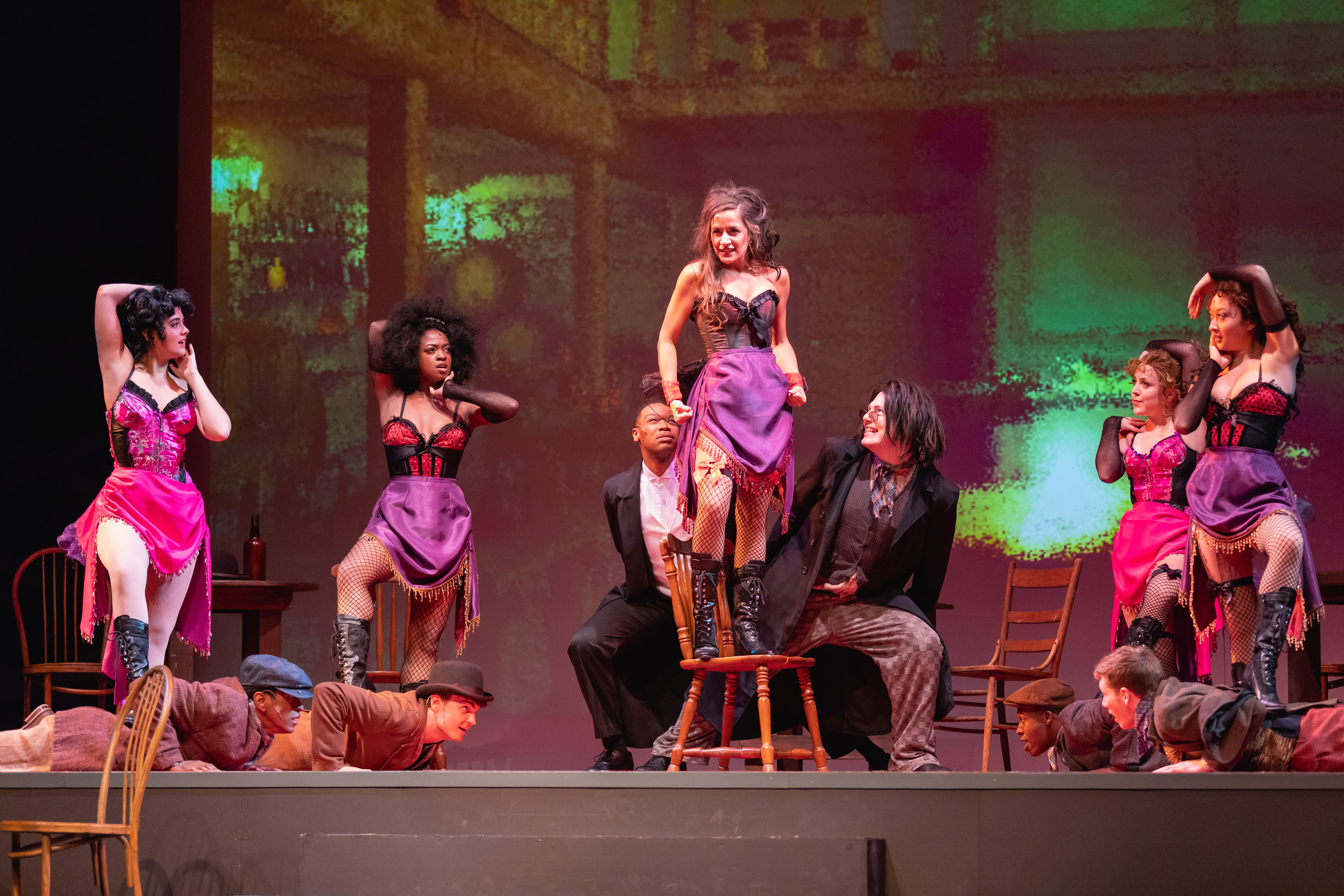
Nobody else gets an American Idol moment in this belt-a-thon, but choreographer Tod Kubo and costume designer Robert Croghan turn up the heat colorfully at The Red Rat Club in “Bring on the Men,” where Lucy makes her first splash, setting herself apart from the other risqué saloon girls. There are also Phantom-like moments (if you recall “Masquerade”) each time the ensemble sings and numbingly reprises “Façade.”

Notwithstanding the elementary psychological truths that Briscusse rehashes about human pretense and deceit, he doesn’t offer many other performers an opportunity to craft two-dimensional portraits, let alone transcend them. Hollis has an embarrassment of riches to deploy on these thin characters. After proving himself up to the challenge of Gaylord Ravenal in Show Boat, Ashton Guthrie as hospital colleague Simon Stride gets only a precious few seconds to reveal himself as Jekyll’s rival – or at least a jealous aspirant to Emma’s affections.

CPCC "Jekyll & Hyde" Final Dress Rehearsal, June 20th, 2019As the only other surviving character from Stevenson’s 1886 novella, Jekyll confidant John Utterson really gets short shrift in the Bricusse book. Tyler Smith ranges very far from his humble “Ol’ Man River” role in Show Boat, giving Utterson true elegance and distinction. Making his first appearance at CP in 2019, where he has performed mostly leading roles over the last 35 years – Camelot and Grand Hotel are among my faves – Jerry Colbert cuts a venerable figure as Danvers Carew, Emma’s ambivalent dad.

Protective toward his daughter, appreciative of Jekyll’s potential, wary of his colleague’s volatile temperament, but abstaining when the governors vote, Danvers sets the tone in crucial ways. Colbert’s “Letting Go” duet with Kornegay finely balances his fatherly affections and trepidations. Trouble is, with Foster giving us a Hyde that is such a natural outgrowth of his Jekyll, it shouldn’t be a close call for Danvers. Or for his daughter.

Excellent CPCC Cast Isn’t Weary of “Show Boat”

Review: Show Boat

By Perry Tannenbaum

Show Boat Dress Rehearsal; June 6th, 2019

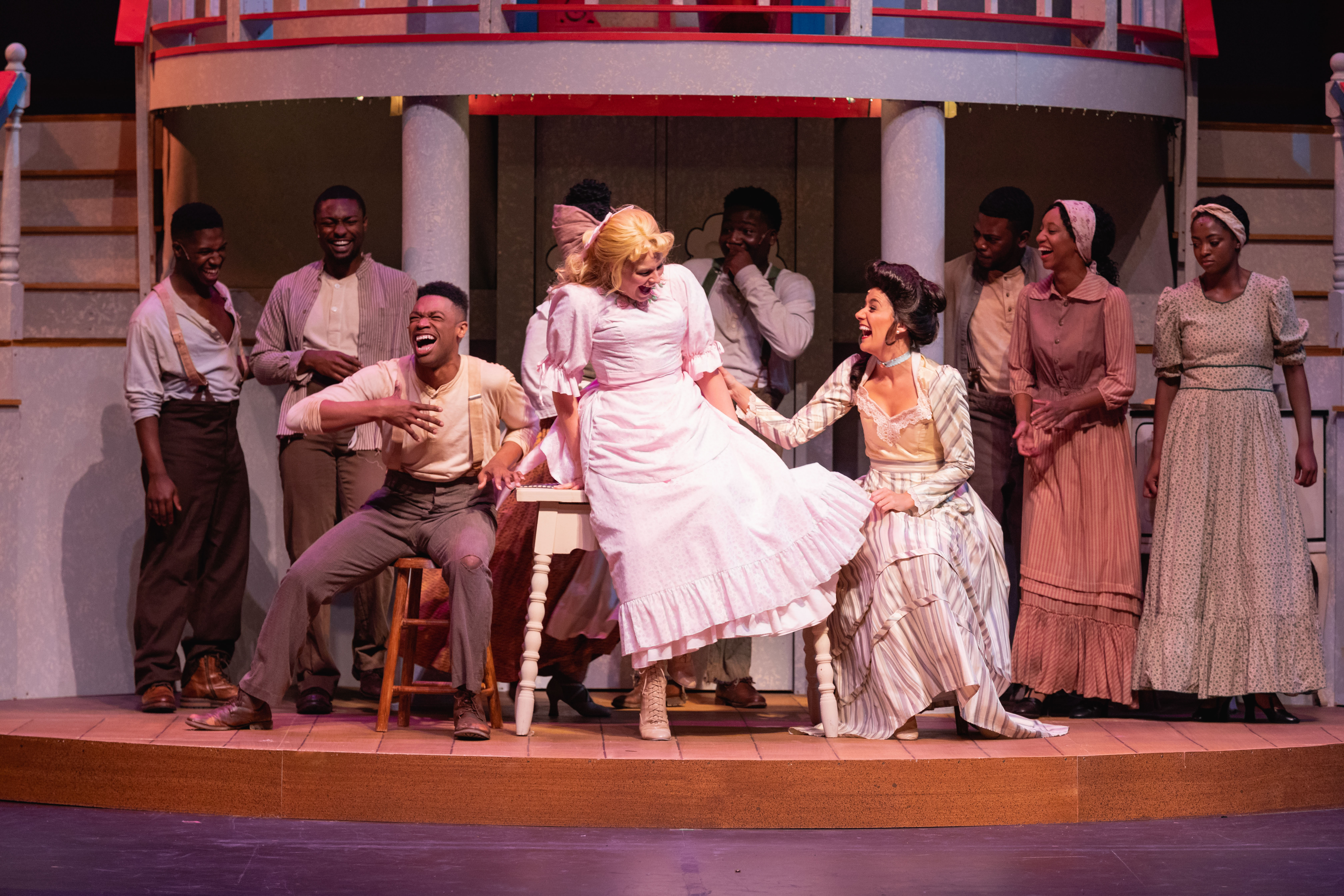
A theatrical breakthrough when it first opened in 1927 but so politically incorrect today, is it finally time to declare that Show Boat has sunk? At the current CPCC revival, kicking off Summer Theatre’s 2019 season, Tyler Smith as Joe seems to avoid the 92 years of “Ol’ Man River” revisions, its Oscar Hammerstein lyric migrating from N-word to “darkies” to “colored folk” and beyond, by making the Cotton Blossom’s stevedore sound like he jes’ step off de boat from Jamaica.

Yet we’re still back in 1887 Natchez, Misssissippi, where the local Sheriff, enforcing Jim Crow laws that forbid Julie LaVern from performing because she is one-sixteenth African, probably hasn’t gotten any memos that he should clean up his speech when referring to his oppressed brethren. It’s sad, but Julie can take solace in the fact that she has made her white chum Magnolia’s singing career – and comeback! – possible by vacating her gigs on the Cotton Blossom and later at the Trocadero Nightclub in Chicago.

Show Boat Dress Rehearsal; June 6th, 2019

Julie’s voluntary departure from her Trocadero dressing room enables us to realize how noble she is even if Julie remains blissfully unaware. Insidiously, it also justifies the suffering we burden black folk with – because they’re so much better than us and so much more equipped to bear it.

It gets irritating for me. Each time Julie appears, it’s so she can benevolently disappear! And doesn’t the rugged, hard-bitten Stoicism of Joe’s “Ol’ Man River” make the innate nobility of his people even greater?

Yes, it does.

Watching Show Boat last weekend, I couldn’t help thinking how much more interesting this Jerome Kern musical would be if it were about Julie, Joe, and their respective spouses. Instead the Hammerstein book, based on Edna Ferber’s novel, concentrates on Magnolia Hawks, her outgoing dad Captain Andy, her small-minded mom Parthy, and her dashing man, riverboat gambler Gaylord Ravenal. Hammerstein’s book doles out crumbs to the people I care about when they should be seeing at least half the loaf.

Ah, but the best of Kern’s score is still heartland wonderful, and director Tom Hollis has assembled an outstanding cast to bring it to life. Set designer Jennifer O’Kelly creates a riverboat with a fair amount of Mark Twain flair, twin staircases joining at the deck and two smokestacks above, and there are impressive drop pieces descending from the fly loft when we arrive at the Trocadero for a genuine scene change. Debbie Scheu’s costume designs have exactly the right frilly-silky-grubby mix to sharply define the racial and class divides.

Show Boat Dress Rehearsal; June 6th, 2019

It’s important that the evening starts off with the big-hearted garrulousness of Tom Ollis as Captain Andy, because other than the salty bitchiness of Paula Baldwin as his wife Parthy, longstanding conflict is in short supply. As the rakish Gaylord, Ashton Guthrie gets the best of the music written for the men who matter here, and he’s singing better than ever before on “Where’s the Mate for Me” and “Make Believe,” adding a touch of old-timey crooning to remind us what this show would have sounded like way back in the Roaring Twenties.

Lindsey Schroeder as Julie and Sarah Henkel as Magnolia share the “Fish gotta swim” resignation of “Can’t Help Lovin’ That Man” long before their paths cross in Chicago and each gets a song of her own. Schroeder’s farewell is a similarly resigned “Bill” before she cedes the Trocadero stage to Magnolia. You would think that Henkel could simply take it from there, but it’s only 1899, women are decades away from getting the vote, so Daddy needs to drop by in the nick of time – coincidence, huh? – to buoy sweet Magnolia’s confidence in “After the Ball.” Hooray for Captain Andy! He saved the day.

Show Boat Dress Rehearsal; June 6th, 2019

The sexual politics here are fairly dismal, Edna Ferber story or not. Men can abruptly leave both Magnolia and Julie without accounting for themselves, and they can expect a hearty welcome if they have second thoughts. The layabout Joe lays it out best in his “I Still Suits Me” duet with his long-suffering wife Queenie (Brittany Harrington): “I may be lifeless, But with one wife less, My life would be more strifeless, yes sirree, No matter what you say, I still suits me!”

That’s the brutal, sexist side of Joe, and you can bet that Tyler Smith brings plenty of bite to his complacent boasting. Yet Smith, singing every bit as beautifully as Guthrie in his reprises of “Ol’ Man River,” is especially golden at the end of each bridge, when he sings those two dark low notes each time “you land in jail.” Are there two bluer notes in the American songbook?

Show Boat Dress Rehearsal; June 6th, 2019

Paul Robeson, the megastar this role was originally written for, must be looking down kindly from his heavenly sphere, for Smith is the best reason at Halton Theater not to get weary of Show Boat.

Break Out the Mindless Nostalgia With CP’s Re-Engineered “Grease”

Review: Grease

By Perry Tannenbaum

People forget that Grease was a huge smash on Broadway for over eight years, the incubator for such hunks as Patrick Swayze, Richard Gere, Barry Bostwick, Peter Gallagher, Treat Williams, and that John Travolta guy. The 1978 film starring Travolta and Olivia Newton-John not only eclipsed the 1972 original, it radically altered the Jim Jacobs and Warren Jacobs book and score. By 2007, the last time it was revived on Broadway, Grease couldn’t be Grease without the two hit songs created for the movie, “You’re the One That I Want,” one of numerous #1 hits that John Farrar wrote for Newton-John, and Barry Gibbs’ “Grease (Is the Word).”

The result at CPCC Summer Theatre, with Carey Kugler directing that 2007 version, will often play like a blurred – or cut – version of the movie. Our summer romance at the beach with its poignant farewells, the second beginning devised for the show, now gives way to a third. Sandy Dumbrowski’s nemesis, Rizzo, is more like a spider lady than a tough punk. Stockard Channing delivered. Sandy’s quest to become part of the Pink Lady clique is forgotten, and there’s no climactic drag race when Danny Zuko reasserts his heroism behind the wheel of Kenickie’s Greased Lightnin’.

With one of the actors absent for the Sunday matinee, confusions compounded. Justin Austin smoothly replaced Aaron Coulson as Teen Angel, singing “Beauty School Dropout” to the disconsolate Frenchy, Sandy’s staunchest ally. But Coulson was also supposed to portray deejay Vince Fontaine at the high school sock hop. Touchy situation. Megan Postle, who terrorized one of Danny’s T-Bird chums as Miss Lynch, his English teacher, had to reappear as the fulsome emcee of the hop, and Ashton Guthrie, who was just learning the rudiments of guitar at the top of Act 1 as Doody (a pretty lame “Those Magic Changes”), now gets to sing Vince’s “Born to Hand Jive,” one of the best numbers in Act 2.

Unless you had recalculated based on CP Theatre Dept. chair Tom Hollis’s pre-show announcements, these were additional head-scratching moments.

Perhaps the most charitable way of looking at the Jacobs-Casey book, substantially overhauled by Allan Carr and Bronte Woodard for the film, is to presume that they were trying to flip Manhattan’s West Side Story into a vaguely Chicago comedy – if they had any idea of what they were doing at all. Otherwise, it’s hard to explain the botched, crisscrossed contretemps at the prom and the abruptly scheduled rumble between the T-Birds and the Scorpions that never happens.

Kugler never seems compelled to plug up any of the plot holes, so Philip Stock as Danny acts like a jerk without any qualms or hesitation. Stopping one time while making your exit doesn’t quite cut it. Robin Dunavant gets more to work with in baring Sandy’s heart – including twice as many songs – but with Danny wavering so capriciously in his affections, her “Hopelessly Devoted to You” feelings seem downright stupid. While Jason Estrada’s costume designs could be more rugged for the T-Birds, the megawatt blond wig he saddles Sandy with throughout her pre-makeover scenes (I’m not sure a single hair moves) made me wonder whether or not a beautiful teen lurked underneath.

Despite these teetering foundations, Stock does project a hard James Dean-like edge and – keeping in mind that this is Rydell High – a lean, sneering arrogance that recalls Bobby Rydell. There really are sparks when Dunavant finally crosses over from Sandra Dee-land to the leather-clad tramp that Danny wants, but the gulf between the two Sandys is so wide that it’s hard to shake the notion that her latter-day self is her creators’ wet dream. The masculinity takeaways from GREASE, that gangster toughness gets you girls and that unprotected sex is cool, are pure ‘50s bull, never questioned.

Amid Danny’s vacillations and Sandy’s pathological primness, the bitchy, predatory Betty Rizzo stands taller with the steadfast power of her slutty convictions. Don’t you dare feel sorry for her! Lindsey Schroeder further accents Rizzo’s outlaw chic with a self-assured swagger that gives her dominion over every scene she appears in, singing or not. The astonishing dancing jolts that Treston Henderson brings to Kenickie’s “Greased Lightnin’” are totally worthy of this spitfire Rizzo, his usual girlfriend. But the garbled speaking parts? Not so much.

Coupling and uncoupling are so unmotivated that the remaining T-Birds and the Pink Ladies threaten to devolve into stock characters. Among the guys, Guthrie as Doody is the only other gang member to leave an impression. Ava Smith as Frenchy is the only Pink aside from Rizzo that I could care a little about, but a beauty school dropout warrants a far more frightful wig. Outside the Pink clique we do better, with Alexis Harder showing some flair as Cha-Cha DiGregorio, the outsider dancing ace that Kenickie brings to the sock hop to spite Rizzo. Patty Simcox is no more scheming or manipulative than Rizzo, but Susannah Upchurch manages to make us dislike her chiefly for her wholesome veneer – and because she doesn’t seem to be enjoying her own wickedness nearly as much.

Fun-loving mindlessness is as much the word at CP as GREASE is. At Rydell High, you are so uncool if you can’t sustain enthusiasm through all the many ram-a-lam-a-ding-dong nonsense phrases that “We Go Together” provides for the ensemble at the end of Acts 1 and 2. The old folk at Halton Theater on Sunday, bobbing their heads to the beats until the lights came up, weren’t looking for any meaning at all in GREASE. They were looking for the sheer joy of youth, and they were finding it.


Celebrity Pistol-Packing Rogues Deliver Guilty Pleasures in “Bonnie & Clyde”

Review: Bonnie & Clyde

By Perry Tannenbaum

Since the days of his greatest successes, with Jekyll & Hyde (1997-2001) and The Scarlet Pimpernel (1997-2000), most of Frank Wildhorn’s Broadway musicals haven’t run more than a month. That includes a revival of Jekyll, Wildhorn’s longest-running show, in 2013 and Bonnie & Clyde, which somehow couldn’t make it through the end of December – the highest grossing month of the year – in 2011. Hearing that the short-lived Bonnie & Clyde was coming to Matthews Playhouse of the Performing Arts roused a morbid curiosity for me: how could a notorious story that won six Oscars in 1968, including Best Picture, flame out so spectacularly in a musical adaptation? Knowing that Billy Ensley, one of Charlotte’s best, would be directing sealed my resolve to investigate.

With the appearance Bonnie Parker and Clyde Barrow as children at the top of the show, it quickly became apparent that Ivan Menchell’s book was not an adaptation of the sensational film. Unlike the Bonnie portrayed by Faye Dunaway, Menchell’s is a ravishing redhead rather than a blond. There’s never really a Barrow Gang, and though this Clyde aspires to fancy clothes, his dream didn’t come true in Matthews. Most puzzling of all, we don’t see Bonnie and Clyde snapping photos of each other – their most modern trait! – although the authentic period projections go way beyond mugshots. So it’s plausible to me now that the Broadway version of this musical didn’t strictly flop on its merits. Boomers expecting to see the style and gore of the iconic film were disappointed, while it’s very likely that younger theatergoers had never even heard of Bonnie and Clyde.

Armed with a reported $6 million budget, there were presumably more costume changes up in New York than Matthews designer Lisa Altieri provides for Bonnie, but with 20 people in the cast, four of them in multiple roles, Altieri is far from idle and contributes some very fine work. What really made this community theatre effort look like a million bucks was the scenic team of designer John Bayless and scenic change artist Beth Aderhold. Weathered wooden slats span the Fullwood Theatre stage, trisected by two sturdy vertical beams. The columns of slats can be raised like window shades, keeping the flow of action going cinematically as the slats rise to reveal new scenes – or slide back downwards to serve as rustic screens for the old-timey projections, mostly of newspaper headlines, mugshots, and snapshots of our celebrity public enemies. At critical moments, a two-seat jalopy showed up in the middle of it all, no less realistic than the photos I’ve seen of the Broadway roadster.

Not only did Ensley brilliantly contrive to keep the action moving, he brought ace talent to the lead roles and beyond. Joe McCourt, who plays Clyde’s vacillating older brother, Buck Barrow, has starred in numerous musicals at Theatre Charlotte in recent years, including Memphis and Avenue Q. Embittering Buck’s every breath, Emily Witte is his very Christian wife Blanche, after playing a similar spoiler role as Amneris in the Disney Aïda at Theatre Charlotte last fall. This bickering pair would have upstaged the title players if Ensley hadn’t found such strong protagonists as Steven Buchanan and Lindsey Schroeder.

Buchanan was definitely in his comfort zone performing edgier fare, for he played prominent roles in Queen City Theatre Company’s The Pride and Actor’s Theatre of Charlotte’s American Idiot last year. Here he sported a hairdo that was halfway between Hitler and punk, looking lean, Brando mean – in a tank top undershirt – and dangerous. Scene work with Bonnie is a tasty mix of tender and raw, but Buchanan is somewhat monochromatic under arrest or during his larcenous, murderous rampage, barking his commands and forsaking the Warren Beatty charm offensive of the film. Ensley should have occasionally reined him in a bit and reminded him that he’s wearing a microphone as well as a pistol.

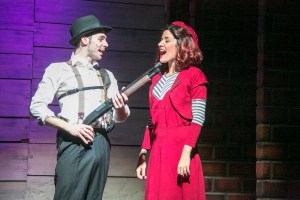
Opening in the ensemble of Evita at CPCC Theatre the weekend after her last performance as Bonnie Parker, Lindsey Schroeder is the one new find among the principals. She takes to every aspect of Parker, most especially to her thrill-seeking, her narcissism, and her lust for Hollywood and pinup fame. Schroeder can belt too, so watch out for “How ‘Bout a Dance” and “Dyin’ Ain’t So Bad.” Overall, Wildhorn’s score wasn’t nearly as bothersome as you’d expect from an epic Broadway flop, but there are noticeable stretch marks on its beauty. Witte does a fine job on behalf of homebodies with “That’s What You Call a Dream,” but Blanche’s Christianity opens up a whole new sector of Gospelized expression that I didn’t recall from the movie. Church scenes are essentially extraneous to the main storyline, but it gave Wildhorn an excuse to widen the variety of his score. Off my radar since 2009, Phil Fowler came to the rescue for a couple of doses of “God’s Arms Are Always Open.” Even if it was a narrative detour, it was a rousing showstopper in the positive sense of the word.

Holiday Grow and Donavan Abeshaus were both excellent in introducing us to the young Bonnie and Clyde. Carol Kelly and Scott C. Reynolds were winsome as Clyde’s rusticated parents, and Carol Weiner was prim yet warm as Bonnie’s mom, quietly urging her daughter to come to her senses – and choose the hometown sheriff who clearly adores her. Andrew Tarek plays that role beautifully, with seething jealous fury toward Clyde and tender hat-holding deference toward Bonnie. I found myself hating this Sheriff Hinton without a good reason why, and I surprised myself once again by rooting for Bonnie and Clyde here almost as fervently as I did in the 1967 film, despite the trail of crime and bloodshed they insouciantly left in their wake. Celebrity pistol-packing rogues are likely unique to America, more to our shame than our glory.