Tag Archives: Josh Webb

Let “The Drowsy Chaperone” Hypnotize You

Review: The Drowsy Chaperone at Theatre Charlotte

By Perry Tannenbaum

My advice for best enjoying The Drowsy Chaperone at Theatre Charlotte is to listen to the Man in the Chair – and yield to his pitch-dark hypnosis. Yes, before the lights even go up at the old Queens Road barn, he’s in his chair speaking to his audience and conjuring up what we should hope and pray for: “I just want to be entertained. Isn’t that the point?”

As the show unfolded, brilliantly directed by Billy Ensley with what must be the local cast of his dreams, I realized that, as a critic, I shou

ld heed that hypnotic suggestion devoutly. Discard my usual pointy critical and analytical tools. What’s more, I came to believe more and more strongly that, if actors and directors of previous Drowsy Chaperones I’d seen had followed that simple mantra, I would have fallen in love with the show long before last Friday night.

When the lights came up a few minutes deeper into the Man in Chair’s monologue, we saw him locking the front door of his humdrum apartment with four or five assorted deadbolts and chains. It’s a bit of an abrupt swerve, but we’re suddenly aware that this Broadway musical devotee is a recluse and a bit paranoid. Each time the phone rings, we’ll see that the Man in Chair fails to answer, yet another confirmation of these traits.
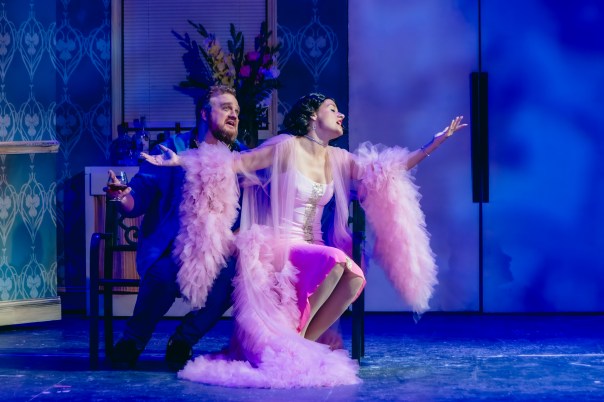
By the time the title character of the fictional “Drowsy Chaperone” is a few wobbly notes into her showstopping “As We Stumble Along,” we already should know that the Man in Chair is gay, which accounts for Lisa Smith Bradley delivering the song as a living fetishization of Ethel Merman and Judy Garland – Merman’s vibrato wedded to Garland’s glitter, slacks, and drug dependency.

Yet when we’re watching Kyle J. Britt as our genial host, we need not attribute his reclusiveness or paranoia to being a gay man. As a Broadway musical fanatic, this Man in Chair identifies more readily as a New Yorker with Innerborough hangups. Meanwhile, Bradley is sufficiently over-the-top as both gay icons – especially Merman – to be accused of impersonating a female impersonator.

We might say that Ensley & Co. have decided that being gay in 2024 isn’t nearly the leaden weight it was in 2006 when Drowsy Chaperone premiered in the Big Apple or in 1996 when Angels in America tore the QC apart and made us a laughingstock. Pretentiousness, solemnity, and subtlety really are inimical to this delicate relic. Britt handles it with audiophile care as removes the vinyl disc – a rare original cast recording of his favorite 1928 musical – from its LP sleeve and gives both sides a loving once-over with a Discwasher brush before lowering his treasure onto a turntable.

The same can be said of size and scale, which may also have muffled my enjoyment of productions at Belk Theater in 2007 and Halton Theater. There’s something so right about our little séance in the dark at the Old Barn on Queens Road that it cannot attain in a more modern and spacious hall where the Man in Chair must project his spell into a distant balcony. The homeliness of the Man’s urban dwelling also sits better on Queens Road than in the bowels of a bank building on Tryon Street.

To be honest, it’s Broadway Lights and the late CP Summer Theatre that should apologize for not matching the unpretentiousness of Josh Webb’s scenic design. Of course, it would be nice if Webb’s scenery could transform spectacularly into Broadway splendor when the stylus of our host’s turntable comes down – with its signature thump – onto the vinyl and the mythical “Drowsy Chaperone” comes to life. In the less-is-more world on Queens Road these days, these shortcomings are comedy assets, part of the overall charm.
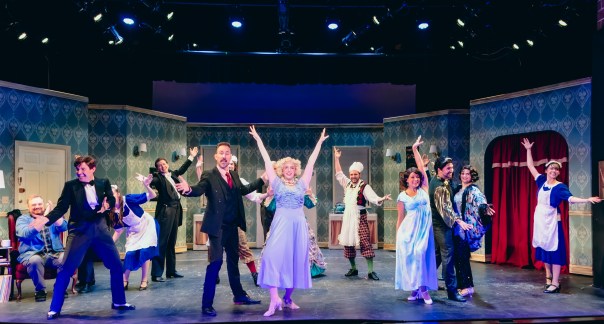
On the other hand, our time travels to 1928 get a softer landing thanks to the costumes by Beth Killion, notable for their flair, their formality, and their discreet dashes of color. We’re awaiting the wedding of Robert Martin and Janet van de Graaf, so there are actually multiple levels of time travel here, for Bob Martin actually co-wrote the Drowsy Chaperone book with Don McKellar – and starred in the original Broadway production as Man in Chair – while he was married to the real-life Van de Graaf.

In fact, this originally Canadian work, which eventually layered on music and lyrics by Lisa Lambert and Greg Morrison, was gestated at Martin’s stag party in 1997, nearly 70 years after these fictional nuptials. More reasons not to view this lark as a gay cri de cœur.

Rare as his vinyl treasure may be, Britt comes across less as a scholar or a critic than as a fanboy, occasionally panting like an eager puppy as he presumes to approach his fantasy idols more and more closely. More than once, the principals will obligingly freeze for him. Nor does this Man in Chair seem to favor the men over the ladies with his adoration, only tipping the scales just before the final bows. Charmingly enough, there are overtones of scholar and critic as he dishes tasty trivia about the fictitious “Drowsy” cast members or advises us to be on the lookout for some truly dreadful lyrics.

These glamorous, theatrical, servile, and criminal characters are all blissfully ignorant of the nerd who has conjured them up, preoccupied with their conflicting efforts to carry off the planned wedding or ruin it. The bride herself, Lindsey Schroeder as Janet, seems to be grandly ambivalent about becoming Robert’s wife, sacrificing her glittery stage career and the adoration of millions, while suppressing her basic instinct to “Show Off.” Love is at comical war with vanity. Carried away by the swiftness of this whirlwind romance, Andy Faulkenberry as Robert also has his doubts.

Aside from Janet’s drunken chaperone, politely labelled as Drowsy, there are a butler Underling, an eccentric Mrs. Tottendale, and Robert’s best man George shepherding the loving lambkins to the altar. Only Zach Linick as George seems to be afflicted with any degree of competence or reliability. More importantly, he and Faulkenberry make up a formidable tapdancing duo. (Thank-yous to choreographer Lisa Blanton.) Allison Rhinehart as a frilly, bustling Tottenham and Darren Spencer as the gray and starchy Underling are no less inevitably channeled toward blithe entertainment.

Counterbalancing the fragile determination of the bride and groom, compounded by the flimsy protection of their good friends, we have an exquisite mix of bumbling baddies trying to sabotage the wedding. These are led by Joe McCourt as Broadway producer Mr. Feldzeig (Feldzeig Follies ring a bell?), under pressure from his mobster backers, who consider Janet to be the cash cow of the Feldzeig franchise. The sneering McCourt is bedeviled by Gangster 1 and Gangster 2, armed emissaries – Titus Quinn and Taylor Minich – masquerading as hired chefs to ensure a catastrophe.

Ah, but it isn’t simply muscle aimed at swaying the maiden and returning her to showbiz. Somehow, a predatory Lothario is among the wedding guests – although he has never met anyone else there. Mitchell Dudas is this egotistical Adolpho, far more arrogant than Feldzeig, a mixture of Erroll Flynn and Bela Lugosi with a thick Iberian accent. Feldzeig has no trouble at all convincing Adolpho that he was born to seduce the bride-to-be.

Equally dumb, Autumn Cravens as Kitty is a ditzy chorine, constantly nagging her boss and wedding escort Feldzeig to let her fill Janet’s shoes in his next Follies. Effortlessly, Dudas will outperform Cravens in thwarting Feldzeig’s schemes. Love conquers all, but it would be a huge spoiler to say how many times when we reach this very happy ending.

Just one more wild card is needed to tie up all the festivities. Be on the watch for Trinity Taylor as Trix the Aviatrix, who descends from the skies at just the right moment with a voice of thunder. For a few moments, she even upstages Britt and Schroeder who are so fabulous.

It would be a mistake to miss the craftmanship lavished on this plot with its stock characters by Martin and McKellar, brought out so brilliantly by Ensley and his dream cast. For instance, think how perfectly 1928 was chosen: between Lindbergh’s transatlantic flight, Babe Ruth’s 60 homers, The Jazz Singer of 1927 and the Wall Street Crash of 1929. A brief last window of bliss before global misery. In the real world, the parade of yearly Ziegfeld Follies revues would be halted after 1927 – until 1931.

“Next to Normal” Is Alive at the Barn!

Review: Next to Normal at Theatre Charlotte

By Perry Tannenbaum

July 4, December 7, September 11, and October 7 are all dates we remember for their historic meaning to the nation and the world. A similar earthshaking significance can descend on a single day in the life of a relationship, a marriage, or a family that can reverberate for generations – whether you were at the event or even alive at the time.

That’s essentially what we’re watching in Brian Yorkey’s Next to Normal with music by Tom Kitt, winner of the Pulitzer Prize for Drama in 2010 after winning Tony Awards for Best Musical, Best Book, and Best Orchestrations the previous year. Instead of doing things the traditional way, setting up the location and the situation in a big opening number that stages or recaps the prime catastrophe, Yorkey fast-forwards us more than 17 years, when the original hurt in the Goodman family has marinated and metastasized – a fissionable maelstrom that will soon explode.

With a fresh set of seismic events.

Diana is at the vortex of the mushrooming crises, so it’s both interesting and wickedly deceptive that Yorkey brings us into her drugged and delusional mind for much of the opening action. We still see the basic outlines of the family turmoil clearly enough. Her husband, Dan, keeps trying to go with the flow of Diana’s bi-polar mood swings. She navigates a series of therapists, looking for either a therapeutic epiphany or the perfectly calibrated cocktail of meds.

Meanwhile, Diana’s teen daughter Natalie feels neglected and unappreciated, living in the shadow of Mom’s obsessive devotion to her older brother Gabe. Warily, Natalie navigates her self-worth issues as schoolmate Henry tries to get closer and establish a relationship. When Natalie overcomes her shame and allows Henry, after much hesitation, to meet her family, we seem to have arrived at a breakthrough.

It’s a brave move and all goes swimmingly at the Goodman dinner table between Natalie and Henry until Diana walks in with a birthday cake, all smiles, candles lit. Yorkey’s sleight-of-hand has worked so beautifully that we wonder which of the two teens is the target of the birthday surprise. Suddenly things are going downhill – off a high cliff.

Like we’ve been overdosing on the meds so far.

Yorkey is very good at these slow build-ups where we see budding new hopes dashed by a sudden disappointment and fresh Diana relapses. After portraying Dan, the long-suffering husband in Queen City Theatre Company’s fine production in 2013, Billy Ensley takes the reins at Theatre Charlotte’s slightly slicker version. His suffering, grimly stoical, was very different from Johnny Hohenstein’s unfiltered and uncontrolled anguish. It’s easier to breathe at the old Queens Road barn when emotions get a space to release.

On the other hand, the Broadway edition starring Alice Ripley in 2009 (which toured here with Ripley in 2011) took a dimmer, more skeptical view of psychiatry and pharmacology, giving those productions directed by Michael Greif a darker, satirical, mad scientist edge. Around the corner from a cluster of medical centers and hospitals, Josh Webb’s set design on Queens Road is easily the brightest and most antiseptic I’ve seen. The usual two-story scaffolding that adorns rock operas is outfitted with colorful fluorescent lighting, though some flickering occasionally marred the serene pastels (intentionally?) inside the translucent fixtures.

So in transit to Charlotte, the emphasis continues to shift more emphatically away from the quackery to the suffering. Hohenstein’s broadened performance now rivals Melissa Cook’s bipolarity as Diana, for he’s still a domesticated dad to Natalie and a cheerful host to Henry between bouts of stressing and losing it in private and with his wife. In its fits and starts, Hohenstein helps us to balance the toll mental illness takes on its victims and on their loved ones. Easily the best of Hohenstein that I’ve seen and the most intensely consistent performance of the night.

Cook’s performance as Diana is as genuine and riveting as any I’ve seen in Charlotte or on Broadway – except when it isn’t. Whether you call it resistance or retreat, there are whole songs where she is suddenly no longer a cri-de-coeur rock singer and becomes a more traditional Broadway belter: sweeter voice with noticeably less emotion and intelligibility. Suddenly, it isn’t about how sensationally Cook is acting but about the singing, likely more in her comfort zone.

I can’t say for certain that the duality was there from the start, but there should be no turning back after the big birthday reveal.

And the words here are important – I could almost hear Ensley stressing this at rehearsals – for we get the best sound in a musical production, local or touring company, since MJ stormed the Belk last September at the beginning of the season. Kudos to Ensley for his pertinacity and, if there was any acoustic work or equipment upgrades in the mojo, glory to the staffers involved in the push, beginning with artistic director Chris Timmons and managing director Scot P J MacDonald. The old barn is sounding better than ever.

It needed to. In contrast with Spirit Square’s more intimate Duke Energy Theatre, where Glenn Griffin directed Normal, a musical on Queens Road requires ample decibels to reach the back of the house. Keeping with Theatre Charlotte wisdom, music director Ellen Robison trims her rock band to six musicians while placing them behind the singers.

Instinctively, Ensley finds a perfect pathway for his cast to turn up the volume. As if inspired by grand opera, he dials up the melodrama past suburban proportions so that most of the characters are wearing their hearts on their sleeves. Craig Allen as Drs. Madden and Fine, allows himself to be callous and ghoulish for the blink of an eye when the script absolutely demands it. Otherwise, he is the throbbing soul of earnest concern – moonlighting as a rock star in Diana’s delusions.

As Natalie, the only lonely daughter, I found Cornelia Barnwell to be more shut-down and compulsive than Abby Corrigan was on her express route to stardom in 2013. Barnwell’s voice is purest rock, piercing as a poignard with no blade. She seems to be the studious type in her scenes at school or alone with Henry. But she can flip and go rogue as soon as she sings. Very appropriate for Natalie, so anti-meds at the beginning because she has seen the wreck of her mom – before following in her footsteps. At the same upstairs medicine cabinet.

If a stoner-slacker can be seen as an oasis of calm, then that’s how Zach Linick will appear as Henry, faithfully devoted, non-judgmental, discreetly giving Natalie her space. There aren’t too many laugh-out-loud moments on this bumpy road to tentative stability, but when Natalie, resistant at first to Henry’s weed, leapfrogs him into wanton pill popping, Linick’s reaction bears watching.

Melodramatic or not, Ensley’s read on Next to Normal is more in tune with our chaotic times than the 2013 original, when Yorkey likely turned to the mad laboratory aspects of pharmacology and electroshock therapy to provide a counterweight to the suffering and gloom. Everybody is wronged here as if the world were all MAGA malcontents, but the uplift and electricity of Kitt’s score have always been there to supply lightning, spirit, and zest. Ensley relies on Robison’s band to deliver and their chemistry with all the suffering Goodmans is fire.

It’s especially white-hot in the stunning performance of Joey Rising as the disembodied Gabe. What a wonderful nuisance he is, impervious to all who ignore him! Over and over, he quashes the best hopes of his mom and dad, and he’s hardly less devastating to our own. If you find it hard to imagine a mad-scientist horror movie strain in this musical, the chill of hearing Rising’s defiant, jubilant “I’m Alive” will convince you that Yorkey believes devoutly in melodrama after all.

We in audience become like the frenzied villagers in Frankenstein, collectively yearning for Gabe’s destruction while wondering at Rising’s fire. But after he beats a full retreat, he returns, fierier than before. And then he multiplies!

Dangerous and Delicious London – With a Twist

Review: Oliver! at Theatre Charlotte

By Perry Tannenbaum

IMG_1349

Ron Law will be retiring when his 15th season as executive director at Theatre Charlotte comes to an end next spring, but he sure isn’t retiring – or even receding into the background – right now. The spotlight will shine brightest on Law in December when he stars for the first time ever as Ebenezer Scrooge in the annual revival of A Christmas Carol at the Queens Road barn. Meanwhile he’s had other things besides bookkeeping on his mind for the past month or so, since the 92nd season at Theatre Charlotte is kicking off with a different Dickens, Lionel Bart’s Oliver! and Law is the stage director.

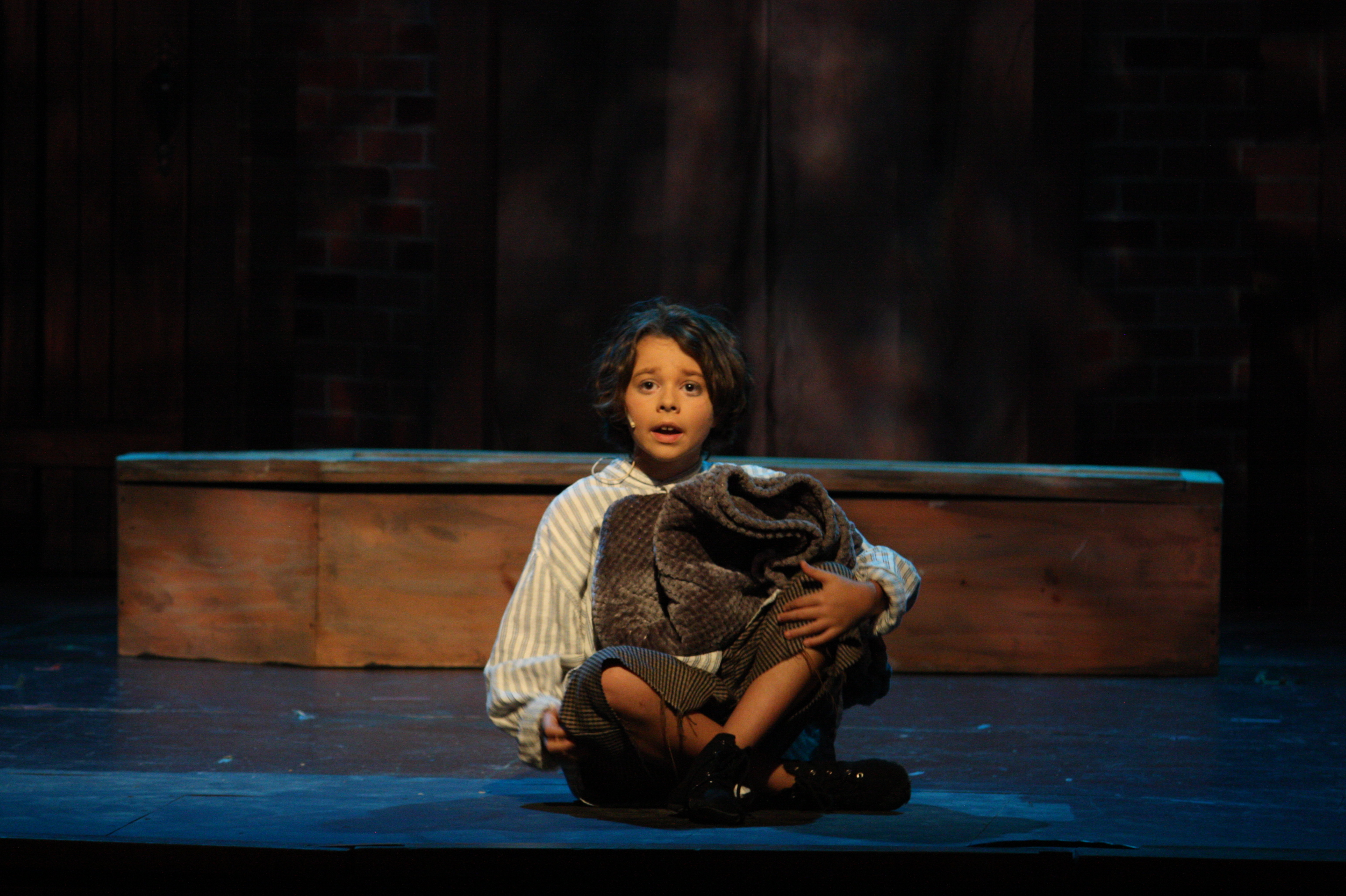
Thanks to some impressively weathered scenic design by Josh Webb and a juicy mix of dignified and low-life costumes by Melody Branch, the current production looks vibrant and fetching before we even reach the title song, though purists will recoil at the sound of the prerecorded orchestra. Your first favorable impressions will be sustained by the fine set of adult principals that Law has gleaned from the rich Queen City talent trove that showed up for auditions. Yet the mean rigidity of Mr. Bumble, the terror of Bill Sikes, the acquisitive cunning of Fagin, and the conflicted kindness of Nancy would be largely wasted if they were directed at an Oliver who didn’t win us over.

IMG_1318

Atticus Ware passes his first key test as Oliver Twist simply by standing up after dinner has been served at the workhouse and having the cheek to say, “More, please!” We’ve actually seen an Oliver at Children’s Theatre long ago who looked the very antithesis of orphaned malnourishment, and it was hard to suppress a laugh. Easily two years younger than any Oliver to appear in a local production – except for Andrew Kenny in 2001 – Ware also passes muster when Bumble reassures the Sowerberrys, morticians he has sold Oliver to, that the lad will surely grow bigger.

There are prudential reasons past directors haven’t opted for an Oliver as young and small – and maybe considered cutting Bumble’s room-to-grow remark. Without a body mic, it’s hard for a middle-schooler to sing Oliver’s angelic “Where Is Love?” or his wonderstruck “Who Will Buy?” and make himself heard across an orchestra and an audience. Nicely miked-up, Ware holds up as beautifully as Andrew Griner did in Theatre Charlotte’s last Oliver! in 2007, and he adds palpable charm when he takes his turns in “I’ll Do Anything.”

Of course, the main reason why Oliver! is being offered in the metro Charlotte area for the sixth time this century is Bart’s amazing score. No fewer than a dozen of the songs have engraved themselves in my mind so that I can agreeably recall their main hooks without assistance. Familiarity can tempt directors and actors to deviate from established Oliver Twist expectations – or, in the practice of casting girls at the workhouse and in Fagin’s band of thieving urchins, widening our expectations.

Law has presented enough iterations of Christmas Carol to value and preserve the Dickensian spirit of Oliver while loosening casting requirements where the envelope has already been pushed. Johnny Hohenstein immediately stands out as a fierce and booming Mr. Bumble, while Geof Knight as Fagin and William Kirkwood as Sikes are among the best we’ve seen. Together they form an adult triumvirate who remind us that greed and corruption aren’t simply confined to the underworld.

Hohenstein is as titanic as a beleaguered husband as he is when he’s a tyrannical beadle, a definite asset. I find ample menace and intimidation in Sikes when Kirkwood delivers his growling “My Name,” and I like the sliminess that Knight brings to “You Got to Pick a Pocket or Two” – and the grim calculation of his “Reviewing the Situation.” You couldn’t get me to dispute that any of these three gave the best auditions for their respective roles.

It’s just that I want to see a craven factor, a fear of Sikes’ violent volatility that would give an extra dimension to Fagin’s craftiness. From there, the chemistry between the two rogues can be further textured by their one-time mentor-apprentice relationship. Knight just doesn’t have the appearance of a cerebral weasel, which would make these layers relatively easy and self-evident. Here it needs work.

When it comes to Sikes’ abusive relationship with Nancy, Bart gives Kristin Graf Sakamoto all that she needs to get to its heart. Even if Nancy isn’t liberated, she’s spirited, best seen in Sakamoto’s interactions with the youngsters and in her lusty, boozy rendition of her “Oom-Pah-Pah” polka. Nancy faces some grim choices with Oliver, yet Sakamoto makes it clear that fidelity to Sikes is infused with fear – propped up by fear, you could say – when she repeats her signature “As Long as He Needs Me.”

So the Sikes-Nancy-Oliver drama and suspense develops beautifully from the first moments that we see Sakamoto. There’s already a glint of welcoming light when the Artful Dodger accosts Oliver after he has escaped Bumble and the Sowerberry mortuary. Bailey Wray ignites a “Consider Yourself” welcome as Dodger, assisted by Lisa Blanton’s choreography, that seems to engulf the whole city of London. Wray himself radiates a city-sized energy all by himself. Dodger’s precocious top hat is a couple of sizes too large, a plausible wardrobe choice, but I suspect that Law has elected to keep it that way in order to keep Wray’s hyperactive hands partially occupied.

Later there’s lively bustle in Fagin’s lair when the master puts his kids through their pickpocketing drill, and a new flowering of Blanton choreography when Oliver awakens at the home of his benefactor, Mr. Brownlow. the greatness of Britain beams at us like a sunshiney day, for Ware isn’t the only vocalist in “Who Will Buy” as it swirls with increasing anthemic force. Consonant with this cornucopia of wholesomeness, Rick Taylor is upright and trusting, a quiet affirmation that goodness and kindheartedness can rise above the miasma that swallows up Bill and Nancy.

Aside from the cloudy Sikes-Fagin chemistry, Law only loses focus at the end when Fagin and Dodger make their final exits – seemingly without any emphasis or attitude. Maybe bringing them downstage would help, but it’s a moment that deserves more fiddling with and agonizing over. Last impressions are as important as our first.

IMG_1338

It’s still quite sensible to hurry over to Queens Road, where the corruption and goodness of humanity are as exquisitely balanced as night and day. At its core, Oliver’s journey is a progression from secluded, deprived oppression to the centers of opportunity and civilization. Performances are almost universally fresh and decisive among over 40 onstage participants, and it’s hard to overpraise the work of musical director Ryan Deal in keeping his singers fresh and precise through a long rehearsal process.

Of course, the excitement of opening night added a jolt of energy to the performance, especially for the 13 actors – plus a dog – who were making their Theatre Charlotte debuts. If you’ve never experienced Oliver! before, you will likely feel a similar jolt of discovery.


“The Philadelphia Story” Bides Its Time Before Detonating

Review:  The Philadelphia Story

By Perry Tannenbaum

One of the wonderful things about Philip Barry’s The Philadelphia Story is that, yes, it really is about class distinctions and peculiarities, but the playwright remains ambivalent and tolerant of them all. Beneath their upper or lower crust exteriors, all of these Philadelphians – young and old – are recognizably human. You rarely see so many fully-fleshed characters onstage in the course of a single evening. I wouldn’t be terribly surprised to see a premier professional company repeatedly reviving this witty, effervescent comedy, but it’s absolutely astounding that Theatre Charlotte, our community theatre, has revived Philadelphia Story twice in the new millennium, now and back in 2000.

Both productions showed the pitfalls. The cast needs to be nine deep, alert to the amount of polish and roughness Barry expects of them, and aware of the energies and pacing required at each point of Barry’s intricate plot. The story revolves around “virgin goddess” socialite Tracy Lord – as you might expect, since Katharine Hepburn, the original Tra on Broadway and on celluloid, matched the 25% investment that the playwright plowed into the original production. Tracy is sensibly engaged to the cold and ambitious George Kittredge, impetuously divorced from the dapper C.K. Dexter Haven, and estranged from her father, whose indiscretions have brought the Lords unwanted publicity.

While Tracy is resolving these relationships, her brother is focused on suppressing a magazine exposé that will be published about their wayward father, dangling the prospect of exclusive access to the wedding as an enticing alternative for the publisher. The reporter and the photographer assigned to the Kittredge-Lord nuptials, Mike Conner and Liz Imbrie, bring another level of complications to the scene. She’s been secretly carrying a torch for him for years, but when spirits rise and champagne flows on the night before the wedding, Mike finds that he has fallen – hard – for Tracy, a prelude to their both enjoying an illicit, drunken midnight dip together in the Lords’ swimming pool.

While Barry is at work on how the wedding, the magazine story, and multiple alienated affections – past and present – will ultimately resolve, director Tonya Bludsworth and her cast must deal with all of the reactions and repercussions along the way. Making all of this bubbly complexity even harder for Bludsworth and Theatre Charlotte to achieve is the relative lack of enthusiasm for the project. Turnout for auditions was likely as tepid as audience turnout. Compared with opening night for Peter and the Starcatcher in September, there were conspicuously more empty seats at the back of the house – and a bit less confidence onstage.

Ten of the 14 cast members are new to Theatre Charlotte, including most of the key characters. We started off strong back in 2000 with a Tracy who had the look, the patrician manner, and sometimes even the sound of Hepburn, but that newcomer’s imperial highness never became sufficiently ruffled when the plot thickened. In Bella Belitto, we have another newcomer as Tracy, and on opening night, her serene highness was conspicuously lacking in the early going and – like others onstage – she was often underpowered and inaudible.

Without that serene aura and grace, the splintering of Tracy’s goddess élan isn’t as poignant as it should be in Belitto’s account of her re-education. Yet when she’s assailed by complications, catastrophes, and intensifying adoration, she faces it all very convincingly, her spirits and energies rising. Waking up on the climactic morning after, her decibel level also crescendos spontaneously. We feel that she is learning her lesson and actually benefiting from the indiscretions that brought on her fall – and that the lesson runs deep to her core. Her epiphany detonated effectively for me.

A lot of that depends on Nick de la Canal radiating a rakish upper-crust urbanity as Dexter with enough of that crust trimmed away to make room for tolerance and forgiveness – the two key qualities Tracy needs to acquire. De la Canal’s insouciance also contrasts nicely with the stuffiness that Will Millwood brings to George Kittredge. Barry doesn’t completely hide his disdain for George’s commercial outsider status, so Millwood makes a prudent choice in stressing his judgmental bent.

Dexter also comes off finer than Mike Conner, but by a significantly smaller margin. Here the nuanced class distinctions are no less telling. Christopher Long reminds us that Mike starts out fairly judgmental himself before Tracy bewitches him, but we indulge his pre-judgments more readily in the same spirit that we’re inclined to forgive his boyish, impulsive trespasses. Our best verdict on him vis-à-vis George is much like Barry’s: he’s more deserving, in spite of his depressed finances, of being called a gentleman.

What gives The Philadelphia Story its screwball slant is that everybody up onstage and down in the audience seems to know who the best fit for Tracy is – except for the goddess herself. This includes her mischievous younger sister, Dinah, who attempts some telephone matchmaking. Helena Dryer makes little sis pesky and likable in the right proportions. She’ll be an utter triumph once she makes herself consistently intelligible.

Tracy’s mom isn’t the most pivotal role here, though Margaret does point the way for her daughter in forgiving her husband’s infidelity. What makes Heather Place’s debut so auspicious as Margaret Lord is her clear bubbly delivery and her effortless projection of warmth and class, richly portending her reconciliation with the dashing, slightly over-the-hill Seth Lord. Victor Sayegh is mildly and earnestly supplicating toward Margaret and his disapproving daughter, as befits a Philadelphia patriarch, another cue for Tracy to accept people’s imperfections, including her own.

Sayegh and Place draw two of Chelsea Retalic’s most stylish costume designs in evoking high society elegance, but it’s an uphill battle to project prosperity amid Josh Webb’s drab and dour set design. Two Ionian columns fail to provide uplift, and there’s no longer a visible hint of the swimming pool in the wings. Portraying the eccentric Uncle Willie in a delightful debut, Dan Kirsch gets my nod as the plutocrat most at home in this down-market mansion, lovable for all his pomposity.

Fresh from his crossdressing exploits in Starcatcher, Johnny Hohenstein is mostly responsible, as Tracy’s scheming brother Sandy, for the PR intrigue that lurks beneath the romantic comedy. Good luck following – or caring about – all the Act 2 twists in that sector of the plot. For that reason, Anna Royal as Liz turns out to be more important for me. Ultimately, she’s modeling the patience, forbearance, and forgiveness toward Mike that Tra should have toward Dex. Royal gives Liz just enough edge to update her and elevate above the cliché she must have been in 1939 when THE PHILADELPHIA STORY first hit Broadway.

Here she isn’t just a working-class woman who knows her place, meekly deserving Tracy’s discards. Wielding her Contax camera, she’s Mike’s professional partner, biding her time for a natural upgrade.

Triumphant “Aïda” Cast Slogs Through Tedious Sir Elton Score

Review: Aïda

By Perry Tannenbaum

Strip away the triumphal march, the trumpets, and the whole processional parade – complete with elephants, if you’re lucky enough to see the famed outdoor productions in Verona – and we discover that Verdi’s Aïda is a rather compact story. The captured Ethiopian princess is at one corner of the love triangle, opposite her slavemistress, Princess Amneris. Both of them love Radamès, the dynamic Egyptian general who is ordained by the goddess Isis to lead the Pharaoh’s army against the forces led by King Amonasro, Aïda’s father.

Pulling against the strong Aïda-Radamès chemistry are their loyalties to their warring countries, the jealousy of Amneris, and the obedience that Aïda owes to her father. Sealing their fates, Pharoah rewards Radamès for capturing Amonasro in battle by promising his daughter’s hand in marriage to the victorious chieftain.

It’s fascinating to watch how Linda Woolverton modernizes the 1871 libretto in her book for the Disney version currently running at Theatre Charlotte – with a couple of deft feminist touches layered on.

Raised on soaps and romcoms, modern audiences could never abide a torrid relationship between romantic leads already established before the curtain rises. So Woolverton efficiently wedges a mini-courtship into her storyline, with Radamès giving Aïda to Amneris as a gift to lighten his beloved’s sufferings in captivity.

Verdi and librettist Antonio Ghislanzoni were perfectly content to portray Amneris as a cunning, vicious shrew from beginning to end. Not Woolverton. She gives the beautiful princess a slick character arc in a thorough makeover, starting her off as a vain and pampered clothes horse on loan from Legally Blonde. Amneris evolves into a peace-loving reformer who not only empathizes with the martyred lovers but also narrates their story, three or more millennia later, returning in mummified form, a shining presence in a gooey stew of museum mystery and reincarnation.

If composer Elton John and lyricist Tim Rice had done their jobs as well as Woolverton, Aïda would be a masterwork. It’s often amusing to see what John, Rice, and Theatre Charlotte do to compensate for the absence of Verdian spectacle – but it’s never thrilling, despite the collection of talent that director Corey Mitchell has assembled at the Queens Road barn. John’s parade of power ballads grows tedious as the evening wears on, and the longueurs are compounded by unnecessary outbreaks of dance that, notwithstanding choreographer Ashlyn Summer’s exertions, display little precision and less sensuality.

Mitchell previously directed this show for Northwest School of the Arts with a little more sparkle, orchestra, and budget – a production that ran briefly at Booth Playhouse in 2009. Maybe Sir Elton’s Aïda works better in the hands of high schoolers. The one holdover from the NWSA edition, Emily Witte as Amneris, is even more stunning this time around, most notably when she hits us with the full force of her arrogance in her “My Strongest Suit” showcase. It’s the kind of superficial villainy that will deeply satisfy fans of Wicked, Glee, and Kristin Chenoweth.

There is a slight country twang to Witte’s singing that would have added a bit of unique abrasiveness to Amneris, but music director Zachary Tarlton encourages the same style from Ron T. Diaz as Radamès, so that twang becomes an Egyptian trait – as if, in Disneyworld, everybody who hails from Memphis, whether it’s Egypt or Tennessee, sounds alike.

Further detracting from the gravitas Diaz should be aiming for is Radamès’ bizarre confrontation with his father, the evil priest Zoser. You wonder just how seriously we can take either adversary when costume designer Hali Hutchison seems to be mimicking Disney’s Aladdin in designing the mighty general’s costume and Zoser’s ministers brandish glowing fuchsia staves.

Diaz never gets a shot at a passionate solo, so he shines brightest in “Elaborate Lives,” sharing the best of the power ballads with his darling Aïda. They sing it full out, face-to-face, no frills, near the end of Act 1, Victoria Fisher’s lighting dimming around them to augment the drama. Maya Sistruck does nearly the whole evening as Aïda with a simple resolute dignity, allowing herself the luxury of discernable facial expressions only at peak moments when she is romantically consumed or royally pissed.

Other than taking radical precautions not to reveal her royal origins, I’m not sure what justifies Hutchison’s humble sackcloth design for a captive princess. We do upgrade to red in the palace, but why Amneris would tolerate such a plainly dressed servant is still baffling. Yet the illogic does pay off in an enduring dramatic contrast, first in the climactic tête-à-tête duet before intermission and shortly afterwards in the “Step Too Far” trio, the most self-consciously operatic moment in the John-Rice score.

Aïda is simply better and purer than these Egyptians are – not Memphis or Nashville at all! – and just knowing her ultimately makes them better and purer.

While Josh Webb’s set design is no more impressive than the costumes or the choreography, budgetary constraints may have been holding him back. The cut-rate budget and the lackluster score might obscure the fact that the excellence of the cast runs deep. Aside from most of the dancers, Howl Cooper makes the only inauspicious debut as Amonasro, though he definitely has a warrior’s demeanor.

Jason Hickerson makes a wonderfully scruffy Pharaoh, a Charlotte debut only slightly eclipsed by Carlos Jimenez’s usefully cheerful depiction of Mereb, the perfect Disney servant. Implausibly, Mereb draws more solo spotlight than Radamès, yet Jimenez is decisively upstaged among the supporting players by the steely-voiced Paul Leopard, fulminating melodramatically as the murderous, conniving Zoser.

Thank heaven for vampires, witches, and pagans. Otherwise, there would be no class of people left for all of us to wholeheartedly hate.