Tag Archives: Gabriella Gonzalez

Vox Populi Deafeningly Lauds “Little Shop” at The Barn

Review: Little Shop of Horrors at Theatre Charlotte

By Perry Tannenbaum

Sunny, frolicsome, dark, and bizarre: it’s tough to say whether the best landing spot for Little Shop of Horrors is during the spring, that fragrant time of flowering hope and romance, or the fall, that decaying season of colorful rot and the macabre. All of the Metrolina theatre companies and colleges that have taken us back to Skid Row this century have chosen one of those two seasons for reprising Howard Ashman’s 1982 adaptation of Roger Corman’s cult comedy flick.

The tally among executive directors, department heads, and boards has been decisively autumnal. Judging by the full house on opening night last week at Theatre Charlotte, which previously staged Little Shop in the spring of 2008, I’d say that the movers and shakers at the Queens Road Barn have seen the light and aligned with the popular vote.

No other explanation for the robust turnout – or the rabid response – springs to mind. There was nothing novel or pricey about TC’s prepublicity, unless Facebook and Instagram are suddenly breakthroughs. Nor is name recognition a factor when you consider the director, the lead couple, or the choreographer.

Only if they knew that Kevin Roberge would be can’t-miss as Mr. Mushnik, owner of a perishing Skid Row flower shop – or that real-life dentist Nehemiah Lawson would be don’t-miss as sadistic dentist Orin – would people be flocking to Queens Road with raised expectations. And if you hadn’t seen their award-winning collaboration in Next to Normal down at Fort Mill Community Playhouse two years ago, you wouldn’t know if it was director Scott Albert who chose Peter Liuzzo as his preternaturally nebishy Seymour or the other way around.

Sometimes you need to listen to the vox populi, and sometimes you must try to blot it out. For me on opening night of Little Shop, it was both. My Apple Watch faithfully notifies me the next morning when sound pressure levels reach or exceed 95dB at concerts, musicals, or plays attended the night before. If the noise tops 100dB, the usual number of notices is one to three.

Little Shop smashed that norm, hitting or exceeding the 100dB bar 14 times, and topping out at an astonishing 115dB. I could see it coming when Liuzzo and Gabriella Gonzalez as Audrey, his newly-won sweetheart, merged their voices in the climactic “Suddenly Seymour.” Three doo-wop vocalists emerged from a tenement apartment door, adding glitz, glamour, and sensuality to the spectacle: Olivia Greene as Ronnette, Tia Robbins as Crystal, and Jessica Milner, a trio of rookies.

Then as Seymour and Audrey responded to each other, Liuzzo dug out his coming-into-manhood voice and began belting wildly. Not to be upstaged, Gonzalez, previously confined to the sugary “Somewhere That’s Green,” let loose with her piercing pipes.

When something is this sensational in a community theatre production, I often find myself weeping or sobbing. This time, my instincts had me clamping my hands over my ears in self-defense. Didn’t do much good.
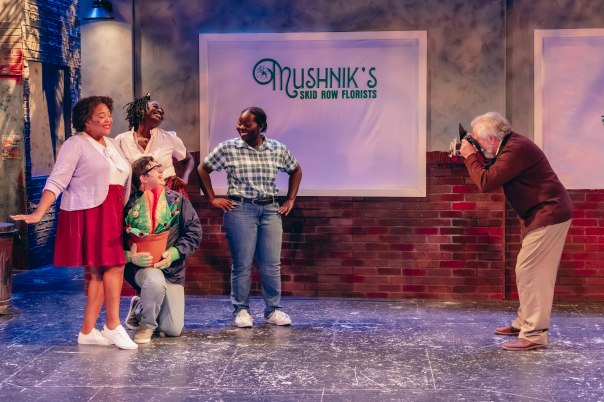
Tinted by J.P. Woody’s groovy lighting, scenic design by Gordon Olson revels in the squalor of the skids with a doo-wop funk and loving detail that reminded me of Mad Magazine comic strips devoured in my youth. The era is the prehistoric ‘50s, when teens toted transistor radios to stay in touch with the Top 40, and Alan Menken’s musical score reveres those vibes as if they are gospel.

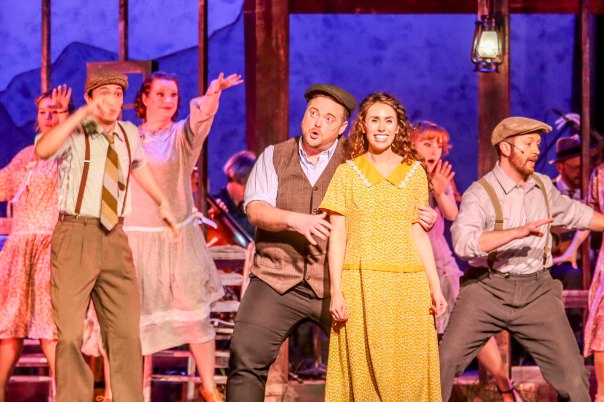
From Seymour’s nerdy sweater vest to Orin’s biker black jacket, Rachel Engstrom’s costume designs are also onboard with the ‘50s beat, with such an outrageous variety of looks for the vocal trio that you can look at them as district goddesses. Props, including a mini press camera and various-sized potted Audrey 2’s that double as puppets, are also a treat from Lea Harkins – plus Orin’s diabolical dentist’s drill.

Besides getting the right moves from his talented cast alongside choreographer Georgie DeCosmo, Albert’s stage direction fosters all kinds of synergies that pave the way for Audrey 2 to have the sleek looks of a garish concept sports car and the voice of a rabid boar. Named after his idolized co-worker, Audrey 2, the carnivorous plant that Seymour suddenly discovers during a total eclipse of the sun, has a special cunning, speaking only to Seymour to get his way.

The voice comes lustily from Toni “Aideem” Morrison, and the movements of her leaves and tendrils come mostly from a team of three unseen puppeteers. When the side wall of Mushnik’s Skid Row Florists slides shut to hide the store, a beehive of activity with puppeteers and stagehands is dressing the interior more and more lushly with Audrey 2’s foliage as the bloodthirsty monster grows.

By the end of opening night, that side wall had been dinged with cracks and bruises, and one stagehand, in damage-control mode, was seen frantically exiting at the end of a scene change. The tech perfection extended similarly to the sound: just one brief dropout assailed Gonzalez, and that’s all. Every note from the four-piece band led by Ellen Robison from the keyboard came through undimmed.

Except when the audience broke loose.

Aside from the original Audrey, none of the main characters is burnished with virtue. Seymour’s origins, though not otherworldly, are no less mysterious than Audrey 2’s, orphaned at the flower shop’s doorstep as a babe and living there ever since. His homicidal tendencies, awakened by the arrival of Audrey 2, prove to be benign when he has to pull the trigger.

Munchnik is no less compromised. Although he has opened his door to Seymour, the lad has always slept out front under the cash register. Until he overhears Orin advising Seymour to leave Skid Row with his newfound cash cow, Mushnik never considers adopting the waif or making him his heir. In the hard times, when Mushnik is on the verge of permanently shutting down his shop, there’s not a peep from him that indicates he has given Seymour’s future so much as a thought.

Liuzzo plays his side of this relationship with gratitude, servility, and fear, while Roberge as Mushnik can load up on scorn, exploitation, and intimidation. Nebishy meets nasty. With those considerable hits to Seymour’s self-esteem, Liuzzo’s timidity can extend toward keeping his feelings for Audrey hidden, especially since she is already in Orin’s firm and abusive grasp.

Framed by the threats of an insanely sadistic dentist and a man-eating alien plant with dreams of global domination, the mundane frictions between Seymour and Mushnik can seem comical. But the best comedy contrivance, preserved by Ashman from the Charles Griffith screenplay, is the mutual non-relationship between Seymour and Audrey: both of these sweethearts have good reason to feel unworthy of the other.

It’s pretty classic how clearly Liuzzo and Gonzalez venerate one another before they connect – adding fuel to the explosive audience reaction in Act 2 when they have their “Suddenly Seymour” moment. Roberge coming up on them and taking it all in during an extended smooch is a cherry on top.

Contrasting with all this bliss and twisted domesticity are the crazed, barbecued voices of Lawson and Aideem. Since the days of silent film, dentistry has proudly perched on the knife’s edge between comedy and horror. Thanks to this delicious script, Lawson gets to sharpen that blade more keenly by adding masochism. Not to worry, after Orin nourishes Audrey 2 piecemeal, Lawson returns after intermission in a series of cameos to entice Seymour with additional money-making opportunities.

Yet it’s Aideem who endures forever as Audrey 2, aided by a wonderful tech flourish in the epilogue. His bubbly vibrato is not the deepest I’ve heard out of Audrey 2’s maw, but it’s more than sufficiently low, spirited, and spicy. Aideem’s performance will likely draw another noise notification if you’re wearing an Apple Watch. The final bows certainly will.

“Bright Star” Shines Zestfully in Matthews

Review: Bright Star at Matthews Playhouse

By Perry Tannenbaum

Though it never settles down here in the QC, it’s nice to know that Steve Martin’s beautifully crafted Bright Star, while tracing its graceful decades-longstory, carves a North Carolina oval around Charlotte. Crisscrossing between Asheville and Raleigh with stopovers in Hayes Creek and Zebulon. Martin’s music leans pleasantly westward, delivering bluegrass and mountain flavors, brightly flecked with sounds of the comedy polymath’s signature banjo. Nor in transporting the original “Iron Mountain Baby” story to the Blue Ridge Mountains, does Martin neglect the rhythm of the rails, for a train traveling over a river is pivotal to the plotline.

So of course, this genial musical, which stopped at Belk Theater on its national tour in 2018, is a perfect match for Matthews Playhouse (and its nearby depots) as it arrives for a richly deserved revival. Newly crowned last month with the 2024 North Carolina Theatre Conference Community Theatre Award, headquartered at the Matthews Community Center, this company is perfectly poised to deliver the authentic vibe.

Under the meticulous direction of Paula Baldwin, it does. Her design team, also leaning mountainward, delivers a rusticated look overall, with Yvette Moten’s varied costume designs pushing gently back against the drift of scenic designer Marty Wolff’s driftwood-and-tree-trunk set. Even when we’re at the Asheville Southern Journal, where Alice Murphy passes judgment on manuscripts by Carl Sandburg and Tennessee Williams, the fancy signage over the office is painted on wood. This buttoned-up office is no less rusticated than Jimmy Ray Dobbs’ porch at the mayoral mansion in Zebulon, way over past Raleigh.

And the music! Nestled in an upstage shed framed by the timbers, musical director Ellen Robinson leads a zesty septet from the keyboard, with Nelson Frazier on the banjo. Edie Brickell’s lyrics ain’t no great shakes, but he had a hand in composing the music, so we’ll give him a pass.

Shuttling across the Tarheel State, we also shuttle between 1923 and 1946, when Alice decides to tell us her story. Although I loved the tale when I first set sight on it over six years ago, it wasn’t until I revisited it last week that I experienced its full power. Part of the revelation came from the alchemy of gradually remembering the Bright Star story as it unfolded anew inside Fullwood Theater – knowing what was coming a few minutes before it happened – and part of it came from Baldwin and her company simply doing a better job.

It seemed like the director of the touring production, whose name I didn’t mention in my review, cast his Alice solely on the basis of how well she personified the spinster-like stickler editor of 1946 rather than how well she evoked the vivacious and vulnerable underage victim of 1923. But Hilary Powell is consistently flesh-and-blood in spanning the wide gap between her prim present and her more primal past.

Powell decisively makes these Alices different people when we finally get to see the lass who captivated Jimmy Ray, the mayor’s son. Her smiles are like a sudden outpouring of sunshine on a previously rainy day. When we first saw her as a formidable editor, still aggrieved by her ancient breakup, we could hardly guess how it all had ended. As open and joyous as she once was, the prestigious editor is now largely inscrutable. Was her dear Jimmy Ray cruel and alive or devoted and dead?

Turns out there’s another possibility when we delve into Alice’s past, meet Jimmy Ray, and revisit their illicit romance. Lit up by Powell, Nick Culp as her beau brings us more radiance, eclipsing the touring portrayal we saw in 2018 as charismatically as his paramour does.

While we’re time-traveling out in Asheville and over in Zebulon, the story in Hayes Creek moves steadily forward from 1945, when Billy Cane returns from WW2, apparently unscathed, undecorated, and unkissed. He’s an aspiring writer with many stories to tell about his hometown, so it’s natural that the owner of Margot’s Bookstore is the first to greet him – clearly more chastely than she’d like. Billy’s heart is set on Asheville, where he hopes to publish his first works in the Southern Journal.

Not above a little subterfuge, Billy pens a letter of recommendation from Thomas Wolfe to bring along with his manuscripts to the Journal office. Gatekeepers Lucy and Daryl find Billy’s presumptions ludicrous, blithely tossing the unknown’s precious manuscript in the trash before his eyes. Fortunately, Alice happens by and, knowing that Wolfe has been dead these seven years, finds herself impressed by Billy’s duplicitous audacity.

We can presume that Billy knew enough about Wolfe’s connection to Asheville to accurately gauge how a recommendation from him would resonate there. Conveniently enough for Martin’s purposes, Wolfe’s Asheville home – a boarding house really, if you remember Look Homeward Angel – wasn’t turned into a memorial landmark until 1949. Sandburg’s home in Flat Rock, as you may know, is also a National Historic Site.

Billy sheepishly realizes that he’s been busted by the person he most wishes to impress, which only enhances his naïve charm. Alice keeps one of the manuscripts, not to publish but because she sees promise. Subsequently, she puts Billy under Daryl’s tutelage as his personal editor and sounding board. Robert Allen isn’t too swishy as Daryl but gay enough, and he provides a cosmopolitan contrast to Joshua Brand’s wide-eyed innocence as Billy.

I’m willing to entertain the idea that Brand is fulfilling the role of a drop-dead dreamboat, but it’s Hannah Daniels as Lucy who cements his magnetism, coming on to Billy after his first tastes of alcohol. Brand is hit-and-miss in rendering Billy’s reactions, overacting more than once, but I’ll admit that made him more unpolished and adorable for me.

Truth is, the augmented professionalism of Theatre Charlotte and Matthews Playhouse – in the absence of big Equity companies across the Metrolina region – makes me miss community theatre. Yet I also found the exaggerated greenhorn aspects of this Billy to be very complementary to the dark, melodramatic side of Martin’s yarn. Softened only by his contrite drunkenness deep in Act 2, Darren Spencer was absolutely fiendish as Mayor Josiah Dobbs, more like the ketchup Trump we’ve never seen than the eating-cats debater who is merely hilarious TV.

Jimmy Ray’s dad was a man who could stuff a newborn baby in a satchel, board a train, toss his grandson in a river, and inspire a lurid folksong. Spencer revels in the moment and Baldwin makes a point of triple underlining it. She also makes sure that Culp and Murphy don’t mute their reactions to the loss of their child and the atrocity.

Of course, in this retelling, the satchel dropping doesn’t become notorious. Alice keeps seeking to discover the whereabouts of her adopted son and her parents nurse their regrets, dad for signing the papers and mom for letting him. Compared to Mayor Dobbs, John West as Daddy Murphy and Liz Waller as Mama are benign, eventually earning our empathy with their years of suffering, estrangement from their daughter, and remorse. Even at his worst, West contrasts meaningfully with the diabolical mayor, rejecting his grandson out of wrongheaded righteousness rather than self-interest.

Back in Hayes Creek, Daddy Cane and Margot eagerly follow Billy’s progress over in Asheville. Looking at Todd Basinger as the dad, you can easily see where Billy’s simplicity and goodness came from. And if Gabriella Gonzalez as Margo seems conspicuously more experienced as an actress than Brand, that also plays beautifully. Remember, she’s a successful bookstore owner. Like Alice, she knows good writing when she sees it.

Daddy Cane has a big secret, but in a moment that reverberates back to Ulysses’ scar in The Odyssey, the secret gives itself up without him. Aristotle himself would have been delighted to see how Baldwin brought his concept of anagnorisis – the moment of recognition – to life. That heart-stopping revelation brought me close to tears, mostly because I saw it coming.

“Young Frankenstein” Delivers Excess, Glitz, and Glorious Shtick

Review: Young Frankenstein at Matthews Playhouse

By Perry Tannenbaum

July 12, 2024, Matthews, NC – Just turned 98, Mel Brooks has overachieved in every way possible, including longevity. Yes, he wrote the music and lyrics in adapting his own Oscar-winning script, The Producers, into a Broadway musical. If that 2001 megahit was the most prodigious and successful transformation of his career – already past 50 years as a writer, comedian, and actor – then his 2007 follow-up, Young Frankenstein, was the most natural.

Mel had already stolen Irving Berlin’s “Puttin’ on the Ritz” and Victor Herbert’s “Ah, Sweet Mystery of Life” to gild two of the most shining moments of the original film, shot in retro black-and-white. Composing his musical adaptation, Brooks stole some more, changing the ardent lyrics of “One Song” from Disney’s Snow White into a deliciously salacious “Deep Love” after the Broadway edition’s third coital climax.

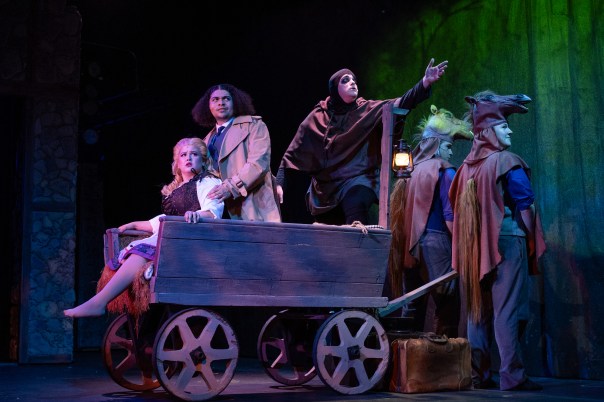
There are some rather filthy connotations strewn throughout our horrific romp through Transylvania, enough for Matthews Playhouse to caution parents against bringing youngsters under 13 to the current production. But stage director Jill Bloede presents each granule of this glorious filth with bawdy, bodacious, and childish glee at Fullwood Theater. Scenic designer Marty Wolff, costume designer Yvette Moten, lighting designer Jeffrey Childs, and choreographer Emily Hunter are all let loose to fashion fresh layers of excess and glitz.

A whole second stage opens up behind the teeming downtown Transylvania downstage when we reach Victor Frankenstein’s secret laboratory hidden behind the mad scientist’s library – an installation that permits special effects designer Roy Schumacher to make the moments of creation and coition inside the lab more spectacular.

Brooks’s venerated comedy reputation and Bloede’s every-shtick-in-the-book approach have drawn a bounty of professional grade talent to this cast. Wearing a frizzy Gene Wilder hairdo, Neifert Enrique cements his elite credentials as Dr. Frederick Frankenstein, grandson of Mary Shelley’s “Modern Prometheus,” bringing a youthful wonderment to the role that makes all the lead women’s roles a little plumier. If you missed Nick Culp’s outdoor exploits as Columbia in The Rocky Horror Picture Show during the pandemic, one of Actor’s Theatre’s valedictory efforts, his Matthews debut as Igor will likely come as a revelation, though he looked way closer to Fester Addams than to a hump-backed Marty Feldman. Lungs of steel and a wicked comedy flair.

With Mary Lynn Bain as noli-me-tangere New York socialite Elizabeth Benning and Gabriella Gonzalez as Inga, the cheery and buxom Transylvania peasant, the contrast between “Please Don’t Touch Me” and “Roll in the Hay” is as radical as any horny Frankenstein could wish. Bridging this chasm is The Monster, endowed by Brooks with a super-virility that surely would have drawn a polite giggle from Ms. Shelley. Hulking Matthew Corbett, roaring and bellowing with the best, makes Elizabeth’s deflowering a special joy, for while he is melting Bain’s ice maiden inhibitions, Brooks cooly has him overcoming his fear of fire.

Now we easily can find on YouTube that Peter Boyle actually danced in the Hollywood version, but the “Ritz” extravaganza concocted by Hunter is arguably more demanding, with Moten outfitting a good chunk of the Transylvanian peasantry in white tuxes. Top hats and canes for all the gents! We can’t call him Bojangles just yet, but Corbett contributes handsomely to the tap segments.

With leading roles in The Producers, La Cage aux Folles, Cabaret, and Ruthless! over the past 30 years, the charismatic Steve Bryan is a bit of overkill for his cameo as the Hermit. Decked out like a medieval monk, with a wig worthy of Joan Crawford in her dotage, Bryan is perfection as The Monster’s blind and bumbling host, not a trace of a smirk as he scalds his starving guest with soup – a comical affirmation of the beast’s docility as we delight in Corbett’s bellowing. Typical of his elegance, Bryan didn’t milk the last drop of deathless pathos out “Please Send Me Someone” before Corbett’s on-cue arrival answered his lonely prayers. True, Bryan got down on his knees begging, but he never once cried out for his mammy. Maybe next week.