Tag Archives: Andrea King

The Ghost of “(I Hate) Hamlet” Returns – With a Vengeance

Review: Women Playing Hamlet
By Perry Tannenbaum

Written and premiered in an era when only men could perform on stage, Hamlet has been performed many times with the finest actresses of their day in the title role. Poetic justice, playwright William Missouri Downs will tell you in his Women Playing Hamlet, since Shakespeare’s magnum opus is a revenge tragedy. Compounding this revenge – and attracting the notice of Charlotte’s Chickspeare banditas and Donna Scott Productions – Downs has decreed that all roles in his comedy, regardless of gender, shall be played by women.

Braininess and silliness play well together at Charlotte Art League, where Donna Scott Productions previously mustered the oddball Civil War re-enactors of Shiloh Rules and the eccentric Amish of The Book of Liz. Most of the cast gathered by director Tonya Bludsworth have performed with both Donna Scott and the Chix before.

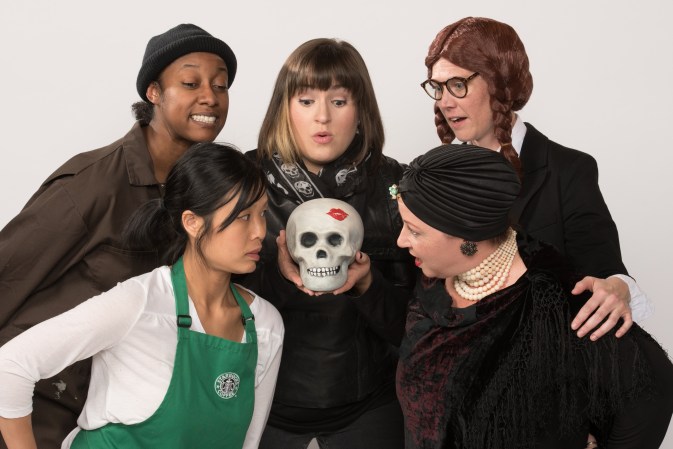
Oddballs abound here as well. The most stressed, conflicted, and self-doubting of these is Jessica Ostergaard, who has had the awesome role of Hamlet unexpectedly thrust upon her – despite a résumé that includes a killed-off character in the Young and the Restless and a flicker of a cameo in a Tarantino film (also dying). Everyone in New York who advises Jessica on this prodigious undertaking, whether the advice is solicited or not, tells her that she is too young to play Hamlet. And every one of these opinions has a certain amount of credibility, since everyone on Manhattan Island has an MFA in Acting, from your lowly Starbucks barkeep on up to your legendary acting guru.

Glynnis O’Donoghue has always had a look that mixes determined pluckiness and confused vulnerability, so she is always as perfect a Jessica as director Bludsworth could hope for. She soaks up the pithy pointers with the eagerness of a puppy and absorbs discouraging words with the most endearing and pathetic pout, one that still retains a glint of chin-up determination.

Downs layers on interesting reasons why Jessica should identify with the brooding Danish Prince. At her father’s funeral, we learn that Jessica’s mom announced her intent to marry her uncle. Somehow that doesn’t sound quite so sinister when the announcement is made in a folksy Minnesota accent, don’t-you-know.

That tawdry revelation allows Sheila Snow Proctor, as Minnesota Mother, to steal one scene from O’Donoghue in a flashback. More often, Proctor regally sports a turban, à la Norma Desmond, as Jessica’s acting guru. This imperious Gwen terrifies Jessica with her frank appraisals and such rigid dogmas as “Hamlet is the ‘Mona Lisa’ of plays.” If this formula reminds you of the TV actor haunted by John Barrymore in Paul Rudnick’s I Hate Hamlet, a very popular comedy in the early 1990’s, then you have the gist.
Nonetheless, Snow gets maximum mileage out of her scenes with the cringing O’Donoghue, because she maintains a stony hauteur that defies contradiction. And she is far from Jessica’s only tormentor. Tania Kelly, Vivian T Howell, and Andrea King all play five different roles along Jessica’s bumbling odyssey – with at least two apiece that are standouts. Howell is best as the Starbucks know-it-all and as Gwen’s other student, a ditzy model content to be patronized.

King and Kelly draw more eccentric assignments. As Jessica’s young niece Emily, a very immature Pippi Longstocking-ish Minnesotan, King unwillingly accompanies Jessica to the theater and gets the aspiring actress in trouble with Patrick Stewart during the movie star’s attempt at Hamlet. After disrupting the performance, damage control doesn’t go so well for Jessica at first, compounding Stewart’s rage against texting and tweeting. King’s other triumph is Lord Derby, a renowned Shakespearean scholar in his dotage.

Kelly hardly needs to do more than walk onstage to draw laughs, but she is especially memorable as a more shambling and déclassé academic, Jessica’s Humanities Professor, a veritable fount of dubious information. But Kelly surpasses herself as the Gravedigger, a scene where Downs gives us glints of Shakespearean depth. For a brief moment, we’re outside the hustle and bustle of Broadway and the ephemera of actors’ pretensions.

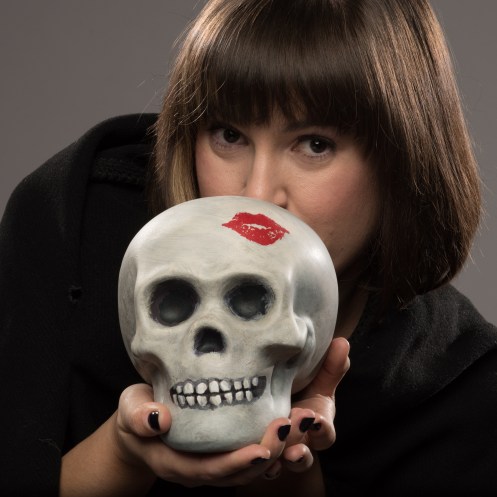
Chuck Bludworth’s projection slides underscore the web-based slickness and superficiality of the city. With no lack of self-esteem whatsoever, Gwen and the two academics manage to amuse us while educating us about the melancholy Dane and the women who have played him. But the dimly lit graveyard scene is something different. In this wilderness, Downs’s comedy and Shakespeare’s tragedy intermingle, for the two gravediggers in the Bard’s script were actually called Clowns in the dramatis personae. Somehow, Kelly’s portrayal makes me wish to see her tossing Yorick’s skull one day.


Less Bard and More Beer

Theater Reviews: Every Christmas Story Ever Told (and then some!) and The Great American Trailer Park Christmas Musical

everyxmasstoryphoto2

By Perry Tannenbaum

Four centuries after William Shakespeare’s death, Charlotte’s own Chickspeare inhabits a parallel universe. Or maybe it’s retribution: while all of the Bard’s works were performed by all-male theatre troupes, all of Chickspeare’s productions since 1998 have been “All women! All the time!” as originally promised. The “All Shakespeare” in the middle of that slogan was gradually blurred and dropped as the Chix added Reduced Shakespeare Company lampoons to their rep and then ventured father afield.

Written by Michael Carleton, James FitzGerald, and John K. Alvarez, Every Christmas Story Ever Told (and then some!) is very much in the spirit of Reduced Shakespeare’s original assault on the Elizabethan titan’s complete works. The parentheses in the title, the quickie romp through multiple classics by three actors playing multiple roles, and the devotion of all of Act 2 to a single extravagant lampoon all follow the Reduced template.

But gender only begins to describe the difference between Chickspeare’s version and the 2010 Actor’s Theatre Every Christmas. The new model is as much an event as it is a theatre production, an experience that begins and ends at the newer NoDa Brewery on N. Tryon Street. In between, there are a couple of shuttle bus rides back and forth from the original Brewery location on N. Davidson Street. You’ll find more brew choices on tap at North Tryon, but the enticement of lifting a mug and participating in the many “To beer!” toasts during the Chix performance at North Davidson is hard to resist.

Few did last Friday night. Besides the brewskis, we had Anne Lambert lubricating the experience with a steady feed of Christmas trivia challenges on the bus ride to the show and the conviviality of the Chix banditas – Sheila Snow Proctor, Lane Morris, and Tanya McClellan – during their performance. But mainly, it was the beer that induced the party atmosphere.

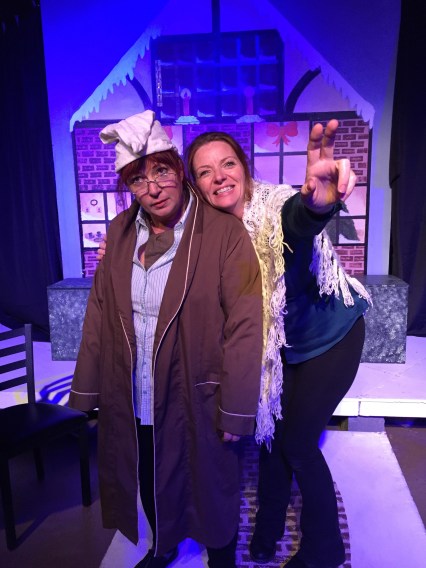
Directing the show, Joanna Gerdy and Andrea King had a healthy disregard for the script. The playwrights labored under a handicap that never afflicted the Reduced Shakespeare collaborators when they chose ancient targets like Hamlet, the Bible, and American history for their merry desecrations. Unlike your seasonal carols, most of our familiar Christmas stories aren’t free-range prey. Copyright law prevents satiric assaults upon Rudolph the Red-Nosed Reindeer, the Charlie Brown Christmas, and the Yuletide yarns of Truman Capote, Dylan Thomas, and Jean Sheperd.

When Carleton, FitzGerald, and Alvarez lashed out at these restrictions, the result was “Gustav, the Green-Nosed Rain-Goat,” not the funniest sketch you’ll ever see. Morris never plays the mutated venison as if it were comedy gold, so there’s never any deadly straining to make it funnier than it is. We’ll raise a glass, and then we’ll move on.

The premise of the show is that Proctor wishes to proceed traditionally with a presentation of Dickens’ A Christmas Carol, but Morris and McClellan are sick and tired of the same old stuff. Before they’ll allow Snow to read her Dickens and play her Scrooge, she must join them in a medley of other Christmas faves, including Frosty the Snowman, Macy’s Thanksgiving Parade, the Grinch, O’Henry’s “The Gift of the Magi,” and – maybe if there’s enough time – the inevitable It’s a Wonderful Life.

scrooge-and-mary2

There isn’t enough time, but that doesn’t deter Morris. While Proctor is on-task as Scrooge, with McClellan visiting her as all three ghosts, Morris keeps insisting that Proctor is George Bailey, inflicting on us a bevy of characters from New Bedford Falls, including George’s guardian angel, his brother, his banker nemesis, and his adoring wife. By the time Lane reaches the wife, it comes off oddly like a female impersonation.

Fortunately, Proctor is the ideal Scrooge in the face of these torments. There’s a bit of Oliver Hardy and Bud Abbott in her forbearance, but we somehow remain on her side throughout her ordeal. At the climax of Christmas Carol, Morris is still bedeviling her, so she finally submits to becoming George Bailey – in a schizophrenic frenzy that finds her shuttling between Scrooge and Bailey as both McClellan and Morris assail her.

In her surrender, Proctor produces a Jimmy Stewart impersonation that’s barely good enough to let you know what she’s doing. It will probably improve during the next couple of weekends as the run continues, but I’m not sure it should. Likewise, Proctor can be a mite slow changing costumes, but McClellan’s patience with her cast mate is so priceless, it would hardly pay for Proctor to hurry.

It’s been a rocky road for Actor’s Theatre of Charlotte since developers forced them out of their longtime home on Stonewall Street last summer. We thought they would resurface on Louise Avenue, but negotiations there collapsed, and the company tacked toward Freedom Drive. City and county paperwork delayed the opening, so their Toxic Avenger was redirected to a nearby church, and the current Great American Trailer Park Christmas Musical has been rerouted to the Patricia McBride and Jean-Pierre Bonnefoux Center for Dance, Charlotte Ballet’s HQ on N. Tryon Street.

I was curious to see how director Chip Decker and his design team would adapt to studios with so much space and such a high ceiling. With two fair-sized ramshackle trailers, topped by two jumbo projection screens, height isn’t a problem, and the design team fills out the stage with a fence, some Florida flamingo kitsch, an incongruous array of Star Wars memorabilia and, dead center of the stage between the two trailers, a half-decorated Christmas tree.

That odd tree, straddling the borderline between Rufus and Darleen’s properties, triggers Betsy Kelso’s plotline. Rufus loves Christmas and adores Darleen, but mean Darleen snarls “Bah” and “Humbug” to both. She will not decorate her trailer or even allow Rufus onto her property to decorate her side of the tree. That’s a source of huge consternation to Betty, the manager of Armadillo Acres, who has always wanted – but failed – to win the big prize awarded to the best-decorated trailer park. A vague curse plagues Armadillo Acres, and it too will to be exorcised before we reach a happy ending.

There’s a certain amount of respectability in Betty, so we’re fortunate that it is more than counterbalanced by the trashiness of her other tenants, Pickles and Lin (short for Linoleum). They also come in handy when ghosts are needed to populate Darleen’s Dickensian dream sequence. Rufus’s romantic fantasies and Betty’s hopes of nabbing top kitsch honors are revived when Darleen, in an effort to pull the plug on the park’s Christmas lights, gets electrocuted by Rufus’s déclassé cable-splitter and wakens with amnesia. That enables her to forget what a Scrooge she is and the fact that she belongs to Jackie, owner of a slutty pancake joint.

If you missed the first and second comings of this trashy romp, it’s good for you to know all the basics I’ve detailed. Although Actor’s Theatre has done well with the Charlotte Ballet space, they have thoroughly failed to conquer its acoustics. So the songs and lyrics by David Nehls are more crucial to your enjoyment than usual – but often unintelligible over the four-piece band led by music director Brad Fugate.

Tommy Foster isn’t as rednecky as Ryan Stamey was as Rufus, but he’s a tad more pathetic and lovable. Karen Christensen is more than sufficiently bitchy as Darleen, and we often forget that Matt Kenyon is in drag as Lin. (So does he, I suspect.) But Jon Parker Douglas nearly steals the show as Jackie when he is possessed during the climactic exorcism. It’s an epileptic farting fantasia that isn’t quickly forgotten – and the kind of broad physical comedy this acoustically-challenged show desperately needs.


Not Your Same Old Vampire

Reviews: She Who Watches and Charlotte Symphony

By Perry Tannenbaum

Performances of She Who Watches run through Oct. 30 at Frock Shop.


When J. Sheridan Le Fanu serialized Carmilla in 1871-72, Count Dracula wasn’t even a gleam in Bram Stoker’s eye. Yet a quarter of a century later, when Dracula became the paradigm for modern vampire literature, Stoker himself acknowledged that Le Fanu’s most famous novella was a part of that gleam. So after a steady sprinkling of October visitations from the undead lord of Transylvania — no less than seven Metrolina Dracula productions since 2002 — it’s nice to see a change of pace in the form of a new PaperHouse Theatre adaptation of Le Fanu’s spellbinding horror classic.

Eerie echoes are a key motif in the storytelling, which co-directors Nicia Carla and Chester Shepherd have retitled She Who Watches in their adaptation. The narrator of the story, Laura, is haunted by a nightmarish experience from her childhood, when she awoke to find a teen-aged girl in her bedroom. That girl seemed to fall into a slumber on Laura’s chest, but when she awoke the second time, what the girl was doing made her shriek in terror. And then, before her governess could come to the rescue, the girl vanished into thin air!

It would be cruel to divulge much of what happens 12 years after this creepy prologue, but you’re correct in assuming that the beautiful face indelibly etched in Laura’s memory is Carmilla. How Carmilla returns to Laura’s home — and ultimately, her bed — took just under 69 minutes to deliciously unfold on opening night, with neat surprises and more eerie echoes along the way. That’s about the same amount of time you might spend in your family car getting from the I-277 overpass to the dubious thrills of Scarowinds.

It’s a shorter, more enjoyable evening at PaperHouse’s customary haunt, The Frock Shop. Le Fanu’s story placed the action at a lonely Austrian castle in a place called Styria, but the parlor of the Frock Shop cottage on Central Avenue seems to suit Carla and Shepherd quite dandily. The antique atmosphere is built in, augmented by a gallery of starchy, frilly, diaphanous, and full-length costumes designed by Magda Guichard.

Lighting designer Chaz Pofahl, strategically potting the illumination levels, is certainly a part of the spooky conspiracy, but our stage directors also utilize the windows lining two of the parlor’s walls to pique the suspense and ambiance. Perhaps emboldened by the numerous film, stage and TV adaptations of Carmilla that have come before, Carla and Sheperd have done some character shuffling as well. Instead of a kindly father, Laura’s lone parent is a coolish mom, and instead of a distressed friend of her father, General Spielsdorf, we get a more down-to-earth and frazzled Aunt Jean.

The core protagonists remain the same, and we’re very fortunate there. After two strong outings in Theatre Charlotte’s Miracle Worker and PaperHouse’s Much Ado About Nothing, Sarah Woldum is probably the busiest actress in town this year, taking on the role of Carmilla. She seems to revel in the menace of this role, seething with a mysterious intensity when she isn’t softening her prey with endearments. The whole chemistry of her is different from Dracula’s, seemingly resistant to daylight, but you wonder whether her episodes of weakness are symptoms of a gnawing blood hunger or simply playacting to draw sympathy. When Woldum becomes the predator, Carmilla’s rapacity is as much sexual as it is animal.

Racquel Nadhiri spoke too softly at the outset, compounding my difficulties with her Jamaican accent, so I won’t give her top marks as our Narrator. But Nadhiri beautifully captures the mixture of attraction and repulsion that is the essence of Laura’s reaction to Carmilla. Our empathy for Laura’s victimhood is that much stronger because it stems from her sunny heroism.

The ending that Carla and Shepherd have devised for her — distinctly different from Le Fanu’s — fits Nadhiri like a glove, and you might say that the word “bloodcurdling” was specially cooked up to describe her screams.

Two interludes punctuate the action, so you can get refills on the beverages that were served on the front lawn as you first entered, or you might nosh on cream puffs and sausage balls. When we reached the denouement, the audience was split in two, half of us ascending the staircase to witness the climactic encounter between Laura and Carmilla in the bedroom, half of us remaining downstairs to hear the disclosures that Laura’s mom receives from Aunt Jean.

You’ll have a better appreciation of the synchronicity of the two scenes from the downstairs vantage point, but everyone gets the chance to see both scenes — because, we realize, they actually occur simultaneously.

As I’ve already hinted, the cold and clueless Mother isn’t the plum role here, so you won’t be seeing Andrea King at her best, though she’s very good, of course. Most of the scene stealing comes from Rebecca Costas, busily changing costumes and characters throughout the show. Maybe her most comical turn is as the Doctor who says she’ll return so nervously that you can be absolutely sure she won’t, but she’s also pretty funny as Hunch-Hag, dispensing some fairly toxic marital insight to audience members.

Costas also gets a couple of serious cameos, first as the mysterious and malevolent Countess, Carmilla’s aunt. More urgent — and earnest — is Aunt Jean as the action comes to a boil.

Since her stint as she-devil Abigail Williams in CPCC Theatre’s 2001 production of The Crucible, Costas has only emerged briefly and intermittently on the local scene. It’s a kick to see her shining 15 years later in such a versatile performance, her devilish fire not only intact but several degrees hotter.

Charlotte Symphony’s 85th season is off to an exciting start, and Mary A. Deissler, the new president and CEO, is already making her impact. She has things to say, both onstage at Belk Theater when the orchestra plays and in the CSO program booklet, which isn’t as staid and stagnant as it used to be. Sitting down to last week’s Beethoven Symphony No. 2 concert, I found new artwork, festooned with pumpkins, on the cover.

Image result for picture of benedetto lupo playing piano

The two artworks I’ve seen on the booklet covers, through two 2016-17 Classics concerts, already doubles the number I’ve seen in previous seasons. More importantly, Deissler has kept an inside page, opposite the page where you find tonight’s composers and compositions listed, reserved for herself. So instead of some generic remarks designed to linger more or more inanely as the season wore on, Deissler did a reset on page 17A.

The Welcome Page addressed the divisiveness that has fractured our community in recent weeks, the unifying power of music, and Deissler’s gratitude that we were back at a time when healing is needed. Rang true.

Switching from music director Christopher Warren-Green to guest conductor Michael Christie, the Beethoven offerings were more varied and adventurous than the All-Tchaikovsky season opener, veering off into Franz Liszt’s Piano Concerto No. 1 and his Totentanz before we jackknifed into György Ligeti’s folksier and funkier Concert Românesc.

Guest soloist Benedetto Lupo and the CSO brass were a bit overeager and brutish in the opening section of the concerto, but after the pianist navigated through his first softer, lyrical passages, everyone seemed to settle into a more relaxed groove. A fresh production wrinkle further enlivened the concert: a projection screen descended over the Belk stage so an overhead camera could transmit a bird’s eye view of the hurtin’ that Lupo was delivering to a defenseless Steinway Model D.

Van Cliburn himself might have winced.

Shakespeare Pens a Sitcom

Theater Review: The Comedy of Errors

By Perry Tannenbaum

unnamed-8

Up on North Tryon Street at NoDa Brewing Company, Chickspeare is flipping the script again.

Founded upon the principle that Shakespeare’s works, originally performed by all-male companies in Merrie Olde England, can also be performed by all-female companies in Modern America, Chickspeare now propounds a new heresy. Although the Bard’s first great work, The Comedy of Errors, has its roots in Ancient Rome, why can’t we equate this trusty old farce with our own dopey TV sitcoms?

Executing this audacious concept, Chickspeare director Andrea King decrees a modicum of pruning and reshaping upon the script, along with hefty helpings of mugging, styling, and profiling from her hambone cast. If that weren’t enough to win us over — and it definitely was last Saturday night — then there’s the prepaid cupful of NoDa Brewing’s draft beer to further lubricate our receptivity. Four different brews were flowing from the kegs.

As the old story unfolds in modern dress, linkage to American sitcoms comes largely through familiar theme songs. When the luckless Egeon tells how his twin sons, both named Antipholus, were separated during infancy along with their parents, the fateful sea voyage is evoked by the familiar shipwreck of The Minnow immortalized in the ballad of Gilligan’s Island — plus an extremely cheesy scene change. Later when Antipholus of Syracuse marvels at the fact that everyone recognizes him in Ephesus, where he has never been before, his astonishment is punctuated by the theme song from Cheers, that Boston pub where everybody knows your name.

Action comes fast and quick in this Shakespeare in the Park(ing Lot) production, so I didn’t keep track of all the sitcom and game-show themes that zoomed by, or whether references to The Jeffersons, Mission Impossible, Laverne and Shirley, and The Beverly Hillbillies were linked quite as cunningly to the text. These “Chicksbeer” shows are all outdoors, with a nearby food truck supplementing the brewery offerings, but the evening performances beginning at 7 p.m. make some extra buffoonery possible as the Ephesian nitwits take multiple stabs at pointing to the setting sun.

Two sets of identical twins scurry about during this carnival of confusion, for the two Antipholuses are served by two Dromios who were also separated during infancy. Their befuddlement can only be sustained if they don’t meet, so it isn’t until deep in act five that all four of our protagonists must appear simultaneously before us. Historically, directors have relied upon actors’ height, costumes, and grooming to bridge the inevitable gap in physical appearances. Only recently have I seen or heard of directors who explore the comic possibilities of radically mismatching the identical twins.

King adopts yet another strategy. Perhaps inspired by her own recent experience in PaperHouse Theatre’s Much Ado About Nothing, where she was briefly Dogberry and Leonato simultaneously, King has cast Caroline Renfro as both Antipholuses and Tania Kelly as both Dromios. Talk about flipping the script! In most productions of Comedy of Errors, we’re challenged to perceive the twins as identical in spite of their obvious physical differences. At the NoDa Brewing Company parking lot, we’re challenged to keep track of which identical twin is which.

A couple of visual aids are helpful. When Kelly is the Dromio who dwells in Ephesus, she dons a dopey floppy hat, and when Renfro appears as the Syracusan Antipholus, she flips out a Clark Kent set of eyeglass frames. As you’ll see in the zany staging of her nativity, this Antipholus was actually born with eyeglasses. Additionally, the philandering Antipholus of Ephesus seems to be tipsy for nearly the whole evening.

Chickspeare (Photo by Weldon Weaver)

That extra degree of differentiation for Renfro seems justified. With all the thankless errands, unjust castigations, and slapstick beatings that Kelly absorbs as the two Dromios, it eventually ceases to matter which whipping boy is drawing the belly laughs. Except when Dromio of Syracuse is pursued by the amply padded Carmen Bartlett as Nell, Antipholus of Ephesus’ kitchen maid — and his manservant’s massive wife.

Kelly works up a delightful lather as she gets most of the shtick, but Renfro generates her share of zaniness, perhaps most memorably when she picks up a mic-like prop and hosts an impromptu segment of … let’s call it The Dating Game. Antipholus of Syracuse is less hotly pursued by his twin’s wife, but the scantily clad Alexandria White definitively stamps herself as the hottie of the house as Adriana, spurned though she might be by the look-alike Antipholus while her real husband is cheating on her.

Theme music from Bewitched may have been cued up when the alluring Adriana invited her Syracuse brother-in-law to her home for dinner. Not only can’t Antipholus believe his good fortune, he is smitten by Adriana’s sister, Luciana. Some of the juice seems to be drained from this faux love triangle to trim this production to its desired running time, so we miss some of the sisters’ consternation when the Syracusan obeys his instincts and speaks his heart. Likewise, Dromio of Syracuse’s eventual relief seemed to overshadow his master’s delight in the denouement.

So Kacy Southerland didn’t get the fullest opportunity to explore the virtues of Luciana — or their ultimate reward. But she moonlights as Amelia, the local abbess, so she can lavish additional virtue on Egeon’s long-lost wife and gush forth the bliss of her reunion with her children and her husband.

Arrested in the opening scene for being a Syracusan on Ephesian soil, Amanda Liles isn’t seen much as Egeon after narrating the hilarious sea saga that sets up the plot. Not to fear, she resurfaces as the frustrated goldsmith, Angelo, who can’t get paid for the necklace he fashions for the philandering Antipholus — and as the courtesan he’s two-timing with. Of course, Egeon must be there for the sentimental reunions, so Liles has her schizoid moment, splitting into Angelo as all is settled.

Cara Wood is the Duke of Ephesus, who — mercifully? — grants Egeon 24 hours to raise the ransom money that will enable him to avoid execution for his trespass. We need more Duke at the end when the terrified Antipholus of Syracuse and his Dromio take refuge at the Abbey and the implacable Adriana wants her husband back. Wood tosses off the Duke — and an arresting officer in the necklace affair — with far more distinction than we usually see, never detracting from the merry mood.

Chickspeare has a knack for broadly entertaining while duly honoring the Bard, making the texts accessible to common folk four centuries after they played to the groundlings.

Symptomatic of the troupe’s sure touch here is how they treat the often intimidating soliloquies. Instead of making them occasions for declamatory orations, they’re prerecorded and presented as interior monologues, brought down to the level of cartoonish thought bubbles that pop with crass and delicious effervescence.

Yeah, the Chix banditas understand what contemporary audiences crave, and their Chicksbeer series deftly taps in.

A Mad Tea Party at the Frock Shop

Theatre Review: Much Ado About Nothing

By Perry Tannenbaum

Much Ado1For a second straight spring, PaperHouse Theatre is using the Frock Shop on Central Avenue as a backdrop for an English comedy, but you can be sure that this year’s Much Ado About Nothing is far more freewheeling and lighthearted than last year’s A Woman of No Importance. Oscar Wilde’s work was about class, privilege, loyalty, and ideals, while Shakespeare’s is very much about misconceptions and manipulation.

Last June, the prissiness of Frock Shop and its charming hominess were upheld in the Victorian finery worn by the cast. Now as we arrive at June 2016, we can observe that formality has been largely relaxed, the better for all the cast to not only change costumes but also to change characters. Even the saltiest and wittiest of the lovebirds, Beatrice and Benedick, get to moonlight as buffoons. Hero and Claudio, the more ardent and tedious couple, also get in their comic licks, Hero working for her own destruction as Borachio, a sleazy stoner, and Claudio crossdressing as Ursula, Hero’s maidservant.

Nicia Carla adds deftly to the lightheartedness of the comedy in her first attempt at directing a Shakespearean script. Both the cuts she has applied to the script and the clarity that survives despite those hefty splices testify that she’s quite good at it. Several of the players on hand have experience with the Bard, and it shows.

The barbs Beatrice and Benedick exchange in Much Ado hearken back to the strife between Kate and Petruchio in The Taming of the Shrew, while the malicious scheming against Claudio prefigures the work of Iago in Othello and Edmund, the bastard noble in King Lear. So when Carla lightens the comedy, there’s a risk of diluting the drama. Yet the church scene where the wedding goes awry is one of the best of the evening.

Whether benign or virulent, manipulation is hard to pull off perfectly. In Much Ado, both plots are unmasked, but there are provocative contrasts in how each is resolved. Order is restored as the plot against Beatrice and Benedick exposes the love that both were hiding deep within – lingering from a liaison that had been broken off before the action begins, before Benedick marched off into battle. But the haze of the catastrophe that could have been hovers over the happy resolution of the deception practiced upon Claudio.

In the PaperHouse production, that darkness adds poignancy to the ultimate happiness Claudio and Hero achieve. After bringing so much youth and vitality to Annie Sullivan at Theatre Charlotte back in March, Sarah Woldum is softer and shyer as Hero with the same lurking buoyancy of youth, and it’s hard to believe that Deven Ginyard is a college freshman playing Claudio – unless we assume he has taken about seven gap years after high school.

Much Ado2

Chester Shepherd was at the heart of the success of last year’s Woman of No Importance when he was paired with Katy Shepherd. Now Shepherd is fencing with Alexandria White, whom I previously encountered last June as a glamorous gallery of discards in The Picture of Dorian Gray. Yet I can’t say these Shakespearean lovebirds are noticeably less wholesome than the romantic fledglings we followed around The Frock Shop last June when PaperHouse also tackled Wilde.

Curiously, the jousting lovers’ lack of sharpness doesn’t throw this Much Ado off-kilter because of all the zaniness that Carla strews around them. Andrea King and Shawna Pledger are the chief perpetrators of the low comedy, King as a Dogberry who’ll remind you of a backwoods highway trooper and Pledger in a trio of crossdressing roles, recycling the same crappy hair scrap as The Friar’s eyebrows and Don John’s mustache. Or vice versa? The thing just hangs like a sorry backwards necklace when not in use.

As I’ve mentioned, the lovers also moonlight as lowlifes. Woldum gets the juiciest opportunities when she crossdresses as Borachio, but Ginyard’s matronly bustle as Ursula is also a hoot. King upstages them all when she must appear simultaneously as both her characters, Hero’s father Leonato and the bumbling Dogberry. On these occasions, King produces a Dogberry puppet and converses with herself. Not great puppetry, but it is great fun.

Adding to the merriment, PaperHouse serves up tea, hot and soft beverages, and finger foods at various intervals before and during the show. A Pavlovian bell signals those times when you’ll move among the downstairs rooms during the production as well as the front porch, lawn, and rear parking lot. All in all, a pretty mad tea party.