Tag Archives: Alan Menken

Vox Populi Deafeningly Lauds “Little Shop” at The Barn

Review: Little Shop of Horrors at Theatre Charlotte

By Perry Tannenbaum

Sunny, frolicsome, dark, and bizarre: it’s tough to say whether the best landing spot for Little Shop of Horrors is during the spring, that fragrant time of flowering hope and romance, or the fall, that decaying season of colorful rot and the macabre. All of the Metrolina theatre companies and colleges that have taken us back to Skid Row this century have chosen one of those two seasons for reprising Howard Ashman’s 1982 adaptation of Roger Corman’s cult comedy flick.

The tally among executive directors, department heads, and boards has been decisively autumnal. Judging by the full house on opening night last week at Theatre Charlotte, which previously staged Little Shop in the spring of 2008, I’d say that the movers and shakers at the Queens Road Barn have seen the light and aligned with the popular vote.

No other explanation for the robust turnout – or the rabid response – springs to mind. There was nothing novel or pricey about TC’s prepublicity, unless Facebook and Instagram are suddenly breakthroughs. Nor is name recognition a factor when you consider the director, the lead couple, or the choreographer.

Only if they knew that Kevin Roberge would be can’t-miss as Mr. Mushnik, owner of a perishing Skid Row flower shop – or that real-life dentist Nehemiah Lawson would be don’t-miss as sadistic dentist Orin – would people be flocking to Queens Road with raised expectations. And if you hadn’t seen their award-winning collaboration in Next to Normal down at Fort Mill Community Playhouse two years ago, you wouldn’t know if it was director Scott Albert who chose Peter Liuzzo as his preternaturally nebishy Seymour or the other way around.

Sometimes you need to listen to the vox populi, and sometimes you must try to blot it out. For me on opening night of Little Shop, it was both. My Apple Watch faithfully notifies me the next morning when sound pressure levels reach or exceed 95dB at concerts, musicals, or plays attended the night before. If the noise tops 100dB, the usual number of notices is one to three.

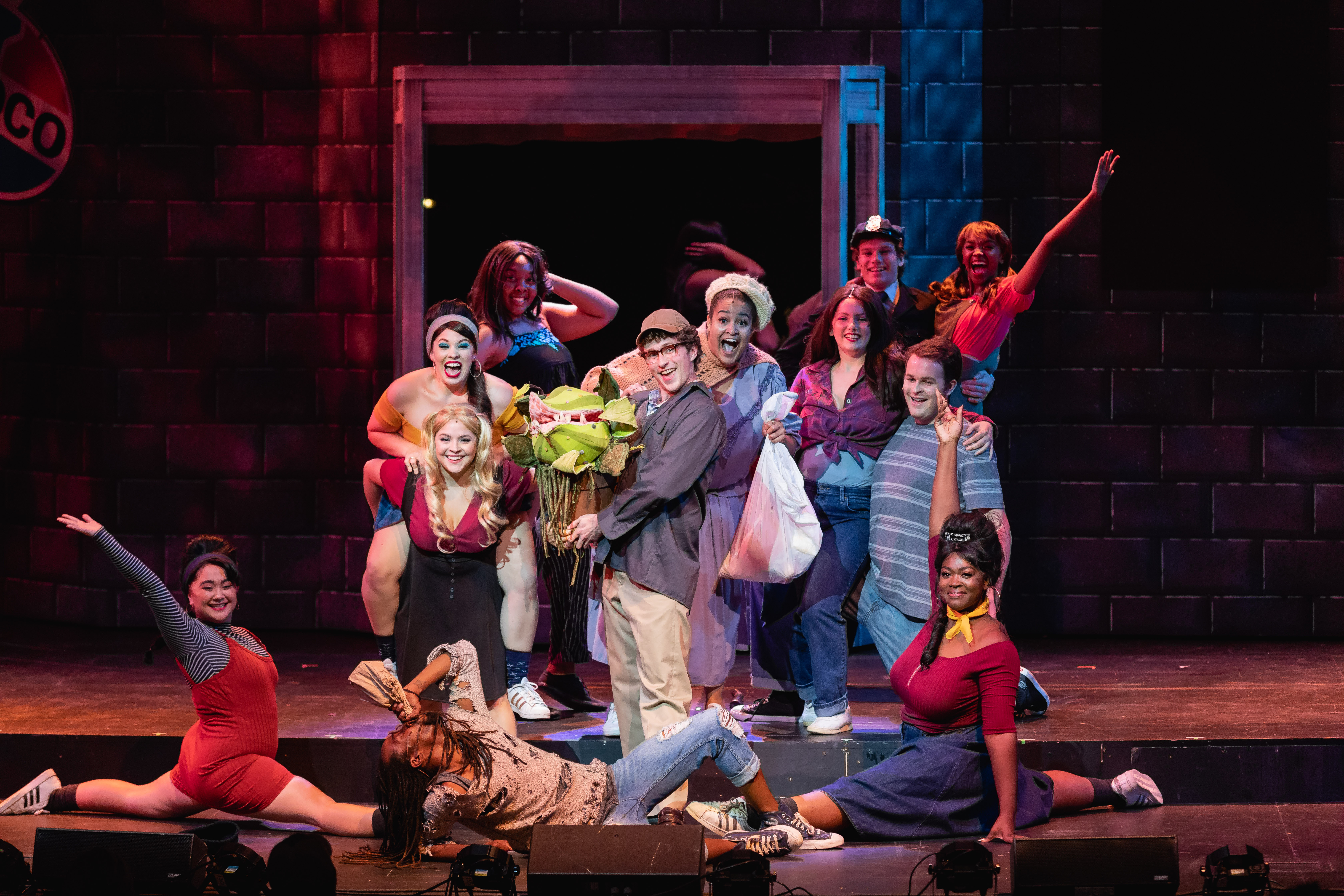
Little Shop smashed that norm, hitting or exceeding the 100dB bar 14 times, and topping out at an astonishing 115dB. I could see it coming when Liuzzo and Gabriella Gonzalez as Audrey, his newly-won sweetheart, merged their voices in the climactic “Suddenly Seymour.” Three doo-wop vocalists emerged from a tenement apartment door, adding glitz, glamour, and sensuality to the spectacle: Olivia Greene as Ronnette, Tia Robbins as Crystal, and Jessica Milner, a trio of rookies.

Then as Seymour and Audrey responded to each other, Liuzzo dug out his coming-into-manhood voice and began belting wildly. Not to be upstaged, Gonzalez, previously confined to the sugary “Somewhere That’s Green,” let loose with her piercing pipes.

When something is this sensational in a community theatre production, I often find myself weeping or sobbing. This time, my instincts had me clamping my hands over my ears in self-defense. Didn’t do much good.
Tinted by J.P. Woody’s groovy lighting, scenic design by Gordon Olson revels in the squalor of the skids with a doo-wop funk and loving detail that reminded me of Mad Magazine comic strips devoured in my youth. The era is the prehistoric ‘50s, when teens toted transistor radios to stay in touch with the Top 40, and Alan Menken’s musical score reveres those vibes as if they are gospel.

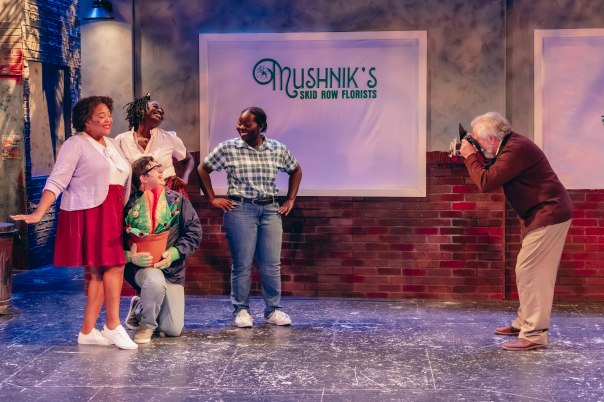
From Seymour’s nerdy sweater vest to Orin’s biker black jacket, Rachel Engstrom’s costume designs are also onboard with the ‘50s beat, with such an outrageous variety of looks for the vocal trio that you can look at them as district goddesses. Props, including a mini press camera and various-sized potted Audrey 2’s that double as puppets, are also a treat from Lea Harkins – plus Orin’s diabolical dentist’s drill.

Besides getting the right moves from his talented cast alongside choreographer Georgie DeCosmo, Albert’s stage direction fosters all kinds of synergies that pave the way for Audrey 2 to have the sleek looks of a garish concept sports car and the voice of a rabid boar. Named after his idolized co-worker, Audrey 2, the carnivorous plant that Seymour suddenly discovers during a total eclipse of the sun, has a special cunning, speaking only to Seymour to get his way.

The voice comes lustily from Toni “Aideem” Morrison, and the movements of her leaves and tendrils come mostly from a team of three unseen puppeteers. When the side wall of Mushnik’s Skid Row Florists slides shut to hide the store, a beehive of activity with puppeteers and stagehands is dressing the interior more and more lushly with Audrey 2’s foliage as the bloodthirsty monster grows.

By the end of opening night, that side wall had been dinged with cracks and bruises, and one stagehand, in damage-control mode, was seen frantically exiting at the end of a scene change. The tech perfection extended similarly to the sound: just one brief dropout assailed Gonzalez, and that’s all. Every note from the four-piece band led by Ellen Robison from the keyboard came through undimmed.

Except when the audience broke loose.

Aside from the original Audrey, none of the main characters is burnished with virtue. Seymour’s origins, though not otherworldly, are no less mysterious than Audrey 2’s, orphaned at the flower shop’s doorstep as a babe and living there ever since. His homicidal tendencies, awakened by the arrival of Audrey 2, prove to be benign when he has to pull the trigger.

Munchnik is no less compromised. Although he has opened his door to Seymour, the lad has always slept out front under the cash register. Until he overhears Orin advising Seymour to leave Skid Row with his newfound cash cow, Mushnik never considers adopting the waif or making him his heir. In the hard times, when Mushnik is on the verge of permanently shutting down his shop, there’s not a peep from him that indicates he has given Seymour’s future so much as a thought.

Liuzzo plays his side of this relationship with gratitude, servility, and fear, while Roberge as Mushnik can load up on scorn, exploitation, and intimidation. Nebishy meets nasty. With those considerable hits to Seymour’s self-esteem, Liuzzo’s timidity can extend toward keeping his feelings for Audrey hidden, especially since she is already in Orin’s firm and abusive grasp.

Framed by the threats of an insanely sadistic dentist and a man-eating alien plant with dreams of global domination, the mundane frictions between Seymour and Mushnik can seem comical. But the best comedy contrivance, preserved by Ashman from the Charles Griffith screenplay, is the mutual non-relationship between Seymour and Audrey: both of these sweethearts have good reason to feel unworthy of the other.

It’s pretty classic how clearly Liuzzo and Gonzalez venerate one another before they connect – adding fuel to the explosive audience reaction in Act 2 when they have their “Suddenly Seymour” moment. Roberge coming up on them and taking it all in during an extended smooch is a cherry on top.

Contrasting with all this bliss and twisted domesticity are the crazed, barbecued voices of Lawson and Aideem. Since the days of silent film, dentistry has proudly perched on the knife’s edge between comedy and horror. Thanks to this delicious script, Lawson gets to sharpen that blade more keenly by adding masochism. Not to worry, after Orin nourishes Audrey 2 piecemeal, Lawson returns after intermission in a series of cameos to entice Seymour with additional money-making opportunities.

Yet it’s Aideem who endures forever as Audrey 2, aided by a wonderful tech flourish in the epilogue. His bubbly vibrato is not the deepest I’ve heard out of Audrey 2’s maw, but it’s more than sufficiently low, spirited, and spicy. Aideem’s performance will likely draw another noise notification if you’re wearing an Apple Watch. The final bows certainly will.

Upsizing “Little Shop” at CP

Review: Little Shop of Horrors

By Perry Tannenbaum

Little Shop of Horrors Final Dress Rehearsal; October 24th, 2019

What seemed so axiomatic when Little Shop of Horrors opened Off-Broadway in 1982 – that it was a little musical – was shunted aside when the smash hit was finally revived on Broadway in 2003. Bringing the show to Broadway seemed against the grain to Howard Ashman after he had directed his own original adaptation of Roger Corman’s 1960 sci-fi comedy. His misgivings were borne out by the lukewarm reviews from the New York critics and the equally tepid box office.

Big productions of Little Shop, like the touring version that hit Ovens Auditorium in 2005, have been aberrations. Around the country, the welcome mat for Ashman’s artful adaptation, with a rockin’ doo-wop score by Alan Menken, is customarily rolled out by smaller regional companies and community theatres.

A little surprising, then, to see Central Piedmont Theatre bringing Audrey, Seymour, and Audrey II to Halton Theater, which is only marginally smaller than the Virginia Theatre (now the August Wilson), where it ran on Broadway. But guess what? Charlotte isn’t receiving Little Shop as if it were a niche musical for guerilla companies and intimate venues. A robust crowd turned out for this past Sunday’s matinee, with armloads of tickets sold up in the oft-empty Halton balcony.

Little Shop of Horrors Final Dress Rehearsal; October 24th, 2019

Nor is director Ron Chisholm and his CP team shying away from the challenge of making Little Shop big. James Duke’s set design fills the stage from wing to wing, and Chisholm pours a larger cast around Audrey and Seymour than the one that populated Mushnik’s Flower Shop and Skid Row in the Broadway revival. I should also say that Chisholm pours a larger cast into Audrey II, but I won’t spoil how that plays out.

My wife Sue didn’t recognize any of the names on the CP cast list, which ultimately demonstrated just how deep Charlotte’s talent pool is these days. The name I recognized from her starring role over the summer in CP’s Beehive, Iris DeWitt, was not to be recognized here at Mushnik’s. With body mics liberally distributed among the Skid Row citizenry, it’s safest to say that DeWitt represented onstage by the latter Audrey II puppets. That’s when the alien plant lets loose with her infamous “Feed Me,” displaying its vocal gifts upon growing to maturity.LITTLESHOPOFHORRORS-123.jpg

While you need a full-throated – even intimidating – voice that DeWitt brings to an invader that metastasizes into a global threat, we need to get more ambivalent impressions of Seymour, Mushnik, and the human Audrey. We empathize with the orphaned Seymour, who is bossed by Mushnik, bullied by Mushnik, terrified by Audrey’s dentist boyfriend, and ignored by Audrey.

Until Seymour becomes homicidal.

Then we see him feeding body parts to Audrey 2 and covering up his guilt by luring Mushnik into the same maw. He’s reluctant to do 2’s bidding and become a bloodthirsty killer, but it’s bringing him fortune, fame, and – in his mind – the Audrey who has hitherto shunned him. Ultimately, he pushes back, ready to face what his recovered integrity brings him. It’s a fairly daunting role for Matthew Howie in his Charlotte debut, and the dude must also prove he can sing – both as a downtrodden clod and, in “Suddenly, Seymour,” as a newly-minted romantic hero. Howie knows how, and Chisholm gives him a comical Clark Kent moment to punctuate his transformation.

LITTLESHOPOFHORRORS-198

Nearly 60 years after she first appeared onscreen, we look more askance at Audrey for absorbing and covering up the abuse she takes from Orin, her dentist boyfriend, than we do for her presumed promiscuity. She encourages Seymour to stand up to Mushnik, and when he suddenly achieves celebrity, declares she isn’t good enough for him. Anna Farish proved to be sensational in her own way as Seymour’s ideal, belting “Suddenly Seymour” opposite Howie with equal gusto in their duet and tapping into Audrey’s humdrum sweetness in the gooey “Somewhere That’s Green.”

I quite envy anyone who hears the reprise of that bucolic ballad for the first time. The sick comedy of it comes through in Farish’s last gasps, but that was one of multiple moments when I wished I were seeing Little Shop in a more intimate venue. Because a huge set piece by Duke was spun around when we went from the outdoor squalor of Skid Row to the inside of the flower shop, scenes at the shop played too far away upstage for maximum enjoyment.

Little Shop of Horrors Final Dress Rehearsal; October 24th, 2019

On the other hand, there were plenty of outsized performances besides DeWitt’s to help bridge the distance. Most outré was Victor Tran as the sadistic, laughing-gas fueled Orin, who gets to shine late in Act 1 singing “Dentist” with a backup trio, somewhat denuded of its usual 50’s trimmings. Clad in leather when he calls on Audrey, Tran also gets to handle two of the most interesting props in this production, an emasculated motorcycle and the wondrous dentist’s chair he mounts in order to terrorize Seymour – extracting only a single tooth, alas.

Jake Yara has that slight avuncular quality – and the hearty voice – you want to see in Mushnik and plenty of the selfish greed you want to see offsetting it. Mushnik is a bit of a Jewish stereotype, more comical than offensive. But when Yara sings “Mushnik and Son” with Howie, as Mushnik offers to make the suddenly promising Seymour his partner, there’s a pinch of warm regard mixed into his cunning pragmatism. On the street, where the alleys and trashcan evoke the seedy ‘hood, Katie Marcelino, Logan Cosper, and Taylor Goodwin do more than just sing backup.

They keep it real. So does the ensemble actor who plays the neighborhood drunk, rousing from his stupor only long enough to sing the low notes.

Earthbound “Newsies” Charms With Punk Hero and Youthful Fervor

Review: Newsies The Musical

By Perry Tannenbaum

It wasn’t long after music director Drina Keen cued the opening bars of Newsies that I already knew. This Disney musical fits the CPCC Summer Theatre program like a glove. Largely fueled by singing, acting, and dancing talent fresh out of college and grad school by way of regional Southeastern Theatre Conference auditions, CP’s youthful summer company is exactly what you want for a story about underpaid New York City newsboys who dare to strike against newspaper publisher Joseph Pulitzer.

Look at the scaffolding that rises across the stage at Halton Theater, representing the tenements where the raw, gifted Jack Kelly and his fellow newsies are holed up, and you might also suspect that Robert Croghan’s set design measures up well against those of the Broadway production and the national tour. Having seen both, I can add that Croghan’s costumes and Gary Sivak’s lighting also reach those lofty levels. Differences only begin to emerge when the ensemble of paper hawkers starts to dance.

Whether constrained by the limitations of his dancers or the liability limits of CP’s insurance coverage, Ron Chisholm’s choreography doesn’t begin to compare with the high-flying exploits that brought Newsies a best choreography Tony Award in 2012. I found it illuminating to see how that shortfall reverberated through the rest of the production. Music played by the CP Orchestra seemed less vibrant behind more earthbound dancers, draining the Alan Menken score of a bit of its punch. Even the Harvey Fierstein book seemed thinner, plotlines and characters less fleshed-out.

Of course, director Tom Hollis hasn’t trimmed the script, so I’d presume that first-timers may be surprised to discover how mature this Disney product truly is. Sure, the history of the 1899 strike has been tidied up and moved to Manhattan, while the financials are fudged to amp up the drama. Kelly has been installed as the single organizer and leader while Katherine, modeled on an actual newsperson who backed the strike, has been extensively re-engineered, predictably becoming Jack’s love interest.

Jack gets a Jewish newbie named Morris as a sidekick who handles the practicalities of organizing and publicizing the strike, another vague nod toward history; and up in his office, Pulitzer does entice Jack to recant his strike support with a tempting offer. Teddy Roosevelt, then Governor of New York, makes a couple of cameo appearances, adding extra period flavoring, though not nearly as crucial as cousin Franklin was in Annie.

Other factors come into play that could deflect Jack from plunging into full-bore labor agitation. At the top of the show, he and his crippled crony stand on top of their roof, mooning over an escape from the tenements to a cleaner life in “Santa Fe.” Later on, the police raid a newsie gathering and haul Crutchie (what else does a city kid call a crippled crony?) off to jail. Jack feels responsible – and he’s on the lam from the cops himself.

Above all else, our Jack has talent. He could become a visual artist or, more to the point, an illustrator at the newspaper he’s been selling all this time. Jack’s artistic aptitude and the introduction of Katherine are the chief alterations Fierstein makes to the 1992 screenplay by Bob Tzudiker and Noni White. You may shake your head a bit at the end after watching Jack take advantage of both of these exciting opportunities. He’s still waltzing off into the sunset as a newsboy.

With awesome gravity-defying dancing in the jubilant Newsies package, you might easily ignore this gauche resolution, but at Halton Theater, we must fall back on the excellence of Ashton Guthrie as Jack. C’mon, this is all about Jack, isn’t it? Happily, Guthrie delivers. I’ve been watching Guthrie on local stages since high school when he was the evil Zoser in Aïda (from Disney to Disney, right?), and I greeted him back then in 2009 as a triple threat to watch – and keep in Charlotte.

His command of all those skills is fuller now, and the professional polish of his Jack is a constant joy to behold whether he’s speaking, singing, dancing, or simply listening to others onstage. Smoothly, he combines the poise of a natural leader with the roughness of the streets, stirring in the rebellious hormones of a teen. Familiar with much of his past work, I had to chuckle a bit at his pugnacious punk mannerisms.

The elders are so good in this cast that I have to cite them as being the other key reasons why this CP production so enjoyable. Hollis gives every one of these vets free license to give performances that are a wee bit outsized. As Pulitzer, we find that Rob Addison adds a pinch of melodramatic villainy to the brass tacks businessman, and springing off Mount Rushmore as Teddy Roosevelt, Craig Estep adds a Jerry Colonna twinkle to the Rough Rider’s vitality.

Presiding over the newsies’ hangouts, Brittany Harrison and Jonathan Buckner bring us some Big Apple diversity, Harrison as a diva nightclub hostess and Buckner as a deli owner who opens his doors to the boys even when they’re nigh broke from striking. Among the newsie gang, only two pairs of brothers really stand apart to leave as much of an impression as Treston Henderson’s Crutchie. Jalen Walker is just slightly nerdy as Morris Delancey and Patrick Stepp is precociously adorable as little brother Oscar. Collin Newton and Alex Kim are the other bros, Jack’s most enthusiastic boosters and the staunchest militants in his roused rabble.

Looking quite serene and elegant in her prim business attire, Robin Dunavant does get to sketch out a modest storyline of her own, trying to prove that women can be serious journalists long before the suffrage movement prevailed. She’s cool to Jack’s advances at first. Only when she realizes that this déclassé Jack is an upstart labor agitator does she see him as a stepping stone toward professional respectability. And we eventually learn that Katherine isn’t a nobody from nowhere. So that’s why Fierstein has added on Jack’s talents! To justify her affections.

Whatever the right degree of warming up to Jack is required, Dunavant reaches it demurely. She could have turned up the heat a little without endangering Guthrie’s dominance, but this will do.