“Ripcord” Brings Mortal Combat to Senior Living

Review: Ripcord at Davidson College

By Perry Tannenbaum

We’ve had more than a couple of engaging David Lindsay-Abaire moments in the Charlotte metro over the years, beginning with the Actor’s Theatre production of Fuddy Meers in 2002. Wonder of the World continued the company’s love affair with Lindsay-Abaire in 2004, and when the playwright’s Rabbit Hole took the 2006 Tony Award and the 2007 Pulitzer, Actor’s Theatre took full custody for the 2008 Charlotte premiere.

Since then, the edgy Lindsay-Abaire has largely disappeared, along with – not coincidentally, I’d contend – Actor’s Theatre of Charlotte. The exception proved the rule when Carolina Actor’s Studio Theatre mounted a fine production of L-A’s Good People in 2013, for CAST made its exit years before ATC’s demise.

Tiding us over until the current run of Ripcord in a Davidson Community Players productionat Duke Family Performance Hall, Lindsay-Abaire has graced us with numerous softer, cuddlier visitations. For he wrote the book for the musicals that brought the animated Shrek to life in a trinity of darling fluff, beginning with Shrek the Musical before hatching its twin afterbirths, Shrek Jr. and Shrek TYA. A full-length revival was staged at ImaginOn by Children’s Theatre as recently as 2022.

With the touring edition of Lindsay-Abaire’s newest Tony Award winner, Kimberly Akimbo,due for a Knight Theater rendezvous next April, many Charlotte theatergoers may rightly feel that the time is ripe for catching up with this notably successful writer. They will find a very fine production at the Duke, nestled inside the Davidson College student center, although Ripcord isn’t Lindsay-Abaire at his edgiest.

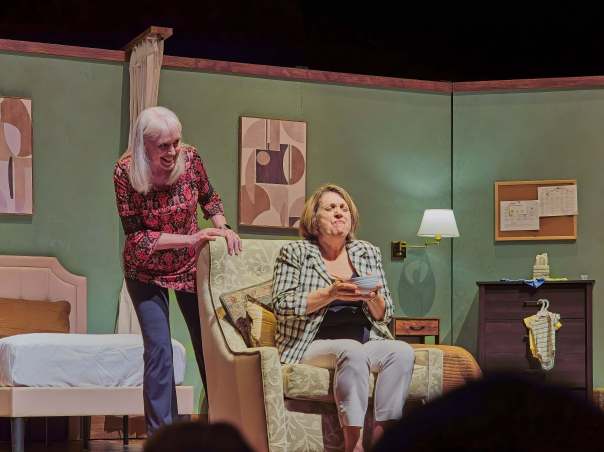
On the other hand, Ripcord isn’t nearly as humdrum as its main locale, Bristol Place Senior Living in New Jersey, would lead you to presume. That’s because roommates Abby and Marilyn have radically clashing temperaments, turning the apartment into a tinderbox. Fundamentally, Abby is misanthropic grouch who treasures her privacy – but instead of forking out the extra cash that would put her in a private apartment, she has pragmatically made herself impossible to live with.

Sunny, cheerful, and chatty, Marilyn is totally averse to the quiet and solitude Abby thrives on, breezing into the suite in a jogging outfit while her sedentary counterpart vegetates on an easy chair. She doesn’t see Abby as a mortal enemy. She’s oblivious to most of the insults that Abby hurls at her and impervious to the rest. Marilyn needs to play with others and blithely treats Abby’s hostility as playful banter.

Such insouciance totally flabbergasts and infuriates Abby, opening avenues to comedy and drama. Lindsay-Abaire slyly chooses both. So do director Matt Webster and his cast, decidedly tipping the scales toward comedy. You can easily despise both Pat Langille as the Pollyanna senior Marilyn and Karen Lico as her adversary.

Abby’s inability to dim Marilyn’s sunniness is frustrating enough for her to enlist the assistance of eager-to-please Scotty, the resident aide who cares most about the women. You can definitely empathize with Scotty when Abby confides in him and keeps pestering him to get Marilyn transferred to a single apartment that has become vacant downstairs.

Strangely enough, Scotty’s patience isn’t as boundless as the saintly Marilyn’s, which gives Lowell Lark some leverage to work with in the role. As a peacemaker, he gently informs Abby that she likes it upstairs, where it’s sunnier and there’s a nice view of the nearby park. As a dealmaker, he won’t commit to speaking to management on Abby’s behalf about moving out her roomie, but he could get in a word for her about serving up some chicken and dumplings – instead of the usual tasteless gruel – if she’ll buy a ticket and come to a show he’s acting in.

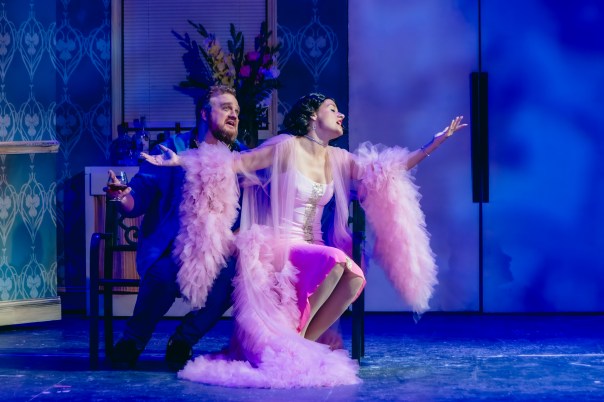
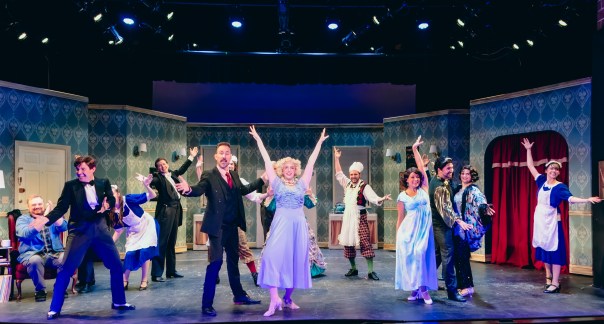
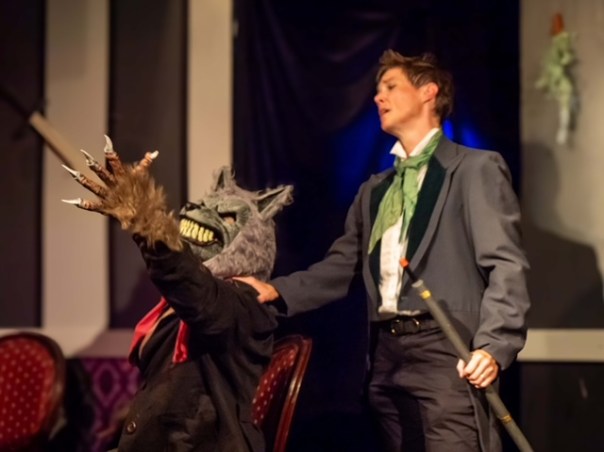
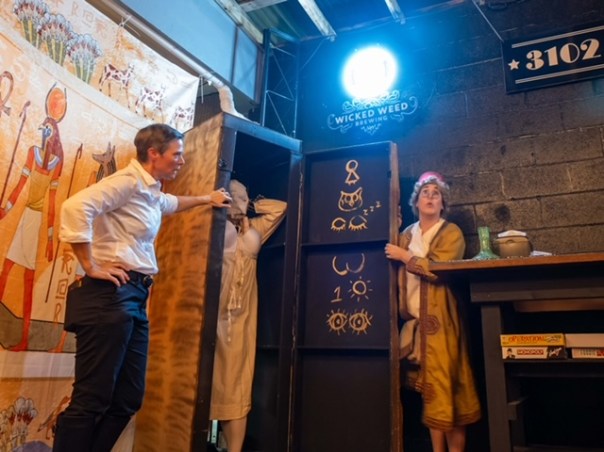
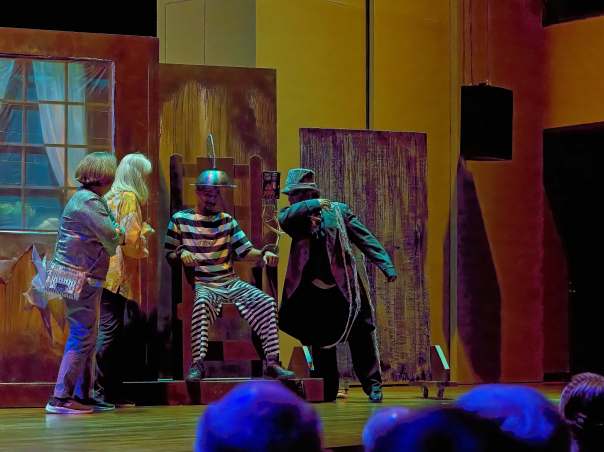
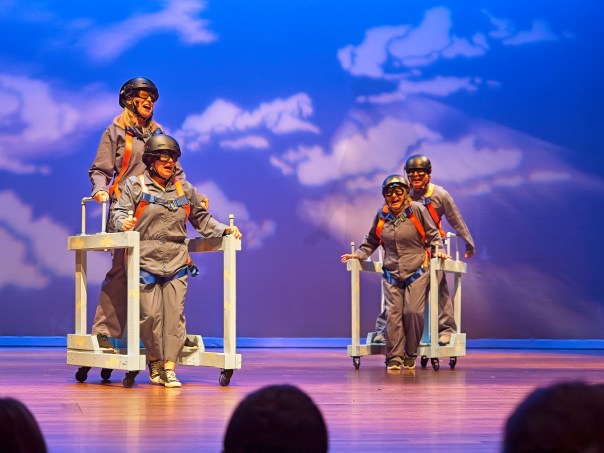
Actually, “Beelzebub’s Den” is a haunted house, liberating us from the ladies’ institutional humdrum bedroom and bath on an excursion to the first of three breakaway scenes, two of them obliging set designer Kaylin Gess to create living quarters that quickly stow away in the Duke’s commodious wings. Lots of work for the seven-person set crew. Doubling as DCP’s lighting designer, Gess gets to supply the phantasmagoria at Beelzebub’s while Beth Killion provides the outré costume designs. Technical director Shawn Halliday also gets in on the fun, here and in the signature skydiving scene.

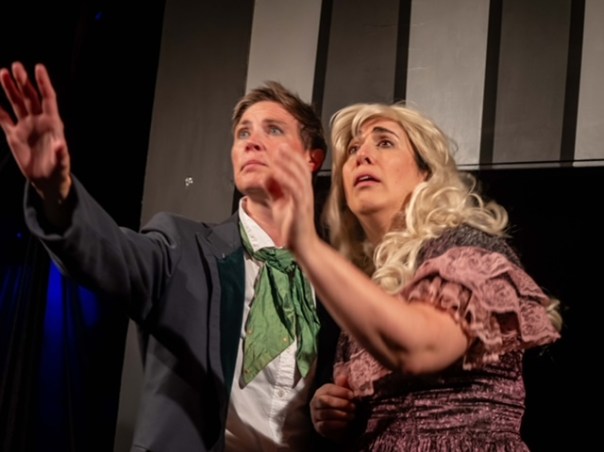
There’s fun for us watching the haunted house antics, but Abby is neither impressed with Scotty’s acting nor scared by any of the spookiness. Abby matter-of-factly tells that she doesn’t scare. Period.

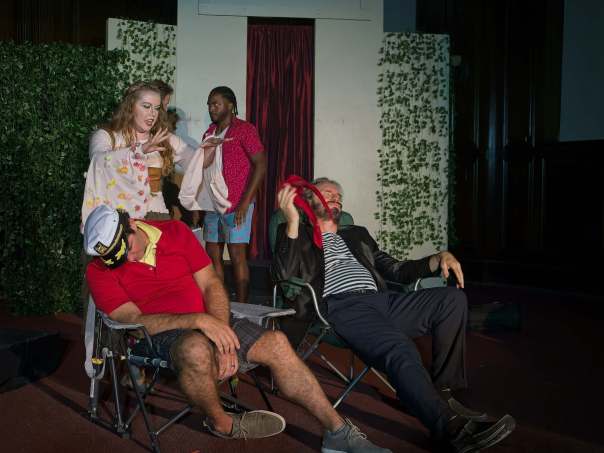
Enjoy the fun, then, but the prime takeaway from Beelzebub’s is Abby’s pride in her fearlessness. In the very next scene back at assisted living, Marilyn will insist with equal certitude that nothing Abby can do will make her angry. Resistant to all the previous bets her quirky roomie has proposed, including whether she can balance a slipper on her head, Abby sees a betting opportunity here. If Abby can make Marilyn angry, she wins. If Marilyn can scare Abby, victory!

The high stakes are predictable: if Abby wins, Marilyn leaves; if Abby loses, Marilyn gets to take over the coveted bed near the window. Game on!

And no holds barred. Lico and Langille aren’t at the high end of Lindsay-Abaire’s specified age range for their roles, so the patina of seeing ancient biddies acting like kiddies isn’t happening in Davidson. But it is definitely the playwright’s intent for Langille to exceed expectations with her imaginativeness and for Lico to shock us with her meanness and cruelty.

With stakes set this high, this is war, and the warfare escalates each time an attack fails. Bombarding your roomie with phone calls and fake messages or drugging your roomie are not out of bounds as the battles begin. Enlisting your relatives and pranking your opponents’ kin are also legit strategies as the Abby-Marilyn War escalates. The avenues of comedy and drama widen along the way.

Langille and Lico obviously revel in hatching their devilish schemes and flouting our presumptions of senior citizens’ dignity and decorum. So the Odd Couple comedy, seasoned with a half century of aging, works well. But there’s also a theme of bonding that Lindsay-Abaire plants deeply in his script from the moment his antagonists strike their bet. Reviews of the 2015 Manhattan Theatre Club premiere indicate that director David Hyde Pearce missed it with his sitcom reading, and Webster also misses some of the early hints.

Yeah, Scotty the peacemaker and dealmaker subtly evolves into the common enemy – inevitably, the uniter, if both women survive! – when Abby and Marilyn solemnly agree to keep their bet a secret from him. Lark has his best moments when he suddenly appears at an inopportune time, threatening to blow the renegade gamblers’ cover.

The deeper mojo is in the bond formed between the two combatants, a literary staple stretching past Robin Hood and Little John all the way back to the Homeric epics. We’ve all seen two boxers sincerely hugging one another after pummeling each other for 12 or even 15 rounds. That’s genuine emotion, the rawest kind, not ritual or fakery. It comes from a gradually growing appreciation of your opponents’ gifts and grit as the battle grinds on. At its keenest, the upswell of emotion also comes from the realization that your mortal enemy has pushed you to a level that you never believed possible – and that part of extra specialness of your opponents’ performance comes partly from you.

So there are many fine moments that Lico and Langille have once the game is on, though digging into them would disclose too many comical and dramatic spoilers. Equal to any one of them is the spot where, the bet having been won, the combatants begin praising each other for their devilish deeds. At that point, Webster, Lico, and Langille are all catching Lindsay-Abaire’s drift.

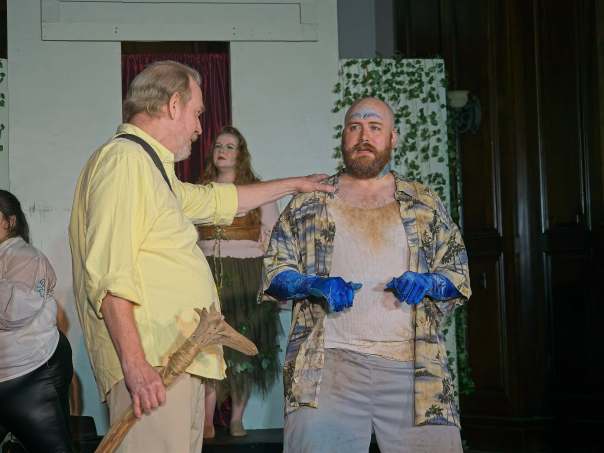
Supporting actors are also a treat, starting with Rigo Nova as the Zombie Butler, our host at Beelzebub’s. Transforming into Derek, Marilyn’s son-in-law, Nova is almost as surreal in his geniality and self-doubt. Victimized by one of Marilyn’s pranks, John Pace wears his victimhood well as Abby’s drifter son after donning a clown suit back at the haunted house.

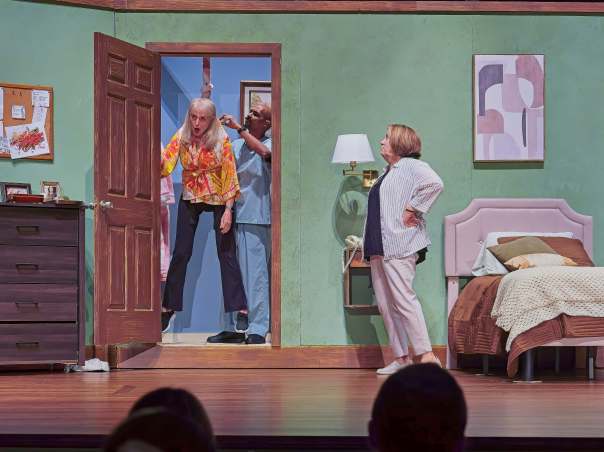
Kimberly Saunders is also spectacularly silent at Beelzebub’s as the Woman in White, but her surprise appearance as Colleen, Marilyn’s daughter, is an immediate joy – for she is foiling Abby’s first wicked prank just by walking through the doorway. Soon she’ll be rubbing her hands with glee at the prospect of joining her Mom in some awesome payback. Mischief is more fun when the whole family is in on the plot.

Can “Back to the Future” Fly as a Musical?

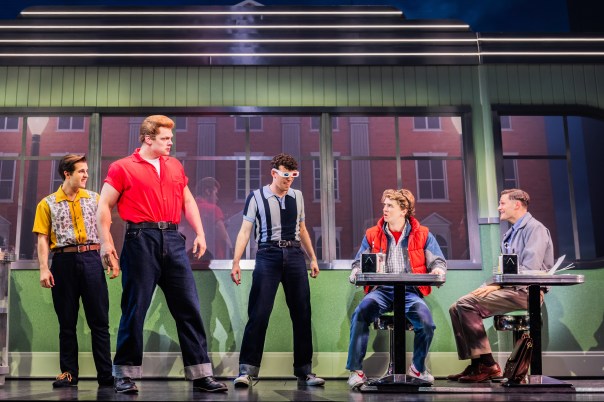
Review: Back to the Future The Musical at Belk Theater

By Perry Tannenbaum

The stars aligned – and Hollywood’s star system functioned flawlessly – when Michael J. Fox and Christopher Lloyd, both proven TV commodities, came together in 1985 to star in the year’s top-grossing blockbuster, Back to the Future. You could easily “see” Fox as Marty McFly if you tuned into Family Ties, where the diminutive 23-year-old was already starring as a son who was more grounded, pragmatic, and strait-laced than his hippy dad. Likewise, the lean and bony Lloyd was perpetually disheveled and long-haired enough on Taxi to ace an audition for the pivotal role of Doc Brown, the eccentric nuclear physicist who unlocks the secret of time travel.

Doc and Marty live in Hill Valley, a town that is perfectly rigged to enable time travel back-and-forth from 1985 to 1955, according to the unique formula concocted by screenwriters Robert Zemeckis and Bob Gale The writing/directing team clearly liked wheels: they put Marty on a skateboard and put wheels into time travel – in a customized DeLorean that was as fuel hungry as a space rocket. No less than the force of an atomic bomb was required to achieve lift-off at the magical speed of 88mph.

Anybody remember Oldsmobiles?

Stolen plutonium fuels the DeLorean in its maiden flight to 1985, but if you don’t already know, it’s Hill Valley and its highest, most visible landmark that powers the kooky, suspenseful journey back. More than 30 years after the box office smash – and a franchise that includes two film sequels, video games, amusement park rides, and a lunchbox – Gale wasn’t going to hand over his story to anyone else when the time was ripe for Back to the Future The Musical.

As fans of the film will soon discover at Belk Theater, Gale’s parental care for his brainchild hasn’t prevented him from tinkering extensively with its workings. Doc’s DeLorean is now equipped with voice recognition, with a smart-ass voice that tells McFly he can no longer change its settings. In other vehicular news, Marty’s grandpa will no longer run into him with his jalopy and the lad’s skateboard usage will be seriously curtailed. Nor is there any traffic onstage from Libyan terrorists, so Marty’s letter to Doc, to be acted upon 30 years later, now has a different safety warning.

The magical family snapshot that Marty carries along with him to 1955, providing useful updates on whether he and his sibs still exist in 1985, is gracefully finessed. No, we can’t see closeups of the photo at the Belk like we could on a big screen, but Doc’s lab is thoughtfully outfitted with an overhead projector so we can track changes on a smaller pulldown screen.

While the telltale snapshot is upscaled, so is the buffoonery of Marty’s dad, George McFly. A conspicuous loser in both time slots, carrying over a Jerry Lewis gawkiness into each, Burke Swanson feasts on George’s timid nerdiness, threatening to steal the show whenever he appears. Next to her clownish husband, Zan Berube suffers some shrinkage in 1985 as Lorraine, Marty’s long-suffering mom, but she conspicuously flowers as the younger teen in 1955, evidently the queen bee of Hill Valley High.

There she is glamorous as the ideal of both George and his nemesis, Biff Tannen*, the town bully – and she is dangerous because she fancies Marty, a mortal threat to the space-time continuum and his existence. Aided by a bodacious Campbell Young Associates wig, Ethan Rogers makes for wonderfully cartoonish Biff, looking like a monstrously morphed Archie Andrews, with flecks of Bluto, Curly from Oklahoma, and The Donald. This Biff ought to be the toast of the town in New York.

With so many delicious distractions – and so many, many, many songs by Alan Silvestri and Glen Ballard – Don Stephenson as Doc and Caden Brauch as Marty struggle to stay at the forefront throughout Act 1, where pacing reaches cruising speed but never really sustains it. We pine, we ache for the DeLorean whenever it’s parked out of sight.

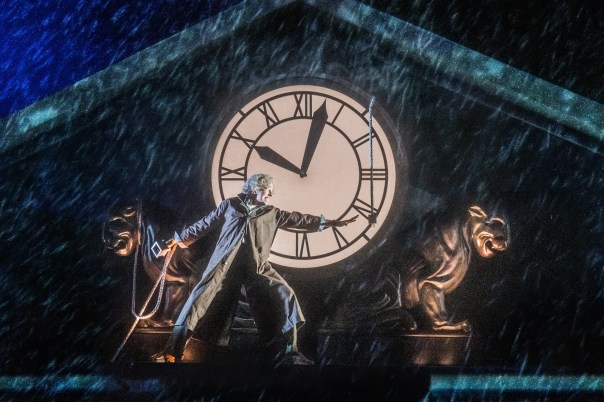
But the payoff for the increased development of Mom and Dad, before and after marriage, lands nicely as Act 2 accelerates to its finale. We’re not assailed with frantic jumpcuts or chases, but so many difficulties and complications remain to be resolved as 10:04pm inches closer at the fateful courthouse clock tower. Before the lightning strikes, hopefully lavishing its gigawatts on the DeLorean at its magical speed, Biff must be thwarted, Mom and Dad – with nothing to build on yet in their relationship – must consummate their first kiss, and Marty must take fond leave of all the key people in his life.

Preferably, with his own survival assured. Then all he needs to do, in the dark of night in a high wind driving his DeLorean at 88mph, is thread a needle at precisely the right moment. Piece of cake.

It’s easy to forget the emotional weight of the film’s relationships and time-traveling farewells 35 or more years after savoring its pulsating adventure, so they all came back forcefully for me on opening night. Although they aren’t Rodgers & Hammerstein, the songs by Silvestri & Ballard mystically magnified that weight – even if I sometimes wished the revving-up sounds of the DeLorean might drown them out.

While his headgear and goggles still brand him as a mad scientist, Stephenson as Doc veers more toward personifying the physicist as a visionary. His vision of the “21st Century” impacts comically as cockeyed optimism rather than eccentricity, and his “For the Dreamers,” an anthem for losers, resonates rather poignantly with the sorry loser futures faced by George and his present-but-unborn son.

Fox’s fidgety acting style, his three little jumps before making an exit – or simply moving – have become avatars for seemingly every leading man on tour or on Broadway in a musical. Those hiccups are intact in Brauch’s embodiment of Marty McFly, punctuated with all his skateboard and DeLorean business, but he also recaptures Michael J’s anguish and urgency as he counsels his own dad on how to be a man. Yes, that’s the knack that Fox brought to movies from his stint on Family Ties, but here the stakes are immensely higher – as high as they can be – in a cosmic comedy!

At times, the time traveling intervention with Dad is cringeworthy. Marty is basically telling Dad how to bed his mom so he can be born. But with music, Brauch can heighten his role from advisor to motivator. Brauch’s powers of inspiration are magnified when he plants idea of running for mayor in the mind of the kid sweeping the floor at the diner where Marty first encounters his dad-to-be (a fine “Gotta Start Somewhere” cameo for Cartreze Tucker as Goldie Wilson).

When he sings “Put Your Mind to It” to Dad in Act 2, Marty must skirt the Scylla and Charybdis of phoniness or peppiness. We don’t want him sounding like huckster Max Bialystock singing “We Can Do It” in The Producers or evoking a Richard Simmons workout session.

So yeah, besides those hops, Brauch also needs to have that youthful brashness we associate with Fox and McFly. Elevating a shallow and tepid rock song into a motivating “We Can Do It” mantra, Brauch pours on all the energy and earnestness needed to make Marty take flight.

Nor does it hurt when the DeLorean levitates.

*No relation

“Young Frankenstein” Delivers Excess, Glitz, and Glorious Shtick

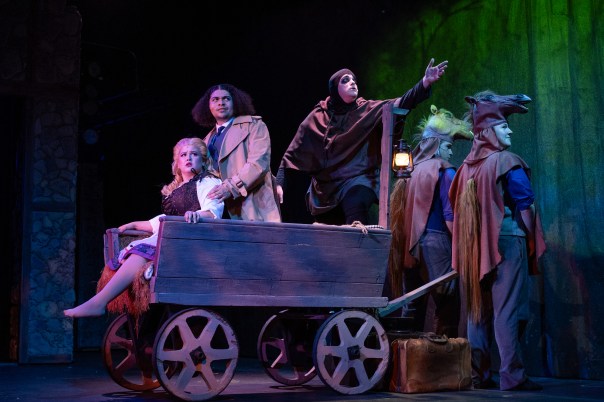
Review: Young Frankenstein at Matthews Playhouse

By Perry Tannenbaum

July 12, 2024, Matthews, NC – Just turned 98, Mel Brooks has overachieved in every way possible, including longevity. Yes, he wrote the music and lyrics in adapting his own Oscar-winning script, The Producers, into a Broadway musical. If that 2001 megahit was the most prodigious and successful transformation of his career – already past 50 years as a writer, comedian, and actor – then his 2007 follow-up, Young Frankenstein, was the most natural.

Mel had already stolen Irving Berlin’s “Puttin’ on the Ritz” and Victor Herbert’s “Ah, Sweet Mystery of Life” to gild two of the most shining moments of the original film, shot in retro black-and-white. Composing his musical adaptation, Brooks stole some more, changing the ardent lyrics of “One Song” from Disney’s Snow White into a deliciously salacious “Deep Love” after the Broadway edition’s third coital climax.

There are some rather filthy connotations strewn throughout our horrific romp through Transylvania, enough for Matthews Playhouse to caution parents against bringing youngsters under 13 to the current production. But stage director Jill Bloede presents each granule of this glorious filth with bawdy, bodacious, and childish glee at Fullwood Theater. Scenic designer Marty Wolff, costume designer Yvette Moten, lighting designer Jeffrey Childs, and choreographer Emily Hunter are all let loose to fashion fresh layers of excess and glitz.

A whole second stage opens up behind the teeming downtown Transylvania downstage when we reach Victor Frankenstein’s secret laboratory hidden behind the mad scientist’s library – an installation that permits special effects designer Roy Schumacher to make the moments of creation and coition inside the lab more spectacular.

Brooks’s venerated comedy reputation and Bloede’s every-shtick-in-the-book approach have drawn a bounty of professional grade talent to this cast. Wearing a frizzy Gene Wilder hairdo, Neifert Enrique cements his elite credentials as Dr. Frederick Frankenstein, grandson of Mary Shelley’s “Modern Prometheus,” bringing a youthful wonderment to the role that makes all the lead women’s roles a little plumier. If you missed Nick Culp’s outdoor exploits as Columbia in The Rocky Horror Picture Show during the pandemic, one of Actor’s Theatre’s valedictory efforts, his Matthews debut as Igor will likely come as a revelation, though he looked way closer to Fester Addams than to a hump-backed Marty Feldman. Lungs of steel and a wicked comedy flair.

With Mary Lynn Bain as noli-me-tangere New York socialite Elizabeth Benning and Gabriella Gonzalez as Inga, the cheery and buxom Transylvania peasant, the contrast between “Please Don’t Touch Me” and “Roll in the Hay” is as radical as any horny Frankenstein could wish. Bridging this chasm is The Monster, endowed by Brooks with a super-virility that surely would have drawn a polite giggle from Ms. Shelley. Hulking Matthew Corbett, roaring and bellowing with the best, makes Elizabeth’s deflowering a special joy, for while he is melting Bain’s ice maiden inhibitions, Brooks cooly has him overcoming his fear of fire.

Now we easily can find on YouTube that Peter Boyle actually danced in the Hollywood version, but the “Ritz” extravaganza concocted by Hunter is arguably more demanding, with Moten outfitting a good chunk of the Transylvanian peasantry in white tuxes. Top hats and canes for all the gents! We can’t call him Bojangles just yet, but Corbett contributes handsomely to the tap segments.

With leading roles in The Producers, La Cage aux Folles, Cabaret, and Ruthless! over the past 30 years, the charismatic Steve Bryan is a bit of overkill for his cameo as the Hermit. Decked out like a medieval monk, with a wig worthy of Joan Crawford in her dotage, Bryan is perfection as The Monster’s blind and bumbling host, not a trace of a smirk as he scalds his starving guest with soup – a comical affirmation of the beast’s docility as we delight in Corbett’s bellowing. Typical of his elegance, Bryan didn’t milk the last drop of deathless pathos out “Please Send Me Someone” before Corbett’s on-cue arrival answered his lonely prayers. True, Bryan got down on his knees begging, but he never once cried out for his mammy. Maybe next week.

Charlotte Bach Festival Travels Back to the Future With “Bach, the Next Chapter”

by Perry Tannenbaum

CHARLOTTE, NC – With the departure of the two people most instrumental in establishing Bach Akademie Charlotte and the Charlotte Bach Festival, artistic director Scott Allen Jarrett and chief exec Mike Trammell, we couldn’t help wondering how radical changes might be at the 2024 festival. The new artistic leaders filling in for Jarrett have actually been with the Bach Festival since the first Charlotte celebration in 2018. All three – concertmaster Aisslinn Nosky, cellist Guy Fishman, and keyboardist Nicolas Haigh – have made significant contributions in performance season after season. The new executive director, Garrett Murphy, began his hosting chores last spring at the Venetian Vespers concert, prior to the last year’s Bach Fest that featured marathon offerings of Johann Sebastian’s Christmas Oratorio.

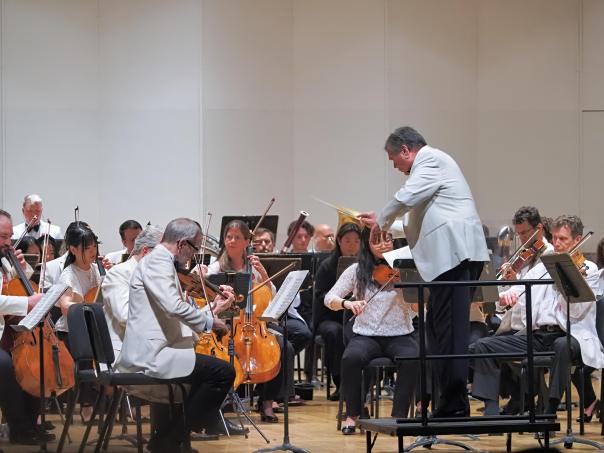
The changes for 2024 were somewhat telegraphed by the first glimpses we had of Claudio Monteverdi’s Vespers of 1610 in that spring concert last year. For the first time, the headline works for the opening and closing concerts at Charlotte Bach are not by Bach. The laurel for the big opening at Sandra Levine Theatre was Antonio Vivaldi’s The Four Seasons, with Nosky fronting a string reduction of the iconic score that reprised her triumph as guest soloist with the Charlotte Symphony a few months before the inaugural festival. Stamping and mugging, red-headed Nosky brought the Red Priest’s electricity back. But with two afternoon sessions devoted to demonstration concerts of the Vespers, the closing concert with Monteverdi’s gem has been clearly designated as this year’s top highlight.

Not that Johann has been totally neglected. He had some play when Peter Blanchette, inventor of the 11-string archguitar, unofficially opened the festival with a “Bach at the Brauhaus” event at the temporary Pianodrome constructed at the Brooklyn Collective. And in the wake of The Four Seasons, where Bach’s “Tilge, Höchster, meine Sünden” served as a handsome preamble, Jonathan William Moyer‘s Organ Recital was all-Bach, an earth-shaking German Organ Mass that may be the best organ concert in the festival’s history.

In this year of transition, the “Bach, the Next Chapter” concert instantly stood out for me as the most telling event in this year’s lineup. Not only was the festival looking at Bach’s predecessors and contemporaries to explore their influence, it was now guiding us forward to examine his legacy – beginning in his own family with his most illustrious son, Carl Philipp Emanuel Bach. That extra stretch of the envelope – at a new venue, the Kathryn Greenhoot Recital Hall, never before called into service at Charlotte Bach – made “Next Chapter” a little more fetching than the half dozen other festival events scheduled at sites making their CBF debuts.

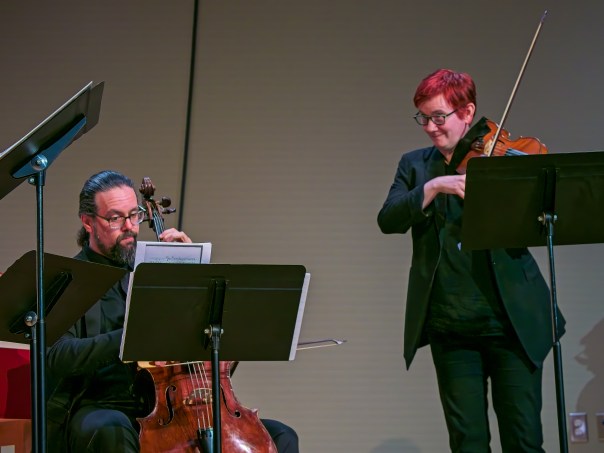
“Next Chapter” began with Johann Sebastian’s Magnificat, but only a small taste of its Canon Perpetuus – played by Nosky, Fishman, and oboist Kristin Olson – enough to establish the Leipzig master’s achievement as a jumping off point. Then before playing CPE’s Sonata for Oboe in G minor, Olson discussed how the younger Bach was intent on diverging with his illustrious father. Without the modern oboe’s metal keys, the baroque oboe would prove to be a fussier instrument, requiring more frequent swabbing, and its tone was noticeably thinner in the opening Adagio movement, with a litheness that seemed even better suited to the middle Allegro. The wide leaps of the closing Vivace were effortlessly navigated, and Olson’s tone grew slightly richer.

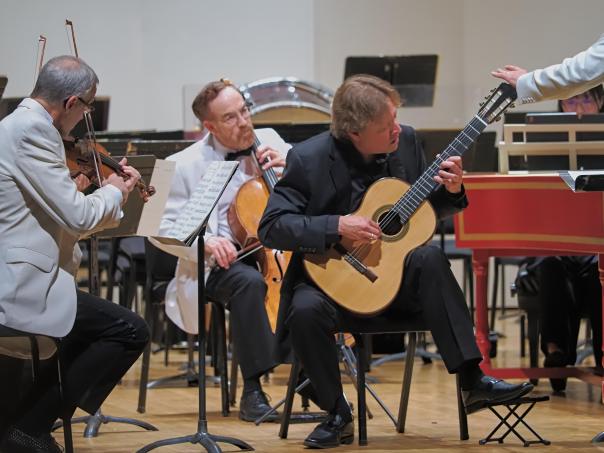
Johann Gottleib Graun’s Trio Sonata in B-flat for Violin and Viola actually brought four musicians to the fore. Harpsichordist Jennifer Streeter teamed with Fishman on the continuo while violist Maureen Murchie shared the title roles with Nosky. Introducing the piece, Nosky emphasized the new tendency of composers to give the spotlight to multiple soloists. Yet the promised parity between violin was only confirmed in the opening Adagio before it was discarded in the middle Allegretto, where Nosky was clearly the superior among equals in drawing technical challenges. Murchie had more of a chance to shine in the closing Vivace, where she had the first run at the theme.

All five hands came on deck for Johann Adolph Hasse’s Sonata for Oboe, Violin and Viola, though we were cautioned that Hasse was likely not the true composer of this charming piece. Olson drew most of the spotlight, with Nosky her chief responder, but Murchie had more challenges here than in the preceding piece. Nosky and Murchie withdrew for the next work by Princess Anna Amalia of Prussia, and Olson had the joy of announcing the discovery of a woman composer in the generation that followed Bach. Nosky’s excellent program notes offered only a slight clarification, reminding us that Anna Amalia studied with a student of Johann’s, distancing her musically from Bach by an additional generation.

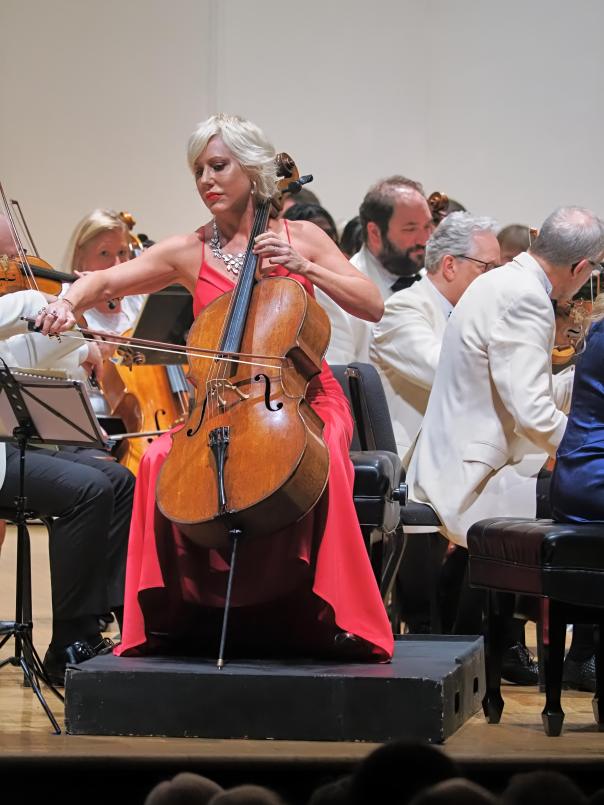
Olson also confided that the piece was originally written for flute before possessing it in scintillating fashion with her oboe. The beauties of the opening Adagio drew even richer sounds from the oboist, yet Olson had to pause before the ensuing Allegretto “so all the notes will come out,” explaining the troubled relationship between her instrument and moisture as she swabbed. Fishman sat by patiently before upstaging his colleague, helpfully quipping that it was the same with his cello. Not to worry, Olson more than answered back with dazzling work on both the Allegretto and the concluding Allegro ma non troppo.

Nosky and Murchie returned for the evening’s finale, Johann Gottlieb Janitsch’s Quadro in G for Oboe, Violin and Viola, but once again Olson more than justified her top billing – in a four-movement crowdpleaser that was the most radical break with the Baroque Era that we heard. Once again, we had a swabbing pause between movements as Olson primed her instrument for the final fireworks of the Vivace non troppo. If you think of the baroque music canon as a cavalcade of perpetual motion machines, this last salvo was a shocker. Olson excelled yet again, laying down the gauntlet on multiple occasions and, rather than merely repeating, Nosky and Murchie fired back their flaming responses – after dramatic silences that crackled with tension.

Photos by Perry Tannenbaum

Wavering Loyalty to the Bard in “Fat Ham”

Review: Common Thread Theatre’s Fat Ham @ Davidson College

By Perry Tannenbaum

Thanks to the inclusion of fat-shaming in our officially accepted roster of politically correct taboos, we have all evolved far beyond the days of Fats Domino, Fats Waller, and good old Fatty Arbuckle. So you may wonder how award-winning playwright James Ijames manages to avoid explicitly calling the hero of his Fat Ham by that unholy adjective. Well, Ijames’s latter-day Hamlet, Juicy, is never called that word by any of the modern-day nobles who gather in his backyard to celebrate his mom Tedra’s marriage to Uncle Rev at a good old-fashioned barbecue.

As you’ll soon see in the Common Thread Theatre Collective production up in Davidson, Rev is roasting a piglet on his barbecue spit, providing Juicy with extra cover. Even in his script, Ijames describes his leading man as “thicc, 20-21, Black. He’s beautiful. He is lonely. He is smart. A kind of Hamlet.”

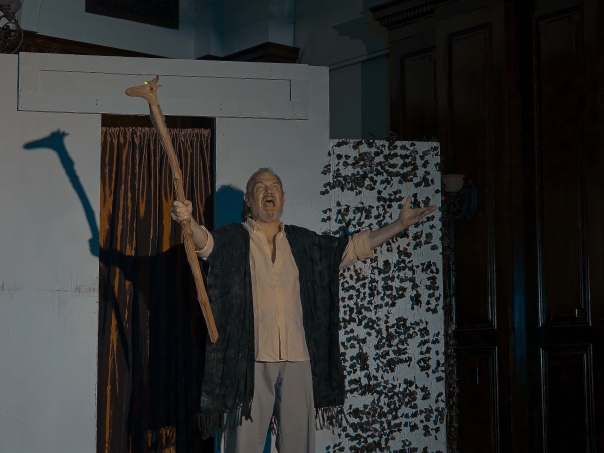
If you remember Hamlet, then you’ll understand that Mom marrying his uncle a week after Dad’s death rubs Juicy the wrong way. Now Juicy’s dad wasn’t as worthy a dude as Prince Hamlet’s: Pap was murdered in prison, where he was serving a sentence for… murder. Boogie, the victim, apparently had bad breath. That was enough.

We begin pondering the differences between Shakespeare’s Hamlet and Ijames’s Juicy as soon as Pap returns as a ghost – not on the battlements of the royal castle in Elsinore to Hamlet and Horatio but to Juicy and his cousin Tio (“A kind of Horatio”) from underneath the back porch, likely somewhere up in Caldwell County. With a Casper the Ghost bedsheet over his head before we see Pap’s orange prison suit.

Of course, if you’re not torn and ambivalent, you’re not really doing Hamlet, so Ijames would allow his neo-tragedy to occur in Virginia or Tennessee, across the border, or even Maryland. But not Alabama, Mississippi, or Florida. Different Southern vibe. And although Tio is watching porn on his cellphone when we first see him, Juicy’s world sits vaguely between the ‘60s and ‘80s “aesthetically.”

King Hamlet and Pap are also alike in getting briefed on the pertinent details as they transition into ghostliness. That’s how Pap knows that Brother Rev ordered the hit, though he may have been on his guard. Shakespeare’s king needed the info more, since he was offed in his sleep.

Do Tio and Juicy believe in ghosts – particularly when Ijames has Pap “doing ghost shit” in broad daylight instead of past midnight? Apparently, they do, for Tio divines with the same perceptiveness of Horatio that Pap’s ghost is silent towards him because he wishes to speak only with his son.

Ambivalence goes beyond Shakespeare when it comes to the key father-son relationship, for Pap abused both Juicy and his mom when he could lay his hands on them. In his current incorporeal state, abusing Juicy is no longer possible, so he can taunt Dad’s powerlessness all he wants – over what is obliquely a fat-shaming issue, for Pap tries to get his son to drop his candy bar. We likely join Juicy in his gleeful emancipation as he stokes Pap’s anger. He can still yell like hell, that’s for sure.

Even though Pap is calling for him to avenge his murder on a man who disgusts and bullies him, Juicy pushes back. Dad’s track record not only includes cruel abuse but also the tendency to show up on the front doorstep at odd intervals when he needs to ask a favor. Offing your brother is a pretty big ask, particularly when you yourself have served jail time for murder.

And Pap just might have a credibility problem. Even after Rev bullies him and punches him in the gut, Juicy wavers. The ocean of difference between King Hamlet and King Claudius is shrunk to less than a millimeter, for Ijames has decreed that the same actor will portray both Pap and Rev.

As it was in Elsinore, so it must be in humble Caldwell County: the play’s the thing to catch Rev’s conscience. Since Juicy doesn’t have the budget to hire a theatre troupe to perform a play – in fact, Mom just pulled his tuition money from the online university where he’s enrolled for a Human Resources degree – Juicy will play a game of charades with the newlyweds and their wedding guests specially concocted to grab Rev’s attention.

Naturally, the guests at Tedra and Rev’s backyard wedding reception are all “kind of” Hamlet characters, namely Tio and the revamped Polonius family. The two sibs, Ophelia and Laertes, are now Opal and Larry, their sententious dad is usurped by Rabby, a sententious mom. There are also episodes that further parallel Shakespeare, including one where Juicy must refrain in all good conscience from killing Rev while he’s saying grace, a soliloquy or five here and a nod to Yorick there. Other episodes curiously twist the original, most notably Juicy’s strife with Larry. It’s not about Opal at all.

While Ijames dodges and weaves in landing his punches and playing his games, he drops savvy references throughout his dialogue offering sharp reminders that he knows what he’s about. Telling Juicy how to cope with his new situation, Tio references Oedipus before we’ve even met the folks. Not only does this reference aptly describe Juicy’s feelings toward his dear mum and daddy, it subtly evokes the model that Aristotle uses in his Poetics in laying out his famed doctrine of the unities in tragic drama.

Yes, there are episodes in Fat Ham, not scenes.Ijames succeeds in reinventing his Hamlet by compressing it into a single day of action in seemingly real time, fulfilling the grand Aristotelian formula. The Bard, in typically five-act form, stretched his tragedy over at least five months, maybe nine. Ijames even works in three costume changes, two of them startling and one of them absolutely unbelievable. He will bend reality his way if he wants.

Each of the roles Ijames has lampooned is a plum, especially for Shabaza Vaird as Juicy and Brandon Johnson as Pap/Rev. Teaming with costume designer Gregory J. Horton, director Xulee Vanecia J makes this Juicy more gender-fluid than the playwright probably imagined, with Vaird amply going with the flow. There’s a wonderful tenderness to him, yet none of the defiance is missing from Vaird’s portrayal of a man who insists on wearing black to his mom’s wedding.

Johnson certainly feasts on both brothers’ vileness, not without some comical moments, and works well with fight choreographer Garrad Alex Taylor to spice up the action and ratchet up the dramatic tension. Both of him have the look of ex-cons, but Rev also has the swagger, complacency, and greed of a true snake. Completing the Oedipal trio, Mya Brown sparkles and effervesces as Tedra, flirting or subtly pouting, depending on whether she gets her way, with enough high energy for Juicy to wonder whether she’s actually happy.

In its third summer, Common Thread is an innovative and inspiring partnership between the theatre departments at Davidson College and North Carolina A&T University. Since it embraces both students and faculty in its productions, the company is perfectly constructed to deliver on a script like Fat Ham, which could easily be tainted by seasoned actors bending over backwards to simulate confused teens.

That doesn’t happen in this all-Black marvel, and it’s heartening that Thread’s best effort to date will also run up in Greensboro for the first time on the NCA&T campus. It could be a painful to experience an effortful attempt at what Kaia Michelle and Jeremiah Dennis accomplish so naturally in projecting the awkwardness and insecurity of Rabby’s spawn, Opal and Larry. Michelle is bold yet apprehensive in proclaiming Opal’s sexual orientation, while Dennis is somehow proud and sheepish in his military uniform. That will miraculously change.

Meanwhile, let’s not omit the exploits of La’Tanya Wiley as Rabby. Unlike Polonius, she isn’t channeling Cicero or Marcus Aurelius. Good lord, it’s all about Jesus.

Certainly all involved were consumed with making the epigraph on the front page of the program come hilariously to life. “What a piece of work is a man!” As the Nigga-Negro taunts at the top of the play faded from memory, Fat Ham delighted me – and concerned me – more and more. Why was Ijames doing what he was doing, and why must all these people be Black? What should the differences between Shakespeare’s noble Danes and Ijames’s common folk be saying to us?

I’m not sure I would have come up with any conjecture during the long ride home if my wife Sue and I hadn’t seen the superb US Premiere of Dark Noon at Spoleto Festival two weeks earlier. The Danish fix+foxy company uses a mostly Black cast – South African actors pointedly putting on “white face” makeup – to tell the mighty tale of western migration and the white man’s racist conquest of our native population.

Ah, but this time it was from the viewpoint of the victims. Among many other revelations, including our shameless greed for land and gold, the show helped me understand the intimate connection between the White America’s racism, their sense of superiority and entitlement, and their worship of the gun.

Such a sardonic view of whites doesn’t fully surface in Fat Ham. But please pay special attention from the moment Juicy looks at us and then at all who are left standing on the Barber Theatre stage, saying, “You know what they think ‘bout to happen right?” A few seconds later, he hammers it home: “We tragic.”

Can these contemporary North Carolinians truly commit to that?

Charlotte Bach Is Breaking Out All Over

Preview: Charlotte Bach Festival 2024

By Perry Tannenbaum

Since 2018 – with a pandemic hiatus – singers, musicians, and ancient instruments have been gathering to greet the summer at the Charlotte Bach Festival, a nine-day celebration of the Baroque Era’s best. Well, once again, the assembly has gathered, but they’re branching out. Embracing new locations, new composers, and venturing beyond the baroque.

Neither of the headline pieces at the festival’s big Saturday night concerts is by the great Bach patriarch, Johann Sebastian. The big kickoff features violinist Aisslinn Nosky, who first dazzled the Queen City in 2018 playing Antonio Vivaldi’s The Four Seasons at Belk Theater with the Charlotte Symphony. Now the redhead is offering a Red Priest encore with authentic baroque instruments at the Sandra Levine Theatre at Queens University.

Of course, Vivaldi was a contemporary of Bach’s, and Johann will share the bill with Antonio, launching the Opening Concert in Tilge, Höchster, meine Sünden, a church cantata based on Giovanni Pergolesi’s famed Stabat mater – only with a new text based on Psalm 51. On the other hand, Claudio Monteverdi’s Vespro della Beata Vergine, more commonly known as the Vespers of 1610, was premiered 40 years before Bach’s birth. Or maybe 414 years before its Charlotte premiere at Charlotte Bach’s Closing Concert on June 22, also at the Levine.
Bach Akademie Charlotte, the festival presenters, performed a teaser of the complete Vespers last March at an all-Venetian concert.

“That was the one we did at Myers Park Presbyterian,” recalls Akademie president Garrett Murphy. “We had quite a good audience for that, and a preview movement of the Monteverdi Vespers. We knew at that moment we were going to do that whole piece, so the artistic leadership team designed a whole festival around that theme of what was happening in Italy.”

Vespers also gets the biggest build-up with a sequence two noonday demonstration lectures, “The Monteverdi Experience” I & II, at St. Peter’s Episcopal Church on Thursday and Friday – both free with the purchase of Vespers tickets. Clearly the festival climax.

Plus the entire piece hasn’t been played here in ages, if at all.

“Our musicians are most excited about that,” Murphy confides. “For them, that’s the festival, and they are coming together with great excitement to perform the Monteverdi Vespers and are really hoping that folks will come out.”

Leadership of the festival is also branching out in the wake of artistic director Scott Allen Jarrett’s departure. A triumvirate now reigns as artistic leaders, including Nosky, cellist Guy Fishman, and keyboardist Nicolas Haigh. While they craft the festival’s programming – and a burgeoning season of Akademie concerts between festivals – Haigh’s spouse, soprano Margaret Carpenter Haigh, corrals the talent.

Each of the four will also headline a festival concert. After Nosky’s Vivaldi on Saturday, Margaret Haigh teams up with theorbo master William Simms for Lagrime mie: Songs of Lamentation, Disdain, and Renewal next Monday at the McColl Center on N. Tryon Street. She’ll naturally be singing songs by Italians, including Giovanni Kapsberger, Luigi Rossi, Monteverdi, and of course Barbara Strozzi’s “Lagrime mie,” for she has privately labeled the entire 2024 festival “Bach Akademie Goes Italy.”

But not before she and Simms begin in the Renaissance and Elizabethan England with a sheaf of songs by renowned lutenist composer John Dowland.

Nicolas, a fixture on harpsichord and organ at past festivals, steps into the spotlight as he leads the Bach Akademie Charlotte Choir and the festival’s four vocal fellows in “The Renaissance Motet” with compositions by Giovanni da Palestrina, Giaches de Wert, Nicolas Gombert, and the marvelously innovative Englishman, William Byrd. This Wednesday night concert and the Tuesday night “Vocal Fellows Recital” preceding it bring a new site into play, both for the festival and the QC.

Apparently, the Holy Comforter Episcopal Church on Park Road is ready for its closeup.

Fishman opens another new frontier for the festival at Trinity Presbyterian on Providence Road in what promises to be one of the season’s most revelatory programs “The Cello, Ascending.” Leading an assortment of Akademie Choir and Orchestra members, Fishman will illustrate what he subtitles “The Rising Virtuosity of the Baroque Cello” as the instrument shed its subsidiary timekeeping role of providing an ensemble’s bass line and emerged as a major solo voice. The mix of composers will include Vivaldi, Handel, and Gabrielli along with less familiar names.

Arguably the most trailblazing of all the Bach Festival concerts is the Tuesday event, “Bach, the Next Chapter,” staged at a previously undiscovered underground treasure: the Kathryn Greenhoot Recital Hall, below the Levine at the Sarah Belk Gambrell Center.

Nosky leads a tight-knit group in guiding us into the influence JS had on the generation after him, including Princess Amalia of Prussia and his own most famous son, Carl Philipp Emanuel Bach. Spoiler: Johann was a very popular name in the Bachs’ day.

“Since the first time I toured Queens,” Murphy remembers, “I’ve been excited about using that Katherine Greenhoot Recital Hall downstairs, which I think is a perfect size venue for something like this. It’s beautiful, about 150 seats, I think. And very modern and a nice little space. But this is something we’re excited to share with Charlotte and are hopeful that we can continue to grow a following for C.P.E. Bach as well.”

ImaginOn almost gets its Charlotte Bach concert debut as it hosts “Lunch and Learn” at noon on Tuesday. Carolina Pro Musica’s multi-instrumentalist mainstay Holly Maurer and Weber State University professor Esther Jeehae Ahn will go over some Baroque basics and explore the influence Italian composers, from Monteverdi to Vivaldi, had on J.S. Bach in a casual bring-your-own-lunch setting. Sorry, kids, this freebie is “sold” out.

Which brings us to Charlotte Bach’s guest celebs and another free event. Peter Blanchette, the virtuoso inventor of the 11-string archguitar takes the festival’s popular Bach@The Brauhaus series to The Pianodrome on S. Brevard Street in The Historic Grace at the Brooklyn Collective. Blanchette has arranged hundreds of Bach compositions for his invention, but his repertoire ranges from medieval and Renaissance to contemporary and world music. Already this Friday’s revels are sold out.

But perhaps in honor of Simms and his many-stringed theorbo, you’ll also find a cash bar Monday night at the McColl for the Lagrime mie concert.

St. Peter’s mighty organ gets a workout as virtuoso Jonathan William Moyer plays J.S. Bach’s complete German Organ Mass – with an intermission – on Sunday evening. Then on Monday afternoon, Moyer offers an Organ Masterclass at Providence United Methodist, listening to and critiquing local organists, then showing how it’s done. This freebie, open to the public, starts at 2:00 PM.

“He is now the professor at Oberlin, and a consummate artist, doing recitals all over the world,” Murphy says about Moyer. “He’s doing the complete, as they call it, Organ Book Three, but it has a lot of familiar tunes, and it’s a pretty epic thing to hear all at once. He is just delighted to be coming and playing that organ at St. Peter’s, one of the few, I’m told, in the country that can really do that piece justice.”

Planning by the new Nosky-Fishman-Haigh troika has already begun for the 2026 Bach Festival and beyond. Meanwhile, they will be tag-teaming Bach Akademie’s upcoming regular season, just announced this week. Lift-off is set for September 7 when Fishman will play all six Bach Cello Suites, split into afternoon and evening concerts with three suites each.

A new and different kind of split happens when Nicolas Haigh leads the Bach Akademie Choir in October. They’re breaking out of town! On successive nights, October 25-27, Akademie’s choral concert will be performed in Asheville, Charlotte, and Lancaster. Fishman returns for a single concert, leading the Akademie Ensemble in Charlotte on January 25.

Then before the 6th Charlotte Bach Festival returns in 2025 on June 14-21, the regular season climaxes with another three-day marathon. Nosky and Margaret Carpenter Haigh will co-lead the Akademie Charlotte Choir & Orchestra on another Asheville-Charlotte-Lancaster tour, May 9-11.

Bach Akademie is definitely spreading the music around, even into the Palmetto State. Spread the word!

Down at Spoleto USA, the Vibe Is Shifting

Review: Spoleto Festival USA in Charleston

By Perry Tannenbaum

‘Song of Rome’ at Spoleto Festival USA in Charleston. (Photo by William Struhs)

Looking down benignly at his Dock Street Theater audience, the newly anointed host of Spoleto Festival USA’s chamber music series, Paul Wiancko, gave us a slight ceremonial nod. “You have chosen wisely,” he said sagely.

But he wasn’t exactly speaking to me, since this was already the fifth program in the noonday series – the backbone of Spoleto – that I was attending this year. Nor was he speaking to the “eleven-ers” in the audience who were signed up for the complete set of programs down in Charleston through June 9.

He was speaking directly to those in the audience who would only attend one of the concerts. Today. And he would go on to ask us all to participate in making the experience special and unforgettable.

It would be very special – beginning with a Beethoven piano trio that showcased Amy Wang at the keyboard, Benjamin Beilman on violin, and Raman Ramakrishnan on cello. How’s that for diversity? My love affair with Wang’s artistry and demeanor had begun just two hours earlier when she played the Schumann Violin Sonata, teamed up with the Slavically expressive Alexi Kenney.

Enough to mightily crown most concerts, the Beethoven was merely a satisfying appetizer. For Wiancko had cooked up a powerful combo, calling upon two living composers that I was barely familiar with, Jonathan Dove (b. 1959) and Valentin Silvestrov (b. 1937).

Our contribution to the magic would be to withhold our applause between the two pieces. It was easy enough to maintain stunned silence after In Damascus, Dove’s heartfelt setting of Syrian poet Ali Safar’s grieving – and aggrieved – reaction to a senseless car-bombing in his nation’s war-torn capital.

The prose poems were achingly and angrily sung by tenor Karim Sulayman, perhaps most indelibly after an extended instrumental interlude, turbulently delivered by a string quartet that included Kenney, Beilman, Wiancko (on cello), and violist Masumi Per Rostad.

“We will be free,” Sulayman sang in Anne-Marie McManus’s ardent translation, “of our faces and our souls – or our faces and our souls will be free of us. And the happy world won’t have to listen to our clamor anymore, we who have ruined the peace of this little patch of Earth and angered a sea of joy.”

Sulayman was visibly in tears as the lights went down on In Damascus and pianist Pedja Mužijević entered with his iPad and sat down at the Steinway. In the dimness, Mužijević played Silvestrov’s Lullaby, an appropriate coda to a song sequence that began with the children of the Zuhur neighborhood in Damascus who would never wake from their sleep – or survive a bogus “holiday truce” – and ended with the evocation of mothers and loved ones who would always await their return.

Amazingly enough, this isn’t the only instance where Sulayman is singing about children caught in the web of brutal war and barbaric terror, for his wondrous voice also figures at Spoleto in the world premiere of Ruinous Gods, a new opera with exotic music by Layale Chaker and libretto by Lisa Schlesinger.

Co-commissioned by Spoleto, Nederlandse Reisopera, and Opera Wuppertal, Ruinous Gods is a fantastical deep dive into the mindworld of Uppgivenhetssyndrome, a rare traumatic response to living in the limbo of displacement. It was first observed in children detained in Sweden, but the syndrome has now been observed in refugee camps around the world. Hopeless children simply go to sleep in reaction to their endlessly unresolved status. Some die, others lapse into coma – sustained only by a feeding tube.

Encased in a surreal bubble over a grassy bed from scenic designer Joelle Aoun, that is how we find our sleeping-beauty protagonist, Teryn Kuzma as H’ala, when the opera begins. Mezzo-soprano Taylor-Alexis DuPont as her mom, Hannah, is stressing and blaming herself while two doctors, Overcast and Undertow, hover over their patient, unsympathetic researchers hoping to analyze and classify the disease.

Meanwhile, Sulayman is decked out in a feathery all-black outfit as Crow, the mentor who, like Dante’s Virgil, guides all these comatose children from around the globe into a common underworld dreamscape where all are free. Is that a spaghetti rainbow dropping down across the Sottile Theatre stage from the fly loft as the imprisoning globule lifts off H’ala, or is there an unfathomably large jellyfish floating above?

Sinuous, jazzy, and sensuously obsessive, Chaker’s music resurfaced in the jazz sector of Spoleto 2024 – at Charleston Music Hall, a venue never used by the festival before. Bigger than Spoleto’s customary hall for chamber jazz (and eccentric modern music), the Emmett Robinson at the College of Charleston, the Music Hall was an acoustic revelation and a welcome escape from the Robinson’s clean-room sterility. Bonus points for the stars that lit up on the black backdrop.

Attendance was astonishing, more than could ever be seated at the Robinson, as Chaker, leading her Sarafand quintet on violin – with an occasional vocal – delved into her two most recent albums, Radio Afloat (2024) and Inner Rhyme (2019). Having worked with Daniel Barenboim and his West-Eastern Divan Orchestra, Chaker has created a jazz equivalent in Sarafand with Phillip Golub on keyboards, Jake Charkey on cello, John Hadfield on drums, and Sam Minaie behind the bass.

Compared to her opera, Chaker’s jazz and her Sarafand personnel made subtler political points. But this wasn’t the only jazz gig that came loaded with extra cargo. Terri Lyne Carrington returned to Cistern Yard for a pointedly themed concert under the moon and the live oaks – with political firebrand diva (and NEA Jazz Master) Dianne Reeves as her special guest.

Carrington’s cargo was collected into her Grammy-winning album of 2022, New Standards, Vol. 1, the first studio sprouting of her pathfinding songbook collection, New Standards: 101 Lead Sheets by Women Composers. So without much preaching, her set was a celebration of Geri Allen, Gretchen Parlato, Eliane Elias, and – at a high summit where Reeves duetted for the first time with Christie Dashiell – the great Abbey Lincoln and her mesmerizing “Throw It Away.”

All these greats joined together again on Allen’s “Unconditional Love,” with Kris Davis on piano, Matthew Stevens on guitar, and trumpeter Etienne Charles all getting in their licks, plus spoken and dance stints from Christiana Hunte. Wow.

Theatre at Spoleto this season is densely messaged. Or not. The Song of Rome was deeply immersed in issues of immigration and sexism, with an overarching interest in the fate of republics, in ancient day Rome and 21st century USA. Cassette Roulette, on the other hand, was pure frivolity, barely deeper than its title and whole lot bawdier.

After starring in An Iliad last season, Denis O’Hare could be logically expected to follow up that one-man conquest with An Odyssey. Well, he has, sort of. O’Hare co-wrote A Song of Rome with Lisa Peterson, his Iliad writing partner, but this time he doesn’t appear onstage, handing over the acting chores to Rachel Christopher and Hadi Tabbal.

Christopher is Sheree in modern times, a grad student striving to learn Latin, and Octavia, Emperor Augustus’s sister at the dawn of the Roman Empire. Tabbal is Azem in present day, Sheree’s immigrant Latin tutor – and our overall storyteller – and the poet Virgil during the reign of Augustus.

So O’Hare is skipping over the rest of Homer to engage with Rome’s great epic, The Aeneid, knowing full well that Virgil based the first six books of his masterwork on The Odyssey and the last six on The Iliad. As a thematic bonus, O’Hare and Peterson discovered during their research for this world premiere that Virgil himself was a refugee, forced out of his ancestral home in Northern Italy by Roman avengers of Julius Caesar who got Dad’s estate for their prize.

Although Virgil’s epic was likely commissioned by Emperor Augustus, aka Octavian, doubt remains whether The Aeneid is a work of propaganda justifying the Roman Empire as divinely ordained – tracing Octavian’s ancestry back to Aeneas and Venus as meticulously as the New Testament traces Jesus back to King David, son of Jesse – or a subversive work by an immigrant genius settling a score. While getting handsomely paid to do it.

Octavia and Virgil go back and forth on this point because the Emperor’s sister is both an admirer and a keen reader, but both are critical of Octavian, who is hell-bent on buttressing the legitimacy of Rome while closing off its path back to a glorious Republic.

“The Republic is over,” they agree. And how about ours?

While Sheree is learning about the Roman issue that comes up as Virgil delivers more and more manuscript pages to Octavia over the years, Sheree must face the issue in American terms when Azem receives a deportation notice. Does she instantly jump to his defense and rescue, or does she immediately suspect him of criminal activity?

Meanwhile, Sheree is reading The Aeneid differently from Azem and Octavia. Why is Octavia left out of literary history if she played such a key role? Why are Virgil’s women, particularly Dido and Lavinia, so passive and pathetic while the strong woman, Camilla, is a she-devil?

Finding this insidious neglect and defamation rampant in literary history and beyond, Sheree comes up with a radical, shocking solution that she announces on her podcast. She will pour fuel over every single book piled on the Dock Street stage and burn them all.

When will all this vicious animosity end? Citing the end of Virgil’s epic, where Aeneas, the immigrant from far-off Troy, killed the vanquished Turnus instead of offering peace, conciliation, and mercy, Sheree answers us curtly lighting the flame: it won’t. Opting for chaos, she almost says it aloud – to hell with the immigrants. (Or give it to the immigrants, if you’ve heard of the Goths.)

Moments like that land hard at Spoleto. Deep in Trump Country, at the Sunday matinee of Ruinous Gods, there was a loud boo among all the lusty cheering as the singers took their bows. Good. The nurturing point of the opera, gushing with empathy toward immigrants worldwide, had hit home, no matter how you feel about it.

Depending on whether you were attuned to John Cameron Mitchell’s Hedwig and the Angry Inch cache, or whether you resonated with Amber Martin’s worship of Reba McIntyre, Bette Midler, and Stevie Nicks, Cassette Roulette was hit-and-miss, redeemed or further cheapened by Martin’s bawdiness. Nicks’ “Rhiannon” was the crowd fave and mine on the night I attended, getting a far more epic performance that you’ll hear on AM radio or an elevator. But neither David Bowie nor Midler got much of a rise. The diet of ‘70s and ‘80s hits didn’t draw much of a youth crowd to Festival Hall, which was made over to a quasi-cabaret setup.

Trombone Shorty slayed far more decisively at TD Arena, where his outdoor revels with Orleans Avenue were abruptly moved when rain threatened. At the height of the indoor bacchanale, Shorty paraded through the audience at the home of College of Charleston basketball with key members of the band (none of whom were named in Spoleto’s fabled program book). They slashed up the rear aisle of the stadium, swung around to the side of the gym and came down along the side.

Snaking through the stadium, Shorty & Orleans reigned over the reigning pandemonium. The prohibition against photography was washed out to sea in a riptide of glowing cellphones.

Shoot, the band was taking selfies! And through it all, the sound remained perfect, Shorty and his brass perfectly aligned with the rhythm section on the TD stage, absolutely distortion-free. Sure, a few dissenters and defectors also trickled through the aisles, accompanied by true believers seeking and returning with beverage.

The most pathetic sufferer sat right across the aisle from my wife Sue and me, hunched over, elbows on kness, with his hands tightly cupped over his ears. Probably needed a ride to escape. Maybe he would have fared better in the open air, where at least some of the sound could have escaped skyward through the live oaks of Cistern Yard.

Final week highlights: Bank on it, the Bank of America Chamber Music series has four more different programs to offer – and a dozen performances – before Spoleto wraps up on Sunday. The Wells Fargo Jazz lineup continues strong, with an all-star Latin twist. Puerto Rican saxophonist Miguel Zenón and Venezuelan pianist Luis Perdomo bring their Grammy-nominated El Arte Del Bolero albums to life at the Dock Street Theatre in a three-day, five-performance engagement (June 6-8) while Cuban percussionist extraordinaire Pedrito Martinez lights up Cistern Yard with an Afro-Cuban stewpot of infectious rhythm, Echoes of Africa (June 7).

After distinguishing themselves in Mahler’s Fifth, the Spoleto Festival USA Orchestra returns to Gaillard Center with Beethoven’s Third (June 5), plus a Rachmaninoff concerto for piano + trumpet and composer-in-residence Reena Esmail’s “Testament” for tabla and orchestra. Upstaged by a visitation from the Charles Lloyd Sky Quartet this past weekend, the Spoleto Festival USA Chorus rebounds with a two-performance run of The Heart Starts Singing (June 6-7), sporting another Esmail piece that will feature Wiancko’s cello – and an eclectic mix of works by Tomás Luis de Victoria, Rachmaninoff, Irving Berlin, and more.

The Festival Finale of yore is gone this year, but there’s more folk, funk, Americana, and alt-country in this year’s Spoleto lineup. Still to come are Andrew Marlin and Emily Frantz’s latest partnering, Watchhouse (June 5), with their own band-backed experiments in folk-rock playing at Cistern Yard; Grammy Award winner Aiofe O’Donovan (June 7) returns with the SFUSA Orchestra to Sottile Theatre; and Jason Isbell (June 8-9) headlines the final weekend with a two-night stint at the Cistern.

Theatre continued during Spoleto’s second weekend with sharply contrasting shows, the wholesome Ugly Duckling from Lightwire Theater and the savagely satirical send-up of the American West, Dark Noon, from the Danish fit + foxy company in its US Premiere. A similar dichotomy prevails this week as Australian company Casus Creations takes over Festival Hall with Apricity (June 6-9), a family-friendly mix of aerial and acrobatic astonishment, with sprinklings of comic shtick and moody music.

On the edgy side, RuPaul’s Drag Race fans can rejoice greatly as Season 9 champion Sasha Velour deigns to bring her presence to Gaillard Center with The Big Reveal Live Show! (June 6). Is Charleston’s big house big enough for drag’s Queen of Queens? The Holy City and Spoleto haven’t been so sensationally desecrated since Taylor Mac ruled the festival.

Wiancko Takes the Baton at Spoleto’s Fabled Chamber Music Series

Review: Spoleto Festival USA Chamber Music at Dock Street Theatre

By Perry Tannenbaum

When Geoff Nuttall died of pancreatic cancer in October 2022, Spoleto Festival USA lost its most distinctive personality, the “Jon Stewart of chamber music,” before any of us had noticed a single gray hair on his glorious mane. Replacing him as director of the festival’s noonday chamber music series, the backbone of Spoleto, seemed like sacrilege last season to those close to the ebullient violinist. However, Nuttall’s stylish hosting chores still needed to be done.

Fittingly, a cavalcade of other chamber music players stepped into the role, for hosting at Dock Street Theatre had always been handled by musicians who contributed to the playing. Esteemed harpsichordist Charles Wadsworth had passed the baton over to Nuttall after many years as Spoleto’s most recognizable personality and the series’ jovial noonday host. Nobody would say whether the parading pinch-hitters were auditioning for the role of Nuttall’s successor. Still, it felt that way, especially since the festival’s general director, Mena Mark Hanna, had declared that the musician-host tradition would go on in Charleston.

And Charleston is a very traditional city.

So for cellist/composer Paul Wiancko, 2023 was an auspicious year. In late winter, before his fourth appearance at Spoleto, Wiancko became the new cellist with the pioneering Kronos Quartet, and in early fall, he was named SFUSA’s third chamber music director. Changes to the series have been noticeable: nine of the 22 performers in the 2024 festival are making their Spoleto debuts, and there are 50 percent more pieces by living composers in the program lineup.

Coupled with the abrupt terminations of resident conductor/director of orchestral activities John Kennedy and his Music in Time series, Wiancko becomes not only Spoleto’s chamber music guru but also the festival’s chief purveyor of contemporary classical music.

And he’s doing it with his own unique style.

Wiancko is more about theming each of the 11 concerts in the chamber music, more about the Zen of each program. Nuttall was very laid-back and West Coast in his attitude toward programming and concertgoing, stressing variety in his repertoire choices and encouraging his audiences to be at ease. If you want to applaud between movements, go right ahead. At a couple of concerts, Wiancko took what seemed like a Far Eastern approach, requesting that we withhold applause – to magnify the cumulative effect of two pieces he was presenting in tandem.

The first time Wiancko employed this tactic, it became emotional on the Dock Street stage. In retrospect, we can understand why. For this coupling, Wiancko led off with an unfamiliar work, Marejada, created during the 2020 pandemic by Puerto Rican composer Angélica Negrón, and then in the silence segued to Franz Schubert’s posthumous String Quintet in C, perhaps the most-played chamber work in Spoleto history – for many years, the last piece performed in the lunchtime series.

Written for string quartet, assorted percussion, and pre-recorded ocean waves (referenced in Negrón’s title), performers for Marejeda included Wiancko, violinists Alexi Kenney and Livia Sohn, and Wiancko’s spouse, violist Ayane Kozasa. Kenney would leave crumpled paper onstage after the piece as he exited along with Wiancko and Kozasa, respectively carrying a conch shell and a can – plus a spoon to hit it with.

That left Sohn and her gong onstage as Owen Dalby entered to take over the first violin chair, Lesley Robertson replaced Kozasa place on viola, and cellists Christopher Constanza and Ramakrishnan spelled Wiancko. It was quite possible to overlook the fact that three of the four members of the now-defunct St. Lawrence String Quartet – Dalby, Robertson, and Constanza – were now reassembled, minus their first violin, Geoff Nuttall. Or it was until, more than a half hour later, the sweetly mournful, fiercely and achingly turbulent second movement Adagio concluded and Sohn, Nuttall’s widow, broke down momentarily.

Dalby understood as the delay continued, softly clutching Sohn’s bow hand until she could go on. More of us would have shed tears, I believe, if they had reprised that Adagio.

More tears flowed more predictably three days later when Wiancko coupled two contemporary composers, Jonathan Dove and Valentin Silvestrov, in his next hold-your-applause tandem. Another string quartet was augmented by a fifth voice, this time tenor Karim Sulayman in Dove’s In Damascus, set to the prose poem sequence by Syrian poet Ali Safar, as translated by Anne-Marie McManus.

Eclipsed by Rhiannon Giddens’ Omar when he brought his Unholy Wars to Charleston in 2022, Sulayman has been indelible this year, first in the world premiere of Layale Chakar’s new opera, Ruinous Gods, which embraces the most vulnerable refugee children from war and terror worldwide, and then in this absolute Dove-Safir stunner.

Two days ago we were standing where the long line of Syrians trying to leave the country waited… Nothing happened, except that we saw a nation where the sun had burned out. Over time, no spark remained for its residents except the sparks of their eyes, which were fading… Like tears…

After Dove’s 11-part cycle – only the sixth part was wholly instrumental, featuring Wiancko, violist Masumi Per Rostad, and violinists Alexi Kenney and Benjamin Beilman – the lights dimmed as Pedja Mužijević entered from the wings to play Silvestrov’s touching Lullaby at the Steinway. But the funereal gloom and Mužijević’s entrance at stage right weren’t sufficient to distract us from Sulayman, still standing at centerstage, weeping profusely before he daubed his eyes.

Preceded by Beethoven’s Piano Trio No. 3, with Beilman playing violin, Ramakrishnan cello, and newcomer Amy Yang at the keyboard, this was surely one of the greatest of the many great chamber music concerts ever performed at the Dock. Yet just two hours earlier, I’d witnessed Yang’s debut at Spoleto, definitely one of the most sensational in recent years as she teamed with Kenney on Robert Schumann’s majestic Violin Sonata No. 1, the best and most passionate live performance I’ve seen of a violin sonata since Daniel Hope and Sebastian Knauer played Beethoven’s Kreutzer at the Savannah Music Festival in 2011.

Both Yang and Kenney can be regarded as among Wiancko’s inner circle, Kenney along with Kozasa being fellow members of Owls, an “inverted string quartet” with two cellists, and Yang being one of the artists Wiancko has composed for. They seemed to be kindred spirits from the opening bars. With admirable subtlety, Wiancko themed this concert as a “Celebration of Resonance,” never mentioning that Yang’s debut solo album of 2019 was Resonance, including pieces by Bach, Caroline Shaw, and Schumann.

Of the 11 programs presented during the lunch hours at Spoleto in 2024, I only saw seven, so I cannot offer an authoritative judgment on whether Yang’s big splash was surpassed by any of the other debuts. But two strong contenders emerged in Program VII on my last day in Charleston, cellist Sterling Elliott and percussionist Ian Rosenbaum, both of whom made their debuts in Program VI the previous day.

Elliott had slipped in among a string septet that played the original 1978 version of John Adams’ breakthrough piece, Shaker Loops, where fitting in was a prime objective. Standing out became the mission when the cellist sat down with Mužijević to play William Grant Still’s Mother and Child – Elliott’s transcription of Still’s 1943 Suite for Violin and Piano, Part II. It really sounded like his own piece, the tenderness of the composition darker and more aching and the affirmation nearly as joyous.

Rosenbaum’s debut had kicked off Program VI, more high-profile since he was paired with Wiancko on Andy Akiho’s 21 for cello, marimba, bass drum, tambourine, and electronics. Plucking strings, clapping, tapping the top and sides of the cello, and pedaling the big drum – as well as plain bowing – Wiancko garnered most of the attention at the beginning and end of the piece, though the percussionist was also performing some extracurricular antics behind the marimba, switching mallets, rapping the tambourine, and triggering the electronics.

Played on steel pans as it was originally written, Akiho’s piece looks and sounds a little better, particularly when the sides of the pans are struck. But the marimba version was still spectacular, building to a pounding climax, four instruments and electronics sounding simultaneously. Almost as spectacular, Christopher Cerrone’s Double Happiness, with Rosenbaum playing vibraphone and a small array of malleted instruments in duet with a prepared piano, was far more sublime. We watched over Wiancko’s shoulder as Yang prepared the Steinway’s innards.

Nor did Wiancko disappear after he and Yang delivered their play-by-play of the piano prep, retreating to one wing to operate electronics on cue. At a somewhat hypnotic pace, Yang was obliged to stand up at the keyboard, plucking or strumming or dampening the strings inside the Steinway, sometimes while playing the keys with her free hand. Usually wielding two mallets in each hand, Rosenbaum performed similar wonders at his instruments, occasionally striking both the vibraphone and a smaller instrument behind it with mallets wielded by the same hand.

Paradoxically, the prerecorded electronics and reverb effects layered onto Double Happiness added the echoey steel pan aura that was missing the day before. The cathedral of sound at Dock Street Theatre was magical, like nothing I had experienced since I first heard A Genuine Tong Funeral,composed by Carla Bley, on Gary Burton’s memorable CD with quartet and orchestra.

Wiancko may not be a perfect fit for the Jon Stewart label, but there’s something in each of his programs that reminds me of the Comedy Central shows I once watched regularly. More than Nuttall ever did, Wiancko makes it his business to interview at least one other musician or composer during every program. More often than not, he frames these encounters like a podcast. Very entertaining.

When composer-in-residence Reena Esmail made her debut on the same program where Rosenbaum and Elliott made their bows, Wiancko greeted her like a starstruck fan. The build-up stood up as Yang and longtime Spoleto stalwart Todd Palmer gave a very fine account of Esmail’s Jhula Jhule for clarinet and piano.

“Thoughts of a Colored Man” Lauds Three Strong Women

Review: Thoughts of a Colored Man at the Arts Factory

By Perry Tannenbaum

So Lust and Passion walk into a bar… You can imagine how fervently I’ve longed to lead off a review with a line like that for close to 40 years. Well, now that Keenan Scott II’s Thoughts of a Colored Man has almost provided that opportunity, you can see that I’ve pulled the trigger. Jumped the gun. For in multiple scenes of Scott’s 2021 script, we can find Love, Lust, Depression, Passion, and Happiness all congregated in a Brooklyn barbershop run by Wisdom and Anger.

Scott gives us more than a hint that Colored Man was written as a companion piece of Ntozake Shange’s for colored girls who have considered suicide / when the rainbow is enuf. That 1976 “choreopoem” had seven women with similarly abstract names, corresponding with the colors of the rainbow, and it is similarly studded with monologues and poetry. Scott’s newer piece at the Arts Factory, flawlessly cast by director Sidney Horton for Three Bone Theatre and imbued with just the right sizzle and raw edge, comes at us evolved into SLAM poetry rants rather than incantatory spells.

Less obviously, Scott’s form is modeled on “Four Women,” one of Nina Simone’s signature songs. Simone gives us the names of her women after she has told their stories, but we’re usually not in suspense for appreciably more than a minute as the complete sequence clocks in at under five. Unless you’ve paid close attention to your playbill before the lights dim, this playwright will make you wait nearly the full intermission-less 90 minutes until, one by one, we get the group reveal.

Thankfully, plenty of names pop up in various scenes. At the barbershop, Kobe, LeBron, and MJ are upheld as the GOAT by bickering customers and kibitzers, moving right along to a similarly lightweight comparison of rap giants past and present. Equally memorable, and no less intense, there’s a lengthy dispute about the best basketball sneakers of all time as the group stands in line for a latenight release of the newest Jordans carrying the legendary Jumpman logo.

Wisdom welcomes us to Joe’s Barbershop, but it becomes clearer as the meandering chatter proceeds that old Joe has retired or passed away, leaving him in charge. Nor does anybody identify Depression as he’s bagging groceries, retrieving carts, or stocking shelves at Whole Foods, though he relays boss’s orders to an offstage Timmy. So as Scott veers and swerves on his path of SLAM poetry and raw prose, with some rhythmic prose bridging the gap, he is also at play with raw specifics and unspoken generalities.

The opening question that Depression poses, “Who is the Colored Man? Is he a king… or is he a slave?” invites that kind of approach. Or evasion. Ironically, only Depression will introduce himself well before the evening is over – at a little past 7:30 PM. One of the ways Scott has of stringing out his opposing tracks is by offering signposts in his stage directions that tell us what time of day it is, steadily moving us forward. Horton has these projected on the upstage wall perfectly on cue.

And whether you’re Love or Lust, Depression or Happiness, you have a personal story. Depression, for example, fumbled an opportunity to break away from Brooklyn and attend MIT on a full scholarship. Giving that up by taking care of his mom – without a moment’s hesitation – he settled for the ongoing indignity of Whole Foods.

On the other hand, Happiness is a stranger in town, living with his fiancé. He grew up in the South, his parents were the first in his family to earn six figures, and that’s why he was shunned by the relatives back home. Up in Brooklyn, he feels no less alienated, because he is prosperous and because he is gay.

Scott is pulling hard here against answering his own opening question. The reason that such fascinating hostility flares up between Depression and Happiness in an aisle at Whole Foods is that neither one can answer “Who is the Colored Man?” when they meet one. Both pointedly tell each other “you don’t know me” – which is what any of Scott’s characters could have shouted at us at the beginning if the playwright were less designing and discreet. Or if he hadn’t been aware that Colored Men themselves cannot answer any better than by telling us, one by one, who they are.

It’s hard for me to resist applying the same observation more widely to the whole Black theatre scene in Charlotte these days. Having sampled Penumbra in Minneapolis presenting August Wilson, Black Ensemble in Chicago celebrating Marvin Gaye, and a multitude of companies from across the US bringing their best to the National Black Theatre Festival in Winston-Salem in even numbered years – ahem, the International Black Theatre Festival for 2024 (July 29-August 3) – I’m always telling people that the Black performers, directors, and theatercraftsmen that we have in the QC are second to none.

Catch is: not only doesn’t the Charlotte theatergoing public seem to realize the bounty in our midst. The artists themselves seem to be sleeping on it. To a greater degree now than ever before, when we were merely equals.

Lesser performers and directors might struggle with the challenge of portraying Anger, Passion, or Wisdom and real people at the same time. Horton and his able cast wisely let it slide. When he’s not shaving, shearing, and trimming at Joe’s, Devin Clark as Anger trains and does drills with highly-ranked basketball players who aspire to the big-name colleges, the NBA draft, and huge commercial endorsements. Now they’re possible in college! Or he drifts into nostalgic recollections of his peak playing days when he was “nice.” He earned his scholarship back in the day, so he’s worried about how today’s NIL generation will maintain their dedication – and their grades, if b-ball doesn’t pan out.

Jonovan Adams, another mainstay on the local scene, also assumes a mentor’s role as Passion, a seasoned teacher of 26 students – plus cameo roles as social worker, psychiatrist, and surrogate parent, depending on the kid and his or her homelife. Neither Passion nor Anger is likely to strike you as particularly tough: more likely, Clark and Adams will come across as personable and authentic as ever.

It is well that Passion invokes the OGs of yesteryear who helped him growing up, hanging around the hood and doling out free advice. He wants to be one of those old heads now, a street scholar. That’s what cool, easygoing-yet-stern Graham Williams personifies at his shop as Wisdom, conscientiously doling out sharp cuts and implacably demanding a buck for the swear jar each time a customer – or Anger – curses or breaches decorum.

Dionte Darko as Lust is the most-often-fined in the group, a youngblood with repeat offenses in swearing, misogyny, and homophobia in and out of the barbershop. With his undimmed geniality, Darko is so useful to have around. Aside from needing to apologize to Wisdom for his multiple trespasses, he also riles up the romantic Daylon Jones as Love, so vulnerably poetic in his amatory feelings that he has not yet dared to approach his beloved – while Lust will instantly harass any skirt that walks by, previously known or not.

With similar boorishness, Lust also runs afoul of Nehemiah Lawson as Happiness. Renowned as the Minstrel of Something Rotten and Leading Player of Pippin at Theatre Charlotte, lead Drifter in Beautiful at Matthews Playhouse, and _thesingingdentist on Instagram, Lawson has more than sufficient urbanity and polish for portraying a relatively mundane financial director, so it’s interesting to see him in a performance that discards stage magic in favor of wariness, loneliness, and a touch of anxiety.

Maybe Scott would have preferred someone older than Lawson in Happiness’s encounters with Lust and Depression, but in the Whole Foods scene especially, Horton’s calculus paid off for me though it changed the chemistry. If there was any bullying flavor intended in the hostility between Lust and Happiness, that is gone.

Marvin King bookends the show as Depression and, with a long white tunic that echoes the twin white fires of his flowing beard, sanctifies it with a mystic, ceremonial aura that the more worldly SLAM poetry and prose never dispels. King’s mighty presence certainly endures when he descends to the degradation of a Whole Foods grocery drudge, and the reason why he discloses his name before anyone else will become clear enough if we’ve watched closely. In this cityscape of living, breathing, struggling abstractions, Depression is probably the one who best encompasses them all. By that time, Scott has fastened upon a fresh muse, supplanting Shange’s Colored Girls and Simone’s “Four Women.” This third inspiration is Lorraine Hansberry’s Raisin, handed down from Langston Hughes, and the effects of the sun are still the same as they were at the height of the Harlem Renaissance

Breathtaking Perfection Makes Charlotte Ballet’s “Swan Lake” Premiere a Dazzler

Review: Swan Lake at Knight Theater

By Perry Tannenbaum

May 3, 2024, Charlotte, NC – For generations, budding ballerinas around the globe have aspired to be a member of the gaggle who dance to the primeval strains of Pyotr Ilyich Tchaikovsky’s Swan Lake. The best of them dare to dream of dancing the roles of Odette, Queen of the Swans, and her evil, seductive doppelganger, Odile. Yet more than 50 years elapsed in the life of Charlotte Ballet before the company brought Odile, Odette, and Swan Lake to the Queen City. To many, including millions of those budding ballerinas, Swan Lake and ballet are synonymous. So in a town that has a reputation of resisting the new and clinging blindly to proven classics, you have to wonder why this premiere – a quite glorious one at Knight Theater – has taken so long to happen.

Although scenery, costumes, and props are on loan from the ballet troupes of Cincinnati, Arizona, and Atlanta, the mélange is quite impressive. Choreography by Ib Anderson, based on the definitive 1895 overhaul by Marius Petipa and Lev Ivanov, and the work of CharBallet dancers, Charlotte Ballet II, members of the pre-professional program, and students of the Ballet Academy are more than enough to stamp this marvel as homegrown. Extra freshness and vivacity rose from the orchestra pit as the Charlotte Symphony, directed by Gavriel Heine, performed the full score for the first time – with the ardor of an orchestra that has been waiting over 90 years for a living, breathing ballet corps to partner with on this mammoth venture.

Those little-girl aspirations are freshly recalled by the glittery merch in the Knight lobby, so the anticipation in the audience before curtain-rise was akin to the excitement that greets the CharBallet-Symphony collaboration each December as Belk Theater fills up for The Nutcracker. Even after opening night, you are at a special event. While the Cincinnati scenery can be improved upon (rather easily, I’m afraid); especially in and around Prince Siegfried’s castle; the courtiers, the servers, and the ladies in waiting regally create a teeming spectacle that fulfills expectations in Act 1. Oliver Oguma, the first of three leading men who will rotate during the 12-performance run, is a soulful Prince Siegfried with a bonus of brawn. Some heavy lifting lies ahead, but before lifting Odile up high Oguma had to be able to shine solo in the opening scene, where he basically rejects every eligible maid in the kingdom. The Queen Mother is royally chagrined – a triumphant comeback for Ayisha McMillan Cravotta, more beautiful than ever.

Anderson discreetly subtracts some courtiers from the Petipa scenario, but there’s enough dazzle remaining for them not to be terribly missed. The dozen courtiers beguile us in varying configurations, and the pas de trois sequence with Bridget Fox, Humberto Ramazzina, and Samantha Riester is endearing elegance and charm. Dancing the Page’s solos, Academy student Russell Abel struck me as a prodigy, able to leap and land squarely on the beat. Yet as the act climaxed, viewers who are accustomed to seeing Prince Siegfried flanked by noble chums might feel that Oguma gradually becomes excessively forlorn in spite of all his solo exploits.

Yet it’s justified to view the sparsity of plot and companionship in the opening scene as a perfect way to magnify the éclat of Act 2, where the evil sorcerer Von Rothbart and his enchanted flock finally take the stage – a bevy of 24 Cygnets and Swans plus one sublime Queen. You might even be tempted to laugh at the triteness of the choreography that precedes Odette’s first entrance – until you realize that Ivanov and Swan Lake likely fashioned the familiar template that Hollywood, Broadway, TV, and Vegas have turned to ever after in innumerable dancing build-ups to the entrances of their stars. James Kopecky, in a spectacularly hideous bird costume of his own – with poles to extend his wingspan – is magnificently malign in his various poses and flourishes, adding magic and menace to the big moment.

Evelyn Robinson was more than equal to it. She was divine perfection: fearlessness, symmetry, balance, musicality, and supple flow were all absolute to an inhuman degree. Only the little expressive flutters of her head and face subtly reassured us that a tortured soul hovered above her pluperfect point work. Later, when Robinson invaded Prince Siegfried’s surprisingly drab ballroom as Odile, you kind of wondered whether she would dramatically vary or eclipse what has gone before. Seemingly responding to more spellbinding sorcerer gestures from Kopecky, a bit like a taunting pro wrestling baddie in his taunts, Robinson softened ever so slightly. Her seductiveness trickled naturally from her added liquidity, and her expressions became more worldly and knowing, like a Vogue supermodel shoot. Or Melania.

In sum, Robinson was all I could hope for and occasionally more. But the swans! I hadn’t even begun to imagine what they can be in live performance. Whether it was the composer’s masterstroke in the original 1877 score premiered by the Bolshoi or the brainchild of ballet specialist Riccardo Drigo, who revised the score for its successful 1895 resuscitation in St. Petersburg, the music hushes so much that the en pointe work of flock is clearly audible – not only audible but a chief element of the music’s fluttery percussion. Over the course of the 2 hour 17 minute epic, it wasn’t only principal harpist Andrea Mumm who excelled. Concertmaster Calin Ovidiu Lupanu came to the fore with some fine solo work in Act 3 and acting principal oboist Erica Cice was gold all evening long on the haunting big tune.

What floored me most, after watching Charlotte Ballet ever since it arrived here (from Winston-Salem) as North Carolina Dance Theatre in 1990, was the unprecedented synchronicity of this bevy of fluttering Swans. For decades, the individuality of each NC or Charlotte dancer was the company’s trademark. Let Miami and what’s-his-name do synchronicity! Yet here in an instant, the phenomenon of a perfectly calibrated ensemble of 24 women, dancing on point to the same heartbeat, had arrived in Charlotte, North Carolina. It was eerie and breathtaking. Historic.

Will CharBallet fully possess Swan Lake in the future with their own scenery, props, and costumes? Hope so. This is one you’ll want to see again.