The Lullaby Off-Broadway

By Perry Tannenbaum

Hir (***3/4) – Taylor Mac and I have a history. When I first saw him at Spoleto Festival USA in 2008, the highlight of his one-man Be(a)st of Taylor Mac came when he donned a ginormous set of singing boobs to deliver one of his greatest hits, “The Revolution Will Not Be Masculinized.” Three years later, it got more personal. Now it was his festival, bitches, renamed the Stiletto Festival. Mid-performance, he stopped to ask me why I was writing. Mac not only found my answer cool, he called me “Honey”!

So as I planned my latest New York pilgrimage, when I learned that Mac had penned a new play — and that he and his ukulele were not in it — I was intrigued and a little skeptical. As Mac himself freely admits in his illuminating essay included in the Playwrights Horizons playbill, Hir is a totally new kind of venture for him, a plunge into the mainstream.

He’s riffing on the hopeless environment he grew up in — Stockton, California — “one of those places where the American dream got stuck in an American reality.” The family situation; Mom and Dad living in their starter home for 30 years, raising two boys who are now fully grown; echoes Mac’s own upbringing. But the realism pretty much stops there.

What we see at curtain rise is no less disturbing than the explosive ending Mac has in store, just more strangely comical. The living room/dining room/kitchen is chaotic — with a willful vengeance, a tacky mess-terpiece by set designer David Zinn.

In the corner, by the side door (the front door has been sacrificed to a mound of junk), a man adorned with clown wig and makeup lives and sleeps in a cardboard box. He’s still in his nightgown — and his diaper may need changing.

Enter our returning war vet, Isaac, a Marine who has served the past three years in Mortuary Affairs, doing what must be done with body parts retrieved from combat. What he sees blows his mind, for the man is Isaac’s father, Arnold, debilitated from a massive stroke during his son’s absence. His formerly meek mother, Paige, not only condones her husband’s degraded condition, she forcibly insists on it. This is her ghoulish retribution for the years that she suffered abuse at Arnold’s hands. Same thing with the epic clutter. Don’t you dare clean that disgusting sink!

A bigger surprise emerges from the bedroom. Isaac’s younger sister, Maxine, is now transgendered as Max, a walking new New Testament of thou-shall-nots. Ze is the pronoun that must replace he or she, and from now on, him or her are off-limits when referring to Max. It’s hir. Ze also would have us acknowledge Mona Lisa’s true gender and discard the Old Testament, due to the gender bias evident in the Noah’s Ark story.

Beyond seeing his baby sis sprouting a beard, future shock besets Isaac, who presumably never got the memo that trannies are no longer content with mere tolerance and equality. But instead of staying focused on Max, Hir becomes a pitched battle over how Arnold should be treated and whether order should return to Isaac’s home.

The chief reason why this dark comedy worked so well, despite somewhat betraying its title, was the astounding Kristine Nielsen as Paige, more frightfully eccentric than she was in Vanya and Sonia and Masha and Spike and just as funny despite all her sadism. No less colorful in his nearly silent role, Daniel Oreskes as Arnold ably bestrides the pitiful invalid he is now and the brute he once was.

The brothers, less traveled than the true theatre vets, were also very fine. Under Niegel Smith’s deft direction, Cameron Scoggins gradually allows us to see the upside of Isaac’s spit-and-polish temperament. And in so many ways, Tom Phelan is the antithesis of Mac as Max. Despite a certain amount of brashness and defiance, we can see that Max is sensitive, vulnerable, and normal. There are no sequins in his makeup kit. All in all, Max may be the most wholesome person we see, the Medium Mac of Mac’s uniquely twisted Fun Home.

While his preoccupation with Paige strays from the subject promised in his title, Hir doesn’t stray from its main theme. It’s a question, really: how far can we go in redressing past abuses before we become the abusers? You can bet we’ll see a Charlotte company address that question as soon as it can get the production rights. Much of what’s wrong with today’s world is wrapped up in that explosive question.That’s exactly right. I’m accusing Taylor Mac of profundity. (Closed on January 3)

Colin Quinn: The New York Story (***1/4) — It’s interesting to observe how Quinn has flipped his basic thesis since his previous off-Broadway hit of 2011, Long Story Short. In that story of world history, ranging from the days of the Greek and Roman Empires right up to the just-completed economic summit in Davos, Switzerland, Quinn debunked the notion that humanity had progressed and evolved. All you needed to do was pick up a copy of today’s newspaper, and you’d find such presumptions of evolution decisively refuted.

Now, he’s telling the story of New York from the opposite perspective, showing us how the characteristics we now associate with New Yorkers are the result of successive waves of immigrants washing onto the shores of Manhattan, beginning with the original Dutch settlers. So why are New Yorkers so pushy, so blunt, so cynical, so rude, so snobbish and so cultured? The answers lie in the cavalcade of nationalities that didn’t altogether melt into the city’s melting pot: Dutchmen, Germans, Irish, Jews, Italians, Blacks, Greeks, Chinese, Russians, Dominicans, Arabs and East Indians.

Some of these groups were already in Quinn’s crosshairs back in 2011, when he also had some choice quips about the French, the Israelis, and Indians. But if you haven’t heard any good Polish jokes lately — or if you’ve been a bit freaked about how Mexicans, Muslims and Syrians are being mentioned in political discourse — you might share my notion that times have changed as radically as Quinn’s historical perspective.

Ethnic humor isn’t as innocent and carefree as it was just five years ago. Perhaps that’s the reason why Quinn, who only seemed nervous when his show began in 2011 (in a performance that was filmed by HBO), displayed some nervousness spasmodically for the entire 67 minutes. The SNL alum is sharper than ever in his analysis, but he’s more keenly aware that he must tread carefully. (Through January 31)

 nutcracker_rouge.jpg

Nutcracker Rouge (***) – Fin de siècle decadence was already in full swing when Tchaikovsky joined choreographer Marius Petipa in producing a new yuletide ballet in December 1892. Perhaps it was the lack of decadence in this sugary adaptation of E.T.A. Hoffman’s The Nutcracker and the Mouse King that caused it to fail. While orchestras retained their affection for the Nutcracker Suite, gleaned from the score’s greatest hits, the ballet didn’t gain traction until the San Francisco Ballet made it a holiday tradition in 1944 and George Balanchine’s New York City Ballet followed suit a decade later.

So can we say that Company XIV’s radical alteration of the now-beloved ballet–making it bluer, raunchier, and more acrobatic — is simply bringing us what The Nutcracker should have been all along? Nah. Director/choreographer Austin McComick only begins by relocating Marie-Claire’s sugarplum discoveries from the Land of Sweets to a land of hedonistic abandon. He and our burlesque hostess, zaftig Shelly Watson as Madame Drosselmeyer, also take us far beyond the bounds of Tchaikovsky’s music.

I knew that this wicked confection would be for 16-and-over audiences only, but I was surprised to discover that photography was not only permitted but also encouraged. Tweet your naughtiest shots during the show if you wish, nobody will mind. Luckily, I had my camera with me, for the orgy of picture-taking that I indulged in would have surely exhausted my cell phone’s battery.

Yes, I watched a goodly portion of Nutcracker Rouge through the 3-inch monitor of my Canon G15, and it did occur to me that this might be somewhat unprofessional. But how else could I plumb the true depths of this voyeuristic experience?

There were orgiastic ensembles complete with simulated copulation, an artsy pole dance, an S&M-lesbian episode, a cross-dressing stag party and a kick line of man-poodles. There were also lyrical moments, particularly when Marcy Richardson soared above us into star-studded blackness on an aerial hoop, singing an operatic arrangement of Sia’s “Chandelier.” There may be a few messages from Cirque du Soleil on Richardson’s voicemail. Vegas beckons!

Straddling the gulf between kinkiness and lyricism, Laura Careless as Marie-Claire shed her hoop skirt and corset — and nearly everything else — to dance Tchaikovsky’s climactic “Grand Pas de Deux.” Steven Trumon Gray, wearing nothing more than a florid military coat and a thong, was her Nutcracker Cavalier. Careless has made the sexual awakening of Marie-Claire into her signature role over the course of six years with Company XIV, and she owns it with an expressiveness worthy of the best dancers we’ve had here in the Charlotte Ballet.

Inevitably, Careless’s awakening isn’t as vernal as it once must have been. There’s an unstated conspiracy now between the innocent ballerina and her expectant audience. We all understand that her ignorance, innocence, and shock are all artfully shammed, which gives her fantastical adventure an extra jolt of witchery. (Through January 17)

 ruthless.jpg

Ruthless! (**1/2) – Written and directed by Joel Paley, with music by Marvin Laird, this high-energy spoof, billed as “The Stage Mother of All Musicals,” first stormed onto the off-Broadway scene early in 1992 and snagged the 1993 Outer Critics Circle Award. When it arrived here in 1995, Ruthless! pretty much swept CL’s Charlotte Theatre Awards, including our Show of the Year, encouraging Vance Theatrical Organization to reprise their production in 1996.

Precocious child actress Tina Denmark is the main attraction. Tina can pout impressively, toss a tantrum, or even sob unconvincingly. When these ploys let her down, there’s murder. Tina will literally kill for a role at her school’s upcoming Pippi Longstocking. “But not just any role,” she protests. “The lead!”

Sylvia St. Croix becomes Tina’s manager and agent, hiding the fact that she’s actually her grandmother, the shattered Ruth Del Marco, slain by a critic’s sarcastic review. Believing that Ruth had committed suicide because of her review, the guilt-ridden critic adopted Judy, never letting her know her true origins. So while there’s murder, deception, and violence lurking in the Del Marco/Denmark gene pool, there’s also — talent!

As you might expect in a stage mother spoof, Gypsy is a prime target, but only one of many. Paley recommends that the entire production team should also familiarize themselves The Bad Seed, All About Eve, The Women and Valley of the Dolls. Back then, you might have also found hints of Mame, Cats, A Chorus Line, Mommie Dearest and A Star Is Born, plus a string of long-forgotten Broadway and Hollywood drivel.

So what went wrong in the current revival, also directed by Paley? A couple of things leap to mind. First, he decided to streamline the show to 90 minutes, ditch the intermission, and quicken the pace. Why? So many of those titles in the catalogue above may be too forgotten, 24 years later, to remain ripe targets for mockery. Updating those sharp attacks within the Ruthless framework would have been a mighty challenge. Yet the streamlined result seems thin and hurried. The bang-bang finish that once was so wildly absurd and hilarious is now little more than a blur.

Perhaps more to the point, Paley has continued to maintain that Ruthless is an all-woman show and that the only reason why the over-the-top stage grandmother Sylvia St. Croix is traditionally played by a man is because a man, Joel Vig, gave the best audition for the premiere production. So it would seem that Paul Pecorino, who has replaced Peter Land, is playing Sylvia as an actor disguised as a woman – with little of the effeminate bravura that would gush forth from an authentic drag queen.

Back in 1995, it never occurred to me that Steve Bryan’s diva rendition of Sylvia was better than Vig’s. But it should have, because he was certainly better then than Pecorino is now. Way better. The rest of Paley’s new cast does measure up, beginning with Tori Murray as Tina, a beauty contest belter with an insane evil streak. Kim Maresca as her mother Judy is as perfect a housekeeper as Tina is an ingénue — with similar schizoid tendencies.

Yet Rita McKenzie as theatre critic Lita Encore upstages her daughter in the big show-stopping song, “I Hate Musicals.” This is preternatural, Ethel Merman-sized hatred for a critic’s daily bread, and McKenzie nearly does it as brashly and robustly as dear Deborah Rhodes did it here in ’95 and ’96. God bless ’em both. (Through April 2)

Two Simpatico Spirits Combine on Saint-Saëns

Photos by Michael Polito and Sheila Rock

By Perry Tannenbaum

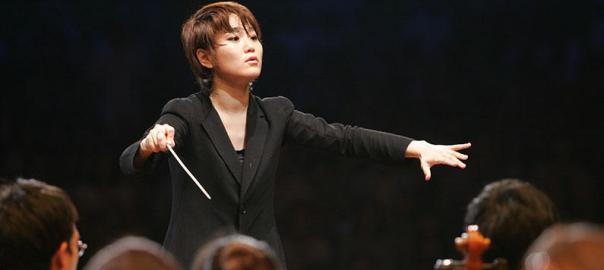
January 8, 2016, Charlotte, NC – Twenty years after her breakthrough recording of Saint-Saëns’ First Cello Concerto, Han-Na Chang made her debut with the Charlotte Symphony last week. Only she wasn’t playing the cello as she was then, when Mstislav Rostopovich conducted the London Symphony. No, at the ripe old age of 33, Chang was our guest conductor and Cicely Parnas, 22, was our soloist – in the midst of a victory lap of her own with the Saint-Saëns.

ParnasPredictably, the concert perked up when the kindred spirits collaborated. The busy opening isn’t easy for the soloist to project in a concert hall. Among the recordings I’ve sampled – including two I own by cellists Yo-Yo Ma and Jacqueline DuPré – only the one recorded by the Seattle Symphony by Gerard Schwarz with his son Julian as the soloist manages to truly balance orchestra and cello. So I suspect that legerdemain was accomplished at a mixing board.

Chang didn’t hold back in her accompaniment any more than Rostropovich had, but there was a little more snap to her conducting, a special relish for the sudden sforzandos. Some exquisite filigree from flutist Amy Orsinger Whitehead adorned the opening Allegretto non troppo, instigating some sweet dialogue as Parnas played the slow section beautifully, more body suffusing her tone.

Somehow there was more space provided for her sound when Parnas returned to the uptempo climaxes of the movement. Yet there was no sense of her being hurled into these more passionate outpourings. The suddenness of the sforzandos halted the flow instead of prodding the soloist onwards, and I wasn’t as swept along as I am listening to the two London recordings.

The soft middle movement, a quaint Allegretto con moto, crept in without quite matching the delicacy you hear from Michael Tilson Thomas in his fine 1993 recording, also with the Londoners, behind Steven Isserlis. Gradually, the orchestra in staccato was partially won over by the cello’s legato, so a rather starchy minuet eventually became a pleasantly flowing waltz. Here there was more admirable delicacy from the woodwinds with Parnas trilling behind them.

With no pause between the middle movement and the concluding Allegro non troppo, the dialogue between the Chang and Parnas came into fullest flower. Principal oboist Hollis Ulaky keyed the return to the fast tempo, and the snappiness of Chang’s approach worked perfectly. The big orchestral passages were played speedily, zestfully, and precisely – with Parnas answering in kind. (The Chang and Isserlis are at the head of the class among the Saint-Saëns recordings I’ve heard. Ultimately, I find that the Isserlis has the benefit of richer sound.)

As graceful in her own willowy way as Christopher Warren-Green on the podium, Chang often reminded me of Seiji Ozawa and his zest for color and percussion. Applied to Ravel’s eight-part Valses nobles et sentimentales, the opening suite of the concert occasionally sounded too raucous and contemporary, as if warring with the sentimental waltzes and its own pastoral charm. The French horns and the strings emitted a magical glow in one of the middle movements, and the woodwinds faded gracefully in the quiescent conclusion, leaving plucked strings in their wake.

But I really loved the zest that Chang brought to the Sibelius – and the bravura that came from Charlotte Symphony’s principals. Eugene Kavadlo opened this Andante with an extended clarinet solo, occasionally backed by a soft rumble of the timpani. What really triggered the full orchestral outburst, among the most memorable for me in symphonic music, was the churning of the second violins. Each time the music peaked, the robust brass section – three trumpets, three trombones, and the tuba – were there to crown it.

The violins were very sweet – or skittish – carrying us along toward the huge brassy reprise. In the quieter moments, harpist Andrea Mumm conspired first with Ulaky and later with Kavadlo, but as the storms gathered, timpanist Leonardo Soto became increasingly active. Another andante followed, where Chang and the violins seemed spontaneously swept along. When she brought her characteristic snap to the orchestral texture, it was after the strings had ratcheted up the urgency and let out a keening lament. At the point when we spun toward warlike fury, those jagged edges spiked the insanity. A weepy aftermath ensued from the violins with a solemn overlay from the brass.

Sibelius’s idea of Scherzo was also much to Chang’s liking, its quick marching sections very amenable to the punch she applied to them. Lighter moments came courtesy of the flighty flutes and the calm French horns. Soto was able to play the insistent marching theme a few times on timpani, and he didn’t shrink at all from his moments of melody.

Chang was no more immune to the rhapsodic allure of Sibelius’s Finale than Jan himself must have been when he heard the symphonic works of Tchaikovsky that surely inspired it. (Scratch that, Sibelius hated it when everyone compared his symphonies to Tchaikovsky’s!) There’s plenty of turbulence counterbalancing the opening schmaltz, plenty of opportunities for Chang’s slashing proclivities to come to the fore. But unlike the Ravel, the shuttling between the bellicose and the sentimental episodes was deftly handled.

Mumm was not only active in the sugary sections. There were times when she actually coaxed a tinny sound from her harp. The spotlight fell on her at the end of the piece, as the last thunder from Soto and the brass gave way to a brief hush. My favorite recording of the symphony remains the first I acquired, by Mariss Jansons and the Oslo Philharmonic. They thoughtfully give a special credit to the clarinetist, so it was no surprise that Chang asked Kavadlo to stand for the first bow. The audience needed no such prompting.

“Schumanniana” Presents Vivid Echoes of Bipolarity and Romanticism

By Perry Tannenbaum

There is certainly no post-holiday letdown in Classical programming at the Bechtler Museum of Modern Art. Leaping into 2016, they’ve resumed their first-Tuesday series with an all-Schumann concert of chamber music gems, foreshadowing a February visitation by world-renowned clarinetist Michael Collins, who will be playing trio works by Mozart and Bruch. In addition, a side order of John Adams is planned early in the same week, when he plays Mozart’s concerto for basset clarinet with the Charlotte Symphony. Nor does the March installment of the Music and Museum series qualify as an anticlimax, since Antonio Lysy will be playing half of Bach’s six solo cello suites at the lunchtime concert and the other half – the even-numbered suites – later in the day at the after-work concert.

Turning the clock further and further back as it progressed, the noontime “Schumanniana” launched the new year with the first of the composer’s two 1851 violin sonatas, calmed down somewhat with the cello sonata scoring of the 1849 Adagio and Allegro, and galloped to the finish line with the rousing Piano Trio No. 1 from 1847. Bruce Murray, the former Brevard Music Center dean, was at the keyboard throughout. After the opening piece, Charlotte Symphony’s assistant principal cellist, Jon Lewis, joined him. Only the young French-born violinist, Chloé Kiffer was making her Charlotte debut – one that I will not soon forget.

If the programming strategy had prioritized acclimating the audience to the echoey acoustic of the Bechtler’s fourth floor with its high-vaulted ceiling, the ensemble would have opted to begin smoothly and lyrically with the Adagio and Allegro. Instead, we plunged into the dark brooding mood of Schumann’s “Mit leidenschaftlichem Ausdruck” (with passionate expression), the swift opening movement of the A minor Violin Sonata No. 1. It wasn’t the best way to spotlight Kiffer’s precision – or her silvery tone – as she attacked the turbulent swirl of Schumann’s romanticism. However, amid the hairpin turns of mood there were calm episodes when the music slowed down long enough to dispel the room’s reverberations and reveal the pearlescent clarity of Murray’s accompaniment and the graceful sinew of Kiffer’s playing. Kiffer navigated the shifting currents with the driving purposefulness of an Olympic kayak racer knifing through the rapids.

We could luxuriate more in Kiffer’s sweet lyricism when we reached the middle Allegretto movement, where the Bechtler’s acoustic warmth became more of an asset. The lilt of the violinist’s playing didn’t disappear during quicker-paced episodes. Their joy bloomed while a delicate elegance remained. Rounding into the closing “Lebhaft” (lively) movement, Kiffer didn’t have to deal with the constant bipolarity of Schumann’s mood swings, and forged straight ahead with a speed that carried the jubilation of love along with its urgent anguish. Only a couple of cautionary decelerations punctuated the onrush of exhilaration. Murray and Kiffer conspired to sustain the freshness of this finale, serving up abrupt changes in dynamics and tempo until it climaxed.

There were far more opportunities for Murray to shine in the A-flat Adagio and Allegro, beginning in the opening movement, marked “Langsam, mit innigem Ausdruck” (slowly with heartfelt expression), where he and Lewis passed the melody back and forth. The cellist’s fine left hand was particularly effective here, delivering silken glissandos and a well-judged vibrato. Lewis hit the more familiar Allegro melody with admirable gusto, although he also ran afoul of the room’s acoustics in the most agitated moments, as you might expect with a movement marked “Rasch und feurig” (quick and fiery). The effort required to savor Lewis’ work on the melody often distracted me from Murray’s fine work at the keyboard, a richer accompaniment than you might expect behind such a catchy tune. As we reached the crest of this powerfully yearning movement, the duo turned up their intensity a notch, drawing attention to their fine rapport as the piece ended.

Schumann’s Piano Trio No. 1 is so chockfull of memorable ideas that only the third of the four movements can sound unfamiliar after you’ve heard the piece two or three times. Both Murray and Kiffer reveled in the melodiousness of the opening, sharing most of the action of this “Mit Energie und Leidenschaft” (with energy and passion) movement. Lewis was most impactful in the onset of the mood change, Kiffer stamping it in wistfulness before the onset of another passionate storm.

The violinist had a keen sense of the flourishing gestures in the foreboding moments and of their connection to the grand peaks that followed. She and Murray galloped into the ensuing movement, nearly violating the “not too fast” component of its “Lebhaft, doch nicht zu rasch” marking. Nor did the softer midsection of the movement ease off as dramatically as other readings I’ve heard. So the return to the opening gallop was more organically connected, though less dramatic. Yet there was still unmistakable bravura held in reserve for the conclusion.

An island of calm – and ordinariness – in this powerful masterwork, the third movement was particularly notable for its pleasantly tart blending of Lewis’ cello with Kiffer’s violin. Murray was no less effective here, levitating the end of this “Langsam” so that it floated decorously into the final “Mit Feuer” without a pause. It was here that I noticed the ongoing ministrations of the projectionist, which dissolved a previous quibble I had with the slides on the rear wall that I noticed as Benjamin K. Roe was delivering his erudite intros to the works and the musicians. Amid the movements listed under the titles of each succeeding piece, the first movement was always bolded, standing apart from the other movements. It was only when we moved seamlessly to the final movement of the concert that I noticed the boldface helpfully shifting to “Mit Feuer” on the projected slide.

While the trio didn’t initially illuminate the mystery of why Schumann thought this movement was notably fiery, they brought out its true anthemic flavor as well as any live performance or recording I’ve heard. Murray and Kiffer were both ardent handing the melody off to each other, all the more powerful when they chimed in together. The entire trio churned ominously before the final return of the triumphal theme. After it sounded, the pianist and the violinist took turns taking us on arpeggiated excursions, ratcheting up the tension before an ultimate release of true fire. It was a frantic, galloping rush to the finish, and there was no mystery at all about why the performance drew a standing ovation.

50 Ways to Leave Your Sofa: the Best of Charlotte Theatre in 2015

There really was a time when I could legitimately claim to have seen every theatre production that Charlotte had to offer. So when I tell you that I saw 67 comedies, dramas, and musicals during 1988 — the first full calendar year that the Loaf was dispensed in our ugly green boxes — well, that’s pretty close to all there was, folks. Even among that manageable number of productions, a few from Concord, Davidson, Winthrop, and UNC Charlotte padded the total.

Nowadays, I can’t really keep up with it all. When the ball drops in Times Square later this week, I will have seen upwards of 85 events in the Metrolina area that exhibited the spark of live theatre. And I will have missed at least 46 more — not counting productions in Concord, Winthrop, and UNC Charlotte.

On rare occasions, I get the feeling that quality of local presentations has grown as lushly as quantity. Just after Labor Day, when the 2015-16 season unofficially launched, our most professional adult company in town, Actor’s Theatre of Charlotte, was running The Patron Saint of Losing Sleep, winner of their second nuVoices New Play Festival competition. It was arguably no better than the fourth-best homegrown show opening that week, behind Theatre Charlotte’s La Cage aux Folles, Queen City Theatre Company’s The Money Shot, and — up yonder in Cornelius — The Warehouse’s Wonder of the World.

The latter three are among my picks for the 50 Best Charlotte Theatre Productions of 2015 that you’ll find posted online at our website. We need not shed crocodile tears for Actor’s Theatre as their lease on Stonewall Street lapses, for you’ll find four or five of their other productions on that list, with strong candidates for top comedy, drama, and musical among them.

But when have we ever been able to say the same thing about Theatre Charlotte, CPCC Theatre, and Children’s Theatre of Charlotte all in the same year? Yup, 2015 was pretty historic hereabouts for its theatrical excellence.

Sure, these companies are filling the voids left by the implosions of Charlotte Repertory Theatre in 2005 and CAST in 2014. But they’re just part of the story.

Rep was the resident company at Booth Playhouse while they were twisting in the last throes of their death spiral. In the years since they left, Blumenthal Performing Arts has dramatically augmented their theatrical offerings. While top-tier tours are playing at Belk Theater in their longstanding Broadway Lights series, the Blumenthal is increasingly importing Off-Broadway attractions to their smaller venues, including the Booth, whose exterior often sports an authentic Broadway vulgarity these days.

50 Shades! The Musical Parody, Dixie’s Tupperware Party, Menopause the Musical Survivor Tour, Evil Dead The Musical and Love, Loss, and What I Wore are among the pint-sized theatricals that Blumenthal brought to us in 2015. Meanwhile, they’ve grown more proactive in other performing arts, most notably in jazz and dance. Although their Jazz Room series is already in full swing, Blumenthal PA’s biggest jazz splash is yet to come, with the debut of the new Charlotte Jazz Festival set for April 22-23.

With visits from Martha Graham Dance Company, Momix, and this week’s Hip Hop Nutcracker, you might infer that Blumenthal has designs on establishing Charlotte as a hub for modern dance, anchored by our own Charlotte Ballet. But when they staged the first Breakin’ Convention at Levine Avenue of the Arts and Knight Theater for two days in October — with commitments to reprise the Sadler’s Wells import twice more through 2017 — we could heartily declare a mission accomplished.

Up in NoDa, where CAST left its void, the scenario has been subtler. When we broke the story of how another rogue theater board of directors wimped their way to oblivion — on the same real estate where Rep’s administrative offices and rehearsal space had stood — we recapped the final hours when CAST founder Michael Simmons had reached out to UpStage impresario Michael Ford. Simmons’ scheme to partner with Ford in leasing the 2424 N. Davidson St. site never came to fruition.

Yet the overflow demand for bookings at UpStage, fueling Ford’s interest in extra space at CAST’s multiple stages, didn’t evaporate. How could Appalachian Creative Theatre, Charlotte’s Off-Broadway, Citizens of the Universe, FroShow Productions, Innate Productions, PaperHouse Theatre, Quixotic Theatre, TAPROOT, Three Bone Theatre, and XOXO all create in peace and harmony in the spacious grunge of Ford’s trendy NoDa landmark?

Even with the formation of the League of Independent Theatres (LIT), such coordination was impossible. The overflow of booking demand took a migratory turn, and the geographical overflow irrigated sites in NoDa and the surrounding area that hadn’t hosted theatre before or recently. Led by visionary eccentric James Cartee, Citizens of the Universe (COTU) did most of the groundbreaking. First they tilled 100 Gardens on 36th Street, transplanted one of their staples to Tommy’s Pub in Plaza-Midwood, took a Beowulf detour to Spirit Square, overran NoDa’s streets in a second annual pursuit of Jack the Ripper, and occupied NoDa’s signature consignment shop, Salvaged Beauty, for a suitably retro Halloween.

Other explorations were auspicious. Nicia Carla took Oscar Wilde to the vintage Frock Shop on Central Avenue, Brianna Smith’s TAPROOT and Caroline Renfro’s FroShow reclaimed the 1212 Studio on E. 10th St., and Donna Scott Productions revived the Charlotte Art League in SouthEnd as a theatre destination. Finally, the COTU odyssey weighed anchor in the desolation of 2424 N. Davidson. Yes, The Woolgatherer was staged on the same property where CAST had decamped. Actually, their most recent effort played out at the 28th Street entrance to the site, where the lobby to Charlotte Rep’s offices had once been. How’s that for tying the essence of 2015 into a neat little bow?

I’ll do the same by naming my choices for best comedies, dramas, and musicals for 2015. Winners are shown in bold with Show of the Year in caps.

Comedies: Bad Jews (Actor’s Theatre), Boeing Boeing (CPCC), The Book of Liz (Donna Scott Productions), Lilly’s Purple Plastic Purse (Children’s Theatre), The Money Shot (Queen City), A Woman of No Importance (PaperHouse), Wonder of the World (The Warehouse)

Dramas: Detroit (Actor’s Theatre), 4000 Miles (Three Bone), Jackie & Me (Children’s Theatre), Joe Turner’s Come and Gone (CPCC), The Lion in Winter (COTU), The Normal Heart (Theatre Charlotte), Seven Guitars (On Q Performing Arts)

Musicals: Chicago (Davidson Community Players), Ella’s Big Chance (Children’s Theatre), La Cage aux Folles (Theatre Charlotte), The Phantom of the Opera (CPCC), Rock of Ages (Actor’s Theatre), Spunk (On Q), Young Frankenstein (CPCC)

And what about those touring productions that invaded Belk Theater? The best were Newsies, Pippin, and Kinky Boots. The winner is pretty obvious, since the Kinky Boots is back at the Belk this week.


50 WAYS TO LEAVE YOUR SOFA: Roll the Credits!

Here are the best shows Charlotte theater companies had to offer in 2015, listed alphabetically by company. Where more than one show is listed for a company, shows are given chronologically.

Actor’s Theatre of Charlotte

Caesar’s Blood [staged reading]

Stick Fly

*Detroit

*Rock of Ages

*Bad Jews

Appalachian Creative Theatre

Sylvia

Children’s Theatre of Charlotte

Mike Mulligan and His Steam Shovel

*Lilly’s Purple Plastic Purse

*Jackie & Me

Coraline

*Ella’s Big Chance

‘Twas the Night Before…

Citizens of the Universe

1984

*The Lion in Winter

Beowulf

The Woolgatherer

CPCC Theatre

*Joe Turner’s Come and Gone

Oliver!

Anything Goes

*Boeing Boeing

*Young Frankenstein

The Trip to Bountiful

*The Phantom of the Opera

Davidson College

What You Will

Davidson Community Players

Ordinary People

*Chicago

Donna Scott Productions

Shiloh Rules

*The Book of Liz

FroShow Productions

Grounded

Innate Productions

Three Tall Women

On Q Performing Arts

*Seven Guitars

*Spunk

PaperHouse Theatre

*A WOMAN OF NO IMPORTANCE

Queen City Theatre Company

Buyer & Cellar

*The Money Shot

Quixotic Theatre

The Pillowman

Shakespeare Carolina

Henry V

The Picture of Dorian Gray

Theatre Charlotte

Harvey

*The Normal Heart

Jesus Christ Superstar

*La Cage aux Folles

Dracula

The Avant Guardians

Bull

The Playworks Group

Lunch at the Piccadilly

The Warehouse

Barrymore

*Wonder of the World

Three Bone Theatre

2 Across

*4000 Miles

Two Rooms

* – category nominees

Bold – category winners

Bold caps – Show of the Year.

Drosselmeyer Takes It to the Hood, Yo

By Perry Tannenbaum

On a nighttime set projected onto the back wall of Booth Playhouse that evokes the setting for Lin-Manuel Miranda’s In the Heights, Mike Fitelson has made over a Christmas classic produced by the New Jersey Performing Arts Center. Aside from Drosselmeyer’s Toy Shop and the tumescent fir tree that sprouts up deep in Act 1 on an empty moonlit playground, The Hip Hop Nutcracker makes few references to Christmas or the E.T.A. Hoffman story that inspired Tchaikovsky’s wondrous ballet.

But a lithe and versatile 11-member dance troupe certainly reminds us of the Russian composer’s music, dancing to a conventional pre-recorded performance of the score with live lagniappe provided by violinist Mathew Silvera and DJ Boo. Here in Washington Heights, with the mighty GW Bridge looming behind the tenements, Maria-Clara is our protagonist. The teenager’s quarreling parents and an assortment of neighborhood characters, some of them gang members, precede her onstage.

Surrounded by such seedy strife, Maria-Clara could use a Prince Charming coming to her rescue. Enter The Nutcracker in the appropriate artist-formerly-known-as-Prince costume, wheeling a pushcart that bears his nutty name. He’s promptly thrashed by the gang when he tries to come to the aid of our damsel in distress. So perhaps it’s more accurate to say that Drosselmeyer is her prince – except, in this instance, it’s Frau Drosselmeyer, since the impish Miki Michelle dances the role.

As in the traditional Nutcracker, Drosselmeyer flamboyantly doles out gifts, and once again, it’s ambiguous whether Frau Drosselmeyer sends Maria-Clara off on a magical journey or lulls her into a fabulous dream with a hypnotic watch chain. In either case, no Flying by Foy is necessary to convey Maria-Clara to this magical realm – as it is when Charlotte Ballet sets up its traditional Nutcracker downstairs at Belk Theater. No, the gateway to this journey is a graffiti-strewn storefront façade that lifts like the garage door of a loading dock (such protection is required by Upper West Side shopkeepers), revealing a deeper more amazing vista than you would ever have suspected inside a neighborhood Candyland store.

There are more blandishments to the new scenario that you’ll enjoy, most notably the pair of red sneakers slung over the lamppost where we first see the violinist play, and Fitelson does attack the problem that besets most traditional Nutcracker productions – the fact that nothing really happens in Act 2 besides a pleasant parade of luscious melodies and dances.

What chiefly pleased me was choreography of Jennifer Weber, a marvelous fusion of hip-hop and traditional ballet. Perhaps because Weber, who also stage directed, allows for so much of the dancers’ freestyling to be incorporated into the dance, the lead characters positively gush with charisma. Leading the ensembles, Ann Sylvia Clark gives Maria-Clara a definite Janet Jackson wickedness and flair, yet in the pas de deux, there’s an innocence and grace that recalls Mia Cunningham’s sweetheart exuberance during the many years that she was NC Dance Theatre’s Clara. In the title role, Gabriel Alvarez is as proper and deferential as his starchy military costume would imply, but he can also bust some prodigious moves.

In the holiday spirit, the strife between Mom and Dad is more comical than mean, with Myriam Gadri and Alain “Hurrikane” Lauture establishing a winsome contrast. Gadri is long, leggy, and wanton, a Mom who wants to dance; while Lauture is crotchety, jealous, and hypochondriacal. Another side to the old folks emerges in Act 2 when we behold the couple back in 1984, before Marie-Claire was a gleam in Dad’s eye, so these are two juicy roles. Among the minor players, I’d call attention to Brandon Rosario, as the gang leader and the Mouse King, and Sophia Lavonne as Drosselmeyer’s toy marionette, perhaps the most classical episode of the entire evening.

My only disappointment was in the music coming languidly out of the Booth’s sound system. I wish they had done more with it. Duke Ellington was able to record a whole CD of jazzy Nutcracker hits, making them over into his inimitable big band idiom. I think a funkified Tchaikovsky would be more to the point here, at least interspersed with the orchestral score. Except for one charming moment when his soundboard ministrations mimic a blizzard wind, DJ Boo devolves into virtual insignificance after his overloud preshow and break, and the lonesome forlorn Silvera merely plays the tunes as written.

A fiddler under a pair of sneakers. Sounds crazy, no?” Okay, that was a bad joke, but I couldn’t resist throwing it out there.

Jamie Laval Injects Wassail, Bagpipes, Poetry, and Highland Dancing into His Scottish Christmas

Jamie-&-Dancers-Christmas-5-Low-res

By Perry Tannenbaum

Unconvinced that Charlotte was a hotbed for competitive fiddling enthusiasts, I was a little doubtful that a U.S. National Scottish Fiddle Champion would attract a substantial crowd to a “Christmas in Scotland” concert on a Monday night three days after the holiday. But as we drew up to the Great Aunt Stella Center on a sloppy evening, we noticed that the outdoor parking lot was full. So was the lower level of the nearby parking deck, and there was a bit of a crowd in the lobby, where we picked up our tickets. Jamie Laval last appeared in the Metrolina area back in October at Belmont Abbey College, more than two years after participating in a Classical Idol fundraiser on behalf of the Charlotte Symphony – perhaps on the strength of the Asheville-based violinist’s previous Metrolina foray at Davidson College in 2011. This Christmas gift from the mountains had no precedent, but there is no doubt that the Great Aunt Stella Center has established an enviable folk music cachet in Charlotte due to the series of free concerts that Charlotte Folk Society stages there monthly.

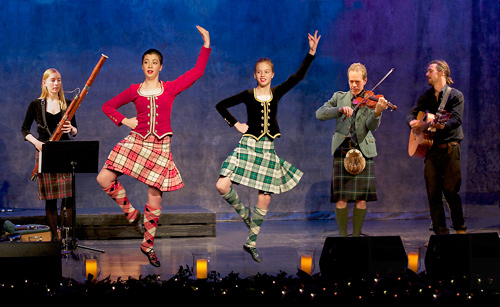
Ensuring that the event would be nothing if not colorful, Laval brought plenty of artillery to the occasion, including four instrumentalists, a budding young vocalist, and four dancers, who changed costumes at least four times during the concert. Further diversifying the musical palette, most of the musicians played multiple instruments. Both McLeod brothers, David and Michael, played bagpipes and the less punishing smallpipes, with Michael adding a drum and a pennywhistle along the way. For the most part, Rosalind Buda supplied a fluid obbligato and continuo on bassoon, but she also wended her way through a couple of bombards, a recorder, and an odd percussion instrument that could have begun life as a black canteen. Above all else, Buda read all the poetry selections beautifully, adorning them with a warm expressiveness and just a faint touch of dramatic flair. When he wasn’t flashing his championship fiddling bravura, Laval switched less impressively to strumming a guitar. But Laval was also a relaxed and personable host – his intros, anecdotes, and stories flowing so effortlessly that I sometimes lost track of when he crossed over from one type of spiel into another.

Yet there was nothing offhand about this concert. Laval’s craftsmanship was immediately apparent in the arrangement of the opening medley. Kelly Brzozowski began it with a lovely solo on the Celtic harp, introducing the “Wexford Carol,” and reminding me what a marvelous acoustic the Great Aunt Stella offers – something I’d quite forgotten since I last heard music there in 2001. We savored the sweet-sounding Ana Carolina Scott soon enough as she sang the ensuing “Angelus ad Virginem,” where we also heard our first sampling of the smallpipes. By the time we galloped into the fifth and final tune in this medley, “The Flagon,” we had seen most of the musical arsenal. With three wind instruments blowing simultaneously, the dynamic difference from the opening quiescence was startling.

The variety, contrasts, and unpredictability of the opening medley were mirrored by the entire program, which eventually covered more than 30 songs. Scott returned for three more vocals before intermission, beginning with a quiet rendition of a pre-Christian version of “The Holly and the Ivy,” accompaniment by harp and guitar with a couple of bassoon fills between stanzas. Assembling his program, Laval took a special interest in Celtic materials, melodies and lyrics that were eventually commandeered by Christianity – altering traditions rather than superseding them. That didn’t prevent Laval from utilizing a trio of young women from Atlanta’s Glencoe School of Highland Dance in further exploring Scottish folkways or from sneaking into North American tradition for a taste of Cape Breton step dancing with Amy Mooney.

After Buda and the McLeod brothers demonstrated how loud and make-it-stop irritating just three smallpipes could be on “Ding Dong Merrily on High,” things quieted down for the no-less-lively “Cape Breton Step Dance” featuring Laval’s infectious fiddling and Mooney’s percussive stepping. Mooney’s dancing was actually so percussive that she and Laval would trade two-bar solos with each other as Brzozowski accompanied on harp (with a few foot stomps of her own). All three Glencoe dancers then appeared in bright plaid skirts for their “Highland Dance Set,” accompanied by Luval’s fiddle and the McLeods’ smallpipes.

Return visits by the quaint trio didn’t wear out their welcome. The Glencoes next appeared in black outfits that were bedecked with colorful strips of fabric. Shaking bell sticks in both hands as they danced, they simulated a pair of wassail ceremonies designed to waken the apple orchards in the dead of winter and ensure the hard cider for the coming year. The next costume change was even more surprising as the Glencoe gals shuffled back onto the stage after intermission in sailor suits, doing mock battle with one another as the two bagpipers played the “Sailor’s Hornpipe” behind them.

While the smallpipes’ wind is supplied entirely by a small bellows pumped under the armpit, the bagpipes are fueled by both breath and bellows. Two of them, as was proven by the ensemble’s “Bessie Brown” just before intermission, can be even more make-it-stop loud than three smallpipes – with a rougher, more irritating sound at full blast. A rock concert sensibility would have been helpful, but I found that I’d acclimated well enough by the time we reached the evening’s final medley, finishing with the “Break Your Bass Drone” and “Flett from Flocca.” Meanwhile, Laval pursued his musical travelogue even more extensively than the ladies’ dance rounds, taking us to Orkney, Brittany, Coventry, Sussex, and Gloucester before we were done.

Most engaging of all was Laval’s extended excursion to Iceland, from where he brought us some diverting Yuletide legends and anecdotes along with three very entertaining songs. Withholding them until the end of the evening, Laval obviously knew the value of what he had. But he also edited prudently, beginning the “Icelandic Yule Lada,” the local equivalent of “The Twelve Days of Christmas,” on Day 8. There are actually 13 days in the Icelandic tradition, and how that evolved was another narrative. Laval hadn’t sung audibly during the evening, and when he duetted with Scott in “The Wren in the Furze,” we could hear why, for his vocals were chiefly effective in contrasting with the beauty of Scott’s. The backstory of this song, traditionally sung on St. Stephen’s Day after Christmas, meandered into Icelandic history and how the wren became an icon for military betrayal before taking on a radically different meaning for the holidays. Basically, “The Wren” was the weirdest begging song I’ve ever heard.

The final medley began with the “Boar’s Head Carol” and ended with the entire audience clapping rhythmically as the musicians and dancers took their bows, both bagpipes blaring once again. Even that wasn’t a sufficiently emphatic return to Scotland, but Laval wasn’t guilty of an oversight. For an encore, the pipers and the harpist accompanied Scott as she sang “Auld Lang Syne.” I didn’t recognize Scottish laureate Robert Burns’ words – or his brogue – in the stanzas Scott sang, but when the ensemble answered with the refrain, all hearts were in the Highlands.

Imagining a More Inclusive Yule @ ImaginOn

Children’s Theatre looks beyond Christmas

Scratch the wreath from a Starbuck’s cup design and you get an uproar: they’re defiling religion and steamrolling Christianity into oblivion! As usual, the silent majority is loud enough to drown out the opposing viewpoint — that the ever-expanding commercializing and mythologizing of Christmas is numbingly repetitive and downright offensive to those of us who believe differently. A few of us don’t welcome the sound of jingling bells and jolly Santas from mid-October through late December. And some of “us” could be Christians.

Long, long ago, it was past time to push back. So, it’s nice to hear that freedom of religion isn’t a mere shibboleth at Children’s Theatre of Charlotte. Not only are they daring to program a non-Christmas show at one of their two theaters at ImaginOn this December, they’re revamping the remaining Christmas show so it yields space to Chanukah and Kwanzaa.

As daring as this undertaking is, it’s even more ambitious. The non-Christmas show is Ella’s Big Chance: A Jazz Age Cinderella, and the Yuletide offering is ‘Twas the Night Before. Both of these productions are spanking-new world premieres, both commissioned by Children’s Theatre. On top of that, Ella is also a musical. Adapted from Shirley Hughes’ children’s book by Joan Cushing, Ella is a formidable project all by itself.

So, the first question I needed to ask artistic director Adam Burke, who’s directing Ella, was when did you lose your mind, shepherding two premieres to ImaginOn at the same time? But that struck me as a bit hostile, so I bumped it down to my second question.

“I’m surprised that you are the first person to ask me that!” Burke confessed. One thing that has made this double-plunge feasible is the confidence that Children’s Theatre has in Cushing, who previously premiered a new musical, A Christmas Doll, back in 2007, before Burke arrived in Charlotte. Besides that piece, numerous other Cushing musicals have enjoyed success at ImaginOn, including Junie B. Jones and the wickedest Red Riding Hood adaptation you’ll ever see, the Cajun-spiced Petite Rouge.

Make no mistake, Ella Cinders is a thoroughly modern Cinderella. She’s a London dressmaker serving her apprenticeship in her father’s shop during the Jazz Age, the Roaring Twenties. To their credit, Ella’s new stepmom and stepsisters turn Dad’s humble shop into a fashion hotspot — leaning heavily on our heroine’s toil. Do not think of them as clones of Carly Fiorina. The focus remains primarily on Ella.

“The traditional Cinderella tells us that we need to find and marry Prince Charming and he will make us happy,” Burke observes. “Ella discovers that she is in control of her choices, and her choices will determine her own happiness. That distinction is clear and important.”

Besides the opportunity to collaborate with Cushing, a prime attraction of this jazzy Cinderella was its feminist thrust. It may also be possible for a wonder-working godmother to be a picture of elegance rather than a bumbling Disney biddy babbling “Bibbidi-Bobbidi-Boo.” Burke promises that Ella will be jazzy.

“We have a fabulous orchestra, and Joan Cushing has been working hard with Keith Tittermary and music director Drina Keen to include lots of fun horns etc.,” Burke says. “[Choreographer] Ron Chisholm has been tirelessly working on Jazz Age dances like the Grizzly Bear, the Turkey Trot, the Bunny Hug and more.”

Providing a hip fairytale alternative to Christmas fare is certainly welcome, but the sharper edge of this two-pronged overhaul of December programming is ‘Twas the Night Before, written and directed by April Jones. A commanding force on the local scene before leaving Charlotte in 2005 to care for her father and grandmother up in Buffalo, New York, Jones won eight of the Loaf‘s most prestigious Theatre Awards over a three-year span. These included a Director of the Year and Theaterperson of the Year double in 2000 and again in 2002, when she also won Best Original Play honors.

Nearly all of Jones’s award-winning exploits were at Children’s Theatre in its pre-ImaginOn days on Morehead Street. She acted in Ramona Quimby when it won Show of the Year honors in 1997 and directed Boundless Grace when it took the prize in 2000. Jones has been back in Charlotte for just over a year, currently a visiting lecturer on acting at UNC Charlotte.

“I had to get out of Buffalo,” Jones confides. “My artistic spirit was being crushed, and job opportunities wereÊpractically nonexistent. I had a terminal degree but was working in retail. I came back to Charlotte because it feels like home, and I knew that I would find some degree of artistic food to feed my soul.”

Burke also teaches at UNC Charlotte, and in conjunction with his Theatre for Young Audiences class, has brought a couple of Children’s Theatre plays to the university for development, calling upon actors in the theatre department for help. With Jones stationed in the same department, Burke was able to bring ‘Twas the Night to his class with the playwright close at hand.

To Burke’s mind, Jones was a perfect fit for the project. “The first time I met April,” Burke recalls, “we had a great and heated discussion about diversity and faith. I knew then that I wanted to in some way support her as an artist so that she can better explore her beliefs and bring that conversation to life. So when the opportunity presented itself, I reached out to her in order to bring her ideas to the table.”

Writing for a young audience, with just the four actors of Children’s Theatre’s Resident Touring Company at her disposal, Jones found it challenging to shape a simple and meaningful tale that freshly embraces three different traditions. Respecting and understanding the less-familiar holidays was also fundamental.

“I felt is was important to tell about the origins of Chanukah, because some people seem to think it’s a Jewish form of Christmas, even though it predates Christmas,” Jones says. “In writing this play, I often reflected on the seven principles of Kwanzaa, because I believe that, at their core, these three holidays are about family, community and faith. Some people dismiss Kwanzaa as an African American form of Christmas, which it is not, or discount it as being a ‘made up holiday,’ but aren’t all holidays made up?”

Paradoxically, Jones struggled most with Christmas, the most familiar holiday. If you skirt the Nativity, you’re missing the essence of the holiday, yet the story has been told over and over — to the point that you’re repeating, not really telling anything. Research didn’t help here. Creativity took over, leading Jones to a new theme.

“Ultimately, I decided to craft a story about an anthropomorphic star named Bethlehem, or Beth for short,” Jones reveals. “There is an Adinkra symbol in the Ghanaian culture that means ‘unity is diversity.’ This truth was a significant part of why I wanted to write this play. Another theme that revealed itself to me was the idea of passing light from one holiday to another, from one person to another, from one culture to another, so that we all may be enlightened as we celebrate our differences and embrace our similarities.”

Call it secularism or diversity, these bold Children’s Theatre initiatives aren’t the impulses of a few rogue artists.

“This comes from the whole team — from the board, staff and lead by the artistic team,” Burke says, “It is an effort to be more inclusive. We recognize that not everyone believes and celebrates the same thing. So we used this as an opportunity to expand the meaning of the holiday season.”

It couldn’t come at a better time.

For Veterans and Victims

Concert Review: Charlotte Symphony Performs Fauré’s Requiem and Ravel’s Mother Goose

By 

The Charlotte Symphony’s most recent concert was designed by music director Christopher Warren-Green to be a seasonally appropriate tribute to the brave men-in-arms who serve and sacrifice for our nation in our military. Between Veterans Day on November 11 and the first of three concerts at Belk Theater on November 19-21, history intruded in Paris and Beirut. So after the orchestra played George Butterworth’s A Shropshire Lad Rhapsody and Maurice Ravel’s Mother Goose, maestro Warren-Green returned to the podium and rededicated the final piece of the evening, Gabriel Fauré’s Requiem – and, indeed, the entire program.

Now the 1888 Requiem was dedicated to veterans of our armed forces and to victims of terrorism in Paris, Beirut, and around the globe. While the traditional Latin text isn’t custom-tailored to either group, the setting by Fauré sounded very serendipitous. We’ve had four other requiems presented in Charlotte in recent years, by Mozart, Verdi, Duruflé, and Howells. The Fauré reminded me most of the Duruflé in its calmer moments, most of the Verdi in its moments of turbulence.

Drama resonating with our anger and outrage had to be vented in response to this shocking occasion, and baritone Douglas Williams – along with the Charlotte Symphony Chorus under Kenney Potter – voiced those emotions most compellingly when we reached the “Agnus Dei” section and its climactic “Day of Wrath” stanza. Yet we also needed the consoling serenity of Christina Pier softly singing the “Pie Jesu” in her velvety soprano.

Butterworth certainly wasn’t the only turn-of-the-20th-century British composer to be inspired by the terse stoical beauty of A.E. Housman’s pastoral poetry, but this rhapsody for orchestra had a special twilight radiance under Warren-Green’s baton. The sonority of the full ensemble was poignantly punctuated with a wide palette of succinct solos by clarinetist Eugene Kavadlo, English horn virtuoso Terry Maskin, harpist Andrea Mumm, concertmaster Calin Lupanu, bassoonist Mary Beth Griglak, and bass clarinetist Alan Rosenfeld. Amy Whitehead had the ethereal last word on flute over a soft barrage of timpani from Leonardo Soto.

You wonder whether Warren-Green considered moving Ravel’s charming fantasy suite to the end of the program, just to send us home with a smile. Stealing the scene from the other impish or enchanting episodes was the penultimate “Conversations of Beauty and the Beast.” Kavadlo, Whitehead, Mumm, oboist Hollis Ulaky, and – highest of all – Lupanu all took turns with the beauteous portion of the dialogue. But ‘twas contrabassoonist Lori Tiberio as the Beast who unquestionably conquered the beauties in musical derring-do. Keeping these lighthearted moments in the middle of all the somber moods surrounding it proved to be the right choice.

“The Book of Liz”: A Bifocal Satire of Life in the Heartland

By Perry Tannenbaum

Life on the prairie in small towns is pretty much how Garrison Keillor has been describing it for so long on NPR, except in university towns scattered across the Midwest and the occasional religious enclave. I sampled both during my sojourn at the U of Iowa in Iowa City, visiting the nearby Amana Colonies on a couple of boring weekends. Breaking the monotony of one of my drives back from a winter break, I also took a tip from my mom and looked in on the Amish in Pennsylvania.

Those humble years in America’s heartland came back vividly last week as I watched The Book of Liz, the second piece that Donna Scott Productions has performed at the Charlotte Art League. If you’re familiar with the other pranks by the playwriting siblings who conspired on this script in 2001, Amy and David Sedaris, you’ll readily guess that laughter far outweighed my nostalgia.

A stern ascetic strain is readily apparent in the Sedarises’ portrait of the Squeamish who live in the seclusion of Clusterhaven. Yet the script steers deftly around religion, aiming its satire primarily at the stodgy sexist patriarchs who rule the colony and their absorption with Clusterhaven’s prime product: cheese balls, traditional or smoky.

Both varieties of the colony-sustaining cheese balls are crafted by Sister Elizabeth Donderstock, following her own secret recipes. Reverend Tollhouse doesn’t seem to appreciate Liz’s kitchen artistry, and when young Brother Brightbee arrives in town, he sternly decrees that Liz hand over the cheese ball recipes – and all of the manufacturing responsibilities – to the sparkish newcomer. Already suffering from a profuse sweating problem, the redeployment sends Liz into crisis. She not only leaves the recipes behind in the community kitchen, she abandons the colony entirely and sets off into the real world.

The odyssey that follows is as circumscribed as Liz’s experience, education, and audacity. Even if she doesn’t get as far as Chicago – or even the Quad Cities! – we see the outside world, its zaniness and insularity, colored through the lens of Liz’s inner purity. It’s a picaresque journey or a bifocal satire; take your pick.

On the road, the first person she runs into is dressed as a Planter’s Peanut, trying to offer samples to passing motorists. We instantly get the idea that Liz’s adventure will juxtapose her with an outré character or two, and Oxana, the woman inside the ginormous peanut shell doesn’t disappoint us even when she sheds her costume, a Ukrainian immigrant with an English accent dwelling in a trailer with husband Yvone.

Thanks to Liz’s innate kindness, both women soon find new jobs. The situation – and the costumes – are slightly less outrageous as Liz comes to work at Plymouth Crock, a Pilgrim-themed restaurant that just might be trading off the proximity and cachet of Clusterhaven. Purposely or not, Liz’s new world resembles her old world in the way Oz resembled Kansas, and so does its effect.

Any temptation to take all this too seriously is quickly defused by director Glynnis O’Donoghue and her mischievous cast. Costumer Luci Wilson spares all expense in outfitting Reverend Tollhouse and Brother Brightbee with their beards, attaching them with crude elastic. The Pilgrim finery at the restaurant and Oxana’s peanut shell provide additional roasting as we move along.

Matthew Corbett begins double-underlining Rev Tollhouse’s starchiness and pomposity before anyone joins him onstage, offering some oddly phrased praises to his savior as he prays. A mercifully inserted blackout sweeps us along to the 38th of these “compliments” before Liz enters, with Tonya Bludsworth double-underlining her naïveté and her squirming diffidence from the outset. With Corbett’s imposing size, they’re instantly feeding off one another in a comedy symbiosis that dates back to Laurel & Hardy.

All isn’t quite as the Sedarises intended. Field Cantey enters with a perfectly calibrated excess of self-regard as Brother Brightbee, but it is Scott as Sister Butterworth, Liz’s associate, who is salivating in a subsequent scene at the very thought of seeing the heralded newcomer. Scott is also dialed in, since nasty, petty busybodies are her longtime specialties. What’s curious is the lack of reaction from Liz, a more natural indifference from our heroine if she were 20 years older than Bludsworth, as the playwrights prescribed – but this age misalignment only becomes glaring in the Act 2 denouement.

Corbett, Cantey, and Scott all reappear in multiple guises after Liz flees Clusterhaven, their slipshod costume changes adding further fizz to the story – but not before we come upon Tania Kelly, clearly the ideal nut topping for this cheese ball comedy. I’ve been raving about Kelly’s comedy prowess for nearly eight years, and she still never fails to delight and surprise. Here she makes up for her tardy arrival by taking on four varied roles.

During her travels, we wonder if Liz will find a cure for her sweating disorder – and whether reconciliation at Clusterhaven and appreciation from the Squeamish will be possible. The resolution isn’t likely to be exactly as you imagine, which is why you’ll probably be happy to find that the whole story turns out to be very much like a secret recipe revealed.


Hollywood Brings out a Sunnier Neil Labute

The Money Shot and Diana Grisanti’s The Patron Saint of Losing Sleep (nee Inc.)

https://i0.wp.com/media2.fdncms.com/charlotte/imager/u/zoom/3678994/artfeature.jpg

By Perry Tannenbaum

More than a couple of Neil LaBute plays have waltzed through Charlotte in the past dozen years, including Fat Pig, Reasons to Be Pretty, The Mercy Seat, Autobahn, Some Girl(s), and the suite of Mormon one-acts, Bash, that introduced the BYU grad to the Queen City in 2003. They aren’t teeming with admirable heroes — or even evil folk we might acknowledge as rogues. In Fat Pig, Reasons to Be Pretty, and Some Girl(s), LaBute was chiefly adept at showing what boorish, sexist assholes men can be. Comedy rarely intruded in LaBute’s world. When it surfaced, in a brief two-hander that was part of the Autobahn suite, results were quite tepid.

No, LaBute was funniest when he shocked us with how unabashedly crass and unapologetically cruel his boors could be. I’ve never seen LaBute as bent on comedy as he is in The Money Shot, the newest of his plays to hit town in a smart Queen City Theatre Company production at Duke Energy Theater.

With three women and just one guy in the cast, the demo has altered somewhat in this latest LaBute effort, but what triggers the playwright’s newfound comic vein are his decisions to amp up their egos while tamping down their intelligence.

Although outnumbered here at co-star Karen’s plush home, Steve wields the most clout and drives the plot. He’s a former Sexiest Man Alive and a bona fide Hollywood action hero, but his career desperately needs a reboot. So he has reached out to a trendy European director, hoping to bring new artsiness to his image by way of a new film that Steve will be executive producing.

If you are already familiar with what a “money shot” is in the realm of porn flicks, then you already have a good idea why Steve and his glam gold-digging wife Missy are calling upon Karen and her butch partner Bev, an established film editor. Otherwise, you would need to wait until we’re fairly deep into this 108-minute production — or have read some pre-publicity or this review — before Steve and Karen broach the point of this get-together.

So, there will definitely be drama here, but not until we’ve crossed plenty of comical character-study terrain aimed at taking down Hollywood’s pretenses of sophistication and culture. The key specimens are the co-stars. Steve follows in the footsteps of LaButean louts, but with his wealthy arrogance — compounded by his ignorance of the location of Belgium, the lineage of David Crosby, and the western march of civilization — he brings a unique suavity to the loutish breed, its aura further magnified by his bimbo wife’s worship.

Karen’s vapidity seems to have a more specific target: the shameless self-promotion of Hollywood celebs through branded products, business enterprises and endorsements. She already has a restaurant, a fashion line and a website extending her marketability. After the upcoming film, Karen has visions of launching her own line of sex toys! So yes, if you haven’t already guessed, it’s a raw sex scene — not a simulated one, mind you — that will crown the upcoming Steve-Karen hook-up with artistic legitimacy.

Missy is already enthusiastically on board with her husband’s scheme, giddy over the prospect of soon reaching their first anniversary (with the assistance of their marriage counselor). But beware, Missy has artistic aspirations of her own, and you will be obliged to endure a portion of her capabilities, as she reprises an episode from her role in a high school production of The Crucible.

Bev is the only true obstacle in the way of Steve and Karen copulating onscreen, since she’s hard-working, intelligent and saddled with a modicum of modesty and decency. There probably wouldn’t be quite as much friction within this foursome if Steve weren’t so boorishly tactless and homophobic, except that Bev brings so much righteous political correctness to the table that she’s almost as irritating as he is. Furthermore, Bev’s petulance toward Karen is so toxic that, at one point, even the dimwitted Missy can see that her marriage counselor might be helpful.

How all this plays out is pretty wild and delicious, thanks to an energetic cast directed by Glenn T. Griffin, who keenly amplifies the effervescent comedy. You may not think that J.R. Adduci is old enough to be pretending he’s only 45, but once we’re rolling, that hardly seems to matter. He brings such charm to Steve that he personifies the Hollywood paradox: a pantheon of demigods we worship while fully grasping their shallowness. As Adduci sat there on the couch, desperately googling on his cell to back up his contention that Belgium is not in Europe, I found myself feeling sorry for the schmuck.

Michelle Fleshman captures even more of the pathos of Hollywood’s fading stars, brilliantly brittle as Karen, especially poignant as she affirms her bisexuality to her sneering guests. You’ll also like Karen’s assorted meltdowns when she fails at mediation and conciliation. In so many ways, Iesha Nyree’s steely portrayal of Bev brings uneasiness to the piece. She’s sufficiently abrasive to make us wish that Steve and Karen will have their way, and when the gloves come off, she convincingly emerges as the alpha predator.

Nobody comes off nearly as shallow as Karen Christensen in her exuberantly silly portrait of Missy. Many of Griffin’s directorial excesses are lavished on this bleached blonde, whether she’s shamelessly spooning with her new husband on the hosts’ couch or when she finally turns on him in the denouement.

The ills of Hollywood may be crass and clichéd. Yet they pepped up David Mamet’s work when he wrote Speed-the-Plow — and they’re ministering a similar therapy here for the misanthropic LaBute. This may be the sunniest piece he ever writes.

https://i0.wp.com/media1.fdncms.com/charlotte/imager/u/zoom/3669927/top10-4_28.jpg

Playwright Diana Grisanti won first prize again for a staged reading of her new script at last winter’s NuVoices festival, so Actor’s Theatre is bringing The Patron Saint of Losing Sleep (nee Inc.) back to Stonewall Street for its fully-staged world premiere. I wasn’t among the judges who thought Inc. was the best script at NuVoices, but I thought it was distinctively better than Grisanti’s previous winner, River City, which premiered here last September.

Unfortunately, Grisanti’s rewrite has degraded her product — particularly her title heroine, Ada, who might be described as the patron saint of catastrophic interventions. Back at divinity school, Ada intervened on behalf of a college pal, who was fielding some sexual harassment from her advisor. Memories of this intervention, which merely resulted in Ada’s dismissal from school, are dredged up when she stages a more harmful intervention while working at a customer service phone bank.

Nicia Carla gives us a vivid account of Ada as she deals with the insomnia stemming from her misdeeds; and her supporting cast, meticulously directed by Elissa Goetschius, stir up a lively mix of comedy and drama. But Grisanti has botched her formula and lost moral focus, making Ada less savory while tilting the overall tone toward comedy. Just because Ada pierces (stigmatizes?) her hands with a fork, Grisanti and the college chum seem to be granting the meddlesome sinner forgiveness for causing the death of an unborn child.

Nope, I wasn’t cool with that.