Will Eno Makes Indecision an Honorable Way of Life

Review:  Middletown

By Perry Tannenbaum

“Daytime. Night-time. Enough. I get it.” Folks in Will Eno‘s Middletown may remind you at times of the stark simplicities of Samuel Beckett’s Waiting for Godot. There are definitely absurdist and existential ideas running amok in Eno’s quaint American village, but there were other modernist ideas vying for our attention as actors in the nine-member ensemble swerved in and out of character, broke the fourth wall, or simply joined us in the audience as loudmouth spectators. Disbelief was not to be suspended for long in this amiably odd student-directed production by the Davidson College Theatre Department at the Barber Theatre. Nor was information very useful here, though the question of where we were was quickly addressed and muddled. Among the candidates instantly put forth by Google in Connecticut, Ohio, New York, New Jersey, or Rhode Island, Eno’s Middletown is none of the above – or possibly all of the above. “Middle” can certainly mean average in an Our Town way, or it can mean between in an existential way, at the crossroads between the past and future, the intersection where all times meet. Now.

cop

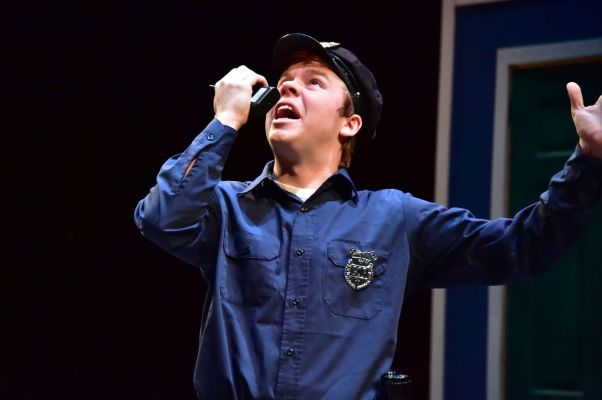
Eno’s playfulness wasn’t long in coming. His Cop broke the fourth wall in welcoming us as “Ladies and Gentlemen,” but the rest of the ensemble, planted in the audience, went about exhausting all the other possibilities of whom the Cop might be addressing – to such an epic length that we might have forgetten this catalogue was nothing more than a greeting. Then we came to the scene that most reminded me of Waiting for Godot. Sauntering out of the audience, the Cop encountered the Mechanic who was loitering in the middle of the stage. The interrogation that followed mixed silliness, slapstick, and brutality in a fashion that resembled the Beckett recipe. It also served to introduce us to the two subspecies that inhabit Middletown, those who have settled positions in life and those who are in transition, in between what they used to do and what might come next. Not surprisingly, Eno had us empathizing with his unsettled middle people. Indecision seemed to equal sanity in his universe.

Dressed as a mechanic, the Mechanic was no longer working as one. Perennially holding a beer bottle in his hand, Sam Giberga showed us that the Mechanic might have a buzz going, but not enough for Matt Hunter as the Cop to toss him in the slammer. The costume and the beer bottle also told us, as the evening rolled along, that despite the Mechanic’s search for a new direction in life, he wasn’t pursuing it at warp speed. Near the end of this bittersweet comedy, a parade of other actors – out of time or in a dream – came by and dressed the Mechanic in something emblematic of his or her profession. One of the nurses helped the Mechanic into a lab coat, the Astronaut contributed his helmet, the Librarian draped a book bag on his arm, and the Cop surrendered his walkie-talkie. All directions were possible in this fantasia.

In subsequent appearances, Hunter managed to convince me that the Cop’s unexpected, random brutality toward the Mechanic had been as much the result of boredom as anything else. Actions by the Librarian, the Astronaut, and the nurses underscored the point that people are basically going through the motions at their jobs. The people who interested Eno the most were those in search of motions through with to go. Futility abounds: in a scene with a tour guide and two tourists, it was hard to tell who was trying hardest to help the other out. None of them had much of a clue.

librarian

After the Cop chased the Mechanic off the stage, Mrs. Swanson arrived, a newcomer to Middletown. Hers was a more consequential scene, for she not only met the Librarian, who was eager to fill in Mrs. Swanson on the nebulosities that form Middletown’s history (Vickie Williams was a marvelously professional and preoccupied Librarian), she also met John Dodge, another listlessly searching townsperson. Not yet visibly pregnant, Mrs. Swanson was the embodiment of expectation, but her husband was never around to share her anxieties or her bliss. John, on the other hand, was perpetually downcast and lacking in initiative. Knowing Mrs. Swanson’s story and hearing that she was naming her unborn son John, John still didn’t act on his obvious affection for her.

woman

These two central roles were the best suited for collegiate actors, and both Savannah Deal and Ryan Rotella were superb. Only Deal was truly age-appropriate last year when the two appeared in Sarah Ruhl’s Eurydice. Here, their unaffected styles made their scene work even more satisfyingly. Rotella’s hangdog approach to John gave the untethered man a cuddly, pathetic appeal, while Deal’s slight cheerfulness always seemed undercut by her disorientation, uncertainty, and profound loneliness. The common bond that united both subspecies of Middletowners, both the shiftless and the settled, was the loneliness that made Mrs. Swanson and John appear to be natural soulmates.

For this production, Barber Theatre was configured in stadium style, half the audience facing the other half with the stage in the middle. Scenic designer Neil Reda didn’t often have much to show us in the middle, but for Act I, he set up two colorful pairs of housefronts facing each other from opposite ends of the stage, about the size of a changing cabin you might rent at the beach. As the 10-minute intermission ended, ensemble members planted themselves at both sides of the house to discuss what they – as audience members – saw in Act I. It wasn’t a particularly enlightening discussion, of course, digressing into a guy on my side of the theatre marveling at the memory of one of the women on the other side. A latter-day Pirandello prank, perhaps?

During the interval, however, Reda’s two set pieces were swiveled around, revealing yet another aspect of what Middletown might be. On the other side of the exterior doors we saw in Act I, there were now two hospital rooms, one for Mrs. Swanson and one for John. In one room, there was an impending birth, while on John’s side, there just might be an impending death. Eno gives us a grimly humorous takeaway here: if you’re thinking about suicide and not absolutely sure you won’t have regrets, use a clean knife to better ensure your recovery.

Of course, the bigger takeaway was the one laid out before the audience. Middletown is that seemingly large space between birth and death, the entirety of our awareness. One of the ensemble members comes onstage to plant a little tree there, but it is whisked away before the important action resumes.

Sweet and Sour Romance for V-Day

pamcoffman-johnxenakis2

Preview:  Three Bone Theatre Presents Love/Sick

By Perry Tannenbaum

Three Bone Theatre has mostly been a fringe group during its first four seasons, starting out at UpStage in NoDa and performing there as recently as a year ago. For 2016-2017, Three Bone has taken it up a notch, settling in at Duke Energy Theatre as one of Spirit Square’s three resident companies, with more of a mainstream look and plenty more seats to fill.

Starting off with Theresa Rebeck’s Seminar in August and following up with Heidi Schreck’s Grand Concourse in November, Three Bone proved they were ready to make the UpStage-to-Uptown leap. With their upcoming production of Love/Sick coinciding with Valentine’s Day, they’re doing it with marketing savvy as well.

“The placement of Love/Sick in the season was definitely intentional,” says Three Bone artistic director Robin Tynes. “Everyone loves romantic comedies that end happily. This piece questions that a little bit and tells the sweet and the sour of relationships. What’s so great about the show is that it is enjoyable for couples and singles alike. The show has an awesome blend of hilarity and sucker-punches. Relationships are hard and these quirky stories offer something for everyone.”

Playwright John Cariani, who also starred in the 2015 off-Broadway premiere of Love/Sick, is better-known for Almost, Maine, one of the most frequently produced comedies across America in 2009-11. That’s when it jumped around the Metrolina area, with productions in Davidson, Ballantyne, and CPCC.

Pam Coffman was in that CP presentation and comes back to Cariani as one of the 10 cast members at Duke Energy. She knows the territory well. Instead of introducing us to a single pair of loving – or unloving – protagonists, Cariani presents us with a cavalcade of couples. Almost, a fantastical town in northernmost Maine that “doesn’t quite exist,” was the unifying geography of the earlier set of playlets. In Love/Sick, we’re in a surreal suburbia – less whimsy and no Northern Lights.

“All of the stories take place at the same time in the same town, with the town’s Super Center as the common thread throughout the play,” Coffman explains. “While the themes are also very similar – the quest for love, falling in love, maintaining love, loss of love – Cariani presents these themes in a darker, perhaps even cynical way. If Almost, Maine is a Moscato, then Love/Sick is a Cabernet Sauvignon – truly enjoyable, with a little bite on the end.”

Cariani’s suburbia is also a little more orderly than his Almost, for the scenes in Love/Sick aren’t merely different couples at the same time. This parade represents different stages of romantic relationships, presented in sequential order. Within this pattern and loose cohesion, there can also be wide variety.


amywada-robertallen

Like most of the other cast members, Amy Wada appears in multiple vignettes, once as Celia on the threshold of marriage and later as Abbie, a weary stay-at-home mom. Like Coffman, Wada appeared in Almost at CP in 2011, so Love/Sick for her is a Cariani déjà vu.

“The main difference between the two plays for me is how each scene ends,” says Wada. “In Almost, Maine, there is always some sort of closure to the relationship. The couples don’t always end up happy or together, but there’s some sort of punctuation at the end of each scene. In Love/Sick, Cariani leaves the status of the future of each couple’s relationship up in the air and for me, as an audience member, makes it more interesting.”

Coffman and her scene partner, John Xenakis, are the only members of the Love/Sick cast who don’t have multiple scenes. Furthermore, they don’t appear until the closing scene. So until last week, when they moved from their rehearsal space to Spirit Square, the actors really didn’t see each other perform – or experience a conventional run-through. When you’re in scenes that are essentially self-contained and disconnected from the rest, you can expect a director (Sean Kimbro, in this case) to run rehearsals out of sequence to respect his actors’ time.

The concluding scene, however, is somewhat different from those that precede. While Cariani might leave the future of his couples open-ended, he’s a bit tidier with his overall design. As Emily, we see Coffman as a woman who is wandering around the surreal suburbia’s supermarket by accident, stranded there just temporarily because she missed her connecting flight.

“She happens upon her ex-husband who now lives there,” Coffman says. “As the scene unfolds, they realize they are both single again, and begin to wonder if destiny has brought them together. The beauty of this scene is that, because these characters have lived longer and experienced more life, they are able to explore all of the love themes that have been touched on in the previous vignettes. The result is a bittersweet compilation of the many roads love can take, and hopefully, the desire to ‘do love’ better.”

In the process of this meeting – maybe a fresh beginning? – Emily and her ex become the vehicle that circles us back to the opening scene. If we haven’t realized it before, or if we’ve allowed ourselves to forget, all of Cariani’s scenes were occurring simultaneously.

Do the whimsy and brevity of the scenes take away from their impact? Not for Wada: “Even though the situations aren’t always realistic, what’s actually going on and the feelings the characters are experiencing are truthful and raw. The length of the pieces doesn’t affect the arc of each story. We can relate because we’ve all been somewhere along the spectrum of these relationships.”

Part of the fun for couples on a date night, perhaps a belated Valentine’s Day celebration, will come from the special connection that Three Bone is making with their community partner du jour, the 100 Love Notes Foundation. Established more than a year ago by Charlotte assistant city manager Hyong Yi in memory of his wife, Catherine Zanga, Yi went around town passing out his love notes celebrating the relationship that ended when she died of ovarian cancer.

The idea, the celebration, became an Internet phenomenon and then a foundation. Last week, Three Bone took to the streets and handed out a fresh batch of lunchtime love notes. According to Tynes, there will be more of “spread the love” opportunities at each performance of Love/Sick and more acts of random kindness on the streets.

“In such an anxiety-ridden and divisive time,” Tynes says, “we could all use a little more love. We will have the opportunity for our audience members to contribute their own love notes, with the possibility of their notes appearing in a slideshow before each performance.”

Or after? There were some tweets from God recently before Queen City Theatre Company’s Act of God at Duke Energy Theatre, but the 2015 Broadway revival of Sylvia took it a step further with the help of photo text messages from audience members transmitted during intermission. When the cast took their final bows, an adorable slideshow of audience doggie photos began right behind the actors.

How appropriate, then, that Three Bone Theatre’s production for Valentine’s Day will feature a similar embrace of their audience!

American Reset Brings New Relevance to “Ragtime”

Ragtime Promo Photos

Preview: Ragtime

By Perry Tannenbaum

Things were so different in 1906, when E.L. Doctorow’s Ragtime begins. Theodore Roosevelt, a conservationist Republican, was in his second term at the White House. The wave of immigrant Jewish refugees, fleeing pogroms in Russia, was at its peak.

American women would have to wait three more presidential elections before they could vote, but the charismatic Emma Goldman was one of the strong voices agitating on the streets. Jazz had yet to be born in New Orleans, and the African-American superstars who sparked its popularity were still children, but Scott Joplin had already codified the architecture of ragtime.

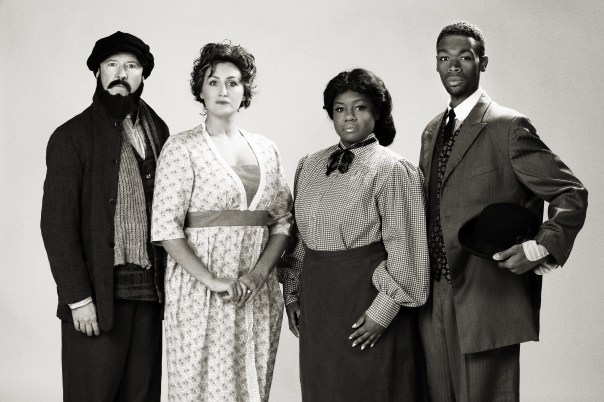
When Terrence McNally adapted Doctorow’s 1975 novel for the musical that opened on Broadway in 1998, costumes worn by Goldman, by Tateh the Jewish immigrant, and by ragtime piano player Coalhouse Walker added to my impression that Ragtime was so yesterday. Women had already ascended to high elective offices and had figured prominently in presidential politics. Jewish immigrants and their descendants had crafted the very framework of Hollywood’s studios and Broadway’s musical theatre. Satchmo and the Duke were far in the rearview mirror of American cultural history, and Michael Jackson was deep into his reign as the King of Pop.

Surely we had matured as a nation since those primitive days Doctorow and McNally chronicled. Each time I saw Ragtime again, in 2001, 2005, and especially in 2011 – when Barack Obama was President, and Hillary Clinton, his most formidable opponent in the 2008 election, was Secretary of State – my sense of our superiority and progress as a nation continued to grow.

Then came 2016. The shocking election result. The inauguration. The women’s demonstrations across America and across the ocean. The opening assault on immigration.

Or how about Trayvon Martin, Ferguson, and the cavalcade of atrocities posted to social media since early 2012? When Ragtime arrives this weekend at Halton Theater in a new production by CPCC Theatre, it won’t seem as quaint and primitive as it did five years ago. In so many ways, we’ve punched the reset button.

When I saw Brian Stokes Mitchell as Coalhouse, the rousing song he introduced, “Wheels of a Dream,” seemed to be dreaming of today – or 1999, when I saw Mitchell at the Ford Theatre on 42nd Street, and the whole ensemble transformed “Wheels of a Dream” into an anthem at the end of the show. This week, when Charlotte powerhouse Tyler Smith takes on Coalhouse, I’ll have to humbly concede that his anthem is still envisioning a better tomorrow that hasn’t come.

Ragtime Promo Photos

Smith was never under any illusions. “This country was founded on principles that were never all-inclusive,” he says. “Our recent presidential results showed the world how much racial hatred still looms here.”

After a couple of lightweight roles at CP in last winter’s Irving Berlin revue and last summer’s Sister Act, Megan Postle is eager to show some range – and depth – as Goldman. “I have a personal attachment to Ragtime,” Postle reveals. “It was my first Broadway show. My aunt took me to see the original cast.”

One of the fascinating things about Ragtime is its mix of historical and fictional characters. Doctorow also gives cameos of varying lengths to J.P. Morgan, Booker T. Washington, Harry Houdini, Henry Ford, Admiral Peary, and Evelyn Nesbit.

But none of the historical characters is altered more in trafficking with Doctorow’s fictional characters than Emma, who sheds her anarchist and assassin tendencies. “Goldman is the Greek chorus for Ragtime,” says Postle. “She speaks for all members of the human race who feel there is inequality.”

Emma also helps to stitch the various strands of the plot together. Coalhouse and Tateh head two of the three families that anchor this story. They are the outsiders while the third family, prosperous inhabitants of New Rochelle, complete the New York triangle of the story. Sailing off to join Admiral Peary’s polar expedition as we begin, the Father waves to Tateh, who is on a raggedy ship that has nearly completed its voyage across the Atlantic to Ellis Island.

From that point, the story forms an epic arc that resolves gracefully as the full company delivers its epilogue. Along the way, we glide past a labor strike by exploited millworkers in Massachusetts, Goldman’s galvanizing oratory, horrid police brutality, and audacious, explosive, vengeful responses from Coalhouse.

Smith admits that racial issues have heated up since the most recent 2009 revival of Ragtime on Broadway and the end of the Obama presidency.

“Today’s Coalhouse is every father, husband, brother and son killed without proper justice being served,” he said. “Every wife, sister, mother and daughter who have to feel the grief and bear the weight of losing a lost one while nobody seems to care. People like Eric Gardner, Trayvon Martin, Keith Lamont Scott, the mothers of all those murdered in Chicago. There is a line sung in the show saying ‘we’re all Coalhouse.’ It hits home because it is true.”

Tom Hollis, CP’s drama chair, chose Ragtime for the 2016-17 season back in the spring of 2015, around the time when the announcement of Donald Trump’s candidacy was greeted with more laughter than alarm. Hollis considered it then in the vein of 1776, the musical that was already set to run last September, just before the first presidential debate.

He still does. “When we were doing 1776 in the fall of 2016, we were constantly being struck by the parallels to life today,” Hollis says. “Each generation of Americans has had to face coming up with an answer to these issues because they are woven into the fabric of our country. That we haven’t been able to find a permanent solution is the sad irony of our history.”

A hard, tragic compromise on slavery clouded the happy ending of 1776, and what happens to Coalhouse clouds the ending of Ragtime. A member of the New Rochelle family who was inspired by Goldman ultimately vows to keep Coalhouse’s story alive, while Tateh achieves the American dream.

Billy Ensley, a mainstay of the CPCC Theatre for decades, will play Tateh at the Halton. It’s just the latest in a series of Jewish roles that he has played over the course of his acting career, including Eugene in Neil Simon’s Broadway Bound and two ill-fated historical figures, San Francisco activist Harvey Milk and Atlanta’s Leo Frank. Wrongly convicted of the 1913 murder of Mary Phagan in Atlanta – and subsequently lynched – Frank was the tragic hero of Alfred Uhry’s Parade, presented at the Halton in 2006.

So for Ensley, it’s a journey back to the same period with a similar rueful takeaway, even if Tateh does end happily.

“Current events regarding immigration have only strengthened the way I have always felt about those that are marginalized, forgotten, discriminated against,” Ensley says. “We all deserve a chance to live fulfilling, safe and happy lives, and those of us that have that already should do what we can to see to it that others less fortunate can as well. Our country was built by immigrants.”

Ensley offers advice for immigration opponents: “For those today in favor of a closed-off America, I suggest a trip to Ellis Island and a little research on where the people came from that made this country the wonderful and rich country that it is.”

Travel advisory: Ellis Island is just a short boat ride away from the Statue of Liberty, depicted on the cover of numerous editions and translations of Ragtime.

Hit the Road, James, With a Mind-Boggling “Hitchhiker’s Guide”

trillbeer

Review:  The Hitchhiker’s Guide to the Galaxy

By Perry Tannenbaum

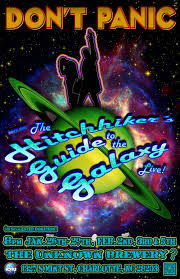
Can this really be the end? Citizens of the Universe and its indefatigable intergalactic peacekeeper, James Cartee, are leaving Charlotte, heading for Texas, and only possibly leaving an appendage behind them to carry on their mission. Closing with The Hitchhiker’s Guide to the Galaxy at the Unknown Brewing Company, their most lavish production since they adapted The Princess Bride at the now-defunct Breakfast Club in 2011, COTU is going out with a big bang.

Two parallel events trigger the sci-fi comedy as we meet the shambling, stiff-necked Arthur Dent, who never sheds his PJs and bathrobe throughout his mind-boggling travels. On the earthly plane, Arthur is battling to keep his Cottington home from demolition by the county to provide a pulverized right-of-way for a new thruway. He’s ready to lay down his life for his property, and he’s actually lying down in front of his Cottington cottage so that the county bulldozer can’t move further.

Meanwhile, on a more galactic plane, Vogon overlords who are constructing a hyperspace bypass have slated Earth for demolition. Why a perpetually moving planet in a perpetually expanding universe would be slated for demolition is beside the point, do you hear me?

By the most improbable coincidence, Arthur is singled out for rescue by Ford Prefect, an embedded alien who contributes to the Hitchhiker’s Guide as a roving travel writer. Yes, when Douglas Adams first conceived his sci-fi serial for BBC

zaphod

Radio in 1978, ebooks were already on his imaginary assembly line. Arthur frequently consults his pocket reader after hitchhiking aboard a new space cruise or during his downtime, but it is Mandy Kendall who brings The Book to life between stints as our narrator.

She’s also, as our costume designer, the person who makes COTU’s valedictory so outré sensational. Arthur may be a humdrum everyman, with Chris Freeman faithfully executing his shambling duties, but Tom Ollis and Billy Whalen, tethered together as two-headed galaxy prez Zaphod Beeblebrox, take us back past the disco ‘70s to the hippy ‘60s with their outfit. Loud colors, a florid headband, with brash tie-dyes clashing unapologetically against paisleys.

Of course, Beeblebrox doesn’t exhaust the weird phenomena Kendall must costume on Arthur’s odyssey. Other cameos range from Ravenous Bugbladder Beast of Traal (Greg Irwin), Marvin the morose robot (David G. Holland), Deep Thought the computer (Martin Barry), a Whale (Kevin Sario) swimming with a Bowl of Petunias, and the two life forms on our planet that are smarter than we are, mice and dolphins.

Freeman maintains a British diffidence that occasionally flares into puzzlement amid his haywire journeying, but Nathan Morris as Ford is the optimistic huckster forever urging Arthur onwards, almost oozing insincerity when the going gets tough. Like the brainy Trillian and the gregarious Book, Ford is occasionally incomprehensible when he uses jargon that is outside the ken of the BBC and the OED.

index

Both Ford and Kendall occasionally stumbled on their lines Saturday night when they wandered through this alien corn, less like the terminology of a botany catalogue than the brainchildren of Lewis Carroll. By comparison, Elisha Bryant skates through these lingual brambles effortlessly as the other earthling in our story, not merely assimilating into the galactic hierarchy after being kidnapped by Beeblebrox, but becoming his/its/their right-hand organism.

If you saw Bryant’s work recently in two of the plays at Children’s Theatre’s WonderFest, including the title role in The Commedia Snow White, her excellence at the Unknown Brewing Company will come as no surprise. Every time Bryant appears, it’s in a different costume. Trillian is adequate reason for Arthur to keep on traipsing across the galaxy.

Aside from their helter-skelter production style or their intriguing choices of classics and film adaptations, COTU is best known for pioneering new venues, going where no other theatre company has presented before. Surrounding the players with a wall of wooden casks and an armada of tall stainless steel brewing tanks, the Unknown was surprisingly apt for a sci-fi comedy.

Yes, the sound seal between the brewing room and the bustling taproom wasn’t perfect as the evening ripened, and the makeshift seating wasn’t cushy enough to prevent the onset of butt burnout at the end of the show. But you can settle into the general seating with your brewski in hand, and there was a convenient food truck parked outside last Saturday night on the corner of S. Mint and Lincoln Streets. I can vouch for the blackened salmon sandwich that I took into the theater, but once the lights went down, I couldn’t accurately describe all its green and crunchy contents.

Getting the answer to the meaning of life from Deep Thought is a profound reason for going, so I won’t be a spoiler. But the anthem near the close of Act 2 is such an emblematic goodbye that I can’t resist. After sitting behind the control board for most of the night, cuing projections that I suspect he devised and overseeing the excellent sound, Cartee strode forward to the stage and joined the action – as a dolphin. Somehow in time-honored comic book style, Adams had brought us back to Earth just before the wily dolphins threw off their domesticated disguises and fled the planet.

“So long,” they sang in a joyous, rudimentary production number, “and thanks for all the fish!” Goodbye to you, too, COTU. Thanks for sticking with it so long through so many challenges and hardships.


One Amazing Voice Stands Out at Suspicious Cheese Lords Concert

Review: Suspicious Cheese Lords

By Perry Tannenbaum

hqdefault

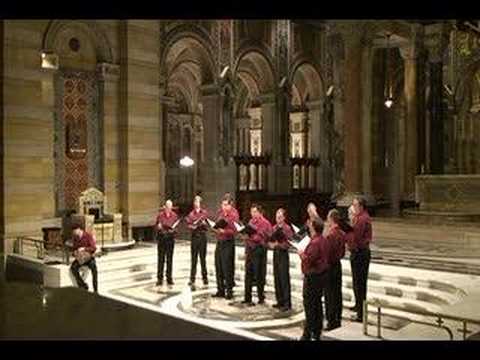
You probably wouldn’t guess it by their name, but the Suspicious Cheese Lords are a vocal group hailing from Washington, DC. Their name derives from the mischievously mistranslated title of a Thomas Tallis motet, “Suscipe quæso Domine,” a work that their website tells us the Cheese Lords have never performed. Suspicious! Considering that the Lords proudly specialize in works, from Gregorian chant through the Renaissance, that have never been recorded before, we cannot know whether these eccentric choristers will ever perform their quasi-namesake motet. Eccentric or not, the Cheese Lords had plenty of church gigs under their belts, participating in services at places as awesome as Washington’s National Cathedral, before they arrived at the Abbey Basilica on the Belmont Abbey College campus for their Sunday afternoon concert.

Those belts were conventional leather rather than thick rope, although the Cheese Lords were the choir-in-residence at DC’s Franciscan Monastery from 1998 to 2006. Attired in dark slacks and burgundy shirts, the Cheese Lords looked rather humdrum compared to their name. Nor were they terribly suspicious – except for their prime spokesperson and leader, Christopher Riggs. After emcee Karen Hite Jacob had just made the blunder of speaking to us via a lectern microphone, rendering her intro almost completely unintelligible, Riggs separated himself from the ensemble and offered greetings, individual intros of his colleagues and, with the assistance of each of the Lords’ four sections, a thorough demonstration of polyphony. Yet his first words to us, “Can you hear me?” must surely have been rhetorical, notwithstanding the fact that he had disdained the microphone. Riggs’ big baritone voice boomed across the hall effortlessly.

What was suspicious, surprising, and sensational was yet to come. Riggs, known as “Lord Taskmaster” at the Cheese Lords website, receded into the ensemble and proceeded to tune and cue the other singers – from the countertenor section. Neither “receded” or even “blended” would be entirely accurate here. As we moved from the demonstration snippet of Giovanni Pierluigi da Palestrina’s “Sicut cervus” (Psalm 42:2) to a full performance of the piece, it became apparent first that Riggs’ singing voice was a gleaming countertenor, as effortless as his speaking voice. More remarkable, as the concert continued, it became obvious that Riggs’ countertenor was a dominant voice. I have no trouble believing Riggs’ website blurb where it claims that Lord Taskmaster’s range extends from bass to countertenor. It’s just hard for me to believe that he isn’t better known.

After the Palestrina, the program took a hairpin turn that I loved – to a living composer’s setting of Psalm 43. Tony Domenick’s “Vindicate Me, O God” not only livened the program with its contrast, it enabled the Cheese Lords to re-emphasize the differences between modern harmony and polyphony. Better yet, the work was the first winner of a compositional prize, contested by composers aged 35 or younger, awarded in 2016. Where the effect of the Palestrina had been somewhat intoxicating, overlapping words blending in a language I don’t speak, the Domenick performance glowed in English with clarity and plainspoken emotion. The Abbey Basilica may be unkind to softspoken people who resort to amplification, but it’s very much like heaven for a choir, uncompromised by dead-end nooks that might muffle the commingling of sound waves.

Unfortunately, the shuttle between ancient and modern compositions wasn’t repeated. Nor was there a return to English, though translations abounded in the eight-page program booklet. The Cheese Lords proceeded to stitch together a “FrankenMass” from sources and parodies spanning five centuries, beginning (chronologically, anyway) with a Gregoria chant by Hermannus Contractus (1013-54) and terminating with a pair of pieces by Elzéar Genet (c1470-1548). Pieces were grouped in the order of the five sections of the ordinary Mass: Kyrie, Gloria, Credo, Sanctus, and Agnus Dei. Most of the sections led off with a piece that was later parodied. Now Riggs was careful to explain that the parodists weren’t at all mocking their sources as Mel Brooks’s Young Frankenstein mocked the Boris Karloff classic. These were simply choral pieces that used earlier pieces as jumping-off points for development and elaboration, so Ludwig Senfl’s “Gloria” from Missa L’Homme armé no more mocked the anonymous 15th century composer of “L’homme armé” than Rachmaninoff mocked Paganini. In between these two pieces, we heard a different repurposing of “L’homme armé” by Robert Morton, who composed an “Il sera pour vu conbatu” overlay for the earlier song.

A bit of convoluted logic justified the inclusion of the unparodied “Kyrie” from an anonymous 13th century Messe de Tournai, and the messy formatting of the printed material, where a lyric might appear four boldfaced headers after a song title was mentioned, had my head spinning a bit. Compounding my confusion, a “Gloria” heading appeared in boldface on the line directly above the two Palestrina pieces where the composer parodied himself with his “Credo” from Missa O admirabile commercium. The music itself soothed my confusion, and a few more of the 10 Lords came forward to personably introduce the pieces. By far the least informative – and most entertaining – of these presentations was Cheese Lords founder and president Clifton “Skip” West III, who gave a lively account of the Tallis-based etymology of the group.

There were interesting wrinkles in the arrangements. The “Kyrie” began with a tenor-countertenor duet, baritone Sargon de Jesus soloed to kick off Senfl’s “Gloria” (where the tenors soon took the lead), and after disappearing behind the far altar before West’s remarks, two basses and a baritone began the “Alma Redemptoris Mater” plainchant from their distant concealment. Reunited, the full ensemble turned in some of their most beautiful work on Jean Mouton’s “Sanctus,” though lyrics were missing from the booklet, which repeated its misleading layout.

Even more delightful was the arrival at the music of Genet and the unexpectedly worldly source of his “Agnus Dei” from Missa Se mieulx ne vient. The first line of the original French rondeau translates as “If it doesn’t get any better, I’m not content with love.” Surprisingly, searches of Spotify and Amazon confirm that recordings of Genet are almost exclusively a Cheese Lords domain: no other full-length CD devoted to Genet is available at either outlet. The Cheese Lords’ 2002 Maestro Di Capella, including the complete Se mieulx mass, has no competition. Now if they had to do it all over again, I suspect they would have recorded the parodied song, as they subsequently did prefacing their recordings of the L’Homme armé, O admirabile commercium, and Alma Redeptoris Mater masses.

Our sampling of the piece confirmed that Genet’s music deserves a full hearing as much as the more frequently recorded Palestrina, Senfl, and Mouton. The warmth of the ensemble in live performance at the Basilica surpassed the engineered recording, where the post-production mix may have enabled Riggs to sound more subdued if no less distinctive. Added to the completed “FrankenMass” was another Genet gem, “Tibi Christe,” a hymn for the feast of St. Michael. The special treat here was the shuttling alternatum style, alternating verses of chant and polyphony. Riggs called our attention to the first of the two polyphonic stanzas, where brave Michael pulverizes the devil. Actually, the live performance far exceeded the recorded version in clarity and excitement, which was held in check until the final stanza on the CD. For the encore, one of the tenors – Kevin Elam, I believe – brought out a tambourine as the Cheese Lords finished with an even more freewheeling Spanish tune, “Rey a Quien Reyes Adoran.” People lined up after the concert for the merch that discreetly appeared on the Basilica’s piano. More gathered around the remarkable Riggs and his cohorts.

Two Pieces by Sasha Janes Highlight Charlotte Ballet’s Innovative Works

Review Dance: Charlotte Ballet’s Innovative Works and Its Tribute to Jean-Pierre Bonnefoux
By Perry Tannenbaum


Twenty years is a long time in the history of a dance troupe – four or more generations for Charlotte Ballet if you calculate how long the typical dancer remains before moving along or retiring. Charlotte Ballet’s artistic director, Jean-Pierre Bonnefoux, is taking the latter route after 20 seasons at the helm, an era during which excellence was admirably sustained while the organization grew in strength, most notably in its facilities and educational programming. So it was appropriate to dedicate the latest iteration of Innovative Works as a special tribute to Bonnefoux, not only because this annual showcase of new, exciting, and intimate works was his brainchild but because its current home has been the Patricia McBride and Jean-Pierre Bonnefoux Center for Dance since 2011. There’s no better place for Charlotte Ballet to celebrate.

When Bonnefoux first divulged his imminent fadeout to emeritus status a couple of years ago, he told me that he wouldn’t be choreographing any new pieces, although some new wrinkles were evident in the million-dollar makeover of his Nutcracker last fall. There were no surprises in the 2017 crop of Innovative pieces. The in-house feel of the programming still remains intact, all of the choreographers hailing from within the Charlotte Ballet orbit without any unexpected debuts.

The program began and ended with pieces by associate artistic director (and resident choreographer) Sasha Janes, whose pieces continue to grow more intriguing every year. In between, there were works by Mark Diamond, director of Charlotte Ballet II, Sarah Hayes Harkins, a longtime principal in the company, and David Ingram, a fondly-remembered alum. Continuing the tradition of recent years, each of these choreographers cut an intro that was projected on the side walls of the McBride-Bonnefoux studio before each dance began. Since Janes’ “Hallejujah” was a reprise from last year, Bonnefoux took the opportunity of subbing for Janes, reflecting back on his Innovative series while introducing a piece that was well worth its revival.

170126-peterzay48-web

Opening the program, Janes’ “Utopia” was a startling piece to come from a man who spent his formative years in Australia, born more than a decade after the songs on his playlist – by The Platters, Link Wray, Patience & Prudence, and The Teddy Bears – found their way to jukeboxes on 45 rpm discs. The Aussie’s erudition with The Platters is particularly impressive in his sardonic look at 1950’s American domesticity, where everything wasn’t the Father Knows Best bliss that Eisenhower voters would have us recall. “No Matter What You Are,” the song that bookends Janes’ piece, isn’t at all among The Platters’ greatest hits. For over a half century, it has been hidden in plain view on the flipside of “Smoke Gets in Your Eyes” – a clever hint that we’re watching the flipside of the Ike Era. With Elizabeth Truell as the Wife and Josh Hall as the Husband, we watch the typical morning scene of seeing the family breadwinner off to work. Only there was some visible desperation from Truell as she clung to her husband, handing him his hat and briefcase, the devoted housewife gone slightly berserk. Hall was visibly impatient and eager to go, irritated with all the affectionate blandishments, but as we adjourned to his office with “The Great Pretender” (The Platters’ breakthrough hit), we could see that the Husband was suffering from frustrations – and neuroses – of his own.

170126-peterzay150-web-1024x774

Enter Jamie Dee Clifton as the Secretary, to the beat – and power chords – of Wray’s “Rumble.” Her attempts at seduction got a far more welcome reception from the Husband, though there were definitely some signs of distress as he absorbed the vamping. Yet with Patience and Prudence’s “Tonight You Belong to Me,” there could be no doubting Secretary’s conquest, though the necking session was interrupted by a phone call from the patiently waiting Wife back home. Truell’s ensuing solo, begun on the couch of her Psychiatrist (Michael Menghini) was the most sensational segment of the suite for me, savagely contrasted with the cuddlesome harmonies of The Teddy Bears’ “To Know Him Is to Love Him.” The frenetic energies that preceded this therapy session came to full boil, overflowing into a primal scream that Truell delivered into the unresponsive shrink’s face (before he presented his bill). As Janes predicted in his intro, the repetition of “No Matter What You Are” and the bizarre morning send-off took on an added level of irony as we saw so much more clearly how the lyrics applied to the married couple’s daily ritual.

fix_1008-5717-web-1024x683

The other works that preceded intermission weren’t as daring, ambitious, or satisfying. Set to a Chopin favorite, Harkins’ “Gemini” never convinced me that we were seeing two aspects of the same individual, and the promised improvisation element eluded me altogether though the performances by Drew Grant and Ben Ingel were certainly intriguing. Part of the problem was the damage that the McBride-Bonnefoux acoustics did to Ingel’s monologue when he ventured into the audience. Not sitting in the center sections, I hardly understood a word. Nor could I tell what it was that Grant replied from the stage or determine whether it echoed what his partner had just spoken. In this one respect, Booth Playhouse, where Innovative was staged 1998-2009, was a better venue, though it was no better for pre-recorded music and less hospitable for lobby receptions. “Ever After” by Diamond was a better showcase for Harkins’ talents as she partnered with Hall in an abstract piece about the transition to afterlife, set to music by J.S. Bach, Ivan Spassov, and Karl Jenkins. Destined to partner in the program finale later in the evening, the Harkins-Hall duo stole most of what was left, in the wake of Rose Nuchims’ lighting design, of the focus that could have gone to the three other couples onstage. Another barrier to full appreciation was the language barrier, Bach’s German and Jenkins’ Latin.

fix_1008-4071-jeff-cravotta-web-1024x682

Following the hypnotic ecstasy of Diamond’s piece, Ingram’s new “Flamouriá” after the break was rousing and refreshing, set to the music of Luigi Boccherini, which deserves to be heard more often. The modern visuals – huge balloons suspended over the action, projections on the rear wall – clashed provocatively with the 18th century score, and a certain amount of sloppiness was built in to the concept. Movement by four couples, led by Alessandra Ball James and James Kopecky, was by the dancers, “curated” by Ingram. This sparked numerous questions as I watched. Like the other works on the program, “Flamouriá” will be danced by multiple sets of dancers as Innovative continues it run through February 18. So, will the movement change to accord with the other set of dancers – and did Ingram allow his performers any latitude, or multiple choices, in their movements? Unfortunately, some of the sloppiness I witnessed was layered on by the new projection technology that was lavished on the piece. Most of the video was blurry and, at times, edges of the projections cut randomly and inelegantly on the rear screen, stealing focus from the dancers. I’d also thought that those massive white balloons might double as projection surfaces – a potential that went unfulfilled. There were some special moments when Nuchims’ lighting was uncluttered by the new gadgetry, most notably when the dancers became silhouettes against the ginormous backlighting of the rear screen.

1454643066_crop

Little needs to be added to the raves I posted at my own website a year ago when Janes’ “Hallelujah” was first unveiled as the penultimate segment of his “Sketches from Grace,” especially since Harkins and Hall danced it last January as well. Okay, maybe not as well as they did this year after living another year with the piece and their dance partnership. The “Sketches,” originally intended by Janes as a tribute to Leonard Cohen, was deflected from its original purpose when the choreographer heard Jeff Buckley’s cover of “Hallelujah” and turned the suite into a Buckley-based sequence. But if Janes had introduced this year’s reprise instead of Bonnefoux, I suspect that he would have mentioned the Canadian troubadour’s death (on the eve of our momentous Election Day). Pared down to the originating essence of  became a fitting tribute to Cohen, with Harkins and Hall sensuously evoking the darkness of his vision through their memorial flame.

An Act of God Ordains Wedolowski as Divine Vessel

Theatre Review: Queen City Theatre An Act of God

By Perry Tannenbaum


promo2_aog

After gracing Broadway’s Studio 54 with his presence in the body of Jim Parsons, God has chosen Duke Energy Theatre at Spirit Square for his newest abode and the body of Queen City Theatre Company’s Kristian Wedolowski as his instrument. As may be divined from the title, An Act Of God, there is no intermission as God gives Charlotte his new Ten Commandments – but flanked by two of his angels, the obsequious Gabriel and the trouble-making Michael, there are occasional interruptions, with faux questions from the audience.

The zenith of David Javerbaum’s career, which took a major upswing during his tenure as head writer and executive producer of The Daily Show (not to mention his participation in Jon Stewart’s knee-slapper textbook, America: A Citizen’s Guide to Democracy Inaction), this script began up in the proverbial cloud as @TheTweetOfGod and coalesced into The Last Testament: A Memoir by God in 2011, four years before Parsons was appointed as his vessel. Not having spoken to us for nearly two millennia, Javerbaum’s God has a lot to get off his chest.

He’s tired of man’s misconceptions about God, tired of our demands upon him, and he’s developed a painful insight: mankind has been fashioned too much in his image, an arrogant, vengeful asshole. Not only has God been thinking about his anger management issues and a reset for the Ten Commandments, he’s contemplating a rollout of Universe 2.0. Steve Jobs seems to be his role model.

Act of God turns out to have two simultaneous organizing principles. While we’re seeing the big reveal (thanks to the multimedia ministrations of Lore Postman Schneider) of the New Ten Commandments, some of which are holdovers from the Original Ten, God is also giving us the lowdown on the early chapters of the Book of Genesis, Adam and Steve through Abraham. Then we’re doing a jump skip to that notorious parenting episode when God allowed his kid to come down here.

picture-aog

We still have to brave Wedolowki’s Uruguayan accent to comprehend the word of God, but he has made large leaps in mastering American cadences, so the wacky incongruity works in his favor after a while. Christopher Jones seems to embody the Serenity Prayer as Gabriel, though we suspect he’s terrified of the boss, and Steven B. Martin as Michael is perpetually flirting with a furlough to the Other Place, sporting the thinnest veneer of obedience.

The show had already taken the Donald aboard when it reopened this past summer on Broadway starring Sean Hayes, but artistic director Glenn Griffin adds new topicality, acknowledging that the bible chronicles “alternative facts” and warning against faith in the Carolina Panthers. He also takes the opportunity to turn his pre-show greetings into an extension of what follows, giving God the benefit of a really big Ed Sullivan-style intro. WFAE radio host Mike Collins is the unseen Voiceover. We only mention that because I haven’t been a guest on Collins’ Charlotte Talks for over a year.

Wacky Magrath Sisters Still Deliver Southern-Fried Hilarity

Theater Review: Charlotte’s Theatre Crimes of the Heart

By Perry Tannenbaum

image1

It’s been a long time – nearly 15 years as far as I can tell – since I’ve spent an evening with Beth Henley’s lovable Mississippi Magrath Sisters. Looking in on them at Theatre Charlotte’s revival of CRIMES OF THE HEART affirms how vividly these deftly differentiated sibs stick in a theatergoer’s memory. First and foremost, you’ll remember kooky Babe, who doubts her own sanity after shooting her husband. Carefree temptress Meg seems to be the enviable paragon, looking down on her sibs as she waltzes back to the home sod with her Left Coast cool, but she’s beginning to doubt her own specialness now that her stab at stardom has come up empty. Lastly, that dear and dutiful doormat, Lenny, with her shriveled ovary and low self-esteem.

If the 1981 Pulitzer Prize winner is beginning to show its age, I couldn’t tell it by the audience reaction at the Queens Road barn. The quirkiness and the comedy still work, but at a distance of 35 years, we can begin to appreciate what made CRIMES OF THE HEART so unique when it burst upon the scene.

Prize-winning plays and novels set in Dixie had invariably been about elegant, decayed, and tragic folk, following the Southern archetypes embraced by William Faulkner, Tennessee Williams, and Harper Lee. Henley showed us once and for all that the eccentricities celebrated in You Can’t Take It With You could play just as well down in Mississippi – even when peppered with dark Arsenic and Old Lace humor.

Yet Henley’s comedy is notably more realistic than Kaufman’s crowdpleaser and both lighter and saner than Arsenic. That’s because the Magrath sisters are quirky rather than balmy – and because no significant antagonist appears onstage. When Cousin Chick drops by to chide or alarm the sisters, she is more of an irritant than an antagonist, her exits usually comical hasty retreats. She’s more like the recurring meanie from a TV sitcom than a force to reckoned with. The only real threat is State Senator Zachery Bottrelle, convalescing offstage somewhere with the bullet hole in his gut that Babe put there.

The Magrath Sisters came equipped with leavening agents that had usually been absent from American comedies: sorrows and regrets. You could easily presume that these were Southern heirlooms from Williams’ iconic dramas, but I wouldn’t dismiss the possibility that this quality in Henley’s heroines may have had its roots in the novels of Jane Austen. Like Gentle Jane, Henley doesn’t presume to show us how men speak to each other when ladies aren’t in the room.

Directing for the first time at Theatre Charlotte, Christian Casper isn’t trying to reimagine our leading characters. Nor is set designer Chris Timmons trying to depict the Hazelhurst, Missisippi, home as any more luxurious or squalid than you might expect. We’re in a bland, slightly cheesy smalltown home, and its only discordant element is the dwarf fridge in the kitchen.

One of the ways that Henley binds her comedy together and makes it memorable is with the pair of ceremonies framing the action in celebration of Lenny’s 30th birthday. As you’ll see in the final moments, budgetary constraints are a bit more exposed than strictly necessary – cakewise and candlewise. But if Casper isn’t sufficiently savvy about the technical strategies to make the final scene truly shine, he certainly doesn’t mess up the opening.

Lenny’s clandestine celebrations get us off to a charming start with Meredith Westbrooks Owen as the pitiful birthday girl, repeatedly hunched over her wee little cupcake, singing to herself. Comedy – and the big news about the crime – burst in with Zendyn Duellman feasting on the role of Chick. Catty, gossipy, and fault-finding don’t completely describe Chick, for she’s also vulgar and trashy, richly deserving the Magraths’ scorn. Picking up a pair of pantyhose that Lenny has obligingly bought for her at the store, Chick begins squirming into them before our very eyes.

Henley meant Chick’s struggles to appear “slightly grotesque” in her stage directions, but Casper has Duellman going way beyond that. Like Lenny, we don’t care whether Chick remembers her cousin’s landmark birthday or not, but the same lapses from her younger sisters clearly hurt. Lenny’s clandestine candle-lighting lingers as an subliminal rebuke, underscoring her siblings’ tendency to be insensitive, neglectful, and self-absorbed. Beyond that, they expect Lenny to perform all the family’s mop-up chores, chiefly the onerous task of caring for bedridden Old Granddaddy.

From the moment that Jennifer Barnette enters as Meg, there are conflicting airs about her of regality and rebelliousness, elegance and uncouth. One minute, she’s lighting up a cigarette to vex Chick, the next she’s disconcerting Lenny by cracking pecans with her shoe. What a fascinating character arc for Barnette as she careens from Coca-Cola and stolen candy crèmes to bourbon and birthday cake. But of course, Barnette’s physical comedy – or even Chick’s, for that matter – will pale in comparison to Babe’s prodigies.

Emily Klingman performed them on opening night with a neurotic edge that eventually won me over. She repeatedly convinces us that Babe is the youngest, most immature person onstage, quite capable of obsessing morbidly over why her mom killed the family cat when she committed suicide. And hey, when a kitchen oven and a chandelier are among your props, you will get laughs.

Self-sacrifice is enough to win our affection for Lenny, but Henley calls upon two good men to help in sealing our fondness for her more self-centered sibs. Allen Eby is Doc Porter, surprisingly mellow for a man whom Meg left drenched and limping after a spectacular breakup during Hurricane Camille. On the other hand, Cole Long as dorky Barnette Lloyd, the legal eagle who is trying to keep Babe out of jail, seems uncannily capable of homing in on his client’s ditzy wavelength.

Moscow Ballet’s “Nutcracker” Brims With Tradition, Grace, and Delight

Review : Great Russian Nutcracker

14-moscow-ballets-sergey-chumakov-and-elena-petrichenko-1

By Perry Tannenbaum

Now in its 24th annual North American tour with traditional Russian favorites, the Moscow Ballet is a massive enterprise to contemplate. Three separate tours are currently crisscrossing the US and Western Canada with their Great Russian Nutcracker. So on December 11, for example, when the Central tour came to Ovens Auditorium in Charlotte, the Eastern tour was in Syracuse, NY, and the Western tour was in Albuquerque, NM. And what about back home? We can’t imagine that the cupboard is bare back in the Motherland, where the puissant Putin rules.

So after seeing the new $1 million Charlotte Ballet remount of Tchaikovsky’s holiday favorite, I was curious to see how the Great Russian would compare – with Moscow’s resources and talent spread so far and wide. The negatives manifested themselves pretty quickly. You can’t replace the curtains with proscenium-spanning art at over 100 theaters when you’re only performing there just once, with few exceptions, and you can’t tour with three symphony orchestras playing the beloved score live.

Nor can you take over 200 schoolchildren on tours that last over a month – 54 days, in the case of the mammoth Western tour. This is where the Great Russian also becomes the friendly Nutcracker, for the Moscow Ballet teamed with Gay Porter’s Charlotte School of Ballet to fill over 70 roles: Party Children, Mice, Snowflakes, Snow Maidens, Snow Sprites, and backup dancers for the Act 2 divertissements by Moscow’s Spanish, Chinese, Russian, and French soloists.

So on any given night, over 200 costumes may be worn by aspiring dancers who hail from the towns where Moscow Ballet performs. Talk about outreach. Over 5,000 young dancers are getting to rehearse, perform, and wear those wondrous costumes in through Moscow’s Dance With Me program. Better than Halloween, as the Donald would say, believe me.

2-moscow-ballet-great-russian-nutcracker-set-designed-by-carl-sprague

The negatives I’ve spoken of soon recede. I didn’t have to send up a flare to alert the people in the soundbooth that the music was turned up too loud, but I did wish it were potted down sooner. When the curtains parted at Ovens, Moscow’s newly revamped scenery, with new designs by Carl Sprague, was definitely in the same class as Charlotte Ballet’s, with a faux proscenium as ornate as the real one I’d seen the previous weekend.

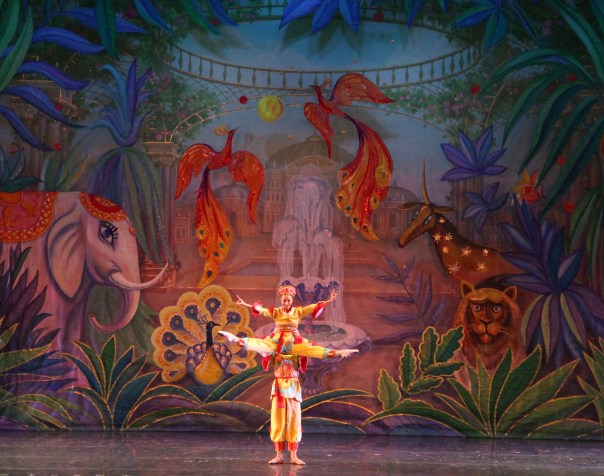
There weren’t as many scene changes as Charlotte Ballet lavishes on their production. The sleigh that carries Masha – better known to us as Clara – to the Land of Peace and Harmony remains earthbound instead of flying, and did the parade of playful 10-foot-high puppets ballyhooed in the program synopsis really escape my notice? Don’t think so. Most of these beasts were depicted on the imposing backdrop in a style vaguely reminiscent of Henri Rousseau.

Other details that distinguished this Nutcracker from those I’m accustomed to did not escape detection. Though there wasn’t liftoff for the sleigh, it was conveyed to Peace and Harmony by “Ded Moroz,” Russia’s Father Christmas, and Snow Maiden “Snegurochka,” both resplendently attired in Carolina – um, cerulean – blue costumes newly designed by Arthur Oliver. Uncle Drosselmeyer was a jovial gift-giving enchanter, still sporting a cape but more like a ringmaster or a game show host. And imagine, the Sugar Plum Fairy and her Cavalier never appear! Instead, it’s Masha and the Nutcracker Prince who dance the grand pas de deux.

21-moscow-ballets-ekaterina-bortiakova-and-akzhol-mussakhanov

After receiving so many gifts, Masha and her Prince present their dance to – the flowers that just waltzed for them? The synopsis is mum on that point, but Ekaterina Bortiakova is pure delight as our heroine, most adorable when does her simple tippy-toe shtick in the “Dance of Sugar Plum Fairy,” as light as the celesta cuing each step. She’s graceful, demure, vivacious, and youthful enough for us to imagine Nutcracker as a coming-of-age story. Andrey Batalov brings star quality of his own to the role of the Prince, definitely a cavalier partner when he sheds his Nutcracker headgear and brocaded waistcoat, most memorable when he whirls around the stage in his uptempo solo.

Choreography by balletmaster Stanislov Vlasov adheres to the manner of Tchaikovsky’s original collaborators, Lev Ivanov and Marius Petipa, most challenging when we arrive at the Act 2 showcases. Casting in these key spots is predictable, since only one pair of partners is listed for each of the divertissements, but most of the major roles we see in Act 1 are double-cast, including Masha and the Nutcracker Prince. Chiefly worthy of mention here were Sergey Dotsenko, a dashing Uncle Drosselmeyer in his florid purple cape, and Meievsky Vsevelod as the furtive and menacing Rat King.

Four of the six couples who partnered in Act 2 etched themselves vividly in my memory. In the snowy transition between the Stahlbaums’ Christmas soiree and Masha’s final destination, Anna Radik and an unmasked Dotsenko were the most sculpturesque of the couples as the Dove of Peace, each one of the silvery dancers bearing one of the bird’s luxuriant 10-foot-wide white wings, another new Oliver design. Perpetually leaning left with index fingers pointing upwards, Kseniia Stukalenko and Vladyslav Stepanov were the most charming and amusing pair as the Chinese Variation.

11-moscow-ballet-chinese-variation-set-design-valentin-federov

Contrasting marvelously – again – with the perky Chinese, Radik and Dotsenko returned as the smoldering Arabian Variation, with Radik executing snaky contortions that were unrivaled by anything else we saw. Clearly this was the most sensuous couple of the afternoon, but Veronika Melnyk and Michail Botoc as the Russian Variation took us to another dimension – sheer athleticism. Botoc, in particular, astonished with a series of leg-split jumps, a string of somersaults that spanned half the stage, and various gymnastic moves, effectively stealing the latter moments of the show. He even persisted during the curtain calls, unfurling the famed Cossack Kazatsky squat dance, more than sufficient reason why Putin wishes to recover the Ukraine.

The couple sitting next to my wife and me have a daughter who will be dancing with this tour when it arrives in Detroit. They came to Charlotte because one of their kin was a Charlotte School of Ballet student in a similar role at this performance. I could see that they had no regrets at all about making the trip to see a Mouse. Very likely, they and their daughter view the Great Russian Nutcracker as the experience of a lifetime. From the ovation and the swells of applause that spontaneously broke out all over Ovens during curtain calls, it was obvious that hundreds of non-relatives felt the same

Less Bard and More Beer

Theater Reviews: Every Christmas Story Ever Told (and then some!) and The Great American Trailer Park Christmas Musical

everyxmasstoryphoto2

By Perry Tannenbaum

Four centuries after William Shakespeare’s death, Charlotte’s own Chickspeare inhabits a parallel universe. Or maybe it’s retribution: while all of the Bard’s works were performed by all-male theatre troupes, all of Chickspeare’s productions since 1998 have been “All women! All the time!” as originally promised. The “All Shakespeare” in the middle of that slogan was gradually blurred and dropped as the Chix added Reduced Shakespeare Company lampoons to their rep and then ventured father afield.

Written by Michael Carleton, James FitzGerald, and John K. Alvarez, Every Christmas Story Ever Told (and then some!) is very much in the spirit of Reduced Shakespeare’s original assault on the Elizabethan titan’s complete works. The parentheses in the title, the quickie romp through multiple classics by three actors playing multiple roles, and the devotion of all of Act 2 to a single extravagant lampoon all follow the Reduced template.

But gender only begins to describe the difference between Chickspeare’s version and the 2010 Actor’s Theatre Every Christmas. The new model is as much an event as it is a theatre production, an experience that begins and ends at the newer NoDa Brewery on N. Tryon Street. In between, there are a couple of shuttle bus rides back and forth from the original Brewery location on N. Davidson Street. You’ll find more brew choices on tap at North Tryon, but the enticement of lifting a mug and participating in the many “To beer!” toasts during the Chix performance at North Davidson is hard to resist.

Few did last Friday night. Besides the brewskis, we had Anne Lambert lubricating the experience with a steady feed of Christmas trivia challenges on the bus ride to the show and the conviviality of the Chix banditas – Sheila Snow Proctor, Lane Morris, and Tanya McClellan – during their performance. But mainly, it was the beer that induced the party atmosphere.

Directing the show, Joanna Gerdy and Andrea King had a healthy disregard for the script. The playwrights labored under a handicap that never afflicted the Reduced Shakespeare collaborators when they chose ancient targets like Hamlet, the Bible, and American history for their merry desecrations. Unlike your seasonal carols, most of our familiar Christmas stories aren’t free-range prey. Copyright law prevents satiric assaults upon Rudolph the Red-Nosed Reindeer, the Charlie Brown Christmas, and the Yuletide yarns of Truman Capote, Dylan Thomas, and Jean Sheperd.

When Carleton, FitzGerald, and Alvarez lashed out at these restrictions, the result was “Gustav, the Green-Nosed Rain-Goat,” not the funniest sketch you’ll ever see. Morris never plays the mutated venison as if it were comedy gold, so there’s never any deadly straining to make it funnier than it is. We’ll raise a glass, and then we’ll move on.

The premise of the show is that Proctor wishes to proceed traditionally with a presentation of Dickens’ A Christmas Carol, but Morris and McClellan are sick and tired of the same old stuff. Before they’ll allow Snow to read her Dickens and play her Scrooge, she must join them in a medley of other Christmas faves, including Frosty the Snowman, Macy’s Thanksgiving Parade, the Grinch, O’Henry’s “The Gift of the Magi,” and – maybe if there’s enough time – the inevitable It’s a Wonderful Life.

scrooge-and-mary2

There isn’t enough time, but that doesn’t deter Morris. While Proctor is on-task as Scrooge, with McClellan visiting her as all three ghosts, Morris keeps insisting that Proctor is George Bailey, inflicting on us a bevy of characters from New Bedford Falls, including George’s guardian angel, his brother, his banker nemesis, and his adoring wife. By the time Lane reaches the wife, it comes off oddly like a female impersonation.

Fortunately, Proctor is the ideal Scrooge in the face of these torments. There’s a bit of Oliver Hardy and Bud Abbott in her forbearance, but we somehow remain on her side throughout her ordeal. At the climax of Christmas Carol, Morris is still bedeviling her, so she finally submits to becoming George Bailey – in a schizophrenic frenzy that finds her shuttling between Scrooge and Bailey as both McClellan and Morris assail her.

In her surrender, Proctor produces a Jimmy Stewart impersonation that’s barely good enough to let you know what she’s doing. It will probably improve during the next couple of weekends as the run continues, but I’m not sure it should. Likewise, Proctor can be a mite slow changing costumes, but McClellan’s patience with her cast mate is so priceless, it would hardly pay for Proctor to hurry.

It’s been a rocky road for Actor’s Theatre of Charlotte since developers forced them out of their longtime home on Stonewall Street last summer. We thought they would resurface on Louise Avenue, but negotiations there collapsed, and the company tacked toward Freedom Drive. City and county paperwork delayed the opening, so their Toxic Avenger was redirected to a nearby church, and the current Great American Trailer Park Christmas Musical has been rerouted to the Patricia McBride and Jean-Pierre Bonnefoux Center for Dance, Charlotte Ballet’s HQ on N. Tryon Street.

I was curious to see how director Chip Decker and his design team would adapt to studios with so much space and such a high ceiling. With two fair-sized ramshackle trailers, topped by two jumbo projection screens, height isn’t a problem, and the design team fills out the stage with a fence, some Florida flamingo kitsch, an incongruous array of Star Wars memorabilia and, dead center of the stage between the two trailers, a half-decorated Christmas tree.

That odd tree, straddling the borderline between Rufus and Darleen’s properties, triggers Betsy Kelso’s plotline. Rufus loves Christmas and adores Darleen, but mean Darleen snarls “Bah” and “Humbug” to both. She will not decorate her trailer or even allow Rufus onto her property to decorate her side of the tree. That’s a source of huge consternation to Betty, the manager of Armadillo Acres, who has always wanted – but failed – to win the big prize awarded to the best-decorated trailer park. A vague curse plagues Armadillo Acres, and it too will to be exorcised before we reach a happy ending.

There’s a certain amount of respectability in Betty, so we’re fortunate that it is more than counterbalanced by the trashiness of her other tenants, Pickles and Lin (short for Linoleum). They also come in handy when ghosts are needed to populate Darleen’s Dickensian dream sequence. Rufus’s romantic fantasies and Betty’s hopes of nabbing top kitsch honors are revived when Darleen, in an effort to pull the plug on the park’s Christmas lights, gets electrocuted by Rufus’s déclassé cable-splitter and wakens with amnesia. That enables her to forget what a Scrooge she is and the fact that she belongs to Jackie, owner of a slutty pancake joint.

If you missed the first and second comings of this trashy romp, it’s good for you to know all the basics I’ve detailed. Although Actor’s Theatre has done well with the Charlotte Ballet space, they have thoroughly failed to conquer its acoustics. So the songs and lyrics by David Nehls are more crucial to your enjoyment than usual – but often unintelligible over the four-piece band led by music director Brad Fugate.

Tommy Foster isn’t as rednecky as Ryan Stamey was as Rufus, but he’s a tad more pathetic and lovable. Karen Christensen is more than sufficiently bitchy as Darleen, and we often forget that Matt Kenyon is in drag as Lin. (So does he, I suspect.) But Jon Parker Douglas nearly steals the show as Jackie when he is possessed during the climactic exorcism. It’s an epileptic farting fantasia that isn’t quickly forgotten – and the kind of broad physical comedy this acoustically-challenged show desperately needs.