Corey Mitchell Fine-tunes a Kook’s Southern Drawl

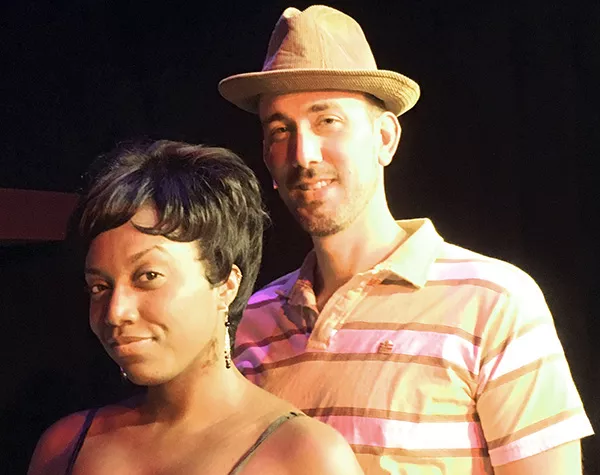
In Corey Mitchell’s production of 'Memphis the Musical,' Joe McCourt (right) plays Huey Calhoun, and Dani Burke Huey’s love interest Felicia Farrell.

Preview: Memphis The Musical

By Perry Tannenbaum

You can see Huey Calhoun as a scavenger, a conman, and an illiterate hick. Or you can see him as a rock ‘n’ roll visionary, a natural salesman, and a quirky promotional genius. However you see Huey, in Memphis the Musical at Theatre Charlotte starting this Friday, you will not find him dull. Based loosely on the career of Memphis radio jock Dewey Phillips, the story by Joe DiPetro may remind you of Hairspray, another musical that took us back to the early days of rock and tensions between the races.

Taking us to the innards of radio as well as TV, Memphis gets us closer to the true heart of rock. South of the Mason-Dixon line, there’s more bigotry from whites — and more wariness from blacks — when Huey not only promotes African American music on the middle of the AM dial, but also romances a black singer.

Without the comical cross-dressing, cartoonish bigots, and outrageous promotional stunts incorporated into Hairspray, the terrain of Memphis will be more difficult to navigate. So it’s exciting to learn that Tony Award winner Corey Mitchell will be directing, Joe McCourt will be starring as Huey, and Dani Burke will be sparking Huey’s passions as femme fatale Felicia Farrell.

Burke has been sensational in her two previous mainstage appearances at the Queens Road barn, first with her lead vocal on “Aquarius” in the 2014 production of Hair and again last year singing “Disco Inferno” in Saturday Night Fever. Since his Theatre Charlotte debut as the star of Godspell in 2008, McCourt has shown us astonishing range, from Roger Davis of Rent to the porn-addicted Trekkie Monster of Avenue Q to low-self-esteem finalist Leaf Coneybear in The 25th Annual Putnam County Spelling Bee.

After singing telegrams on land and entertaining on cruise ships at sea, Mitchell came to Charlotte in 2001 by way of Wilmington — and its Opera House Theatre Company — to make his sensational local debut as Hysterium in the Theatre Charlotte production of A Funny Thing Happened to Me on the Way to the Forum. Since then, Mitchell has directed or acted in productions at Theatre Charlotte, Davidson Community Players, CPCC, and Actor’s Theatre of Charlotte.

What makes Mitchell such a key part of the Charlotte scene is his teaching and directing in the theatre program at Northwest School of the Arts. And don’t think his special Tony Award for Theatre Education was a bolt out of the blue. Aside from a CL Theatre Award, Mitchell has snagged honors from the Metrolina Theatre Association, the North Carolina Theatre Conference, the Educational Theatre Association, the International Thespian Festival, and National Youth Theatre. Productions directed by Mitchell have garnered at least a dozen Blumey Awards — with seven more nominations still in play for the 2017 ceremonies at Belk Theater on May 21.

You could say he’s connected in the community. It would have been hard for anybody who has performed extensively in Charlotte to catch Mitchell off-guard at auditions when he cast Memphis. He has worked with Burke before in Davidson and is quite familiar McCourt’s work. Tyler Smith, who plays Felicia’s protective brother Delray, is coming off a powerful performance as Coalhouse Walker, fueling CP’s production of Ragtime.

“The three of them bring so much presence and power to the stage,” Mitchell says. “Joe’s work is incredible. The biggest challenge has been just the herculean task Joe has to take on each evening. Huey is in every single scene in this show.”

Surprisingly, Mitchell doesn’t take the view that Memphis is about race, mixed couples, or even the title city.

“I decided to treat the relationship between Huey and Felicia on the micro level of how this man loves this woman,” Mitchell explains. “While Huey has an absolute obsession with black music, he certainly doesn’t fetishize black women in general. He is specifically in love with this woman — and despite her best efforts not to be, Felicia is love with this man. She is, however, a realist.”

Huey was an eccentric goofball when Chad Kimball played him in the original Broadway production, slinking back and forth across the stage, seemingly unable to take two consecutive steps in the same direction. He wasn’t Gomer Pyle, but Huey was very Southern, perhaps in a way that New Yorkers could look down on from afar.

“Trying to portray his unique persona was challenging,” McCourt admits. “We decided to tame the over-exaggerated drawl of Chad Kimball’s original Broadway take so that he doesn’t appear too cartoonish but still hold on to his kooky side. It has been hard finding a balance between too much and not enough [drawl] while trying hard not to insult the Southern accent itself!”

Dani Burke as Felicia Farrell and Joe McCourt as Huey Calhoun.

A new worry materializes when you make the illiterate Huey smarter and more cunning in Charlotte than he was on Broadway. Hopefully, the micro lens that Mitchell wants to apply to Huey and Felicia is helping McCourt to skirt the impression that he is slyly exploiting her commercial potential.

“Huey is a born salesman and smart for being uneducated,” says McCourt. “I don’t see him as a con artist nor cunning. He’s naive to a fault, a free spirit that knows what he wants. Music moved him; so it was no surprise that he fell for Felicia, who not only inspired him musically but also opened his heart to new possibilities. He simply lacked the emotional intelligence and social skills to handle those feelings. I’m walking a fine line trying to make sure he doesn’t come across the wrong way.”

And Mitchell, for all his accolades, is giving McCourt free rein. They’re definitely on the same page when it comes to portraying Southerners.

“I want to strike a balance with him — and the rest of the cast, for that matter — to be Southern without being a caricature,” Mitchell says. “Too often, I see Southern people portrayed onstage as rubes. Joe is an impeccable actor and a professional in the best sense of the word. I try to give him room to play and explore and then nuance in those areas that seem to need a little tweaking.”

Ultimately, the issue that drives a wedge between Huey and Felicia isn’t race or prejudice. It’s an issue that our most gifted theatre artists constantly wrestle with: should I build on what I’ve done here in my hometown, or should I set out for a bigger market in the hopes of greater opportunities and nationwide renown? McCourt senses that Memphis brings Huey a feeling of comfort and security, that he also fears the unknown.

He can identify with the dilemma.

“For me personally,” he says, “I took that leap and moved from a small town south of Buffalo and headed to NYC many years ago for the possibility of making it ‘big.’ Although young and bold, looking back, I was also afraid of failure, which held me back from pursuing many things there. I’m at a different stage in my life now. So building upon what I’ve done here in Charlotte has been very fulfilling. A realtor by day, a performer by night, and a father and husband in between!”

Mitchell is far from cooped-up in Charlotte since his Tony triumph. He has delivered keynote addresses at theatre conferences across the Southeast and traveled to Dubai as a Varkey Teacher Ambassador. Purple Dreams, a documentary about Mitchell’s 2013 production of The Color Purple at Northwest, was released on April 7 to considerable publicity and acclaim.

So it’s likely we’ll be seeing more from both Mitchell and McCourt in Charlotte for years to come. Their best work may still lie ahead.

Opera Carolina – and Six International Collaborators – Present a Top-Drawer La Fanciulla del West

Review: Charlotte Opera The Girl of the Golden West

By Perry Tannenbaum

When Opera Carolina general director and principal conductor James Meena walked out onto the Belk Theater stage to introduce the Charlotte premiere of Puccini’s La Fanciulla del West, he was appropriately sporting a black Western-style Stetson. That hat nearly grew old before our eyes as Meena delivered his curtain speech, for he had so much more to say than usual – even when he’s enumerating the generous sponsors of a production and capping off a season by announcing next year’s lineup. Not only was the New York City Opera a collaborator on this production (as they were for last season’s American premiere of Rachmaninoff’s Aleko), so were five new co-producing companies from Italy, including Teatro del Giglio in Lucca, Puccini’s hometown.

That was just the first leg of the extras from Meena. One of the sponsors, Wells Fargo, is actually represented in the opera – and in the David Belasco melodrama, The Girl of the Golden West, from which Puccini took his storyline – by Ashby, the Wells Fargo agent on the trail of Dick Johnson, our hero. So the storied San Francisco company has contributed some memorabilia to the design of this production, dating back to its iconic stagecoach days during the California Gold Rush. Finally, if there were some in the audience who weren’t already aware of it, tenor Marcello Giordani, who was about to sing the role of Johnson (alias the outlaw Ramerrez), has brought his international vocal competition to Charlotte. The four sessions of preliminary rounds, semifinals, and finals are interlaced with the three performances of La Fanciulla at Belk Theater. All in all, quite a week for Meena and Opera Carolina.

Although Sheriff Jack Rance broods among the miners at the Polka Saloon in the opening moments, impatiently awaiting the arrival of Minnie, La Fanciulla doesn’t zero in on its core story and characters as efficiently as Puccini’s Tosca, Butterfly, and Bohème. That’s not a problem if you have strong singers in the secondary roles carrying the early action. Most of the singers in minor roles gave first-rate performances. Jeff McEvoy as camp minstrel Jake Wallace gave a fine account of the homesick “Che faranno I vecchi miei” aria, justifiably launching an empathetic men’s chorus after him. Baritone Giovanni Guagliardo was such a powerful presence onstage that you could think he was one of the leading players until he was identified as Sonora, and bass-baritone Dan Boye slid ably from bravado to pathos as Sid when the card dealer was caught cheating. But all of the aspirants to Minnie’s regard didn’t sound as formidable as Sonora, and tenor Gianluca Bocchino was shockingly underpowered when he appeared as Nick, the Polka’s sly barkeep. Bocchino must have been pretty alarmed himself, for he sang much more effectively later on.

The poignant homesickness of the minstrel and the collection Sonora takes up on behalf of the disillusioned miner are well worth keeping in mind when Minnie pleads for Johnson’s life in Act 3. Similarly, the miners’ rage against Sid’s duplicity – and Rance’s authoritative intervention on behalf of the cardsharper, meting out punishment that is less than a noose – also foreshadows what we’ll see from them after intermission. While the overall design is artful, there was a welcome intensification of the drama when Minnie, Johnson, and the outlaw’s chief pursuer, Agent Ashby, showed up. As Sheriff Rance, baritone Aleksey Bogdanov is a powerful, menacing presence – Scarpia-like in his driving urges, with feelings and morals layered on. But until he was alone with Minnie, past the midpoint of Act 1, Rance could not reveal his soul. Singing the “Minnie, dalla mia casa son partito” aria, Bogdanov showed it to us, a wisp of tenderness mixed into his gruffness. Although they don’t come into play nearly as dramatically, Ashby also seems to have feelings for Minnie, and baritone Jason McKinney has a powerful presence that matches up well with the other lawman.

Stage director and production designer Ivan Stefanutti has responded well to the demands of this drama in casting and directing these two imposing baritones, but there is an extra measure of flamboyance to this pioneering spaghetti Western. Set in the foothills of the mighty Sierra Mountains, this Western emphatically separates itself from the Cactus League of the genre by including a massive blizzard at the climax of Act 2. So the men don’t merely sport boots, buckskins, vests, and a panoply of brimmed and furry hats. They also wear a variety of coats. In a wonderful array of costumes – including a turquoise suit for Rance – Steffanuti has gone with fur coats for both Rance and Johnson. Ashby’s rakish raincoat, on the other hand, is worthy of the Flying Dutchman.

Maybe a couple of words should be said about the projections designed by Op Carolina’s Michael Baumgarten. Setting the scene in the Sierras, the animated views of the mountain are tastefully dark and monochromatic, maybe a little too aggressively varied for their purpose. The animated backdrops, when the Polka interior becomes established, also changed a little too busily for my taste, but the emphasis on the Ramerrez wanted poster pointed up a prime advantage of animation. One second, the poster can be many times lifesize; the next moment, it can diminish to insignificance. In Act 2, as we reached the pivotal poker game between Minnie and Rance – with Ramerrez’s life as the stakes – the backdrop filled with supersized playing cards. But do they really need to crazily flip around like we’re in a living slot machine? Again the background changes at Minnie’s cabin were too busy, at one point seeming to suggest that Minnie lives inside a tree, and later implying that either Ramerrez’s gang or the Sheriff’s posse was outside guarding the cabin. Mercifully, Baumgarten was more restrained in Act 3, and the dawn of Ramerrez’s redemption came with more subtlety.

Giordani measures up well physically against his imposing antagonists, but the tenor has a noticeably gentler demeanor as Johnson, more convincing as an ardent lover than as a cunning and ruthless bandit on the run. Since he’s tracked down, shot, and strung up, banditry wasn’t a particularly strong aptitude for Ramerrez, so a name change followed by a career change would be sensible directions that he could see for himself in Act 2. Puccini’s music certainly pulls Johnson toward romance, redemption, and domesticity, and Giordani responds best in the heartfelt “Io non ti lascio più” duet in Act 2, before his past dalliances with a certain Nina are confirmed. Listening to Giordani deliver the “Ch’ella mi creda” in Act 3 when the jig is up, I really did feel like this was a penitent and reformed Ramerrez.

Making her Opera Carolina debut, soprano Kristin Sampson brings a stocky presence to Minnie that seemed, upon a few minutes of reflection, to be as right as Ethel Merman singing the gun-toting Annie Oakley. While I’d be leery of seeing Sampson as the fragile Mimi in Bohème, there was Tosca-like power for her to work with here as she made her dynamic entrance with a good-sized firearm holstered on her hip. She decisively resisted Rance and did not melt easily when Johnson started wooing, so her half of the Act 2 love duet came with a delicious onrush of amorous passion we hadn’t heard before. Yet she far surpassed herself in Act 3, pleading for Ramerrez’s life – one miner at a time – in Minnie’s “Non vi fu mai chi disse ‘Basta!’” The plaint built powerfully in its conviction, and as the miners gradually joined in, became a chorus of communal forgiveness and kindness that I found unexpectedly moving. Never having seen La Fanciulla performed live before, I hoped I’d be seeing a first-rate production of second-rate Puccini. Leaving Belk Theater, I had the distinct feeling that this opera deserves top-drawer status. I suspect many other longtime Opera Carolina subscribers felt the same.

With a Gifted Cabaret Cast, Gardner Triumphs in His Davidson College Farewell

Review: Cabaret

By Perry Tannenbaum

Few musicals are more fascinating, malleable, or ominous than John Kander and Fred Ebb’s tuneful Cabaret with its masterful book by Joe Masteroff, currently being produced by Davidson College Theatre Department. Lingering despair and defeat, holdovers from World War I, hover over Berlin and Germany as we make our first visit to the decadent Kit Kat Klub. In the opening “Wilkommen,” the emcee assures us that this is a place of forgetting. But the more we get to know Berlin, largely through the eyes of aspiring American novelist Clifford Bradshaw, we realize that what’s forgotten – escaped and avoided, really – are the present and the future, as the teetering Weimar Republic becomes forgotten in the wave of insanity and horror that will be Nazi Germany. “Tomorrow Belongs to Me,” sing the waiters and Nazi youth, not really grasping what Adolph Hitler is or the havoc he will wreak.

Yet of course, the followers of the Hitler cult are the least sympathetic of the victims here, though the fate of these dupes is suddenly more relevant after America’s disastrous 2016 election. So many of the characters drawn from the 1939 Berlin Stories of Christopher Isherwood – and altered or added to by Masteroff – charm us, tug at our sympathies, or gradually fuel our disgust and outrage. And so many are fated to be pitiful victims. Nearly all of those we care about most enjoy the intensifying benefits of Kander and Ebb’s chameleonic songwriting. In his valedictory effort after 43 distinguished years in the Davidson College Theatre Department, director Joe Gardner had plenty to sift through. Not only are Cliff, the Emcee, and Kit Kat chanteuse Sally Bowles all engaging creations, they’ve all undergone significant changes since the original 1966 Broadway premiere. Most notably, there was the all-about-Sally film version in 1972, which added two showstoppers for Liza Minnelli, “Mein Herr” and “Maybe This Time.” Alterations in the 1998 and 2014 Broadway revivals starring Alan Cumming as the Emcee were nearly as extensive. Now the Emcee, as a homosexual, emerged fully as a victim of the oncoming regime at the end of the show. Along the way, one of the backups for the Emcee’s risqué “Two Ladies” was changed from a Kit Kat Girl to Bobby, and Cliff became more overtly bisexual. As for Sally, the blithe Londoner became more neurotic, something of a cokehead.

Gardner’s mix-and-match version of Cabaret seems to be mostly retro, stripping the Minnelli showstoppers from the songlist and reverting to two female backups on “Two Ladies.” Cliff gave me the impression that he wished to keep his past homoerotic liaisons in Paris behind him, resisting his opportunities to cheat on Sally after she moved in with him. Where Gardner surprised me most, however, was on the emphasis this production put on the story outside the Kit Kat Klub at Fräulein Schneider’s boarding home. The doomed relationship between the warm and welcoming Schneider and her shy admirer, Jewish fruit seller Herr Schultz, figured to be an inevitable weak spot for a college production. But Theo Ebarb managed to look remarkably middle-aged for a college junior as Schultz, not at all ethnically inappropriate, and junior Hannah Thigpen, though not as convincingly transformed by wig and makeup designer Clara Abernathy, was the best actress on the Duke Family Performance Hall stage on opening night.

Schneider doesn’t have the best songs for her solos, but Abernathy made a very dignified case for “What Would You Do” late in Act II when she called off her engagement to Schultz, and she nearly resuscitated the moribund “So What?” when we first met her. In between, her duets with Ebarb were both charming, a blushing humor gently squeezed from the “Pineapple Song” and a folksy German flavor infused into the waltzing “Married.” Suddenly, I could realize that Schneider was every bit as important as Sally in the original 1966 concept until we reached the title song, the most decisive closure in the story. That outcome was far from inevitable when I first beheld sophomore Ashley Behnke and her bare-shouldered pizzazz in Sally’s “Don’t Tell Mama.” A little of that aura wore off when she and her mink coat invaded Cliff’s apartment and Sally became the seductive femme fatale. There were breaks in concentration in Sally’s serene “Perfectly Marvelous” duet with Cliff, and I didn’t always hear Behnke’s words clearly, spoken or sung. Vocally, Behnke was stronger and more consistent in the climactic “Cabaret,” but just a little bit lost: I didn’t sense a firm grasp of who Sally was behind that song – or a clear take on the dramatic decisions she had just made.

Both of the male leads astonished me. With an amazingly smooth and polished voice, only slightly strained at the top of his range, junior Spencer Ballantyne was delightfully befuddled and principled as Cliff, making a perfectly marvelous impression in his only solo, “Don’t Go.” But the show was dominated in numerous ways by senior Robert Kopf as the Emcee, nearly flawless in his cynicism, his swagger, and his corruption. More than anyone else, the Emcee personifies the “end of the world” about which Cliff will eventually write. But in this production, Kopf had other assignments. From the time the show began, it was primarily Kopf who bridged the gap between the audience and the Duke stage, frequently walking across the ramps that crossed the orchestra pit toward us and inviting intimacy in a hall that normally feels remote from the stage action.

There are also two stairways in Anita J. Tripathi’s set design, one winding up to the occasional perch for a couple of musicians and the other leading straight up to an overpass with a guardrail. On or behind these steps, Kopf will often lurk sardonically as action outside the Klub unfolds – or he might appear even more ominously prowling across the overpass, one of lighting designer Greg Thorn’s spotlights reserved especially for him. Vocally, Kopf is most naughty when he sings “Two Ladies,” most roguish when he sings “Wilkommen,” and most devastating when he delivers the anti-Semitic freight of “If You Could See Her.” Yet Kopf’s stage presence is so powerful that his most chilling moments might have come when he didn’t say or sing a word, dropping the fateful brick into Schultz’s shop or making his final exit.

Technical polish was never a worry. Except for a bump here or a ring there, the sound system at the Duke was completely tamed, and while the orchestra could have been reined in at times to let lyrics through, Jacque Culpepper’s musical direction was outstanding. Tempos for the singers and musicians were never compromised. Once Gardner and his cast had jumped the hurdle of making the oldsters and their swastika-crossed love believable, Cabaret could be quite compellingly viewed with untinted glasses. With all the Hitler Youth undertones already in the script, the collegians I saw in Davidson often became an asset I’d never anticipated. Maybe senior Dakota Morlan needed more mileage on her for the whorish Fräulein Kost, or maybe not; and maybe the urbane Ernst Ludwig was more chilling when he revealed his Nazi armband because sophomore Jacob Haythorn was playing him. In some ways, the horror was enlarged.

Two Takes on Gay Pride, 50 Years Apart

Preview: The Pride

By Perry Tannenbaum

Whether it’s Moises Kaufman’s Gross Indecency, chronicling the downfall of Oscar Wilde, or Martin Sherman’s Bent, depicting gays imprisoned by Nazi Germany at the Dachau death camp, compelling dramas written during the past 25 years have repeatedly reminded us how far gay rights have progressed. Yet progress can be precarious. Within the last year, we’ve seen the passage of HB2 locally and the imposition of Stalag Trump nationally: relapses and backlashes are still very possible.
Besides the occasional wave of reactionary politics and demagoguery, we must acknowledge that there’s more to quality of life — gay or straight, First World or Third — than laws and rights. That’s a key reason why Alexi Kaye Campbell’s Olivier Award-winning drama, The Pride, promises to be so fascinating in its Charlotte premiere this week at Spirit Square.

Campbell compares 1958 with 2008 by placing the same three people in both eras — not 50 years older in the new millennium but, by some freak of reincarnation or misaligned parallel universes, the exact same people of the exact same ages. Of course, their identical essences are shaped by their upbringings and the times they’re living in. So outwardly, vocationally and temperamentally, we will see that the Oliver, Philip and Sylvia of 1958 are different from those we’re reacquainted with in 2008.

Costume changes and music cues will keep us from falling off the merry-go-round as we circle back and forth between the two eras.

“With the first shift to 2008,” says Queen City Theatre Company artistic director Glenn Griffin, “it might be a little jarring for the audience to fully understand that we have shifted to a different time plane, but after the first few minutes it becomes completely understandable. How the characters dress in 1958 and again in 2008 is also incredibly different. I have worked extremely hard with the cast on body language of both decades, and how society norms would influence how they would do everyday actions from sitting, talking, acting, etc.”

Philip is a real estate agent in 1958, married to Sylvia, an illustrator who brings Oliver into the picture when they collaborate on a children’s book he has written. To Philip, Oliver’s advances are a mortal threat: yielding to them risks everything. Jump to 2008 and Philip is a photographer who has already committed himself to Oliver, who is now a journalist. Entering such relationships is no longer an existential threat — but that is the problem.

Enough of a problem to scrutinize the presumed benefits of social progress. “In 50 years,” Griffin notes, “so much has changed, but is it all for the better?” Maybe not.

“In 1958, it was illegal to be gay, which put a huge barrier up when it came to relationships in general,” he continues. “In 2008, it is not illegal, but technology and sexual freedom have also put a large barrier up when it comes to close relationships. With different phone apps, it is so easy to find a sexual partner 50 feet away from you, hook up with them, have sex, and then they will leave. There is so much freedom now, which is great, but it’s getting in the way of human connections, the real type, the one that lasts.”

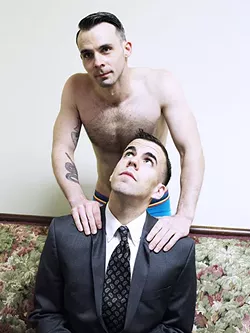
Buchanan and Collins.

Bringing anguish to poor Philip at 50-year intervals, Oliver is likely the most fascinating creation in Campbell’s drama. After a hiatus of just over eight years, Steve Buchanan is returning to Queen City Theatre Company — and Duke Energy Theater — to slip into Oliver’s skin (or skins). In the space of a couple of months before leaving for New York in 2009, Buchanan ranged from Jason at Queen City, the hunky quarry of Valmont’s seductive powers in Dangerous (an all-male update of Les Liaisons Dangereuses), to Riff, the leader of the Jets in Davidson Community Players’ West Side Story.

Buchanan finds elements of both those diverse roles as he prepares for The Pride: the self-assured Riff inside 1958 Oliver and the wild, free attitude of Jason in the 2008 edition. Though he’s not at all uncomfortable with his sexuality and questioning of the convention of monogamy, Buchanan admits that being two different people in the same skin, interacting with the same pair of people 50 years apart, was difficult at first.

It had to be. Imagine walking into a bare rehearsal space and trying to create slightly different selves, from scene to scene, in two different stories — even though you’re performing with the same people in the same clothes with the same fictitious names in both stories.

“As I progressed thru the script and exploring with Glenn in various ways, I came to terms with exactly who I want Oliver to be,” Buchanan says. “It’s definitely been a struggle at times to nail down certain reactions to very similar circumstances. Glenn has been an excellent guide. We have explored the two worlds by watching documentaries, photos — even 1958 gay pornography — and he shared his own research and knowledge making this show come to life for us.”

Griffin didn’t see either the original 2009 London version of The Pride or the 2010 off-Broadway import directed by Joe Mantello for the Manhattan Theatre Club, and as a director, he prefers it that way, trusting completely to his informed imagination. Getting 1958 right was Griffin’s primary challenge, but he also devoted time to 2008, and in directing the show, he had to give equal emphasis to both eras. Eventually, he decided the best way for his actors to look at themselves and their stories was through the lens of reincarnation.

“How often have these same three characters been meeting, interacting, falling in and out of love until they can finally get it right?” Griffin asks. “All three want the same thing in both decades. Sylvia wants to be a wife and mother, be loved, but have a satisfying career in the arts. Oliver wants to find love with Philip, but can’t get beyond anonymous sex. Philip, on the other hand, wants to love Oliver, but can’t get past what society is telling him about this same-sex relationship.”

Parallels and differences, parallels and differences. They swirl around in this play, and they swirl around us. Beyond Trump and HB2, which might seem to change the conversation, Griffin notices that in Chechnya today, they’re entrapping gays in very much the same way they did in the U.K. after WW2.

Amid such uncomfortable echoes, the contemplation of transmigrating souls — and what they want — may be soothing. Buchanan is striving to convey sweet coherence in the face of historical and societal flux.

“There is a stark difference in 1958 and 2008 Oliver as it pertains to his social lives,” Buchanan says of the journey. “His ride feels very much like a wave. Ups and downs, calm to belligerent. Playing Oliver is one of the greatest challenges I’ve undertaken and I’m very proud of my work. I really hope you can see Oliver as a soul longing for love and acceptance. As a soul who is vulnerable and just the right kind of crazy.”

“Wuthering Heights” Dances Madly to the End of Love

Review: Wuthering Heights

By Perry Tannenbaum

In the epigraph to his new ballet, choreographer Sasha Janes spread out one of Emily Brontë’s most lurid quotes over a full page in the program booklet for Charlotte Ballet’s production of Wuthering Heights. Contemplating her love for the elegant Edgar Linton and the mysterious Heathcliff, Catherine Linton likens her love for Edgar to the leaves of a forest, decorous and mutable, while her love for Heathcliff resembles the rocks below – short on delight, but necessary and eternal.

“I am Heathcliff!” Catherine famously tells Nelly Dean, the narrator of the novel.

Janes was not merely going to tell the story of Wuthering Heights, he was signaling that he would be trying to replicate its towering emotions, manias, and passions.

Incredibly, he largely succeeds.

It helps, of course, that the technical team behind him get the atmospherics right, most notably the lighting and projection designs by Christopher Ash and the costumes by Jennifer Janes. The Janeses are obviously on the same page conceptually, for the costumes designed for Catherine and Heathcliff are folksy and flowing, while the Lintons and Earnshaws tend toward genteel formality, starchiness, and pastels. Choreography magnifies those contrasts, controlled and elegant at Catherine’s wedding to Edgar, wild and athletic in her youthful frolics with Heathcliff.

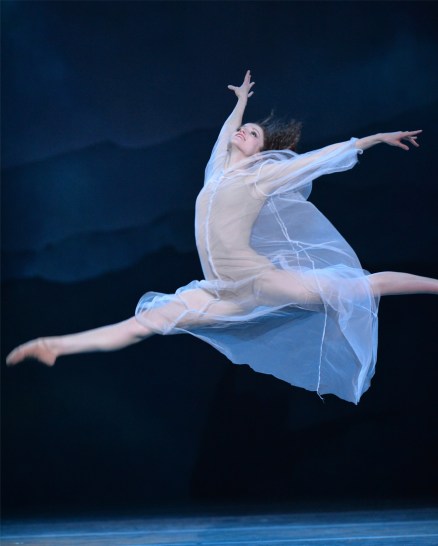
Charlotte Ballet_Sasha Janes Wuthering Heights_Josh Hall and Chelsea Dumas_1_photo by Christopher Record

As the plot thickens and the protagonists mature, the pas de deuxs between Catherine and Heathcliff become darker and more sensual – and the costumes more diaphanous and scanty. Even uncannier than his choreography, the rightness of Janes’s musical choices assures that you can hardly tear your attention away from the dancers until the overwhelming final scene.

With his dark curly hair and his robust, muscular torso, Josh Hall (alternating with Ben Ingel) was the perfect blend of savagery and beauty as Heathcliff on opening night. After the intermission interval, Hall carried off Heathcliff’s astounding transformation from unrefined rusticity to steely, seething gentility marvelously well, and his partnering in the unique final pas de deux was both powerful and heartbreaking.

Working opposite the power and virility of Hall, Chelsea Dumas very likely convinced a hefty chunk of the opening night crowd that Catherine was the role in Wuthering Heights. Hers were the moves that gave the pas de deuxs with Heathcliff their wildness. Hers were the anguish and madness when the transformed Heathcliff married her sister-in-law Isabella, avenging himself for her betrayal of their love. Through it all, she stands up for Heathcliff against her abusive brother Hindley and her jealous husband Edgar.

Charlotte Ballet_Sasha Janes Wuthering Heights_ Chelsea Dumas_photo by Peter Zay

Both Janes and Dumas seemed to grasp that Brontë thought of Catherine as a woman whose fierce spirit and vitality were too much for her frail frame – particularly when pregnancy and parturition were added to her stresses. In the novel, Catherine’s death is a halfway mark, where our attentions begin to shift to a new generation after a raging, grieving Heathcliff curses his beloved and calls upon her spirit to haunt him the rest of his days.

Following the lead of the 1939 film, starring Laurence Olivier and Merle Oberon, Janes makes Catherine’s death his denouement. Yet cursing and conjuring aren’t things that ballet does well. So Janes elaborates brilliantly on Heathcliff’s graveside vigil: here Hall clawed at the still fresh mound of dirt over Catherine’s body and actually pulled Dumas out of her grave. Then he danced a pas de deux with Dumas’ lifeless body, lifting and carrying her all over the stage, pouring out his love, his rage, and his grief.

Dumas remained inert as the music and the passion swelled, coming back to life for just a few precious moments, her second death intensifying Hall’s anguish and devastation. Tears flowed freely throughout Knight Theater.

Action before intermission, though clearly distinguishing the protagonists from the others, wasn’t always as brilliant. Janes tells the story well in theatrical vignettes, but there needed to be more real dancing from the supporting players. There could be more ensemble work when Catherine and Heathcliff first spy on the Lintons. By the time we do reach the outbreak of dance at the Catherine-Edgar wedding, it feels overdue and overlong.

Drew Grant as foster brother Hindley and James Kopecky as Edgar had unique dancing spots, Grant in a high-stakes card game with Heathcliff and Kopecky vying with Heathcliff for Catherine’s affections. Other supporting players – most notably Mark Diamond as Heathcliff’s foster father and Sarah Hayes Harkins as his wife Isabella – further demonstrated the depth of the Charlotte Ballet company with their exemplary dramatic work.

Though a final tribute to Jean-Pierre Bonnefoux has been hurriedly arranged for next month, Wuthering Heights was to be the last program in Bonnefoux’s 21-year tenure as Charlotte Ballet’s artistic director. Fittingly enough, the last ballet commissioned for the company under Bonnefoux’s leadership was paired with the first new work commissioned during Bonnefoux’s years, Alonzo King’s MAP, premiered when the company was still known as North Carolina Dance Theatre.

Bridging 1996-2017, the two works were a handsome frame for an impressive artistic director, president, and choreographer. Bonnefoux strengthened a company that was already excellent and made it more prominent in the city’s life. With its powerhouse educational and apprentice programs, Charlotte Ballet now plays a more important role in the city’s future. My turn to lead the cheers, Jean-Pierre. Bravo!

Anat Cohen Brings Her Magic to College

2017~Anat Cohen @ Davidson-36

Review: Anat Cohen and the Davidson College Jazz Ensemble

By Perry Tannenbaum

We’ve known for a long time that Anat Cohen can electrify audiences whenever she picks up her clarinet and plays. After her recent residency at Davidson College, we can now proclaim that she has a similar effect on jazz students – and faculty. At the public concert that concluded the residency, Professor Bill Lawing, after leading the Davidson College Jazz Ensemble behind Cohen, struggled to find sufficiently effusive words to describe what she had achieved in a few short days.

To adequately measure it, Lawing said, we would need to have heard what his band had sounded like when they began rehearsals.

The concert itself followed an arc similar to the one hinted at by Lawing, with some fairly radical advances along the way as the band’s confidence grew and their soloists had more space to shine. Before Cohen made her entrance, the Jazz Ensemble made theirs with an arrangement of Slide Hampton’s “Go East, Young Man” where scanty spots were doled out for pianist Tyler Holman and guitarist Matthew Bell to play on. Even when Cohen appeared with her clarinet, the impulse to showcase band members continued in the first two arrangements by Oded Lev-Ari.

Anat’s solos were both cool and hot on Ernesto Lacuona’s “La comparsa” in between Ensemble interludes. Then Cohen picked up the tenor sax that was pre-set at centerstage near her mic and played a bunch of solos on Johnny Griffin’s “Do It” that never quite gathered momentum, as the collegians’ intervening solos swept from one side of the five-person sax section to the other.

It was a good time for Cohen and the band to get more relaxed as she spoke briefly about working with the students earlier in the week and tested our familiarity with Julie London by way of moving on to Lev-Ari’s arrangement of “Cry Me a River.” Returning to clarinet, Anat gave us our first really deep swig of her soulfulness in a chart that confined the Ensemble to taking the first half of the bridge – both during the first pass through the melody and during the clarinetist’s solo. She opened up even more compellingly with a cadenza to cap off the out chorus.

2017~Anat Cohen @ Davidson-12

By some sort of alchemy, the band became more articulate in their soloing after Cohen told the story about how she and her combo were jamming one night on Luiz Bonfá’s “Samba de Orfeo” and found themselves playing Satchmo’s vintage “Struttin’ With Some Barbecue.” Referring to the Lev-Ari medley that resulted, Anat said, “So we decided to make it official.” Perhaps the spontaneity crept into the band by osmosis through Cohen’s anecdote, but as we went into intermission, the band finally seemed to be enjoying the jolt of playing with their celebrated new mentor.

It seemed cruel to pare the Ensemble down to combo size at the moment that everyone was rounding into top form, but there was a density to the arrangements of Ellington’s “The Mooche” and Cohen’s “Tfila” that lifted the concert to a higher, tighter level. On Cohen’s arrangement of Duke’s composition, we finally heard Anat’s full magic on clarinet for the first time. “Tfila” was by far the superior foray by Cohen onto her tenor sax with a couple of nice spots by Ken Lee, switching here from alto to soprano. There was a distinctive part written for trumpet embedded in the out chorus after Cohen’s sublime solo and a superb coda for trumpet and a pair of saxes.

A new infusion of jubilation spread through the hall as the remainder of the Ensemble returned, mainly to add muscle to the backup as Cohen dominated the soloing more completely. In her spoken intro, she promised to combine the traditional “Tiger Rag” with some Israeli falafel, and there were indeed some klezmer flavorings in the prelude before Cohen and the band launched into the tune with its lusty trombone glisses. Dylan Hyman on baritone and Lee, back on alto, had some nice moments here.

Cohen saved her most stunning trad explorations for last. Though she shot encouraging looks to the band and even praised bassist Tom Champion for mastering the difficulties of the bass-line and keeping it in three, Cohen herself owned Fats Waller’s “Jitterbug Waltz” and took it to exultant new places. Anybody who had come doubting Cohen’s power was likely converted by her amazing work here, but she had one last marvel to reveal.

Invoking the names of arranger Tommy Newsom, diva Billie Holiday, and King of Swing Benny Goodman in her remarks, Cohen softly wriggled into an epic arrangement of “What a Little Moonlight Can Do” over the drums and then Holman’s spare piano. The intensity of Anat’s playing seemed to draw the rest of the band into the accompaniment magnetically, and the energy of the band seemed to spark a quicker tempo from the soloist, along with an onrush of inspiration and virtuosity. Softer, louder, and softer again, Cohen wailed on until the band mostly peeled away so she could blaze through a final cadenza. It felt like everyone had stopped to watch something primal and sacred. Everyone except Anat, of course: standing, crouching, and writhing at the vortex of it all.

Trumpet and Organ Summits Top Jazz Week at Savannah Music Festival

Review:  Savannah Music Festival

By Perry Tannenbaum

Jazz is always prominent when the Savannah Music Festival cranks up its eclectic springtime assortment of classical, country, Americana, rock, folk, and world music vibes. But diehard jazz fans will want to land at the festival during Jazz Week, culminating in the epic Swing Central Finale celebration and concert at Lucas Theatre of the Arts. Before the top three ensembles lead off the festivities, 12 high school bands play for a panel of jazz notables, once at the Lucas and once along the Savannah riverfront.

Workshops and clinics make Swing Central as much an educational experience as a competitive one. In the second half of the Finale, the awesome array of mentoring musicians gets to come out – after the winners’ placings are announced and the supersized checks presented – and strut their stuff. With the likes of Marcus Roberts, Ted Nash, Terrell Stafford, Stephen Riley, Ron Westray, Jason Marsalis, and Marcus Printup in their number, you can bet it’s a glorious march.

Celebrating the centenaries of both Thelonious Monk and Dizzy Gillespie, Swing Central 2017 was particularly splendid.

Until that culmination happened, the Charles H. Morris Center was the workhorse venue for jazz concerts. On successive nights, SMF executive and artistic director Rob Gibson pleasurably introduced a pair of organ and trumpet aces. Ike Stubblefield and Joey DeFrancesco presided over the rare sight of two vintage Hammond B-3 organs on the same stage. Next night, on the eve of the Swing Central Finale, Rodney Whitaker and MSU Professors of Jazz showcased the estimable Etienne Charles blowing his horn after Printup teamed up with a quintet of Youngbloods.
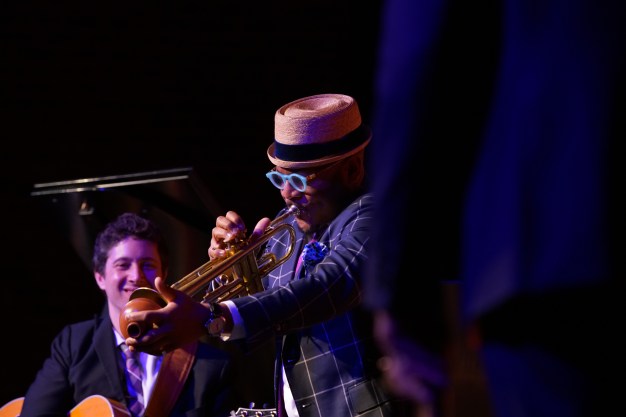
Festivalgoers could choose between pairs of sets beginning at 5:30 or 8:30. If you missed the back-to-back organists at night, you could partially atone with a set by the Ike Stubblefield Trio the following afternoon at 12:30, while Printup & Youngbloods did the afternoon honors the following day. With a little creativity – and a media pass – I was able to negotiate a 6pm classical piano recital on organ night, stop out for dinner, and arrive at the Morris Center just before intermission so I could scope out empty seats for my wife Sue and me when Joey DeFrancisco took over the stage.

DeFrancesco isn’t a shy or contemplative personality, and I first heard how he wails in live performance shortly after his first Columbia recording, at the tender age of 17, in 1989. So I thought I knew what to expect from him and The People who back him up. But Joey has piled an electronic keyboard on top of his B-3 console, and he brings a trumpet with him these days when he comes onstage.

A new electronic bent manifested itself immediately in DeFrancesco’s percolating intro to “So Near, So Far,” nodding to the middle acoustic and later electronic periods of Miles Davis at the same time. Yet that track remains fairly mellow on the new Project Freedom recording, while here Troy Roberts signaled on tenor sax that it was time to fasten our seatbelts as he finished playing the line. DeFrancesco turned up the heat to a temperature that surpassed the studio version, and Troy kept the flame high – while Joey and drummer Jason Brown became very busy underneath. For anybody who might be sleeping on Roberts: he is not your generic sideman, and both of his most recent recordings as a leader are well worth checking out. Dan Wilson was also a treat on guitar taking his choruses, never distorting his silky tone, and Roberts roughened his outro with a pedal I hadn’t noticed on the floor near his mic.

There was no reprise of the floor pedal as the quartet reverted to the trad grooves usually heard at the Morris. “Bluz ‘n’ 3” brought to mind the funky flavoring Cannonball Adderley brought to hard bop when Bobby Timmons played with him – except on the opening solo when Wilson’s crystalline work on guitar conjured up Kenny Burrell. Roberts took us into rough turbulence with his solo, though there was a calm eye to the storm at its center where he quoted Monk. DeFrancesco seemed to relish the challenge of following in the wake of this bravura, prudently dialing back the intensity as he began. As he reached what seemed to be full throttle, Joey snuck in a sustained bass chord to play over, so he could take his two-fisted attack to an even greater sizzle. Brown quieted things down at the start of his solo, ably shuttling from sticks to brushes in the ebb and flow of his solo.

Compared to this eruption, the next two selections were relatively light – but with plenty of fresh colors. “Better Than Yesterday,” another track from the new CD, also shed its studio mellowness, taking on a “Parisian Thoroughfare” élan in live performance with more rim work from Brown at the kit, more intense crosstalk between Joey and Troy, and more quirky rhythms all around. Then a DeFrancesco spot like none I’d seen live before: he sang “Around the World” in a surprisingly effective hipster style and, after the choruses by Wilson and Roberts, returned with a trumpet solo, the first half of which he played with a mute. Not content with these novelties, Joey D traded fours with Troy, firing scat lines on all his vocal salvos.

As caught in the studio, the intro and outro of the righteous “Lift Every Voice and Sing” caught in the studio were very much like what we heard live, with Wilson and Roberts splitting the opening chorus. Roberts and Brown added a little extra lift to the release into the solos and there was more real blowing in the middle. Toward the end, just before the last gospel explosion, Wilson drew a little more space to clear the way with an unaccompanied rumination. Enough funk was added to the live version of “Karma” for DeFrancesco to solicit audience hand claps behind his own solo and those by Wilson and Roberts.

We seemed to be building to a predictable finale, but DeFrancesco surprised us by calling Ike Stubblefield back onto the stage to join in on the second B-3. Two organ giants then paid tribute to a third as the ensemble dug into Jimmy Smith’s “The Sermon.” Things became loose and joyous like a jam session when Stubblefield’s drummer, Herlin Riley, slid into Brown’s chair midway through the tune. Yet there was additional polish to the backup behind Ike as Joey picked up his trumpet for a second time and formed a horn section with Roberts, playing harmonized riffs.

A longtime sideman who has gigged with storied rock and R&B bands, Stubblefield is equally comfortable in backup or take-charge modes. Like the earth before an earthquake, he is always there, with no compelling need for finger-busting displays, but always capable of them. In his afternoon gig at the Morris, Ike broke loose most memorably on Richard “Groove” Holmes’s “Groove’s Groove,” a tune very much in the vein of “The Sermon” with perhaps a little more hop in its step. First his guitarist, Detroit Brooks, worked the tune from a relaxed groove to such a lather that, for the one time in the entire set, he felt compelled to stand up while he played. Stubblefield also stirred the line upwards from a simmer, until he was wailing, clawing at the sky before an abrupt halt giving way to Riley.

Like Holmes and Jimmy Smith, Stubblefield has a winning way with pop tunes whose tempos might seem set in stone. Back in 2011, he put some extra jump in “Misty,” as Holmes was fond of doing, but this time he took on Little Willie John’s “Fever,” which has resisted loudness, speed, and even instrumentation since Peggy Lee waxed her chart-topping cover in 1959. After Ike grooved on it, Detroit showed there’s plenty to be done with this line at a peppy pace. Then Ike proved there’s joy at the very heart of it.

Excitement always peaks for the second set on Thursday night of Jazz Week, because the house is filled to overflowing with an influx of Swing Central high schoolers – most of them enthusiastic jazz fans – on the eve of their final competition. With two sextets crammed with instruments you actually find teens playing (no B-3’s here), the festival was definitely keeping their audience in mind. Featuring arrangements with heads that always blended two or three horns, Marcus Printup & Youngbloods served up music the young crowd could identify with.

“Peace in the Abstract” kicked off jubilantly, featuring entirely different personnel behind Printup from those behind him in his 2006 CD with that same title. Nor were there any holdovers from Printup’s 2015 Young Bloods recording on Steeplechase. The group label lingers, but the personnel move on, a la Blakey and the Jazz Messengers. Printup roared into his opening solo as if this were the first time he was playing on this tune, and young trombonist Corey Wilcox brought equal fire to his follow-up. Alto saxophonist Mercedes Beckman dialed it back a little before rapidly ramping up, but pianist Michael King aimed unerringly for a change of pace, almost Monkish in his initial relaxation. Yet drummer Henry Conerway III implacably picked up the intensity underneath King’s action, and the pianist’s solo soon swelled to rhapsodic density. This in turn was a perfect launching pad for Conerway’s pyrotechnics.

“Soul Vamp” was another trip back to 2006, but Printup gave the catchy tune a choppier, more energetic arrangement and added some vocal call-and-response to the out chorus. I was beginning to wonder whether the leader would be promoting his newer work when the next two selections, Printup’s own “The Bishop” and Dave Brubeck’s “In Your Own Sweet Way,” were plucked from the Young Bloods disc. Of all the tunes on this set, “The Bishop” probably showed off the whole group best, with Beckman blowing her finest solo and King unveiling a tasty Basie quality, again acting as a mellowing agent. Yet King was most distinctive, pointedly not Brubeck, in his freaky solo on “Your Own Sweet Way.”

With the finale, “The New Boogaloo,” the tune became something of a family heirloom as Wilcox had one more chance to shine in taking the first solo after the three-horn head. Wilcox’s father, Wycliffe Gordon, was the trombone sideman on the 2002 CD that was named after this Printup composition. Hidden in plain view for the last two years among the Swing Central mentors, Wilcox announced he was a force to contend with at the 2016 latenight jam, dueling with his dad and other greats. He’s be at Dizzy’s Club Coca-Cola for a five-night stint – also latenight – on April 18-22 if you care to judge for yourself.

Printup and Beckham would follow the same basic path as the 2002 arrangement, soloing over a shuffle pattern laid down by Conerway until he provided a stop-time break for them to blow on. It was Wilcox – with King’s spikier accompaniment – who actually cooked up something new for “New Boogaloo.” After the horns, King took a modest but tasty solo, revving up his momentum with the first stop-time break and yielding gracefully on the second to bassist Eric Wheeler, who knew exactly what to do. Wheeler got into such a compelling groove that the audience spontaneously joined in clapping it out.

I loved the way that Rodney Whitaker and his drummer, Dana Hall, casually took the stage for the MSU Professors set, jamming quietly together as if they were doing a soundcheck. Before we knew it, Etienne Charles and tenor saxophonist Diego Rivera were in place, wailing out the melody of “In Walked Bud.” Twenty-four hours ahead of schedule, the Monk celebration had begun with an all-Thelonious songlist.

Unlike most of the Monk selections announced for the following evening, none of these were rarities, and all of Whitaker’s colleagues proved to be able professors of the repertoire. Randy Napoleon broke out on “Bud” with the first solo on guitar, pianist Bruce Barth demonstrated that the line could turn in a barrelhouse direction, and Hall returned with a series of explosions from the drum set before the horns took the out chorus.

Charles was no doubt the most powerful of the frontliners, but he didn’t really start firing off his arsenal until the ensuing “Monk’s Dream.” Rivera charged hard in his solo, but Charles’s had more arc and build, ending with an elegant handover to Napoleon. Solos by Whitaker and Hall established a similar mold, regularly marking each measure – until Hall broke that mold, mixing things up and splattering them like a textbook Max Roach fireworks display.

You couldn’t ignore Charles on the final three tunes, each of his stints halved in a different way. Quieting things down after a Rivera roar on “Evidence,” Charles meandered softly for a while before abruptly turning up the burners. On “Ask Me Now,” he took two pieces of the opening chorus, one muted after Rivera kicked things off and another wide open after Barth handled the bridge. Not only did Charles play quite tenderly in his solo, but Rivera also proved to have an affecting soft side to complement his hard-charging mode – underscored later when he delivered a mellow coda.

The two sides of Charles in the closing “Blue Monk” were both irresistibly ebullient as the trumpet ace started off with a mute plunger, expostulating the line in tandem with Rivera. Napoleon delivered his most burning work of the set and Rivera reverted to his leonine mode before Charles cooled the bluesy blowing down, fanning the low flame with his plunger. The plunger work became progressively louder and more playful until the time was ripe to Charles to discard the rubber and go all-exclamatory in Dizzy Gillespie style.

MSU’s rhythm section was a constant delight. Barth was the most chameleonic among them, channeling Dave McKenna in “Bud,” Thelonious in “Monk’s Dream,” and Horace Silver in “Evidence” before coolly quoting a mess of Monk in the bluesy closer. Aside from their stellar work on “Monk’s Dream,” Whitaker and Hall asserted themselves most memorably on their intros, whether it was Hall clunking on wood blocks leading us into “Evidence” or Whitaker misdirecting us at the top of “Blue Monk,” invoking the familiar bass-line of “A Love Supreme.”

Nothing was routine or hackneyed about the big band performances by Swing Central finalists Byron Center Jazz Orchestra (Byron Center, MI), Agoura High School (Agoura Hills, CA), and Douglas Anderson School of the Arts (Jacksonville, FL) – not when the titles included “Easy Money,” “Buddha,” and the winning Douglas Anderson’s “At the House, In Da Pocket” by Jason Marsalis. So I didn’t grow impatient for the all-star team to take the stage after the winners’ checks were distributed. The playing was consistently precocious and the vibe at Lucas Theatre, with so many young musicians and their families in attendance, was special.

The Monk-Diz centennial celebration lifted the evening even higher. Music directors Marcus Roberts and Ted Nash, both of whom with longtime links to Wynton Marsalis and Jazz at Lincoln Center, split emceeing chores while their set list took a singular approach to each of the honorees. Long acknowledged as a bandleader, showman, and innovative instrumentalist, Gillespie hasn’t gotten nearly as much recognition as a composer. So it’s altogether fitting that the Jazz at Lincoln Center Orchestra is taking a compendium of Diz’s greatest hits on the road and making the case at selected concerts.

On the other hand, albums by younger artists devoted completely to Monk’s works are not so hard to find. It makes sense, then, to reprise Monk pieces we hear too rarely or to unearth new gems – expanding our appreciation of his compositional range. While shuttling between familiar and unfamiliar tunes, we also zigzagged between big band charts and tight combo presentations, always with plenty of space for band members to blow.

Signaling that this would all be fun, the band started out with Diz’s “Oop Bop Sh’ Bam,” a pretty grand display of the composer’s exuberance and the musicians’ firepower. You couldn’t say it was the full orchestra because there were two rhythm sections, starting out with pianist Bill Peterson, bassist Whitaker, and drummer Bryan. When we shifted to small combo mode for Gillespie’s “Groovin’ High,” the Marcus Roberts Trio took over the rhythm, Rodney Jordon on bass and Jason Marsalis on drums, while David L. Harris on trombone, Ricardo Pascal on tenor, and Terrell Stafford on trumpet stepped forward to form an impromptu horn section. With the flare and assurance of his solo, Stafford gave us our first indication that he would be the designated stand-in for Diz on this night.

Nash returned, alto in hand, with trumpeter Alphonso Horne and the Peterson rhythm to do “Con Alma.” From this third iconic Diz title, we switched to lesser-known Monk and big band format as the Roberts Trio took its first turn with the full ensemble on “Blues Five Spot.” While it isn’t Monk’s most familiar work, “Five Spot” is obviously a Roberts fave, since he has now played it three years in a row in Savannah. The piece certainly distills Monk’s essence and lent itself to nice round of blowing, with Roberts, Stafford, and trombonist Ron Westray standing out.

Roberts and his rhythm stayed aboard for the next two Monk morsels, “Coming on the Hudson” and the delicious “Little Rootie Tootie.” Two of my favorite Gillespie compositions followed as we reverted to combo format: “Manteca,” the fine co-composition with Chano Pozo, and “Woody ‘n’ You.” As Peterson returned to the keyboard, Marsalis switched to vibes on “Manteca,” making for an interesting new palette when altoist Joe Goldberg and trumpeter Jim Ketch came down to join them. Perhaps because the Cuban percussion and vocal shouts were missing from “Manteca,” I was more pleased when Wilcox, trumpeter Randall Haywood, and tenorist Stephen Riley lit into “Woody ‘n’ You.”

They found two more opportunities to put four rhythm players onstage at the same time, featuring both of the bassists on Monk’s “Light Blue” and fielding Marsalis on vibes once more for “Ugly Beauty,” a pretty ballad that served nicely to clear the way for a rousing finish. That one-two-three punch began with “Two Bass Hit,” Gillespie’s collaboration with John Lewis, with Printup and his plunger mute making a punchy cameo.

Monk’s “We See,” and “A Night in Tunisia,” Diz’s most familiar piece, closed things out. “Tunisia” was particularly potent on this night. One by one, the solos poured forth from the band members, a effervescent anthology of bebop. Surprisingly, we were able to scale one more pinnacle. After all the glorious blowing, after the whole band had repeated the anthemic theme, Stafford launched into a lonely cadenza, working it until he ended on a long, jubilant high note that could make a grown man weep.

It was emblematic of all that jazz can say and do.

Art and Business Clash in “Ma Rainey’s Black Bottom”

Review: Ma Rainey’s Black Bottom

By Perry Tannenbaum

Few playwrights, black or white, would write a line so richly laden with poignancy as “Somewhere the moon has fallen through a window and broken into thirty pieces of silver” only to bury it in the silent text of his prologue. Just to ensure that such a line would be spoken out loud, Tennessee Williams would have temporarily deputized one of his characters as his mouthpiece so that this line would have a life in our ears.

Yet somehow, the “Somewhere” line dropped into the intro of Ma Rainey’s Black Bottom perfectly describes the setting of August Wilson’s 1984 drama. Ma Rainey, her entourage, and her jazz quartet gather at a one o’clock rendezvous with Ma’s nervous manager, Irwin, and record studio boss Sturdyvant. While Irwin is careful not to rouse Ma’s mighty temperament and ego, Sturdyvant’s regard for Ma extends no further than to the pieces of silver her recordings can stream into his coffers.

So I can think of a personal as well as an artistic reason why Wilson elected to inter his telling line. A man who conceives of a ten-play series of plays that will chronicle the history of his people through every decade of the 20th century probably wouldn’t preserve, shepherd, and showcase a 30-pieces line like that with the same urgent care that we might. Or frankly, surveying the crew he assembles for this 1927 studio session, Wilson could have soberly concluded that none of these folk, black or white, had the discernment or eloquence to deliver such a lyrical line.

What comes out of Ma’s mouth is almost always salty, bitter, and infused with rage, while her nephew Sylvester, a stutterer, struggles to say anything at all – even as Ma, laying on more pressure, insists that he deliver the spoken intro to her “Black Bottom” recording. These are the two people who present the most daunting challenges for the whites in the recording studio.

But as the split layout of the Pease Auditorium stage faithfully discloses in Jennifer O‘Kelly’s shambling set design, this CPCC Theatre production of Ma Rainey is very much an upstairs-downstairs story. We spend as much time downstairs in the musicians’ rehearsal room – Cutler on trombone, Toledo on piano, Slow Drag on bass, and Levee on trumpet – and the latter half of the tragic denouement unfolds there.

Needless to say, there is as much tension downstairs between the musicians as there is between Ma, the truculent Sturdyvant, and the ever-appeasing Irvin. Cutler seems to run the show downstairs from a business standpoint, accountable for getting the band to show up on time, distributing the pay, and counting out the downbeats. Levee is the young buck with the big ideas, confident that his arrangements of Ma’s tunes will be preferred to her own, and planning to sign on independently with Sturdyvant so he can record his own songs with his own band.

Although the inevitability of a clash between Ma and Levee isn’t exactly trumpeted when we first meet them, it is deep-set into the structure of the script. Both Ma and Levee arrive significantly later to the gig than Sturdyvant or Cutler expect – though Ma’s arrival is later, louder, and more tumultuous. So the outcome of these prima donnas’ collision is also fairly predictable.

Since at least 1998, Corlis Hayes has been involved in several August Wilson plays around town, including The Piano Lesson, Joe Turner’s Come and Gone, and Fences as both a player and a director. Although line problems cropped up occasionally in the rehearsal room, lengthening the production to a running time of nearly 2:20 plus intermission, Hayes directs with a sure feel for Ma Rainey’s moody, spasmodic pacing, and Tony Wright’s fight choreography aptly points up the climaxes.

Jonavan Adams first teamed up with Hayes in 2008, when I felt that The Piano Lesson should have been more forte. As Levee, there are welcome times when Adams goes fortissimo on us, particularly in his mighty monologues and crises. Yet there are still a few moments when we’re getting to know Levee that Hayes should whisking Adams downstage so that we can hear him better and other moments that Adams zips through unclearly. More forgivable toward the end are the moments when Levee is desperately talking to himself.

Clearly, this is a man who is haunted by his childhood and partially imprisoned by it – very emblematic of his people.

Pitted against Adams as Ma is Shar Marlin, who made her first splash on the local scene six years ago as the matriarch in George C. Wolfe’s “Last Mama-on-the-Couch Play” and hasn’t looked back. With both Bessie Smith and Zora Neale Hurston’s Blues Speak Woman in her rearview mirror, Marlin takes on another outsized personality with perfect aplomb. Called upon to sing Rainey’s signature blues, Marlin delivers ornery volume laced with gutsy growls. And believe me, the force of her first entrance is worth waiting for.

With trombonist Tyrone Jefferson tackling the roles of Cutler and this production’s musical director, the jazz behind Rainey – and behind the scenes downstairs – has a unique authenticity. When Cutler gives his oft-repeated “One… Two…You know what to do” cue, three musicians respond from somewhere offstage while he himself delivers the trombone fills. Jefferson, the arranger and musical director behind numerous recent productions, proves to be quite capable as an actor.

Gagan Hunter turns pianist Toledo into a slightly starchy back-porch philosopher, which seems about right, and soft-spoken Willie Stratford – who really needs to be brought downstage – brings an abundance of cool to Slow Drag. In real life, Ma Rainey was indeed the Mother of the Blues, and there was also a notable New Orleans bassist named Slow Drag Pavageau who got his nickname from his dancing prowess.

The white folk are both exploiters, but it’s Tom Scott as Sturdyvant who is far and away the more cruel and noxious. His presence is so toxic that we can easily forget the looming clash between Ma and Levee. Scott always seems to be close to boiling over when he considers Ma’s sense of majesty and entitlement. Hank West as Irvin is the conciliator, but just when he verges on becoming sympathetic, a thin steely mean streak appears in a very nuanced portrayal.

No such subtlety beclouds Carol J. McKIenith’s wantonness as Dussie Mae, Ma’s companion. But there’s an interesting combination of meekness and determination, pride and shame, in Danius Jones’s portrayal of the stuttering Sylvester that makes him unexpectedly rewarding.

In another burst of unheard poetry, Wilson quotes blues great Blind Lemon Jefferson in his epigraph. Because “they tore the railroad down,” sings Jefferson, “the Sunshine Special can’t run.” Confronting this catastrophe, Jefferson plans to “build me a railroad of my own.” Ma and Levee have the same yearnings deep in their bones, to break away and blaze their own musical trails. But it’s still 1927, the traditional tracks are still sturdy, and their people don’t own them.

“Stupid F@#%ing Bird” Mashes Chekhov With Giddy Modernism

Review: Stupid F@#%ing Bird

By Perry Tannenbaum

If you’re looking for clear outspoken themes and messages onstage, there are better places to look than the aching comedies of Anton Chekhov. Among his contemporaries, Count Leo Tolstoy found the best works of Chekhov difficult to grasp yet full of insights into “the inner workings of the human soul.” Chekhov’s mix of clinical objectivity and soul-searching empathy would become touchstones of modern drama and modern acting technique.

So it’s no surprise that Aaron Posner’s adaptation of Chekhov’s The Seagull, irreverently retitled Stupid F@#%ing Bird, is so willfully modernistic. Conrad Arkadina, nee Konstantine Gavrolovich Trepleff in the original, doesn’t merely write the bad script we see performed early in Act 1. He’s also the author of this play that we’re watching and will pause to tell us about it from time to time. But that doesn’t mean his mom, film producer Emma Arkadina, or his Uncle Eugene – a dying doctor – won’t also address us and lay bare their ostensibly fictional souls.

We can almost go around the complete cast in this Actor’s Theatre of Charlotte production simply by cataloguing their unrequited loves. Mash, who is madly in love with Conrad, is desperately beloved by Dev. But Conrad burns for the beautiful Nina, who offers body and soul to the famous writer Trigorin, who is in a committed relationship with Emma – until he isn’t. Passion for other people or for art is the essence of futility among this crowd, often leading to self-loathing. Even Trigorin, slightly weary with his own fame, has restless longings that go unfulfilled.

If you already know The Seagull well, the idea of Conrad being our author is more than slightly absurd, for in the denouement, his spiraling depression begins with his ripping up all his manuscripts when he realizes he can never have Nina. Compounding the absurdity, Conrad frankly tells us of the catastrophe to come.

Assuming that you can find the Hadley Theater on the Queens University campus near Myers Park Traditional School, you’ll find that director Chip Decker – with his own fantastical set design and Hallie Gray’s lighting – has grasped the zany bittersweetness of this script remarkably well. The mixture of wholesomeness, naïveté, candor, and earnestness that Chester Shepherd brings to Conrad further ensures success. Somehow, in this blizzard of fiction and reality, where Conrad is both the playwright and his protagonist, Shepherd can come to his audience for advice and handle our spontaneous feedback.

He realizes that Nina, a rather bad actress who sustains a career, is not particularly worthy of his love. Hell, Mariana Bracciale as Nina is well aware of her shortcomings as an actress, with a slight Julia Louis-Dreyfus charm wrapped into her maddening flightiness. Scott A. Miller as Trigorin realizes Nina’s shallowness as well as anyone, his mind at odds with his loins in his struggle to decide what to do about her, yet he also grasps that his rascality is as much of his charm as his talent.

Emma suffers in her relationship with Trigorin and in her lack of aptitude for parenting Conrad, yet Becca Worthington is most disarming in her acknowledgement to us that she’s the meanie in this story, unlikely to redeem herself. Every one else lurks on the periphery, adding to the impression that our main characters are living in a teeming world. I was fairly smitten with the comedy of Carmen A. Lawrence as Mash, for she mopes so hopelessly – and needlessly, since the loving, patient, and wise Dev is crazy about her.

Peripheral or not, Jeremy DeCarlos as Dev combines with Lawrence to give their scenes a Midsummer Night’s Dream giddiness, for neither of them is among our gifted characters. Yet DeCarlos, more goofball here than I’ve ever seen him before, seems to have the knowledge that his waiting game – and his faith that Mash will come to her senses – will be rewarded. It’s a part of his calm wisdom, which occasionally reminds Conrad (and us) what an unbalanced, disturbingly normal hysteric he is.

Hope Prevails With Quatuor Ébène at Savannah

Ébène and Daniel Hope at Savanah Music Festival

By Perry Tannenbaum

Celebrated for their recordings of Fauré, Debussy, and Ravel, the Quatuor Ébène have shown themselves to be equally comfortable in repertoire by Haydn, Mozart, Bartók, the Mendelssohn siblings, Jobim, Piazzola, Sting, and Erroll Garner. The string quartet is currently touring the US with new infusions of Beethoven, culminating with an all-Beethoven program at Carnegie Hall on March 31 and a Beethoven-Debussy mix at the Kimmel Center six nights later.

Yet Savannah Music Festival artistic director Rob Gibson and violin colossus Daniel Hope, the festival’s associate artistic director for classical programming, could legitimately claim a coup for the Ébène’s return to Savannah, where they had played an all-French program in 2011. Wowed by their performance of the Ravel, Hope had prevailed upon the quartet to join him and pianist Simon Crawford-Phillips in Ernest Chausson’s Concert in D Major for Violin, Piano and String Quartet.

Prior to intermission, the program foreshadowed what New Yorkers will hear on Friday at Carnegie: the String Quartet in B-flat, Opus 18, No. 6, followed by the String Quartet No. 11 in F Minor, Opus 95, “Serioso.” Based on the performances we heard down in Savannah, New York concertgoers need only fear that what follows after intermission might be anticlimactic.

Having listened to the great recorded Beethoven traversals of the past by the Takács, Tokyo, Guarneri, Juilliard, Italiano, Alban Berg, and Budapest quartets, I still found the live performances by the Quatuor Ébène at Trinity United Methodist Church astonishing. Part of the wonder, no doubt, was the church’s acoustics, even friendlier to strings than to either vocal or keyboard performances – though I’ve never heard its gilded organ pipes in action.

More decisive were the ensemble’s creamy approach to the harmonized sections of the score, the conversational interplay of the musicians, and the sheer excellence of first violinist Pierre Colombet. Of the recent surveys I’ve listened to, only the Belcea Quartet comes close in their recording of the B-flat Quartet No. 6 to matching the relish that Ébène took in the harmonious ritardandos of the opening Allegro con brio movement, which usually sound like lulls between the fireworks. That same attention to detail was also evident within those fireworks as the quartet zestfully leapt upon the opening exposition, varying tempos and dynamics with restless precision.

What surprised me most, from musicians making their first forays into Beethoven’s quartets, was the liveliness of their interplay. Adrien Boisseau sounded buoyant when he peeped in on viola, and the dialogue between Colombet and cellist Raphaël Merlin was even richer, the first responses by the cello playful and the last answer delivered with abrupt, prankish ferocity. Colombet’s artistry was more exquisite in the ensuing Adagio, as he floated lyrically above the soft accompanying trio before gracefully landing with a couple of delicate pizzicato chords.

In the bubbly Scherzo, Colombet and second violinist Gabriel La Magadure drove the music, darting around unpredictably while the lower strings were restrained. Any worries that the Ébènes might not be up to the demands of heavier Beethoven were largely dispelled in the “Malinconia” section of the final movement. Slow, and darkly harmonized, Merlin’s cello was especially morose as the instrumental lines diverged, until Colombet ignited a quicker, folksier tempo.

While no one questions the position of Quartet No. 6 as the last of Beethoven’s early Opus 18 period, offering tantalizing hints of the more turbulent middle period ahead, the No. 11 “Serioso” seems to lie slightly on the cusp. Nearly all quartets group the F Minor Opus 95 with their Rasumovsky and “Harp” recordings from the middle period, but a few let it lead off their compilations of the Late Quartets.

With the onset of the opening Allegro con brio, the Quatuor Ébène emphatically let us know, in a stunning wave of collective turbulence, that their most intense ferocity and flame throwing still lay ahead. Not immediately, of course, for middle Beethoven is ever mercurial, and we’re never sure if he’s wickedly mischievous with his surprises or divinely deranged. The opening storm soon gives way to reflective unrest, enabling a second onrushing wave to be more ferocious – cycling back and forth to a quiescent close.

Quiet returned throughout mournful Allegretto, beginning with Merlin’s lachrymose intro on cello, transitioning to a fugal section launched by Boisseau’s viola, and growing exquisitely slow and eerie with Colombet softly ascending the treble. Now came the time for peak ferocity, a final fury somehow kept in reserve, as we moved without pausing into the signature Allegro assai vivace ma serioso movement.

Diabolically, the pause missing at the start of this movement gets transferred to the middle – more than once after comparative lulls. Even when I knew another sforzando was coming after the second pause, it came with a jolt. Lacking the same fury as the Serioso movement, the concluding Larghett0-Allegretto might have been sorely anticlimactic if it weren’t so melodious and joyful, the contagious tune handed to each of the musicians as part of the jocund farewell.

It isn’t the last we’ll be hearing of Beethoven’s music at the Savannah Music Festival this year. The special Ébène event came between two “Beethoven and Beyond” concerts fronted by violinists Hope and Benny Kim with pianists Crawford-Phillips and Sebastian Knauer, backed by a quartet festival regulars. Each of those concerts had a Beethoven piece paired with works by his musical contemporaries or descendants – before and after intermission. My deadline for this review strikes in the middle of another mammoth Beethoven event, Stewart Goodyear’s three-concert “Sonatathon,” presenting all 32 piano sonatas in a single morning, afternoon, and evening.

A kind of closure with Beethoven will happen this Saturday when the Dover Quartet follows the latest of Mozart’s “Prussian” quartets with two late Beethovens, No. 13 in B-flat and the Grosse Fuge. Cellist David Finckel and pianist Wu Han add a charming coda next week when they perform the 12 Variations on Handel’s “See the Conqu’ring Hero” in the middle of a program that includes pieces by Bach, Shostakovich, and Rachmaninov.

Amid a 17-day festival that also embraces jazz, blues, bluegrass, country, pop, and world music, the aforementioned are barely half of the classical offerings. Tops among other headliners include pianists Jan Lisiecki and Knauer, violist Lawrence Power, and the Atlanta Symphony under the direction of Robert Spano, presenting an all-Rachmaninov program with Stephen Hough playing the Piano Concerto No. 1.

All of these will struggle to eclipse the éclat of Hope, Crawford-Phillips, and the Quatuor Ébène in Chausson’s Concert in D. After three harsh opening chords from Crawford-Phillips, the quartet’s entry was happily ominous, still restless when the piano part suddenly became rhapsodic. Hope soared above this conflict, and while the quartet – individually and collectively – continued to make telling contributions, it was Hope and Crawford-Phillips, playing off each other, who built to a climax of resounding joy, ecstatic joy, yearning joy, fulfilled joy, and purely sweet joy. That was merely the epic Décidé, Animé movement, with three more to come.

In the splendor that followed, the Quatuor Ébène ran the gamut from orchestral might to mute passivity. These extremes were crystalized in the final Très animé. After some galvanic fireworks from the keyboard, the sliding ensemble work with looping crescendos and decrescendos made me think that Chausson could have easily added a extra o to his title, for here his Concert seemed to have the fullness of a piano concerto. Moments later, the quartet wasn’t playing at all during an extended episode that was a fiery Hope/Crawford-Phillips violin sonata. None of the Quatuor members bothered to hide their frank awe of the violinist standing before them.

Joining in after this violin sonata eruption, the quartet played with a richness that made me wish to hear them taking on Dvořák’s quartets. Then a pizzicato shower as Hope and Crawford-Phillips crested to peak intensity again. No, there was one more detonation from the keyboard – and yet another before the final satisfying chords.

Thrilling was almost an adequate description of the first Chausson Concert that I heard at Spoleto Festival in 2002 and two others that followed, most notably with Chee-Yun and Anne-Marie McDermott in 2009. With Quatuor Ébène behind them, Hope and Crawford-Phillips set the bar even higher.

Last night at “Beethoven and Beyond, Part II,” Hope and Crawford-Phillips came perilously close to topping themselves – with Keith Robinson playing cello – in Shostakovich’s harrowing Piano Concerto No. 2. Prior to the concert, Gibson revealed that the festival’s 2018 slate had been set. He divulged only two tantalizing bookings: Pinchas Zukerman is on the guest list, and (after taking over the reins of leadership from Sir Roger Norrington) Daniel Hope is bringing the Zurich Chamber Orchestra to Savannah.

Everything I’ve heard at Savannah Music Festival this year has been encouraging, especially the music. That’s why I’m filing this review early and making sure I don’t miss a note of Goodyear’s “Sonatathon.”