Bullock Brings Folk and Baroque to St. Alban’s

Review: Robin Bullock Plays Guitar and Mandolin

By Perry Tannenbaum
2020~Robin Bullock @ St. Alban's-13

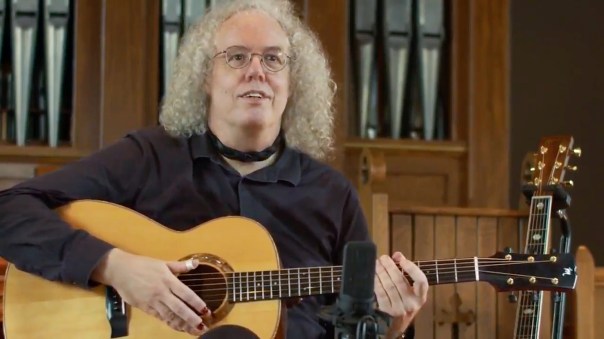
Watching Robin Bullock with his guitars and mandolin at St. Alban’s Episcopal Church in Davidson wasn’t exactly a first – we had reviewed a previous appearance. Nor can we feign surprise that Bullock’s program included selections from Turlough O’Carolan, J.S. Bach, and Stephen Foster. Bach and O’Carolan were fixtures in Bullock’s 2017 Music @ St. Alban’s concert – and that concert concluded with “Oh, Shenandoah,” which the guitarist called “the American folksong.” What made this concert so different, three years later, were the changes necessitated by COVID-19: the reduced size of the audience and the move to online streaming. Yet the similarities with the 2017 concert and Bullock’s relaxed personality were comforting, reminders that all is not lost and people can work, create, and recreate in the teeth of a resurgent pandemic.

Bullock has recorded an entire album of work by the blind 18th century Irish bard, so it was puzzling that he started off his 2020 concert with “Lord Inchiquin,” one of the two O’Carolan pieces he performed in 2017. Played on a Martin steel string guitar, the piece delivered more bite than might have been extracted from a harp, the instrument O’Carolan usually composed for, and it was heartening to hear applause ringing out from the small audience at St. Alban’s. Subsequent outbursts of applause sounded suspiciously identical, but critics tend toward cynicism. More and more, the pretense of live performance is being discarded in streaming presentations, so a fade-dissolve can now replace the tedium of watching a performer switch from one instrument to another, tuning up, and whatnot. We could rejoin the performance after instrument switches without any awkwardness, and Bullock was sufficiently at ease to deliver his intros while tuning. In fact, the last two songs were done in a single continuous take.

Double intros were necessary for both of Bullock’s next two selections. As a preamble to Foster’s “Oh, Susannah,” Bullock told us how folksinger Tom Paxton had advised him to compile an album of American guitar classics – now available at the guitarist’s website and titled, predictably enough, An American Guitar Album. “Susannah,” Bullock then informed us, was Foster’s first hit, published when the lad was 22. Lamentably, Bullock felt no compulsion to play the verses of this classic as Foster had written them, leaving me to wonder where he had misplaced Susannah’s buckwheat cake, the hill she came down, and the weather. Obviously, he was more enamored with the chorus, where he clung closer to the melody, but Bullock wasn’t exactly kind to the lyric. Each time he played the refrain, he added a syllable to “cry” and “Alabama.”

2020~Robin Bullock @ St. Alban's-8

Switching to mandolin in the blink of an edit, Bullock ventured beyond his CD compilation with the next O’Carolan piece he played, “Carolan’s Concerto,” enhancing the adventure by coupling the harp piece with a movement adapted from Bach’s Cello Suite No. 3, Bouree I and II. Bullock’s finger-picking here, fleet and sure, was more sparsely sprinkled with strums and grace notes, yielding a more discernable melody – and a more harp-like sound – than his previous foray on guitar into the Irishman’s work. The seamless transition into the C Major Cello Suite, easily detected by anyone familiar with the great recordings by Pablo Casals or Yo-Yo Ma, further shored up my confidence that he was not straying far from the original compositions.

If the mandolin didn’t sound quite right for the Cello Suite, Bullock was more discerning in his choices of instruments for the movements excerpted from Bach’s Violin Partita No. 1. Again, this was a piece that does not appear on any of the 21 downloads at Bullock’s online store. The are actually four pairs of movements in this B minor Partita, rooted in French dances, namely the Allemande, Courante, Sarabande, and Bouree. Bullock chose the Sarabande and its complementary Double movement. The rich sound crisp articulation of the Martin guitar was key to Bullock’s most satisfying Bach performance on the languid Sarabande, and his Gibson mandolin meshed beautifully with the speedier Double. Obviously, Bullock wasn’t taking his inspiration from the 2017 account of the Double movement by Christian Tetzlaff, who hardly varies the tempos at all. More likely, Bullock took his cue from recordings by Midori or Gidon Kremer, who also hit the accelerator on the Double.

2020~Robin Bullock @ St. Alban's-4

Favoring one of his custom-made guitars, notable for their wolf paw print insignias on the marker spots along their necks, Bullock now turned to “Westlin Winds,” a tune associated with its Robert Burns lyric. The melody lurked closer to the surface than “Oh, Susannah,” though you couldn’t emerge from the concert knowing either melody unless you had heard it before. Yet the arrangement was quite lovely, soaring up to the treble for some unexpectedly ethereal interpolations after its folksy beginning, probably more woodsy than windy but vividly capturing the autumnal scent of Burns’s lyric.

Having primed us earlier with Foster’s first classic, Bullock left us with “Beautiful Dreamer,” said to be his valedictory song. In his intro, the guitarist spoke of the serenity and acceptance he found in both the melody and the lyric, hinting that it could be construed as a voice from beyond calling to the songwriter, who died at the age of 37, even younger than Burns. While the textual analysis that Bullock offered hits a road hazard when it runs into “queen of my song,” his oral reading of the lyric and his instrumental adoration of the melody were luminous and sublime. There was little ornament here, and the variant chords that Bullock imposed on the melody after his opening chorus added poignancy and a country music flavor – clarifying for me why the slightly cowboy-tinged recording I found on Spotify by Marty Robbins far outshone the more elaborate arrangement sung by Bing Crosby. Especially moving was the beginning of the final chorus, where the guitarist slowed down and hushed to a whisper, as if he might not be able to continue. We’ve had a painful amount of this kind of serenity over the past eight months, and perhaps in that moment, Bullock felt an inrush of solemnity amid the serene.


Charlotte Symphony Returns, Stoutly Resisting Escapism

Review:  CSO Livestreams Grieg and Tchaikovsky

By Perry Tannenbaum


2020~CSO Grieg-Tchaikovsky-07

Over the past seven months of an unabated pandemic, I’ve become more and more immersed in reporting on and then reviewing performing arts companies and their responses to COVID-19 as it continues to swallow up the norms of our cultural life. Lately, I’ve become fascinated by what artists think we wish to see and what they wish to say. The balance seems to have tilted toward diverting and amusing us while easing the burden on our fragile attention spans. All of us wish to escape this moment, I’m sure, but ceding the drama in our lives to COVID news bulletins and political campaign rhetoric has seemed like a wan, impoverished response.

Sadly, the toolkits of artists who wish to address the moment – not to mention their monetary resources – have been drained by the necessities of social distancing and shrunken live audience limits. Larger organizations like Charlotte Symphony have had to pivot multiple times as the course of events spun out of control. Indoor concerts had to be cancelled late in the spring, and then outdoor summer events, both previously planned and hastily improvised, also fell by the wayside.

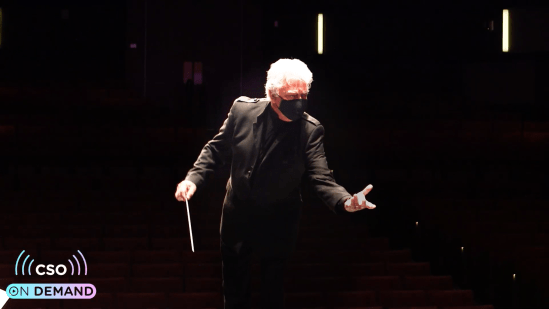
Hence a pivot to virtuality with a new CSO On Demand livestreaming series. It was doubly satisfying to see Christopher Warren-Green and a sizable contingent of his musicians onstage again at the Knight Theater, even if I was watching on a smart TV, for they hadn’t returned merely to serve up some musical pabulum. Edvard Grieg’s From Holberg’s Time and Tchaikovsky’s Serenade for Strings both have extended contemplative and elegiac episodes, echoing and commiserating with how we often feel in these mournful times instead of prodding us into forgetting.

2020~CSO Grieg-Tchaikovsky-12

Even before they played, you couldn’t think Symphony was back to normal if you were watching. Winds, brass, and percussion were missing in action, so the stage wasn’t teeming with musicians and instruments. Nearly 40 percent of CSO’s string players were absent from this skeleton crew, spread out and socially-distanced on the Knight stage. Yes, I had expected Warren-Green and his orchestra to be masked, but the sight of them still took me aback, and I didn’t anticipate how different the ensemble would look when no two players shared the same music stand.

Whether it was hygiene, democratic deliberations, or aesthetics, the normal formalities of concert dress codes were relaxed, further emphasizing – or memorializing – that we were not back to normal. All were masked. Women were liberated to wear colored blouses or sweaters. Men wore jackets, but white shirts were not mandatory, and none wore neckties. Even with the purple-and-blue background lighting, the overall look didn’t suggest a triumphant celebration. All of these alterations seemed to color the music, making the opening Praeludium of the Holberg Suite sound braver and less festive. Similarly, I found the ensuing Sarabande more affecting, solemn, and poignant than I will if I revisit this concert at Symphony’s website in 2022.

The scent of springtime was unmistakable from the start of the middle movement Gavotte with hints of jollity in its brisk Allegretto. Nothing short of piercing heartbreak came across in the longest movement of the suite, the Air marked Andante religioso, all the more keenly felt when the music faded to a whisper before the last swell of feeling. Thankfully, concertmaster Calin Lupanu brought us back from this precipice with some truly zestful fiddling in the folksy Rigaudon finale, all of the other strings sustaining the merry Allegro con brio tempo behind him with pizzicatos, until his solo reached its jazzy release.

I don’t have any record of hearing Charlotte Symphony playing the Holberg before, but I own two recordings of the suite, one of which I reviewed in 2009, with Yuri Bashmet leading the Moscow Soloists. One of the things I particularly enjoyed on that CD was how the sound of the 17-member ensemble shuttled between the textured graininess of chamber music and the homogenized sheen of orchestral performance. That same delicious variety was audible in the Knight Theater webcast, particularly when I listened via Bluetooth on my Boston Acoustic loudspeakers via my Yamaha Receiver. Some of that texture Symphony’s 22 players was blurred when I listened through the same audio system via Chromecast, which also produced less delightful definition in the pizzicatos.

That same enhancement via Bluetooth was evident when I replayed the Tchaikovsky Serenade, which also appears on the previously mentioned Bashmet recording. So does Mozart’s famous Serenade No. 13, “Eine kleine Nachtmusik” – and with good reason. Tchaikovsky’s piece was written as an homage to Mozart’s Serenades, quickly finished while he was at work on the 1812 Overture and esteemed by the composer as having more heart and artistic merit than his flashier warhorse. Warren-Green didn’t seem to be aiming for Mozart as his trim orchestra launched into the initial Pezzo in forma di sonatina, which moves from an Andante non troppo tempo to Allegro moderato and back again. The massive sound Warren-Green elicited from his ensemble at the slower tempo evoked Bach more vividly than Mozart, and at the quicker Allegro juncture, the music was like the involuted canons Bach or Beethoven might whip up – or a dizzying 3/4 dance that might adorn one of Tchaikovsky’s own ballets.

2020~CSO Grieg-Tchaikovsky-06

With more of a ballroom ambiance as Warren-Green slowed and accelerated his tempos, the dancing flavor carried over to the Valse, where the cellos heightened the sense of intimacy with their warmth and tenderness. Beginning with a weepy whisper, the penultimate Élégie was the most tragic music of the evening, filled to bursting with bittersweet nostalgia. With pizzicatos handed off from section to section – four violas, four cellos, and two double basses to Warren-Green’s right, and 12 violins to his left – optimum audio reproduction paid especially huge dividends here. The orchestra has notably mastered playing softly under Warren-Green’s tenure, and the ending of the Larghetto was absolutely sublime.

The Tema russo conclusion began at a hushed Andante, hardly distinguishable from the Élégie that had preceded. With the onset of the Allegro con spirito section, we felt the joy and exuberance we had been craving during the middle movement of this Serenade – and realized how much we craved them. Before an even more rousing reprise of this celebration, the cellos ignited a romantic theme – and turbulent episode that built to a climax. A stately melody seemingly materialized out of nowhere, encapsulating all bravery, anguish, and grief that had weighed upon us through the evening before a final celebratory romp. Grimly, we were reminded how much more genuine joy feels after we’ve endured suffering and catharsis. Welcome back, Symphony, I’ve missed such authenticity.


Company SBB Takes to ZOOM and the Outdoors

Review: Company SBB at Duke Performances’ Show Must Go Online

By Perry Tannenbaum

Company SBB narrowly missed me in 2018 when they decided to tour the Spoleto Festival in Italy instead of Spoleto Festival USA. If the company founded by Stefanie Batten Bland had turned south instead of east from their New York HQ, my first encounter with them would have given me a more typical sampling of the Jerome Robbins Award winner’s work as a dancer and choreographer. On their recent appearance with Duke Performances, rebranded for the pandemic as their “Show Must Go Online” series, Company SBB veered away from stage presentation in both of their new pieces.

“Mondays at Two” gathered its dancers onto the ZOOM platform, building upon the troupe’s weekly meetings with additional footage shot by individual dancers, in imaginative – often surreal – TikTok fashion. “Currents” liberated us from the confines of the SBB dancers’ webcams and cellphone cameras, taking us outdoors to a secluded stream in upstate New York, where a trio of dancers, including Batten Bland, were part of a cinematic design that was ominously surreal and naturally serene.

Batten Bland’s relaxed webcast introductions not only yielded useful insights on the works that followed but also offered us hints and glimpses of how she inspires her dancers. “Mondays at Two” began with the sort of ZOOM tableau we’ve become accustomed to during our prolonged lockdowns, only instead of crosstalk between 18 participants, there was music by Paul Damian Hogan. Warmups no longer happened haphazardly on a studio floor or on ballet barres against walls and mirrors. In a ZOOM universe, dancers mostly limbered up close to their webcams, stretching their necks or rapidly bobbing their heads so that multiple waves of hair dotted the screen. The claustrophobic confinement of ZOOM meetings was quickly established, humorously followed by stillness, dejection, and undisguised boredom. We could all commiserate.

If dance under normal circumstances explores the possibilities and meanings of motion, it was clear that, in creating her pieces during quarantined pandemic conditions, Batten Bland also wished to convey the sheer preciousness of movement. While all her other dancers slouched, moped, or blankly stared at their monitors, one of the screens in the second row lit up yellow along its frame, inevitably grabbing our attention. The dancer who owned that screen, Claire Gieringer, clearly relished the attention, for the busy eye-catching scene that filled her screen was revealed to be a cellphone as she drew it away from her webcam. At that point, there was a doubled “through the looking glass” reveal sucking us in: we were rushed into the dancer’s bedroom while we zoomed into the dancer’s screen until it was the only screen, all the ZOOM frames stripped away.

Now there was a succession of privately filmed and edited videos from the dancers, individually or in pairs. In-production and post-production editing created assorted surreal effects, and occasionally multiple videos from multiple sources were juxtaposed. Prevailing themes among the dancers’ videos were walls, halls, and doors. One dancer trembled before a formidable double- or triple-locked front door, another writhed and danced against her door, while yet another dancer emerged from a closet into her partner’s bedroom. One of the cellphones was propped inside a drawer or storage nook, yielding a similar feel as a dancer peered in.

Perspectives were often strange and unique as the experiences of cabin fever and confinement were explored. Only in the final sequence, filmed by a middle-aged couple, did anybody venture outside – even then, the excursion was brief and plagued with distrust. The turning back of the male partner to the anxious female partner waiting at the front door circled us back to the full troupe on their ZOOM screens. They could have been kissing us or each other goodbye as we faded out, but the meaning of their parting moues was ambiguous.

While “Current” took us outdoors, neither the weather nor the mood was sunny. Jean Claude Dien’s cinematography left the opening sequence a bit cryptic, for he was expecting us to notice the falling of a single yellow leaf – the preciousness of motion – against a relatively vast forest scene. Unlike Gieringer’s antics, the falling leaf could be overlooked, though the principle was the same: a small spot of activity amid a vast surrounding stillness. We cut to a leaf, presumably that leaf, as it floated downstream until it collided with the arm of Jennifer Payán, lying motionless in the shallow water.

Soon we had a shot of a canoe adrift on the stream and then a gloomier cliffside scene along the shore, where the three dancers performed individually or collectively, never really connecting or acknowledging each other’s presence. In the dim light near the cliff, movements seemed particularly anguished, desperate, and despairing. The dancers’ wide-eyed blankness put me in mind of how the insane Renfield is usually portrayed onstage in productions of Dracula. Joining Payán in these eerie revels was Batten Bland and Oluwadamilare Ayorinde. Neither of the women’s full, silky dresses, designed by Shane Ballard, was especially intended for camping or canoeing, and Ayorinde’s outfit, pants and vest cut from a khaki-colored tweed, was more suited for a night on an urban street than an afternoon on a lonely stream.

As the camera repositioned and we saw the dancers positioned in front of the stream, movement became more dazed. Batten Bland was the most inert, seemingly catatonic. When his tempo quickened, Hogan’s music came to the forefront of the cinematic concept as the dancers began shaking and trembling. Intercut with this suddenly spasmodic choreography, we saw shots of the rushing water, and the sound of the water suddenly became prominent in the soundscape, hushed as suddenly as it was unleashed. More spasmodic action and quicker cuts ensued as the drumbeat reached the apex of its crescendo.

All three dancers were shown individually in the water – luxuriating, lazing, or warily hunting – or collectively huddled onshore, still emotionally disconnected from one another, perhaps too enervated to connect. As if all we had seen since the opening sequence had been a flashback, the music and the action subsided. The pace of the water’s flow was greater now than before, and we saw more leaves going with the flow. At last, the leaves led us back to the dancers, all recumbent in the shallow water, as lifeless as before. Rather than morbidly fatalistic, the lingering impression was of a lyrical beauty, of a place where nature’s eternal cycles prevail.

Finckel-Han Deliver Powerful Beethoven and Brahms

Review:  Wu Han and David Finckel at Duke Performances

By Perry Tannenbaum

2020~Finckel and Han~6

Wu Han and David Finckel, longtime artistic directors of The Chamber Music Society of Lincoln Center, are among the world’s greatest ambassadors of chamber music – with talents and personalities worthy of their mission. I’ve seen them together in live performance on at least three occasions in past years at the Savannah Music Festival, and before those encounters, I had seen Finckel play without his wife at the Aspen Music Festival in epic two-night traversal of the Bartok string quartets while he was still the cellist with the Emerson String Quartet.

I’m still hoping to see them together at the Music@Menlo festival, which the New York-based couple established in California back in 2003, at some future date when air travel is no longer a game of Russian roulette, provided that the premises haven’t been reduced to cinders. In the meantime, I was delighted that Duke Performances was offering a virtual opportunity to see Han and Finckel online in a concert of works by Beethoven and Brahms – and curious to see how these elegant performers would handle the technical side of their webcast.

The video setup was fairly inconspicuous as the power couple opened with Beethoven’s pioneering Sonata for Cello and Piano in F Major, the first of two pieces written in 1796 for no less than Friedrich Wilhelm II, the cello-playing Emperor of Prussia. It was Finckel, in the charmingly shared introductory remarks, who pointed out that this was the first piece written for these instruments that placed the cello on equal footing. Three unseen cameras faced the players as they began the Adagio sostenuto against a bosky backdrop of what appeared to be the couple’s back porch, looking out on a brightly-lit forest that filled up nearly all we could see through the generously-sized sliding glass doors of their studio. Sound was warm and rich as Finckel immediately took the lead, Han helping to build the tension of the movement until we reached its crest.

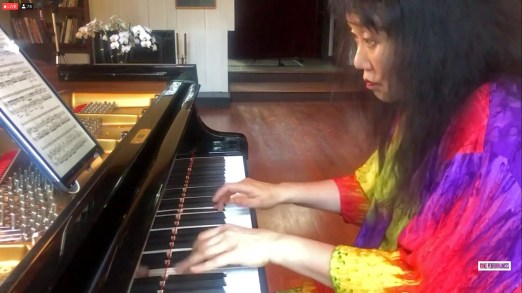
Around that point, when we verged on the seamless transition to the middle Allegro, without our having seen a cameraman silhouetted against the burnt-out background, there were suddenly close-up shots of Han from a camera in the opposite direction that somehow didn’t expose any of the three camera placements that had already been deployed. When video was handed back to the frontal cameras, I finally noticed what looked like an iPhone mounted inconspicuously on a slender tripod just beyond the Han’s Steinway, roughly parallel with her left ear.

2020~Finckel and Han~10

This was an excellent vantage point to watch Han’s light touch as she sped the tempo into the brighter Allegro and its sunnier melody, the most dramatic moment of the linked movements before they concluded. Finckel repeated the catchy melody with less filigree but no shortage of merriment and gusto. Overhead shots, which began to proliferate toward the end of the Allegro, revealed a dangling microphone less than a yard above Finckel’s right shoulder, almost directly in line with his bowing elbow.

With Finckel performing the Cello Sonata without any visible score and his microphone mostly out of sight, the look was very clean, particularly since Han was using a tablet to read her part, obviating the need for a page-turner. The two shared a dramatic cadenza, Finckel supplying most of the gravitas, before the rousing, effervescent finish. The sonata’s finale, a Rondo marked Allegro vivace, initially sounded anticlimactic in the wake of the middle Allegro, which is more than twice as long. Finckel and Han gradually stirred up its strength and intensity without sacrificing its essential merriment.

2020~Finckel and Han~8

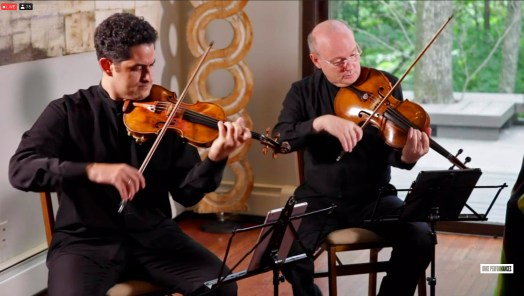
After the ensuing blackout, violinist Arnaud Sussmann and violist Paul Neubauer materialized, bows at the ready, for Brahms’ Quartet for Piano and Strings No. 1 in G Minor, firmly settled in the space formerly occupied by Finckel, while the cellist crossed over to the right side of our screens. Camera positions also changed. One placement put the newcomers exclusively in view, and the cellphone near Han was repositioned to give us a more frontal – and greatly improved – view of the keyboard. Lighting was also enhanced: the background greenery was not so nearly bleached away by the sun and additional indoor light insinuated itself upon the string players.

While it was natural to see Han and Finckel performing unmasked as a duo, I was a little surprised to see no adjustment with the arrival of Sussmann and Neubauer, who also played unmasked. Further decluttering the presentation, both the violinist and the violist mounted tablets on their music stands, so I never saw any pages turning. Finckel alone was old school, with a score that protruded from the right side of his stand, presumably paper.2020~Finckel and Han~9

All of the musicians knew their way around this Brahms, confident and collegial in a setting that was marvelously intimate. Acoustics were so beautifully balanced that no engineering seemed to be involved, the music forward and effortlessly in our faces in a way that chamber music in a concert hall rarely is. Seemingly positioned so close to the performers, we could easily see their camaraderie as they collectively savored the twists and turns – and the peaks and valleys – of the opening Allegro, described by Finckel as “almost epic.” The group was genial and jolly in this performance than Emil Gilels’ mighty DGG recording with the Amadeus Quartet but no less convincing. The ensuing Intermezzo had a nice brisk tempo for its Allegro ma non troppo marking, with plenty of moody, brooding heft, culminating with a charming little coda where Han shined – somewhat belying Finckel’s description of the movement as “perhaps the most wistful scherzo-style movement ever composed,” but never disappointing.

More twists and turns greeted us in the Andante con moto with sweet lyricism early on, Han continuing to assert herself, followed by a majestic rhapsodic episode that broke into a deliciously pompous military march. The upper strings combined to steer us into lullaby land, and Sussman took the lead in a climactic ascent before the other players imposed a soft touch-down. It was in the closing Rondo alla Zingarese, described by Finckel as “one of the wildest folkdances in chamber music,” that the congeniality between the players paid off most handsomely.2020~Finckel and Han~3

From the outset, a thrilling gallop, there was no question that this foursome was taking the Presto marking seriously, increasing the excitement with sudden decisive shifts in dynamics, triggered by Sussmann’s assaults on the treble. Han took over control, calming things down, while the strings plucked pizzicatos in anticipation of the restart. The upper strings launched a new theme before Finckel and Neubauer sweetly launched another. Ideas continued to bounce unpredictably between the strings and the piano with hairpin changes in mood and tempo until Han triggered the final frenzy. There was enough speed and fire to convince you that the musicians were racing each other to the finish – but more than enough virtuosity and togetherness to reassure us that they were all fully synchronized and having tremendous fun. It wasn’t relief flowing through the room and through the screen when the music was done. It was pure Gypsy joy.

Pattishall and Sotashe Deliver a Jazz Concert Gem

Review: Pattishall and Sotashe

By Perry Tannenbaum

2020~Chris Pattishall @ Duke-4

Enigmatic and eclectic, Chris Pattishall is largely absent from Amazon, Spotify, or Apple Music, the places where I usually search out the latest in jazz and classical – and he’s not always captured to best advantage on YouTube, where his presence is far more substantial. The keyboard artist (he plays accordion as well as piano) has firm ties to Jazz at Lincoln Center and the great Marcus Roberts, so it’s not surprising to find that he has earned a roster spot at the Savannah Music Festival for the past three years. Nor does it come as a shock that he would show up among the headliners at Duke Performances’ The Show Must Go Online series. Pattishall, after all, is a Durham native who has a special affinity with the music of Mary Lou Williams (1910-81), Duke University’s first artist-in-residence. Naturally, Pattishall’s solo offerings included samples – or should I say signs? – from Williams’ Zodiac Suite, for his quintet played an assortment of them when I saw the group live in 2019. Other selections, whether alone at the Steinway or with vocalist Vuyo Sotashe, were pleasant and intriguing surprises.

It seems almost sacrilegious to jump into the music without showering praise on the woodgrain vibe of The Bunker Studio, where this concert was filmed, and the wonderful sound engineering by Todd Carter. Director of photography Nick Hughes presumably merits the credit for the moody lighting and the restless variety of camera angles – producing images that are perennially sharp and never handheld. Introductory titles and video by Hughes told us immediately how classy the production values would be while establishing an astronomical/astrological motif, foreshadowing Pattishall’s Zodiac centerpiece. The first titles that flashed over shots of antique maps and a sweep of stars and concentric circles – more curious documents would be spread across Pattishall’s piano – were Carman Moore’s “Tema I” and Richard Lee Smallwood’s “Angels.” Further indications that we were headed skyward. We were still panning across a document depicting the night and the stars when the concert began.

Pattishall used “Tema” to frame his medley, a piece whose contemplative simplicity reminded me of Chick Corea’s Children’s Songs and Bill Evans’ recording of “Some Other Time.” In the middle, “Angels” sounded jazzier and more jagged with a harmonic palette that evoked a gloomy deserted cocktail bar late in the afternoon, not very ethereal at all. So “Angels” was a verbal harbinger of the Zodiac Suite, but it was “Tema I” that actually set the stage, beginning and ending Pattishall’s mashup. In his spoken intro, Pattishall wove his growing interest in Williams into a chronicle of his own development as a jazz musician. He was aware of her as he grew up in Durham, his dad had a vinyl record of hers, and he had gone to Duke University to hear pianist Geri Allen when she came and played the Zodiac Suite. What fascinated Pattishall most was how neatly Williams cut between the idioms of jazz, blues, and the church during a single composition or performance.

You may wish to search outside the Zodiac Suite – or at least beyond the four signs that Pattishall played – for footprints of the church. “Taurus” was heavily infused with both jazz and the blues, shuttling back and forth between the two idioms. At times, the blues seemed to take up residence in Pattishall’s left hand while jazz was partying upstairs in the treble – and some might have indeed perceived the occasional stomping chords up there as footprints of the church. Pattishall actually ranged further than Williams, whose 1945 recording of “Taurus” clocked in at a mere 2:35, playing a full minute longer and exploring chromatic terrain and Gershwinesque harmonies. “Libra” brought more sunshine in with it, sounding more like spring than autumn, with the feel of childhood, first steps, and plashing in a quiet brook before ending on a more meditative note, Pattishall once again giving himself a full minute more than Williams’ 1945 recording.

“Scorpio” certainly didn’t linger in the ruminative mood of “Libra,” entering stealthily and mischievously, as if Williams had sought to hint at the spookiness of Halloween in her opening bass figure. Pattishall stretched the original concept, taking the tune down a brooding path into an impressionistic clearing that veered spasmodically toward Thelonious Monk before softly reprising the opening vamp. Adding to the mischief, Hughes and B camera operator Rafiq Bhatia tossed in entirely new side and front angles throughout the piece. “Sagittarius” retained the new camera angles, soared with a rich aerial sound in the treble, where it circled around Gershwin-like chords once again. It wasn’t Pattishall’s longest tribute to Williams, but it was the one that added the most playing time to the 1945 original.

Admitting that he was “a sucker for a slow second movement with a haunting English horn melody,” Pattishall said that he had discovered William Dawson and his Negro Folk Symphony only recently, so his transcription of the second movement, “Hope in the Night,” was also a personal exploration of the composer’s counterpoint, his sense of drama, and his pacing. Interestingly, this transcription substantially reduced the length of Dawson’s slow movement, smoothed the jagged edges of transitions that jump from one orchestra section to another in the symphony, and transmuted the primal passages in the latter half of the movement into something yearning and modern.

2020~Chris Pattishall @ Duke-12

Pattishall told us how he first met Satashe at William Paterson University in 2013 and connected with him subsequently in the offices of Jazz at Lincoln Center. Then he recalled how, when he first heard Satashe perform, he lived up to all the hype he had heard. What he left out, and what you can only catch hints of on previous YouTube clips, is how astonishingly Satashe has advanced his artistry and transformed his presentation. The man hails from South Africa, so the exotic element, his ability to inject Xhosa clicks into renditions of African songs, has always been there. You can also find more than a couple specimens of his scatting ability among the clips. Because Satashe hasn’t been recorded quite so clearly and intimately as he was at The Bunker, you would likely miss how chameleonic his voice is.

On “I’ll Never Be the Same,” his timbre and inflections reminded me of Billie Holiday first (Holiday recorded the song in 1937) and then Dinah Washington – with an interval of Pattishall soloing that sounded, ironically enough, more like Mary Lou Williams’ keyboard style than any of his prior riffs on her music. Satashe’s African selection, “Sylvia” by Michael Moerane, had a surprisingly Western pop flavor, sprinkled so lightly with Xhosa clicks that I wasn’t sure at first that I’d heard them. There were actually two kinds if you listened closely: one a generic knock or clunk, the other like a flick of a fly-swatter on your window. But now as I scrambled to find an analogous voice, I found myself settling on Abbey Lincoln, maybe taken down a third.

When we reached “Autumn Nocturne,” Satashe suddenly went low, often sounding like Stevie Wonder in this ballad, with a bottom that Wonder can only pray for – amazingly in the same league as Kurt Elling, though I suspect Satashe has also listened to Johnny Hartman’s “Autumn Serenade.” Before the duet on Dave and Iola Brubeck’s “They Say I Look Like God,” both Satashe and Pattishall extolled the humanity of Louis Armstrong, who introduced the song on The Real Ambassadors, a show and recording from 1962. They also discussed the poignance of the song, what Satashe said connects with the “ancestral energy of our fight for life force.” In his candor, Satashe let slip that the original song – recorded only that one time on Columbia – had biblical verses intertwined with Armstrong’s lead vocal. These were sung by Dave Lambert, Jon Hendricks, and Annie Ross, the renowned jazz vocal trio, but behind Satashe, Pattishall had to cut all those biblical verses the singer was referencing. Instead, he played piano reductions of the trio’s chant (plus a solo break replicating one stanza of the vocal), leaving Satashe to address racism with his haunting Socratic questions.

As with his Dawson arrangement, Pattishall compacted the length of the Brubecks’ original, which can be accused of hammering its point with too many biblical verses – making Satashe’s reclamation all the more powerful. Here the vocalist once again sounded like Lincoln with just a pinch of Carmen McRae, but on the closing tune, “Come Back as a Flower,” Satashe shuttled back to Wonder, which made sense when the credits rolled, since it turned out to be a Stevie Wonder composition I was unfamiliar with.

My first priority after the video was done was to swing on over to Google and YouTube to check Satashe out – for neither the singer’s first name nor the program notes decisively settled the question of gender. Well, when you look at other bios and watch the YouTube videos, where Satashe sports men’s suits and sweaters, the question is readily settled. On this new Bunker date, the singer looked as androgynous as his voice, newly adorned with dreadlocks, big earrings, and a nose ring. So the presentation was now of an exotic African with Xhosa clicks compounded by the mystery of androgyny when you see and hear him – far different from his gangly prom date look I found on YouTube when he sang at the Mid-Atlantic Jazz Festival in 2015. Clearly this is an artist who is finding his identity even more quickly and arrestingly than he’s finding his own individual voice, if he’s even thinking in those terms. As long as he keeps the clicks, I’ll be watching and listening.


Three Bone Theatre Responds to this Moment with “Hands Up”

Review: Hands Up: 7 Playwrights, 7 Testaments

By Perry Tannenbaum

Actor- Jay Ward

The stats and the realities have been out there for years – before a racist took up residence in the White House. Racial profiling by people with badges, guns, and gavels had already been documented with actuarial precision. The disproportionate number of black men stopped and ticketed for broken tail lights, frisked at checkpoints, picked up on ticky-tack drug violations, incarcerated for maximum sentences on trumped -up evidence, and gunned down or choked to death by police without cause or provocation? All of it had been calculated over and over.

When Ferguson happened in 2014, triggering an oft-repeated American awakening, Michael Brown lay in the streets for hours after he was murdered. Police brutality seemed to be hidden in the shadows under the cover of darkness during those primordial days. Our iPhones and mandated police bodycams have opened our eyes since then. Now in 2020, after the brutal suffocation of George Floyd in broad daylight, the essence of the Black Lives Matter grievance is no longer the abstract result of a statistical calculation. It is vivid and visceral for millions of us here and around the globe.

And maybe, just maybe, the worldwide unrest has made a dent in policemen’s brazenness, in police chiefs’ and unions’ defiance, in mayors’ aloofness, and in legislators’ indifference. Normally, black and guerilla theatre companies might be expected to help sustain momentum for change, but in a time of pandemic, norms themselves have changed. So it’s welcome that Three Bone Theatre has returned to the Charlotte scene at this moment focusing on an issue that seems lately to be waning among our priorities – distantly behind ejecting a noxious clown from the Oval Office.

Following up on commissioning a set of 10-minute plays sparked by the murder of Trayvon Martin the previous year, the New Black Fest commissioned Hands Up: Six Playwrights, Six Testaments. An early reading stage version preserved on YouTube was recorded in November 2014, just three months after the Michael Brown shooting. That six-pack retained its original formulation when the piece was formally premiered in Philadelphia on June 10, 2015, in a Flashpoint Theatre Company production directed by Joanna Settle.

Actor- LeShea Nicole

One might infer that Settle influenced the subsequent trajectory of the piece, for its subtitle is now 7 Playwrights, 7 Testaments, and smack in the middle of the previously all-male lineup of playwrights and protagonists, we now have “Dead of Night… The Execution Of…” by Nambi E. Kelley, in a stunning performance by LeShea Nicole that any production, past or future, would benefit from.

Mainly, the black men keep asking how they need to act to shield themselves from racial profiling, police paranoia, and the hail of bullets fired at them without impunity. “Hands up, don’t shoot,” the slogan that quickly cropped up during the Ferguson protests of 2014, has sadly retained its currency alongside “I can’t breathe” and “Get your knee off our necks.” That slogan gets a riveting workout in the concluding playlet, “How I Feel” by Dennis A. Allen II. The fact that Sultan Omar El-Amin didn’t have an audience in the house to interact with at Duke Energy Theater hardly detracted from the power of the grim communal ritual he led.

Added to the intrinsic power of the 7 Testaments, the current Three Bone production forcefully reminds us that nothing has changed since Hands Up had its first reading six years ago. Quentin Talley’s stage direction helps us grasp all that is still true about the difficulties blacks face in navigating everyday life in America – and all that was prescient in these seven scripts about what would be so graphically demonstrated on TV and social media. As a society we aren’t merely discovering the systemic racism thriving in our midst the systemic racism thriving in our midst. We’re taking our blinders off.

Talley’s audio setup at Spirit Square frequently let him and the other performers down as this compelling livestream unfolded. The dropouts pretty much ruined Mason Parker’s rendering of “They Shootin! Or I Ain’t Neva Scared…” by Idris Goodwin and intermittently – but annoyingly – cut the argumentative thread of “Abortion” by NSangou Njikam as Gerard Hazelton engagingly prowled the stage. “Walking Next to Michael Brown” by Eric Micha Holmes fared slightly better, dramatically delivered by Laurence Maher.

My hypothesis was that microphone placement was nearly as much responsible for the dropouts as the wayward streaming signal. Talley had these guys moving around more in his blocking than Nicole, whose audio was comparatively solid. When Talley himself opened the show, performing “Superiority Fantasy” by Nathan James, his voice tended to fade when he distanced himself from centerstage. That’s probably why the full force of James’s distinction between whites and Caucasians didn’t quite register as it should. It was a distinction that, for millions of people of good will, would have come in handy decades ago.

Members of the audience who have waited in vain for spokespersons from Antifa or the Deep State to share their views could hear more pointed and realistic testimonies about how it feels to wake up every morning and walk America’s streets in a black skin. Talley’s character described it as constantly walking on eggshells even when he wore his carefully crafted non-threatening smile. Jay Ward, performing Nathan Yungerburg’s “Holes in My Identity,” recalls the cringeworthy moment in grade school when a classmate mispronounced the River Niger and all the other white students turned towards him.

Actor- Sultan Omar El-Amin

Perhaps the most poignant evocation was in El-Amin’s testimony when he overheard his mother remembering how, when she was pregnant, she had wished that her child would not be a boy. We’ve seen enough tearful moms on the evening news to know why. El-Amin went on to describe how radically blacks and whites would need to change before Mom could discard those fears. Even then, he wasn’t betting that systemic racism would be on the ropes.

So he finally lowered his hands and simply vented: “Fuck you! And fuck this shit!”

The concluding Allen ceremony and rant justifiably gave the New Black Fest collection its title, surely the most stirring piece in this Three Bone production. But the Yungerburg monologue struck me as the most nuanced and sneakily persuasive. The main “hole” in this speaker’s identity as a black person was that he had reached the age of 43 without ever having been stopped, frisked, interrogated, or beaten for no reason. It’s not an initiation you seek out, of course, but it’s a condition that drives Ward’s character to a therapist.

Eventually, he pierces to the core of why the hurts fester in the hearts of police victims, no matter how trivial – or even paranoid – the victimization might be. “Dismissal steps quietly,” he says, because we’re not always aware that we’re doing it while the victim feels it keenly. At a certain point, Ward’s uncannily untouched character, during a walk in the park with a black partner, discovers that he himself has dismissed his friend’s fears as a silly phobia.

And he takes the opportunity, then and there, to apologize. It’s at that pivotal moment that Yungerburg and Allen are empathizing with us, grasping that we often don’t know how to cope with an unbridgeable divide – and showing us the way.

“That’s where the healing begins.”

Return to Planet of the Masks

Reviews: CP Theatre’s Webcast of John Cariani’s Almost, Maine and Terry Gabbard’s Our Place.

By Perry Tannenbaum

Our Place, Dress Rehearsal; Halton Theater, Overcash. November 4th, 2020

If you sign up for CP Theatre’s webcast of John Cariani’s Almost, Maine, you may wind up noticing that it has more than a couple of common features with CP’s other online production of Terry Gabbard’s Our Place. Both shows are comprised of multiple vignettes, both feature some of the same actors, and both share the same stage and elements of the same Kenton Jones set design. Both are also situated in places that tie together their varied vignettes, the sort of place we might think seriously about escaping to during a pandemic – particularly in the toxic twilight of Mr. Tangerine Man’s bizarre presidency.

The pandemic, however, follows both productions, Cariani’s suite directed by Ron Chisholm and Gabbard’s by James Duke, out into their forlorn wildernesses. These escapes, as a result, glow with an extra sheen of poignancy, for all the players – dating, breaking up, carousing at a bar, or bickering on a family outing – are doing the right thing, the CDC thing, and the Governor’s executive order thing: they are wearing masks.

It’s a curious collision. Wild pristine places you might dream of escaping to, away from the constraints of our COVID-infested civilization, are strangely populated with people who are devoutly wearing their mandated masks – as if they hadn’t escaped at all.

Cariani and Gabbard surely penned their blackout sketches without envisioning that someday they would be performed by acting troupes wearing surgical masks. Yet I wouldn’t be surprised if their granting of licensing rights to CPCC Theatre hinged on the condition that everybody onstage would be masking up.

Almost Maine, Dress Rehearsal; Halton Theater, Overcash. November 3rd, 2020

After a dopey prologue, a native explains to a visitor that Almost comes by its name naturally, since there aren’t quite enough people, facilities, or initiative for the place to earn a spot on the map with Maine’s more substantial towns. It “doesn’t quite exist,” according to Cariani’s script. And the unreality of the place manifests itself fairly quickly, for the pilgrim who is hoping to glimpse the Northern Lights, Glory, is carrying her broken heart in her backpack, while her lovestruck host, East, is not particularly interested in debunking her wild story.

CP presented the Charlotte premiere of Almost in 2011, a little more than a year after Davidson Community Players brought their production to Spirit Square. Seeing it now during the Trump twilight, I find the goofball flavor altered somewhat. In “Her Heart,” the scene with the Northern Lights, I couldn’t escape the notion that I was watching extraterrestrial aliens becoming intimate. In “Seeing the Thing,” where Dave finds himself at Rhonda’s front door for the umpteenth time after a fun evening together – without being invited inside – their progress toward a long-delayed first kiss seems a bit like a Peanuts special when framed by a small screen.

Daniel Keith and Corina Childs deliver the comedy endearingly, quickening the pace awkwardly and adorably when they begin peeling off their clothes after their first kisses, but their brightly colored outerwear and all the garish underthings they tug off each other only heightened my impression that I was watching a cartoon. Garish jackets, woolly ski caps, and artsy masks push us toward the realms of Homer Simpson and Planet of the Apes. Add a couple of floppy ear flaps, and I sensed a Charlie Brown Thanksgiving right around the corner.

Almost Maine, Dress Rehearsal; Halton Theater, Overcash. November 3rd, 2020Can you literally return all the love your boyfriend has given you? In Almost, you can, as Gayle, infused with extravagant irrationality by Hannah Snyder, demonstrates by lugging suitcase after suitcase filled with it into a hapless Lendall’s living room. Responding to Hannah’s imperious demand that he return all her love, Andrew Blackwell as Lendall returns with a wee little red pouch – without faulting his beloved for the disparity. You can’t help feeling for the flummoxed lad.

East, a repairman, can have a go at fixing Glory’s broken heart in Almost. Two men in “They Fell,” Chad and Randy, can overcome their rustic inhibitions there and literally fall in love, with Griffin Digsby and Jacob Feldpausch executing an orgy of pratfalls. Chisholm, costume designer Beth Levine Chaitman, and the cast are ultimately on-target in their efforts to broaden the comedy. My smart TV isn’t quite as big as life, so this whimsical Maine can stand a modicum of upsizing.

Aside from the prologue and epilogue, there are eight vignettes in this cozy comedy. Cariani wrote it with four actors in mind, including himself, but Chisholm spreads the precious stage exposure to 16 people, including some you may have met back in September in CP’s Virtual Whodunnit.

Childs and Keith come the closest to tying all these vignettes together in “Seeing the Thing,” when Dave begins to enumerate all the Almost folk who have told him that he and Rhonda should be together. That rollcall ought to compound the happy ending when Dave finally gets to cross his beloved’s threshold, but Chisholm has pushed this scene up one slot and saved the sadder “Story of Hope” for last.

Almost Maine, Dress Rehearsal; Halton Theater, Overcash. November 3rd, 2020

That puts Tony Cudic and Quincy Stanford in a bittersweet finale as the title character returns to answer her high school sweetheart’s marriage proposal after many years of absence – long enough ago that Hope doesn’t recognize her Danny. Two dividends from transposing the last two vignettes: we’re not closing with a scene that mandates the two masked kisses we see in “Seeing the Thing,” and in “The Story of Hope,” we now have an additional reason to believe that a woman who has traveled 163 miles by taxi to say yes to a marriage proposal might not recognize that man at the front door of his house.

He’s wearing a mask to greet a stranger!

The bittersweet ending of CP’s Almost, Maine also meshes well with the more dramatic tone and consequential events of Our Place. Utilizing 14 players, half of whom also double as Almost citizens, Our Place is especially well-named a for local production. Gabbard’s play actually premiered here in Charlotte at the 2014 North Carolina Theatre Conference, performed by students of Ardrey Kell High School and directed by the playwright with Brian Seagroves.

Our Place, Dress Rehearsal; Halton Theater, Overcash. November 4th, 2020

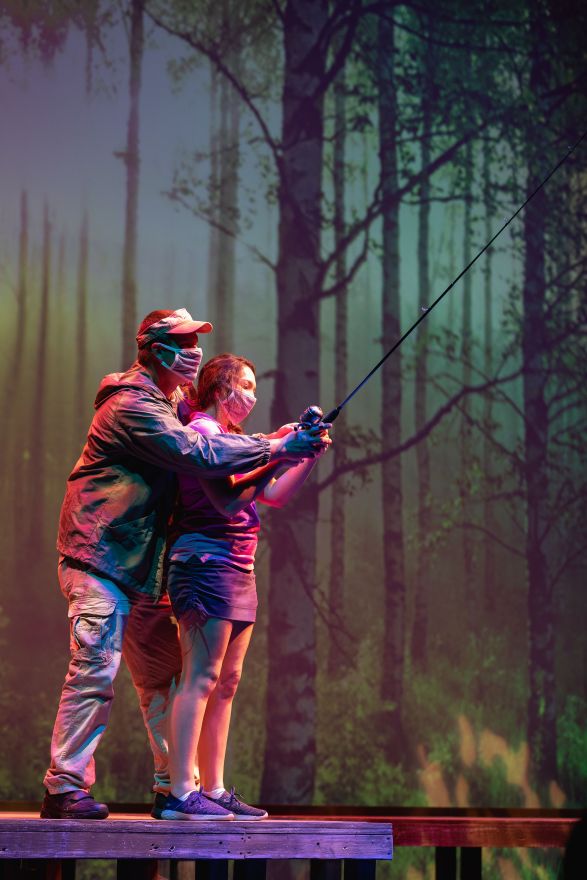
Although projection designer Jeff Childs pushes the envelope a little, all five scenes – and a collective epilogue – occur at the same place. A weathered dock stretches across the upstage and extends a couple of arms toward us along the wings. The aura of a special, secret, and secluded place is somewhat contradicted by this dock and the wide canoe nestled against it in the water (imagination needed here), but that myth is exploded in the opening scene.

Hoping to impress his new girlfriend, Jake tells Holly that he is responsible for fixing up this hideaway, forgotten since real estate developers purchased it decades ago. Jake is in the middle of laying a “love blanket” on Holly – along with additional BS about their special place – when his former girlfriend Anne arrives with her new boyfriend, introducing him to their special place.

In the fracas that erupts, Gracie Page as Anne has the more serious grievances, so if you find yourself liking Brandon Scott as Jake, it will be more for his elaborate rascality than for his counterclaims or penitence. Three of the remaining four scenes are more obviously two-handers. In “Flick of the Wrist,” Corina Childs plays a daughter trying to connect with Tony Cudic as her widowed dad. “Tuna Fish” exposes the fissure between Yazmin Battee as Liberty, a woman so worried about her future that she cannot enjoy the moment, and Jacob Feldpausch as Corey, too smug in his rut to change course or see what’s coming.

Our Place, Dress Rehearsal; Halton Theater, Overcash. November 4th, 2020

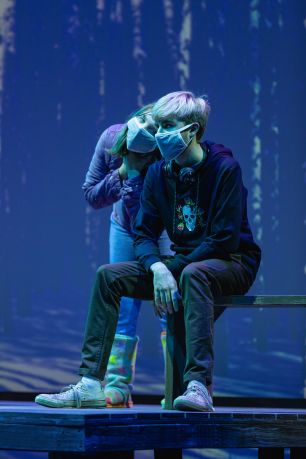
“Stay With You” was easily the most haunting of Gabbard’s two-handers, with Andrew Blackwell as a moody, rebellious teen and Avery Ruse as his pesky six-year-old sister who pursues him to his secret retreat. Hoping to heal the rift between Stanley and his family, little Sidney achieves the exact opposite.

Midway through Our Place, “Famtime” is the scene that has the most affinity with Cariani’s comedy. J. Michael Beech as gung-ho dad Al drags the rest of the Gilbert household to their place because dammit, they’re going to have some fun together as a family. Michael Fargas as the disaffected son and Summer Schroter as the ditzy daughter aren’t close to sharing Dad’s enthusiastic pep, and Shelby Armstrong as the put-upon mom seems strapped in until Al’s whim runs its course.

So it’s midway through Gabbard’s one-act that the canoe comes into play. As a plot device, the wallop of a canoe has roughly the same decisive effect as an ironing board has in Cariani’s “This Hurts,” where Emma Joles wields the weapon against Scott. For once, this event at Our Place isn’t as consequential as the wallop is in Almost. Or even almost.

Ziad Quartet Celebrates the Middleweight Champ of the Tenor Sax

Review: Ziad Jazz Quartet’s Tribute to Hank Mobley

2020~Ziad's Mobley Tribute~8

By Perry Tannenbaum

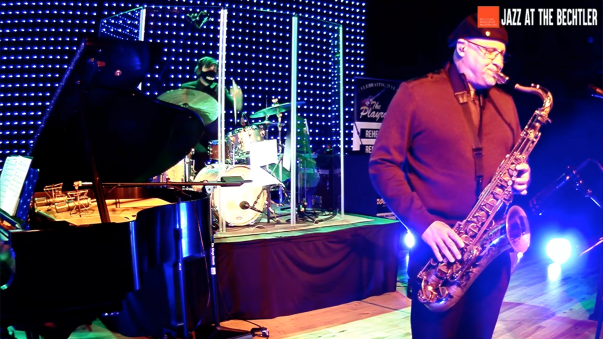
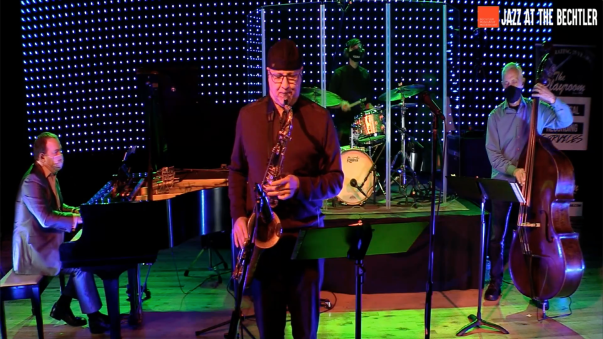
Introducing the honoree at the latest Jazz at the Bechtler concert, Ziad Rabie cited fellow saxophonist Hank Mobley as a foundational member of the hardbop stable of musicians on the Blue Note record label during the 1950s. Mobley, he further asserted, was also one of the most prolific hardbop composers of that era, at one time releasing eight albums within the space of 16 months. So there was plenty for Rabie to pick from for the Ziad Jazz Quartet’s hourlong tribute. My own collection merely includes seven albums with Mobley as the leader and stints as a sideman with Miles Davis, Art Blakey, and Horace Silver, so of the six tunes on the Ziad set list, I had only heard four before, including two title tunes from Blue Note albums of the ‘60s.

We started out with drummer Al Sergel’s cool preamble to “High and Flighty,” an uptempo gem from 1958 that I acquired in the 2008 reissue of Peckin’ Time while I was catching up with Mobley’s work five decades later. While some of the Blue Note flavor was missing when Rabie roared through the melody without a trumpeter alongside him on the bandstand matching him note for note, Rabie’s pace and energy were as compelling as the master take on the Mobley album when he launched into his solo, faster than the alternate take from Mobley and trumpeter Lee Morgan added on the reissue.

Without an intervening trumpet solo in the Ziad arrangement, pianist Sean Higgins entered the fray sooner – with an effervescent spirit that chimed well with Wynton Kelly’s work on the original session, along with some filigree that Herbie Hancock might recognize. Since there wasn’t a trumpeter in sight to join with Rabie in firing four-bar volleys back and forth with Sergel – as Morgan had alternated with Mobley in the original – Higgins replaced the trumpet in bringing the piece to a rousing climax, before Rabie played the outchorus.Screen Shot 2020-11-07 at 5.32.17 PM

Sergel didn’t quite let go at the end of “High and Flighty,” thrashing away mostly on his cymbals as he transitioned to “The Morning After,” a tumultuous 3/4 composition that appeared on Mobley’s A Caddy for Daddy in 1965. With Higgins adopting a McCoy Tyner manner as he layered on, dropping power chords in his left hand that were a hallmark of John Coltrane’s quartet recordings of 1961-65, the rhythm section sounded very much like the sound Tyner and drummer Elvin Jones pioneered on those classic sessions on Impulse.

Rabie certainly picked up on the sound, for Tyner turned out to be a key ingredient on Caddy for Daddy when I tracked it down, and the tenor saxophonist’s solo had a few licks that echoed Coltrane’s Crescent from 1964, abandoning Mobley’s less fiery style. When Higgins followed Rabie’s incendiary exploits, he let loose with more bombs in his left hand and a Tyner-like flurry in the treble. Nor was this powerful rhythm section done here, for Sergel was still thrashing when the leader returned to reprise the melody on sax, and he took over for a second drum solo afterwards with wailing support from Higgins underneath.

This was a perfect moment for Rabie to repeat jazz critic Leonard Feather’s judgment that Mobley was “the middleweight champion of the tenor saxophone,” for his quartet was about to turn down the heat for “Madeline,” an original recorded in Mobley’s pre-Blue Note days. Sergel switched to brushes behind his drumkit and, after lyrical solos by Rabie and Higgins, Ron Brendle finally had an opportunity to shine in the spotlight, better captured in his bass solo than in any of the previous Bechtler webcasts from The Playroom – double kudos for the sound and the music. Higgins was more distinctively his own man in his solo, maybe weaving in wisps of Hancock and Red Garland, while Rabie came closest on this tune to replicating Mobley’s smoky sound on tenor before giving way to Higgins. After the pianist took his solo, Rabie’s blowing had more of a Coltrane tang as Sergel unobtrusively switched to mallets, and the breathiness at the end of the tenor coda injected a faint hint of Ben Webster.2020~Ziad's Mobley Tribute~2Rabie’s final three selections were his most predictable, culled from two of Mobley’s most acclaimed Blue Note recordings, Soul Station (1960) and Workout (1961). “This I Dig of You,” from the earlier album, bopped more than “High and Flighty,” but the creativity flowed richly from the quartet as all the players had a chance to solo. Sergel took up his sticks to launch the merriment, pounding on his rims as well as his toms, and Rabie handed things over quickly to Higgins, who swung his first chorus on the keyboard and offered fresh new angles on each ensuing variation. Rabie was deceptively tame at first, almost cool with his bopping triplets, before he whipped up a harder sound up in the treble, getting a second wind. Brendle had a crisp, swinging take on the tune before Sergel crafted a hybrid solo at the drums, beginning with brushes in Brendle’s wake and then turning the heat back up with his drumsticks.
Weighing in at a middleweight 16 bars, “Soul Station” is as groovy and infectious a blues as you’ll hear, arguably Mobley’s signature composition, and the Ziad Quartet made sure they didn’t mess up the pulse or the tempo, leaning into its medium-paced quietude with its arrangement and obviously having fun. Rabie scorched it without rushing it, and Higgins tossed a bit “Night Train” into his flame (a 12-bar blues that can be traced back to Ellington). Brendle proved that he had been listening closely, popping a bar or two of the same train into his solo.

Inevitably, Rabie chose the title tune of Workout as part of his Mobley tribute, for Feather’s memorable pronouncement on the tenor sax great was the first sentence of his liner notes for that worthy album. Now it sounded like it was Rabie who was refusing to let go, thundering into each new improvised chorus, with Sergel in an orgiastic mode behind him. Higgins was no less dazzling, he and the drummer spurring each other on the pianist’s solo until Sergel pounced on his solo. The liquid intensity of guitarist Grant Green’s solo spot on the Blue Note recording was expunged from the Ziad arrangement, nor did Sergel gradually build to primitive ferocity as Philly Joe Jones had in the March 26, 1961, studio session. He was still roaring while Rabie reprised the Mobley melody one last time. Listening to this rousing closer, I heard more champion than middleweight in this “Workout.”


Loose Ends and All, “The Resurrection of Alice” Still Offers a Fresh Viewpoint on Black Subjugation

Review: NC Black Rep’s The Resurrection of Alice

By Perry Tannenbaum

Rounding into November, I would ordinarily check the weather forecast before venturing out to Boone, NC, to review a theatre production. Not in 2020. All of the Schaefer Center’s events on the campus of Appalachian State University are listed as online. Weather, ticket availability, and travel are no longer in the equation, all obviated by the new norms of computerized streaming. Virtuality would be a straightforward compromise if it only involved translating music, dance, and theatre from three dimensions to two. Mandated social distancing for professional actors and dancers, concerns over spreading airborne particles by singers and horn players, and stricter limits on the number of people who can gather in public places have added more constraints.

So it was refreshing to see how effortlessly all of these new restrictions were handled in the North Carolina Black Repertory Company’s production of The Resurrection of Alice, the latest Schaefer Center presentation. Better yet, the NC Black Rep production team disdained the annoyances that have plagued performing arts webcasts during the pandemic – dumbed-down content, abbreviated runtimes, and screens carved up ZOOM-style into tic-tack-toe boxes.

Though she would have to be 88 years old to actually stand before us as the protagonist in this drama, the script and the one-woman performance by Perri Gaffney had the detail – and superabundance of characters – of an autobiographical narrative. Sure enough, Gaffney’s play of 2013 resurrected a novel that she had self-published in 2004, so the 2020 version, shot with multiple cameras on the Schaefer stage, brought us an actress/playwright/novelist who had lived with the multiple roles she was taking on for nearly two decades.

The actress wasted no time in reaching peak energy, for Alice begins her tale in 1939 as a raucous, upbeat 7-year-old in the fictional backwater of Smedley, South Cackalacky – she doesn’t break down and let on that it’s South Carolina until much later. As the eldest child in her humble household, Alice must set a “zample” for her siblings, which drains some of the fun out of her childhood; and as the prettiest, she must marry Mr. Luthern Tucker, the family benefactor, which robs the teenager and the grownup of her budding love life with Isaac Freeman – and deprives her of the college scholarship she is so excited to win.

Alice’s “best birthday” is her 13th, when she meets Isaac at her party and savors her first peppermint-flavored kiss during a game of spin-the-bottle – until that kiss is cruelly interrupted by her elders. The other bright light in Alice’s life is her schoolteacher, Miss Johnson, who recognizes her gifts and encourages her college ambitions. Although the shadow of Mr. Tucker had hung over Alice from an early age, her parents kept their betrothal agreement a secret until the moment she joyfully received news of her fully-paid tuition scholarship in the mail.

Gaffney crafted the lead-up to this catastrophe and performed its impact upon Alice in a manner that delivered both the shock and the inevitability of her disappointment. Although Alice elicited a promise from Miss Johnson to intercede at the wedding ceremony, an unfortunate miscommunication ensued – along with another shock. Alice found herself imprisoned in wedlock at Mr. Tucker’s luxurious home, expected to do her part in birthing a male heir.

Balancing Alice’s rusticity and intellect, Gaffney’s narrative leans a little more than necessary towards her backwoods naivete in the early episodes, forcing Alice’s interest in Paul Lawrence Dunbar’s poetry to do the heavy lifting in conveying her academic potential. It was intriguing to hear two of Dunbar’s most oft-quoted works, presumably giving voice to a Black man’s struggles in White America, so provocatively repurposed. For here, “We Wear the Mask” and “Sympathy” (with its famous “I know why the caged bird sings”) are the outcries of an African American woman who is subjugated by a man of her own race. When Alice finds her own voice, two or three children later, I was more convinced that a resurrection was possible, although Gaffney’s script makes her protagonist’s reawakening and rehab too precipitous to be fully satisfying.

Gaffney’s exploits as an actress offered ample compensation. Inspiring resurrection or not, Gaffney bridged the gap between narrating Alice’s story and inhabiting her personality so seamlessly that I felt that I was watching her grow and mature before my eyes while the narrative unfolded. Portrayals of the men in Alice’s life, prudently brief and nicely differentiated, added richness wherever they popped up, particularly when we glimpsed Isaac, Mr. Tucker, and Rev. Pritchard. If I were director Jackie Alexander, I would try to prevail upon Gaffney to fill out her portrayals of the key women in her tale. Alice’s mamma was too cartoonish for what she had to say, and Mrs. Johnson was too colorless.

Alexander occasionally took advantage of the cinematic medium by blacking out between scenes, though he never implemented any costume changes. Scenic projections on the upstage curtain were hit-and-miss in terms of registering well on video and a bit slow in playing an integral role in the production. Each time Alice voiced the anger that was welling up inside her but, as it turned out, didn’t actually say out loud at the time, lighting designer underscored the motif by flooding the stage with lurid red light. A bit heavy-handed and Rocky Horror, perhaps, but the crude device paid dividends when Alice finally flipped the script and discarded her inhibitions.

While the lapses in Gaffney’s artistry lend a certain rough-hewn authenticity to her narrative, they also deprive us of seeing more of the actress at work. It would make more sense – and give us a fuller grasp of her maturation as a woman – if Alice’s experience as a mother of her three children (or at least of her two eldest) were part of her growth. And Alice’s younger daughter, Ola, “came out” so abruptly near the end that you could easily have missed it. If these loose ends happen to be tied up in Gaffney’s 2004 novel, a simple import would suffice in 2020 and beyond.

David Lail’s Jazz Quintet Celebrate the Goliaths of Tenor Sax

2020~David Lail~7

Review:   The David Lail Jazz Quintet, Live at the Crown

By Perry Tannenbaum

My last memories of the NoDa district of Charlotte, when theatre still thrived there and gentrification was still in progress, are vividly stamped by the obstruction that bisected 36th Street about a block west of North Davidson Street. This was the ongoing construction of light rail, envisioned as salvation for theatre companies producing in NoDa until Carolina Actors Studio Theatre was shut down in 2014 by its less-than-visionary board of directors.

Fringe theatre companies are more comfortable these days in Plaza Midwood, but a new online JazzArts Charlotte series is supplying me with fresh incentive to revisit NoDa once we’re all clear of current pandemic restrictions. Presenters Ocie and Lonnie Davis have launched a new series, Live at the Crown, that has an intimate clubby feel, devoid of the glitzy studio vibe of The Playroom, where Bechtler Museum is streaming its jazz series, and more to the liking of cellar dwellers.

Crown Station, as its name implies, will be accessible for its indoor events by motor and light-rail transit once Governor Cooper sounds the all-clear. Meanwhile, my first exposure to the Crown via the David Lail Quintet put me in mind of the Village Vanguard with its unassuming ambiance. Three cameras were deployed for the Facebook Live webcast, none of which changed position or zoomed in when musicians soloed. Combined with Chromecast, the stream produced fairly sharp video, particularly when pianist Phillip Howe soloed.

On the audio feed (pumped into Boston Acoustic speakers via Bluetooth and a Yamaha receiver), Lail on tenor sax, Matt Postle playing trumpet, and Ocie Davis behind the drumkit were the best served. Howe could have benefited from a smidge more amplification at his open-front upright, and bassist Vince Rivers was woefully undermiked on his first solo, but evidence of on-the-fly audio engineering could be detected during Rivers’ subsequent solo, and he was a satisfying part of the mix afterwards. On a couple of occasions, Lail’s hand mic didn’t seem to be switched on during his introductions, but this problem seemed to have been remedied in post-production when I watched the set a second time.

After Davis’s welcoming remarks, Lail’s program emerged as an homage to his tenor sax heroes – Wayne Shorter, Joe Farrell, Stan Getz, and Joe Henderson. Discriminating listeners may have descried John Coltrane and Dexter Gordon among the leader’s unmentioned influences. The emphasis for the first three selections was on Shorter, Coltrane’s successor in the Miles Davis Quintet, in compositions written during the 1960s – before Shorter became a foundational member of Weather Report and better known for his work on soprano sax.

2020~David Lail~5

“Armageddon,” the opening tune, was first recorded on Shorter’s Night Dreamer album, his 1964 debut on the legendary Blue Note label. This composition surely has the hard-bop flavor that Blue Note is famous for, but Lail’s solo, like Shorter’s before him, was marked by the surge and wail of Coltrane and Gordon. Postle proved to an effective counterpart, cooler and less frenetic in his trumpet solo. Howe was even cooler, soft enough for us to savor the support from Davis more keenly before Rivers had his muffled spot. Davis took over briefly and effectively before the horns reprised the melody.

“Night Dreamer” brought forth an even more blazing solo from Lail, with Postle and Howe sounding comparatively meek in his wake, but it was reassuring to hear the swing from Rivers’ bass as his solo gathered steam. Once again, the tenor and the trumpet returned with the outchorus, but this time, Lail reserved a slice of the replay for himself.

My strongest misgivings of the evening assailed me when Lail announced “Nefertiti” as his next number, a Shorter composition that first appeared as the title tune on a Miles Davis release in 1968. On both the Davis album and Herbie Hancock’s subsequent V.S.O.P. recording, the arrangement became a tedious repetition of the same slow-paced riff played by the horns, with all the excitement passed down to the piano and drums’ accompaniment. Lail and Postle both triumphantly proved that you can improvise on this composition without compromising its lazy, luxurious pace, and despite being granted scant time in this arrangement, Howe also distinguished himself with his thoughtful work.

There are certainly more obvious launchpads for a tribute to Joe Farrell than “500 Miles High,” a Chick Corea tune that first appeared on Return to Forever’s Light as a Feather album in 1973, where Farrell appeared as a guest artist playing flute, soprano sax, and tenor. The texture of that cut – with a Flora Purim vocal, Corea playing electric piano, and no trumpet at all – was very different from the sound that the Lail Qunitet brought to the Crown. Maybe that’s why the performances on “500 Miles High” were even more impressive than those on “Nefertiti.”

Postle opened the soloing, more brash and confident than he had been when comparisons might be made with trumpeters Lee Morgan or Miles on the original recordings. Lail had a more individual sound here as well when he followed – and a well-defined story to tell, building his solo beautifully and not entirely discarding his Trane-like wail. Not at all obligated to sound like an electronic Corea, Howe sounded more like Hancock or early McCoy Tyner as he worked up a lather.

Tyner is the common denominator who bridged Lail’s early segment of Shorter compositions with the final two paying tribute to Henderson, for Tyner was a sideman on Shorter’s Night Dreamer and on Henderson’s Inner Urge. After those stellar 1964 albums, Henderson guested on another Blue Note gem in 1967, The Real McCoy, from which Lail covered one of Tyner’s most celebrated compositions, “Passion Dance.” Once again, Postle took the first solo, still frisky and brash but now punching in a style that might bring Dizzy Gillespie to mind. Lail roared again in his Coltrane comfort zone, but it was Howe who surprised most. Inevitably, he must have been thinking of Tyner’s rich and heavy left hand, but the chords he played were different and his right-hand treble was funkier, reminding me more of Dave McKenna’s hard-driving swing. In a foretaste of fireworks yet to come, Davis asserted himself in a fine bashing solo.

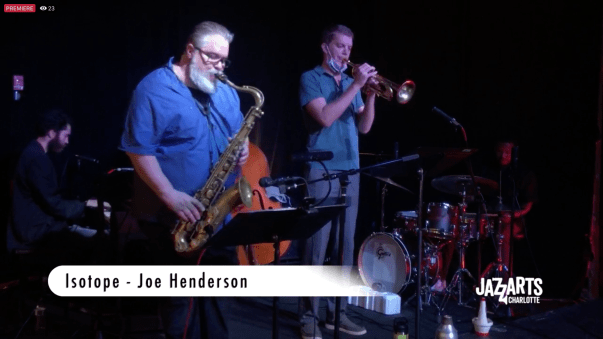
Before a snippet of Shorter’s “Footprints” faded us out, the closer was a Henderson original, “Isotope.” It would have been interesting to hear Lail and Howe hook up on the melody as Henderson and Tyner did on Inner Urge, but instead Lail remained formulaic, introducing the catchy tune in unison with Postle. The trumpeter began the soloing again, poised and authoritative, and the leader was nearly as inspired as he had been in “500 Miles,” clearly having fun and dropping a snatch of Coltrane’s “Bessie’s Blues” as he signed off.

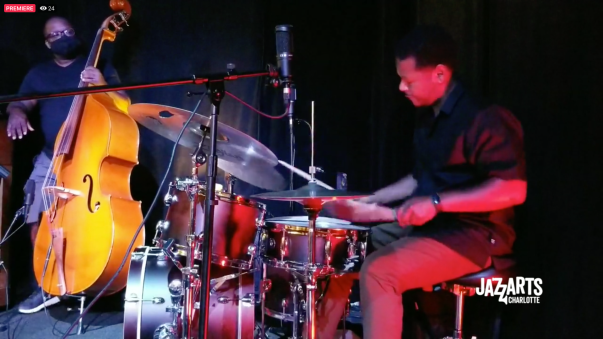
Howe was also in a frolicsome mood as he soloed, and the camera caught Davis acknowledging that he was up next. Here Lail’s arrangement was more in line with Henderson’s when the tenor sax traded four-bar volleys with Davis, but Lail also admitted Postle and Howe to his trading-fours party. Two rounds of Davis pounding his answers to trumpet, tenor, and piano led us back to Henderson’s genial melody. Taking up his microphone and thanking us for virtually being there, Davis had plenty to be pleased with.