Category Archives: Concert

Spoleto Festival USA: More Diverse, Hybrid, and Inclusive Than Ever

By Perry Tannenbaum

With so many theatre, dance, opera, jazz, orchestral, choral, and chamber music events to choose from – more than 300 artists from around the world, streaming in and out of Charleston over 17 days (May 26 through June 11 this year) – planning a dip into Spoleto Festival USA is always a challenge. Even Spoleto’s general director, Mena Mark Hanna, struggles to prescribe a strategy, as hesitant as a loving mother of 39 children to pick favorites.

“My suggestion for a first-time participant,” he says, sidestepping, “would be to see two things you like and feel comfortable about seeing, maybe that’s Nickel Creek (May 31-June 1) and Kishi Bashi (June 3), and two things that are really pushing the envelope for you. So maybe that’s Dada Masilo (June 1-4) and Only an Octave Apart (June 7-11).”

Nicely said. Only you can easily take in the first three events Hanna has named within three days, but you’ll need another four days before you can see singer-songwriter phenom Justin Vivian Bond and their monster opera-meets-cabaret-meets-pop collaboration with countertenor sensation Anthony Roth Costanzo. If you happened to see the recent Carol Burnett tribute on TV, the cat is out of the bag as far as what that will sound like, if you remember the “Only an Octave Apart” duet with opera diva Beverly Sills – recreated for Carol by Bernadette Peters and Kristin Chenowith.

What it will look like can be savored in the Spoleto brochure.

The giddy Bond-Costanzo hybrid is one of the key reasons that my wife Sue and I are lingering in Charleston through June 9. Equally decisive is the chance to see jazz legends Henry Threadgill (June 6) and Abdullah Ibrahim (June 8), the Spoleto Festival USA Chorus singing Thomas Tallis’ Spem in alium (June 7-8),and Jonathon Heyward conducting Hector Berlioz’s Symphonie Fantastique (June 9).

One other irresistible lure: the opportunity to see Maestra Mei-Ann Chen conduct Antonín Dvořák’s New World Symphony (June 7), along with works by Florence Price and Michael Abels – less than four months after her scintillating debut with the Charlotte Symphony.

Abels, you may recall, teamed with Rhiannon Giddens last year in composing Omar, the new opera that premiered at Spoleto – after an epic gestation that spanned the pandemic – and won the Pulitzer Prize for Music earlier this month. It was a proud moment for Spoleto, for Charleston, and for the Carolinas. For Hanna, it was an extra special serendipity to help shepherd that work to completion.

“I mean, it’s kind of incredible,” he explains, “to be someone who comes from Egyptian parentage, speaks Arabic, grew up sort of fascinated by opera and stage work and spent their career in opera and was a boy soprano – to then have this opportunity to bring to life the words of an enslaved African in Charleston, South Carolina. And those words are Arabic!”

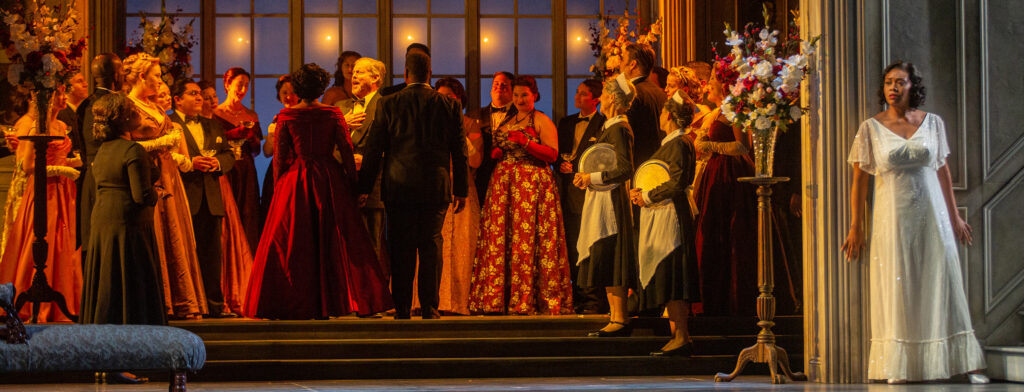
We may discern additional serendipity in the programming of this year’s opera, Samuel Barber and Gian Carlo Menotti’s Vanessa (May 27-June 10), which garnered the Pulitzer in 1958. Revived at Spoleto in 1978, the second year of the festival – with festival founder Menotti stage directing – the production was videotaped by PBS and syndicated nationwide on Great Performances, a huge boost for the infant fest. That revival also sparked a critical revival of Barber’s work.

Omar was the centerpiece of a concerted pushback at Spoleto last year against the Islamophobia of the MAGA zealots who had dominated the headlines while the new opera was taking shape. Vanessa is part of what Hanna sees as a subtler undercurrent in this year’s lineup, more about #MeToo, Black Lives Matter, and the repeal of Roe v. Wade.

“I want there to be a kind of cohesiveness without necessarily us being able to see what the theme is,” Hanna reveals. “If there is something that unifies a lot of these pieces, it’s about understanding that we are telling stories from our past, some of them the most ancient stories that we have in our intellectual heritage. We are looking at these stories with a different sense that takes on the reverberations of today’s social discourse.”

Among other works this season at Spoleto that Hanna places in his ring of relevance are An Iliad (May 26-June 3), a one-man retelling of Homer’s epic featuring Denis O’Hare; Igor Stravinsky’s The Rite of Spring (June 5), as an orchestral concert and the inspiration for Masilo’s The Sacrifice; Helen Pickett’s new adaptation of Arthur Miller’s The Crucible for Scottish Ballet (June 2-4); and A Poet’s Love (May 26-30), a reinterpretation of Robert Schumann’s Dichterliebe song cycle by tenor/pianist Jamez McCorkle, who played the title role in Omar last year – with stagecraft, shadow puppetry, and projections by Miwa Matreyek.

“Going back to the Trojan War, An Iliad is as much about war and plague then as it can be today with the reverberations of Ukraine and the pandemic,” says Hanna. “Vanessa, is reinterpreted here through the lens of a remarkable female director, Rodula Gaitanou. The cast is just killer: You have Nicole Heaston as the lead with Zoe Reams and Edward Graves and Malcolm McKenzie and Rosalind Plowright, just a world class cast at the very, very top. And it’s also really cool to see these roles, which are traditionally sung by Caucasian people, being sung by people of color.”

Aside from the recurring motif of reclusion, so vividly resonant for all of us since our collective pandemic experience, Hanna points to a key turning point in the opera. Menotti left it mysterious and ambiguous in his libretto at a key point when Vanessa’s niece, Erika, either has a miscarriage or – more likely – an abortion.

For Hanna, that brings up an important question: “What does that mean now when we are looking at a renewed political assault on female autonomy? So these stories take on new messaging, new reverberation in 2023. And we need to retell these stories with the new lens of today.”

Especially in the Carolinas.

Long accompanied by a more grassroots and American-flavored satellite, the Piccolo Spoleto Festival, Menotti’s international arts orgy has taken a long, long time to shed its elitist mantle. Now it is moving forcefully in that inclusive direction with a new Pay What You Will program, offering tickets to about 20 performances for as low as $5 – thanks to an anonymous donor who is liberating about $50,000 of ticket inventory.

Hanna brought this exciting concept to the unnamed donor, hasn’t talked to him or her or them – yet – about sponsoring the program in future years, but he is pledging to continue it regardless.

“What art can do is endow you with a new experience, a transformational experience that you did not have before you took your seat,” he says. “It can help create an understanding of another side that is normally seen by one perspective as socially disparate, as highly politicized, as a discourse that’s just way too far away. Art can break down that barrier through the magic and enchantment of performance. To me, having those artists onstage, representative of a demographic we wish to serve, only takes us so far. We also have to lower the barrier of entry so that we can actually serve that demographic.”

Kishi Bashi not only continues Spoleto’s well-established outreach to Asian culture, he also typifies the more hybrid, genre-busting artists that Hanna wants to include at future festivals.

“We want to try to find these artists that are like pivot artists, who occupy these interstitial spaces between dance and theater and classical music and jazz and folk music,” Hanna declares. “And Kishi Bashi is one of those. He plays the violin on stage. He has all of these violinists on stage with him, but it’s this kind of strange, hallucinatory, intoxicating music that’s like somehow trance music and Japanese folk music, but using sort of Western classical instruments. Yet it’s very much in an indie rock tradition as well.”

Other wild hybrids include Leyla McCalla (May 26), the former Carolina Chocolate Drops cellist who blends Creole, Cajun, and American jazz and folk influences; Australian physical theatre company Gravity & Other Myths (June 7-11), mixing intimate confessions with acrobatics; Alisa Amador (June 7), synthesizing rock, jazz, Latin and alt folk; and the festival finale, Tank and the Bangas (June 11), hyphenating jazz, hip-hop, soul, and rock. Pushing the envelope in that direction is exciting for Hanna, and he promises more of the same for the ’24, ’25, and ’26 festivals.

Until the Pulitzer win, the year had been pretty rough on Hanna, losing Geoff Nuttall, the personable host of the lunchtime Chamber Music Series at Dock Street Theatre. Nuttall was the artist who convinced Hanna to come to Spoleto. At the tender age of 56, Nuttall had become the elder of Spoleto’s artistic leadership when he died, beloved for his style, wit, demonstrative fiddling, and his passionate advocacy of the music. Especially Papa Haydn.

The special Celebrating Geoff Nuttall (May 26) concert will gather his close friends and colleagues for a memorial tribute at Charleston Gaillard Center, including violinist Livia Sohn, cellist Alisa Weilerstein, countertenor Anthony Roth Costanzo, tenor Paul Groves, pianist Stephen Prutsman, and surviving members of the St. Lawrence Quartet. The occasion will be enhanced by the Spoleto Festival USA Orchestra and Atlanta Symphony’s Robert Spano – plus other guests soon to be announced.

Hosting chores for the lunchtime 2023 Chamber Music series, spread over the full festival, 11 different programs presented three times each (16 performances at 11:00am, 17 at 1:00pm) will be divvied among vocalists and instrumentalists who perform at the Dock. It was totally inappropriate, in Hanna’s eyes to replace Nuttall onstage this year, but he will begin to consider the charismatic violinist’s successor during the festival and into the summer. Hanna assured me that the player-to-be-named later will be a performer who participates in the musicmaking.

Continuing on the trail blazed by Amistad (2008), Porgy and Bess (2016) and Omar, Hanna wants to place renewed emphasis on the Port City and its African connection. It must run deeper than seeing Vanessa delivered by people of color.

“Charleston was the port of entry for the Middle Passage,” Hanna reminds us. “And Charleston has at its core an incredibly rich Gullah-Geechee-West African-American tradition that is part of the reason this is such a special, beautiful place to live in with its baleful history. So I think that you see that this year, you see that with Gakire Katese and The Book of Life (June 1-4), you see that with Dada Masilo and The Sacrifice, you see that with Abdullah Ibrahim and Ekaya.”

Resonating with the brutalities of Ukraine, Ethiopia, and Syria on three different continents, the US Premiere of Odile Gakire Katese’s The Book of Life may be the sleeper of this year’s festival, crafted from collected letters by survivors and perpetrators of Rwanda’s 1994 genocide and performed by Katese, better known as Kiki. “After the unthinkable, a path forward,” the festival brochure proclaims. The finding-of-hope theme will be underscored by music created by Ingoma Nshya, Rwanda’s first-ever female drumming ensemble, founded by Katese.

“Kiki is engaging with how a country tries to reconcile with its recent, terrifically horrific past of the Rwandan genocide as someone who grew up Rwandan in exile. You see that in the work of Abdallah Ibrahim, who was really one of the great musicians of the anti-apartheid movement, who composed an anthem for the anti-apartheid movement, was in a kind of exile between Europe and North America in the 80s. And then when he finally came back to South Africa for Nelson Mandela’s inauguration, Nelson Mandela called him our Mozart, South Africa’s Mozart.”

Marvelous to relate, you can hear more of South Africa’s Mozart this year at Spoleto Festival USA than Vienna’s Wolfgang Amadeus – or Germany’s Ludwig von Beethoven. That’s how eclectic and adventurous this amazing multidisciplinary festival has become.

See for yourself.

Lan Shui’s Rachmaninoff Is a Special Gift – and a Flexion Point for Charlotte Symphony

By Perry Tannenbaum

2023~Rahmaninoff 2-19

April 28, 2023, Charlotte, NC – It’s time to admit that Charlotte Symphony has flipped the script. After a string of four consecutive concerts that I’ve reviewed in 2023, with four different guest conductors, every one of them immaculately played, I can no longer agree that CSO is in search of a new music director who will take the orchestra to the next level. The virtuosity and consistency are here, the responsiveness to varied composers and conducting styles is here, and the mastery of a multitude of musical styles can no longer be overlooked.

My moment of revelation came after the intermission in this week’s program at Belk Theater with guest conductor Lan Shui. Everything had been wonderful so far: Samuel Barber’s “Overture to The School for Scandal” had been colorful, cohesive, and melodious; the accompaniment of guest pianist Mari Kodama’s scintillating work on Mendelssohn’s Piano Concerto No. 1 had been as robust as the support Canadian soprano Alexandra Smither received on Benjamin Britten’s Les Illuminations with guest conductor Vinay Parameswaran on the podium.

My moment of realization came as the opening Largo-Allegro movement of Sergei Rachmaninoff’s Symphony No. 2 came to its finish – epic in its variety, impeccable in its flow, and utterly convincing in its pacing and drama. I had never appreciated how rich and gorgeous this music was. Repeatedly over the years, I have written about the low points in my CSO concertgoing experiences, when I needed to hurry home after performances of Beethoven’s Eroica and Copland’s Appalachian Spring to re-establish, via CDs in my collection, that I actually liked and admired this music. Finding out at Belk Theater what I’d missed on recordings I have heard before at home, as I did last night with Symphony’s Rachmaninoff, was a complete 180-degree turnaround.

Mei-Ann Chen’s exhortations that Charlotte should support their orchestra as much as it deserved weren’t tainted at all with pragmatic flattery as I had thought, it was plain honesty. The only reason she remains the top candidate among those I’ve heard after Shui’s equal triumph is that I still feel Chen will bring more youth and effort to the true tasks at hand – keeping CSO’s performance level at its admirable height, enlarging its numbers, and enhancing its reputation and touring opportunities. Nor should I leave what is implied here unspoken, that Christopher Warren-Green completed his mission of lifting Symphony’s quality to international standards by the time his tenure ended in 2022.

2023~Rahmaninoff 2-24

Triggering the lush and playful violins, principal oboist Hollis Ulaky and principal clarinetist Taylor Marino played beguiling solos. Pacing and dynamics were beautifully judged until the cycle repeated, the violins seeming to respond lower in the treble and Marino playing more challenging passages. The Mendelssohn that followed was Molto allegro from the start, Kodama’s febrile attack matched by Symphony’s zesty engagement. When we flowed into quieter interludes the transitions were utterly seamless, with lyricism spontaneous enough to foreshadow an ethereal rapturous treat when we reached the middle movement – so transporting that I need to rouse myself and realize we were already in that dreamy movement and that the orchestra had arrived there without a pause.

2023~Rahmaninoff 2-12

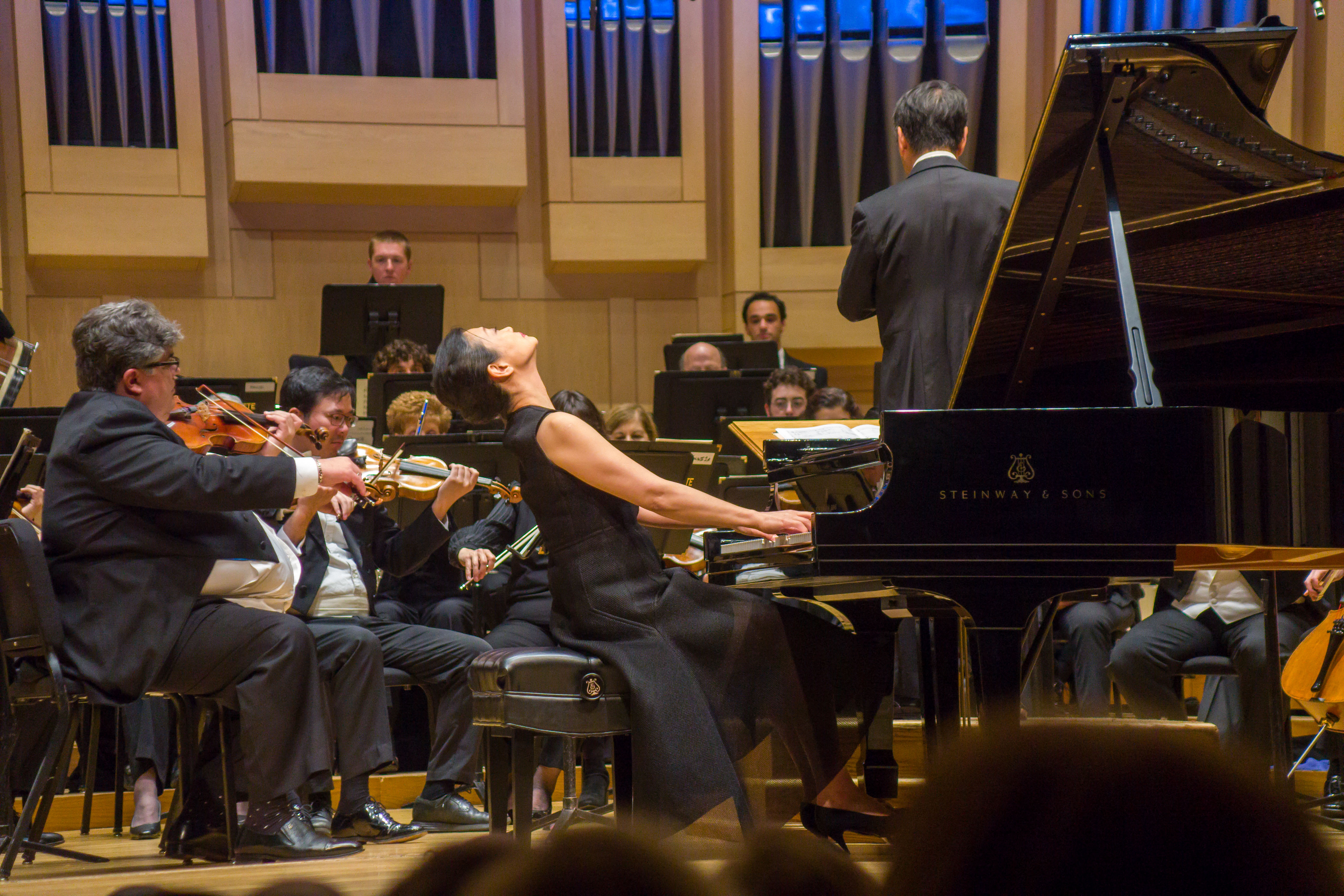
Kodama caressed the treble at times with her delicate right hand while cherishing it in her left hand with a closed fist, at other times, she leaned back and gazed almost directly upwards. Shui and the orchestra were far more emphatic in signaling the segue to the finale, a rousing Presto-Molto allegro. Early in the movement, Kodama wasn’t as crystalline in her fingering as Howard Shelley in his recording with the London Mozart Players, and I’m not sure she quite equaled the drama of the manic build at the very end that Stephen Hough achieved with the City of Birmingham Orchestra. Overall, though, the live Kodama-CSO performance matched them both.

2023~Rahmaninoff 2-21

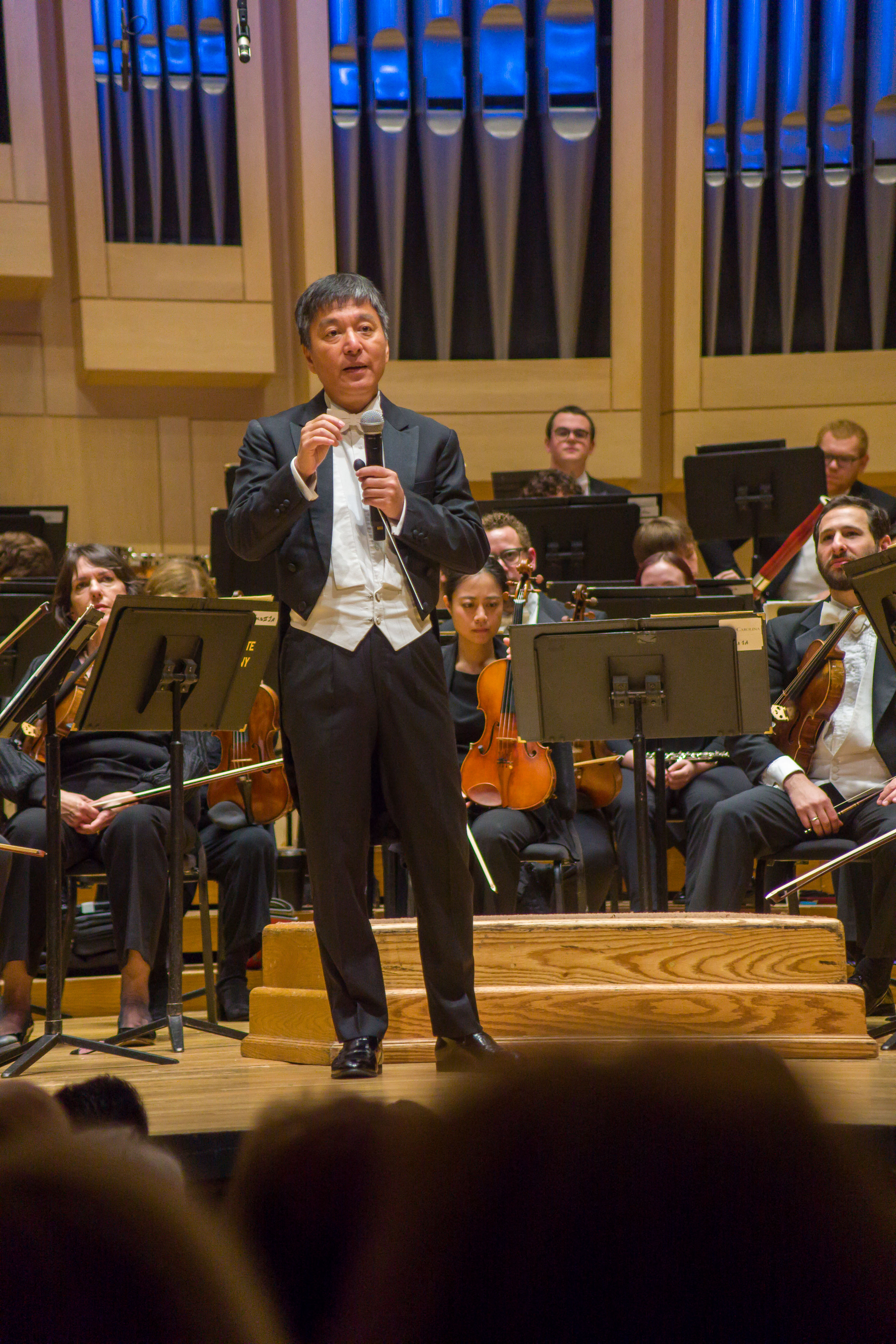
As the glory of Symphony’s performance of the Largo-Allegro moderato opening movement flowed so gorgeously from pinnacle to pinnacle, cogent and suffused with seething tension, it occurred to me that the orchestra’s immersions outside their mainstage classical offerings – in big band jazz charts and film scores – has paid off in handsome dividends. From measure to measure, like frame to frame at the movies, connections remained ironclad. Shui’s spoken intro was entertaining and informative, not above repeating some of the information in the digital program booklet, a practice that Warren-Green religiously avoided. He warned us of the hourlong length of the piece and had us on the lookout for Marino’s lovely clarinet spot at the beginning of the Adagio third movement. It emerged unforgettably out of a hush and took sad flight until the strings joined in the restless, aching keening, flowing into work’s biggest tune.

I couldn’t trace any previous CSO performances of this grand piece on my calendar or in my document dating back to 1994, so few if any of the musicians onstage were much more familiar with this gem than those of us in the audience marveling at its beauty. Shui has recorded all the Rachmaninoff symphonies with Singapore Symphony Orchestra, where he was music director from 1997 to 2019, so he has a special affinity for this music. Getting to hear his interpretation of the E minor No. 2 is a special gift for us.

CSO and the JCSU Concert Choir Lift Every Spirit at Brayboy

Review: Johnson C. Smith University and Charlotte Symphony

By Perry Tannenbaum

2023~CSO at JCSU-35

March 21, 2023, Charlotte, NC – You might have thought that a symphony orchestra performing in a college gymnasium would prove to be an odd coupling. Sure, there can be satisfying concerts staged at coliseums where a city’s basketball team plays, but those are usually performed by rockstars, pop icons, and the occasional Cirque du Soleil troupe when every note is processed electronically. My curiosity was certainly piqued when Charlotte Symphony Orchestra announced that its “In Concert with Johnson C. Smith University” program would be happening on campus at the Brayboy Gymnasium. Led by resident conductor Christopher James Lees, Symphony would be joined on the court – the hardwood covered with bright blue tarpaulin – by the JCSU Concert Choir, led by soprano Shawn-Allyce White and accompanied by pianist Frank Williams.2023~CSO at JCSU-13

A hookup between Symphony and JCSU at a more established concert venue should have seemed inevitable as long ago as 2015, when the leadership of Spoleto Festival USA visited the campus to announce that the Concert Choir would be participating in the high-profile production of Porgy and Bess the following year, celebrating the festival’s 40th anniversary. Yet when Lees picked up a microphone to greet the crowd, he reminded us that Symphony hadn’t been on campus for 13 years – indicating that this was his first time on campus and implying that CSO’s last musical director, Christopher Warren-Green, had never gotten around to the inevitable before his tenure ended. Were the optics or the acoustics the obstacles that had forestalled a return visit? Or was the idea simply slept on after Opera Carolina enlisted the men of the Concert Choir for their production of Cyrano in 2017, followed by the full choir’s appearance in I Dream in 2018?

Any questions about the Brayboy’s acoustics were swiftly dispelled. The sound from Lees’ microphone was crisp and present, nothing like the muffled sound from a faraway galaxy that emanates from PA systems at some basketball arenas or outdoor stadiums. As the brass heralded the assault of Franz von Suppé’s “Overture from Light Cavalry,” the sound remained bright and forward for all sections of the orchestra, not at all like an echoey gymnasium. French hornist Robert Rydel and principal flutist Victor Wang stood out sharply from the ensemble in their little cameos.

Rather than the controlled gallop and fury of Karajan’s recording with the Berlin Philharmonic, Lees seemed to favor the frantic onrush of Paul Paray’s recording with the Detroit Symphony, which shaves more than a minute off the Berliners’ 7:38 timing. The strings could show off their fast fingering as well as their lush tone, and when the familiar big tune surfaced, four percussionists sprang into action to make the cavalry charge more thrilling. Maybe more impressive – and surely boding well for the 14-member Concert Choir standing by for their pieces – was the syrupy sweetness of principal clarinetist Taylor Marino’s eloquence during a lull between two of the Cavalry dust storms.2023~CSO at JCSU-23

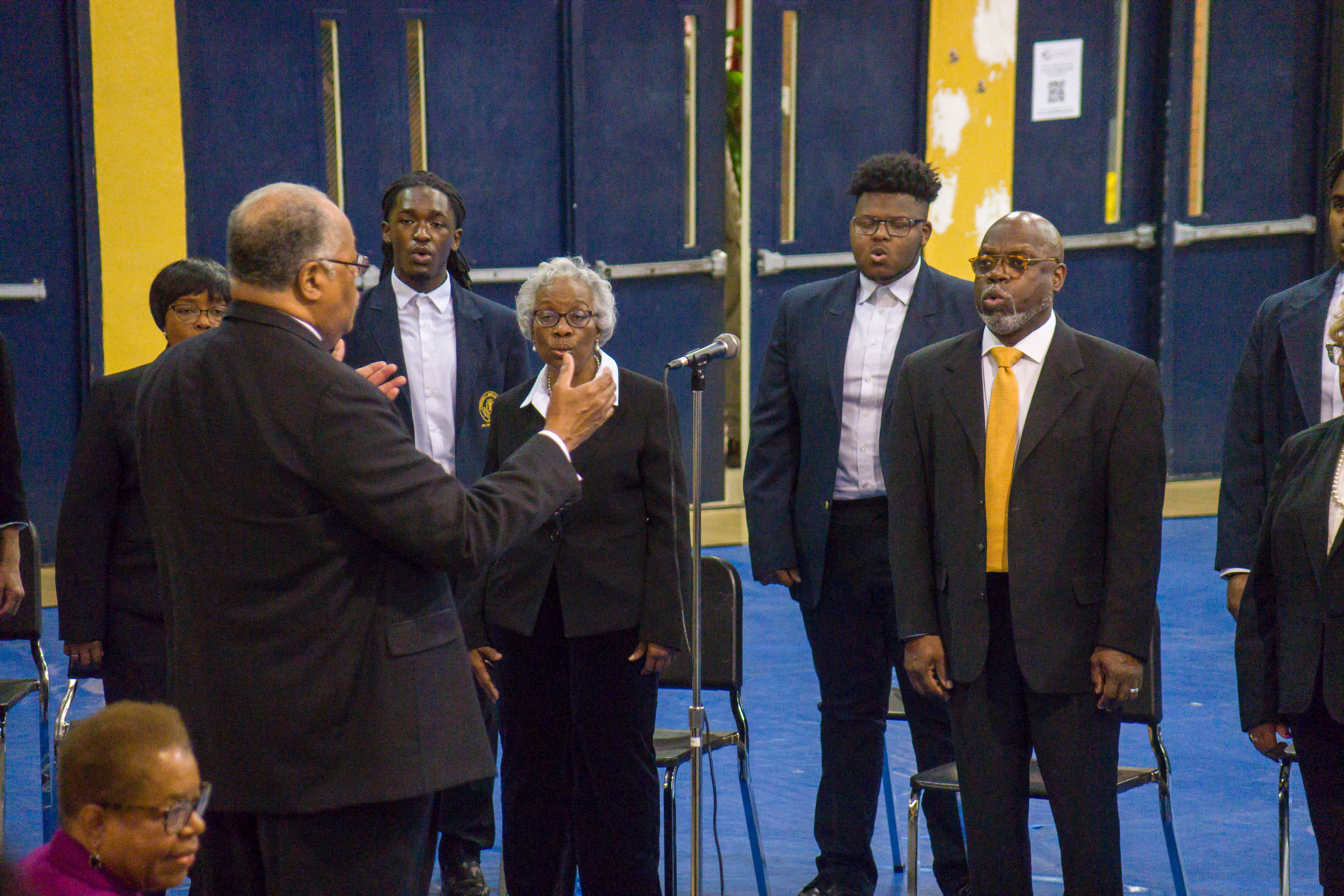
Fortified by two floor-standing mikes, the Concert Choir, eight women and six men on this occasion, were as stirring and powerful as ever at Brayboy, opening with William Henry Smith’s acapella arrangement of the traditional “Walk Together, Children.” Mostly tinted with treble and infused with jubilation, the main takeaway from the Choir’s performance wasn’t the urging of walking together but the excitement of “a great camp meeting in the Promised Land.” Richard Smallwood’s “Trust Me” was statelier, more equally weighted between the men and the women, never deteriorating into the sluggishness or singsong repetitiveness of other performances I’ve heard. The pause midway was particularly dramatic, daring to linger in silence long enough for the first smatterings of applause to break out before returning with thunder.

In between these two righteous chorales, Lees slipped in Jessica Meyer’s Slow Burn, reminding us in his intro that the composer was a violist and to be on the lookout for principal CSO violist Benjam2023~CSO at JCSU-07in Geller’s pivotal solo – but somehow neglecting to mention that the 2018 composition was written for a burlesque dancer. The piece was wonderfully apt when Symphony first performed it in early 2021, when wind players weren’t yet allowed back in concert halls due to pandemic restrictions, and the worldliness of this all-strings piece was a fine fit at the Brayboy. Bluesy strings did all of the sensual slitherings, while a pair of double basses provided percussion via pizzicatos, hand slaps, and vigorous thwacks of the bow on the necks of the instruments, accentuating Meyer’s jazzier passages. Most alluring was Geller’s suggestive glissando triggering the key swell of the strings that most vividly evoked Meyer’s title. Nor did Geller’s subsequent solo disappoint.
The two orchestral pieces that followed were more like what we expect from a city’s Symphony, but a pleasant surprise lurked in the first of these, a work dating back to the days of Haydn and Mozart, the Symphony No. 2 by Joseph Bologne, Chevalier de Saint-Georges. A champion swordsman, military leader, and political revolutionary, Saint-Georges was the son of a French planter and an African slave who would be called “The Black Mozart” because of his varied musical output, including orchestral works and operas. Saint-Georges played a key role in commissioning Haydn’s Paris Symphonies and may have mentored the younger Mozart. The outer movements, Allegro and then Presto, reminded me instantly of Mozart’s symphonic pieces, while the inner Andante brought Papa Haydn to mind. Violins dominated throughout, subtly backed by French horn and oboe in the opening movement, then by pizzicatos from the lower strings in the finale.

Some Slavic coloring had peeped into the Cavalry overture, but the performance of Antonín Dvořák’s Slavonic Dance No. 8 was the pure essence, a percussion orgy driving the main theme and the high woodwinds taking the spotlight. Anything less would have been anticlimactic in the wake of Dr. White’s stirring vocal on the Hall Johnson arrangement of “Ride on, King Jesus,” accompanied by Williams at the keyboard and crowned with a flurry of vocal fireworks. White was only slightly less impressive after the Dvořák, taking the lead vocal on the Moses Hogan arrangement of “Ev’ry Time I Feel the Spirit,” backed by the full choir with Williams conducting.

Lees stated the obvious when he declared that we were all waiting to see Charlotte Symphony and JCSU Concert Choir perform together. Would we get the Gershwin brothers or the Johnson brothers? Nothing less than the “National Black Anthem” would do at this point of the evening. While there are many YouTube examples of Dr. Roland Carter’s arrangement of “Lift Every Voice and Sing,” none on my radar sport more than a piano and an organ for their instrumentation. So Charlotte Symphony may have broken some new ground here with its uncredited orchestration.

The effect was electrifying as the entire audience rose to their feet to honor the anthem. In Carter’s arrangement, there are instrumental sections before each of the three stanzas where James Weldon Johnson’s lyrics are set to J. Rosamond Johnson’s music. Each of these interludes affording sufficient space where an orchestra can shine while providing an orchestrator with engaging new melodic material. Of course, you also want the orchestra to actively support the choir each time it enters, so the new CSO orchestration added a dimension that has always been missing in the YouTube versions. Together, Charlotte Symphony and the Johnson C. Smith Concert lifted the impact of “Lift Every Voice.”2023~CSO at JCSU-29

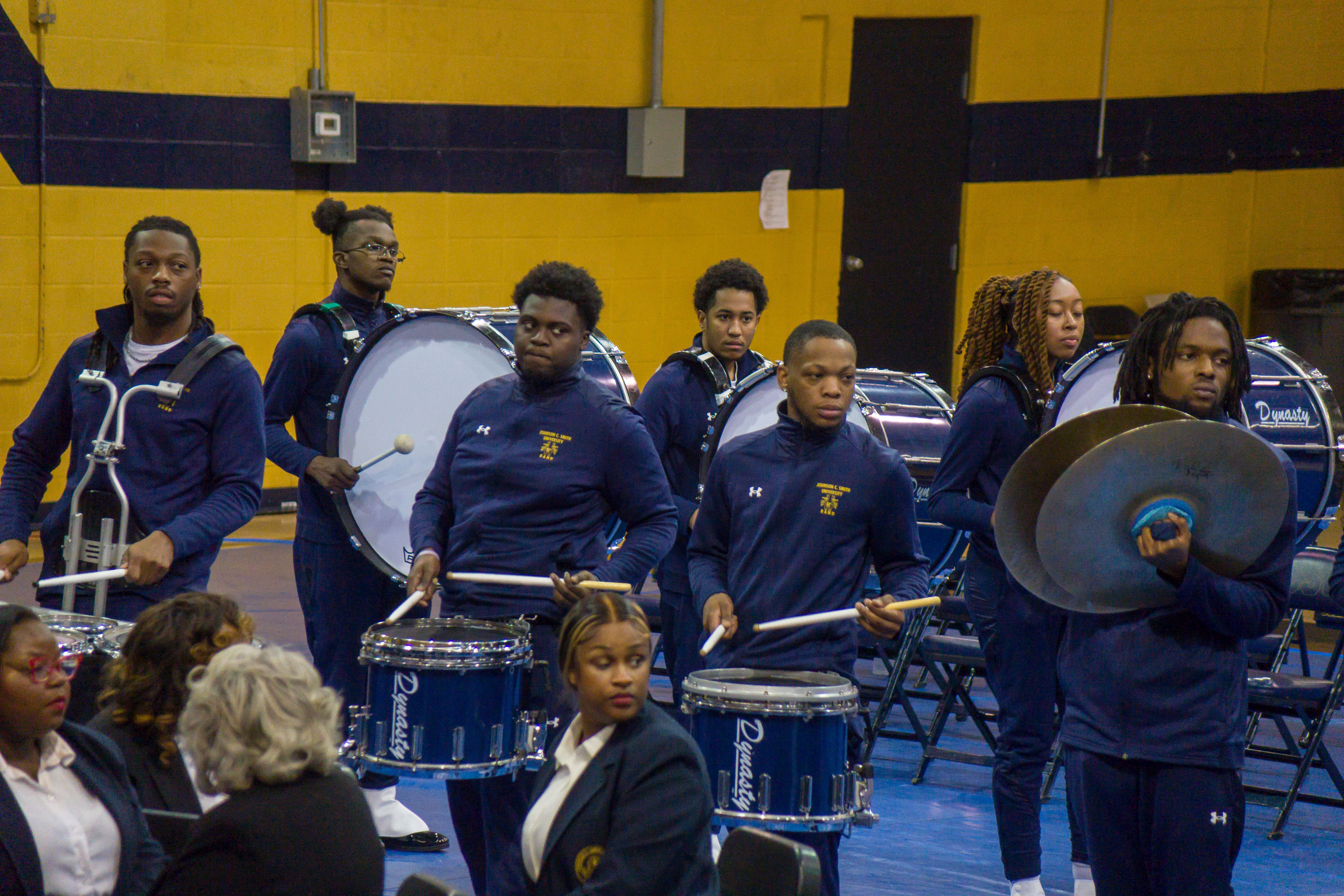
We weren’t quite done even now. Lees had hedged a bit in announcing that a surprise awaited us, probably remembering as he spoke that the JCSU Drumline, alias the Funk Phi MOB, was already mentioned in the digital program. But before they brought on the rhythm and the funk, we were all invited to participate in a lighter CSO-JCSU hookup. After a brief rehearsal of the seven-note melody, we all joined in on cue for vocal sections of Daniel Bernard Roumain’s La, La, La, La. Needless to say, the lyrics were not a challenge.

2023~CSO at JCSU-32

Amid this glee, Funk Phi MOB came marching in with their purely collegiate pandemonium, carrying me back to long-ago Saturday afternoons at the University of Iowa, the University of Oregon, and Williams-Brice Stadium where my shivers were alleviated or intensified by the fortunes of my hometown college football teams. This drumline was a bit more up-to-date than the drum corps I remember stationing themselves at midfield. Beside the customary bass drums and snare drums, a couple of these percussionists were outfitted with some sort of Yamaha hybrid, five or six flat shiny surfaces arrayed like a cross between timpani and a xylophone. If you’ve experienced how a stadium rocks during halftime, you can imagine the gymnasium version, peaking at a sensible 94dB according to my Apple Watch.

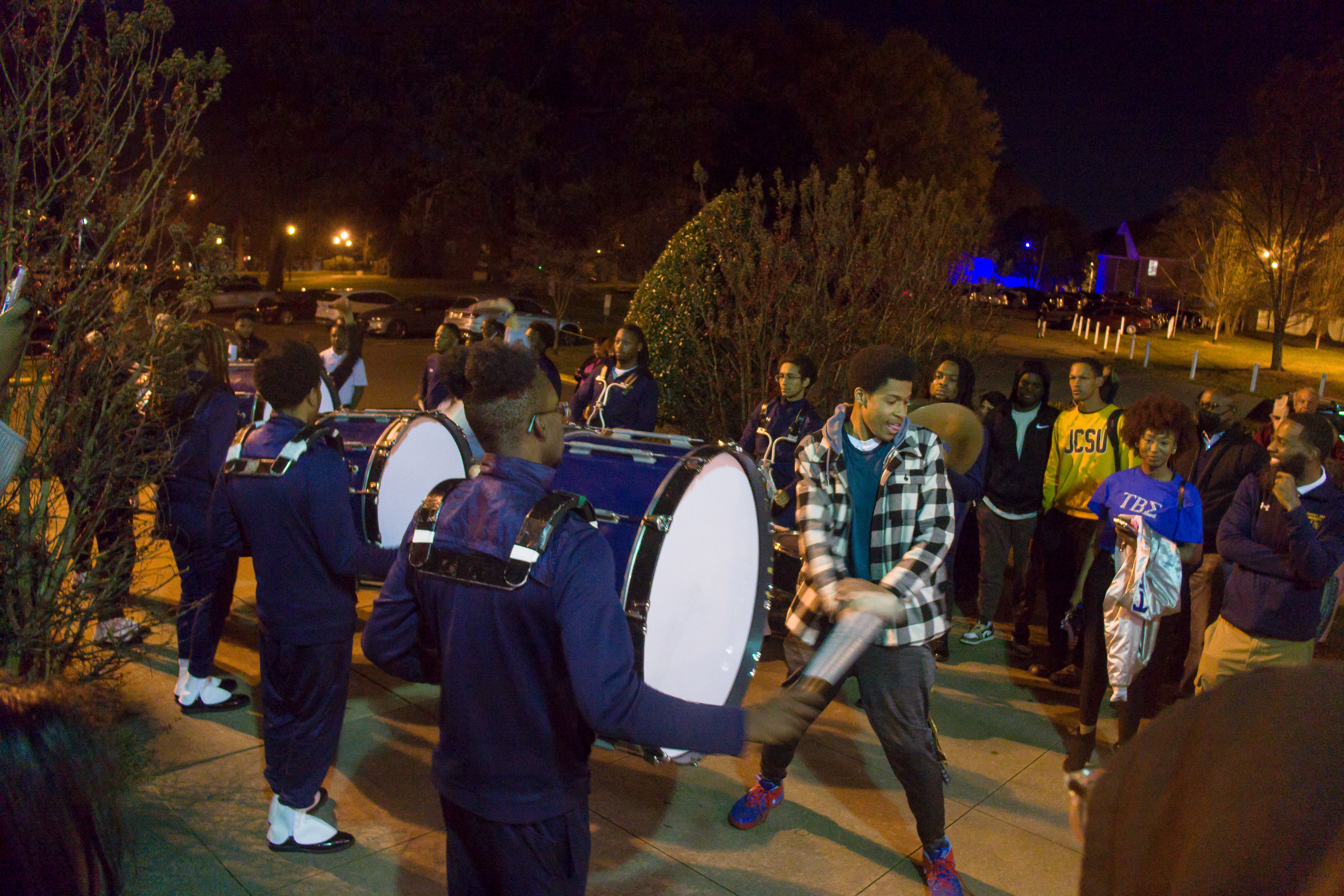
Topping off this mighty2023~CSO at JCSU-38mayhem, a drum major arrived with all his spirited, ceremonial, and high-stepping antics. Thanks for being here had been expressed long before this all-American climax, so without further adieus, the drum major could end the concert by leading the Drumline, Dr. White, and Lees out of the hall. When my wife Sue and I managed to navigate from our seats through the exiting audience and folks still milling on the court – conversing, posing for photos, and taking selfies – we emerged from the Brayboy Gymnasium and found that a drum party was still going on outside the entrance. Fortunately, I had brought my camera. Sue wouldn’t let me proceed to the parking lot until I took a few shots.

Monteverdi Validated at Myers Park With Venetian Vespers

Review: Venetian Vespers with Bach Akademie Charlotte

 By Perry Tannenbaum

2023~Venetian Vespers-03

March 4, 2023, Charlotte, NC – You might gasp audibly upon learning that The Oxford Dictionary of Music proclaims that Claudio “Monteverdi’s place in the history of Renaissance music can justly be compared to Shakespeare’s in literature.” That high regard was echoed stateside by Ted Libbey in The NPR Listener’s Encyclopedia of Classical Music: “To paraphrase his contemporary Shakespeare, he bestrode the musical world like a colossus.” Yet many at the Myers Park Presbyterian Church; where Bach Akademie Charlotte presented their latest concert, Venetian Vespers conducted by Scott Allen Jarrett; were probably witnessing a live performance of Monteverdi’s music for the first time. Others had likely never heard Monteverdi anywhere but in church and/or on recordings in their entire lives.

As far as I can tell, the Renaissance colossus has never had a hearing at Belk Theater or Knight Theater in Charlotte. I’m fairly certain that my first live encounter with Monteverdi was at Spoleto Festival USA in 1991, when L’Incoronazione di Poppea was presented at Dock Street Theatre. Before then, my revelations had happened at local libraries in Columbia and Charlotte, where I could borrow and fall in love with vinyl recordings of Monteverdi’s Madrigals (there are nine books of them) followed by my discovery of L’Orfeo, the first masterpiece in opera history.

In keeping with the tone of the venues where Bach Akademie usually performs – and the liturgical spirit of their marquee composer – Jarrett, with a small chorus of six voices and an instrumental quintet, focused on two major sacred works that bookended Monteverdi’s career, his Vespro della Beata Vergine (1610) and his Selva morale e spiritual (1641). Sensing a general unfamiliarity with Monteverdi’s music and his importance, Jarrett spoke at length on both, stressing the cultural eminence of Venice at the peak of the Renaissance and Monteverdi’s towering influence over how composers would write for voice after he upended traditional practice by prioritizing text over music.

The texts that Bach Akademie performed were mostly scriptural and liturgical Latin, but Jarrett and his musicians also dipped into the “moral madrigals” found in the Selva collection, with Italian texts written by Francesco Petrarch and Angelo Grillo. In fact, Jarrett’s selections were admirably proportional to the original collections: we had twice as many excerpts from the Selva as we heard from the Vespro, and the Italian songs gave us a balanced representation of the larger collection, which on complete recordings is just over twice the size of the 1610 Vespers.

2023~Venetian Vespers-17

We began and ended the concert with full ensemble pieces from the Selva, starting with “Laudate Dominum” (second version). Sopranos Margaret Carpenter Haigh and Arwen Myers blithely chimed the opening exhortation – “let us praise” – over and over, interspersed with full choral and instrumental passages, along with a couple of merry exchanges between tenors Nick Karageorgiou and i. Four of the six Selva selections were originally for accompaniment by two violins, slots ably filled by two mainstays of Boston’s exemplary Handel and Haydn Society, concertmaster Aisslinn Nosky and Fiona Hughes.

2023~Venetian Vespers-32

Replacing the four trombones in the score as well as playing their own parts, Nosky and Hughes figured more prominently in the “Gloria” that followed Jarrett’s impressive disquisition. This larger-scaled composition also offered more opportunity for the vocalists to shine, the tenors declaiming the title word most often before the sopranos dominated with their filigree on the recurring “Domine.” Thanks to Jarrett’s intro, we were also on the lookout for the heavenly harmony lavished on the stately “peace on earth” passage, enriched by Edmund Milly’s bass-baritone, cellist Guy Fishman, and organist Nicolas Haigh.

2023~Venetian Vespers-13

Accompanied solely by Deborah Fox on theorbo, Myers and Margaret Haigh gave us a marvelous first sampling of the Vespro, “Pulchra es,” set to two amorous verses from the Song of Solomon, delicately straddling the borderline between chastity and seduction as they sang from opposite sides of the chancel. Both sopranos rejoined the male vocalists as we returned to the Selva with “Laudate pueri” (first version). The men harmonized sweetly to launch this setting of Psalm 113 before the sopranos quickened the tempo and lifted the music to joy and jubilation.

I wondered how Jarrett and Bach Akademie planned to handle “Duo Seraphim,” the next Vespro selection, since it was written for three tenors, according to the program booklet, and the conductor deployed Karageorgiou and Wilson to opposite ends of the stage. Akademie’s artistic director must have also anticipated some suspense in the room, for it wasn’t until halfway through the piece that the third tenor walked to his place upstage, behind organist Nicolas Haigh – Milly, the bass! While Milly’s tessitura didn’t need to reach quite as high as the two other tenors’, he did quite well, actually sounding louder than his comrades on a few notes. Of course, there’s another way of construing the drama of Jarrett’s staging. At the exact point where the text departed momentarily from its familiar Isaiah 6 refrain, and the heavenly witnesses to the seraphs’ “Holy, holy, holy” call were cataloged as “the Father, the Word, and the Holy Spirit,” Milly took his spot upstage before the three were said to be one.

Composed while Monteverdi was still in service to the Duke of Mantua, the “Dixit Dominus” for six voices and instruments seemed to be specially crafted for the acoustics of the Venetian Basilica of San Marco where he would later serve as the chapel maestro. John Eliot Gardner’s recording of the complete Vespro at San Marco with the English Baroque Soloists in 1986 implicitly made that point, and Jarrett, both in his introductory remarks and with the ensemble’s performance, made that point explicitly at Myers Park Presbyterian.

2023~Venetian Vespers-31

Although she didn’t get much of the vocal spotlight, alto Laura Atkinson picked up a microphone to preface the remaining three Selva selections. Both of the poems that followed, written by Monteverdi for the other five voices, proved worthy of the pulpit, as their translated titles indicated: Petrarch’s “O blind ones! What use is all your toiling?” and Grillo’s “This life is a flash of lightning.” Reminding us that this was Bach Akademie and that the Charlotte Bach Festival is slated for its return on June 10-17 (if interim managing director Garrett Murphy’s fundraising goal is met), Jarrett and company gave us a small-scale preview of the plenty to come with Johann’s “Sanctus in D.” Not the swiftest version you’ll ever hear, but light, lively, and irresistible.

“Beatus vir” (first version), set to Psalm 112, was an apt finale to this Venetian Vespers concert, carrying forward the festive mood of the penultimate Bach with invigorating vocal counterpoint – Monteverdi writing here for six exactly voices at last – and providing Nosky and Hughes, as the two violinists also prescribed by the score, with their best opportunities to shine. But it wasn’t until the music slowed down, where the Psalmist spoke on the steadfastness of a god-fearing man in the face of evil tidings, that the finale became truly grand. The sheer massiveness of the sound summoned up the church to mix its harmonies, reminding us that we were in a house of worship.

Mei-Ann Chen Rocks the Knight in CSO Debut

Review: Bruch’s Violin Concerto with Charlotte Symphony

By Perry Tannenbaum

2023~Bruch Violin-18We’ve been hearing about numerous identified and unidentified flying objects in recent weeks, emanating from numerous sectors of the globe, crossing over our nation’s territorial waters and seeking all sorts of military and meteorological intelligence. Less mysteriously, there have been precise predictions in recent months of astral objects whistling through our solar system, one of them brushing closer to dear Earth than the moon.

But until now, not a word about the meteor that struck the Knight Theater in the heart of Uptown Charlotte. Her name is Mei-Ann Chen, and we can only hope that the guest conductor now in our midst is vying for the vacant music directorship at the Charlotte Symphony. It would be grossly unfair, no doubt, but it wouldn’t a bad idea to sign her up before she left town.

Chen’s impact on – and appeal to – the Symphony’s musicians and subscribers was nothing short of electric.2023~Bruch Violin-09_Export

The orchestra had never performed Fanny Mendelssohn Hensel’s Overture in C Major before, yet they attacked the work zestfully, conveying its sharp contrasts and drama with unmistakable fervor. Flutist Amy Orsinger and principal oboist Hollis Ulaky excelled, jointly and separately, in the piece’s gentler moments. Although we had heard the CSO play the BRUCH VIOLIN CONCERTO as recently as 2016, Chen ignited the ensemble with fresh fire rather than receding to a subsidiary role behind concertmaster Calin Ovidiu Lupanu.

Instead of deferring to the soloist – or even seeking an agreeable balance between orchestra and violinist – Chen laid the gauntlet down to them both, so that Lupanu and Symphony spurred each other to greater heights vying for supremacy, achieving a higher level of parity through their combat. More adventurous now than I can recall, Lupanu was nearly note-perfect all the way through the treacherous terrain of the Allegro energico finale while his attack, confidence, and feeling were never better. His command was certainly impressive throughout the opening Allegro moderato, with a transition to the slow middle movement that was amorously smooth. Principal flutist Victor Wang helped to make this Adagio extra exquisite.

As the concerto climaxed, it might have been a toss-up to many in the audience whether Chen was inspiring the CSO or vice-versa. In respect for your colleagues, you’re not going to urge an orchestra too insistently to give us more during a performance – that has to have happened behind the scenes in rehearsal.

Our first glimpse of what that might have been like came right after the concerto, when Chen gestured to the audience to give Lupanu more love for his sterling performance. After the break, our impressions grew more vivid as Chen picked up a mic at the podium and greeted us. Not satisfied with our “Good evening!” Chen urged us to make a second try, somehow infusing this tired old emcee shtick with new energy and spontaneity – and getting results.2023~Bruch Violin-23

Speaking about the works on tonight’s program, Chen included info we could have gleaned from the program – a practice that Christof Perick and Christopher Warren-Green staunchly resisted – and made an effort to link the pieces together with a common theme. Faced with a crowd that was significantly more numerous than the crowd I’d seen three weeks earlier, but still significantly short of Knight’s capacity, Chen declared that Charlotte should be more supportive toward its Symphony.

That was a more compelling statement after delivering two examples of our musicians performing at their peak.

Chen rightly surmised that the main draw of the evening was the Bruch, since the César Franck Symphony in D minor, originally slated for its revival last March, hadn’t been heard in the Queen City since November 2003. Now that was a pitifully attended concert at Belk Theater, after striking CSO musicians had settled on a new contract and returned to work, so Symphony subscribers can pat themselves on the back for improving on that turnout.2023~Bruch Violin-10_Export

The main link between the two Francks that I’ve seen was the fine work by Terry Maskin on the cor anglais solo in the middle Allegretto movement. In the outer Allegro movements, our brass proved its mettle once again, though we’ve surely seen a Chening of the guard during the intervening decades. Associate concertmaster Joseph Meyer distinguished himself in the early Lento of the opening and principal French hornist Byron Johns had outstanding moments when the music quickened.

Chen improved most on the Perick performance of 2003 in the Allegretto, livening the effect of Maskin’s soulfulness on the English horn with more standout work from Johns and Andrea Mumm Trammell’s delicacy on the harp. Before the brass brought the finale to its brash climax, CSO’s principal harpist bubbled up tellingly in the symphony’s last calming episode.

Obviously content with her musicians’ handiwork, Chen gave the audience opportunity after opportunity to show the appreciation she had previously asked for. With unmistakable cues, Chen called upon us – already giving them a standing O – to really let the musicians hear it as she prompted them individually and collectively to take their well-earned bows. We did.

[If you missed Mei-Ann Chen in Charlotte, you can catch up with her on June 7, when the Chicago Sinfonietta music director conducts Antonín Dvořák’s “New World Symphony” at Spoleto Festival USA.]

Photos by Perry Tannenbaum

Parameswaran Delights With Eclectic Mix of Moderns

Review: Sibelius No. 5 with the Charlotte Symphony

 By Perry Tannenbaum

2023~Sibelius 5-14

Maybe subscribers to Charlotte Symphony’s Classical Series aren’t as invested in choosing a successor to music director Christopher Warren-Green as I had presumed, or maybe the weather was too darn wintry for the wusses. Whatever the cause, the audience that came to see guest conductor Vinay Parameswaran perform a program that included music by Gabriella Smith, Benjamin Britten, and Jean Sibelius – while launching CSO’s celebration with a fine example of William Grant Still’s artistry – didn’t come close to filling Knight Theater to capacity.

Nor could anyone who looked over the stalwarts who braved the Arctic cold have called us diverse.

Could be that we’re complacent, self-satisfied, and spoiled. After hosting a musician as renowned and prestigious as Warren-Green, we may have forgotten that the candidates parading before us, seeking to impress in order to land a job offer, might just need to be sufficiently impressed by us to accept.

So it was interesting to watch how Parameswaran reacted when he looked out at the crowd, pocked with empty seats, and met us for the first time in his Charlotte debut. A rather sober look on his face abruptly turned to shock, surprise, and gladness as he heard our outsized enthusiasm.2023~Sibelius 5-02

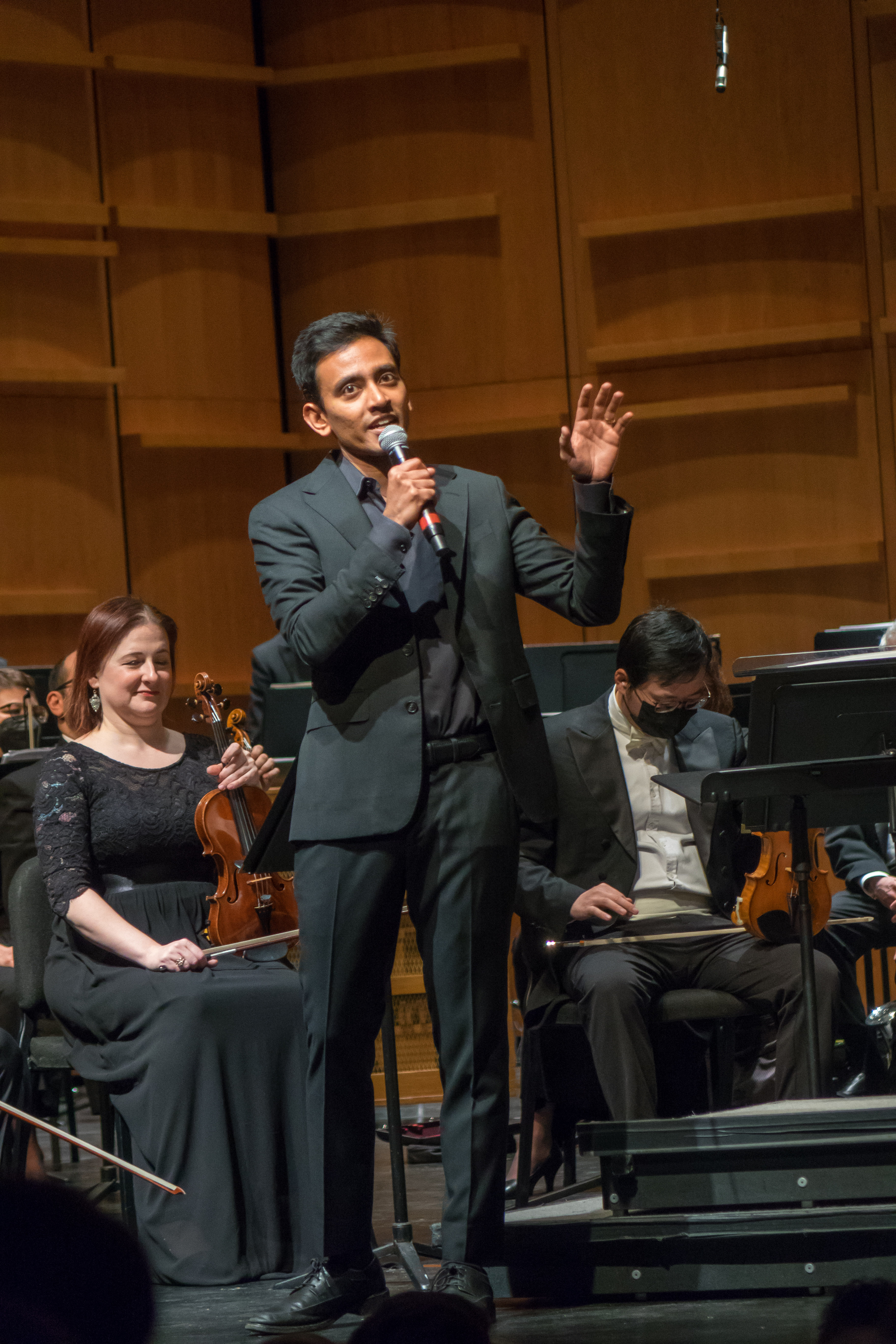
He was rather charming, then, when he picked up the mic at the podium and described Smith’s piece, Field Guide, along with the works that followed. Any misgivings that concertgoers who stayed away could have harbored about his foreign-sounding name would have been instantly dispelled by the ease with which he spoke and the ease with which we understood – even if it was outré for him to describe Arthur Rimbaud’s Les Illuminations, the text for Britten’s song cycle, as “nonsensical.” I could hardly believe my ears.

Fortunately, the boldness of the San Francisco Bay Area native didn’t end there. He and the orchestra dug into Field Guide with gusto. Or tapped in, for the lower string players tattooed a sustained ostinato at the beginning of this pictorial voyage, delivering the sounds of insects, birds, animals, and swirling waters that Smith had recorded in the field and given new orchestral color. Cacophony was also mixed with the woodland stealth, and a look at the digital program booklet confirmed, in stray passages reminiscent of Debussy’s La Mer, that Smith had also taken her recording equipment to the ocean and under the sea.2023~Sibelius 5-24

Surreal, visionary, and hallucinatory though they might be, Rimbaud’s landmark prose poems are neither indecipherable nor dated. Canadian soprano Alexandra Smither, also making her Queen City debut, was evidently eager to share the wonder and variety of Britten’s settings, though she seemed as taken aback and gratified by our lusty greeting as Parameswaran had been. To fully savor the rightness of the music and the subtly crafted lucidity of Britten’s discreetly edited text, you’ll want to download the digital program booklet (via QR code) and follow along on your smartphone.

They do ask that you turn down the brightness of your screen as you’re reading the English translations of the French. Savor the irony as you reduce the illumination for Illuminations.

Our CSO thinned out during the transition from Smith to Britten, for the song cycle was written for strings and voice – with its intimacy compounded when concertmaster Calin Lupanu and principal cellist Jonathan Lewis play solos. Taking for a refrain a line of Rimbaud’s “Parade,” which concludes with “I alone have the key to this savage parade,” Britten turns his entire cycle into a savage parade – or as Duke University professor Wallace Fowlie translated it, “this wild circus.”

“Parade” doesn’t actually occur until the penultimate song in the 10-part suite, and both Smither and Parameswaran fully savored its climactic orchestral exuberance, appropriately rendered in marching tempo. Unlike Rimbaud’s masterpiece, which ends by scaling to a blasphemous pinnacle in “Genie,” Britten goes from “Parade” to a devastatingly subdued “Départ” (Departure), perhaps expressing empathy for the tragic gay poet. The effect was more powerful because Smither and the CSO had partnered in mostly uptempo songs until then. Excitement had been fairly intense from the beginning, when tremolos from the lower strings flowed into the first vocal scoring of Britten’s surreal refrain in “Fanfare,” taken by Smither at an infectious poco presto tempo with all her characterful ebullience.

Okay, so I’ll confess that I had slept as soundly as anybody on William Grant Still until Parameswaran brought him brashly to us. We’re catching up with him comfortably ahead of the centennial of Still’s ascension to the title of “Dean of African American Composers,” when he was the first black composer to have his work performed by the New York Philharmonic in 1930. The Naxos label and Apple Music are fairly woke to Still, woker than my first Spotify searches could confirm, though I found the same recording of Poem for Orchestra – by the renowned Fort Smith Symphony – at both streaming services.

With a helter-skelter cacophonous opening, Symphony and Parameswaran were far bolder and more modern than their Fort Smith counterparts as the full ensemble returned after intermission. Even when the CSO settled down and we could see the Brahms-and-Gershwin bloodlines of Still’s composition, with occasional soured passages paralleling Shostakovich’s wartime works, the music sounded more vibrant and contemporary. After that startling first onslaught, I very much liked what I heard.

There’s also plenty more for us to experience live after dipping into the streaming goodies we can sample. Still wrote at least four more symphonies after the NY Phil breakthrough, a fairly copious amount of piano and chamber music, and numerous memorable elegies, including one for “The Colored Soldiers Who Died for Democracy” and a “Threnody for Jean Sibelius.”

Following the Poem for Orchestra with Sibelius’ most admired and recorded symphony didn’t sound random, either. Last played at Belk Theater by the CSO and Warren-Green in the spring of 2015, the brassy Tempo molto moderato opening movement made itself immediately welcome, cresting with a grandeur that almost brought me to tears. The delicacy of the Andante middle movement, beginning with waves of pizzicatos and morphing convincingly into an Allegretto scherzo, was also brilliantly calibrated.

Perhaps because those pizzicatos sound so much more vivid in live performance than on recording, the deficiencies of the closing Allegro molto – Misterioso were more apparent compared to the CDs in my library, including the definitive 1997 interpretation by Osmo Vänskä. Parameswaran didn’t push the pace as thrillingly to start the movement, so the big tune from the brass didn’t arrive as majestically in repose. But the orchestra delivered amply on the restless, mysterious aftermath, and the six hammering whomps at the end, half of them spiked with timpani, satisfied everyone.

–Photos by Perry Tannenbaum

Ryan and CSO Launch 2023 in American Style, with a Wisp of Freedom-Fighting Ukraine

Review: Charlotte Symphony Plays Copland’s “Great American” Symphony No. 3

 By Perry Tannenbaum

January 13, 2023, Charlotte, NC – Kwamé Ryan was slated to make his Charlotte Symphony debut at Knight Theater last March in a program that included Errollyn Wallen’s Mighty River, César Franck’s Symphony in D minor, and Samuel Barber’s Violin Concerto with soloist Jinjoo Cho. Cho showed, but Joshua Gersen from the New York Phil and the New World Symphony filled in for Ryan. We could have speculated that Ryan had withdrawn his name from consideration as Symphony’s next music director, giving way to Gerson as a hot new prospect for our upcoming vacancy. Earlier that same week, however, the native Canadian was announced as one of 10 guest conductors for the current season, so it was clear that Ryan’s hat remained in the ring – but he and Symphony would need to fashion an entirely new program.

2023~Copland + Korngold-12

This time at Belk Theater, the program would be all-20th century – John Adams’ Short Ride in a Fast Machine (1986), Erich Wolfgang Korngold’s Violin Concerto in D (1945), and Aaron Copland’s “Great American” Symphony No. 3 (1946) – and even more American, since Korngold, revered for his many Hollywood film scores, became a US citizen four years before his concerto premiered, with Jascha Heifetz wielding the fiddle. Bella Hristova, making her local debut in the Korngold, was apparently booked after Ryan and the concerto piece had been placed in the 2022-23 lineup.

If you haven’t Adams’ brisk orchestral bagatelle, the title describes it well. Marin Alsop, recording the piece with the Bournemouth Symphony, appears to hold the land speed record for her Fast Machine among the seven samples I’ve tracked down, clocking in at 3:58. At the other end of the spectrum, Michael Tilson Thomas with the San Fran Symphony and Kurt Masur with the New York Phil are the sluggards among the conductors on record, leaning more toward Adams’ subtitle, Fanfare for Orchestra, than to the work’s speed. Tilson Thomas made the best-sounding recording, though Stephen Mosko’s performance with the Netherlands Wind Ensemble is definitely worth a listen, even if the woodblock opening the piece – and its insistent marking of time afterward – is tuned higher in the treble. Here the crisp woodblock over the pulsing brass may not have worn out its welcome before giving way to a richer timekeeping shaker when the brass began to soar.

We’ve heard Charlotte Symphony in this music at least a couple of times before, with Alan Yamamoto at the Belk podium in 2006 and Jacomo Rafael Bairos in an all-American KnightSounds concert in 2013. My review of the Yamamoto performance cruelly credited him with thinning the crowd during intermission, but with Bairos, I could happily note how far our subscribers had progressed in accepting Adams. There was a little helter-skelter in Ryan’s reading, maybe a good thing in warding off minimalist monotony, but the audience was downright enthusiastic when the rollercoaster abruptly shut down. Latecomers who were ushered to their seats in the wake of this tasty appetizer could be legitimately pitied for missing out.

Between the evening’s two fanfares – for the Copland Symphony famously repackages his well-known Fanfare for the Common Man – Korngold’s Concerto made for a lyrically lush contrast. Hristova was more precise than Vadim Gluzman, who introduced the piece to Charlotte with Christof Perick at the Belk in 2005, five years before his fine recording on the BIS label. But Gluzman was more ardent, personable, and charismatic in his playing. You can tell a lot in the opening bars of the Moderato nobile about which direction the soloist intends to take. There’s the richer, lusher approach taken by Gil Shaham and James Ehnes that opts for the alluring path I prefer, and then there is the thinner, more gilded approach favored by Sophie Mutter and Itzhak Perlman that aims toward the exquisite and ethereal.

2023~Copland + Korngold-01

Hristova most resembled Mutter among these four, but I felt that Ryan and the CSO outshone her in the opening movement. She wasn’t playing enough with the orchestra’s swells, so their oceanic responses to her episodes weren’t like majestically crashing waves, and her climactic cadenza lacked fire and confidence. Reaching the middle Romance-Andante movement, Hristova achieved parity with the orchestra, growing tenderer and richer in tone with heightened expressiveness. Better still, she was outstanding in the rousing Allegro assai vivace that climaxes the concerto, fairly dazzling with her ricochet bowing and pizzicatos. Here she was meshing well with the folksy ensemble as they reached the spirited series of cymbal smashes that signal the onset of the finale.

Although Copland’s most familiar fanfare doesn’t get its Symphony 3 rebirth until the concluding Molto deliberato movement, Ryan certainly understood the fanfare kinship of the opening Molto moderato with the more familiar Common Man proclamation that awaited us three movements later. More in keeping with Leonard Bernstein’s CD version than with the initially mopey takes by the San Francisco and Minnesota Symphonies, Ryan threw the themes into an echo chamber spin cycle before emerging at the conductors’ common summit: a cathedral of sound that fell away into quiet, mellow sublimity. With a bass drum alarm blast and fresh brass annunciations that dribbled away into comical clockwork pulses of woodwind and percussion, the Allegro molto sounded like a scherzo at first. But when Ryan brought back the heraldry from the brass and drums, the orchestral response was pointedly mellower and mature, cuing us to expect steady grandeur when the artillery returned once more.

2023~Copland + Korngold-16

Where Bernstein was weepy and wistful, Ryan and CSO applied a gloomy, brooding patina to the other inner movement, an Andantino quasi allegretto. He didn’t find the same range of grandeur and folksiness that Lenny unveiled in 1986, but as the piece transitioned without pause into the stately Molto deliberato, there was a wonderful mix of forlorn wilderness and divinity as the quiet woodwinds introduced the familiar Common Man phrase. The brassy orchestral repetition came with all the éclat and majesty you’ll ever hear in the similarly crowning moment of Copland’s Appalachian Spring, gloriously tattooed with timpani, cymbals, and drums. There was plenty left to do before the second and third series of heraldic salvos, beginning with Hollis Ulaky’s magical oboe, escalating to some pre-dawn tweedling from the higher winds, and some shiny “Frère Jacques” tolling from the brass and strings. CSO continued to excel as new variants of the “Common Man” theme mixed with the recurring tolling, simulating an awesome and propitious post-war sunrise. In his apt introductory remarks, Ryan turned our attention – and the ultimate optimism of Copland’s symphony – to the current battle for freedom in Ukraine. We could hear and understand the relevance.

Rhiannon Giddens Returns to Charlotte and Leaves Plenty of Music in the Air

Review: Rhiannon Giddens with Charlotte Symphony

By Perry Tannenbaum

2022~Rhiannon Giddens-33

November 5, 2022, Charlotte, NC – Since the long-anticipated world premiere of her new opera, Omar, at Spoleto Festival USA back in May, composer-singer-instrumentalist Rhiannon Giddens has hopscotched the worlds of folk, jazz, and classical music. Her Spoleto apotheosis down in Charleston was embellished with a sit-down interview event and an outdoor concert with multi-instrumentalist Francesco Turrisi, her collaborator on They’re Calling Me Home, the 2022 Grammy-Award-winner for Best Folk Album. Among Giddens’ many gigs since then, she has headlined at the San Francisco Jazz Festival and Carnegie Hall before entering downstage at Belk Theater for a rendezvous with the Charlotte Symphony and resident conductor Christopher James Lees. As you might presume of a MacArthur “Genius Grant” recipient, Giddens is not easily pigeonholed.

2022~Rhiannon Giddens-23Yet the Greensboro native co-founded the Carolina Chocolate Drops, her first Grammy Award exploit, and now has an opera firmly rooted in the Carolinas to her credit, so an audience studded with black ties and tuxes had no difficulty embracing the polyglot Giddens as their own – even as she navigated a songlist that included Parisian and Celtic selections. They may not have realized that Giddens had played Charlotte before, as far back as 2008 when I caught her with the Chocolate Drops at Northwest School of the Arts. Turrisi and bassist Jason Sypher, who shared the Cistern Yards stage with Giddens at the College of Charleston in May, accompanied her once again, though Lees and Symphony lightened their load. Nor was it obvious that Turrisi would be playing piano until late in the concert when he insinuated himself upstage.

As soon as my QR code scanner brought up the evening’s program, I could see that the Symphony offerings would be more eclectic, accessible, and daring than the set Giddens performed at Spoleto. Even before Giddens led her trio onstage, Lees and the orchestra demonstrated that they would not be content to trot out the stale and familiar, following up on John Williams’ brassy Liberty Fanfare with Samuel Coleridge-Taylor’s Overture to Hiawatha, referencing a half dozen episodes from the composer’s trilogy of Longfellow-inspired cantatas. In the wake of the fervid Fanfare, a little more finesse could have been applied to the opening of the African Britisher’s evocation of the primeval American classic, letting the harp sound more clearly, but Lees was certainly simpatico with the shifting moods and tempos afterward. Violins were gossamer-light in “The Wooing” section, the waltzing section that followed had admirable propulsion, and the cello corps warmed the tenderest episode, before the big build in the “Reunion” finale.2022~Rhiannon Giddens-31

The truly treasurable experiences began when Giddens strode onstage and picked up her banjo; for her first song, “Spanish Mary,” was co-written with Bob Dylan, with a fine orchestral arrangement for Lees and Symphony to luxuriate in. Shedding the banjo, Giddens followed up with “Julie’s Aria” from Omar, co-written with Michael Abels, reminding us of her own capabilities as an operatic soprano. Yet within minutes, Giddens was delivering a smoking-hot version of “Water Boy,” the pile-driving prison song immortalized in recorded versions by Paul Robeson, Odetta, and Harry Belafonte.

No doubt, Giddens has listened repeatedly to all three of these cultural touchstones, for the simple hammering arrangement was borrowed from Odetta and Belafonte while the lyrical clarity hearkened back to Robeson. The Odetta recordings of “Water Boy” are unparalleled, particularly when it caps a medley begun with “I’ve Been Driving on Bald Mountain,” shot through with explosive grunts and gasps from the hammer-wielding prisoner. But Giddens has found her own path toward heightening the intensity at the end, and the orchestra beats delivered by Symphony added jolts of electricity throughout the piece that simple guitar strums couldn’t match. Better still, Giddens’ preamble, “At the Purchaser’s Option,” was certainly a coupling with “Water Boy” that civil rights champion Odetta would have appreciated, repeatedly delivering a “you can take my body, you can take my bones, you can take my blood but not my soul” mantra.

2022~Rhiannon Giddens-19“Mouth Music” was all we needed to hear if we needed assurance that Giddens could make a credible showing at a jazz festival, and there would be more to follow. Lees ceded the stage to the guest trio, lightening the vibe, and Giddens picked up a viola and yielded some of the spotlight to her bandmates, especially Turrisi when he sizzled on his accordion during one of the fiddle tunes. The merriment faded when Lees returned to the podium, replaced by the romance of “Autumn Leaves” en français until Giddens favored us with the English lyric as well. If you hadn’t glimpsed the program, just the tropical sway of the violins was enough to announce our return to the Carolinas and “Summertime” from the Gershwins’ Porgy and Bess, sweetly sung. Plenty of space was afforded to both Giddens and Symphony in the arrangement of “La Vie en Rose,” and the singer did not seem to be straining to sound like Edith Piaf, which was more than OK with me.2022~Rhiannon Giddens-15

Homing in on the end of the evening, Giddens and Symphony tacked toward the spiritual. With Turrisi at the keyboard, Giddens embarked on this final journey with “He Will See You Through,” followed by “Wayfaring Stranger,” opting to travel through this world “alone” rather than “below” or “of woe” as others have sung. These songs of faith certainly cleared the way for the affirmation and joy of Giddens’ final two selections, an irresistible pairing of “That Lonesome Road” and “Up Above My Head,” a perennial YouTube favorite that can’t be found on her albums. The last of these was memorably inspired. We all heard so much “music in the air” that we could leave more than satisfied, even without the planned encore.

New Charlotte Symphony Season Brings New Sounds and Welcome Echoes

Review: CSO Plays Elgar’s Cello Concerto and Strauss’s Aus Italien

2022~Elgar Cello-05By Perry Tannenbaum

October 7, 2022, Charlotte, NC – Charlotte Symphony’s conductor laureate, Christopher Warren-Green, had been gone nearly a full week, but the echo of his presence remained at the kickoff of the 2022-23 season at Knight Theater. Once again, the Orchestra fired off the “Star-Spangled Banner” to inaugurate the new season, and once again, the ensemble achieved lift-off with Edward Elgar’s Cello Concerto – just like they did in 2012 at Belk Theater in Warren-Green’s first concert as musical director. Now Andrew Grams wielded the baton, his first guest shot with Symphony since 2016, and the soloist making her Charlotte debut was Israeli cellist Inbal Segev rather than Alisa Weilerstein.

Both artists have recorded the Elgar, Bloch’s Kol Nidre, and the complete Bach Cello Suites, so they may be described as kindred spirits. Perhaps Segev gets the nod over Weilerstein in being more simpatico with Grams, who began his program with PIVOT by British composer Anna Clyne. Not only did Segev commission a new Clyne concerto, DANCE, but she also premiered it on the same 2020 album where she plays the Elgar. Grams returned after intermission with Richard Strauss’s rarely-heard Aus Italien, arguably a more outlaw piece than the composer’s Don Juan.

Always forthcoming and charming when he addresses an audience, Grams likened the transitions of PIVOT to pressing the “previous channel” button on a TV remote control. True enough, shifts back and forth from the slow to the fast sections of the piece were often abrupt, incongruous jumps, sometimes startlingly so. But compared to the premiere performance, recorded at the Edinburgh International Festival in 2021, Grams seemed a bit heavy-handed in making his point. Instead of reveling in the contrasts, I found myself longing for the return of the calmer, quieter interludes – a sad waltz, a lazy Irish reel, and an Eastern European lament flavored with paprika – because Grams was more inclined to make the dominant loud sections raucous rather than catchy, though I was certainly delighted by the double-bass section providing whip-crack percussion, snapping their strings. I found myself rehabbing my appreciation for Clyne by listening to Segev’s recording of DANCE the following morning.2022~Elgar Cello-26

In person, Segev’s playing on the Elgar moved me far more than her excellent recording. Clearly, she was as comfortable with the orchestra as Grams and his musicians were with her. Hardly showy at all, her relaxed and dignified manner welcomed the audience and musicians to immerse themselves in the music along with her. Technical obstacles and difficulties never fazed Segev, so instead of capping strenuous journeys, we seemed to arrive more suddenly and dramatically at peak moments, where the cellist and Grams simultaneously turned up the voltage. The outer movements, the opening Adagio and an epic closing Allegro with no less than five sections, were teeming with rich contours and vivid contrasts. The more homogeneous middle movements, a Lento followed an Adagio, were object lessons in how an accomplished artist keeps our interest between musical tempests.

Although the Knight wasn’t filled to overflowing, a robust crowd was wildly appreciative of Inbal’s grace and verve. Nor was her encore, the Courante from Bach’s Suite No. 3, chosen to reconcile us to her departure. The standing ovation for this sparkly gem was every bit as enthusiastic as the reception for the Elgar. Deservedly.2022~Elgar Cello-22

Somewhere in Germany or possibly Austria, Christof Perick, Charlotte Symphony’s most ardent champion of Strauss, must have been smiling when Grams deftly navigated the many delights of Aus Italien. This youthful symphonic poem, premiered in 1887 while Strauss was in his early 20s, committed the folly of stealing “Funiculì, Funiculà” for the cornerstone of his final movement when composer Luigi Denza could readily sue him for the theft. But the inventiveness of the young genius is unalloyed in the previous three movements. Opening Strauss’s travelogue, “In the Country” isn’t bucolic in the manner of Copeland or Beethoven. Its serenity, filled with gravity and sadness, builds to yearning drama and then to majestic triumph. Surprisingly, for a movement titled “Amid the Ruins of Rome,” the music becomes livelier and turbulent, more like Strauss’s later heroic tone poems – for as he wanders amid the remnants of the past, he conjures up the glories.

Most impressive and precocious for me was the penultimate “At the Shore of Sorrento” movement, written more than a quarter of a century before Claude Debussy’s La Mer and no less accurate in sketching seagulls with the woodwinds and rippling waters with a harp. Grams had the Charlotte Symphony as immersed in Aus Italien as they had been in the Elgar, and the ebullience of the Orchestra in the closing “Neopolitan Folk Life” was irresistible, no matter how cheesy you might find Strauss’s “Funiculì” thievery. Hearing this still familiar tune played on bassoon and then as a march was just plain fun.