Category Archives: Concert

Renée Fleming Provides the Glitter in Symphony’s Glitzy Spring Gala

Review: Charlotte Symphony @ Carolina Theatre

By Perry Tannenbaum

March 28, 2025, Charlotte, NC – In so many ways – for me, for Charlotte Symphony enthusiasts, and for the city – last week’s Spring Gala at the Historic Carolina Theatre was a thrilling revival and an orgy of nostalgia. First and foremost was the reopening of the ancient movie theater and concert hall, dormant movie-wise since 1978 and briefly revived in the late 1990’s by Moving Poets Theatre of Charlotte and the beloved Creative Loafing Theatre Awards. The Carolina has stood in midtown Charlotte since 1927 and the Charlotte Symphony Orchestra sprang to life there with its first public performance on March 20, 1932. So a couple of auspicious centennials are on the horizon during the next decade.

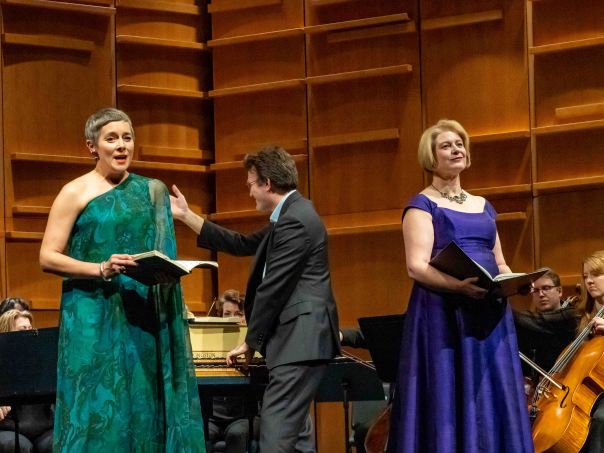
On the other hand, Carolina Theatre crystallizes what Symphony has become in its recent years of modernization. Within the past month alone, our orchestra has performed in front of movie screens on three programs, John Luther Adams’ Become Ocean, John Powell’s How to Train Your Dragon in Concert, and the glittery Spring Gala featuring Renée Fleming. If memory serves, we hadn’t seen Fleming perform with the Charlotte Symphony since 2004, and the last time my mom and I saw her at the Metropolitan Opera was in 2014, playing the title role of The Merry Widow.

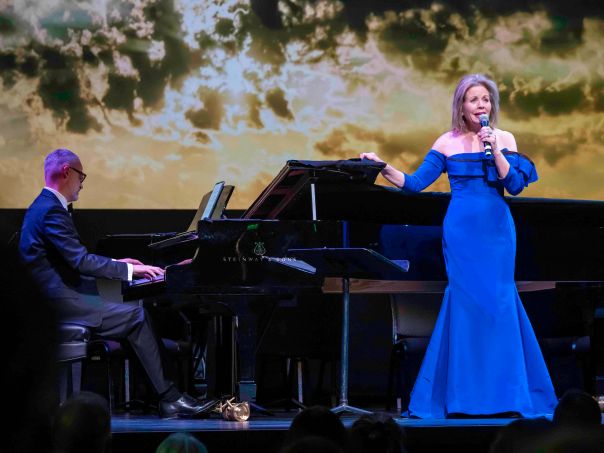
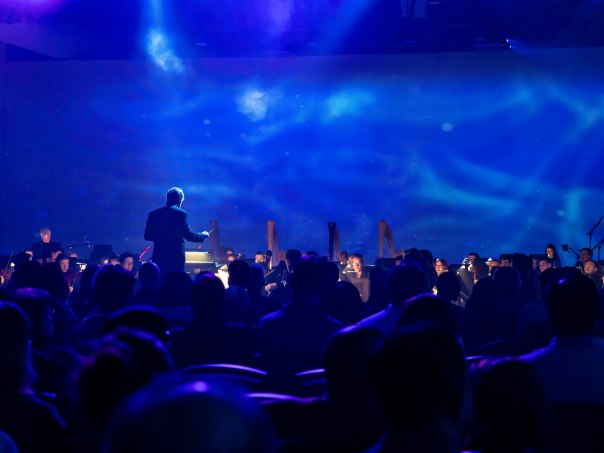
The epic assemblage of National Geographic footage added extra dimensions to Fleming’s live rendition of her Grammy Award-winning album of 2021, Voice of Nature: The Anthropocene – or it would have if the soprano had actually sung more than two of the album’s 17 tracks in front of the lushly cinematic backdrop. Two additional screens flanked the stage, not only tripling the Geo cinema to near-surround proportions but also supplying the texts or translations of the songs if you could peel your eyes away from Fleming, still glamorous at 66, accompanied by pianist Bradley Moore.

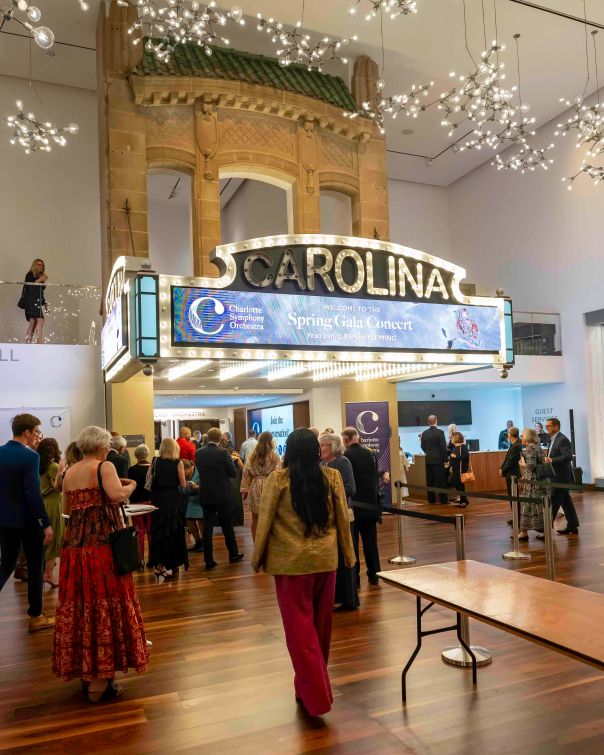
Cinematically and acoustically, the renovated Carolina Theatre was quite good for its age, too, but not spectacular. If you came to behold the sensational, that was taken care of before you entered the hall, for the glow of the lobby and the Carolina signage could be seen from blocks away as you began grappling with the riddle of where to park. Inside the lobby, where the sleek glassy modernity of the hall clashes with the quaintness of the updated Roaring Twenties marquee, you’re already in the presence of something unique, but when you enter the hall, spanking new with all its old-timey trimmings, you feel like you’re inside a time capsule.

So it’s hard for a critic to be churlish about Fleming delivering less than a quarter of her original Anthropocene in live performance when the 15 songs she substituted were so well-chosen and – mostly – flawlessly sung. From the album, Kevin Puts’s “Evening” and Reynaldo Hahn’s “L’heure Exquise” were the most delightful, but an objective assessment of Nico Muhly’s “Endless Space” was impossible for me. This was where the screens surrounding Fleming exploded with National Geo imagery: the glories of sky, ocean, rivers, and ice, followed by the ravages of fires, floods, drought, and sunbaked skeletons. Hazel Dickens’ “Pretty Bird” and an aria from G.F. Handel’s Atalanta were charming enough, but chiefly backed by massive tree trunks, comparatively sleepy on celluloid.

My favorites among Fleming’s inserts were Curtis and Pearce Green’s “Red Mountains Sometimes Cry,” Maria Schneider’s “Our Finch Feeder” from Winter Morning Walks,Giacomo Puccini’s “O mio babbino caro” from Gianni Schicchi,Rodgers & Hammerstein’s “The Sound of Music” and Joseph Cantaloube’s “Baïlèro” from his Chants d’Auvergne. Allow me a little churlishness on “Baïlèro”: although it was the most achingly lovely song that we heard before intermission, still magical though stripped down to Moore’s accompaniment, a full orchestral version with Symphony could have elevated the magic to sublimity with its lovelorn oboe passages and sprinklings of harp. Recorded versions by Frederica von Stade, Kiri Te Kanawa, and Victoria de los Angeles are the best – along with Fleming’s own, the final track on her 1998 Beautiful Voice album.

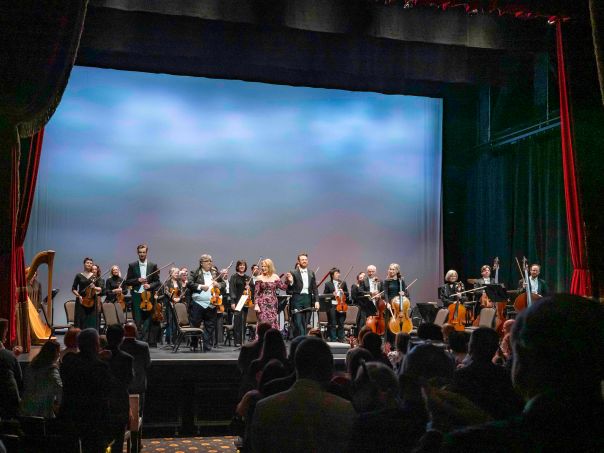
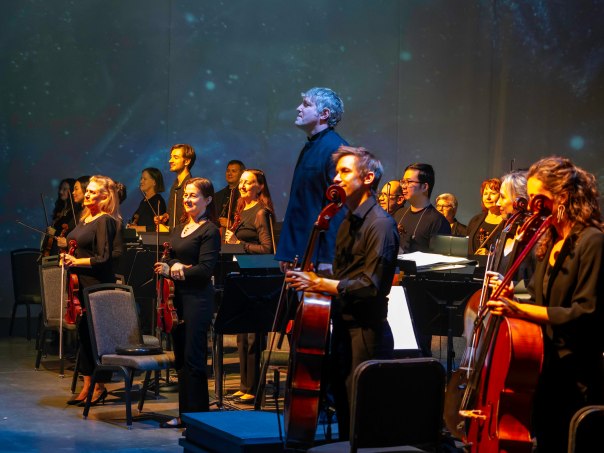
When Charlotte Symphony finally assembled onstage, it was more than an hour after president and CEO David Fisk and Charlotte Mayor Vi Lyles graced the evening with their gala presences and welcoming remarks. A bit undermanned for guest conductor Courtney Lewis in his Charlotte debut, the Orchestra sounded lackluster in the Overture to Mozart’s Le nozze di Figaro and downright moribund in the Overture to Gabriel Fauré’s Masques et bergamasques. It amazed me to find that nothing could mar or spoil this occasion when you felt privileged to be there. Partly because our expectations had been politely lowered, Lewis and Symphony seemed to overachieve in Richard Rodgers’ “Waltz” from Carousel.

Fleming’s voice has lost some of its creaminess above her midrange and I found myself rooting for her to easefully reach her top as she climbed to the climax of R&H’s “You’ll Never Walk Alone.” But Renée had banked plenty of his goodwill for arts lovers long before she resigned recently from the tainted Kennedy Center. Decades before she put her heart post-pandemic into the global environment, she championed American opera, most notably in 1998 when she premiered the role of Blanche in André Previn’s A Streetcar Named Desire while also collecting American arias into an 11-track album representing nine composers, I Want Magic! The aging diva is still banking residuals and Spotify pennies for her exemplary recorded output. Meanwhile, each time Charlotte Symphony had the chance to play live behind Fleming, they seemed to play better, producing fresh magic aplenty for us all – with the promise of much more from Fleming and the Carolina Theatre in years

Poiesis Quartet and Charlotte Poet Laureate “Jay” Combine for a 7th Street Benediction

Review: The Poetry of Music at St. Peter’s Episcopal Church

By Perry Tannenbaum

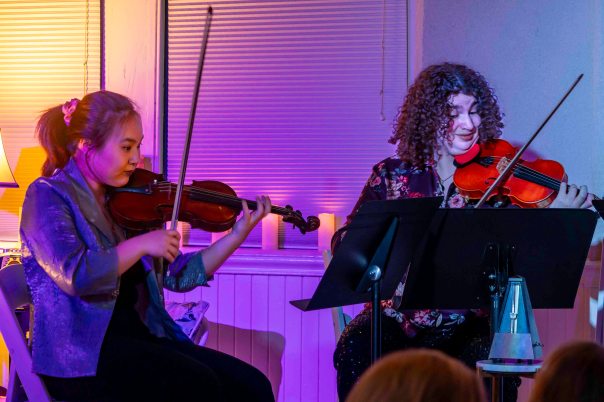
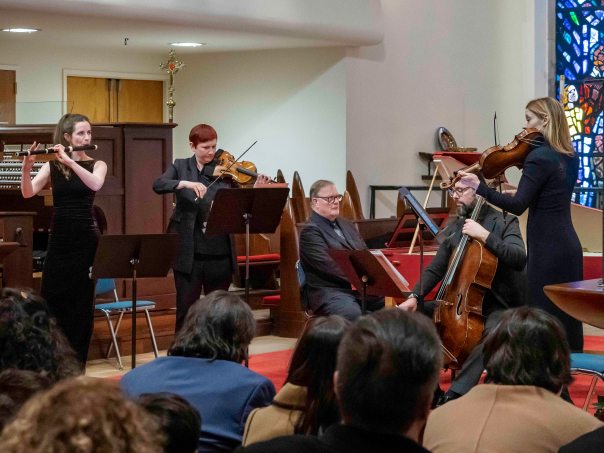
March 22, 2025, Charlotte, NC – You can’t say that 7th Street Concerts isn’t daring – or eclectic. Just within the past four weeks, the series has presented music ranging from the 12th to the 21st centuries, Hildegard van Bingen to Sky Macklay, with a heavy dose of Baroque writing in between. The two programs were staged just above street level in the St. Peter’s Episcopal Church sanctuary and then upstairs in the meeting hall. If that range weren’t sufficient, the latest concert featuring The Poiesis Quartet layered on spoken word by Charlotte’s poet laureate, Junious “Jay” Ward: four poems written specially for this “Poetry of Music” event.

The back-and-forth between the outré string quartet and the 2019 International Slam champ worked better than the average churchgoer would have hoped or believed. At times, the spoken word was a welcome counterbalance when the mod string compositions grew chaotic, cacophonous, or weird, for Jay’s modes were predominantly cosmic and engaged, without any lapses in lucidity. At other times, when the music grew quiet, dreary, or repetitive, it suddenly dovetailed handsomely with Jay’s rhythms and musings as a background.

It’s hard enough nowadays to discourage symphony subscribers from applauding between movements of a large orchestral work, and the corporate smiles that appear on musicians’ faces during these unexpected intervals only compound their awkwardness. “Sure, we love it when you applaud!” the performers seem to be saying through clenched teeth. So it’s been praiseworthy, both at Spoleto Festival USA and now here in Charlotte, to see musicians and conductors leaning into the idea that there shouldn’t be any applause until the end of a piece, a cluster of pieces, or the end of a concert. We can all stay in the moment longer and go home sooner.

Speaking on behalf of the quartet, cellist Drew Dansby made the request while making his acknowledgements and introductions. The pieces, about 41 minutes in length on their Spotify counterparts, would be played without any significant pauses – and without any notice about how Jay’s four poems would be wedged in. As a latecomer who had missed two-thirds of 7th Street artistic director Kristin Olson’s welcoming remarks, I may have been more disoriented than the punctual ticketholders when Poiesis readied themselves for the third movement Scherzo of Béla Bartók’s String Quartet No. 5 (if for no other reason than the printed program said it would be Quartet No. 3).

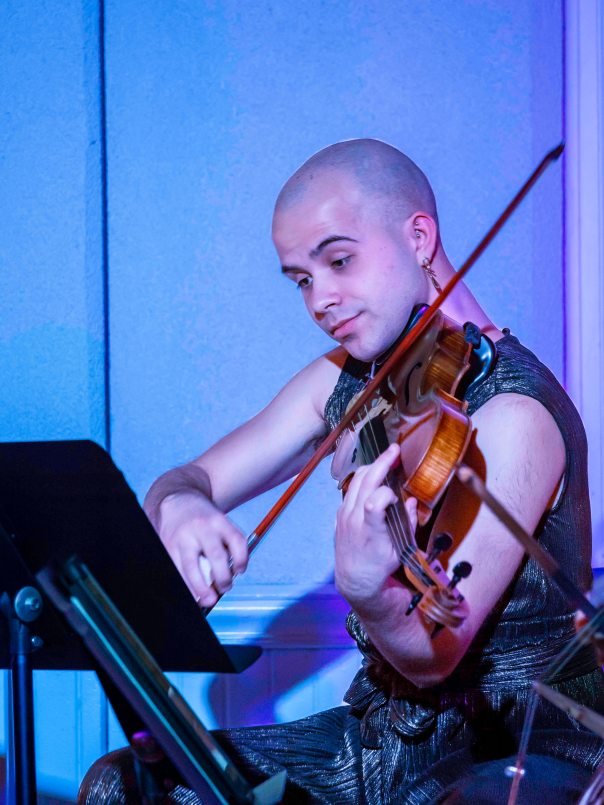
Was Jay even in the house as he began reading “Stunted,” his first poem? Lurking behind my left shoulder in the corner of the hall, outside my line of sight, he began behind a music stand holding a mic. Coming to me via a loudspeaker, his voice sounded pre-recorded! There was plenty to distract us onstage, for Poiesis doesn’t merely sport BIPOC credentials: more than a dash of gender fluidity greeted our eyes, along with assorted piercings. The first violinist’s long hair and attire, for starters, initially made Max Ball’s gender a mystery. Not to worry, Ball switched chairs at least twice with Sarah Ying Ma during the course of the program, so both genders earned first violin laurels during the evening. Choices in attire – and pronouns, if you read the program booklet – underscored the freewheeling fluidity.

Bartók (1881-1945) had completed five of his six string quartets before Dmitri Shostakovich had completed his first, so he is undoubtedly the wellspring for the modern rep. The Tokyo Quartet recording of the complete string quartets has been my favorite for over four decades. Since vinyl and cassette dubs. In the meanwhile, I’ve heard spirited live accounts by the St. Lawrence Quartet at Spoleto Festival USA and by the Emerson Quartet at Aspen, the latter a two-night marathon of the complete cycle. So it was rather astonishing to hear Poiesis’ confidence as they attacked the difficulties of the Scherzo and savor their maturity in intertwining its acerbic lines and sustaining its odd Bulgarian rhythms. Later that night, it was quite astonishing to come home and read that the Poiesis violist, Jasper de Boor, was currently a student of Ayane Kozasa, a mainstay at Spoleto and a member of the revered Kronos Quartet.

The entire quartet was playing at that high level before veering off into terra incognita – four works, two complete quartets and two excerpts by composers who were all unfamiliar to me. The excerpted composers, Joe Hisaishi (1950- ) and Winston-Salem native Coleridge-Taylor Perkinson (1932-2004), were my most egregious oversights. To those in the audience who were new to the Bartók string quartet soundworld, Hisaishi’s “Phosphorescent Sea,” the second movement of his String Quartet No. 1, was no less enticing. A printed illustration of M.C. Escher’s woodcut (sadly, not the correct illustration) added further allure to the evocative piece. Sonorous harmonies evoked the oceanic calm and its immanent magic until Ball pierced through on first violin with harmonics that conjured up the bioluminescence, sounding at times more like a flute than a stringed instrument over the plucked chords of Dansby’s cello.

Perkinson’s “Calvary” quartet, built on the traditional African-American spiritual of the same name, was easily the most soulful piece of the evening – and among the pair that were most uplifting. Like “Only Black,” which had been interwoven with Hisaishi’s “Sea,” Jay’s “All the Colors” was less topical and street-smart than “Stunted” but more serious, meditative, and profound. The quiescent second movement Adagio from “Calvary,” with its moody dialogue between De Boor’s viola and Dansby’s cello, provided the most appropriate platform for Jay to be seated onstage at the center of the Poiesis Quartet. Better yet, after Ying Ma soared above the viola and the cello – with a part that could almost have been scored for a second viola – the piece comes to a complete halt, accommodating the poet perfectly.

In Many Many Cadences by Sky Macklay (1988- ), a screechy scherzo that yields grudgingly to a dyspeptic drone from the lower strings before all four members get hyper, was undoubtably the best piece on the program for Jay not to write a poem for. Described by the composer as “lonely, disjunct ends-of-phrases [that] eventually congeal and transform into new kinds of phrases and sound objects,” her best-known piece – the opener on Spektral Quartet’s Grammy-nominated Serious Business album – is militantly modern. Yet Ma and Ball were obviously having a merry time helping Macklay “stretch the listeners’ perception of cadences” until De Boor and Dansby could join the party. It would have been a hoot to hear this spray of sound cells and objects down in the sanctuary!

After Jay joined Poiesis onstage for the “Calvary” excerpt, it seemed like we were headed for an anticlimax as the poet left the stage and began circling the hall as the ensemble launched into their finale, String Quartet No. 2 by Eleanor Alberga (1949- ), the longest piece of the evening. With its many varied episodes, gorgeously stitched together, Alberga’s piece abundantly merited its length and earned our extended delight. Teeming with prickly sonorities and folksy rhythms, Alberga’s quartet perfectly bookended the program with Bartók’s.

Theatrically, it also solved the problem of how to follow Jay’s onstage powwow with Poiesis. “Growth” may not have been loftier than “Only Black” and “All the Colors,” but it was certainly more speechy and oracular. Jay recited rather than read this last poem, adding to his spontaneity and flexibility. He walked slowly toward the stage from our left when we heard his voice again, able to look across the audience as he declaimed. Most of us likely assumed he would join the musicians onstage as before. Instead, he backed away down the center aisle that split the audience while the music soared and slowed, reaching an equally unexpected pinnacle. Backlit by the stage lights, there was a bright aura around Jay as he raised his voice, before Poiesis concluded with a final frenetic flourish. It was a uniquely magical moment, as if the poet were giving the musicians his benediction.

“Look! Here you are, the impossible, tall in the midst of chaos— a rose, a bloom of color broken beautiful against a morning sun.”

Lasers, Projections, and Artful Plumbing Bring New Vitality to “Become Ocean”

Review: Charlotte Symphony’s Become Ocean at Blume Studios

By Perry Tannenbaum

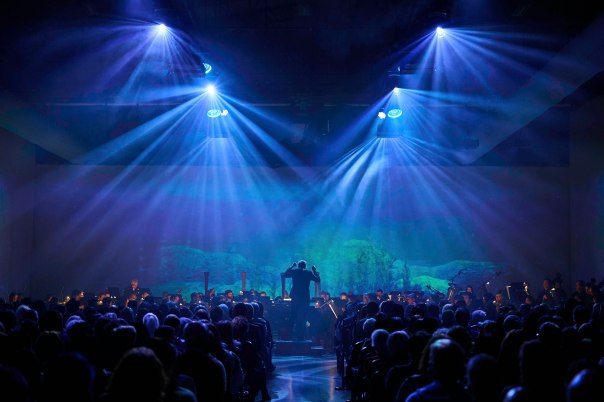
Animated bubbles rose from the pillars of four harps. Aquamarine waves flowed toward us and surrounded us. Revolving laser lights played upon silent infusions of smoke and mists, forming clouds and starbursts above.

Become Ocean by John Luther Adams, conducted by Yaniv Dinur at the newly unveiled Blume Studios, was not a typical Charlotte Symphony program. It was an elaborately crafted experience. All of the orchestra and all of the audience were together in a vast shoebox, walled by white curtains punctuated only by exit doors. The only people elevated above the musicians were Dinur, haloed in a spotlight, and the phalanx of lighting and sound technicians at the rear of the hall.

Touring Broadway shows usually bring fewer board operators to the Belk Theater soundbooth. Creative directors Aaron Mccoy and Ian Robinson, projections designer Jeff Cason, and lighting designer/laserist Jay Huleatt were duly listed in Symphony’s digital program as members of the production team headed by co-producers Bree Stallings and Scott Freck.

Likely they took their cue – and its immersive drift – from Adams’ own words, written before the live 2013 premiere of the work by the Seattle Symphony, which commissioned the work. “We came from the ocean, and we’re going back to the ocean, right? We’re made up mostly of water, and life on earth first emerged from the seas. And with the melting of the polar ice caps and the rising sea levels, we may become ocean sooner than we imagine.”

For all of its gorgeous waveforms, colors, and lights, there was no mistaking the doomsday lifelessness of the massive projections. No fish or mammals inhabited these waters. No crawlies moved or glimmered on seawalls. The smallest bubbles might be imagined to suggest primal cellular life, and translucent forms taking shape in the deep could be seen as lazy jellyfish if you didn’t require intentionality. Plant forms occasionally appeared on the ocean floor, always motionless, never as fragile or temporal as grass.

Additional golden light gently flooded Dinur’s players, so when we reached the darkest ocean depths, we might see them as a hopeful golden glow, guiding us forward through the gloom. The feel of the Charlotte performance, notwithstanding all the electronics, was organic.

Unlike a “Symphony at the Movies” concert, conductor and orchestra didn’t calibrate their tempo with a soundtrack. On the contrary, the techs at the back of the hall were able to interweave their effects and projection episodes in sync with the musicians. The even, somewhat glacial pacing of Adams’ score certainly eased the synchronization to the point where it consistently felt seamless.

The composer’s scenario, if there is one, does not begin with a theatrical catastrophe or cosmic apocalypse. More like Debussy’s La Mer, the opening rises up gradually out of silence, evoking the infinite. Seated midway between the front and rear of the space along the right-side audience wall, where Symphony seated us in order to best hear the score, my wife Sue and I couldn’t really discern exactly when the music reached us after Dinur gave his downbeat.

It almost seemed to emerge – via double basses, contrabassoon, and maybe tuba – from the lower depths of human audibility, more like a hearing test than melodic music when first discernible. If we’d insisted on seats that offered a view of the musicians, the effect would not have been as mystifying. On this level playing field, with its wretched sightlines to the orchestra, we were prodded into looking upwards and around us.

Even with a conspicuous absence of violins in the initial murmurs and the emerging sound weave, the score was not devoid of sweetness. Waveforms layered onto the low subterranean drone surely emanated from the harps. Whatever Adams added to these rising and falling arpeggios from the marimbas, vibraphones, celesta, and bells only added an electronic roundness – and a dim metallic glow – to the harps’ liquid ostinato. The crystallization of all this unseen plucking of soft pounding became quite magical.

Without cataclysm or catastrophe, becoming ocean could be experienced in a variety of ways, subtly aided by the light show. There was the gradual seduction of immersion in the liquid deep when we surrendered to it, each one of us at a different moment. Perhaps we moved further toward an acclimation to Adams’ prompt – proclaimed out loud by the sound system, like an epigraph preceding the performance – that this is “where we came from.”

As the projections evolved from abstract auroras and drifting bubbles to more solid shapes – waves, undersea gorges, boulders, and petrified plants – evidence mounted that the production team’s concept took us far, far away from the pivotal moments of environmental catastrophe. By now, millions of years after birds, men, reptiles, amphibians, and fish had breathed their last gulps of oxygen, we had become ocean in the sense that we were the hopeful spirit of a potential rebirth of life.

The structures of the score and the complementary projections open the doors to other interpretations. We could puzzle out the meaning when brass became as prominent as the harp and percussion ensembles. We could decide – or not decide – whether the extended whistling from the woodwinds was ominous or a hopeful sign.

In the longer scheme of planetary transformation, a similar ambiguity hovers over the long cataclysmic build near the end of this sea odyssey that crests with timpani, bass drums, and a muted trumpet. While it’s tempting to assume that this peak, subsiding into a quietude with sounds that evoked the funereal tolling of a bell, was the sealing of our doom, my reading was more upbeat.

The sea-shaking impact, millions of years from today, could signify a distant collision with an extraterrestrial object or force that eventually brings life back. The tolling would then signal a restarting of time.

What became clearer during this Charlotte Symphony performance piloted by Dinur was that Adams’ Become Ocean still merits all of its accolades, aging well since it was awarded the Pulitzer Prize in 2014. The Stalling-Freck production team has collaborated beautifully with Symphony and its new Blume Studios facility. Their multi-media addition never trivializes this epic symphony. Not does it constrain the visceral takeaways we can experience with the music. On the contrary.

First-timers will need GPS guidance when they venture away from Uptown Charlotte to their first Blume Studios experience. Plenty of free parking rewards their pioneering spirit when they arrive.

Bach Akademie Delights and Mystifies With “A Musical Offering”

Review: A Musical Offering at St. Mark’s Lutheran

By Perry Tannenbaum

Whether it’s jazz, bluegrass, or the rock fantasias of Eric Clapton, John McLaughlin, and Carlos Santana, much of modern music is rooted in the appeal of riffing on a tune. That allure has been around for centuries, known as theme and variations when dressed up in the periwigs and cravats of the Baroque Era. Among the great classical composers who have shown off their wizardry in the form are Rachmaninoff, Tchaikovsky, Brahms, Beethoven, and Bach.

Embellishing a melody and cracking open its chord structure are at the heart of theme-and-variations praxis, but there are also wicked, macho elements of challenge, competition, and virtuosity baked into the form. The jam session in jazz becomes a cutting contest when two titans collide. Who can imagine and execute the most intricate, complex, and satisfying variation?

So it was gratifying to learn that Johann Sebastian Bach’s A Musical Offering originated as a challenge. The challenge was issued in Berlin to the visiting Leipzig master – by none other than Frederick II, King of Prussia, his son Carl Philipp Emanuel’s employer. After Bach had duly impressed the king, his noblemen, and an assembly of the finest musicians in Europe by improvising new compositions on each of the new fortepianos at court, King Frederick laid down his gauntlet.

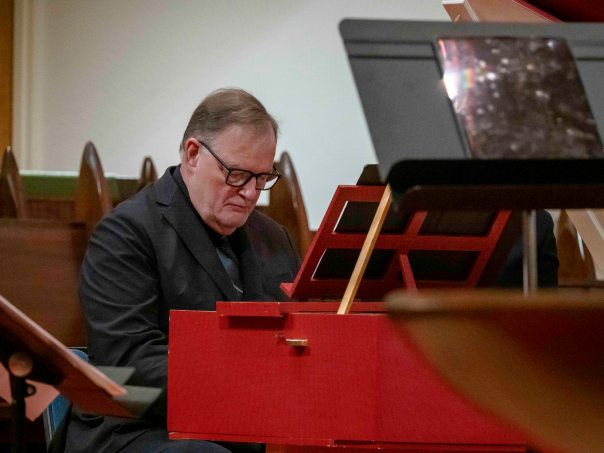
Compose a three-part fugue on the spot based on a melody he, the king, had written. Game on! Bach sat down once again at one of the keyboards he had just tested and tossed off a brand new 1747 masterwork on May 7, the first piece in Bach Akademie Charlotte’s inaugural concert of 2025 at St. Mark’s Lutheran Church, played by renowned harpsichordist Ian Watson.

Thankfully, “Frederick the Great” was royally miffed to see Bach meet his challenge so effortlessly. He literally doubled down on his challenge to humiliate his distinguished guest, daring Bach to execute a six-part fugue on the same tune. Here Bach judiciously yielded, saying that he would need some time at home to fulfill such a daunting assignment on such a worthy theme. Within two months, at age 62, Bach delivered on the king’s request and completed the six-part invention plus over a dozen more canonic gems.

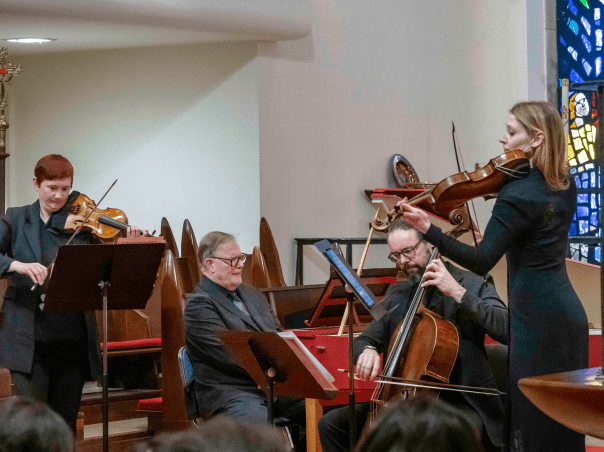
Modern recordings of A Musical Offering are all over 50 minutes in length and, depending on whether the original theme is prefaced, 16 or 17 tracks. Various instrumental configurations are available after the initial solo track. For this live Akademie concert, BACh artistic leader Guy Fishman assembled an all-star quintet that included himself on cello, Watson at the keyboard, Emi Fergusson on transverse flute, co-artistic leader Aisslinn Nosky on violin, and Renée Hemsing playing viola and violin.

Though I have four or five Goldberg Variations in my collection, I’ve never heard Bach’s most famous variations performed live, so this opportunity to hear the lesser-known Musicalisches Opfer was doubly special. Interspersed with the marquee piece of the evening were three other works, a CPE Bach Violin Sonata, a flute sonata by King Frederick II, and a Cello Sonata by Carl Heinrich Braun, another Bach contemporary.

Fishman’s spoken remarks, supplemented by his generous program notes, vividly described the king’s arrogance and his guest’s tactful responses. Nor did the principal cellist of Boston’s Handel & Haydn Society avoid detailing the various devices and complexities that Bach lavished on his thematically connected compositions. But with five musicians assembled before us, many in the audience must have been surprised that Watson alone would be playing Bach’s opening salvo.

The result was denser and tinnier than orchestral recordings of the Ricercar a 3, with less linearity than a recording on organ that I’ve heard. Three voices presented by two hands on a live stage! No matter how dense that sounded – remember that an organ can differentiate with multiple keyboards and registers plus a pedal board – it was amazing to see and hear.

Each new movement in the piece was usefully punctuated by musicians rising and sitting while music stands were being set up in new configurations. Nevertheless, confusion set in before we reached the second piece of the evening, the King of Prussia’s Flute Sonata No. 9. Three movements were listed under the Musical Offering and the ensemble was clearly playing more.

I lost track. Scattered in the program, in clusters of three, five, and five (if I’m deciphering the typography properly), were the remaining pieces of the Musical Offering. Titles for the remaining movements didn’t entirely correspond with titles of any recording available to me on Apple or Spotify. The four Sonata movements embedded in the piece could have been mistaken for another listing if it weren’t for the BWV catalog number, and a hefty number of the segments that could easily be recognized were played sooner or later than common practice.

Most recordings don’t label any of the movements “Quaerendo invenietis,” a title given twice in the Akademie program, and where they do appear, they are played consecutively. Not at St. Mark’s Lutheran. The climactic Ricercar a 6 that Frederick had ordered, for another example, usually claims Track 9 on Musical Offering recordings. At St. Mark’s Lutheran, it was sixteenth and last on the bill. Thus I can say with conviction that all five instrumentalists were involved in the glorious finale, but I’m more than a bit hazy on most of the rest.

While this disorientation made it impossible for us to even attempt to track the incredible gymnastics of Bach’s inventions – themes and variations played in reverse, simultaneously in varying tempos, descending instead of ascending, or even upside down – the confusion didn’t carry over to the other pieces on the program. Here we were freer to scrutinize and enjoy.

Fergusson, of course, benefitted most from the spotlight shifting toward the non-Musicalisches pieces. One of these by Frederick II, in addition to the four-movement sequence embedded in the Offering, was a flute sonata. It was possible, upon hearing Fergusson’s performance of the king’s Sonata No. 9, to reserve judgment for a little while since the first of Frederick’s three E-minor movements was at a slow Grave tempo. Prussia’s monarch was a flutist, after all, writing chiefly to spotlight his own prowess.

But the next two movements were fast and faster, Allegro assai and Presto, so there could be no doubting Frederick’s genuine proficiency as a composer or as a performer. The piece was also sufficiently virtuosic to tempt me toward rushing to judgment on Fergusson, partly because the acoustics at St. Mark’s were so extraordinarily friendly to her transverse flute.

This performance was the best I had seen live on baroque flute since 2004 when I had the privilege of seeing, hearing, and meeting Michala Petri at the Verbier Festival. When we arrived at the four-movement Trio Sonata for Flute, Violin, and Continuo shortly after intermission, my reflex reactions to Fergusson’s artistry were bolstered. In the lyrical odd-numbered movements, her fruity tone bloomed again. And in the two uptempo Allegros, where her virtuosity not only impressed but intertwined with Nosky’s delicious work, one could nearly marvel as much at the musicians as at the composer.

“Now for something completely different,” Fishman quipped before leaning into Graun Sonata for Violoncello and Continuo in C, accompanied by Watson. If you’ve heard Fishman tackle Bach’s Cello Suites here in Charlotte, the three-movement Graun was lighter and less daunting. Fishman seemed to have the most fun with the final Allegretto, making it dance in its 3/4 waltz tempo.

Even simpler, Fishman joined Watson as continuo partners in Carl Philipp Emanuel’s Violin Sonata in D, accompanying Nosky. Here again, the piece was not a stretch for anyone involved, but it brought us merrily enough to intermission, with another movement in 3/4, a leisurely Menuet sandwiched between two iterations of a faster one.

The piece closes a delightful collection of CPE Violin Sonatas released by Rachel Podger in 2023, demonstrating over and over that Bach’s most prestigious son merits more play. Three minor-key sonatas on the same disc are equally fine. The E-minor, in particular, yields more pleasure in less time.

Photos by Perry Tannenbaum

Caritas a Cappella Delivers a Mix of Ancient and Modern Gems

Review: Caritas a Cappella Ensemble @ St. Alban’s

By Perry Tannenbaum

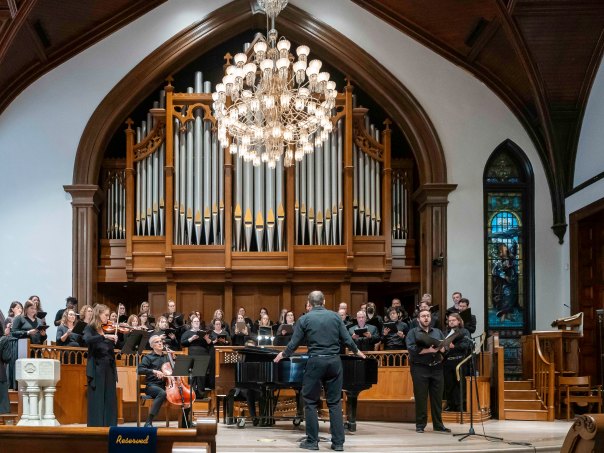
January 19, 2025, Davidson, NC – With so many churches in the metro Charlotte area, it’s little wonder that the Queen City is fertile ground for choirs and choristers – and receptive audiences for choral music. Considering this profusion of talent and activity, as well as the total absence of Caritas A Cappella Ensemble press releases in my voluminous mailbox and the lack of catch-up info on the Caritas website, I was able to forgive myself for not having known about this organization, founded by Cathy Youngblood in 2017, until signing up for this review.

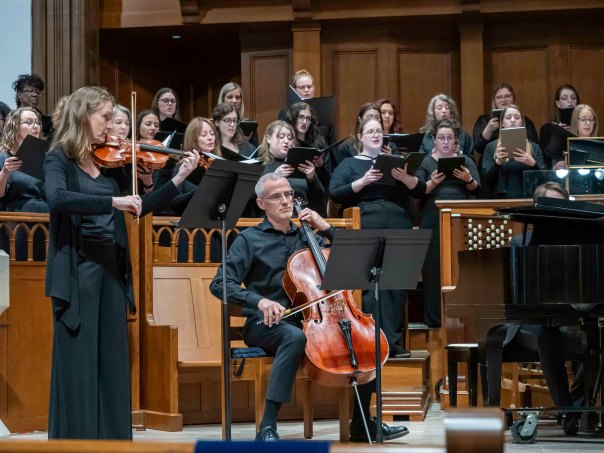
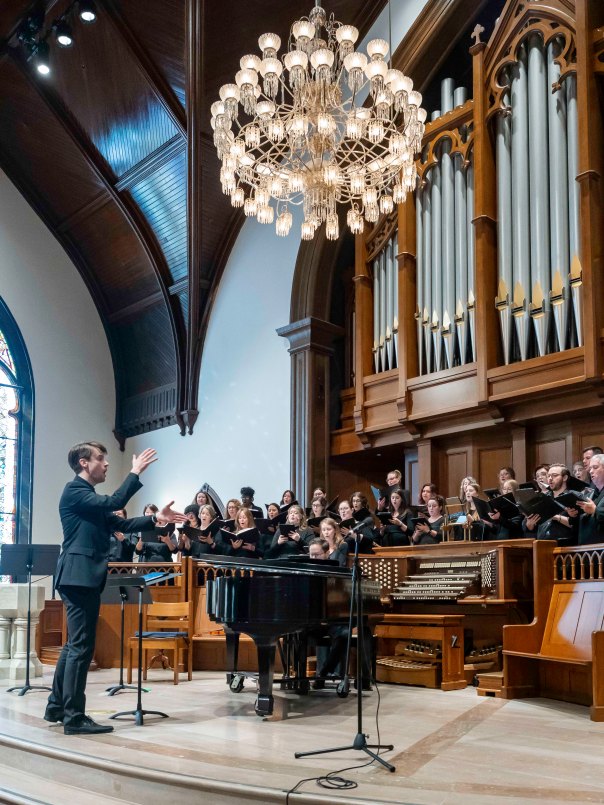
More ominous, as we entered the St. Alban’s Episcopal Church, was the elephant in the room: a spanking new grand piano in the middle of the sanctuary, standing in front of two rows of music stands where the singers would be placing their iPads and music scores. Was there somebody at Caritas HQ (if there’s more to it than the PO Box given at the website) who needed to learn the meaning of a cappella?

Thankfully, the piano was there for a delayed pre-show, so the mammoth obstacle turned out to be a blessing. For once, my wife Sue and I had arrived early enough for a Music at St. Alban’s concert to take in the prelude event, where star students from the Davidson area are given the opportunity to play for an audience and warm us up for the featured guests.

Those of us who had arrived on time for the pre-show were rewarded, while awaiting the arrival of Tianyang Chen, with a couple of delightful morsels of Brahms from his teacher, Cynthia Lawing. Once Chen had gone through his recital of pieces by Ginastera, Liszt, Brahms, and Debussy, the elephant could be moved to make way for the marquee players.

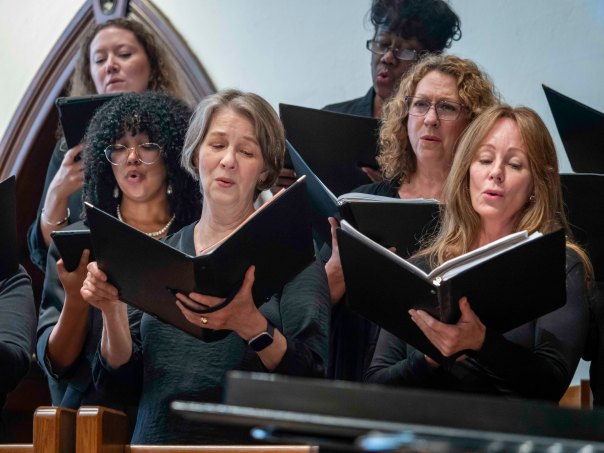
Surprises didn’t cease with the piano’s exit. Caritas artistic director Jeremy Mims entered the sanctuary in the usual way, but the Ensemble didn’t take their places behind the music stands. Instead, they encircled the audience – men in front, women at the rear of the hall – for the opening selection, “Musick’s Empire” from Triptych by Lloyd Pfautsch (1921-2003). Besides the ethereal surround sound blend, this presentation heightened the drama when Mims cued the female voices. Fittingly, the outré deployment of the Ensemble was devoted to a modern piece. It wasn’t until the singers took their places after this opening that the title of their concert, “A Capella Through the Ages,” could be fulfilled in a more orderly, chronological manner.

Fussing a bit with the printed program, replacing a couple of titles on the list with new selections and occasionally shuffling the order of performance, the concert kept to its original design, flashing back to the Baroque days of Vivaldi, Palestrina, and the Scarlattis with a nice mix of sacred and secular lyrics. Whether it’s Handel or Bach, we hear many of the mightiest works from that wondrous era, so it was nice to sample these less familiar gems.

What interested me most on the program was the predominance of more modern pieces, from the days of Bruckner, Holst and Vaughan Williams to the present day. Pieces like these, which sound surprisingly retro compared to the modern chamber and orchestral pieces we’re familiar with, have always been mainstays at Spoleto Festival USA concerts down in Charleston, SC, so I was eager to see how these performances would compare and how a North Carolina audience would react.

The composers’ names were no less intriguing and enticing. We don’t readily recognize contemporary composers Elaine Hagenberg (1979-), Kevin Memley (1971-), Eric Whitacre (1970-), and Pärt Uusberg (1986-) by their last names. As for Frank Tichelli (1958-), whose “Earth Song” was inserted after the program was printed, I was nowhere close to knowing how to spell his name when Mims announced it. “Sikelly” was my first stab. Well-matched to the slow-paced, richly-scored music, Earth’s lyric was rather simple at its core: “Oh war and power, you blind and blur. The torn heart cries out in pain. In pain. But music and singing have been my refuge, and music and singing shall be my light.”

Uniquely, the beauty of the hallelujahs later on was more like a solemn sunset than a jubilant festival. Sadly, Caritas’s enunciation was no clearer than that of multiple recordings – including one by the famed Seraphic Fire – I sampled on Spotify, which offered welcome first aid in deciphering the lovely lyrics. Consonants were often unclear, vain routinely indistinguishable from pain. And vowels! Try to hear “light” when that word pops up!

Never again will I blame myself for losing track of what a choir is singing in Latin (or any other foreign language) when I have the printed text before me. For that reason alone, Uusberg’s magical “Ōhtul” nudged “Earth Song” aside for me as the most impressive piece on the program. Since translations were appended to the program, full contentment with the performance was a simpler matter. The grand swell, as the poet’s song paddled away, was a lovely surprise after everything else – bird, little flower, and forest trees – had been silenced and lulled to sleep by the twilight. Erkki-Sven Tüür (1959-) and Arvo Pärt (1935-) will need to leave some space for this youngster on their pedestal as my favorite Estonian composers.

As for the practice of printing translations for vocal performances, a brief word. Follow the practice of most opera companies nowadays who project subtitles even when the operas are performed in English. Print the English texts with the translations for our fullest enjoyment.

“Nunc Dimitis” by Gustav Holst (1874-1934) impressed me nearly as much as the Uusberg, with solos from soprano Sarah Ochoa and tenor Nicholas Setzer. The soloists not only sang their brief solos purely, they set the stage for responses from the Ensemble at a dramatically augmented volume. Wisely, the Latin didn’t appear in the program, clearing the pathway to pleasure when we went straight to the translation.

Of course, the fullest experiences at this concert came from songs in our language that were either familiar to us or readily grasped in real time. The most enjoyable of these included Hagenberg’s joyous “Alleluia,” though it sported few more words aside from amen, and the finale that followed, “Ezekiel Saw de Wheel” as arranged by William L. Dawson (1899-1990). Most surprising of all was Vaughan Williams’ “O Mistress Mine,” from his Three Elizabethan Part-Songs, a rather frisky departure for a composer better known for the grandeur of A Sea Symphony, the anguish and majesty of Job,and the simple tragedy of Riders to the Sea.

Gerald Finzi’s “My spirit sang all day,” mercifully brief, didn’t really speak to me, and “Shenadoah,” as arranged by James Erb (1926-2014) disappointed. Crossing the “wide Missouri,” we have an inalienable right to more bass and sinew between the shores. Bypassing my personal distaste for the foundational baby-worship that pervades Christianity, the pairing of Whitacre’s “Lux Aurumque” and Memley’s “O Magnum Mysterium” were more pleasing to me in Latin, since ignoring the translations – and savoring Memley’s heavenly harmonies – was an option.

Amusingly enough, I had to adjust my attitude toward Caritas’s choice of William Billings’ “I am the Rose of Sharon” past the midway point of a largely repetitive and pedestrian performance. When the famed snippet from the Song of Solomon reached its denouement, “for, lo, the winter is past and the rain is gone,” you could look out the huge St. Alban’s windows and see that the rain really was stopping in response to these pertinent repetitions.

If you missed that, you couldn’t help but notice streaks of bright sunlight suddenly streaming across the front rows of singers. In his intro to the piece, Mims had hoped that the concluding verse would bring an end to the rain. But the power of Caritas’s incantations exceeded this extravagant hope. Repetitions and all, you won’t find me arguing with such cosmic success!

Photos by Perry Tannenbaum

Review: “Messiah” at Knight Theater

Handel’s Messiah Rejoices Greatly with Charlotte Symphony

By Perry Tannenbaum

December 13, 2024, Charlotte, NC – While I’m not as faithful to the Yuletide visitations of George Frideric Handel’s Messiah as I was ages ago at Queens College CUNY, where I attended free concerts at least three of my four years, my diligence has lately improved. In the last decade, I’ve seen four performances, counting the one that launched this weekend’s run at Knight Theater, with Kenney Potter preparing the Charlotte Master Chorale and guest conductor Julian Perkins leading the Charlotte Symphony. I’d actually had my heart set on a Messiah performed at the Teatro Colón in early November, but an unresponsive press office and an unexpected dress code, discovered at the box office after we had landed in Buenos Aires, thwarted our plan.

Wrapped into our plans were an opportunity to hear how a Bach choir flying in from Stuttgart would handle the King’s English, and how the vocalists would compare with our esteemed Chorale and guests. Not to mention the fabled acoustics of Teatro Colón. Lacking those Argentinian comparisons, I can still say that the Chorale was a match for any chorus I’ve heard in Messiah, and that the guest vocalists were the best I’ve heard in recent memory, including those who performed with the New York Philharmonic in 2015. Those who look for a massive orchestra might have reason to pause before rushing to the Knight, for the scale of forces led by Perkins seemed more like the North Carolina Baroque Orchestra that performed with the Chorale at First United Methodist in 2018 than the band we saw at the Knight in 2017. Over a dozen different orchestrations evolved during Handel’s own performances of Messiah over 17 years, from 1742 to 1759, so Perkins could easily match a version to the number of his orchestral recruits.

Leading from behind a harpsichord – pretty novel in itself – Perkins had some interesting ideas on staging, deploying the brass to the balcony for their dramatic entrance into “For unto us a Child is Born” and then after intermission, bringing principal trumpeter Alex Wilborn downstage for a climactic “The Trumpet Shall Sound” confrontation with bass baritone Hadleigh Adams. Otherwise, it would seem presumptuous to say that Perkins, for all his Handel and Baroque expertise, directed any of the four guest soloists at all. Each one of them was magisterially confident and self-assured. Hadleigh was not the least of them in that regard, striding auspiciously to centerstage for the first time and quaking the hall with his “Thus saith the Lord” proclamation. After delivering his towering “Why do the nations so furiously rage together?” rebuke at the crest of Part 2, Hadleigh loudly clapped his book shut and stormed back to his seat.

Richard Pittsinger was not quite so flamboyant, for the tenor wore his hair the same way before and after intermission. But his impact came sooner with supremely creamy accounts of the “Come ye, my people” recitative and the “Ev’ry valley shall be exalted.” He truly made the “rough places plain” again and again with soft floating glides that never strained his breath control. Drama was definitely in his arsenal, just before the climactic “Hallelujah” chorus, when he delivered one of the more militant verses of the Psalms, “Thou shalt break them with a rod of iron.”

It was no less difficult deciding whom to love most among the women. Mezzo-soprano Diana Moore sang her first air, “But who may abide the day of His Coming,” so richly and dramatically that I could hardly wait for her return in “O Thou, that tellest good tidings to Zion” so she could conquer its challenging low notes. Even the QR code on the program sheet doesn’t lead to the text, so Moore faced a more amusing hurdle when she came to the “spitting” in her “He was despised and rejected of men” air near the beginning of Part 2. Pronounced too diffidently, the audience might wonder what was said – too emphatically and you risk laughter. Passing that test, she went on to a satisfying Part 3 duet with Pittsinger in “O death, where is thy sting?”

Less tasked and dramatic but far more lyrical, soprano Anna Dennis dazzled in each of her airs, especially in her first splash late in Part 1, “Rejoice greatly, O daughter of Zion!” Here the refrain ideally exemplified how spectacularly Handel brought his lyrics to life. Equal to the joy she delivered here was the sanctified tenderness Dennis lavished upon “I know that my Redeemer liveth” launching Part 3. The effect was all the more ethereal for the effortless way that Dennis reached her highest notes.

Of course, the “Hallelujah” and the closing “Amen” fugue make the mightiest, most lasting impressions, but the Chorale delivered drama and delight all evening long. They were hardly accompanied by more than the harpsichord and organ until the brass and sawing violins exploded into “Wonderful! Counsellor!” in the incomparable “For unto us a Child is born.” The dynamic was no less dramatic toward the end of the evening when they reached the shuttling between gloom and jubilation in “Since by man came death.” Most exquisite, perhaps, was the delicacy Potter and Chorale endowed upon “All we, like sheep, have gone astray” seemingly more staccato than we’d ever heard it before. A disagreement seemed to arise whether it was “glorify” or “purify” when the Chorale broke into so many contrapuntal groups for “And He shall purify.” Any other blemish in the evening was almost impossible to detect.

Photos by Perry Tannenbaum

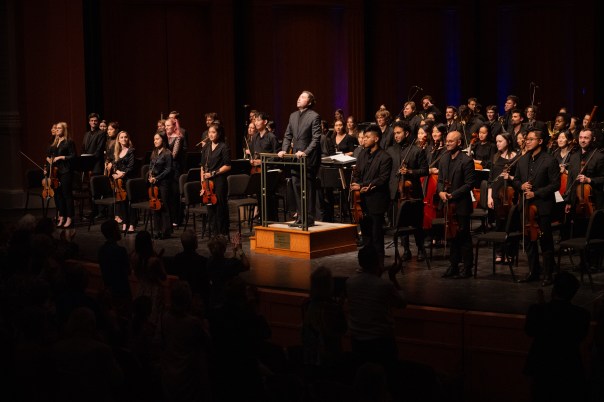
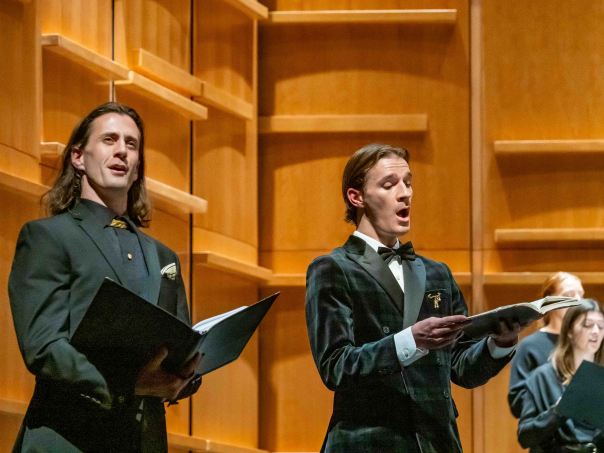
Ryan Clicks with the Master Chorale in a Walloping CSO Debut

Review: A German Requiem at Belk Theater

By Perry Tannenbaum

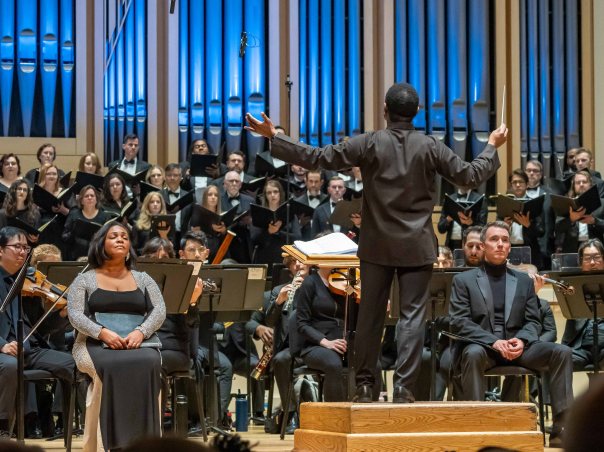
November 22, 2024, Charlotte, NC – In Kwamé Ryan’s first full season as the new music director of Charlotte Symphony, we aren’t getting to see him perform as much as we would hope, but when we do see him onstage at Knight Theater or Belk Theater, he always appears to be overjoyed to be here. Ryan was absolutely beaming as he took the Belk’s centerstage for the first time as CSO’s leader – and he certainly didn’t wear out his warm welcome, delivering a walloping performance of Johannes Brahms’ Ein deutches Requiem. Even before Ryan’s arrival, the new season has proven to be adventurous and diverse in its programming, showcasing fresh repertoire and youthful guest soloists.

Subscribers can judge for themselves whether Ryan’s outré intro to his debut program, coupling the Brahms with Latvian composer Pēteris Vasks’ Musica Dolorosa, was a sign of confidence or a symptom of nervousness. Whether or not my recollection can be trusted, Ryan’s scripted intro was unprecedented. Some intros we may have seen in the past could be dismissed as gratuitous – or countenanced as witty fluff. Here, Ryan’s intro was necessary, for we needed to be prepped for how the program would be delivered: without a pause between the music of the two composers. That would also be fairly unique. Our new maestro was crafting an experience.

Indeed, Ryan’s preface was necessary for another reason. Vasks’ piece flowed into the Brahms so smoothly it was as if they were written in collaboration and in the same key. Outside that merging point, the two pieces were quite different in the ways that they dealt with death. Responding to his sister’s untimely death, Vasks voiced his personal despair and compounded his feelings with grieving for his nation, still subject to Soviet rule when the Dolorosa premiered in 1984. Written for string orchestra, the mood of the opening section of Dolorosa may put you in mind of Barber’s Adagio. But the Vasks elegy eventually transcends the sameness and the hypnotic monotony of Barber’s dolor with louder and more piercing pain.

As the lower strings tap and strum percussively, Vasks gradually quickens the pace and turns up the volume as the beat becomes more insistent and dramatic. Once the dynamics peak, the strings, now smoothed out with a cessation of the percussion, become even more disturbing, tossing away pleasant tonality in a disciplined cacophony of fearsome chaos. The slashing lower strings, however, hadn’t been vanquished. They punctuated this harshness and dissonance at its height, seemingly puncturing it, for the noise homogenized into the sound of a diminishing wind or a siren receding into the distance – clearing the way for the quietest and most memorable episode in the Dolorosa. Principal cellist Jonathan Lewis, echoing the opening bars, played an eloquent lament from his downstage seat, accompanied only by the low mysterious hum – like a bass clarinet or a contrabassoon – emanating from upstage, hidden from my sight. The higher strings now took up the cello’s increasingly bold cry and built it to raw anguish.

The slightly hushed and abrupt ending of the Dolorosa nicely conformed with Ryan’s concept, and it dispensed with the shuffling of chairs usually necessary for the transition to full orchestra with winds, brass, and drums. Nor were the troops of the Charlotte Master Chorale obliged to parade in from the wings and settle into their perches above the Symphony. That honor was reserved for the guest vocalists, soprano Janai Brugger and baritone Alexander Birch Elliott, gracefully delayed until well after the transition between the Dolorosa and A German Requiem. The Brahms is not new to the CSO, last given by Christopher Warren-Green almost exactly 10 years ago – after his predecessor, Christof Perick, had presented it (already for the second time this century) in 2005.

With its consoling attitude, the Requiem is not at all a bad fit for the holiday season. You’re likely to recognize more than a couple of verses from the Brahms, conveniently projected in supertitles, as German translations of verses from Handel’s Messiah, the most beloved musical birthday celebration that we have. Most notably, you’ll get an Oktoberfest taste of “The trumpet shall sound.” Maybe sitting down in the orchestra, as opposed to the Grand Tier Circle, accounted for the heightened thunder of Ryan’s rendition, but Symphony somehow sounded crisper. The sudden sforzandos struck like a punch to the jaw, yet Ryan kept the ensemble under strict control, never threatening to overwhelm the hall with volume, emphatically relishing the work’s percussive moments.

Both Brugger and Elliott shone in their debuts. There was a noticeable Renee Fleming-like milkiness and sheen to Brugger’s voice, most appropriate for the motherly comfort she delivered in “Ihr habt nun Traurigkeit (You now have sorrow).” Elliott was even more impressive in his larger workload, a more pleading “Herr, lehre doch mich (Lord, teach me),” bolstered by a lusty Chorale response, before he delved into the “trumpet shall sound” mystery and affirmation of “Denn wir haben hie keine bleibende Statt (For here we have no everlasting city).” Belatedly, Music Chorale artistic director Kenney Potter was summoned onstage to share the credit for his singers’ brilliance and verve. He was absolutely beaming with delight.

Photos by Perry Tannenbaum

Charismatic Parnther Justifies Shostakovich’s Top Billing at the Knight

Review: Charlotte Symphony Presents Shostakovich and Mendelssohn

By Perry Tannenbaum

November 8, 2024, Charlotte, NC – Hailing from Norfolk, VA – and perhaps the Sith Order of the Galactic Empire – guest conductor Anthony Parnther has brought a big James Earl Jones voice to Knight Theater and an even bigger personality. He instantly engaged Charlotte Symphony subscribers with a lengthy intro to the first piece of the evening, Samuel Coleridge-Taylor’s Ballade in A Minor (1898). Amid some insightful observations on the Black Britisher’s talents and his fin de siècle milieu, Parnther threw in some shtick that drew attention to his mighty larynx, looking askance at what appeared to be a perfectly fine microphone and coming to the mic’s rescue with his “opera voice” and, a bit later, with his “Shakespeare voice.”

In short, he dared to educate us and did a damn good job of it. The performance was just as brash, though occasionally too loud for the hall. There was gravitas in the opening measures sweeping into a zingy elan. Violins excelled in the midsection of the work with some very tender section playing, and the piece built nicely to an anthemic climax, reminding me of Jean Sibelius’s less-neglected symphonic masterworks. North Carolinians can point with pride to the best recorded version available on Spotify or Apple Music, featuring the Royal Liverpool Phil directed by Grant Llewellyn, who has given so much to The Old North State. Beyond that, Parnther could tell us very confidently that Black composers, according to the latest tallies, account for only 2.5% of programming among America’s top orchestras, knowing that we were quite entitled to feeling superior in the wake of hosting Sphinx Virtuosi a month ago – in a mostly Black and Hispanic program.

Sphinx’s visit turned out to be a gift that kept on giving, for the guest soloist playing Mendelssohn’s Violin Concerto in E minor, 16-year-old Amaryn Olmeda, was a first-prize winner – and audience fave – at the 24th Annual Sphinx Competition and toured with the Virtuosi two years ago. While I wouldn’t wish to compare Olmeda’s performance to my favorite recordings; including those by David Oistrakh, Yehudi Menuhin, and even Itzhak Perlman (who gave a live rendition at Belk Theater in 2019); there was certainly beauty aplenty in Olmeda’s account, with virtuosity to spare. But Symphony concertmaster Calin Lupanu attacked the infectious Allegro opening more fiercely in 2021, bowing with bolder panache when he played the piece online with Christopher Warren-Green at the podium. After a simple and lovely transition from principal bassoonist AJ Neubert, Olmeda was at her best in the middle Andante movement, freeing Parnther and the CSO to give her more robust support.

Olmeda relaxed and reveled more in the closing Allegretto-Allegro than she had in the previous outer movement, so Parnther and the CSO could be more assertive in their support, but true brilliance seeemed still beyond her at this tender age. Nonetheless, the audience joined me in giving Olmeda a standing O, perhaps sharing my feeling that we should pay her forward. Although attendance at the Knight was strikingly sparse, the young violinist was beaming. With a nicely articulated Bach solo, she returned our appreciation with an encore. Instinct tells me that the ripple of applause from the audience as intermission ended was in response to Olmeda joining them.

The young prodigy could not be faulted for the disappointing turnout, for the Sphinx Virtuosi had triumphed at Symphony’s annual gala last month. More likely, it was Shostakovich, topping the bill with his Symphony No. 9, who was the culprit on a beautiful autumn evening. Yet here was where Parnther and the CSO were at their best. The Norfolk native was pointedly suggestive in his introductory remarks, but mostly objective in his lengthy explorations – cuing us on what to look for in each of the five movements rather than telling us what to make of it. Thorough but never boring or academic, not at all show-offy or self-indulgent. Truly helpful.

The performance was spectacular, brilliantly contoured to the hall with fine evocative details, fully justifying Parnther’s enthusiastic intro. Which instrumentalist shone brightest in the opening Allegro was a tossup between Lupanu and piccolo stalwart Erinn Frechette, but principal trombonist John Bartlett stole all the scenes, emphatically partitioning the many episodes and injecting Shosty’s comedy with just two oompah notes. From that lighthearted opening – antithetical to what all Ninth Symphonies should be in the wake of Beethoven’s behemoth – we plunged into the depths and dolor of the Moderato, the lengthiest movement in this lapidary stunner. Principal clarinetist Taylor Marino, bolstered by section mate Samuel Sparrow, set the doleful tone of this sharply contrasting movement (again antithetical to the triumphal music Soviet Premier Joseph Stalin expected in 1945), achingly extended by two other principal winds, flutist Victor Wang and Neubert. Dreary strings increased the profundity of this oppressed lament, with Marino returning to soar above it in near-manic anguish.

It’s easy to lose your place after this unforgettable pairing of light and dark movements because the last three are played without pause, steadily increasing in intensity until a steady locomotion of victorious woodwinds are prodded into accelerating by the pulsations of the lower strings. These, in turn, triggered and excited the violins. Blaring brass then drove the journey into complete madness – and off the rails. Adding to the overwhelming bite of this sonic climax, the slashing, plucking, and sawing of the bowstrings across the stage added vivid visual drama.

Photos by Perry Tannenbaum

With a Riddling Program, Sphinx Virtuosi Youthfully Inspire Symphony’s Gala

Review: Sphinx Virtuosi @ Charlotte Symphony’s Annual Gala

By Perry Tannenbaum

October 9, 2024, Charlotte, NC – It’s always encouraging when an annual gala at least partially sheds its patrician aura of black ties, ball gowns, and champagne toasts. So I heartily applauded Charlotte Symphony’s musical director emeritus Christopher Warren-Green when, instead of mentioning crass sums of moneys raised or needed, he notified us that a part of tonight’s proceeds would be sent to those in dire straits in Western North Carolina in the wake of Hurricane Helene. In an even more unexpected gesture, the evening’s guests, Sphinx Virtuosi, announced that they would linger in Charlotte to play an additional concert on Friday at Charlotte Preparatory School – free if you bring a Hurricane Helene contribution.

They all worked well, together and apart, in gifting the gala audience at Belk Theater with a fine show, though not exactly what was initially planned. Or even what was listed in the printed program. Instead, a series of changes to the program were announced by email before and after the program went to press. Even then, a couple of new wrinkles emerged after the lineup seemed to be settled in the last inbox update on September 19. Maybe the plutocrats who dined and toasted earlier at the pre-concert cocktail and dinner sessions got a heads-up.

As a result of the first alteration, changing the title of LA-based composer Levi Taylor’s from American Forms to Daydreaming (A Fantasy on Scott Joplin), the opening segment of the concert became an explicitly extended tribute to Joplin. Actually, the Overture from Joplin’s only surviving opera, Treemonisha (1911), was nearly as new as Taylor’s offering and similar in length. The orchestration chosen by Warren-Green, arranged by Jannina Norpoth with Jessie Montgomery (a Sphinx Medal of Excellence winner in 2020), was premiered last year in Toronto as part of a “reimagining” of Joplin’s opera, so it didn’t quite sound like any of the handful of versions that Spotify can offer. Principal clarinetist Taylor Marino was brilliant playing the catchy recurring theme, an instrumental assignment that Norpoth reaffirms, but principal trumpeter Alex Wilborn’s spot struck me as a lively improvement upon Norpoth’s predecessors.

In a shorter, no-intermission program, it was nice to have a proper mood-setter leading into Taylor’s premiere – and Sphinx Virtuosi’s entrance – rather than a genial throwaway aperitif. Paradoxically, the Joplin overture, aimed for an opera house, was not as raggy as Taylor’s new work, an homage to the Joplin music we’re most familiar with. Personably introduced by cellist Lindsey Sharpe, the piece had an engaging solo spot for principal cellist Tommy Mesa and a refreshing jauntiness. Amazing how much more highbrow and classical the Joplin idiom sounds when you ditch the piano so justifiably associated with the “King of Ragtime.” Taylor took a well-deserved, enthusiastically applauded bow when concertmaster Alex Gonzalez pointed him out in the audience.

Sphinx’s outreach to Helene victims is quite natural when you consider its DNA. Conceived in Ann Arbor at the University of Michigan in 1997, Sphinx quickly became an important of young Black and Latino talent with its annual junior and senior competitions, open to musicians up to age 26, and its Performance Academy, a competitive boot camp, where faculty members include Norpoth, Gonzalez, and second violinist Rainel Joubert – who would play in the Delights and Dances string quartet when the Michael Abels composition, commissioned by Sphinx, had its Charlotte premiere.

The full ensemble departed – all too briefly – as Warren-Green and CSO delivered a more familiar Leonard Bernstein overture to his opera, Candide. If Sphinx had lingered offstage longer, the CSO performance might have been more prudently paced. Dynamics were OK, but when piece started off too swiftly, there was little room for Symphony to speed up when the piece thundered and thrust to its climax. The whole acceleration plus crescendo effect, so exciting in multiple Rossini overtures, was never even a possibility, surely the nadir of Warren-Green’s work with CSO as far back as I can remember.

Then the listed world premiere of Curtis Stewart’s Drill went AWOL, along with guest percussionist Britton-René Collins. This surprise was less of a disaster than the lackluster Bernstein, for the Sphinx Virtuosi returned instead with Samuel Coleridge-Taylor’s Allegro Moderato, the opening movement from his Four Novelleten (1903) for string orchestra. So many of Coleridge-Taylor’s principal works have yet to be recorded that it’s probable that this excavation, listed as Op. 59 in Wikipedia, has yet to get a hearing outside of Sphinx’s orbit – another gladdening example of the ensemble’s vital and generous outreach.

All the remaining works were glorious, throwing the Bernstein blooper far into our rearview mirrors. It helped a little to know your Vivaldi when Sphinx moved upstage to merge with the CSO as tango king Astor Piazzola’s “Verano Porteño (Buenos Aires Summer)” movement from his Four Seasons of Buenos Aires filled the stage with violinist Adé Williams as guest soloist. For those who saw Aisslinn Nosky playing the complete Vivaldi at the Charlotte Bach Festival, the Piazzola Four Seasons evoked some pleasant nostalgia, especially since the Festival Orchestra, like the Virtuosi, often performs without a conductor.

Williams, a winner of the Sphinx Junior Division back in 2012, still played with youthful vitality and joy. Both Symphony and Warren-Green were obviously fond of her playing, her swooping glisses, and the tango twists Piazzola brought to his baroque inspiration. Controversial in Argentina for his modifications of the trad tango – cab drivers often turned him away! – this summer piece was popular enough for Piazzola to draw encouragement for him to complete his seasonal cycle. The Belk audience responded favorably as well, with their first standing O of the evening.

The Abels piece was an even longer, grander gatherum, with the string quartet arriving upstage where Williams had just stood. Joubert and CSO principal second violin were to Warren-Green’s left opposite CSO principal viola Benjamin Geller and cellist Gabriel Cabezas, the Sphinx Medal of Excellence winner in 2016. The Delights were rather delicate before the composer, who famously co-wrote the acclaimed Omar with Rhiannon Giddens, gradually ramped up to the Dances.Cabezas was more than able to eloquently launch Abel’s slow-building piece, which tacked leftward after his engaging solo with additional solo spots for the rest of the quartet members.

Nor was Abels in any hurry to layer on the orchestra, for their first contributions were background pizzicatos behind the full quartet before they picked up their bows. The piece is no less than the title work on a 2013 album recorded by the Harlem Quartet and the Chicago Sinfonietta conducted by Mei-Ann Chen. Definitely worth a listen if you missed the gala – and Abels’ Global Warming leads off the Sphinx Virtuosi’s recent Songs of Our Times release, their first album. Some rousing fiddling embroidered the loud and lively climax of Delights & Dances, easily the most epic piece of the night, programmed in exactly the right spot.

Mexican composer Arturo Márquez’s Conga del Fuego Nuevo (1996) was no less appropriately placed in the encore slot, starting up white-hot and danceable without lowering its flame. Fully recovered from his Bernstein misadventure, Warren-Green not only led the combined ensembles zestfully, he exhibited some winsome showmanship of his own, not only bidding Wilborn to stand up for his solos on muted and unmuted trumpet, but also commanding the winds and the brass to rise when moments came. How can a piece we’ve never heard before sound so familiar? Maybe via discreet borrowing and insistent repetition. No matter, CSO’s jolly encore became a curtain call at the same time – and a wonderful welcome to the 2024-25 season. Hopefully, the Coleridge-Taylor and the Abels were previews of the next Sphinx recording.

Photos by Perry Tannenbaum

EMF’s Symphonic Triptych Overflows With Virtuosity and Enthusiasm

Review: Symphonic Triptych at Eastern Music Festival

By Perry Tannenbaum

July 20, 2024, Greensboro, NC – You could almost hear the consternation behind the scenes as Gerard Schwarz and the Eastern Music Festival deliberated over what to call their most recent Saturday evening concert, the penultimate fourth of five offerings in this season’s Joseph M. Bryan Jr. concert series. All four of the pieces on the program could have been a headliner, beginning with Antonio Vivaldi’s Concerto for Lute and Strings, played on guitar by the estimable Jason Vieaux. At this banquet, Vieaux’s virtuosity and soul would merely be an appetizer, whetting our palates for Richard Strauss’s Don Juan, Paul Hindemith’s Mathis der Maler symphony, and Ludvig van Beethoven’s Triple Concerto for violin, cello, and piano – with three more virtuosic guests, violinist Chee-Yun, cellist Amanda Forsyth, and pianist Marika Bournaki.

With all the many opportunities for headshot placement in print and in an epic digital program booklet, the spotlight was more than ample enough for all four artists to get at least one four-color nod in a key location. In what might be taken as a tiebreaker, Schwarz listed Forsyth along with Béla Fleck as the most stellar EMF guests for 2024 in his seasonal welcome inside the printed festival program. So after what must have been extensive brainstorming, the cryptic “Symphonic Triptych” emerged in all caps as our concert title.

At first blush, the reference seems to be an oblique nod to Beethoven’s Triple, but it more solidly evokes Hindemith’s symphonic distillation of his opera. Mathis der Maler, for which Hindemith also penned the libretto, chronicled the struggles of painter Matthias Grünewald for artistic freedom during the German Peasants’ War, more than four centuries before its 1938 premiere. By that time, Hindemith had escaped Nazi Germany with his partly Jewish wife and was living in Switzerland, so the Zurich premiere was actually played three years after the composition was complete.

From a symphonic standpoint, the Mathis symphony was the highlight of the evening, providing the most sensational musical moment. Schwarz seemed to have rehearsed the piece even more meticulously than the Don Juan, for the mammoth student/faculty EMF orchestra at Guilford College occasionally overwhelmed Dana Auditorium with its ebullient volume. When the third and final movement of the Mathis exploded, where Hindemith evokes the hellish onslaught depicted by Grünewald in his Saint Anthony Tormented by Demons, the detonation could hardly have been more impactful and delightful – powerful yet deftly controlled.

The éclat of this final movement, which shuttles to Grünewald’s Visit of Saint Anthony to Saint Paul the Hermit before returning to turbulence, may have been too much for the Greensboro audience. The number of satisfied – or dissatisfied? – ticketholders who did not return after intermission was shocking.

Did they not know that that Beethoven’s Triple – with a visual triptych of Chee-Yun, Forsyth, and Bournaki – was still to come? Were they so delighted that they feared the Beethoven would mar the perfection? Or was the worry that Beethoven’s mighty Triple, which is actually shorter than most of his piano concertos, might keep them up past their bedtimes? The other explanation that occurs to me is the most unfortunate: audience members presumed that the Symphonic Triptych was complete after three works had been performed.

Whatever explained the exodus, it wasn’t a good look when the three ladies made their regal entrances.

All three were rather entrancing afterwards. One of the challenges Beethoven posed to himself when he started on this behemoth was allotting all three soloists with ample parts – and letting all three achieve parity in how they measured against the orchestra. This goal obliged Beethoven to make adjustments and accommodations for the cellist and his or her background accompaniment.

The most noteworthy adjustment, playing the instrument in a higher register than usual, is a laudable last step that works beautifully in live performance as the cellist frequently introduces new melodies and themes that will be repeated by the pianist and the violinist. But this last graceful touch tends to disappear on recordings, where we often get the illusory impression that it’s the violin that’s leading the way.

All of the volleying back and forth gets its beautiful balance restored when we enjoy the Beethoven Triple live. Alternately facing each other and the audience, Forsyth and Chee-Yun delivered the chief revelation of live performance with the chemistry between them. Facing away from the string soloists, Bournaki divided her attention between the keyboard and Schwarz’s baton.

There were moments, especially during the epic outer movements of the Triple, when Bournaki and the orchestra were answering proclamations by both string players playing simultaneously, and there were moments when the whole trio was pitted against the full ensemble. These were most electric in the opening Allegro and in the closing Rondo alla Polacca, a finale that was absolute magic at the Dana. In between these two tidal waves was a pleasant paradise of a Largo, where the Forsyth/Chee-Yun chemistry took root almost immediately, preceding a gorgeous blossoming from Bournaki.

When you saw Forsyth leading the charge so frequently, that was only half of the revelation, for the agility of her cello became the equal of the violin while the sound invaded its range. Chee-Yun met these repeated challenges ruthlessly, passionately, emerging particularly triumphant in the whirlwinds of the Rondo, where her violin reached the highest peaks at the end of the thrilling, accelerating ascents.

Vieaux could never reach the decibel levels of the soloists who followed him, but he didn’t vie with nearly the same amount of heavy artillery behind him in the Vivaldi. Nor was there any type of boost in front of him like the mini-amp Sharon Isbin brought to her 2005 Zurich Chamber Orchestra concert in Charlotte. Here the outer Allegro movements, summoning scintillating technique from Vieaux, were not as memorable as the middle Largo, maybe the most beautiful flowering of melody that Vivaldi ever wrote. The mellow sounds Vieaux coaxed from his guitar were infused with glimmering sublimity.

While the Don Juan that ensued didn’t match Vieaux’s finesse, we weren’t looking for subtlety in Strauss’s heroic tone poem. Yet it was in the quiet, intimate passages where the faculty-student orchestra was most controlled. Even if it occasionally overflowed, the enthusiasm of this mammoth band was contagious, overpowering any quibbles one might have about discipline. This youthful enthusiasm and élan may be a prime reason why Schwarz might look forward to returning each summer to Greensboro, why the faculty revels in playing the old warhorses along with challenging outré pieces, smiling onstage with pride after long days of rehearsals and private lessons.

Playing with the new generation is likely exhilarating and rejuvenating for the guest artists as well. Every one of them at this concert also hosted a masterclass in addition to their valuable rehearsal time.