Category Archives: Concert

Duruflé and Respighi Are an Unexpectedly Dynamic Duo at Belk Theater

Review: Charlotte Symphony Plays Respighi’s Pines of Rome

By Perry Tannenbaum

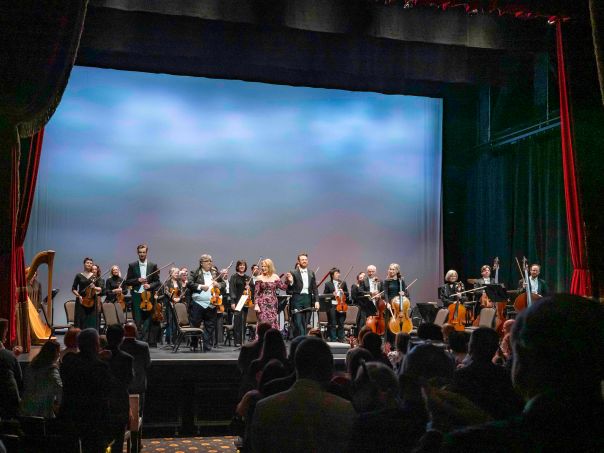
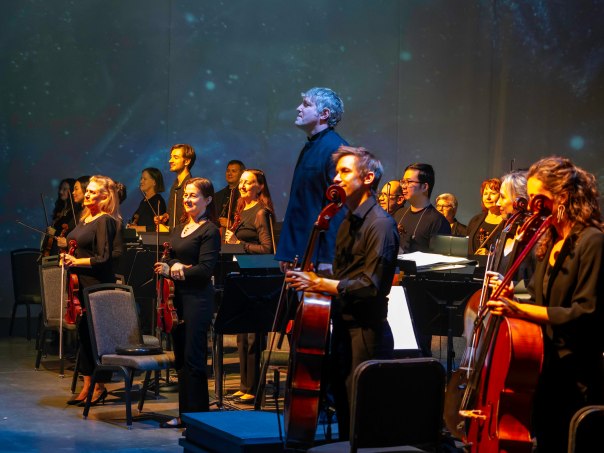
November 14, 2025, Charlotte, NC – Neither Maurice Duruflé nor Ottorino Respighi would rank high among composers that Charlotte Symphony subscribers most wish to hear. The orchestra’s previous two music directors, Christopher Warren-Green and Christof Perick, never performed Respighi as part of the orchestra’s classics series – he remained the province of guest conductors – and the Duruflé Requiem, after concerts by the old Oratorio Singers and Carolina Voices early in the century, hadn’t surfaced at all locally since 2007.

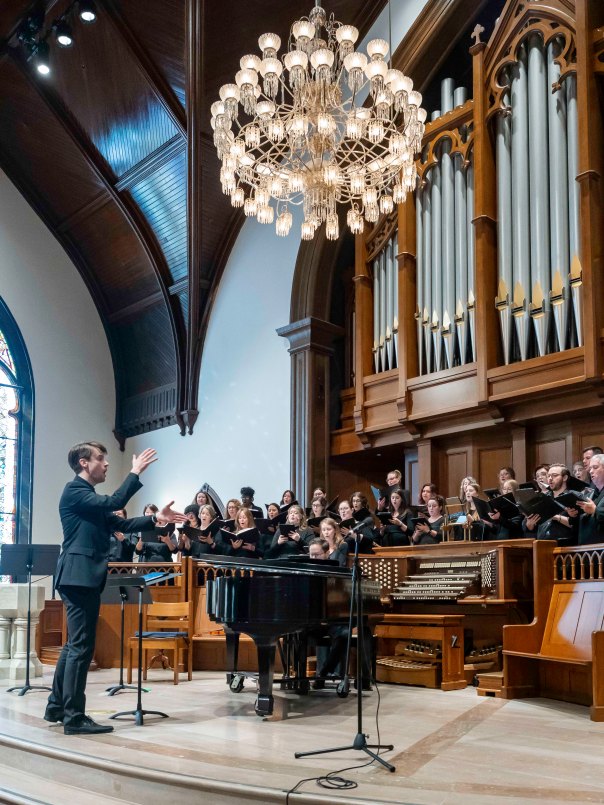
So a pairing of Duruflé’s most highly regarded work with two Respighi favorites, The Pines of Rome and The Fountains of Rome, didn’t figure to fill Belk Theater with rabid enthusiasts. Yet the sheer scale of the Requiem, calling forth the Charlotte Master Chorale under Kenney Potter’s leadership, made the Belk an obvious choice over the snugger Knight Theater.

Although our current music director, Kwamé Ryan, brought us Respighi’s Roman Festivals last spring, a guest conductor was once again on the podium for these more beloved Roman delights by the Italian icon. While a Duruflé-Respighi pairing will never be boffo box office, starting with the Requiem – which likely drew hundreds of the choristers’ family members to these performances – made the host of Master Chorale choristers onstage before intermission available to swell the audience for the Fountains and Pines afterwards. Adding to the electricity in the house, guest maestro Francesco Lecce-Chong deployed two groups of brass players upstairs to opposite sides of the grand tier for the final “Appian Way” section of The Pines.

Based on Gregorian themes from the Mass of the Dead, the Requiem sounded like the oldest piece on the program, though it was the newest. Fortifying that impression was the dominant role of the Chorale compared to the two soloists, mezzo-soprano Megan Samarin and baritone Eleomar Cuello. Most of us likely felt that Cuello’s noble bearing and vocals in the “Domine Jesu Christe” section were all too brief: even there, the choir had the larger share of the singing.

Samarin’s conquest in the middle “Pie Jesu” section, an ethereal solo, also seemed too fleeting, though here the Chorale was silent. Sampling recorded versions of the Requiem on Spotify and Apple, you’ll probably conclude that the orchestral version performed at the Belk packs more wallop than the organ scoring, which was probably the version that Carolina Voices chose 18 years ago at the Friendship Missionary Baptist Church. Another reason for the guest vocalists to make a more muted impression this time.

The fourth section, the “Sanctus,” decisively upstaged Cuello as Lecce-Chong rallied the forces of the orchestra and the Chorale together, but the baritone returned for a second cameo during the first half of climactic “Libera Me,” fueling the fires of the choral “dies irae” that followed. Somehow, the sublimity of the concluding “In Paradism” doused those fires. The beatific loveliness of the women’s voices certainly made for a heavenly arrival, yet the men miraculously eclipsed them in their visionary entrance, truly a mystic chorus of angels.

Instrumental excellence peeped in occasionally during the Requiem, chiefly in Timothy Swanson’s oboe obbligato for the “Kyrie” section, in bassoonist AJ Neubert’s “Lux Aeterna” intro, and in the exquisite welcome to “In Paradisium” from yet another principal, harpist Andrea Mumm Trammell. Even more play was afforded to the players in the Respighi pieces with all their resplendent colors and shadings.

Memories of hearing Respighi are invariably more sugary to me than the actual music, which under Lecce-Chong’s baton, especially in The Fountains of Rome, was refreshing and exhilarating – and, of course, effervescent. Neubert probably made an even stronger impression on oboe in his lovely, languid sketching for “The Fountain of Valle Giulia at Dawn,” with principals Taylor Marino on clarinet, Jon Lewis on cello, and Victor Wang on flute following eloquently in the same opening section.

The sunnier middle sections, depicting “Triton Fountain” and “The Fountain of Trevi,” were more impressively orchestral and brassy, Triton’s horn issuing an early proclamation at the beginning of his section and a rampage of brass, chiefly trombones, heralding midday at Trevi, Rome’s most majestic fountain. No doubt the audience was a bit surprised by the delicacy of the Fountains finale, “The Villa Medici Fountain,” and its sprinkling of percussion, celesta, and soft chimes, simulating a distant church at twilight.

My mind had first been changed on Respighi way back in 1997 when Daniele Gatti had led the London Royal Philharmonic into town with diva pianist Alicia de Larrocha. His rendition of The Fountains with the Londoners was sufficiently revelatory for me to place a rush order for Gatti’s recording of Respighi’s complete Roman trilogy, where additional revelations awaited: Roman Festivals and Pines of Rome were both more powerful, varied, and grand. Though The Pines had popped up on my calendar at the dearly departed Eastern Music Festival in 2011, this was my first opportunity to hear – and compare – Fontane di Roma and Pini di Roma in the same live concert.

With a feel as sure for Respighi as Gatti’s, Lecce-Chong’s performance was worth the long wait. “The Pines of the Villa Borghese” had a marvelous orchestral bustle before principal trumpeter Alex Wilborn was dispatched to the wings for the signature eerie effect in the solemn “Pines Near a Catacomb.” Even more quietude came with “The Pines of the Janiculum” as piano, clarinet, cellos, and a soft oboe anthem enhanced the magic. But the epic build and variety of “The Pines of the Appian Way,” seasoned with prerecorded nightingale chirruping and crowned, at the end of a satisfyingly long and majestic crescendo, with the outbreak of brass from the balcony, surpassed the grandeur of the Respighi we had heard before and joined the peaks of the Master Chorale as the pinnacles of the evening.

Listen! Charlotte Symphony Has Launched Its 94th Season With a Truly Musical Logo

Review: Charlotte Symphony Plays Shostakovich Symphony No. 5

By Perry Tannenbaum

October 10, 2025, Charlotte, NC – It’s a bit of a mind-bending concept, so after launching Charlotte Symphony’s 94th season by leading his orchestra and audience in the National Anthem, music director Kwamé Ryan needed to take a couple of minutes to explain what exactly a musical logo is. Symphony also has a new conventional logo, a graphic see-through C with a top seraph that reminds one of a bass clef. But Symphony’s musical or sonic logo, Ryan explained, is akin to the six notes you hear on your iPad when you get a fresh sports bulletin from ESPN or the sonic boom that blasts you off your couch when you sign in to Netflix.

Ryan joked that Symphony had gone to John Williams to write the new theme but he wasn’t available. So he settled for Mason Bates, the second most-performed living composer (by American orchestras), who accepted the commission. The timing was auspicious, for Bates’s acclaimed new opera, The Adventures of Kavalier & Clay, opened at the Met less than a month ago.

Ryan proceeded to lead his orchestra in two versions of the new logo, the world premiere of an extended concert version followed by the abbreviated five-second version concertgoers could expect to hear in the Knight Theater lobby, summoning us back from intermission. Tell me I’m wrong, but Bates also seemed to have Williams in mind, in a heraldic vein, when he fulfilled his commission. And if musical or sonic logos become a thing among orchestras, Bates, Ryan, Symphony, and its subscribers can all claim to have been on the ground floor at the Knight.

Bates also took honors for composing the first piece to appear on our printed programs for the new season, Attack Decay Sustain Release. Premiered 12 years ago on the Left Coast, this lively five-minute appetizer was written, Ryan revealed, in 7/4-time. Bates’s title was likely onomatopoetic, describing the flow of his primary melody, for the seven beats often ended with a sustained crescendo. In its multiple episodes, the five-minute piece also boasted plenty of space for highlighting Symphony’s strings and brass section, sprinkled with an assortment of woody and frond-y percussion.

The remainder of the evening would be devoted to Dmitri Shostakovich, if our printed programs were to be trusted. In greeting us, however, Symphony president David Fisk told us to expect an extra musical moment after intermission. Surprises galore! Maybe the biggest went unmentioned by Fisk and Ryan: the turnout at the Knight. Compared with the “disappointing” turnout I reported last November for Shostakovich’s Ninth, the first and only previous occasion that Shostakovich topped the bill of a Symphony program, our 2025 crowd for the composer’s Fifth was robust, few empty seats across the orchestra section and seats sold in the balcony to the uppermost row.

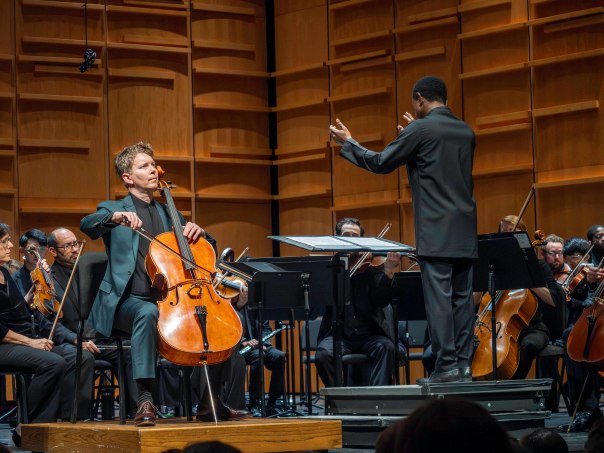
Guest soloist Joshua Roman may not have been apprised of the surprisingly enthusiastic crowd awaiting him, appearing slightly wary as he seated himself for Shosty’s Cello Concerto No. 1. With good reason. The piece, written for Mstislav Rostropovich in 1959 is bold and daring from the brash onset of its opening Allegretto movement, not at all a timid or apprentice composition. Roman’s part in the Allegretto was precociously modern; so driving, repetitive, and mechanical that it seems to antedate the minimalism of Philip Glass and John Adams. The comical interjections from brass and clarinet upstaged the soloist somewhat in my first live audition of this piece.

Roman could have told himself to be patient about winning us over, for his role became more complex and impressive after the only pause in the piece, when he tackled the cluster of three final movements, delivered without further pause. At the heart of this cluster, between a soulful Moderato and a joyous Allegro con moto, Ryan and his orchestra observed a reverential silence as Roman played the Rostropovich-worthy third movement cadenza. There were bowed sections featuring a melody and a bassline simultaneously and, deeper into the virtuosic display, interludes of counterpoint where he bowed with his right arm on open strings while plucking a second melody line with his left hand. You couldn’t miss the difficulties here even if you closed your eyes. Nor was the final movement anticlimactic, featuring the return of the orchestra and a more decorative and colorful return of the march motif from the opening movement.

Undoubtedly, the audience perceived the military triumph they had witnessed, rising for a lusty standing ovation. This triggered a final pre-intermission surprise, for after being cheered back onstage a couple of times, Roman sat himself down for an encore and, before the tumult died down, launched into the Prelude to J.S. Bach’s Cello Suite No. 1, maybe the most familiar solo he could possibly offer.

Pure negligence prevented me from sampling the sounding of the musical logo prompting our return after intermission for our most touching surprise, played in tribute to three dearly departed members of the Charlotte Symphony family. Thankfully, it wasn’t Samuel Barber’s Adagio but rather a piece that necessitated some fresh sculpting and rehearsal, Arvo Pärt’s Cantus in memoriam Benjamin Britten. Beautiful!

We’ve heard a lot from Ryan in recent years, though many Symphony subscribers might say we should have heard much more. In preparing what Shostakovich subtitled “A Soviet Artist’s Practical Creative Reply to Just Criticism” – from renowned music critic Josef Stalin – Ryan trampled on the notion that Symphony No. 5 was in any way servile, apologetic, or conciliatory. All the true moods of Shosty’s 1937 portrait of Soviet Russia were vividly rendered, beginning with the bleak, haunting, and ultimately aching qualities of the epic opening Moderato. This battlefield desolation was not altogether relieved by the comical marching of the ensuing Allegretto, which combined sourness with merriment, along with a delicious dancing interlude from concertmaster Calin Ovidiu Lupanu. The Largo reverted to the weepy and misty grumblings and dyspepsia of the opening movement. Then we transitioned wonderfully – especially in ghoulish October – to the surreal, manic phantasmagoria of the concluding Allegro non troppo. My happy memories of Christopher Warren-Green conducting this work have faded since 2013, so I offer no comparisons. But this was no doubt the finest performance I

Three Women Empathize Historically With “Stabat Mater” on a Historic Night

Review: Pergolesi’s Stabat Mater at The Mint Museum

By Perry Tannenbaum

September 11, 2025, Charlotte, NC – With its stained-glass windows, high ceiling, and resonant wooden flooring, the Uptown Mint Museum proved to be an unexpectedly apt venue for Opera Carolina and Charlotte Symphony to join in commemorating mournful, horrific events with sacred music. Reflexively, we look to the past – and to religion – to express our feelings amid present woes, but neither of the musical organizations could have anticipated the extra layers of calamity earlier in the week that would pile onto their memorial to the victims and heroes of 9/11 on its 24th anniversary. The work they performed, Giovanni Battista Pergolesi’s Stabat Mater, has always had a tragical tinge. Pergolesi composed his most-performed work near the end of his life, all too suddenly ended in 1736 by the onset of tuberculosis at the age of 26.

The Italian was casting his eyes across the centuries in scoring his Latin text, which had already existed for four or five hundred years, depending on whether it was written by Jacopone da Todi, a Franciscan friar, or by Lotario de’ Conti di Segni, better known as Pope Innocent III. The “Stabat mater dolorósa” poem, 20 three-line stanzas written in trochaic tetrameter, meditates on the sorrows and sufferings of Jesus’ mother, more than a millennium further back in time, standing by her son during the agonies of crucifixion. While the Oxford Dictionary of Music describes the piece as originally written for male soprano, male alto, and orchestra, most of the vocalists on the 60 or so recordings of the work have been female sopranos and mezzos.

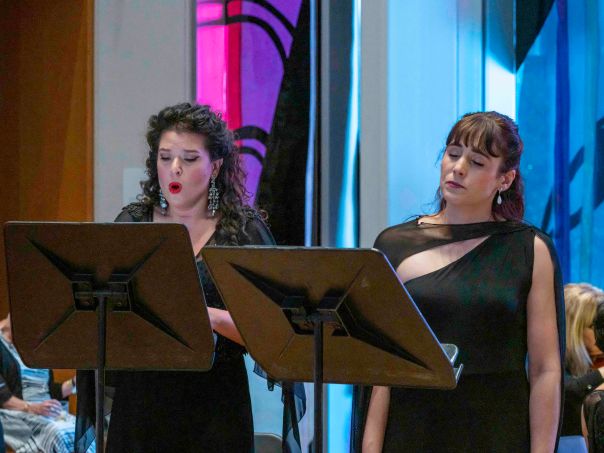
Marie Van Rhijn was the first woman to conduct a recording of Pergolesi’s chef d’oeuvre in 2021 on the Chateau de Versailles label, so Emily Jarrell Urbanek was almost a pioneer in adding her special empathy toward the grieving Virgin Mary as she stood on the podium leading the Charlotte Symphony Orchestra Ensemble. But wait: the Van Rhijn recording was done with two male vocalists! Samuel Mariño and Filippo Mineccia, listed on the album cover as the “deux costrats,” also perform the Vivaldi Stabat Mater on that release with Van Rhijn conducting. So together, Urbanek, soprano Corey Raquel Lovelace, and mezzo Leyla Martinucci may have been making feminist history after all.

Of course, the Van Rhijn recording remains a great place to begin if you’re wishing to hear how Pergolesi’s Stabat Mater actually sounded at its premiere in Naples. Yet it didn’t take long for the first all-female version ever led by a woman in Charlotte – and the first Symphony concert we’ve heard at The Mint – to impress. Pergolesi divided the twenty-stanza text into 12 compositions, and the opening “Stabat Mater dolorosa” duet is by far the most beloved. While the orchestral intro was engaging enough, though recordings with an organ yield more heft, the blending of Martinucci’s voice with Lovelace’s was sublime.

The first five sections of Pergolesi’s Stabat Mater fully demonstrate the composer’s strengths in solo and duet writing, his lithe capacity for transitioning back and forth between those modes, and his perverse disregard for the stanza couplings of the text’s rhyme scheme. After hearing Lovelace and Martinucci, I sampled Van Rhijn’s recording, then a starry version with Anna Netrebko and Magdelena Kožená, and finally ancient music specialist Christopher Hogwood’s prestigious recording with Emma Kirkby and James Bowman. My admiration only grew for both Lovelace and Martinucci’s approach to the music. Less vibrato and ornamentation seemed more in keeping with the sacred music and the solemn occasion.

Martinucci was the more unique find overall because of the creamy richness of her sound, though Lovelace sang equally well and matched her purity. Not long after Martinucci’s luscious and revelatory “Quae moerebat et dolebat,” Lovelace’s most affecting solo was the “Vidi suum dulcem natum,” two sections later. Between them came Pergolesi’s fifth section, “Quis est homo qui non fleret,” perhaps the apex of the concert. Lovelace launched into this section at some length, so it briefly seemed like this was a solo and Martinucci had neglected to take her seat. But Martinucci had an equally gorgeous solo afterwards and Lovelace didn’t return to her seat, either. We would be ascending heavenwards once more when the two voices soon intertwined.

The tone of the special occasion was nicely prefaced with words from OpCarolina general director Shanté Williams and Profit Insight senior advisor Duncan MacNichol, who a tolled a bell for each of the four planes that crashed in 2001 when the Twin Towers fell. The only discernible shortcoming at the Mint Museum was the lack of supertitles keeping track of where we were in the text. Though Lovelace was often difficult to follow, Martinucci usually lost me. Better to luxuriate in her voice than to decode her Latin.

Xuefei Yang Thrusts Herself Into the Classical Vanguard

Review: Xuefei Yang at The Parr Center

By Perry Tannenbaum

It wasn’t until my third time around with the Shuman Public Relations press release that it hit me. A national solo tour by any classical guitarist – let alone a Chinese female guitarist – is a rather unique event. No other pre-publicity had registered on my radar, so my curiosity was doubly piqued. To my eagerness to determine whether Xuefei Yang would live up to the hype was added fresh worries.

What kind of audience do we have in Charlotte, NC, for classical guitar? Would people be able to find the Parr Center, the two-year-old venue that had only been used once before for classical music – by Opera Carolina over 18 months ago?

Timed to coincide with the release of her new Chapeau Satie album – itself chiming with the centennial of Erik Satie’s death – the Yang tour isn’t running on fumes. Yang is one of the first artists to be signed onto Apple’s Platoon label, another encouraging sign alongside lossless music files that Apple Music is committed to classical. Enough Yang videos are on YouTube to suggest that she is quite savvy about marketing.

Her Parr concert quickly dispelled my fears of an empty house. Because of Yang’s impressive technique, her winsome rapport with the audience, and her wide-ranging repertoire, the evening was a buoyant mix of retro intimacy and decorum counterbalanced by an open-armed diversity and eclecticism: classical, jazz, tango, and Tin Pan Alley. Gleaned from four continents.

Aside from the finely calibrated sound, the deep Apple pockets behind Yang’s tour were out of sight. No printed programs were handed out at the entrance, and no QR codes lurked in the house. No poster-sized signage for selfies loomed in the lobby, and no merch was on sale. The prerecorded announcement introducing the guitarist was as slick and primetime as Yang’s best videos, yet efficiently brief.

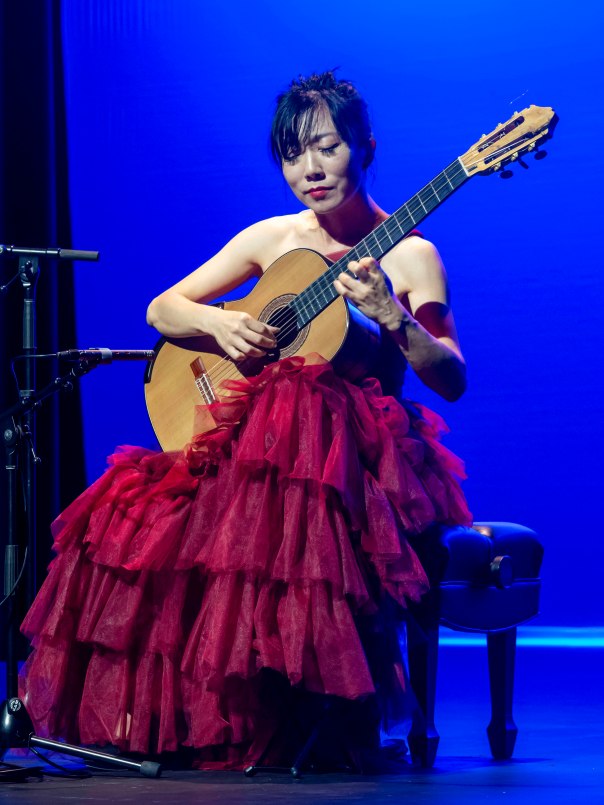
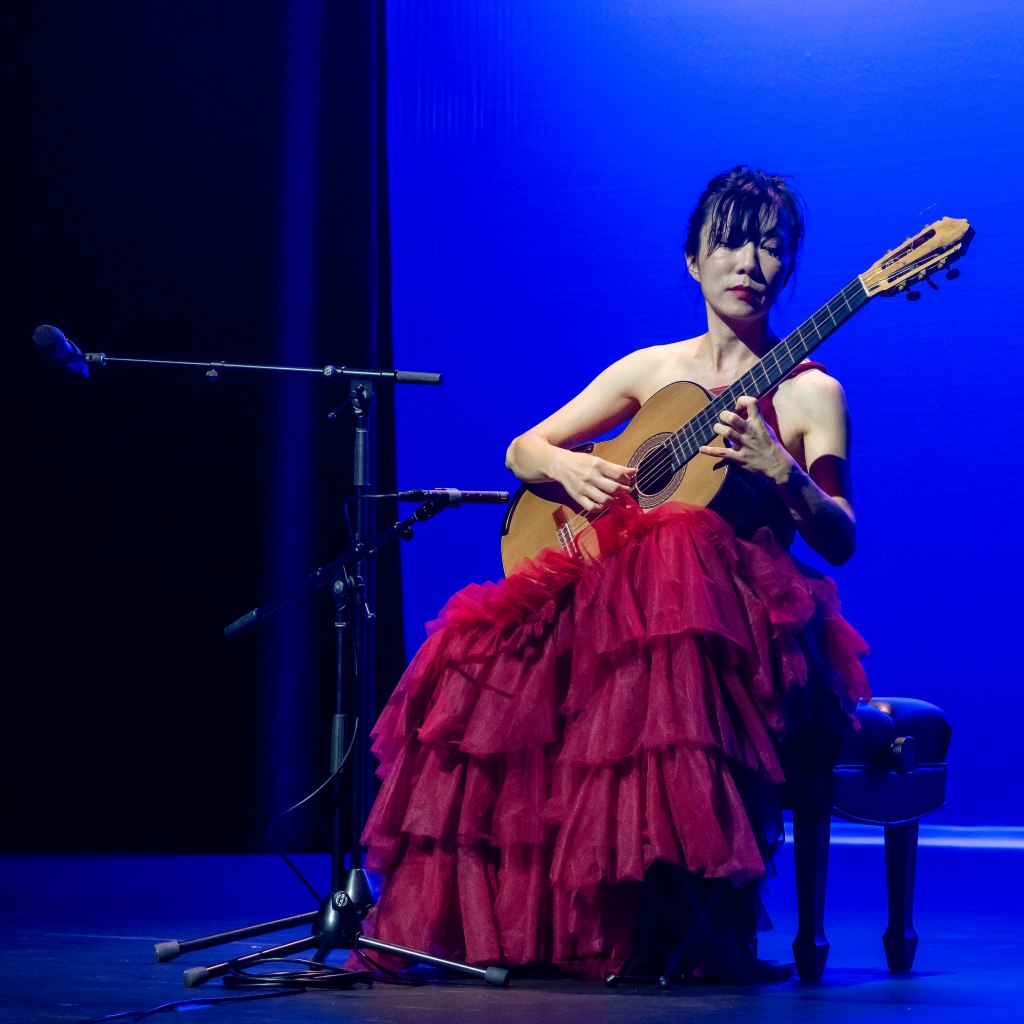
With nobody else onstage to greet her, Yang walked in from the wings, acknowledged the enthusiasm of what turned out to be a good-sized audience, sat herself down on an adjustable piano bench, and positioned herself – and a rather fluffy red skirt – on her foot rest. Though the applause was robust, there were no jumpers, no double-time clappers, and no whoopers in the crowd to indicate the presence of rabid fans.

Six minutes later, things would be different. Yang opened fire with Isaac Albeniz’s Asturias (Leyenda), a piece that you never forget once you’ve heard it. Nor do you have to see it being played to appreciate its rapidly compounding difficulties. It begins with a flamenco-styled bassline, layers on a trilling treble, and peaks with repeated strums stomping as the third layer – the fiercer, the better – as the bass and treble keep going, seemingly uninterrupted.

Or at least the flow sounds steady, undeflected by the ferocity, in the John Williams recording of 1974, which made me fall in love with the piece. Gradually, the sublimity of the slow middle section etches itself into memory after repeated hearings, the more so as you appreciate how perfectly it circles back to the opening bassline, trills, and strums.

At the Parr Center, Yang played better than she had in either of her 2022 studio recordings, first on the Decca label and then on a rushed and misjudged retake on Warner. She set the land speed record for the Asturias on Warner but surrendered her grasp of the argument. Now she was just a tad slower than Williams in the bravura sections, still in a thrilling groove, and only marginally swifter in the malagueña middle, her lucidity abounding and connecting both sections, with sublime harmonics perfectly timed.

An audacious beginning, to be sure. Now there were whoops aplenty, a couple of them uncomfortably close to my ears. Yang stood up with a bigger smile, holding her beautiful guitar in her open hands in a way that surely plays well at the seven churches on the 15-city tour. But she didn’t begin speaking to us until she reset herself and swiveled a second microphone her way.

We had begun our four-continent journey in Spain, she told us, and would continue to Paris with a couple of pieces from the new album. Again, these were transcriptions of pieces originally composed for piano that showed two sides of Satie, the spare and contemplative Gnossienne No. 3 and the unexpectedly frisky “La Diva de l’Empire.” Prepare for a cakewalk, Yang told us.

Of course, the cakewalk was the more adventurous Satie setting, especially since Yang is contriving on tour to replace vocalist Héloïse Werner, who sings with her on the recorded track. She soloed with a beautiful lilt, especially jaunty and supple where she was replacing Werner’s vocal.

Onward to Asia, where we were given a Japanese treat, an excerpt from Ryuichi Sakamoto’s Merry Christmas, Mr. Lawrence film score, my first gratifying discovery of the evening. You can actually check out the final track on Yang’s 2023 X Culture release and see how her version improves upon the composer’s soundtrack album – sadder, moodier, and poignant. To my ears, the Parr Center performance was even better, adding dimensions of foreboding as the tempo quickened, heartbreak and disillusion as the performance climaxed, crowned by a beautifully delicate coda.

Those in the audience who knew Sakamoto’s original could more fully appreciate the extras that Yang had imaginatively lavished upon it. For me, Yang’s excellence as a composer did not become apparent until she unveiled her own Xinjiang Fantasy. The tempo changes and the trilling treble might tell us of Yang’s desire for more pieces like Asturias in the repertoire – and perhaps more room for improvisation. Compared to the version she recorded on the same Decca album where her Asturias first appeared, the Parr version was more thoughtful, contemplative, and impressionistic, all of the percussive embellishments banished.

Perhaps because of the scarcity of flights from China to South America, Yang stopped over in Mexico for a couple of pieces by Manuel Ponce before crossing the equator. “Scherzino Mexicano” was an adorable departure from the broodings that had preceded, and “Estrellita” was like a sentimental homecoming, played ardently with touches of the sublime and Yang’s bell-toned harmonics.

The rest of our stay in the New World was more casual, relaxed, and jazzy. Astor Piazzolla chipped in one of his multitudinous tangos, “La muerte del ángel,” and Luiz Bonfá welcomed us to Brazil with his famed “Manhã de Carnaval” from Black Orpheus. We lingered in Brazil, in bossa nova, and in Black Orpheus with Antônio Carlos Jobim’s “A felicidade” before arriving at last in the USA.

So you can’t name a single piece written in America for classical guitar, right? Yang to the rescue with three superb transcriptions of tunes by Erroll Garner, Jerome Kern, and Billy Strayhorn. Garner’s “Misty” was the most innovative of the three, most adventurous in its bravura variations on the midsection (or bridge) of the familiar melody. Strayhorn’s “Take the A Train” was probably the most popular selection of the evening, delivering Duke Ellington’s familiar keyboard intro transposed to guitar, along with some of the familiar big band riffs. Nor did “Smoke Gets in Your Eyes” disappoint.

These American arrangements may indicate a new direction for Yang in upcoming releases, since there are no studio parallels to be found on Spotify or Apple Music. It’s tempting to think that Yang is also at the vanguard of a new wave of national tours by solo classical artists. That Apple and its new Apple Platoon label are at work preserving and recording classical music in higher fidelity and promoting live performance is as amazing as it is encouraging.

Heinichen Highlights NC Baroque’s “Magnificent” Concert

Review: Magnificent Baroque at St. Mark’s Lutheran

By Perry Tannenbaum

August 8, 2025, Charlotte, NC – Baroque music may not be synonymous with magnificence, but magnificence was arguably what baroque composers strove for most ardently in their music, particularly in a sacred setting. Little wonder, then, that over 80 percent of baroque music concerts in the Metrolina area are performed in churches – or that St. Mark’s Lutheran Church has now hosted the area’s three foremost baroque ensembles, Carolina Pro Musica, Bach Akademie Charlotte, and The North Carolina Baroque Orchestra.

Though based in Davidson, musicians in the Orchestra hail from more than ten different states across the US. Currently in their fifteenth year, they are still led by their sister co-founders, artistic director Frances Blaker and executive director Barbara Blaker Krumdieck. Ailing in San Francisco, Blaker yielded her conducting chores to concertmaster Martie Perry. Titling their St. Mark’s concert “Magnificent Orchestral Music of the Baroque,” NC Baroque wasn’t obliged to stray far from familiar composers or their warhorses. Yet even with J.S. Bach and Antonio Vivaldi on the program, the selections were all adventurous, with works by Johann David Heinichen and Joseph Bodin de Boismortier in the mix.

It’s never a terrible idea to begin with Vivaldi, but the Concerto in D minor was especially apt, since it allowed opportunities for both our co-hosts, Perry and first cellist Krumdieck, to immediately swing into action. Indeed, the chief delights of the opening Allegro were the exchanges between the two violinists, Perry and Annie Loud, and the phalanx of four cellists led by Krumdieck. The slow movements, an Adagio and a Largo, were charming, but the Allegros following them underscored one of the chief characteristics we cherish in Vivaldi, his abrupt changes in tempo and dynamics.

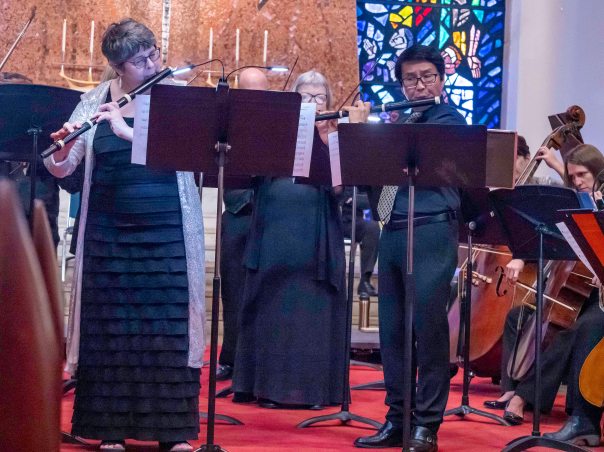
Vivaldi wrote over five hundred concertos in his lifetime, hundreds more than the famously prolific Georg Philipp Telemann, so NC Baroque had no problem unearthing repertoire that we had never heard before – or outside the familiar keyboard and string orbit. Fourteen oboe concertos and over 40 bassoon concertos are out there, to cite a couple of examples. Still, it’s a labor of patience, endurance, and discernment for the ensemble to settle on a single Concerto for Two Flutes in C (RV 533) – and from that three-movement concerto, to single out the opening Allegro molto. For the occasion, Sung Lee and Barbara Norton rose from the front pew of St. Mark’s, took their places centerstage between the violins and the cellos, and played flawlessly on their authentic instruments. What a lovely blend.

Krumdieck did the honors in introducing the double flute Vivaldi, but it was Perry who introduced the rarely-heard Heinichen, perhaps being offered for the first time in the region. Our Cultural Voice index mentions the German just twice over the years, both at performances in the Triangle Area: a Sonata for oboe, viola, and harpsichord, played in Raleigh by Mallarmé Chamber Players in 2015, and two unspecified Dresden Concertos played at the American Dance Festival in Durham two years earlier – likely through loudspeakers – accompanying a new work, Perpetual Dawn, by the Paul Taylor Dance Company.

If Spotify and Apple Music are to be trusted, virtually nobody knew about Heinichen until 1993, for that was when the much-lauded 2-CD collection of 11 Dresden Concertos was released on the Archiv label, performed by the Musica Antigua Köln led by Reinhold Goebel. My own familiarity with Heinichen, many of whose works were destroyed in the Dresden bombings of 1945, began shortly after reading a rave review of the recording (and Goebel’s introductory essay) in Gramophone.

On this night, the Concerto Grosso in G major (S. 215) and the Concerto Grosso in F (S. 232) – apparently Heinichen’s favorite keys – were the highlights, delivering the most magnificence. They were rightfully presented in ascending, chronological order, the G major after the Vivaldi works and the F major as the program finale after a sheaf of Bach Sinfonias. Again we would hear Lee and Norton on their flutes, but both Heinichen scores added a pair of oboes, played by Will Thauer and Sarah Weiner, that clashed rather than blending with the other winds.

After the first Heinichen, the two movements from Boismortier’s comic ballet, “Don Quichotte chez la duchesse,” were more than pleasant. My only problem with the performance was finding myself oversold on Perry’s tasty intro. Never did detect the promised windmills or underworld in the music, and if Mendelssohn had done Sancho Panza’s donkey, I’m sure little Rucio wouldn’t also have eluded me. Yet the Overture and Chaconne by the Frenchman provided a nice transition to the unique Bach segment of the program: four introductory instrumental pieces from four Bach Cantatas, an interlude comprised of four preludes.

All of these pieces were well chosen, none of them coming off like background Divertimentos or lackadaisical baroque elevator music. They offered fresh opportunities for soloists to take on different instruments. Subbing for Blaker on recorder, Weiner intertwined beautifully with Trauer’s oboe in the contrapuntal passages of the opening Sinfonia from the Tritt auf die Glaubensbahn (“Step onto the path of faith”) Cantata.

Trauer and Lee both switched from oboe to recorder for Gleichwie der Regen und Schnee vom Himmel fällt (“Just as the rain and snow fall from heaven”), bringing the Sinfonia set to a sparkling finish. Other versions you may audition on Spotify won’t sound as crisp, for it seems they’re fronted by oboes. Not that the oboes were slighted in the Sinfonia set. Weiner switched back to her customary instrument, playing beautifully on the Weinen, Klagen, Sorgen, Zagen (“Weeping, lamenting, worrying, fearing”) Sinfonia. Yet she had already been upstaged by Lee’s achingly lovely rendition of the Ich steh mit einem Fuß im Grabe (“I stand with one foot in the grave”) Sinfonia, likely repurposed from a previous concerto and subsequently recycled into the Harpsichord Concerto in F minor. Nectar of the gods.

Berko’s “Sacred Place” Is the Chief Revelation at Master Chorale’s Wholeness Concert

Review: Wholeness Concert at First Presbyterian Church

By Perry Tannenbaum

May 17, 2025, Charlotte, NC – Noted singer, conductor, and educator Helen Kemp (1918-2015) was most concerned with the musical training and development of children through children’s choirs when she coined her beloved mantra, “Body, mind, spirit, voice. It takes the whole person to sing and rejoice.” But in times of widespread warfare, terrorism, societal fracturing, and political upheaval, the Charlotte Master Chorale aptly adopted these words to subtitle its final concert for the 2024-25 season. Their “Wholeness” concert, conducted by Kenney Potter and Philip Biedenbender, affirmed the First Presbyterian Church of Charlotte as a place of healing, harmony, and communal gathering.

With Alex Berko’s Sacred Place as the centerpiece of the program, ecumenical engagement became the most salient feature of Wholeness for me. Between Shabbat morning services at Temple Israel of Charlotte and a Charlotte Symphony concert at dusk with works by Jewish composers Bernstein and Copland topping the marquee, Wholeness – and especially Sacred Places – proved to be a surprisingly perfect bridge. Berko’s six-part service is modeled on Jewish liturgy, with four of the six sections bearing the Hebrew title of a foundational prayer. These core elements of this prayerful suite were framed by an identical opening and closing prayer, excerpted from Wendell Berry’s 1966 poem, “The Porch Over the River.”

The prayers became a distillation of the poem, where Berry’s porch was the most benign human intrusion upon the primeval serenity of nature at a wooded riverfront. As for the Jewish service, texts chosen by Berko were only obliquely connected to the original Hebrew – actual connection in the instance of “Amidah” vestigially retained only in the composer’s introductory note. The music echoes the transition in Berko’s chosen texts from the hushed tranquility of Berry’s riverscape to John Muir’s evocations of majesty and glory in his eloquent description of Yosemite. It was originally sent to Theodore Roosevelt, urging the president to preserve this magnificent temple of nature. Only the connection between text and the literal meaning of “Amidah,” mostly a silent prayer said while standing, remained obscure.

Musically ranging from solo vocals to grand choral proclamations – accompanied by violinist Sarah Case and cellist Peter Case, with Biedenbender at the keyboard – the “Amidah” was only slightly eclipsed by the ensuing “Shema,” which superbly referenced the cornerstone of all Jewish prayer. Orthodox Jews will have the words of the “Shema” on all their doorposts and say them at least two times daily, if not three, biblically enjoining Israelites to listen and hear that the Lord is their god and the Lord is one. For this pivotal section, Berko chose William Stafford’s 1961 poem, “In Response to a Question: ‘What Does the Earth Say?’” Unlike the voice of the Lord, thundering from the peak of Mount Sinai and proclaimed by Moses to the people below, Stafford strains to hear what the earth says. Presumably, the poet has divined its message: “The earth says have a place, be what that place requires…” So again, Berko’s music roars and whispers.

Text for the “Mi Shebeirach” had a smidge of Hebrew in it, but contrary to Berko’s belief, it was not a translation of the actual prayer. Instead, it was taken verbatim from a setting that Debbie Friedman had written for the prayer in 1993, using the English she had interspersed with the original Hebrew. The Friedman version has amazing popularity, widely replacing the original “Mi Shebeirach” prayer across the English-speaking world, so Berko’s mistake is not unusual. Nor is it the worst.

A drama that was judged for the 2013 Jewish Plays Project, The Man in the Sukkah, presumed that the song, with its mishmash of Hebrew and English, was sung by persecuted Jews during the days of the Holocaust. When Berko’s setting reached the brief Hebrew phrase in Friedman’s lyric – “Bless those in need of healing with r’fuah sh’leimah” – the section, which had been more like recitative until this point, swelled with melody and feeling. The section that followed, “Kaddish,” retreated briefly toward the quietude of “Closing Prayer” with a snippet from Rabidranath Tagore’s Stray Birds (No. 273). It was good to have the delayed final words, “at the margin of starry silence,” printed out in the program booklet for the sake of clarity – and to fully savor the music’s sublimity.

Although the other nine pieces on the program didn’t benefit from the favor of being printed out – or credited, when the lyricist was not the composer – they were all worthy of the Wholeness theme. None of them were at all too brief, cute, or at all bouncy. The closest to rejoicing was Reginal Wright’s “We Are the Music Makers.” Less facile and more propulsive was the Adam and Matt Podd arrangement of “How Can I Keep from Singing,” with touches of melancholy throughout, especially in its concluding decrescendo.

The most intimate and solemn of the short works was Don Macdonald’s “When the Earth Stands Still,” with lyrics by the composer that merited inclusion alongside Berko’s texts. But the most remarkable piece of the afternoon was arguably Craig Hella Johnson’s beauteous, slightly sugary “Psalm of Life,” set to one of Mattie J.T. Stepanik’s Heartsongs. Before succumbing to a rare form of muscular dystrophy at the age of 13, the astonishing prodigy appeared on TV with Larry King, Oprah Winfrey, with former president Jimmy Carter on Good Morning America, and on New York Times bestseller lists on multiple occasions with his books of poetry and essays. Like all the other composers and writers behind the Wholeness concert, I’d never been acquainted with Stepanik before. He was a revelation to me among revelations.

Must-See Classical Abounds at Spoleto Festival USA

Reviews: Opera, Chamber Music, Orchestral Music, and Alisa at Spoleto

By Perry Tannenbaum

Three different sea changes have reshaped Spoleto Festival USA since Nigel Redden, responding to the WSYWAT turmoil that followed in the wake of George Floyd’s brutal murder, departed after the 2021 season. Redden saw himself in the crosshairs of the 2020 We See You White American Theatre manifesto, though he wasn’t strictly a theatre person, and felt that steeping as aside was the honorable thing to do.

Diversity has never been inimical to Spoleto, which has always looked more Euro and Afro than American. Yet as Spoleto 2025 concludes, a near-total change of artistic leadership has transpired – with an unmistakable lean toward diversity. Mena Mark Hanna has replaced Redden as general director. Paul Wiancko has filled the void left by the charismatic Geoff Nuttall’s sudden death, taking over the reins of chamber music programming. When John Kennedy was abruptly dismissed after the 2023 season, Timothy Myers became music director, wielding the Spoleto Orchestra baton.

And Joe Miller, after 20 seasons as director of choral activities, is resigning to lead the Vocal Arts Ensemble in Cincinnati. His Spoleto farewell, Bach’s Mass in B Minor, will be followed soon by an announcement of his successor in Charleston.

Conversely, Spoleto is responding to fiscal, box office, and government funding pressures to be more self-sufficient. While Kennedy’s programming arguably made the  festival America’s chief hub for 21st century classical music composition, his afternoon Music in Time programs were as much box office poison as they were cutting edge. That experimental ghetto has disappeared while Wiancko and Myers have integrated more infusions of contemporary, new, and world premiere music into the festival’s chamber music and orchestral offerings.

Beyond shrinking the outré and avant garde, Spoleto is expanding its pop, punk, folk, and R&B presentations to no less than a dozen Front Row events with Patti Smith, Band of Horses, Mavis Staples, Lucinda Williams, and Jeff Tweedy among the headliners. The strategy is to “expand the aperture” in Hanna’s words, offset the losses of more adventurous fare, and make Spoleto more accessible to a wider audience. Hopefully, these newbies may be tempted into tasting the 17-day festival’s higher protein offerings.

Other belt-tightening measures include offering 15%-off discount packages of tickets to multiple events, and ending of the longstanding tradition of inviting a theatre company from abroad to co-tenant the Dock Street Theatre with the lunchtime chamber music series. Wilder still, two of the Dock Street chamber music concerts were staged during evening hours! Sacrilege.

Finally, little touches in the festival brochure and the program booklet underscored a deepset commitment to making Spoleto more navigable and customer-friendly. Jazz fans could gorge on all the Spoleto headliners within the space of 10 days, while theatre lovers could get their fill in seven.

While both of these lineups were tilted toward the latter half of the festival; opera, dance, and orchestral music could be largely traversed within the first 10 days; along with seven of the eleven chamber music programs. As compacted as the scheduling was for festivalgoers devoted to one genre, omnivores like me who preferred a mix found themselves stretched. For us, the scheduling was scattered and fragmented.

How appropriate, then, that the most awesome classical music event this season, intertwining 27 new works by living composers with J.S. Bach’s Six Cello Suites, was Alisa Weilerstein’s FRAGMENTS. Conceived during the global pandemic, FRAGMENTS has some of the randomness and the quirky, curated individuality of a mixtape. Weilerstein did not commit herself to playing the Suites in their entirety or – within each Suite – in their traditional order. Or tempo.

Beyond that, in commissioning 27 three-part compositions roughly 10 minutes long, Weilerstein obtained the right to shuffle the order of the parts and to slice and dice the new works to create smooth transitions into each other and the Bach. Layering on stage direction at Sottile Theatre by Elkhanah Pulitzer, scenic and lighting design by Seth Reiser, and costumes by Molly Irelan, Weilerstein crafted her FRAGMENTS into a creation you literally had to see.

As revealed in an interview event moderated by Martha Teichner, Weilerstein has no intentions of releasing an audio recording of FRAGMENTS. Video only. However, the cellist will honor the composers she commissioned by recording their works as written. All in all, Weilerstein was onstage soloing and fielding interview questions for more than seven hours spaced over six days, capped with world premiere performances of FRAGMENTS 5: Lament and 6: Radiance on her final day.

Renée Fleming Provides the Glitter in Symphony’s Glitzy Spring Gala

Review: Charlotte Symphony @ Carolina Theatre

By Perry Tannenbaum

March 28, 2025, Charlotte, NC – In so many ways – for me, for Charlotte Symphony enthusiasts, and for the city – last week’s Spring Gala at the Historic Carolina Theatre was a thrilling revival and an orgy of nostalgia. First and foremost was the reopening of the ancient movie theater and concert hall, dormant movie-wise since 1978 and briefly revived in the late 1990’s by Moving Poets Theatre of Charlotte and the beloved Creative Loafing Theatre Awards. The Carolina has stood in midtown Charlotte since 1927 and the Charlotte Symphony Orchestra sprang to life there with its first public performance on March 20, 1932. So a couple of auspicious centennials are on the horizon during the next decade.

On the other hand, Carolina Theatre crystallizes what Symphony has become in its recent years of modernization. Within the past month alone, our orchestra has performed in front of movie screens on three programs, John Luther Adams’ Become Ocean, John Powell’s How to Train Your Dragon in Concert, and the glittery Spring Gala featuring Renée Fleming. If memory serves, we hadn’t seen Fleming perform with the Charlotte Symphony since 2004, and the last time my mom and I saw her at the Metropolitan Opera was in 2014, playing the title role of The Merry Widow.

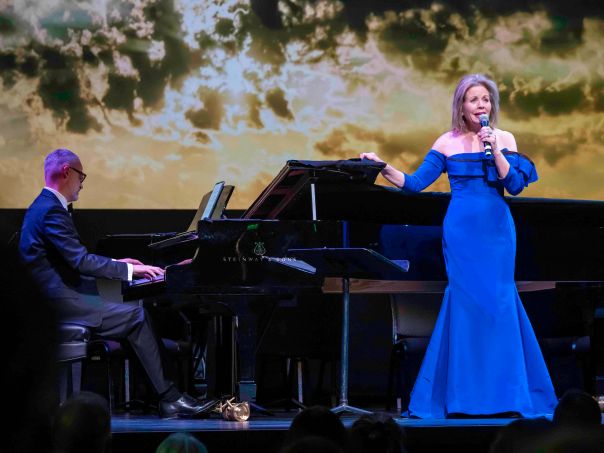
The epic assemblage of National Geographic footage added extra dimensions to Fleming’s live rendition of her Grammy Award-winning album of 2021, Voice of Nature: The Anthropocene – or it would have if the soprano had actually sung more than two of the album’s 17 tracks in front of the lushly cinematic backdrop. Two additional screens flanked the stage, not only tripling the Geo cinema to near-surround proportions but also supplying the texts or translations of the songs if you could peel your eyes away from Fleming, still glamorous at 66, accompanied by pianist Bradley Moore.

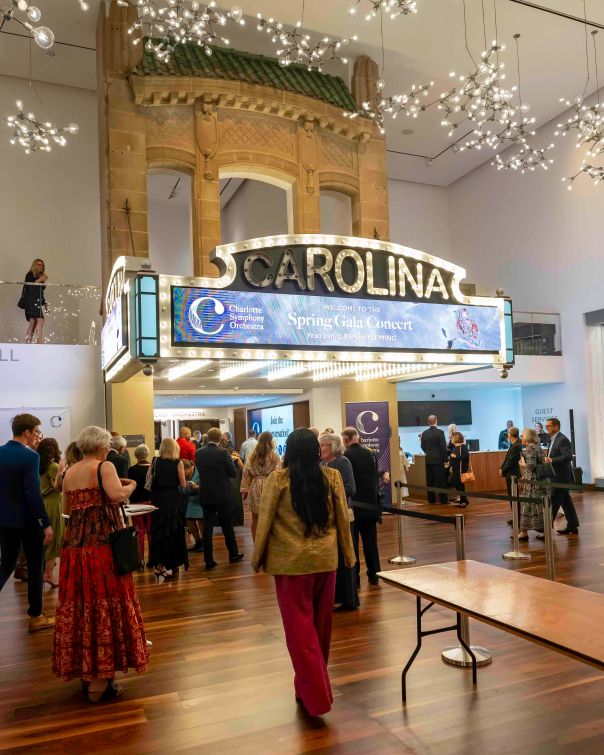
Cinematically and acoustically, the renovated Carolina Theatre was quite good for its age, too, but not spectacular. If you came to behold the sensational, that was taken care of before you entered the hall, for the glow of the lobby and the Carolina signage could be seen from blocks away as you began grappling with the riddle of where to park. Inside the lobby, where the sleek glassy modernity of the hall clashes with the quaintness of the updated Roaring Twenties marquee, you’re already in the presence of something unique, but when you enter the hall, spanking new with all its old-timey trimmings, you feel like you’re inside a time capsule.

So it’s hard for a critic to be churlish about Fleming delivering less than a quarter of her original Anthropocene in live performance when the 15 songs she substituted were so well-chosen and – mostly – flawlessly sung. From the album, Kevin Puts’s “Evening” and Reynaldo Hahn’s “L’heure Exquise” were the most delightful, but an objective assessment of Nico Muhly’s “Endless Space” was impossible for me. This was where the screens surrounding Fleming exploded with National Geo imagery: the glories of sky, ocean, rivers, and ice, followed by the ravages of fires, floods, drought, and sunbaked skeletons. Hazel Dickens’ “Pretty Bird” and an aria from G.F. Handel’s Atalanta were charming enough, but chiefly backed by massive tree trunks, comparatively sleepy on celluloid.

My favorites among Fleming’s inserts were Curtis and Pearce Green’s “Red Mountains Sometimes Cry,” Maria Schneider’s “Our Finch Feeder” from Winter Morning Walks,Giacomo Puccini’s “O mio babbino caro” from Gianni Schicchi,Rodgers & Hammerstein’s “The Sound of Music” and Joseph Cantaloube’s “Baïlèro” from his Chants d’Auvergne. Allow me a little churlishness on “Baïlèro”: although it was the most achingly lovely song that we heard before intermission, still magical though stripped down to Moore’s accompaniment, a full orchestral version with Symphony could have elevated the magic to sublimity with its lovelorn oboe passages and sprinklings of harp. Recorded versions by Frederica von Stade, Kiri Te Kanawa, and Victoria de los Angeles are the best – along with Fleming’s own, the final track on her 1998 Beautiful Voice album.

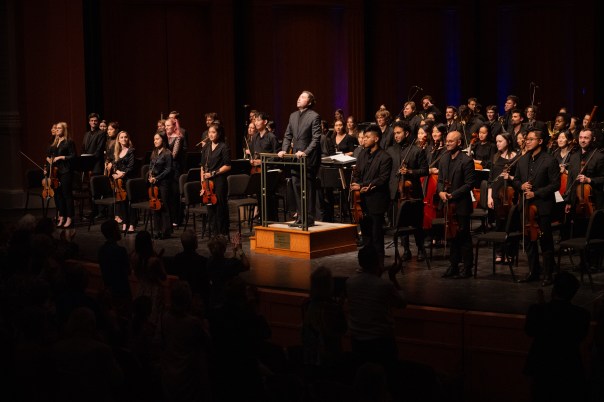
When Charlotte Symphony finally assembled onstage, it was more than an hour after president and CEO David Fisk and Charlotte Mayor Vi Lyles graced the evening with their gala presences and welcoming remarks. A bit undermanned for guest conductor Courtney Lewis in his Charlotte debut, the Orchestra sounded lackluster in the Overture to Mozart’s Le nozze di Figaro and downright moribund in the Overture to Gabriel Fauré’s Masques et bergamasques. It amazed me to find that nothing could mar or spoil this occasion when you felt privileged to be there. Partly because our expectations had been politely lowered, Lewis and Symphony seemed to overachieve in Richard Rodgers’ “Waltz” from Carousel.

Fleming’s voice has lost some of its creaminess above her midrange and I found myself rooting for her to easefully reach her top as she climbed to the climax of R&H’s “You’ll Never Walk Alone.” But Renée had banked plenty of his goodwill for arts lovers long before she resigned recently from the tainted Kennedy Center. Decades before she put her heart post-pandemic into the global environment, she championed American opera, most notably in 1998 when she premiered the role of Blanche in André Previn’s A Streetcar Named Desire while also collecting American arias into an 11-track album representing nine composers, I Want Magic! The aging diva is still banking residuals and Spotify pennies for her exemplary recorded output. Meanwhile, each time Charlotte Symphony had the chance to play live behind Fleming, they seemed to play better, producing fresh magic aplenty for us all – with the promise of much more from Fleming and the Carolina Theatre in years

Poiesis Quartet and Charlotte Poet Laureate “Jay” Combine for a 7th Street Benediction

Review: The Poetry of Music at St. Peter’s Episcopal Church

By Perry Tannenbaum

March 22, 2025, Charlotte, NC – You can’t say that 7th Street Concerts isn’t daring – or eclectic. Just within the past four weeks, the series has presented music ranging from the 12th to the 21st centuries, Hildegard van Bingen to Sky Macklay, with a heavy dose of Baroque writing in between. The two programs were staged just above street level in the St. Peter’s Episcopal Church sanctuary and then upstairs in the meeting hall. If that range weren’t sufficient, the latest concert featuring The Poiesis Quartet layered on spoken word by Charlotte’s poet laureate, Junious “Jay” Ward: four poems written specially for this “Poetry of Music” event.

The back-and-forth between the outré string quartet and the 2019 International Slam champ worked better than the average churchgoer would have hoped or believed. At times, the spoken word was a welcome counterbalance when the mod string compositions grew chaotic, cacophonous, or weird, for Jay’s modes were predominantly cosmic and engaged, without any lapses in lucidity. At other times, when the music grew quiet, dreary, or repetitive, it suddenly dovetailed handsomely with Jay’s rhythms and musings as a background.

It’s hard enough nowadays to discourage symphony subscribers from applauding between movements of a large orchestral work, and the corporate smiles that appear on musicians’ faces during these unexpected intervals only compound their awkwardness. “Sure, we love it when you applaud!” the performers seem to be saying through clenched teeth. So it’s been praiseworthy, both at Spoleto Festival USA and now here in Charlotte, to see musicians and conductors leaning into the idea that there shouldn’t be any applause until the end of a piece, a cluster of pieces, or the end of a concert. We can all stay in the moment longer and go home sooner.

Speaking on behalf of the quartet, cellist Drew Dansby made the request while making his acknowledgements and introductions. The pieces, about 41 minutes in length on their Spotify counterparts, would be played without any significant pauses – and without any notice about how Jay’s four poems would be wedged in. As a latecomer who had missed two-thirds of 7th Street artistic director Kristin Olson’s welcoming remarks, I may have been more disoriented than the punctual ticketholders when Poiesis readied themselves for the third movement Scherzo of Béla Bartók’s String Quartet No. 5 (if for no other reason than the printed program said it would be Quartet No. 3).

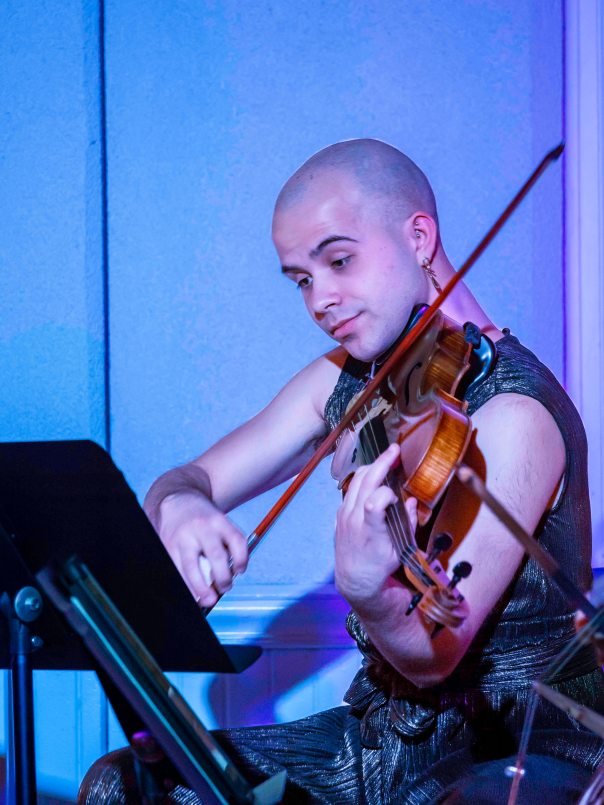
Was Jay even in the house as he began reading “Stunted,” his first poem? Lurking behind my left shoulder in the corner of the hall, outside my line of sight, he began behind a music stand holding a mic. Coming to me via a loudspeaker, his voice sounded pre-recorded! There was plenty to distract us onstage, for Poiesis doesn’t merely sport BIPOC credentials: more than a dash of gender fluidity greeted our eyes, along with assorted piercings. The first violinist’s long hair and attire, for starters, initially made Max Ball’s gender a mystery. Not to worry, Ball switched chairs at least twice with Sarah Ying Ma during the course of the program, so both genders earned first violin laurels during the evening. Choices in attire – and pronouns, if you read the program booklet – underscored the freewheeling fluidity.

Bartók (1881-1945) had completed five of his six string quartets before Dmitri Shostakovich had completed his first, so he is undoubtedly the wellspring for the modern rep. The Tokyo Quartet recording of the complete string quartets has been my favorite for over four decades. Since vinyl and cassette dubs. In the meanwhile, I’ve heard spirited live accounts by the St. Lawrence Quartet at Spoleto Festival USA and by the Emerson Quartet at Aspen, the latter a two-night marathon of the complete cycle. So it was rather astonishing to hear Poiesis’ confidence as they attacked the difficulties of the Scherzo and savor their maturity in intertwining its acerbic lines and sustaining its odd Bulgarian rhythms. Later that night, it was quite astonishing to come home and read that the Poiesis violist, Jasper de Boor, was currently a student of Ayane Kozasa, a mainstay at Spoleto and a member of the revered Kronos Quartet.

The entire quartet was playing at that high level before veering off into terra incognita – four works, two complete quartets and two excerpts by composers who were all unfamiliar to me. The excerpted composers, Joe Hisaishi (1950- ) and Winston-Salem native Coleridge-Taylor Perkinson (1932-2004), were my most egregious oversights. To those in the audience who were new to the Bartók string quartet soundworld, Hisaishi’s “Phosphorescent Sea,” the second movement of his String Quartet No. 1, was no less enticing. A printed illustration of M.C. Escher’s woodcut (sadly, not the correct illustration) added further allure to the evocative piece. Sonorous harmonies evoked the oceanic calm and its immanent magic until Ball pierced through on first violin with harmonics that conjured up the bioluminescence, sounding at times more like a flute than a stringed instrument over the plucked chords of Dansby’s cello.

Perkinson’s “Calvary” quartet, built on the traditional African-American spiritual of the same name, was easily the most soulful piece of the evening – and among the pair that were most uplifting. Like “Only Black,” which had been interwoven with Hisaishi’s “Sea,” Jay’s “All the Colors” was less topical and street-smart than “Stunted” but more serious, meditative, and profound. The quiescent second movement Adagio from “Calvary,” with its moody dialogue between De Boor’s viola and Dansby’s cello, provided the most appropriate platform for Jay to be seated onstage at the center of the Poiesis Quartet. Better yet, after Ying Ma soared above the viola and the cello – with a part that could almost have been scored for a second viola – the piece comes to a complete halt, accommodating the poet perfectly.

In Many Many Cadences by Sky Macklay (1988- ), a screechy scherzo that yields grudgingly to a dyspeptic drone from the lower strings before all four members get hyper, was undoubtably the best piece on the program for Jay not to write a poem for. Described by the composer as “lonely, disjunct ends-of-phrases [that] eventually congeal and transform into new kinds of phrases and sound objects,” her best-known piece – the opener on Spektral Quartet’s Grammy-nominated Serious Business album – is militantly modern. Yet Ma and Ball were obviously having a merry time helping Macklay “stretch the listeners’ perception of cadences” until De Boor and Dansby could join the party. It would have been a hoot to hear this spray of sound cells and objects down in the sanctuary!

After Jay joined Poiesis onstage for the “Calvary” excerpt, it seemed like we were headed for an anticlimax as the poet left the stage and began circling the hall as the ensemble launched into their finale, String Quartet No. 2 by Eleanor Alberga (1949- ), the longest piece of the evening. With its many varied episodes, gorgeously stitched together, Alberga’s piece abundantly merited its length and earned our extended delight. Teeming with prickly sonorities and folksy rhythms, Alberga’s quartet perfectly bookended the program with Bartók’s.

Theatrically, it also solved the problem of how to follow Jay’s onstage powwow with Poiesis. “Growth” may not have been loftier than “Only Black” and “All the Colors,” but it was certainly more speechy and oracular. Jay recited rather than read this last poem, adding to his spontaneity and flexibility. He walked slowly toward the stage from our left when we heard his voice again, able to look across the audience as he declaimed. Most of us likely assumed he would join the musicians onstage as before. Instead, he backed away down the center aisle that split the audience while the music soared and slowed, reaching an equally unexpected pinnacle. Backlit by the stage lights, there was a bright aura around Jay as he raised his voice, before Poiesis concluded with a final frenetic flourish. It was a uniquely magical moment, as if the poet were giving the musicians his benediction.

“Look! Here you are, the impossible, tall in the midst of chaos— a rose, a bloom of color broken beautiful against a morning sun.”

Lasers, Projections, and Artful Plumbing Bring New Vitality to “Become Ocean”

Review: Charlotte Symphony’s Become Ocean at Blume Studios

By Perry Tannenbaum

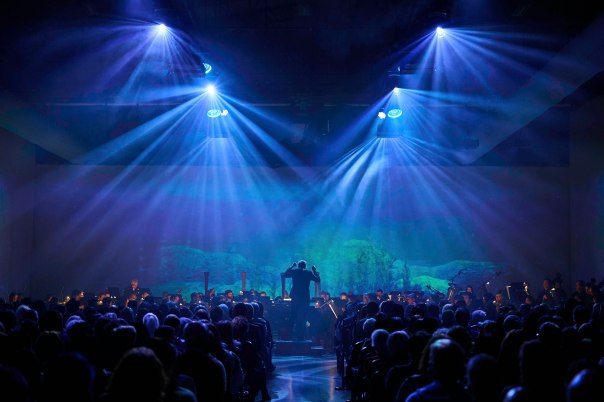
Animated bubbles rose from the pillars of four harps. Aquamarine waves flowed toward us and surrounded us. Revolving laser lights played upon silent infusions of smoke and mists, forming clouds and starbursts above.

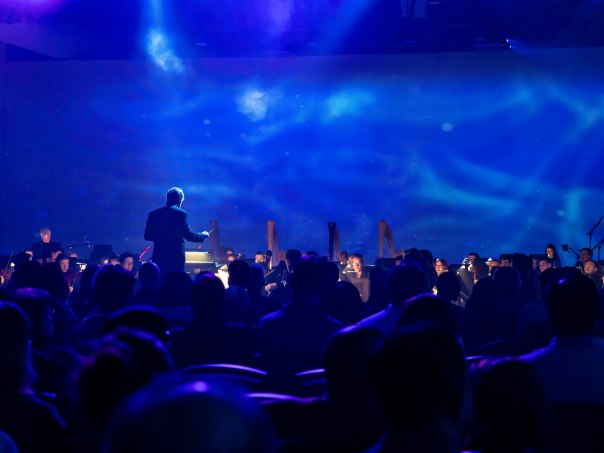
Become Ocean by John Luther Adams, conducted by Yaniv Dinur at the newly unveiled Blume Studios, was not a typical Charlotte Symphony program. It was an elaborately crafted experience. All of the orchestra and all of the audience were together in a vast shoebox, walled by white curtains punctuated only by exit doors. The only people elevated above the musicians were Dinur, haloed in a spotlight, and the phalanx of lighting and sound technicians at the rear of the hall.

Touring Broadway shows usually bring fewer board operators to the Belk Theater soundbooth. Creative directors Aaron Mccoy and Ian Robinson, projections designer Jeff Cason, and lighting designer/laserist Jay Huleatt were duly listed in Symphony’s digital program as members of the production team headed by co-producers Bree Stallings and Scott Freck.

Likely they took their cue – and its immersive drift – from Adams’ own words, written before the live 2013 premiere of the work by the Seattle Symphony, which commissioned the work. “We came from the ocean, and we’re going back to the ocean, right? We’re made up mostly of water, and life on earth first emerged from the seas. And with the melting of the polar ice caps and the rising sea levels, we may become ocean sooner than we imagine.”

For all of its gorgeous waveforms, colors, and lights, there was no mistaking the doomsday lifelessness of the massive projections. No fish or mammals inhabited these waters. No crawlies moved or glimmered on seawalls. The smallest bubbles might be imagined to suggest primal cellular life, and translucent forms taking shape in the deep could be seen as lazy jellyfish if you didn’t require intentionality. Plant forms occasionally appeared on the ocean floor, always motionless, never as fragile or temporal as grass.

Additional golden light gently flooded Dinur’s players, so when we reached the darkest ocean depths, we might see them as a hopeful golden glow, guiding us forward through the gloom. The feel of the Charlotte performance, notwithstanding all the electronics, was organic.

Unlike a “Symphony at the Movies” concert, conductor and orchestra didn’t calibrate their tempo with a soundtrack. On the contrary, the techs at the back of the hall were able to interweave their effects and projection episodes in sync with the musicians. The even, somewhat glacial pacing of Adams’ score certainly eased the synchronization to the point where it consistently felt seamless.

The composer’s scenario, if there is one, does not begin with a theatrical catastrophe or cosmic apocalypse. More like Debussy’s La Mer, the opening rises up gradually out of silence, evoking the infinite. Seated midway between the front and rear of the space along the right-side audience wall, where Symphony seated us in order to best hear the score, my wife Sue and I couldn’t really discern exactly when the music reached us after Dinur gave his downbeat.

It almost seemed to emerge – via double basses, contrabassoon, and maybe tuba – from the lower depths of human audibility, more like a hearing test than melodic music when first discernible. If we’d insisted on seats that offered a view of the musicians, the effect would not have been as mystifying. On this level playing field, with its wretched sightlines to the orchestra, we were prodded into looking upwards and around us.
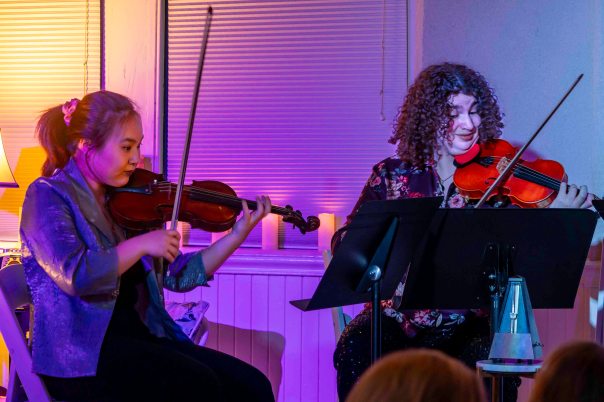
Even with a conspicuous absence of violins in the initial murmurs and the emerging sound weave, the score was not devoid of sweetness. Waveforms layered onto the low subterranean drone surely emanated from the harps. Whatever Adams added to these rising and falling arpeggios from the marimbas, vibraphones, celesta, and bells only added an electronic roundness – and a dim metallic glow – to the harps’ liquid ostinato. The crystallization of all this unseen plucking of soft pounding became quite magical.

Without cataclysm or catastrophe, becoming ocean could be experienced in a variety of ways, subtly aided by the light show. There was the gradual seduction of immersion in the liquid deep when we surrendered to it, each one of us at a different moment. Perhaps we moved further toward an acclimation to Adams’ prompt – proclaimed out loud by the sound system, like an epigraph preceding the performance – that this is “where we came from.”

As the projections evolved from abstract auroras and drifting bubbles to more solid shapes – waves, undersea gorges, boulders, and petrified plants – evidence mounted that the production team’s concept took us far, far away from the pivotal moments of environmental catastrophe. By now, millions of years after birds, men, reptiles, amphibians, and fish had breathed their last gulps of oxygen, we had become ocean in the sense that we were the hopeful spirit of a potential rebirth of life.

The structures of the score and the complementary projections open the doors to other interpretations. We could puzzle out the meaning when brass became as prominent as the harp and percussion ensembles. We could decide – or not decide – whether the extended whistling from the woodwinds was ominous or a hopeful sign.

In the longer scheme of planetary transformation, a similar ambiguity hovers over the long cataclysmic build near the end of this sea odyssey that crests with timpani, bass drums, and a muted trumpet. While it’s tempting to assume that this peak, subsiding into a quietude with sounds that evoked the funereal tolling of a bell, was the sealing of our doom, my reading was more upbeat.

The sea-shaking impact, millions of years from today, could signify a distant collision with an extraterrestrial object or force that eventually brings life back. The tolling would then signal a restarting of time.

What became clearer during this Charlotte Symphony performance piloted by Dinur was that Adams’ Become Ocean still merits all of its accolades, aging well since it was awarded the Pulitzer Prize in 2014. The Stalling-Freck production team has collaborated beautifully with Symphony and its new Blume Studios facility. Their multi-media addition never trivializes this epic symphony. Not does it constrain the visceral takeaways we can experience with the music. On the contrary.

First-timers will need GPS guidance when they venture away from Uptown Charlotte to their first Blume Studios experience. Plenty of free parking rewards their pioneering spirit when they arrive.