Review: Suspicious Cheese Lords
By Perry Tannenbaum
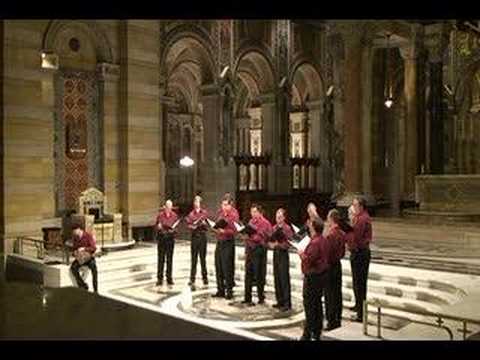
You probably wouldn’t guess it by their name, but the Suspicious Cheese Lords are a vocal group hailing from Washington, DC. Their name derives from the mischievously mistranslated title of a Thomas Tallis motet, “Suscipe quæso Domine,” a work that their website tells us the Cheese Lords have never performed. Suspicious! Considering that the Lords proudly specialize in works, from Gregorian chant through the Renaissance, that have never been recorded before, we cannot know whether these eccentric choristers will ever perform their quasi-namesake motet. Eccentric or not, the Cheese Lords had plenty of church gigs under their belts, participating in services at places as awesome as Washington’s National Cathedral, before they arrived at the Abbey Basilica on the Belmont Abbey College campus for their Sunday afternoon concert.
Those belts were conventional leather rather than thick rope, although the Cheese Lords were the choir-in-residence at DC’s Franciscan Monastery from 1998 to 2006. Attired in dark slacks and burgundy shirts, the Cheese Lords looked rather humdrum compared to their name. Nor were they terribly suspicious – except for their prime spokesperson and leader, Christopher Riggs. After emcee Karen Hite Jacob had just made the blunder of speaking to us via a lectern microphone, rendering her intro almost completely unintelligible, Riggs separated himself from the ensemble and offered greetings, individual intros of his colleagues and, with the assistance of each of the Lords’ four sections, a thorough demonstration of polyphony. Yet his first words to us, “Can you hear me?” must surely have been rhetorical, notwithstanding the fact that he had disdained the microphone. Riggs’ big baritone voice boomed across the hall effortlessly.
What was suspicious, surprising, and sensational was yet to come. Riggs, known as “Lord Taskmaster” at the Cheese Lords website, receded into the ensemble and proceeded to tune and cue the other singers – from the countertenor section. Neither “receded” or even “blended” would be entirely accurate here. As we moved from the demonstration snippet of Giovanni Pierluigi da Palestrina’s “Sicut cervus” (Psalm 42:2) to a full performance of the piece, it became apparent first that Riggs’ singing voice was a gleaming countertenor, as effortless as his speaking voice. More remarkable, as the concert continued, it became obvious that Riggs’ countertenor was a dominant voice. I have no trouble believing Riggs’ website blurb where it claims that Lord Taskmaster’s range extends from bass to countertenor. It’s just hard for me to believe that he isn’t better known.
After the Palestrina, the program took a hairpin turn that I loved – to a living composer’s setting of Psalm 43. Tony Domenick’s “Vindicate Me, O God” not only livened the program with its contrast, it enabled the Cheese Lords to re-emphasize the differences between modern harmony and polyphony. Better yet, the work was the first winner of a compositional prize, contested by composers aged 35 or younger, awarded in 2016. Where the effect of the Palestrina had been somewhat intoxicating, overlapping words blending in a language I don’t speak, the Domenick performance glowed in English with clarity and plainspoken emotion. The Abbey Basilica may be unkind to softspoken people who resort to amplification, but it’s very much like heaven for a choir, uncompromised by dead-end nooks that might muffle the commingling of sound waves.
Unfortunately, the shuttle between ancient and modern compositions wasn’t repeated. Nor was there a return to English, though translations abounded in the eight-page program booklet. The Cheese Lords proceeded to stitch together a “FrankenMass” from sources and parodies spanning five centuries, beginning (chronologically, anyway) with a Gregoria chant by Hermannus Contractus (1013-54) and terminating with a pair of pieces by Elzéar Genet (c1470-1548). Pieces were grouped in the order of the five sections of the ordinary Mass: Kyrie, Gloria, Credo, Sanctus, and Agnus Dei. Most of the sections led off with a piece that was later parodied. Now Riggs was careful to explain that the parodists weren’t at all mocking their sources as Mel Brooks’s Young Frankenstein mocked the Boris Karloff classic. These were simply choral pieces that used earlier pieces as jumping-off points for development and elaboration, so Ludwig Senfl’s “Gloria” from Missa L’Homme armé no more mocked the anonymous 15th century composer of “L’homme armé” than Rachmaninoff mocked Paganini. In between these two pieces, we heard a different repurposing of “L’homme armé” by Robert Morton, who composed an “Il sera pour vu conbatu” overlay for the earlier song.
A bit of convoluted logic justified the inclusion of the unparodied “Kyrie” from an anonymous 13th century Messe de Tournai, and the messy formatting of the printed material, where a lyric might appear four boldfaced headers after a song title was mentioned, had my head spinning a bit. Compounding my confusion, a “Gloria” heading appeared in boldface on the line directly above the two Palestrina pieces where the composer parodied himself with his “Credo” from Missa O admirabile commercium. The music itself soothed my confusion, and a few more of the 10 Lords came forward to personably introduce the pieces. By far the least informative – and most entertaining – of these presentations was Cheese Lords founder and president Clifton “Skip” West III, who gave a lively account of the Tallis-based etymology of the group.
There were interesting wrinkles in the arrangements. The “Kyrie” began with a tenor-countertenor duet, baritone Sargon de Jesus soloed to kick off Senfl’s “Gloria” (where the tenors soon took the lead), and after disappearing behind the far altar before West’s remarks, two basses and a baritone began the “Alma Redemptoris Mater” plainchant from their distant concealment. Reunited, the full ensemble turned in some of their most beautiful work on Jean Mouton’s “Sanctus,” though lyrics were missing from the booklet, which repeated its misleading layout.
Even more delightful was the arrival at the music of Genet and the unexpectedly worldly source of his “Agnus Dei” from Missa Se mieulx ne vient. The first line of the original French rondeau translates as “If it doesn’t get any better, I’m not content with love.” Surprisingly, searches of Spotify and Amazon confirm that recordings of Genet are almost exclusively a Cheese Lords domain: no other full-length CD devoted to Genet is available at either outlet. The Cheese Lords’ 2002 Maestro Di Capella, including the complete Se mieulx mass, has no competition. Now if they had to do it all over again, I suspect they would have recorded the parodied song, as they subsequently did prefacing their recordings of the L’Homme armé, O admirabile commercium, and Alma Redeptoris Mater masses.
Our sampling of the piece confirmed that Genet’s music deserves a full hearing as much as the more frequently recorded Palestrina, Senfl, and Mouton. The warmth of the ensemble in live performance at the Basilica surpassed the engineered recording, where the post-production mix may have enabled Riggs to sound more subdued if no less distinctive. Added to the completed “FrankenMass” was another Genet gem, “Tibi Christe,” a hymn for the feast of St. Michael. The special treat here was the shuttling alternatum style, alternating verses of chant and polyphony. Riggs called our attention to the first of the two polyphonic stanzas, where brave Michael pulverizes the devil. Actually, the live performance far exceeded the recorded version in clarity and excitement, which was held in check until the final stanza on the CD. For the encore, one of the tenors – Kevin Elam, I believe – brought out a tambourine as the Cheese Lords finished with an even more freewheeling Spanish tune, “Rey a Quien Reyes Adoran.” People lined up after the concert for the merch that discreetly appeared on the Basilica’s piano. More gathered around the remarkable Riggs and his cohorts.


