Tag Archives: Yvette Moten

Hohenstein Gets Greedier in His Second Go-Round With “Peter and the Starcatcher”

Review: Peter and the Starcatcher at Matthews Playhouse

By Perry Tannenbaum

July 12, 2025, Matthews, NC – Though their names are similar and they’ve both written about Peter Pan, the temperamental gap between James M. Barrie and Dave Barry would seem to be as wide as oceans. Barrie created Peter in 1904 as an embodiment of eternal youth and the spirit of noble adventure. A century after Peter made his stage debut (played by a woman, of course), Barry teamed up with Ridley Pearson to write a novel-length prequel, Peter and the Starcatchers, keeping the non-fantasy base of the story in Victorian England while snatching Neverland from up among the stars and plopping it down on an earthly ocean.

What Rick Elice seems to have done, in returning the Barry-Pearson preteen page-turner to its stage origins, is to worshipfully replicate all the seagoing pirate action of Starcatchers along with Barry’s choicest quips. Then to supercharge the effect, Elice seems to concentrate it all so that it flies by in a blizzardy blur, all the more frenetic because scenery is stripped so bare – people become doors, ropes become ocean waves, and flag streamers are crocodile teeth – that we’re exercising sizable hunks of imagination to fill out what’s actually happening before our eyes.

Barrie fairies were jubilantly diced and desecrated by Barry’s mischief and mirth: or so it seemed the first three times I saw Elice’s Peter and the Starcatcher – on Broadway, on tour, and at Theatre Charlotte, directed by Jill Bloede. Having read Barry’s Pulitzer Prize-winning humor pieces for decades, I was so sure of my familiarity with America’s beloved joke-and-quip machine that I never bothered to read a single page of his Starcatchers. My naïve conclusion was that Elice had simply let the Barrie-Barry mashup work its magic with as little intervention – and budget – as possible.

My fourth encounter with Starcatcher at Matthews Playhouse, once again directed by Bloede, helped to enlighten me. In her previous work with the script, the evanescence of the budding relationship between Peter and Molly Aster – and the poignancy of their parting – felt more touching to me than previously. That’s significant compensation for anyone who adores Barrie’s original story, whose magic can seem drowned in humor, wit, and shtick when first encountering Starcatcher.

This time around at Matthews Playhouse, another thematic thread struck me for the first time: Elice’s orphaned Peter reaches puberty without ever having a first or last name. By now, it will only come with his consent. At the other end of the moral spectrum, Black Stache has been searching throughout his pirate career for a hero antagonist who will perpetuate his fame.
So their first grand meeting and tussle have biblical Israel-Angel proportions and consequences, or Robin Hood-Little John echoes if you prefer a secular, literary parallel. Two combatants become permanently linked and one of them emerges with a new name. Bloede’s staging here, when Peter gets his name from Stache – and later when Pan is added on – brought a new aura to those moments.

That’s what sent me to the web in search of Barry-Pearson’s actual text. Elice’s wit and humor seemed to chime with the belly laughs Barry’s newspaper columns repeatedly deliver. But is the class clown who grew up no less jokey truly capable of such yiddishe flavor and mythic depth? My suspicions were confirmed in the very first sentence of Barry’s saga: it already includes Peter’s name! An even more amazing revelation awaits if we read on. The jokey Barry tone we know and love is nowhere to be found in the opening chapters we can sample at Amazon. Instead, Barry and Pearson were following along on the dark gallows humor path that Lemony Snicket had pioneered with his Series of Unfortunate Events books for kids.

Deep breath. In my previous reviews of Starcatcher, I repeatedly gave Barry too much credit and blame for what I had seen and much too little to Elice. Both the jokiness and the mythic dimensions of Starcatcher can be credited to Elice – with additional bravos for how thoroughly he convinces us that this is how Barry would tell the origin story of Peter Pan.

Meanwhile, community theatre in Davidson, Charlotte, and Matthews continue to reap the dubious benefit of having so little professional-grade theatre in the Queen City. What a cast Bloede has assembled! Before the show began, representatives from the North Carolina Theatre Conference presented artistic director Sarah Bumgardner with their Theatre of the Year Award for 2024. So the folks backstage with their costumes on, waiting overtime for the ceremonies to conclude, were obviously under extra pressure to deliver. Even Bloede was nervous!

No matter how good your cast is, there’s plenty of stage business to be nervous about in running Starcatcher.Actors must move all the props and furniture around and keep track of all the many Yvette Moten costumes they must find and change in and out of as we move from a London dock to two sailing ships to a faraway island with a beach, a mountain, and a jungle. Stage manager Jessie Hull had to be preternaturally adept. Molly must float in the air. Peter and some nameless alley cat must fly. A lot going on while the quips shoot out at us, many of them newly minted to mock Myers Park and nearby country clubs.

Nearly all of these players were newcomers to Starcatcher, beginning with Joshua Brand as Peter and Emma Brand as Molly, presumably arriving on the Fullwood Theater stage with ready-made chemistry. Their boy-girl antipathy is no less charming than their tentative stabs at intimacy, and both can seem fueled by the promise of adventure and ignited by its thrill. The only holdover from Bloede’s 2018 cast is Johnny Hohenstein, who in bygone days crossdressed to portray Mrs. Bumbrake, Molly’s flirtatious nanny.

With even more liberties, including more than a slight leftover effeminacy from Bumbrake, Hohenstein burst into full flower as the carnivorous Black Stache, heartily devouring the scenery in Stache’s emblematic amputation scene. His eyes shone greedily as he attacked the hambone bits, and yet a queer kind of avuncular calmness came over him as he finally met his predestined antagonist and named him. For some reason, Hohenstein drew the only problematic microphone on opening night but remained unflustered by its fussiness.

Of course, one of the glories of Peter Pan is its superabundance of meanies and piratical buffoons, and we do not lack them here. In her latest crossdressing exploit, Andrea King was the perfectly servile and supercilious Smee, with glints of valor and wickedness. Chip Bradley was the wily Slank, Captain of the Neverland,who steals the precious trunk full of starstuff from under the nose of Lord Aster, the Queen’s devoted ambassador and most eminent Starcatcher. Andrew Pippin portrayed the austere Aster with sufficient British crust, entrusted with the mission of transporting the precious starstuff cargo to Rundoon, where the trunk can be dumped into a nearby volcano and kept out of evil hands.

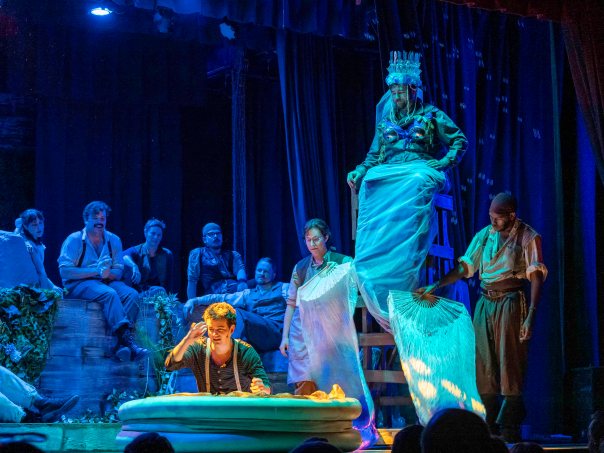
When we reach the faraway island where Peter and the trunk of starstuff serendipitously wash ashore, we will find that Neifert Enrique is the outré and eccentric King Fighting Prawn, monarch of the Mollusk natives. Was this the wildest of Moten’s costumes, or was it Hohenstein’s at the start of Act 2 during his brief song-and-dance as one of the Mermaids? Maybe Ryan Caulley snatches the prize toward the very end as Teacher, a salmon magically transformed into a Mermaid sage atop a lifeguard’s chair. It was a fitting reward for Caulley after a full evening gagged as Captain Scott from the first moment we saw him aboard his ship, the Wasp.

Ben Allen as Prentiss and Alijah Wilson as Ted were more individualized than Peter’s fellow orphans had been in previous productions I’d seen, and Miles Thompson was more rounded and nuanced as Alf, the smelly sailor who woos and distracts Molly’s nanny. Davis Hickson wasn’t as giddy and over-the-top as Hohenstein had been as Bumbrake at Theatre Charlotte in days of yore, so the Alf-Bumbrake thing (with Alf breaking most of the wind) was less orgiastic now and more genuinely warm.


The Delphic Oracle Sings The Go-Go’s

Review: Head Over Heels at Duke Family Performance Hall by Davidson Community Players

By Perry Tannenbaum

Heaven, Elysium, Utopia, Paradise, and Arcadia are all perfect places in our minds, too placid and static to be considered as settings for comedy, thrilling action, or drama. If you were in search of a perfect backdrop for the music of The Go-Go’s, you would more likely pick a city on the California coast, Las Vegas, or even Indianapolis than opting for heaven or the Elysian Fields.

That’s not how Jeff Whitty saw it when he conceived Head Over Heels. You get the idea that, after birthing Avenue Q, Whitty almost had free rein from the Oregon Shakespeare Festival to do anything he pleased. Whether he was inspired by the Elizabethan aura of OSF’s outdoor and indoor stages in greeny Ashland, Oregon – or bound to play up to them – Whitty reached back to The Countess of Pembroke’s Arcadia by Sir Philip Sidney, first published by the Countess in 1593.

Whitty had absolutely no intention of bridging the two eras – or smoothing the discordance between Elizabethan and Go-Go’s English. Whitty does tone it down a bit when Philoclea, the younger daughter of Arcadia’s King Basilius, tells her ardent admirer Musidorus to “Speak English, not Eclogue” when the shepherd boy begins his wooings.

At about the time that Head Over Heels premiered at OSF in 2015, Something Rotten!, with Will Shakespeare as its rockstar, was premiering on Broadway. That might explain the lukewarm reception that greeted Whitty’s show when it had its NYC premiere in 2018, for its Broadway run fizzled out in less than six months.

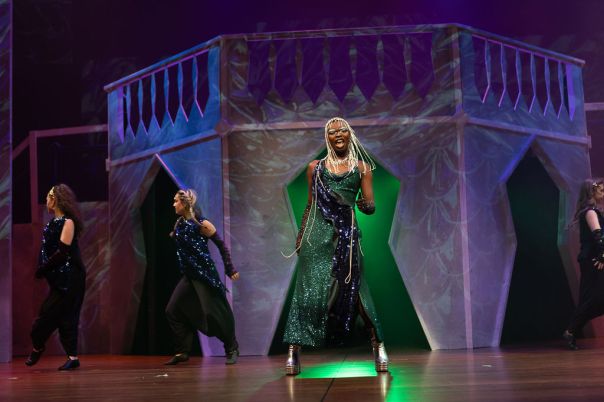
You can judge for yourself at spacious Duke Family Performance Hall as Davidson Community Playhouse rather splendidly presents its summer musical in nearly all of its gender bending glory. For this Metrolina premiere, projection designer Caleb Sigmon, scenic designer Ryan Maloney, and costume designer Yvette Moten fill the Broadway-sized stage on the Davidson College campus with eye-popping color and Hellenic style.

With the disclaimer that I’d never heard a single bar of Go-Go’s music before Head Over Heels came to our region, I can say that I delved into The Go-Go’s greatest hits afterwards on Spotify and listened to the original Broadway cast album. From the opening “We Got the Beat” onwards, the two generations of singers up at Exit 30 on I-77 beat them both.

Word of DCP’s excellence has extended its reach, and director Chris Patton and music director Matthew Primm have reaped the benefits. Belting the Go-Go’s “Beautiful” to her own mirror, Jassi Bynum is the vain elder sister, Pamela (a name apparently invented by Sir Philip). No less capable of letting loose, Kiearra Gary is the obedient “Good Girl” sister, Philoclea. And the well-established powerhouse, Nonye Obichere, is Mopsa, who seems for awhile to be a third sister until we learn that she is actually the daughter of the King’s steward, Dametas.

When Mopsa’s heart is broken, she will flee to Lesbos (wink, wink) and sing “Vacation.” Obichere slays at least as convincingly as the sisters.

It’s easy enough to get confused by the parents because they’re all white folk who fit nicely into Sidney’s Grecian mold but look nothing like their offspring. Yet Lisa Schacher, not seen hereabouts in a truly breakout musical role since the early days of QC Concerts, keeps her where-have-you-been-all-my-life belting capabilities under wraps until after intermission as Gynecia, the Arcadian queen. We’re not just talking Judy Garland belting, for Schacher crosses over the borderline to Whitney Houston territory along with Bynum, Gary, and Obichere.

Once whatever was clogging Tommy Foster’s larynx in the first moments of Saturday night’s performance as Dametas was expelled, the longtime veteran reminded us that he could also wail. Saddled with a more earthbound voice, Rob Addison brings a nicely grizzled dignity to King Basilius that is forceful enough for the lead vocal of “Get Up and Go” and his climactic king-and-queen duet with Schacher, “This Old Feeling.”

Kel Wright, whose pronouns are Kel and I in her coy bio, is the gender-fluid complication roiling the eternal placidity of Arcadia. She is the ardent shepherd boy Musidorus, Philoclea’s bestie since her tomboy days, who must disguise himself as an Amazon warrior, Cleophila, after he’s banished from Arcadia in order to regain access to his lady love.

Everybody seems to be attracted to Cleophila, though they come to all the possible conclusions about the Amazon’s true gender. It’s a mess – a hormonal thundershower that afflicts the King, the Queen, and their daughters. All of them scurry about in a mad passion that comes off with all the innocent merriment of a musical comedy. Adding to all of this hilarity is the disconnect between Wright’s tinniness and the Amazon’s virility, so feverishly irresistible to Pamela and her mom.

All of this mad pursuit, however, happens under the cloud of a prophesy that threatens Arcadia’s doom. A snake sent by Pythio, the Delphic Oracle, lets loose of a letter summoning King Basilius to the temple to hear the Oracle’s oracle. In Sidney’s original manuscript, not recovered until 1908, the prophecy is given concisely in verse at the end of the novel’s opening paragraph.

Thy elder care shall from thy careful face

By princely mean be stolen and yet not lost;

Thy younger shall with nature’s bliss embrace

An uncouth love, which nature hateth most.

Thou with thy wife adult’ry shalt commit,

And in thy throne a foreign state shall sit.

All this on thee this fatal year shall hit.

Whitty actually retains the adultery line – with its apostrophe! – but flips the plotlines of the elder and younger daughters. In Arcadia, Basilius is seeking to preserve his family and kingdom, but in Head Over Heels, he’s also battling to ward off the mass extinction of Arcadians. Forget about the “fatal year”: Each time one of the four prophecies is fulfilled, a flag will fall. If Basilius fails to confound the Delphic Oracle’s prophecy and the fourth flag falls… game over. If he succeeds in thwarting the prophecy even once, Arcadia is saved.

The roadblock to all this heroic questing and defying taking hold at Duke Family is the sensational Treyveon Purvis as the glittery Pythio, who describes themselves as a “non-binary plural.” No, that isn’t verbatim from Arcadia. We don’t need to understand every word of “Vision of Nowness” instantly as Pythio bodaciously belts it. If you don’t catch a phrase the first time or Purvis slurs it, you’ll get a second chance. Besides, the Go-Go’s lyrics are of little consequence once the song is done.

But the four prophecies and the fluttery flag drops are the whole damn evening, so when Purvis garbled every one of Pythio’s pronouncements – and the flag bit as well – much of what followed became equally incomprehensible. Why were those flags falling again? Was Foster wildly excited when he caught those falling flags, or was his Dametas frantically panicked?

Never could get a read on all these things until I sorted them out later at home. A few other gems had eluded me when I perused the script. For example, when Wright is lavishing her outsized voice on Musidorus’s “Mad About You,” the shepherd’s backup group are his sheep, altering the Go-Go’s deathless lyric to “Ma-ad about ewe.” Bleating as they sang? I don’t remember.

Nor did it quite register that Pythio’s backup were all snakes. So there was little chance for me to savor Purvis’s best line of the night: “Snakelettes, slither hither!” They are only named that one time, so catch it if you can.

Arguably, the main historic aspect of Head Over Heels was that it offered Peppermint, as Pythio, the opportunity to be the first openly trans actor taking on a major role on Broadway. There’s summery breeziness to this show and a cozy ending, not nearly as biting as Avenue Q. Maybe if the Broadway production had had the chance to run for a full summer, it might have found its legs instead of perishing in the dead of winter.

It’s the Go-Go’s, after all. Just don’t go in expecting the usual Jack-shall-have-Jill windup. Whitty remains a bit queer.

“Bright Star” Shines Zestfully in Matthews

Review: Bright Star at Matthews Playhouse

By Perry Tannenbaum

Though it never settles down here in the QC, it’s nice to know that Steve Martin’s beautifully crafted Bright Star, while tracing its graceful decades-longstory, carves a North Carolina oval around Charlotte. Crisscrossing between Asheville and Raleigh with stopovers in Hayes Creek and Zebulon. Martin’s music leans pleasantly westward, delivering bluegrass and mountain flavors, brightly flecked with sounds of the comedy polymath’s signature banjo. Nor in transporting the original “Iron Mountain Baby” story to the Blue Ridge Mountains, does Martin neglect the rhythm of the rails, for a train traveling over a river is pivotal to the plotline.

So of course, this genial musical, which stopped at Belk Theater on its national tour in 2018, is a perfect match for Matthews Playhouse (and its nearby depots) as it arrives for a richly deserved revival. Newly crowned last month with the 2024 North Carolina Theatre Conference Community Theatre Award, headquartered at the Matthews Community Center, this company is perfectly poised to deliver the authentic vibe.

Under the meticulous direction of Paula Baldwin, it does. Her design team, also leaning mountainward, delivers a rusticated look overall, with Yvette Moten’s varied costume designs pushing gently back against the drift of scenic designer Marty Wolff’s driftwood-and-tree-trunk set. Even when we’re at the Asheville Southern Journal, where Alice Murphy passes judgment on manuscripts by Carl Sandburg and Tennessee Williams, the fancy signage over the office is painted on wood. This buttoned-up office is no less rusticated than Jimmy Ray Dobbs’ porch at the mayoral mansion in Zebulon, way over past Raleigh.

And the music! Nestled in an upstage shed framed by the timbers, musical director Ellen Robinson leads a zesty septet from the keyboard, with Nelson Frazier on the banjo. Edie Brickell’s lyrics ain’t no great shakes, but he had a hand in composing the music, so we’ll give him a pass.

Shuttling across the Tarheel State, we also shuttle between 1923 and 1946, when Alice decides to tell us her story. Although I loved the tale when I first set sight on it over six years ago, it wasn’t until I revisited it last week that I experienced its full power. Part of the revelation came from the alchemy of gradually remembering the Bright Star story as it unfolded anew inside Fullwood Theater – knowing what was coming a few minutes before it happened – and part of it came from Baldwin and her company simply doing a better job.

It seemed like the director of the touring production, whose name I didn’t mention in my review, cast his Alice solely on the basis of how well she personified the spinster-like stickler editor of 1946 rather than how well she evoked the vivacious and vulnerable underage victim of 1923. But Hilary Powell is consistently flesh-and-blood in spanning the wide gap between her prim present and her more primal past.

Powell decisively makes these Alices different people when we finally get to see the lass who captivated Jimmy Ray, the mayor’s son. Her smiles are like a sudden outpouring of sunshine on a previously rainy day. When we first saw her as a formidable editor, still aggrieved by her ancient breakup, we could hardly guess how it all had ended. As open and joyous as she once was, the prestigious editor is now largely inscrutable. Was her dear Jimmy Ray cruel and alive or devoted and dead?

Turns out there’s another possibility when we delve into Alice’s past, meet Jimmy Ray, and revisit their illicit romance. Lit up by Powell, Nick Culp as her beau brings us more radiance, eclipsing the touring portrayal we saw in 2018 as charismatically as his paramour does.

While we’re time-traveling out in Asheville and over in Zebulon, the story in Hayes Creek moves steadily forward from 1945, when Billy Cane returns from WW2, apparently unscathed, undecorated, and unkissed. He’s an aspiring writer with many stories to tell about his hometown, so it’s natural that the owner of Margot’s Bookstore is the first to greet him – clearly more chastely than she’d like. Billy’s heart is set on Asheville, where he hopes to publish his first works in the Southern Journal.

Not above a little subterfuge, Billy pens a letter of recommendation from Thomas Wolfe to bring along with his manuscripts to the Journal office. Gatekeepers Lucy and Daryl find Billy’s presumptions ludicrous, blithely tossing the unknown’s precious manuscript in the trash before his eyes. Fortunately, Alice happens by and, knowing that Wolfe has been dead these seven years, finds herself impressed by Billy’s duplicitous audacity.

We can presume that Billy knew enough about Wolfe’s connection to Asheville to accurately gauge how a recommendation from him would resonate there. Conveniently enough for Martin’s purposes, Wolfe’s Asheville home – a boarding house really, if you remember Look Homeward Angel – wasn’t turned into a memorial landmark until 1949. Sandburg’s home in Flat Rock, as you may know, is also a National Historic Site.

Billy sheepishly realizes that he’s been busted by the person he most wishes to impress, which only enhances his naïve charm. Alice keeps one of the manuscripts, not to publish but because she sees promise. Subsequently, she puts Billy under Daryl’s tutelage as his personal editor and sounding board. Robert Allen isn’t too swishy as Daryl but gay enough, and he provides a cosmopolitan contrast to Joshua Brand’s wide-eyed innocence as Billy.

I’m willing to entertain the idea that Brand is fulfilling the role of a drop-dead dreamboat, but it’s Hannah Daniels as Lucy who cements his magnetism, coming on to Billy after his first tastes of alcohol. Brand is hit-and-miss in rendering Billy’s reactions, overacting more than once, but I’ll admit that made him more unpolished and adorable for me.

Truth is, the augmented professionalism of Theatre Charlotte and Matthews Playhouse – in the absence of big Equity companies across the Metrolina region – makes me miss community theatre. Yet I also found the exaggerated greenhorn aspects of this Billy to be very complementary to the dark, melodramatic side of Martin’s yarn. Softened only by his contrite drunkenness deep in Act 2, Darren Spencer was absolutely fiendish as Mayor Josiah Dobbs, more like the ketchup Trump we’ve never seen than the eating-cats debater who is merely hilarious TV.

Jimmy Ray’s dad was a man who could stuff a newborn baby in a satchel, board a train, toss his grandson in a river, and inspire a lurid folksong. Spencer revels in the moment and Baldwin makes a point of triple underlining it. She also makes sure that Culp and Murphy don’t mute their reactions to the loss of their child and the atrocity.

Of course, in this retelling, the satchel dropping doesn’t become notorious. Alice keeps seeking to discover the whereabouts of her adopted son and her parents nurse their regrets, dad for signing the papers and mom for letting him. Compared to Mayor Dobbs, John West as Daddy Murphy and Liz Waller as Mama are benign, eventually earning our empathy with their years of suffering, estrangement from their daughter, and remorse. Even at his worst, West contrasts meaningfully with the diabolical mayor, rejecting his grandson out of wrongheaded righteousness rather than self-interest.

Back in Hayes Creek, Daddy Cane and Margot eagerly follow Billy’s progress over in Asheville. Looking at Todd Basinger as the dad, you can easily see where Billy’s simplicity and goodness came from. And if Gabriella Gonzalez as Margo seems conspicuously more experienced as an actress than Brand, that also plays beautifully. Remember, she’s a successful bookstore owner. Like Alice, she knows good writing when she sees it.

Daddy Cane has a big secret, but in a moment that reverberates back to Ulysses’ scar in The Odyssey, the secret gives itself up without him. Aristotle himself would have been delighted to see how Baldwin brought his concept of anagnorisis – the moment of recognition – to life. That heart-stopping revelation brought me close to tears, mostly because I saw it coming.

“One Year to Die” Is a Premiere to Be Proud of in Matthews

Review: One Year to Die at Matthews Playhouse

By Perry Tannenbaum

September 11 has been part of LaBorde family lore much longer than for nearly all other American families. On that date in 1943, the USS Rowan was sunk in Mediterranean waters by German torpedoes after delivering an arms shipment to Italy to combat the Nazis. Local actor/director/playwright/school principal Charles Laborde’s Uncle Joe was among those aboard the Navy destroyer lost on that day, along with 201 other officers and crew. Only 71 survived the attack, rescued by the USS Bristol.

Curiously enough, the official date of Uncle Joe’s death is listed as September 12, 1944 – still a full five years before Charles was born – because none of those 202 bodies was recovered. As the Naval Officer informs Charles’s grandma Edwina with full-dress formality in LaBorde’s new play, One Year to Die, Joe was officially “missing” after the Rowan was torpedoed until one year and one day had elapsed. Then the Naval Death Certificate would be issued.

The world premiere of LaBorde’s play opened last week at Matthews Playhouse and runs through September 29 at the Fullwood Theater.

While it’s intriguing to wonder how Charles’s grandparents, Oscar and Edwina, coped with this limbo year of unofficial death – maybe holding out hopes of a miracle for a few weeks or months – it’s hardly the stuff of sustained suspense and drama. To achieve these enhancements, LaBorde applies some research, imagination, and basic math.

Time-travelling back to his grandparents’ farm in Hessmer, Louisiana, which wasn’t big enough to be incorporated until 1955, LaBorde modestly multiplies the number of local families impacted by the Rowan’s sinking. Now two moms down in Cajun country are grieving over their lost sons, Edwina and Ella Broussard, an ailing black washerwoman who takes in laundry from the richer families in the region.

Everybody seems to know everyone else around town, so when the Naval Officer shows up on Edwina’s front porch to deliver his sad news, she can point him in the right direction toward the part of town where Ella presumably lives. The fact that LaBorde has invented her makes no difference. But it’s going to take far more resourcefulness from the playwright for him to even begin exploring the racial divisions and tensions that prevailed in the little town of Hessmer when the dark days of Jim Crow hadn’t been dispelled, even after African Americans were welcomed by our military.

No, for that to happen, LaBorde had to find a compelling reason for Ella to appear at Edwina’s doorstep. Indeed, to fully engage us and win our admiration for Ella, the mission driving her to Edwina’s farmhouse had to be compelling enough for her to knock on the LaBordes’ front door. Now you have an action sufficiently outré to set a little Jim Crow town in turmoil.

What on earth could be so important for Ella to commit such an effrontery?

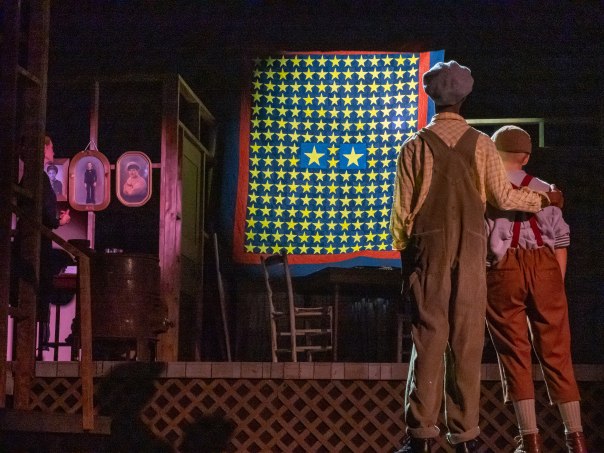
She has enough imagination and ambition to match her chutzpah, for she plans to pay tribute to both her son Lonnie and Edwina’s Joe – along with all the other 200 soldiers aboard the USS Rowan who perished fighting the Nazis. The tribute will be a quilt of 202 gold stars on a field of blue, with the two stars representing Lonnie and Joe conspicuously larger than the 200 others.

The project is worthy, and quilting 202 squares with 202 perfectly centered stars, along with a suitable border to frame it all, seems to be a sufficiently monumental task to occupy two women for the better part of a year – once the ladies have solved the math problem of how to symmetrically configure those 202 stars. Director Dennis Delamar certainly isn’t going to gloss over the problem of getting the math exactly right.

But that front door thing is key (even though Edwina is proud to say it’s unlocked) and obliges LaBorde’s family to be tested onstage in a manner they probably never faced in real life. To the playwright’s credit, neither of his kinfolk is perfect in receiving their surprise guest – who should, as everybody in Hessmer knows, be knocking at the back door.

That is the attitude here from both Edwina and Oscar when they first encounter this unfathomable cheek. Just to double-underline the point that the LaBordes are not perfection, Edwina rebuffs Ella twice. Yet we soon see that they are willing to evolve, uniting with Ella’s cause once they’ve heard her out. Granting her the unique privilege of entering by the front door. But what about the rest of the town? Here is where LaBorde can inject suspense, drama, and a sprinkling of terror.

Joshua Webb’s set design, with its wood-burning stove and perpetual coffee pot centerstage, has a rusticity that allows for a wisp of primal danger and violence lurking beneath its humble domesticity. Both kitchens are lovingly dressed, but sightlines are a rather dreadful problem: unless you’re seated in the center or toward the right side of the Fullwood Theater audience, you might go home never knowing that Oscar had been visible building his stone wall – hidden by the Broussard kitchen to those of us sitting on left – in defiance of stone-throwing yahoos (or KKK) repeatedly breaking the LaBordes’ windows.

Complemented by Sean Ordway’s moody lighting design, which casts a spell even before the action begins, Yvette Moten’s costume designs have the timelessness of Norman Rockwell paintings on the covers of old-timey Saturday Evening Post magazines. It’s hard to resist the visual charm of this production as Delamar frames one memorable tableau after another. From the time we first see the spirits of Young Lonnie and Joe (Aaron Scott Brown and Bennett Thurgood in rather touching non-speaking roles) to the great starry quilt reveal, Delamar lavishes a series of freeze-frames that are a memorable slideshow within the show.

Some discreet subtraction is applied to LaBorde family history that results in somewhat awkward casting for the leading ladies, Paula Baldwin and Corlis Hayes. Nowadays, we’d expect moms of strapping young military enlistees to be in their forties or fifties, not 60+ – but the real Edwina had way more offspring than two sons, so she actually was aged 60 at the time of Joe’s death.

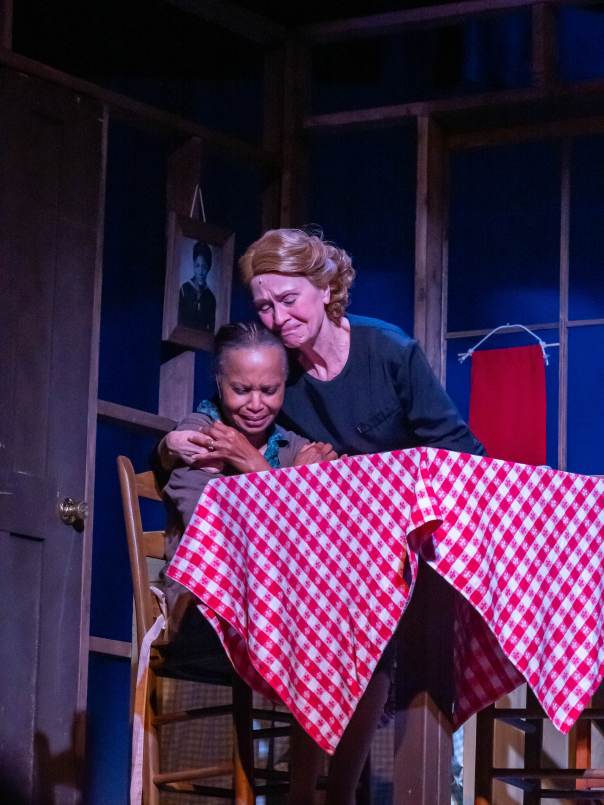
So sitting at her kitchen table, sustaining her renown as the county’s quilting queen, and looking rather matronly, Baldwin is exactly what LaBorde envisioned as Edwina. Life on the bayou does take its toll here, so Joe will merely be the beginning of Edwina’s ennobling griefs. Baldwin endures these crucibles like so many we’ve seen from her over her distinguished QC stage career, with signature stoicism. Neither Delamar nor LaBorde had any hesitation in casting her.

As for Hayes, I first encountered her at Johnson C. Smith in 1988 when she directed for colored girls at the tender age of “24” – just guesstimating here – so she’s also perfectly cast as Ella. Maybe the most heartwarming aspect of this production is the gift LaBorde has given her with a world premiere credit in this role. Confronted by both black and white folk, Ella is a far more nuanced and varied character than we normally see Hayes portray.

We instantly see the strong spine that brings her to Edwina’s door – twice – and we see her pragmatism in backing off the first time. She seethes back home and resolves to repeat her effrontery, still knocking at the front door. Then there’s the beautiful passive aggression when Edwina belatedly agrees to allow Ella over her front threshold. Hayes pointedly hesitates, referencing the insults she has previously absorbed and the dignity she maintains.

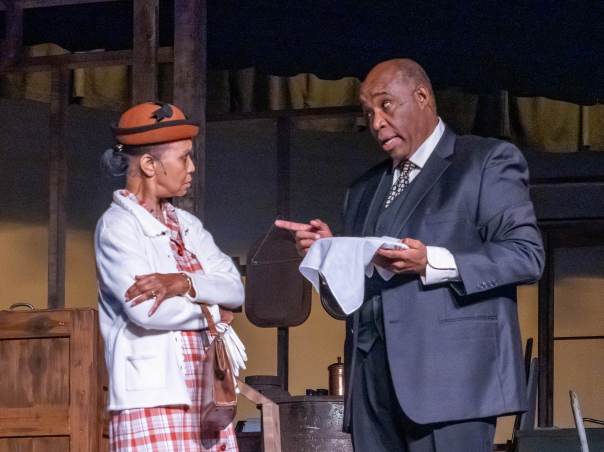
LaBorde has obviously labored over Ella, for she has her maintaining this steely dignity when confronted by her minister, Reverend Johnson, and even when she is complimented by white churchlady Nodie Ardoin, Edwina’s nemesis. Yet there’s one more telling Easter egg to be found in LaBorde’s script, that Hayes and Delamar brilliantly emphasize. As soon as Ella gets the first clear sign from Oscar that she might not be welcome in his kitchen, we see Hayes instantly cowering, clutching her pocketbook, and readying for a quick exit.

That’s the kind of good sense Ella has, for all of her sturdy spine. We can be thankful that this rich role has finally found Hayes.

If it weren’t obvious before, One Year to Die signals that Matthews Playhouse has joined the ranks of Metrolina community theatres that consistently present pro-grade work. The standard set by Hayes and Baldwin is met by the men who portray the Hessmer clergy, Steve Price as the soulful Father Morton only slightly upstaged by the charismatic Keith Logan as Rev Johnson. LaBorde would have done better by both of these religious leaders if he had refrained from broadly hinting that Catholic and Baptist ministers follow the exact same script when upbraiding wayward lady congregants.

Aside from Oscar, the other guys we see onstage are military, so we never sample the boorishness or the toxic philosophies of the town’s window breakers. The military cameos, however, are beautifully handled by Vic Sayegh as the Naval Officer who rocks the LaBordes’ world and Brian DeDora, who appears as The Sailor after the Normandy invasion.

Possibly, LaBorde dropped the idea of including the rock-slingers onstage, for Nodie bears the same last name as one of them. Robin Conchola as Nodie is actually the more benign of the “watchin’ committee” that darkens Edwina’s doorstep to register their condemnation, a lot more conflicted than Barbara Dial Mager as Sarah Jeansonne. It’s Conchola as Nodie who has the chance to be rebuffed by Hayes. Sarah is slower to evolve, so we can despise Mager longer, if only for her horrid wig.

As Oscar, also aged 60 when Joe perished at sea, Henk Bouhuys is delightfully homespun, although there’s still enough Jim Crow ingrained in him to be shocked by the ladies’ audacity. Bouhuys continues to project ambivalence long after Oscar decides the memorial project is worth doing no matter how the rest of Hessmer may think. Once he gives Edwina his assent, his loyalty is as steadfast as his love.

Whether it was absent-mindedness or a directive from Delamar, Bouhuys only intermittently sounded Cajun on opening night – while the rest of the players hardly bothered with an accent. So it was startling when Oscar became full-out Cajun just before intermission after a cowardly attack on the LaBorde farmhouse. Out of nowhere, the accent was stunningly convincing, adding some sharp ethnic spice to the most fiery monologue of the night.

Photos by Perry Tannenbaum

“Young Frankenstein” Delivers Excess, Glitz, and Glorious Shtick

Review: Young Frankenstein at Matthews Playhouse

By Perry Tannenbaum

July 12, 2024, Matthews, NC – Just turned 98, Mel Brooks has overachieved in every way possible, including longevity. Yes, he wrote the music and lyrics in adapting his own Oscar-winning script, The Producers, into a Broadway musical. If that 2001 megahit was the most prodigious and successful transformation of his career – already past 50 years as a writer, comedian, and actor – then his 2007 follow-up, Young Frankenstein, was the most natural.

Mel had already stolen Irving Berlin’s “Puttin’ on the Ritz” and Victor Herbert’s “Ah, Sweet Mystery of Life” to gild two of the most shining moments of the original film, shot in retro black-and-white. Composing his musical adaptation, Brooks stole some more, changing the ardent lyrics of “One Song” from Disney’s Snow White into a deliciously salacious “Deep Love” after the Broadway edition’s third coital climax.

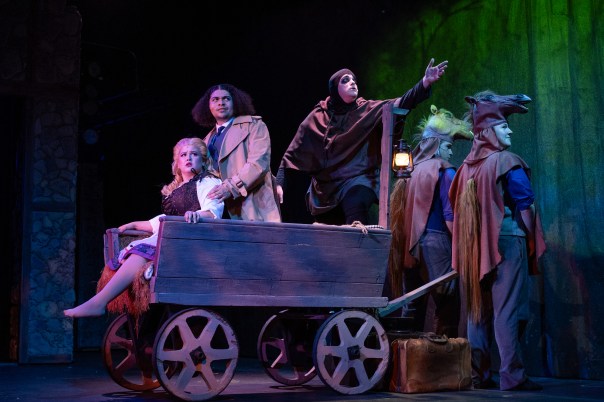
There are some rather filthy connotations strewn throughout our horrific romp through Transylvania, enough for Matthews Playhouse to caution parents against bringing youngsters under 13 to the current production. But stage director Jill Bloede presents each granule of this glorious filth with bawdy, bodacious, and childish glee at Fullwood Theater. Scenic designer Marty Wolff, costume designer Yvette Moten, lighting designer Jeffrey Childs, and choreographer Emily Hunter are all let loose to fashion fresh layers of excess and glitz.

A whole second stage opens up behind the teeming downtown Transylvania downstage when we reach Victor Frankenstein’s secret laboratory hidden behind the mad scientist’s library – an installation that permits special effects designer Roy Schumacher to make the moments of creation and coition inside the lab more spectacular.

Brooks’s venerated comedy reputation and Bloede’s every-shtick-in-the-book approach have drawn a bounty of professional grade talent to this cast. Wearing a frizzy Gene Wilder hairdo, Neifert Enrique cements his elite credentials as Dr. Frederick Frankenstein, grandson of Mary Shelley’s “Modern Prometheus,” bringing a youthful wonderment to the role that makes all the lead women’s roles a little plumier. If you missed Nick Culp’s outdoor exploits as Columbia in The Rocky Horror Picture Show during the pandemic, one of Actor’s Theatre’s valedictory efforts, his Matthews debut as Igor will likely come as a revelation, though he looked way closer to Fester Addams than to a hump-backed Marty Feldman. Lungs of steel and a wicked comedy flair.

With Mary Lynn Bain as noli-me-tangere New York socialite Elizabeth Benning and Gabriella Gonzalez as Inga, the cheery and buxom Transylvania peasant, the contrast between “Please Don’t Touch Me” and “Roll in the Hay” is as radical as any horny Frankenstein could wish. Bridging this chasm is The Monster, endowed by Brooks with a super-virility that surely would have drawn a polite giggle from Ms. Shelley. Hulking Matthew Corbett, roaring and bellowing with the best, makes Elizabeth’s deflowering a special joy, for while he is melting Bain’s ice maiden inhibitions, Brooks cooly has him overcoming his fear of fire.

Now we easily can find on YouTube that Peter Boyle actually danced in the Hollywood version, but the “Ritz” extravaganza concocted by Hunter is arguably more demanding, with Moten outfitting a good chunk of the Transylvanian peasantry in white tuxes. Top hats and canes for all the gents! We can’t call him Bojangles just yet, but Corbett contributes handsomely to the tap segments.

With leading roles in The Producers, La Cage aux Folles, Cabaret, and Ruthless! over the past 30 years, the charismatic Steve Bryan is a bit of overkill for his cameo as the Hermit. Decked out like a medieval monk, with a wig worthy of Joan Crawford in her dotage, Bryan is perfection as The Monster’s blind and bumbling host, not a trace of a smirk as he scalds his starving guest with soup – a comical affirmation of the beast’s docility as we delight in Corbett’s bellowing. Typical of his elegance, Bryan didn’t milk the last drop of deathless pathos out “Please Send Me Someone” before Corbett’s on-cue arrival answered his lonely prayers. True, Bryan got down on his knees begging, but he never once cried out for his mammy. Maybe next week.

“Clue” Reaches New Heights of Silliness at Matthews Playhouse

Review: Clue at Matthews Playhouse of the Performing Arts

By Perry Tannenbaum

2023~Clue~18

Apparently, I didn’t have much of a clue about CLUE, a new comedy by Sandy Rustin based on the 80-year-old board game and its 1985 screen adaptation. I presumed that Matthews Playhouse would be staging the musical version that has periodically skulked around regional and community theatres after ignominiously posting its closing notice a week after it opened Off-Broadway in early December 1997.

Our playbill, listing “Original music composed by Michael Holland,” kept me in the dark a bit longer until the show began without an overture or an opening number. While we waited, we had the chance to fill out a form and predict which of the “usual suspects” would be revealed as the culprit – or culprits – at the end of the show. It’s a pretty simple form since, unlike the board game, we don’t have to sniff out where the murder takes place and which of six lethal weapons is used. Simpler than the movie, too, which was famously released with three different endings.2023~Clue~4

After directing a nearly sublime Book of Will at Belmont Abbey College back in February, Jill Bloede shows that she and her sure comedy instincts can lift up the utterly ridiculous in Matthews. She and set designer Marty Wolff aren’t going to let us forget that Clue is a board game. With sliding wood panels for walls and cunning little swinging gates for doors, we can see three rooms at a time on each side of the stage simultaneously, with a corridor representing the Boddy Mansion’s hallway completing the symmetry – seven of the nine rooms depicted (even more primitively) by the humble game board’s overhead view.

Flimsy as those thin walls may appear sliding in and out of view, they must be sturdy enough to accommodate the workings of secret panels that either flip their graphics or open and shut widely enough for the comings and goings of arms visibly wielding weapons. If your Clue erudition has stuck with you since childhood, you’ll remember that those weapons are a candlestick, a lead pipe, a monkey wrench, a dagger, a rope, and a revolver.

It’s with the entrance of our prime suspects that the plot of Jonathan Lynn’s screenplay and Rustin’s script, mimicking the film’s plot setup, swerve from the classic simplicities of the Parker Brothers’ game. Each of the six guests who have been invited to the Boddy Mansion is given one of the aliases bestowed on the iconic game pieces. Each now has a colorful – but compromising – back story that he or she is being blackmailed for. Serious enough misdeeds lurk beneath all our guests’ respectable facades for a murder motive, and their sophisticated enough for them to apply for membership among the avatars of more evolved adult board games.2023~Clue~19

So Colonel Mustard does have a military background, and Mrs. Peacock, a US Senator’s wife, has reason to be prideful. Mr. Green has a gay bent that could be costly as news of the McCarthy un-American hearings, circa 1954, seep through in radio broadcasts, and Miss Scarlet’s flame seems to be fueled by undercover stints as a high-priced madame. Professor Plum was apparently disgraced in another profession before finding refuge in academia, and Mrs. White… why is she dressed in black? Presumably because one or more of her late husbands could be the skeleton in her closet.

Now if you or I were anonymously blackmailing six evildoers with DC connections, you might think twice – or 700 times – before inviting even one of those cash cows for dinner, blowing your cover and, in a faraway secluded manor, endangering your own life. Ah, but the Lynn-Rustin silliness has just begun. Let’s distribute the six iconic murder weapons among the six color-schemed guests! And after all, if six possible murderers are gathered for an evening of killing and sleuthing – and dinner! – why limit the victims to just the ever-ready Mr. Boddy?2023~Clue~10

The whole Boddy household staff might be available to boost the body count: the maid, the cook, and the butler. Maybe we could liven (or deaden?) things up with a stranded motorist, a snoopy cop, or even a singing telegram girl? Hey, it’s a party!

With Allen Andrews as the suave and mysterious butler Wadsworth greeting mutton-chopped Jeremy Cartee as the pompous Colonel Mustard, the ball gets rolling nicely as the pair let us in on the rules of the game. Andrews as Wadsworth is so slick of a host greeting all of our suspects that he manages, through sheer brass and sliminess, to cast suspicion on himself. Cartee, meanwhile, must vie with longtime local diva Paula Baldwin as Mrs. Peacock for the distinction of being the most arrogant and pretentious of the suspects. Baldwin makes up for lost time by being the most outgoing, neurotic, and loquacious guest.2023~Clue~17

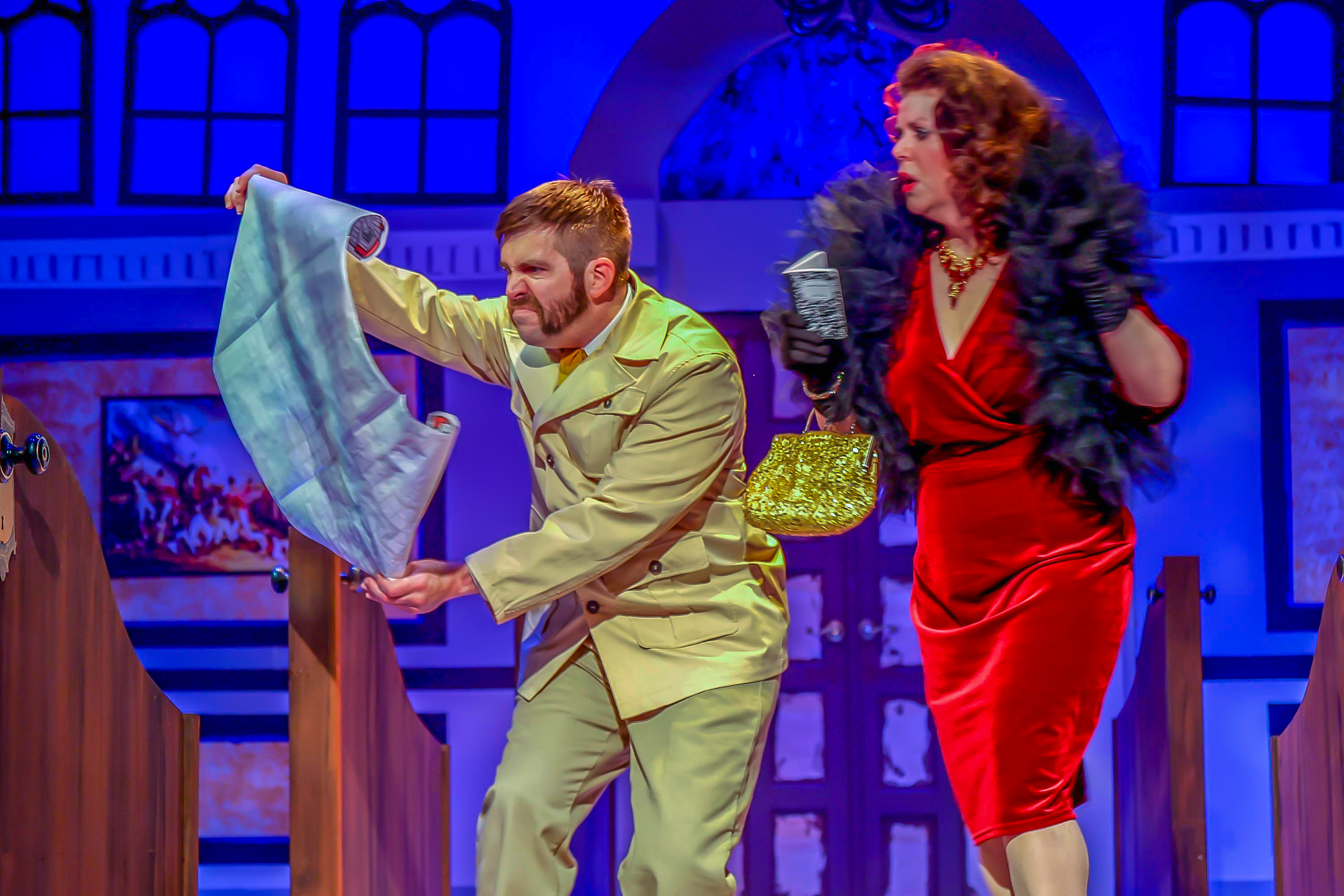
Clad in a screaming red dress, red hair garishly beribboned, and wrapped in a boa, Vanessa Davis as Miss Scarlet is the polar opposite of the cool Mary Lynn Bain as the semi-funereal Mrs. White. While Davis shoots seductive glances everywhere, Bain seems to be in perpetual mourning.

Yvette Moten’s costume designs are predictably color-coded, but they are not altogether studded with solid hues. While Andrew Pippin as the reserved Mr. Green gets to wear the most stylishly coordinated and urbane ensemble in harboring the deepest secret, Moten allows herself to go fairly wild over Johnny Hohenstein’s outfit as Mr. Plum: a cringeworthy maroon plaid jacket striped with deep purple and sky blue, a weirdly coordinated motley bowtie, and the loudest purple argyle sweater she could find.

Kathleen Cole is most notable for all the costumes – and phony eyebrows – that she wears, changing from the Cook to the Singing Telegram Girl before resurfacing as police backup. That glittery delivery girl outfit would liven any costume ball.2023~Clue~1

Bloede obviously takes much delight in maneuvering her game pieces. Sometimes they scurry around so swiftly that we lose track of them, and at other times, Wadsworth and staff parade them from room to room with a ceremoniousness that actually does evoke silly avatars moving around the squares of a game board. Yet there wasn’t a single missed beat during all the hectic scene changes at the Saturday matinees, never a missed cue, and never a flubbed line.

We seem to all get nine different rooms with all the back-and-forth of the sliding walls, so efficiently whisked in and out of sight from the wings. But I don’t remember seeing a ballroom, so I’m sure we don’t see more than eight.

Eight is enough.

Climb Aboard a Retro Laugh Riot

Review: A highly animated Odd Couple revival with a professional-grade cast

By Perry Tannenbaum


IMG_2229

With the benefit of hindsight, we can see more clearly that Neil Simon and his esteemed stablemates – Woody Allen, Larry Gelbart, and Mel Brooks – who all wrote for Sid Caesar during the early days of television, didn’t simply disperse into the realms of stand-up, movies, and theatre for the obvious practical reasons. Autonomy, fame, and fortune were surely enticing, but so was the satisfaction of working in longer forms than TV sketch comedy or a star comedian’s monologues.

Come back to The Odd Couple – or revisit Bananas and Zelig, A Funny Thing Happened and Tootsie, The Producers and Blazing Saddles – and we see a mature writer working beyond the limitations of zany characters and snappy one-liners. Simon develops his Oscar and Felix, tells a full-length story about them, and keeps the hilarity going. Entering Theatre Charlotte, where Jill Bloede is directing a highly animated Odd Couple revival with a professional-grade cast, I wasn’t thinking that I’d be seeing this old cash cow so freshly.

Somehow the difference between this 1965 comedy and TV sitcoms of the same era – including the spinoff Odd Couple sitcom that came to ABC in 1970 – suddenly seemed rather radical. The cardinal rule for most 22-minute sitcom writers back then was to hit the reset button at the end of each episode, so that next week’s episode would start out as if this week’s had never happened. On Broadway, you could expect the uptight, neurotic, neat freak Felix to wear out his slovenly pal Oscar’s patience by the time the curtain came down. On TV? No way. Felix made himself at home in Oscar’s Manhattan apartment for nearly five seasons.

IMG_2222

Many in the sold-out house at the Queens Road barn on opening night were struck even more freshly by Felix, Oscar, their poker-night buddies, and the neighboring Pigeon Sisters. Unless the younger people in the house had been hooked on the Matthew Perry reincarnation of the sitcom during 2015-2017 on CBS, they likely hadn’t run into much Simon or Oscar in their lifetimes. I was a little taken aback when I came home, double-checked, and found that I’d only seen Odd Couple once in Charlotte during the last 30+ years, back in 2007 at CPCC.

On the other hand, this comedy staple had been quasi road-tested at Theatre Charlotte when the Female Version – with Florence, Olive and a klatch of Trivial Pursuit-playing women replacing the poker buddies – dropped by in the summer of 2012. Bloede also directed then, an overachievement that certainly warranted her current return engagement.

Whether it’s Lady Bracknell or Lucy Ricardo, Bloede knows her comedy, and she has prospected long enough in Charlotte to be able to mine its finest talent. Doesn’t look like she had to twist any arms, either. For her Oscar, she landed the most experienced Simon exponent in town, Brian Lafontaine. Breaking in to Charlotte theatre in 1992-1994, Lafontaine played leads in three of Simon’s comedies, Brighton Beach Memoirs and Biloxi Blues on Queens Road – and Lost in Yonkers at Charlotte Rep.

Bloede goes edgier and high-energy for her Felix with Mark Scarboro, who first carved out his eccentric niche in 2001-02 with standout performances in Thumbs, The Pitchfork Disney, and Fuddy Meers. Yet Bloede has Lafontaine playing the 43-year-old Oscar with more energy than I’ve ever seen from this slovenly New York Post sportswriter. If she’s going to turn Scarboro loose to be as anal, neurotic, outré, and irritating as he can imagine Felix to be, then she’s returning the favor to Lafontaine and turning him loose to be as irritated, provoked, and out-of-control as he can imagine a devout 44-year-old slob can be.

No less pleasurable is the build-up to Felix’s first entrance. That’s because Bloede has a deep bench sitting around Oscar’s dining room poker table, supporting her stars. If we’re returning to Odd Couple, we’re likely surprised to find that Felix isn’t going to show up until we’re 17 pages into the script. Even Oscar isn’t onstage at the outset in his own apartment! Simon’s poker preamble steadily stokes concern for fragile Felix’s welfare in the wake of his breakup with his wife, but there’s already hostility and comedy shtick at the table before the two marquee combatants show up.

Just watch Michael Corrigan and Patrick Keenan at work, sparring as Murray and Speed, and you’ll see that Bloede has selected a second comedy team for us to revel in, very much in the same Felix-Oscar, Laurel-Hardy template. Decades ago, when Corrigan was younger and slimmer, he tended to remind you of Tim Conway. So the particular quirks of Murray the policeman come to readily to Corrigan, his exasperating slowness in shuffling cards and his alarmist reactions to any new news about Felix. Keenan is the master of the slow burn and the bellowing explosion, repeatedly supplying perfect exclamation points to punctuate the comedy.

Tall and lanky Matt Olin is the perfect choice for the spineless Vinnie, the guy Murray and Speed can both agree to pick on, the dutiful husband who submits to his wife’s curfew, and the man who deeply appreciates Felix’s sissy sandwiches. Meanwhile, Lee Thomas continues to ply his teddy bear charm as Oscar’s diffident, occasionally witty accountant, Roy.

IMG_2270

If you’re worried that Bloede might be taking PC pains to update the Pigeon Sisters and present them as more evolved, rest easy. Vanessa Davis as Gwendolyn and Johanna Jowett as Cecily stay true to their origins, Davis the flirtier sister and Jowett the more empathetic bleeding heart. Set designer Rick Moll, costumer Yvette Moten, and sound designer Rick Wiggins have all climbed aboard Theatre Charlotte’s retro train. With a soundtrack that includes James Brown, Petula Clark, Jack Jones, Herb Alpert, and The Shirelles, Bloede and her all-pro cast are bent on taking you back to the ‘60s, like it or not. I’m betting you’ll like it.