Tag Archives: Tommy Prudenti

Laugh Your Butt Off at “Meet & Greet”

Review: Meet and Greet at The VAPA Center

By Perry Tannenbaum

Auditions are a kind of interview, and interviews are a kind of audition. You enter, drop a résumé on somebody’s desk, and minutes or hours later, you exit elated or deflated. Instant drama. Singularly human. A paradigm of life.

At the VAPA Center, auditions and interviews are the entire evening for three weekends in Meet & Greet, a themed set of three one-act comedies produced by Charlotte’s Off-Broadway in the COB Black Box. Yeah, from the outside looking in on aspirants and applicants who have stressed for weeks preparing, strategizing, dressing, and grooming for the big moment or trial by ordeal, the denouement can be quite entertaining.

We can laugh our heads off at these overinvested humans and empathize at the same time. Imagining we were them or grateful that we are not.

Of course, there are perils for playwrights working within these familiar templates. Skirting predictability is the keenest, particularly if your audience has been exposed to sketch comedy over and over.

You can rest assured that each of the playwrights featured at VAPA contrives to make the familiar ritual different from what we expect, concealing at least one twist and surprise. Neither Susan Lambert Hatem’s Hamilton Audition nor Don Zolidis’s The Job Interview far exceeds the length of a typical TV sketch, so opinions will likely vary on whether they transcend the streaming standard.

Both of them have yummy roles for multiple players, so transcendence becomes less of a factor if you’re seeking comedy simply for escape in these dark days. The incontestable headliner of the evening is the finale, Meet & Greet by Stan Zimmerman and Christian McLaughlin – in terms of length, number of histrionic roles, and prestige. Zimmerman’s fame rests chiefly upon his extensive writing credits, most notably the beloved Gilmore Girls and The Golden Girls.

Meet & Greet clocks in at more than twice the length of most sitcom episodes. Between laughs or afterwards, you may catch yourself pondering why.
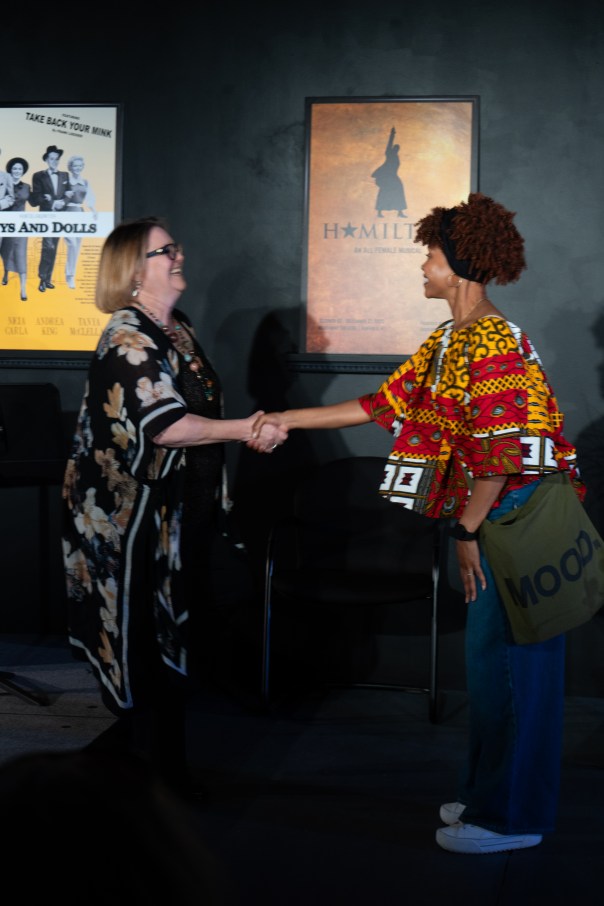
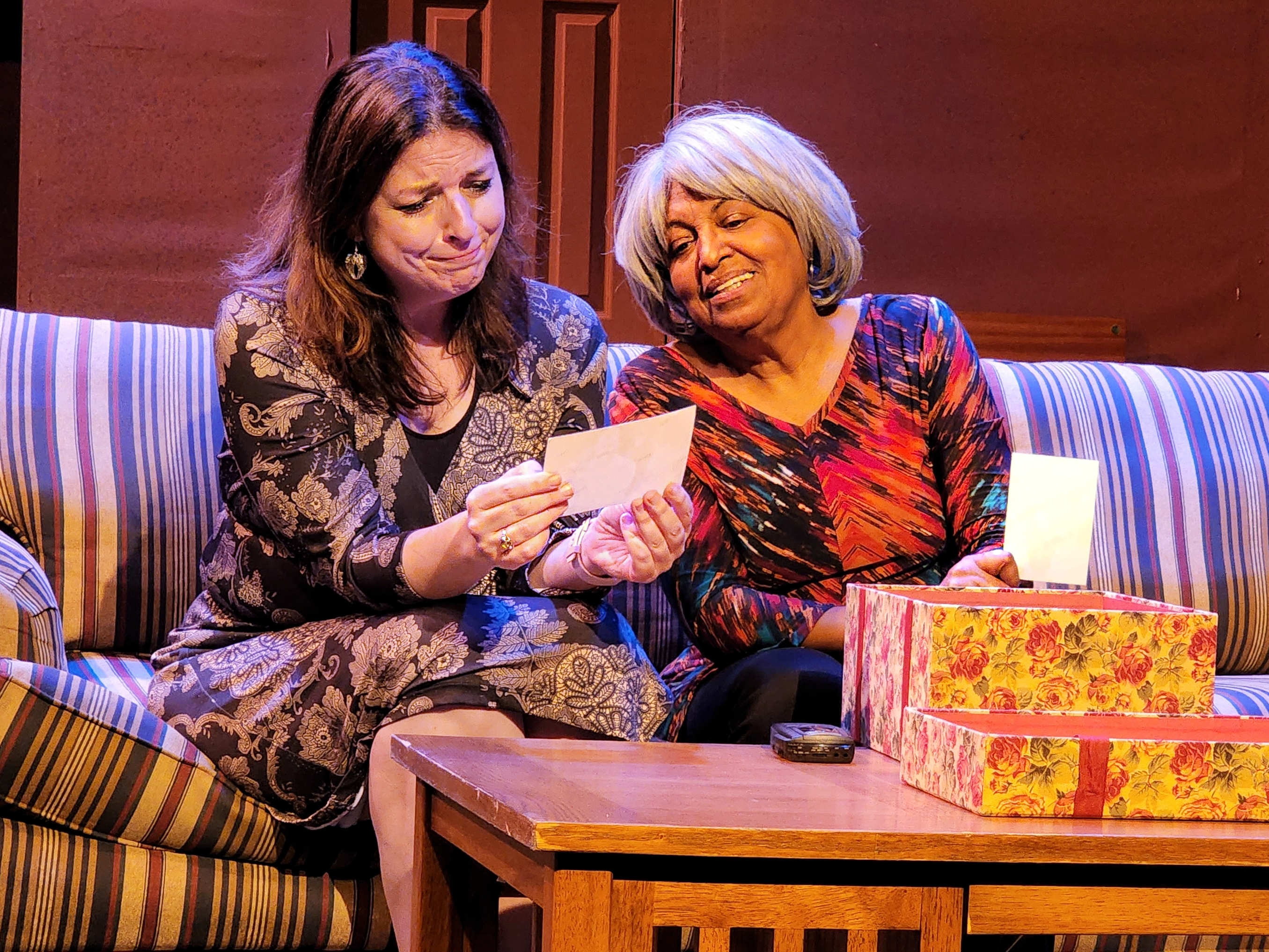
COB’s producing artistic director – and VAPA Center co-founder – Anne Lambert has her energetic hands all over this one-act hodgepodge, starring as The Director in her sister’s Hamilton Audition and (what else?) stage directing all that follows.

There may be an inside joke here. Do you really audition for the role of The Director in the play you have programmed by your sister at your own theatre? Do you think director Anna Montgomerie invited Lambert to play the role, or was the inviting done in the opposite… direction? Wouldn’t Lambert, not the shyest person on the Charlotte theatre scene, have leveraged some of her status – and experience – in determining how her character should be written and played?

We’ll never know, unless the saga of putting Hamilton Audition on its feet spawns another script. In the present instance, Lambert has invited the most prodigious voice in town to audition for the lead role in an all-female production of Hamilton, and the diva who has graciously consented is apparently the only person on the planet who has never heard of Lin-Manuel Miranda’s megahit.

More likely, people who come to see Hamilton Audition will not realize that Lambert was a co-founder of Chickspeare, which pioneered all-female productions of Shakespeare in the QC. It is not at all far-fetched to say that Lambert inspired the role she is playing as well as the play her sister has written. Posters on the rear wall touting fictional Chickspeare productions practically shout this in-joke out loud.

From appearances, you might conclude that Lambert is more out of her element directing a hip-hop musical than Nasha Shandri as Shondra Graves is auditioning for the role of Aaron Burr. Just you wait. Although she looks perfect for her dashing Founding Father role, Shondra gives a more atrocious hip-hop reading than you would dare to expect from The Director.

Comedy gold.

Amazingly, Shandri is supposed to be no less ignorant about rap than she is of Hamilton! Suddenly, the whole idea of a pioneering all-female version seems like a certain disaster… with fallout for females and minorities. It’s at this point that Graves and The Director probe the sexism that already lurks in the original gendered Hamilton. So yes, Hatem has put some meat on her hambone dialogue.

Whether or not Zolidis replicates that feat in The Job Interview is more open to question. The bio in the digital program, summoned by your QR code reader, states that Zolidis is one of the most prolific and produced playwrights in the world. Maybe the thuddingly generic blandness of this title explains why Zolidis was so previously unknown to me nonetheless.

Fortunately, his Job Interview playscript proves to be livelier and more imaginative. The basic premise, we will soon find, ensures that the sparks will fly. Both of the applicants waiting to be called into T.J.’s office, Chloe Shade as Marigold and Marla Brown as Emily, will be interviewed at the same time, adding the elements of confrontation and fierce female competition to the drama. For Emily, it’s already life-or-death.

If you’ve inferred that T.J. is eccentric and perhaps sadistic, you’re on the right track. Rahman Williams as T.J. doesn’t ask his applicants a scripted set of questions – or even the same questions. Deepening his aggression and moving us abruptly from interview to audition, he challenges Marigold and Emily to show him how they would handle specific on-the-job situations.

Not only might we say that the difficulty of the questions and roleplay challenges seems to be tipping the scales of fairness way off kilter, but we can also discern radical differences in the temperaments and preparedness of the two candidates. It would be impossible to find an aspect of Emily’s performance where she outscores her rival… aside from how desperately she needs this.

Now anybody interviewing for a job knows that he or she is already facing steep odds, but knowing that you’re outclassed during the interview is a special torture, one that permits Brown to go totally nuclear as Emily. On the other hand, Shade can play with the absurd and ballooning insult that Marigold, in all her perfection, is obliged to keep competing with this loser – and that the outcome still lies in the hands of this outrageous interviewer.

Rahman, in the meantime, gets to play with the disconnect between T.J.’s spit-and-polish military background and his high-level position at Build-a-Bear Toys. Three tasty roles, all well-done. During the run, Nicole Cunningham shares Shade’s chores.

Contrary to what you may be thinking while it plays out, Zimmerman & McLaughlin have aptly named their Meet & Greet. Take it in the same way that the four auditioning actresses do and ride the rollercoaster. To make it all tastier, two of the four have a history together, co-starring long ago during better days on a hit sitcom, Lane Morris as the embittered psycho Belinda and Stephanie DiPaolo as the bimbo Teri.

For my generation, I was thinking Joyce DeWitt and Suzanne Sommers from Three’s Company, but you might hear different echoes. Teri is the airhead who tends to spoil everything, or she is deeply misunderstood and cruelly typecast. Bubbling and pouting seem to be her main forms of expression. Also in the room before Teri’s majestic entrance is Marsha Perry as Desiree White, with some sort of acting experience as the star of the “Real Housekeepers of Palm Beach” reality show.

Contrasting nicely with Desiree and her leopard-skin bodysuit is Joanna Gerdy as the splendiferously monochromatic Margo Jane Mardsden, who has fallen from her regal perch as living Broadway legend due to a combo of drink and disgrace. Being among this gaggle, especially the déclassé Desiree, is already a devastating humiliation.

Yet as we can hear as they emerge from their auditions, both Desiree and Margo are spectacularly successful in their auditions for the role of Andrea, the leading lady of an upcoming series pilot. Leopard Skin draws uproarious laughter from the sanctum within before Diva Nun draws a thunderous ovation. Which one do the showrunners, producers, and writers inside actually prefer?

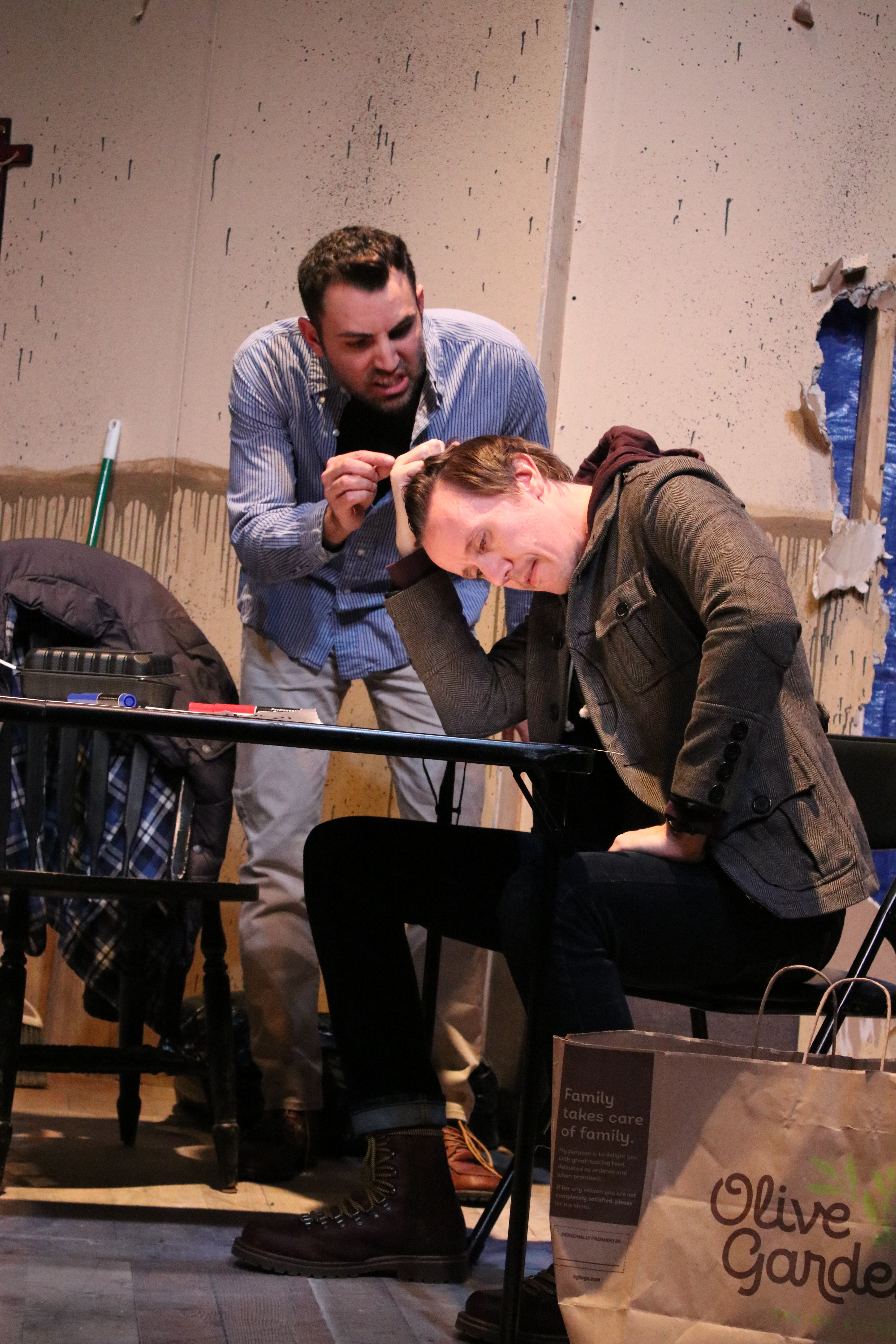
Every word that Tommy Prudenti utters as the Casting Assistant is a tantalizing clue to what the show and Angela will be, and there is a girlish coyness about him… and a deceptive servility. All through this epic catfight showdown, Zimmerman’s Golden Girls pedigree is on display in a blizzard of quips, taunts, and one-liners. We shall only divulge the maestro’s recipe for “sidewalk pizza” here: you jump out the window of a tall city building.

Domingo’s Dot Makes Its Point

Review: Three Bone Theatre Presents Dot

 By Perry Tannenbaum

Dotty2

The question that he frames in all but words

Is what to make of a diminished thing.

–Robert Frost, “The Oven Bird”

Since their return to live performance last October, Three Bone Theatre has been contracting and then expanding as they adapt to The Arts Factory, their new base of operations on W. Trade Street. They were breathing in at first, perhaps, with a compact one-woman show, and now they’re breathing out. Open was smaller in every way than either of the two productions Three Bone had streamcast during the QC’s lockdowns, Prisoner 34042 and their New Black Playwrights Fest. Smaller cast, shorter running time, and probably smaller audience.

From what I’ve been able to discern, each of Three Bone’s 2022 shows has been bigger, longer, and better attended than the one before. With Lucy Kirkwood’s The Children back in March, we saw a larger cast, a longer show, and actual scenery. Meanwhile, armed with masks and vaccination cards, more theatergoers seemed ready to venture out into the night to see a relevant post-apocalyptic drama.

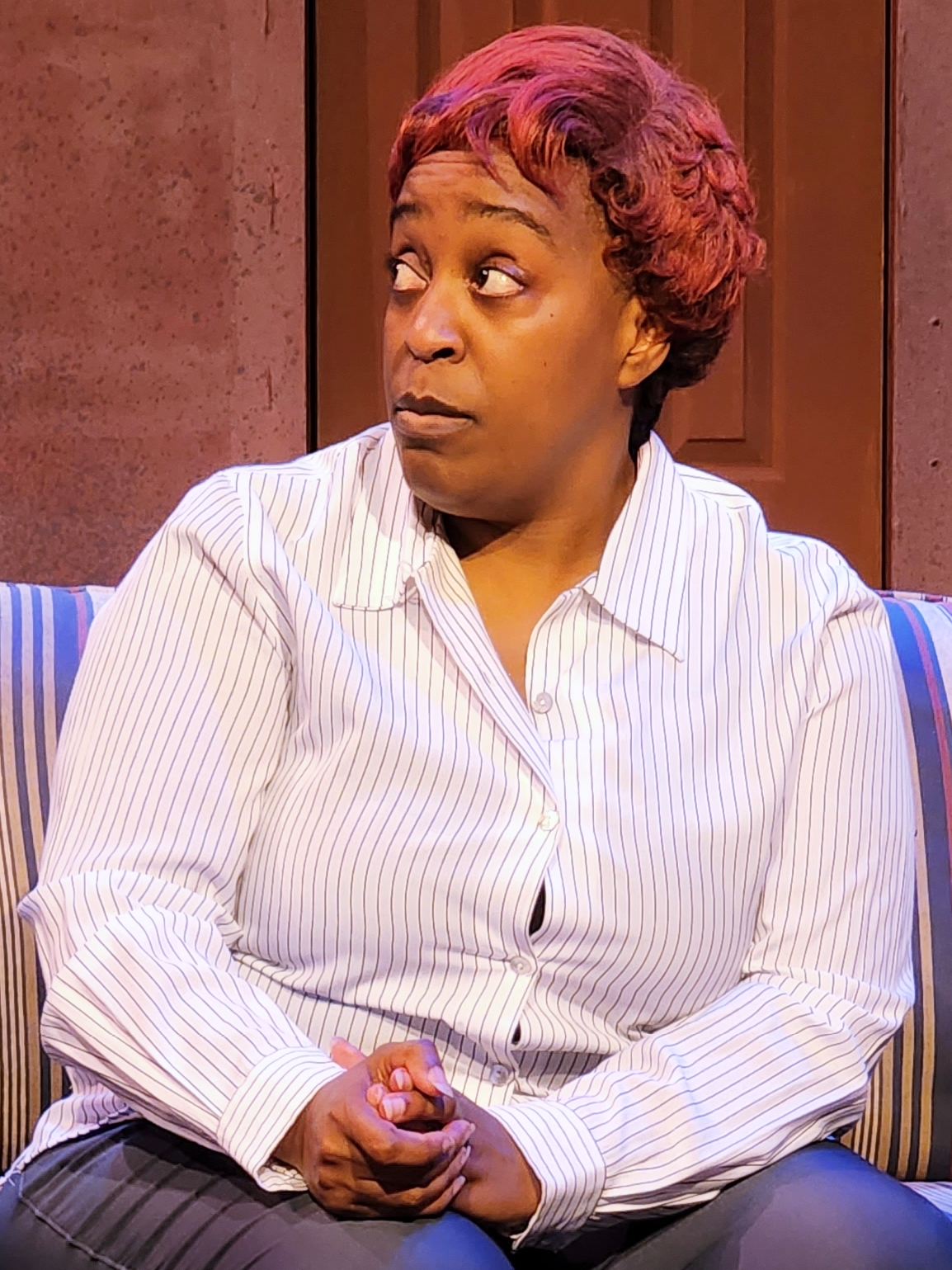
Colman Domingo’s Dot detains us longer and offers us more characters to consider, though it’s clear that Philadelphia matriarch Dottie Shealy is far and away the one that we – and her three children – should be most concerned about. It’s the Christmas holiday season in Philly, a time when the children converge around a tall spruce tree with enough lead time to collaborate on the decorations. Shelly, the eldest and a lawyer, is holding down the fort while her sibs, Donnie and Averie, have the freedom to flounder in their careers.

Shelly

Shelly rightfully feels that she must watch her mom like a hawk. Ever since Dotty was hauled into a local police station after speeding at 95mph, unthinkable anywhere near Philly, Shelly has been unsure what bizarre lapse Mom might have next. With the onset of dementia and a diagnosis of progressing Alzheimer’s, Dotty shuttles between the self her children have always known and somebody prone to forgetting names and events, losing track of where she is and what time it is, or coming back from her kitchen with a bag of Oreos instead of the salt she went in for.

Unable to keep tabs on Dotty around-the-clock, Shelly has hired a gentle young Indian man, Fidel, to help her out. But Shelly is out of patience and out of her depth, so she has become a bit bossy and toxic. Not only has she hidden Mom’s car keys, she uses her disorientation to trick her into signing legal papers she doesn’t understand and going to bed in the middle of the day. Calling for a family conference with Donnie and Averie deep in Act 2, she locks Dotty in her bedroom, astonishing her sibs. Convinced that Mom is planning to kill herself – driving around at 95mph is a serious symptom – Shelly has also developed a paranoid attitude toward Fidel, suspecting him of helping Dotty to hatch her plan.

Woven into all this dramatic intrigue – and all of Shelly’s questionable choices – you’ll find that Domingo has provided plenty of opportunities for comedy. Shelly’s deceitful and aggressive coping mechanisms compromise her character for us long before her sibs arrive on the scene. So we can see why Donnie and Averie would both impugn her credibility and resent her bossiness, no matter how stressed she may be. Aside from that pushback, Dotty can be quite formidable herself when she’s lucid, with quite the sharp tongue on her.

Dotty1

Perceptive, too. She could always see that Donnie was “gay as giftwrap,” even before her daughters knew. Nor is Dotty totally blind to her own decline, despite all the resistance she puts up against Shelly. It’s hard to believe that Dotty would off herself on Christmas as a reaction to her own deterioration, when all the family is gathered ‘round, but there is definitely something secretive about her interactions with Fidel.

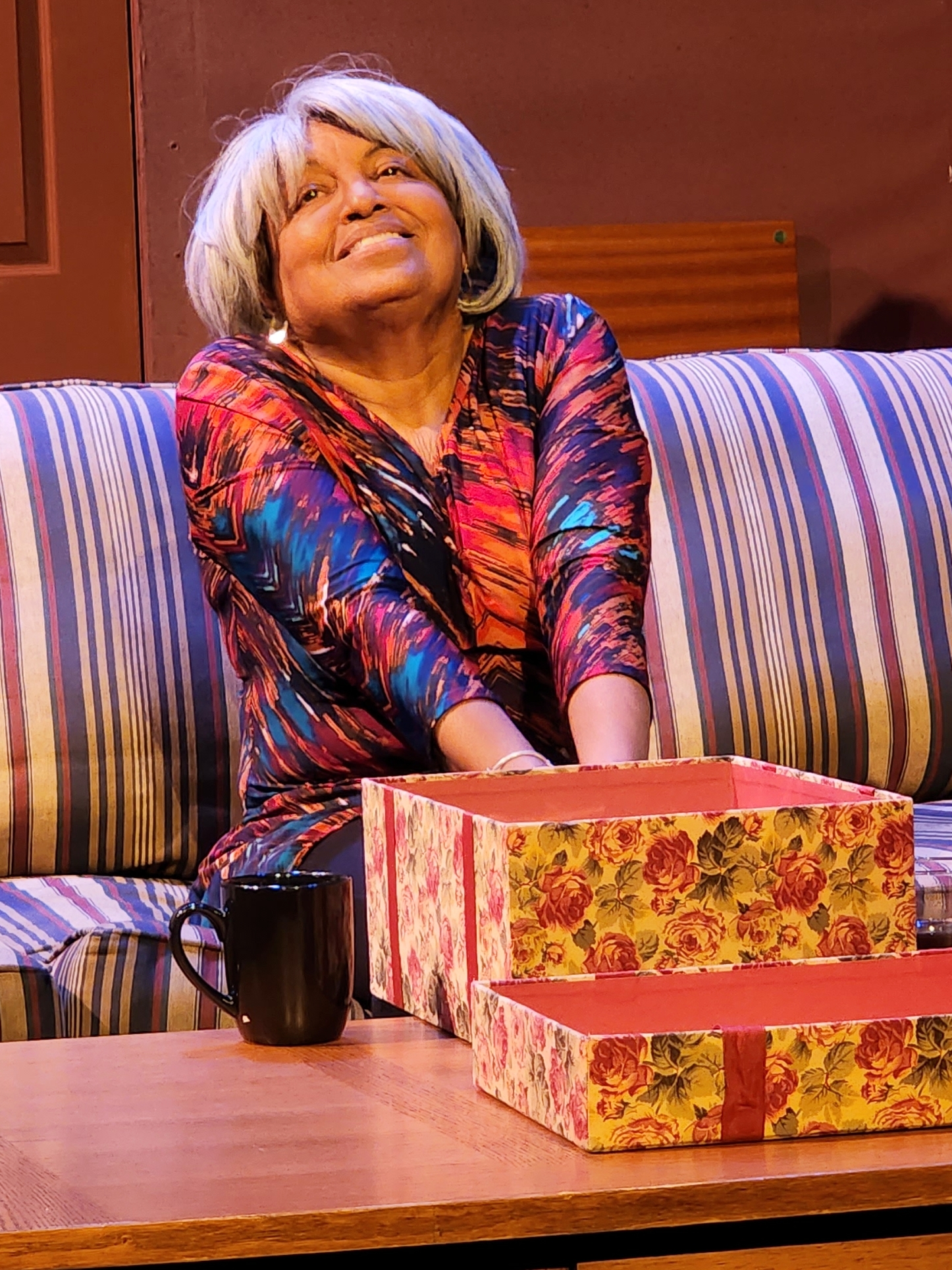
Navigating Dotty’s mood swings, mental lapses, and surreptitious plotting takes a performer over some tricky terrain, requiring sudden hairpin turns; but if you saw Lillie Ann Oden as the wary, savvy, and pragmatic wife in The Children, you’ll likely have little doubt that she can tackle this black Philly matriarch. With Corey Mitchell back as director, after an all-too-common two-year hiatus from the local scene, you might find that Oden still exceeds your high expectations with her saltiness, her increasing confusion, and her sheer naturalness.

While Dotty and her struggles are comparatively fresh onstage, experienced actors and theatergoers will likely recognize the regathering sibs as somewhat formulaic. It won’t be the first time we’ve seen one of a set of sibs turn out to be disagreeably disapproving and controlling, nor will it be a shock to see a sister or brother who is insouciantly adrift, unsettled, charismatic, and irresponsible. Kookiness is often in the mix. Domingo takes pains to give Valerie Thames as Shelly, Marvin King as Donnie, and Nasha Shandri as Averie distinctive personalities and detailed backstories for them to inhabit.

You’re still forgiven if you occasionally find yourself feeling that these capable actors are filling in time-tested sitcom slots or a template lifted from Crimes of the Heart and skillfully refurbished. Thames gets to switch during intermission from a pineapple hair color to a bright raspberry, signaling that she may be the responsible sister but has no intention of remaining anonymous – at the same time showing us that Shelly can be vulnerable, sensitive to Mom’s criticisms.

Long before Shandri has made her first entrance, we’re aware that Averie is the most outré and unbridled of the Shealys. Yet we’re very quickly aware that there’s a loving, conciliatory core to Averie. Over and over, we see that the estrangement between the two sisters is strictly one-sided. It’s Averie who counsels Shelly, with full persuasiveness of a sister, that changing hair colors isn’t quite the right path. She must ditch Andre instead, her hairdresser. Off-handedly and gradually, Shandri and King reveal to us that Shelly undervalues both her sibs.

Jackie and Dotty

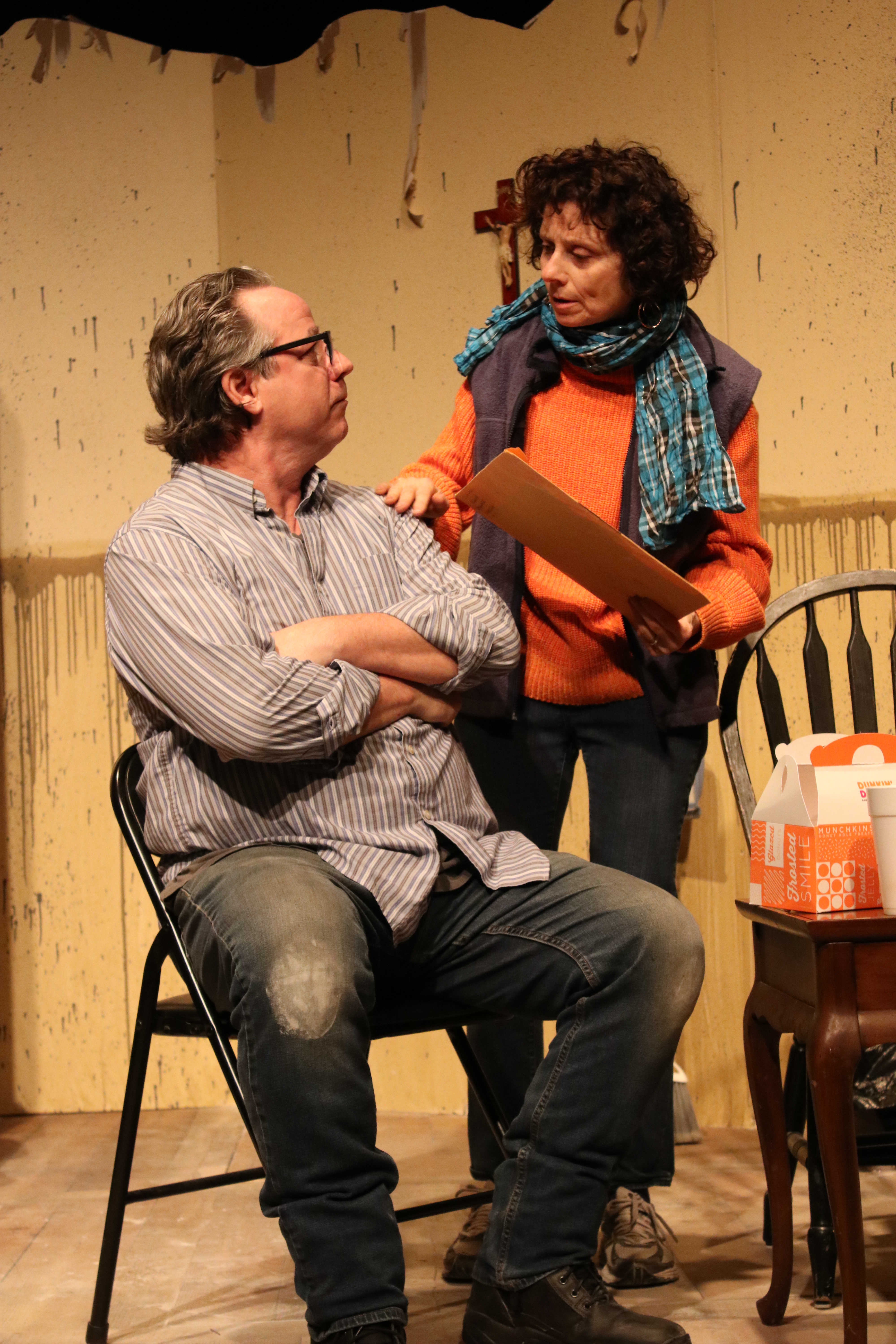
Likely an autobiographical creation from Domingo, Donnie is the sibling who most breaks the sitcom mold. King is a moderately daring casting choice from Mitchell, not reminding me of giftwrap at all, but he’s immensely likable without hardly trying. Although he never earmarks him as his parents’ favorite, Domingo clearly designates Donnie as the most beloved of the Shealys. Two additional characters are devoted to double-underlining this point, Tommy Prudenti as Donnie’s husband and Amy Dunn as his high school sweetheart.

Jackie, still carrying a torch for her old flame (among other things), is a useful character from the very beginning, long before she tries to come between Donnie and Adam. Frank conversations between Dotty and her children seem to have ceased years before her current aging crisis, and as the houselights go down, Shelly and her mom have no plausible reason to exchange information about each other that we need to know as quickly as possible. Jackie’s coming back home and catching up with her old flame’s mom, after years away in New York, opens up windows for us into what’s happening with both Dotty and Shelly.

Donnie and Adam

Dunn’s slant on Jackie takes into account that she is not at all opposed to homewrecking, so she can be a bit brash and irritating, though she usefully questions the crueler aspects of Shelly’s caretaking. She brings out a lot from Dottie and Shelly in the beginning, but it’s Prudenti as Adam who really brings out the best in his mother-in-law, unexpectedly reminding her of her dead husband. Due to his marital issues with Donnie, we get to feel that we know Donnie nearly as well as Dottie and Shelly, though Domingo overestimates our interest in seeing them sort out their love lives.

Both Jackie and Adam, interestingly enough, are white, so there’s a refreshing lack of racial tension in Dot, though the meanness of Philly’s inner city lurks plainly enough in the background. In fact, Jackie is Jewish, further broadening the palette. In these matters, Domingo is most subtle, for there is a shared prejudice against Fidel among the younger Shealys, leading them to underestimate the foreigner, either through unwarranted suspicion or dismissiveness. Our dear Dottie is the first to properly gauge his intelligence and worth.

In his theatrical debut, computer science grad student Satheesh Kandula gives us a marvelously mild account of Fidel, diffident and polite but not at all servile. Kandula is hardly a credible target for xenophobia, but we’re not terribly surprised to see it happening – and it might give us pause if we consider the possibility that Fidel may understand Dottie better than anyone else onstage. What he and his co-conspirator wind up concocting for Christmas turns out to be the best lesson of the night.

Only Jackie calls Dottie “Mrs. Shealy,” and absolutely nobody presumes to call her Dot. So why is that Domingo’s title? I’ve yet to read a review that mulls that question over, though I consider the answers – pragmatic or literary – worth pondering. “Dottie” might hint too broadly that Domingo’s protagonist has gone crazy, a matter that the playwright would surely prefer to remain ambiguous.

The other reason for the title is about what Domingo does wish to say. He’s using the diminutive of Dorothy and Dottie to emphasize that Dottie, in her drift toward dementia and Alzheimer’s, is becoming different, “a diminished thing” as Robert Frost would say. At the same time, she remains the same. That’s the main point of Dot.

Resettling in the Rubble

Review:   By the Water

By Perry Tannenbaum

IMG_3340

Compared with Cape Hatteras, Wilmington, or Charleston here in the Carolinas, the borough of Staten Island up in New York City hasn’t historically been known as a punching bag for hurricanes. Until late 2012, when Hurricane Sandy battered three NYC boroughs, Staten Island was hardly in the conversation when compared even with nearby Long Island. Zeroing in on the impact of Sandy on a Staten Island family and community, Sharyn Rothstein’s By the Water not only changes the conversation, it also fiddles with history.

Taking in Ryan Maloney’s storm-ravaged set design at Duke Power Theater, with its waist-high waterline, you would likely expect Rothstein’s drama to be about the folly of resettling near a hurricane-prone shore. Or we might assume we’ll encounter the innocent victims of unscrupulous real estate developers, or come face-to-face with the new New York calculus of climate change. None of the working-class folk in this Three Bone Theatre production, smartly directed by Ron Law, seems capable – or sufficiently woke – to address any of these subjects.IMG_3234

As a result, the topicality of By the Water becomes rather shrouded in a mist of Murphy family grudges and disputes, further distanced from pressing issues that might concern us by the neighboring Carter family’s involvement. The Murphys seem as broken, fallible, and struggling as the Lomans were in Death of a Salesman, and the heads of this devastated household, Marty and Mary, have a fairly similar relationship.

For Marty, it’s axiomatic that he should rebuild and restart. To his eldest son, Sal, it’s obvious that his dad should move to higher, safer ground – and way past time that his mom stop blindly supporting whatever Dad says, especially after all his past misjudgments and misdeeds. Philip and Andrea Carter, the Murphys’ longtime friends and neighbors, have decided that they wish to accept a government buyout and move to Montclair, New Jersey.

But this isn’t a laissez-faire situation, where the Murphys and the Carters are free to do whatever they wish, no harm done. The government’s offer to the Carters and other survivors in the neighborhood will be withdrawn unless 80% of the community decides to sign on. Marty is fervid enough about his cause to go out picketing against the buyout.

A stretch at a hotel and returning to a home that boasts a few sticks of furniture, a hardy fridge, and the better part of one wall is starting to fray Mary’s unquestioning loyalty to her husband. The younger son, Brian, is returning home after a stretch of own – in prison as a result of his past drug addiction. He sides with his dad, seemingly to keep his favor, but his endorsement is tainted by his rap sheet, and he’s actually more intent on regaining the affections of the Carters’ daughter, Emily. Her parents, of course, know all about him, so they don’t approve.

Could work in Brian’s favor, right? He and Emily are both City kids. Minds of their own.

IMG_3248

A corner of the stage is set aside for the wee wharf where Brian and Emily rendezvous, providing a respite from the family quarreling and the neighborhood politics, which grew a little repetitious during the 91-minute performance on opening night. More substance in the debate would have dispelled the tedium. It might have been worth pondering what government should and shouldn’t subsidize on these fragile wetlands. And a more eloquent Marty might voice the notion that, given the historical infrequency of tropical storms and hurricanes hitting Staten Island, it’s not such a stupid plan to live out the 20-30 remaining years of your life in the house your father built rather than transplanting to Montclair.

While Rothstein does disappoint me on topicality, and in giving us any sense that she’s intensively researched the Tri-State housing market or Marty’s prospects for homeowner’s insurance, there are times when she brings us vividly into the moment. Despite skirting the basic survivalist questions of home life without a roof, the playwright etches her characters with finely judged individuality and gives us a nuanced feel for the Murphys’ family dynamics.

Law and his cast are definitely on Rothstein’s wavelength, and the only major mistake they make is in overestimating the Duke’s acoustics. As the inimitable Tania Kelly demonstrated last year in Three Bone’s Every Brilliant Thing, it’s easy to convince yourself that you’re being heard up in the balcony when people are actually having problems in the second row.

While you might not catch the ends of all of Marty’s sentences, Thom Tonetti delivers all of the outsized personality and bossiness that fosters Mary’s adoration and submission. We are definitely dealing with a force that can sway community sentiment when we encounter Tonetti, and we are not surprised to learn that Marty is capable of taking audacious and catastrophic risks. Physically, Susan Stein projects the frailty that perfectly fits Mary but with a salty New York accent that constantly reminds us of the street savvy and toughness that lurk within. There’s a tenseness and pallor to Stein as well, hinting that Mary has reached the end of her tether.IMG_3301

Law would have been safer casting an older actor to get the right look for Sal, the elder son, but there’s no doubt that Tommy Prudenti captures his straight-arrow essence in his Charlotte debut. Sal is a living white-collar rebuke of his father’s values, yet at key moments, Prudenti convinces us that he still craves Dad’s love. Tim Hager’s portrait of Brian adds another black sheep to his gallery, and if you saw his Franz in Three Bone’s Appropriate last summer, you won’t be surprised that he’s as lovable a reprobate up in the New York City wetlands as he was down on the bayou.

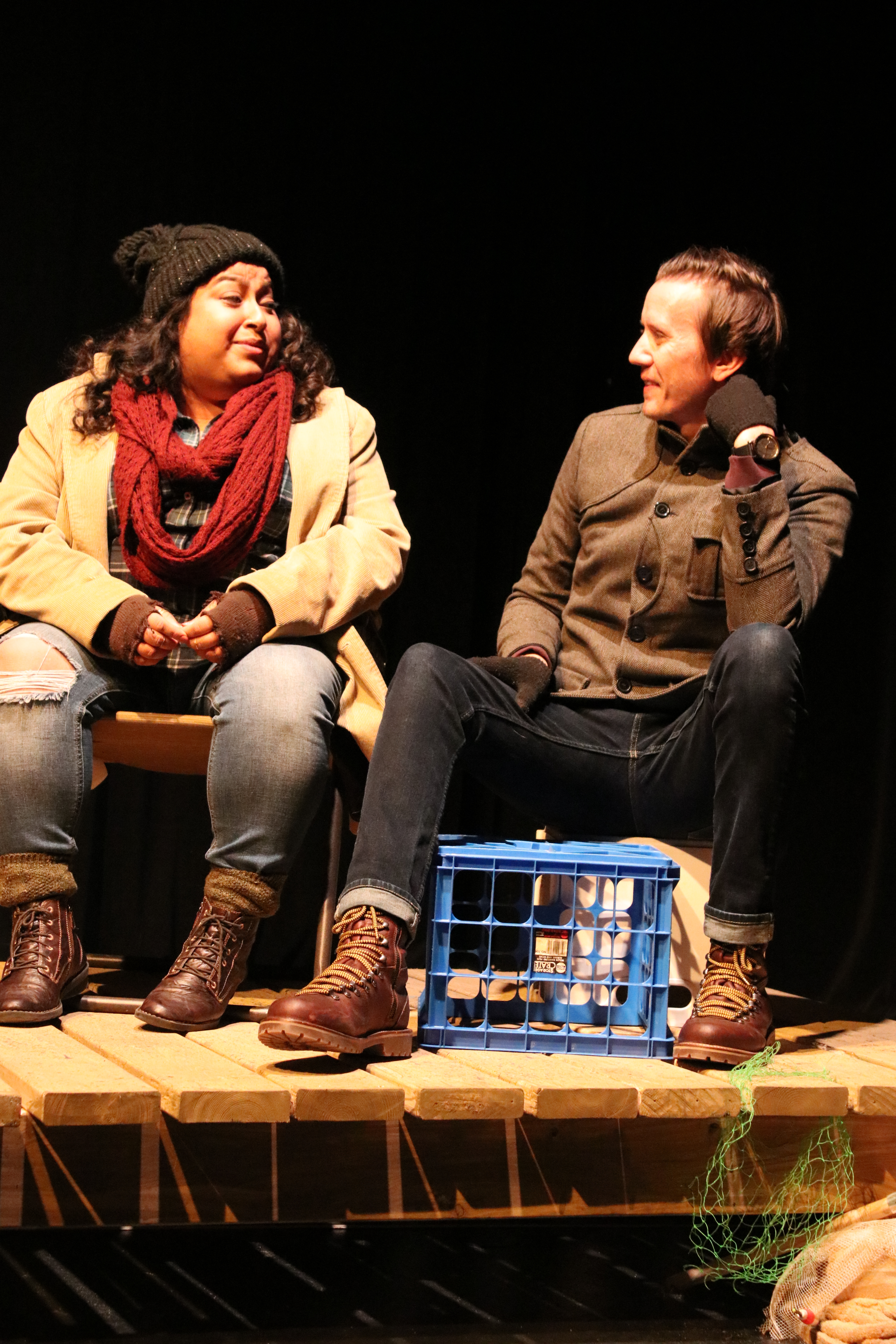
The accent is different, but this bad boy remains a magnet for one unattached lady who may be ready to rekindle an old pre-prison flame. I think you’ll like the sassy flavor that Sonia J. Rosales brings to Emily in her Charlotte debut. She’s certainly more liberated than the two moms we see here.

It’s slightly surprising to see Law pairing Lillie Oden with Joe Copley as the Carters, but they work beautifully together. Opposed to the Murphys’ plans, there’s a clear gender difference in how their oppositions play out. Like Mary, Oden as Andrea is more apt to be conciliatory, and like Marty, Copley as Philip inevitably becomes enraged and bellicose. You get the idea that Rothstein believes that the world would be so much more peaceful and sensible if women were in charge. But where would her drama be without all her guys?