Tag Archives: Thom Tonetti

Watch for the Closing Door at CAST’s “Sunset Limited”

Review: The Sunset Limited at The Arts Factory
By Perry Tannenbaum

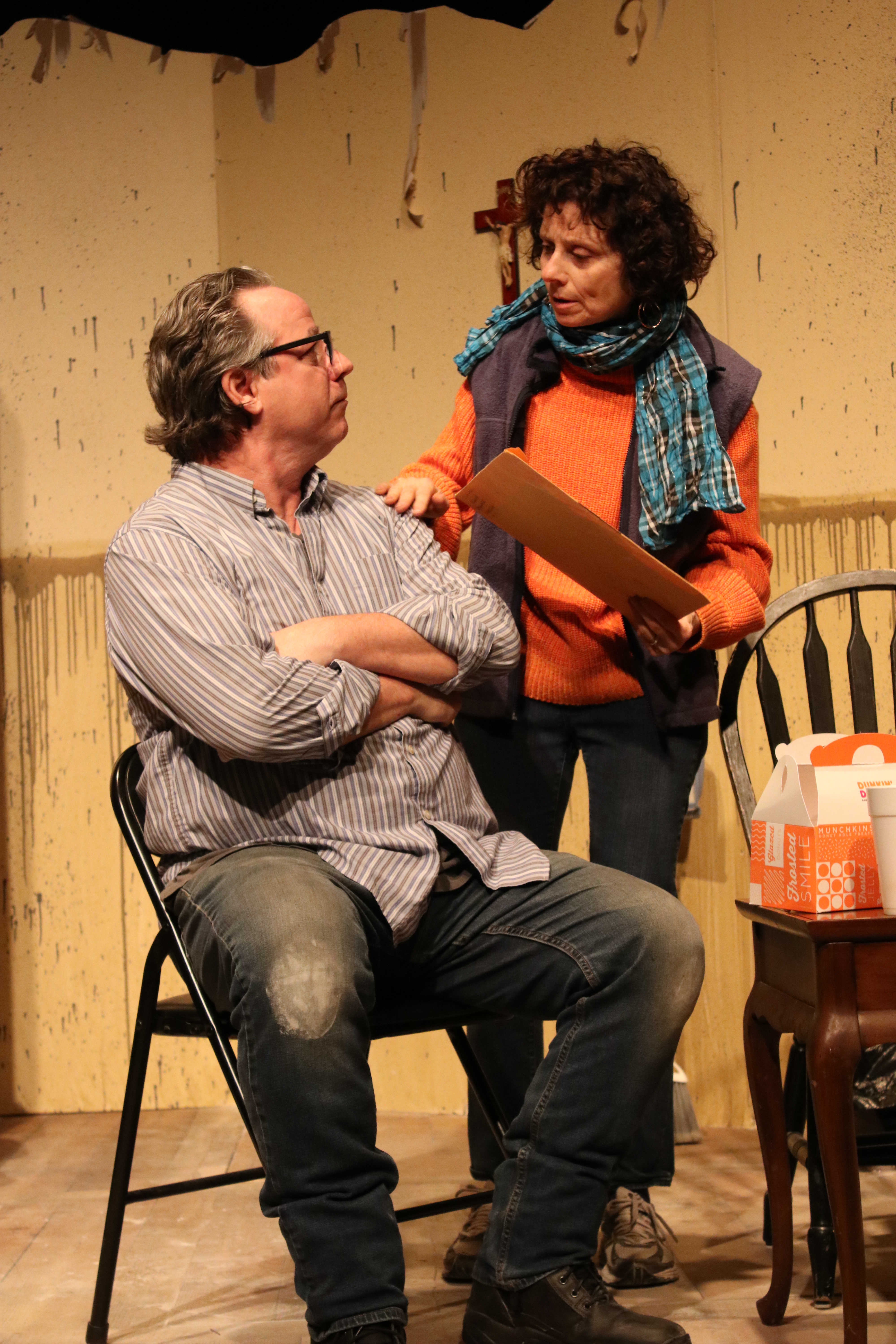
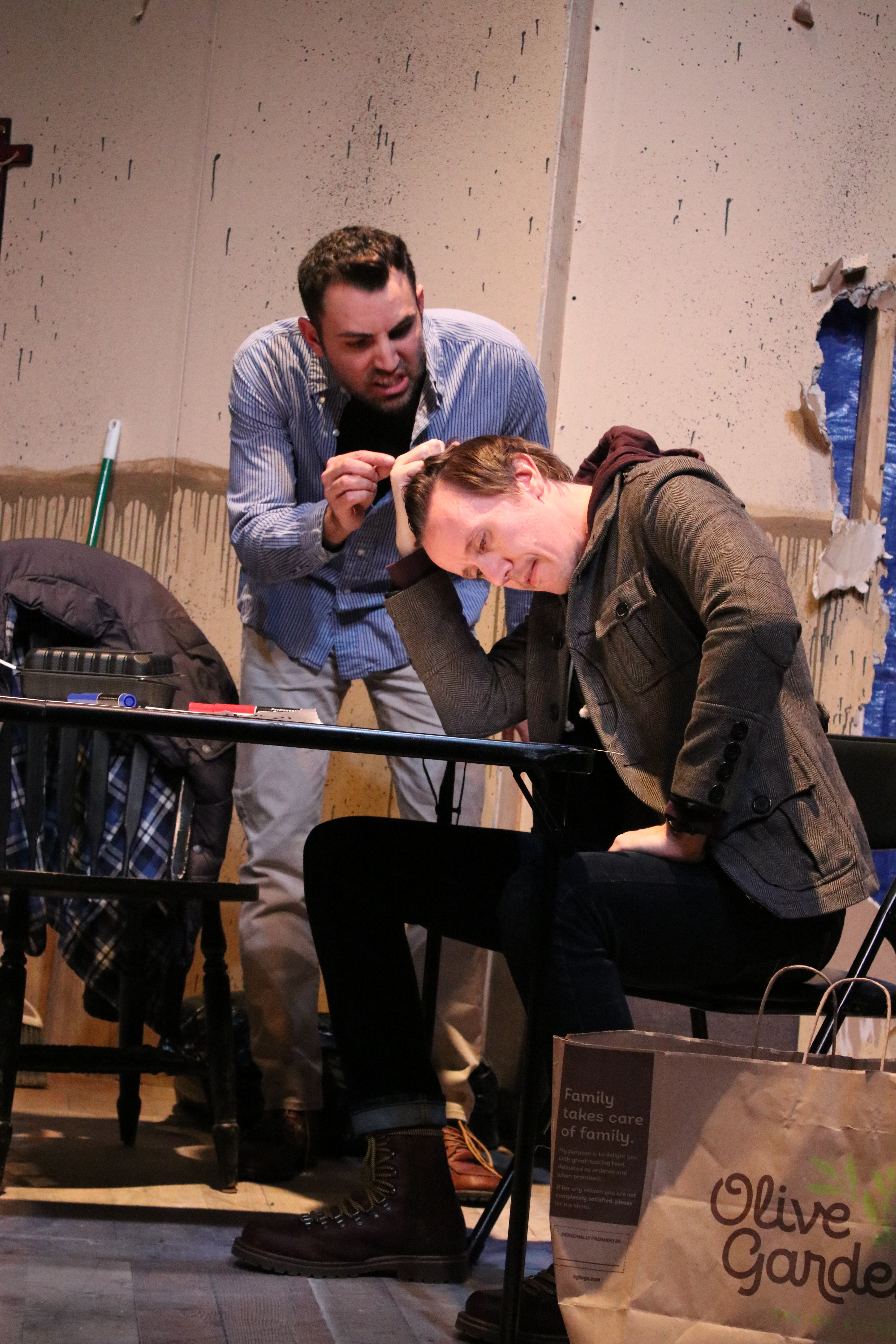
Would it rub you the wrong way to be solicited by a beggar selling candies outside your favorite theater? What if we add a tramp handing you your tickets, then a drunk, a druggie, a streetwalker, and a guy hawking fake Rolexes for six bucks lining the path to your seats? Welcome to experiential theatre at the Arts Factory on West Trade, where Cormac McCarthy’s THE SUNSET LIMITED is rounding the bend into its second weekend.

Or if you’re already fondly familiar with how Carolina Actors Studio Theatre means to do things, welcome back to the good old days.

CAST artistic director Michael Simmons doesn’t merely content himself with just these genial Skid Row stereotypes. No, no, no, for then your experience would normalize as soon you entered the theater.

Not so fast, for Simmons’ rather fiendish set design has at least six walls. After you enter the theater doorway, you need to wind around a cruddy corridor to reach another doorway that leads into the shithole apartment where McCarthy’s action takes place. This is absolute brilliance from Simmons, since the seediness of our host’s life helps to balance the to-be-or-not-to-be debates to come.

This point gets double-underlined when our host, a hulking Black ex-con, triple locks his front door behind his reluctant – and relatively puny – white guest. Subtly, something may click instinctively in us as we hear the clank of the locks. We are locked in this space for the duration of this debate, and the longer we linger, the more forceful White’s arguments become that Black’s life is cramped, sordid, and futile. We’ve gotten a taste.

It’s director Dee Abdullah who layers this emphatic entrance for Zach Humphrey onto the script, a nice touch. McCarthy also tips the balance of the debate in this harrowing direction, for Thom Tonetti as White is armed with more age, experience, education, wealth, and endowed with a professorial intellect.

In a jumpsuit designed by Abdullah, Humphrey appears to have more keys and tools dangling from him than locks on his doors – as if he’s a janitor or a subway worker. That’s where Humphrey saved Tonetti from jumping in the path of an oncoming train, catching him and carrying him home.

If Tonetti stays too long, his rescue becomes a kidnapping, and Humphrey seems to understand there’s a time limit on how long he can hold his suicidal guest against his will. His main intellectual artillery is the Holy Bible, bolstered by his faith, which he frequently brandishes if he’s not thumbing through it. Trying to preach this book to the local drunks, derelicts, and druggies hasn’t yielded any positive results – and he’s been at it long enough that The Greatest Book Ever Written engraving has worn off its cover.

Without a doubt, Humphrey has the more urgent, desperate, and anguished role, especially when Tonetti rubs his nose in his past and present failures – and the squalor surrounding them both. At his most fragile moments, we see Humphrey processing the devastating irony that he has admirably served his time, licked his wounds, and freed himself from one prison only to lock himself in another.

(McCarthy called his players Black and White in his 2006 script, subtitled “A Novel in Dramatic Form,” but those names are absent from the actual dialogue and the CAST playbill.)
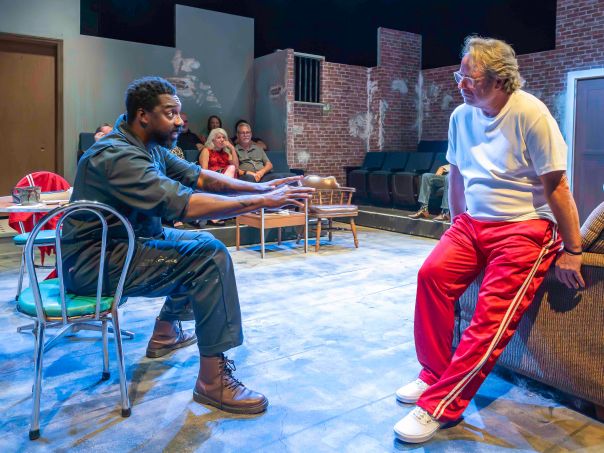
One of the reasons we manage to like Humphrey more is his ability to admit, no offense to Jesus or Scripture, that he is intellectually overmatched. Teaching should trump preaching since it’s fortified with facts and knowledge. Won’t it simply hurt horribly when the Sunset Limited rams into him? No, Tonetti calmly responds, at 70mph, the train would outspeed his neurons.

If we press the pause button here, we can scrutinize a telling moment, for Tonetti – (and maybe McCarthy) has miscalculated. Trains don’t ever speed past train platforms at 70mph, needing to decelerate and accelerate before they’re gone. And if McCarthy had only had the luxury of a Google Hub a couple of decades ago, he could have ascertained that the max speed for MTA subway cars is 55mph.

So Tonetti has an extra psychological advantage: when he starts spouting facts – real, imagined, or fabricated – Humphrey will not contradict him. Yes, he does have all the time in the world to throw himself in front of the Sunset Limited, so he can remain calm and keep his cards close to the vest. If he maintains his resolve, whether combatively or cordially, he will prevail. He even realizes that he can spare the time for a cup coffee of and a bite to eat.

Heightened emotions from Tonetti spill out when he is most tellingly challenged and when he swerves to the counterattack. We may be hoping that Humphrey goads him sufficiently to spew out all the venom, hatred, resentment, and bitterness that lurks inside him, resulting in some sort of cleansing purgation. Or exorcism, since a dilapidated bible is ready-to-hand.

As it turns out, Tonetti has had too little connection with other humans for oceans of accumulated bile to come cascading out of him. Maybe he’s only metaphorically a professor! There is an enervated numbness to Tonetti that makes his sudden outbursts all the mightier.

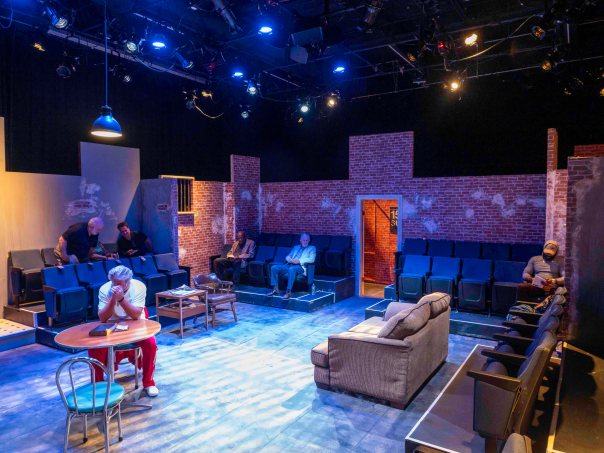
It’s all a conspiracy, for we must factor in how Simmons has configured his black box into a thrust staging. The thrust of the compacted performance space, extending from Humphrey’s kitchen to his triple-locked door, implicates us all as it heightens our involvement.

When telling his gory prison tale of intense violence and grim survival, he was looking straight at Tonetti… and me right behind his left shoulder! And when I viewed both men sitting close to me in profile, I couldn’t help glimpsing how audience members in two other sections were reacting.

Yeah, it’s intense but sometimes a little comical. Face it, since the days of Socrates and Plato, any philosophical or existential dialogue will have its circular, tedious, or repetitive patches. You’ll be seeing smiles from other people across the way, some deeply pondering expressions, and the occasional blank wearied stare.

For me, that added to the experiential realism of my evening and enhanced my involvement.

The Road Gets Bumpy, but Theatre Charlotte’s “Christmas Carol” Prevails at CP

Review: A Christmas Carol at Halton Theater

 By Perry Tannenbaum

IMG_9668

Almost a year ago, fire struck the Theatre Charlotte building on Queens Road, gouging a sizable trench in its auditorium and destroying its electrical equipment. Repairs and renovations will hopefully be completed in time for the launch of the company’s 95th season next fall, but meanwhile, actors, directors, designers, and technicians are soldiering on at various venues for 2021-22, their year of exile cheerfully branded as “The Road Trip Season Tour.” Ironically enough, Theatre Charlotte’s Season 94 began in September with a downsized musical, The Fantasticks, at the Palmer Building, a facility that once served as a training ground for firefighters. For their 14th production of A Christmas Carol, Theatre Charlotte has moved along to Halton Theater, the permanent home of Central Piedmont Theatre.

Timing is a bit awkward on the campus of Central Piedmont Community College, where a new theater that will be friendlier to dramatic productions – replacing the demolished Pease Auditorium – is slated to open in April with The Diary of Anne Frank. Graced with a generous orchestra pit, the Halton is more hospitable to big splashy musicals (when its sound system responds favorably to our crossed fingers). In fact, this transplanted production of A Christmas Carol, in Julius Arthur Leonard’s adaptation of Charles Dickens’ iconic novella, reminds us how well-suited the old “Queens Road barn” was for such spooky and creepy fare. Not only were the ghosts of Christmases Past, Present, and Future at home there, but so were such confections as Arsenic and Old Lace, Assassins, Blithe Spirit, and To Kill a Mockingbird. The Halton occasionally seemed oversized when You Can’t Take It With You took up residence there at the beginning of Central Piedmont’s current season, and you can imagine how their spectacular 2015 Phantom of the Opera emphasized the grandness of Andy Lloyd Webber’s grand guignol.

Encountering the vastness of the Halton in transplanting Theatre Charlotte’s cozy Christmas Carol, director Jill Bloede has been characteristically resourceful in executing its many daunting scene changes. At times, we could see cast members whisking set pieces off to the wings in a smooth out-with-the-old, in-with-the-new routine. But there were occasions when changes of scenery necessitated a complete closing and reopening of the stage curtains. Veiling the tediousness of that maneuver, Bloede has summoned repeated parades of a small band of merry carolers, coached by Jim Eddings, to cross the stage while the curtains are closed – so you would probably be right in thinking there are more carols sung this year than in Christmases past on Queens Road. My welcome for the carolers on opening night veered toward the unredeemed Ebenezer Scrooge’s grumpy attitude as the evening progressed, yet opening night is destined to be enshrined in Theatre Charlotte lore as the night of the infamous doorknocker scene fiasco.

One of the first indications that Scrooge’s house will be haunted, after a ghostly “Ebenezer Scrooge!” exclamation blows in on the Halton’s sound system, is the brief scene at the threshold to Ebenezer’s home. Here is where Scrooge sees a fleeting glimpse of his deceased partner, Jacob Marley, bringing his doorknocker to life. The precision needed to carry off such a simple scene only became apparent when it went awry. Either the Halton curtains were tardy in arriving at their centerstage spots, where they would fully frame Scrooge’s front door, or the actor who was to lurk unseen behind that door arrived early – and was very clearly seen, garishly aglow. Portraying Scrooge, Hank West seemed sufficiently poised to extemporize while the stage curtains and the lurking Marley came into proper alignment. But the carolers took their cue and entered before West could properly proceed, and the panicked actor behind the door fled. West finished out the brief scene as well he could without any eerie lights beaming through the doorknocker, but the special effect was lost – the only real reason for that scene.

Legions of Theatre Charlotte veterans – and new initiates in years to come – will no doubt keep the memory of this snafu alive for generations, heartily laughing all the more at the incident because it didn’t typify the production. Scenic design by Chris Timmons and lighting by Gordon Olson didn’t expand quite enough to comfortably acclimate at the Halton, nor did the company splurge on smoke or fog effects during its financial woes, which might have deepened the spell of the spookier Marley and graveyard scenes. Don’t expect any snow to flutter down on the vast Halton acreage, either. With balmy temperatures likely to prevail throughout the opening weekend, it’s Beth Killion’s set of period costumes that most successfully instill a chill into the air.IMG_8525

We’ve seen some of this cast before, notably West as Scrooge, Chip Bradley as Christmas Present, and Mary Lynn Bain doubling as Fred’s wife Elizabeth in the present and Belle, Scrooge’s old flame, in the flashbacks. All of these enlarge on their past performances to some extent, maybe West most of all. His meanness is more startling in person than it was in last year’s video version, streamed online, and his sorrow and penitence are also magnified. The graceful arc of Scrooge’s redemption is only slightly bumpier this year with West’s adjustments to the new space, Bloede’s script edits for this intermission-free edition, and a body mic. Projected into a larger hall, Scrooge’s newly minted intentions needed to sound more like settled resolves and less like agonized pleas. Bradley enlarges to a similar degree upon Present’s outsized cheer, the more the merrier in his case – until he issues his climactic admonitions, now sharper in their contrast. Bain seems most content to let her mic do her amplification, but she is stronger this year in the climactic flashback scene when she returns Ebenezer’s engagement ring.IMG_8694_dcoston

All the newcomers to TC’s Carol are quite fine, a testament to Bloede’s ability to attract talent when she holds auditions. In contrast with the veiled youthful mystery of Anna McCarty last year, Suzanne Newsom brought a nostalgic melancholy to the Ghost of Christmas Past that was quite affecting in its serenity, while Mike Corrigan appeared for the first time as Bob Cratchit – very different with his more muted brand of meekness from Andrea King last year but no less kindly or comical. For richer or poorer, Josh Logsdon and Rebecca Kirby were a fine pairing for the Fezziwigs, Aedan Coughlin doubled well as Young Ebenezer and Ghost of Christmas Future, and Riley Smith brought all the optimism needed for the sanctity of Tiny Tim. With Mitzi Corrigan and Emma Corrigan on board as Mrs. Cratchit and daughter Belinda, there’s plenty of family authenticity around the humble Cratchit hearth – or there will be when Mitzi returns from personal leave due to a death in her real family. Vanessa Davis spelled ably for Corrigan as Mrs. Cratchit at the premiere performance, augmenting her regular role as Mrs. Dilbur.

Assuming that Thom Tonetti was already in character as Jacob Marley during the notorious doorknocker scene, I’ll say his opening night adventures most typified the Theatre Charlotte crew’s tribulations in acclimating to a new space. Marley’s entrance into Scrooge’s home wasn’t dramatized with smoke and lights, and Tonetti didn’t enjoy the benefit of having his prophecies and imprecations magnified with thunderous jolts from the soundboard. During the flashbacks, the actor certainly earned some sort of sportsmanship award, appearing as the younger Jacob opposite the truly younger Coughlin.IMG_8645_dcoston

Steadying this production and assuring that its professional polish never deteriorated into community theatre chaos for long, West ultimately triumphed over all missteps and obstacles, bringing us the compelling Scrooge we expect in all his goodness. It’s still a strong story, and 24 of its most ardent Theatre Charlotte believers are moonlighting at Central Piedmont, giving this 87-minute production the old college try. A drama within a drama, to be sure, both ending happily.

Originally published on 12/18 at CVNC.org

Resettling in the Rubble

Review:   By the Water

By Perry Tannenbaum

IMG_3340

Compared with Cape Hatteras, Wilmington, or Charleston here in the Carolinas, the borough of Staten Island up in New York City hasn’t historically been known as a punching bag for hurricanes. Until late 2012, when Hurricane Sandy battered three NYC boroughs, Staten Island was hardly in the conversation when compared even with nearby Long Island. Zeroing in on the impact of Sandy on a Staten Island family and community, Sharyn Rothstein’s By the Water not only changes the conversation, it also fiddles with history.

Taking in Ryan Maloney’s storm-ravaged set design at Duke Power Theater, with its waist-high waterline, you would likely expect Rothstein’s drama to be about the folly of resettling near a hurricane-prone shore. Or we might assume we’ll encounter the innocent victims of unscrupulous real estate developers, or come face-to-face with the new New York calculus of climate change. None of the working-class folk in this Three Bone Theatre production, smartly directed by Ron Law, seems capable – or sufficiently woke – to address any of these subjects.IMG_3234

As a result, the topicality of By the Water becomes rather shrouded in a mist of Murphy family grudges and disputes, further distanced from pressing issues that might concern us by the neighboring Carter family’s involvement. The Murphys seem as broken, fallible, and struggling as the Lomans were in Death of a Salesman, and the heads of this devastated household, Marty and Mary, have a fairly similar relationship.

For Marty, it’s axiomatic that he should rebuild and restart. To his eldest son, Sal, it’s obvious that his dad should move to higher, safer ground – and way past time that his mom stop blindly supporting whatever Dad says, especially after all his past misjudgments and misdeeds. Philip and Andrea Carter, the Murphys’ longtime friends and neighbors, have decided that they wish to accept a government buyout and move to Montclair, New Jersey.

But this isn’t a laissez-faire situation, where the Murphys and the Carters are free to do whatever they wish, no harm done. The government’s offer to the Carters and other survivors in the neighborhood will be withdrawn unless 80% of the community decides to sign on. Marty is fervid enough about his cause to go out picketing against the buyout.

A stretch at a hotel and returning to a home that boasts a few sticks of furniture, a hardy fridge, and the better part of one wall is starting to fray Mary’s unquestioning loyalty to her husband. The younger son, Brian, is returning home after a stretch of own – in prison as a result of his past drug addiction. He sides with his dad, seemingly to keep his favor, but his endorsement is tainted by his rap sheet, and he’s actually more intent on regaining the affections of the Carters’ daughter, Emily. Her parents, of course, know all about him, so they don’t approve.

Could work in Brian’s favor, right? He and Emily are both City kids. Minds of their own.

IMG_3248

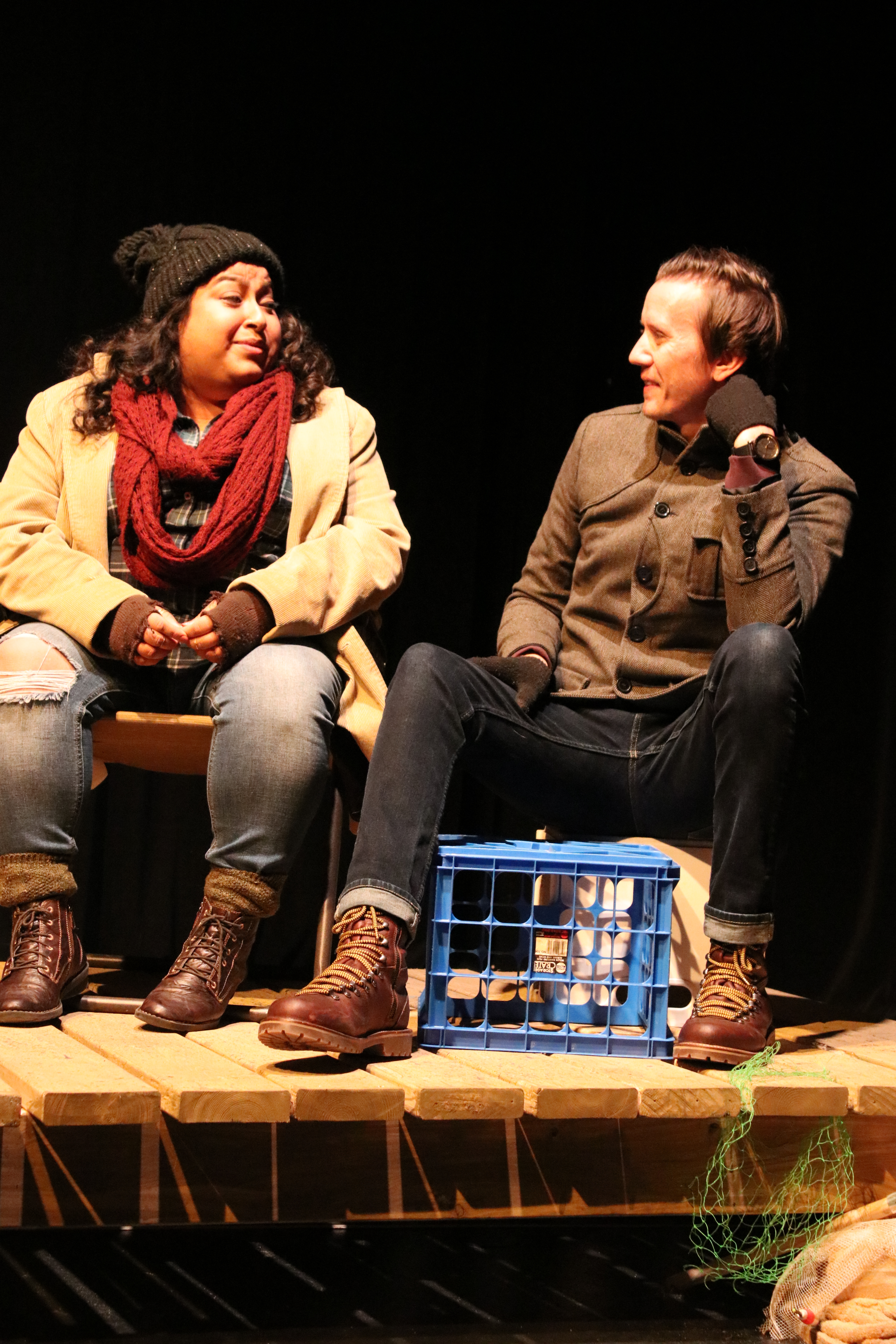
A corner of the stage is set aside for the wee wharf where Brian and Emily rendezvous, providing a respite from the family quarreling and the neighborhood politics, which grew a little repetitious during the 91-minute performance on opening night. More substance in the debate would have dispelled the tedium. It might have been worth pondering what government should and shouldn’t subsidize on these fragile wetlands. And a more eloquent Marty might voice the notion that, given the historical infrequency of tropical storms and hurricanes hitting Staten Island, it’s not such a stupid plan to live out the 20-30 remaining years of your life in the house your father built rather than transplanting to Montclair.

While Rothstein does disappoint me on topicality, and in giving us any sense that she’s intensively researched the Tri-State housing market or Marty’s prospects for homeowner’s insurance, there are times when she brings us vividly into the moment. Despite skirting the basic survivalist questions of home life without a roof, the playwright etches her characters with finely judged individuality and gives us a nuanced feel for the Murphys’ family dynamics.

Law and his cast are definitely on Rothstein’s wavelength, and the only major mistake they make is in overestimating the Duke’s acoustics. As the inimitable Tania Kelly demonstrated last year in Three Bone’s Every Brilliant Thing, it’s easy to convince yourself that you’re being heard up in the balcony when people are actually having problems in the second row.

While you might not catch the ends of all of Marty’s sentences, Thom Tonetti delivers all of the outsized personality and bossiness that fosters Mary’s adoration and submission. We are definitely dealing with a force that can sway community sentiment when we encounter Tonetti, and we are not surprised to learn that Marty is capable of taking audacious and catastrophic risks. Physically, Susan Stein projects the frailty that perfectly fits Mary but with a salty New York accent that constantly reminds us of the street savvy and toughness that lurk within. There’s a tenseness and pallor to Stein as well, hinting that Mary has reached the end of her tether.IMG_3301

Law would have been safer casting an older actor to get the right look for Sal, the elder son, but there’s no doubt that Tommy Prudenti captures his straight-arrow essence in his Charlotte debut. Sal is a living white-collar rebuke of his father’s values, yet at key moments, Prudenti convinces us that he still craves Dad’s love. Tim Hager’s portrait of Brian adds another black sheep to his gallery, and if you saw his Franz in Three Bone’s Appropriate last summer, you won’t be surprised that he’s as lovable a reprobate up in the New York City wetlands as he was down on the bayou.

The accent is different, but this bad boy remains a magnet for one unattached lady who may be ready to rekindle an old pre-prison flame. I think you’ll like the sassy flavor that Sonia J. Rosales brings to Emily in her Charlotte debut. She’s certainly more liberated than the two moms we see here.

It’s slightly surprising to see Law pairing Lillie Oden with Joe Copley as the Carters, but they work beautifully together. Opposed to the Murphys’ plans, there’s a clear gender difference in how their oppositions play out. Like Mary, Oden as Andrea is more apt to be conciliatory, and like Marty, Copley as Philip inevitably becomes enraged and bellicose. You get the idea that Rothstein believes that the world would be so much more peaceful and sensible if women were in charge. But where would her drama be without all her guys?


Subversive Energy Still Ignites “Fahrenheit 451”

Review:  Fahrenheit 451

By Perry Tannenbaum

Each time Ray Bradbury’s Fahrenheit 451 returns to Charlotte, it seems like a telltale barometer: how much closer have we come to fulfilling its grim dystopian vision – or how much further have we mercifully drifted away? Book burning and other assaults on culture may have been more virulent when the sci-fi classic was last served up at Children’s Theatre in 2005, when Taliban desecrations flamed our anger, or as recently as 2015, when ISIS insanity ruled Mosul and Palmyra.

With Kindle and Google Books, the concern nowadays seems more centered on physical books and booksellers, for notwithstanding the proud illiteracy of the toxic Agent Orange 45 – who still knows words, mind you – reading and literature appear safe for now. The battlefront seems to have shifted to information, reporting, and science. In Charlotte, the culture wars played out at local theatres back in the 90s have been upstaged by anti-LGBT initiatives in the state legislature and racial profiling on the streets.

Because of the complex crisscrossing of events in Charlotte and Charlottesville in the past few months, it gets pretty murky when we attempt to draw a sharp parallel between the firefighters that Bradbury’s hero, Guy Montag, breaks away from and the police of today. It was the protestors, after all, who carried the intimidating torches up in Virginia while police meekly looked on.

Forget the Charlottesville hullabaloo, then, if you go to see the Bradbury combustion up at Spirit Square in a crackling Three Bone Theatre production, for the company surely programmed 451 at Duke Energy Theatre between the Charlotte and Charlottesville riots.

Of course, while times inevitably have changed, productions will add another layer of difference, depending on the company and the director. Compared to the Children’s Theatre productions of 1993 and 2005, we get the full Bradbury stage adaptation now. Three Bone’s adds over 40 minutes, clocking in at 2:21, including intermission. The other big changes are the leading men that director Charles LaBorde has chosen.

With Harry Jones Jr. as Montag facing off against Thom Tonetti as Chief Beatty, we have a clash of physical titans that we haven’t seen before, both firefighters looking more like hard-working enforcers. Greater contrasts are also drawn between youth and age, innocence and experience, ignorance and knowledge. Mark Sutton could do many things onstage as Montag, but looming before us as physically – or vocally – intimidating wasn’t one of them. His early ignorance looked comparatively slack-jawed or nebbishy, slightly endearing.

Now we can see Montag as not only ignorant but also devolved and brutish. When Beatty warns that any influx of knowledge or enlightenment gained from reading will instantly register on Jones’s face, we believe it. He and the mass of mankind have evidently regressed so far that taking the first bite of the contents of a book is like beginning all over again – in a biblical or Darwinian sense.

Tonetti can roar nearly as loudly as Jones, and if he certainly isn’t any more rugged as Beatty than Scott Helm was in 2005, he has the advantage of more years to make him seem more experienced, scruffier, more cynical, and more embittered. Helm’s version of the fire chief was cooler, more inscrutable, while Tonetti is a hot boiling mess. He is erudite, filled with forbidden knowledge, and like God in Eden, able to smell the onset of intellect. But ambivalence rages within Beatty, set in his commitment to firefighting yet never able to fully vanquish the notion that he has made the wrong choice.

Library

Written in 1953, Fahrenheit 451 isn’t prescient about women’s advances in the future, but Bradbury was writing about a dystopian America, so we’re likely to give him a pass. LaBorde plants some women among the firefighters, and Bradbury’s main women, though not in the workforce, are interesting and varied. Mildred Montag, Guy’s wife, is the most conventional, unquestioning in her devotion to pills and brainless TV pap. Lisa Hatt as Mildred is mindless and sedated enough to be a likely source of Guy’s smoldering discontent.

Interestingly, there is a lax acceptance by Mildred and her neighbors of Montag’s predilection toward books. They’ll let it slide until Montag rocks the boat.

Near the Montags, a neighbor lady is found to have a vast home library that must be incinerated. Angie Cee gets a fine cameo as Mrs. Hudson, the library lady willing to burn with her beloved books, playing her with a memorable wild-eyed zeal – and just a trace of motherly love. Her martyrdom certainly gives Montag the inescapable notion that there might be something in books worth dying for.

Montag’s discontents at home and on the job make him vulnerable to the probing and teasing of his rebellious misfit neighbor, Clarisse. It’s a role that works well with the raffish delicacy that Stefani Cronley brings to it. Cronley becomes a dear and lively enough mentor to Montag for us to feel some of the same emptiness he feels when she disappears.

Perhaps the finest character Bradbury created in Fahrenheit 451 was the crazed fugitive outlaw, Faber. Somebody needs to register the horror of what has happened in America, and somebody needs to have an inkling about what can still be done. Bill Reilly brings a wild unkempt fervor to Faber, a catlike cunning wrapped into his cowardice and a divine spark twinkling in his despair. Mankind’s survival hangs on a slender thread, and he’s it – unless Montag and others like him can work out as recruits.

Like the Johann Stegmeir design concept for the 2005 Fahrenheit, Ryan Maloney’s set design and Ramsey Lyric’s costumes for Three Bone are not averse to the idea that we have entered a nuclear winter as well as an intellectual one. Other novelists have played with the idea that nuclear catastrophe might bring about reactionary rejection of science and culture. In Bradbury’s futureworld, nobody seems to know what exactly brought us to this, and that’s part of what makes it so sad.