Tag Archives: Tanya McClellan

Vampires and Trumpers

Reviews: Vampire Lesbians of Sodom and Thanksgiving: 2016

By Perry Tannenbaum

For devout upstanding citizens who had decided way back in the hippie ‘60s that Greenwich Village was an abominable den of sin, Charles Busch’s Vampire Lesbians of Sodom was a flaming and perverse poke in the eye. Or an argument clincher when it landed on Macdougal Street in 1985. The New York Times raved, the extravagant little trio of sketches became a cult obsession, and Vampire Lesbians had a five-year run.

Busch slipped away from his castmates when the review came out in the early morning after the Provincetown Playhouse premiere and had a good cry. Why did this diva desecrate his mascara? His career in theatre was now assured. He would write more outrageous comedies and send-ups that he, as the prima donna, could cross-dress and slay in, most famously Psycho Beach Party.

Vampire Lesbians made it to Charlotte at the Pterodactyl Club in 1991, after the slightly wholesomer Psycho Beach had paved the way during the previous year. George Brown directed this orgy of sacrilege with fiendish glee, while Innovative Theatre co-founder Alan Poindexter starred with Keith Bulla as the titular vamps.

With the Rev. Joe Chambers carrying the torch for fundamentalism in the wake of Jim Bakker’s disgrace, Banktown was still a very Christian place. It was my sacred duty to bring my daughter, not yet bat mitzvahed, to see Poindexter in all his counter-culture glory. After beholding the kinky wonders of Psycho Beach, my Ilana would have kissed Alan’s feet.

Flash forward to 2023. Poindexter is gone and the Pterodactyl Club, the one-time cultural capital of Freedom Drive, is goner. But thanks to Nicia Carla and her PaperHouse Theatre, Hollywood antagonists La Condesa and Madeleiné Astarté (a Succubus and a Virgin Sacrifice back in their Sodom days) are undead again!

Taking on Busch’s mantle, Carla directs and stars in this stunning revival at VisArt Video, tucked into the nether region of a strip mall on Eastway Drive – I’m trying to make this little suburban dive sound as risqué as the Pterodactyl! Walls are black as you walk inside, and hostesses in Goth attire and makeup are there to greet you. Whatever Google Maps has told you (it misled both me and my wife Sue on separate occasions), you can now be sure you’re in the right place.

Small as it is, the inner sanctum of VisArt is perfectly sized for Busch’s secret forbidden rites. The seats are soft enough to keep butt burnout at bay for 90 minutes, even if you don’t stretch for intermission and fall prey to the treats in the lobby. Yet sightlines are not ideal according to Sue’s scouting report.
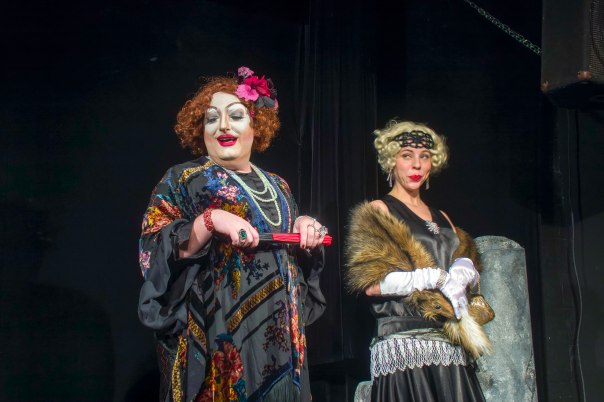
The PaperHouse cast multitasks even more than Busch’s original ensemble, just six players covering the 14 roles instead of seven. All six are battle-tested in madcap comedy, so this outrage is hardly outside their comfort zones. Nicia probably hasn’t had this much fun onstage since Poindexter directed her as The Witch in Hansel & Gretel. She minces and manipulates here as the Virgin Sacrifice, growing regal and stentorian as theatrical megastar Astarté as she assaults the Left Coast. Opposite her, Ashby Blakely is a steely, sneering diva bridging four millennia as The Succubus, aging gracefully into La Condesa and crossdressing in costume designer Beth Levine Chaitman’s most outré couture.

That isn’t to say that Josh Looney and Charlie Carla are anything less than visions of decadence as Sodomite musclemen Ali and Hujar in complementary S&M outfits and Wagnerian wigs. Nicia is already fairly slutty in the opening sketch despite her somewhat revealing white dress, willing to break her hymen with Ali or cut a deal with the cave monster Succubus. Subsequent scenes in Hollywood and Sin City climax in a couple of startling onstage costume changes, most improbably by Tanya McClellan who snoops into La Condesa’s boudoir as gossip columnist Oatsie Carewe.

Gosh, it’s good to see McClellan back onstage in manic comedy mode. Squinting her snoopiness, she sniffs out the ungodly acts performed by Nicia as Astarté on La Condessa’s protégée, luminous Sarah Molloy as flapper Renee Vain, and her meddlesome boy toy, Looney as matinee idol King Carlyle.

Hard times for a vampire? You’ll need to come back after intermission for Blakely’s final transformations. Andrea King’s choreography, on loan from Jane Fonda, elegantly shows off McClellan’s dancing prowess.

Anyone who reads advice columns or cruises social media at this time of year will have an accurate inkling of what Thanksgiving: 2016 might be about. Millions of Turkey Day hosts are wondering how they will keep opposing family factions from shouting their lungs out or coming to blows while the sharp cutlery is still on the table. Playwright Elaine Alexander smartly calculates that the situation is prime fuel for a dining room comedy – or tragedy – but the world premiere of Charlotte’s Off-Broadway production now at VAPA also reveals that the NC native had a tough time deciding which way to go.

Ground Zero for the annual onset of hosting panic was clearly in November 2016 when Hillary Rodham Clinton resoundingly won the popular vote for the US presidency while Donald Jefferson Trump won the Electoral College – and the White House – just as resoundingly. Liberals, Democrats, and rational folk are still in shock. Yet as Alexander deftly reminds us along the way, they are all blissfully unaware of the betrayals of good sense, rationality, rule of law, and democracy to come.

As the West family up in the liberal Northeast prepares to host young Eric’s girlfriend, riding up the highway from Alabama, the aroma of crisis already fills the suburban kitchen. Papa Harry, after diligently knocking on hundreds of doors crusading for Clinton, was hospitalized – either for a nervous breakdown or a heart attack – immediately after watching CNN declare Florida for Trump. The chief Turkey Day watchword from Harry’s physician is for wife and son to prevent the shell-shocked Hillary soldier from indulging his CNN addiction.
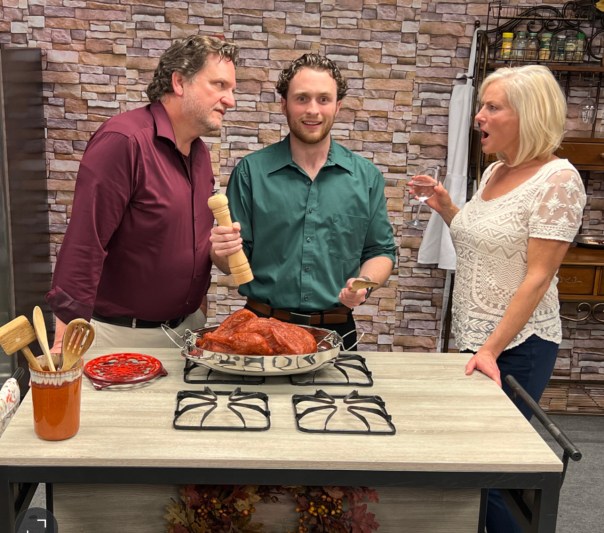
Taking to drink in the wake of her husband’s collapse, either out of worry or guilt, Renee has pretty much abandoned any serious intent to impress Brittany, the Southern belle she’ll be meeting for the first time. So it has fallen to young Eric to try to cook a luscious feast for his beloved, even though Mom hasn’t properly shopped for the occasion. Some improvising and substitution will need to be done. Worse, frozen will occasionally need to stand in for fresh.

Worst of all, Brittany voted for Trump, so Eric desperately hopes to keep talk of politics – the subject Dad is obsessed with and still agonizing over – away from the holiday dinner table. Harry has enough difficulty digesting that his son would date a girl from Alabama. Nor does Dad have enough self-awareness to realize that, in a reflexive action stemming from his years in community theatre, he mocks every Southern drawl he comes in contact with.

Finding out she’s a Trump voter could send him over the edge. Getting Dad to refrain from talking politics promises to be even tougher than steering him away from CNN. Finessing how to keep Brittany off the touchy subject is a bridge Eric hasn’t crossed yet.

As a director, Alexander casts father and son perfectly. Matthew Howie is a master of timorous anxiety as Eric. He can craft crescendos of panic and befuddlement while doing a hilariously awful job of warding off disaster with a shit-eating smile. Nor could we improve much on Tom Ollis as Harry. Since his 1997 debut at Theatre Charlotte in Arsenic and Old Lace, Ollis has grown into the most visible volcano on the Metrolina theatre landscape. Whether as Mr. Blonde in Reservoir Dogs, Sweeney Todd, or Titus Andronicus, Ollis is peerless at seething, suspecting, and erupting into towering, raving rages.

Since Harry is also a trial lawyer recently dismissed from his law firm because of his excessive zeal, Ollis can feast on numerous opportunities to cross-examine everyone in sight, bullying and browbeating every witness. Alexander’s women don’t get nearly as much scenery to chew, but her casting choices are nearly as impeccable.

Donna Norcross seemed to be battling opening night jitters early in Act 1 as Renee, but as Mom yielded to a multitude of wine refills, Norcross also relaxed, becoming quite powerful in the Act 2 denouement. Quite ripe for stereotyping, Michelle Strom as Renee entered the West home like a sudden ray of sunshine, without the preamble of a knock or a doorbell chime, her drawl as wide as the Mississippi. No, Dad could not restrain himself, nor could I blame him.

As you can imagine, the setup of Thanksgiving: 2016 is almost pure comedy – until the Trumper truth finally comes out, as an announcement rather than a shy confession, with the proud flourish of a cheerleader’s somersault. Looking from Strom to Ollis as we reach intermission, we can only wonder whether Dad will clutch his head or his heart.
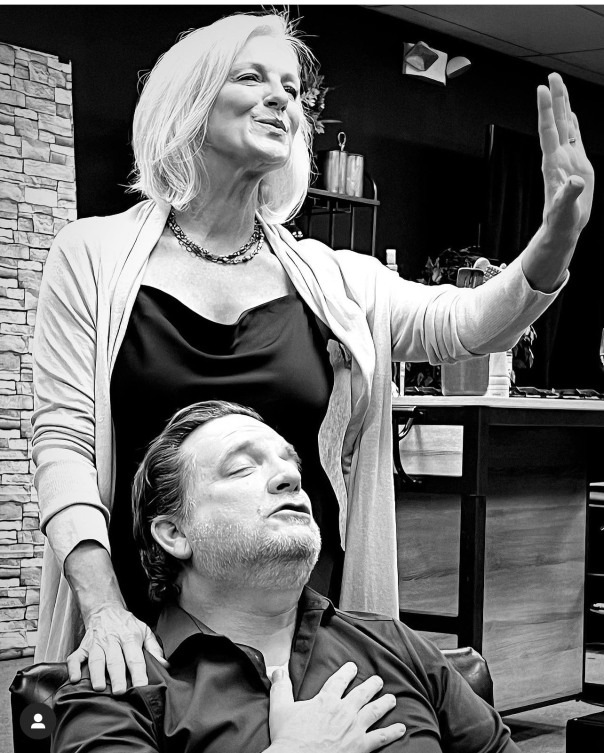
But what can come afterward from our host, our hostess, and from poor Eric? Admirably enough, Alexander lets her characters carry her along across Act 2. But her impulse to bludgeon Harry with more secrets and uncomfortable turns this comedy upside-down. We transition, not very gradually, from a Neil Simon comedy of futile secret -eeping to an impactful series of revelations that conjures up Sophocles’ Oedipus, Strindberg’s The Father, or Albee’s Virginia Woolf. Those revelations are topped off by a  couple of increasingly jaw-dropping ideological rebukes to Harry’s smug liberalism that might shake you up a bit.

We seem to fall over a cliff here, with too little before intermission to prepare us for the high drama afterward. By the time the cast is taking their bows, Renee has radically transformed from a borderline bimbo into a pieta resembling Steinbeck’s Rose of Sharon on the final pages of The Grapes of Wrath. Instead of dumping us off a high cliff, I’d advise Alexander to lay down more track that would guide us around the mountain: a sudden dramatic swerve – not too sudden – would be more satisfying than this swan dive.

A visit to VAPA for Thanksgiving: 2016 is still worth it, delivering hearty laughs and a gasp or two. By all means, dig in!

Warehouse PAC’s “Sweat” Deploys Stellar Cast on Stellar Script

Review: Sweat at Spirit Square

By Perry Tannenbaum

)1001

Not at all liberal or intellectual, nor with aspirations toward witty stylishness or trendiness, Lynn Nottage’s Sweat is a brutal and humbling lesson in empathy. Very humbling for clueless liberals and intellectuals who never got why blue collar and union workers jumped out of the pockets of the Democratic Party at the turn of the 21st century – turning our history and politics into a train wreck.

Premiered at the Oregon Shakespeare Festival in 2015, before opening at The Public Theatre in November 2016 and transferring to Broadway the following March, Nottage’s working-class drama, which won a second Pulitzer Prize for the playwright in 2017, seemed to break out when it would resonate loudest with 2016 presidential politics and issues. By that time, NAFTA (the North American Free Trade Agreement), ratified more than two decades earlier in 1993, was swept into a whirlwind of xenophobic issues that included illegal immigrants, Mexican gang rapists, manufacturing jobs shipped overseas, immigration reform, and a border wall.

Nottage mostly takes us back to 2000, when the reality of NAFTA was impacting on steelworkers in Reading, Pennsylvania. The authenticity of her lunch-pail portrayals comes by dint of personal interviews that Nottage conducted in Reading with Kate Whoriskey, who would ultimately direct the Oregon premiere, over a two-year period beginning in 2011. Subjects of these interviews included many factory workers who had been locked out of a steel tubing manufacturing plant for 93 weeks.

IMG_3998

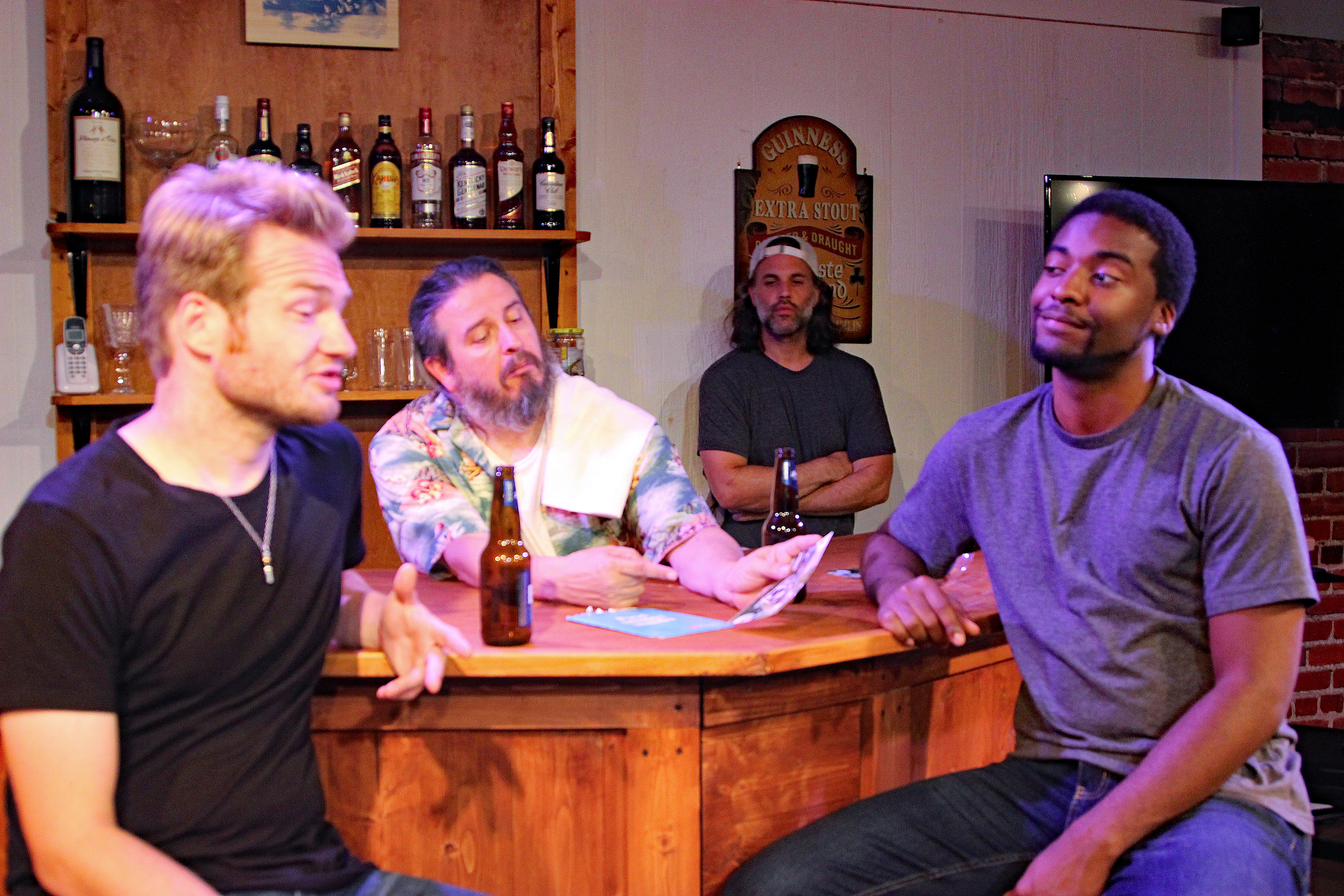
Two such plants figure in Nottage’s portrait of Reading. One of them has previously crushed Brucie and his fellow union members, so he’s already a pitiful druggie when the action begins. Another plant, where his son Chris and his estranged wife Cynthia still work, will soon follow suit, further dividing Brucie’s family and the other regulars who gather at a rundown bar where Stan serves up drinks and downtrodden Oscar mops up.

Directing the Warehouse Performing Arts Center production at Duke Energy Theater in Spirit Square, a month after its debut run in Cornelius, Michael Connor deftly contextualizes the action. Where Nottage’s script calls for “News of the day” sound montages, we’re repeatedly reminded – amid mentions of Allen Iverson, the Philly 76ers, and troublemaking Iraq – that this is the election year of the pivotal Bush-Gore showdown.

Yet Nottage isn’t exclusively focused on the fallout from NAFTA, nor is Brucie the only foreshadowing of how her story will develop. The preamble to the explosive action of 2000 is the opening scene, where Chris and his friend Jason meet separately in 2008 with Evan, their parole officer. As we gradually become aware that the fallout from NAFTA will deal yet another blow to Reading, we also realize that the chums will do something violent to earn their serious prison time.

We also learn in the preamble how different and antagonistic Jason and Chris have become, for Jason sports white supremacist tattoos on his face from his prison years while Chris grasps a bible in his left hand. Jason is the powder keg we keep our eyes on in the unfolding flashback scenes, but it isn’t too long before we realize that his emerging racism is a family hand-me-down from Tracey, his mom.

The rifts between these black and white families develop along separate tracks. When Olstead’s posts a notice that they have an opening for a new supervisor, Tracey’s kneejerk reaction is to spurn the idea of crossing over to management, but Cynthia tells Stan that she intends to apply, feeling that she has earned a promotion by virtue of all the years of hard work she has put on the floor.

Tracey certainly vies with her son Jason as the most toxic person in town. When she loses out to Cynthia on the promotion after she also applies, she attributes her friend’s success to affirmative action and the tax breaks she presumes Olstead’s receives for hiring a minority. She also refuses to help Oscar come on board at the company, viewing him as a foreigner. Of Puerto Rican ancestry but born in Reading, Oscar eventually signs on as a scab when Olstead’s locks Tracey, Jason, Chris, and their union out. They send Cynthia out to post the lockout notice, further roiling tensions around the plant – and at the bar.

So the ills of Reading aren’t confined to corporate greed. Xenophobia and racism are also on the scene, bringing latent Trumpism into bloom. The balance of Nottage’s analysis extends to the depth and pluminess of the parts she doles out. Warehouse artistic director Marla Brown only slightly dilutes Tracey’s toxicity, leaving room for a hint of mid-America wholesomeness and nicely gauging Nottage’s rounded assessment. For the arc of her disintegration starts at a merry, drunken celebration of her 45th birthday in the first flashback scene.

Tanya McClellan, off my radar for far too long, shows everyone what she can do with the opportunity to branch out from comedy roles into drama, for she does more than her share to flavor the friendship – and later, the complex antagonism – between Cynthia and Tracey. Before serving as a barometer for Tracey’s disintegration, there’s a marital confrontation with Brucie where Cynthia fills out our picture of how far he has fallen. McClellan’s mix of vulnerability and dignity is just right in both situations.

Never on an even keel like the other characters here, Brucie is as challenging as Tracey, for he’d flatten to two dimensions in the hands of an actor who couldn’t deliver several levels of desperation. In his scattered scenes, including one with a majestic monologue and another where he proves not to be the sponge we thought he was, Dominic Weaver is so very real and unforgettable.

Matt Webster as Stan and Justin Thomas as Oscar seem equally detached from the main plotlines – until they aren’t. While still on the periphery, both have eloquent moments. Webster excels when Stan describes life in a company as successive generations of the same family toiling at the same plant for successive lifetimes, with no solid hopes of advancement, no real appreciation from management, and instantly disposable. After about an hourlong immersion in that dreary reality, Thomas gets to shock us a little by telling us what it’s like as a Hispanic to live a lifetime as the hydrant of all these self-pitying underdogs, even if you’re born in the US like Oscar.

If you’ve already gathered that there are no weak links in this Warehouse production, you won’t be surprised to learn that I was impressed by both our protagonists, Maxwell Greger as Jason and Drue Allen as Chris, though Nottage shunts her leads to the wings for long stretches while plant politics take center stage. From the black eye we see on Greger in the preamble, augmenting the three tats on the other side of his face, we know quickly that that Jason is always coiled for action. Even when those markers disappear in the flashback scenes, Greger has a chiseled James Dean intentness in the set of his jaw, an unfocused discontent that portends trouble.

Allen, in his portrayal of Chris, underscores what irks Jason and his mom most deeply: like Cynthia, who craves a promotion, Chris wants to better himself by going to college. There’s a relatively calm purposefulness to his demeanor, firm but without rigid righteousness, as he deals with his broken dad and his beggary. And we come to see through Allen’s eyes that when a broken justice system unjustly incarcerates you because of your color, taking up the bible isn’t the worst way to cope.

IMG_4024

As Evan, Ron McClelland has that seen-it-all confidence of a parole officer who knows the ploys and dodges of hardened criminals, yet beneath his tough exterior, this copper seems earnestly engaged with even Jason’s rehabilitation. Becca Worthington rounds out the cast as Jessie, a third musketeer with Cynthia and Tracey at the outset when they’re still chums. Arguably, she serves as a white counterpart to Brucie: no matter how sloshed she gets hanging out at the bar until last call, she cleans up and punctually punches in at the plant at 6:00 or 7:00 the next morning.

The presence of McClelland and Worthington in such minor roles is just another earmark of this high-quality Warehouse PAC production. It also testifies to the attractions of working with such a stellar cast on such a stellar and timely script.

Less Bard and More Beer

Theater Reviews: Every Christmas Story Ever Told (and then some!) and The Great American Trailer Park Christmas Musical

everyxmasstoryphoto2

By Perry Tannenbaum

Four centuries after William Shakespeare’s death, Charlotte’s own Chickspeare inhabits a parallel universe. Or maybe it’s retribution: while all of the Bard’s works were performed by all-male theatre troupes, all of Chickspeare’s productions since 1998 have been “All women! All the time!” as originally promised. The “All Shakespeare” in the middle of that slogan was gradually blurred and dropped as the Chix added Reduced Shakespeare Company lampoons to their rep and then ventured father afield.

Written by Michael Carleton, James FitzGerald, and John K. Alvarez, Every Christmas Story Ever Told (and then some!) is very much in the spirit of Reduced Shakespeare’s original assault on the Elizabethan titan’s complete works. The parentheses in the title, the quickie romp through multiple classics by three actors playing multiple roles, and the devotion of all of Act 2 to a single extravagant lampoon all follow the Reduced template.

But gender only begins to describe the difference between Chickspeare’s version and the 2010 Actor’s Theatre Every Christmas. The new model is as much an event as it is a theatre production, an experience that begins and ends at the newer NoDa Brewery on N. Tryon Street. In between, there are a couple of shuttle bus rides back and forth from the original Brewery location on N. Davidson Street. You’ll find more brew choices on tap at North Tryon, but the enticement of lifting a mug and participating in the many “To beer!” toasts during the Chix performance at North Davidson is hard to resist.

Few did last Friday night. Besides the brewskis, we had Anne Lambert lubricating the experience with a steady feed of Christmas trivia challenges on the bus ride to the show and the conviviality of the Chix banditas – Sheila Snow Proctor, Lane Morris, and Tanya McClellan – during their performance. But mainly, it was the beer that induced the party atmosphere.

Directing the show, Joanna Gerdy and Andrea King had a healthy disregard for the script. The playwrights labored under a handicap that never afflicted the Reduced Shakespeare collaborators when they chose ancient targets like Hamlet, the Bible, and American history for their merry desecrations. Unlike your seasonal carols, most of our familiar Christmas stories aren’t free-range prey. Copyright law prevents satiric assaults upon Rudolph the Red-Nosed Reindeer, the Charlie Brown Christmas, and the Yuletide yarns of Truman Capote, Dylan Thomas, and Jean Sheperd.

When Carleton, FitzGerald, and Alvarez lashed out at these restrictions, the result was “Gustav, the Green-Nosed Rain-Goat,” not the funniest sketch you’ll ever see. Morris never plays the mutated venison as if it were comedy gold, so there’s never any deadly straining to make it funnier than it is. We’ll raise a glass, and then we’ll move on.

The premise of the show is that Proctor wishes to proceed traditionally with a presentation of Dickens’ A Christmas Carol, but Morris and McClellan are sick and tired of the same old stuff. Before they’ll allow Snow to read her Dickens and play her Scrooge, she must join them in a medley of other Christmas faves, including Frosty the Snowman, Macy’s Thanksgiving Parade, the Grinch, O’Henry’s “The Gift of the Magi,” and – maybe if there’s enough time – the inevitable It’s a Wonderful Life.

scrooge-and-mary2

There isn’t enough time, but that doesn’t deter Morris. While Proctor is on-task as Scrooge, with McClellan visiting her as all three ghosts, Morris keeps insisting that Proctor is George Bailey, inflicting on us a bevy of characters from New Bedford Falls, including George’s guardian angel, his brother, his banker nemesis, and his adoring wife. By the time Lane reaches the wife, it comes off oddly like a female impersonation.

Fortunately, Proctor is the ideal Scrooge in the face of these torments. There’s a bit of Oliver Hardy and Bud Abbott in her forbearance, but we somehow remain on her side throughout her ordeal. At the climax of Christmas Carol, Morris is still bedeviling her, so she finally submits to becoming George Bailey – in a schizophrenic frenzy that finds her shuttling between Scrooge and Bailey as both McClellan and Morris assail her.

In her surrender, Proctor produces a Jimmy Stewart impersonation that’s barely good enough to let you know what she’s doing. It will probably improve during the next couple of weekends as the run continues, but I’m not sure it should. Likewise, Proctor can be a mite slow changing costumes, but McClellan’s patience with her cast mate is so priceless, it would hardly pay for Proctor to hurry.

It’s been a rocky road for Actor’s Theatre of Charlotte since developers forced them out of their longtime home on Stonewall Street last summer. We thought they would resurface on Louise Avenue, but negotiations there collapsed, and the company tacked toward Freedom Drive. City and county paperwork delayed the opening, so their Toxic Avenger was redirected to a nearby church, and the current Great American Trailer Park Christmas Musical has been rerouted to the Patricia McBride and Jean-Pierre Bonnefoux Center for Dance, Charlotte Ballet’s HQ on N. Tryon Street.

I was curious to see how director Chip Decker and his design team would adapt to studios with so much space and such a high ceiling. With two fair-sized ramshackle trailers, topped by two jumbo projection screens, height isn’t a problem, and the design team fills out the stage with a fence, some Florida flamingo kitsch, an incongruous array of Star Wars memorabilia and, dead center of the stage between the two trailers, a half-decorated Christmas tree.

That odd tree, straddling the borderline between Rufus and Darleen’s properties, triggers Betsy Kelso’s plotline. Rufus loves Christmas and adores Darleen, but mean Darleen snarls “Bah” and “Humbug” to both. She will not decorate her trailer or even allow Rufus onto her property to decorate her side of the tree. That’s a source of huge consternation to Betty, the manager of Armadillo Acres, who has always wanted – but failed – to win the big prize awarded to the best-decorated trailer park. A vague curse plagues Armadillo Acres, and it too will to be exorcised before we reach a happy ending.

There’s a certain amount of respectability in Betty, so we’re fortunate that it is more than counterbalanced by the trashiness of her other tenants, Pickles and Lin (short for Linoleum). They also come in handy when ghosts are needed to populate Darleen’s Dickensian dream sequence. Rufus’s romantic fantasies and Betty’s hopes of nabbing top kitsch honors are revived when Darleen, in an effort to pull the plug on the park’s Christmas lights, gets electrocuted by Rufus’s déclassé cable-splitter and wakens with amnesia. That enables her to forget what a Scrooge she is and the fact that she belongs to Jackie, owner of a slutty pancake joint.

If you missed the first and second comings of this trashy romp, it’s good for you to know all the basics I’ve detailed. Although Actor’s Theatre has done well with the Charlotte Ballet space, they have thoroughly failed to conquer its acoustics. So the songs and lyrics by David Nehls are more crucial to your enjoyment than usual – but often unintelligible over the four-piece band led by music director Brad Fugate.

Tommy Foster isn’t as rednecky as Ryan Stamey was as Rufus, but he’s a tad more pathetic and lovable. Karen Christensen is more than sufficiently bitchy as Darleen, and we often forget that Matt Kenyon is in drag as Lin. (So does he, I suspect.) But Jon Parker Douglas nearly steals the show as Jackie when he is possessed during the climactic exorcism. It’s an epileptic farting fantasia that isn’t quickly forgotten – and the kind of broad physical comedy this acoustically-challenged show desperately needs.