Tag Archives: Stephen West-Rogers

Hurry, Hurry, See “The Chinese Lady” for 50¢

Review: The Chinese Lady at The Arts Factory

By Perry Tannenbaum

Somewhere in China, either forgotten in the innards of a few cellphones and computer hard drives or hanging up proudly framed on living room walls, are photos of my wife Sue and me taken in front of the fabled Great Wall, posing with a couple of families who had never seen Westerners before. For a few fleeting moments during our 2016 travels, we could have empathized – a little – with Afong Moy, the teenager imported from Canton City in 1834 by traders Nathaniel and Frederick Carne and put on display. “To be stared at, for half a dollar a head,” according to a disapproving New York Mirror editorial.

But we hadn’t heard of Afong Moy, and our ignorance remained intact until last Friday evening when Lloyd Suh’s The Chinese Lady had its local premiere at The Arts Factory in an affecting Three Bone Theatre production. Directed by Three Bone co-founder Robin Tynes-Miller and starring Amy Wada, Suh’s 2018 script repeatedly reminds us that we’re merely witnessing a performance – not really hearing Moy’s voice or even her words and not really seeing her body.

For in the great tradition of American aggrandizement, the original Moy’s body wasn’t her own, either. It was purportedly on loan to the Carne Brothers from Moy’s dad for two years, a deal that the Americans found easy enough to break, setting the precedent for Madame Butterfly and other dealings Uncle Sam and her upright citizens have had with the Far East. As for the absurdity of it all, we can easily perceive sweet revenge for Moy as Wada introduces us to such exotic fundamentals as brewing tea, holding chopsticks, and actually managing to walk with her tiny bound feet.

We can almost hear that lusty voice of P.T. Barnum himself proclaiming, “Ladies and Gentlemen, you are being patronized!” Yes, after the novelty began to wear off, the exhibition at Peale’s Museum in Philadelphia and an ensuing national tour having run their course, Moy becomes a sideshow at Barnum’s traveling circus. Running parallel to that deepening degradation, Stephen West-Rogers is Atung, Afong’s translator. Since Moy never speaks a word of Cantonese to us, the modern surrogates for The Chinese Lady’s actual audiences, Atung is stoically aware of his irrelevance from the start.

West-Rogers bickers with Wada when he isn’t serving her or bossing her, no need for his translation services except in one climactic scene. At the height of her celebrity, Moy gets to see “America’s emperor,” President Andrew Jackson, at the White House. Suddenly, Atung is the only person in the room who can tell us everything that was said. It’s a feast for West-Rogers who gets to play the lascivious Old Hickory with a thick cowboy drawl only to spring out of his regal easy chair to portray Atung cunningly and diplomatically mistranslating key parts of the conversation – if that’s the proper word.

Wada plays a more nuanced set of multiple roles. At times, she’s channeling Moy and at other moments she has become Suh’s mouthpiece, for Moy is merely Exhibit A in an extensive list of atrocities, prohibitions, and indignities inflicted by Americans upon Asians since she arrived here as a tender 14-year-old – and the playwright is not letting them slide. Nor should he, since our widespread ignorance of Chinese and Asian travails in the US goes far beyond not knowing about Afong Moy.

More than likely, the players who deliver Suh’s sad drama are also learning and digesting some of this history. There’s still another dimension to Afong in her early years here, for her purposes were not strictly educational. The Carne Brothers had merch to sell to their captivated audiences via their exotic spokeswoman: maybe the chopsticks Moy was eating with for starters, maybe the quaint tea sets and trays that Atung officiously carries in from the wings.
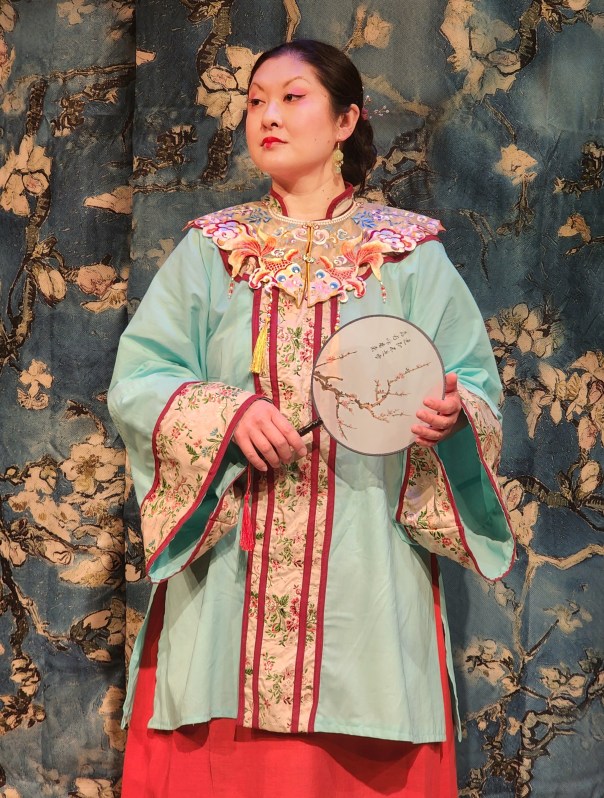
Afong is surrounded, of course, by decorative furnishings, vases, fabrics, draperies, and – at the whim of set designer Chip Davis – an elegant wooden birdcage that may have been unloaded from the same ship she sailed in on. Our Chinese Lady simply models many of these items without saying a word, the Carne Brothers merely scripting her actions. But at other times, Moy was an actress dutifully mouthing words that were not her own, words of gratitude to her benefactors and words directing our attention to the Carne Brothers’ merch on sale nearby.

It’s bittersweet, then, when Barnum has relieved her of her commercial obligations and transformed her into one of many sideshow attractions. As she becomes more authentically herself and gradually learns the language of her new homeland, Afong becomes less unique, less celebrated, less valuable to her employer, and more degraded and disposable.
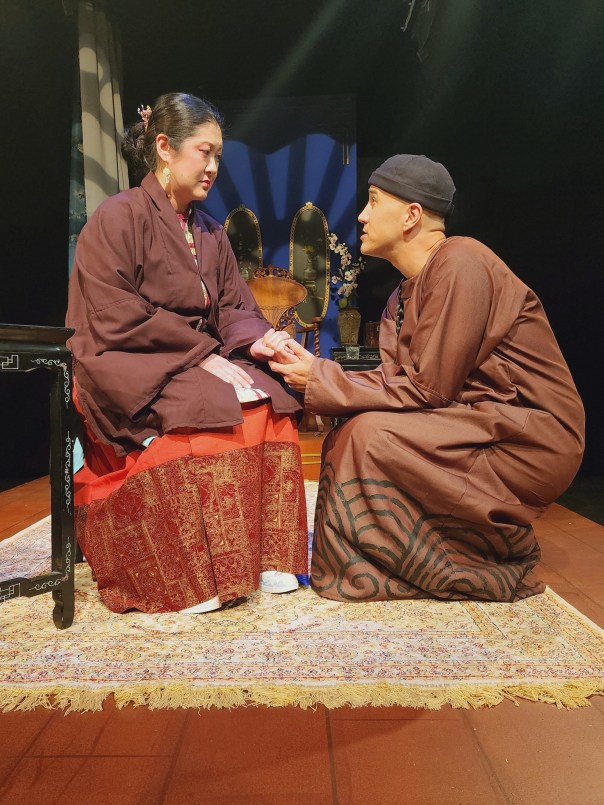
Just one altercation between Afong and Atung, when he attempts to draw the curtain closed around her little performing space, is enough to remind us that her comings and goings are not voluntary. Each closing of the curtain propels the action at last a year closer to our time. While Suh doesn’t spend much effort in dramatizing Moy’s increased mastery of her second language during those years – and partial forgetting of her first – he diligently opens her eyes to how we proceeded to exploit the influx of Chinese immigrants that came after her.

It wouldn’t have been a pretty sight even if Moy had lived past 1850, when history loses track of her. The first great wave of Chinese immigration was triggered by the California Gold Rush of 1849. By the time the Golden Spike completed Transcontinental Railroad in 1869, there were 12,000 Chinese in the construction crew that completed its western leg, working for the Central Pacific Railroad.

Sketching our great nation’s appreciation for Chinese labor, Suh’s Afong catalogs a few of the hideous slaughters of miners and laborers that Asians were treated to. Then in 1882, our US House of Representatives had their first opportunity to express their gratitude to the immigrants by voting down the Chinese Exclusion Act, which would stop immigration in its tracks for the next 10 years. But guess what. Our Congress passed the heinous restrictions overwhelmingly, the first such action Congress had taken against any nation, and 10 years later, they passed an extension of the Exclusion Act for another 10 years.

Then in 1902, our wise and magnanimous Congress said enough is enough. This time, they made the law permanent.

Now I can’t recall learning any of this back in my school days, no doubt a comfort to many framers of school curricula today who worry so devoutly about disturbing their fragile offspring. Lucky for them, The Chinese Lady was written before the COVID-19 pandemic rekindled widespread hatred and violence toward Asians. Tynes-Miller refrains from layering on any additional references to the re-emergence of this ugly bigotry, a kindness that was not granted by last year’s New York revival at the Public Theatre.

Still, Suh’s play won’t appeal to the haters or the educational censors who redline uncomfortable highlights of American history. Big green light, though, for those of you who feel like we should all know our history as fully and fairly as possible. You will be rewarded with new insights and an extraordinary pair of performances by both Wada and West-Rogers.

One-Two Punch of Surprises Powers “Eat the Runt”

Review: Eat the Runt

By Perry Tannenbaum

Even before you set out for the Charlotte Art League, the quest for parking, and the unique Eat the Runt from Donna Scott Productions, you need to remember one key preparation: bring your smartphone. Yes, you’ll be asked to turn off or silence the device when the action is set to begin, but before that, you’ll be asked to join the remainder of the audience in choosing the cast for that evening’s performance.

Eight actors vie for the seven roles listed in your program. The audience goes through the cast list one by one, voting their choice for each role on a group texting setup by punching the number assigned to each actor. Playwright Avery Crozier gives each of the characters at his (or her) second-tier art museum a unisex name, so any member of the ensemble directed by Tonya Bludsworth might play any of the roles on a given night.

To execute all of the possible 40,320 casting permutations, each actor must be prepared to play all of the roles, wear all of the costumes, and pounce on cues from all his or her castmates. That not only multiplies what each character has to memorize and the number of costumes designer Luci Wilson has to create, it also multiplies the amount of time that the ensemble must devote to rehearsal – even though they can’t begin to cover all the possible scene partners they will have during the actual run of Runt performances.

On the Saturday night that I attended, I voted with the audience on four of our choices: Ericka Ross as grantwriter Chris, Stephen Seay as human resources coordinator Jean, Tracie Frank as curator of modern art Hollis, and Kevin Shimko as museum director Pinky. Andrea King won the juiciest – and most demanding – role as Merritt, interviewing for a vacant position at the museum. Kevin Aoussou as director of development Royce and Jenn Grabenstetter as museum trustee Sidney rounded out the cast.

Somehow Stephen West-Rogers’ previous exploits in theatrical versions of Fight Club and Trainspotting had escaped the notice of Donna Scott fans. Nor did his new clean-shaven look bring fresh evocations of his ruggedness. As a result, West-Rogers was the odd man out, sent away to take the night off when Shimko snagged the last remaining role.

After this poignant moment, presided over by Scott, we were asked to give the cast a few minutes to sort things out, a reasonable enough request, I thought. When they returned, it was virtually impossible to find any indication that this wasn’t the fixed cast that had rehearsed Eat the Runt every night. King especially was a delight as Merritt, deftly bringing out the applicant’s uncanny ability to take the ideal approach for each museum official who interviewed her.

Merritt’s chameleonic shifts bespoke either a dangerously unstable personality or a cunning Machiavel – one perhaps gifted with psychic powers. Whether it’s the hemorrhoidal HR coordinator, the horny development director, the coke-addicted curator, or the defensive trustee, Merritt always seems to pounce on the perfect approach without any need for probing. It’s only when she’s spouting Ayn Rand to the museum director that Merritt drops hints of a supernatural gift.

Forget about the gimmickry at the top of the evening, it’s very rare for any playwright to be able to detonate a walloping surprise at the end of Act 1 and at the end of Act 2. Crozier not only achieved that, but the surprise at the end of the evening slickly explains away much of the puzzlement we may experience as the series of job interviews metastasizes and explodes.

A few days later, some of the deception that had been played on me became clearer. By then, I couldn’t regret the fun ride that Eat the Runt had taken me on. It may be radically different for you if your casting choices turn out to be more incongruous, risqué, or preposterous. That may increase the already plentiful comedy.

Smokey and the Epic Hero

Theatre Review: O Brother

O Brother

By Perry Tannenbaum

In Greek legend, Odysseus was a man of many ways who sacked the sacred citadels of Troy, traveled widely, struggled valiantly, and suffered greatly. But even if this Homeric catalogue of achievements pales in comparison to the praise lavished upon presidential candidates at our quadrennial conventions, there’s something about the guy that continues to spark admiration – despite the fact that he was once captured and imprisoned.

Latterday tributes from Lord Tennyson and James Joyce to Ulysses (O’s Roman name) gradually humanized the Ithacan warlord and brought him down to life-size. Ethan and Joel Coen decided that wasn’t quite enough indignity to heap upon the mythic hero. The Coen Brothers’ O Brother, Where Art Thou not only presented Ulysses Everett McGill as an escaped jailbird, they made him a Mississippi hayseed. If any role George Clooney plays can be considered a hayseed.

On a ridiculously limited budget, Citizens of the Universe bring Odysseus down the social ladder a few more rungs with O Brother, for the costumes and backdrops by Mandy Kendall aren’t Hollywood. On the other hand, the newly unveiled performance space at NoDa Brewing Company – on North Tryon Street – can’t be accused of being Mississippi.

Trailblazing yet another new venue, COTU embraces an outdoor ambiance that is more picnic theatre than dinner theatre. Beer flows from the interior of the spacious new NoDa tavern, and grub is rustled up from a food truck you can’t miss on your way in from the parking lot. There’s a bluegrass trio at the side of the modest playing area: the Hashbrown Belly Boys, who start up before the odyssey begins. Very relaxed and homespun.

Energy amps up as soon as director Courtney Varnum, perky and pigtailed, steps forward to introduce the show. O Brother is only loosely based on Homer’s epic – and loose only faintly describes its trashy, Southern-fried, slapstick style. These are not realms usually explored by James Cartee and his COTU, but Varnum has been able to round up more than a couple of the usual suspects from past COTU navigations.

Tom Ollis is the one Citizen you would expect to fit in well in this new rusticated universe, playing “Pappy” O’Daniel, the gregariously corrupt Miss’sippi guvnah seeking re-election while hosting a Grand Ole Opry-style radio show on the side. Sort of a cross between Tennessee Williams’ Big Daddy, Huey Long, and Yosemite Sam the way Ollis plays him – mythologically, he’s Menelaus in the scheme of things.

Most surprising is Shane Brayton as our hero Ulysses, after playing opposite Ollis as an arrogant Richard the Lion-Hearted in The Lion in Winter. Down in the Delta, Brayton taps into hillbilly pluck, energy, optimism, and rascality in a way that I’d likely find irresistible if part of the audience weren’t partying and oblivious. Of course, persisting in the face of such loud inattention adds to the pluck factor, but I found the entire cast up to that challenge.

We need to listen all the more attentively because some of the actors’ names are flip-flopped with the names of the folk they play in the playbill. The most obvious of these is “Sheriff Cooley as Stephen West-Rogers.” While he isn’t quite as megalomaniacal as he was in Fight Club or as violently vehement as he was in Trainspotting, West-Rogers is more than sufficiently implacable and clueless as the Sheriff.

Make no mistake, all of these principals are surrounded by sidekicks or underlings that make them look like sages. “Pappy” has Michael Haynes as Junior O’Daniel and Jeremy Bryant as Pap’s political opponent, Homer Stokes, who turns out to have clout in the KKK. Sheriff Cooley has Justin Mulcahy as his standard-issue deputy, and Ulysses is saddled with Michael Anderson as Delmar O’Donnell and Josh Elicker as Pete Hogwallop – Varnum and Charlie Napier extend the deep-down hayseediness of the Hogwallop family.

Not counting the vocal trio of Ulysses’ daughters that doubles as the Sirens, three of the actors zip through multiple roles. Napier stands out as the aforementioned Wash Hogwallop, as a Blind Seer modeled on Teiresias, and as a marauding gangster with a chip on his shoulder, George Nelson, because he’s not the more infamous Babyface. All the great menaces of The Odyssey don’t appear in this hashbrown mashup, but we do get Scotland Gallo as “Big Dan” Teague, certainly Polyphemus with his eyepatch, and Kendall as Penny, Ulysses’ wife.

All of Penelope’s famed suitors coalesce into one Vernon T. Waldrip (Napier again) and, with this Ulysses, Kendall’s infidelity doesn’t play as sluttiness so much as cold pragmatism. A ne’er-do-well jailbird – as opposed to an MIA hero – should cause a sensible wife to make new plans, even in the backwoods. Calypso’s shtick in the journey gets merged into the three singing Sirens – Becca Whitesmith, MoMo Hughes, and Laura M Lee.

As you’ve no doubt divined, Odysseus’ sea voyage and his epic struggle to return home after the Trojan War have been downsized to a comical chase triggered by Ulysses’ jailbreak. Toss in the bluegrass music and it shouldn’t be surprising if O Brother sometimes reminds you of Smokey and the Bandit – without the same Hollywood charisma from the lead rascal. Igniting the chase, Ulysses cons Delmar and Pete into joining him in the escape by enlisting them in a quest for a treasure that he has hidden at the bottom of a valley soon to be flooded to create a dam. Echoes of Deliverance, another bluegrass bromance.

Only here, the music is more deeply woven into the storyline. For along the way, the three escaped white men hook up with Tommy Johnson, a black musician who claims to have gotten his phenomenal skills in a deal with the devil, a la Robert Johnson. On one of their stops before they break up, the quartet cuts a record as the Soggy Bottom Boys. It’s at these key musical moments – and subsequently at his KKK lynching – that we encounter yet one more familiar COTU personality, James Lee Walker II, best remembered for his one-man presentation of Karl Marx.

Walker is a bit humbler this time around. Everybody is. Sifting through the distractions, I’d say that Koly McBride’s O Brother tribute/arrangement of the Coen Brothers’ film is among the very best adaptations COTU has ever done. If the ratio of audience to partyers can be boosted significantly this weekend, the experience will be even better.