Tag Archives: Quentin Baxter

Spoleto’s 2025 Jazz Lineup Cements the Festival’s Place Among America’s Finest Jazz Showcases

Reviews: Phillip Golub, Cécile McLorin Salvant, Branford Marsalis, Vijay Iyer, Etienne Charles, and Ambrose Akinmusire

By Perry Tannenbaum

June 6, 2025, Charleston, SC – Jazz roots run deep in the Carolinas, where such international jazz ambassadors as Thelonious Monk, Dizzy Gillespie, Nina Simone, and John Coltrane were born. Though we’re usually not mentioned in the same breath as Newport, Monterey, SFJazz, DC, or Montreal, the Carolinas are home to significant festivals worth celebrating in High Point, Columbia, and – in years when we get our act together – Charlotte. Yet our most significant jazz festival has been hiding in plain view for nearly 50 years: Spoleto Festival USA. From its first year in 1977; when the headliners included Phil Woods, Urbie Green, and Louis Bellson; jazz has been a constant at Charleston’s international performing arts revels. Unlike visual arts, country music, puppetry, or circus, jazz has been on the bill at every Spoleto.

Of course, so much more besides jazz is offered at Spoleto. Any of the staple components of the festival – opera, theatre, chamber music, choral music, or dance – can find itself hiding in plain view amid the prodigious entirety of the festival, 120+ performances this year over 17 days. Strip away that mass of other stuff and it isn’t really hard to see that the 2025 lineup down in Charleston measures up with the best in North America. Cécile McLorin Salvant, Branford Marsalis, Vijay Iyer, Ambrose Akinmusire, Phillip Golub, and Etienne Charles not only match up well with the most elite festivals on the continent. Two of them, trumpeter Akinmusire and keyboardist Golub, lingered at multiple festival sites for three-day residencies, giving four and six performances respectively.

Thanks to the efforts of general director Mena Mark Hanna to make the massive festival more navigable, the jazz artists were listed on consecutive pages in the festival’s promotional brochure and the free – and comprehensive – festival program books for the first time. Scheduling was also conveniently compressed so that you could sample all of these jazz giants within the space of 10 days. Mavis Staples and Arooj Aftab, headliners at multiple jazz festivals around the country, were also slotted into Spoleto’s Front Row pop/country/rock/folk series, and accessible during that same timeframe.
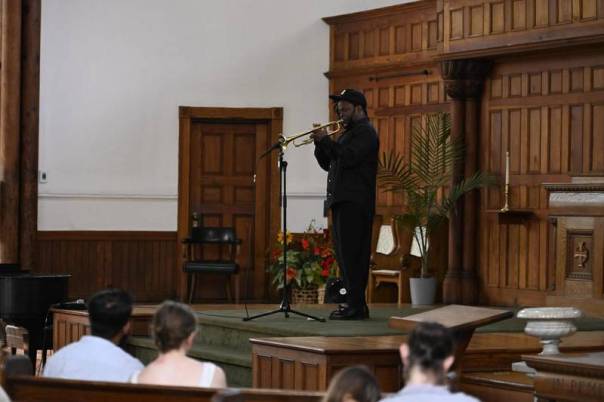
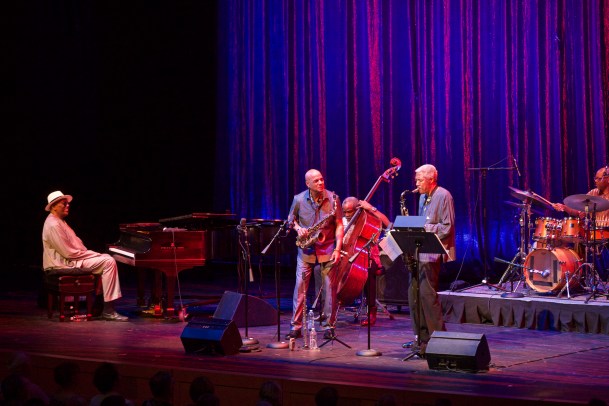
My own jazz feast started on Day 5 of the festival with Golub’s quintet, his final program at the Circular Congregational Church. My fondest memory of the Circular dates back to 1997 when Spoleto’s production of Benjamin Britten’s moody Curlew River was staged there in dim gilded light. As a jazz venue, the Church was most unkind to Golub’s piano, which seemed to emerge from its corner as a somewhat muffled echo, though the bandleader’s perch was fortified with a Rhodes synthesizer. Neither Alec Goldfarb’s electric guitar nor Daniel Hass’s cello was spooked by the hall’s acoustics, and the remainder of the rhythm, Sam Minaie’s bass and Adriano Vicentino’s drums, may have actually been enhanced.

The quintet played Golub’s Abiding Memory Suite in its entirety, with Vicentino as the only newcomer to the ensemble that recorded the studio album released in 2024. Once the piece, played without significant pauses, drifted away from the piano, it proved to be nicely varied and unpredictable. After Goldfarb’s guitar pierced the hall with its ethereally thin and silvery timbre in “Threads Gather,” the oddest, most scattered and modernistic episodes, “A Regrouping” and “Unspooled (Waiting Quietly),” cast a quiescent spell. “In a Secret Corner” carried that irregular flow forward, building gradually before breaking back into metrical jazz. Though he played provocatively in spots, Hass seemed underemployed until late in in the suite, when he at last justified his presence with some memorable solo work in “At the 11th Hour.”

It was fascinating to see and hear various configurations of the Spoleto Festival USA Orchestra throughout our 12-night stay. Massenet’s Thaïs, a Mozart symphony, Britten’s The Turn of the Screw, the Sibelius Violin Concerto, and Cécile McLorin Salvant each had a uniquely configured ensemble – led by three different conductors. It was a bit surprising for me, nonetheless, that the ensemble playing behind Alexi Kenney in the Sibelius underperformed compared with the superb support Salvant received three nights earlier in the same hall, Gaillard Center.

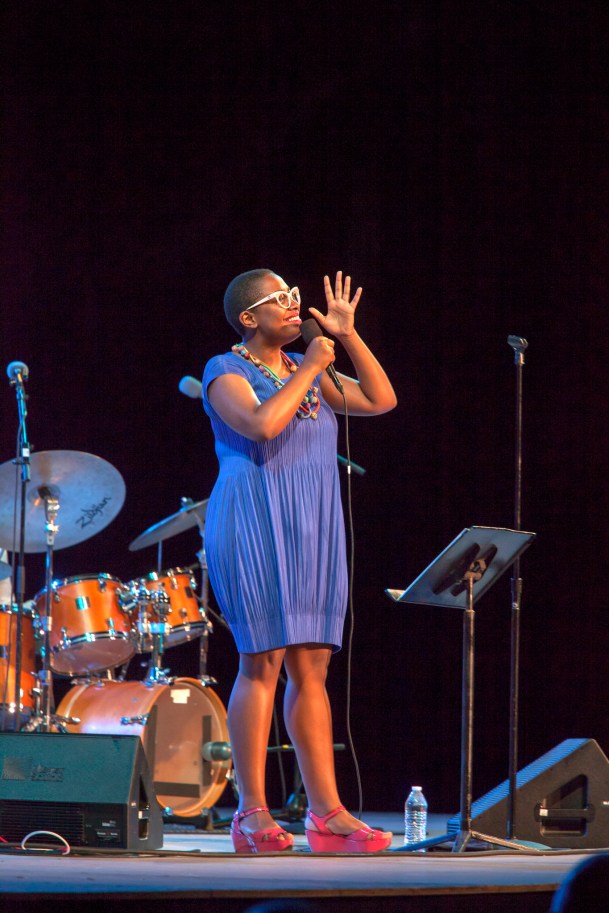
There was a sense, after three previous appearances at Spoleto, that both the festival and Salvant were wanting to try something different and reach higher. And until the festival premiered its production of The Turn of the Screw, Salvant was incontestably the highlight. We haven’t seen a new album from Salvant in two years, but none of Darcy James Argue’s orchestral arrangements were from that mostly French Mélusine release. Neither of the songs in the set that the diva has recorded, her own “Left Over” and Noël Coward’s “Mad About the Boy,” had orchestral arrangements before Salvant brought them to Charleston, and she sat down at the piano to replace the esteemed Sullivan Fortner (cover boy on the February 2025 issue of DownBeat) for her own original.

The highlights of the set were Salvant and Argue’s fresh takes on Duke Ellington’s “Sophisticated Lady” and Billy Strayhorn’s “Lush Life,” perhaps their most beloved ballads. But the audience showed even more enthusiasm for Stephen Sondheim’s “Send in the Clowns” and Michel Legrand’s “I Will Wait for You” from The Umbrellas of Cherbourg. With a disdain that would have pleased Parisians, Salvant sang the original French lyrics, “Je ne pourrai jamais vivre sans toi,” without a single interpolation of the English lyric. Salvant’s “Send in the Clowns” reminded us of the quirkiness that charmed the world from the outset of her career, flouting the usual 3/4 groove, speak-singing some of the familiar lyric, and wiping away some of the usual nostalgia and sentimental goo. Best version I’ve heard since Carmen McRae.

Naturally enough, since Branford Marsalis was on the May cover of DownBeat, he and his quartet surely do have a new album out there to tour with, Belonging. Marsalis didn’t lean on the recent release as heavily as Golub leaned on his, but he certainly referenced his magazine celebrity with the two titles he did pluck from that CD, “’Long as You Know You’re Living Yours” and “Blossom.” Both were Keith Jarrett compositions, chiming well with the front page May headline, “Marsalis Tackles Keith Jarrett.”

Branford was pretty cool as a bandleader, usually slipping away after his soprano or tenor sax solos were done – often abruptly – behind Justin Faulkner and his drumkit when others were soloing. Pianist Joey Calderazzo not only had ample chances to shine in the Jarrett pieces, but he also had two of his compositions, “The Mighty Sword” and “Conversation Among the Ruins,” prominently featured on the setlist.

With past stints jammin’ with Sting and leading The Tonight Show band, it would appear Branford’s appetite for celebrity has long since been satisfied. Bassist Eric Revis also got some love when Marsalis called for his “Nilaste” toward the end of the concert. Lighter gems – and more popular with the Charleston Music Hall crowd – were Jimmy McHugh’s “On the Sunny Side of the Street” and the rousing encore, “My Bucket’s Got a Hole in It” (more likely by Buddy Bolden or Clarence Williams than Hank Williams).

Iyer took over Sottile Theatre with his supertrio two nights after Marsalis. Like Iyer, bassist Linda May Han Oh and drummer Tyshawn Sorey (a fellow MacArthur Fellow) had both headlined at Spoleto in past festivals. As a group, they’ve put out two albums in the past four years, but in live performance, it was hard to see them as close-knit. Whether they wished to simulate a recording studio ambiance or someone in the group wished to remain unmasked despite COVID fears is anyone’s guess. But they sat and stood at more than the customary distance away from each other. When I last saw Iyer play at the Jazz Standard in New York, my wife Sue and I were seated closer to Iyer than either Sorey or Oh.

Despite the trio’s separation, their chemistry and interaction were all the more amazing. Each appeared to be in his or her own world, yet they were constantly interconnected. If one of them was not playing, he or she seemed to have peeled off at a predetermined or spontaneously signaled moment. Intensity didn’t wane in those moments when balances shifted among the players. Sorey could assert himself with a single stroke anywhere in a measure and take complete control with a sudden flurry, endlessly inventive and colorful. Oh showed us once and for all that she is a composer/improviser who can easily hold her own in the presence of two major virtuoso composers – even though her bass didn’t penetrate at the Sottile like it does on the trio’s recent Compassion recording, where it’s as intimate as your heartbeat.

As for Iyer, he once again proved nonpareil. In the space of a single piece or solo, he could build to the epic force of McCoy Tyner, jet through that thunderous cloud he and Sorey stirred up, and emerge with all the purposefulness, lyricism, and freedom from mannerism of Bill Evans. “Overjoyed,” a very inventive and angular cover of Stevie Wonder’s tune, was probably the easiest for newcomers to Iyer’s music to latch onto. The “Free Spirits/Drummer’s Song” pairing was far more exciting for me because Sorey was so much sparer, explosive, and creative than he was on the Compassion track. Other trios might have swung harder, but since the great Evans trios, none I’ve heard was more beautiful or compelling.

Since I had seen him live at the Seixal Jazz Festival in Portugal with his quartet less than three years earlier, Akinmusire’s residency was by far the most intriguing for me. But we had to find out what “An Evening with Isaac Mizrahi” was all about – the festival brochure and program book seemed to imply that Mizrahi was everything – so we had to miss out on Akinmusire’s quartet and trio concerts, both of which overlapped. It was especially brutal for me not to attend what would have been my first jazz concerts at Dock Street Theatre after more than 30 years of attending Spoleto, but Sue’s reactions to the giddy Mizrahi and the cutting-edge trumpeter vindicated my choice.

Akinmusire’s gig at the Sottile, our last event in the Holy City this year, was likely the most unique and accessible of his residency, though I’m still bemoaning my lost opportunity to behold an Akinmusire-Fortner-Sorey trio at the Dock. The nine performers in the Honey from a Winter’s Stone concert, including the PUBLIQuartet and vocalist Kokayi, were spread out across the Sottile stage even more widely than the Iyer Trio. Boundaries between what was written by Akinmusire for the string quartet and what was improvised by his quartet were more distinct, but it seemed like Kokayi’s rap rants, rhythmic and melodically on key, straddled those boundaries as the speed of the spewed verbiage increased. Most infectious rap performance I’ve ever experienced, even though most of the words weren’t clear.

Reggie Washington on electric bass and Justin Brown on drums counterbalanced the strings and Kokayi by sticking to their jazz rhythms, but keyboardist Sam Harris brought an acoustic and an electric instrument to the stage, another straddler. Through the course of the evening, as the group traversed their 2025 honey from a winter’s stone recording – with nearly identical personnel – Harris might lay down a vamp on his synthesizer or trigger a modulating drone as frequently as he soloed. Generous space was also set aside for Brown’s thrashings.

Akinmusire had little to say between selections, usually pointing to and naming one of his bandmates, but his horn said plenty, with judicious electronic alterations here and there. You could argue that Akinmusire had somehow synthesized the earliest electronic explorations of Bitches Brew Miles Davis with the two acoustic periods that preceded that revolution, the Kind of Blue period and Davis’s playing with the quintet he led that introduced Herbie Hancock and Wayne Shorter to the universe. But the living trumpeter is undoubtedly building upon that legacy.
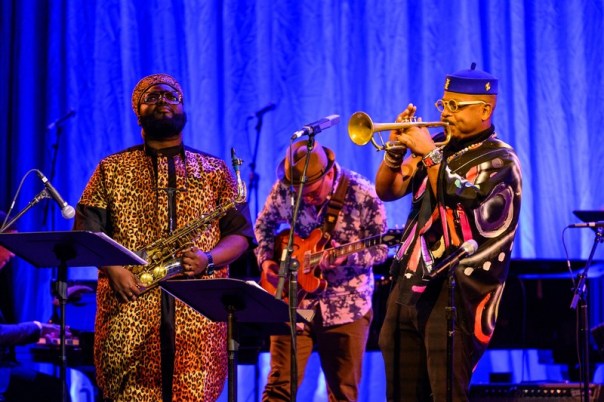
None of this year’s jazz events took place outdoors at Cistern Yard, the temple of Spoleto jazz in years gone by. Like last year, when Trombone Shorty had to move his show to the College of Charleston’s TD Arena, weather intervened between us and seeing Etienne Charles and his Gullah Roots band under the live oaks. By now, such last-minute schedule switches are almost routine at the festival: the sound system is tight and the lurid outdoor lighting arrives somewhat intact. Charles’s show was not quite as rambunctious or gaudy as Shorty’s extravaganza had been, but his suite – soon to be officially released on CD – was far more profound, moving, and relevant.

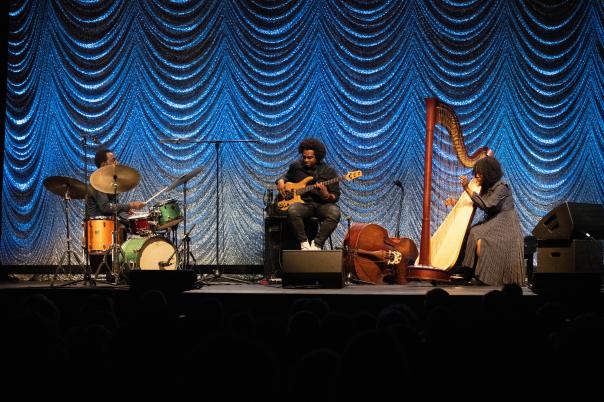
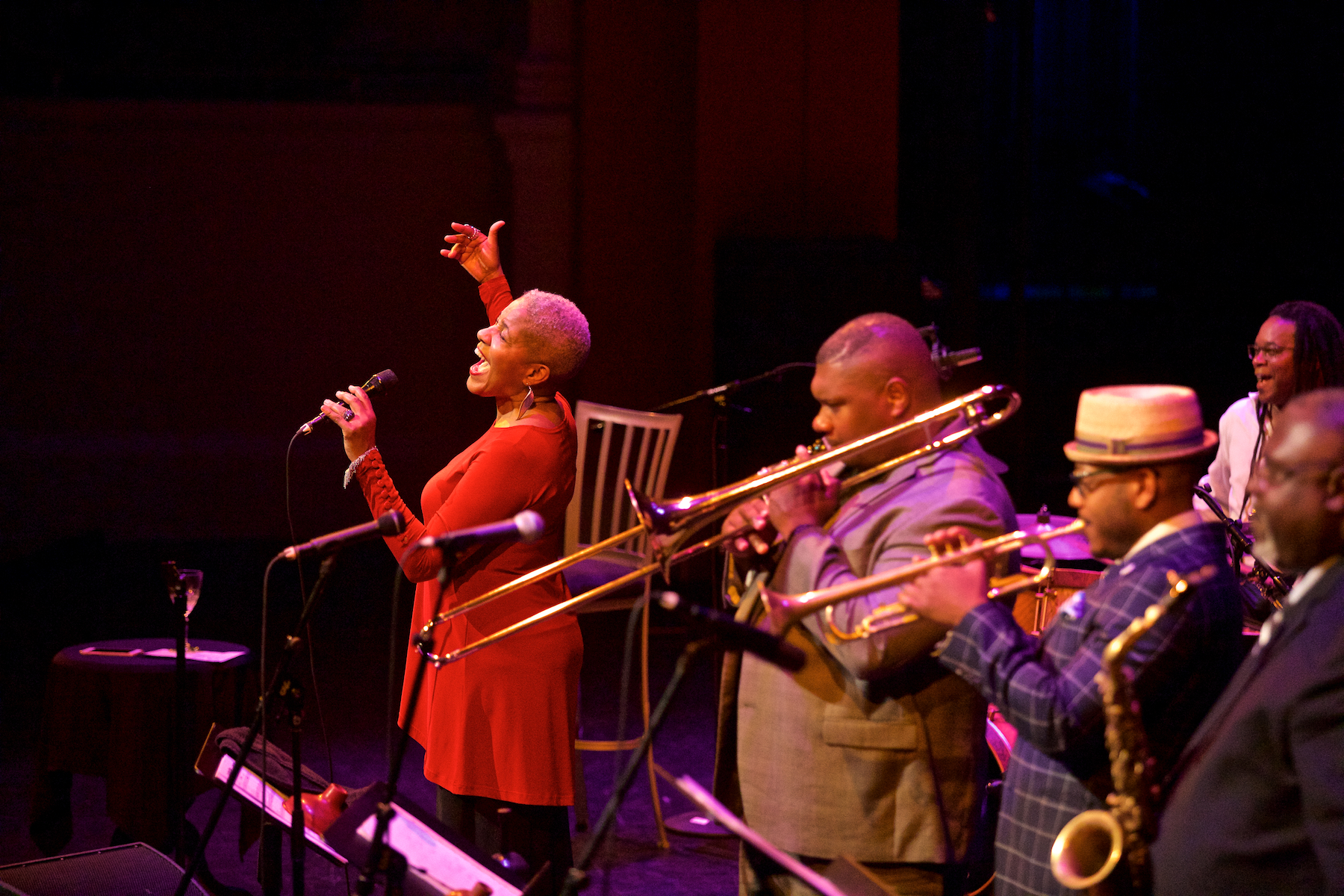
Nor was there any lack of showmanship in the presentation of this epical suite, which traversed the arrival of the Gullah in the New World via the Middle Passage to the morning when Lincoln’s Emancipation Proclamation took effect. In three stages, the Gullah Roots ensemble grew from six to seven, seven to eight, and eight to 14 as the massiveness of Charles’s concept enlarged. Those two historical watersheds were both marked with two-part compositions, “Igbo Landing” and “Watch Night.” After the foundational “Gullah Roots” piece, special guest Quentin Baxter, a longtime Charleston-and-Spoleto fixture, joined the group as a second percussionist for the dramatic “Landing.” Later for “Bilali,” Samir LaGus came forth in more striking African garb than we had seen before, bringing with him a guembri, a three-stringed lute-like instrument that merited its own introduction from Charles.

For “Watch Night,” taking us back to New Year’s Eve on December 31, 1862, a four-woman choir (The Wives), vocal soloist Quiana Parker, and organist/choir conductor Damian Sneed joined the solemn vigil and ultimate jubilation. Visually the spectacle was as grand as the music as Sneed and his singers filled the side of the stage opposite LaGus and the percussion. Issued on September 22, the iconic Proclamation would become law at midnight, the beginning of Freedom Day. One day after Juneteenth 2025, Charles brought his Gullah Roots to the Stage Door at Blumenthal Center for what promised to be a very special Jazz Room concert presented by JazzArts Charlotte.

Living Legends and Young Lionesses Featured in Spoleto Festival USA Jazz Lineup

Review: Brandee Younger, Henry Threadgill Zooid, Immanuel Wilkins Quartet, and Abdullah Ibrahim & Ekaya at Spoleto Festival USA

By Perry Tannenbaum

Respect for the elders in this year’s Spoleto Festival USA jazz lineup was gracefully counterbalanced by a hearty welcome to newer generations. It only felt fleetingly like the closing of the book on a previous era when South Africa’s iconic pianist-composer Abdullah Ibrahim returned to Charleston, one of the last – if not the very last – headliners booked for the canceled 2020 festival to make his belated post-pandemic appearance.

Henry Threadgill, the NEA Jazz Master and 2016 Pulitzer Prize winner for his In for a Penny, In for a Pound, was the other esteemed elder in the lineup, making his overdue debut at Spoleto. Festival jazz curator Larry Blumenfeld, who would have interviewed Ibrahim in 2020, had no difficulty shifting his Jazz Talks events – and venues – to Threadgill at the Riviera Theatre and harpist Brandee Younger at Queen Street Playhouse, two halls that had never been in play at Spoleto before.

Younger was announced as a substitution (for Courtney Bryan) just three weeks before Spoleto opened on May 26, adding to the luster of Blumenfeld’s agility – as a producer and as an interviewer. Other young lions and lionesses in the lineup included Charleston native Quentin Baxter, Kris Davis Diatom Ribbons, and the Immanuel Wilkins Quartet.

Ibrahim, absent from the festival for an epic 25 years, may have carved the largest arc of departure and return in Spoleto history, but others in the lineup had links with past festivals. Baxter appeared with Ranky Tanky in 2018 and as a concert host in other years, Diatom Ribbons included guitarist Julian Lage (2010) and NEA Master Terri Lyne Carrington (2019), and Younger was a gleaming feature of last year’s Universal Consciousness, Ravi Coltrane’s stunning tribute to his mom, Alice Coltrane.

Rashaan Carter, Younger’s bassist, was also a holdover from Ravi’s tribute – and so, almost inevitably, were additional nods to Alice Coltrane in a well-chosen pair of compositions. The first of these, “Ghost Trane” from Coltrane’s Monastic Trio album of 1968, set a nifty precedent for the second nod to follow, “Turiya and Ramakrishna” from the imposing Ptah, The El Daoud release of 1970. Both were recorded by Coltrane on piano rather than behind her iconic harp, expelling any taint of imitation from Younger’s performances.

If you ever thought Alice couldn’t truly belong in a John Coltrane Quartet, or if you’ve thought of her strictly in terms of spirituality and ethereality, the original “Ghost Trane” track, with its groovy line and Coltrane’s finger-busting solo, will dispel your delusions. After an intro that subtly suggested the line to come, Younger made the lustrous, silky sound of her harp swing. Jumping off into her improvisations, riffing with wave after wave of invention, Younger almost dared anyone to say she is anything less than the McCoy Tyner of the harp. Yet it would be silly to pretend that any pianist could play as softly as Brandee did on her outro.

Nor would it be correct to imply that Younger allowed the sublimity of Alice Coltrane to be forgotten for long. “Love & Struggle” had a mixture of sublime Coltrane with a few flecks of soaring Carlos Santana fire, punctuated by a couple of fine Carter solos on acoustic bass. Fitfully, Younger’s harp can evoke the sound of a guitar or reverberate like a set of vibes – even within her harp timbre, she can veer away from the velvety, mesmerizing Coltrane idiom into the crisper sound Dorothy Ashby espoused.

“Unrest,” parts I and II, delivered without a pause, began with an extended meditative Younger solo before Allan Mednard, filling out the trio on drums, and Carter abruptly upshifted the tempo. Younger began comping chords behind her rhythm as Mednard steadily galloped until Carter briefly emerged as the dominant ingredient in the percolating stew, leaving space for Mednard to back away, restart, and take over with a palpitating solo. As in the previous piece, the drummer had the last word.

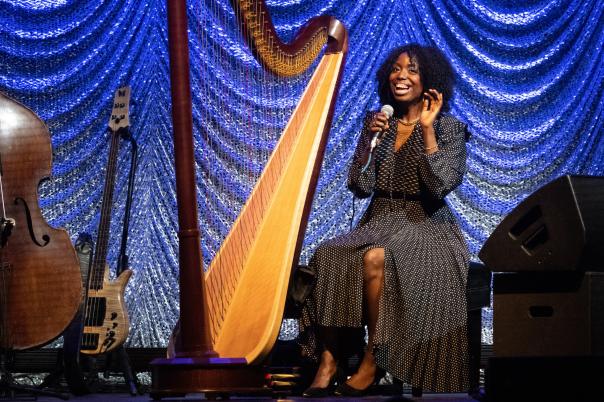
“Turiya and Ramakrishna” and “Spirit U Will” continued on this lofty plane. “Turiya” was the more exciting of the two because it revivified Coltrane’s piano version with virtuosic brio and it was the one title on this setlist that Younger hasn’t recorded. Taking us gracefully into a soft landing, Younger finished with two titles from her current Brand New Life release – a beautiful “If It’s Magic” solo that hushed the hall and a sweet trio version of “You’re a Girl for One Man Only” at a loping mid-tempo.

After Younger played Spoleto’s first jazz gig at the Queen Street, Threadgill turned a longtime theatre and dance venue, Sottile Theatre, back into a jazz hall for the first time since 2007, when Dino Saluzzi and Anja Lechner played there. Unluckily, Ibrahim was scheduled to reopen the Sottile to jazz in 2020, which would have been the largest jazz group to perform there since the Fred Hersch Ensemble, with Kurt Elling and Ralph Alessi, in 2004. Tyshawn Sorey put the classy old place into play at last year’s Spoleto in the capacity of a composer, when a concert of his classical works was performed at the Sottile in the wake of his jazz trio’s performance at TD Arena two nights earlier.

Acoustically, the idea worked well, as Threadgill and his oddly configured Zooid quintet played a set of six selections culled from releases stretching back to their This Brings Us To, Vol. 1 of 2009, plus a newborn to end the program. The lineup included, but did not overstress, Threadgill’s Pulitzer Prize winner, dipping more generously into his newer Poof outing with the group.

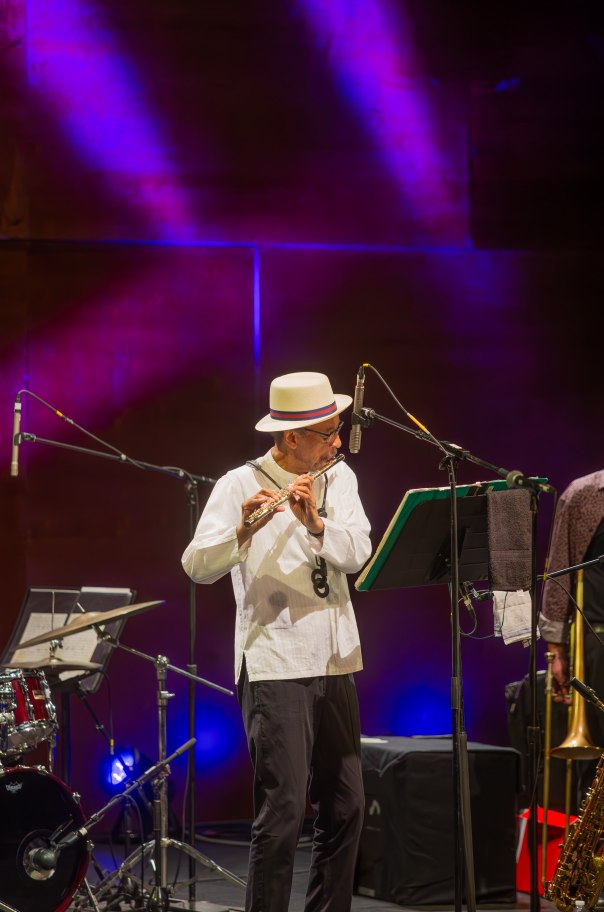
No matter how far the group hearkened back, they still looked and sounded cutting-edge, Threadgill starting out on flute for the first two compositions, “To Undertake My Corners Open” and “Beneath the Bottom,” before switching to his alto horn for “Chairmaster.” Jose Davila followed a parallel path, switching from trombone to tuba, playing the intro to “Chairmaster” over Christopher Hoffman’s cello until Threadgill entered with such rambunctiousness on alto that he briefly reminded me of Eric Dolphy. Hoffman then went into a bowed solo, further varying the sound palette.

Found more readily in a Google search than by scouring Threadgill’s discography, “Not the White Flag” was a special live treat, begun by Davila on tuba before Threadgill, Hoffman, and guitarist Liberty Ellman took a series of tasty solos. Continuing to blur the borderline between composition and improvisation, Threadgill returned with a mysteriously diffident coda.

The genial stridency of “Now and Then,” very much in an Ornette Coleman mold on Zooid’s recent Poof album, had more Hoffman cello beneath Davila’s tuba ramblings, a brief bluesy interlude in the middle, with Ellman’s guitar explorations moved to the end of the arrangement. “Off the Prompt Box” retained its astringency from the In for a Penny release with Hoffman’s bowed solo, yet it sprouted new sections before and after the cellist seized the spotlight, allowing Threadgill fresh opportunities to extemporize on alto, most notably after Chris slowed the tempo.

Threadgill’s new composition, “Fluoroscope,” was an apt closer for his Sottile set, not only affording ample space to showcase the members of the quintet but also bringing a rugged circularity to the concert. Zooid drummer Elliot Humberto Kavee, who began the concert so auspiciously with an extended solo on “Undertake My Corners” – playing his cymbals, toms, high-hat, and pedal rather than thrashing them – drew the spotlight three times in this final arrangement. Ellman and Threadgill hooked up in the final section of this impressive concert.

Starting off his five-show engagement at Queen Street, Wilkins plunged straight into a set of compositions he is readying for the studio, accessorized with some electronics that the altoist used sparingly and initially struggled with. Yet the minor difficulties never obscured the exquisite chemistry of this quartet, with Micah Thomas at the keyboard, Rick Rosato on bass, and Kweku Sumbry behind the drums. Wherever it was emanating from so softly, the synthesized vamp from Wilkins’ electronics barely intruded as he played the line and soloed on “The Big Country,” discreetly disappearing as Thomas held forth.

Detractors might have charged that the synthesized sounds interrupted the flow of music in “Apparition,” bridging the gap between the leader’s solo and the rhythm section’s takeover, while defenders might claim they personified the title. Wilkins himself seemed a bit dissatisfied, calling out to the soundbooth, and the next two numbers were acoustically sourced, mics working well though Immanuel’s monitor may have been a concern.

By shedding their electronic woes, Wilkins and the quartet reached higher altitudes with their music. Grooving into a mellow mid-tempo, “Dark Eyes Smile” was their most engaging piece so far, Wilkins introducing the line over Rosato’s bass, then sharing solo honors with Thomas before returning for the outchorus. The ascent continued to its zenith with “If That Blood Runs East,” where piano and alto harmonized on the melody before Sumbry kicked up the tempo behind the kit. Thomas mostly asserted himself afterward via a hypnotic ostinato while Wilkins soloed, ceding the spotlight back to Sumbry before re-entering for a moody landing.

“Blues Blood,” the closer, was no less exciting and even more varied, for Wilkins was emboldened to try out his electronics once more after he and Thomas had soloed. Before settling into a bluesy groove as Wilkins vamped, Thomas showed us he could swing as well, and as this winsome tune faded out, he sprinkled some gospel flavoring into his comping.

Wilkins’ engagement at Queen Street was fortuitously timed, so that he and the quartet could take in the Threadgill concert on the evening before their four-day engagement began and comfortably peep in on Ibrahim and Ekaya midway through his sojourn after his second performance. Ironically, Ibrahim’s timing turned out to be less fortunate. Bad weather prevented him from returning to Cistern Yard, one of the two festival sites where he played in 1998.

Instead, the concert was transplanted indoors to the TD Arena a couple of blocks away, where the sound is better than the lighting and the lawn seating can be faithfully replicated. Delayed by the rescheduling, Ibrahim’s arrival in the College of Charleston basketball arena was more solemn and dramatic in the dimmer light. Aside from introducing the members of Ekaya, the Zulu word for homeland, we heard little from Ibrahim, but it’s very likely that the Ekaya sextet heard – and saw – plenty of prompts from their leader.

The intricate tapestry woven by the ensemble included seven piano solos from Ibrahim, three trio performances, and six arrangements with the horns – 14 Ibrahim compositions doled out into seven music clusters – before the group returned after a feint toward the exit and covered Thelonious Monk’s “Skippy” in their encore. Most easily recognized among the Ekaya arrangements were “Tuang Guru” and “Nisa” from The Balance,the 2019 release where “Skippy” also appears.

After a trio entrance that was likely an abbreviated “Mindiff,” a chameleonic staple in Ibrahim’s discography that he has recorded in multiple forms, Cleave E. Guyton, Jr., jumped all over bassist Noah Jackson and drummer Will Terrill with his piccolo, the signature instrument of “Tuang Guru” in the studio version. Michael Pallas took a fine solo on trombone before Lance Bryant, a session mate with the rhythm section on The Balance, steered the arrangement toward solemnity with his tenor sax – and more massive scoring with the horns and piccolo.

Joshua Lee’s bodacious baritone sax solo was the most salient identifier when we segued from an Ibrahim solo, likely on “For Coltrane,” to an epic arrangement of “Nisa.” Guyton switched to flute on this piece, and there were succinct and tasty solos from Bryant and Jackson. In his ability to stamp his individuality and genius on a piece in the space of eight bars or less, Ibrahim reminded me here of Ellington in his concise regality after the tempo slowed to a stately march. Yet after the reeds and Jackson had distinguished themselves, Pallas emerged as the dominant force in this arrangement, soloing and leading the horns with his muted trombone, then opening up for a brilliant cadenza.

At age 88, Ibrahim still has impressive skills, a prodigious band, and enough venturesome spirit – and trust in his musicians – to continue tinkering with his arrangements. “Skippy” as an encore was notably different from the studio track, with Guyton switching back to flute and Jackson back to bowed cello, the weaponry they had used at the start of the concert, and without a clarinet solo from Guyton, a highlight of the 2016 Mukashi album, it was difficult to be sure where “Mississippi” occurred in the magnificent 80-minute concert.

So let’s prayerfully put it out there that four years is already too long since the most recent Ibrahim & Ekaya recording. Greedy though the request may be, we need to hear more.

Jazz Greats Brave Steamy and Stormy Weather at Spoleto

© WILLIAM STRUHS 2015

Jazz Roundup: Spoleto Festival USA

By Perry Tannenbaum

Weather veered to extremes during the first week of Spoleto Festival USA this year. Thunderstorms forced Arturo O’Farrill and the Afro Latin Jazz Orchestra to abandon the great outdoor Cistern Yard concert venue on Saturday night for another College of Charleston facility, the TD Arena. But René Marie, with a sextet that boasted Wycliffe Gordon and Etienne Charles, was untroubled by the elements the following evening as she became the first jazz headliner to perform at the totally rebuilt Gaillard Center.

By the time Randy Weston brought his African Rhythms Sextet to the Gaillard on the following Thursday, heat and humidity had risen to summertime levels, firing a shot of Africa right back at the musicians. Opening night of the 40th annual festival set the tone, as Spoleto celebrated the new Gaillard with a dazzling new production of Porgy and Bess, the Gershwin Brothers’ folk opera that has been a wellspring of inspiration for American jazz.

Spoleto~Porgy and Bess

To tell the truth, the grand new hall proved to be better suited to amplified jazz than to grand opera. Alyson Cambridge, as Bess, was often unintelligible to those sitting deep in the house, and at the last two Spoleto performances of the festival, supertitles were added to combat the problem. Loudspeakers didn’t make their way into Gaillard until the second night of the festival at the 40th-Season Celebration Concert. Marie appeared briefly, singing two arias from Heiner Goebbels’ Surrogate Cities (originally presented at the 1999 festival), and it was obvious that the amplified acoustics would be marvelous the following evening.

From the outset, so was Marie, beginning with “Be the Change,” a powerful song that she wrote as a tribute to the victims of last year’s shootings at the Emanuel A.M.E. Church – across the street from the Gaillard. Inspired by her father, Lester, “The South Is Mine” was nearly as apropos for the occasion. While all the songs that followed were from her new The Sound of Red album, when she arrived at “Blessings,” Marie turned her original song into another opportunity to offer her love to Charleston.

© WILLIAM STRUHS 2015

All the songs on the program were, in fact, Marie originals, but the headliner gave her distinguished sidemen and her working trio ample space to shine. Though unacknowledged in the Festival’s prepublicity – or its lavish program book – altoist Sherman Irby was certainly a force to be reckoned with among the soloists, taking two spots in the arresting opener. Focus shifted to Charles and Gordon in “The South,” the trumpeter muted before the trombonist worked his customary magic with his plunger.

“Lost,” a musical portrait of Marie’s sister, and “If You Were Mine” narrowed the focus to Marie and her working trio, particularly pianist John Chin and bassist Elias Bailey, who both soloed admirably. Somewhat abbreviated compared with the album versions, both of Marie’s vocal performances were epic – delivering all of the scat and “Battle Hymn of the Republic” pyrotechnics from “Lost” (minus the drums) and more edge on the conversational parts of “Mine.”

Time borrowed from these arrangements was added onto a far more lavish version of “Colorado River Song” as the concert slipped into a more relaxed groove. Everybody chipped in solo spots, including drummer Quentin Baxter, who traded 4’s with all the horns after their solos. Marie herself replaced the recorded whistling chorus with a healthy helping of scat before the blowing began. “Blessings” sounds like a pop anthem on the new CD and retained its kinship with Dylan’s “Forever Young” in live performance but with a more fervid sanctified flavor as the horns joined in.

Chin, Gordon, Irby, and Charles all took tasty solos in the concluding “Joy of Jazz,” adding new fire to the piece and transforming the celebratory dance of the studio version into an exuberantly dancing celebration. People who are listening to The Sound of Red as it gets increasing airplay are getting the flavor of Marie’s new compositions, but at the Spoleto concert, we heard their power.

Marie was performing for the fourth time at Spoleto in the past 10 seasons, having already achieved Gaillard prestige at the old Auditorium back in 2009, but Weston appeared at the Gaillard for the first time this season, returning to the festival 35 years after his 1981 debut at Cistern Yard, where he and his sextet shared the bill with Taj Mahal. Weston’s return was a doubly auspicious occasion, since no purely instrumental jazz combo had headlined at the Gaillard since 1996-98, when Sonny Rollins, Ahmad Jamal, and George Shearing performed in successive years.

© WILLIAM STRUHS 2015

While the name was slightly different from the Randy Weston & African Rhythms with Billy Harper group that I saw at Dizzy’s Club Coca-Cola in 2011, the personnel were nearly the same, omitting only trombonist Robert Trowers. The one common thread running through the two sets was Weston’s “Blue Moses,” aptly referencing the 1972 album with that title, a more exotic release than other CTI recordings of that era. With Neil Clarke on African percussion, Lewis Nash on drums, and T.K. Blue occasionally on flute, the soundscape vividly echoes what Airto, Weston’s son Azzedin, and Hubert Laws etched so memorably into vinyl.

The ensemble seemed grander, more seasoned, and more African at the Gaillard than they had at Columbus Circle. On “Moses,” where Blue had soloed on soprano sax in New York, he now played flute over Harper’s tenor before breaking into his solo, heavily flavored with “Wade in the Water.” After Harper wailed, Clarke went to work slapping his African drums with answering claps from the audience cued by bassist Alex Blake. Then Blake, as he is so prone to do, upstaged everyone with his rich soloing, zestfully plucking and slapping and pouring out vocalese as he had done on two previous tunes. But the delight of it hadn’t worn thin.

As for Weston, he contented himself with long ruminative intro to “Moses” that nearly had me in tears before we finally arrived at the melody. The man has just passed 90, and he still plays marvelously well. He drew a direct connection between his African music and the sounds of nature, so in that respect the opening piece, “The Healer,” was the most successful of the night, culminating in group improv that conjured up a rainforest with Blue’s flute providing a glint of sunlight and birdsong. Weston led it off with a moody intro followed by Blake and his percussive work on bass. Flute and tenor layered on before Harper established his sax as king of this jungle.

© WILLIAM STRUHS 2015

“African Sunrise,” one several African Weston titles that is now 60 years old, still sounds pristine, though Blue’s alto solo hasn’t stopped quoting “Manteca” and other Gillespiana heard on Weston’s live 2010 Storyteller album. Weston’s outro, over Blake’s scatting bass, was a fresh wrinkle. “Little Niles” sounded surprisingly raw, Harper’s tenor and Blue’s alto screaming back and forth at each other, more agonized than waltzing – perhaps because, as Weston mentioned in his preface, he had outlived the son it was written for. The closer, “Niger Mambo,” brought more focus to Weston’s muscular playing but really served as a belated showcase for Nash, equally impressive with sticks and brushes.

While the Gaillard reconstruction was going on through the past three festivals, Marie, Béla Fleck, and Angelique Kidjo were among the performers who proved that TD Arena was a serviceable music venue. But longtime festivalgoers had to wonder whether we would return to the thrilling days of yesteryear when the old Gaillard served as the backup for outdoor concerts at the Cistern when they were forced to seek shelter from springtime storms. Ticketholders for O’Farrill’s concert were informed by email more than eight hours in advance that the concert had been moved to TD. With just one other Spoleto event scheduled at the basketball arena during the entire festival, the concert would not have to be delayed as usually happened at the Gaillard.

Leading from a keyboard or from behind a centerstage mic where he also introduced tunes, O’Farrill brought a brassy 17-piece band with him, including four trombones, four trumpets, and five saxes. Brash music that moved restlessly through Latin and South America, the first two-thirds of the set list came from the three Afro Latin Jazz Orchestra albums released over the past five years, beginning with “Rumba Urbana” from the 40 Acres and a Burro compilation of 2011 and zigzagging afterwards between that album, The Offense of the Drum (2014) and Cuba: The Conversation Continues (2015).

“On the Corner of Malecón and Bourbon” was the most exciting and majestic of the arrangements, shuttling from ragtime to Latin to “St. James Infirmary” on an epic path blazed by multiple piano and baritone sax spots, blaring brass ensembles, a four-trumpet free-for-all, and a bowed bass solo. “Guajira Simple” offered a greater variety of moods as O’Farrill played a dreamy intro as the stage lights were dimmed, with trombone, soprano sax and trumpet layering on as the bandleader quickened the tempo. Then came a quiet interlude as Ivan Renta soloed soulfully on tenor, followed by Bobby Porcelli on flute before O’Farrill triggered a huge orchestral build from the keyboard.

Like Marie and Weston, O’Farrill had a message for Charleston, only it wasn’t consolation for murdered churchgoers or a benison of nature and healing. After he and his band rocked the house with Emilio Solla’s “Llegará, Llegará, Llegará,” O’Farrill strode up to the microphone and declared that he was a proud Mexican American – and not a rapist, a murderer, or a drug dealer. To make sure that the target of his remarks was not misunderstood, O’Farrill apologized in advance for his language in advance and announced that the title of the next piece would be “Trump, Fuck Trump.”

Not surprisingly in South Carolina, one of the states that The Donald won during the Republican primaries, more than a couple of people responded by walking out amid the general approval for what O’Farrill was saying. There were some purposeful anti-musical moments in the composition, to be sure – and a brief, pitch-perfect Trump impersonation by trumpeter Seneca Black, judiciously (and cryptically) limited to a single word: “China!” After this memorable episode, the concert ended with “Obsesion,” with Rafi Malkiel offering the last of his fine trombone solos and tenor saxophonist Chad Lefkowitz-Brown, heretofore anonymous, getting a chance to shine.

Spoleto~Cécile McLorin Salvant_Julia Lynn Photography

Time seems to stand still when Cécile McLorin Salvant comes to sing with her tight trio. You can listen to Salvant’s lightly dramatized versions of “The Trolley Song” or “Wives and Lovers” and imagine that she is subverting their archaic attitudes with a subtle feminist archness. Or you could just as easily conclude that she’s wholeheartedly immersing herself in Judy Garland’s pop Cinderella or Burt Bacharach’s domesticated Barbi.

Fortunately, there always seems to be a modicum of restlessness in the way Salvant selects her material. While I’ve heard her treatments of Bob Dorough’s “Nothing Like You,” Leonard Bernstein’s “Something’s Coming,” and her own original “Fog” before, it was interesting to see that Salvant’s new excavations include “Somehow I Never Could Believe.” Introduced as an aria from Kurt Weill’s 1947 Street Scene, Salvant transformed the Langston Hughes lyric into an urban odyssey.

“What’s the Matter Now?” swiped from the Bessie Smith songbook had some of the friskiness Salvant fans crave, with a tasty solo from bassist Paul Sikivie that far outshone his work on “So in Love” and a splashy solo from pianist Aaron Diehl that nicely set up Salvant’s honky-tonk reprise and his own outro. “Wild Women Don’t Have the Blues” offered much of the same earlier in the set, but there was never a fully seismic Salvant eruption of “Growlin’ Dan” or “You Bring Out the Savage in Me” proportions, if that was among your expectations.

No, Salvant’s lava flow was relatively under control this time with titles like “I Get a Kick Out of You” and “Wild Is Love” on the set list. Lawrence Leathers never really had the opportunity to stand out on his own on drums, but he mixed it up tellingly on “I Get a Kick” and “Something’s Coming.” What Diehl and Leathers did on “The Trolley Song” was more of a marvel than a mere accompaniment, for their intro and their interjections became part of the storytelling ride.

You probably heard about Jason Moran’s All Rise tribute to Fats Waller a couple of years back, but that CD was actually the studio version of a live event that Moran had conceived for the Harlem Stage Gatehouse in 2011. The event, a Fats Waller Dance Party, features Moran at both acoustic and Fender Rhodes pianos, often wearing a huge papier-mâché mask created by Didier Civil as he plays. Moran has taken the event all over the country, and the amount of dancing and partying that he, his combo, his dancers, and his vocalists have been able to spark has varied from city to city.

High humidity persisted at Spoleto into its second weekend, and the temperature still hovered above 80°F for Moran’s Cistern Yard concert. So I was not at all eager to rise from my seat and dance, no matter how heartily vocalist Lisa E. Harris or trumpeter Donvonte McCoy urged us on. Most of the audience shared my disinclination, Moran himself frequently couldn’t take the heat under his mask, and even the ebullient Harris removed her chapeau for a spell of relief.

Spoleto~Jason Moran_Julia Lynn Photography

How much you might have liked this Waller Party – and how much I tended to dislike it – can be sampled by streaming the “Honeysuckle Rose” and “Ain’t Misbehavin’” tracks from All Rise. I’m not on board with thinking these are inspired re-imaginings of Waller’s music befitting a MacArthur genius. They strike me as listless, simplified, bridge-averse descents into stultifying Motown doo-wop. Above this norm, “Yacht Club Swing” and “I Found a New Baby” had genuine spark; and Moran’s newer additions, his original “Fat Lick” and a Wallerized version of Ornette Coleman’s “Lonely Woman,” won me over.

But while “Honeysuckle” and “Misbehavin’” may indeed fulfill Moran’s “joyful elegy” concept for some, I couldn’t find a flicker of mirth in the lugubrious dirge that Harris made out of “Ain’t Nobody’s Business.” Compounding my frustrations with Harris, trumpeter McCoy not only looked a lot like Waller, he sounded like him as well in his only vocal on “Two Sleepy People.” More McCoy would have meant more Waller at the party.

The pluses didn’t end there for those of us susceptible to the precocity of 12-year-olds. Right before “Yacht Club Swing,” Moran introduced his twin sons, Malcolm and Jonas, saying he had only recently witnessed the results of their tutelage at the Alvin Ailey School. Whether or not the lithe moves they proceeded to cut were part of the Ailey curriculum, they certainly added youthful energy to Moran’s fitfully eventful vamp. But party lift-off didn’t occur until the unexpected invasion of cast members from Grace Notes, a curious blend of music, poetry, and dance that had premiered earlier in the evening a block away.

Dancers from that production streamed onto the stage during “The Joint Is Jumpin’,” not only dancing with Harris and the Moran twins but also forming a whirling dance circle around the musicians. Topping off the invasion, trombonist Craig Harris, part of the Grace Notes jazz band, came up onstage and soloed with righteous conviction. While this explosion didn’t turn the tide out in the audience, a substantial number of people migrated off to the side of the stage and turned it into a dance floor – once the funereal “Ain’t Nobody’s Business” was done – proof that Moran’s brand of Waller was connecting with younger listeners.

Spoleto~Bohemian Trio2_Julia Lynn Photography

While shuttling back and forth between Africa and Latin America for his wondrous Grammy-nominated New Throned King music, saxophonist-composer Yosvany Terry was also on an alternate path. His Bohemian Trio was formed at about the same time that the Afro-Latin album was in production, with Cuban-born pianist Orlando Alonso and Franco-American cellist Yves Dharamraj. The music they play isn’t as exuberant or raucous as the tracks on New Throned King, calmer for its classical and European elements, so the intimate Simons Center Recital Hall was a more fitting place for them to perform than the Cistern or the Gaillard.

The eclecticism of the trio’s approach was evident from the outset as Terry on alto sax, Dharamraj, and Alonso brought out the classical flavor in the fugue-like opening of Pedro Giraudo’s “Push Gift.” Past the midpoint of this arrangement, Terry broke through its formality with an extended solo. Giraudo was a composer who might naturally be expected to be represented in a Terry concert, but the next two offerings took us to works by André Previn and Sonia Jacobsen.

The Trio’s performance of “White Raven” from Jacobsen’s Fables Macabres was a radical transformation, turning an orchestral piece with strings into chamber music, with Terry once again taking charge in the middle. Playing the fifth prelude from Previn’s “The Invisible Drummer,” Alonso may not have played on the piece but he surely played with it, making the “invisible” drumming quite audible with his insistent pounding. That repurposed prelude became an introduction for Terry’s original, “Punto Cubano de Domingo,” where cello and soprano sax launched the piece in canonical fashion and both Terry and Dharamraj took solos.

Compositions in the latter part of the program didn’t drift away from the Western Hemisphere, with second helpings of works by Terry and Argentinian bandleader Giraudo, plus an additional dose of Argentina from Emilio Solla. The Bohemian version of Solla’s “Llegará, Llegará, Llegará” didn’t have the epic build of the composer’s recent Second Half album (or the firepower of O’Farrill’s cover at the Cistern), but it was a fine showcase for Alonso, whose piano solo revealed definite Chick Corea inclinations with Terry backing up on chékere.

Terry’s sound is most distinctive on soprano, and “Tarde en La Lisa” was the best example of the exuberance and plenitude of his ideas. Alonso’s backing had steely force as the composer played the line, a perfect launch pad for the soprano rant that followed. Then the piano was an island of calm, setting us up for a full round of vigorous Bohemian solos before Terry circled back to the melody. “Hiroshima,” the placid finale on the Giraudo Jazz Orchestra’s 2009 El Viaje release, was not radically altered at all as the Bohemians’ valedictory. Dharamraj eloquently played the line before Alonso and Terry, still on soprano, paid their soulful, subdued respects.

© WILLIAM STRUHS 2015

Yielding in seniority at this Spoleto only to Weston, Freddy Cole and his quartet still sounded fresh although the leader is nearing 85. Cole’s voice isn’t as rich and rounded as it was when he cut his first album in 1964, but there are still moments when he sounds like his elder brother Nat in his prime. Thanks to the exploits of guitarist Randy Napoleon, there are also moments when the new quartet sounds instrumentally like the vintage King Cole Trio of the 1940’s, for little brother can still solo deliciously at the keyboard.

Although Cole’s set list included a healthy number of familiar titles, they weren’t necessarily those you’d expect: “Cottage for Sale,” “Love Walked In,” and “Easy to Remember” slipped in with the more predictable “Pretend,” “Route 66,” and “L-O-V-E.” Before we reconnected with these songs, Cole walked us down less-trodden paths, beginning with “Wonder Why” and continuing with “Where Can I Go Without You?” “A Lovely Way to Spend an Evening,” and “How Little We Know.”

Even when Cole began stirring up old memories, there were rarer gems mixed in, “I Just Found Out About Love” after “Pretend,” then “Maybe It’s Because” and “To the Ends of the Earth” after “Route 66.” Cole sings with such simplicity and assurance that the rather bland Simons space was transformed into a moody nightclub as he performed. With solos by Napoleon on 11 of the 13 tunes – and occasionally two on a single arrangement – to go along with six piano solos from the leader, it seemed like there was all the time in the world for each song, old or new, to etch its way into memory.

There seemed to be no end to the number of familiar and unfamiliar songs Cole knew and could effortlessly sing – with a familiarity that reached their depths, along with a hip swing that must be a family heirloom. Under Cole’s spell, the old songs seemed as new as the ones I’d never heard. Getting acquainted with the Jimmy Van Heusen lyrics for “How Little We Know,” where “two tingles intermingle” and we find “how ignorant bliss is,” was like a first visit to a garden of delight.