Tag Archives: Nick Southwick

“Violet” Comes from Country in a Musical Teeming with Blues and Gospel

Review: Violet at Theatre Charlotte
By Perry Tannenbaum

So here’s something we’ve learned over the past month on the Charlotte theatre scene. There are two schools of thought on how to portray a horrifically scarred woman onstage. Back in late February, Carolina Actors Studio Theatre took the cinematic approach at the original Mint Museum on Randolph, painstakingly applying makeup to their leading lady, Zoe Matney, before every performance of Alabaster, down the entire left side of her body from head to ankle.

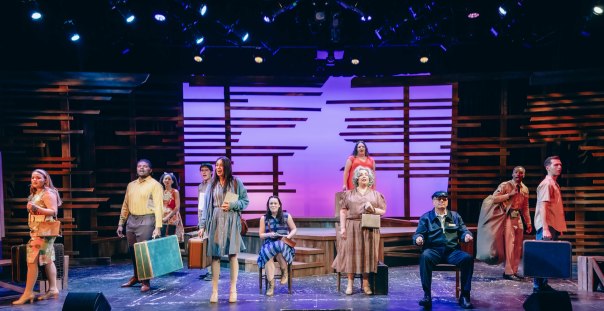
Now we have the Violet approach at Theatre Charlotte, where Destiney Wolfe stars in the title role with a hideous scar that looks more like a fine line drawn with a red ballpoint pen than a shocking horror. So it was – minus the fine red line – when Lauren Ward originated the role in 1997 on Broadway and when Sutton Foster revived it there in 2014.

Besides the risk of an Emperor’s New Clothes moment from an innocent child (“But Mommy, Violet doesn’t have any scar!”), it figures to be more effortful to watch Wolfe without the scar everybody onstage is talking about and constantly having to imagine a scar we are not seeing. That’s different from reading “The Ugliest Pilgrim” by Doris Betts, the short story that this Jeanine Tesori-Brian Crawley musical is based on.

Until the fourth page, the scar isn’t explicitly mentioned. Once the word is seen, it quickly becomes the center of the story – the reason why Violet is on a bus from Spruce Pine, NC, to Tulsa, where she ardently believes a venerated TV preacher will heal her terrible affliction. Nothing on the remaining 25 pages contradicts the image engraved in our imaginations.

Within the blissful two dimensions of a book, we don’t need to keep imagining what isn’t. Perhaps more subtly, as demonstrated by Matney’s portrayal of June in Alabaster,we can gradually get used to the disfigurement, look past it, and see the person. Along the way, we could also find plenty of relief looking at June’s unscathed side.
Notwithstanding her terrible scar and her pathetic reliance on Oral Roberts – oops, I mean the famed Oklahoma preacher – Violet is clearsighted enough to grasp her most valid reason for boarding the bus. Spruce Pine is a very small-minded town. Her elders stare at her in pity and her peers are worse, shunning her, mocking her, and pranking her.

As the saying goes, she needs to get out and meet people. Spruce Pine isn’t the place for it.

Betts had Violet saying that in a more biblical way: “Good people have nearly turned me against you, Lord. They open their mouths for the milk of human kindness and boiling oil spews out.”

Told objectively by Crawley rather than in first-person by Betts’s Violet, we see the townsfolk clearly sooner rather than judging them on a single casual quote. Scarred or not, Crawley and Betts agree on one key point: Violet is way too thin-skinned.
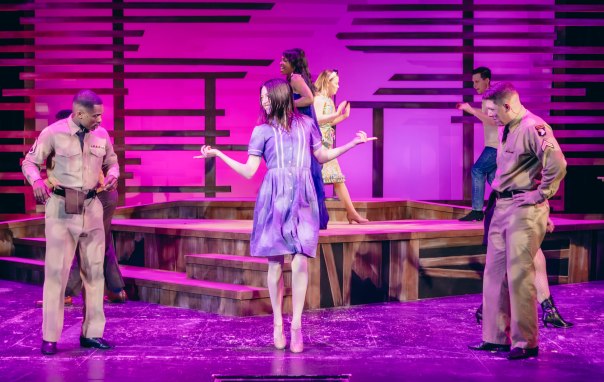
Meanwhile, reasons for dismissing Violet’s self-pity – and doubting her self-awareness – are multiplying. Before the bus reaches Arkansas, she has hooked up with two military men who are quickly captivated by her. Both of them, one black and one white, are eager to show their ardor on a stopover in Memphis, where they spend a night out together.

So the necessity of imagining that hideous scar becomes more urgent for us.

Thankfully, the Memphis sojourn allows Tessori to naturally widen her musical palette, welcoming us to the blues along with the Beale Street underbelly of town. Violet’s dream of healing and her actual Oklahoma encounters with the Preacher are welcome prompts for Tessori to branch out further into righteous, stomping, spirit-of-the-Lord gospel.

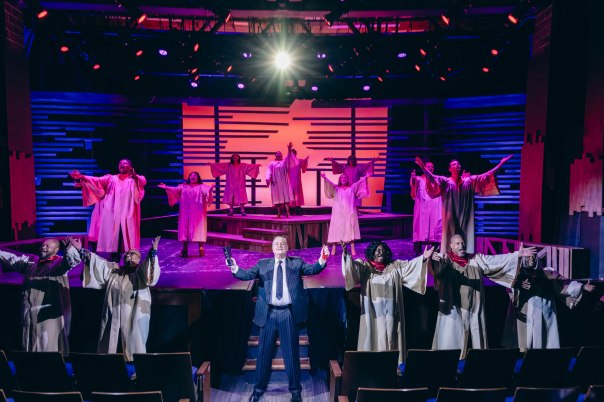
A five-piece band led from the keyboard by Danielle Barnes Hayes leaned into the gospel music at the Preacher’s revival meeting as lustily as the more countrified tunes that had gone before. Our eagerness to hear those gospel strains was certainly piqued and primed last Saturday when a seven-voice choir greeted us in the lobby of the old Queens Road Barn, accompanied by a wee electric keyboard, singing hymns and shouts for a half hour before showtime.

While director Stuart Spencer skimps on makeup design, he is deeply attuned to the material, having been part of the Davidson Community Players cast when Violet had its regional premiere in 2010. Was it a makeup job on Cassandra Howley Wood that gave me such a favorable impression of her local debut and the show? Or was it simply the intimacy of Armour Street Theatre, bridging the gap between first-person narrative and Broadway musical?

At the bus station where Violet embarks on her odyssey, at the Memphis music hall where Asley Benjamin belts a couple of songs, and at the Tulsa TV revival, a bigger stage is surely better. More space for more people and more decibels! More opportunities for lighting designer Gordon Olson to colorize costumer Sophie Carlick’s shiny robes for the Preacher’s hallelujah choir – and to add pizzazz to Sharlie Duncan’s choreography!

To their credit, neither of the soldier boys seriously believes that Violet will look any better after her Oral rendezvous in Tulsa when she reboards her Greyhound bus, heads back home to Spruce Pine, and stops off in Arkansas for another meet-up. With Sean Bryant as Flick and Ethan Vatske as Monty, the interracial relationship and rivalry between the soldiers occasionally becomes more compelling and suspenseful than Violet’s cosmetic quest.

Bryant gets the advantage of a more instructive interracial relationship between Flick and Violet. On the way to learning that her inner scars are more debilitating – and curable – than her outer ones, it’s necessary for her to appreciate that there are other, more serious skin problems in life. Beginning with pigment. In the Betts story, there’s one other huge hurdle in Violet’s spiritual growth that we don’t hear about onstage: her use of the N-word. More of Spruce Pine needs to be exorcized from her soul than she realizes.

On top of that, this thin-skinned Violet is stubborn, too. As dynamic as Wolfe’s vocals are, her adamant refusal to believe that anyone besides her daddy could love her is the most startling aspect of Violet we must encounter. We recognize this trait in people we’ve met, maybe in ourselves. Violet’s stubbornness goes so irrationally deep that it not only prolongs her path to enlightenment, it obliges Crawley to pile on a flashback recalling a cruel prank that was played on her by her schoolmates.

Counterbalancing Bryant’s shyness and vulnerability as Flick, Vatske draws the luxuries of being the more cocksure and aggressive Romeo. Just sitting down to play poker with Flick and Violet softens us up to Monty, and confident as he is, Vatske keeps us a little in suspense about with whether he’s playing with the lass or serious. The way Vatske is playing him, you’re not sure whether Monty is sure himself.

This upsized Violet is a special boon for Henk Bouhuys, who draws two plum roles, the sometimes surly, sometimes avuncular Bus Driver and the charismatic Preacher. Never mind that that the Preacher is surrounded by a fervid Gospel Choir, both in the TV flashback and in Tulsa, Bouhuys dominates the stage with his fiery motormouth exhortations.

It’s awesome enough to make his backstage powwows with this pilgrim unexpectedly tender and poignant – a quietly dazzling reality check – and allows Wolfe to enlarge upon Violet’s devotional and delusional traits.

Unfortunately, on a big musical stage, Bouhuys’s dazzle and the decadence of Memphis nightlife tend to cast the flashback scenes between Young Vi and her Father into comparatively dreary shadow. To put it bluntly, when Tessori worked with the multiple Allisons of Fun Home in 2015, she had a superior book and lyrics from Lisa Kron.

So Spencer, Abigail Sharpe as Young Vi, and Nick Southwick as her dad are doing the best they can with the weak hand they are dealt here. It’s heartwarming to see the widower dad teaching Young Vi how to play poker in order to jumpstart her math skills. “Luck of the Draw,” blending this flashback with Violet’s cardplaying triumph over Monty and Flick, puts Sharpe and Southwick to their best use.

But these flashbacks, before and after the catastrophic accident that scars Violet, are also the best reason why we never see that scar on the face of either protagonist. It would need to be applied to Young Vi during the show, a fearsome hurdle for a makeup artists and stage managers.

The script and the dumpy cardigan sweaters the Violets wear supply a wonderful way to differentiate between the two. When we first see Wolfe huddled at the bus station and boarding her bus, she looks more homeless than scarred. It’s only after dark in Memphis, when she’s escorted to the music hall by two strapping soldiers, that Wolfe tosses her cardigan aside and shows signs of full-blooded womanhood.

Miracle of miracles, she becomes flirty!

Ensley and Schroeder Check All the Beautiful Boxes in Matthews

Review: Beautiful The Carol King Musical at Matthews Playhouse

By Perry Tannenbaum

When you think of singer/songwriter Carole King and Broadway musicals, there’s an instant disconnect: the humble simplicity of King’s Tapestry album cover clashing with the glitz and blare of the Great White Way. So a Broadway musical about King’s career is more of a stylistic stretch than a biomusical about most rock stars, pop stars, or jazz & blues divas. Everyone involved behind the scenes of the original 2014 production of Beautiful The Carol King Musical seemed keenly aware of the dichotomy, including director Marc Bruni, orchestrator/arranger Steve Sidwell, and scriptwriter Douglas McGrath.

Their idea of coping with the problem was by leaning into it. Not too subtly, they conspired to make the early stages of King’s career seem crass and commercial, as if she were trapped in the dog-eat-dog maw of the pop music industry. King and her writing partner, lyricist Gerry Goffin, write the songs while producer Don Kirshner finds the singers and the groups who will cut the singles – the likes of Bobby Vee, Little Eva, The Drifters, and The Shirelles. Yet somehow the hierarchy is flipped in the famed Brill Building in NYC.

Carole and Gerry are slaving for Kirshner, a genial industry mogul and taskmaster, and the couple’s best early music loses a lot of its luster when it’s farmed out, especially when “Up on the Roof” falls into the hands of The Drifters and “Will You Still Love Me Tomorrow?” is butchered by The Shirelles, thanks to excessively ornate Sidwell arrangements that would be more at home on Broadway or Vegas than Motown. These excesses helped Jessie Mueller to shine all the more brightly in the original cast – and for her sister, Abby Mueller, to shine equally when the touring version hit the QC in April 2016.

So a downsized production, like the one currently running at Matthews Playhouse, actually has the potential to be better than the Broadway and touring versions – with the right personnel and sufficient pizzazz. With Billy Ensley directing and Lindsey Schroeder leading a heavyweight cast, both those boxes are checked. The Broadway ensemble sheds two of its three keyboards nestling into Matthews, one its two guitars, and one of its percussionists. The slimming helps. No longer smothered by their orchestrations, Neil Sedaka’s “Oh! Carol,” Gene Vincent’s “Be Bop a Lula,” and Little Eva’s “Loco-Motion” sound more like rock music and less like mockeries.

Ensley targets the megahit by the King-Goffin duo’s friendly rivals, Barry Mann and Cynthia Weil, for his most farcical treatment. Not only is the arrangement of “You’ve Lost That Lovin’ Feelin’” garishly distorted, amped up from the swampy-echoey-churchy vibe of the original single, but the gulf between the bass and tenor voices of the Righteous Brothers is greatly emphasized, exaggerated, and comically exploited by Johnny Hohenstein and Zach Linick.

McGrath’s book is most affecting when it deals directly with King, though there’s bold poetic license in his voodoo, historically speaking. Pressured by Kirshner to come up with a new hit overnight for The Shirelles (in real life, they only had one hit record so far), King writes the music and goes to bed with Goffin. Perfect setup. Wouldn’t you like to wake up in the morning and find the handwritten lyrics for “Will You Still Love Me Tomorrow” perched on your piano – and be the first person on Earth to read and sing them?

No disrespect to the great Bobby Vee, but we’ve suddenly ascended more than a few notches above “Take Good Care of My Baby.” This moment still grabs me, but there are more moments like this after intermission, when “You’ve Got a Friend” and “A Natural Woman” are unveiled, that choke me up even more – as King breaks away from the Brill Building and starts to do her own thing. Schroeder replicates the sandy sound of Carole’s voice from the beginning, but as she transforms from a demo singer behind an upright piano to a chart-topping performer, watch out.

Schroeder can not only belt – she can tear your heart out.

McGrath’s dramatization heightens the magic most memorably when “You’ve Got a Friend” is reframed as a not-quite-farewell song, when King embarks for her solo career in LA with Kirshner’s blessing, and both Barry and Cynthia gather round the old upright with her to sing this newborn masterpiece. The song didn’t really come out until her second album, but who’s counting, right?

Nick Southwick as Barry and Sophie Lanser as Cynthia (get that woman a more reliable mic!) deliver polished performances all evening long, but they also grow more gravitas after intermission. Lanser sheds the frivolity of a “Happy Days Are Here Again” parody and “He’s Sure the Boy I Love” and joins Southwick – previously mired in the silliness of “Who Put the Bomp” and the wrong-key version of “You’ve Lost That Lovin’ Feelin’ – in a heartfelt “Walking in the Rain” duet.

Then if you haven’t started weeping with Schroeder’s “It’s Too Late,” you’re at the mercy of “You’ve Got a Friend” when Lanser and Southwick join in on the quivering-lip goodbyes. After playing Kirshner with avuncular savvy throughout King’s formative years, Ryan Dunn sprinkles some welcome laughter into this maudlin scene with a (purposely) bad attempt at vocalizing.

I’d forgotten that Carole had Aretha’s 1967 hit in her hip pocket when she cut Tapestry out on the Left Coast in 1971, so I found myself suddenly suppressing sobs when “A Natural Woman” began. Here it felt very right that Sidwell’s arrangement brought added vocalists and brass to beef up the simplicity of King’s version – and freed Schroeder to narrow the gap between Carole and the Queen of Soul with some fervent belting.

Marty Wolff’s simple two-story set design, with four wide strips of stained-glass paneling running vertically upstage in front of the eight-piece band led by Ellen Robison from the keyboard, needs only JP Woodey’s lighting to give it a rockin’ modernistic zing. Lisa Blanton’s choreography is devout doo-wop, most praiseworthy for how well the groups stay in sync, and Chelsea Retalic likely cranked out between 75 and 100 costumes for this large cast – all of them, from the sleekest to the grungiest, on point.

And the wigs! The only misfire here, among dozens of triumphant coifs – several for Schroeder – was the oceanic profusion of waves that perched on Joe McCourt’s head as Gerry Goffin, making him virtually unrecognizable. McCourt, a musical mainstay in the QC since his debut in 2008 as the lead in Godspell, has suavity to spare to spare and, in contrast with Southwick’s quirky neuroses as Barry, gets a nice and bumpy character curve as the only troubled soul we see.

This image has an empty alt attribute; its file name is beautiful24-139.jpg

As for the Afro-American doo-woppers… my, oh my! By bringing Nehemiah Lawson aboard to take over “Some Kind of Wonderful” from Schroeder and McCourt and then to bring him back again and again to sing “Up on the Roof” and “On Broadway,” the latter one of Weil & Mann’s best, Ensley and Robison signal that they have no plans of dissing The Drifters. Meanwhile, two lead singers are embedded among Ensley’s Shirelles. As Janelle Woods, the Shirelle who denigrates “Will You Still Love Me” as “too country” before fronting the breakthrough single (first Billboard #1 for an African-American girls’ group), Brianna Mayo gets a chance to show that her acting chops are as strong as her singing skills.

Shortly afterwards, Raven Monroe emerges from the backup Shirelles to become Little Eva and ignite “The Loco-Motion.” Until then, she moonlights as King’s babysitter during the leading lady’s brief marriage to the restless Goffin.

There’s a formulaic circle to McGrath’s storytelling that’s not at all displeasing, starting and ending with King as a star behind a grand piano singing a song from Tapestry. We flash back to her youth in Brooklyn and eventually touch down at Carnegie Hall, surely a kind of Jerusalem for a humble Jewish girl. Alongside her at the beginning and at the end is Carol Weiner as Genie Klein, King’s mother. Both were abandoned by her no-good father, steeled by adversity. Along the way to Carnegie, Weiner peeps in with a couple of overprotective warnings, a few salty quips, and a proud Mama’s lie.

If McGrath can embellish a good story, why shouldn’t she

“Hit the Wall” Reminds Us of the Continuing Relevance of the Stonewall Riots

Review: Hit the Wall at The Arts Factory

By Perry Tannenbaum

August 19, 2023, Charlotte, NC – On the eve of the annual Charlotte Pride Festival & Parade, a series of LGBTQ+ events spread across the city in the coming week, Queen City Concerts has chosen a perfect moment to commemorate the Stonewall Riots of 1969, a watershed moment for gay liberation and empowerment. Best known for their resourceful reductions of big musicals to a more bare-bones concert format, Queen City has previously shattered their own template with a fine script-in-hand production of Tony Kushner’s Angels in America, Parts 1 and 2.

Three months later, after a return to form with Diana: The Musical late last month, the company has shown us that Angels wasn’t a fluke, staging the local premiere of Ike Holter’s Hit the Wall, a 2012 play with music that premiered in Holter’s hometown of Chicago before director Eric Hoff restaged his original Steppenwolf Garage production with a New York cast. That Off-Broadway production opened in the spring of 2013 at the Barrow Street Theater, not far from Christopher Park in Greenwich Village, where much of the original action went down.

Directing this concert version at The Arts Factory, J. Christopher Brown isn’t quite as resourceful or ambitious as he was with Angels in utilizing projections and costumes. Scenery and props are also less lavish, and there are no stage directions at all read aloud. With a rowdy rock trio roaring from one corner of the black box space, the experience remained richly visceral, though our awareness of where we are or who is speaking was sometimes delayed. We get an abbreviated staircase for the proverbial sidewalk stoop, where the “Snap Queen Team” of Tano and Mika hang out, and a couple of chairs occasionally appear.

Projections could have transported us inside the Stonewall Inn gay bar, but we only get the exterior, and a lamppost or a park bench could have transported us to Christopher Park more emphatically. It doesn’t take long to get the gist after scenes at these locations begin, but who is telling us in the opening tableau that “The reports of what happened next are not exactly clear”? Without a simple cop’s uniform on actor Nick Southwick, it takes a long while before we know how to digest this declaration.

Of course, a long while in a production that zipped through Holter’s script in less than 90 minutes wasn’t uncomfortably long. What Christopher continued to do extremely well was cut down on key moments when actors read from their scripts. For most of the production, actors were off-book and the booklets they clutched served as reminders of their cues rather than reading material. We were aware of the scripts onstage, but the flow of the action and the actors’ lively energy grabbed nearly all our attention. If anything, the occasional peep at a script reminded us how quickly and thoroughly this cast had mastered its essence with just a few rehearsals.

We should also understand that the sanctification of Stonewall over the past 54 years has partly happened as myth rushed in to fill in a vacuum of determined facts. It’s interesting to see the strategies Holter used to recreate Stonewall, chiefly by inventing a compacted community of fictionalized gay, lesbian, queer, and crossdressing people, from the neighborhood and from elsewhere, who gather at The Stonewall, owned by the mob but catering to this eight-person crowd.

As the Snap Queen Team, Lamar Davis as Mika and Zelena Sierra as Tano have attitudes, sometimes confrontational, about anyone who passes by. When Zachary Parham arrives as the queer Newbie, the Queens are not at all welcoming. But Holter’s style of hostility isn’t mean-streets raw or even ‘60s bohemian. Combats and putdowns come at us in the form of rap rhymes and poetry slams.

Aj White, arriving in high heels and a low-cut dress as Carson, is too much for the Snap Queens to handle despite his grieving over the recent death of Judy Garland. Yet he is visibly floored by the advances of lanky Neifert Enrique as the self-confident, draft-dodging, pot-smoking Cliff, a fatalistic drifter who assumes he will be dumped into the Viet Nam War the next time he is picked up in a raid. None of these core characters appear ripe for radicalization, though the tough Carson and roving slickster Cliff have agreed to meet at The Stonewall. Eric Martinez as the arrogant A-Gay further convinces us of the submissiveness that bonds the Newbie and the Queens. The Harvard grad lords it over all three.

Two catalysts for change are deftly stirred into the mix. Shaniya Simmons as Peg will combine with Carson in fomenting the police brutality at The Stonewall, and Valerie Thames as Roberta, an activist perpetually straining to draw a crowd, will finally be gifted with a galvanizing cause. Besides Southwick as the Cop, friction comes from Iris DeWitt as Madeline, a character who morphs from a concerned citizen to a disapproving sister. Music blasted by guitarist Daniel Hight, bassist Harley, and drummer Paul Fisher was most appropriate when we convened at The Stonewall and the bulk of our cast began to party.

Ironically, the music was most effective when it suddenly stopped as police commands triggered the raid. The music vibe and the slam poetry styling were shattered simultaneously. Soon we were in the ladies’ room watching the grim brutality. A little less riveting – but perhaps more emotionally fraught – was the climactic confrontation between the sisters after the raid.

Reports of what happened afterwards are unclear, but we do adjourn to the sidewalk stoop where the main point impacts the Queens who sit on it: there’s no turning back. Paired with Angels within three points, Hit the Wall reminds us that Kushner’s epic ended with a similar takeaway. The feeling that both dramas remain timely urgently underscores the fact that the Pride movement has more work to do.

Spying on Hamlet for Laughs

Reviews: Rosencrantz and Guildenstern Are Dead and BOOM

By Perry Tannenbaum

Rosencrantz and Guildenstern are Dead PromosIf you’re playing Rosencrantz or Guildenstern in Hamlet, you’re not exactly one of the Danish Prince’s most formidable adversaries. On the contrary, you’ve been specially chosen by King Claudius to spy on your old friend Hamlet, who sees through your treachery rather quickly. You’re not exactly peripheral, either: you come on early in Act 2, lurk fairly often onstage until late in Act 4, and the pair of you have nearly 5% of the tragedy’s lines.
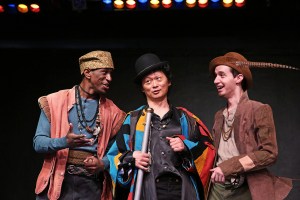
But the most telling comical point that Tom Stoppard makes about you in Rosencrantz and Guildenstern Are Dead, the playwright’s 1966 riff on Shakespeare’s text, is that neither of you has enough personality to distinguish yourself from the other. Winner of the 1968 Tony Award, the play is a centerpiece of the current Sensoria celebration of the arts at Central Piedmont Community College, a natural in the month and year marking the 400th anniversary of the Bard’s death.

With a title that telegraphs the fate of its protagonists, there are easier scripts to produce. Other than the UNC Charlotte staging in 1992 directed by Bill Morrison (#12 on my list of best shows for that year), I can’t recall a single local production that truly satisfied. On the contrary, each of the three revivals I’ve seen in the past eleven years, including this one at Pease Auditorium piloted by Tom Hollis, has come freighted with enough confusion and incoherence to make most audience members wonder: why?

To be fair, Hollis is working with the most inexperienced CPCC Theatre cast that I can recall. Yet at the same time, he and scenic designer James Duke try to keep things simple. There’s usually an upstairs-downstairs distinction between the royals who dominate Shakespeare’s stage and Stoppard’s flunky protagonists. Costumes by Jamey Varnadore aren’t lavish – down-market Elizabethan for the royals and courtiers, and a touch of commedia for The Player and his acting troupe.

Fifty years ago, it was only a slight exaggeration to declare that the pervasive influence of Hamlet in modern literature and culture was overbearing. Responding to all that was obviously a part of Stoppard’s agenda in his offstage retelling. But 50 years ago, Stoppard could be fairly sure that nearly everyone in the audience – on both sides of the pond – was in on the joke. In Stoppard’s native England, that’s probably still true. In 2016 Charlotte, after overhearing someone in the lobby confess that she’d never read Hamlet, I’d have to concur that it would have been helpful.

Quick quiz: what was The Murder of Gonzago? You might want to brush up on that stuff before you spend two hours and 40 minutes with Rosie, Guildy, and the gang.

Of course, it helps to have Shakespearean actors playing those portions that Stoppard swipes from the Elizabethan master. Yet what I saw from Jacob D. Page as Hamlet, Cara Cameron as Ophelia, Nick Southwick as Horatio and Polonius, Dwayne Helms as King Claudius, and Kristina Blake as Queen Gertrude didn’t convince me that any of them could give a credible full-length performance of any of those roles.

Rosencrantz and Guildenstern are Dead Promos

I did detect some promise in this group of nobles and even more in the actors that Hollis found for his leads, particularly Tyson Hamilton as Guildenstern, usually the straight man in the comedy. If Kyle Willson had delivered more broadly and confidently as the simple-minded Rosencrantz, the chemistry might have worked better. Similarly, I saw plenty to praise in Larry Wu’s animation as The Player, but his scenes with the title characters lost traction as inevitably as the duo’s dialogues.

A familiarity with the absurdist chitchat between Vladimir and Estragon in Beckett’s Waiting for Godot is also recommended for all who plan to see or perform in R&G. Curiously, it was when the chitchat paused and Page appeared on the scene as the troubled Prince that my interest perked up. These are islands of realism in Stoppard’s world, for our bumbling antiheroes actually behave differently when confronted with their betters.

In the bustle of Friday evening in Plaza-Midwood, I wasn’t sure how many of the people crowding the nightspots were even aware of the new BOOM festival in their midst, and its special vibe. My wife Sue and I took in two events that night, On Q’s Mo’ Betta and Taproot’s DinnerBell, and two more the following afternoon, Sinergismo’s Not a Cult and Sarah Emery’s Threads of Color.

It was far easier to find parking on Saturday afternoon. Yet the shows we saw were just as well-attended.

All the fare I sampled was delightful. My favorite was the spoofery of Not a Cult: the True, Unbiased, Authentic History of Sinergismo at Petra’s Piano Bar & Cabaret. Mat Duncan was the Sinergismo Scholar, Dr. Reginald Haephestus Winterbottom, our guide to the sacred birth, copulation, sickness, celebration, and funeral rites of the ancient Gismo society, performed by re-enactors from Charlotte, their only known descendants.

Duncan likely concocted and directed all this fakery, including the first pair audience questions after the Winterbottom lecture. But who fleshed out the archeological spoof with the re-enactors’ costumes, choreography, and ceremonial masks is open to conjecture. The artisan who sculpted the sacred mound from whence all Gismo life issued and to whence it returned is also shrouded in mystery. Likewise the bogus, cheesy props, including a dispenser for the healing mound squeezings, a mound flower, and a severed head.

Probably the best aspect of Duncan’s performance was its lack of polish. Challenged by the planted audience member on why the mating ritual had omitted the jingling turtles, Winterbottom responded with the bluster of a true mountebank.

IMG_JazzyGala_2014_dcost_2_1_9L3PEP1I_L97362418

Mo’ Betta was an old-timey mix of jazz, stand-up comedy, and improv poetry hosted by Quentin Talley. Jazz vocalist Kenya Templeton, backed by pianist Tim Scott Jr. and his trio, was the standout. Freed of the scripted constraints of last January’s Children of Children retrospective, where Marian Anderson and Ella Fitzgerald were her primary inspirations, Templeton floated beyond strict 4/4 time, sounding more like Betty Carter in an exemplary rendition of “Afro-Blue.”

DinnerBell may add an “e” to its mealtime compound before long, since it was a compendium of feminine grace, hospitality, beauty pageantry, and genial racism that comprise the heritage of Southern belles. Brianna Susan Smith was the singer/narrator steering this “Field Guide to Impolite Southern Conversation” on its chameleon path – sometimes campy, sometimes satirical, and sometimes bluntly direct. There were biscuits, deviled eggs, collard greens, and bread pudding served up by the same ensemble that vied in the Ms. Georgia Cow beauty contest. The Q&A at the end of that contest was the best part.

For her suite of seven dance pieces, Emery took her inspiration from the paintings of local ArtPop Street Gallery artists, each of them projected on a huge wall at Open Door Studios as the dancers performed. With Emery taking a solo in “Sixth Season” and former Charlotte Ballet standout Emily Ramirez included in three other pieces – and taking a cameo in yet another – the ensembles and soloists were consistently proficient. Wrapped into the community feel that Emery orchestrated in her show was a dazzling array of costume designers who diverted my eyes as excitingly as the dancers and the projected paintings.

A great start for Boom and a great boost for Plaza-Midwood, where Actor’s Theatre of Charlotte plans to open early in 2017. You can help make that happen at atcharlotte.org.