Tag Archives: Michael Korsch

Dimming the Lights, Cerrudo Delights With Three Dance Originals

Review: Charlotte Ballet’s A Realm of Existence

By Perry Tannenbaum
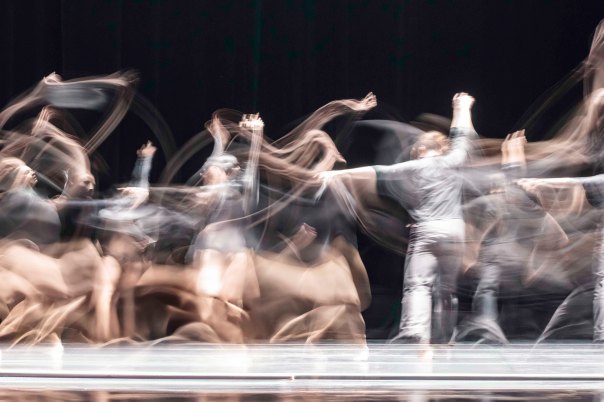
March 6, 2025, Charlotte, NC – Past and present eras of Charlotte Ballet intertwined at Knight Theater in their latest program, A Realm of Existence, named after none of the choreography below. Three of the four pieces were by artistic director Alejandro Cerrudo, including Dos y Dos y Dos, his first world premiere with the company since he was designated to lead it in 2022. After a break, Pacopepepluto lightened the mood with settings for three Dean Martin hits, and Cloudless cast an intimate, almost erotic aura before the second intermission. Hearkening back to the preceding Hope Muir stint as artistic director, nine dancers performed the surreal scenario of Johan Inger’s Walking Mad. It was the first piece performed at Knight Theater under Muir’s leadership in 2017, reprised there by Muir in 2019.

For a piece that emphasized pairs, Dos y Dos y Dos was strikingly touchless – and for that reason, perhaps most fascinating in its interstitial moments between the various couplings. The first ensemble reacted to one another in waves, like coils of a Slinky toy or a row of dominoes, creating the push-pull of gravity between them out of thin air. The intriguing style carried over into the pas de deux – not religiously since there was minimal contact – but wasn’t as unique for me in that idiom. While the variety of the ensembles grabbed me more, the variety of music for the couples – composed by Marek Hunhap, Jean Michel Blais, and Frederic Chopin – brought fresh vibes to their dreaminess.

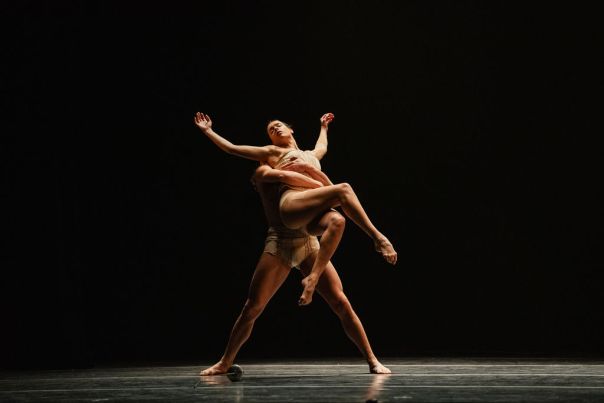
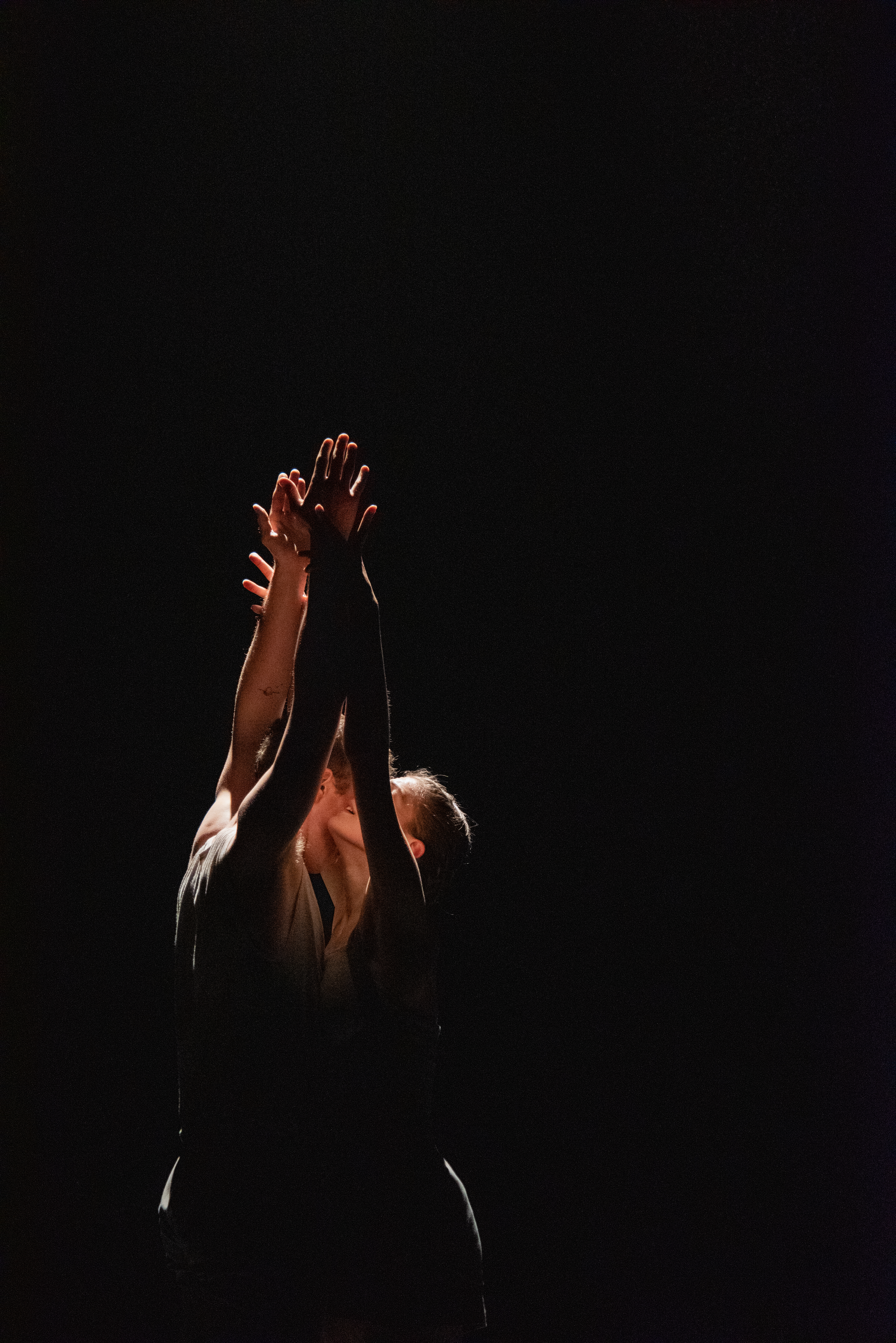
Absent any props, scenery, or flashy costuming, Cerrudo placed strong emphases on form and flow in his new work. Lighting by Michael Korsch is important in this piece – but not expensive. Dim lighting has been almost a trademark of Cerrudo’s tenure, certainly CharBallet’s settled style in recent non-Nutcracker production photos. PR photos of A Realm of Existence couldn’t be anything other than dimly lit. But as Pacopepepluto quickly made clear, a dimly lit mood needn’t always chime with a Chopin Nocturne.
“Memories Are Made of This,” the first of Cerrudo’s three solo pieces (the “Paco” piece?), showcased a true gem of bad Dean Martin imitation by Joe Scalissi – or a treasure since neither Spotify nor Apple Music have a clue about Scalissi, Joe or otherwise. You could hardly imagine a better dance track for mocking Martin’s schmaltzy style, Cerrudo’s moves prodding Mouzon into projecting the antithesis of suavity.

Apparently, gems like Scalissi’s are very rare indeed, so Mario Gonzalez had to content himself with an authentic Martin cut, the exponentially schmaltzier and creepier “In the Chapel in the Moonlight,” so he drew more laughs than Mouzon’s antics anyhow. How did Cerrudo top himself after that for Rees Launer? With Dino’s most beloved – and outright silliest – hit, “That’s Amore,” complete with its original chart-topping chorus and accordions.

Packaging moon, stars, and an underfoot cloud, this was clearly the “Pluto” segment. There was so much intrinsic merriment in that track for Launer to build on with his discordantly spasmodic movements, and the choreographer mischievously brought back Gonzalez and Mouzon for comedic cameos as lagniappe. That really was amore, especially for the gals in the audience since the guys were hardly wearing a stitch.

Flipping the customary script, Cerrudo had objectified his men more than he would the women in Cloudless, Anna Owens, and Adriana Wagenveld on opening night. Branimira Ivanova’s costumes for this pas de deux were more for a dance studio than a runway. That enabled Owen and Wagenveld to build their chemistry, intimacy, and heat from scratch, a steeper climb without flashy lights and glam dresses. With the gentle music of Nils Frahm simmering in the background, there was actually a bit of tension for me, wondering how far the intimacy would go – and whether it would upset the giggling church ladies sitting behind us. The work out costuming helped to widen Cerrudo’s latitude.

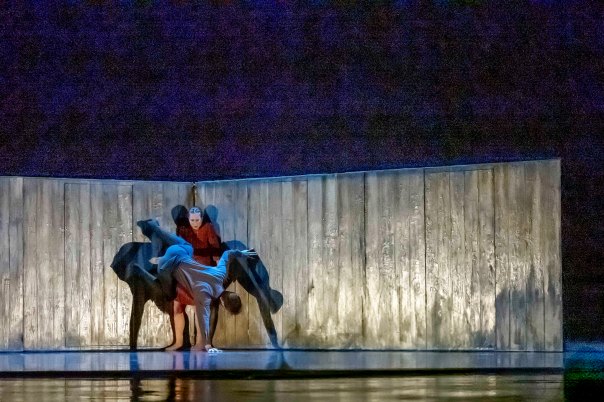
As for Walking Mad, I’ve written about it before, here and elsewhere. So I’m dispensing with yet another description of the piece and developing a theory about Inger’s intent – after noting those same church ladies’ surprise and delight in seeing it for the first time. No doubt the wooden wall, nearly as versatile as the dancers who play with it, is in permanent storage somewhere in town now that this crowd favorite has been performed three times. This wall plays such a big part in the action that what it is can quickly elude our consideration.

It’s a wall that separates the insiders partying behind it from the outsiders who can’t seem to forget their worries and merge with the mindless, monotonous fun. That’s fairly obvious when a crowd of partyers with conical hats spill out from the sides of the wall and briefly join the lonely, trembling folks on our side – especially since they’re almost always engulfed by the hypnotic repetitions of Ravel’s Bolero. But there’s also a night-and-day monotony to Inger’s scheme, for the first dancer we see, seeking to toss away his workday attire and join the festivities, is wearing a bowler hat.
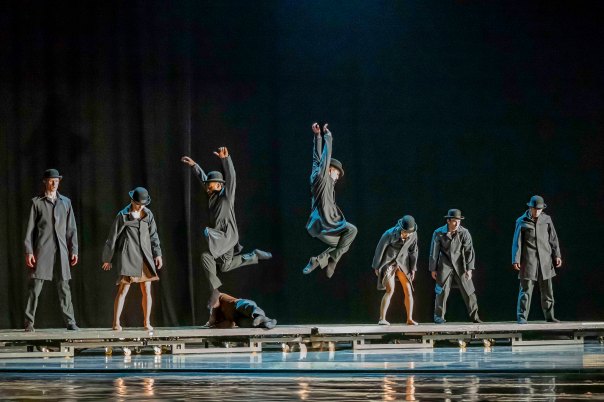
A group of male dancers will parade funereally across the stage later in the piece, all wearing similar Magritte bowler hats. It’s a broad hint that our days are as repetitious and monotonous as our nights, only more formal and mindful. That’s where the fears and trembling of the outsiders come from. Notwithstanding the surprised gasps and giggles from the crowd, this may not have been the best realm of existence.

The Full Cerrudo Experience Is a Hit in Come to Life

Review: Charlotte Ballet’s Come to Life at Knight Theater

By Perry Tannenbaum

March 7, 2024, Charlotte, NC – Midway through his second full season as artistic director, we can now say that Alejandro Cerrudo has stamped Charlotte Ballet as his company. The corps looks fresh, peopled with more newbies we’re getting to know than trusted heirlooms who have long since proven their mettle. The choreography on their current Come To Life program at Knight Theater – Cerrudo’s Little mortal jump, Jiří Kylián’s Petite Mort, and the world premiere of Penny Saunders’ Beat the Clock – is beguilingly adventurous. Wow factor? Check.

For those of you who remember the 1950s, yes, Beat the Clock exhumes the classic TV game show hosted by the preternaturally vacuous Bud Collyer and sponsored by Sylvania. So at first, it wasn’t at all apparent that Saunders was targeting gender roles in those ancient days. But while the jackpot money was still flying gloriously above the dancers portraying the announcer, the host, the contestants, and the amped audience, we were cinematically fade-dissolving into a different scene as the shower of bills hit the ground.

This was a panel discussion where three women discussed the provocative question of whether housewives could benefit from additional education. Though it’s a godsend for the choreography, the discussion got heated, which may frustrate a few feminists in the audience. What frustrated me, however, was that Saunders’ sound design wasn’t as clearly audible for the panelists as it was for the archival gameshow track.

As the panelists’ hubbub subsided at stage right, there were a few moments of split screen as Michael Korsch’s lighting intensified at stage left for a briefer husband-and-wife scene, where both of the marrieds ended up feeling ignored and unvalued. Is this why we won the war? Sometimes, it felt this way. This brief microcosm gave way to two concluding community scenes, the first spotlighting the women and the finale embracing the entire 14-person ensemble.

Kerri Martinsen’s costume design had something to say about conformity in the outfits sported by the gameshow contestants and audience, later giving way to assorted nondescript outfits. Similarly, Maurice Mouzon Jr. as the announcer and James Kopecky as the host wore uniform outfits – with glittery silver blazers, to hell with historical accuracy. Back then, the em in emcee stood emphatically for master of ceremonies, so I suspected that Saunders and Martinsen were double-underlining their point.

After the first intermission, the repertoire flipped from cinematic to theatrical, with costume designer Joke Visser adorning Kylián’s men with gilt-edged cavalier attire that fit tightly and, for his women, the stiffest possible dresses. Suffice it to say that you’ve probably never seen women move laterally across the stage as these ladies in black do. Nor can it be doubted that these ladies – or their dresses – are the little deaths implied by Kylián’s Petite Mort title. Scored with slow movements from Mozart’s 21st and 23rd Piano Concertos, Mort both celebrates and lovingly skewers classic elegance – with a beautiful set of pas de deuxs between the ensemble segments and a couple of breathtaking transitions that require some nifty undercover choreography of their own.

The most eye-catching pairings among the six couples, for me, were Kopecky and Samantha Riester along with Raven Barkley and Rees Launer. Your mileage may vary, especially if you’re witnessing Charlotte Ballet for the first time, and the six couples will change from performance to performance (only Reister and Kopecky are constants, and they will be swapping out dances and partners). Just try not to gag on the relentless grace and symmetry.

If Kylián’s piece was a wry and perfect gem, then Cerrudo’s Little mortal jump, premiered by Hubbard Street Dance back in 2012, impacted like a coolly calculated over-the-top extravaganza. Korsch italicized the spectacle with his lighting design, principally when he aimed his beams at the audience and when he illuminated rows of vanity bulbs on cue. Branimira Ivanova’s costumes arguably upstaged Korsch’s lighting and Cerrudo’s choreography, literally stopping the show and putting two of Charlotte Ballet’s dancers in suspended animation, pinned to the scenery. Well before that, it was apparent that Cerrudo’s scenic design – massive movable boxes about as high as a school locker – was an integral part of his choreography. The movements of these huge boxes made transitions between scenes a constant source of excitement and surprise.

Ten pieces on Cerrudo’s playlist, listed alphabetically rather than sequentially in the program booklet, add to the kaleidoscopic swirl of his scenario and the giddy, stagey energy of the dancers. So his magical moment of suspended animation stands all the more dramatically apart from the hectic electricity that bookends this utterly unique pas de deux. Cerrudo’s piece, longer than the others, fit in well with them, maybe even eclipsing them a little. More comfortable in his leading role, his welcoming remarks were confident, for his invitation to support CharBallet’s 2024-25 season would soon be buttressed with a stunning program. The buzz in the house seemed to indicate that Cerrudo is winning over fervent new fans in his audience and onstage. As one ticketholder summarized, leaving the elevator that descends into the nearby parking garage: “Holy cow.”

Cerrudo Revives Innovative Works With Fresh Excitement

Review: Innovative Works at Center for Dance

By Perry Tannenbaum

The Deatils Are the Meaning by Helen Simoneau - full cast - photo by Taylor Jones Charlotte Ballet’s reveal wasn’t as dramatic as the recent return of the renovated Old Barn on Queens Road with a full-fledged Theatre Charlotte musical. But after the COVID shutdowns, postponements and cancellations, and the abrupt departure of artistic director Hope Muir after barely five years – the last two during the pandemic – it was hard to feel that Charlotte Ballet was all the way back until last weekend. Until we had seen some choreography by the new AD, Alejandro Cerrudo. Extra frustrating for me, since I had declared his work a perfect fit for CharBallet when I had first seen it at Spoleto Festival USA in 2014, had been the absence of his imprint on the Fall Works program at Knight Theater last October.

With Cerrudo now hosting the annual Innovative Works wintertime program, contributing a fine piece that crowns an invigorating evening at the McBride-Bonnefoux Center for Dance, we can let it all seep in. A new era has emphatically begun at the Center for Dance, with a new AD starting to reshape the company’s identity, working with a mix of familiar dancers, new dancers, and dancers who have matriculated to the varsity through the satellite Charlotte Ballet II troupe.

The state of Charlotte Ballet, to coin a phrase, is strong.HdrM by Jennifer Archibald - Olivr Oguma and Amelia Sturt-Dilley - photo by Taylor Jones

Jennifer Archibald’s vowel-starved HdrM and Helen Simoneau’s The Details Are the Meaning, both world premieres, preceded Cerrudo’s no-less-cryptic Silent Ghost. Silence was a subtle motif: It’s been awhile since Charlotte Ballet presented an entire evening of dance works that were devoid of storyline, song lyrics, or voiceovers. Taking on the hosting chores, Cerrudo recalled his takeaway from the first time he squired his daughter to a set of modern dance pieces. Comprehension was no problem at all, as it turned out. Just let it seep in was the core of his message.

On this occasion, anyway, Cerrudo discarded the introductory videos that have enhanced the studio ambience at past Center for Dance programs, where the evening’s choreographers, projected on screens flanking the audience, would talk about their works before we saw them, or dancers would give us their insights. Instead of those slick videos – all three “Behind the Ballet” videos are available at Charlotte Ballet’s website – we contented ourselves with Cerrudo’s remarks and a strange, mysterious welcome from CharBallet dancer Maurice Mouzon Jr. in a flowing black costume. Three quarters bacchante conjuration and one quarter airline steward pantomime, the conjuration was so absorbing that I really didn’t pay attention to the voiceover until Mouzon pointed out the exits to us.

That shtick was another great ice breaker, arguably the most amusing of the night.HdrM by Jennifer Archibald - Nadine Barton and Oliver Oguma - by Taylor Jones (1)

Like the other dances that followed, HdrM didn’t readily disclose its intentions, but Archibald offers a couple of useful hints in our program booklets. Her subject is environmental psychology, questioning whether society has a responsibility to humanize architecture. What the choreography takes aim at is “hard architecture,” as explored in Robert Sommer’s Tight Spaces: Hard Architecture and How to Humanize It (1974). Since there is no scenery with the fledgling piece, nor any projections, we can decide among several kinds of hard architecture that Sommer was concerned with: prisons, classrooms, asylums, hospitals, or zoos.

Kerri Martinson’s drab costumes seem to narrow that field to secure buildings for human adults, with no further clues provided by the music of Federico Albanese, Ludwig Ronquist, and Heilung. What I found most enjoyable here was Archibald’s struggling, yet never agonized, language of movement – a mixture of sensual interaction between the eight dancers and self-absorbed precision. Likewise, there were episodes when the dancers connected intimately with the flow of the music, interrupted by abrupt mechanical disconnects from the soundtrack.Silent Ghost - Anna Mains and Luke Csordas - photo by Taylor Jones

While the eight dancers never evoked a prison or an asylum, they brought us a dark, broken world. The moments of trauma were less common and affecting than the flow of brave, resolute striving. If the other choreographies reached these levels of intensity and artistry, I knew that the evening’s experience would be unforgettable.

Dressed in a different set of Martinson costumes, these in various colors with sheer unisex skirts, Simoneau’s The Details Are the Meaning showcased six fresh dancers whom we hadn’t seen in the previous piece. Though collections of Caroline Shaw compositions played by the Attacca Quartet have won two Grammy Awards since 2019, the music that Simoneau had selected was badly overmiked on Saturday night – far past the point of clarifying detail, if that was the point.

Movements in Simoneau’s setting were more classical and conventional than Archibald’s had been, with a greater tendency toward traditional partnering: Anna Mains with newcomer Oliver Oguma, Sarah Hayes Harkins with Rees Launer, and Isabella Franco with Mouzon. Beautifully executed lifts were no more lively or original, and I missed the point of the static, I-could-also-do-that poses in the middle of the piece. Combined with the wayward potting of the audio and the unsexy unisex outfits, this piece struck me as calling for more time in the workshop and more polish.Silent Ghost - Sarah Hayes Harkins and Sarah Lapointe - photo by Taylor Jones

Silent Ghost felt very consonant with the two premieres that had preceded it, so Cerrudo had been judicious in calling upon Michael Korsch to provide lighting design for the new works after serving as Cerrudo’s original designer back 2015, when Ghost premiered in Santa Fe. Saving his own work for last was also a sensible idea, for it presented more CharBallet dancers for our scrutiny and delight than either Simoneau or Archibald had engaged.

Yet as Cerrudo’s numinous title indicates, the mood was far from celebratory or triumphant, as you might expect capping an Innovative program. The ambiance hinted at in the ghostly title was perhaps best approximated by the music of Jon Hopkins and Kenny Anderson (King Creosote) – a dimly recorded household conversation mixed over New Age piano. The opening track, by Dustin Hamman, presented a similar profile with fuzzy guitar chords strummed over intermittently intelligible vocals. Additional tracks were by Ólafur Arnalds and Nils Frahm.

Costumes by Branamira Ivanova were even more monochromatic than Martinson’s for HdrM, but smarter somehow and more fun to wear and dance in. While Cerrudo’s style of movement never struck me as either edgy or outré, which Archibald’s choreography definitely had, the style was markedly individual, comfortably at odds with tradition rather than defiant of it. Silent Ghost flowed no less naturally than HdrM. There was no perceivable strain on the ensemble in clothing themselves with the choreographer’s movements, and they were all perpetually wedded to the soundtrack, no matter what combination was onstage.

These combos were often pas de deuxs pairing Sarah Hayes Harkins with Oguma or Mains with newcomer Luke Csordas, always excellent. To my understanding, past ADs at Charlotte Ballet haven’t given new company members so much spotlight so soon, tending to give the impression that there was an unofficial hierarchy. I applaud Cerrudo’s audacious impulse: it makes his new era of leadership feel more exciting and unpredictable.

Ballet’s Last Dance Ranges from Grief to Orgy

Dance Review: Charlotte Ballet’s Spring Works

By Perry Tannenbaum

Finishing Jean-Pierre Bonnefoux’s penultimate year as artistic director, Charlotte Ballet served up an evening of Spring Works that carved a graceful arc from sorrow to celebration. Musically, the program could be described as all-American, though sticklers would consider that a stretch. Resident choreographer Sasha Janes’s We Danced Through Life, premiered at Chautauqua last summer, is set to Dvorak’s Symphony No. 9, “From the New World,” written in 1893 while the Czech composer was living in America.

No ambiguity about music that followed. George Balanchine’s Who Cares? was set to a sheaf of Gershwin tunes when it premiered in 1970, pared down to eight selections by associate artistic director Patricia McBride, who introduced three of the original 17 pieces back in the days when she was a star of the New York City Ballet. Capping the evening was the world premiere of Dwight Rhoden’s Bop Doo Wah, danced to eight jazz standards by the likes of Duke Ellington, Billy Strayhorn, Louis Prima, Irving Berlin, and George Benson.

Although Janes scrapped the opening movement of “New World” in condensing it to 20 minutes, he retained a fast-slow-fast (or dense-light-dense) structure by tucking the lovely Largo second movement – and its memorable “Goin’ Home” tune – in between the third movement Molto vivace and the concluding Allegro. That showcased the fearless elegance of Sarah Hayes Harkins in an achingly tender pas de deux with David Morse, along with a move I’d never seen before.

Charlotte Ballet_Sasha Janes_We Danced Through Life_Sarah Hayes Harkins_...[2]

Starting from upstage right and running diagonally toward downstage center, Harkins took one of those leaps that flings a ballerina’s arms and legs out parallel to the floor an instant before a sure-handed guy catches her in midair. But there was no guy standing there to catch Harkins in Janes’s choreography. Instead, two guys somehow overtook her and caught her two arms at the same moment, one under each arm.

Clearly, Harkins and Morse were the tragic couple Janes had in mind as his most pointed evocation of Terrie Valle Hauck, who commissioned the dance at Chautauqua for her late husband Jimmy – particularly at that instant when Morse wasn’t there to catch his partner. But another couple shone in the outer movements, Alessandra Ball James and Josh Hall, amid busier action with four other couples. At the end of one set of lifts, the men didn’t put their partners down on the ground. Instead they maintained their lifts and trotted upstage, placing each woman on her own pedestal.

Well done, Jimmy!

Aside from McBride, James and her pink flapper dress was the living link between this presentation of Who Cares? and the company’s previous revival in 2008. She’s still musical and precise in “The Man I Love,” her duet with Hall, and she’s still youthfully jazzy in “Fascinatin’ Rhythm,” the other piece that McBride originated. There was a tinge of poetry in the title tune, Jamie Dee Clifton’s duet with Hall, and a touch of Fred-and-Ginger sophistication in “Embraceable You,” the Hall-Harkins pairing.

I just felt that this Balanchine was unnecessarily musty compared to the newer pieces bookending it. Couldn’t we get a recording of Hershey Kay’s orchestrations that sounded like they were recorded in stereo, let alone digitally? And the costumes, recreated by Aimee J. Coleman, could stand a refresh. Clifton’s looked like it should have been discarded five washings ago, and Harkins’ – when cutie pie Anna Gerberich danced “My One and Only” eight years ago, it was teal, but now it seemed faded to turquoise.

Yep, it’s challenging to nitpick a Charlotte Ballet program. Everyone is so damn good, but in Rhoden’s Bop Doo Wah, we could lament seeing Addul Manzano, David Morse and Gregory Taylor for the last time. While I wasn’t particularly impressed with his singer, Gloria Reuben (more different in her interpretations than delightful), guitarist Marty Ashby’s jazz band could definitely swing and bop. But come on, man: “Teenie’s Blues,” ostensibly written by trombonist Jay Ashby, had more of Dizzy Gillespie’s “Oop Bop Sh’Bam” than anything else.

Charlotte Ballet_Dwight Rhoden_Bop Doo Wah_Sarah Hayes Harkins_Josh Hall_photo by Jeff Cravotta[10]

That’s why the tune stood up to those that surrounded it, Ellington’s “It Don’t Mean a Thing (If It Ain’t Got That Swing)” and Berlin’s “Steppin’ Out With My Baby.” The piece intensified with Strayhorn’s “Blood Count” as James partnered with Morse and Harkins reconnected with Hall, and “How High the Moon,” one of five pieces set by Rhoden for the full cast of 16, fired up with an alto sax solo that I considered the best of the whole suite.

With James partnering Morse one last time, the full cast turned it up another notch as the women let their hair down for Benson’s “My Latin Brother.” But Rhoden knows the value of turning up the intensity to its fullest when his dancers ought to be nearing exhaustion. That’s what a dance orgy is, and Louis Prima’s classic “Sing, Sing, Sing” was the perfect vehicle to take us there, arranged to evoke the Benny Goodman band’s landmark 1939 invasion of Carnegie Hall – and the legendary set of LPs that emerged from it.

Instrumental solo followed instrumental solo in this epic performance, with the guys, previously clad in punkish black costumes by Christine Darch, adding on matching androgynous skirts as they intensified the furious celebration. Not the way Manzano envisioned ending his career, I’m sure – his was the only farewell performance signaling retirement – but he looked as hot as ever in his valedictory appearance. Darch’s costumes for the women were equally sensuous, but due to the shifting hues of Michael Korsch’s lighting design, I never could determine exactly what three or four deep colors the ladies wore.