Tag Archives: Michael Baumgarten

“Turandot” Grandly Usurps Saint-Saëns at Belk Theater

Review: Opera Carolina’s Turandot

By Perry Tannenbaum
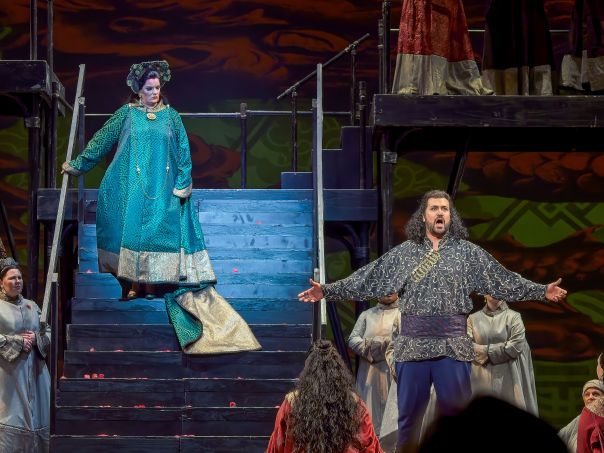
When we gauge the cultural influence of Giacomo Puccini, we’re most likely to invoke the operas he composed that were subsequently repurposed into megahit Broadway musicals. The American colonialism that fueled the domestic tragedy of Madama Butterfly eventually suffused the spectacular Miss Saigon, and La Bohème, Puccini’s verismo masterwork was Americanized – Greenwich Village filling in for Paris – and turned even more successfully into Rent.

But we don’t readily think of Puccini in terms of grand opera, ALL CAPS, unless we narrow our focus to the Italian master’s last work, Turandot, the one opera he didn’t live to complete or see premiered in 1926. The fate of nations routinely hung in the balance when Verdi selected his libretti, but for Puccini, this tale of ancient China and Peking stands apart from his more private and intimate norm. If Traviata is Verdi’s most visionary work, anticipating Puccini, then Turandot is Puccini’s grandest and most retro work.

Opera Carolina’s history with the work tallies well with its popularity. This is the sixth time the company has staged Turandot, decisively trailing Puccini’s big three, Bohème, Butterfly, and Tosca, two of which have reached double figures. Yet since James Meena, a devout Verdian, arrived on the scene in 2000, Turandot has maintained parity with its kindred, staged three times since the turn of the century.
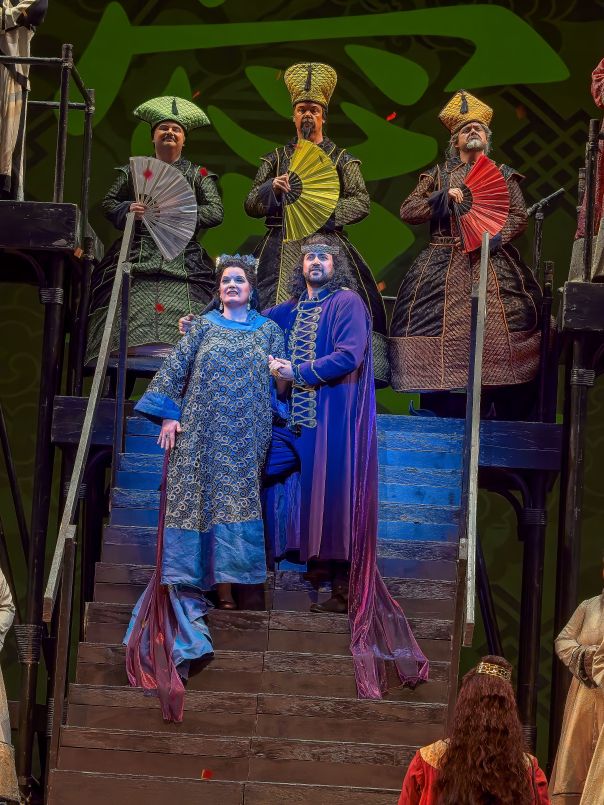
We must, begging Milady’s pardon, bestow an asterisk next to the current incarnation of Peking’s princess. If she wasn’t exactly a last-minute or eleventh-hour replacement for Camille Saint-Saëns’ Samson and Delilah, it’s fair to say that she was an eleventh-month substitution for the previously slated season closer.

Yes, a grand opera was inserted at Belk Theater as the clock or calendar was winding down! Around the world, Maria Callas, Birgit Nilsson, and Joan Sutherland are among the celebrated dramatic sopranos who have graced the powerhouse title role, and the Franco Zeffirelli production at the Metropolitan Opera is as revered for its stateliness and splendor as the Notre Dame Cathedral.

Grand? Monumental.

Needless to say, the Opera Carolina production didn’t figure to deliver legendary grandeur. But instead of smoke and mirrors, set designer Anita Stewart and lighting designer Michael Baumgarten call upon scaffolding and projections to bridge the gap. Stage director Jay Lesenger wisely keeps the curtain down over Stewart’s barebones set until Meena, down in the orchestra pit with the Charlotte Symphony, can begin working his magic with the score. It doesn’t take long to taste its beauties, ranging from delicate to majestic, or realize Meena’s deep affection for it.
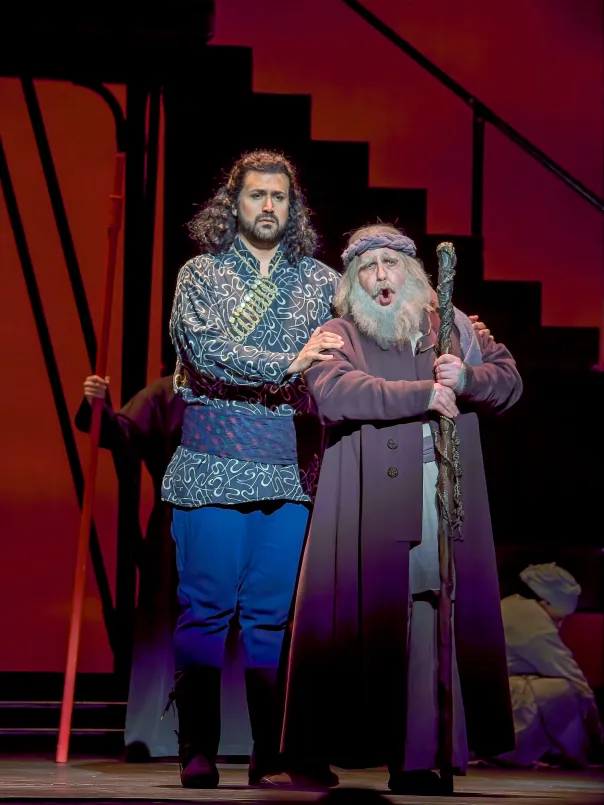
Parallel to the build-up to Prince Calaf’s climactic confrontation with Peking’s ice goddess, when the princess asks him three riddles that he must solve – or die – there’s a steady build-up of ritual. A Persian prince has failed the Trial of Three Riddles and must be beheaded. To declare his candidacy, against the fervent wishes of his father and his dear maidservant, Calaf – “The Unknown Prince” – must strike the gleaming gong near the gates of the imperial palace. To stage a new trial, there must be a public proclamation, holy men must gather, the Emperor must preside, and Turandot herself must pose the riddles.

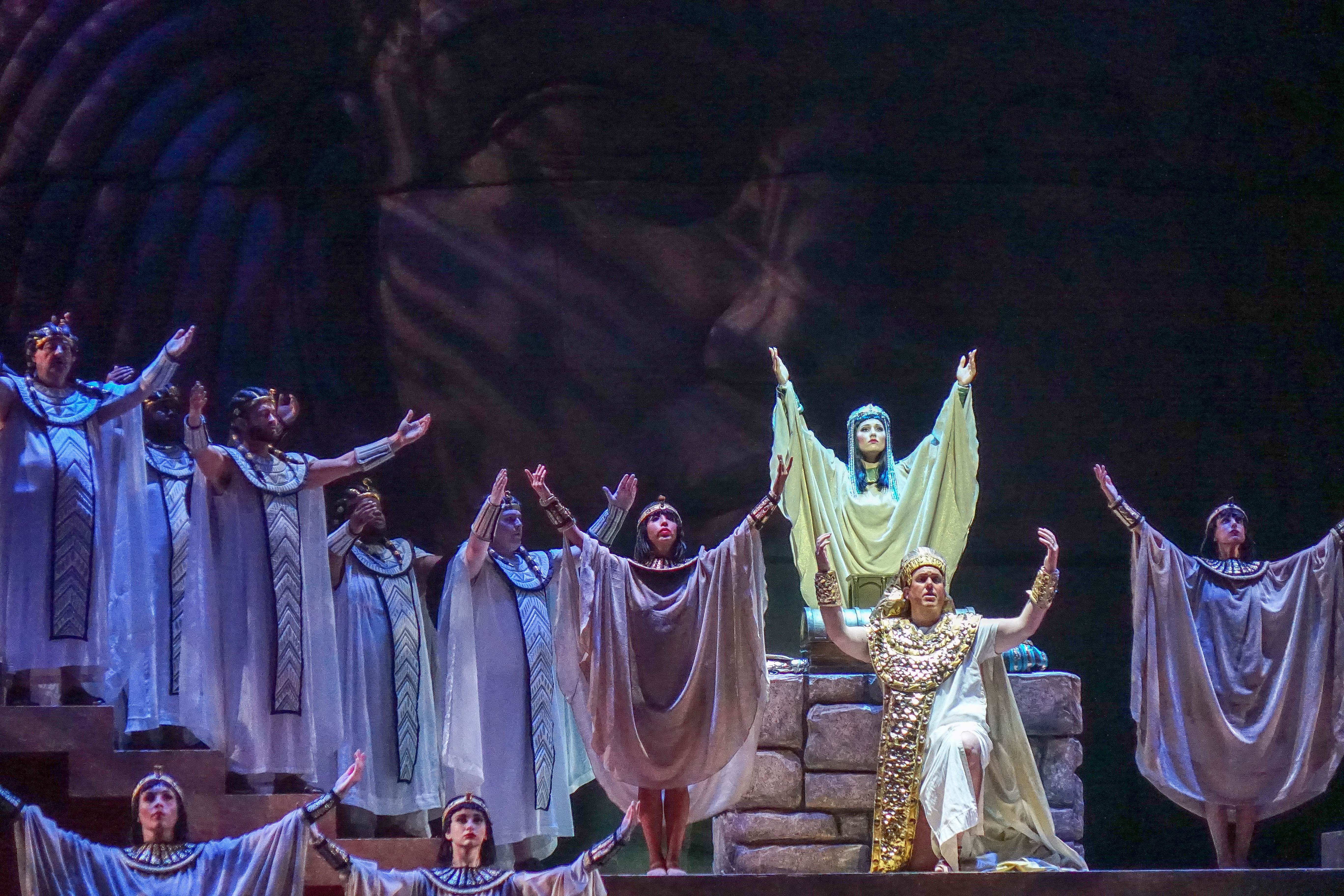
It’s a regal crescendo of pomp, ceremony, and colorful, eye-popping costuming from Anna Oliver that ultimately matches the trumpets heralding the divine Principessa. Watching the royal entrances of Emperor, Turandot, and their respective ministers and maidservants, high up and almost level with the proscenium, I had to wonder how much more scaffolding and stairs there must be hidden in the wings so that all these nobles, old and young, could safely ascend to those lofty heights.

At ground level, my worries began as soon as soprano Jennifer Forni made her auspicious Opera Carolina debut as Liù, the maidservant who has devoted herself to dethroned Tartar king Timur simply because her son, Calaf, once smiled at her before he fled the kingdom. Forni distinguished herself within the first ten minutes with her sweet fruity timbre recounting Liù’s backstory, and her buttery soft notes put the protagonists waiting for their big moments in serious jeopardy of being upstaged. After all, Renata Tebaldi, Renata Scotto, and Montserrat Caballé are among the notables who have been drawn to this role.

If we don’t see or hear the very best of Diego Di Vietro early in Act 1, there was enough Luciano Pavarotti DNA surfacing in his tenor to assure us that he would likely be equal to Calaf’s big “Nessun dorma” moment when the curtain rose on Act 3. The extra panache that was missing before intermission arrived on time, and Lesenger made more of Calaf’s first private moment with Turandot, calling upon Di Vietro to conquer the princess with brutish aggressiveness and charm. The chemistry that was so sorely missing when Opera Carolina brought Turandot to the Belk in 2009 had finally been recovered, making for a more deeply satisfying ending.

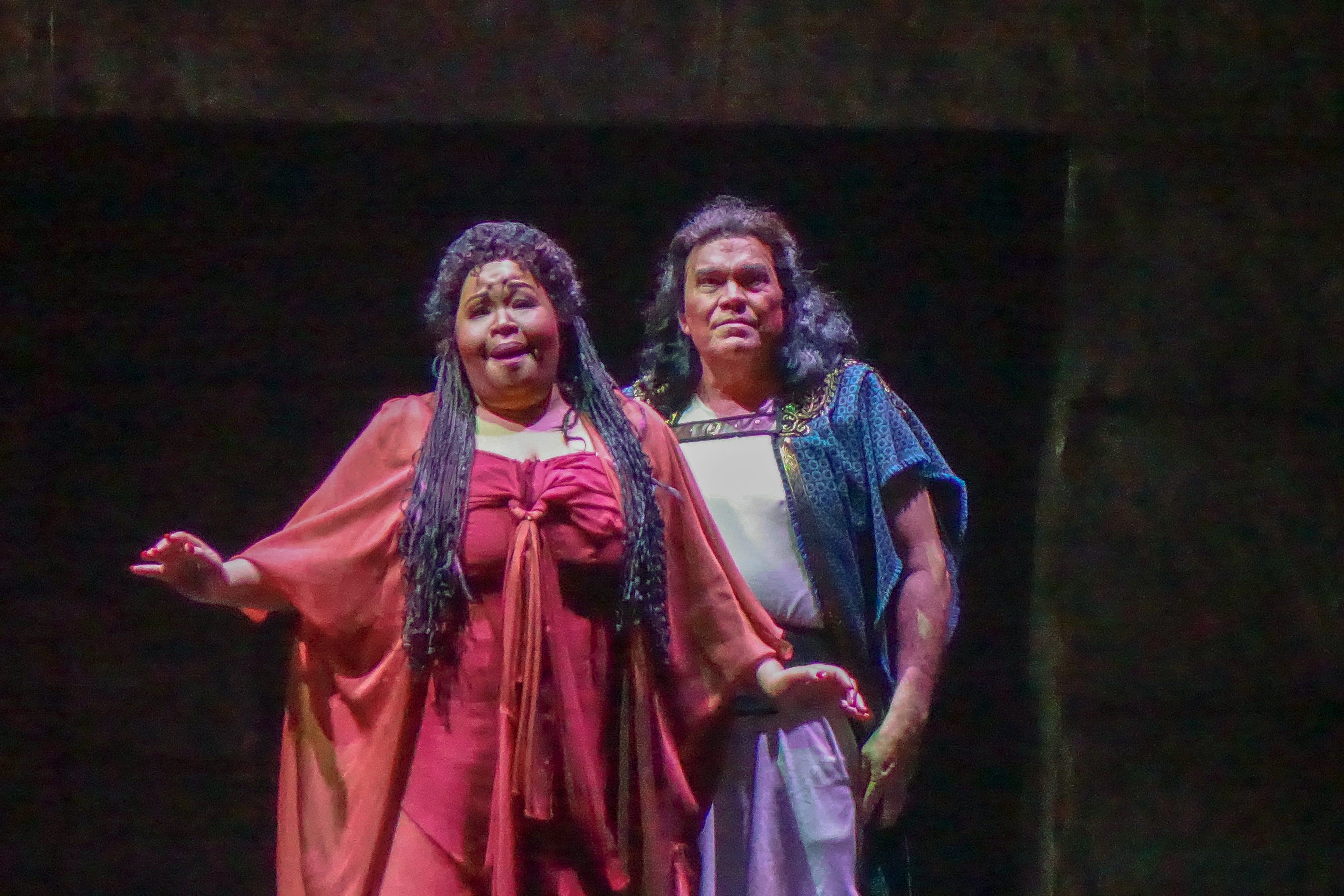
Though Lesenger could have given her more to do during Turandot’s icy phase, Amy Shoremount-Obra was certainly majestic, intimidating, and cruel as the Principessa in the stunning trial scene. Nor am I quite sure that Baumgarten took the best approach in lighting the Princess when she first appeared. Yes, Shoremount-Obra was dazzling but blinding might be equally accurate as the lights were so dazzling that there was no chance to behold the beauty of the Princess’s face, utterly bleached by the spotlight. (My photographer agrees.)

Yet there is visual drama in this tense ceremony as Turandot gradually descends the long staircase from her lofty height as her successive riddles are solved. Shoremount-Obra visibly becomes more human and vulnerable as she comes closer to the Unknown Prince’s level at the climax of Act 2 and he proves more and more worthy of her. The dramatic soprano’s stamina wavered just slightly after intermission in her pre-dawn duet with Di Vietro, but by this time, Shoremount-Obra’s beauty had been revealed and the chemistry was kindled.
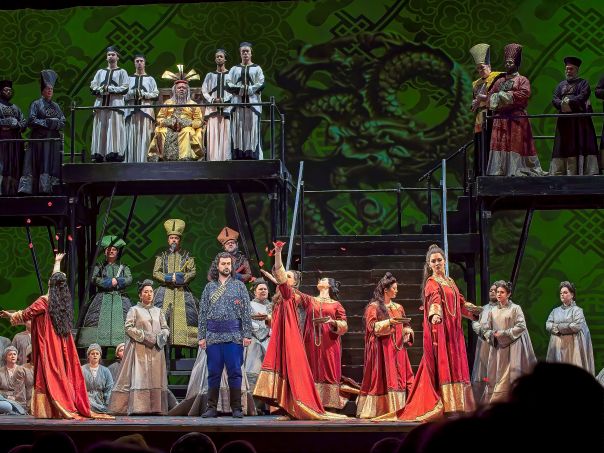
Otherwise, there was no lack of strength or color among the remaining cast. John Fortson was austere and imposing in all of the Mandarin’s proclamations. Jeffrey McEvoy, Zachary Taylor, and resident artist Johnathan White were delightful as Ping, Pang, and Pong when we needed comic relief. Garbed and bearded in gray, basso James Eder brought out a paternal spirituality in the blind King Timur, and Elliott Brown, decked out in enough gold to be declared a Sun King, was a magnificent Emperor Altoum.

Rather electrifying, all around. Bravi.

Photos by Perry Tannenbaum

“Cavalleria Rusticana” Returns After a Long Absence With a Gently Rebuked “Pagliacci”

Review: Pagliacci With Cavalleria Rusticana @ Opera Carolina

By Perry Tannenbaum

October 28, 2023, Charlotte, NC – Long coupled in double bills around the world, Pietro Mascagni’s Cavalleria Rusticana and Ruggiero Leoncavallo’s Pagliacci parted ways at Opera Carolina nearly 30 years ago, immediately after the two were finally wed in Charlotte. Until then, the operas had appeared separately or in successive engagements during the seasons of 1957-58, 1969-70, 1974-75, and 1986-87.

The transcendent popularity of Canio’s climactic aria in Pagliacci, “Vesti la giubba,”has given that opera a stronger grip in the repertoire, which accounts for Opera Carolina programming its most recent presentations of the work in 2006 and 2015 in tandem with two other one-acts. Yet the coupling with Cavalleria is very natural, since Leoncavallo wrote his opera in response to seeing Mascagni’s, and the two premieres were almost exactly two years apart.

Natural and convenient, for the current Opera Carolina production, conducted by James Meena and directed by Garnett Bruce, demonstrates how seamlessly two distinctively different works can be fused together – in their casting and design – after thousands of precedents spanning more than a century. We’ve seen greater scenic alterations in most opera productions at Belk Theater than we saw here from designers John Farrell and Michael Baumgarten for this twin-bill.

On stage right, the church façade remained the same, and across on stage left, a boxcar café was discreetly modified at intermission to become a boxcar theater. Between these, projections by Baumgarten could recycle the centerstage backdrop in the blink of an eye. More radical were the costume changes provided by Allison Collins, who reveled in bringing us the harlequin costumes of the Pagliacci clown troupe, and brought a more urban World War 2 flavor to the garb of the townspeople and visiting soldiers on leave.

Although billed on the OpCarolina website as “Pagliacci With Cavalleria Rusticana,”the two operas are presented in chronological order – the right choice if you’re building to a climax at the end of the evening. With extended instrumental sections at the start, Cavalleria isn’t as instantly impactful as Pagliacci, which begins with a member of Leoncavallo’s commedia troupe directly addressing the audience. For a one-act, the exposition of Cavalleria proceeds at a surprisingly glacial pace, all the more reason to be pleased with how beautifully Meena and the Charlotte Symphony perform the bountiful orchestral episodes.


We didn’t have to wait until the famous “Vesti la giubba” for the vocal splendor of this production to become manifest. Soprano Barbara Frittoli was already a rising star, soon to debut at the Metropolitan Opera, the last time Cavalleria Rusticana was performed in Charlotte, and now she’s the leading lady in both Cav as Santuzza and Pagliacci as Nedda in her Opera Carolina debut – though Yunah Lee will give her a breather in the Sunday matinee performance of the curtain raiser. Nearly as auspicious, baritone Leo An made his debut as the malevolent Alfio in Cavalleria and reappeared almost immediately as Tonio, the odious clown who greets us after intermission.

These are two marvelous singers, normally filling the quota of marvels we have heard in past years at Belk Theater. But we seemed to be entering a new golden age as the curtain rose on Pagliacci, for those two notables were joined onstage by baritone Nmon Ford as Silvio, Nedda’s secret lover, and Carl Tanner’s long-awaited return to the Belk as Canio, after his 2010 triumphs in Carmen and Otello. Nor did resident company member Jonathan Kaufman sound at all outclassed in the tenor role of Turiddu, the soldier who heartlessly yet helplessly abandons Santuzza for Alfio’s wife, Lola. Likewise, mezzo Julia Woodward held her own as Lola, not at all hindered by a flaming red dress.

Everything is beautifully sung, but it was fascinating to note how Bruce navigates the inevitable changes in attitudes and social norms that have occurred since 1890, when Cavalleria Rusticana premiered. Audiences in 2023 may wonder why Santuzza, seduced by Turiddu, feels unworthy of entering a church on Easter Sunday after the adulterers betrayed her. Bruce inserts some silent business between Frittoli and a stranger that might be interpreted as solicitation, but otherwise, he ignores the question, leaving us to assume that Santuzza’s sin is not getting a marriage proposal before sleeping with Turiddu. On the other hand, Bruce and Tanner must confront the reality that Tonio is not a pitiful cuckold we can empathize with anymore when he cold-bloodedly plots to murder his wife and her lover.

Tanner was a volatile volcano of jealousy almost instantly as Canio, and he didn’t sob the final notes of his signature aria to milk our sympathies. Distancing us further, Bruce took the final words of the evening from Canio and gave them to the sardonic and vengeful Tonio. Even here, political correctness reigns, for our host is no longer hunchbacked or deformed, though the ugliness of Tonio is retained from Leoncavallo’s libretto. Opera Carolina’s Pagliacci is thus cleansed while it is so magnificently sung, no longer asking us to empathize with Canio’s vendetta or assuming that we will connect Tonio’s warped morality with his appearance. Most amazing, perhaps, were the Frittoli-Ford duets, still youthful and sensual. Great music can rejuvenate us all.

Opera Carolina’s “Porgy and Bess” Remains True to Gershwin and Heyward

Review: Porgy and Bess at Belk Theater

 By Perry Tannenbaum

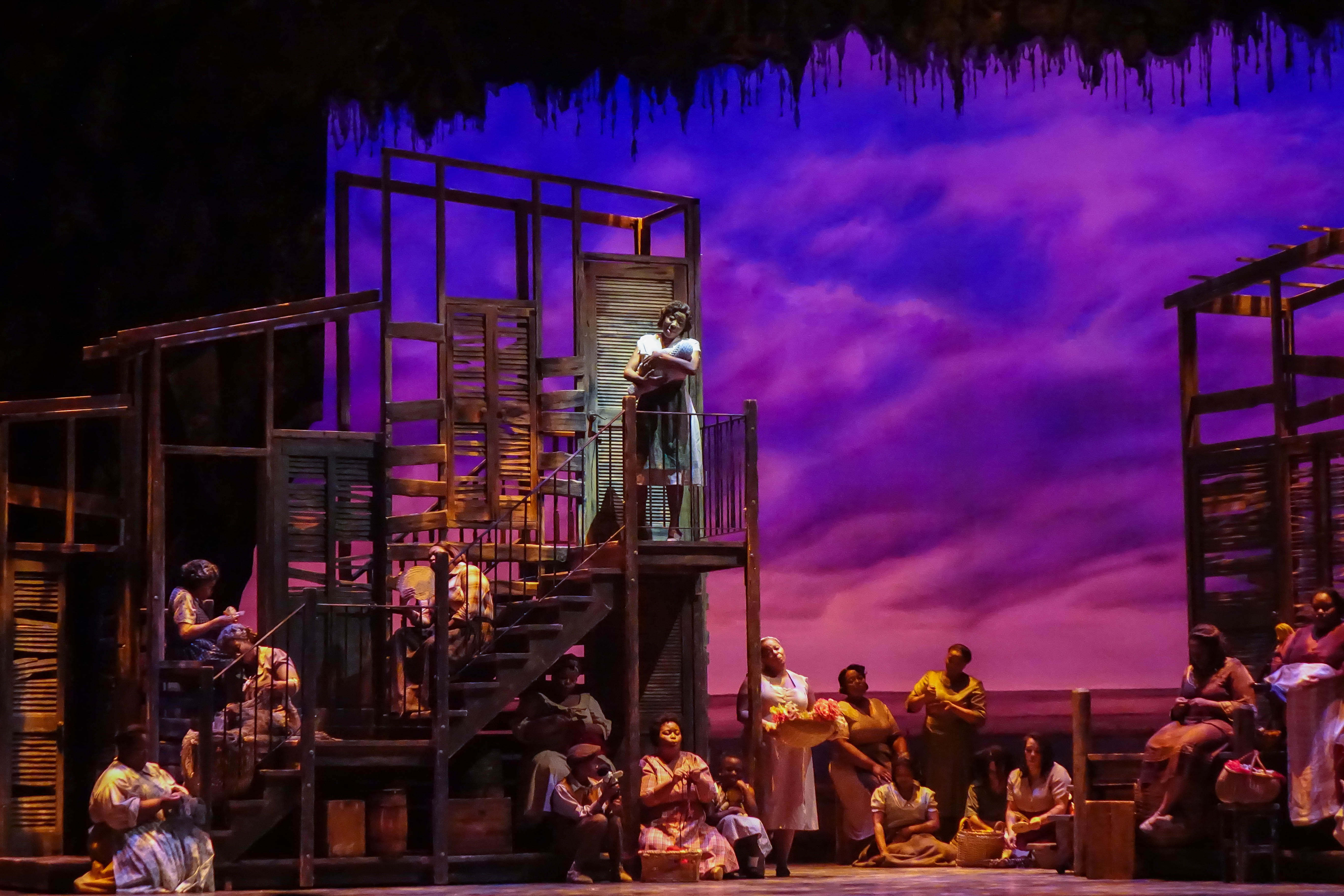
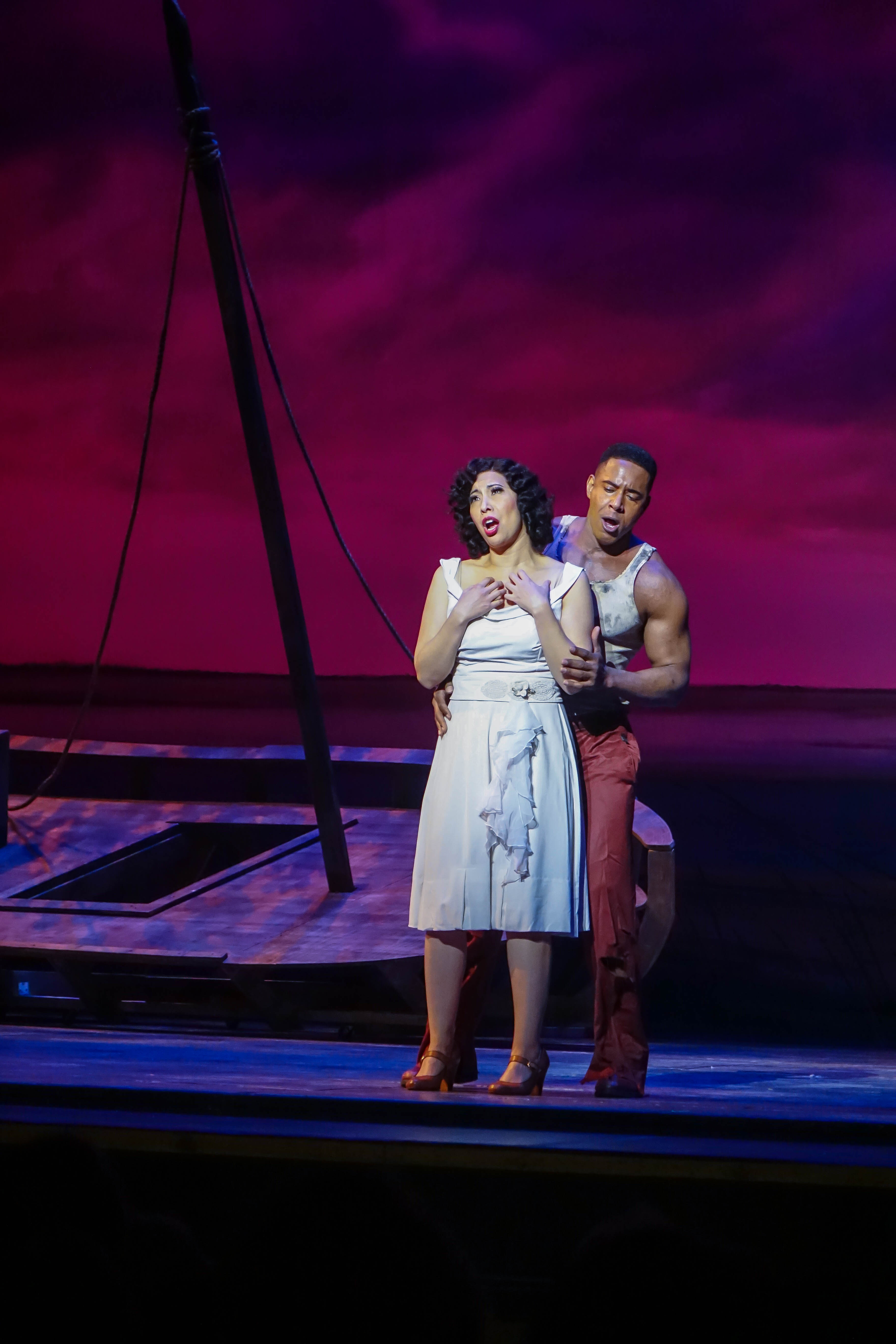
2023~Porgy & Bess-27

January 22, 2023, Charlotte, NC – Curiously enough, Opera Carolina didn’t get around to producing the Gershwin Brothers’ Porgy and Bess – an opera incomparably suffused with the sounds, scents, and DNA of the Carolinas – until its 33rd season in 1980. Turns out that was somewhat bolder than Spoleto Festival USA, which waited until its 40th anniversary in 2016 to bring this opera to Charleston, where the story is set, and where its creator/librettist DuBose Heyward was born. It can be argued that the snooty world of opera recordings was even more hesitant to acknowledge this American classic, issuing the first full-length CD edition in 1976, a full 41 years after the Boston and Broadway premieres.

Hesitancy has lingered a little at Opera Carolina, which brought back new homegrown productions of Porgy and Bess to Belk Theater in 1995 and 2003, but no others until now. OpCarolina did bring us a touring version in 2010, commemorating the 75th anniversary of the Broadway premiere, but that fiasco is best forgotten. A couple more touring versions have come our way over the past quarter century. The best of these was at the Belk in 2014, the touring version of the slimmed-down 2012 Broadway revival that had starred Audra McDonald and Norm Lewis (who just happened to be performing in the touring version of A Soldier’s Play as it finished up its two-week Charlotte run down the block at Knight Theater).

In comparison to that estimable touring treat, the new Opera Carolina production conducted by artistic director James Meena did not need to blush. At the Sunday matinee premiere, Sequina DuBose reprised her role of Clara from the Broadway tour while Nicole Cabell, featured as Clara – who sings the incandescent “Summertime” – on Decca’s landmark 2006 recording of the original 1935 Broadway score, made her Charlotte debut as Bess. Kenneth Overton, who was billed as the star of that infamous 75th-anniversary tour, was replaced by a fifth-string singer at Ovens Auditorium whose name could not be determined until five days later, finally got his chance to impress as Porgy. No less prestigious, Victor Ryan Robertson gave us a taste of what made the ornate Spoleto production so splendid by reprising his slickster grace as Sportin’ Life.

2023~Porgy & Bess-03

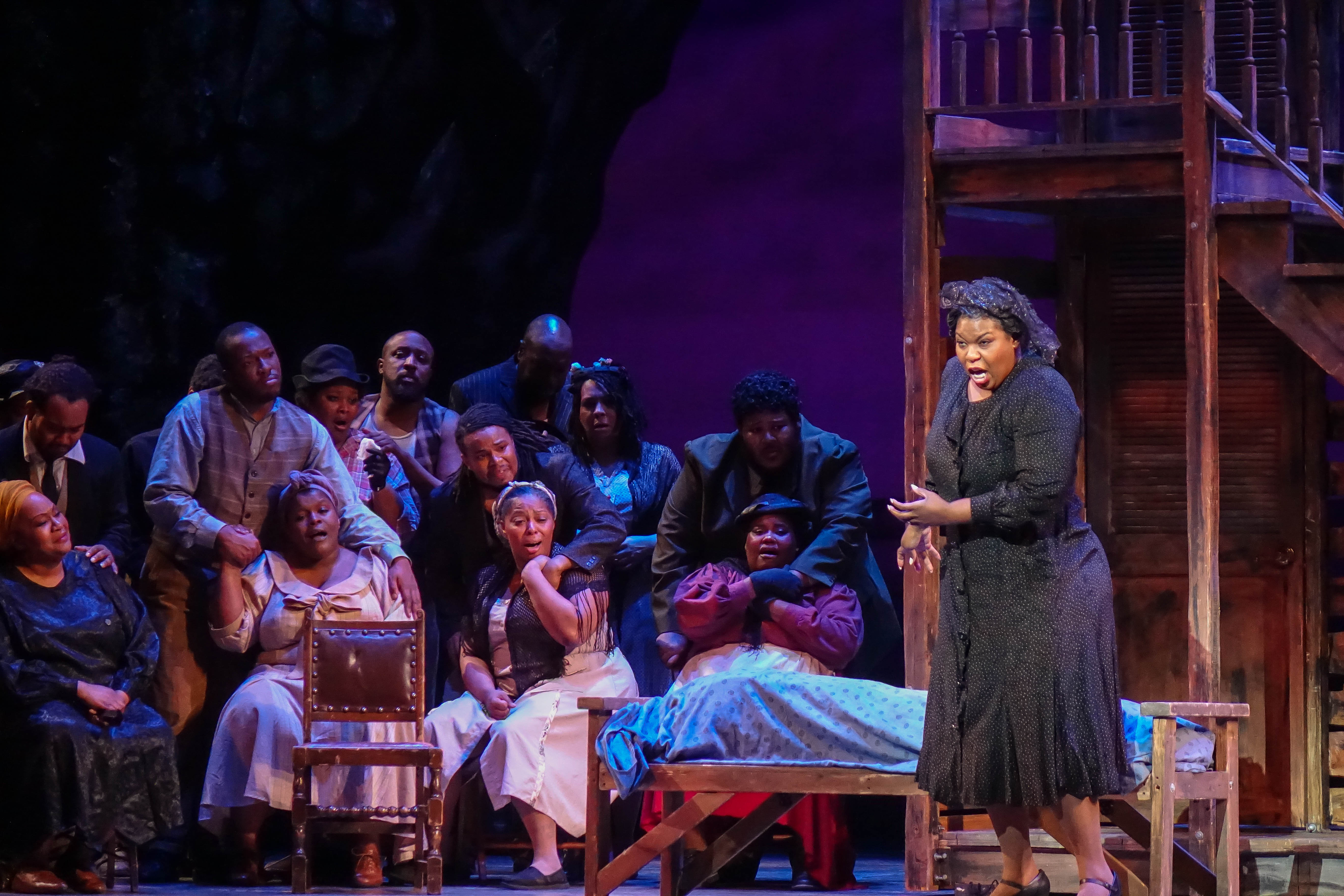
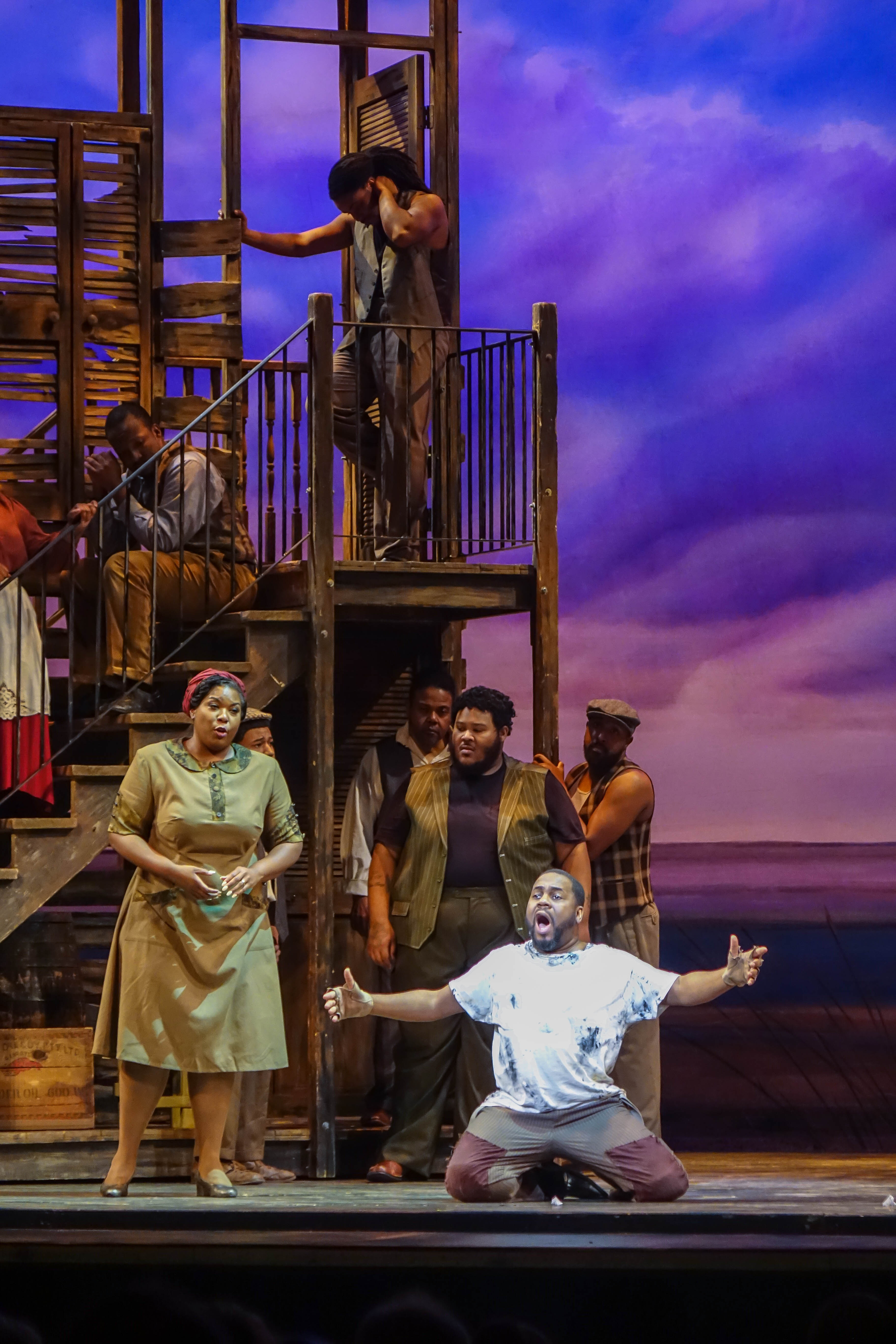
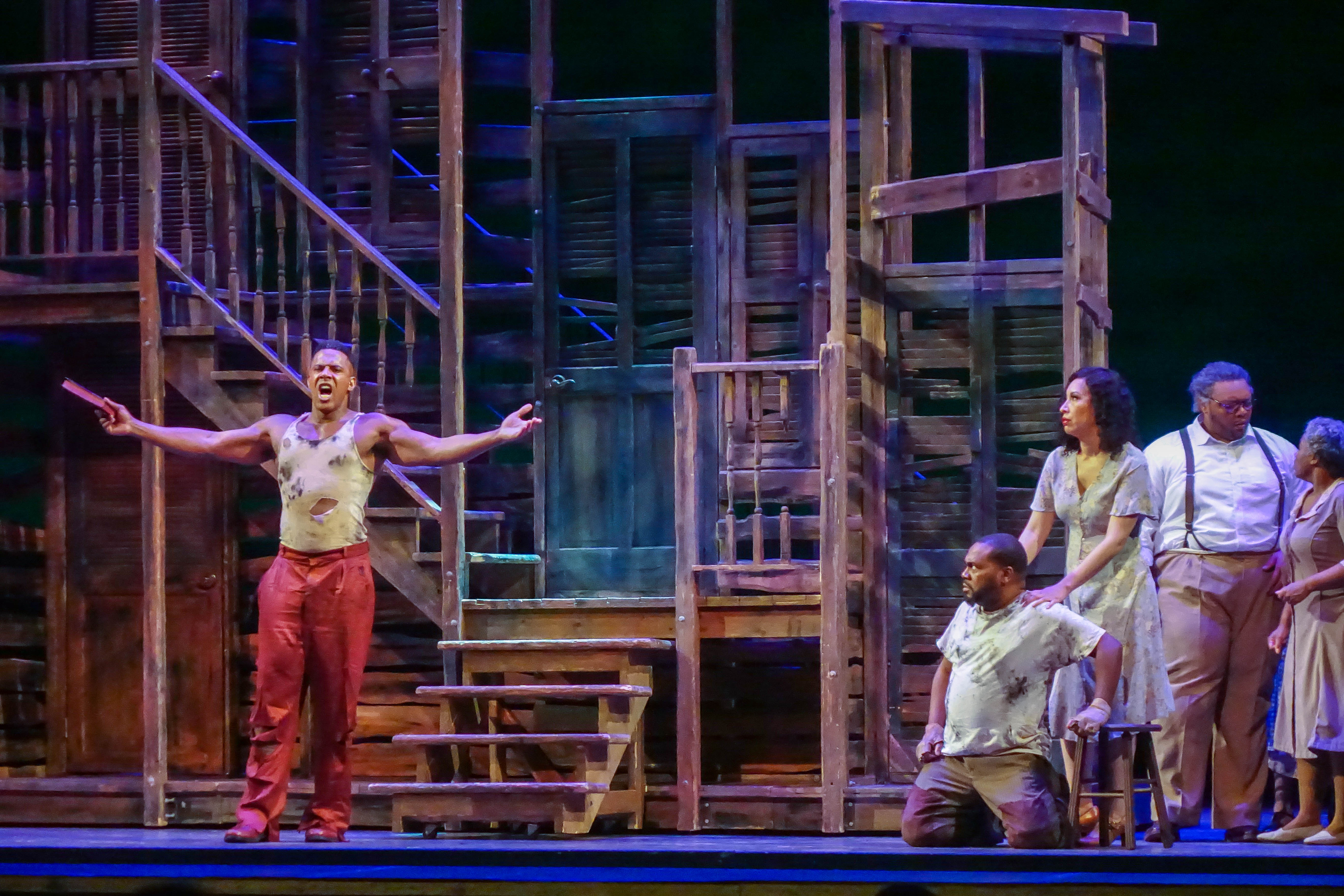
Stage director Dennis Robinson hasn’t sought to replicate that scenic Spoleto splendor, concentrating his attention instead on building the drama. Two rolling set pieces by scenic designer John Farrell replicate the dilapidated Catfish Row tenements, with backdrops and Michael Baumgarten’s wonderful lighting supplying much of the color. Those colors are usually upstaged by Ildikó Debreczeni’s artful costume designs, motley women’s and working men’s clothing in the outdoor community scenes, veering toward black in the dimly lit funeral scene for the murdered Robbins, and suddenly switching to a splash of white linens for the Kittiwah Island picnic.

Even the stylish Sportin’ Life, all purple with gold accents when we first see him, wears pure white pants and vest at the beach, though a lurid silk fuchsia shirt peeps through. Other costumes sketch the main characters’ evolution. Crown, Robbins’ murderer and Bess’s abusive former husband, is nearly as dandified as Sportin’ Life when we first see them shooting craps, yet he’s nearly in tatters when he madly emerges from hiding, seeking Bess. Debreczeni’s Bess transforms only slightly less dramatically, her first appearance in a flaming red dress when she still belongs to Crown, followed by a citified black “mourning” dress at the funeral – pointedly accessorized with pearls.

2023~Porgy & Bess-09

The funeral and picnic scenes both show off how dignity has triumphed over poverty along Catfish Row, though the seafaring men and a climactic hurricane remind us how tenuous their victory is. As Jake, Clara’s husband, reminds us as the lead voice in the men’s worksong, “It Take a Long Pull to Get There,” evoking the Promised Land in much the same way that Rev. Martin Luther King would at the Lincoln Memorial decades later. Laudably, Robinson isn’t ashamed of either Porgy or Bess. He permits Cabell’s Bess to be Bess, ambivalent toward Porgy, Crown, and Sportin’ Life, just as she was written – bold yet insecure. She yields resignedly to Crown after arguing and resisting, so she is absolutely credible when she confesses the full range of her fears in her famed “I Loves You, Porgy” of the imminent confrontation when Crown comes for her: “he hypnotize me when he take hold of me with his hot hand.”

2023~Porgy & Bess-61

Refusing to enlighten Bess or belittle her demons, Robinson collaborates with Overton to rehabilitate Porgy, making him happier and less pathetic than I’ve ever seen him before. Robinson doesn’t ignore Porgy’s mobility issues, but unlike other directors, he offers Overton multiple avenues for motion, dispelling the cripple’s usual monotony and impotence. In most productions, Porgy perpetually limps with a crutch or glides along on a cart. Occasionally, you might see that four-wheel vehicle at the rear of a goat cart, honoring Samuel Smalls, alias “Goat Cart Sam,” the real-life Charlestonian that Heyward based his protagonist upon in his celebrated 1920 novel.

2023~Porgy & Bess-04

Discarding that goat, Overton will limp, glide, crawl, and – at one key dramatic moment – even attempt to stand up and walk. This variety made Overton’s Porgy more restless, powerful, and dynamic. His crutch is a forked affair, topped by little ironing board-like cushion joining the branches, enabling Porgy to lean on it with his arm and stand upright. The cart is also cushioned to comfortably accommodate Porgy’s kneepads. We see that Overton can glide a good distance along the stage with a single paddling motion, braking with his toes, but I really didn’t notice that his wheels could swivel until the last possible moment. That revelation made Porgy’s final exit the most stunning I’ve ever seen.

2023~Porgy & Bess-46

When Overton first entered, the neighborhood greeted him with affection rather than pity. Even before he got his gal and somewhat domesticated her, he brimmed with sufficient confidence and joie-de-vivre to heartily sing “I Got Plenty o’ Nuttin’” to every woman along Catfish Row who had doubted him. You could believe in Overton as he jumped into the transcendent “I Loves You, Porgy” duet: he will stand up to Crown – and unlike the original libretto prescribed, this Porgy met Crown face-to-face rather than sneaking up on him.

2023~Porgy & Bess-53

Until Porgy’s surprisingly military departure, Robertson’s slithery balletic grace as Sportin’ Life provided the most delicious movement we saw. Executing Michael Jackson-styled spins, Robertson was the “happy dust” he peddled, the wicked exhilaration of the high life that Bess was giving up. Citified and flamboyant, Robertson also rocked Sportin’ Life’s cynicism smack in the middle of the idyllic Kittiwah picnic. His “It Ain’t Necessarily So” became a showstopper that launched Act 2 buoyantly, no less successful than DuBose’s spotlit “Summertime” when the curtain first rose. Nor did the quality wane after the drunken brawl at the dice game and Robbins’ murder when we adjourned to the gloomy funereal aftermath. Not only did we get to see Porgy duded up, upright on his feet, and escorted by a newly demure and penitent Bess, we got reminded by Michelle Johnson as Serena, Robbins’ grieving widow, of the heartfelt power pent up in “My Man’s Gone Now,” Serena’s swaying lament.

2023~Porgy & Bess-35

As the murderous Crown, Donovan Singletary had ample pects and biceps for Bess to ogle at in his OpCarolina debut, manhandling her on Kittiwah Island with the confidence – and restraint – of a brute who has willed “his” woman back to his arms for the last five years anytime he wished. The “Oh, What You Want wid Bess” duet had exactly the right blend of chemistry, antagonism, lust, and loathing. More of Singletary’s heat surfaced as Catfish Row rode out the hurricane, but his raunchy “A Red-Headed Woman” was too abbreviated, defanged, and on-the-fly for my liking. Give us a longer version, please!

Otherwise, the only persistent flaw in this beautifully sung, meticulously crafted production was the singers when they weren’t singing their arias. Nobody else came close to matching Overton’s intelligibility or audibility when dialogue or recitative pushed the story forward, an unwanted reminder of the touring production that played Ovens Auditorium in 1998. The dropout in decibels was especially dreary for me in the opening scene as the crap game dragged on, but my discomfort may be benign compared to what Porgy newcomers experienced if they didn’t already know the lyrics to the songs.

Once the brawl broke out, Heyward’s story pretty much told itself for me through the actions we watched, aided by George Gershwin’s music and orchestrations. Miking the dialogue, as most touring Broadway shows do, would certainly have been helpful, but the simplest solution for these nagging woes at the Belk would have been supertitles. That way, we could have appreciated Heyward and lyricist Ira Gershwin nearly as much as George.

Stunning and Grand, Opera Carolina Recreates the Original Designs of “Tosca”

Review: Opera Carolina Presents Puccini’s Tosca

By Perry Tannenbaum

2022~Tosca-40 

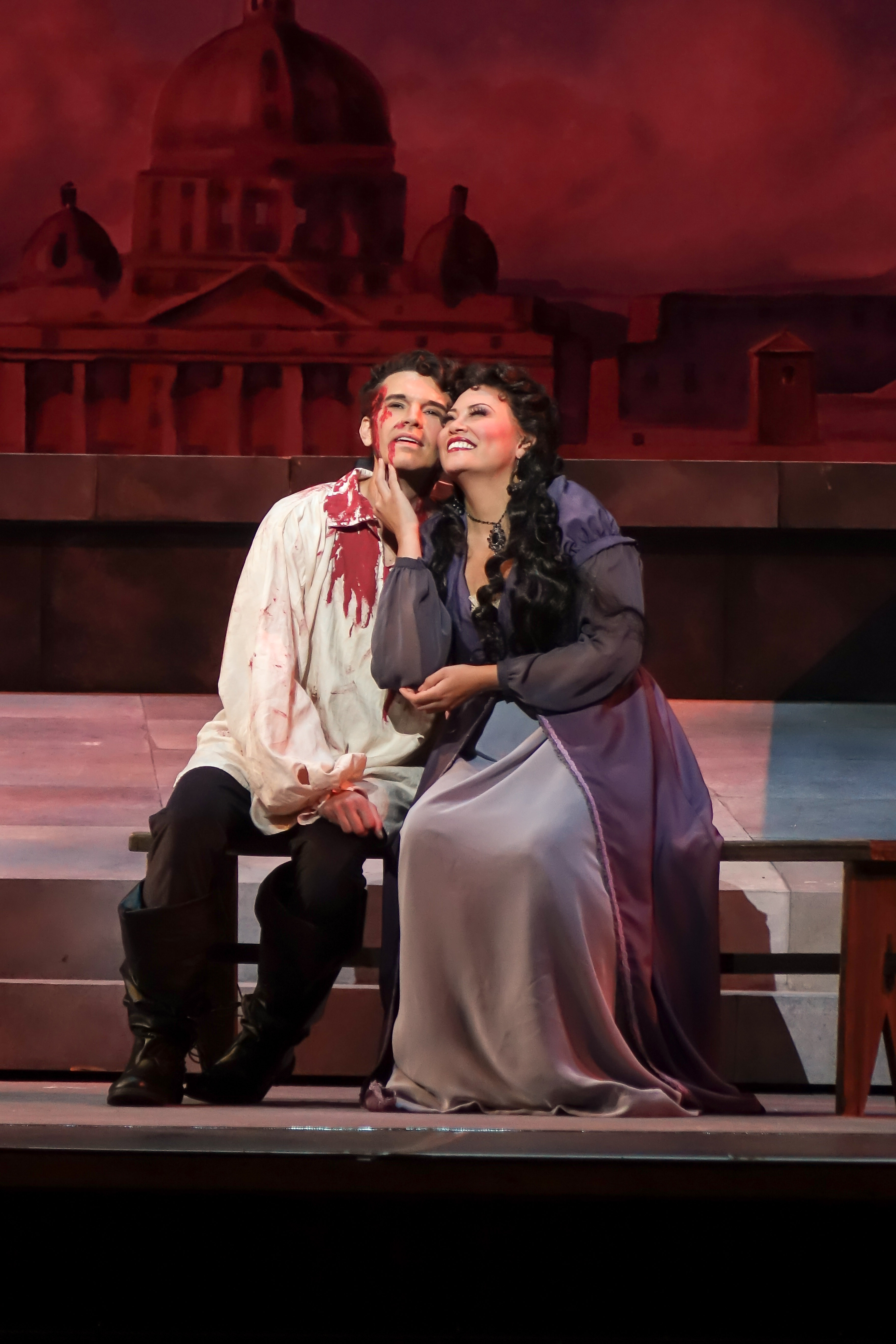
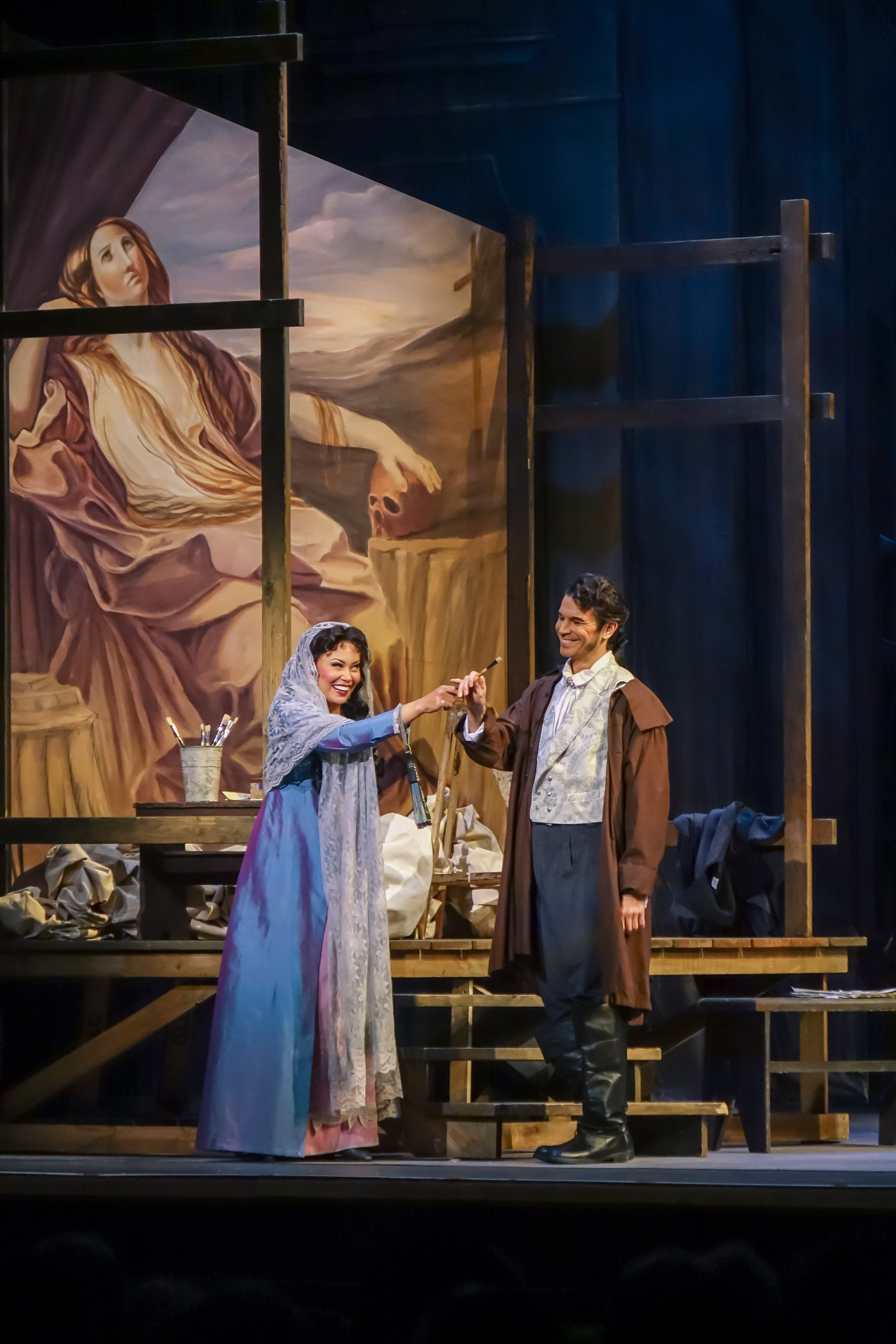
October 13, 2022, Charlotte, NC – Even in an Opera Carolina production with merely eight solo vocalists in the cast, it was easy enough to see what makes grand opera so grand. Most of the musicians on Charlotte Symphony’s payroll were in the orchestra pit when we entered Belk Theater, tuning up or rehearsing. The program booklets handed to us at the door had the size and stylishness of a glossy fashion magazine, and when the curtain rose on Giacomo Puccini’s Tosca, we saw the interior of a Roman cathedral, the first of Adolph Hohenstein’s three diverse set designs. By the end of the opening act, the stage was filled with clergy, a cardinal, and a throng of Opera Carolina choristers, all celebrating a mistaken report of a royalist victory over Napoleon’s invading army.

All of these blandishments – and extras – spell out expensive in big, bold capital letters. So it was particularly disappointing to see the Belk’s uppermost balcony completely empty and so many unclaimed seats below. If Hohenstein’s name rings a bell, we can multiply our disappointment, because he designed the sets, the costumes, the props, and the poster art for the original Milanese production of Tosca in January 1900. We can thank the New York City Opera for this meticulous recreation of Hohenstein’s handiwork – by heading out to the Belk Theater and seeing it.2022~Tosca-13

Opera Carolina lighting designer Michael Baumgarten certainly helps to capture the melodramatic spirit of Puccini’s deft adaptation of Victorien Sardou’s La Tosca, written for Sarah Bernhardt in 1887. But perhaps disheartened by all those empty seats, the opening night performance didn’t attain its full potboiler heat until late in Act 1 when bass baritone Steven Condy entered as Baron Scarpia, the cruel, lascivious, and unscrupulous chief of Rome’s city police. Until then, soprano Alyson Cambridge as opera diva Floria Tosca and tenor John Viscardi as principled painter Mario Cavaradossi hadn’t belittled the love, intrigue, jealousy, and playfulness of their relationship. Not at all. But against the backdrop of the Charlotte Symphony Orchestra, tempestuously conducted by OpCar artistic director James Meena from the opening bars onwards, both sounded somewhat underpowered, though they were clearly gifted as actors.2022~Tosca-10

Chasing after former Roman Republic consul Cesare Angelotti, who has escaped from prison and has already been secreted into hiding by Cavaradossi, Condy as Scarpia quickly injected menace and urgency into the drama. Then he cunningly worked on Tosca’s unfounded jealousy to freshen the trail to her paramour’s hideout before the curtain fell. In his tense confrontation with Tosca, Condy seemed to kindle some of the spark we would see unceasingly from Cambridge in the two acts that followed.

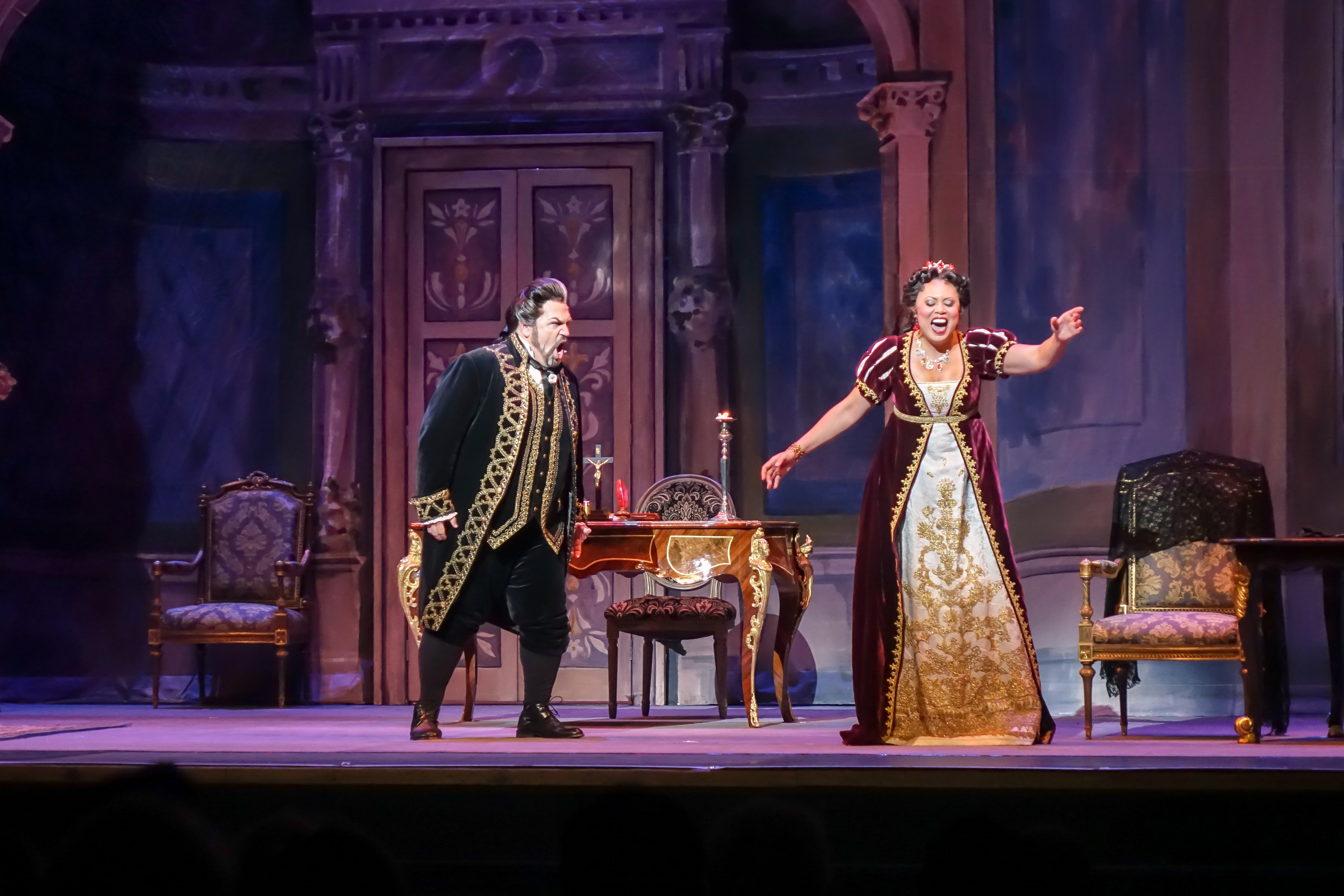
Stage director James Marvel takes full advantage of his principals’ gifts as the intricacies of Sardou’s plot come brutally to fruition in Act 2. Tosca has led Scarpia’s spies to Cavaradossi’s hideout, and soon the painter will be in custody while Angelotti has once again escaped. Scarpia dispatches his prisoner to a torture chamber adjoining his lavish apartment, hoping to extract information about Angelotti’s whereabouts. He and his thugs cannot break Cavaradossi, but they don’t have to. Tosca is with him, ruefully aware that her jealousy was baseless, and able to hear her beloved’s outcries as Scarpia’s men inflict their torture. Where the fiend has failed with Cavaradossi, he succeeds with Tosca, breaking her twice. In exchange for stopping the torture, Tosca gives up Angelotti, and to barter for Cavaradossi’s freedom, the price will be Tosca’s virtue.

2022~Tosca-16Beyond having doubted her true love’s fidelity, there was so much more for Tosca to regret now. In singing the famous “Vissi d’arte” aria before nodding her consent to Scarpia, Cambridge drew upon all the additional anguish Puccini had written for her. All of the art she had lived for, all of her passionate love, all her charitable deeds, and all her fervent prayers have been for naught in the face of this perverted monster. God has shortchanged her. With all the grim delight that Condy took in tormenting her in their crackling duets, it certainly seemed so. But Marvel was no less cold-blooded in staging “Tosca’s kiss,” where the diva settles all her debts with the Baron and appends a chilling religious ceremony.2022~Tosca-35

Courageous and bloodied in his brief appearances, Viscardi’s energy jumped nearly as much as Cambridge’s after the first intermission, but he didn’t reach his zenith until he staggered onto the rooftop battlements of the Sant’Angelo Castle in the pre-dawn light of Act 3, sentenced to face a firing squad. Maybe not quite as electrifying as Cambridge’s signature aria, Viscardi filled Cavaradossi’s “E lucevan le stelle” with sweet lyrical despair that soared upwards into the dawn appointed for his death. Alone for an extended conspiratorial duet, when both lovers grew joyous at the prospect of their coming bliss, Cambridge and Viscardi poignantly lit up the stage one last time before fate cruelly closed its fist on them. Stunning – and grand.

Scaling Back on Brassy Pomp, OpCarolina Brings Us a More Classic and Elegant Aïda

Review: Opera Carolina Presents Aïda

By Perry Tannenbaum

2022~Aïda-35

April 7, 2022, Charlotte, NC – Premiered in Egypt in late 1871 and brought home to Milan less than two months later, Giuseppe Verdi’s Aïda has become synonymous with all that’s grandiose and spectacular in grand opera. Opera Carolina has now produced this signature work nine times since its founding in 1948, only once allowing more than a decade to go by between productions. An eight-year interval is about the average in Charlotte, which we would have had if the current production has arrived, as originally scheduled, at the end of the 2020-21 season. The postponement seemed to benefit the design team responsible for the visuals; set designer Roberto Oswald, costumer Annibal Lapiz, and lighting designer Michael Baumgarten; all of whom collaborated on the 2013 production here at Belk Theater. A year further in the distance, deferred by the pandemic, this Aïda was perhaps fresher and certainly more welcome.2022~Aïda-14

With the exception of the Opera Carolina Chorus and baritone Mark Rucker reprising his Amonasro, the Ethiopian king, all of the faces onstage were new, especially tenor Arnold Rawls, substituting for the indisposed Gianluca Sciarpeletti as Radames on short notice. Infusing more freshness, almost upstaging the principals in the big scenes, were the elegant touches and classic symmetries of stage director Linda Brovsky and choreographer Gabriella Sevillano with dancers from Corta Jaca. Once again, Ancient Egypt was a no-twerking zone, graced with processions and tableaus that jibed with the times. Conducting his Verdi with customary panache, artistic director James Meena discreetly scaled back on the brassiness of the triumphal scene, recognizing that a parade of subdued Ethiopian prisoners, fettered in chains, isn’t the most glorious spectacle in 2022, when images of wartime destruction clutter our news media.2022~Aïda-07

Intertwined with the spectacle indoors and outdoors, in the blaze of day and the hush of night, was a poignant love triangle, heightened by the scintillating debut of mezzo-soprano Catherine Martin as Amneris, the cunning, jealous, amorous, and conflicted princess of Egypt. The smoothness of her arias, particularly the “Vieni amor mio” anticipating Radames’s arrival in Act 2, nicely chimed with her cool and confident manner, for once making the prospect of someday reigning with her over Egypt worth considering for the undeniably ambitious Radames. Conquering this princess’s heart was on a par with conquering Ethiopia. Also tilting the triangle, presumably because of a lack of rehearsal, was the slow-to-ignite chemistry between Rawls as Radames and Karen Slack, making her Charlotte debut as Aïda.

Launching his debut, Rawls didn’t show us all he can do vocally in his “Celeste Aïda,” and Slack similarly fell short on the self-reproachful “Ritorna vincitor!” – too nervous and melodramatic in realizing that a victory for her beloved Radames meant defeat for her native Ethiopia, and possibly death for her father, the king. More vulnerability and youthful confusion were needed here, and we never had a vivid impression that Aïda was observing even demure caution, let alone simulating deference, in keeping her royal identity from her mistress, Amneris.

2022~Aïda-21After intermission, both Slack and Rawls ascended to loftier levels, achieving parity with Martin. I was frankly surprised – and delighted – by how beautifully Slack sang the iconic “O patria mia” aria in the pivotal nocturnal scene in front of the Temple of Isis. The missing chemistry between Slack and Rawls then arrived with such a rush that it seemed like Aïda might forget to coax Radames into divulging his key military secret to the eavesdropping Amonasro. Martin and Rucker helped this denouement to crackle with tension, though Rucker wasn’t quite as imperious and intimidating as he was in 2013.2022~Aïda-23So the unique two-tiered finale played really well, with all three principals in top form. Rawls and Slack, buried alive as the lovers, consoled each other sweetly in their love duet as Aïda managed to sneak into the tomb and share Radames’s punishment for betraying his country. Meanwhile, Martin completed Amneris’s graceful arc above them, remorseful for triggering the downfalls of her beloved and her rival, wishing both of them peace.

Credit Brovsky and Sevillano for the stateliness and elegance of the public scenes, the one at the Temple of Vulcan, where the beneficence of Ptah is invoked, and the triumphal scene where Pharoah and Amneris preside. Song Zaikuan was a resplendent Pharoah, Jordan Bisch declaimed with stony certitude as Ramfis, the high priest, and Katherine Kuckelman was a sublime High Priestess – all in costumes to die for.

With both a matinee and an evening performance scheduled for Saturday, this review serves as a reliable guide to the upcoming evening encore. Only Bisch and Zaikuan will be on hand for the Saturday matinee – along with Meena’s sure hand with the score.

Originally published on 4/9 at CVNC.org

“The Falling and the Rising” Offers a Kaleidoscopic View of the Military Experience

Review: Opera Carolina Presents The Falling and the Rising

 By Perry Tannenbaum

2022~Falling and Rising-24

March 11, 2022, Charlotte, NC – Four men give their lives to save just one woman soldier, a woman so severely injured that she must be placed in an induced coma to give her any chance of continued survival or even partial recovery. The math and the logic may not seem to add up unless you’ve served in the military or you’ve witnessed The Falling and the Rising, a fairly new opera by Zach Redler and Jerre Dye that may impact Opera Carolina audiences more freshly today than when it premiered in 2018.

Before COVID and Ukraine, when the White House was occupied by a grifter who labeled people who signed up for battlefield duty as “suckers,” the mentality passionately advocated by The Soldier protagonist – that military service is not only a commitment to give your life for your country but also a commitment to give your life for your soldiering comrades – may have seemed rabid, over-the-top, or naively gung-ho. After witnessing the bravery of so many healthcare workers routinely facing the perils of a deadly transmissible disease for the past two years and, more recently, the inspiring popular resistance of so many outgunned Ukrainians, we can likely view that military mentality – and those four soldiers’ sacrifice – as making more sense.2022~Falling and Rising-07

This brash Opera Carolina production, conducted by Emily Jarrell Urbanek and stage directed by Sam Mungo, brings the company to a new venue, the Sandra Levine Theatre in the gorgeously renovated Sarah Belk Gambrell Center, while it brings subscribers a radically different experience. Once the female Soldier is comatose, we’re carried along with her for the bulk of the opera on a kaleidoscopic cavalcade of dream sequences, so the military experience is conveyed to us not only by soldiers in battle and trauma, but also by dedicated doctors and anxious family.

The immersion begins in the Gambrell lobby, where you can pick up info on the Montford Point Marine Association and the Blue Star Mothers of Charlotte. You can also peep in on artworks and obtain a comprehensive coffee table book produced by Bullets & Bandaids, a non-profit veteran and civilian art project. Immersion couples with education at the Gambrell, so it’s fitting that the complex is on the Queens University campus, for the world premiere of The Falling and the Rising was also on academic soil at Texas Christian University, one of seven organizations that commissioned the piece.

A new work set in wartime might trigger a couple of red flags for traditional opera lovers averse to chaos and cacophony. But you’ll find that Redler’s score is comfortably tonal and melodic when soprano Melinda Whittington begins singing a birthday video into a laptop computer for her daughter’s upcoming thirteenth, apologizing and commiserating because they will not be together to celebrate. In fact, when Redler has Whittington pivoting to a shuffle beat, you might briefly wonder whether the composer has crafted a score that’s too casual and accessible.

The roadside IED explosion, with a striking video montage by designer Michael Baumgarten (lights/scenery/video), puts that worry permanently to rest. After the hospital huddle of doctors and a ZOOM consultation where the induced coma is prescribed, the opera is largely a series of extended arias and duets until we reach a closing paean to the men and women who serve, joined by a pre-chosen brigade of vets parading up to the stage from the audience.2022~Falling and Rising-23

Sound at the Levine is noticeably more resonant than the Belk Theater and marginally warmer than Knight Theater, halls where we normally hear Opera Carolina and Charlotte Symphony. Although directors might be tempted to mic student plays and musicals in this 1000-seat space, all of the soloists projected quite easily on opening night to Row M, where we were seated. Redler’s orchestration for 11 musicians balanced well with the singers, and Urbanek had no difficulty in coaxing a hearty variety of colors from her band, which included a French horn, clarinet, guitar, piano, two percussionists, and strings. There is an orchestra pit at the Levine, but it doesn’t protrude far – or impinge on the bond between audience and performer. When baritone Kenneth Overton as the Homecoming Soldier concluded his church sermon, seated in a wheelchair in front of a large wooden crucifix, it didn’t feel like he was calling across a wide gulf when he asked us for an “Amen!”2022~Falling and Rising-11

Gathered from interviews at Fort Myer, Fort Meade, and the famed Walter Reade Military Medical Center, Dye’s libretto was suffused with authenticity and often riveting. Mezzo-soprano Audrey Babcock exuded intensity as Staff Sergeant First Class Toledo, steely and tough as her nickname, which figures into the boot camp segment of her aria. Dominic Armstrong took us to the skies with his heroic tenor voice as Jumper, a First Sergeant who mixes hard-nosed honesty with patriotism as he readies Soldier for her first parachute jump. Parting words: “Don’t forget to pull the string!” After that uplift, bass-baritone Peter Morgan brought us back down to earth as Colonel, seen in civvies in his living room, hoping that his military wife will survive.2022~Falling and Rising-17

Each of these monologues was substantial enough to give Whittington a chance to rest her voice before she joined in duet, a mercy when you consider the extra decibels she can pour out. The most brutally honest testimony in this cavalcade came from Overton in his wheelchair as the Homecoming Soldier, ideally placed by Dye at the juncture of his libretto between the last of personal testimonies and our protagonist’s emergence from her coma. Also artful were the spins that Dye put on his title, for we quickly learned that The Falling and the Rising wasn’t simply, as we expected, about the traumas and dramas of battlefield injury and recovery. We first encountered “The falling and the rising” in the Soldier’s memories of her daughter, back when she was an infant and Soldier was simply a mom watching her baby’s breathing as she slept. Later it was the impending leap from an airplane, with all of its danger and exhalation.

So there is music and drama in this latest Opera Carolina production – and poetry as well.

Originally published on 3/13 at CVNC.org

Opera Carolina Finds New Balance in Mozart’s “Don Giovanni”

Review: Don Giovanni at Belk Theater

 By Perry Tannenbaum

220203_OPC_CON_1103

February 3, 2022, Charlotte, NC – Among the lovable scoundrels of Western world literature, surely Don Juan has proven to be the most lovable – Molière, Goldoni, Lord Byron, Shaw, and Mozart are just a few of the notables who have sung the Spanish Don’s sins over the past 400 years. His tale can be seen as a series picaresque escapades and comical conquests, or as a grim and grisly revenge tragedy, or as a stern moral lesson. Armed with a wondrous libretto by Lorenzo da Ponte, Mozart disdained to choose among these alternatives, daring to make his Don Giovanni all of the above. With so much to see and emphasize, it’s no wonder that each of the six productions I’ve reviewed since 1991 has been so different from the others – including a Czech National Theatre production at the Estates Theater in Prague, the venue where Mozart’s masterwork premiered in 1787.220201_OPC_DON_053

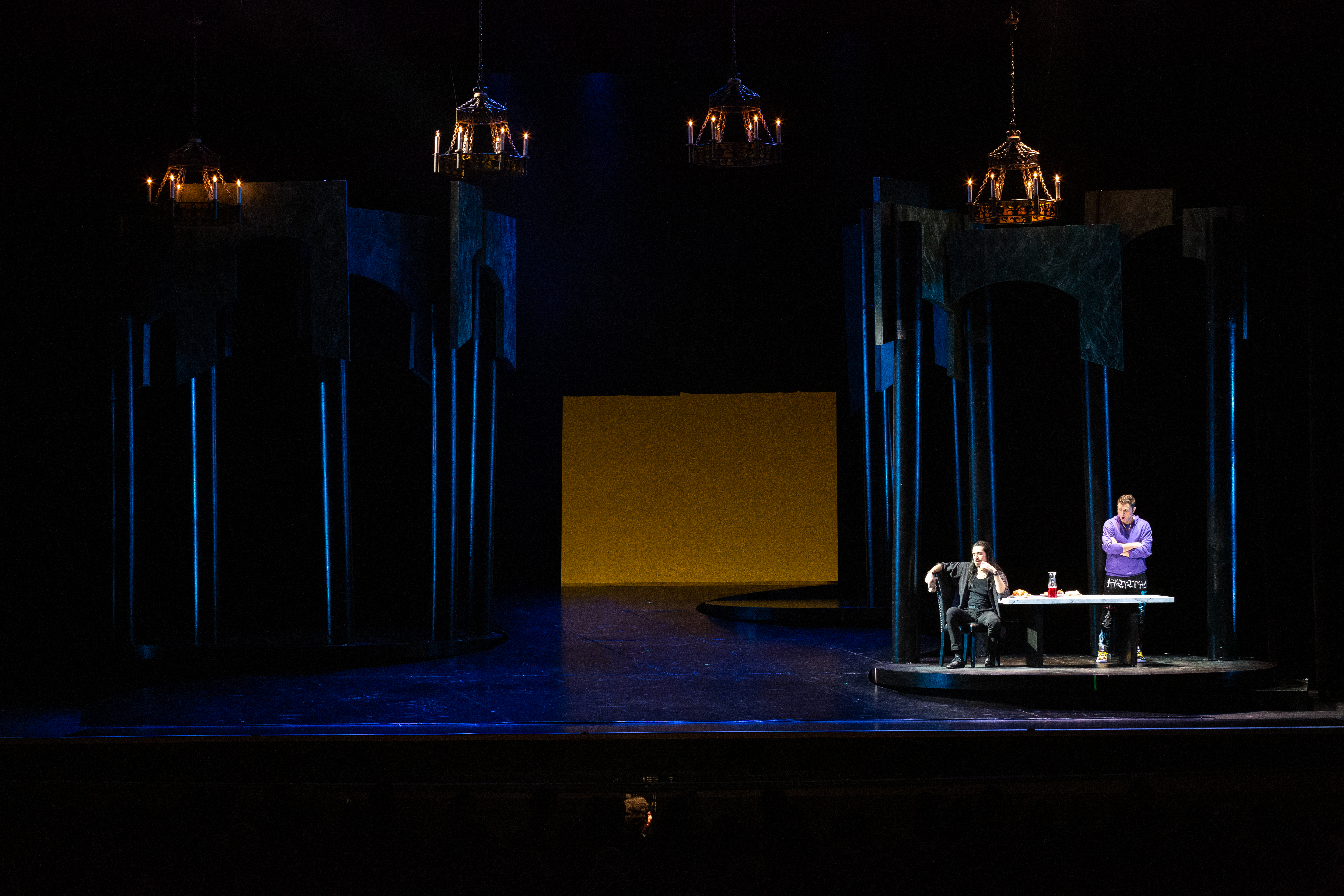
In her Opera Carolina debut, stage director Eve Summer pays little attention to scenery, relying on props and Whitney Locher’s costume designs to modernize the action. Donna Anna’s home doesn’t have a façade in the opening scene, where Giovanni flees after raping the noblewoman and is compelled to murder her father before he can escape. Nor is there an exterior, let alone an upstairs, at Donna Elvira’s lodgings in Act 2, when Giovanni serenades milady’s maidservant while Leporello, the Don’s servant masquerading as his master, creates a cunning diversion. Three revolving pods help simulate the places where the swift action unfolds, and Michael Baumgarten’s lighting designs signal the transitions and enhance the drama – especially in the denouement, when the Commendatore, Donna Anna’s murdered father risen from the dead, implacably gets his revenge.220201_OPC_DON_426

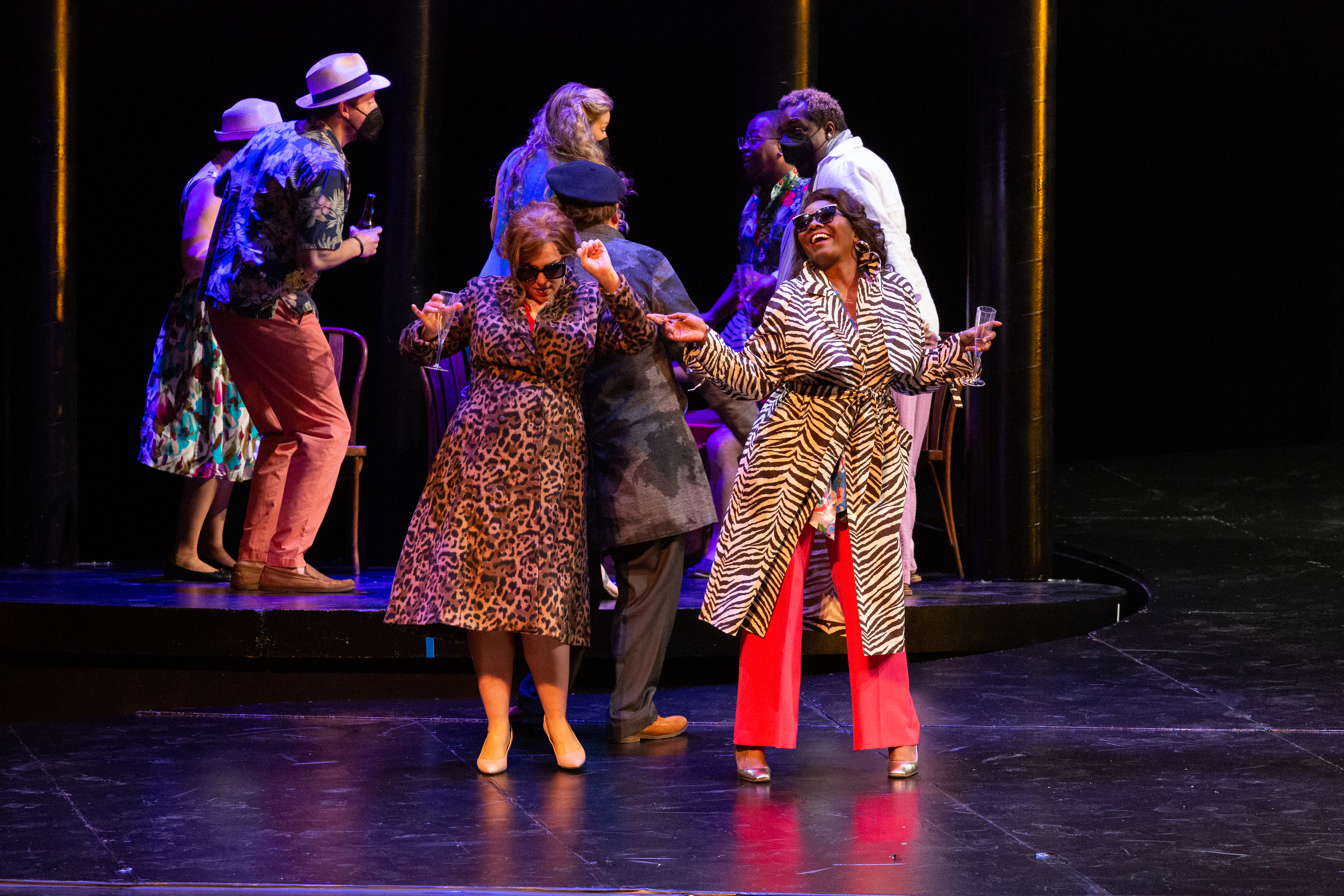
Summer hasn’t totally surrendered to modernity in her vision of Giovanni, for she surely could have gone further than equipping Elvira with contemporary luggage as she pursues the Don and turning the pages of Leporello’s book chronicling the rogue’s romantic conquests into an iPad that he scrolls. Balancing these modern touches are the curved tops of the revolving pods, evoking ancient arches, and the presence of harpsichordist Emily Jarrell Urbanak, seated at stage right throughout the evening. In a way, the singers also straddled different eras, always immersing themselves in Mozart’s music, yet the diversity of the casting – and a few of the dance moves they busted at Giovanni’s soiree – returned us to the new millennium. Most anachronistic were Sequina DuBose as Elvira, lugging her rolling stack of suitcases up a couple of stairs and down a ramp, and Alex Soare as Leporello, discarding his sensationally grungy attire only when he impersonated Giovanni (though Locher’s design here may have also been inspired by the Ghost of Christmas Future).220201_OPC_DON_170

Dashing, cruel, and overflowing with conceit, bass-baritone Richard Ollarsaba made a stunning debut as Giovanni, even if the mod dress deprived him of the opportunity to unsheathe a sword. His overtures to Elvira, her maid, and the peasant girl Zerlina were all lusciously seductive. Encounters with Leporello and Masetto, Zerlina’s fiancé, crackled with scornful superiority, sometimes snarling and sometimes nonchalant. The old Commendatore seemed to draw the very best from Ollarsada, cavalierly deferential to his age in resisting his challenges to combat in the opening scene, defiant and fatally unrepentant when Giovanni’s fate was sealed. As rich and appealing as Ollarsaba was when he sang, Alex Soare was startlingly convincing as Leporello when the servant was called upon to masquerade as his master. To bring out the servant’s comic flavor, moments when Leporello was marveling at the gullibility of Giovanni’s victims were underscored more boldly than the disillusion, disgust, and abject fear that the Don’s escapades put him through. Nor was bass-baritone Ashraf Sewailam chiefly onstage as Masetto to clownishly portray the peasant’s malleability, showing us far more of the hothead than the usual hayseed. In the same spirit, tenor Johnathan Stafford White as Don Ottavio, Anna’s staunch and patient fiancé, is more of a noble champion than a feckless chump.27sQMG5Q

Perhaps even more than the men, the excellence of the three sopranos cemented my suspicion that this was the deepest Opera Carolina cast I’ve seen. While Summer didn’t allow Rachel Mills quite as much risqué latitude as I saw in Prague in consoling her battered Masetto, this Zerlina was no less irresistible in her “Vedrai carino,” applying the balm of love on his bruises. Although there were slight chinks in DuBose’s vocal armor, there were no losses in sweetness when there were dips in volume as Elvira sang her woes, and DuBose is such a fine performer that I had second thoughts each time I steered my attention elsewhere – so many of her reactions are worth watching. Most revelatory was Melinda Whittington as Donna Anna, a role I’ve often found annoying in her chaste righteousness. Whittington amped up the feeling of this grieving rape victim while tamping down her outraged fervor. Summer allowed her to wear a color to the Don’s soiree instead of shrouding her in mourning, and those dance moves further humanized her.220203_OPC_CON_1197

The joyous epilogue, celebrating the triumph of justice over wickedness, is scrapped in this new Opera Carolina production. Somehow that enhances the impact of bass Jordan Bisch as the avenging Commendatore. Both at the cemetery accepting Giovanni’s dinner invitation and later at the Don’s banquet hall, Bisch resounds thrillingly as the voice of doom. After blasting my eardrums just three weeks earlier from the Belk Theater stage with Mahler’s Ninth, a discreetly reduced Charlotte Symphony sounded comparatively wan as it wafted the Giovanni overture out of the orchestra pit. But Opera Carolina artistic director James Meena had the ensemble perfectly calibrated for the occasion, and when the curtain rose, the blend of singing and playing gave constant pleasure. As I stepped onto the elevator with another couple, hurrying to beat the Belk crowd out of the parking lot, the husband couldn’t help gushing, “This is the first classical opera we’ve seen!” If future productions are as good as this Giovanni, they will be coming back again and again.

Originally published on 2/5 at CVNC.org

Reboot of “I Dream” Reminds Us How True Heroes Fight for the Right

Review: I Dream from Opera Carolina

 By Perry Tannenbaum

I Dream.

After repeated efforts to capture the essence of Martin Luther King in his twice-revised I Dream, opera composer and librettist Douglas Tappin must keenly appreciate the biblical frustration of Moses on Mount Nebo – and of MLK behind a Memphis lectern on his final night. He has seen the Promised Land, but he cannot get there. For the life of this civil rights hero/icon/martyr is inextricably intertwined with his words, unforgettably spoken in Washington, in Memphis, from his Atlanta pulpit, and written from a Birmingham jail, yet hardly a trace of them can be found in Tappin’s script.

Opera Carolina’s latest remount of I Dream, which premiered in 2010 in Atlanta and reappeared in Toledo and Charlotte in 2018, newly revised for the 50th anniversary of MLK’s assassination, is a more strategically refined and focused dance around the rhetoric with new stage direction – and considerable dramaturgical input – by Tom Diamond. James Meena, now entering his twentieth season as Opera Carolina’s artistic director, once again directed the orchestra, arguably with more ardor than ever for Tappin’s score.

If the music brings Porgy and Bess to mind, your concept likely chimes with Meena’s, for two of his principals, Alyson Cambridge as Coretta Scott King and Victor Ryan Robertson as Hosea, figured prominently in the storied revival of George Gershwin’s opera at Spoleto Festival USA in 2016. Kenneth Overton as Ralph Abernathy and Lucia Bradford as MLK’s Grandma are also steeped in that Gershwin masterwork. Yet it’s equally apt to note the influence of Broadway-style musicals on Tappin, whether it’s the revolutionary fervor of Les Miz or Andrew Lloyd Weber’s notion of opera in his Phantom. Certainly, Tappin’s music disarms any fear of being assaulted by discordant recitative and parched in a desert where no melody or aria is to be heard. On the contrary, ticket holders should brace themselves for a superabundance of power ballads.

The musical climax of the show, in the Birmingham jail, is a duel of power ballads. Robertson challenges the whole non-violent ethos of King’s movement with a spirited, militant “No Victory by Love,” and Derrick Davis as MLK answers – still triumphantly, if audience reaction was any indication – with the anthemic title song. Davis and Tappin are at their best in showing us the visionary MLK and the staunch courage of his non-violent philosophy, but the libretto needlessly attempts to deepen our impression of King as a prophet. Repeatedly, Davis must dwell on a foreboding dream in which he sees the balcony of the Memphis motel where he will be shot.

We must assume that Tappin believes this device cements King’s credentials as a prophet, though it actually undercuts them, for Davis must keep puzzling about the meaning of this dream – which is emphatically not the dream we associate with King – and Overton as Abernathy, instead of all the substantial issues and concerns he might be discussing, must waste his time (and ours) by counseling his leader to confide Tappin’s invention to his dear wife Coretta.

One might quibble over whether MLK really dedicated his career to his Grandma, but Bradford’s rendition of “Sunday Is the Day” was certainly powerful enough to inspire dedication. If Coretta is also a formative presence in MLK’s career, there’s a place for Cambridge to be singing “I Have Love to Give,” since it dovetails with her husband’s story and core beliefs, but “Midnight Moon” merely detains us in generic romance. While repeating a song with new meaning is a traditional Broadway device, it’s a bit problematical in Tappin’s hands. Late in the show when Cambridge sings “Queen Without a King,” she memorably expresses a steely determination to continue her martyred Martin’s work and assume a leadership role, a wisp of Evita that should take firmer root in Tappin’s score. Earlier, the song simply types Coretta as a weepy wife wishing her husband would stay home with family instead of pursuing a noble cause.

Sounding like a swaggering song that Crown might sing in Porgy, “No One’s Gonna Keep Us Down” took us deepest into Gershwin’s bluesy groove, and “Count to 10” worked surprisingly well in espousing MLK’s turn-the-other-cheek credo. “Top of the World,” a song of risqué celebration like “Masquerade” in Phantom, hinted at the danger of celebrity for King that could have made him vulnerable to the scheming of FBI director J. Edgar Hoover, who gets a sadly superficial airing that is also symptomatic of Broadway. He’s not an implacable Javert, that’s for sure.

If Martin’s womanizing or Hoover’s scandal mongering could have been shown as jeopardizing MLK’s greatest enterprises – the March on Washington, the march on Selma, or the Voting Rights Act – they would have rewarded deeper exploration. But in circling King’s greatest speeches, Tappin barely grazes what Memphis meant and almost completely ignores the March on Washington. That’s nothing short of astonishing vis-à-vis the expectations of an audience coming to see I Dream – until we consider that Tappin is skirting the actual quote, “I have a dream.” Gaping hole there as well.

To be fair, Tappin’s last two revisions were pre-pandemic, when the freshest take on King’s legacy was the Oscar-nominated Selma. No doubt about it, the march on Selma and its aftermath, in a presidential address by Lyndon B. Johnson, are the dramatic high points in Tappin’s revision, in Diamond’s staging, and Michael Baumgarten’s lighting and video design, climbing majestically on the shoulders of the Birmingham sequence. Meena was strong throughout the evening, all through the two hours and 18 minutes that Tappin’s music flowed through him, perhaps strongest when he was needed most, after Davis climbed the ramp to the Memphis motel balcony for the last time.

Before the pandemic, George Floyd, the 2020 landslide election, and January 6, I Dream was more on target than it is today. If he had rewritten his opera after last November, Tappin would likely have sharpened his libretto’s emphasis on the importance of voting rights. A revision after January 6 might have further prompted a reawakening to the significance of the August 28, 1963, March on Washington. For we do need reminding now what peaceful protest really is, how powerful and transformative non-violence can be, and how much more civil “I have a dream” and “We shall overcome” are as rallying cries than “fight like hell or you won’t have a country anymore.”

Sadly, we also need to be reminded that Martin Luther King hoped to move us toward “that day when all God’s children, Black men and white men, Jews and Gentiles, Protestants and Catholics, will be able to join hands and sing.” The “you” that Donald J. Trump was addressing on January 6, 2021, belonged to only one of those groups, preferably those willing to march into the Capitol with a Confederate flag.

Op Carolina Animates “Macbeth” in “Game of Thrones” Style

Review: Verdi’s Macbeth

By Perry Tannenbaum

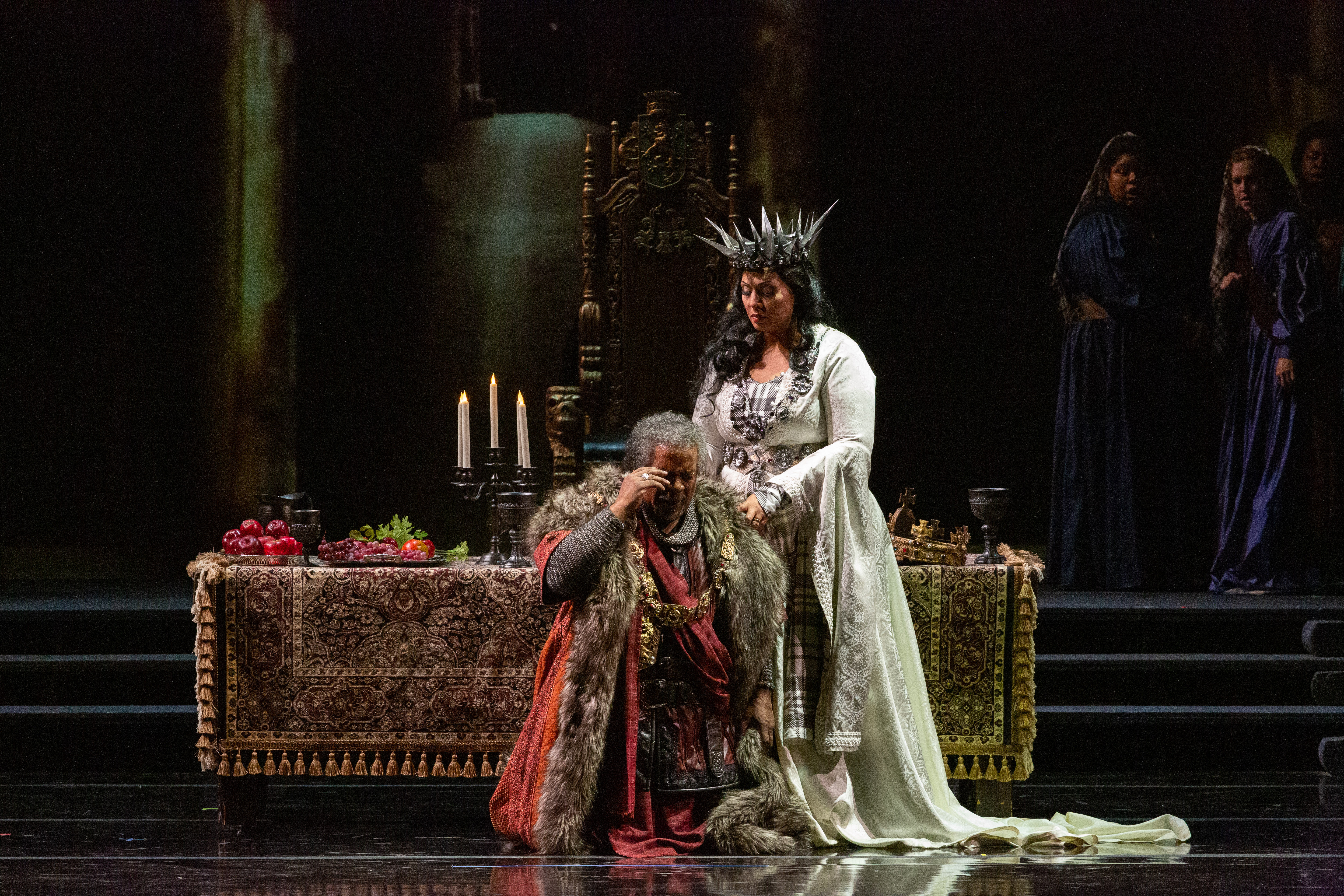
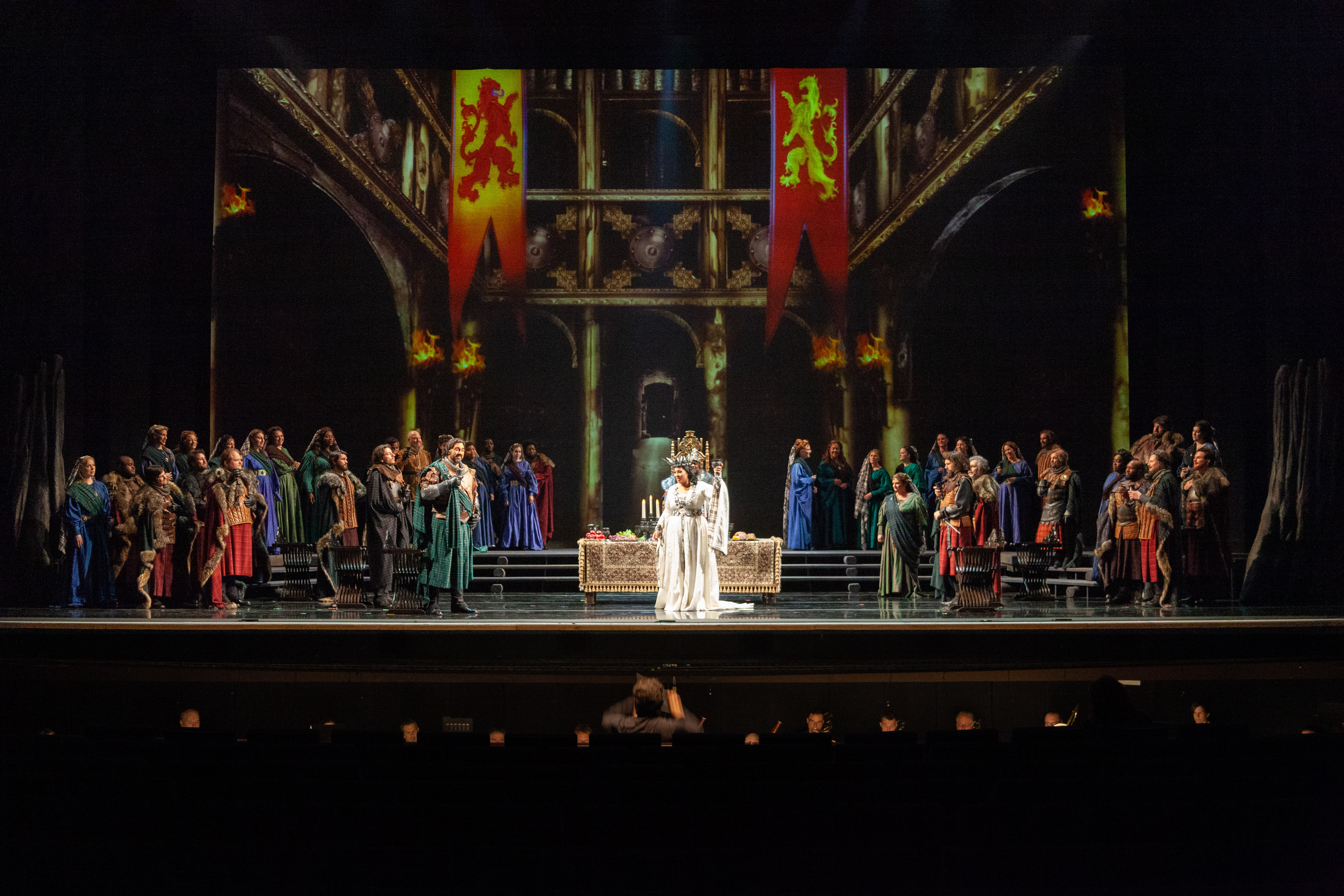
191105_OPE_MAC_251

Witches, ghosts, Scottish clans, regicide, guilty sleepwalking, and Shakespeare’s most famous despairing rhetoric have kept Macbeth among the Bard’s most-produced tragedies. Onstage, we’ve seen such spinoffs as Tiny Ninja Macbeth and Kabuki Macbeth in Charlotte conjuring up the one Shakespeare title that theatre veterans dread to say aloud. I suspect that, in opera as in theatre, only Romeo and Juliet has inspired more adaptations and spinoffs.

Further riffs on Macbeth have been applied by opera directors. Perhaps the most notorious were the costumes and scenic design of Mark Thompson at the Metropolitan Opera in 2008, where the Thane of Cawdor, prior to meeting the witches’ coven in post-WW2 Scotland, came riding onto the battlefield in an army Jeep. Trading on the popularity of Game of Thrones, stage director Ivan Stefanutti – adding his own costume and scenic designs to his new brew at Opera Carolina – has been quite content to return the action to 11th century Scotland, where King Duncan was murdered in 1040.

191105_OPE_MAC_874

Undoubtably trusting Op Carolina artistic director James Meena, who directed the company’s premiere of Macbeth in 2004, Stefanutti brings baritone Mark Rucker back to Belk Theater to headline his high-concept production in the title role. Rucker conquered vocally as convincingly as before, though his tendency to waddle across the stage rather than striding confidently has become more noticeable during his 15-year hiatus. Stefanutti limits Macbeth’s mobility in his staging to the point that he is often upstaged by the Witches and Lady Macbeth.

Yet it must be said that Rucker’s hulking lack of grace chimes well with the Game of Thrones design concept, emphasizing the barbaric elements of the bloodthirsty king. It was probably a worse decision for Stefanutti not to delegate the animated backdrop of his production to a different artist. As executed with Michael Baumgarten, Stefanutti’s animations are way too busy, too much like a low-budget video game, and occasionally over-the-top, especially when the ghost of Banquo appears.

For some reason, there were stretches when the animations strove to simulate traditional set pieces and backdrops. Scrolling through a series of these stage-filling line drawings while the stage was vacant, Baumgarten made it look like Macbeth’s throne was riding an elevator from one hall to another! In a far, far niftier stroke, color begins to seep into the design concept when Macduff launches his vengeful rebellion against Macbeth, escalating further when Lady M has her sleepwalking scene.

191105_OPE_MAC_268

Thrones fans will likely adore the Witches’ costumes with their piercing LED eyes and floor-length beards, but their singing is equally triumphant. Outfitted in less outré gear, the men’s half of the Op Carolina Chorus is vocally as outstanding as the women’s. Obviously, the entire ensemble drew plenty of attention from Meena in rehearsals – and plenty of blocking from Stefanutti.

The youngbloods making their Charlotte debuts all do well under Meena’s baton. Bass baritone Song Zaikuan excels as Banquo even when that ridiculously large ghost animation looms behind him. Tenor Gianluca Sciarpeletti sings purely, but he struck me as too youthful to have lost a gaggle of children, which may account for his shortage of gravitas. In the other tenor role, Johnathan Kaufman’s similarly pure voice and manner are more of what we expect of Prince Malcolm, who assumes the Scottish crown after the showdown between the Macs.

191105_OPE_MAC_811

Biggest disappointment of the night was soprano Othalie Graham as Lady Macbeth. On opening night, she seemed to have lost the bloom that I found in her voice when she made her Op Carolina debut in 2013 as Aïda. Reading Macbeth’s letter, plotting Duncan’s death, and even singing gaily at the haunted banquet, Graham had me wincing each time she prepared to sing an upward interval. Couldn’t be sure she would land on precisely the right note. Yet she still cuts a charismatic figure onstage, with genuine diva acting chops. Lady M’s white gowns by Stefanutti enhance Graham’s royal glow, setting her apart from her gloomy surroundings.

Warmed up and relaxed, Graham was at her best in her valedictory sleepwalking scene. From that highlight onwards, action from singers other than the Witches picked up, Meena continued to draw spirited work from the Op Carolina Orchestra, and those mammoth animations didn’t distract during the climactic battle.

All in all, Op Carolina seems to have created a stylized Macbeth that would spark mass appeal. After all the toil and trouble that Meena, Stefanutti, and Rucker put into this spectacle – with more LED-eyed Witches than I could count – I was shocked that more people weren’t at Belk Theater to soak up all the fun, spookiness, and Game of Thrones cachet.

A Duke Has Fun, Safe from #MeToo Consequences, in Opera Carolina’s “Rigoletto”

Review: Rigoletto

By Perry Tannenbaum

When he wrote his 1832 play, La roi s’amuse, Victor Hugo lavished a good amount of research on 16th century French king François I and his illicit love for the daughter of his court jester, Triboulet. Giuseppe Verdi and librettist Francesco Maria Piave, who had previously teamed together in transforming Hugo’s Ernani into opera, plunged into La roi despite the fact that its depiction of depraved historical characters had run afoul of French censors. That was something of a miscalculation, for Italian censors were no more lenient.

Verdi and Piave were compelled to move their opera to nearby Mantua and demote Hugo’s king to a duke. Those shifts affect the interrelationships of all three main characters in Rigoletto. A duke’s womanizing is more presumptuous than a king’s, and a jester’s plot to strangle a duke is less of a high crime than assassinating a king. Most important, an Italian daughter’s desire to thwart her father’s vendetta against a duke who deflowered and betrayed her is far less comprehensible than a French daughter sacrificing herself for her king and protecting her family from the stain of regicide.

Adding to the discomfort that has always suffused Gilda’s sacrifice on behalf of the reprehensible Duke of Mantua is watching it in our current #MeToo climate. The notorious Metropolitan Opera production of 2010-11 made Gilda’s adulation toward the Duke more understandable by transporting the action to Las Vegas and turning Gilda’s seducer into a nightclub superstar crooner with ties to the mob. It would be interesting to see what Opera Carolina could do with a more traditional concept, a co-production by Boston Lyric Opera, Atlanta Opera, and Opera Omaha that has had its set design and costumes baked in since it premiered in Boston, under the direction of Tomer Zvulun, in 2014.


You couldn’t say that Opera Carolina was ignoring their #MeToo problem, because they brought Jordan Lee Braun aboard to stage direct the Charlotte edition of this production and hired Sara Jobin to prepare the Charlotte Symphony and conduct two of the three performances. It was the first such female tandem in the company’s history.

Most of the Rigoletto rehab was evident before intermission. Conducting the orchestra at the premiere performance, general director and principal conductor James Meena had the Charlotte Symphony attacking the first sforzandos of the prelude with more savagery than we usually hear foreshadowing the curse that falls on Rigoletto from the Count Monterone, leaving less ferocity for the orchestra to crescendo to afterwards. It’s bit more vulgar and in-your-face, which is what Raffaele Abete turns out to be in the opening scene as the Duke, throwing around Monterone’s daughter, his latest conquest, by the hair as if she were a ragdoll – cuing us that he has conquered this beauty with his power and privilege rather than his charm. The other “ladies” in this opening scene, many of them courtesans who entertain the Duke’s courtiers, have been excised from this production, concentrating all malice and decadence on the Duke – and his jester, Rigoletto. Our protagonist certainly earns the Count’s curse by suggesting to the Duke that he execute the nobleman to spare himself that dad’s righteous indignation.

As Rigoletto, baritone Anooshah Golesorkhi wasn’t the most malignant mocker I’ve seen, and though costume designer Victoria Tzykun outfits him with a sizable hump, Golesorkhi declined to stoop over and enlist himself among Hugo’s hunchbacks. So he wasn’t the most pitifully deformed of jesters, either. Humpbacked rather than hunchbacked, this Rigoletto struck me as a stronger, crueler father in his insistence on walling up Gilda against the outside world. We don’t get nearly as much to pity about Rigoletto’s possessiveness. It appears, then, that Braun has elected to make both Rigoletto and the Duke more cognizant of their abusive choices and more repellent. When Gilda hoped out loud that her secret love would be poor and simple, the Duke visibly overheard it, debunking any notion that he was romantically inspired when he masqueraded as the penniless Gualtier Maldè.

Yet after intermission, Abete pushed back against the notion that he was a purely vicious, self-gratifying rogue. In his fervent “Parmi veder le lagrime,” the tenor convinced me that the Duke was feeling the pangs of true love for the first time, and later, when his infidelity would soon be exposed to the worshipful Gilda, he sang the famous “La donna è mobile” with the joy of a world-class hedonist. Returning to Charlotte after a fine turn last fall as Roxane in David DiChiera’s Cyrano, soprano Magali Simard-Galdés wasn’t as impressive in Gilda’s signature aria. The notes of the beloved “Caro nome” were all there – including most of the trills – but the blushes and longing we could have heard, let alone the heavy aches that Maria Callas achieved, were nowhere to be found in a rendition that was hardly middling, and she earned no bravas from the audience.

Called upon to be more confessional and spirited in her subsequent arias, Simard-Galdés plumbed more deeply into Gilda’s soul. She was poignant after Gilda had been dismissed by the Duke at his palace. In the final act, after watching the Duke betray her love with nearly the exact sentiments he professed to her, Gilda is sent off to Verona where, disguised as a man, Rigoletto instructs her to wait for him while his hired assassin, Sparafucile, does his dirty work. This was where Simard-Galdés was at her best, reacting to the Duke’s betrayal as part of Verdi’s great quartet, and implausibly returning later on to take her beloved Duke’s place as Sparafucile’s victim. The soprano’s heartfelt little aria was heartbreaking – and like so many other moments in this opera, absolutely infuriating.

I sympathized most with Golesorkhi in the final two acts, when Rigoletto told Monterone that he would make sure to see that his curse on the Duke was fulfilled and when he empathized with Gilda at those moments she was seeing the Duke’s true character clearly. Sadly, Golesorkhi’s moping return to the palace, after Gilda was stolen from him, was relatively lackluster. But the volcano of rage welling up in Rigoletto; telling the courtiers that Gilda was his daughter, not his lover, and then cursing the lot of them; was magnificent.

For anyone who has felt that the closing tableau of Rigoletto was dramatically overlong, as Gilda slowly reaches her final breath in Rigoletto’s arms, Golesorkhi and Simard-Galdés were both helped by Opera Carolina’s staging. A nifty sleight-of-hand took place before Rigoletto, alerted by the sound of the Duke’s signature aria, realized that Gilda had been murdered instead of her seducer. Golesorkhi seemed to discover the dying Gilda and to cradle her in his arms, but she was a body double. Simard-Galdés emerged from behind a scrim, radiantly lit in Michael Baumgarten’s lighting design, a soul already in heaven as she sang. The alteration made sense, but I was ambivalent about it.

Unlike Tzykun’s costume designs or Martha Ruskai’s wig and makeup designs, I didn’t find John Conklin’s set design particularly worth preserving, scanty for its palace, lacking a façade for Sparafucile’s tavern, and utterly illogical for the courtship and abduction episodes. Courtiers actually looked down on the garden scene as Gilda sang the final notes of her rapturous “Caro nome,” moments before they climbed up a ladder to abduct her! But it’s utterly fanciful to say that the courtiers climbed anything, for there was nothing substantial for Rigoletto to lean a ladder against, except an invisible fourth wall facing us. That ladder was ridiculously small, and needless to say, no climbing was done.

Overall, the Opera Carolina components of this production were stronger than their borrowings. Ashraf Sawailam reminded us what a plum cameo Count Monterone’s role is with his stern denunciations, and bass baritone Matthew Curran had nearly all of Sparafucile’s sneering machismo, including the long low note he must hold departing from his first conspiratorial parley with Rigoletto. Paradoxically, it was Leyla Martinucci as Sparafucile’s sister and accomplice Maddalena, who best affirmed Gilda’s crazed devotion toward the Duke.

Hired to help take the Duke off-guard, Martinucci simpers, flirts, and vamps with professional self-assurance, yet she also convinces us that Maddelena has fallen victim to his charms when she pleads with her cutthroat brother to save the rascal’s life. Martinucci is an apt subject for the Duke’s “Bella figlia dell’amore” aria, and the mezzo-soprano contributed beguilingly to the climactic quartet that blossomed from his endless appetite for self-gratification. Yes, the Duke was having fun as Hugo’s original title prescribed, but what remained horrifying was that woman after woman could mistake it for love.