Tag Archives: Lisa Kron

Small Sizing Yields Big Rewards in DCP’s Fun Home

Review: Fun Home at Armour Street Theater

By Perry Tannenbaum

Across the way from the Gershwin Theatre, where Wicked has been running for over 20 years, you can find my favorite Broadway theater, Circle in the Square. At the other end of an underpass that connects the two venues – and two or three flights of stairs underground – you and 800+ plus patrons (less than half the Gershwin’s capacity) can have a theater-in-the-round experience in a space that’s like a wee oval basketball court or a hockey rink.

I’ve seen seven different productions at this underground stadium since 1999, most unforgettably the world premiere of Tennessee Williams’ Not About Nightingales that year and the visionary waterworld of Mary Zimmerman’s Metamorphoses in 2003. Right now, two other Circle gems are playing in Metrolina revivals, Lombardi at the Lee Street Theater in Salisbury and five-time Tony Award winner Fun Home at the Armour Street Theater in Davidson.

A couple of admirable versions of Jeanine Tesori’s musical have already run in the QC, a Broadway tour at Knight Theater and an Actor’s Theatre reprise on the Queens U campus, so the current Davidson Community Players production, directed by Danielle Melendez, has big shoes to fill. What strikes me most positively about DCP’s effort, however, is how small it is. If you’re sitting in the front row, as my wife Sue and I were last Saturday evening, some of the action will be right next to you. Or behind you.

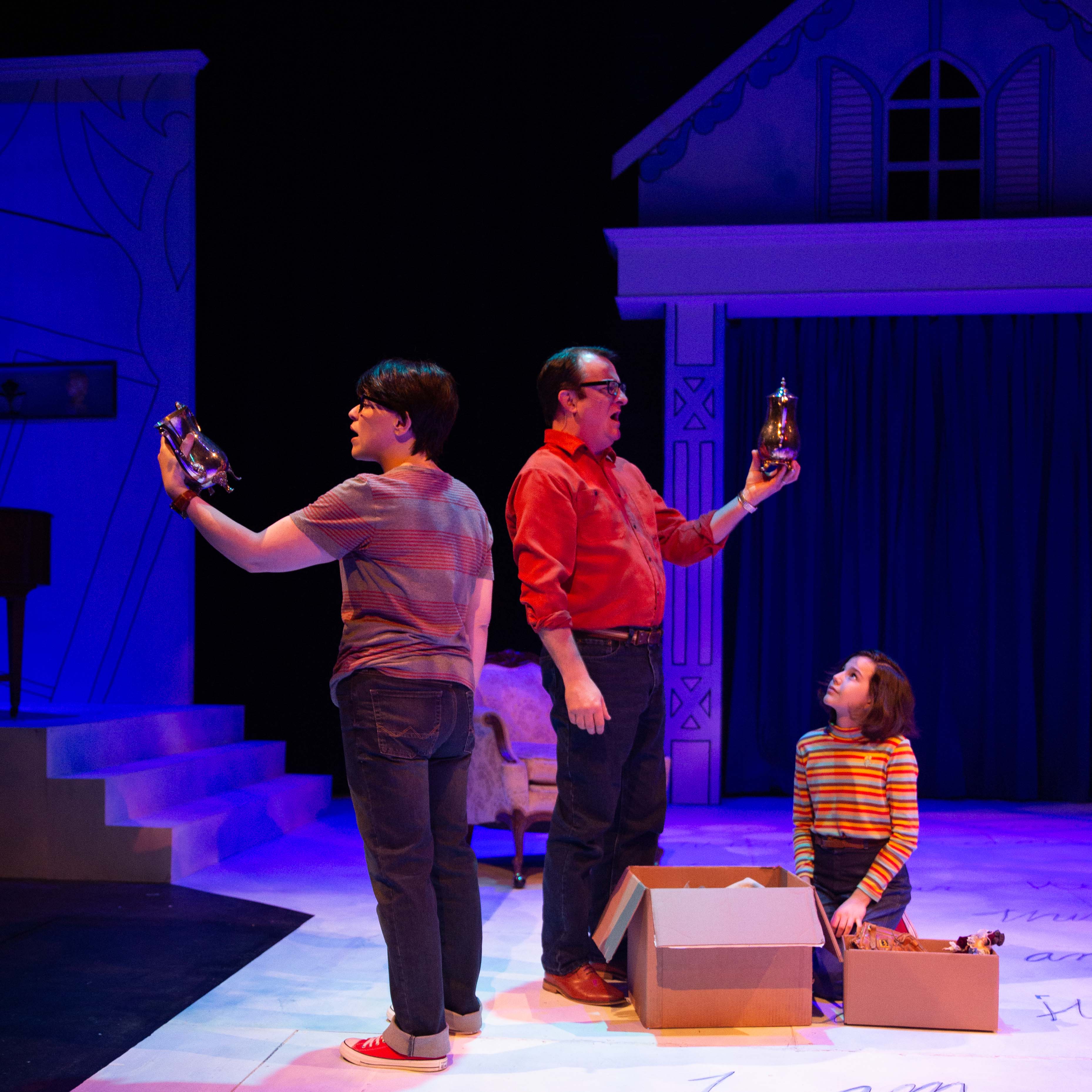
From that vantage point, DCP is better than even the 2019 Actor’s Theatre production at Queens’s Hadley Theater in replicating the intimacy of the Circle in the Square experience. Set designer Chip Decker, who stage directed the Hadley production during his years at the helm of ATC, retains his bright visual concept – a departure from the more funereal Broadway and touring versions – in depicting the Bechdel Funeral Home, allowing Alison Bechdel’s cartoons free play on the translucent windows of the parlor.

Often, they’re animated, with Bechdel’s words and drawings blooming before our eyes.

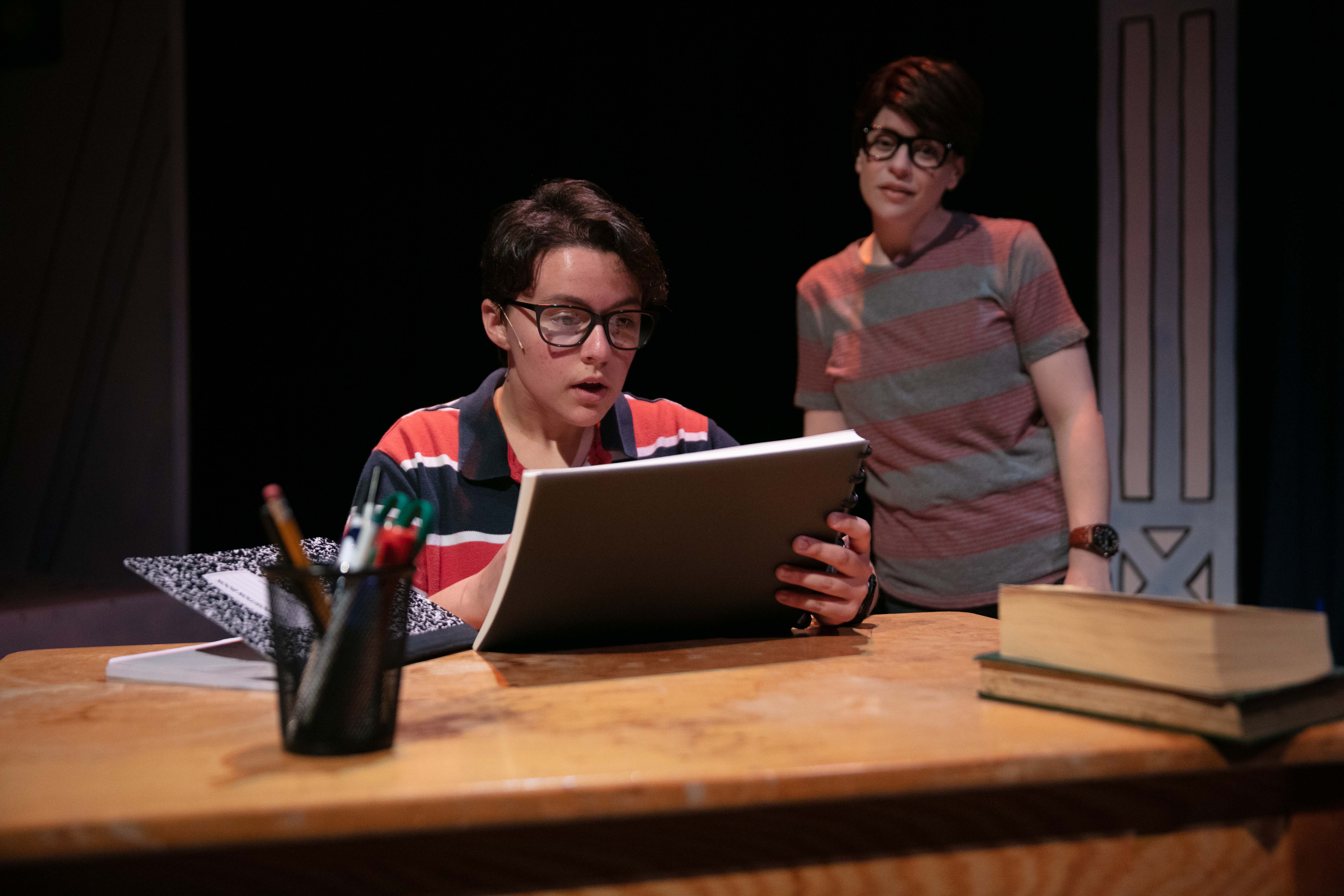
As we watch Lisa Kron’s adaptation of Bechdel’s graphic novel unfold, there’s a nice little studio perch set aside at stage right for the full-grown Alison to narrate. Sometimes as Alison, Kel Wright insinuates herself into the action, lurking in the main playing space, sketchbook in hand, as Small Allison and Middle Allison act out her vivid memories of growing up at a Pennsylvania funeral home and coming out as a lesbian at Oberlin College.

The bright visual concept tracks better with Kron’s book, because darkness only gradually seeps into the story. Alison’s dad, Bruce, seems like a bookish, excessively neat and proper mortician at first, mainly because he and his dutiful wife Helen conspire to hush up his big secrets. When Small Alison and her brothers sing “Come to the Fun Home,” a faux commercial jingle for the funeral home, the childish glee is as contagious as an early Jackson 5 hit or something fresh from little Donny Osmond and his backups.

Bruce may discourage these boisterous outbursts, but he cannot suppress them. Similarly, when Small Alison wants to go to her school party in jeans and sweater, Bruce can temporarily impose his will by shaming his daughter into wearing a dress. It’s only in retrospect that we and the full-grown Alison realize that Bruce was mostly protecting himself, shielding the truth of his own sexuality rather than upholding propriety.

Ironically, the fulcrum begins to shift for Middle Alison at Oberlin College, where she discovers her own gayness. This is jubilantly proclaimed in “Changing My Major (to Joan),” a song that equals the joy of “Fun Home” and surpasses it in exuberant sensual comedy. Tesori is at her best in these chamber sized songs with their pop flavorings and their Avenue Q spice. Even at her peak in Caroline, or Change and Kimberly Akimbo, Tesori’s other acclaimed shows, there’s a little bit of Sesame Street mischief going on.

Having coped with Bruce’s escapades for decades, Helen understandably freaks out when her daughter informs her that she has come out. Alison can only see her mom’s distress through a haze of misperception. Yet we always like Alison because she not only observes herself and her family with her sketchbook, she perseveres on her path and eventually, if still hesitantly, confronts her problems.

Despite Dad’s disdain, she continues to opt for cartooning instead of “serious” art, continues to wears jeans instead of dresses. Faced with Joan’s advances, Middle Alison retreats… temporarily. She seems to hibernate and marinate after writing home about her gay epiphany, processing Dad’s puzzling evasiveness and Mom’s distress, but she elects to bring Joan home with her when she returns from Ohio on winter break.

Darkness falls gradually, but it falls hard.

Mortician, English teacher, preservationist, and molester of underage boys – there’s a lot to unpack, even for adults in the audience, as we try to understand and judge Bruce in the context of his times. Coming off his outré antics in Vampire Lesbians of Sodom,Ashby Blakely is as varied, complex, and nuanced as we’ve ever seen him as Bruce. At times, he roars in his tyrannical moments, overpowering the small house. Like all the other players, he’s miked, but thanks to Kathryn Harding’s exemplary sound design, there’s never any distortion, clipping, or dropouts to mar the show or its music.

The one major sacrifice for theatergoing purists is the lack of a live orchestra at Armour Street. Nevertheless, Harding contrives a surround effect by channeling the prerecorded soundtrack and the amplified voices from the rear speakers. It was a pretty unique front-row experience for me, rather enjoyable.

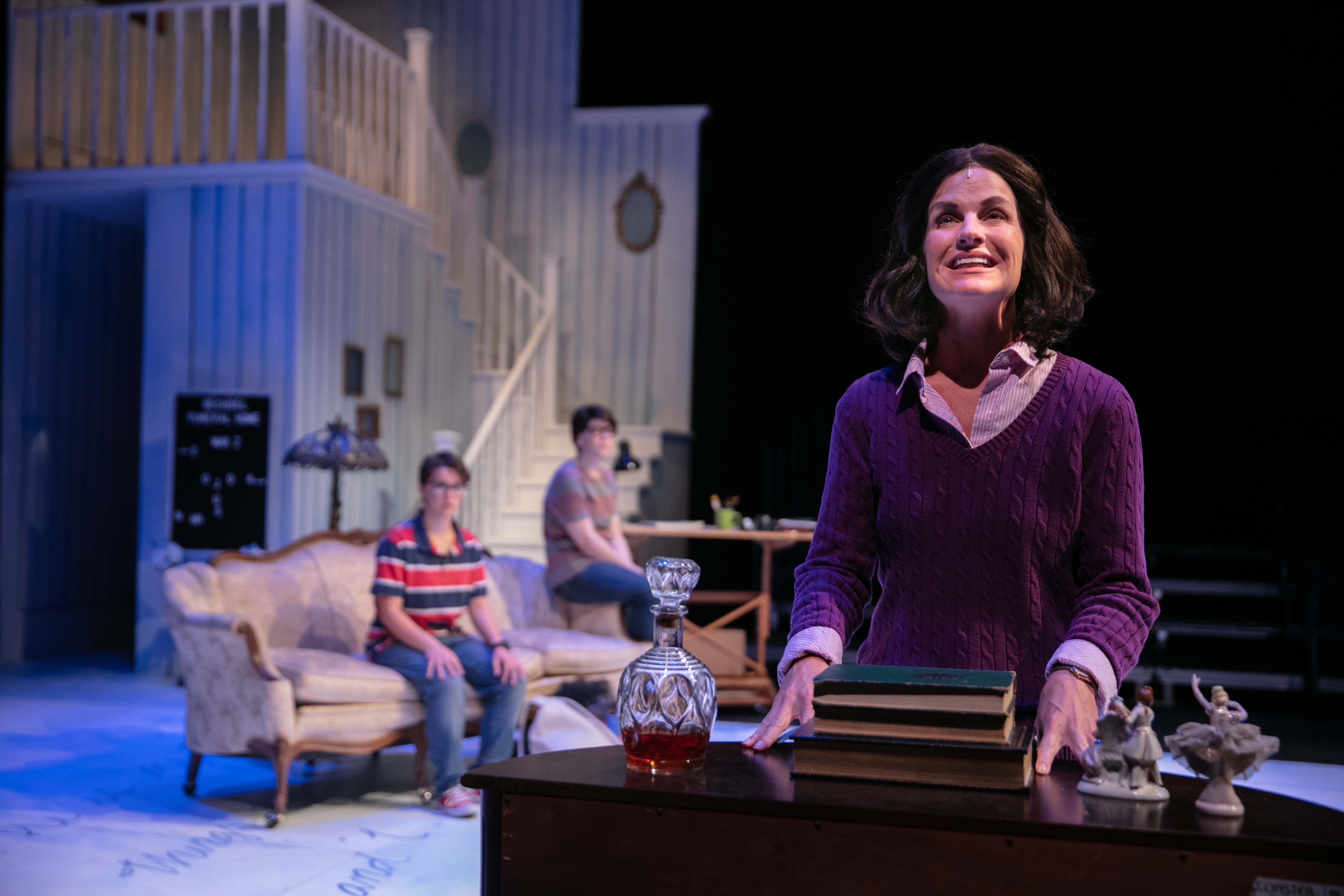
After her exploits at Booth Playhouse as Norma Desmond in Sunset Boulevard, Alison Rhinehardt had already convinced me that she could overpower Armour without a mic. As Helen, she predictably knocks her showpiece, “Days and Days,” out of the park with diva aplomb. Until then, she’s rather wholesome and humdrum, accentuating Mom’s breakout.

Nor is there any perceptible cratering when we scrutinize the less familiar names in this cast. Recently unveiling her directing chops in the Queen City Concerts premiere of Local Singles,Wright brings an exacting intensity to Alison that always captures the drama, even when she sings. “Caption,” she keeps barking in Kron’s script, so her valuation of le mot juste always seems foremost as her castmates take care of the graphics.

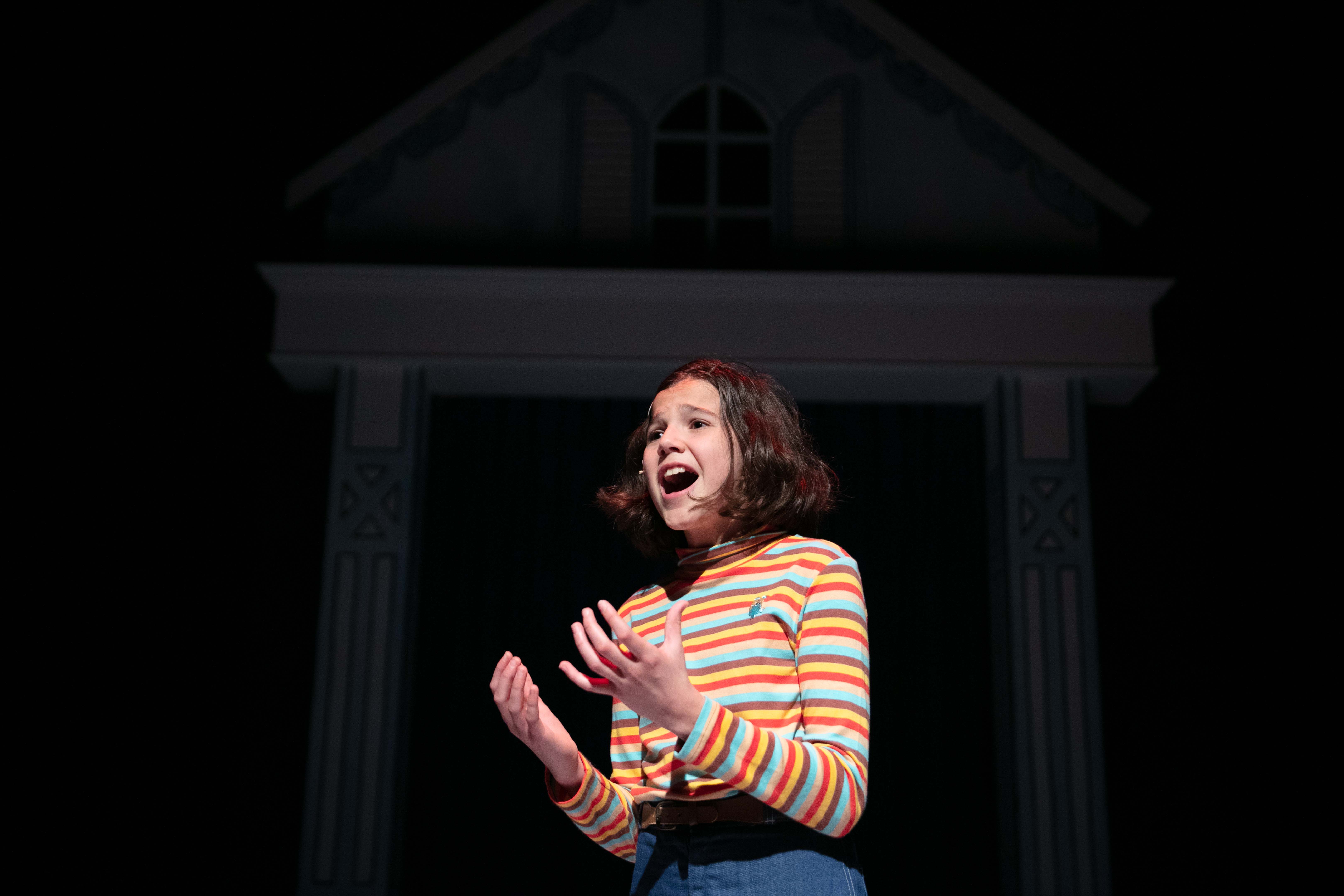
As the Bechdel brothers, Aiden Honeycutt as John and Grayson Flowers as Christian help turn Small Allison’s “Fun Home” promo into an exhilarating panorama. Bailey Fischer takes flight almost from the first moment we see her as Small Alison – goodness, energy, and precocity personified until her last “Flying Away” moment. That energy is formidable when Ann Schnabel must take over as Middle Alison, especially in the intimidating context of a matriculating college freshman. In a sense, then, her “Changing My Major” is as much a rebirth as it is an affirmation.

It’s the needed embrace of the real world that will ultimately help her in coming to terms with the truth about Dad.

Criminal law is far more confident than my feelings in determining who the forbidden fruit is among the remaining cast. As the revelatory Joan, Sierra Key seems healthy enough, her seductiveness sufficiently muted for a Midwest coed. At school and visiting the funeral home, Key hits all the notes that emphasize Joan’s savoir-faire and discretion without pounding them. As the Bechdels’ handyman, Bart Copeland struts and preens enough to convince us that he’s also a consenting adult.

When he switches roles and becomes a former student that Bruce picks up on his nocturnal rambles, Copeland calls upon the naivete that made his star turn as Pippin so compelling last spring at Theatre Charlotte. Topped with a mop-top wig, you’ll see he’s also a perfect fit for Tesori’s retro pop music.

Doubling the Fun

Okay, so maybe you weren’t duly impressed that two shows are now running in Metrolina that premiered at the same Broadway theater. We can do better. Weirder. This coming weekend boasts two different shows set at a funeral parlor! Yes, as Fun Home continues for two more weekends up in Davidson, down here at Booth Playhouse, Charlotte Conservatory Theatre is bringing us the world premiere of Nan-Lynn Nelson’s Leaving Watermaine, directed by the playwright.

It opens on leap day this Thursday, at the tail-end of Black History Month, for a four-day run. By the end of Act 1, we’re greeted with a busy weave of plot threads involving undertaker Werly Mainlodge, his three daughters, and their beaus – both beloved or unwanted. Which of the three young ladies will be leaving first? Elopement or honeymoon? Will the Klan intervene on the eve of the planned departure?

Has there been a KKK lynching or a passionate murder? Or is the presumed victim still alive? Mystery, racism, colorism, and comedy peep into what seems like a tragedy, so you’ll need to stick around after intermission to learn how the dangling threads sort out. Nelson seemed to have it all calculated, incorporating her own musical soundtrack into her sound design.

Actor’s Theatre Shines New Light on Bechdel’s “Family Tragicomic”

Review: Fun Home at Actor’s Theatre of Charlotte

By Perry Tannenbaum

FUN HOME 5

Graphic novelist Alison Bechdel’s Fun Home grabs – and sustains – our attention in large measure because the title is a misnomer, the nickname given by Alison and her siblings to the family business, the Bechdel Funeral Home. Yet as the story unfolds, with its cargo of closeted homosexuality, sexual molestation, and suicide, we realize that Alison is stressing – and cherishing – the fun times she had with her siblings and her troubled dad. Sweetened by Lisa Kron’s stage adaptation and juiced by Jeanine Tesori’s music, the fun in Fun Home gains further momentum.

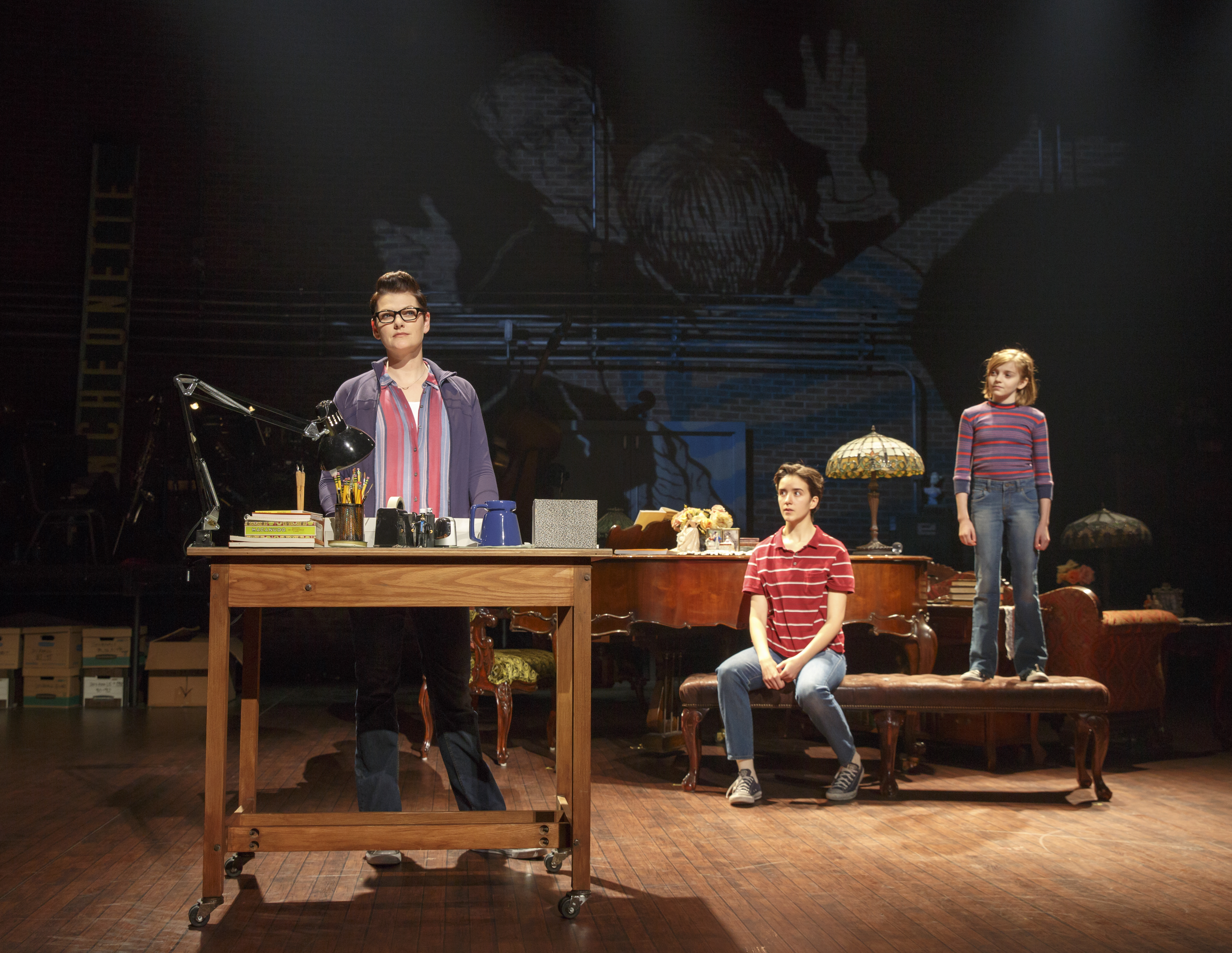
It keeps rolling in the Actor’s Theatre of Charlotte production at Queens University with lively stage directing, choreography, and preteen actors playing the young Bechdel pranksters. Aiming in that enlightened direction, set designer Dee Blackburn starts with the thrust stage configuration I saw at Circle in the Square for the Broadway, but she departs from the funereal darkness that characterized the New York run and the national tour. Abetted by Hallie Gray’s lighting design, Blackburn gives us the kind of bright home that Alison’s neat freak dad might fuss over.

FUN HOME 3

Or not. We also get darkness when Bruce, Alison’s dad, summons her to assist him in prepping a cadaver – and on numerous occasions when we leave the Bechdel house. Bruce’s nocturnal rambles, creepy and predatory, might occur far away on a family trip or in his car cruising the neighborhood for prey. If you’ve seen Fun Home before, you might find Bruce’s rambles more chilling, since his household isn’t an Addams Family lookalike. Bechdel’s original subtitle, “a family tragicomic,” wickedly sets the tone.

The most fun is when the three Bechdel kids do the big “Come to the Fun Home” song, pretending to cut a TV commercial for the funeral parlor, with choreography by Tod Kubo that captures all the goofy giddiness of the previous productions I’ve seen. Both Allie Joseph and Ryan Campos distinguished themselves at the start of this season in Children’s Theatre of Charlotte’s admirable Matilda, while Donavan Abeshaus has flown a little more under the radar, appearing as the young anti-hero in Bonnie and Clyde at Matthews Playhouse in February 2018. They make a fine set of Bechdel sibs now, though Joseph once again draws the plumiest role.

FUN HOME 7

Joseph is so brash and brilliant as Small Alison that she steals a little of the thunder from Amanda Ortega’s somewhat understated Medium Alison, the collegian who discovers her true sexuality at Oberlin and comes out as a lesbian. Ortega’s “Changing My Major” (to Joan, her first lover) was still an uproarious showstopper for those at opening night encountering it for the first time, though it brought nothing fresh that I hadn’t seen, but Lisa Hatt as our narrating Alison did offer something new, besting even the Tony-nominated Beth Malone as our storyteller.

FUN HOME 1.jpg

Maybe director Chip Decker believed she could be more than what she was on Broadway and on tour, for liberating Hatt – just by freeing her from the nerdy sketchpad she perpetually carried – is likely the foundation for all the Hatt achieves. Even when focus is elsewhere, on Bruce or one of the other Alisons, Hatt’s reactions matter, and her delivery of the climactic “Telephone Lines” is star quality. Yet there’s less of a feeling that this Alison has it all worked out after coming to terms with her sexuality and the fact that, as a graphic novelist, she isn’t going to join Faulkner and Hemingway in her English teacher dad’s pantheon. Hatt strikes me as a less confident Alison, still searching.

Hatt’s take on Alison allows Rob Addison as Bruce to be a little less formidable – more lifesize – than Michael Cerveris was on Broadway. A little more nuance helps because the ground has shifted somewhat since 2015, when Fun Home premiered, under the issues that Alison’s dad straddles. Though nothing excuses Bruce’s sexual predatoriness, fears of exposure and disgrace as a homosexual may be prime reasons why Dad is so rigid, regardful of others’ impressions, and so virulently bossy. You can believe it when Addison lets down his guard and plays with Young Alison at the start of Fun Home, and you can eventually see why this might be so atypical of Dad that our narrator would cherish the memory.

FUN HOME 8

Of course, the tortured and torturing Bruce can have more empathy with Alison – and be more grimly protective of her – than Helen Bechdel, her mom, and Lisa Schacher delivers a nicely nuanced portrait. Submissive, disapproving, and beneath it all, the caretaker, with a self-loathing to match her husband’s. Maybe a little more nuance from Sebastian Sowell as Joan to go along with her invincible cool would help me see why everyone, especially Medium, is so impressed with her. You can see, however, that a medium-energy Medium Alison is attractive to her.

Rounding out the cast as a couple of Bruce’s trespasses, Patrick Stepp shows enough self-awareness as Roy, the yard boy that Bruce plies with drinks – while Mom is elsewhere in the house! – to let us suppose that all this isn’t as surprising to Roy as it might be to us. Or unprecedented. In a scene that Alison isn’t narrating from her own experience, giving Dad a small benefit of the doubt is probably the perfect path to take. A little more sugar – and a soaring flight of fancy – will help Alison bring an uneasy but upbeat closure to her engaging memoir

“Fun Home” Strikes a New Balance on Tour

Fun Home

Review:  Fun Home

By Perry Tannenbaum

Every show that wins a Tony Award for Best Play or Best Musical doesn’t necessarily bowl me over when I head to New York to critique it. Fun Home was one winner that proved itself worthy of all its accolades – five Tonys – and more. The biggest differences between that Broadway production and the current touring version in Charlotte are Knight Theater and Charlotte native Abby Corrigan.

Tightly adapted by Lisa Kron from Alison Bechdel’s autobiographical graphic novel, with an exceptionally varied and emotional score by Kroon and Jeanine Tesori, Fun Home revolves around two complex characters: Alison and her troubled, multi-faceted dad. Bruce is a charismatic English teacher, a visual artist, a restorer of dilapidated houses, a connoisseur of antiques, and owner of the family business, the Bechdels’ funeral home. On the other side of the ledger, Alison’s dad is a neatness-and-control freak.

He’s also a closeted homosexual who preys on underage boys, not above taking advantage of his own students.

So while Alison, played by a succession of three actors, is on a path to discovering her own gay sexuality and becoming a cartoonist, she’s also on a collision course with the truth about her father. Bruce, the meticulous and domineering dad, is on a more fearsome path – to isolation, self-loathing, and suicide.Fun Home

Mostly used for symphony and dance, Knight Theater is probably the best place in town for replicating the Broadway musical experience, markedly better than Belk Theater. But Fun Home wasn’t at a typical Broadway theater for its New York run. At Circle in the Square, the audience surrounded the stage, and when Alison and her two brothers sang “Come to the Fun Home,” a singing advertisement for the funeral home that is the antithesis of solemnity, the three siblings seemed to explode out towards us.

At the Knight, all the action is flattened, and the Bechdel kids merely circle around each other. David Zinn’s scenic pieces seem disappointingly unchanged at first, two-dimensional and cramped on the Knight stage, but during the latter half of the show (there’s no intermission), Zinn exploits the resources of a proscenium stage. Medium Allison’s homecoming becomes more of an event when we see the funeral parlor again.

Corrigan plays the pivotal Middle Allison, flanked by tomboyish Carly Gold as Small Alison and Kate Shindle as the mature, emphatically butch Alison who narrates, often with sketchpad in hand. Gold is every bit as exuberant and appealing as her Broadway counterpart, but it’s Shindle who brings new life – and heartache – to our narrator with a more powerful, penetrating voice.

While both Small Allison and mature Allison are recognizably in the same Broadway mold that won director Sam Gold his Tony Award, Corrigan strikes me as a notably different transitional figure between her younger and older selves. On Broadway, Emily Skeggs leaned more toward the sunny exuberance of Small Allison grown to college age. Corrigan is more of an awkward foreshadowing of the comparatively subdued and serious elder Allison.09FunHomeTour0126r.jpg

As a result, when Medium Allison quickly succumbs to the attractions of Joan and liberates her lesbian leanings, Corrigan gets the same comedy mileage from her anthemic “I’m changing my major to Joan,” but with less raucous exuberance in her delivery. There’s more in-the-moment pragmatism to Corrigan’s take, as if she’s afraid of waking the object of her adoration as she lies sleeping on her bed – or just afraid of breaking an unbelievable magic spell. It’s very effective, and theatergoers seeing Fun Home for the first time will find it hard to imagine “Changing My Major” sung any other way.

With the three touring Allisons more than holding their own versus the original Broadway cast, there’s a further gravitational shift when Robert Petkoff as Bruce doesn’t match the bigger-than-life dimensions of Tony winner Michael Carveris. Amplitude is the difference with Petkoff, not detail, for he expertly navigates all the twists and turns of Bruce’s complexity. In a way, this is beneficial, for the importance of his character and Allison’s development are more evenly balanced on tour.

Further diluting Bruce’s dominance is the steely performance of Susan Moniz as his stoical wife, Helen. It was Moniz who opened my eyes to the Chekhovian dimensions of Kron’s book, for her silences were the first that spoke loudly to me on opening night, and her “Days and Days” had a martyred nobility. Moments later in the show, silence is very much the point when Alison is alone with Bruce in their climactic confrontation, where Shindle suddenly shifts from narrator to actor in the devastating “Telephone Wire” drive.

As Joan, Kally Duling seduces with a self-confident swagger, and Zinn’s costume design underlines her casual sophistication. But Duling never gets a solo, either to comment on Alison or the Bechdels. That’s symptomatic of the only problem I have with the show. Clocking in at 92 minutes on Tuesday, Kron’s script is too tight. It needs to breathe more, maybe as far as – danger ahead! – examining Alison’s feelings about her dad more closely. Yet there’s no denying that Fun Home is truly fun while it lasts, with plenty to mull over afterwards.


Music to a Mother’s Ears

Preview: Abby Corrigan Comes Home in Fun Home

Abby_MediumAlison_edited-1

By Perry Tannenbaum


There’s an unforgettably wanton, lascivious, and joyful song nearly halfway through Fun Home, the Tony Award-winning musical that rolls into town next week. Based on cartoonist Alison Bechdel’s autobiographical graphic novel, Lisa Kron’s script splits our hero in three, the middle-aged Alison who tells us the story and the two younger Alisons, Small and Medium, who live it out.

Small Alison absorbs the first, often misleading impressions of her parents, Bruce and Helen. It’s Medium Alison who discovers the revelatory truths – about her own lesbian leanings and about her dad’s sexual pathology – after she goes off to college. The bold, beautiful, and seductive Joan sets Alison straight about herself, so it’s Medium Alison who gets to jubilantly proclaim, “I’m changing my major to Joan!” as her first and most important college lesson.

Charlotte native Abby Corrigan gets to sing this showstopping song beginning on Tuesday at Knight Theater in what figures to be a triumphant homecoming.

Abby_BestChristPageant

It’s certainly a sudden change in fortune for the young actress, who turned 19 in February – but not a surprise to those of us who have seen Corrigan perform. She leapt onto the local scene in 2008, while she was still a 10-year-old, as the incorrigible Gladys Herdman in the Children’s Theatre production of The Best Christmas Pageant Ever.

Corrigan remained on our radar, playing prominent roles in 25th Annual Putnam County Spelling Bee down in Rock Hill, Next to Normal at Queen City Theatre Company, and delivering a riveting epileptic seizure to climax The Effect of Gamma Rays at CPCC. As the daughter of Mike and Mitzi Corrigan, both of whom acted in Charlotte Repertory Theatre productions, Abby figured to have acting talent.

But Mom, a talent agent and casting director who has a professional’s detachment, saw vivid signs of Abby’s gifts long before she became the Herald Angel shouting “Shazzam!” as Gladys.

“The first time I knew that she had something really special to offer,” says Mitzi, “was when she was 6 years old and we did a backyard production of The Lion King. She was Nala, and when she sang ‘Shadowland,’ I was bowled over by how she became that character and I thought to myself, ‘Wow, where did that come from?!’”

Knowing full well that you need intense passion and inner drive to survive in showbiz, Mitzi never pushed. Abby did plenty of that. At the age of 12, Abby and friend Matt Mitchell started their own theatre company, Treehouse Acting Company, mounting their first production at CAST in NoDa. The following year, Abby, Matt, and two other collaborators staged an original musical, Cybersoul, tackling a range of issues that included drug addiction, bullying, suicide, and homophobia.

You hear about precocious actors – many have paraded in and out of the Children’s Theatre of Charlotte spotlight over the years. But have you heard of anyone else who started a theatre company and co-wrote a mature musical before the age of 15?

“It really was off the charts,” Mitzi agrees. “I became good friends with Matt’s mom and we wanted to help them find ways to pursue their dreams. Because producing backyard plays had become such a regular occurrence in our existence, it seemed like a natural step to encourage them to produce their own plays.”

Of course, Abby didn’t think about measuring her ambitions against any norms. According to her mom, acting must be something you have to do in order to breathe if you wish to succeed. That’s how it has always been with Abby. She remembers loving to imitate animals when she was very young, convincing herself that she was truly what she pretended to be. Mom and Dad tried to deflect her into sports, but tee-ball never took.

Abby_Matt_Treehouse

“I wanted to show people that I could become anything,” Abby recalls. “As a kid, I would’ve played all the parts if I could have, and I wanted other kids to want to play along with me. I also think Matt and I wanted to play parts that we were too young to play. We would design sets and cast shows we wanted to do for fun, but we wanted to really do the work and make it happen.”

Inevitably, Abby’s talents and drive took her to Northwest School of the Arts, where her theatre exploits – starring in Cabaret, Shrek, and Peter Pan – took her on a rollercoaster ride. At her peaks, Abby was a finalist for Best Actress honors two years in a row at the Blumey Awards, winning a trip to New York for her Princess Fiona in Shrek and a chance to compete against winners from across the country at the national Jimmy Awards, the holy grail of high school theatre prizes.

Just as that brass ring was within sight, the opportunity to perform in front of top Broadway professionals vanished. Initially misdiagnosed in ER, Abby’s appendix ruptured, sending her back into the hospital, and she had to give us her spot at the Jimmys to the Blumey runner-up. Opportunity lost, but Abby was happy just to be alive. She returned to Belk Theater the following season, once again performing onstage as one of the Blumey finalists, but she didn’t win.

“I didn’t want to win that year,” Abby says. “I just wanted to do ‘Ugg-a-Wugg’ with my cast because it was so much fun to scream and bang the ground with sticks onstage as Peter Pan. I mean, come on. That’s what should matter. Not an award.”

Peter_TigerLilyAbby wasn’t totally exiled from New York because of her misfortune and subsequent defeat. For a couple of summers, she participated in a Destination Broadway theatre camp where the musical director was conductor Michael Rafter. So happens that Rafter is the ex-husband of Jeanine Tesori, who wrote music for the “Changing My Major” song – and the entire Fun Home score. When Mitzi invited Rafter to be the keynote speaker at a NW School of the Arts fundraiser, he informed her about Fun Home auditions.

Opportunity was knocking again, but how ready was Abby for it? Medium Alison doesn’t merely participate in this touring version of Fun Home, she drives the action.

“Yes, I about peed myself walking in the audition room those three times,” Abby confesses. The last two of those auditions were in front of three Tony Award winners – Kron, Tesori, and stage director Sam Gold. “I’d never wanted anything more in my life. After my first audition, the casting director gave me tickets to see it on Broadway, and I knew I had to do the show. I just wanted to eat the script/score whole.”

There are easier people to reach than Gold, especially during this year’s Tony Awards weekend, when he was up for a second Best Director trophy for his work on A Doll’s House, Part 2. Busy as he is, he had no trouble remembering Abby’s audition from a year ago, when she was still 18.

“Abby’s audition was one of the best and most memorable of my career,” Gold tells me. “It was like seeing the character of Medium Alison in front of me. She had worked very hard on the material and it was deeply felt, full of detail and comic timing, and she exuded confidence. When we spoke after, she said she was about to graduate, and I said, ‘What college do you go to?’ She said, ‘from high school!’ I couldn’t believe the poise and professionalism I saw was coming from an actor who would barely be of age for the tour.”

Both the poise and the professionalism are somewhat paradoxical in an actor who says she’s constantly striving to maintain the curiosity, fearlessness, and joy of a kid when she works – but her mom finds that onstage poise is just as genuine offstage. Time and again, Mitzi has come across the rejection, the ugly desperation, the deformed egos, and the over-swelled sense of entitlement that stalk theatre people – and she has seen the beauty and happiness it brings to Abby.

“Letting her go has been the hardest thing in the world for me,” Mitzi admits, “but she continually reassures me by saying, ‘Don’t worry mom. I’ve got this!’ Those words are like music to a mother’s ears.”