Tag Archives: Kel Wright

The Delphic Oracle Sings The Go-Go’s

Review: Head Over Heels at Duke Family Performance Hall by Davidson Community Players

By Perry Tannenbaum
Heaven, Elysium, Utopia, Paradise, and Arcadia are all perfect places in our minds, too placid and static to be considered as settings for comedy, thrilling action, or drama. If you were in search of a perfect backdrop for the music of The Go-Go’s, you would more likely pick a city on the California coast, Las Vegas, or even Indianapolis than opting for heaven or the Elysian Fields.

That’s not how Jeff Whitty saw it when he conceived Head Over Heels. You get the idea that, after birthing Avenue Q, Whitty almost had free rein from the Oregon Shakespeare Festival to do anything he pleased. Whether he was inspired by the Elizabethan aura of OSF’s outdoor and indoor stages in greeny Ashland, Oregon – or bound to play up to them – Whitty reached back to The Countess of Pembroke’s Arcadia by Sir Philip Sidney, first published by the Countess in 1593.

Whitty had absolutely no intention of bridging the two eras – or smoothing the discordance between Elizabethan and Go-Go’s English. Whitty does tone it down a bit when Philoclea, the younger daughter of Arcadia’s King Basilius, tells her ardent admirer Musidorus to “Speak English, not Eclogue” when the shepherd boy begins his wooings.

At about the time that Head Over Heels premiered at OSF in 2015, Something Rotten!, with Will Shakespeare as its rockstar, was premiering on Broadway. That might explain the lukewarm reception that greeted Whitty’s show when it had its NYC premiere in 2018, for its Broadway run fizzled out in less than six months.

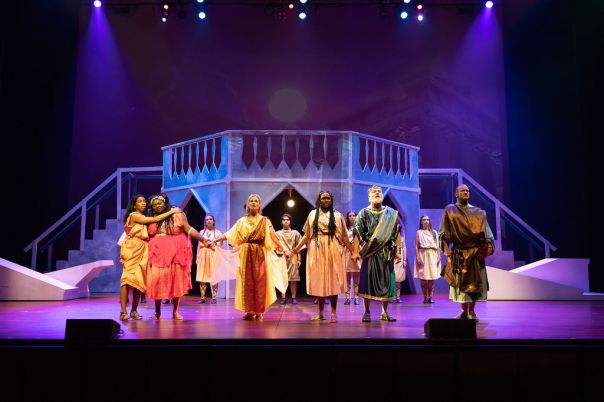
You can judge for yourself at spacious Duke Family Performance Hall as Davidson Community Playhouse rather splendidly presents its summer musical in nearly all of its gender bending glory. For this Metrolina premiere, projection designer Caleb Sigmon, scenic designer Ryan Maloney, and costume designer Yvette Moten fill the Broadway-sized stage on the Davidson College campus with eye-popping color and Hellenic style.

With the disclaimer that I’d never heard a single bar of Go-Go’s music before Head Over Heels came to our region, I can say that I delved into The Go-Go’s greatest hits afterwards on Spotify and listened to the original Broadway cast album. From the opening “We Got the Beat” onwards, the two generations of singers up at Exit 30 on I-77 beat them both.

Word of DCP’s excellence has extended its reach, and director Chris Patton and music director Matthew Primm have reaped the benefits. Belting the Go-Go’s “Beautiful” to her own mirror, Jassi Bynum is the vain elder sister, Pamela (a name apparently invented by Sir Philip). No less capable of letting loose, Kiearra Gary is the obedient “Good Girl” sister, Philoclea. And the well-established powerhouse, Nonye Obichere, is Mopsa, who seems for awhile to be a third sister until we learn that she is actually the daughter of the King’s steward, Dametas.

When Mopsa’s heart is broken, she will flee to Lesbos (wink, wink) and sing “Vacation.” Obichere slays at least as convincingly as the sisters.

It’s easy enough to get confused by the parents because they’re all white folk who fit nicely into Sidney’s Grecian mold but look nothing like their offspring. Yet Lisa Schacher, not seen hereabouts in a truly breakout musical role since the early days of QC Concerts, keeps her where-have-you-been-all-my-life belting capabilities under wraps until after intermission as Gynecia, the Arcadian queen. We’re not just talking Judy Garland belting, for Schacher crosses over the borderline to Whitney Houston territory along with Bynum, Gary, and Obichere.
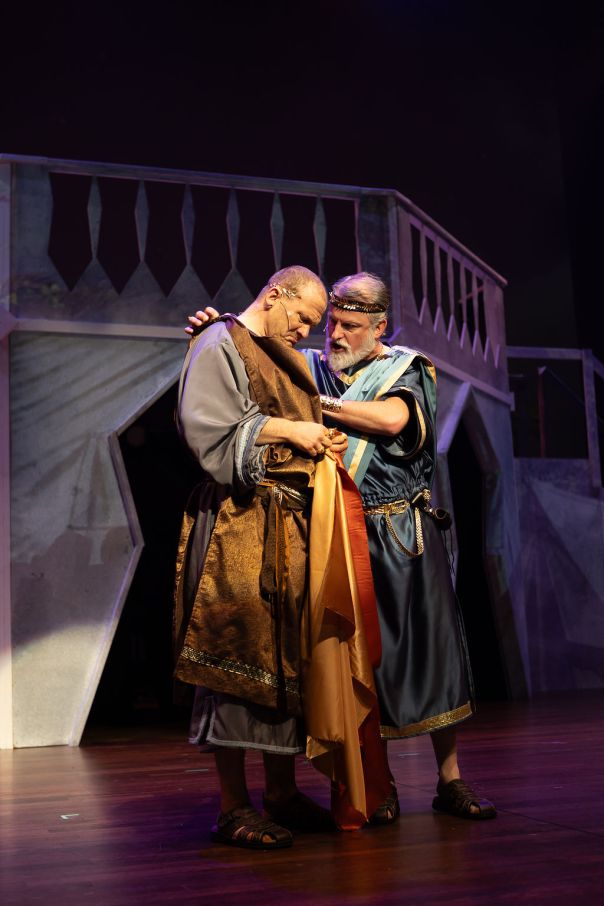
Once whatever was clogging Tommy Foster’s larynx in the first moments of Saturday night’s performance as Dametas was expelled, the longtime veteran reminded us that he could also wail. Saddled with a more earthbound voice, Rob Addison brings a nicely grizzled dignity to King Basilius that is forceful enough for the lead vocal of “Get Up and Go” and his climactic king-and-queen duet with Schacher, “This Old Feeling.”

Kel Wright, whose pronouns are Kel and I in her coy bio, is the gender-fluid complication roiling the eternal placidity of Arcadia. She is the ardent shepherd boy Musidorus, Philoclea’s bestie since her tomboy days, who must disguise himself as an Amazon warrior, Cleophila, after he’s banished from Arcadia in order to regain access to his lady love.

Everybody seems to be attracted to Cleophila, though they come to all the possible conclusions about the Amazon’s true gender. It’s a mess – a hormonal thundershower that afflicts the King, the Queen, and their daughters. All of them scurry about in a mad passion that comes off with all the innocent merriment of a musical comedy. Adding to all of this hilarity is the disconnect between Wright’s tinniness and the Amazon’s virility, so feverishly irresistible to Pamela and her mom.

All of this mad pursuit, however, happens under the cloud of a prophesy that threatens Arcadia’s doom. A snake sent by Pythio, the Delphic Oracle, lets loose of a letter summoning King Basilius to the temple to hear the Oracle’s oracle. In Sidney’s original manuscript, not recovered until 1908, the prophecy is given concisely in verse at the end of the novel’s opening paragraph.

Thy elder care shall from thy careful face

By princely mean be stolen and yet not lost;

Thy younger shall with nature’s bliss embrace

An uncouth love, which nature hateth most.

Thou with thy wife adult’ry shalt commit,

And in thy throne a foreign state shall sit.

All this on thee this fatal year shall hit.

Whitty actually retains the adultery line – with its apostrophe! – but flips the plotlines of the elder and younger daughters. In Arcadia, Basilius is seeking to preserve his family and kingdom, but in Head Over Heels, he’s also battling to ward off the mass extinction of Arcadians. Forget about the “fatal year”: Each time one of the four prophecies is fulfilled, a flag will fall. If Basilius fails to confound the Delphic Oracle’s prophecy and the fourth flag falls… game over. If he succeeds in thwarting the prophecy even once, Arcadia is saved.
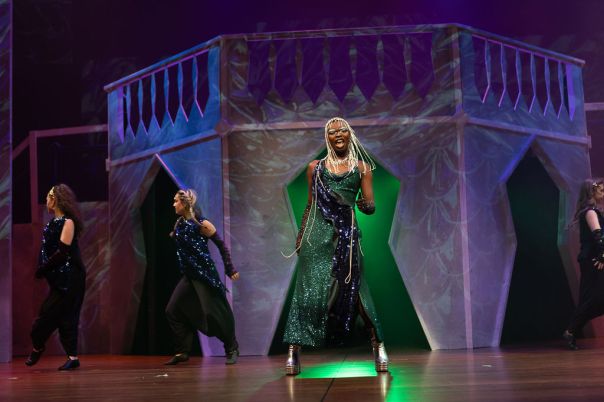
The roadblock to all this heroic questing and defying taking hold at Duke Family is the sensational Treyveon Purvis as the glittery Pythio, who describes themselves as a “non-binary plural.” No, that isn’t verbatim from Arcadia. We don’t need to understand every word of “Vision of Nowness” instantly as Pythio bodaciously belts it. If you don’t catch a phrase the first time or Purvis slurs it, you’ll get a second chance. Besides, the Go-Go’s lyrics are of little consequence once the song is done.

But the four prophecies and the fluttery flag drops are the whole damn evening, so when Purvis garbled every one of Pythio’s pronouncements – and the flag bit as well – much of what followed became equally incomprehensible. Why were those flags falling again? Was Foster wildly excited when he caught those falling flags, or was his Dametas frantically panicked?

Never could get a read on all these things until I sorted them out later at home. A few other gems had eluded me when I perused the script. For example, when Wright is lavishing her outsized voice on Musidorus’s “Mad About You,” the shepherd’s backup group are his sheep, altering the Go-Go’s deathless lyric to “Ma-ad about ewe.” Bleating as they sang? I don’t remember.

Nor did it quite register that Pythio’s backup were all snakes. So there was little chance for me to savor Purvis’s best line of the night: “Snakelettes, slither hither!” They are only named that one time, so catch it if you can.

Arguably, the main historic aspect of Head Over Heels was that it offered Peppermint, as Pythio, the opportunity to be the first openly trans actor taking on a major role on Broadway. There’s summery breeziness to this show and a cozy ending, not nearly as biting as Avenue Q. Maybe if the Broadway production had had the chance to run for a full summer, it might have found its legs instead of perishing in the dead of winter.

It’s the Go-Go’s, after all. Just don’t go in expecting the usual Jack-shall-have-Jill windup. Whitty remains a bit queer.

“Irma Vep” Brings Giddiness to VisArt

Review: The Mystery of Irma Vep – A Penny Dreadful at VisArt Video

By Perry Tannenbaum

My first hints that PaperHouse Theatre’s new production of The Mystery of Irma Vep would be truly unique came when I glanced at a hidden nook of the set and saw a little half-hidden bar napkin that read “Homo Sweet Home.” Shortly before or afterwards, my first peep at the playbill revealed that there were more directors on this project than players. Two more.

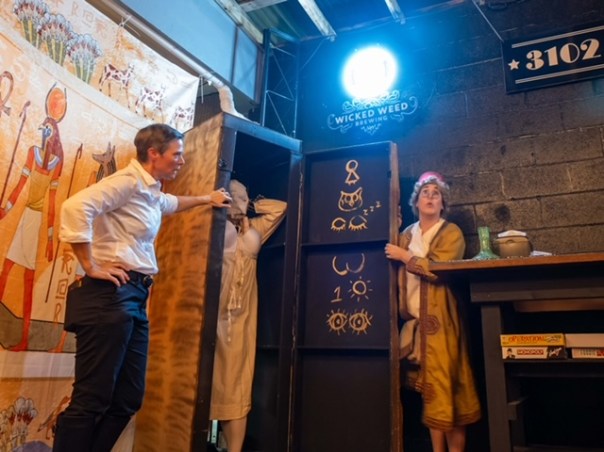
Then before intermission, the aluminum loading dock closure at VisArt Video was raised by the entire cast of two, Nicia Carla and Andrea King, while we joined them on the other side, exiting through the front door to the outside alleyway – the al fresco part of the store. The final Egyptian scene was played out on a second stage, facing out to a few seats, under the shadow of a Wicked Weed Brewing sign. With a nifty little Egyptian tapestry and a fairly gaudy, full-sized sarcophagus.

What really clinched it for me was rolling pin in Act 2 – deployed for a purpose you’d never dream of. That settled it: the new Irma Vep, a Charles Ludlum gem not seen in Charlotte since 1993, is far more than a loving revival. Far more than a couple of hambone actors led by an unusually comical director.

No, this is pure out-of-this-world madness, a starburst of hysteria fueled by a team of four directors feverishly brainstorming in the merciless grip of writer’s room giddiness. Who can possibly care about a three-inch square napkin? Who would conceive of taking the one underground scene in Vep outdoors? And the rolling pin: I can barely imagine the uproarious laughter when that touch was unveiled. Perfect.

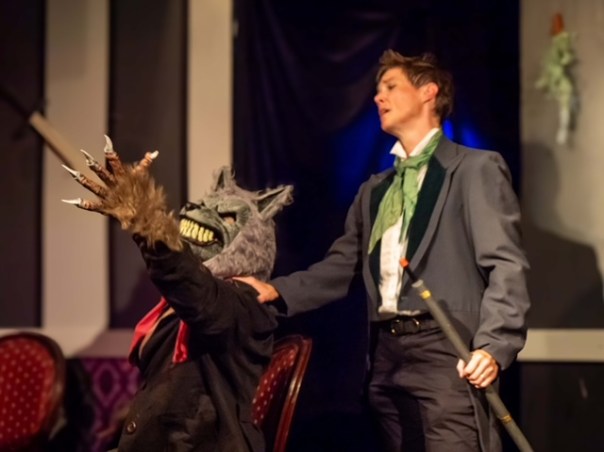
Some of the zaniest futzing could have happened spontaneously during rehearsals, since Carla and King, splitting eight roles between them, are also part of the directorial team, joined by Kevin Lorms and Chaz Pofahl. So scenic designer Kel Wright may have lavished so much attention on her precious sarcophagus that she didn’t notice when that homo napkin got slipped into the wicker basket back at Mandacrest.

That’s where theatre legend Lady Enid Hillcrest, newly married to Lord Edgar Hillcrest, will feel oddly ill-at-ease in the library as a portrait of her predecessor, Milady Irma Hillcrest, stares down at her. Greeting her as maidservant Jane Twisden, King ought to be scornful and sepulchral, since she is replicating Judith Anderson’s role as Mrs. Danvers in Rebecca opposite Carla while she resurrects the Joan Fontaine naif.

Yet by the time Lady Enid sashays into view, numerous other parodies have already been set into motion in Ludlam’s wicked mockery of the “penny dreadful” style of Victorian England. Sleuthing, sarcophagi, werewolves, vampires, witches, and a Wuthering Heights heath are all mixed into this undeadly brew. Plus the obligatory mummy. So why not give King the freedom to jubilantly shatter the Dame Judith mold, sporting a bright red wig and occasionally breaking a smile?

Anderson may never have even slightly bared her teeth before she set Hitchcock’s Manderley ablaze.

Squinting her eyes like a savvy sleuth in the opening scene, Carla as the swineherd Nicodemus quickly references the nearby heath and his determination to hunt down the werewolf suspected in the death of Lord Edgar’s son. As the action speeds up and the creepy creatures proliferate (inspiring Carla’s more outré costume designs), we need to be watchful in keeping track, not only with who’s who but with who’s what. Once the thunder stops, the full moon will have its effect, so we can be on the lookout for the kindred of Lon Chaney, Bela Lugosi, Sir Laurence Olivier, Lady Macbeth, and Edgar Allen Poe.

Ludlam wrote all the roles that Carla plays in this quick-change romp for himself and the others for Everett Quinton, his partner in the Ridiculous Theatrical Company and in life. And Ludlam also directed the 1984 premiere. Small wonder, then, that legendary actor/director Alan Poindexter was actually dissatisfied with Innovative Theatre’s storied 1993 production at the fabled Pterodactyl Club – for he merely starred in that historic riot. He told me in 1995 that he was itching to revisit the script.

Where he didn’t say, but presumably, Poindexter yearned to act and direct next time around, the dual roles that both Carla and King are fulfilling now. The fun they’re having with it was unmistakable almost from the start last Friday. Those many costume changes certainly quicken the heartbeat and release the adrenalin when these gifted players are switching outfits backstage – often speaking lines of dialogue while they do.

It’s gotta be dark back there, so in a small space where so many costumes are parked, Lorms must be especially adept as he switches hats and takes on the stage managing. If there’s an additional person hanging up the hastily discarded clothes, it must really be mayhem back there!

While Carla is shuttling between her Nicodemus and Lady Enid costumes, King is shedding her maidservant uni – and that wig – whenever the Lord Edgar returns from his various adventures. Tortured soul! After losing his ex to a vampire and his son to a werewolf, noble Edgar tasks himself with tracking down both supernatural monsters, with only Nicodemus for backup. Poor choice.

Leaving a beautiful lady alone on a lonely manor; especially near moors, heaths, mists, and hail; is never a good idea, confirmed by even a smattering of familiarity with Hollywood horror. After discovering that an Intruder has left telltale teeth marks around his beloved’s jugular, Lord Edgar proves that he has learned his lesson by immediately traipsing off to Egypt to solve this mystery. Thoughtfully, he checks Lady Enid into a sanatorium.

While Milady convalesces, Carla can transform into two Egyptians, Lord Edgar’s turbaned guide and his royal quarry, the remarkably well-preserved Princess Pev Amri. More hilarity for us; more heartbreak for Lord E.

An easier mystery for us to solve was why the Egyptian scene was moved back from the beginning of Act 2 to the end of Act 1. That sarcophagus appears on both stages, so Carla and King can rely on outside help in schlepping it. In its wake, we’re left facing a handy cantina where we can line up for refreshment during intermission.

No doubt the respite is a godsend for Carla, King, and the hidden crew as they regroup, relax, and hydrate. Action is noticeably more frenetic after the break. Masks appear more frequently, and we’re treated to cameos by vampires and various werewolf body parts, far eclipsing the wolf’s carcass tossed into Act 1. In the hurly-burly, all the mysteries and who’s-whats are solved – but you’d better be alert if you want to catch all the solutions.

By then, you may have been laughing too hard to care.

Small Sizing Yields Big Rewards in DCP’s Fun Home

Review: Fun Home at Armour Street Theater

By Perry Tannenbaum

Across the way from the Gershwin Theatre, where Wicked has been running for over 20 years, you can find my favorite Broadway theater, Circle in the Square. At the other end of an underpass that connects the two venues – and two or three flights of stairs underground – you and 800+ plus patrons (less than half the Gershwin’s capacity) can have a theater-in-the-round experience in a space that’s like a wee oval basketball court or a hockey rink.

I’ve seen seven different productions at this underground stadium since 1999, most unforgettably the world premiere of Tennessee Williams’ Not About Nightingales that year and the visionary waterworld of Mary Zimmerman’s Metamorphoses in 2003. Right now, two other Circle gems are playing in Metrolina revivals, Lombardi at the Lee Street Theater in Salisbury and five-time Tony Award winner Fun Home at the Armour Street Theater in Davidson.

A couple of admirable versions of Jeanine Tesori’s musical have already run in the QC, a Broadway tour at Knight Theater and an Actor’s Theatre reprise on the Queens U campus, so the current Davidson Community Players production, directed by Danielle Melendez, has big shoes to fill. What strikes me most positively about DCP’s effort, however, is how small it is. If you’re sitting in the front row, as my wife Sue and I were last Saturday evening, some of the action will be right next to you. Or behind you.

From that vantage point, DCP is better than even the 2019 Actor’s Theatre production at Queens’s Hadley Theater in replicating the intimacy of the Circle in the Square experience. Set designer Chip Decker, who stage directed the Hadley production during his years at the helm of ATC, retains his bright visual concept – a departure from the more funereal Broadway and touring versions – in depicting the Bechdel Funeral Home, allowing Alison Bechdel’s cartoons free play on the translucent windows of the parlor.

Often, they’re animated, with Bechdel’s words and drawings blooming before our eyes.

As we watch Lisa Kron’s adaptation of Bechdel’s graphic novel unfold, there’s a nice little studio perch set aside at stage right for the full-grown Alison to narrate. Sometimes as Alison, Kel Wright insinuates herself into the action, lurking in the main playing space, sketchbook in hand, as Small Allison and Middle Allison act out her vivid memories of growing up at a Pennsylvania funeral home and coming out as a lesbian at Oberlin College.

The bright visual concept tracks better with Kron’s book, because darkness only gradually seeps into the story. Alison’s dad, Bruce, seems like a bookish, excessively neat and proper mortician at first, mainly because he and his dutiful wife Helen conspire to hush up his big secrets. When Small Alison and her brothers sing “Come to the Fun Home,” a faux commercial jingle for the funeral home, the childish glee is as contagious as an early Jackson 5 hit or something fresh from little Donny Osmond and his backups.

Bruce may discourage these boisterous outbursts, but he cannot suppress them. Similarly, when Small Alison wants to go to her school party in jeans and sweater, Bruce can temporarily impose his will by shaming his daughter into wearing a dress. It’s only in retrospect that we and the full-grown Alison realize that Bruce was mostly protecting himself, shielding the truth of his own sexuality rather than upholding propriety.

Ironically, the fulcrum begins to shift for Middle Alison at Oberlin College, where she discovers her own gayness. This is jubilantly proclaimed in “Changing My Major (to Joan),” a song that equals the joy of “Fun Home” and surpasses it in exuberant sensual comedy. Tesori is at her best in these chamber sized songs with their pop flavorings and their Avenue Q spice. Even at her peak in Caroline, or Change and Kimberly Akimbo, Tesori’s other acclaimed shows, there’s a little bit of Sesame Street mischief going on.

Having coped with Bruce’s escapades for decades, Helen understandably freaks out when her daughter informs her that she has come out. Alison can only see her mom’s distress through a haze of misperception. Yet we always like Alison because she not only observes herself and her family with her sketchbook, she perseveres on her path and eventually, if still hesitantly, confronts her problems.

Despite Dad’s disdain, she continues to opt for cartooning instead of “serious” art, continues to wears jeans instead of dresses. Faced with Joan’s advances, Middle Alison retreats… temporarily. She seems to hibernate and marinate after writing home about her gay epiphany, processing Dad’s puzzling evasiveness and Mom’s distress, but she elects to bring Joan home with her when she returns from Ohio on winter break.

Darkness falls gradually, but it falls hard.

Mortician, English teacher, preservationist, and molester of underage boys – there’s a lot to unpack, even for adults in the audience, as we try to understand and judge Bruce in the context of his times. Coming off his outré antics in Vampire Lesbians of Sodom,Ashby Blakely is as varied, complex, and nuanced as we’ve ever seen him as Bruce. At times, he roars in his tyrannical moments, overpowering the small house. Like all the other players, he’s miked, but thanks to Kathryn Harding’s exemplary sound design, there’s never any distortion, clipping, or dropouts to mar the show or its music.

The one major sacrifice for theatergoing purists is the lack of a live orchestra at Armour Street. Nevertheless, Harding contrives a surround effect by channeling the prerecorded soundtrack and the amplified voices from the rear speakers. It was a pretty unique front-row experience for me, rather enjoyable.

After her exploits at Booth Playhouse as Norma Desmond in Sunset Boulevard, Alison Rhinehardt had already convinced me that she could overpower Armour without a mic. As Helen, she predictably knocks her showpiece, “Days and Days,” out of the park with diva aplomb. Until then, she’s rather wholesome and humdrum, accentuating Mom’s breakout.

Nor is there any perceptible cratering when we scrutinize the less familiar names in this cast. Recently unveiling her directing chops in the Queen City Concerts premiere of Local Singles,Wright brings an exacting intensity to Alison that always captures the drama, even when she sings. “Caption,” she keeps barking in Kron’s script, so her valuation of le mot juste always seems foremost as her castmates take care of the graphics.

As the Bechdel brothers, Aiden Honeycutt as John and Grayson Flowers as Christian help turn Small Allison’s “Fun Home” promo into an exhilarating panorama. Bailey Fischer takes flight almost from the first moment we see her as Small Alison – goodness, energy, and precocity personified until her last “Flying Away” moment. That energy is formidable when Ann Schnabel must take over as Middle Alison, especially in the intimidating context of a matriculating college freshman. In a sense, then, her “Changing My Major” is as much a rebirth as it is an affirmation.

It’s the needed embrace of the real world that will ultimately help her in coming to terms with the truth about Dad.

Criminal law is far more confident than my feelings in determining who the forbidden fruit is among the remaining cast. As the revelatory Joan, Sierra Key seems healthy enough, her seductiveness sufficiently muted for a Midwest coed. At school and visiting the funeral home, Key hits all the notes that emphasize Joan’s savoir-faire and discretion without pounding them. As the Bechdels’ handyman, Bart Copeland struts and preens enough to convince us that he’s also a consenting adult.

When he switches roles and becomes a former student that Bruce picks up on his nocturnal rambles, Copeland calls upon the naivete that made his star turn as Pippin so compelling last spring at Theatre Charlotte. Topped with a mop-top wig, you’ll see he’s also a perfect fit for Tesori’s retro pop music.

Doubling the Fun

Okay, so maybe you weren’t duly impressed that two shows are now running in Metrolina that premiered at the same Broadway theater. We can do better. Weirder. This coming weekend boasts two different shows set at a funeral parlor! Yes, as Fun Home continues for two more weekends up in Davidson, down here at Booth Playhouse, Charlotte Conservatory Theatre is bringing us the world premiere of Nan-Lynn Nelson’s Leaving Watermaine, directed by the playwright.

It opens on leap day this Thursday, at the tail-end of Black History Month, for a four-day run. By the end of Act 1, we’re greeted with a busy weave of plot threads involving undertaker Werly Mainlodge, his three daughters, and their beaus – both beloved or unwanted. Which of the three young ladies will be leaving first? Elopement or honeymoon? Will the Klan intervene on the eve of the planned departure?

Has there been a KKK lynching or a passionate murder? Or is the presumed victim still alive? Mystery, racism, colorism, and comedy peep into what seems like a tragedy, so you’ll need to stick around after intermission to learn how the dangling threads sort out. Nelson seemed to have it all calculated, incorporating her own musical soundtrack into her sound design.

COVID Kindred Behind the Scenes of Local Singles

Preview: Local Singles at The Arts Factory

By Perry Tannenbaum

Once you’ve scaled the summit and staged the legendary Sunset Boulevard at Booth Playhouse with a 40-piece orchestra – the pinnacle of Andrew Lloyd Webber’s achievement, or at least the K2 rivaling the Everest of Phantom –you might think that QC Concerts founder Zachary Tarlton would ask himself how can I top this? But when Tarlton formed his company in 2020, the Q stood for Quarantine, and the modest aim was to keep musical theatre going online via Instagram when actual theatergoing wasn’t possible.

So pianist/actor/musical director Tarlton can think small, no matter how wildly Queen City Concerts has grown and overachieved in less than four years. His idea of following up Sunset Boulevard is to take us from the macabre Hollywood mansion of movie icon Norma Desmond to a room at a Pittsburgh YMCA where Nancy and Richard host weekly therapy sessions that struggle to attract lovelorn clientele. That’s the main HQ for Local Singles (down the hall from Hot Local Singles), the new musical by Nick Navari.

Never heard of Navari? You are forgiven. While Lloyd Webber has been bringing hit musicals to Broadway since 1971, Navari is counting on his first Off-Broadway production to open in January 2025.

That’s the allure for Tarlton and his loyal QC Concerts fanatics: being in on a new creation from a new talent as the new organism develops. Instead of begging publishers and Broadway legends for the rights to produce their masterworks – or in the case of Parade, the stirring piece by Jason Robert Brown and Alfred Uhry, going through the ordeal of having those rights suddenly snatched away – Tarlton had the less stressful experience of Navari coming to him.

Flashing back to the summer of 2022, when QC Concerts was readying to begin its second season with the regional premiere of Kinky Boots, Tarlton recalls Navari reaching out.

“He had somehow found us on Instagram and, through the power of social media, followed along with what we were doing,” Tarlton confides. “Then he reached out to me, presented his whole kind of sales pitch for the musical.”

And why not? Backed by a grant from the National Endowment of the Arts, Navari wrote the music, the lyrics, the script, and the six-piece orchestrations for Local Singles. Then he directed the stage premiere at the New Hazlett Theater in 2021 as well as the cast album and a pro-shot film version. Musicians in the promo video for the world premiere jammed the score in surgical face masks, and the first production of Local Singles in front of a live audience didn’t happen until February 2022 at the Lamp Theater in Irwin, PA. Actors caught on-camera in rehearsals for that production were still sporting N-95s.

That second premiere was midway through QC’s opening season, a mere five months before Kinky Boots gave notice that Tarlton had his eye on blockbuster productions like Titanic, Angels in America, and Sunset Boulevard. The prevailing Tick, Tick… Boom! template of Tarlton’s opening seasonmust have seemed rightdown Navari’s alley.

So while Tarlton was navigating beyond his comfort zone with his first company, taking his quarantine concept live, Navari was venturing beyond writing, directing and performing into the wild frontiers of publicity and promotion, hawking his own work. You could say they were kindred COVID spirits. Accidental entrepreneurs.

Nor are they averse to doctoring their creations. By the time Sunset Boulevard dazzled at the Booth, Tarlton had totally discarded QC’s script-in-hand format in favor of a workshop concept with costumes, lighting, barebones, scenery and onstage orchestra. Meanwhile, Navari has not been idle. After the Pittsburgh premiere and the cast album, one of Navari’s numerous videos proclaims that he has written five new songs and added a character to Local Singles.

You don’t need to go far in the playscript to see a difference. By the second scene – and the second track of the cast album – the script and Spotify diverge. The version we will get at the Arts Factory this weekend will be the closest yet to the Off-Broadway edition slated to open at Players Theatre in Greenwich Village for a five-week engagement next January.

“He’s made a few more changes for our production,” Tarlton reveals. “So I know that he’s excited to have this chance to get it in front of another audience just to see what still may need to be tweaked and changed before it goes to New York.”

When we first see them, Richard and Nancy have been life companions for nine years, not exactly flush with success. Not only are they competing with the Hot Singles group down the hall, they are tied into a six-year deal for this cursed time-slot for another 42 months. The group seems to have been founded in order to help their friend Jack, a good-hearted paranoid mess.

We don’t meet them right away, likely because we need to be prepared for Jack’s eccentricities and for Nancy’s arsenal of therapy tools – including pairs of yellow rubber gloves, a bubble gun, a portable park bench (with an important plaque), and Morgan. In rehearsal photos, she is portrayed by a piece of hard-sided rolling luggage and the head of a mop. But she may evolve – or devolve – before performances begin at the Arts Factory later this week.

A couple of messy breakup scenes pave our way to the Y.

“So the show opens with Penny, who has just discovered that she is pregnant,” Tarlton explains. “Then we meet Wes and then Wes’s ex-girlfriend. There’s a great [new] song where she’s, like, throwing all these clothes out of the apartment. It’s the whole breakdown moment. It’s lovely.”

And it’s fair to say both Penny and Wes are hurting.

Then we travel into the support group,” says Tarlton. “Over the course of the first act, we find how Wes and then Penny makes their way into the group, one of them on purpose, one of them by accident. And then basically it tracks their continual journey with the group where they both end up continuing to come back week after week, getting to know each other more, getting to be a part of each other’s lives.”

The musical’s through-path is the support group bonding with Penny along the journey of her pregnancy. Navari tosses in some goofy detours, including overtures to Morgan and Jack’s daring adventure with his personalized park bench.

“There’s kind of a big twist at the end of act one with Jack as he’s trying to put himself out there and meet the person of his dreams.”

One advantage of turning down Local Singles for QC’s second season would be Tarlton’s ability to increase prep time for its upcoming run. Hitching onto the CharlotteShout Festival last April gave QC the opportunity to preview Season Three in a revue-style concert – and for Tarlton and director Kel Wright to cast all the younger roles. By the time Titanic was staged in the fall of 2022, Wright and all four of the younger players had already worked with QC: Mary Beth Ritter would sing the preggy Penny; Patrick Stepp would be Wes, our leading man; the versatile Lamar Davis would be the pitiful Jack; and Hannah Risser would belt and bellow The Ex, the key cameo.

Thinking big had allowed Tarlton to test-drive a multitude of singers and musicians.

But what about the adults in the room? Those decisions weren’t cinched until last fall in the weeks following the Sunset Boulevard run at the Booth – when Wright and Tarlton saw Nicia and Charlie Carla on Eastway Drive at VisArt Video in a deathless PaperHouse Theatre production of Vampire Lesbians of Sodom.

Turns out that Wright and Tarlton wished to emphasize the acting skills of their therapist partners, especially the zany Nancy, and the Carlas fit the bill perfectly. So let’s forget that we can’t remember the last time Nicia performed in a musical!

“I am super excited that we’re getting to work with Nicia on the show,” Tarlton gushes. “Just the acting presence she brings to the role of Nancy is astounding. We crack up in rehearsal every day – just her line delivery and the way she handles all these moments is perfection. The stuff that Nancy sings in the show is definitely very much still that talk thingy vibe, and she is owning it and comfortable with it.”

Sitting at the keyboard as music director, Tarlton will have a prime vantage point as the Carlas and their castmates work their magic. Maybe a few in the audience will recognize the vestiges of COVID as the musicians play along. The show is scored for keyboard, guitar (Daniel Hight), bass (Ben Stewart), drums (Mike Charlton), violin (Nikki Redman), and cello (Peter Case).

No winds and no brass. Remember those days?

Navari himself plays piano, guitar, and “a few other instruments,” Tarlton reports, explaining the composer’s facility in handling the chamber-sized orchestrations.

He savors the flavor of the strings. “It adds a little mix of more classical string music,” Tarlton observes, “with your very contemporary rock band feel of a traditional kind of modern contemporary, musical theater, off-Broadway sound.”

The idea is for this kooky Y therapy to go beyond the little support group and become contagious. For us.