Tag Archives: James Meena

“Turandot” Grandly Usurps Saint-Saëns at Belk Theater

Review: Opera Carolina’s Turandot

By Perry Tannenbaum

When we gauge the cultural influence of Giacomo Puccini, we’re most likely to invoke the operas he composed that were subsequently repurposed into megahit Broadway musicals. The American colonialism that fueled the domestic tragedy of Madama Butterfly eventually suffused the spectacular Miss Saigon, and La Bohème, Puccini’s verismo masterwork was Americanized – Greenwich Village filling in for Paris – and turned even more successfully into Rent.

But we don’t readily think of Puccini in terms of grand opera, ALL CAPS, unless we narrow our focus to the Italian master’s last work, Turandot, the one opera he didn’t live to complete or see premiered in 1926. The fate of nations routinely hung in the balance when Verdi selected his libretti, but for Puccini, this tale of ancient China and Peking stands apart from his more private and intimate norm. If Traviata is Verdi’s most visionary work, anticipating Puccini, then Turandot is Puccini’s grandest and most retro work.

Opera Carolina’s history with the work tallies well with its popularity. This is the sixth time the company has staged Turandot, decisively trailing Puccini’s big three, Bohème, Butterfly, and Tosca, two of which have reached double figures. Yet since James Meena, a devout Verdian, arrived on the scene in 2000, Turandot has maintained parity with its kindred, staged three times since the turn of the century.

We must, begging Milady’s pardon, bestow an asterisk next to the current incarnation of Peking’s princess. If she wasn’t exactly a last-minute or eleventh-hour replacement for Camille Saint-Saëns’ Samson and Delilah, it’s fair to say that she was an eleventh-month substitution for the previously slated season closer.

Yes, a grand opera was inserted at Belk Theater as the clock or calendar was winding down! Around the world, Maria Callas, Birgit Nilsson, and Joan Sutherland are among the celebrated dramatic sopranos who have graced the powerhouse title role, and the Franco Zeffirelli production at the Metropolitan Opera is as revered for its stateliness and splendor as the Notre Dame Cathedral.

Grand? Monumental.

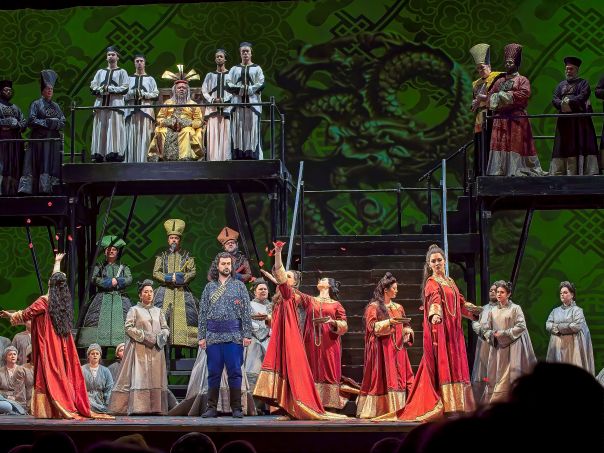
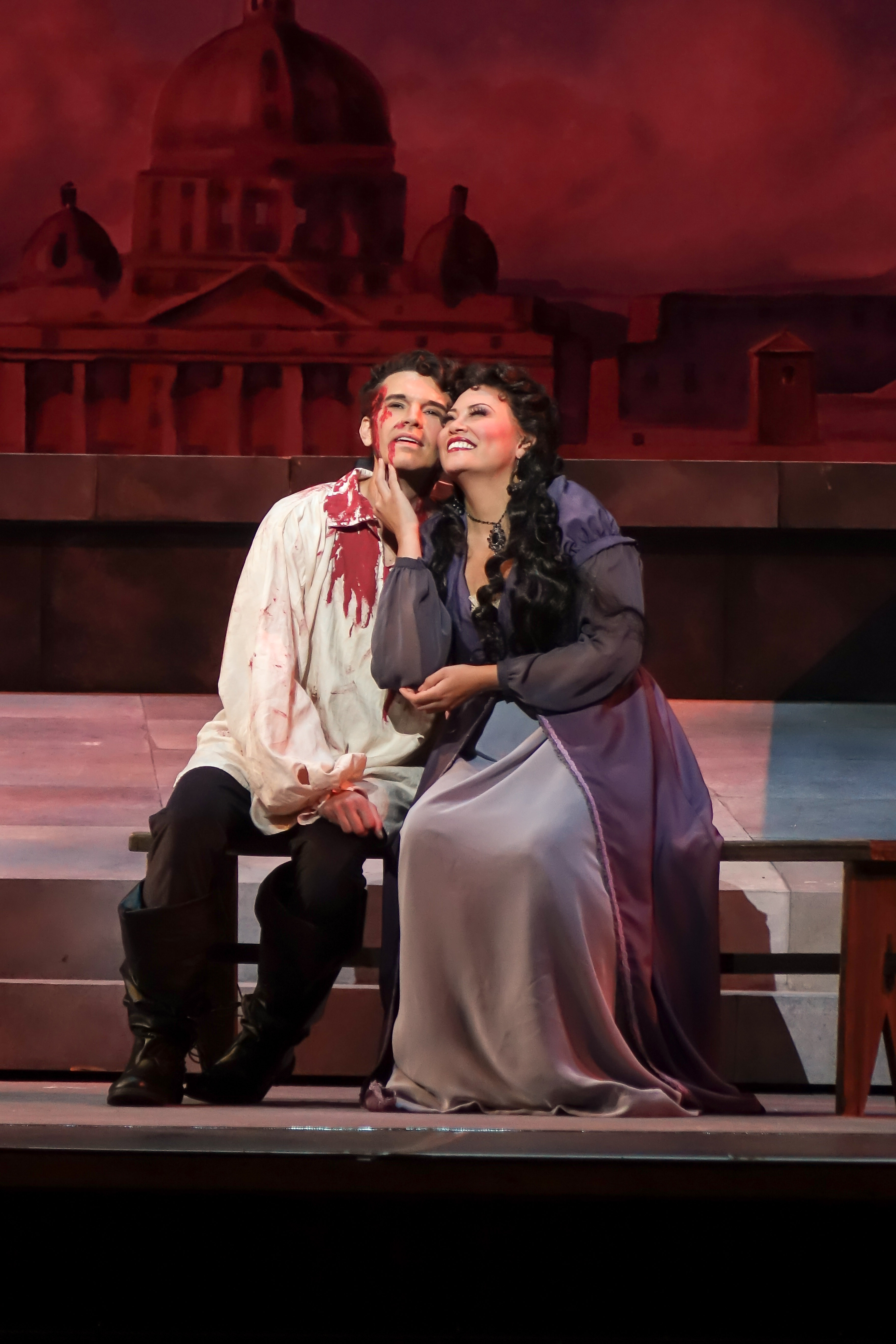
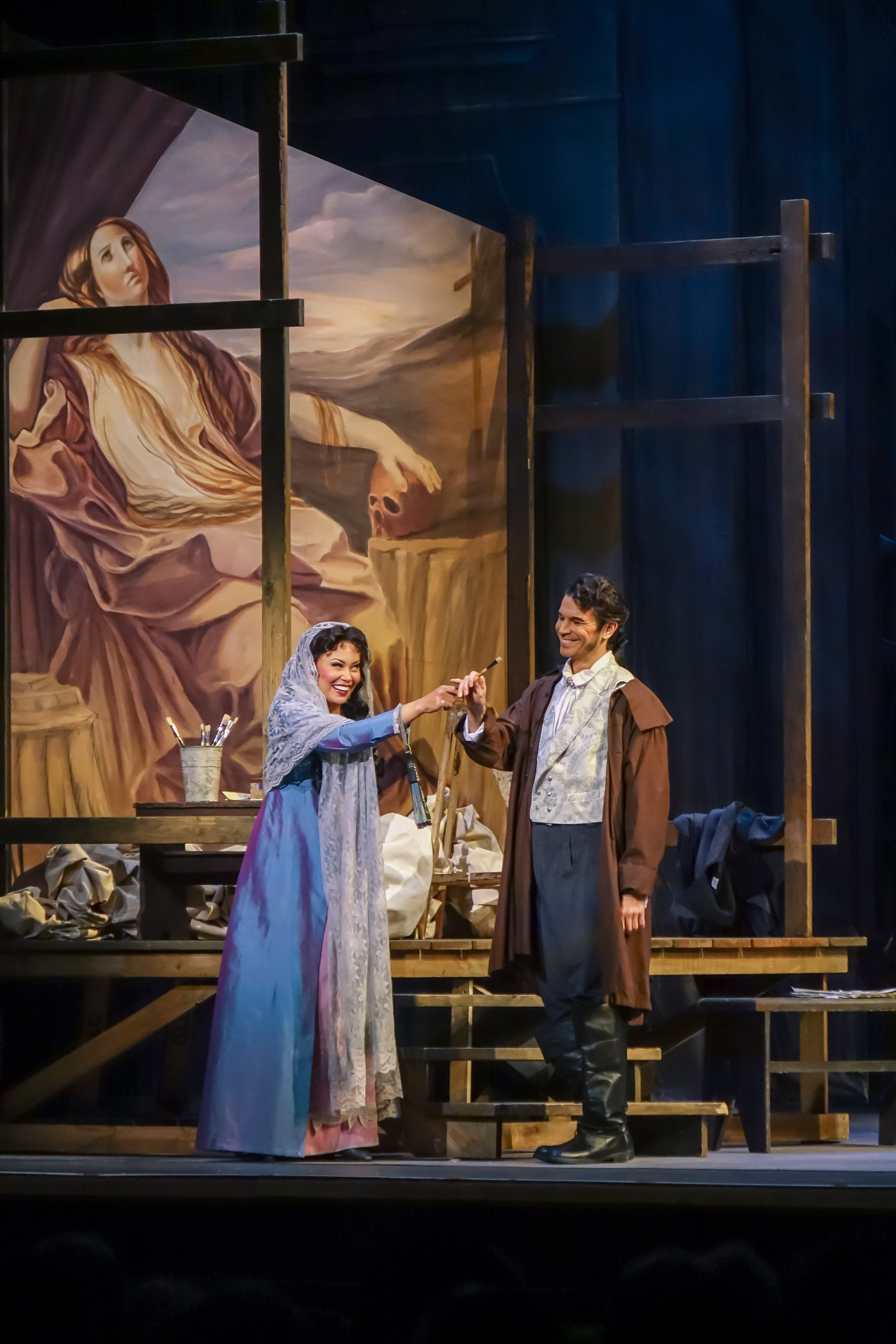
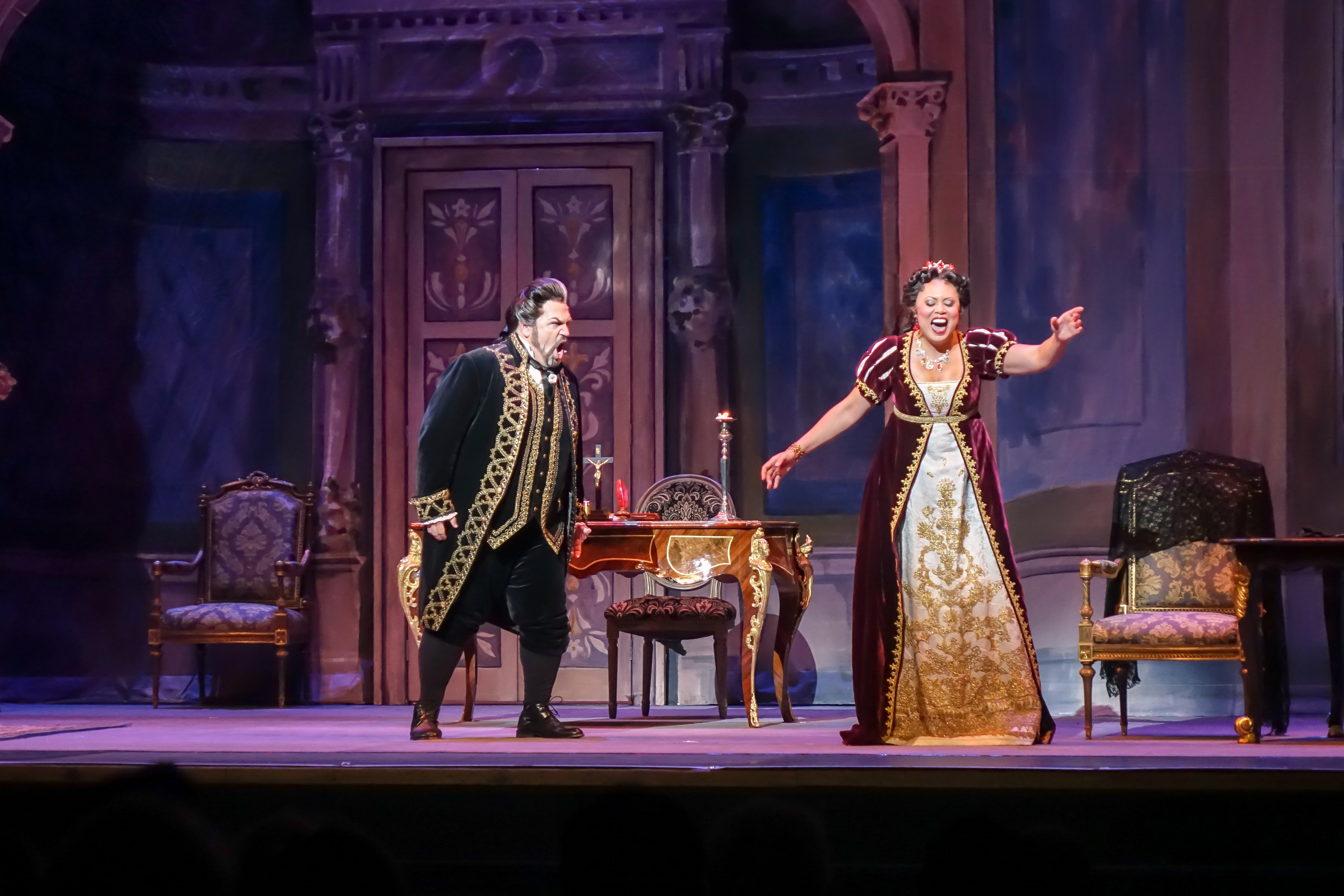
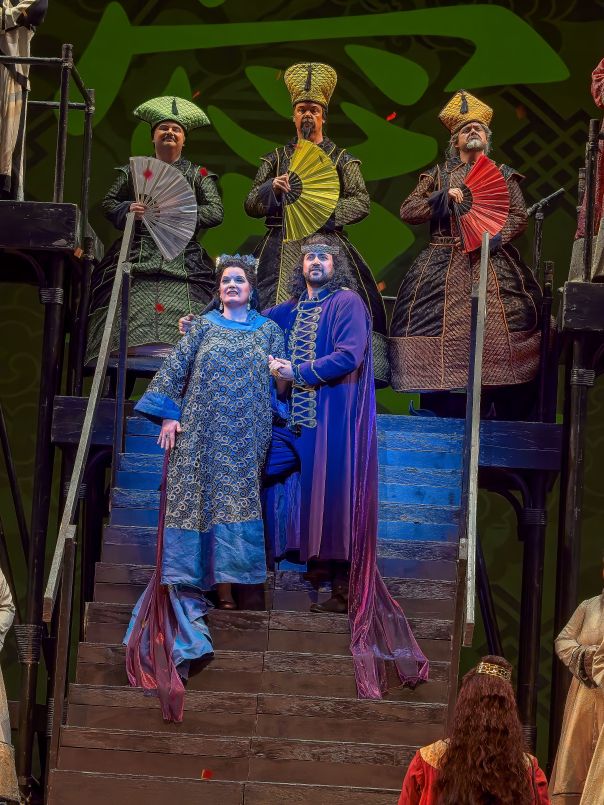
Needless to say, the Opera Carolina production didn’t figure to deliver legendary grandeur. But instead of smoke and mirrors, set designer Anita Stewart and lighting designer Michael Baumgarten call upon scaffolding and projections to bridge the gap. Stage director Jay Lesenger wisely keeps the curtain down over Stewart’s barebones set until Meena, down in the orchestra pit with the Charlotte Symphony, can begin working his magic with the score. It doesn’t take long to taste its beauties, ranging from delicate to majestic, or realize Meena’s deep affection for it.

Parallel to the build-up to Prince Calaf’s climactic confrontation with Peking’s ice goddess, when the princess asks him three riddles that he must solve – or die – there’s a steady build-up of ritual. A Persian prince has failed the Trial of Three Riddles and must be beheaded. To declare his candidacy, against the fervent wishes of his father and his dear maidservant, Calaf – “The Unknown Prince” – must strike the gleaming gong near the gates of the imperial palace. To stage a new trial, there must be a public proclamation, holy men must gather, the Emperor must preside, and Turandot herself must pose the riddles.

It’s a regal crescendo of pomp, ceremony, and colorful, eye-popping costuming from Anna Oliver that ultimately matches the trumpets heralding the divine Principessa. Watching the royal entrances of Emperor, Turandot, and their respective ministers and maidservants, high up and almost level with the proscenium, I had to wonder how much more scaffolding and stairs there must be hidden in the wings so that all these nobles, old and young, could safely ascend to those lofty heights.

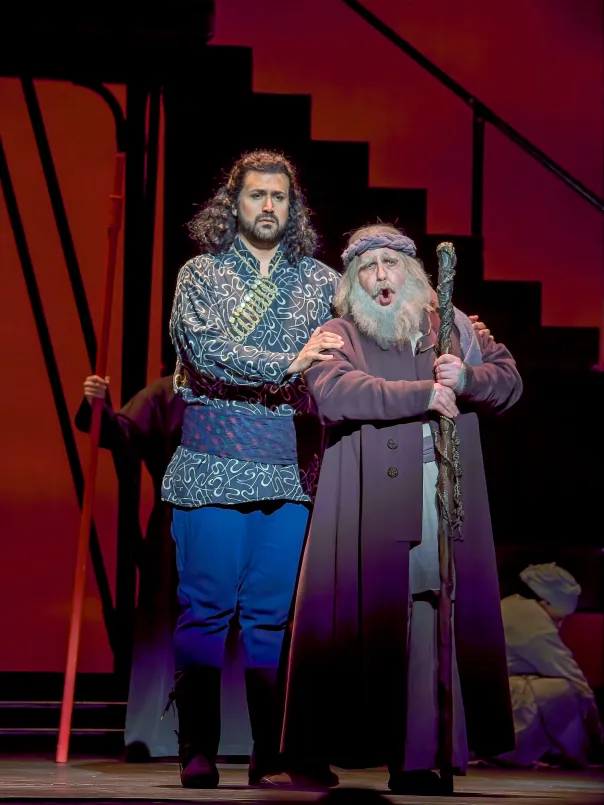
At ground level, my worries began as soon as soprano Jennifer Forni made her auspicious Opera Carolina debut as Liù, the maidservant who has devoted herself to dethroned Tartar king Timur simply because her son, Calaf, once smiled at her before he fled the kingdom. Forni distinguished herself within the first ten minutes with her sweet fruity timbre recounting Liù’s backstory, and her buttery soft notes put the protagonists waiting for their big moments in serious jeopardy of being upstaged. After all, Renata Tebaldi, Renata Scotto, and Montserrat Caballé are among the notables who have been drawn to this role.

If we don’t see or hear the very best of Diego Di Vietro early in Act 1, there was enough Luciano Pavarotti DNA surfacing in his tenor to assure us that he would likely be equal to Calaf’s big “Nessun dorma” moment when the curtain rose on Act 3. The extra panache that was missing before intermission arrived on time, and Lesenger made more of Calaf’s first private moment with Turandot, calling upon Di Vietro to conquer the princess with brutish aggressiveness and charm. The chemistry that was so sorely missing when Opera Carolina brought Turandot to the Belk in 2009 had finally been recovered, making for a more deeply satisfying ending.

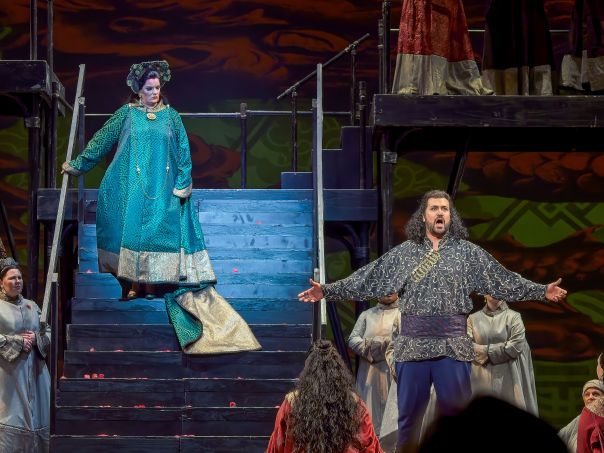
Though Lesenger could have given her more to do during Turandot’s icy phase, Amy Shoremount-Obra was certainly majestic, intimidating, and cruel as the Principessa in the stunning trial scene. Nor am I quite sure that Baumgarten took the best approach in lighting the Princess when she first appeared. Yes, Shoremount-Obra was dazzling but blinding might be equally accurate as the lights were so dazzling that there was no chance to behold the beauty of the Princess’s face, utterly bleached by the spotlight. (My photographer agrees.)

Yet there is visual drama in this tense ceremony as Turandot gradually descends the long staircase from her lofty height as her successive riddles are solved. Shoremount-Obra visibly becomes more human and vulnerable as she comes closer to the Unknown Prince’s level at the climax of Act 2 and he proves more and more worthy of her. The dramatic soprano’s stamina wavered just slightly after intermission in her pre-dawn duet with Di Vietro, but by this time, Shoremount-Obra’s beauty had been revealed and the chemistry was kindled.

Otherwise, there was no lack of strength or color among the remaining cast. John Fortson was austere and imposing in all of the Mandarin’s proclamations. Jeffrey McEvoy, Zachary Taylor, and resident artist Johnathan White were delightful as Ping, Pang, and Pong when we needed comic relief. Garbed and bearded in gray, basso James Eder brought out a paternal spirituality in the blind King Timur, and Elliott Brown, decked out in enough gold to be declared a Sun King, was a magnificent Emperor Altoum.

Rather electrifying, all around. Bravi.

Photos by Perry Tannenbaum

“Cavalleria Rusticana” Returns After a Long Absence With a Gently Rebuked “Pagliacci”

Review: Pagliacci With Cavalleria Rusticana @ Opera Carolina

By Perry Tannenbaum

October 28, 2023, Charlotte, NC – Long coupled in double bills around the world, Pietro Mascagni’s Cavalleria Rusticana and Ruggiero Leoncavallo’s Pagliacci parted ways at Opera Carolina nearly 30 years ago, immediately after the two were finally wed in Charlotte. Until then, the operas had appeared separately or in successive engagements during the seasons of 1957-58, 1969-70, 1974-75, and 1986-87.

The transcendent popularity of Canio’s climactic aria in Pagliacci, “Vesti la giubba,”has given that opera a stronger grip in the repertoire, which accounts for Opera Carolina programming its most recent presentations of the work in 2006 and 2015 in tandem with two other one-acts. Yet the coupling with Cavalleria is very natural, since Leoncavallo wrote his opera in response to seeing Mascagni’s, and the two premieres were almost exactly two years apart.

Natural and convenient, for the current Opera Carolina production, conducted by James Meena and directed by Garnett Bruce, demonstrates how seamlessly two distinctively different works can be fused together – in their casting and design – after thousands of precedents spanning more than a century. We’ve seen greater scenic alterations in most opera productions at Belk Theater than we saw here from designers John Farrell and Michael Baumgarten for this twin-bill.

On stage right, the church façade remained the same, and across on stage left, a boxcar café was discreetly modified at intermission to become a boxcar theater. Between these, projections by Baumgarten could recycle the centerstage backdrop in the blink of an eye. More radical were the costume changes provided by Allison Collins, who reveled in bringing us the harlequin costumes of the Pagliacci clown troupe, and brought a more urban World War 2 flavor to the garb of the townspeople and visiting soldiers on leave.

Although billed on the OpCarolina website as “Pagliacci With Cavalleria Rusticana,”the two operas are presented in chronological order – the right choice if you’re building to a climax at the end of the evening. With extended instrumental sections at the start, Cavalleria isn’t as instantly impactful as Pagliacci, which begins with a member of Leoncavallo’s commedia troupe directly addressing the audience. For a one-act, the exposition of Cavalleria proceeds at a surprisingly glacial pace, all the more reason to be pleased with how beautifully Meena and the Charlotte Symphony perform the bountiful orchestral episodes.


We didn’t have to wait until the famous “Vesti la giubba” for the vocal splendor of this production to become manifest. Soprano Barbara Frittoli was already a rising star, soon to debut at the Metropolitan Opera, the last time Cavalleria Rusticana was performed in Charlotte, and now she’s the leading lady in both Cav as Santuzza and Pagliacci as Nedda in her Opera Carolina debut – though Yunah Lee will give her a breather in the Sunday matinee performance of the curtain raiser. Nearly as auspicious, baritone Leo An made his debut as the malevolent Alfio in Cavalleria and reappeared almost immediately as Tonio, the odious clown who greets us after intermission.

These are two marvelous singers, normally filling the quota of marvels we have heard in past years at Belk Theater. But we seemed to be entering a new golden age as the curtain rose on Pagliacci, for those two notables were joined onstage by baritone Nmon Ford as Silvio, Nedda’s secret lover, and Carl Tanner’s long-awaited return to the Belk as Canio, after his 2010 triumphs in Carmen and Otello. Nor did resident company member Jonathan Kaufman sound at all outclassed in the tenor role of Turiddu, the soldier who heartlessly yet helplessly abandons Santuzza for Alfio’s wife, Lola. Likewise, mezzo Julia Woodward held her own as Lola, not at all hindered by a flaming red dress.

Everything is beautifully sung, but it was fascinating to note how Bruce navigates the inevitable changes in attitudes and social norms that have occurred since 1890, when Cavalleria Rusticana premiered. Audiences in 2023 may wonder why Santuzza, seduced by Turiddu, feels unworthy of entering a church on Easter Sunday after the adulterers betrayed her. Bruce inserts some silent business between Frittoli and a stranger that might be interpreted as solicitation, but otherwise, he ignores the question, leaving us to assume that Santuzza’s sin is not getting a marriage proposal before sleeping with Turiddu. On the other hand, Bruce and Tanner must confront the reality that Tonio is not a pitiful cuckold we can empathize with anymore when he cold-bloodedly plots to murder his wife and her lover.

Tanner was a volatile volcano of jealousy almost instantly as Canio, and he didn’t sob the final notes of his signature aria to milk our sympathies. Distancing us further, Bruce took the final words of the evening from Canio and gave them to the sardonic and vengeful Tonio. Even here, political correctness reigns, for our host is no longer hunchbacked or deformed, though the ugliness of Tonio is retained from Leoncavallo’s libretto. Opera Carolina’s Pagliacci is thus cleansed while it is so magnificently sung, no longer asking us to empathize with Canio’s vendetta or assuming that we will connect Tonio’s warped morality with his appearance. Most amazing, perhaps, were the Frittoli-Ford duets, still youthful and sensual. Great music can rejuvenate us all.

ILA Summer Fest Overachieves With Semi-Staged “Tales of Hoffmann”

Review: The Tales of Hoffmann at the International Lyric Academy Festival

By Perry Tannenbaum

July 5, 2023, Charlotte, NC – Maybe Charlotte’s best-kept cultural secret ever, the 29th International Lyric Academy Summer Festival was officially announced by its partner, Opera Carolina, two days after it had actually begun! From as far away as Cape Town and Seoul, around 150 singers, teachers, accompanists, and conductors had converged on the Central Piedmont Community College to begin a transcontinental five-week program in the Queen City.

The Charlotte segment of this intensive training for young and emerging artists hopscotched from classrooms and rehearsal halls behind-the-scenes during ILA’s first week to CP’s grandest stage, the Dale F. Halton Theater, for the public performances marking the second week. Amid the hullabaloo, two of the College’s venues were discarded from the original festival announcement and poster art, Tate Recital Hall and the new Parr Center, adding to the impression of hurry, indecision, and feverish excitement during the ILA Festival’s opening nights.

Yet the performances I’ve seen have gone marvelously well, showcasing a wide-range of vocal talent and experience, affording us tantalizing glimpses of youngsters taking the stage for the first time and emerging artists well-poised to embark on professional careers. The opening holiday weekend featured two Florilegium concerts offering a potpourri of solo arias; a Mozart Marathon that provided arias from Don Giovanni, Cosi fan Tutte, The Magic, and generous foretastes of La Nozze di Figaro; and a sampling of opera scenes, often spotlighting multiple singers and occasionally venturing into the realm of Broadway musical theatre. Of course, as the middle week unfolded, we could look at the pocket-sized Festival Program and piece together where the singers who were performing in concert would fit into the lineups for the two opera productions that would highlight the final week of this Festival’s US premiere, a semi-staged The Tales of Hoffmann bookending a pair of fully-staged presentations of The Marriage of Figaro.

As the veil lifted from the quality of talent we would witness in the ILA Festival’s climactic week of opera productions, an aura of mystery still lingered over what the upcoming “semi-staged” Tales of Hoffmann might look like. Would it borrow the scenery from Figaro, which is taking over the Halton for the next two nights? Would there be any props, costumes, or furnishings onstage? Will the main singers be holding scripts for the dialogue or scores for the music? Reading stage productions by Charlotte’s theatre companies, I know very well, have taken many shapes over the years, sometimes as austere as actors dressed devoutly in black-and-white, delivering their lines behind music stands. Directors who stick to that format are heartless brutes in my eyes.

Opera lovers across the Metrolina area – and across the Carolinas – can rest assured that the ILA Summer Festival is for real, dispenses with scripts and scores, and delivers the goods. James Meena, Opera Carolina’s artistic director, has revealed that the process of advertising, taking applications, and auditioning for spots at the festival – in six different cities – began last July. However new the template was to Meena and the US, it has obviously proved tried-and-true in Rome, where ILA was founded, and in Vicenza where it resides today.

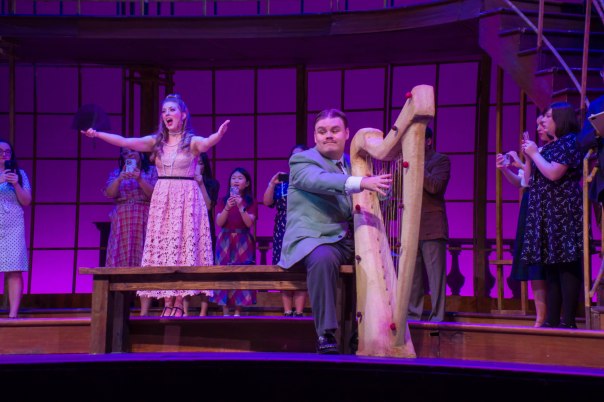
With Meena in the orchestra pit directing an ensemble of at least 20 musicians, and Peter Boon Koh stage directing a cast of 25 actors and choristers, the production looked very polished and not at all bare-boned. Koh deftly had most of the players in modern dress, many of them sporting cellphones in the crowd scenes in Acts 1 and 3. When Olympia winds down, soprano Amber Romero as the life-size automaton who enchants Hoffmann droops forward as usual, but instead of winding her back up with a conspicuous key, tenor Ethan Stinson as dollmaker Spallanzani simply waves a remote control at her while seated behind his garish cut-rate harp.

Meena and Koh have trimmed the opera, which runs between 130 and 140 minutes on recordings, to a sleek 90 minutes, cutting the Prologue and thus depriving South African tenor Luvo Maranti as Hoffmann of his most winsome aria, detailing the legend of Kleinzach, the hunchbacked court jester. We go straight into his misadventures with three iconic sopranos, Huiying Chen as the frail Antonia following Romero, and Ruijing Guo bringing ruination to Hoffmann as femme-fatale courtesan Giulietta. All of these voices exceeded expectations, but the most astonishing were Maranti, Romero, and baritone Zhenpang Zhang who slithered across the stage in three demonic roles as Hoffman’s perennial nemesis, mad scientist Coppelius, quack Doctor Miracle, and – most menacingly – the sorcerer Dappertutto.

The excellence did not stop there, for as Stinson was performing his comical exploits as the devious dollmaker, tenor Jonathan White was beginning his medley of comical turns as his servant Cochenille, culminating in his Act 2 showstopper as Frantz, the cruel and possessive Crespel’s blissfully deaf old servant. The skeletal scenery borrowed from Figaro has a winding staircase leading gracefully upwards to a balcony level, where the portrait of Antonia’s mother can come to life and the temptress Giulietta can begin her imperious and bewitching descent. Supertitles are shown on TV monitors flanking the stage, amply sized so your neck gets a good workout keeping up with the French.

With ticket prices topping out at $35, productions like this and the upcoming Figaro are as accessible as they are irresistible. The US festival concludes on Saturday night with the encore performance of the Offenbach after two consecutive nights of fully-staged Mozart at the same prices. For those who prefer the Broadway style, there’s a Saturday matinee, With a Song in My Heart, paying tribute to Richard Rodgers. Then ILA 29 takes flight to Vicenza, near Venice and Verona, for an additional two weeks of training and performances. Surely, Halton will be more crammed with young and old operagoers in years to come as the ILA Summer Festival continues to grow and word-of-mouth proclaims its high quality. Like Spoleto Festival USA, it’s another great coup for the Carolinas.

Opera Carolina’s “Porgy and Bess” Remains True to Gershwin and Heyward

Review: Porgy and Bess at Belk Theater

 By Perry Tannenbaum

2023~Porgy & Bess-27

January 22, 2023, Charlotte, NC – Curiously enough, Opera Carolina didn’t get around to producing the Gershwin Brothers’ Porgy and Bess – an opera incomparably suffused with the sounds, scents, and DNA of the Carolinas – until its 33rd season in 1980. Turns out that was somewhat bolder than Spoleto Festival USA, which waited until its 40th anniversary in 2016 to bring this opera to Charleston, where the story is set, and where its creator/librettist DuBose Heyward was born. It can be argued that the snooty world of opera recordings was even more hesitant to acknowledge this American classic, issuing the first full-length CD edition in 1976, a full 41 years after the Boston and Broadway premieres.

Hesitancy has lingered a little at Opera Carolina, which brought back new homegrown productions of Porgy and Bess to Belk Theater in 1995 and 2003, but no others until now. OpCarolina did bring us a touring version in 2010, commemorating the 75th anniversary of the Broadway premiere, but that fiasco is best forgotten. A couple more touring versions have come our way over the past quarter century. The best of these was at the Belk in 2014, the touring version of the slimmed-down 2012 Broadway revival that had starred Audra McDonald and Norm Lewis (who just happened to be performing in the touring version of A Soldier’s Play as it finished up its two-week Charlotte run down the block at Knight Theater).

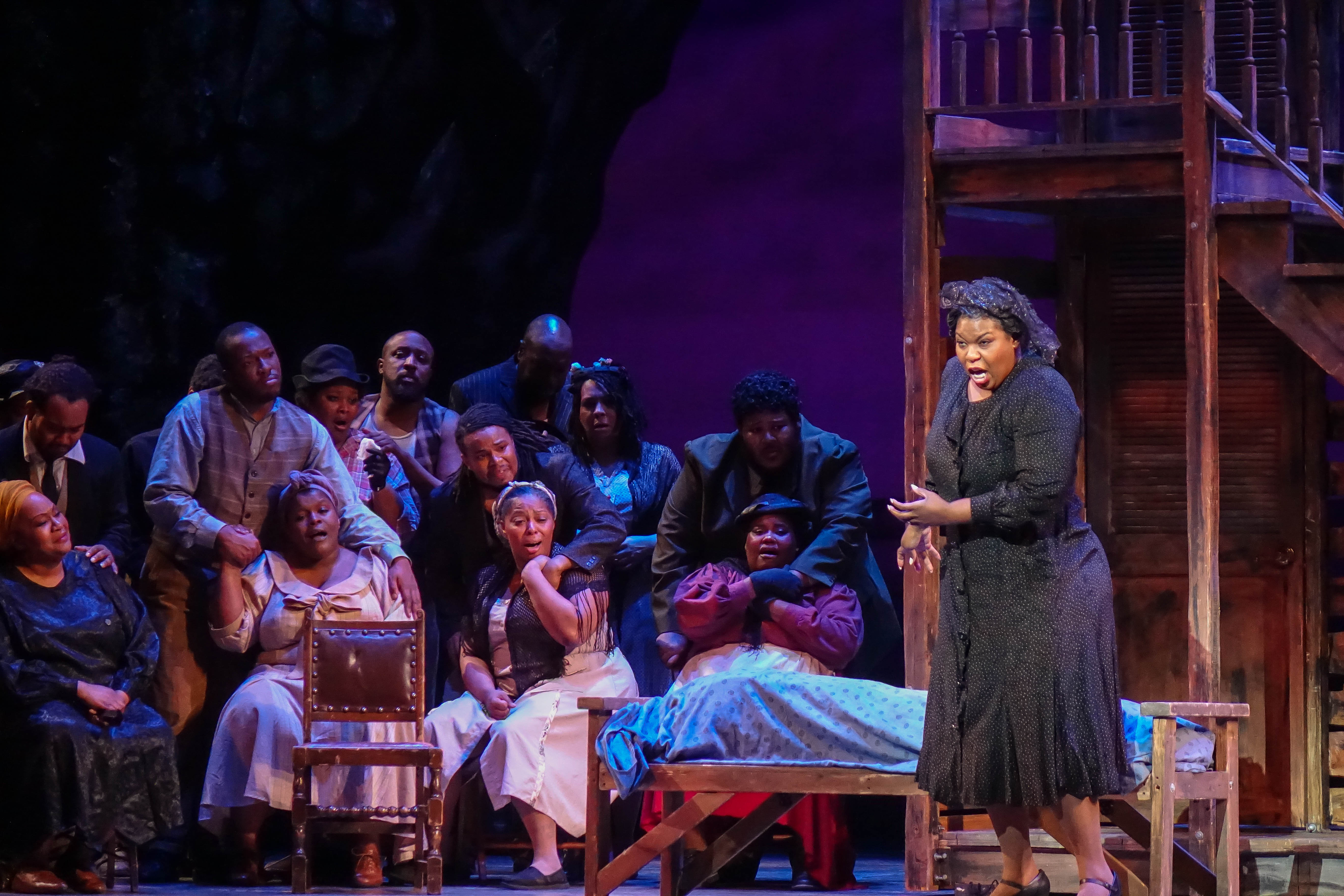
In comparison to that estimable touring treat, the new Opera Carolina production conducted by artistic director James Meena did not need to blush. At the Sunday matinee premiere, Sequina DuBose reprised her role of Clara from the Broadway tour while Nicole Cabell, featured as Clara – who sings the incandescent “Summertime” – on Decca’s landmark 2006 recording of the original 1935 Broadway score, made her Charlotte debut as Bess. Kenneth Overton, who was billed as the star of that infamous 75th-anniversary tour, was replaced by a fifth-string singer at Ovens Auditorium whose name could not be determined until five days later, finally got his chance to impress as Porgy. No less prestigious, Victor Ryan Robertson gave us a taste of what made the ornate Spoleto production so splendid by reprising his slickster grace as Sportin’ Life.

2023~Porgy & Bess-03

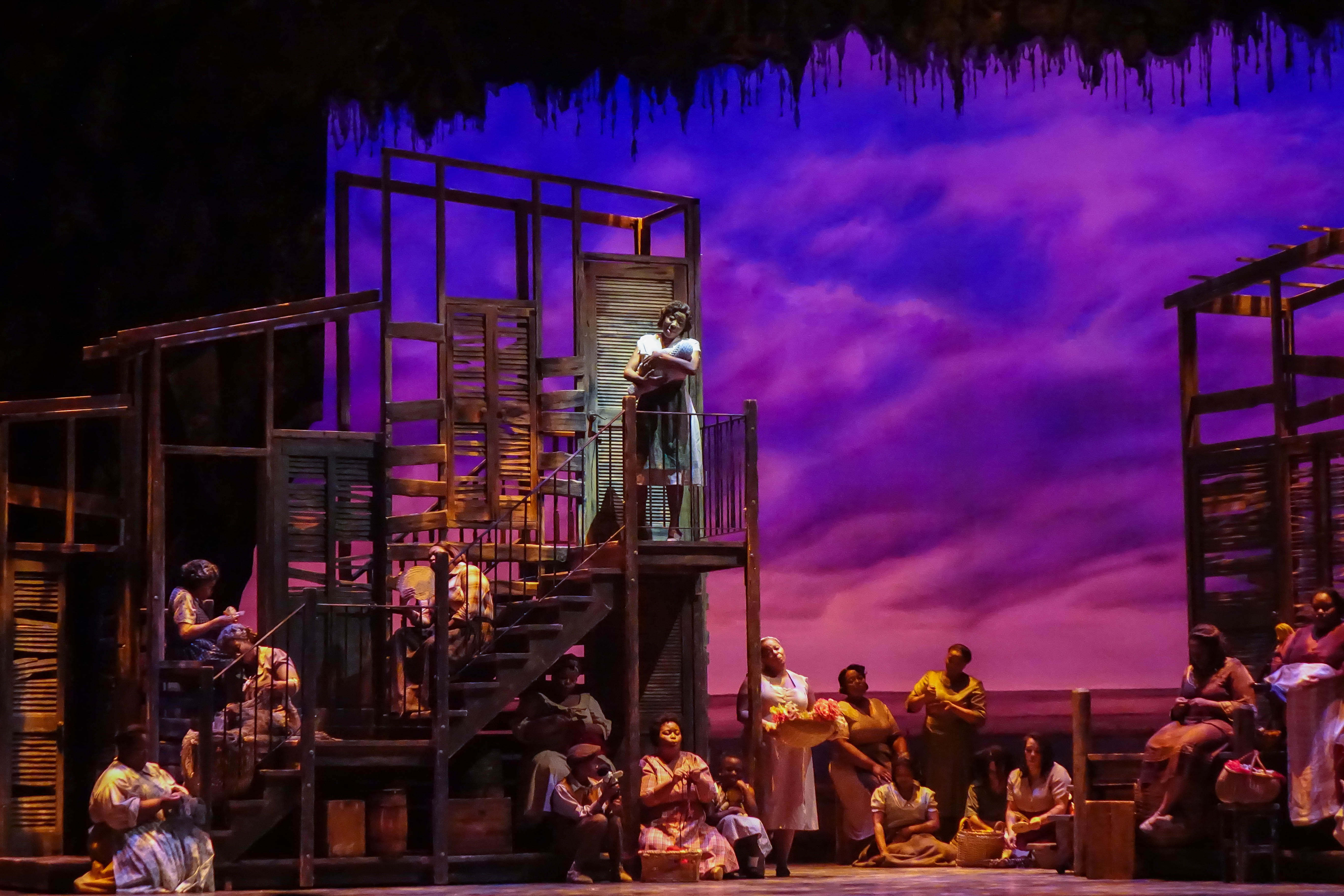
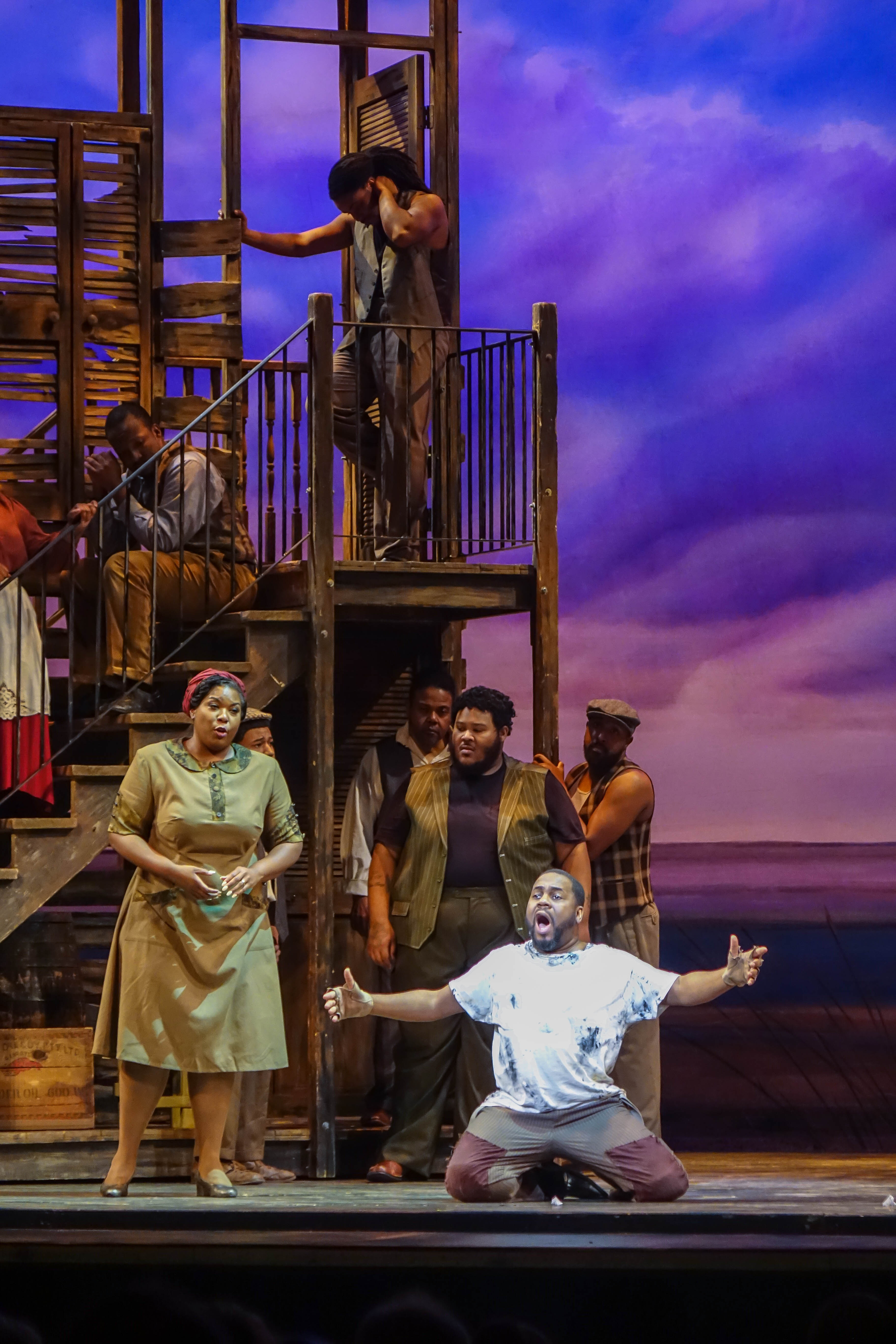
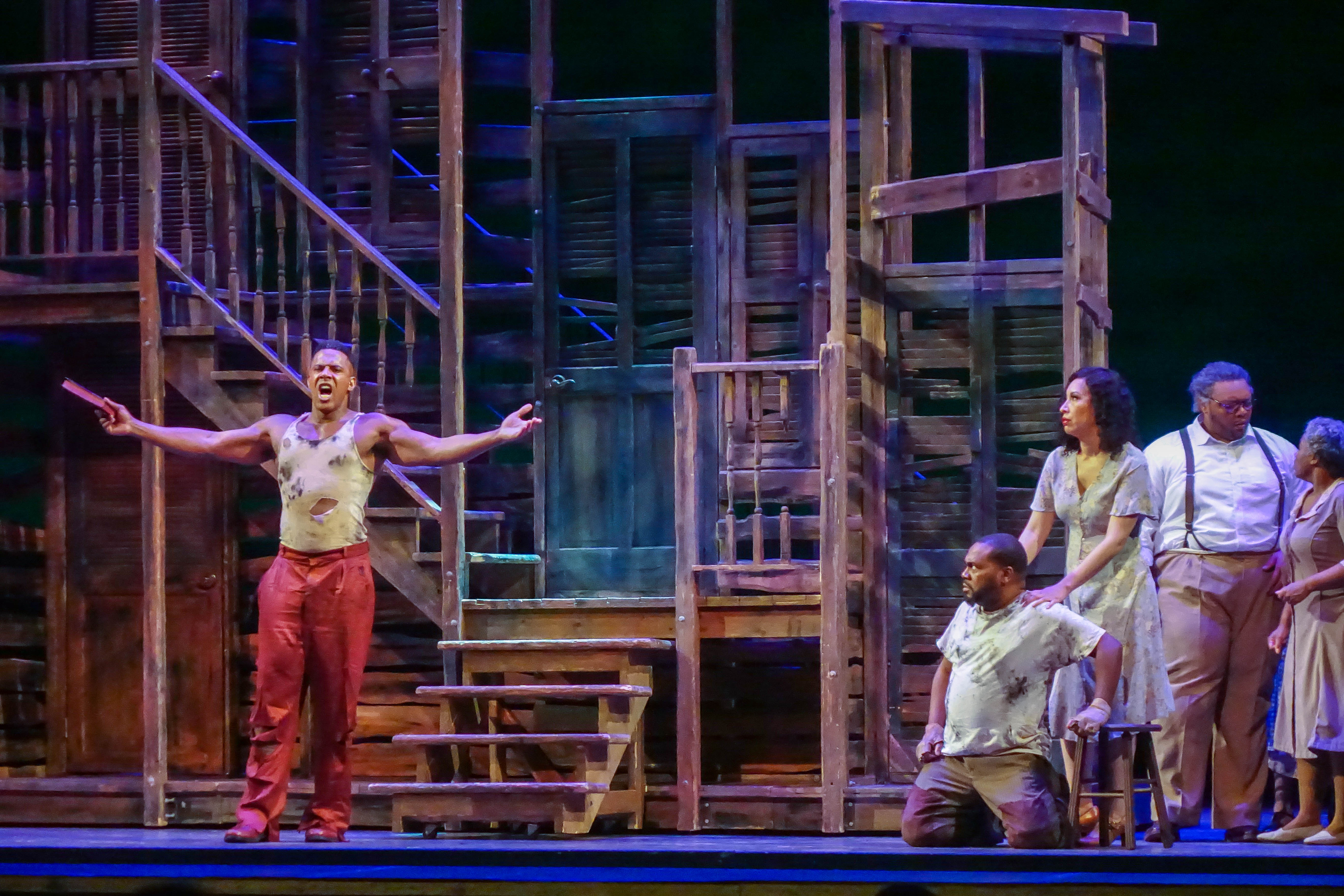
Stage director Dennis Robinson hasn’t sought to replicate that scenic Spoleto splendor, concentrating his attention instead on building the drama. Two rolling set pieces by scenic designer John Farrell replicate the dilapidated Catfish Row tenements, with backdrops and Michael Baumgarten’s wonderful lighting supplying much of the color. Those colors are usually upstaged by Ildikó Debreczeni’s artful costume designs, motley women’s and working men’s clothing in the outdoor community scenes, veering toward black in the dimly lit funeral scene for the murdered Robbins, and suddenly switching to a splash of white linens for the Kittiwah Island picnic.

Even the stylish Sportin’ Life, all purple with gold accents when we first see him, wears pure white pants and vest at the beach, though a lurid silk fuchsia shirt peeps through. Other costumes sketch the main characters’ evolution. Crown, Robbins’ murderer and Bess’s abusive former husband, is nearly as dandified as Sportin’ Life when we first see them shooting craps, yet he’s nearly in tatters when he madly emerges from hiding, seeking Bess. Debreczeni’s Bess transforms only slightly less dramatically, her first appearance in a flaming red dress when she still belongs to Crown, followed by a citified black “mourning” dress at the funeral – pointedly accessorized with pearls.

2023~Porgy & Bess-09

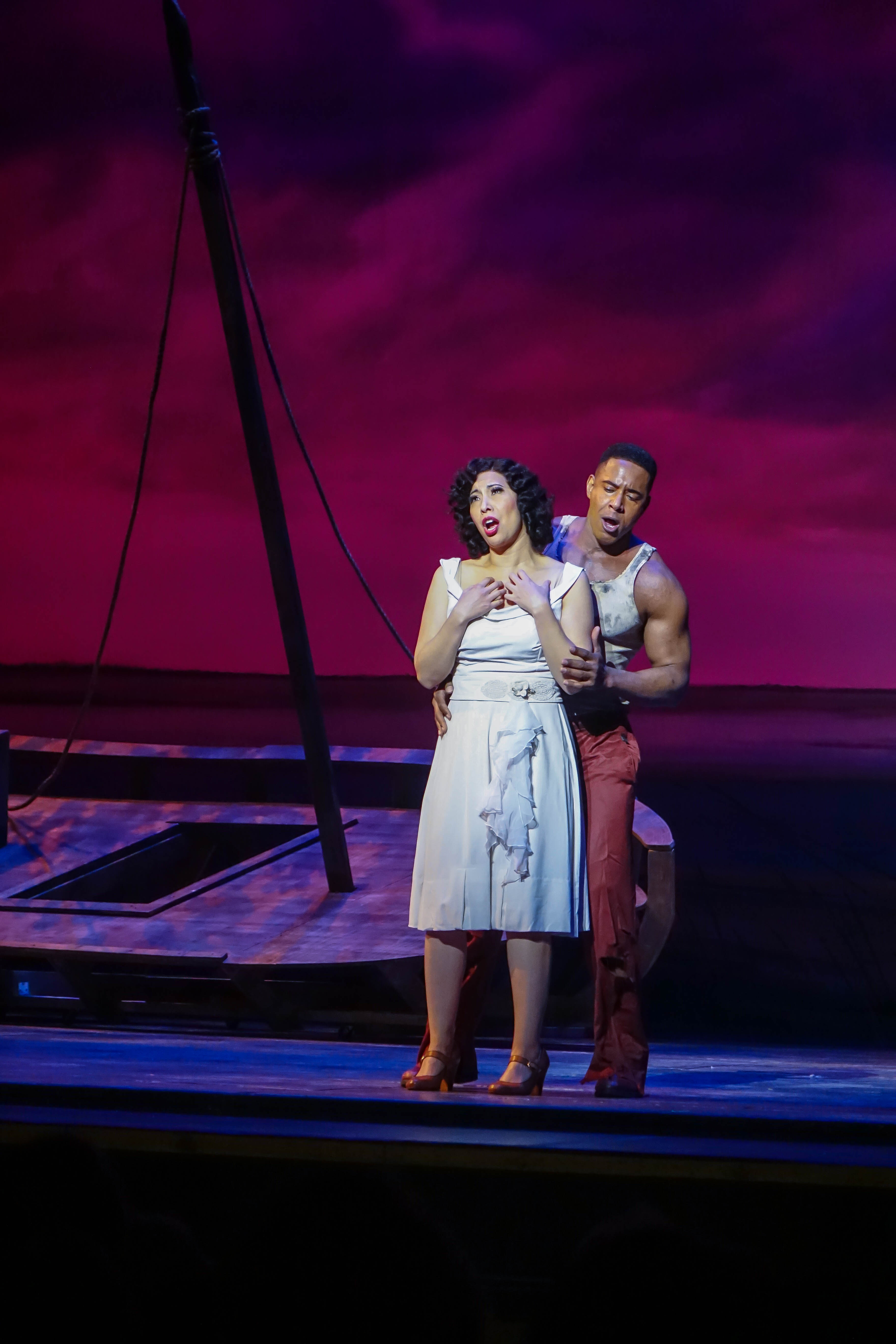
The funeral and picnic scenes both show off how dignity has triumphed over poverty along Catfish Row, though the seafaring men and a climactic hurricane remind us how tenuous their victory is. As Jake, Clara’s husband, reminds us as the lead voice in the men’s worksong, “It Take a Long Pull to Get There,” evoking the Promised Land in much the same way that Rev. Martin Luther King would at the Lincoln Memorial decades later. Laudably, Robinson isn’t ashamed of either Porgy or Bess. He permits Cabell’s Bess to be Bess, ambivalent toward Porgy, Crown, and Sportin’ Life, just as she was written – bold yet insecure. She yields resignedly to Crown after arguing and resisting, so she is absolutely credible when she confesses the full range of her fears in her famed “I Loves You, Porgy” of the imminent confrontation when Crown comes for her: “he hypnotize me when he take hold of me with his hot hand.”

2023~Porgy & Bess-61

Refusing to enlighten Bess or belittle her demons, Robinson collaborates with Overton to rehabilitate Porgy, making him happier and less pathetic than I’ve ever seen him before. Robinson doesn’t ignore Porgy’s mobility issues, but unlike other directors, he offers Overton multiple avenues for motion, dispelling the cripple’s usual monotony and impotence. In most productions, Porgy perpetually limps with a crutch or glides along on a cart. Occasionally, you might see that four-wheel vehicle at the rear of a goat cart, honoring Samuel Smalls, alias “Goat Cart Sam,” the real-life Charlestonian that Heyward based his protagonist upon in his celebrated 1920 novel.

2023~Porgy & Bess-04

Discarding that goat, Overton will limp, glide, crawl, and – at one key dramatic moment – even attempt to stand up and walk. This variety made Overton’s Porgy more restless, powerful, and dynamic. His crutch is a forked affair, topped by little ironing board-like cushion joining the branches, enabling Porgy to lean on it with his arm and stand upright. The cart is also cushioned to comfortably accommodate Porgy’s kneepads. We see that Overton can glide a good distance along the stage with a single paddling motion, braking with his toes, but I really didn’t notice that his wheels could swivel until the last possible moment. That revelation made Porgy’s final exit the most stunning I’ve ever seen.

2023~Porgy & Bess-46

When Overton first entered, the neighborhood greeted him with affection rather than pity. Even before he got his gal and somewhat domesticated her, he brimmed with sufficient confidence and joie-de-vivre to heartily sing “I Got Plenty o’ Nuttin’” to every woman along Catfish Row who had doubted him. You could believe in Overton as he jumped into the transcendent “I Loves You, Porgy” duet: he will stand up to Crown – and unlike the original libretto prescribed, this Porgy met Crown face-to-face rather than sneaking up on him.

2023~Porgy & Bess-53

Until Porgy’s surprisingly military departure, Robertson’s slithery balletic grace as Sportin’ Life provided the most delicious movement we saw. Executing Michael Jackson-styled spins, Robertson was the “happy dust” he peddled, the wicked exhilaration of the high life that Bess was giving up. Citified and flamboyant, Robertson also rocked Sportin’ Life’s cynicism smack in the middle of the idyllic Kittiwah picnic. His “It Ain’t Necessarily So” became a showstopper that launched Act 2 buoyantly, no less successful than DuBose’s spotlit “Summertime” when the curtain first rose. Nor did the quality wane after the drunken brawl at the dice game and Robbins’ murder when we adjourned to the gloomy funereal aftermath. Not only did we get to see Porgy duded up, upright on his feet, and escorted by a newly demure and penitent Bess, we got reminded by Michelle Johnson as Serena, Robbins’ grieving widow, of the heartfelt power pent up in “My Man’s Gone Now,” Serena’s swaying lament.

2023~Porgy & Bess-35

As the murderous Crown, Donovan Singletary had ample pects and biceps for Bess to ogle at in his OpCarolina debut, manhandling her on Kittiwah Island with the confidence – and restraint – of a brute who has willed “his” woman back to his arms for the last five years anytime he wished. The “Oh, What You Want wid Bess” duet had exactly the right blend of chemistry, antagonism, lust, and loathing. More of Singletary’s heat surfaced as Catfish Row rode out the hurricane, but his raunchy “A Red-Headed Woman” was too abbreviated, defanged, and on-the-fly for my liking. Give us a longer version, please!

Otherwise, the only persistent flaw in this beautifully sung, meticulously crafted production was the singers when they weren’t singing their arias. Nobody else came close to matching Overton’s intelligibility or audibility when dialogue or recitative pushed the story forward, an unwanted reminder of the touring production that played Ovens Auditorium in 1998. The dropout in decibels was especially dreary for me in the opening scene as the crap game dragged on, but my discomfort may be benign compared to what Porgy newcomers experienced if they didn’t already know the lyrics to the songs.

Once the brawl broke out, Heyward’s story pretty much told itself for me through the actions we watched, aided by George Gershwin’s music and orchestrations. Miking the dialogue, as most touring Broadway shows do, would certainly have been helpful, but the simplest solution for these nagging woes at the Belk would have been supertitles. That way, we could have appreciated Heyward and lyricist Ira Gershwin nearly as much as George.

Stunning and Grand, Opera Carolina Recreates the Original Designs of “Tosca”

Review: Opera Carolina Presents Puccini’s Tosca

By Perry Tannenbaum

2022~Tosca-40 

October 13, 2022, Charlotte, NC – Even in an Opera Carolina production with merely eight solo vocalists in the cast, it was easy enough to see what makes grand opera so grand. Most of the musicians on Charlotte Symphony’s payroll were in the orchestra pit when we entered Belk Theater, tuning up or rehearsing. The program booklets handed to us at the door had the size and stylishness of a glossy fashion magazine, and when the curtain rose on Giacomo Puccini’s Tosca, we saw the interior of a Roman cathedral, the first of Adolph Hohenstein’s three diverse set designs. By the end of the opening act, the stage was filled with clergy, a cardinal, and a throng of Opera Carolina choristers, all celebrating a mistaken report of a royalist victory over Napoleon’s invading army.

All of these blandishments – and extras – spell out expensive in big, bold capital letters. So it was particularly disappointing to see the Belk’s uppermost balcony completely empty and so many unclaimed seats below. If Hohenstein’s name rings a bell, we can multiply our disappointment, because he designed the sets, the costumes, the props, and the poster art for the original Milanese production of Tosca in January 1900. We can thank the New York City Opera for this meticulous recreation of Hohenstein’s handiwork – by heading out to the Belk Theater and seeing it.2022~Tosca-13

Opera Carolina lighting designer Michael Baumgarten certainly helps to capture the melodramatic spirit of Puccini’s deft adaptation of Victorien Sardou’s La Tosca, written for Sarah Bernhardt in 1887. But perhaps disheartened by all those empty seats, the opening night performance didn’t attain its full potboiler heat until late in Act 1 when bass baritone Steven Condy entered as Baron Scarpia, the cruel, lascivious, and unscrupulous chief of Rome’s city police. Until then, soprano Alyson Cambridge as opera diva Floria Tosca and tenor John Viscardi as principled painter Mario Cavaradossi hadn’t belittled the love, intrigue, jealousy, and playfulness of their relationship. Not at all. But against the backdrop of the Charlotte Symphony Orchestra, tempestuously conducted by OpCar artistic director James Meena from the opening bars onwards, both sounded somewhat underpowered, though they were clearly gifted as actors.2022~Tosca-10

Chasing after former Roman Republic consul Cesare Angelotti, who has escaped from prison and has already been secreted into hiding by Cavaradossi, Condy as Scarpia quickly injected menace and urgency into the drama. Then he cunningly worked on Tosca’s unfounded jealousy to freshen the trail to her paramour’s hideout before the curtain fell. In his tense confrontation with Tosca, Condy seemed to kindle some of the spark we would see unceasingly from Cambridge in the two acts that followed.

Stage director James Marvel takes full advantage of his principals’ gifts as the intricacies of Sardou’s plot come brutally to fruition in Act 2. Tosca has led Scarpia’s spies to Cavaradossi’s hideout, and soon the painter will be in custody while Angelotti has once again escaped. Scarpia dispatches his prisoner to a torture chamber adjoining his lavish apartment, hoping to extract information about Angelotti’s whereabouts. He and his thugs cannot break Cavaradossi, but they don’t have to. Tosca is with him, ruefully aware that her jealousy was baseless, and able to hear her beloved’s outcries as Scarpia’s men inflict their torture. Where the fiend has failed with Cavaradossi, he succeeds with Tosca, breaking her twice. In exchange for stopping the torture, Tosca gives up Angelotti, and to barter for Cavaradossi’s freedom, the price will be Tosca’s virtue.

2022~Tosca-16Beyond having doubted her true love’s fidelity, there was so much more for Tosca to regret now. In singing the famous “Vissi d’arte” aria before nodding her consent to Scarpia, Cambridge drew upon all the additional anguish Puccini had written for her. All of the art she had lived for, all of her passionate love, all her charitable deeds, and all her fervent prayers have been for naught in the face of this perverted monster. God has shortchanged her. With all the grim delight that Condy took in tormenting her in their crackling duets, it certainly seemed so. But Marvel was no less cold-blooded in staging “Tosca’s kiss,” where the diva settles all her debts with the Baron and appends a chilling religious ceremony.2022~Tosca-35

Courageous and bloodied in his brief appearances, Viscardi’s energy jumped nearly as much as Cambridge’s after the first intermission, but he didn’t reach his zenith until he staggered onto the rooftop battlements of the Sant’Angelo Castle in the pre-dawn light of Act 3, sentenced to face a firing squad. Maybe not quite as electrifying as Cambridge’s signature aria, Viscardi filled Cavaradossi’s “E lucevan le stelle” with sweet lyrical despair that soared upwards into the dawn appointed for his death. Alone for an extended conspiratorial duet, when both lovers grew joyous at the prospect of their coming bliss, Cambridge and Viscardi poignantly lit up the stage one last time before fate cruelly closed its fist on them. Stunning – and grand.

Scaling Back on Brassy Pomp, OpCarolina Brings Us a More Classic and Elegant Aïda

Review: Opera Carolina Presents Aïda

By Perry Tannenbaum

2022~Aïda-35

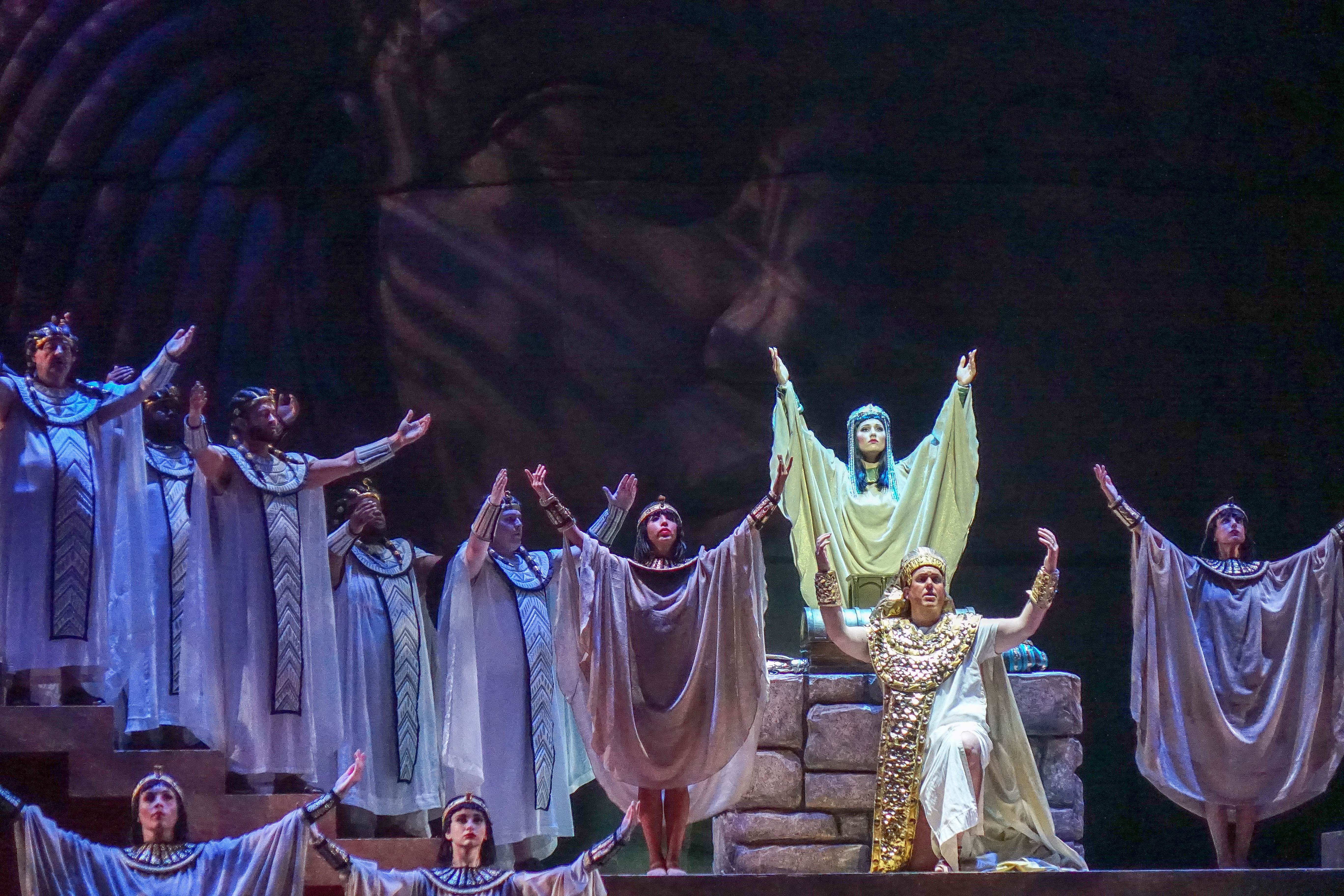
April 7, 2022, Charlotte, NC – Premiered in Egypt in late 1871 and brought home to Milan less than two months later, Giuseppe Verdi’s Aïda has become synonymous with all that’s grandiose and spectacular in grand opera. Opera Carolina has now produced this signature work nine times since its founding in 1948, only once allowing more than a decade to go by between productions. An eight-year interval is about the average in Charlotte, which we would have had if the current production has arrived, as originally scheduled, at the end of the 2020-21 season. The postponement seemed to benefit the design team responsible for the visuals; set designer Roberto Oswald, costumer Annibal Lapiz, and lighting designer Michael Baumgarten; all of whom collaborated on the 2013 production here at Belk Theater. A year further in the distance, deferred by the pandemic, this Aïda was perhaps fresher and certainly more welcome.2022~Aïda-14

With the exception of the Opera Carolina Chorus and baritone Mark Rucker reprising his Amonasro, the Ethiopian king, all of the faces onstage were new, especially tenor Arnold Rawls, substituting for the indisposed Gianluca Sciarpeletti as Radames on short notice. Infusing more freshness, almost upstaging the principals in the big scenes, were the elegant touches and classic symmetries of stage director Linda Brovsky and choreographer Gabriella Sevillano with dancers from Corta Jaca. Once again, Ancient Egypt was a no-twerking zone, graced with processions and tableaus that jibed with the times. Conducting his Verdi with customary panache, artistic director James Meena discreetly scaled back on the brassiness of the triumphal scene, recognizing that a parade of subdued Ethiopian prisoners, fettered in chains, isn’t the most glorious spectacle in 2022, when images of wartime destruction clutter our news media.2022~Aïda-07

Intertwined with the spectacle indoors and outdoors, in the blaze of day and the hush of night, was a poignant love triangle, heightened by the scintillating debut of mezzo-soprano Catherine Martin as Amneris, the cunning, jealous, amorous, and conflicted princess of Egypt. The smoothness of her arias, particularly the “Vieni amor mio” anticipating Radames’s arrival in Act 2, nicely chimed with her cool and confident manner, for once making the prospect of someday reigning with her over Egypt worth considering for the undeniably ambitious Radames. Conquering this princess’s heart was on a par with conquering Ethiopia. Also tilting the triangle, presumably because of a lack of rehearsal, was the slow-to-ignite chemistry between Rawls as Radames and Karen Slack, making her Charlotte debut as Aïda.

Launching his debut, Rawls didn’t show us all he can do vocally in his “Celeste Aïda,” and Slack similarly fell short on the self-reproachful “Ritorna vincitor!” – too nervous and melodramatic in realizing that a victory for her beloved Radames meant defeat for her native Ethiopia, and possibly death for her father, the king. More vulnerability and youthful confusion were needed here, and we never had a vivid impression that Aïda was observing even demure caution, let alone simulating deference, in keeping her royal identity from her mistress, Amneris.

2022~Aïda-21After intermission, both Slack and Rawls ascended to loftier levels, achieving parity with Martin. I was frankly surprised – and delighted – by how beautifully Slack sang the iconic “O patria mia” aria in the pivotal nocturnal scene in front of the Temple of Isis. The missing chemistry between Slack and Rawls then arrived with such a rush that it seemed like Aïda might forget to coax Radames into divulging his key military secret to the eavesdropping Amonasro. Martin and Rucker helped this denouement to crackle with tension, though Rucker wasn’t quite as imperious and intimidating as he was in 2013.2022~Aïda-23So the unique two-tiered finale played really well, with all three principals in top form. Rawls and Slack, buried alive as the lovers, consoled each other sweetly in their love duet as Aïda managed to sneak into the tomb and share Radames’s punishment for betraying his country. Meanwhile, Martin completed Amneris’s graceful arc above them, remorseful for triggering the downfalls of her beloved and her rival, wishing both of them peace.

Credit Brovsky and Sevillano for the stateliness and elegance of the public scenes, the one at the Temple of Vulcan, where the beneficence of Ptah is invoked, and the triumphal scene where Pharoah and Amneris preside. Song Zaikuan was a resplendent Pharoah, Jordan Bisch declaimed with stony certitude as Ramfis, the high priest, and Katherine Kuckelman was a sublime High Priestess – all in costumes to die for.

With both a matinee and an evening performance scheduled for Saturday, this review serves as a reliable guide to the upcoming evening encore. Only Bisch and Zaikuan will be on hand for the Saturday matinee – along with Meena’s sure hand with the score.

Originally published on 4/9 at CVNC.org

Opera Carolina Finds New Balance in Mozart’s “Don Giovanni”

Review: Don Giovanni at Belk Theater

 By Perry Tannenbaum

220203_OPC_CON_1103

February 3, 2022, Charlotte, NC – Among the lovable scoundrels of Western world literature, surely Don Juan has proven to be the most lovable – Molière, Goldoni, Lord Byron, Shaw, and Mozart are just a few of the notables who have sung the Spanish Don’s sins over the past 400 years. His tale can be seen as a series picaresque escapades and comical conquests, or as a grim and grisly revenge tragedy, or as a stern moral lesson. Armed with a wondrous libretto by Lorenzo da Ponte, Mozart disdained to choose among these alternatives, daring to make his Don Giovanni all of the above. With so much to see and emphasize, it’s no wonder that each of the six productions I’ve reviewed since 1991 has been so different from the others – including a Czech National Theatre production at the Estates Theater in Prague, the venue where Mozart’s masterwork premiered in 1787.220201_OPC_DON_053

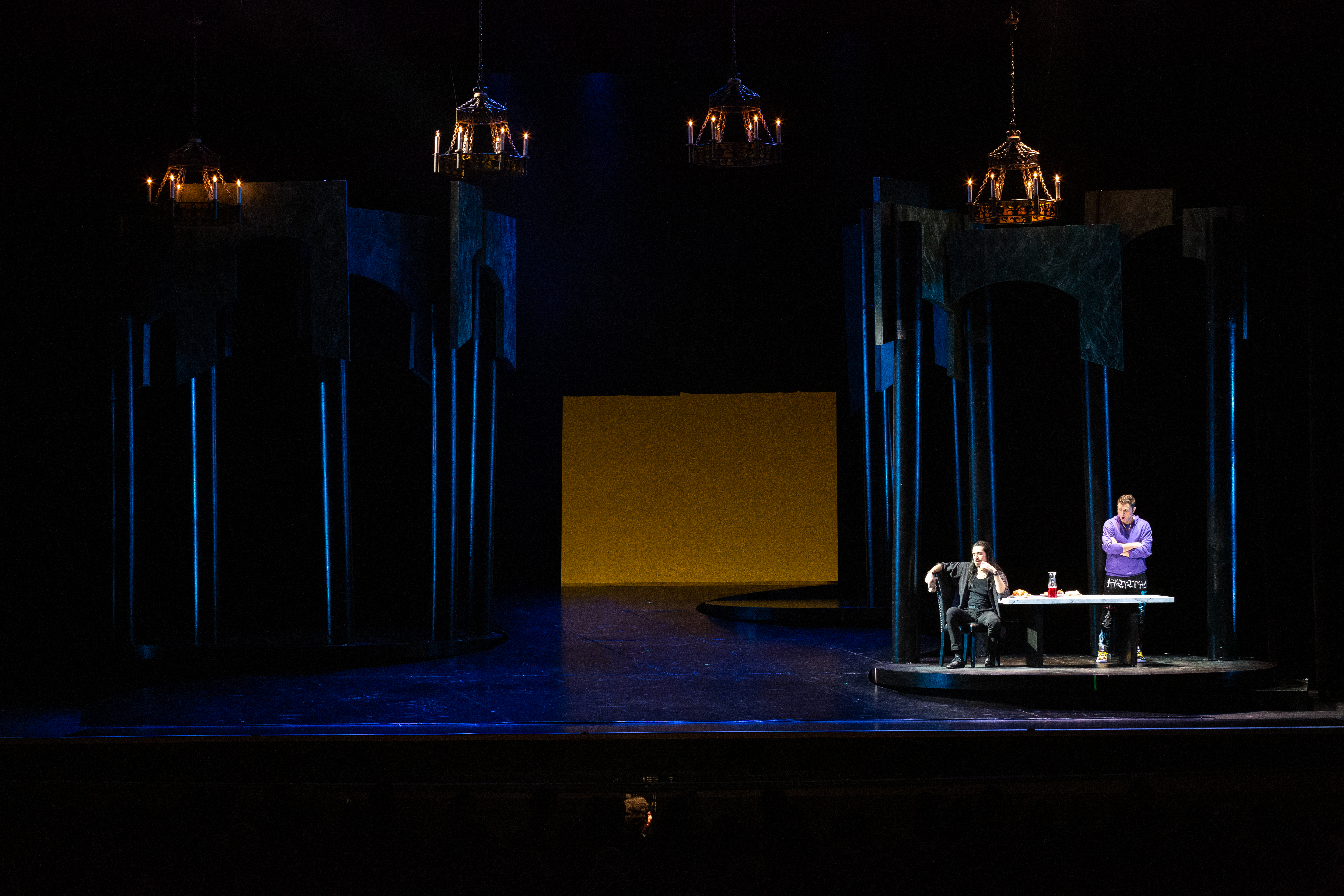
In her Opera Carolina debut, stage director Eve Summer pays little attention to scenery, relying on props and Whitney Locher’s costume designs to modernize the action. Donna Anna’s home doesn’t have a façade in the opening scene, where Giovanni flees after raping the noblewoman and is compelled to murder her father before he can escape. Nor is there an exterior, let alone an upstairs, at Donna Elvira’s lodgings in Act 2, when Giovanni serenades milady’s maidservant while Leporello, the Don’s servant masquerading as his master, creates a cunning diversion. Three revolving pods help simulate the places where the swift action unfolds, and Michael Baumgarten’s lighting designs signal the transitions and enhance the drama – especially in the denouement, when the Commendatore, Donna Anna’s murdered father risen from the dead, implacably gets his revenge.220201_OPC_DON_426

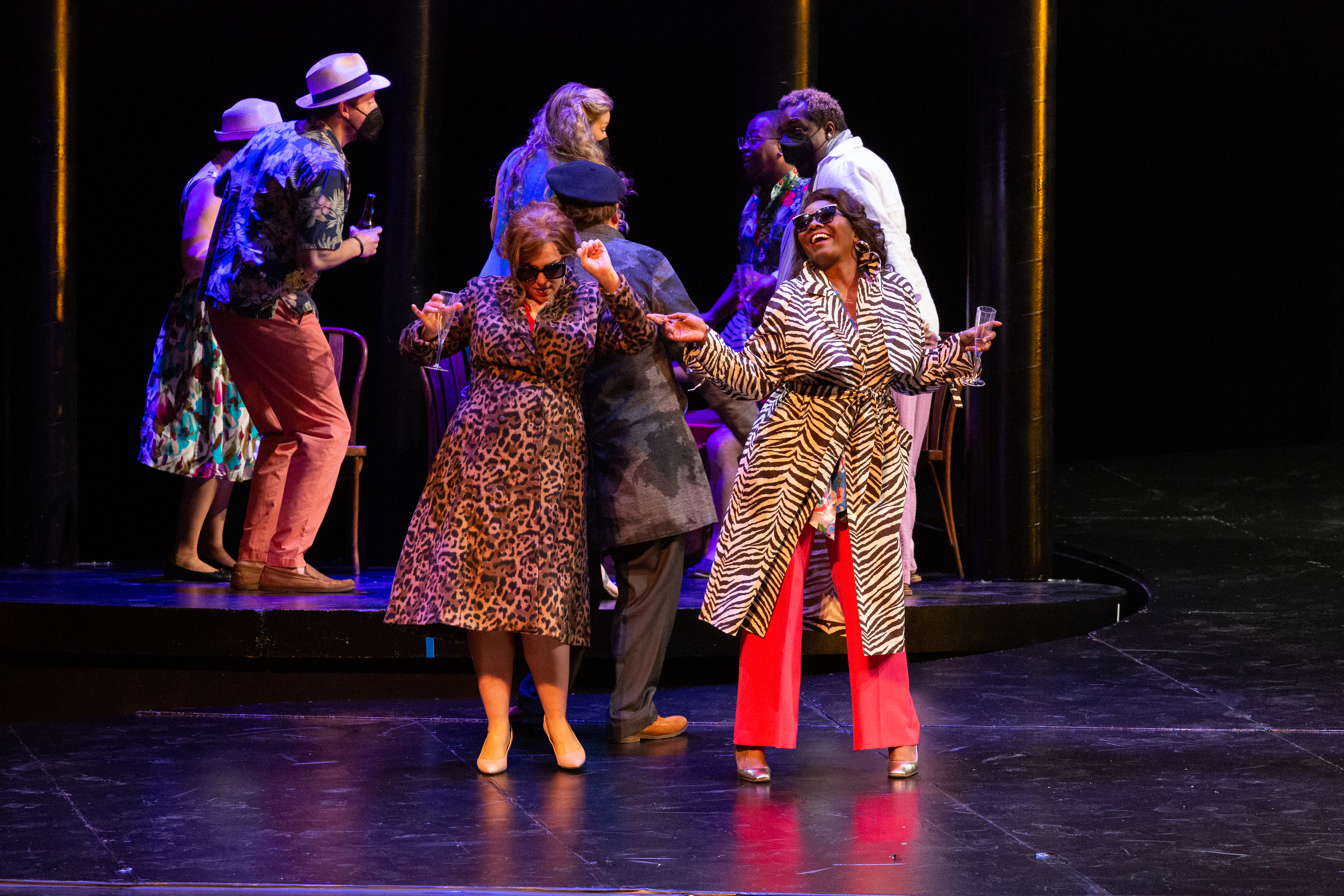
Summer hasn’t totally surrendered to modernity in her vision of Giovanni, for she surely could have gone further than equipping Elvira with contemporary luggage as she pursues the Don and turning the pages of Leporello’s book chronicling the rogue’s romantic conquests into an iPad that he scrolls. Balancing these modern touches are the curved tops of the revolving pods, evoking ancient arches, and the presence of harpsichordist Emily Jarrell Urbanak, seated at stage right throughout the evening. In a way, the singers also straddled different eras, always immersing themselves in Mozart’s music, yet the diversity of the casting – and a few of the dance moves they busted at Giovanni’s soiree – returned us to the new millennium. Most anachronistic were Sequina DuBose as Elvira, lugging her rolling stack of suitcases up a couple of stairs and down a ramp, and Alex Soare as Leporello, discarding his sensationally grungy attire only when he impersonated Giovanni (though Locher’s design here may have also been inspired by the Ghost of Christmas Future).220201_OPC_DON_170

Dashing, cruel, and overflowing with conceit, bass-baritone Richard Ollarsaba made a stunning debut as Giovanni, even if the mod dress deprived him of the opportunity to unsheathe a sword. His overtures to Elvira, her maid, and the peasant girl Zerlina were all lusciously seductive. Encounters with Leporello and Masetto, Zerlina’s fiancé, crackled with scornful superiority, sometimes snarling and sometimes nonchalant. The old Commendatore seemed to draw the very best from Ollarsada, cavalierly deferential to his age in resisting his challenges to combat in the opening scene, defiant and fatally unrepentant when Giovanni’s fate was sealed. As rich and appealing as Ollarsaba was when he sang, Alex Soare was startlingly convincing as Leporello when the servant was called upon to masquerade as his master. To bring out the servant’s comic flavor, moments when Leporello was marveling at the gullibility of Giovanni’s victims were underscored more boldly than the disillusion, disgust, and abject fear that the Don’s escapades put him through. Nor was bass-baritone Ashraf Sewailam chiefly onstage as Masetto to clownishly portray the peasant’s malleability, showing us far more of the hothead than the usual hayseed. In the same spirit, tenor Johnathan Stafford White as Don Ottavio, Anna’s staunch and patient fiancé, is more of a noble champion than a feckless chump.27sQMG5Q

Perhaps even more than the men, the excellence of the three sopranos cemented my suspicion that this was the deepest Opera Carolina cast I’ve seen. While Summer didn’t allow Rachel Mills quite as much risqué latitude as I saw in Prague in consoling her battered Masetto, this Zerlina was no less irresistible in her “Vedrai carino,” applying the balm of love on his bruises. Although there were slight chinks in DuBose’s vocal armor, there were no losses in sweetness when there were dips in volume as Elvira sang her woes, and DuBose is such a fine performer that I had second thoughts each time I steered my attention elsewhere – so many of her reactions are worth watching. Most revelatory was Melinda Whittington as Donna Anna, a role I’ve often found annoying in her chaste righteousness. Whittington amped up the feeling of this grieving rape victim while tamping down her outraged fervor. Summer allowed her to wear a color to the Don’s soiree instead of shrouding her in mourning, and those dance moves further humanized her.220203_OPC_CON_1197

The joyous epilogue, celebrating the triumph of justice over wickedness, is scrapped in this new Opera Carolina production. Somehow that enhances the impact of bass Jordan Bisch as the avenging Commendatore. Both at the cemetery accepting Giovanni’s dinner invitation and later at the Don’s banquet hall, Bisch resounds thrillingly as the voice of doom. After blasting my eardrums just three weeks earlier from the Belk Theater stage with Mahler’s Ninth, a discreetly reduced Charlotte Symphony sounded comparatively wan as it wafted the Giovanni overture out of the orchestra pit. But Opera Carolina artistic director James Meena had the ensemble perfectly calibrated for the occasion, and when the curtain rose, the blend of singing and playing gave constant pleasure. As I stepped onto the elevator with another couple, hurrying to beat the Belk crowd out of the parking lot, the husband couldn’t help gushing, “This is the first classical opera we’ve seen!” If future productions are as good as this Giovanni, they will be coming back again and again.

Originally published on 2/5 at CVNC.org

Reboot of “I Dream” Reminds Us How True Heroes Fight for the Right

Review: I Dream from Opera Carolina

 By Perry Tannenbaum

I Dream.

After repeated efforts to capture the essence of Martin Luther King in his twice-revised I Dream, opera composer and librettist Douglas Tappin must keenly appreciate the biblical frustration of Moses on Mount Nebo – and of MLK behind a Memphis lectern on his final night. He has seen the Promised Land, but he cannot get there. For the life of this civil rights hero/icon/martyr is inextricably intertwined with his words, unforgettably spoken in Washington, in Memphis, from his Atlanta pulpit, and written from a Birmingham jail, yet hardly a trace of them can be found in Tappin’s script.

Opera Carolina’s latest remount of I Dream, which premiered in 2010 in Atlanta and reappeared in Toledo and Charlotte in 2018, newly revised for the 50th anniversary of MLK’s assassination, is a more strategically refined and focused dance around the rhetoric with new stage direction – and considerable dramaturgical input – by Tom Diamond. James Meena, now entering his twentieth season as Opera Carolina’s artistic director, once again directed the orchestra, arguably with more ardor than ever for Tappin’s score.

If the music brings Porgy and Bess to mind, your concept likely chimes with Meena’s, for two of his principals, Alyson Cambridge as Coretta Scott King and Victor Ryan Robertson as Hosea, figured prominently in the storied revival of George Gershwin’s opera at Spoleto Festival USA in 2016. Kenneth Overton as Ralph Abernathy and Lucia Bradford as MLK’s Grandma are also steeped in that Gershwin masterwork. Yet it’s equally apt to note the influence of Broadway-style musicals on Tappin, whether it’s the revolutionary fervor of Les Miz or Andrew Lloyd Weber’s notion of opera in his Phantom. Certainly, Tappin’s music disarms any fear of being assaulted by discordant recitative and parched in a desert where no melody or aria is to be heard. On the contrary, ticket holders should brace themselves for a superabundance of power ballads.

The musical climax of the show, in the Birmingham jail, is a duel of power ballads. Robertson challenges the whole non-violent ethos of King’s movement with a spirited, militant “No Victory by Love,” and Derrick Davis as MLK answers – still triumphantly, if audience reaction was any indication – with the anthemic title song. Davis and Tappin are at their best in showing us the visionary MLK and the staunch courage of his non-violent philosophy, but the libretto needlessly attempts to deepen our impression of King as a prophet. Repeatedly, Davis must dwell on a foreboding dream in which he sees the balcony of the Memphis motel where he will be shot.

We must assume that Tappin believes this device cements King’s credentials as a prophet, though it actually undercuts them, for Davis must keep puzzling about the meaning of this dream – which is emphatically not the dream we associate with King – and Overton as Abernathy, instead of all the substantial issues and concerns he might be discussing, must waste his time (and ours) by counseling his leader to confide Tappin’s invention to his dear wife Coretta.

One might quibble over whether MLK really dedicated his career to his Grandma, but Bradford’s rendition of “Sunday Is the Day” was certainly powerful enough to inspire dedication. If Coretta is also a formative presence in MLK’s career, there’s a place for Cambridge to be singing “I Have Love to Give,” since it dovetails with her husband’s story and core beliefs, but “Midnight Moon” merely detains us in generic romance. While repeating a song with new meaning is a traditional Broadway device, it’s a bit problematical in Tappin’s hands. Late in the show when Cambridge sings “Queen Without a King,” she memorably expresses a steely determination to continue her martyred Martin’s work and assume a leadership role, a wisp of Evita that should take firmer root in Tappin’s score. Earlier, the song simply types Coretta as a weepy wife wishing her husband would stay home with family instead of pursuing a noble cause.

Sounding like a swaggering song that Crown might sing in Porgy, “No One’s Gonna Keep Us Down” took us deepest into Gershwin’s bluesy groove, and “Count to 10” worked surprisingly well in espousing MLK’s turn-the-other-cheek credo. “Top of the World,” a song of risqué celebration like “Masquerade” in Phantom, hinted at the danger of celebrity for King that could have made him vulnerable to the scheming of FBI director J. Edgar Hoover, who gets a sadly superficial airing that is also symptomatic of Broadway. He’s not an implacable Javert, that’s for sure.

If Martin’s womanizing or Hoover’s scandal mongering could have been shown as jeopardizing MLK’s greatest enterprises – the March on Washington, the march on Selma, or the Voting Rights Act – they would have rewarded deeper exploration. But in circling King’s greatest speeches, Tappin barely grazes what Memphis meant and almost completely ignores the March on Washington. That’s nothing short of astonishing vis-à-vis the expectations of an audience coming to see I Dream – until we consider that Tappin is skirting the actual quote, “I have a dream.” Gaping hole there as well.

To be fair, Tappin’s last two revisions were pre-pandemic, when the freshest take on King’s legacy was the Oscar-nominated Selma. No doubt about it, the march on Selma and its aftermath, in a presidential address by Lyndon B. Johnson, are the dramatic high points in Tappin’s revision, in Diamond’s staging, and Michael Baumgarten’s lighting and video design, climbing majestically on the shoulders of the Birmingham sequence. Meena was strong throughout the evening, all through the two hours and 18 minutes that Tappin’s music flowed through him, perhaps strongest when he was needed most, after Davis climbed the ramp to the Memphis motel balcony for the last time.

Before the pandemic, George Floyd, the 2020 landslide election, and January 6, I Dream was more on target than it is today. If he had rewritten his opera after last November, Tappin would likely have sharpened his libretto’s emphasis on the importance of voting rights. A revision after January 6 might have further prompted a reawakening to the significance of the August 28, 1963, March on Washington. For we do need reminding now what peaceful protest really is, how powerful and transformative non-violence can be, and how much more civil “I have a dream” and “We shall overcome” are as rallying cries than “fight like hell or you won’t have a country anymore.”

Sadly, we also need to be reminded that Martin Luther King hoped to move us toward “that day when all God’s children, Black men and white men, Jews and Gentiles, Protestants and Catholics, will be able to join hands and sing.” The “you” that Donald J. Trump was addressing on January 6, 2021, belonged to only one of those groups, preferably those willing to march into the Capitol with a Confederate flag.

Hope in the Time of COVID Sees Sleeping Beauty Reawakening in December

Preview:  Performing Arts Return to Charlotte

By Perry Tannenbaum

The COVID collapse happened quickly on March 13. “We were hours away from the curtain rising on our all-new Fairy-Tailored Sleeping Beauty when we had to postpone the season,” says Hope Muir, Charlotte Ballet’s artistic director. On the morning before that, Charlotte Symphony’s new director of communications, Deirdre Roddin, met with me to discuss future concert coverage at this publication. But the upcoming Saint-Saëns Organ Concerto concert would soon be postponed, among the first performing arts dominoes to fall to the pandemic in the week that followed – along with an annual Women in Jazz fest at the Blumenthal Performing Arts Center, the annual Charlotte Jewish Playwriting Contest at the Levine JCC, a chamber music concert at the Bechtler Museum, and Theatre Charlotte’s production of Cat on a Hot Tin Roof.

Tom Gabbard, president and CEO at Blumenthal Performing Arts, last attended a live show on March 11 – in the UK, before he and his wife Vickie returned home and tested positive for COVID-19. The Gabbards quarantined and recovered, but by the day after Ballet’s postponement, Gabbard had announced that all events at all Blumenthal venues were suspended through April 12. Complying with NC Governor Roy Cooper’s executive order suspending all public gatherings of 100 or more people, the Blumenthal directive took all decision making on the Saint-Saëns concert, scheduled for March 20, out of Symphony’s hands. Both of CSO’s primary venues, Belk Theater and Knight Theater, are managed by Blumenthal.

So far, Symphony has had to cancel 49 concerts. “That’s obviously a huge blow to the organization, both artistically and financially,” says Michelle Hamilton, CSO’s interim president and CEO. “The estimated financial impact of these concerts alone is in excess of $1.5 million. This does not include the impact of the pandemic on future concerts and attendance.”

On the revenue side, Opera Carolina wasn’t as seriously damaged as Symphony, losing just one event, an extensively revised version of Douglas Tappin’s I Dream. “The company received support through the Payroll Protection Plan [PPP],” says Opera artistic director, James Meena. “That has allowed us to maintain our staff and redirect funds to our new online series iStream, which has provided employment to our resident company.”

PPP funding has flowed to the most established arts organizations in Charlotte, including Theatre Charlotte, Children’s Theatre of Charlotte, Actor’s Theatre of Charlotte, Blumenthal Performing Arts, and Charlotte Symphony. “However,” Children’s Theatre artistic director Adam Burke points out, “the PPP was designed to help organizations through what Congress thought was going to be a short-term, 8-week issue.”

Blumenthal drew the largest PPP allotment, $1.7 million, that helped with payroll in May and June. “We avoided furloughs until July 5,” says Gabbard, “when three full-time and 114 part-time team members were furloughed – 105 full-time remain, mostly working from home, with some working in the venues on various maintenance projects. PPP made a big difference.”

What lies ahead for all Charlotte performing arts groups is very murky, subject to weekly health directives from city or state government officials loosening or tightening restrictions. “Opera is dealing with a multitude of challenges,” says Meena, “caused by COVID-19 and now the 43% reduction in ASC [Arts & Science Council] support for the 2020-2021 season. We are evaluating audience concerns for attending performances, and perhaps more dauntingly, health and safety concerns for our performing company.

“Singing is one of the most effective ways to spread the coronavirus. Many church choirs are rehearsing remotely, so imagine a 50-voice opera chorus, principal artists, extras and the more than 30 technicians who normally work on an opera production. Additionally, health and safety concerns for the orchestra musicians (imagine being confined – maybe consigned is a better word – to the orchestra pit where social distancing is all but impossible) are challenges to performing Grand Opera that we have never experienced before.”

All of the companies we’ve mentioned have pivoted to online programming, but all weren’t equally prepared to make the switch. Charlotte Ballet, the first company impacted by the COVID ban on public assembly, was quickest to steer a fresh course. “I had implemented a much more robust structure for archiving and curating digital content over the past three years,” says Muir, “not just performance footage but interviews with artists, designers, collaborators and behind-the-scenes rehearsal footage as well as the documentation of the Choreographic Lab. That commitment, I think, is why we were able to get out of the gate so quickly.”

Raiding their digitized vaults, Ballet was able to present Dispersal online, repackaging the company’s Innovative Works 2019 program with behind-the-scenes footage for a new kind of digital experience on March 27, just two weeks after Sleeping Beauty had been scheduled to premiere. Opera Carolina’s iStream series began in April and is archived on its YouTube channel, while Charlotte Symphony has logged an assortment of live Zoom and pre-recorded material online. For six straight Wednesday evenings, ending on July 29, they streamed a series of Al Fresco chamber music concerts recorded on video in the backyard of principal cellist Alan Black. It’s an avenue that will likely be revisited. Meanwhile, CSO has extensive recorded inventory to call upon, but unlike Charlotte Ballet’s, it is entirely audio, so their outlet of choice has been WDAV 89.9, where past concerts are aired on Friday evenings.

The mass exodus to streaming platforms has been global, creating a glut of available online events that don’t quite measure up to live performances. Charlotte Ballet has responded to this oversaturation by thinking outside the box. “I worked with choreographer Helen Pickett to discuss our options and this resulted in an opportunity for five of our dancers,” says Muir. “Charlotte Ballet joins artists from Alvin Ailey American Dance Theatre and Dance Theater of Harlem for part III of a trilogy Helen developed titled Home Studies, which is entirely choreographed and rehearsed via Zoom.”

Other companies are pushing the envelope by reimagining live performance under COVID restrictions. Rehearsing with masks and performing unmasked live at their dance studio, Caroline Calouche & Co. presented two online showings of A Love Show on July 25, charging admission for a ticket link. Theatre Charlotte is trying a more audacious outdoor model, presenting Grand Nights for Singing: The Parking Lot Performances on Friday nights outside their building, limiting audience size to 25, and charging $10 per ticket. Each of two performing singers wields a separate mic, there are no duets, and the audience is expected to provide their own chairs, snacks, and beverages.

“We are most likely not going to be able to perform for an audience in TC until at least December and maybe beyond,” says Ron Law, who was scheduled to retire June 30 but has extended for another season as Theatre Charlotte artistic director – and as President of the Board of the North Carolina Theatre Conference. “We have purchased appropriate video equipment so we can livestream productions. At this time, we are planning on doing performances of What I Did Last Summer by A.R. Gurney that will be livestreamed, with a per household ticket charge, on three dates in September.’

Waiting until June 11 to announce their 2020-21 season, Theatre Charlotte has prudently delayed their musical productions, The Sound of Music and Pippin, until spring 2021 – with understandable contingency plans. For their fall plays, they are tentatively offering their audience the options of live performances or streaming. Children’s Theatre have allowed themselves less wiggle room for 2020-21, eliminating musicals entirely from their slate. Yet their company, with video production a longtime component of their educational offerings, is probably the most adept we have in Charlotte when it comes to hybrid, live-or-streamed presentation skills.

While closing down all public performances at their two ImaginOn theaters, Children’s Theatre was at the tail-end of a 20-week School of Theatre Training programs, which culminates in four fully-produced OnStage presentations, two plays and two musicals. “We decided to move all four productions to a virtual format,” says Burke. “We’ve made other adjustments as well. We started some online educational programming and shifted our June summer camps to virtual experiences. In July we offered students the choice of virtual or in-person camps. We’ve kept close watch on all CDC, state and federal guidelines and have invested in some technologies that help us to maintain safety.”

Like Charlotte Ballet, Children’s has plenty of past performance video on file. They’ve edited these multi-camera shoots and served them up on a series of “Watch Party” webcasts. The new work keeps coming, further underscoring CTC’s technical prowess. “We’ve continued to move forward, as best we can, with the works that are in development including a collaboration with 37 children’s theatres across the country to adapt, as a virtual performance, the book A Kids Book About Racism.” That new piece launched into cyberspace on August 1. Other projects in the pipeline are Tropical Secrets: Holocaust Refugees in Cuba, and a stage adaptation of the award-winning The Night Diary.

On March 12, the day before performing arts in Charlotte abruptly shut down, the town was abuzz in anticipation of Mecklenburg County announcing its first case of COVID-19. A surreal five months later – without any improvement, to be sure – announcements for the 2020-21 season, sensibly stalled in March, are beginning to flow amid a chaotic atmosphere in anticipation of the fall. Once again, Charlotte Ballet is at the vanguard, announcing that the long-delayed premiere of Sleeping Beauty: A Fairy-Tailored Classic will open at Belk Theater on December 10 – replacing the traditional Yuletide presentation of Nutcracker. Makes sense: the trimmed-down Tchaikovsky ballet remains family-friendly with a helpful narrator to keep us abreast of the storyline. Unlike Nutcracker, the Tailored Sleeping Beauty doesn’t consign the Charlotte Symphony to the orchestra pit, and it doesn’t recruit 150 sacrificial lambs for children’s roles, including the ever-lovable Clara.

Iffier but on the schedule is Charlotte Ballet’s 50th Anniversary Celebration, scheduled for April 22-24. Muir is “holding onto a beacon of hope” that CSO will be able to collaborate with Symphony on that auspicious event, booked at Belk Theater. Opera Carolina maestro Meena has seen his own commitments scuttled in Italy, where he had planned to conduct Andrea Chenier, Manon Lescaut and Turandot. He doesn’t expect opera to resume in Italy until December, so he isn’t counting on Opera Carolina collaborating with CSO before 2021. Meanwhile, expect the unexpected as OpCarolina fires up a new chamber music series, reviving their iStream Online concerts the week of September 11, returning every two weeks through November 16.

Keeping his eyes open for online options and live opportunities, Actor’s Theatre artistic director Chip Decker isn’t counting on returning to live performance at Queens University before July 2021. Tom Hollis, theatre program director at Central Piedmont Community College, retired on August 1. But he didn’t go out directing a final season of CPCC Summer Theatre as he had planned, so he’s expecting to reprise the complete 2020 slate in the spring or summer of 2021. Sense and Sensibility, originally set for this past April, may also figure in the mix.

Gabbard, the first to respond to our questionnaire on July 14, said that over 300 performances had already been cancelled at Blumenthal’s multiple facilities and wasn’t expecting national tours – their bread and butter – to resume “until at least late fall, and perhaps early 2021.” Even outdoor stopgaps that Gabbard might stage in Charlotte’s Uptown must remain on the back burner until public gatherings of 100 or more are approved.

On the lookout for best practices and inspiration, Gabbard is looking globally, “including Seoul, Korea, where big musicals like Phantom have played throughout the pandemic. I was asked to join the COVID-19 Theater Think Tank in New York, where we are speaking with academics and thought leaders in a search not only for short-term solutions, but also ways to improve our venues and hygiene practices long-term.”

Bach Akademie Charlotte artistic director Scott Allen Jarrett slowly realized last spring that there was no way to mobilize the musicians, patrons, and audience that would be necessary to make the third annual Charlotte Bach Festival happen last June. Hurriedly, he pulled together a four-day virtual festival that streamed on Facebook, YouTube, and Zoom. Much like Actor’s Theatre and CPCC Summer Theatre, Jarrett is hoping that the June 2020 event will happen in June 2021.

The experience shook him. “The recognition that I hadn’t made music with another human being in a month hit me hard on Easter Sunday morning,” Jarrett recalls, “and I grieved deeply for several weeks. Gradually, the shared recognition of all that we were losing with one another affirmed a shared value for communal music making. Those conversations continue to sustain me.”

Jarrett is busy, busy, busy these days up in Boston, working as artistic director with the Back Bay Chorale on their new Zoom curriculum and as director of music at Boston University’s Marsh Chapel – and expecting to stay healthy. BU has taken the plunge, plowing millions of dollars into testing in an attempt to bring their student body back to campus, aiming to test all faculty weekly and all students twice weekly. Plans for the 2021 Charlotte Bach Festival are on hold, says Jarrett, until a proven vaccine delivers true COVID immunity.

Yet he’s clearly upbeat, even if he’s forced to deliver the 2021 Bach Experience via Zoom. Describing her own company’s trials, Charlotte Ballet’s Muir offers the best explanation for this paradox: “Once we realized this virus was not going anywhere quickly, we had to pivot and focus on new ways to keep the team motivated and creative. And this is where artists thrive! At our core, we are shape-shifters and it’s exhilarating to think of new ways to communicate and engage with one another.”
A Fine Old-Timey “La Bohème” Comes Sprinkled With Youthful Energy and Fun

Review: La Bohème

By Perry Tannenbaum

200116_OPE_LAB_0097

Whether it’s tuberculosis or AIDS, Paris or Greenwich Village, La Bohème or Rent, 1896 or 1996, death and disease are intertwined in our imaginations with the struggling, impoverished lifestyles of Bohemian artists and intellectuals. What lifts these shivering, starving folk from seediness and squalor to the nobility of poetry, never upgrading their threadbare garments, is the music of Giacomo Puccini and his rock apostle, Jonathan Larson. Come to Belk Theater and the Opera Carolina production of Puccini’s seminal work and you may get an inkling of how inseparable the two composers’ works can become.

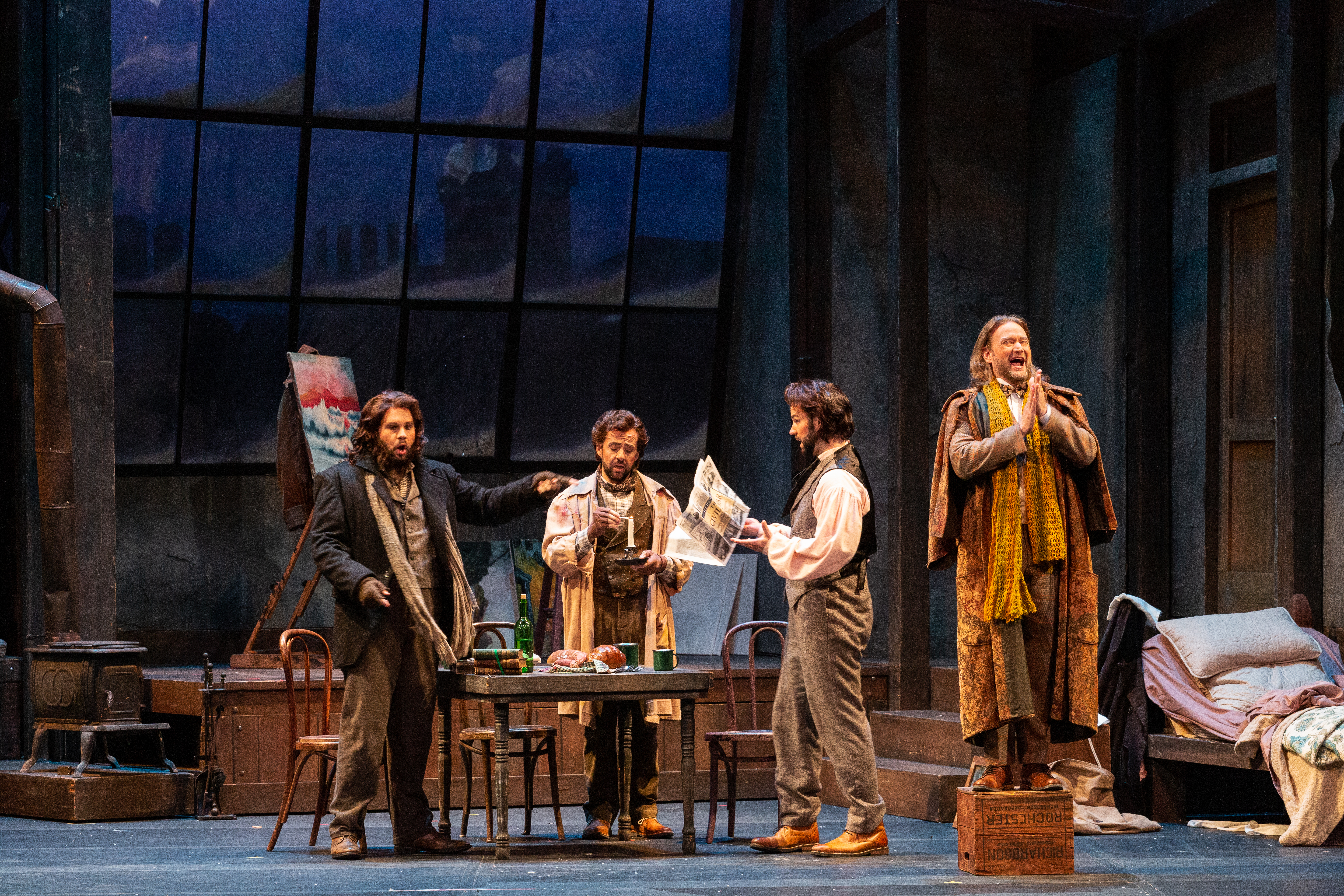
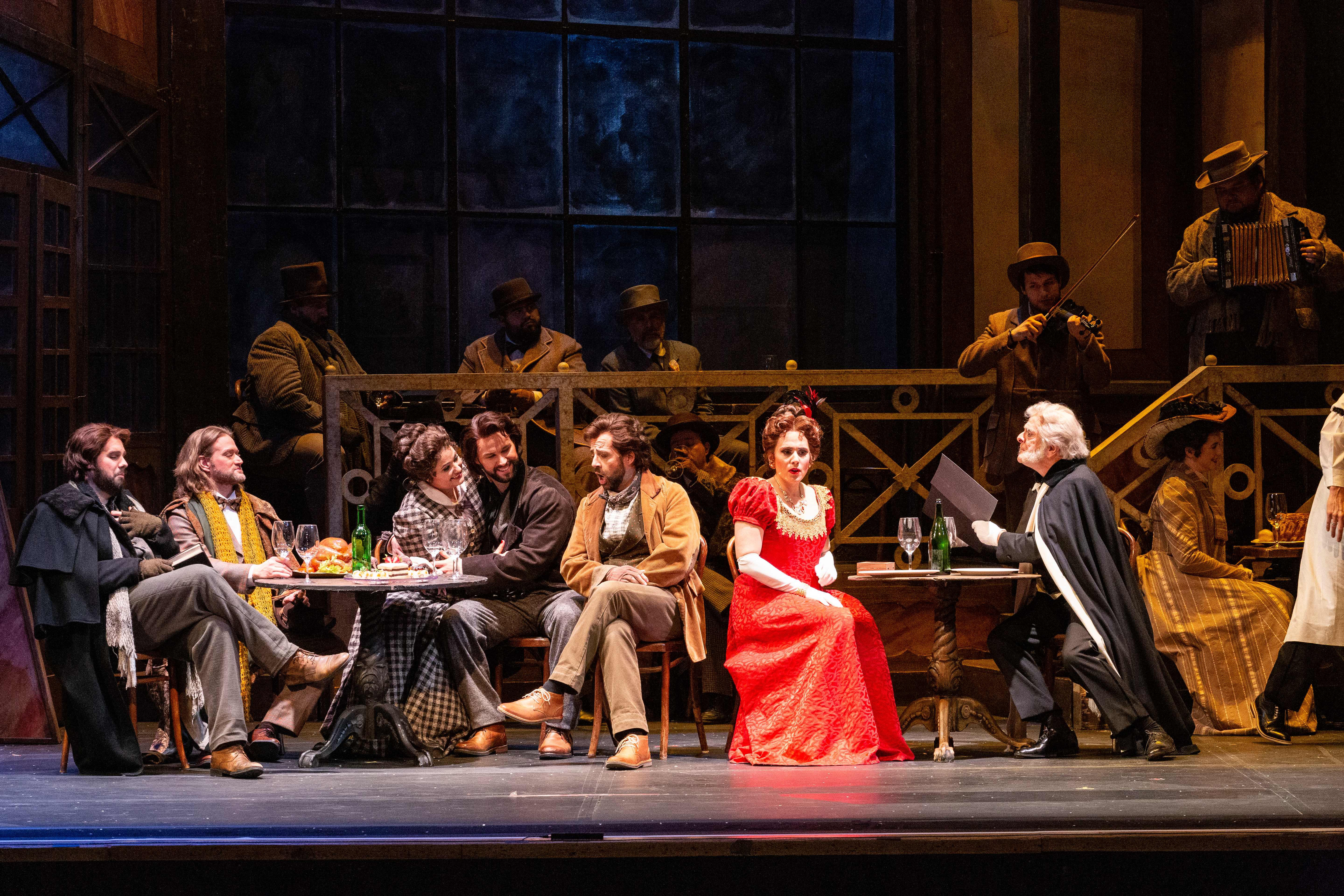
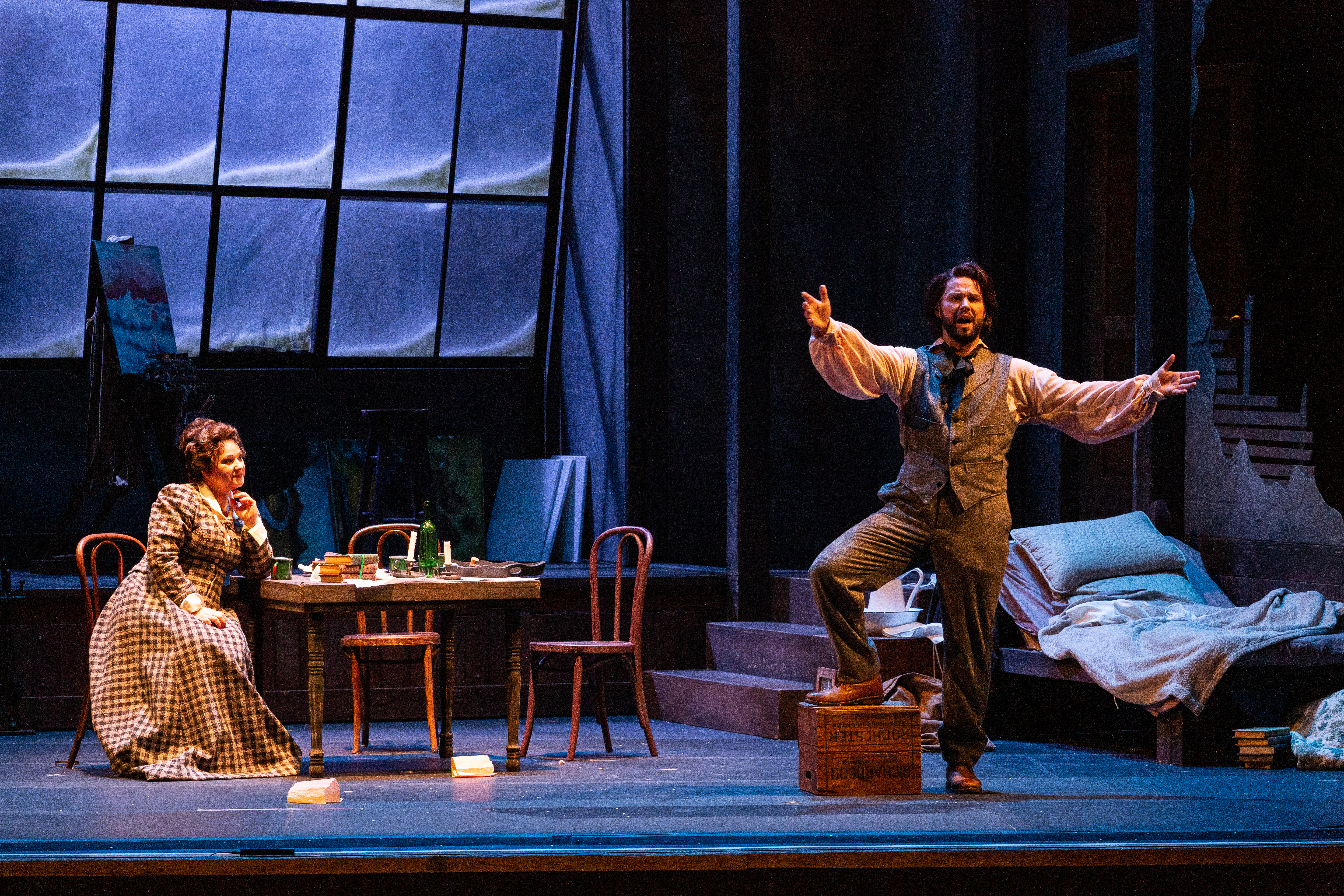
Scenic designer Peter Dean Beck has not updated the loft where we first meet the poet/playwright Rodolfo, his painter chum Marcello, musician Schaunard, and philosopher Colline. The boulevard bustle of the Latin Quarter and Café Momus is not on the awesome Franco Zefferelli scale of the beloved Metropolitan Opera production, but the spirit and colorfulness of Act 2 are also faithfully captured, where temptress Musetta and toyseller Parpignol highlight the broadened palette. Down in the pit, maestro James Meena and the Opera Carolina Orchestra are no less devoted to the shifting moods of the score, whether lovers are pining or Christmas-crazed children are running wild.

200116_OPE_LAB_0397

No, it’s director Aldo Tarabella in his Opera Carolina debut who bridges the gap between the 1830s, the actual setting specified in the Giuseppe Giacosa-Luigi Illica libretto, and the AIDs-plagued 1990s. From the outset through the intermission between Acts 2 and 3, Tarabella dispenses with subtlety in accenting the comedy of the first two scenes – the cavalier badinage between Rodolfo and Marcello as they cope with the cold, the successful conspiracy of the four tenants at the loft to thwart their landlord Benoit’s attempt to collect the rent, and the hoodwinking of Alcindoro, Musetta’s wealthy old sponsor, at Café Momus. There’s a certain amount of incorruptible idealism that infuses the Bohemians’ high spirits and deceptions, but with four performers making Charlotte debuts in this production, Tarabella also underscores the youthfulness of the Bohemians’ camaraderie and pranks.

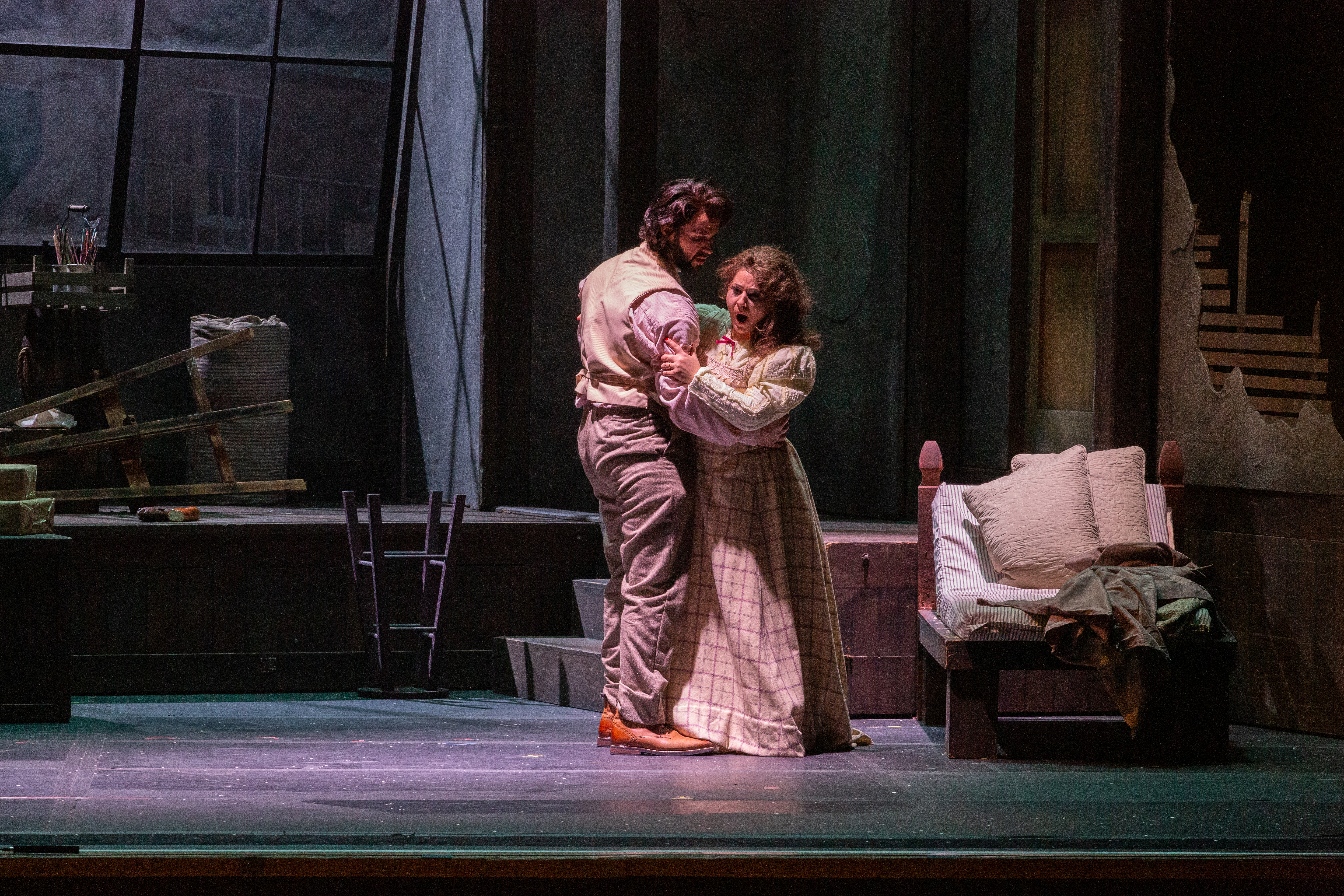
Nor does Tarabella hold back when the mood shifts from mirth to tenderness, anguish, and heartbreak. When Alcindoro receives the bill at Café Momus after the Bohemian scamps have absconded, the old coot literally falls over backwards as the curtain comes down, and at the sad climax of Act 4, when Mimi has coughed her last, the impact on British tenor Adam Smith literally brings him to his knees as Rodolfo. In both instances, the direction is so flamboyant that we might feel like we’re watching a silent movie. Neither played like an overreach to the capacity crowd on opening night.

200116_OPE_LAB_0193

If Tarabella seemed to be persuaded by Rent of the efficacy of emphasizing the youthfulness of Puccini’s opera, then the singers onstage must certainly have exerted a persuasive power over youths in the Belk audience who were experiencing the source of Rent for the first time. Smith in particular didn’t merely touch your heart when he sang the famed “Che gelida manina (Your tiny hand is frozen)” to Mimi as he responded to her plea for him to light her candle. When Smith ascended to the blazing summit of this aria, his rich, full-bodied tenor sent a bloody stake through your heart. It would be an understatement to say that Smith equaled the Rodolfo of tenor Ramón Vargas when I reviewed him at the 1205th performance of Bohème at the Metropolitan Opera in December 2008. Vargas was past his 48th birthday when I saw him, and he could no more match Smith’s sheer vocal power than he could match his youth and freshness.

Smith’s singing ought to be sufficient incentive for snapping up what few tickets might be available for the remaining three performances of this Bohème, but he also delivered the frivolity and nerdiness of Rodolfo when needed. The other Charlotte debuts had more to recommend them than merely their youth. Italian soprano Stefanna Kybalova, though not ideally suited to the exquisite fragility of Mimi, poignantly delivered the seamstress’s consumptive weakness. Kybalova was more effective as a soloist in Acts 3 and 4, during Mimi’s final decline and when she repeated her signature “Mi chiamano Mimi (They call me Mimi)” theme, but the duets with Smith were always gorgeous, including the two fadeouts which seem to crystallize the whole opera.

200116_OPE_LAB_0534

Sicilian baritone Giovanni Guagliardo is considerably mellowed as Marcello compared with his previous Opera Carolina appearances as Tonio in Pagliacci and Sonora in La Fanciulla del West, joking and commiserating with Rodolfo in the loft scenes and sympathizing with the forlorn Mimi in the Act 3 snow scene. Yet he also flashed some fire dealing with the flirtatious, manipulative Musetta. The heat of their quarreling formed an effective counterpoint to Rodolfo and Mimi’s snowy reconciliation in the quartet that took us to the second intermission. For her part, soprano Corey Lovelace had all the sultry fire you could wish for in her Charlotte debut as Musetta, giving Guagliardo as much as he gave her in the fire department. She also had sufficient arrogant majesty to captivate us and dominate a stage full of people in front of Café Momus delivering “Musetta’s Waltz,” though Tarabella didn’t ask for Carmen-grade vamping from her.

200116_OPE_LAB_0848

Outside of the two main couples, I didn’t much notice bass baritone Peter Morgan’s debut as Colline – or, for that matter, Keith Harris’s return as Schaunard – until Act 4. But to help clear the stage for Mimi and Rodolfo’s last deathbed tête-à-tête, Puccini masterfully has Colline sing a tender valedictory to his coat, which he resolves to pawn in order to provide food and medicine for the invalid. Morgan gave the aria a near-Russian solemnity, yet the eccentricity of this episode still resonated with the more blithe and high-spirited action of the opening act, when Rodolfo made a similar sacrifice, feeding his playscript to the stove to keep the Bohemians warm. Not so comical after all, despite the jibes of his companions.

Before Meena took his place in the orchestra, there was a filmed fundraising appeal aimed at boosting contributions from 23 to 30 percent of the company’s budget. Explicitly occasioned by the failure of the Charlotte sales referendum on behalf of arts and parks last November, just two days before a poorly attended opening of Verdi’s Macbeth, the appeal was aptly timed. The production that followed, in front of a packed house, affirmed what Opera Carolina is capable of when it gets the robust support it deserves.