Tag Archives: Graham Williams

Harlem Gets Braided at Jaja’s

Review: Jaja’s African Hair Braiding at The Arts Factory

By Perry Tannenbaum

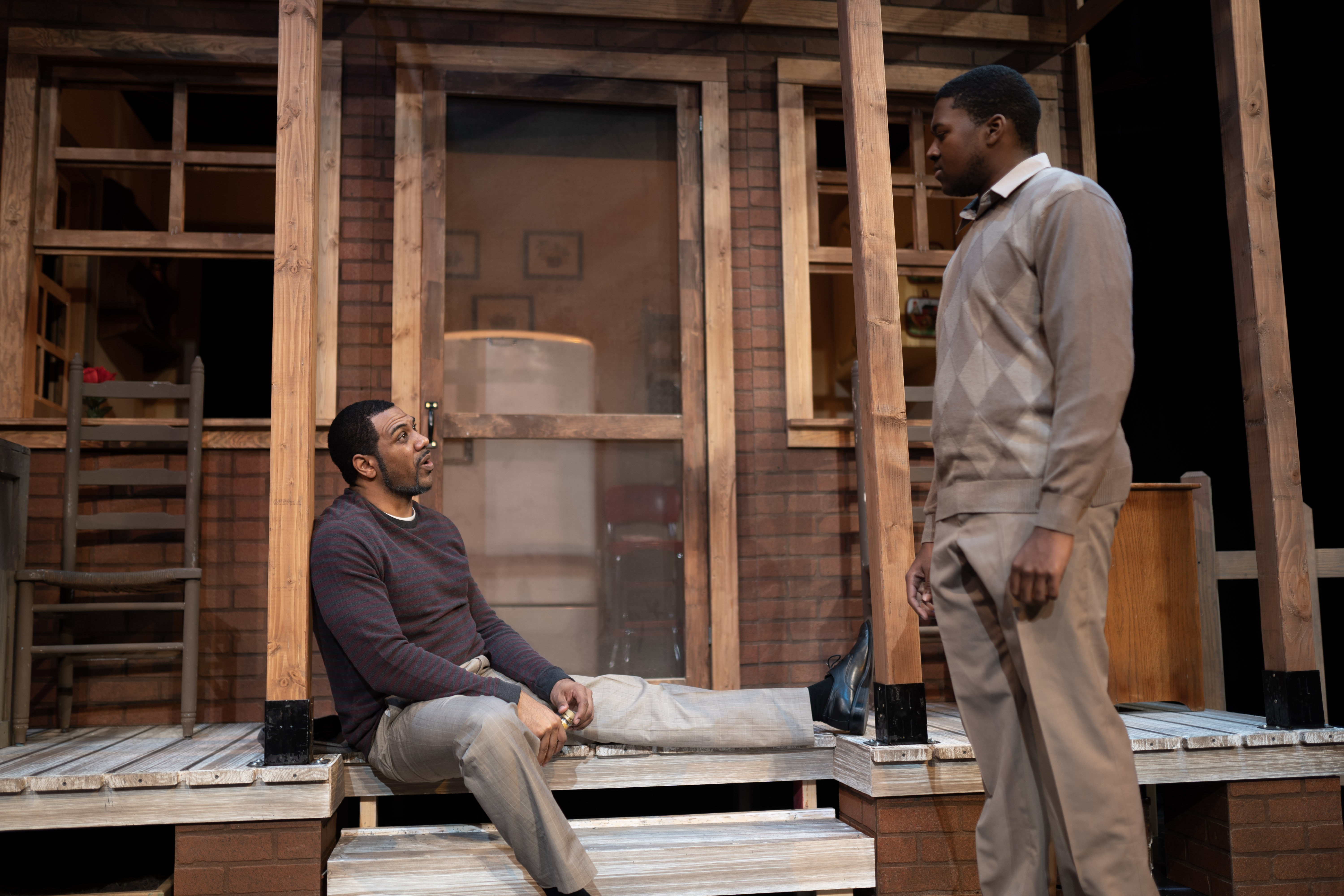
My dear old Mom was born and raised in Harlem over a century ago, when a massive African-American cultural and literary Renaissance named for Harlem had already begun, long after the fabled Manhattan district with its storied 125th Street had been a major destination for Northern Migration after Lee surrendered to Grant. Even then, it would hardly be respectful to change Harlem’s name to Little Africa after all these years.

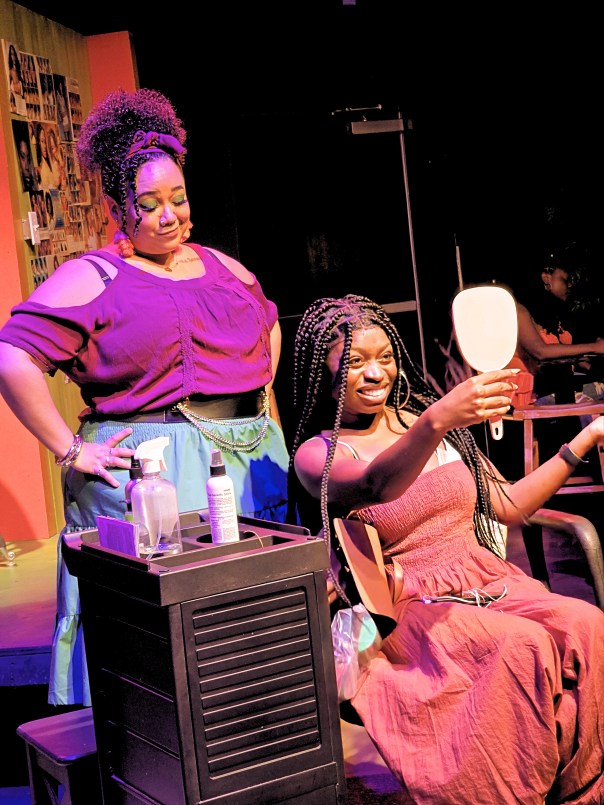
Yet playwright Jocelyn Bioh in her 2023 drama, Jaja’s African Hair Braiding,set on the corner of 125th Street, had me considering whether Bioh would rather call her Harlem – or at least this salon – Little Africa. The vibe and culture of Jaja’s, in Three Bone Theatre’s outstanding QC premiere at The Arts Factory, had me feeling that I was in another country while it was unmistakably my own.

Staffed and patronized by locals who hail from Senegal, Ghana, Nigeria, and Sierra Leone, neither Harlem nor Africa were the best places for Jaja’s craftswomen to be on a hot summer day of 2019 when Bioh’s action takes place. Aside from a breakdown in the braiding shop’s air conditioning, ICE lurks in the background as another of the women’s worries. Our own US President, the most powerful man on Earth, has bunched their homelands into the dismissive category of “shithole countries.”
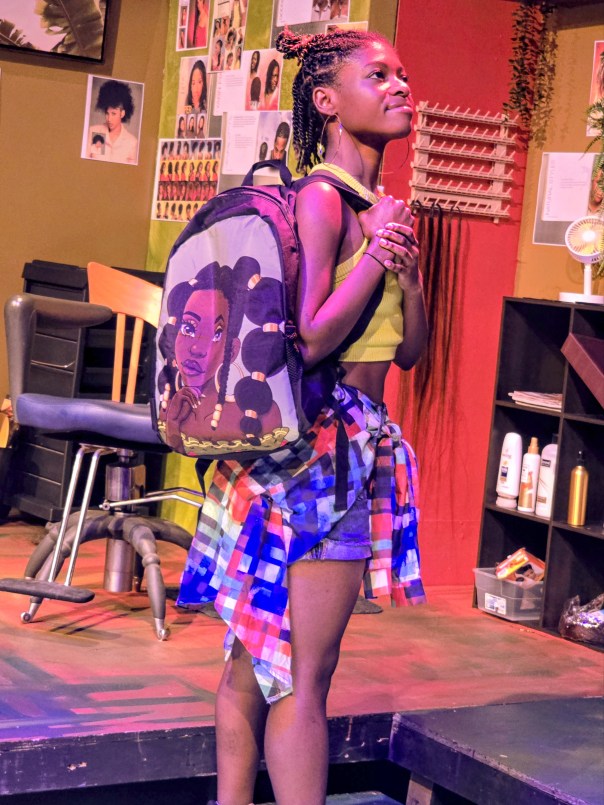
Jaja’s daughter Marie, a brilliant bundle of chaotic energy, is running the salon today because Mom is getting married later this afternoon to an unpopular landlord who will provide her – and Marie – with the shelter of citizenship. That will free Marie, a valedictorian at her high school using a borrowed identity, to apply to an Ivy League school worthy of her energy, talent, and potential.

From the deluge of Marie’s opening monologue onwards, we realize that Jaja’s is a place bustling with life. Music is in the air, sometimes compelling the women to dance. There’s bickering, jealousy, hostility, vanity, teasing, and earthy humor. Not a murderer or a rapist in sight among the immigrants. Not even a pet eater.

About the only big mistake we can accuse director Donna Bradby of making is not helping us to observe Bioh’s signposts – via a wall clock and/or projections – of the time of day and the specified year this long, hot workday unfolds. Otherwise, Jennifer O’Kelly’s scenic design, Toi Aquila R.J.’s costumes, and Rod Oden’s lighting immerse us completely in Jaja’s humdrum-yet-exotic world for all of the show’s 95 minutes.

A clock on the wall, for instance, would help us to appreciate how long young Jennifer, an aspiring reporter, is willing to sit at Miriam’s station in order for the patient artisan to outfit her with a full head of microbraids. And how long does the bossy, rude Vanessa fall asleep at Aminata’s stand before waking to her new look?

The visible excellence of Bradby’s cast is matched by the variety of Deborah Whitaker’s pre-, post-, and mid-weave hair designs. When blackouts happen between scenes, stage manager Megan Hirschy must have a huge chore in the small Arts Factory space helping the scurrying players reappear with the right hair when the lights come back up. We never just sit there tapping our feet during transitions. They’re almost lightning-quick.

Nor does it trouble Bradby that it’s impossible to keep track of who’s from Senegal, Ghana, or Sierra Leone. Venecia Boone was assigned the task of dialect coach anyway, a really nice touch.

Of Ghanaian descent and native to nearby Washington Heights, Bioh obviously knows her characters as much as she loves them. She is also a performer, so Deity Brinson as Marie will not be the last of her players to be gifted with a juicy monologue. Like Marie and the braiders, we will wait a long time before Myneesha King appears as Jaja – in wedding white, of course, with a queenly crown of braids – and delivers the most powerful monologue of all.

Meanwhile, it’s Valerie Thames as Bea, the most fashionable and contentious of Jaja’s employees who fuels the liveliest action, seemingly able to hatch a new grudge at the drop of a spray bottle. The salon was her idea, not Jaja’s. Should have been a full partner in the biz. Refugee newcomer Ndidi is stealing her customers rather than customers just dropping Bea. Thames seethes, fumes, and makes scenes with a steely righteous dignity that sets us up for the turnabout that reveals her deep-down goodness and sense of community.

Until then, the human warmth of the shop emanates from Kellie Williams as Miriam and Vanessa Robinson as Aminata. Williams, rightly stationed upstage at the Arts Factory black box, is mostly distanced from the main sparring during her morning-to-night transformation of Jennifer’s tresses. But there’s a distant man on Miriam’s mind throughout her labors, and she’s spending enough time in Jennifer’s hair to become quite chummy with the 18-year-old by evening’s end.

While her bestie and gossip buddy Bea seethes and sneers, Robinson mostly effervesces as Aminata. She knows that she doesn’t have the patience for a daylong immersion in microbraiding, so she’ll have none of Jennifer despite her youthful sunniness. But EJ Williams as Vanessa riles her almost to the point of losing her cool, a comical series of shticks that begins with the pushy customer objecting to house rules that require her to step outside the shop to negotiate Aminata’s fee. Then Vanessa insists that she be braided with the implements and spray she has brought from home.

Aminata’s man troubles are nearer-to-hand than Miriam’s, for her wayward ne’er-do-well husband James only circles back to the nest to take advantage of her. Righteously divorced, Bea insists that Aminata drop this loser, dismissing the love factor that keeps her from following through with her resolve. Can’t help it when Graham Williams as James drops by and pushes his wife’s buttons.

So these skirmishes between Thames and Robinson, before and after James’s invasion, are the most delicious that we witness. Aside from her dreamer worries, Brinson as Marie is occasionally thrust into the middle of disputes, laying down the law for the prissy Vanessa and stepping into the middle of Bea’s various tussles with Ndidi, Aminata, and her defecting customer, Michelle. At one point, Marie even exiles the incorrigible Bea to the street!
The younger folk are calmer and more acclimated to post-truth America than their diva elders. Before we know it, Aminata is asking Marie how to tune the smart TV to YouTube. Sarah Oguntomilade as Ndidi, the highest-grossing braider in the shop, is especially cool – thoughtfully equipped by Bioh with headphones and loud music to tune out Bea’s accusations and tirades. There’s a really nice interlude when Graham fawns over and flatters her as the Jewelry Man, lavishing her with freebies. This Nigerian cameo as Olu was at least as crowdpleasing as his subsequent turn as the roguish Ghanaian, James.

Graham’s most impactful role is as Eric, the DVD man, who serves as the caring eyes and ears of the community. But it would be cruel to divulge any more.

Things happen quickly at Jaja’s. Notwithstanding the oppressive summer heat, each new character changes the temperature in the shop. Less obtrusively than Graham, Germôna Sharp brings in a variety of flavors as three different customers. The most dramatic of these is the diffident Michelle, who thought she would be switching to Ndidi when Bea wasn’t there. Most comical is Sharp as Chrissy, wanting braids that will make her look like Beyoncé.

As if.

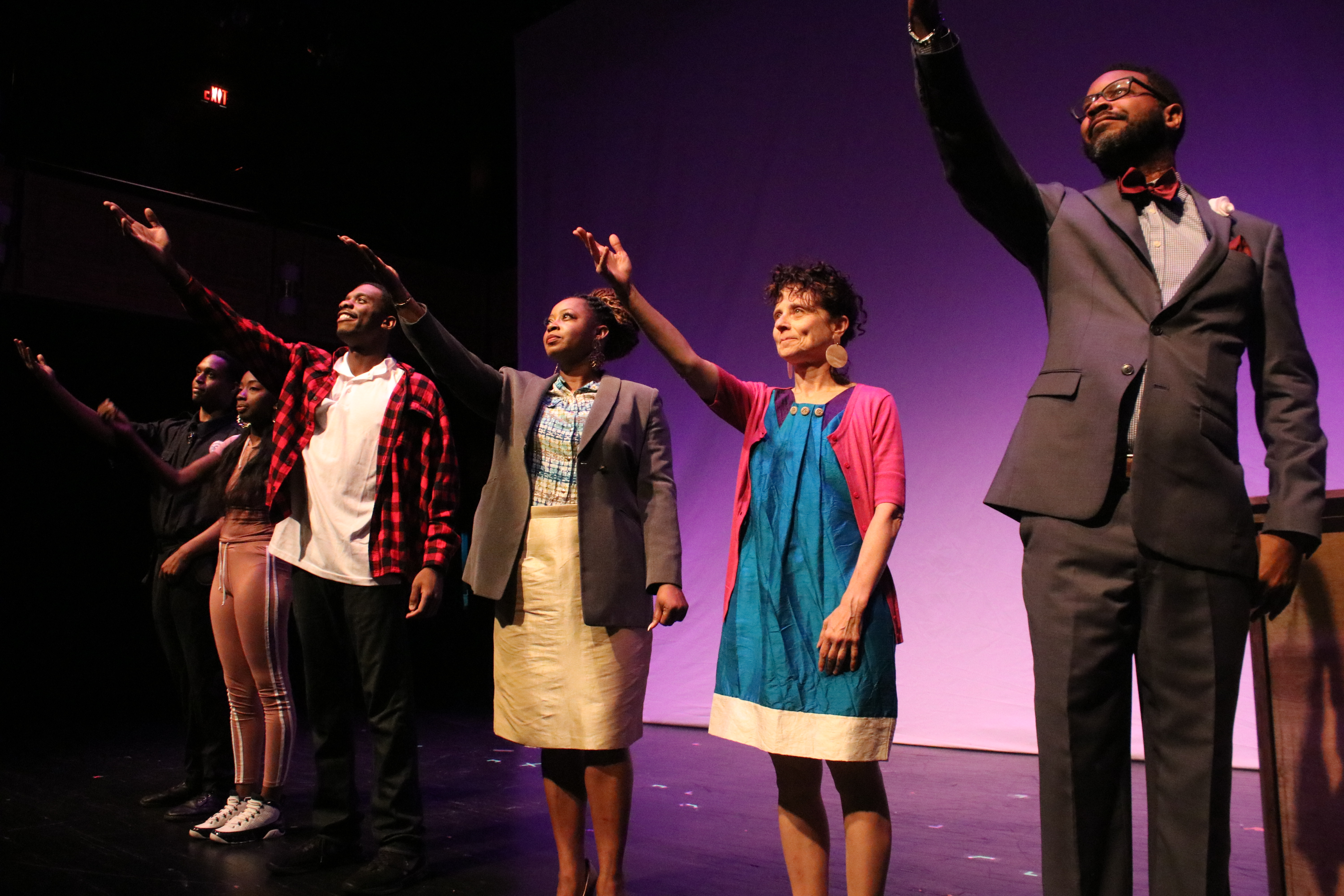
“Thoughts of a Colored Man” Lauds Three Strong Women

Review: Thoughts of a Colored Man at the Arts Factory

By Perry Tannenbaum

So Lust and Passion walk into a bar… You can imagine how fervently I’ve longed to lead off a review with a line like that for close to 40 years. Well, now that Keenan Scott II’s Thoughts of a Colored Man has almost provided that opportunity, you can see that I’ve pulled the trigger. Jumped the gun. For in multiple scenes of Scott’s 2021 script, we can find Love, Lust, Depression, Passion, and Happiness all congregated in a Brooklyn barbershop run by Wisdom and Anger.

Scott gives us more than a hint that Colored Man was written as a companion piece of Ntozake Shange’s for colored girls who have considered suicide / when the rainbow is enuf. That 1976 “choreopoem” had seven women with similarly abstract names, corresponding with the colors of the rainbow, and it is similarly studded with monologues and poetry. Scott’s newer piece at the Arts Factory, flawlessly cast by director Sidney Horton for Three Bone Theatre and imbued with just the right sizzle and raw edge, comes at us evolved into SLAM poetry rants rather than incantatory spells.

Less obviously, Scott’s form is modeled on “Four Women,” one of Nina Simone’s signature songs. Simone gives us the names of her women after she has told their stories, but we’re usually not in suspense for appreciably more than a minute as the complete sequence clocks in at under five. Unless you’ve paid close attention to your playbill before the lights dim, this playwright will make you wait nearly the full intermission-less 90 minutes until, one by one, we get the group reveal.

Thankfully, plenty of names pop up in various scenes. At the barbershop, Kobe, LeBron, and MJ are upheld as the GOAT by bickering customers and kibitzers, moving right along to a similarly lightweight comparison of rap giants past and present. Equally memorable, and no less intense, there’s a lengthy dispute about the best basketball sneakers of all time as the group stands in line for a latenight release of the newest Jordans carrying the legendary Jumpman logo.

Wisdom welcomes us to Joe’s Barbershop, but it becomes clearer as the meandering chatter proceeds that old Joe has retired or passed away, leaving him in charge. Nor does anybody identify Depression as he’s bagging groceries, retrieving carts, or stocking shelves at Whole Foods, though he relays boss’s orders to an offstage Timmy. So as Scott veers and swerves on his path of SLAM poetry and raw prose, with some rhythmic prose bridging the gap, he is also at play with raw specifics and unspoken generalities.

The opening question that Depression poses, “Who is the Colored Man? Is he a king… or is he a slave?” invites that kind of approach. Or evasion. Ironically, only Depression will introduce himself well before the evening is over – at a little past 7:30 PM. One of the ways Scott has of stringing out his opposing tracks is by offering signposts in his stage directions that tell us what time of day it is, steadily moving us forward. Horton has these projected on the upstage wall perfectly on cue.

And whether you’re Love or Lust, Depression or Happiness, you have a personal story. Depression, for example, fumbled an opportunity to break away from Brooklyn and attend MIT on a full scholarship. Giving that up by taking care of his mom – without a moment’s hesitation – he settled for the ongoing indignity of Whole Foods.

On the other hand, Happiness is a stranger in town, living with his fiancé. He grew up in the South, his parents were the first in his family to earn six figures, and that’s why he was shunned by the relatives back home. Up in Brooklyn, he feels no less alienated, because he is prosperous and because he is gay.

Scott is pulling hard here against answering his own opening question. The reason that such fascinating hostility flares up between Depression and Happiness in an aisle at Whole Foods is that neither one can answer “Who is the Colored Man?” when they meet one. Both pointedly tell each other “you don’t know me” – which is what any of Scott’s characters could have shouted at us at the beginning if the playwright were less designing and discreet. Or if he hadn’t been aware that Colored Men themselves cannot answer any better than by telling us, one by one, who they are.

It’s hard for me to resist applying the same observation more widely to the whole Black theatre scene in Charlotte these days. Having sampled Penumbra in Minneapolis presenting August Wilson, Black Ensemble in Chicago celebrating Marvin Gaye, and a multitude of companies from across the US bringing their best to the National Black Theatre Festival in Winston-Salem in even numbered years – ahem, the International Black Theatre Festival for 2024 (July 29-August 3) – I’m always telling people that the Black performers, directors, and theatercraftsmen that we have in the QC are second to none.

Catch is: not only doesn’t the Charlotte theatergoing public seem to realize the bounty in our midst. The artists themselves seem to be sleeping on it. To a greater degree now than ever before, when we were merely equals.

Lesser performers and directors might struggle with the challenge of portraying Anger, Passion, or Wisdom and real people at the same time. Horton and his able cast wisely let it slide. When he’s not shaving, shearing, and trimming at Joe’s, Devin Clark as Anger trains and does drills with highly-ranked basketball players who aspire to the big-name colleges, the NBA draft, and huge commercial endorsements. Now they’re possible in college! Or he drifts into nostalgic recollections of his peak playing days when he was “nice.” He earned his scholarship back in the day, so he’s worried about how today’s NIL generation will maintain their dedication – and their grades, if b-ball doesn’t pan out.

Jonovan Adams, another mainstay on the local scene, also assumes a mentor’s role as Passion, a seasoned teacher of 26 students – plus cameo roles as social worker, psychiatrist, and surrogate parent, depending on the kid and his or her homelife. Neither Passion nor Anger is likely to strike you as particularly tough: more likely, Clark and Adams will come across as personable and authentic as ever.

It is well that Passion invokes the OGs of yesteryear who helped him growing up, hanging around the hood and doling out free advice. He wants to be one of those old heads now, a street scholar. That’s what cool, easygoing-yet-stern Graham Williams personifies at his shop as Wisdom, conscientiously doling out sharp cuts and implacably demanding a buck for the swear jar each time a customer – or Anger – curses or breaches decorum.

Dionte Darko as Lust is the most-often-fined in the group, a youngblood with repeat offenses in swearing, misogyny, and homophobia in and out of the barbershop. With his undimmed geniality, Darko is so useful to have around. Aside from needing to apologize to Wisdom for his multiple trespasses, he also riles up the romantic Daylon Jones as Love, so vulnerably poetic in his amatory feelings that he has not yet dared to approach his beloved – while Lust will instantly harass any skirt that walks by, previously known or not.

With similar boorishness, Lust also runs afoul of Nehemiah Lawson as Happiness. Renowned as the Minstrel of Something Rotten and Leading Player of Pippin at Theatre Charlotte, lead Drifter in Beautiful at Matthews Playhouse, and _thesingingdentist on Instagram, Lawson has more than sufficient urbanity and polish for portraying a relatively mundane financial director, so it’s interesting to see him in a performance that discards stage magic in favor of wariness, loneliness, and a touch of anxiety.

Maybe Scott would have preferred someone older than Lawson in Happiness’s encounters with Lust and Depression, but in the Whole Foods scene especially, Horton’s calculus paid off for me though it changed the chemistry. If there was any bullying flavor intended in the hostility between Lust and Happiness, that is gone.

Marvin King bookends the show as Depression and, with a long white tunic that echoes the twin white fires of his flowing beard, sanctifies it with a mystic, ceremonial aura that the more worldly SLAM poetry and prose never dispels. King’s mighty presence certainly endures when he descends to the degradation of a Whole Foods grocery drudge, and the reason why he discloses his name before anyone else will become clear enough if we’ve watched closely. In this cityscape of living, breathing, struggling abstractions, Depression is probably the one who best encompasses them all. By that time, Scott has fastened upon a fresh muse, supplanting Shange’s Colored Girls and Simone’s “Four Women.” This third inspiration is Lorraine Hansberry’s Raisin, handed down from Langston Hughes, and the effects of the sun are still the same as they were at the height of the Harlem Renaissance

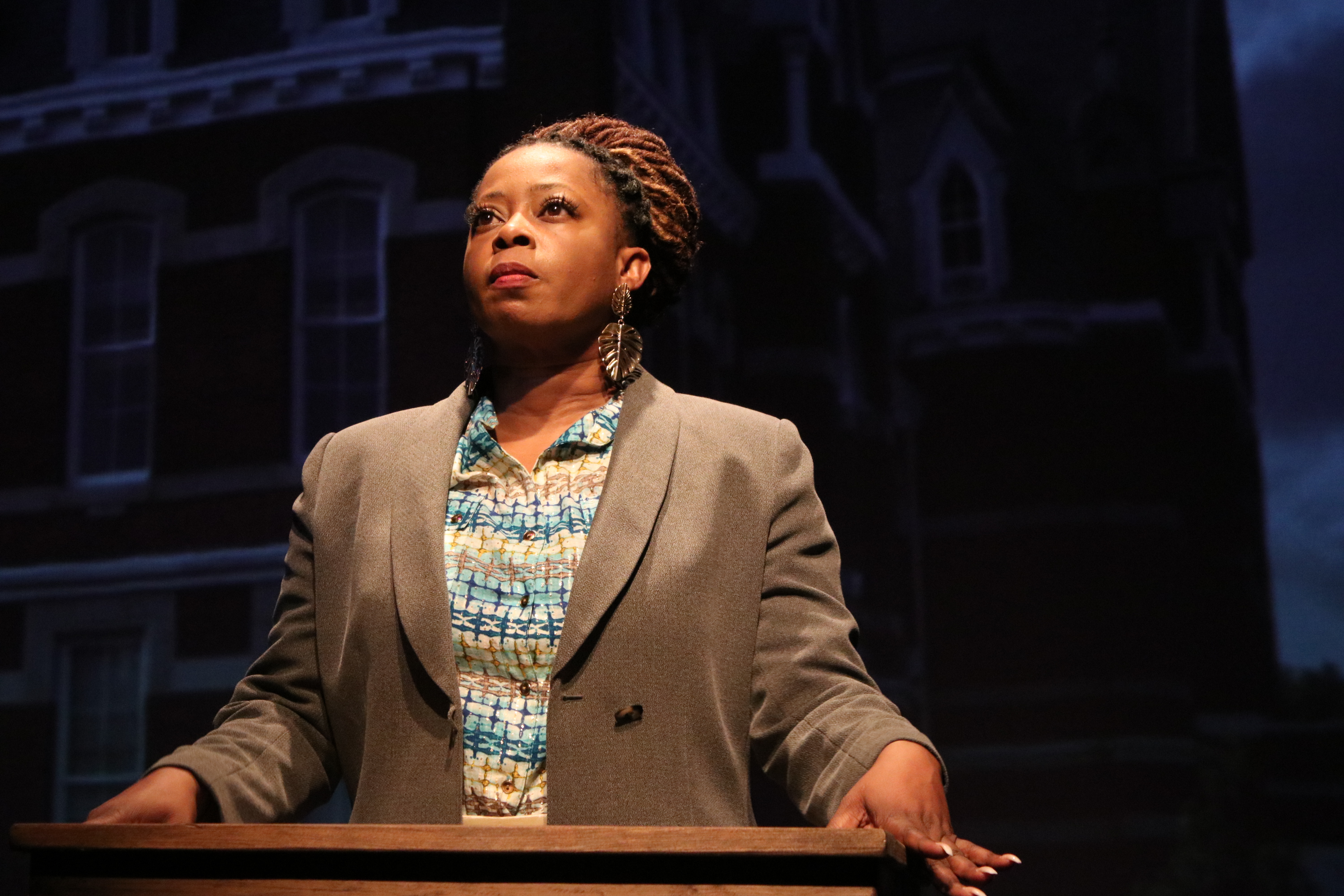
“Detroit ’67 Spins Motown Into History

Review: Detroit ’67 at Theatre Charlotte

By Perry Tannenbaum

Baked into many great American plays is the notion that dreaming big, striving for the golden apple of success, is a kind of latter-day hubris – sure to be tragically quashed and beaten down. Walter Lee Younger in Lorraine Hansberry’s A Raisin in the Sun was a grim example of such a tragic hero, dreaming of owning a liquor store in Chicago during the 1950s. It was hard for me not to think of Walter Lee’s beatdown – and paradoxically, the soaring success of Sidney Poitier, the breakthrough actor who portrayed him – as Dominique Morisseau’s Detroit ’67 unfolded at Theatre Charlotte.

Tautly directed by Ron McClelland and superbly designed by Chris Timmons, Morisseau’s work is darker and bloodier than Hansberry’s classic but emphatically more hopeful. Even with the background of the Detroit race riots of 1967, the pride of Black culture never leaves our eardrums for long as a clunky old record turntable, replaced by a slicker 8-track player and a pair of bookshelf loudspeakers, cranks out the hits of Motown’s famed music machine.

Come on, David Ruffin! The Temptations! Smokey Robinson and The Miracles. Mary Wells. Martha and the Vandellas. The Four Tops. Gladys Knight and the Pips. Marvin Gaye.

Morisseau’s protagonist, Lank, and his sister Chelle are trying to upgrade their unlicensed basement bar so that it will become more competitive with other after-hours speakeasies – when Sly, Lank’s best friend and a numbers runner, offers him an opportunity to buy into a legit bar. History lesson: a police raid on one of the unlicensed bars Lank and Chelle are seeking to emulate triggered the Detroit riots, the worst in 20th century America until another shining example of policing, the Rodney King riots in LA, eclipsed them in 1992.

While the riots rage and Michigan guv George Romney is calling in the National Guard, Lank and Sly are striving to scout out their hoped-for property and close on a deal – against Chelle’s wishes. Meanwhile, a second hubris slowly develops as Lank shelters a lovely white woman, Caroline, who has been battered and is mysteriously linked with the white underworld. She’s actually in more mortal danger than Lank.

Despite mutual suspicions, Caroline and Lank are drawn to each other. But they bond over Motown music, and they are both capable of busting a dance move.

The rioting in the Motor City was a prelude to the Black Power demonstrations at the Mexico City Olympics in 1968. We can also view them as a precipitating factor leading to the pride-filled Summer of Soul celebrations in Harlem and the rapprochement between the races on the musical scene that accelerated at the gloriously chaotic and inspiring Woodstock Festival of 1969, for so many of us the decade-defining event of the ‘60s.

So Detroit ’67 not captures a city in turmoil, it echoes the prime crosscurrents of that era, the struggle of Black people for their legitimate rights, the backlash from white people and government, and the mainstreaming of Motown as it breaks into pop culture. And by the way, Sidney Poitier’s To Sir With Love and Guess Who’s Coming to Dinner were both released in 1967. The question of whether Blacks were making significant progress, suffice it to say, was very much up in the air as we watch this action at the Queens Road barn.

Running an underground business together, Lank and Chelle are more advanced in their autonomy, street smarts, and connections than Walter Lee and his sister Beneatha were, still living under their mother’s roof with Walter Lee’s wife and child. Pushback against Lank’s feasible but difficult dream comes entirely from Chelle, who can realize deep down that continuing to run an illegal operation is also a risky choice.

Morriseau, McClelland, and Shinitra Lockett, making her acting debut as Chelle, all seem to have made this same calculation. So Lockett seems noticeably more vehement in her opposition toward Lank’s romance with Caroline than in her objections toward his business venture with Sly. On the business end, Sly’s persistence and charm in pursuit of Chelle’s affections bodes well for his deal-making prospects, another softening factor, for Lockett occasionally shows us that the slickster is making headway.

Because we see Graham Williams is so composed and self-assured as Sly, we can begin to see Lank as acting audaciously and responsibly. Yet there’s enough shiftiness mixed with Williams’ confidence for us to retain Walter-Lee misgivings about their venture, especially when the riots and the National Guard are thrown into the mix. Devin Clark, one of Charlotte’s best and most consistent performers for more than nine years, gives Lank a stressed and urgent edge. He’s not as regal and commanding as he was portraying Brutus last summer, but he’s far more spontaneous and charismatic.

Chandler Pelliciotta, in their Theatre Charlotte debut, brings a bit of shy diffidence to Caroline that meshes well with her story. Her worldly swagger has obviously been dealt a severe blow as she wakens, bruised and disoriented, in the basement of a Black man’s home she has never seen before. While Lank is drawn to her and wishes to protect her – we aren’t always sure which of these impulses is in play – Chelle has a couple of good reasons to wish her gone.

Not the least of these is the trouble Caroline is in with people who have battered her with impunity. The trouble might pursue her and find her at this fledgling underground speakeasy. It’s an awkward position tinged with risqué allure, but Pelliciotta’s performance leans more into the awkwardness, their glamor far less in the forefront than their fearfulness – for Caroline herself and for her protectors.

You can probably name 15 Black sitcoms that have characters like Chelle’s mismatched chum, Bunny: sexy, flirty, quick-witted, and imperturbable. Germôna Sharp, in her bodacious Charlotte debut, takes on her life-of-the-party role with gusto and sass. Sharp makes sure we’re not getting a PG-17 version of Bunny: slithery, regal, carnal, and militantly unattached. She will dance with anybody – Lank, Sly, or Chelle – but not for long, totally neutral amid the sibling fray.

Costume designer Dee Abdullah helps turn on the glam, more flamboyant for Sharp and more elegant for Pelliciotta. Morriseau withholds from her characters any sententious awareness that they are standing at Ground Zero of anything historic, now or in the future, but she clearly wishes that awareness on us. A distinctive black fist is prominently painted on one of the basement walls, right above the record player and the 8-track, and its presence is meaningfully explained.

Nor should we consider evocations of Hansberry’s classic urban drama as accidental. Morriseau’s script tells us that her protagonist’s name, Lank, is short for Langston. It cannot be a coincidence that the poet Langston Hughes wrote “Harlem,” the iconic poem from which Hansberry drew the title of her masterwork, A Raisin in the Sun.

Brooklyn Grace Receives a Classic Museum

Review: BNS Productions Presents The Colored Museum

By Perry Tannenbaum

CCC02899

In every decade since it premiered Off-Broadway at the Public Theater in 1986, George C. Wolfe’s The Colored Museum has had a homegrown revival here in Charlotte. GM Productions premiered it up in the Attic Theatre at the old Afro-Am Cultural Center on 7th Street in 1993, and Carolina Actors Studio Theatre brought it to their C.A.S.T. location out in Plaza-Midwood ten years later. On Q Productions finally smuggled Wolfe’s 11 vignettes – or “exhibits” – into an Uptown site at Spirit Square in 2011.

Now BNS Productions has brought Colored Museum to its unlikeliest location, the Brooklyn Grace Venue, alias the Grace AME Zion Church on S Brevard Street. Each new revival more fully cements Wolfe’s satire as a classic – Winthrop U and UNC Charlotte have also chimed in with productions since 2009 – and each new resurrection that I see strikes me as fresh and hilarious as the first.

Of course, nothing compares with the edge and impact of your maiden encounter. Wolfe hurls a few choice barbs at white folk, mostly mocking their bland cruelty, but armed with an all-Black cast, it’s African-Americans and their culture that he assails with the most conspicuous gusto. All Colored Museum casts get to feast most hilariously on the sufferings and posturings of the Younger family in Lorraine Hansberry’s A Raisin in the Sun. Walter Lee’s wailings against “the man” in this “Last Mama-On-The-Couch Play” take a detour into Beau Willie Brown’s barbarity in Ntozake Shange’s for colored girls.CCC02756

Familiarity with those two stage gems helps you to savor Graham Williams, Sr.’s over-the-top brilliance as Walter-Lee-Beau-Willie, but his reappearance, immediately after intermission, as The Man only magnifies his triumph. For Wolfe delights especially in depicting the disfigurements that black people inflict upon themselves to survive and succeed in white America. The Kid, played by Jonathan Caldwell, must now disown and discard his Afro-comb, dashiki, autographed Stokely Carmichael photo, Afro-sheen, Jimi Hendrix and Sly Stone recordings, along with Eldridge Cleaver’s Soul on Ice – replaced, The Man tells him, by The Color Purple.

Black Power and protest must be tossed into the trashcan along with slavery if you wish to get to the top. The Kid is dismayed, incredulous, and beside himself when The Man reaches for… The Temptations Greatest Hits! Yes, if The Man is to feel totally comfortable in his black business suit and fully acclimate to white blandness, even “My Girl” must bite the dust.CCC02782

Women also get choice bits from Wolfe, beginning with Nasha Shandri as our prim stewardess, Miss Pat, welcoming us aboard Celebrity Slaveship and inviting us to fasten our shackles as we cross the Atlantic to Savannah. Dancing in the aisles seems to be allowed during our voyage – as long as we keep our shackles on – but “No drums!” Of course, we will get a bluesy cooking lesson from Sandra Thomas as Aunt Ethel, teaching us, with abundant historical ingredients, how to cook up “a batch of Negroes.” Uncanny Aunt Jemima resemblance here.

Shandri and Thomas both reappear in “The Last Mama-On-The-Couch,” with Thomas in the title role switching from cheery to grumpy and Shandri upbraiding Walter-Lee-Beau-Willie (and cataloguing her own sufferings) as Medea Jones, a subtle reminder that white folk are also known to drop babies from great heights. Most of this skit targets Raisin, of course, with Toi Aquila R.J. as Lady in Plaid serving as Shange’s leading Colored Girls emissary.

Meanwhile James Lee Walker, II, has a tasty role as our narrator, bestowing an Oscar-like statuette upon one actress after a heart-rending monologue and then ripping it out of her grasp when the next actress tops her.CCC02580

Walker has already topped himself as the regal, finger-snapping drag queen who imparts “The Gospel According to Miss Roj.” Revisiting Wolfe’s Museum, director Dee Abdullah limits herself to the crossdressing that’s in the script. In 2003, by contrast, Aunt Ethel and Last Mama were also done in drag. But Abdullah brings back Chris Thompson from the CAST production, so the West African choreography at Brooklyn Grace – and the forbidden drumming – have the same sparkle.CCC02717-1

Acoustically, the Grace isn’t ideal for theatre, nor is the place outfitted for professional-grade lighting design. But Abdullah, Sandra Thomas, and Shacana Kimble compensate, teaming up for an admirable array of costumes, from the frumpiness of Last Mama to the imperious splendor of Roj – and on the other side of intermission, the voguish gown of LaLa Lamazing Grace, an expatriated Josephine Baker wannabe done with slaying disdain by Jess Johnson. Until her down-home roots are exposed.CCC02449

In “Hairpiece,” Shandri plays a woman who has literally burnt her roots. Or as Johnson puts it as LaWanda, “She done fried, dyed, and de-chemicalized her shit to death.” All to please the man that Shandri is now dumping. LaWanda is actually a talking wig stand, facing us on a makeup table (and presumably Shandri as well in a fourth-wall mirror). She’s debating whether her owner should be shaking her hot-pressed tresses back and forth when she irately gives her boyfriend the ax, or whether Janine, the Afro wig contemptuously advocated by LaTonya Lewis, should be the fearsome choice to make him shrivel.

While the wigs are debating whether Shandri is most powerful in her natural or chemicalized crown, it’s easy to forget the satirical barb that Wolfe has tossed toward the menfolk. The finally-dispensable boyfriend was a “political quick-change artist,” Janine dishes. Every time “he changed his ideology, she went and changed her hair to fit the occasion.”

Style is important, that’s for sure. Aside from Raisin, the most sacred cow that Wolfe takes down is Ebony Magazine, the barbershop bible of African-American life. Lewis and Williams are the supermodel couple of “The Photo Shoot” who have given away their lives to be beautiful and wear fabulous clothes month after month. Relentlessly smiling and feeling no pain.

Perhaps the wisest thing about Wolfe’s Museum – the good, the bad, the ugly, and the absurd – is that it’s simply there. Do with it as you wish.

“The ultimate questions from Wolfe apply with a fierce pertinence to all oppressed peoples,” I wrote in response to Abdullah’s 2003 production with CAST. “How do we carry the baggage of the past into the future without hampering and crippling ourselves? And how do we leave this baggage behind without discarding key parts of our culture, our heritage, and our identity? These grim questions go unanswered, but watching this energized ensemble wrestling with them will likely double you over with laughter.”

Can’t improve very much on those observations – unless I compress them for 2022 into Wolfe’s words. At the beginning of our journey and again at evening’s end, our stewardess, Miss Pat, tells us: “Before exiting, check the overhead as any baggage you don’t claim, we trash.”

That’s the key choice Wolfe aims to leave us with.

Sports Seasons and Generations Clash in Brand New Sheriff’s “Fences”

Review: August Wilson’s Fences

By Perry Tannenbaum

DSC07128

Sports fans quickly get a feel for what time of year it is in August Wilson’s Fences, set in 1957 Pittsburgh. Baseball seems to be supreme as you walk in to Brand New Sheriff’s production at Spirit Square. James Duke’s impressive set design doles out the left side of the Duke Energy Theater stage to a ramshackle two-story house. But a shabby yard dominates the right side, where a baseball dangles on a rope from an old gray tree. Pick up a bat, this is Troy Maxson’s place.

Maxson, an ex-baseball great, talks about the icons of the game, past and present, mostly contemptuous toward the white men who dominate the scene, while his friend Jim Bono rates Troy only below Babe Ruth and Josh Gibson as the best who have ever played. Since Gibson played in the Negro Leagues for the Homestead Grays, based in a mill town adjacent to Pittsburgh, it’s likely that he’s seen Josh far more often on the field than the Babe – especially since he introduced Troy to the sport during a prison stretch.

By the time Jackie Robinson had broken Major League Baseball’s color line in 1947, Troy was already 43, just missing the boat to national fame and power-hitting glory. Instead, he’s a garbage collector when we first see him on a Friday Night, as he and Jim observe their weekly ritual of getting drunk in Troy’s yard. We’ll hear mentions of Pittsburgh Pirates players, Dick Scofield and the under-utilized Roberto Clemente, who seems promising to Troy’s keen eye, so baseball is always in the air.

DSC07579

We begin to zero in on the time of year it is when Troy’s son Cory first appears, trying to get dad’s permission for a visit from a college scout wanting to offer the kid a football scholarship. Troy doesn’t want Cory to give up his job to start his final season with his high school team, and in subsequent scenes, we’ll see his football jersey and shoulder pads, further assuring us that we’ve reached that point in the year when baseball and football seasons overlap. We hear about the Milwaukee Braves leading the National League pennant race, their wicked pitching duo of Warren Spahn and Lew Burdette, and their young slugger, Henry Aaron.

Hank, we hear, has hit 43 homers in a year he finished with 44, so it must be late September. Within a few weeks, the Brooklyn Dodgers and the New York Giants will play their last home games in New York City before moving out to California, and Aaron – destined to surpass the Babe on the all-time home run list – will lead the Braves to victory over the Yankees in the World Series.

As Troy’s pal Bono and his wife Rose keep telling him, times are changing. A Goliath among ballplayers, accustomed to idol worship, Troy doesn’t easily change his thinking, so it’s interesting to watch how Bono and Rose make headway on those rare occasions when they do. Cory really doesn’t stand a chance against Troy’s tyrannical whims unless Rose intercedes on his behalf. Maybe he should have chosen baseball over football?

The father-son relationship is complicated by jealousy and resentment on both sides. Troy is ambivalent about seeing his son succeed in a way that he couldn’t, and Cory is wary of comparisons with his legendary dad, perhaps seeking to sidestep his shadow by turning to a different sport.

Wilson doesn’t downplay the Troy legend. On the contrary, he delightfully magnifies his mythic dimensions. Troy tells us how he has stared down the Devil, tells us how he wrestled with Death for three days, and he shouts his defiance toward the Grim Reaper before our eyes. So Troy’s practical advice toward his son clashes with his own swollen self-regard – and with his disregard for social norms. On the job, his strength and pugnacity will enable him to become the first black garbage truck driver in town, but at home, his unchecked infidelity will cost him.

DSC06873

Part baseball legend, part Greek epic hero, and – as Bono observes – part “Uncle Remus,” Troy is the powerhouse that makes Fences among the most produced and anthologized of Wilson’s plays. Of the four productions I’ve seen in Charlotte, beginning in 1991 when Charlotte Repertory Theatre presented the local premiere, Brand New Sheriff’s best demonstrates how a strong overall cast elevates the script to the stratosphere of a classic.

And we’re seeing the best Troy we’ve had here in Jonavan Adams, who combines Ed Bernard’s physical presence from the Rep production of 1991 with the corrosive meanness and fiery defiance of Wayne DeHart at Theatre Charlotte in 1996. Snarling, cajoling, roaring, and willing us to see his distorted vision of the world, Adams is more outsized and supernatural than we’ve seen him before.

It likely helps that he and director Corlis Hayes are on their second go-round with Fences. The 2013 version at CPCC, where Adams played Lyons, Troy’s jazzy musician son, wasn’t the best of the previous versions, to be honest. But the current BNS production sure does demonstrate the benefits of taking a second shot at a work you revere. Cumulative experience with the playwright helps, too, for Adams builds upon what he learned in other parts of Wilson’s century-spanning Pittsburgh Cycle, with roles in The Piano Lesson, Two Trains Running, Ma Rainey’s Black Bottom, and Joe Turner’s Come and Gone.

With BNS committed to presenting all of Wilson’s Cycle, others who have appeared with the company and in plays by this playwright are also shining lights here, most conspicuously Tim Bradley as Bono and LeShea Nicole as Rose. Audience members who hopped aboard the Pittsburgh train in 2017 with Jitney are certainly enjoying the ride the most. Bradley has been onstage at Duke Energy at every stop so far, and his Bono is a worthy – and compatible – longtime companion for Troy, not quite as righteous and upstanding as Memphis from Two Trains but strong and honorable when Troy could use a reality check.

DSC06918[6]Nicole was paired with Adams last year in Two Trains, so their rich and nuanced chemistry as Rose and Troy shouldn’t be a surprise. Rose is a stronger woman here, so when she holds out her hand on Friday nights, she isn’t merely asking for Troy’s pay envelope. Rose is Troy’s equal, and then some – the family nucleus. Everybody but Troy seems to get that until her climactic utterances deep in Act 2.

Still a junior at UNC Charlotte, Dylan Ireland is no stranger to BNS, having starred as Huey in Rory Sheriff’s Boys to Baghdad. As Cory, Ireland stands up to his dad without strapping on his shoulder pads. Eventually, he even disrespects Troy when he’s drunk and blocking the front door.

It’s a complex role for Ireland, who must forcefully declare that he doesn’t fear his father while imperfectly hiding that he does. He’s the reluctant, resentful free labor that Troy enlists to help build a fence around his property. So Ireland’s confrontations with Adams – along with Troy’s run-ins with Death – will come to mind when you contemplate the meaning of Wilson’s title.DSC07475

Graham Williams, lately the Tin Man in BNS’s Be A Lion, has the cool-cat swagger you expect to see from Lyons. Though he does scrupulously pay Dad back on his loans, Lyons does not prosper as a musician, and Williams gives us a poignant picture of his decline. Seven-year-old Raynell appears late in the show, a bit of a consolation for the misfortunes that befall the other Maxsons, and Lauren Vinson plays her sweetly, only slightly difficult to manage.DSC07936

Seven years younger than his brother Troy, Gabriel is a World War 2 vet who came back from the battlefield delusional, with a metal plate in his head. Troy may have seen Death and the Devil, but Gabriel believes that he has seen St. Peter and that he is the archangel Gabriel, destined the blow his junky trumpet on Judgment Day. James Lee Walker II plays this extravagant simpleton, the only cast member from the 2013 CPCC production to return in the same role.

More than ever, I must lament that I missed Walker when I reviewed the Sunday matinee of the 2013 production, when he was replaced by an understudy. Walker’s crazed, sunshiney energy this time around is a constant joy, and the ending, botched by the understudy or Hayes’ stage direction back then, was absolute perfection when I saw it on Saturday night. The glow of that ending may convince many that Fences is Wilson’s finest drama, and there’s plenty of firepower from the rest of the cast to fuel that feeling.


BNS “Lion” Keeps Roaring and Romancing

Review: Be A Lion

By Perry Tannenbaum

DSC05325

Without much fanfare or marketing knowhow, Rory Sheriff and his Be A Lion arrived on the local scene in 2014. The musical sequel to The Wiz has been produced here five more times since then, has drawn 12 nominations for excellence from the Metrolina Theatre Association at their recently revived annual awards, and was successfully produced at the 2019 Atlanta Black Theatre Festival, where Sheriff was honored with the Best Director prize. So the time was ripe for me to catch up with this triumphant production. Something must have clicked for Brand New Sheriff Productions for Be a Lion to have been reprised so frequently and lauded so widely.

Sure enough, I found plenty to enthusiastically recommend at Spirit Square last Friday Night. Music and lyrics by Sheriff and five others are clearly ready for prime time, costume design by Dee Abdullah and Shacana Kimble is an absolute joy, and choreography by Toi Phoenix Reynolds consistently hits the sweet spot. Perhaps most exceptional among the show’s technical and design attractions is Gbale Allen’s makeup creations, a category that isn’t adjudicated in Metrolina or Atlanta – or even on Broadway. Lion, Scarecrow, Tin Man, and Damneesha – the hellspawn of wicked witch Evilline – are merely highlights in the gallery of Allen’s splendid handiwork.

f1f6ae4a6746c91b636ceb3f8a6f3ad1.jpeg[4]

Yet overall, I was underwhelmed. Aspects of Lion were surprisingly rudimentary for a company staple that has been so extensively developed and presumably rethought, particularly Jennifer O’Kelly’s scenic design and Sheriff’s book.

Without the blandishments of fade-dissolves, the scenery is a series of projections on a massive sheet that doesn’t stay still. Nor am I awed by the graphics, which never come close to matching Sheriff’s Broadway aspirations. When you can count the bricks on the famed Yellow Brick Road – and it twists more than a couple of times before terminating at approximately shoulder level – you aren’t seeing much of a road.

More disheartening are the lingering weaknesses in Sheriff’s script, which testify to a lack of tough, honest criticism more than to a lack of talent. Action throughout Act 1 simply drags, relieved only by the splashy costumes and the bravura singing. Really, it’s like nobody has suggested a rewrite in five years across the six-plus BNS productions here and elsewhere. As Lion rounds up the old gang with drop-ins on Tin Man and Scarecrow, encouraged by Miss One (formerly Glinda) to travel to Emerald City and claim his rightful kingdom, Sheriff fails to establish any dramatic urgency for his mission.efd8703eb37b1c8e19b483746e1d6515.jpeg[8]

The hybrid offspring of Evilline and a Flying Monkey, Damneesha knocks off her daddy and summons an army of Flying Crabs to muster behind her evil intent. The upshot of this fiendish mobilization? Who knows. We dally instead at a carnival where Tin Man presides, henpecked by wife Teenie, and at a school established by Scarecrow, where she teaches. These are the respective humdrum outcomes of being granted a heart and a brain. Not exactly dramatic substitutes for cutaways to Emerald City, where citizens could be cowering under Damneesha’s tyrannical rule and Gotham City-like chaos could break out as the oppressed masses cry out for a hero.

Not only isn’t there urgency to Lion’s quest, there’s too little drama for Sheriff to build to a big finish and emphatically announce the break. Instead, a prerecorded PA announcement tells us it’s intermission. Axiomatically, that means trouble.1c0906c97b0deab102cd3ec5f253f8c4.jpeg[8]

Somehow, Sheriff mostly finds himself in Act 2 – and we find that the writer-director-producer can also sprinkle plenty of comedy and wit in his script while revving up the drama. Damneesha and her Flying Crabs finally do get aggressive, good ole Dorothy is transported – from Harlem in a cute yellow taxi – to Oz and becomes one of the witch’s kidnap victims, and Lion comes up with a clever stratagem to save the day. Oh yeah, there’s definite evidence that Act 2 has been manicured. The Emerald City masses remain out of the picture, and Dorothy doesn’t have much to contribute, but there’s hope here that Be a Lion could evolve into a truly marketable property.

Although I can trace complete turnover in the cast since the last time Queen City Nerve editor Ryan Pitkin covered BNS in a previous life, the talent onstage now at Duke Energy Theater is exemplary, beginning with Melody Williams as the ultra-wicked Damneesha and Frank “Facheaux” Crawford as Cheetah, her hapless dad. Nikki Dunn could pass for a female impersonator as Miss One, she’s so over-the-top and outrageously dressed; and Danius Jones as Miles, Lion’s obsequious mouse servant, has a bit of weasel mixed into has DNA – and a newfound worship of Michele Obama.DSC05462[4]

At the center of Sheriff’s story, for better or worse, are Tim Bradley as Lion and K. Alana Jones as Ladawn, with the producer (and choreographer) dipping perilously deep into The Lion King in crafting their romance. Lion and Ladawn are a mushy, overlong detour from the cataclysm shaking the Oz kingdom, but the chemistry between Bradley and Jones, fueled by how well she sings and how lithely she moves, keeps them watchable. Bradley never reverts to the big cowardly clown we remember before his audience with The Wizard, but every so often, slight lapses in courage and fortitude add to his texture.

Yet I’m so glad when Lion and Ladawn quarrel and break up, allowing the Oz story to breathe.3c5332bf0b172f337626fc5c9d4f4064.jpeg

While they aren’t as cleverly integrated into Sheriff’s denouement as they were in the classic 1939 Wizard film, you will still enjoy Tin Man and Scarecrow heartily. Graham Williams as Tin Man and Jessika Johnson as Scarecrow not only get the benefits of smashing costumes and makeup, they’re both accessorized with new characters they associate with. For Williams, it’s Shar Marlin playing the termagant ball-and-chain wife Teenie to the hilt. Even better, Johnson gets two Crows to teach, Trinity Muse as Leroy Crow and Cecilia Mitchell as Walter Crow, detonating the Act 2 comedy.

Muse and Mitchell moonlight as minions of the evil Damneesha, Flying Crab #1 and Flying Crab #2. Together, they are her whole army!


Trying an Offramp on the Highway to Prison

Review: Pipeline by Three Bone Theatre

By Perry Tannenbaum

Pipeline Cast 

One of 25 winners of the MacArthur Foundation’s “Genius Grant” last year, playwright Dominique Morisseau has begun, somewhat belatedly, a stealth invasion of the Queen City. How stealthy? UNC Charlotte and Three Bone Theatre, the first two outfits to present Morisseau works here, both latched onto the same acclaimed Detroit ‘67 for productions that would have opened a little more than a month apart.

That mutual unawareness was mercifully cleared up. Instead of two competing productions of the same 2013 script, we’re introduced to Morisseau by Three Bone with a newer work, Pipeline, that premiered at Lincoln Center two summers ago. ’67 matriculates on September 27 at the Robinson Hall Black Box.

Nya2

With a detached black dad checking his smartphone instead of making quality time for his teen-aged son, Pipeline feels 50 years more contemporary than Detroit must be. Yet the tide that high school English teacher Nya desperately resists, the progression of young black men’s lives from school to prison, comes at her with the lethal force of an eternal verity. Like mythic Greek royals seeking to avoid a sure fate pronounced by a Delphic oracle, Nya and her ex-husband Xavier have sent their son Omari off to a private boarding school to avoid the inner-city trail to incarceration.

It isn’t working. Although he isn’t dealing drugs, isn’t in a gang, and has a girlfriend who values him, Omari is volatile. In a classroom discussion of Richard Wright’s Native Son, the teacher has zeroed in on him to explain why Bigger Thomas explodes with such anger and violence – presumably because he, as the black kid the class, was best qualified to understand.

Omari

The questioning escalated in a confrontation and then a physical action from Omari that seems open to dispute. Push, shove, assault, or a simple attempt to leave the room? Whatever happened – we never see the video that went viral – Omari not only faces possible expulsion but the teacher might press charges. Jail may already be on the horizon.

Nobody takes this unexpected defeat harder than Nya. She hasn’t merely been fighting against this tide of imprisonment and doom in her family. Every day in her classroom, she fights the good fight with wave after wave of young men, period after period, year after year. Teaching Gwendolyn Brooks’s “We Real Cool,” written in 1959, Nya doesn’t merely wish her students to understand what the dropout pool players are saying in their semi-literate three-word sentences, she wants them to avoid living it.

So as Nya melts down in front of her students, Omari’s fate and her defeat acquire an Arthur Miller All My Sons moral weight, for she is angered and tinged with guilt at the same time. She is dangerous and out of control as she barges into Jasmine’s dorm room, demanding to know where her son has run off to.

Here is probably the best entry point into Morisseau’s subtext, for Nya gets a free pass on losing her cool and overstepping where Omari doesn’t. Just don’t get so caught up in Nya’s trespasses that you sleep on those of her colleague, Laurie, a white teacher. My first impulses were to see her as an empathizing sounding board for Nya’s anguished feelings and, together with security guard Dun, as a co-worker who underscores the sense of working in a terrifying, corrupting jungle teeming with at-risk youth.

Nya&Omari_2

Ah, but keep your eye on what happens after Laurie snaps, striking one of her students – to break up a fight! Criticism gets hurled at Laurie by Nya and Dun, and surely there will be consequences from New York City school administration. But nobody onstage, not even Nya, believes that Laurie might be fired (in effect, expelled) and nobody, including me, entertains the notion that she might be brought up on assault charges.

These assumptions are the exact opposite of what we take for granted as applying to the Omaris, the Trayvons, and their black brethren striving to reach adulthood in America without being jailed or shot down in cold blood. We’ve all been numbed by this norm that is so hard-wired into American life.

While scene changes at Duke Energy Theater are a bit plodding in this Three Bone production, Ryan Maloney’s set design takes us where we need to go, and his projections add liveliness to the action, especially the poetry demo. Directing this meaty, turbulent, and layered script, Sidney Horton keeps the heat at about medium-high, so the playwright’s light shines through and we don’t suffer exhaustion.

And my goodness, the high-grade performances we get from LeShea Nicole as Nya and Susan Stein as Laurie make Horton look like the genius. Nicole discards all the irony we’ve seen from her in the past and gives us an earnestness and a heart-on-my-sleeve openness that marks an artistic breakthrough. When Nya teaches the last sentence of the Brooks poem, “We Die soon,” we get the full impact of what she feels is at stake.

Yet Nicole doesn’t get the luxury of delivering full-bore anger and toughness all the time as Stein does. Nya has a tender maternal side that peeps through even in the confrontation with Jasmine, Omari’s girlfriend. Stein offers us the sort of scrappy New Yorker whom I remember seeing and hearing so often when I was growing up. Yeah, her Laurie is back on the job after having her face put back together, but don’t you dare pity her.

Nya&Omari_1

All of Nya’s fire and fury would be for naught if Morisseau hadn’t endowed Omari with enough complexity, strength and nuance for her to care about. Deandre Sanders takes a beautiful approach, playing Omari as a troubled young man rather than an immature teen. Nor does Sanders mute Omari’s big blind spot, his perpetually seething anger toward his dad. Omari’s scenes with Jasmine, his mom, and his dad are all multifaceted, Sanders projecting a manly grace and style that only partly veil the powder keg. Omari and his dad arguably draw the most noteworthy of Davita Galloway’s costume designs. That never hurts.

Slick, cold, and distant as he may be, Graham Williams as Xavier lets us know with only a trace of bitterness that he has taken the bullet for the breakup of his marriage to Nya. She slammed the door on him, now wants him back, and all this while has been peddling the myth that he abandoned his family – stoking Omari’s anger and partiality with the deception. So the guilt that afflicts Nya is not at all numinous.

Morisseau and Horton don’t neglect the smallest roles. While somewhat annoying in his pursuit of Nya, Marcus Fitzpatrick as Dun ably makes his point that the English teacher might be doing some income group profiling in undervaluing the school security guard. Meanwhile Alexis Jones gets to spray Jasmine with a few immature traits, letting us know there are some smarts mixed in with the coed’s insecurities and, in her showdown with Nya, that there is true worth behind her petulance.