Tag Archives: Ericka Ross

If You Loved the Clunky TV Rudolph the Red-Nosed Reindeer, You’ll Adore the Children’s Theatre Musical

Review: Rudolph the Red-Nosed Reindeer at ImaginOn

By Perry Tannenbaum

November 22, 2025, Charlotte, NC – Okay, so Christmas erudition isn’t my thing. Thanks to the Gospels of Matthew and Luke, my familiarity with the biography of Jesus, from the Anunciation to the Resurrection, is sufficiently sketched out, though not nearly as complete as my knowledge of Moses and Joseph. My familiarity with Christmas and the Nativity comes mostly from network TV, the annual inundation of all media, neighborhoods, and supermarkets with the holiday spirit when the season comes around, various musical and movie masterworks such as Messiah and The Christmas Carol, and very infrequent visits to Christians’ homes when their trees were decorated.

All of this is to say that, until a couple of days ago, my ignorance of Rudolph the Red-Nosed Reindeer was quite profound. Silly me, I thought “Rudolph the Red-Nosed Reindeer” was simply a hit song recorded by singing cowboy Gene Autry that has haunted the airwaves and shopping malls since 1949. It wasn’t until Children’s Theatre of Charlotte premiered this past weekend at McColl Family Theatre in ImaginOn that I found out that Rudolph the Red-Nosed Reindeer was also a well-known story – and has been since the original song by Johnny Marks and story by Robert L. May was adapted for an animated TV special by Marks and scriptwriter Robert Penola in 1964.

Sam the Snowman, Hermey the elf, Mrs. Donner, Clarice the doe, Yukon Cornelius, snow monster Bumble, Boss Elf, Coach Comet, and the Misfit Toys were all new to me as the Children’s Theatre Rudolph unfolded. Only later was I informed that my own stepchildren had grown up on all of them. Maybe my daughter, too! Sadly, all this nostalgic family info arrived too late to sway my affections toward what I had just seen onstage. As much as I’ve always adored the Rudolph song – or perhaps because of that longtime adoration – I found that I disliked this precious and sugary musical.

Let’s begin with the costume designs by Kahei Shum McRae, so lovingly faithful to the original TV art. That’s a huge problem for me. Since cartoons and animation were defined for me in my childhood by what they delivered, ranging from Snow White and Batman to Bugs Bunny, Bullwinkle, and Hanna-Barbera, the advent of Claymation, Animagic, and stop-motion – whatever you call it – seemed like a clumsy step backward to me. Sure, the small-scale props and dolls cast 3D-like shadows, but they were as immobile and expressionless as dolls or puppets, plopping you awkwardly back into the real world.

Though McRae successfully recreates the feel of the old TV evergreen, he is hamstrung by that objective and all its cuddly clunkiness. Sam the Snowman seems to truly roll across the McColl stage inside his snowy skirt and plaid vest, and the puppeteers who team up to form Bumble are barely more terrifying than a jellyfish of similar size. To the rescue come youth and adult actors who can visibly inhabit McCrae’s costumes and give them energy and spontaneity.

Woke objections that have been raised against the tale didn’t faze me, though they likely dulled the edginess that director Christopher Parks could have brought to this production if he had defied them. Au contraire: Amp up Santa’s rejection of Rudolph’s shiny nose, the other reindeer’s bullying, Donner’s male chauvinism, and the fearsomeness of Bumble (a name change might also help) so that our hero’s sufferings are more in line with those we find in our favorite fairy tales.

Politically correct or not, triumphs over mighty evils are more satisfying than triumphs over muted evils that fade away as soon as they’re opposed. Forbidden to associate with his sweetheart Clarice and banished from his reindeer team and their games, Rudolph runs away instead with Hermey, the misfit elf who would rather become a dentist than build toys. Vance Riley has the perfect elfin look as Hermey, with a resemblance to Will Ferrell that plays well into the misfit’s wackiness.

But it’s Tilly McDaniel as Rudolph who best models why this live theatre Red-Nosed Reindeer, vapid as it may be,is so much finer to me than the TV travesty. Under her adorable reindeer jumpsuit, McDaniel is recognizably human – or venison – rather than clay. When the lovely Julia Straley, as Clarice, comes on to him with praises galore, Rudolph’s reaction is a cosmic blush: Rudolph’s nose suddenly glows, and McDaniel flies up into the air. There’s genuine emotion here, notwithstanding the slaughterhouse hoist..
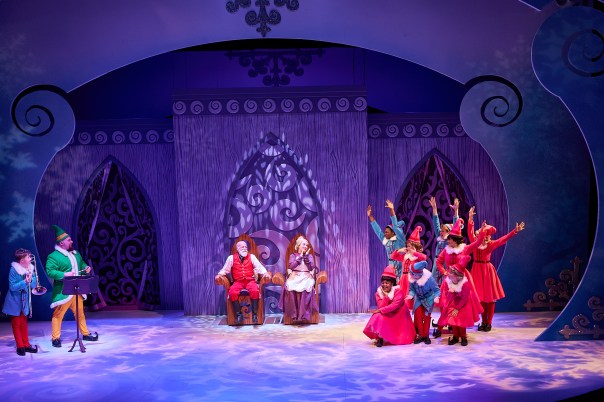
On the other hand, I subjected myself to all of the Animagic version I could find on this side of the $8.99 paywall. Everything I saw struck me as painfully primeval and lifeless – you’d have to pay me far more than nine bucks to watch it all. Only a few snippets of Santa can be found in the clips and trailer I sampled, enough to firm my conviction that John DeMicco as Santa and Allison Snow Rhinehardt as Mrs. Claus are far more rewarding than their Claymation counterparts. Rhinehardt even adds some grace notes that give the impression that Mrs. C is pushing back against Santa’s grumpiness and prejudice.

Likewise, Carlos Nieto and Ericka Ross convince us that Rudolph’s parents, Mr. and Mrs. Donner, have real souls instead of clay molds. You can feel that they’re genuinely worried about their cute little oddball offspring. Our host and narrator, Brandon J. Johns as Sam the Snowman, was geniality itself, establishing a fine rapport with the matinee audience and delivering “A Holly Jolly Christmas” with nearly as much avuncular jollity as its originator, Burl Ives.

Moonlighting from multiple puppeteer exploits, including the bodacious Bumble, Alex Manley gets his face time as the Boss Elf, so sunny that you never believe he really opposes Hermey’s dentist dreams in his heart of hearts. Richard Edward III drew two chauvinist bucks to portray: Coach Comet, Clarice’s intimidating dad, and Yukon, the flamboyantly superfluous gold-digger that Rudolph and Hermey meet in their travels. Kids of all ages seemed to delight every time Edward wielded his prospector’s pick-axe, particularly when we learned – or at least I did – that he wasn’t hunting for gold.

“Raisin” Remains an Aspirational Reminder

Review: A Raisin in the Sun at Matthews Playhouse

By Perry Tannenbaum

Did somebody just say something about FREE SPEECH?? Yeah, about a billion times per second if you’re tracking social media, college campuses, nation’s capitals, and late night TV. Still no theatre critic we know would dare suggest in today’s torrid media climate that the subject generates too much heat and too little light – or that babble about free speech serves as a black hole for time and breath better spent discussing other freedoms.

Addressing the US Congress in 1941, Franklin Delano Roosevelt looked forward to “a world founded on four essential freedoms.” Useful, breathtaking, and a better way to spend January 6 than a subsequent US President chose. When I was graduating junior high more than a half century ago, those four freedoms were still on the curriculum, and my entire class wrote essays about them.

For the record, I wrote about FDR’s Freedom #4, Freedom from Fear.

One of the things we love about Afro-American literature is that their writers show us that freedoms worth prizing are as numerous as personalities – that those dearest to us are an uphill struggle to achieve. In Lorraine Hansberry’s A Raisin in the Sun, returning to the Metrolina area for at least the sixth time this century, every member of the Younger family knows the struggle from the moment they rise in the morning.

Now some of these struggles are fairly picayune, giving a homey warmth to Hansberry’s various yearnings for freedom that we easily empathize with. Take little Travis (Solomon Doleman), for instance, yawning himself awake with his mom’s help for another school day. The youngest Younger doesn’t have a room or a bed of his own, sleeping right before our eyes on the living room couch as the lights go up.

Hell, he doesn’t even have a regular bedtime, since we’ll soon learn that he cannot claim his place on the couch until Dad has finished scheming and schmoozing with his ambitious pals. Walter Lee and his son Travis may both be sleep deprived due to the drinking and scheming of the previous evening, but their first challenge of the day requires teamwork.

Otherwise, they won’t be able to visit the toilet or groom themselves for the day. As if out in the wild, the family must post a lookout on the hallway, so that they can seize control of the single bathroom that serves multiple families in their Chicago tenement. Then this treasured privacy must be passed along to another member of the clan. Yes, it’s a bit comical to watch so much family tension generated over so little. Yet this is part of the layout of the Youngers’ survival.

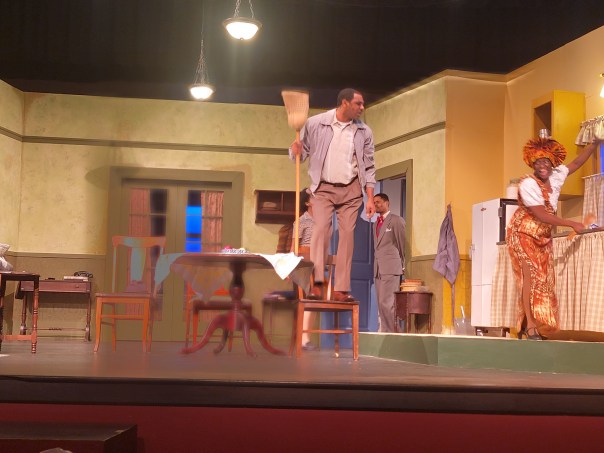
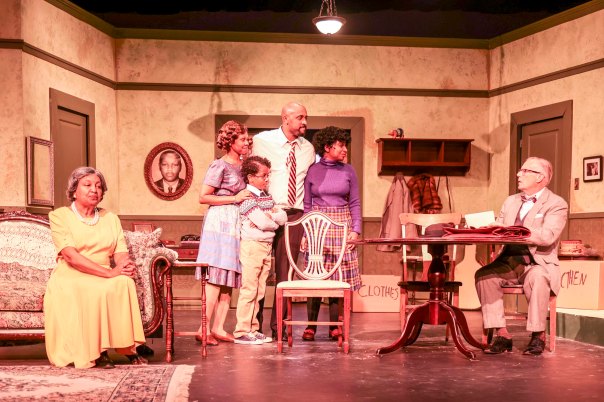
FDR’s Freedom #2, Freedom from Want, is also in the foreground as the Youngers’ successful capture of the bathroom plays out as a backbeat in opening scene. Looking at the Youngers’ apartment for the first time at Matthews Playhouse, we find that director Corlis Hayes and set designer Bob Croghan have pulled back a little in rendering the wear and weariness we should be seeing if Hansberry’s description of the kitchen-dining-living room were followed to the letter. “Cracking walls”? Didn’t see them.

Throughout the evening, there’s a similar shift away from the groaning and wailing tones you might remember from the last time you saw Raisin. That suffering patina has been natural for Raisin since it premiered as the first drama by an African-American female playwright to reach Broadway in 1959. The weight of ancestors hung in the Ethel Barrymore Theatre on opening night, and the fate of the race seemed tethered to the audience’s response.

Likely, at the tender age of 29, Hansberry didn’t view her rise to prominence with such solemnity. The heritage of her family and its struggles, including her father’s fight against a restrictive Chicago housing covenant, are in the annals of the Supreme Court and resulted in a Hansberry v. Lee victory in 1940. As seething, cautionary, and defiant as Raisin often seems, we can look at all the Youngers and see them as positive, determined, and aspirational.

Her banner is Langston Hughes’s 1951 poem, “Harlem,” and its main subject, “a dream deferred.” Hughes offers half a dozen prognostications of what might happen to it. Next to sugaring over, drying like a raisin would seem to be the most benign outcome.

Walter Lee’s dream of opening a liquor shop can hardly be deferred for more than a day, when his mama Lena expects a $10,000 check from his late father’s life insurance. Before he even has his necktie on properly, Walter Lee is lobbying his wife Ruth to soften Lena up so he can calmly present his business plan to his god-fearing mama. Ruth has other concerns: on the surface, it’s feeding her guys breakfast and getting them out the door.

Deeper, and still hidden from everyone else, Ruth is also considering the future of her family from her perspective as a mother.

Ruth’s worries and dreams do not align with her husband’s at all – aside from wishing him success. Two other dreams vie for priority in the family. The comparatively breezy Beneatha wants to go to medical school. But not right now. First, Walter Lee’s younger sister wants to start guitar lessons. Or to see what new revelations from Africa come her way from her new Nigerian acquaintance, Joseph Asagai, who clearly aspires to supplant Beneatha’s current beau, the starchy and monied George Murchison.

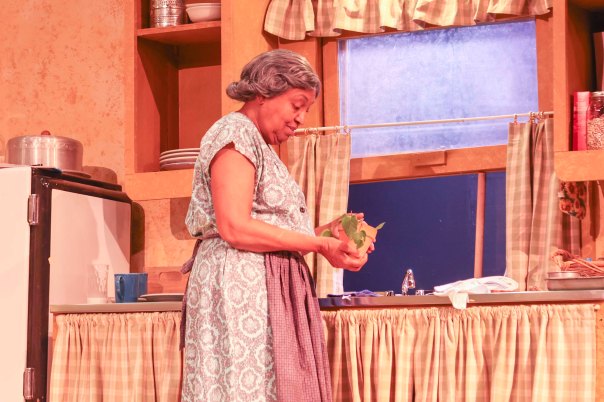
But the $10,000 check will be in Lena’s name, so what does she want? Here the BNS Productions’ dingy set is absolutely true to Hansberry’s spirit, for Croghan only provides a sliver of a window to allow any light in from the outdoors. It’s barely enough for Lena’s scraggly little houseplant, propped up with wee splints, to survive. Hardly big enough for more than a couple of Youngers to gaze out at the street.

Lena isthe Younger who cherishes the dream of Carl Augustus Hansberry, the playwright’s father, to live in a house that can accommodate all her family – along with a little plot for her to maybe grow a garden. If the best value for her money happens to be in Clybourne Park, a whites-only subdivision, fine: her family will certainly not trouble anyone else’s.

Such a rock! Yet Lily Oden plays Lena with a maternal softness, speaking her mind clearly, but never thundering like a prophet on a mountaintop. She does come off as old-fashioned in her confrontation with the godless Beneatha. The slap is still there, life-sized rather than the hand of God. While it may serve to compromise her moral authority, it emphasizes the intensity of her dream, coloring it with a determination to somehow repair and unify her crumbling family.

Along the way, we can feel that Oden has her recognizing that slapping and bullying aren’t always the best paths. That’s especially true in this Playhouse version where BNS mainstay Jonavan Adams is Walter. The way Adams gazes out at us as he articulates his dreams is a bit drier and wearier than most Walters we’ve seen, needing less of a gap to close before shedding his supplicating impulses and coming into manhood.

It appears as if he may let us down in the crunch, but Hayes gives him a life raft at a key moment in his planned capitulation to the white homeowners’ representative: a portrait of Walter’s father, “Big Walter,” hanging on an upstage wall. We see this – and Lena’s insistence that Travis remain in the room – working on Adams at his tipping point.

Unless you’ve seen Renee Welsh-Noel and her wackier exploits at Children’s Theatre of Charlotte, you might not fully appreciate all the nuance and texture she brings to Ruth and her strained position among the Youngers. She’s the bad cop tasked with prodding the menfolk awake, getting them fed, and off to work and school on time… the responsible parent who must deny Travis his 50¢ for school because the family can’t afford it.

Over and over, she is overruled by Walter and Lena, who can point proudly to Beneatha as the outcome of their spoiling. It’s almost as if Ruth doesn’t have aspirations anymore – until the breaking point when her yearnings and her resolve gush forth.

About the only flaw I found in the Regal cast (a second, overlapping Grove cast takes on all the morning and afternoon performances) was K. Alana Jones’s portrayal of Beneatha. I like how Jones plays and exploits the two men who are dating B, and the relationship with Walter is pitch-perfect. But Jones doesn’t seem to get how brainy and rad Beneatha is for a Southside Chicago co-ed in the ‘50s – or how full of herself and entitled she feels as such a progressive try-everything visionary.

The boyfriends for this BNS-Matthews Playhouse production are exactly as you remember them. Sha’Heed J. Brooks is delightfully starchy as George, the snobbish plutocrat who looks down upon Beneatha’s kin, particularly Walter, to his peril. By contrast, Dionte Darko as Asagai wonderfully captures both the exotic and the naïve aspects of the foreign exchange student. Yet with a worldly urbanity mixed with ancient wisdom, Asagai can effortlessly put Beneatha on the defensive.

With brisk pacing – and maybe some deft cutting – the production speeds by, the three original acts performed with one intermission. Yet Hayes somehow squeezes in the visit from the Youngers’ neighbor, Mrs. Johnson, whose scene and character has been dropped from every Raisin production to reach Broadway, including the revivals that featured Phylicia Rashad in 2004 and, ten years later, Denzel Washington.

Ericka Ross is quite obnoxious and brassy as Johnson, chiding Lena for buying into a white neighborhood and forecasting doom, even if she won’t convince everyone that the scene should stick. Bobby Tyson as Bobo and Henk Bouhuys as Karl Linder stand on firmer ground – and draw more dramatic assignments.

Nattily dressed in one of costume designer Emily McCurdy’s most stylish creations, Tyson is the only person during the whole liquor store scheme who doesn’t merely phone in. He has the guts to come by and deliver the bad news to his crony in person … and the moxie to show his irritation when Walter doesn’t immediately grasp how thoroughly they’ve both been screwed.

You’ll notice an awkward exit or two from guests at the Younger abode but none more heated or satisfying than the retreats of Mr. Linder, the Clybourne Park emissary. Bouhuys endows him with all the patronizing pomposity you might expect from an upper level Wells Fargo executive. Hayes strips Linder’s scenes of the buffoonery we may remember in past productions, where it might have seemed proper to boo and hiss his every word.

Bouhuys doesn’t bumble, but he does seem doubly non-plussed. He really cannot grasp why the Youngers won’t defer their dream any further when faced with the absurdity of moving into a neighborhood where they are not wanted – so not wanted that community has banded together to buy them out. Don’t they understand the arithmetic? By accepting Clybourne Park’s offer they could make a profit!

Or at least they could negotiate. Who are these maniacs that refuse to cash in?

What’s often overlooked in the onrush of the great Raisin in the Sun climax is how pivotal Walter Lee’s most humiliating moments are in triggering his turnaround. Yes, he stoops to Stepin Fetchit minstrelsy in furiously declaring his determination to ask Linder back and accept his offer, rightfully drawing Beneatha’s disgust. But Adams shows us that Walter has also seen the spectacle he has made of himself.

A Jamaican Fantasy With a Reggae Beat

Review: Bob Marley’s Three Little Birds

By Perry Tannenbaum


DSC01522

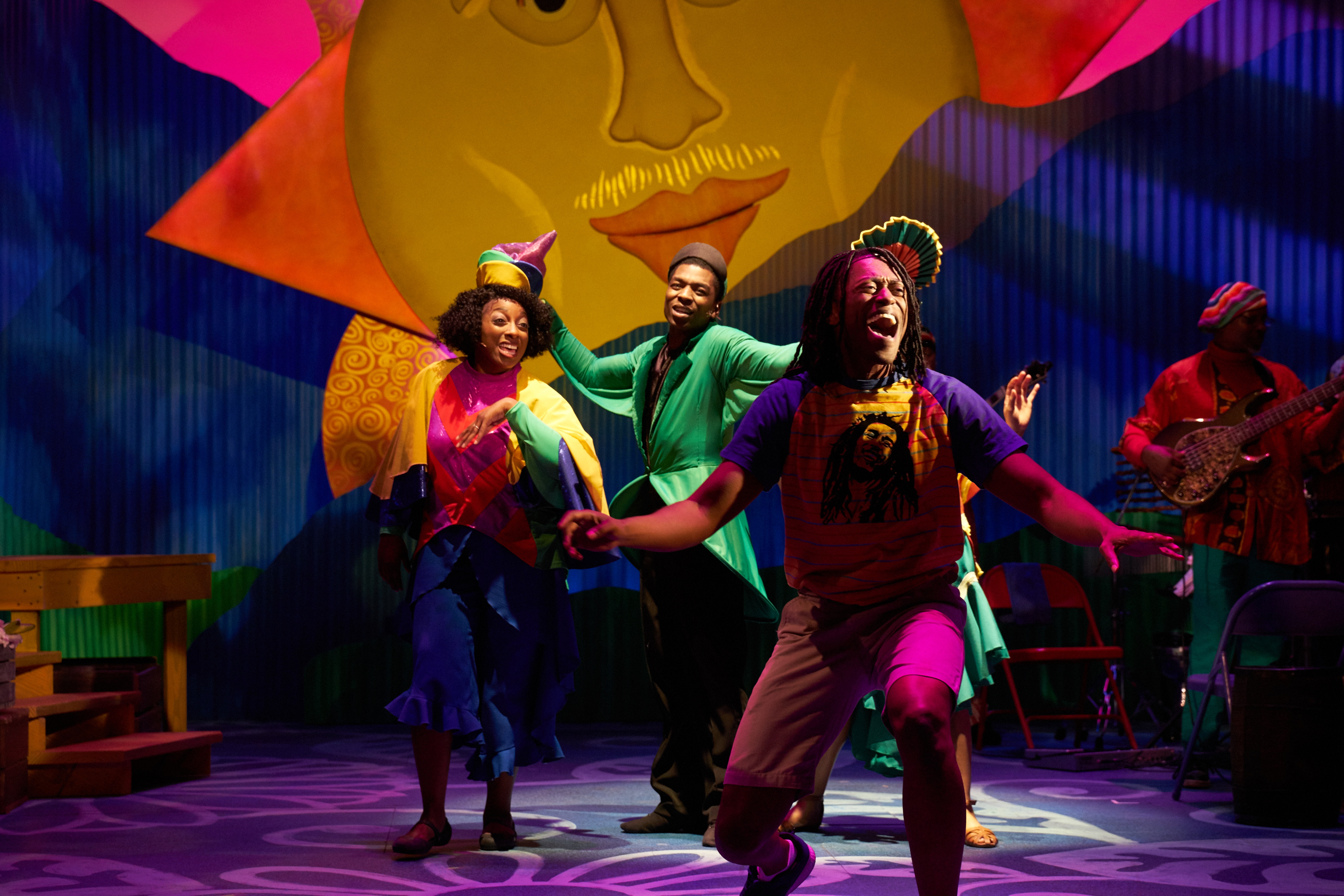
Reggae lovers and mavens are flocking – I repeat, flocking! – to Bob Marley’s Three Little Birds, an eye-popping, shoulder-dipping new musical at ImaginOn. Studded with golden favorites from the Marley songbook and adapted by Michael J. Bobbitt from a story by the reggae king’s daughter, Cedella Marley, this Children’s Theatre of Charlotte production is all about spreading joy and living life zestfully.

Or it is when Bobbitt can squeeze story elements into the crevices of the 15-number reggaethon – some of which are medleys. Cedella turns up as a character in this story, but action revolves around her son Ziggy, an 11-year-old who spends his days huddled at the TV because he’s scared of hurricanes and an encounter with Duppy, a mischievous, malevolent spirit who preys on children’s hair.

Mixing sternness with genuine concern, Cedella shoos her pouting Ziggy out of the house and attempts to pair him with their next-door neighbor, Nansi, who obviously adores him. She urges him to enjoy life! On an errand to bring back water from the town, Ziggy discovers that there really isn’t a hurricane threat when the sun is shining brightly (or sticking its tongue out), that a kiss from Nansi ain’t so bad, and that he has the necessary courage and cunning to face up to his fears, Duppy in particular.

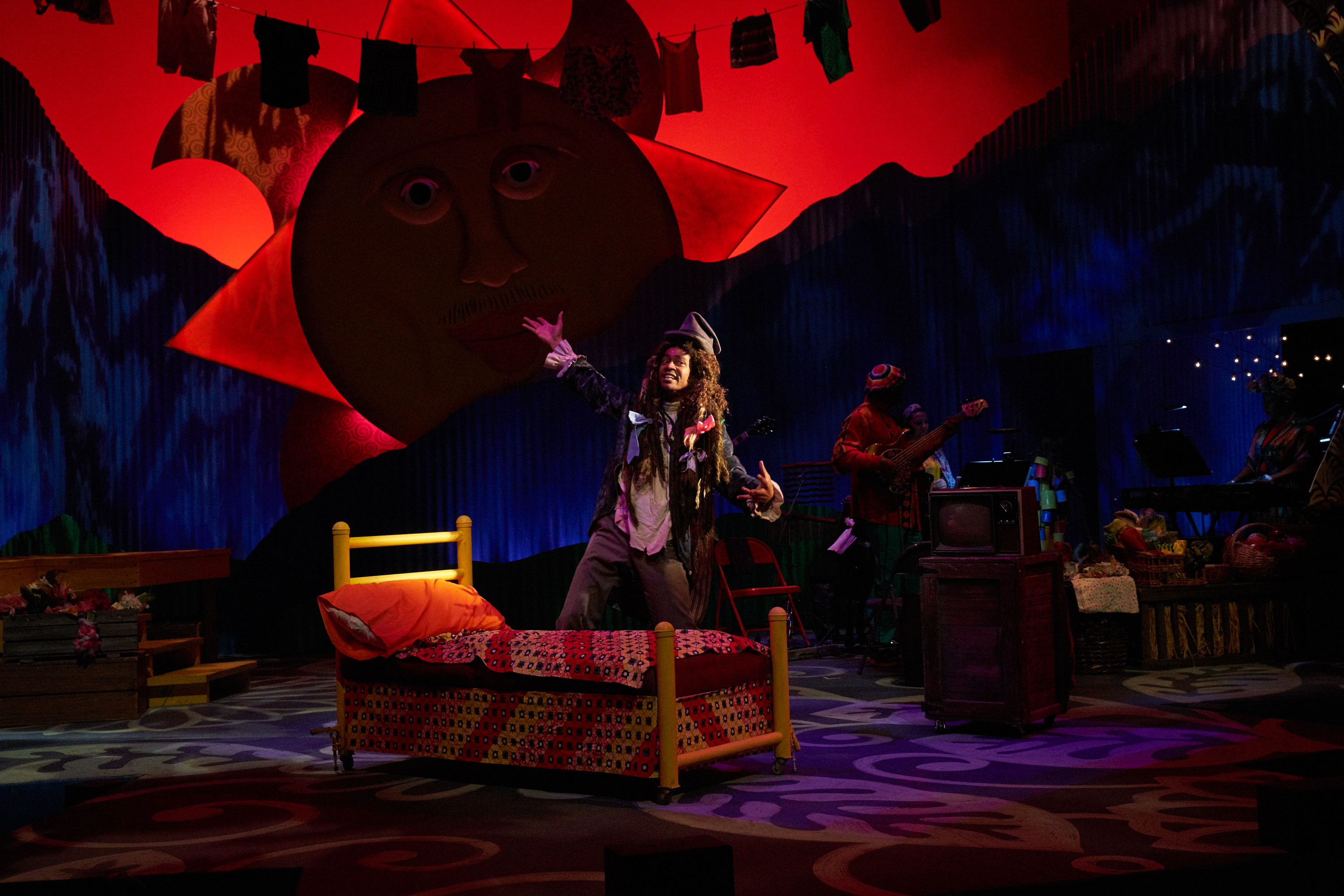
Along the way, three not-so-little birds offer friendship, guidance, and song to Ziggy – and additional solace to Cedella, since one of these creatures has been haunting Ziggy’s window sill and giving extra meaning to the phrase “dropping by.” Between the hiking, the singing, and the chattering, there are mangoes falling occasionally from a tree that overarches Tim Parati’s fantastical set, reminding us that Duppy and his conjuring powers are on the scene, eyeing Ziggy’s beautiful dreadlocks.

DSC00925

I’d be able to go in somewhat greater detail were it not for the dad sitting next to me, singing along to nearly all the Marley golden oldies and answering all his adorable anklebiter’s questions, whether she asked them or not. Formality is not the vibe at McColl Family Theater at this show. Opening up interaction between the actors and the audience, director Shondrika Moss-Bouldin has closed off both entrances to the theater at the lobby level, obliging us to enter through the mezzanine.

Avenues between the stage are now so direct and level that a toddler can easily cross over to this Jamaican fantasyland without a challenging climb. One of the ensemble members, in fact, came out and plucked a toddler from the crowd and invited her to join in on the dancing onstage. Other kids in the audience were swept into the dancing spirit, and the thrust configuration of the stage turned a few who were grooving in the front rows into instant dancing-with-the-stars celebs.

Everybody was friendly to the crowd, even Jeremy DeCarlos, our scheming and stealthy Duppy. Considering his haggard bedraggled look – think the old crone in Disney’s Snow White – and his multitudinous dreads, ingratiating himself with the tots was no small feat. The Duppy rig conjured up for DeCarlos was barely the beginning of costume designer Jason Kyle Estrada’s exploits. Lead fowl Doctor Bird’s get-up features an upturned fluorescent green jacket and a complementary hipster cap.

Oh yeah, Doctor Bird also drops some knowledge. B’s erudition includes a narration of Jamaica’s colonial history, obliging all other birds on deck, DeCarlos, and Ericka Ross as Cedella to slip into varied frilly and conquistador outfits. Ross’s role nearly matches Duppy’s for pluminess. We find out as much about Cedella as we do about Ziggy, for she’s supporting the family by selling her tasty Jamaican jerk chicken to tourists – and she’s wise to the charm that can disarm Duppy of his power. Delivering all that flavor and lore, Ross also speaks with the heaviest accent.

Rahsheem Shabazz absolutely slays as Doctor Bird, and his accent is also competitive. While there are many studio and concert recordings of the Marley tunes on the Three Birds playlist, none that I’ve heard so far really match what I heard from Shabazz. Or DeCarlos. Or Ross. Led by music director Charlene Miranda Thomas at the keyboard, the Children’s Theatre versions are livelier and more colorful to my ears. By comparison, Bob’s tempos plod.

DSC01151

Take that sacrilegious assessment as my assurance that you will not be disappointed with any of the Thomas-led covers. Musically, Garrick Vaughan as Ziggy is a late arrival to the party – demonstrating that, if you’re a central character who quails at the prospect of living, Bob Marley wasn’t the man to write your songs. Vaughan’s mopey role also means that he draws the short straw among Estrada’s splendiferous costumes.

These constraints on Vaughan aren’t because he is really 11 years old. When Bobbitt finally decrees that Ziggy sings, watch out. Vaughan may have the strongest voice in the cast. A lighter, folksier touch would land him more squarely in the reggae groove. As the would-be girlfriend Nansi, Kayla Simone Ferguson is kept busy enough, teasing Ziggy and moonlighting in other guises, but so far, I’m most impressed by her rapport with the kiddies.

Janeta Jackson is an established commodity at Children’s Theatre, having starred – and flown – in last season’s stunning Mary Poppins. She doesn’t get to go full throttle or reach such heights as Tacoomah, our second bird and British colonial, but she reinforces how deep and professional this dazzling production is. Apparently, word has spread swiftly among the Marley faithful. Boogie on!

One-Two Punch of Surprises Powers “Eat the Runt”

Review: Eat the Runt

By Perry Tannenbaum

Even before you set out for the Charlotte Art League, the quest for parking, and the unique Eat the Runt from Donna Scott Productions, you need to remember one key preparation: bring your smartphone. Yes, you’ll be asked to turn off or silence the device when the action is set to begin, but before that, you’ll be asked to join the remainder of the audience in choosing the cast for that evening’s performance.

Eight actors vie for the seven roles listed in your program. The audience goes through the cast list one by one, voting their choice for each role on a group texting setup by punching the number assigned to each actor. Playwright Avery Crozier gives each of the characters at his (or her) second-tier art museum a unisex name, so any member of the ensemble directed by Tonya Bludsworth might play any of the roles on a given night.

To execute all of the possible 40,320 casting permutations, each actor must be prepared to play all of the roles, wear all of the costumes, and pounce on cues from all his or her castmates. That not only multiplies what each character has to memorize and the number of costumes designer Luci Wilson has to create, it also multiplies the amount of time that the ensemble must devote to rehearsal – even though they can’t begin to cover all the possible scene partners they will have during the actual run of Runt performances.

On the Saturday night that I attended, I voted with the audience on four of our choices: Ericka Ross as grantwriter Chris, Stephen Seay as human resources coordinator Jean, Tracie Frank as curator of modern art Hollis, and Kevin Shimko as museum director Pinky. Andrea King won the juiciest – and most demanding – role as Merritt, interviewing for a vacant position at the museum. Kevin Aoussou as director of development Royce and Jenn Grabenstetter as museum trustee Sidney rounded out the cast.

Somehow Stephen West-Rogers’ previous exploits in theatrical versions of Fight Club and Trainspotting had escaped the notice of Donna Scott fans. Nor did his new clean-shaven look bring fresh evocations of his ruggedness. As a result, West-Rogers was the odd man out, sent away to take the night off when Shimko snagged the last remaining role.

After this poignant moment, presided over by Scott, we were asked to give the cast a few minutes to sort things out, a reasonable enough request, I thought. When they returned, it was virtually impossible to find any indication that this wasn’t the fixed cast that had rehearsed Eat the Runt every night. King especially was a delight as Merritt, deftly bringing out the applicant’s uncanny ability to take the ideal approach for each museum official who interviewed her.

Merritt’s chameleonic shifts bespoke either a dangerously unstable personality or a cunning Machiavel – one perhaps gifted with psychic powers. Whether it’s the hemorrhoidal HR coordinator, the horny development director, the coke-addicted curator, or the defensive trustee, Merritt always seems to pounce on the perfect approach without any need for probing. It’s only when she’s spouting Ayn Rand to the museum director that Merritt drops hints of a supernatural gift.

Forget about the gimmickry at the top of the evening, it’s very rare for any playwright to be able to detonate a walloping surprise at the end of Act 1 and at the end of Act 2. Crozier not only achieved that, but the surprise at the end of the evening slickly explains away much of the puzzlement we may experience as the series of job interviews metastasizes and explodes.

A few days later, some of the deception that had been played on me became clearer. By then, I couldn’t regret the fun ride that Eat the Runt had taken me on. It may be radically different for you if your casting choices turn out to be more incongruous, risqué, or preposterous. That may increase the already plentiful comedy.

Sizzling Satire and Seething Inner Turmoil

Review:  Bootycandy

By Perry Tannenbaum

Weird black mothers roam the Mint Museum stage at the Actor’s Theatre of Charlotte’s latest migratory production. One mamma refers to her son’s genitalia as bootycandy, while another mamma actually names her daughter Genitalia. The weirdness of Robert O’Hara’s Bootycandy only begins there, for I don’t think either of these mothers – or their children – ever meet, though the bootycandy boy emerges as our antihero, Sutter. Presumably, this mildly sadistic gay man was messed up by his mom.

Perhaps all of the above have fallen under the influence under the flamboyant influence of Reverend Benson who strides to his pulpit in priestly black robes and exits in a flaming red formal dress and white high-heeled shoes. Or perhaps none of the others knows him, because Rev. Benson preaches directly to us, not at all happy about the intolerance and homophobia we’re spreading around the neighborhood.

Late in Act 1, we get a delightfully specious explanation for all this disconnection. The only white person in the cast seats himself on a chair upstage, seemingly prepared to lead a group therapy session. No, he is actually moderating a symposium where three of the four black cast members have gathered – excluding Sutter. After their previous trashy or swishy turns, they are now the three different playwrights who have written all the action we’ve seen so far. Sophisticated, intellectual, and artsy, they give the Moderator a really hard time.

That veiled hostility toward white people is the underbelly of what mostly seems to be a sharply satirical look at black folk. Mostly we’re looking at hilarious set pieces. Friends try to dissuade Genitalia’s expectant mom from committing her folly while gossiping lustily about it. Or years later, we see Sutter’s mom absolutely putting her foot down on his participation in a sissy high school musical, insisting that he take up a sport while his disengaged stepdad mostly buries himself behind a newspaper.

And of course, the remedy for somebody repeatedly stalking Sutter on the way home from the library isn’t to call the cops – it’s to stop reading those damn Jackie Collins books. The Michael Jackson Thriller jacket continues to fly under Mom’s radar.

More bizarre and surreal is the grownup Genitalia, in a white bridal gown, un- or dis-marrying Intifada in a formal ceremony, complete with increasingly antagonistic vows, ending with bitch slaps from both lesbians. So when Sutter and his boyfriend Larry agree on an assignation with a lonely white guy, what could go wrong?

Kevin Aoussou, who has played a variety of dark roles for Shakespeare Carolina, including Dorian Gray a couple of years ago, mixes it up a little bit more for us here as Sutter. He’s in much lighter scenes now as the younger Sutter, subjected to the bootycandy and compulsory sports indignities inflicted upon him by his mom, more vulnerable and less arrogant. He’s also capable of insight and regret here, delivering a more fully rounded portrayal here than we’ve seen from him before.

Yet the show largely belongs to Jeremy DeCarlos from the moment he tosses off Reverend Benson’s black robes and applies his lipstick. Equally satisfying after his low-key and sympathetic episodes as Step Dad and Larry (the boyfriend), he reappears as Old Granny at an old age home, where she serves up solace to Sutter (and flashbacks for us) when he visits her. All this wisdom and warm reminiscence are bartered for contraband edible eats.

Lydia Williamson and Ericka Ross sinuously intertwine throughout the two-hour evening as mothers, daughters, and playwrights. As the immature mom insisting on naming her daughter Genitalia and later as the more butch daughter Intifada, Williamson certainly lays down a credible case for being the more incorrigible of the two. But while Ross is purposely overmatched as Genitalia, her insensitivity and homophobia as Sutter’s mom are as chilling as they are hilarious.

Directing the show, Martin Damien Wilkins gives all his black performers license to take it far enough over-the-top to remind us occasionally of The Colored Museum, George C. Wolfe’s hilarious 1986 subversion of honored black theatre traditions. Relying primarily on projections, set designer Chip Decker comes fairly close to convincing us that The Mint is Actor’s Theatre’s permanent home. Certainly the acoustics here are far more hospitable than the disastrous holiday sojourn at Charlotte Ballet’s McBride-Bonnefoux studio for The Great American Trailer Park Christmas Musical.

Maybe the niftiest touch from Wilkins, restoring some of the distance between Colored Museum and this 2011 satire, is the consistently natural work he calls forth from Chaz Pofahl in five different roles. Except as the fulsome officiator at the Genitalia-Intifada breakup, Pofahl is consistently life-sized and somewhat pitiful as our white guy – even when he turns up as the pervert stalking the teen-aged Sutter from the library. Instead of shocking me as Sutter and Larry’s victim later on, when he came out to the hallway outside his hotel room completely naked, he broke my heart a little bit.

Arguably, he’s the only player who bares body or soul all evening long.

Wild as it is, Bootycandy is an autobiographical piece by a black gay playwright with an incongruously Irish name. A portion of O’Hara’s animus is directed intellectually toward his own black community, and another more visceral portion is directed reflexively toward white people. Most poignant of all is the remaining scrutiny that O’Hara directs toward himself and his own shortcomings.