Tag Archives: Bob Croghan

“Raisin” Remains an Aspirational Reminder

Review: A Raisin in the Sun at Matthews Playhouse

By Perry Tannenbaum
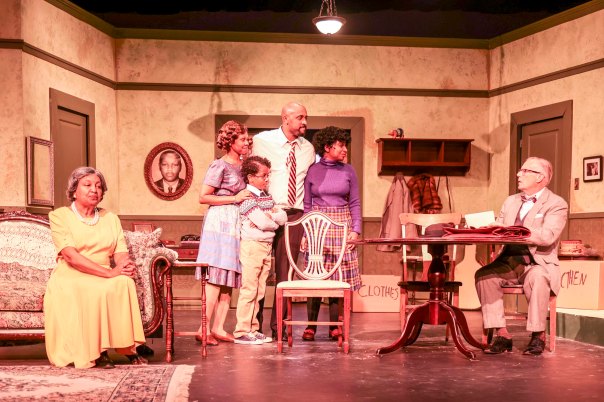
Did somebody just say something about FREE SPEECH?? Yeah, about a billion times per second if you’re tracking social media, college campuses, nation’s capitals, and late night TV. Still no theatre critic we know would dare suggest in today’s torrid media climate that the subject generates too much heat and too little light – or that babble about free speech serves as a black hole for time and breath better spent discussing other freedoms.

Addressing the US Congress in 1941, Franklin Delano Roosevelt looked forward to “a world founded on four essential freedoms.” Useful, breathtaking, and a better way to spend January 6 than a subsequent US President chose. When I was graduating junior high more than a half century ago, those four freedoms were still on the curriculum, and my entire class wrote essays about them.

For the record, I wrote about FDR’s Freedom #4, Freedom from Fear.

One of the things we love about Afro-American literature is that their writers show us that freedoms worth prizing are as numerous as personalities – that those dearest to us are an uphill struggle to achieve. In Lorraine Hansberry’s A Raisin in the Sun, returning to the Metrolina area for at least the sixth time this century, every member of the Younger family knows the struggle from the moment they rise in the morning.

Now some of these struggles are fairly picayune, giving a homey warmth to Hansberry’s various yearnings for freedom that we easily empathize with. Take little Travis (Solomon Doleman), for instance, yawning himself awake with his mom’s help for another school day. The youngest Younger doesn’t have a room or a bed of his own, sleeping right before our eyes on the living room couch as the lights go up.

Hell, he doesn’t even have a regular bedtime, since we’ll soon learn that he cannot claim his place on the couch until Dad has finished scheming and schmoozing with his ambitious pals. Walter Lee and his son Travis may both be sleep deprived due to the drinking and scheming of the previous evening, but their first challenge of the day requires teamwork.

Otherwise, they won’t be able to visit the toilet or groom themselves for the day. As if out in the wild, the family must post a lookout on the hallway, so that they can seize control of the single bathroom that serves multiple families in their Chicago tenement. Then this treasured privacy must be passed along to another member of the clan. Yes, it’s a bit comical to watch so much family tension generated over so little. Yet this is part of the layout of the Youngers’ survival.

FDR’s Freedom #2, Freedom from Want, is also in the foreground as the Youngers’ successful capture of the bathroom plays out as a backbeat in opening scene. Looking at the Youngers’ apartment for the first time at Matthews Playhouse, we find that director Corlis Hayes and set designer Bob Croghan have pulled back a little in rendering the wear and weariness we should be seeing if Hansberry’s description of the kitchen-dining-living room were followed to the letter. “Cracking walls”? Didn’t see them.

Throughout the evening, there’s a similar shift away from the groaning and wailing tones you might remember from the last time you saw Raisin. That suffering patina has been natural for Raisin since it premiered as the first drama by an African-American female playwright to reach Broadway in 1959. The weight of ancestors hung in the Ethel Barrymore Theatre on opening night, and the fate of the race seemed tethered to the audience’s response.

Likely, at the tender age of 29, Hansberry didn’t view her rise to prominence with such solemnity. The heritage of her family and its struggles, including her father’s fight against a restrictive Chicago housing covenant, are in the annals of the Supreme Court and resulted in a Hansberry v. Lee victory in 1940. As seething, cautionary, and defiant as Raisin often seems, we can look at all the Youngers and see them as positive, determined, and aspirational.

Her banner is Langston Hughes’s 1951 poem, “Harlem,” and its main subject, “a dream deferred.” Hughes offers half a dozen prognostications of what might happen to it. Next to sugaring over, drying like a raisin would seem to be the most benign outcome.
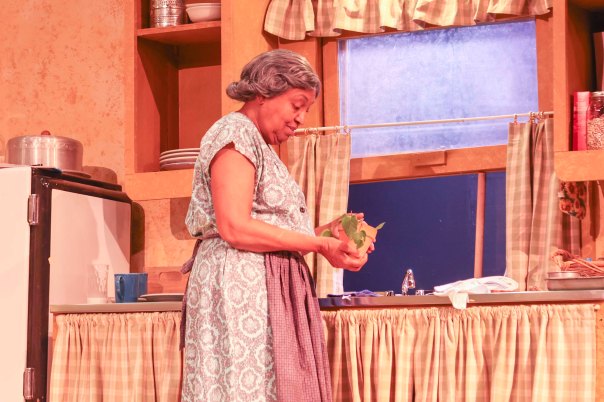
Walter Lee’s dream of opening a liquor shop can hardly be deferred for more than a day, when his mama Lena expects a $10,000 check from his late father’s life insurance. Before he even has his necktie on properly, Walter Lee is lobbying his wife Ruth to soften Lena up so he can calmly present his business plan to his god-fearing mama. Ruth has other concerns: on the surface, it’s feeding her guys breakfast and getting them out the door.

Deeper, and still hidden from everyone else, Ruth is also considering the future of her family from her perspective as a mother.
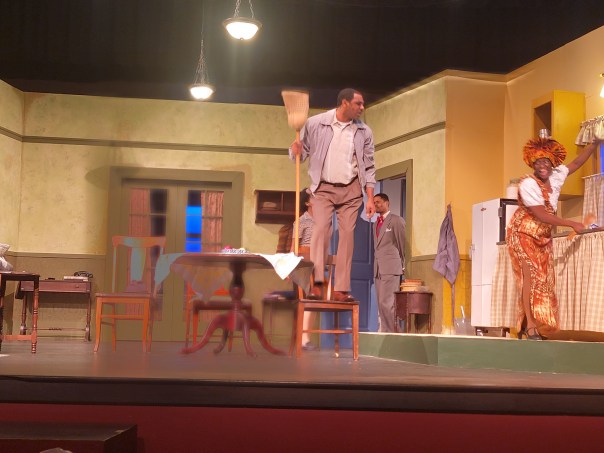
Ruth’s worries and dreams do not align with her husband’s at all – aside from wishing him success. Two other dreams vie for priority in the family. The comparatively breezy Beneatha wants to go to medical school. But not right now. First, Walter Lee’s younger sister wants to start guitar lessons. Or to see what new revelations from Africa come her way from her new Nigerian acquaintance, Joseph Asagai, who clearly aspires to supplant Beneatha’s current beau, the starchy and monied George Murchison.

But the $10,000 check will be in Lena’s name, so what does she want? Here the BNS Productions’ dingy set is absolutely true to Hansberry’s spirit, for Croghan only provides a sliver of a window to allow any light in from the outdoors. It’s barely enough for Lena’s scraggly little houseplant, propped up with wee splints, to survive. Hardly big enough for more than a couple of Youngers to gaze out at the street.

Lena isthe Younger who cherishes the dream of Carl Augustus Hansberry, the playwright’s father, to live in a house that can accommodate all her family – along with a little plot for her to maybe grow a garden. If the best value for her money happens to be in Clybourne Park, a whites-only subdivision, fine: her family will certainly not trouble anyone else’s.

Such a rock! Yet Lily Oden plays Lena with a maternal softness, speaking her mind clearly, but never thundering like a prophet on a mountaintop. She does come off as old-fashioned in her confrontation with the godless Beneatha. The slap is still there, life-sized rather than the hand of God. While it may serve to compromise her moral authority, it emphasizes the intensity of her dream, coloring it with a determination to somehow repair and unify her crumbling family.

Along the way, we can feel that Oden has her recognizing that slapping and bullying aren’t always the best paths. That’s especially true in this Playhouse version where BNS mainstay Jonavan Adams is Walter. The way Adams gazes out at us as he articulates his dreams is a bit drier and wearier than most Walters we’ve seen, needing less of a gap to close before shedding his supplicating impulses and coming into manhood.

It appears as if he may let us down in the crunch, but Hayes gives him a life raft at a key moment in his planned capitulation to the white homeowners’ representative: a portrait of Walter’s father, “Big Walter,” hanging on an upstage wall. We see this – and Lena’s insistence that Travis remain in the room – working on Adams at his tipping point.

Unless you’ve seen Renee Welsh-Noel and her wackier exploits at Children’s Theatre of Charlotte, you might not fully appreciate all the nuance and texture she brings to Ruth and her strained position among the Youngers. She’s the bad cop tasked with prodding the menfolk awake, getting them fed, and off to work and school on time… the responsible parent who must deny Travis his 50¢ for school because the family can’t afford it.

Over and over, she is overruled by Walter and Lena, who can point proudly to Beneatha as the outcome of their spoiling. It’s almost as if Ruth doesn’t have aspirations anymore – until the breaking point when her yearnings and her resolve gush forth.

About the only flaw I found in the Regal cast (a second, overlapping Grove cast takes on all the morning and afternoon performances) was K. Alana Jones’s portrayal of Beneatha. I like how Jones plays and exploits the two men who are dating B, and the relationship with Walter is pitch-perfect. But Jones doesn’t seem to get how brainy and rad Beneatha is for a Southside Chicago co-ed in the ‘50s – or how full of herself and entitled she feels as such a progressive try-everything visionary.

The boyfriends for this BNS-Matthews Playhouse production are exactly as you remember them. Sha’Heed J. Brooks is delightfully starchy as George, the snobbish plutocrat who looks down upon Beneatha’s kin, particularly Walter, to his peril. By contrast, Dionte Darko as Asagai wonderfully captures both the exotic and the naïve aspects of the foreign exchange student. Yet with a worldly urbanity mixed with ancient wisdom, Asagai can effortlessly put Beneatha on the defensive.

With brisk pacing – and maybe some deft cutting – the production speeds by, the three original acts performed with one intermission. Yet Hayes somehow squeezes in the visit from the Youngers’ neighbor, Mrs. Johnson, whose scene and character has been dropped from every Raisin production to reach Broadway, including the revivals that featured Phylicia Rashad in 2004 and, ten years later, Denzel Washington.

Ericka Ross is quite obnoxious and brassy as Johnson, chiding Lena for buying into a white neighborhood and forecasting doom, even if she won’t convince everyone that the scene should stick. Bobby Tyson as Bobo and Henk Bouhuys as Karl Linder stand on firmer ground – and draw more dramatic assignments.

Nattily dressed in one of costume designer Emily McCurdy’s most stylish creations, Tyson is the only person during the whole liquor store scheme who doesn’t merely phone in. He has the guts to come by and deliver the bad news to his crony in person … and the moxie to show his irritation when Walter doesn’t immediately grasp how thoroughly they’ve both been screwed.

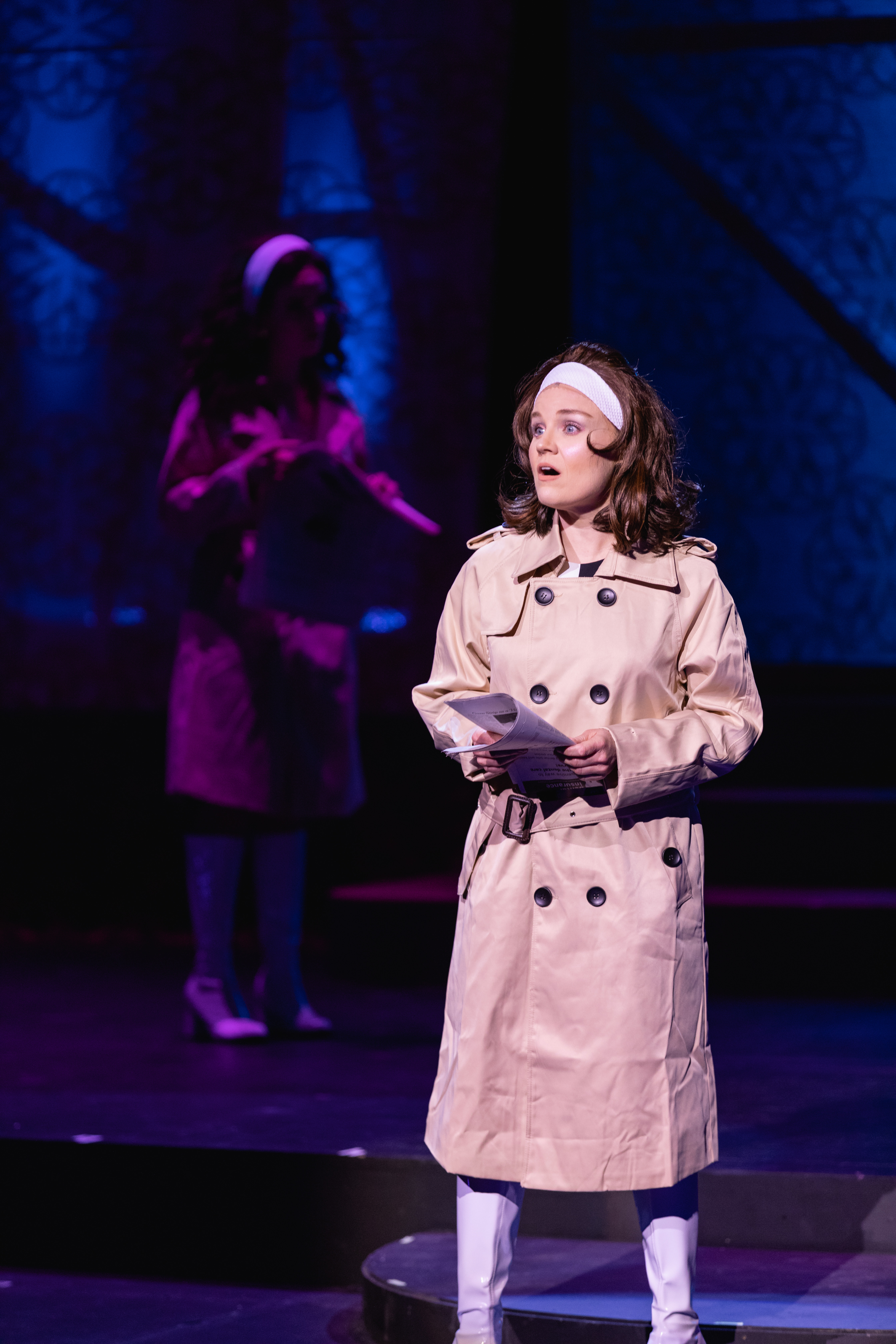
You’ll notice an awkward exit or two from guests at the Younger abode but none more heated or satisfying than the retreats of Mr. Linder, the Clybourne Park emissary. Bouhuys endows him with all the patronizing pomposity you might expect from an upper level Wells Fargo executive. Hayes strips Linder’s scenes of the buffoonery we may remember in past productions, where it might have seemed proper to boo and hiss his every word.

Bouhuys doesn’t bumble, but he does seem doubly non-plussed. He really cannot grasp why the Youngers won’t defer their dream any further when faced with the absurdity of moving into a neighborhood where they are not wanted – so not wanted that community has banded together to buy them out. Don’t they understand the arithmetic? By accepting Clybourne Park’s offer they could make a profit!

Or at least they could negotiate. Who are these maniacs that refuse to cash in?

What’s often overlooked in the onrush of the great Raisin in the Sun climax is how pivotal Walter Lee’s most humiliating moments are in triggering his turnaround. Yes, he stoops to Stepin Fetchit minstrelsy in furiously declaring his determination to ask Linder back and accept his offer, rightfully drawing Beneatha’s disgust. But Adams shows us that Walter has also seen the spectacle he has made of himself.

CP’s “Joseph” Connects With Talent and Style, Frustrates With Ongoing Audio Woes

Review:  Joseph and the Amazing Technicolor Dreamcoat at Halton Theater

By Perry Tannenbaum

THEA2021-DLV-0708-2138

Before this weekend, Halton Theater hadn’t opened its doors to a theatre crowd since February 2020, and Central Piedmont Community College Summer Theatre had been dark since July 2019, when they closed their five-show season with A Gentleman’s Guide to Love and Murder. Returning to the Halton stage as guest director of Andrew Lloyd Webber’s Joseph and the Amazing Technicolor Dreamcoat, Tom Hollis posed a poignant question during his introductory remarks. Does it really count as a season when a company offers its audience just one production? Even the most loyal Central Piedmont supporter can’t buy a 2021 season ticket, that’s for sure. And until Central Piedmont Community College completes its recovery from a debilitating ransomware attack this past winter, they won’t be able to accept credit card payments at their Overcash ticket windows. Cash or checks for walk-ups, plastic for online sales only.

Opening night at Halton was a cautious first step back toward pre-pandemic norms – with a Delta-be-damned giddiness to it as COVID protocols were loosened at last. For most of the crowd mingling in the Halton lobby before and after the show, this was probably the first public event they had risked in at least 16 months, a milestone moment. For the theatre folk scattered among us, it was an emotional reunion – an affirmation.

Last season was originally envisioned as Hollis’s grand valedictory after nearly four decades at Central Piedmont, his latter years as theatre department chair. An encore reset of the lost 2020 season was rumored for a while as Central Piedmont scrambled with their winter programming, so Joseph is a double surprise – not among the shows announced for the lost 47th Central Piedmont Summer Theatre season and the only show replacing them. Previously mounted in Summer 1993 and revived in Summer 2001 at the now-demolished Pease Auditorium (the CPCC Theatre production of 2008 at the Halton was a wintertime affair) – with rousing success on all occasions – Joseph is likely more bankable than Footloose, lighter on the budget than The Music Man, and far better-known and cheaper to produce than Something Rotten! Additionally, there is likely a finely calculated ecology in a true Central Piedmont Summer season that allows the college the biggest bang for their bucks when auditioning and casting their overall troupe of performers and designers. These discarded musicals, plus Peter Pan Jr. and a Ken Ludwig comedy, might conceivably be in cold storage, slated for resurrection in 2022.THEA2021-DLV-0708-1267

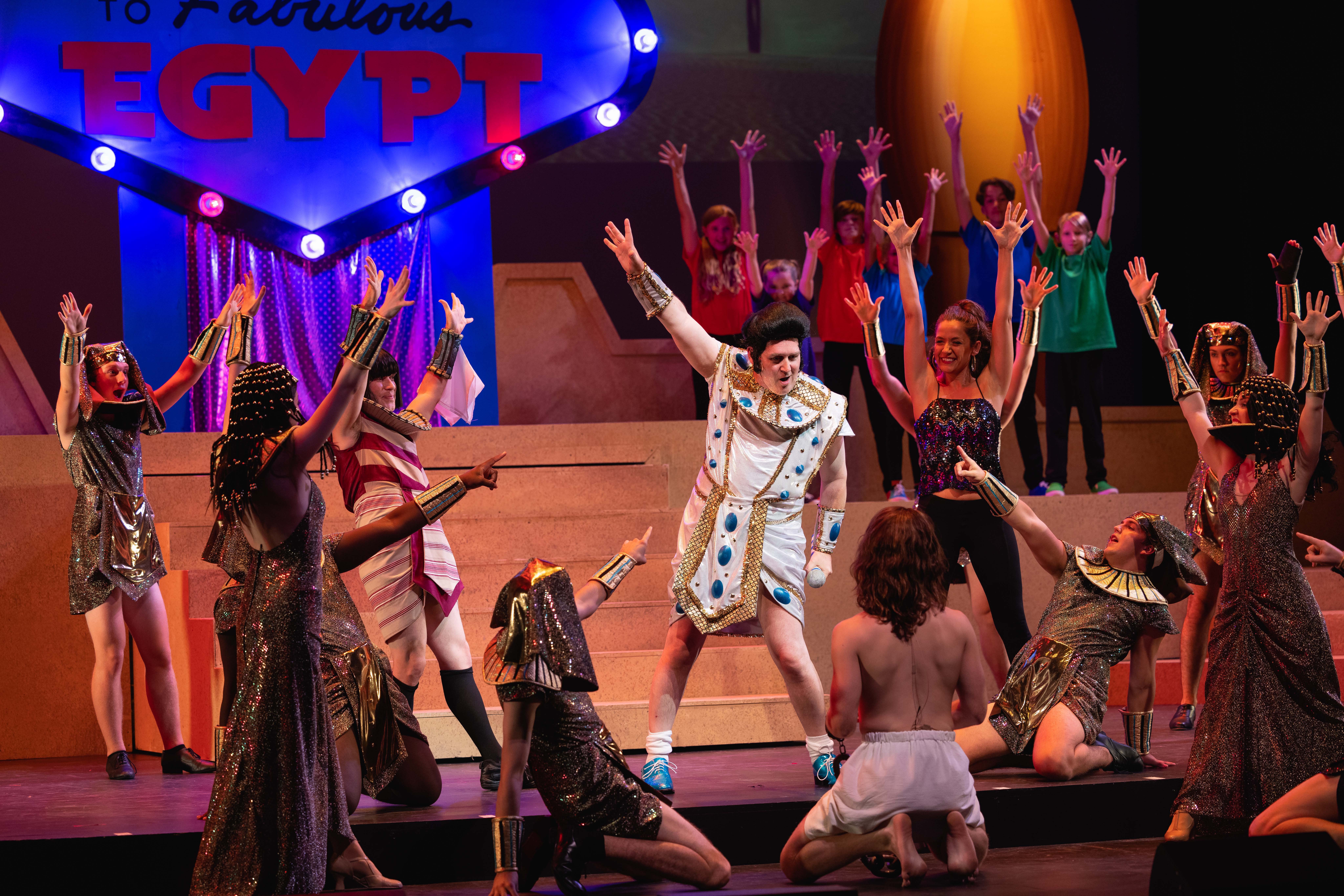
Sitting in Row K, I only noticed one gentleman taking a restroom break during this intermission-free presentation, and I was somewhat surprised that the cast began taking their bows a mere 71 minutes after the show commenced. Another eight minutes came packaged in a “Megamix” reprise of Webber’s most bodacious songs – or parodies, since the composer delights in shuttling among an unlikely array of genres in retelling the most epic tale from the Book of Genesis, aided by Tim Rice’s lyrics. The news of Joseph’s demise is delivered to his doting father, Jacob, in the form of a sobbing lone-prairie cowboy song. Pharaoh is transformed into a pre-historic Elvis as he rocks his account of his prophetic dreams. The poverty of Joseph’s 11 brothers during the years of famine takes on the nostalgic air of a sad French café, complete with Apache dancer, and Naphtali’s pleas for the innocence of little brother Benjamin come in the form of a Caribbean calypso.THEA2021-DLV-0708-1815

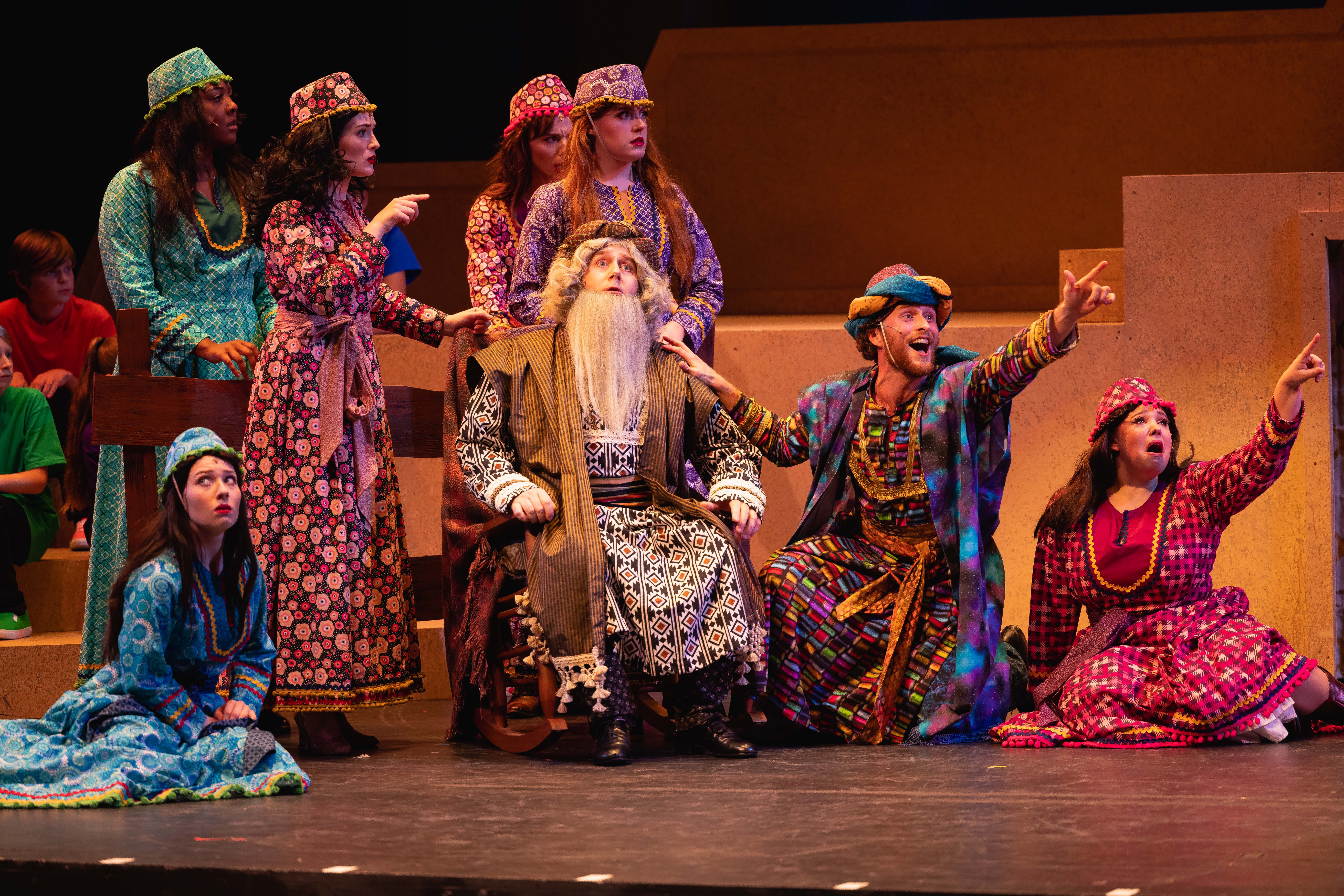
Curiously, the irreverence and multitudinous anachronisms of this Webber-Rice concoction, not to mention the narrative alterations of Holy Writ, have never seemed to spark any massive public outcry from Judeo-Christian clergy. Maybe the outright anachronisms, beginning with the Technicolor in the title, insulate all the irreverence and textual tinkering from being taken seriously. James Duke’s scenic design and Bob Croghan’s costume design underscore the assurance that we are not in the immediate vicinity of ancient Egypt or Canaan, fortified by the equally anachronistic projection designs by Infante Media. No, this is more like a Disney or a Las Vegas style of Egypt, with Duke taking full advantage of the lordly height of the Halton stage compared with Pease’s pancake panorama. Our Elvis is also a Vegas version, clearly the sequined, jumpsuited, decadent superstar of his latter days. The Duke-Infante collaboration is so glittery and colorful that it is only slightly upstaged by Croghan’s creations for Pharaoh and Joseph.THEA2021-DLV-0708-1357

You don’t often get the chance to design a costume that is hyped in the title of a show, and Croghan, on the Charlotte scene even longer than I, doesn’t disappoint. The impact of this mid-pandemic return to live theatre caught me off-guard several times. Each time a major character made his or her first entrance – Lindsey Schroeder as our Narrator, Rixey Terry as Joseph, and J. Michael Beech as Pharaoh – I had that tingling sensation of recognizing something basic and exciting that had been missing in my life for over a year.

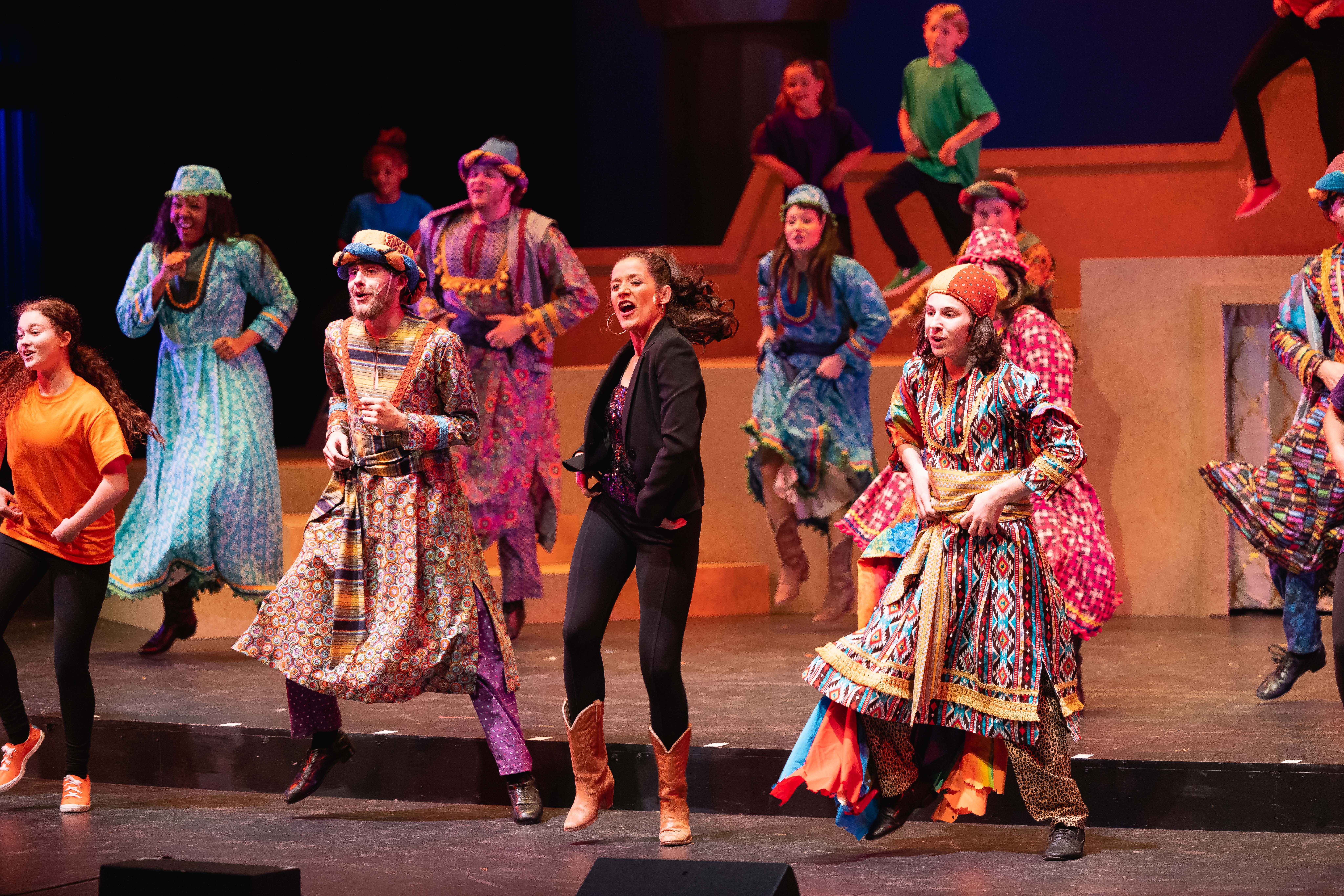
My biggest surprise, a frisson of renewal, came from the audience when they reacted to the most iconic moment in Joseph, when the brothers picked up the skirts of Croghan’s knockout dreamcoat so that it formed a pinwheel around Rixey, spinning around as he, Schroeder, and the ensemble sang “Joseph’s Coat.” Anybody even glancingly familiar with musical theatre anticipates this moment before it happens, or at least recalls it fondly from a previous encounter. But part of the audience at Halton erupted in delighted and surprised laughter, recalling what the first London and Broadway and high school audiences must have experienced when Joseph was new and reminding me of my own delight back in 1993.THEA2021-DLV-0708-1130

Rixey walked a treacherous tightrope, blending innocence with vanity as beautifully and energetically as any Joseph I’ve ever seen, lacking the cloying wholesomeness that only true Donny Osmond fans will miss. Maybe a plunge or two into that saccharine syrup might make Rixey more memorable in “Any Dream Will Do,” but I would prefer that he add a sprinkling of excess to those melodramatic moments when he is unjustly imprisoned, crying out his “Close Every Door.” Lighting designer Jeff Childs does come to the prisoner’s rescue, adding some spiritual gravitas.

Schroeder was brimful of brilliance as the Narrator, infusing enough energy into her string of recitative that it never devolved into tedious singsong, though she was often unintelligible. Beech’s misfortunes with his microphone were even more egregious as Pharaoh, including intermittent sonic dropouts, but his audio setup was likely jostled over the course of the evening, since he donned different costumes and headgear for his other roles – Jacob, Potiphar, and the doomed Baker.

Admittedly, it’s churlish of me to keep harping on Central Piedmont’s defective sound equipment and the cavalcade of professional-grade technicians who have failed to tame it. North of $115 million are being spent on replacing Pease, originally a lecture hall, with a genuine theatre facility, while Central Piedmont’s audio woes have gone unaddressed since 2005, when the Halton was new. But new generations come to the Halton every year, and new summer visitors from afar get their first taste of Charlotte theatre there – and they still need to be cautioned. By the time the “Megamix” came around on opening night, Beech’s “Song of the King” was only fitfully audible and Schroeder’s mic was intermittently dropping out.

THEA2021-DLV-0708-1993

More power, then, to the performers onstage who merrily soldiered through. Even the charade of the brothers’ mournful moments was untarnished. All of the cameo solos hit their marks. Matthew Howie was hilariously rusticated as Reuben delivering the bad news to Jacob with “One More Angel,” and Neifert Enrique as Simeon – aided by his brothers and Emma Metzger’s scene-stealing table dance – brought a boulevardier’s wistful regret to “Those Canaan Days,” with more than a soupçon of self-mockery in his lamentations.

Even more THEA2021-DLV-0708-2049irrepressible and irresistible was the calypso lightness and joy that Griffin Digsby brought to the “Benjamin Calypso” as Naphtali. Around the third or fourth time Digsby reached the “Oh no! Not he!” refrain, I had to stop myself, for I had started to sing along. Just another adjustment I’ll need to make after 16 months of consuming theatre in front of my computer monitor and TV set. It was hard to be displeased by anything that accompanied this welcome change.

CP Loses the ABBA Showdown

Review: Cold-War, USA-vs.-the-Soviets overlay of intrigue to the actual chessboard drama

By Perry Tannenbaum


Chess Dress Rehearsal; February 13th, 2020

So who wins the world championship match between Frederick Trumper and Anatoly Sergievsky in Tim Rice’s Chess, with music by the bodacious ABBA duo, Benny Andersson and Bjorn Ulvaeus? Depends on whether you’re watching the original concept album of 1984, the touring concert version that followed, several British productions that expand the original further for the stage, or the American version with a book by Richard Nelson that arrived on Broadway in 1988. Based very loosely on the premiere event in chess history, when Bobby Fischer challenged Boris Spassky for the world title in 1972, Rice reveled in applying a Cold-War, USA-vs.-the-Soviets overlay of intrigue to the actual chessboard drama.

Good instincts there. The game of chess is even more antithetical to performing arts presentations than golf or curling. Yet Rice’s elaborate behind-the-scenes chess games were equally ill-suited to a concert or album format.

Glenn Griffin said as much before directing and starring in Queen City Theatre Company’s presentation of a reworked Broadway version in 2011. “This makes me feel old, but I have the records,” he said of the concept album and the concert album, nearly four hours in length combined. “I have the two records, and I just remember loving this music even before I knew what it was really about.”

Right now, CPCC Theatre is doing what director Tom Hollis, giving his curtain speech, called a new United Kingdom version that has only recently become available. Don’t expect to see Nelson’s name in your playbill, and don’t count on much dialogue in this bookless throwback – and don’t expect historical accuracy in the outcome of the match. If you saw the QC Theatre production in 2011, that outcome has flipflopped.

Chess Dress Rehearsal; February 13th, 2020

What CPCC and a very able cast offer is mostly an improvement on getting the storyline from the original albums, for you can see what is going on between Freddie, Anatoly, and Florence Vassy, the woman torn between them. You can track the political and romantic defections, compounded by the machinations of KGB operative Alexander Molokov, which are countered by the CIA’s Walter de Courcey. Production designer Bob Croghan’s slick set and costumes – with Freddie in leather! – make it all so easy on the eye, and James Duke’s projections usefully show or tell us where we are.

What I heard last Saturday night, however, was a sound technician’s nightmare. An unintelligible chorus of 18 voices disorients us from the outset, obviously the opposite of what they’re intended to do, and the solo voices of the principals are only intermittently an upgrade. Just about two weeks earlier, sitting farther from the stage at Matthews Playhouse, my wife Sue and I were able to hear another ABBA opus, Mamma Mia, far more clearly.

Chess Dress Rehearsal; February 13th, 2020

No doubt about it, CP lost the ABBA showdown with Matthews because of their wayward sound system and microphones. Oddly enough, we were consistently able to hear the Russians, Anatoly and Alexander, more clearly than the Americans, Freddie and (Hungarian refugee) Florence. Unless CP can clear up its technical difficulties, the best thing they can do would be to send Duke back to his computer, where he could whip up a set of supertitles.

Otherwise, some of the projections and scene titles that Duke throws on the upstage screen or over the Halton Theater proscenium might confuse first-timers. For example, why are we seeing a grainy old photo of Budapest in 1956? Because those fiendish Russians are using the possibility that Florence’s dad might be alive behind the Iron Curtain as a pawn in their game, a potent bargaining chip that might persuade Freddie’s aide to help them conquer Trumper.

Double-crooked, those nasty Russians also dangle the wife Anatoly left behind when he defected, so he’ll return to the motherland after successfully defending his title – or throw a second title match to a new Russian challenger. CP also produced Chess in a revamped Broadway version back in 1991, and it’s interesting to see how Svetlana, Anatoly’s wife, has kept changing. Back then, she had a frumpy peasant personality, but Griffin transformed Svetlana into an alluring black temptress who was every bit as queenly as her white Hungarian counterpart. Now she’s stolid, conventional, and underutilized when she appears in Act 2.

The Broadway denouement happened in Budapest, a more telling place for pressuring Florence. “One Night in Bangkok” is the marquee song in Chess, so you know part of the action will stay there no matter what. But with a return to a British version, action starts out in Merano, Italy, as the match begins. That means “Merano” and up to 12 other songs that were axed from the original British stage version – and the Chess in Concert album – are being heard in Charlotte for the first time.

After the first act, all of it in Merano, my wife Sue sat there bewildered at intermission, wondering how she could have forgotten Chess so totally. Simple answer: we hadn’t seen it here in Charlotte before. The Bangkok setting that we remembered had been moved to Act 2, and Budapest was discarded.

Chess Dress Rehearsal; February 13th, 2020

If it weren’t for the execrable sound, CP’s Chess might have been a pleasant discovery. In or out of his leather, Patrick Stepp brought a great punkish look to Freddie and a piercing heavy-metal tenor, but when he wasn’t singing “Pity the Child,” I rarely understood a word. The score was kinder to J. Michael Beech as Anatoly, doling out more power ballads to his mellower voice, since the brooding Soviet, like Spassky, really is the mellower, more humane chess player. Why else would two women adore him?

Totally obscured in her previous role at CP as the bodacious voice of Audrey 2 in Little Shop of Horrors, Iris DeWitt emerges as merely slightly bigger than life as Florence, easily the most frustrating performance in the show. The pure voice is as delightful to hear as Beech’s, but the most conflicted character onstage during Act 1 wasn’t intelligible for more than a few words at a time – even in her beautiful “Heaven Help My Heart” – and DeWitt’s mic only marginally defogged after the break.

Chess Dress Rehearsal; February 13th, 2020

Wearing a painfully symmetrical dress, Kristin Sakamoto earned future CP payback in the thankless role of Svetlana. No longer worthy in this UK version of a “You and I” duet with her husband Anatoly, Sakamoto’s highlight is the comparatively tepid “I Know Him So Well” duet with DeWitt. The Arbiter, who explains the championship rules and adjudicates protests from the rival camps, turns out to be a juicier role for Rick Hammond in his local debut. Hammond’s mic was no more reliable than DeWitt’s, but his gaudy costume gave him an aura like The Engineer’s in Miss Saigon or a villain in a Batman movie.

Chess Final Dress Rehearsal, February 13th, 2020

With a serviceable Russian accent and an ominous gruffness, Matthew Corbett as Molokov was conspicuously successful in making himself understood – and justifying everybody’s hatred. He’s the one cast member who appeared in the Queen City production of 2011, and after crossing the pond from the American version to the UK edition, he’s likely keeping his preference between the two Top Secret. It sure was useful to have his malignant clarity spread out over seven songs during an evening that left many in the audience completely nonplussed.

Maybe while they’re tearing down and replacing Pease Auditorium across Elizabeth Avenue, CP could be correcting the chronic sound woes at the Halton.

Waiting for Tina, Janis, and Aretha

Review:  Beehive The 60’s Musical

By Perry Tannenbaum

Beehive Dress Rehearsal; July 4th, 2019

Lovers of The Chiffons, The Ronettes, Donna Loren, and Lesley Gore, rejoice! Or if you’ve never heard of The Chiffons and The Ronettes – or you’ve simply despised Lesley Gore for the past 50 years – have a little patience. Beehive The 60’s Musical, Larry Gallagher’s jukebox revue, has wended its way at long last to Halton Theater. The show has kicked around for over three decades since its New York debut at the Village Gate nightclub in 1986 (the show never ran on Broadway) and my Google searches of past productions – and the original cat album on Spotify – testify to a songlist that has been frequently in flux.

Like a jukebox.

I’ve found accounts of the show that report a full two hours of music, compared to the current CPCC Summer Theatre production that clocked in at a shade over 79 minutes plus a 16-minute intermission. Other reports indicate reprises of hits by the Shangri-Las, Shirley Bassey, Petula Clark, Janis Ian, Sonny & Cher, and Brenda Lee. Most of them opt for a different selection of hits by Janis Joplin.

Beehive Dress Rehearsal; July 4th, 2019

But the good news is that while we endure the Beach Blanket Bingo dross of Loren, Gore & Co. throughout Act 1, there are gems we remember from The Shirelles and The Supremes – and the kooky fun of Shirley Ellis’s “The Name Game” – mixed in with the insufferable pap that prevails. And the 40 minutes after intermission are much improved over the 39 before. We reach a Promised Land of singles originated by Dusty Springfield, Mama Cass, and Jefferson Airplane. We sojourn with the likes of Tina Turner, Janis, and Aretha.

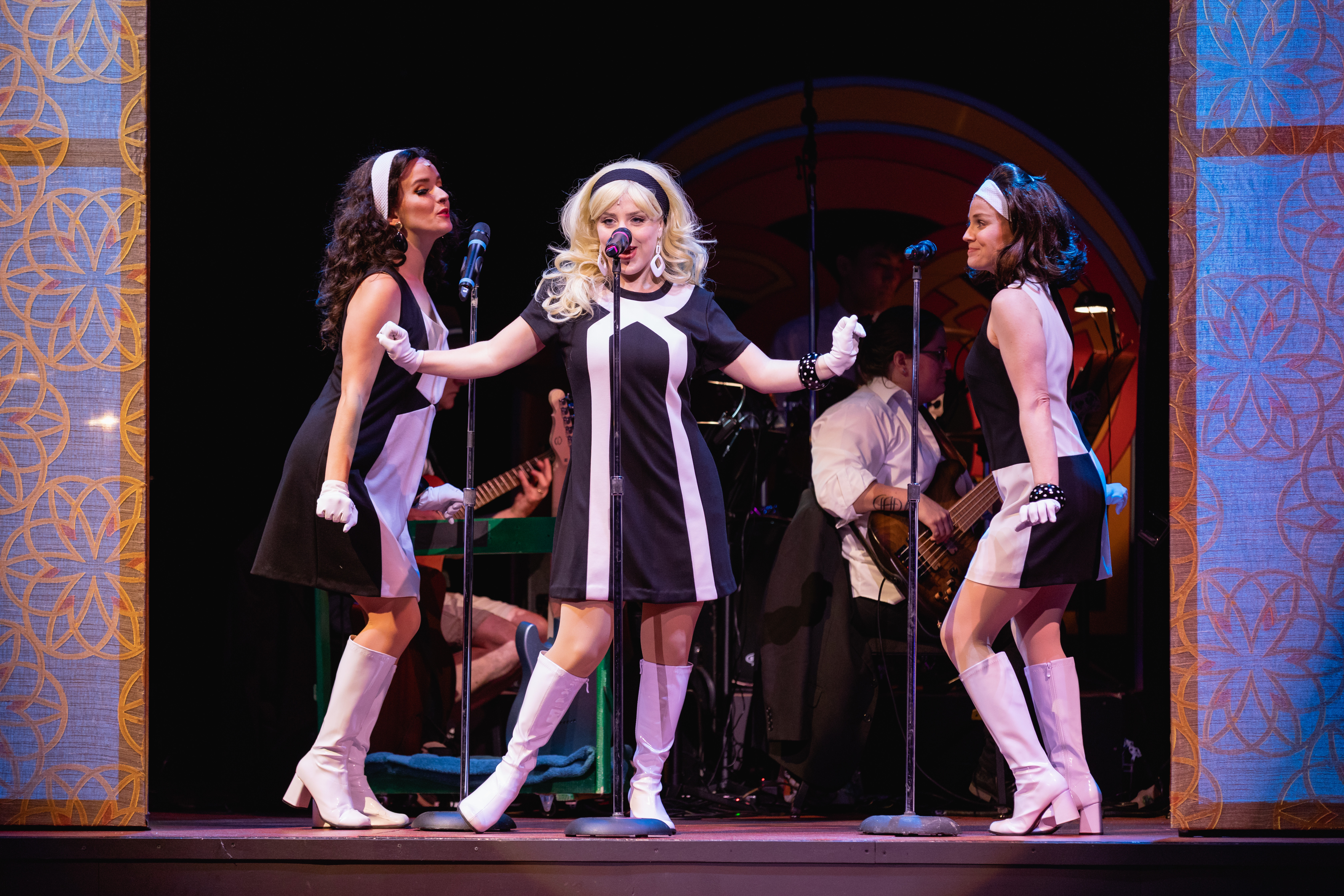
Under the lively direction of Tod Kubo, who also choreographs, Beehive sustains the same high level of artistry and polish that lifted Jekyll & Hyde earlier in the CP Summer season. With wig designs from Barbi Van Schaick, hair reached heights you have to expect from Beehive. Costume designers Bob Croghan and Jennifer O’Kelly, held oddly in check at the outset, break free flamboyantly after intermission, especially when Tina and Janis strut the stage.

Beehive Dress Rehearsal; July 4th, 2019

Defying the Halton’s spacious stage, O’Neill’s scenic design strives to simulate a nightclub feel. Conspiring in the scheme, music director Amy Boger Morris and her band camp upstage, often in plain view and often under a funky “Beehive” logo that helps to fill in the vast expanse of drapery above them.

My apologies if you have not realized that Beehive is an all-woman show, sort of the partner to the all-male Forever Plaid, another jukebox revue that never made it to Broadway. The basic difference between the two, besides gender, is that Beehive has lost all pretenses of sporting a plot. Iris DeWitt as Wanda serves intermittently as our emcee, and the only discernable reason why the other women have character names is so they don’t have to look beyond the script when they introduce themselves in “The Name Game” as Pattie, Alison, Laura, Jasmine, and Gina.

They also go out into the audience and pick out more people to play. Got me on Saturday night! Sorry, no photos or recordings were allowed.

DeWitt, who was quite the authority figure in a 2016 production of Pride and Prejudice at CP, turns out to be a powerful vocalist as well, particularly in “Natural Woman,” her segment in the Aretha trilogy. Caryn Crye is no less revelatory as Laura, since I’ve only seen her in dramas before, most memorably at Theatre Charlotte as Mina Harker in Dracula and as Goody Proctor in The Crucible at CP. She’s stretched a little too far in her Janis Joplin trilogy in “Try (Just a Little Bit Harder),” but her “Me and Bobby McGee” – when she sheds her Pearl fur coat and lounges in her Woodstock gladrags – is a definite highlight.

Beehive Dress Rehearsal; July 4th, 2019

Making her Charlotte debut as Alison, Grace Bell doesn’t get much of a taste of Act 2, but she’s definitely a highlight in the early action, singing The Angels’ “My Boyfriend’s Back” and bringing more to Kubo’s choreography than anyone. Bell’s one spotlight after intermission is a dazzler as she shares the stage with Ava Smith on Jeff Airplane’s “Somebody to Love.” If you’ve seen Smith’s high-energy performances at CP as Frenchy in Grease or at Theatre Charlotte as Annette in Saturday Night Fever, expect more of the same now in Beehive, complementing Bell’s Rockstar moves, aggressively engaging with a guy in the front row, and doing a Pattie solo on Dusty Springfield’s “Son of a Preacher Man.” Sadly, she also draws two Lesley Gore clunkers, but that’s showbiz.

After playing second fiddle to Tyler Smith in Ragtime and Show Boat, Brittany Harrington Currie reminds us here that she also appeared in an Andrew Lloyd Webber revue at CP and is quite comfortable in that format. Currie reveals some truly awesome wheels in “Proud Mary” with her Tina Turner vocal and her frenetic moves. Her vocal on The Shirelles’ “Will You Still Love Me Tomorrow” is a bright spot before we descend into Connie Francis, and her “Never Loved a Man (The Way I Loved You)” keeps the Aretha heat smoldering.

Beehive Dress Rehearsal; July 4th, 2019

Coming over to CP after a series of scintillating outings at Children’s Theatre, including Mary Poppins and Three Little Birds, Janeta Jackson flies under the radar for most of the evening, drawing nothing better than The Chiffons’ “One Fine Day” before intermission. We get a better sampling afterwards, when Jackson leads off the Aretha set with “Chain of Fools,” but it wasn’t enough for me.

I could have said the same about the show if it were possible to restore some of the hits that are no longer available with the rights to perform Beehive. Aretha’s “Respect” and “Do Right Woman” from the cast album would top my list of restorations, making it worthwhile to linger longer at Halton Theater, along with Joplin’s “Piece of My Heart” and her “Ball and Chain.” Unerring with their tempos, Morris and her band squeeze more than 30 tunes into the evening. Sometimes that mitigates the irritants, and sometimes that abbreviates the pleasures.