Tag Archives: Anne Lambert

Less Bard and More Beer

Theater Reviews: Every Christmas Story Ever Told (and then some!) and The Great American Trailer Park Christmas Musical

everyxmasstoryphoto2

By Perry Tannenbaum

Four centuries after William Shakespeare’s death, Charlotte’s own Chickspeare inhabits a parallel universe. Or maybe it’s retribution: while all of the Bard’s works were performed by all-male theatre troupes, all of Chickspeare’s productions since 1998 have been “All women! All the time!” as originally promised. The “All Shakespeare” in the middle of that slogan was gradually blurred and dropped as the Chix added Reduced Shakespeare Company lampoons to their rep and then ventured father afield.

Written by Michael Carleton, James FitzGerald, and John K. Alvarez, Every Christmas Story Ever Told (and then some!) is very much in the spirit of Reduced Shakespeare’s original assault on the Elizabethan titan’s complete works. The parentheses in the title, the quickie romp through multiple classics by three actors playing multiple roles, and the devotion of all of Act 2 to a single extravagant lampoon all follow the Reduced template.

But gender only begins to describe the difference between Chickspeare’s version and the 2010 Actor’s Theatre Every Christmas. The new model is as much an event as it is a theatre production, an experience that begins and ends at the newer NoDa Brewery on N. Tryon Street. In between, there are a couple of shuttle bus rides back and forth from the original Brewery location on N. Davidson Street. You’ll find more brew choices on tap at North Tryon, but the enticement of lifting a mug and participating in the many “To beer!” toasts during the Chix performance at North Davidson is hard to resist.

Few did last Friday night. Besides the brewskis, we had Anne Lambert lubricating the experience with a steady feed of Christmas trivia challenges on the bus ride to the show and the conviviality of the Chix banditas – Sheila Snow Proctor, Lane Morris, and Tanya McClellan – during their performance. But mainly, it was the beer that induced the party atmosphere.

Directing the show, Joanna Gerdy and Andrea King had a healthy disregard for the script. The playwrights labored under a handicap that never afflicted the Reduced Shakespeare collaborators when they chose ancient targets like Hamlet, the Bible, and American history for their merry desecrations. Unlike your seasonal carols, most of our familiar Christmas stories aren’t free-range prey. Copyright law prevents satiric assaults upon Rudolph the Red-Nosed Reindeer, the Charlie Brown Christmas, and the Yuletide yarns of Truman Capote, Dylan Thomas, and Jean Sheperd.

When Carleton, FitzGerald, and Alvarez lashed out at these restrictions, the result was “Gustav, the Green-Nosed Rain-Goat,” not the funniest sketch you’ll ever see. Morris never plays the mutated venison as if it were comedy gold, so there’s never any deadly straining to make it funnier than it is. We’ll raise a glass, and then we’ll move on.

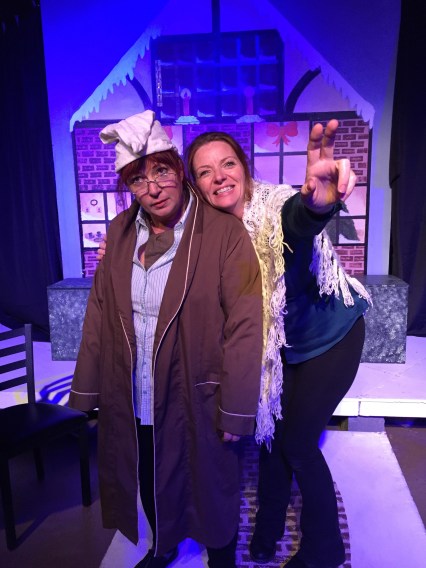
The premise of the show is that Proctor wishes to proceed traditionally with a presentation of Dickens’ A Christmas Carol, but Morris and McClellan are sick and tired of the same old stuff. Before they’ll allow Snow to read her Dickens and play her Scrooge, she must join them in a medley of other Christmas faves, including Frosty the Snowman, Macy’s Thanksgiving Parade, the Grinch, O’Henry’s “The Gift of the Magi,” and – maybe if there’s enough time – the inevitable It’s a Wonderful Life.
scrooge-and-mary2

There isn’t enough time, but that doesn’t deter Morris. While Proctor is on-task as Scrooge, with McClellan visiting her as all three ghosts, Morris keeps insisting that Proctor is George Bailey, inflicting on us a bevy of characters from New Bedford Falls, including George’s guardian angel, his brother, his banker nemesis, and his adoring wife. By the time Lane reaches the wife, it comes off oddly like a female impersonation.

Fortunately, Proctor is the ideal Scrooge in the face of these torments. There’s a bit of Oliver Hardy and Bud Abbott in her forbearance, but we somehow remain on her side throughout her ordeal. At the climax of Christmas Carol, Morris is still bedeviling her, so she finally submits to becoming George Bailey – in a schizophrenic frenzy that finds her shuttling between Scrooge and Bailey as both McClellan and Morris assail her.

In her surrender, Proctor produces a Jimmy Stewart impersonation that’s barely good enough to let you know what she’s doing. It will probably improve during the next couple of weekends as the run continues, but I’m not sure it should. Likewise, Proctor can be a mite slow changing costumes, but McClellan’s patience with her cast mate is so priceless, it would hardly pay for Proctor to hurry.

It’s been a rocky road for Actor’s Theatre of Charlotte since developers forced them out of their longtime home on Stonewall Street last summer. We thought they would resurface on Louise Avenue, but negotiations there collapsed, and the company tacked toward Freedom Drive. City and county paperwork delayed the opening, so their Toxic Avenger was redirected to a nearby church, and the current Great American Trailer Park Christmas Musical has been rerouted to the Patricia McBride and Jean-Pierre Bonnefoux Center for Dance, Charlotte Ballet’s HQ on N. Tryon Street.

I was curious to see how director Chip Decker and his design team would adapt to studios with so much space and such a high ceiling. With two fair-sized ramshackle trailers, topped by two jumbo projection screens, height isn’t a problem, and the design team fills out the stage with a fence, some Florida flamingo kitsch, an incongruous array of Star Wars memorabilia and, dead center of the stage between the two trailers, a half-decorated Christmas tree.

That odd tree, straddling the borderline between Rufus and Darleen’s properties, triggers Betsy Kelso’s plotline. Rufus loves Christmas and adores Darleen, but mean Darleen snarls “Bah” and “Humbug” to both. She will not decorate her trailer or even allow Rufus onto her property to decorate her side of the tree. That’s a source of huge consternation to Betty, the manager of Armadillo Acres, who has always wanted – but failed – to win the big prize awarded to the best-decorated trailer park. A vague curse plagues Armadillo Acres, and it too will to be exorcised before we reach a happy ending.

There’s a certain amount of respectability in Betty, so we’re fortunate that it is more than counterbalanced by the trashiness of her other tenants, Pickles and Lin (short for Linoleum). They also come in handy when ghosts are needed to populate Darleen’s Dickensian dream sequence. Rufus’s romantic fantasies and Betty’s hopes of nabbing top kitsch honors are revived when Darleen, in an effort to pull the plug on the park’s Christmas lights, gets electrocuted by Rufus’s déclassé cable-splitter and wakens with amnesia. That enables her to forget what a Scrooge she is and the fact that she belongs to Jackie, owner of a slutty pancake joint.

If you missed the first and second comings of this trashy romp, it’s good for you to know all the basics I’ve detailed. Although Actor’s Theatre has done well with the Charlotte Ballet space, they have thoroughly failed to conquer its acoustics. So the songs and lyrics by David Nehls are more crucial to your enjoyment than usual – but often unintelligible over the four-piece band led by music director Brad Fugate.

Tommy Foster isn’t as rednecky as Ryan Stamey was as Rufus, but he’s a tad more pathetic and lovable. Karen Christensen is more than sufficiently bitchy as Darleen, and we often forget that Matt Kenyon is in drag as Lin. (So does he, I suspect.) But Jon Parker Douglas nearly steals the show as Jackie when he is possessed during the climactic exorcism. It’s an epileptic farting fantasia that isn’t quickly forgotten – and the kind of broad physical comedy this acoustically-challenged show desperately needs.


The Nerd Who Terrorized New Jersey

toxic-press-5

Theater Reviews:  The Toxic Avenger and Pride and Prejudice

By Perry Tannenbaum

I’m not sure how or when such epithets as “Armpit of the East” or “Scrotum of the Nation” rained down on New Jersey, but they were certainly commonplace before the onset of The Sopranos or Chris Christie. It’s also clear that when Lloyd Kaufman and Joe Ritter cooked up their 1984 screenplay for The Toxic Avenger, they weren’t intending to prettify the Garden State’s battered image. About the only love they showed for Jersey was shooting the film there.

A mere 24 years elapsed before Joe DiPietro and Bon Jovi keyboardist David Bryan, following their successful collaboration on Memphis, hooked up on a Toxic musical adaptation. The record-breaking reception of the show in New Brunswick, before its off-Broadway transfer in 2009, only underscored how highly Jerseyites cherish their notoriety.

DiPietro liberally refashions Kaufman’s original plot, but political corruption, organized crime, unconscionable pollution, and unchecked violence are still among its hallmarks. Actor’s Theatre of Charlotte, newly resurrected on Freedom Drive after its recent homelessness, embraces all of these horrors with the merry glee it applied to Evil Dead The Musical seven years ago. Billy Ensley directed that 2009 gorefest on Stonewall Street, but ATC artistic director Chip Decker takes the reins here, reminding us that crass sci-fi musical parodies are at the core of this company’s DNA.

toxic-press-1

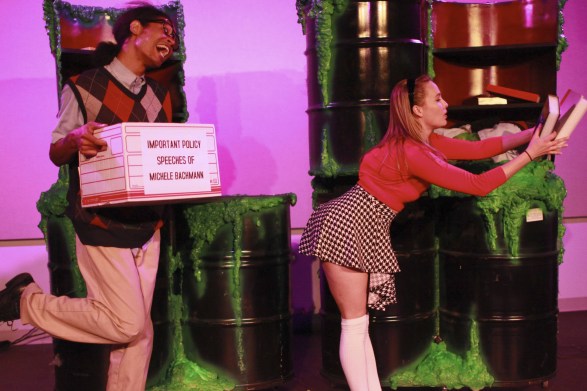
Journeying from screen to stage, Melvin Ferd the Third has lost his signature janitorial mop, but he’s still a hopeless nerd and still smitten by the blind Sarah, who is now a librarian. The new Melvin is an environmental crusader from the get-go, and his plunge into an oozing drum of green toxic goo is far more malignant, ordered by corrupt Tromaville mayor Babs Belgoody. Where does Melvin find the goods on Mayor Belgoody’s polluting schemes? At the library, of course, cleverly filed away by Sarah where they are least likely to be found: among the important policy speeches of Michele Bachmann.

toxic-press-7

Something underhanded seems to have occurred here, since Bachmann didn’t achieve her peak infamy until the 2012 election cycle. Suspicion falls on the prankish Decker, who compounds his violations of DiPietro’s script by introducing the image of Donald Trump later in the evening. Hopefully, that glorified groper will be forgotten by the time the Avenger concludes his rampages on November 12.

Yes, if you didn’t already know, what doesn’t kill Melvin makes him Toxie, the avenging mutant monster. This is exactly where Actor’s Theatre upstages the off-Broadway production once again. In 2009, Ensley simply had the luxury of a better pool of actors to choose from for Evil Dead. This year, Decker enjoys no luxuries whatsoever. ATC and City Hall couldn’t dot all the i’s on permits for the new location at 2219 Freedom Drive in time for opening night last Wednesday, so Decker & Co. were obliged to move next door to Center City Church & The Movement Center at 2225 Freedom.

toxic-press-3

On very short notice. So the set designer is listed as Dire Circumstance in the playbill while other members of the design team have vanished altogether. Whether by accident or design, then, Decker doesn’t make the mistake that plagued the off-Broadway show: overproduction. In the New York version, when Melvin emerged from the chemical dumpsite as Toxie, the green carbuncled mask that covered his head was not only horrific, it robbed actor Nick Cordero of all further facial expression.

Jeremy DeCarlos doesn’t have to combat that handicap. As cool, graceful, and intelligent as DeCarlos has always seemed onstage, I expected both the nerdy Melvin and the homicidal Toxie to be difficult stretches for him. Clearly, I had no idea how well DeCarlos could channel the dopey sound and body language of Jerry Lewis as the socially inept earth scientist. When he emerged from the flimsy façade of chemical drums as Toxie, there were some wrappings on his arms to offer a semblance of might, but it was Decker at the soundboard who offered the more telling boost, amping up DeCarlos’ voice and synthesizing his monster roar.

No, the wrappings and the roars don’t close the gap between DeCarlos and fearsomeness – but that’s another reason why his Toxie is so much more hilarious than the more technically polished off-Broadway version, which often forgot it was a spoof. Leslie Giles certainly isn’t forgetting her spoofery as Sarah, helpless ingénue or aggressive vamp as the occasion demands – and her blind stick shtick with the hapless Melvin is a corny gift that keeps on giving. Sarah’s big number, “My Big French Boyfriend,” struck me as the best in the show.

toxic-press-4

Lisa Hugo, who was so precisely calibrated in the complex leading role of Stage Kiss earlier this year, the last ATC production at Stonewall Street, gets to loosen up in multiple roles. When she isn’t the melodramatic, megalomaniacal Mayor, she’s usually Melvin’s disapproving Mom. These two nasty women turn out to be old enemies from their school days, so their “Bitch/Slut/Liar/Whore” confrontation deep in Act 2 was a manic reminder of a similar duet in the Jekyll & Hyde musical. Ma Ferd also gets an effective “All Men Are Freaks” duet with Sarah.

Ryan Stamey and Dominique Atwater divvy up nearly all the remaining roles, more than I could keep track of, with Matthew Blake Johnson subbing for Atwater on opening night. Somebody needs to terrorize Sarah, toss Melvin into the toxic goo, get their asses kicked by Toxie, scurry around with missing limbs, and represent the hordes of Tromavillians who idolize the grotesque mutant. Stamey and Johnson performed every one of these worthy missions, and more, with the suave sophistication you would expect.

Yes, the middle school auditorium atmospherics of the Movement Center hall are somewhat against the grain of the gorey Toxic Avenger irreverence, but it served better than expected for what turns out to be a unique guerilla theatre project. If you arrive early for one of the remaining performances, you might get a brief tour of the new ATC space next door. What’s going on now on Freedom Drive bodes well for the company and the resourceful artists who make it go.

14657273_1592031430816445_6330787092415780744_n

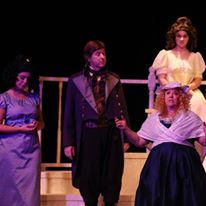
Jon Jory is best known as the artistic director who brought renown to the Humana Festival and the Actor’s Theatre of Louisville – and widely believed to have penned Keely and Du, Flaming Guns of the Purple Sage, and Anton in Show Business under the penname of Jane Martin. When it comes to adapting Jane Austen, whose Pride and Prejudice is currently on view at Pease Auditorium in a CPCC Theatre production, Jory is no dilettante. He has also adapted Sense and Sensibility and Emma.

Even if all the subtleties aren’t always pointed under Heather Wilson-Bowlby’s poised direction, it becomes obvious that Jory’s adaptation preserves the style and thrust of Austen’s liveliest masterwork. Most of the credit goes to Moriah Thomason as Austen’s prejudging heroine, Elizabeth Bennet, though it’s hard to deny she is amply counterbalanced by the hauteur of Brian Logsdon as Fitzwilliam Darcy. Thomason unveiled her elegance in the ATC production of Stick Fly back in February. Here she adds vivacity and wit, so I couldn’t get enough of her.

14639612_1592031587483096_6752582616922785572_n

We see where Elizabeth gets her wit from in Tony Wright’s slightly jaundiced portrait of her father, and Anne Lambert’s rendition of Mrs. Bennet has more than enough vanity, giddiness, and silliness to distribute among the younger Bennet sibs. My chief disappointment was the hoarseness that afflicted Lexie Simerly as Liz’s elder sister Jane. If only she could have borrowed some extra decibels from Iris DeWitt, whose towering presence made the imperious Lady Catherine De Bourgh a perfect victim of Elizabeth’s punctiliously polite sass.

Technical Difficulties Nearly Capsize “Singin’ in the Rain”

singin

By Perry Tannenbaum

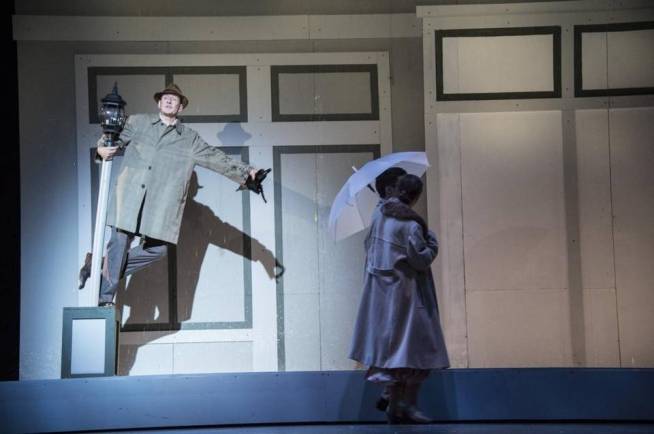
Few musicals are more spectacular on stage than Singin’ in the Rain, adapted by Betty Comden and Adolph Green from their celebrated screenplay. People remember the title tune and Gene Kelly’s carefree rain-drenched spin around a lamppost, but there are other notable songs in the score by Nacio Herb Brown and Arthur Freed, including “You Stepped Out of a Dream,” “All I Do Is Dream of You,” “Make’Em Laugh,” and “Good Mornin’.” While there’s little that’s unpredictable in the storyline, Comden and Green add plenty of comedy to the abundant tapping and hoofing.

Central Piedmont Community College Summer Theatre had a marvelous hit with the show in 2001, but there are understandable reasons why it hasn’t been reprised in the Metrolina area for the past 15 years. To make a splash with Singin’ in the Rain, a company needs to find three triple threats to play the three leads and an accomplished comedienne to play squeaky-voiced villainess Lina Lamont. Above all, you have to make it rain at the end of Act I and restart with a dry stage after intermission, Herculean plumbing and drainage challenges. You have to applaud Davidson Community Players for tackling these difficulties at Duke Family Performance Hall, but in the proud history of this company, Singin’ in the Rain is destined to become legendary for its technical shortcomings.

Lina is the beauteous co-star of the dashing Don Lockwood in numerous silent screen romances, not at all shy about feeding the Hollywood gossip mill with rumors that she and Don are soon to be wed, reigning happily afterwards as king and queen of Tinseltown. Just two things wrong with Lina’s reveries: Don despises Lina and Warner Brothers is about to release The Jazz Singer. While “The Royal Rascal” is a box office hit for Lockwood and Lamont, movie producer R.F. Simpson realizes that footage already shot for “The Dueling Cavalier” is likely to be stillborn because talkies have triumphed so suddenly and decisively. Lina’s voice is so unromantic that Simpson already contrives to make sure she does not speak in public at Hollywood openings.

Don and his old vaudeville sidekick Cosmo Brown cook up a technical stratagem. They will overdub Lina’s toxic voice with a pleasant one. What’s more, Cosmo, a skilled composer, will help turn the whole shebang into a musical, “The Dancing Cavalier.” After the “Royal Rascal” premiere, Don has met and fallen madly in love with aspiring actress Kathy Selden, a triple threat who can supply all the dubbing and body doubling the studio needs. All they have to do is keep the wildly jealous Lina from finding out before the movie is released.

singin laugh

Though they aren’t exactly youngsters, Dan Brunson and Matt Merrell make an admirable vaudeville team as Don and Cosmo. Brunson’s fortes are singing and acting, so Don’s songs and his romancing and his comedy all come off well, but he’s only passable as a dancer. It’s almost fortunate that so much went awry on opening night to draw my attention away from Brunson’s mediocre dancing. While Brunson was unquestionably wet by the end of his grand “Singin’ in the Rain” solo, there had been no detectable waterworks or rain. The iconic lamppost was so unstable that I was actually relieved that he didn’t attempt to take a spin on it. Brunson actually took a spill during his epic solo – or did he? He was so professional covering up, executing a couple of comical swimming strokes while he was splayed out on the floor.

Disaster seemed even more imminent in the preceding “Good Mornin'” trio with Cosmo and Kathy. Choreographer Kathy Mullis has them doing a complex routine with a pair of adjoining stairs in the background and a sofa, which the trio is supposed to flop over and/or topple at the end. None of these pieces of furniture was securely braked after they had been rolled onstage. It was something of a victory when Brunson, Merrell, and Emily Klingman, playing Kathy, didn’t break a limb during this hazardous scene. The comedy of technical errors actually beset Brunson earlier, when the tear in Lockwood’s tear-away tux sleeve became prematurely visible during “You Stepped out of a Dream.”

Merrell has performed almost exclusively in DCP comedies over the years, so it was surprising to find how adept – and athletic – he is as a dancer. His slapstick athleticism on his solo showcase, “Make ‘Em Laugh,” drew roars from the audience, and his tap duo with Brunson on the “Moses Supposes” novelty was also a sensation, though both men appeared winded (and out of sync) as their routine was ending. As the comical sidekick, Merrell could afford to show this weariness without really breaking character. Less experienced than the leading men, Della Knowles as Lina could have used more feedback from director Sylvia Schnople while Emily Klingman as Kathy could have benefited from more encouragement. Knowles altered her voice so radically as Lina that she was mostly unintelligible until deep into Act II, but Klingman’s low-energy performance was perhaps more puzzling. She never seemed to grasp the elemental idea that Kathy was worthier of stardom than Lina.

Technical difficulties that plagued the opening performance certainly disfigured some of the choreography that Mullis brought to this production, but the merits of her work are inescapable, especially in the big ensembles – which have become a tapping DCP trademark. Costumes by John David Brown III, Andy Lominac, and David Townsend surround Brunson and Merrell with a rainbow of color in their final “Broadway Melody” duet, and with Anne Lambert as gossip empress Dora Bailey and Jim Esposito as studio chieftain Simpson, non-singing support is unexpectedly strong.

Ultimately, the sloppiness of this opening night effort nearly sank it. Most of that sloppiness is fixable if tech director Tim Beany, stage manager Lydia Taylor, and the stage crew will start sweating the small details – and Schnople demands more excellence. Knowles struggled to put on her peignoir because it wasn’t laid out properly on her divan, drawing unintended hoots from the audience that could have been prevented. Clips of silent films projected over the stage were clearly videos converted into black and white. Software exists that will distress and vignette video to look like film, but even that wouldn’t help the moribund silent film acting. It must be grand opera, not bland soap opera!

Keller Keeps Tugging at Our Emotions

Theatre Reviews: The Miracle Worker and I’ll Eat You LastMiracle Worker

By Perry Tannenbaum

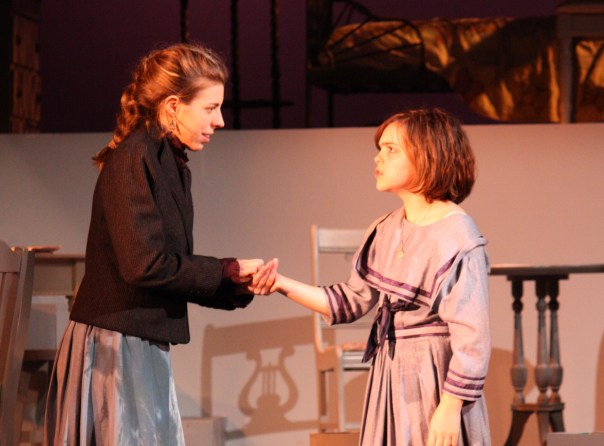
With most dramas, I find that successive productions I review tend to exert less of a powerful tug on my emotions each time I see the same drama again. Yet I’ve found quite the opposite to be true of The Miracle Worker, William Gibson’s 1960 Tony Award winner for Best Play, the chronicle of young Annie Sullivan’s diligent efforts – on her first paying job and her first plunge into the Deep South – to reach the deaf-and-blind Helen Keller and teach her the concept of language.

Last time I covered The Miracle Worker at CPCC in 2008, I found myself choking back sobs when I merely saw the furshlugginer water pump at the start of Act 2. So I was grateful, in a way, to see the pump already in place downstage when I ambled toward my seat for the current production at Theatre Charlotte. Gillian Albinski’s set design, a rather bland thing compared to some of the artistry I’ve seen at the Queens Road barn, seemed to be building up my immunity.

I was mistaken, for it isn’t until intermission that they set up the little guesthouse where Annie is allowed to have exclusive care of Helen for two weeks, during which time she must repair their relationship, tame the child’s wildness, and give her the keys to communication. Just seeing the contours of that secluded place brought on a surge of emotions that I fought to hold in check.

When you think of it, The Miracle Worker is rather unique in establishing powerful associations with each of its different locales at the Kellers’. There’s the upstairs bedroom where Annie must be rescued by ladder because she allows Helen to outsmart her and lock her in during their first encounter. Nor do we forget the dining room, scene of two epic battles between Helen and Annie – and the place where James finally stands up to his imperious father, Captain Keller.

Okay, so the production levels don’t rival the notorious 2003 Charlotte Rep production that was envisioned as a launching pad for Hilary Swank’s Broadway debut. (Never happened, the producers’ verdict on what we saw.) But the gulf between those Broadway-bound costumes and those by Luci Wilson isn’t ridiculously wide at all, and while Theatre Charlotte’s Helen wasn’t victorious in any nationwide search, I think you’ll find Emily Bowers quite extraordinary.

There is never a sense that director Paige Johnston Thomas is trying to replicate the iconic 1962 film, which brought fresh awards to Anne Bancroft and Patty Duke, the original Broadway stars. Quite the contrary: Thomas makes it easier for Sarah Woldum in her Charlotte debut as Annie Sullivan by allowing her to drop the Irish accent that plagued Swank, and Alex Duckworth – notwithstanding his syrupy drawl – may be the least youthful James that I’ve seen.

Throughout the evening, beginning when Kate Keller discovers her daughter’s disabilities upstairs in the nursery, lighting designer Chris Timmons and music composer Grover Smith make telling contributions. Caylyn Temple as Kate and Philip Robertson as Captain Keller do a beautiful job of setting up the dignified family tone. While it’s customary for the Captain to show a lack of love for his daughter – he’s taken aback when Annie calls him on it – Robertson seems to want to love Helen more than any father I’ve seen. Besides the crippling excess of motherly indulgence, Temple partners well with Duckworth in the somewhat awkward relationship between Kate and her stepson.

Woldum is certainly a more youthful Annie than Swank was, more youthful than Joanna Gerdy was when Theatre Charlotte last presented Miracle Worker in 1997. That is the dimension I most love about this production. Sullivan’s age – she’s merely 20 – is arguably what makes her most unfit for the challenge she’s undertaking. Not only can we see Annie’s youth peeping through here, we can perceive how it becomes a double asset when the challenge is engaged.

It’s a matter of sheer physical vitality when Annie confronts Helen’s unruliness in the dinner table scenes and at the guesthouse, but it’s also a matter of empathy. I’m not a big fan of the flashback interludes, when Annie recalls her younger brother’s death, but I’m more reconciled to them in this production, and Timmons delineates them well with his lighting.

Charles Holmes gets credit for the fine fight choreography when the action heats up and the spoons begin to fly, but it’s Bowers’ lack of inhibition that makes it all work. There’s always enough luminosity in her blankest expressions for us to believe in her openness, and when she’s finally sitting quietly and eating at the guesthouse, I found a tinge of pride amid Helen’s exhausted submission.

Maybe the reason I find The Miracle Worker so compelling after all these years is the fact that it becomes less dated with the passage of time. The more I’ve learned about child development and the acquisition of language, the more spot-on Annie’s observations on these subjects have become. One time, the water pump gets to me; the next time, the guest cottage floors me. I wouldn’t be surprised if I’m fighting back tears the next time I see Sullivan lifting the stupid egg. I can only envy those of you who may be just beginning your journeys with this rich drama. It has surprising, rewarding depths.

Anne Lambert as Sue Mengers 3 Feb 2016

An elaborate sofa and its many pillows becomes a luxuriant throne when the star of I’ll Eat You Last: A Chat With Sue Mengers appears to graciously grant us an audience at UpStage in NoDa. Born into a Jewish family in Hamburg, Mengers tells us how her family fled Nazi Germany in 1938 and wound up in Utica, New York – not the most likely beginnings for a woman who would become a Hollywood superagent, whose clientele included Faye Dunaway, Candice Bergen, Michael Caine, Burt Reynolds, Cybill Shepherd, and – preeminently – Barbra Streisand.

John Logan’s one-woman script memorialized Mengers on Broadway, in a production starring Bette Midler, less than two years after her death in 2011. Anne Lambert is the leading lady here in a performance that was shaped in a three-weekend run up in Cornelius before settling into NoDa last weekend and continuing through Sunday. It’s obvious that Mengers considers herself royalty, for she favors us with her rules on throwing a party and succeeding as an agent.

There’s a phone by her right arm that she hopes will ring so that she might heal a troublesome rift with La Barbra. Meanwhile, before we arrive at those circumstances, Mengers dishes on her struggles with Sissy Spacek, Ali McGraw, and Steve McQueen. Landing the Oscar-winning role of Popeye Doyle for Gene Hackman in The French Connection is clearly her ultimate triumph, and Lambert can tell it in spellbinding detail.

Problems only creep into this performance with the chronic buzzing of the electronics – the lights, I’m guessing – compounded by Lambert’s tendency to swallow the ends of punch lines she’s tossing off. Otherwise, she bridges the moments of tension and relaxation well, calling upon an audience member to fetch her a jewelry box stocked with joints and a refill from the bar. There are moments when she could stand to be meaner and more arrogant while she’s getting high, but that’s showbiz.